36.1 C
Bangkok
Saturday, June 27, 2026
Home Blog Page 2160

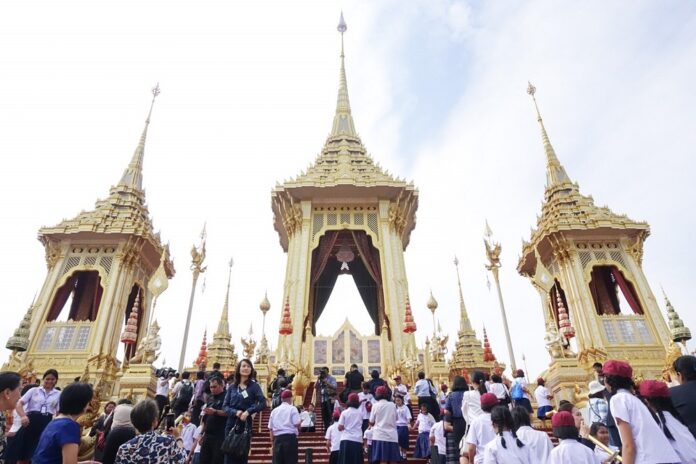
Royal Crematorium to Open Until Dec. 31

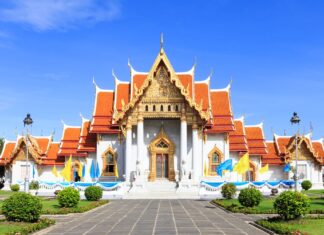
Update Nov. 29: The royal crematorium is extended to open until Dec. 31, the cabinet announced on Wednesday. 

BANGKOK — The royal crematorium exhibit may be open to the public longer than planned.

On Tuesday, Gen. Prayuth Chan-ocha said his cabinet was considering extending the exhibition since visitors are still packing into the site every day since it opened at the beginning of this month following the cremation of King Bhumibol.

Gen. Prayuth said it sent a positive message to the world.

“People take beautiful photos with the crematorium and foreigners all over the world see it. They think, ‘The funeral is over, why are so many people still at the crematorium?’” Prayuth said. “It shows our love, faith and confidence in the monarchy, which is a good thing.”

The general also said that during his foreign travels, foreigners praised his country’s history and art.

“Whether it’s the UN Secretary General or Donald Trump, they say Thailand is beautiful and has nice people, even if they have never been here. But they’ve seen footage on TV, so they view our country in a good light.”

The royal crematorium exhibition opened on Nov. 1 to visitors, days after the late king was cremated in spectacular rites observed nationwide.

The public was subsequently banned from ascending to the structure’s upper levels the next day.

The crematorium was to be dismantled at the end of November, as tradition considers it a bad omen to leave it standing in the city center for long. So far, more than 1.4 million people have reportedly visited the structure, where an exhibition and murals about King Rama IX have been erected.

Related stories:

Royal Crematorium Interior Closes to Visitors

Take a Tour Around the Royal Crematorium (Photos)

Finished: Royal Crematorium 100% Complete (Photos)

Advertisement

More Seatless Subway Cars Coming: MRT

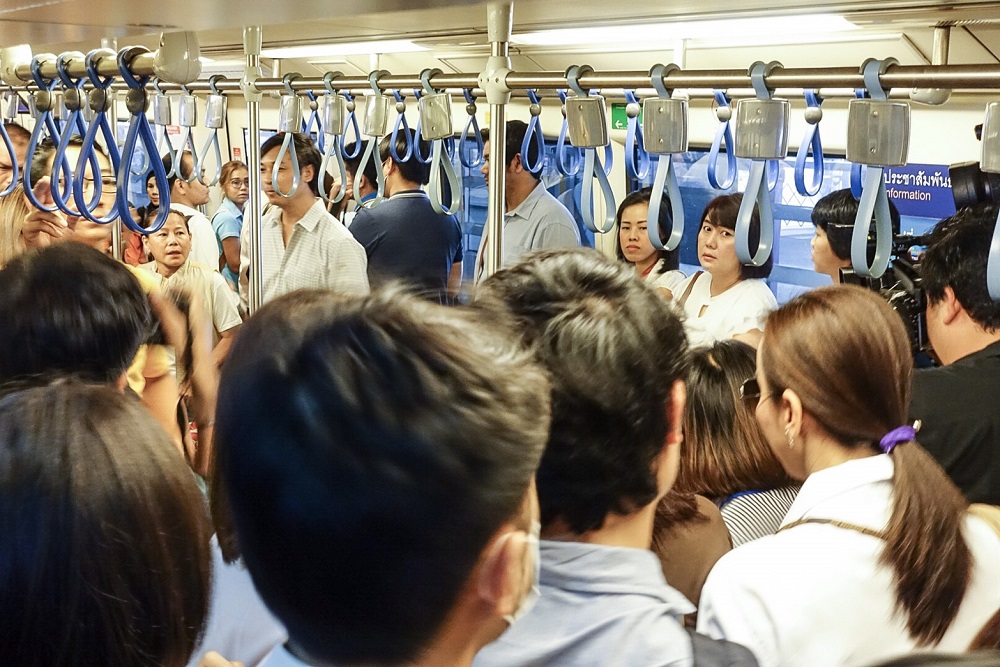
MRT commuters inside a new train that seats were replaced with straps at Tao Poon Station on Thursday morning

BANGKOK — During the Thursday morning crunch, commuters streamed into a train at MRT Tao Poon to find three compartments no longer had seats.

Defending the plan after the unannounced pilot program met a frosty reception this week, officials insisted this morning that the new experiment – replacing 14 seats with 32 more straps in the middle of each compartment – means an additional 10 percent passenger capacity.

Read: Bangkok Subway Removes Seats to Save Space

That means carrying 990 passengers instead of 900, according to Ronnachit Yaemsaard of the Mass Rapid Transit Authority.

The seat removal met a hostile reception from the public Monday, when it was piloted on a single train on the MRT Blue Line subway. Angry commuters protested the plan the system operator has presented as a stop-gap measure until it puts additional trains into service.

“I had a long day today and I only wished to sit in the MRT train. I was first in line, but it appeared the compartment I was on was the one that had its seats removed. Damn it,” @waralee tweeted.

Good governance activist attorney Srisuwan Janya filed a complaint Tuesday alleging the Bangkok Expressway and Metro exploited consumers by not investing in purchasing more trains.

If the plan is approved, seats will be removed from every train by the end of the year, said Sombat Kitjalaksana. managing director of the Bangkok Expressway and Bangkok Metro.

The MRT Blue Line’s 19 trains will be supplemented by an additional 35 trains, Sombat said, which have been ordered and will be rolled out starting in late 2018.

Not all were opposed to the idea. A number of people said the change would add more space and offer more options for commuters.

“[I] like the new MRT. It can fit more people. They only removed the seats in the middle. There are still seats in other areas,” @Natfanjbnaja tweeted.

https://twitter.com/natfanjbnaja/status/933518251396497408

Sombat said the model is common around the world on rail services in places such as Japan and Singapore.

For those who entitled to seats, Ronnachit said the affected carriages will be marked by stickers to inform pregnant women, children, monks and seniors where seats have been removed.

S 6881288

498717


Related stories:

Bangkok Subway Removes Seats to Save Space


Advertisement

UN Envoy: Sexual Attacks Against Rohingya May Be War Crimes

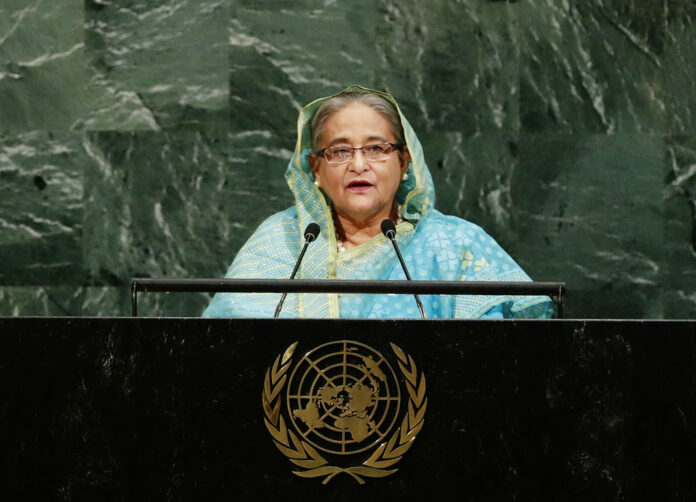
Bangladesh Prime Minister Sheikh Hasina addresses the United Nations General Assembly, Thursday, Sept. 21, 2017, at the U.N. headquarters. Photo: Frank Franklin II / Associated Press

UNITED NATIONS — Widespread atrocities against Rohingya Muslim women and girls have been orchestrated and perpetrated by Myanmar’s military and may amount to war crimes, crimes against humanity and genocide, the U.N. envoy on sexual violence in conflict said Wednesday.

Pramila Patten, who met many Rohingya victims of sexual violence in Bangladesh camps during a visit this month, said she fully endorses the assessment by U.N. human rights chief Zeid Ra’ad Al Hussein that Rohingya have been victims of “ethnic cleansing.”

Patten said at a news conference that the widespread use of sexual violence “was clearly a driver and push factor” for more than 620,000 Rohingya to flee Myanmar. It was “also a calculated tool of terror aimed at the extermination and removal of the Rohingya as a group,” she added.

Myanmar’s government has denied committing any atrocities as has its military. The government refused a request from Patten to visit northern Rakhine state where many Rohingya lived.

Buddhist-majority Myanmar doesn’t recognize the Rohingya as an ethnic group, insisting they are Bengali migrants from Bangladesh living illegally in the country. It has denied them citizenship, leaving them stateless.

The recent spasm of violence began when Rohingya insurgents launched a series of attacks Aug. 25. Myanmar security forces then began a scorched-earth campaign against Rohingya villages that the U.N. and human rights groups have called a campaign of ethnic cleansing.

Patten said that during her visit to camps for the displaced, she heard “the most heartbreaking, most shocking, and horrific accounts of abuses committed cold bloodedly with unparalleled hatred against the Rohingya community.”

Patten, a former member of the U.N. Committee on the Elimination of all Forms of Discrimination Against Women, said sexual violence including gang rape by soldiers, forced public nudity and sexual slavery and it was clearly being used “as a tool of dehumanization and as a form of punishment.”

She said a number of eyewitnesses “reported rapes of the most extreme and brutal nature, which included the tying of women and girls to a rock or tree before being gang raped by multiple soldiers  and many were literally gang-raped to death.”

Some girls who were raped in their houses were left to die when their houses were torched, she added.

Witnesses also said that even before Aug. 25, Myanmar troops would throw Rohingya babies into fires or into village wells to contaminate the water and deprive residents of drinking water, Patten said.

“My observations point to a pattern of widespread atrocities, including sexual violence against Rohingya women and girls who have been systematically targeted on account of their religion and ethnicity,” said Patten, a lawyer from Mauritius.

“And a clear picture has emerged about the alleged perpetrators of these atrocities and their modus operandi,” she said. “The sexual violence has been commanded, orchestrated, and condoned and perpetrated by the armed forces of Myanmar, the Tatmadaw. And other actors involved include the Myanamar border guard police and militia composed of Rakhine Buddhists and other ethnic groups.”

Patten said the U.N. population agency has provided services to 1,644 survivors of various forms of sexual and gender-based violence. “My guess is that this is the tip of the iceberg,” she said.

Patten said she believes “there is a prima facie case for pursuing these atrocities in an international court, especially given that the sexual violence was targeted against the women on the basis of their religion and ethnicity as a form of collective punishment and persecution against the group as a whole.”

“I can also see a basis for characterizing these violations as war crimes, crimes against humanity and acts of genocide, but it is not my role to make that determination,” she said.

Patten said she plans to participate in a Human Rights Council meeting on Myanmar in Geneva on Dec. 5 and hopes to be able to brief the Security Council in New York on sexual violence against Rohingya on Dec. 12.

The council would have to refer Myanmar to the International Criminal Court for the violence against Rohingya to be considered as possible war crimes. That appears highly unlikely as China, an ally of Myanmar, is one of the council’s five powers that can veto any action.

Nonetheless, Patten said she plans to meet with the court’s prosecutor, Fatou Bensouda, next month at U.N. headquarters in.

Story: Edith M. Lederer

Advertisement

UN: Closing Energy Gap Would Help Poorest Countries Develop

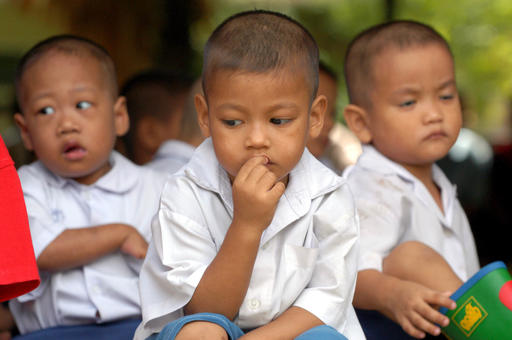
In this Monday, July 12, 2004, file photo, Thai children who are HIV positive and orphaned wait for a function to begin at the Human Development Foundation in Klong Toey slum of Bangkok, Thailand. Photo: David Longstreath / Associated Press

BANGKOK — The world’s least developed countries need access to electricity if they are to break out of poverty, according to a U.N. report that urges wealthy nations to do more to honor their aid commitments to help bridge the energy gap.

The report by the U.N. Conference on Trade and Development says 60 percent of people in the world’s poorest countries, 47 of which meet the U.N.’s standards for being “least developed,” have no access to electricity  some 577 million people in total.

Access to stable supplies of electricity is crucial for helping businesses in developing countries grow.

More than 40 percent of businesses in the countries covered in the report suffer from inadequate, unreliable and unaffordable power, said the report that was released Wednesday. They report an average of 10 power outages a month, each lasting about five hours, that cost them 7 percent of the value of their sales, it said.

“Energy as a source of transformation is one of the key issues of economic development and this is what we are trying to contribute to, specifically for the least developed countries,” Mukhisa Kituyi, secretary-general of UNCTAD, told reporters in Bangkok.

There is a shortfall of USD $1.5 trillion in funding to help meet the goal of universal access to power by 2030, Kituyi said.

The report said it would cost an estimated USD $12 billion to USD $40 billion in annual investment and a more than tripling of the annual rate of gaining access to electricity in those countries.

The countries covered in the report include 33 in Africa, nine in Asia, and five in the South Pacific and Caribbean.

The U.N. is encouraging governments in those countries to adopt policies to attract investors and improve use of their energy resources. Kituyi said it was still difficult for those nations to tap private sources of financing for poverty alleviation.

“The world has come to a point where we say that many solutions to development are best triggered by the private sector,” Kituyi said. “But you cannot say that about the least developed countries. You cannot leave it to the private market to fix Laos and Bangladesh, and Cambodia challenges.”

Renewable energy has the potential to play a revolutionary role in such countries. So far, most of those initiatives have been small scale, and the U.N. is urging that use of such technologies be scaled up to be useful for public utilities.

Story: Kaweewit Kaejinda

Advertisement

US Declares ‘Ethnic Cleansing’ Against Rohingya in Myanmar

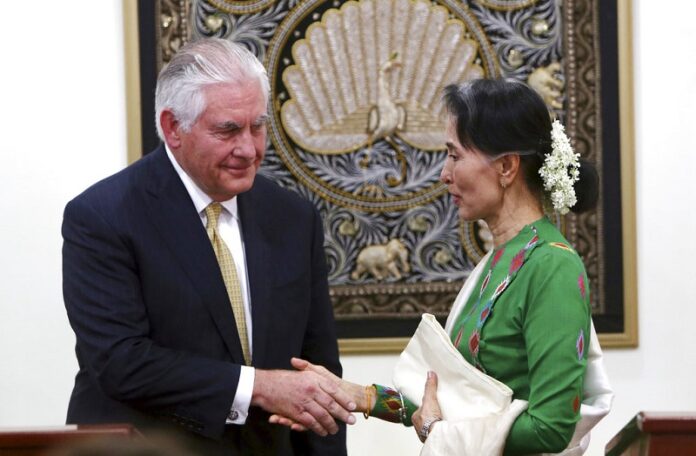
Myanmar's leader Aung San Suu Kyi, right, shakes hands with visiting U.S. Secretary of State Rex Tillerson after their press conference at the Foreign Ministry office Nov. 15 in Naypyitaw, Myanmar. Photo: Aung Shine Oo / Associated Press

WASHINGTON — The United States declared the ongoing violence against Rohingya Muslims in Myanmar to be “ethnic cleansing” on Wednesday, threatening penalties for military officials engaged in a brutal crackdown that has sent more than 600,000 refugees flooding over the border to Bangladesh.

Secretary of State Rex Tillerson blamed Myanmar’s security forces and “local vigilantes” for what he called “intolerable suffering” by the Rohingya. Although the military has accused Rohingya insurgents of triggering the crisis, Tillerson said that “no provocation can justify the horrendous atrocities that have ensued.”

“After a careful and thorough analysis of available facts, it is clear that the situation in northern Rakhine state constitutes ethnic cleansing against the Rohingya,” Tillerson said in a statement.

Although the designation carries no legal obligations for the U.S. to act, Tillerson said those who perpetrated the atrocities “must be held accountable.” He added that the U.S. wanted a full investigation and was considering “targeted sanctions” against those responsible — but not broader sanctions against the nation.

Rohingya from Myanmar’s Rakhine state have been fleeing to neighboring Bangladesh, seeking refuge from what Myanmar’s military has called “clearance operations.” The crisis started in August, when Rohingya insurgents attacked Myanmar security forces, leading to a brutal crackdown in which soldiers and Buddhist mobs have killed men, raped woman and burned homes and property to force the Rohingya to leave.

The declaration followed a lengthy review process by President Donald Trump’s administration to determine whether the violence met the threshold to be considered ethnic cleansing. The United Nations came to that conclusion in September, but the U.S. had held off, with Tillerson saying he needed more information even as he expressed deep concern about the crisis.

Last week, Tillerson traveled to Myanmar in the highest level visit by a U.S. official since Trump took office. U.S. officials dangled the possibility of an “ethnic cleansing” designation ahead of Tillerson’s trip, potentially giving him more leverage as he met with officials in Myanmar. In the capital of Naypitaw, Tillerson met with the country’s civilian leader, Aung San Suu Kyi, as well as Myanmar’s powerful military chief, Min Aung Hlaing, who is in charge of operations in Rakhine state, home to Myanmar’s Rohingya population.

Senior State Department officials said the determination was intended to ramp up pressure on the military and others in Myanmar to resolve the conflict and repatriate refugees who have fled to Bangladesh. Yet it was also likely to intensify calls for the Trump administration and Congress to move toward new sanctions. Earlier this month, a House committee passed a nonbinding resolution condemning “murderous ethnic cleansing and atrocities” and calling on Trump to impose sanctions on those responsible for abuses.

Yet sweeping sanctions targeting Myanmar’s economy or its military as a whole are off the table, officials said, adding that the Trump administration had determined they would not be productive either for ensuring accountability or for promoting broader U.S. goals in Myanmar. Instead, the U.S. is considering sanctions against individuals only, said the officials, who weren’t authorized to comment by name and briefed reporters on a conference call on condition of anonymity.

Broad-based U.S. sanctions on Myanmar were eased under former President Barack Obama as the Southeast Asian nation inched toward democracy. U.S. officials have been concerned that slapping back sanctions or pushing Myanmar’s leaders too hard on the Rohingya violence could undermine the country’s civilian government, led for the last 18 months by Suu Kyi. That could slow or reverse the country’s delicate transition away from decades of harsh military rule and risks pushing Myanmar away from the U.S. and closer to China.

The State Department has also examined whether the violence in Rakhine meets the definitions for crimes against humanity or genocide, but have so far made no such determinations. Both designations carry significant legal consequences.

Ethnic cleansing, on the other hand, isn’t recognized as an independent crime under international law, according to the United Nations Office on Genocide Prevention. The ethnic cleansing term surfaced in the context of the 1990s conflict in the former Yugoslavia, when a U.N. commission defined it as “rendering an area ethnically homogeneous by using force or intimidation to remove persons of given groups from the area.”

Human rights groups accuse the military of a scorched-earth campaign against the Rohinyga, who numbered roughly 1 million in Myanmar before the latest exodus. The Buddhist majority in Myanmar believes they migrated illegally from Bangladesh, but many Rohingya families have lived for generations in Myanmar. In 1982, they were stripped of their citizenship.

Already, the United States has curtailed its ties to Myanmar’s military over the violence. Earlier this year, the U.S. restored restrictions on granting visas to members of Myanmar’s military, and the State Department has deemed units and officers involved in operations in Rakhine state ineligible for U.S. assistance.

Story: Josh Lederman

Advertisement

Army Admits Keeping Dead Cadet’s Organs

Image: Supicha Tanyakan / Facebook

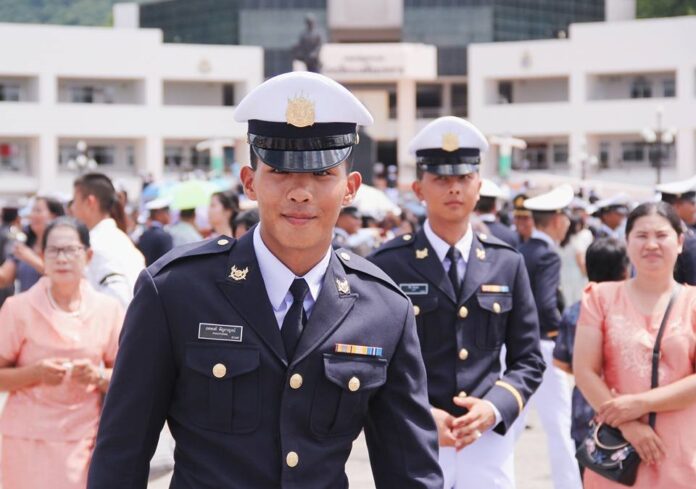
BANGKOK — Forensic officials said Wednesday it was perfectly legal to keep the internal organs of an academy cadet who died under suspicious circumstances without informing his family it had done so.

The military maintain that 19-year-old Pakapong Tanyakan died of natural causes after his family raised suspicions of foul play after discovering his brain, heart, stomach and bladder had been removed prior to the return of his body. Some of his ribs were broken, and his brain had been replaced with wadded tissue paper.

“The evidence so far leans toward abnormal function of the heart,” Col. Narut Thongsorn, a physician at the army-owned Phramongkutklao Hospital, said at a Tuesday news conference. He added that a full inquiry into Pakapong’s October death has not yet concluded.

Narut said his team concluded the bruises and indications of broken ribs weren’t enough to explain Pakapong’s death, so they had cut him open while conducting an autopsy. He decided to freeze the heart, brain and stomach for further inspection, he said.

The colonel said he also took out and cut open Pakapong’s bladder, but found nothing out of the ordinary, so he sewed it up and sent it back to the lab. Narut said he did not know where it ended up.

Pakapong’s family could not be reached for comment Wednesday.

Somn Promaros, director of the Central Institute of Forensic Science, said his agency is cooperating with the military hospital in the ongoing autopsy. He said the three organs will be sent to the institute on Thursday.

“It will take a week for a complete report. It shouldn’t be later than Nov. 30,” Som said. “Or at the latest, it won’t be later than early December.”

Institute spokeswoman Panchai Wohandee said it’s not against the law for doctors to keep such organs without informing Pakapong’s family.

“The collection of tissues and flesh, if it’s beneficial to justice and case procedures, can be done without informing relatives,” Panchai said.

Asked whether doing so is ethical, Som said there’s Thailand has no ethical standards for organ collection. He blamed the controversy on “miscommunication.”

“I understand that the doctors who performed the initial surgery had good intentions,” Som said. “Because this case is important, so they want to store them for close inspection. But there might be a lack of communication with the family.”

‘Don’t Sign Up Then’

The armed forces have a long history of physically abusing recruits and cadets, with occasional deaths resulting. These deaths are rarely explained, and families who seek the truth have been met with silence from the authorities or even prosecution.

In a diary shown to the press by his family, Pakapong said he was subjected to punishment several times in his training, including being punched in the belly. His sister also said in Tuesday’s news conference he once fainted and had to be revived by CPR in August after he was ordered stand on his head as punishment for walking in a wrong way.

Defense minister Prawit Wongsuwan said physical punishment is normal in the military. Even he went through the ordeal when he was the cadet 50 years ago, the general said.

“But I didn’t die,” Prawit said today.

Prawit maintained Pakapong died because of a pre-existing health condition. He said any deaths that take place in military facilities are routinely investigated.

Asked how the military could stop further tragedies resulting from punishment, the defense minister had simple advice: Don’t come.

“Don’t sign up then. Don’t become a soldier. We only want people who are fully willing,” he said.

“So punishment is part of the military?” the reporter pressed.

“Oh yes. Of course,” Prawit said.

Advertisement

Video of Dramatic Defection of N. Korean Soldier Released (Video)

SEOUL, South Korea — It’s 3:11 p.m. on a cold, gray day on the North Korean side of the most heavily armed border in the world, and a lone soldier is racing toward freedom.

His dark olive-green jeep speeds down a straight, tree-lined road, past drab, barren fields and, headlights shining, across the replacement for the Bridge of No Return, which was used for prisoner exchanges during the Korean War. The shock of soldiers watching the jeep rush by is palpable from the video released Wednesday, and no wonder: They’re beginning to realize that one of their comrades is defecting to the South.

They sprint after him.

The jeep slows and turns at a monument to North Korean founder Kim Il Sung, the staging point for North Korean tours of the area.

The border is near, South Korea just beyond it.

Four North Korean soldiers, weapons in their hands, race by the blue huts that straddle the line and are familiar to anyone who has toured the only spot on the border where North and South Korean soldiers face off within spitting distance of each other. There are no tourists this day.

Right at the line that divides North from South, the defector crashes the jeep into a ditch. Seconds pass as he tries in vain to gun the vehicle out of the gully before leaping out and sprinting into the South. He kicks up leaves, ducking below a tree branch just as the North Korean soldiers skid into view.

Muzzles flash. The North Korean soldiers, one of whom drops flat into the leaves, fire at the defector at close range with handguns and AK-47 assault rifles — about 40 rounds, the South says.

Suddenly, two of the North Koreans run away while the soldier in the leaves jumps up and dashes across the dividing line into South Korean territory before stopping, turning on his heels and sprinting back to the northern side after his comrades. The defector falls stretched out and unmoving in a pile of leaves against a small wall on the South Korean side.

The entire sequence, from the first appearance of the jeep to the soldier’s frenzied crossing, lasts four minutes.

It unfolded Nov. 13 in the Joint Security Area, which is overseen by both the American-led U.N. Command and North Korea and lies inside the 4-kilometer-wide Demilitarized Zone that has been the de facto border between the Koreas since the war.

Forty minutes later, the video has switched to infrared to show the heat signatures of two South Korean soldiers as they crawl on their hands and knees, using a wall as cover, toward the prone defector. They grab hold of the defector and drag him to safety. Not far away, heavily armed North Korean troops begin to gather near the Kim Il Sung monument.

For the moment, the border is quiet again.

Surprisingly, North and South Korean soldiers didn’t exchange fire during the shooting, the first in the area in more than three decades. The bullets went in only one direction.
The defection, subsequent surgeries and slow recovery of the soldier have riveted South Korea. But his escape is a huge embarrassment for the North, which claims all defections are the result of rival Seoul kidnapping or enticing North Koreans. Pyongyang has said nothing about the defection so far.

North Korea’s actions during the defector’s escape at the Panmunjom border village violated the armistice agreement ending the Korean War because North Korean soldiers fired across and physically crossed the border in pursuit of the soldier, U.S. Col. Chad Carroll, a spokesman for the U.N. command, told reporters in a live TV briefing Wednesday. A U.N. Command statement said a meeting had been requested with the North’s military to discuss the violations.

After undergoing two surgeries last week to repair internal organ damage and other injuries, the soldier has now regained consciousness and is no longer relying on a breathing machine, according to hospital official Shin Mi-jeong. While his condition is improving, doctors plan to keep him at an intensive care unit for at least several more days to guard against possible infection.

While treating the wounds, surgeons removed dozens of parasites from the soldier’s ruptured small intestine, including presumed roundworms that were as long as 27 centimeters, which may reflect poor nutrition and health in North Korea’s military. The soldier is 1.7 meters tall but weighs just 60 kilograms.

Read: Surgeons Remove Long Worms, Parasites From N. Korean Soldier

About 30,000 North Koreans have fled to South Korea, mostly across the porous border with China, since the end of the 1950-53 Korean War. Now add one more to that tally — a man in uniform, fleeing gunfire toward a new life one overcast afternoon across the world’s most uneasy border.


Advertisement

Ghosts of Christmas to Haunt Bangkok Stage

BANGKOK — Ebenezer Scrooge and Tiny Tim are coming to Bangkok with their timeless tale of greed, regret and redemption.

Adapted from Charles Dickens’ classic novella, “A Christmas Carol” follows stingy businessman Scrooge’s fateful Christmas Eve visitation by his dead business partner and other ghosts in Victorian London.

The Bangkok version is directed by Michael Allman of the Bangkok Community Theatre, the country’s largest and longest running English-language troupe. It will feature six cast members inhabiting the characters from the original story.

The play is in English and is recommended for audience members over 10. Tickets are available online for 800 baht.

“A Christmas Carol” will take place at 7:30pm daily on Dec. 1 & 2, Dec. 8 & 9 (with 2pm matinees on Dec. 2 & 9) at Creative Industries on the second floor of M Theatre. It’s located on Phetchaburi Road and can be reached from Airport Rail Link’s Khlong Tan station.

Advertisement

‘Sap’ Admits to Taking Fall For Hit-and-Run Teacher (Video)

OLYMPUS DIGITAL CAMERA

NAKHON PHANOM — A man who had previously confessed to a hit-and-run fatality to exculpate a teacher told police on Wednesday that he was hired as a scapegoat.

Sap Wapee turned himself in Wednesday morning to Nakhon Phanom provincial police and confessed that he had been paid 400,000 baht to take the fall for Jomsap Saenmuangkot, a retired teacher who served 18 months in jail for the crime.

“I’m willingly turning myself in today. No one is forcing me to. The whole Jomsap case is a lie,”  Sap said to police. “Suriya Nualchaoren, or Kru Ong, said he would give me 400,000 baht to take the fall, but I never got the money.”

Read: Witnesses Accused of Lying to Clear Hit-and-Run Teacher’s Name

Sap’s confession, if true, would be a surprising coda for a drama that erupted 10 months ago when Jomsap garnered an outpouring of public sympathy with her tale of systemic injustice and wrongful imprisonment.

After serving part of a 2013 sentence for killing Lua Pobamrung in 2005 with her truck, Jomsap was freed on a royal pardon and nearly two years later went public with her story and sought to be retroactively exonerated.

While seeking a retrial, allegations began to surface that Suriya Nualcharoen, her former colleague and friend, had arranged to pay several scapegoats to clear her name. On Friday, the Supreme Court threw out Jomsap’s request for a retrial. On Monday, police said seven people, Sap among them, were involved in trying to falsely clear Jomsap’s name.

Sap, along with the six other witnesses face charges of filing a false police report and perjury. Police suspect that Suriya – among the seven accused – organized the hiring of the scapegoats.

Sap said he did not commit the hit-and-run, even though he was promised payment for admitting to the crime. In January, he failed to appear as a key witness at a hearing for Jomsap’s retrial. He contacted Police Col. Kasem Mutaporn Tuesday night, saying that he would turn himself in and give a statement Wednesday morning.

Jomsap’s reversal from object of sympathy to renewed villainy has taken social media by storm, with #TeacherJomsap one of the top trending tweets this morning.

“This #TeacherJomsap case, many people berated the police, the courts and the justice system. Now you’re all speechless,” @Kuuga_Freedom tweeted.

Related stories:

Witnesses Accused of Lying to Clear Hit-and-Run Teacher’s Name

Woman’s Quest for Exoneration Enters Second Day of Trial

Key Witnesses No-Show at Hearing for Teacher’s Retrial

Thai Teacher’s Tale of Injustice Ignites Public Sympathies

Advertisement

Thai Indie Music: The Movie

By Grace Moore

BANGKOK — For years, two major labels have been the kingmakers in Thailand’s music scene, dictating what music is heard and promoting bands with Western appeal.

While GMM Grammy and RS Records continue to dominate, the scene is now diversifying, according to Suchai “Chai” Chucherd, guitarist for Bangkok punk band BrandNew Sunset, with more indie labels launching and building interest in independent music outside the control of the mainstream companies.

This change marks the beginning of a new era for musicians who aspire to make music outside that corporate system, said Kris Pomjairux, cofounder of DIY music promotion company Wildest Youth.

“I think the music industry is changing. You can find independent music and great DIY bands playing shows every night in Bangkok,” Kris said. “Venue owners, bar owners and people in the city see that indie music is popular but we want everyone to be able to see these bands, not just in Bangkok.”

And social media has helped level the playing field and get music heard outside of the capital.

Wildest Youth founders Kris and Supakit “Dew” Supha began organizing and promoting tours for upcoming independent bands outside of Bangkok to bring alternative music to underrepresented communities.

“No one tours these areas,” Supakit said. “It’s important we bring these bands to the north, to Isaan, to crowds that would never get to see them unless they came to Bangkok. It shows people they can do it too.”

Kris and Supakit are an example of the kind of DIY spirit currently fueling the independent music scene in Bangkok. Their aim is to bring music to towns around the nation where bands normally wouldn’t tour; bands play smaller shows packed with loyal fans and expose kids outside of Bangkok to a new Thai sound, they said.

Wildest Youth’s first tour in spring 2017 took three popular Bangkok hardcore and punk bands to venues throughout the northeastern provinces that comprise Isaan. Crammed into a tour bus for four music-filled days, the bands – Pistol’s 99, Degaruda and BrandNew Sunset – talked of their hopes of reaching Thailand’s youth and inspiring a generation of musicians with something other than top 40 or major label music.

Four months on, the duo is teaming up again getting ready to announce another set of tour dates under the Wildest Youth name.

“It’s a work in progress, but we aren’t giving up,” said Kris, who also fronts DIY punk band Pistols 99. “Playing out there, being on the road, we are living our dream.

”With the access to more music publications and websites such as FungJai and BandCamp, bands are now able to promote themselves online and have started to carve out a place for indie music in the country.

This change is empowering Thai musicians to play the music they want, work with independent labels and promoters to book shows and tour the country, without giving up control over their sound to mainstream labels, Suchai of BrandNew Sunset said.

“There are a lot of great bands in Thailand, they just have to learn how to be themselves,” Suchai said.

Wildest Youth’s next tour will take BrandNew Sunset, The Ginks, Pistols 99, Slow Suicide and Big Cock into the south for a tour that kicks off Dec. 2 at Boog Bar in Nakhon Si Thammarat. Entry is 200 baht.

Grace Moore is a Bangkok-based filmmaker and photographer. Her work is available at www.gracelinmoore.com.
Advertisement

Hot News

LATEST NEWS

Bangkok
overcast clouds
36.1 ° C
36.6 °
35 °
61 %
3.6kmh
100 %
Sat
37 °
Sun
36 °
Mon
35 °
Tue
33 °
Wed
32 °