27.2 C
Bangkok
Tuesday, June 30, 2026
Home Blog Page 2193

1 Dead as Fire Nearly Destroys Luxury Myanmar Hotel (Video)

YANGON — A fire has nearly destroyed a luxury teakwood hotel popular with foreigners in Myanmar’s biggest city of Yangon.

A body bag was being carried out of the Kandawgyi Palace Hotel on Thursday morning and firefighters said the victim was male. It was unclear if others were killed or injured.

Photos and video posted online show the spectacular blaze racing through the building early Thursday morning. Smoke was still rising from the remains of the lakeside hotel hours after daybreak, and dozens of firefighters were at the site.

Firefighter Kyaw Kyaw said the blaze started about 3 a.m. and one firefighter suffered from smoke inhalation.

The teak upper floors of the hotel were destroyed and the fire also appeared to have swept through the cement ground and first floors.

Advertisement

Rights Groups Deplore Worsening Repression in Cambodia

Human Rights Watch Deputy Asia director Phil Robertson talks to reporters during a press conference Wednesday in Bangkok. Photo: Sakchai Lalit / Associated Press

BANGKOK — Rights groups say foreign governments should refuse to recognize Cambodia’s next elections and consider sanctions on its leaders if the main opposition party is dissolved.

Prime Minister Hun Sen’s government took legal steps earlier this month to disband the Cambodia National Rescue Party, the latest escalation in a series of attacks on the opposition, the media and civil society groups before elections next year, including the arrest of opposition leader Kem Sokha. The country’s compliant courts are unlikely to offer any resistance to the government moves.

At a news conference in Bangkok on Wednesday, organizations including the International Commission of Jurists and Human Rights Watch said democratic governments need to act decisively to halt what they described as Cambodia’s slide into dictatorship.

Human Rights Watch’s deputy Asia director, Phil Robertson, said repression in Cambodia has reached the level at which sanctions against top political and army leaders should be considered.

Foreign governments should also withdraw technical assistance for Cambodia’s elections, due next July, if the main opposition party is disbanded, to avoid lending the polls legitimacy, he said.

“Quite clearly we’re on the cusp of losing another democracy in the world. The United States has essentially stood by and allowed it to happen,” Robertson said.

“Hun Sen is looking around, he’s seeing very little comment from the international community, and for him that’s a green light to continue the repression,” he said.

If the main opposition party is disbanded, Hun Sen’s government plans to redistribute its 55 seats in the lower house of the National Assembly to five political parties that didn’t win any seats in the 2013 general election.

In other recent moves that tightened the grip of Hun Sen’s government, an independent English-language newspaper, The Cambodia Daily, was shut down after being accused of not paying a huge tax bill, an assessment it disputed.

More than a dozen radio stations that broadcast dissident voices or used programming from the U.S. government-funded Voice of America and Radio Free Asia were forced to stop broadcasting for alleged breach of regulations.

Advertisement

Far From Yaowarat, Discover Bangkok’s ‘New’ Chinatown

Pracha Rat Bamphen in Bangkok's Huai Khwang district is being called the capital's "New Chinatown."

BANGKOK — Chinese signs dominate both sides of the road along which shops cook up fiery Szechuan mala hot pot, mapo tofu, tender pork dishes from Yunnan province and northern-style gyoza.

Except it’s not Yunnan – nor is it even Yaowarat Road. Far from Bangkok’s rapidly gentrifying original Chinatown, a new hub of Chinese businesses and culture has taken root on a half-kilometer strip stretch of Pracha Rat Bamphen in the capital’s Huai Khwang district.

On Monday, my Mandarin-fluent friend Sa-nguan Khumrungroj and I chose Fu Wah Restaurant, a simple eatery near Soi Pracha Rat Bamphen 6/1. Sa-nguan said someone had recommended the place. It was about noon when we ordered three dishes: omelette with prawns, braised pork belly in soy sauce and dry fried string beans with minced pork – a popular Szechuan dish (it proved tasty but a tad too oily).

The fare found in this “New Chinatown” is attracting curious Thais to wine, dine and explore unfamiliar cuisine from regions not traditionally represented in Thailand by earlier waves of Chinese migrants.

Fu Wah is among older establishments predating the emergence of “New Chinatown,” a designation disputed by Sa-nguan.

As we strolled along the strip, Sa-nguan that he doesn’t think the place can yet be called New Chinatown as there are no visible civic spaces, such as the various ethnic and clan associations found in Bangkok’s original Chinatown of Yaowarat. There’s also no shrines or temples, and no Chinatown Gate, said Sa-nguan, who himself is Thai-Chinese.

Sharing his assessment is Chada Triamvithaya, who has researched Chinese migration to the area. Chada, who works at Chulalongkorn University’s Asian Research Center for Migration, prefers the term “Chinese hub” – at least at this stage development.

“It’s not Chinatown yet. That requires a settlement. It should rather be called a hub. During Chinese new year, this place is quiet as people return home. In Yaowarat, there’re associations while here there aren’t,” Chada said. “The ties to Thailand are also feeble.”

In the past two decades, Chinese from Taiwan and Hong Kong have moved in for the reasonable rents, easy road access to other parts of town and proximity to the Chinese embassy. This was so even prior to the existence of the MRT subway system and arrival of mainlanders who’ve solidified its identity as a Chinese enclave.

Most people came to make money quickly in Thailand, Chada added, rather than flee famine or communism as earlier waves of migrants had.

somchai
Somchai sits behind the counter of his shop Monday in New Chinatown.

Walking along the half-kilometer strip with Sa-nguan on Monday, we saw about a dozen or more hot pot restaurants. No tea house to sample fine kungfu tea was visible, however. A few shops selling cosmetics or natural rubber pillows or advertising Thai massages could be found. About 75 percent to 80 percent of the establishments along the road are geared primarily toward Chinese mainland customers.

Chada said the area’s growth has been most noticeable in the past two years. Some young Thais who went to study in China sometimes drop by to eat the food they missed, such as mala hotpot or Northern-Chinese gyoza.

The area has also become a center for Chinese-language teachers sent by Beijing as part of an intergovernmental program between both nations’ ministries of education.

The number of such language teachers rose exponentially over a decade, from 100 in 2003 to 1,800 in 2013, Chada said.

At an old shop house near Soi Pracha Rat Bamphen 6/2, Somchai Euasiriphan sells tailoiring supplies including threads of various colors.

fuwah
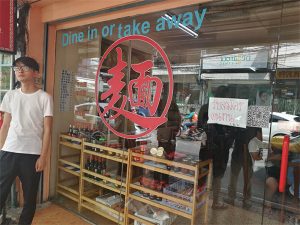
Fu Wa Restaurant.

Somchai, who is Thai-Chinese, has been selling such wares for more than four decades. The irony of how the place has changed is that the 75 year old has no real contact with it. The Chinese mainlanders overwhelmingly speak Mandarin. He doesn’t.

“They sell their stuff, and I sell mine,” he said, packing his merchandise. “How can I communicate with them? I don’t speak or understand. I don’t talk with them, and we just carry on our own businesses.”

Somchai got caught in a debate with Sa-nguan about calling the area New Chinatown. Somchai said despite its differences and separations from older Chinese communities, people have been calling it New Chinatown as its appearance has undergone a radical transformation in the past two years.

“Who am I to argue? They call it ‘New Chinatown,’” Somchai said.

Back at Fu Wah, we ordered two bottles of “699 apple drinks.” This is no apple cider or even apple juice but rather a drink supposedly made of 7.04 percent brown sugar, 1.1 percent honey, 5.5 percent apple vinegar and 86.3 percent water.

wufahinterior
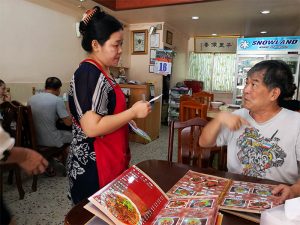
Sa-nguan orders food Monday at Fu Wa restaurant in at the New Chinatown.

At 30 baht a bottle, the drink – which was actually made in Chiang Rai’s Mae Sai district, just south of China’s Yunnan province – is supposed to be a health drink to boost your immunity and assist digestion and detoxification. This is the nice thing about New Chinatown: the chance to try something new.

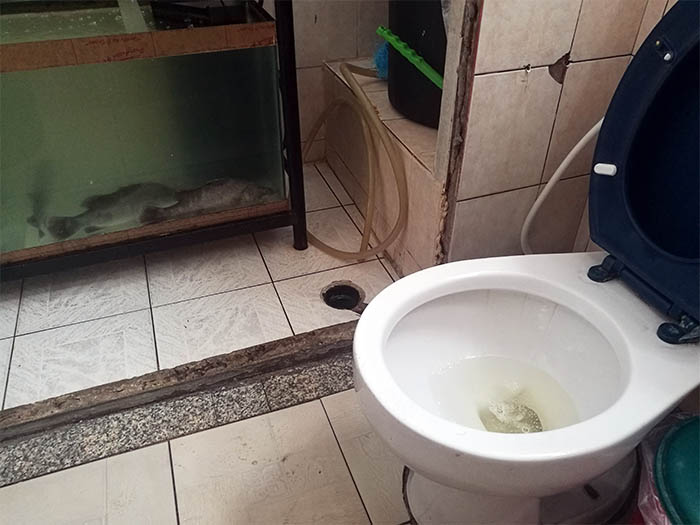
I can’t in good conscience recommend Fu Wah, however. After the meal I went to the restaurant’s bathroom on the upper floor only to find a tank filled with a few white snappers waiting to be turned into someone’s meal swimming in a fish tank next to the toilet bowl itself.

By then it was too late to not pay and somehow couldn’t throw up what I’d already ingested. At least I got a unique photo souvenir – as opposed to the mundane location of such fish tanks in front of restaurants in “Old” Chinatown.

As I stated earlier, New Chinatown is about discoveries.

New Chinatown can be reached via a one-minute walk from MRT Huai Khwang’s exits No. 1 or 2.

fishtank
An unsuspecting fish tank in the toilet of Fu Wa Restaurant’s bathroom.
Advertisement

Why Few Thai Women Are Saying #MeToo

BANGKOK — As women the world over say #MeToo and share stories of sexual harassment on social media to show how widespread the experience is, the campaign has barely made a ripple in Thailand.

While millions of people, largely in the West, have tagged posts #MeToo in the wake of the furor over allegations of sexual harassment against Hollywood producer Harvey Weinstein, activists in Thailand cite different social mores and a lack of leadership on the issue.

Not only are women less inclined to disclose their experiences, there are no examples being set by role models or celebrities.

There were no viral posts being widely shared, but a Facebook user may find one or two of their friends sharing a #metoo, with a privacy setting set to friends only.

The tweet that started it all.

Several gender rights advocates spoke about why.

Supensri Puengkhokesoong, a women’s welfare advocate and director of the Social Equality Promotion Foundation, said #MeToo hasn’t gained traction in Thailand because of cultural and social factors – and because the number of big names and celebrities coming forward with their own stories has amounted to zero.

“The cultural structures are different. Thai people see sexual harassment as a very personal issue between two people, so they might not want to come forward with their stories,” she said. “They might get the law or organizations involved, but not people in their social circle.”

The complete lack of Thai celebrities or politicians coming forward with #MeToo stories has also pushed the entire movement away, back overseas. For most Thais, reading about Harvey Weinstein’s sexual abuses are “faraway issues that don’t impact them personally, and seem to be from a different culture. No one in their own society is talking about it or expressing opinions.”

“They see it and are still,” Supensri said. “Thai society does not give importance to the issue of sexual harassment yet.”

Supensri said it’s not hard to find examples of sexual harassment and violence in Thailand, whether in show business, modeling agencies or the workplace. They tend to enter the news cycles with a focus on the victims rather than the perpetrators, she said, before being “made silent” by “big names.”

Jaded Chaowilai, director of Women and Men Progressive Movement, said there are reasons the social media campaign is less powerful in Thailand compared to elsewhere. Social systems where men hold the primary power is chief among them.

“The patriarchy in Thailand is more dense and deeper than America,” Jaded said. “Another reason is that men is more are prevalent in workplace authority than women.”

Thailand still grapples with a victim-blaming culture in which victims of rape or sexual harassment are blamed for what they wear or where they go. This mindset remains fixed in society at large.

Jaded, who campaigns extensively on women’s rights, said these beliefs must change.

“The myth that blames victims for calling for attention or dress in overly revealing clothes should be changed,” he said. “We must blame the patriarchy and its related power structures.”

Jaded referred to the experience of Thararat Panya, a law student at Thammasat University, who recently spoke up about being raped by a fellow activist in a story reported by Khaosod English.

“There are many organizations campaigning against sexual violence, but it would be more effective when those who are abused step up and speak for themselves,” Jaded said. “That has the most impact.”

While entrenched patriarchy may be blamed for holding back society, LGBT activist Sulaiporn Chonwilai said the government and institutions foster ignorance toward the pervasive rape culture.

As victims of sexual violence have to go leap many hurdles and potentially suffer further indignity to get justice, they’re as likely to change their minds and just give up, Sulaiporn said.

“There is no space in our society to discuss women’s rights,” she said.

Asked what could have be done to expand women’s basic rights, Sulaiporn said ideally, the educational system would be dismantled and reconstituted.

“We need schools that teach children about basic rights, sexual rights and gender equality. Not only men have to respect women, but women must respect men equally,” said the board member of the Women, Gender and Sexuality Studies Programme.

Supensri agreed that Thais need early education in basic fundamental human rights, especially regarding personal freedoms.

“They have to be trained in this since kindergarten, or else perpetrators will insist that their sexual harassment was done to show affection,” she said.

“Hopefully, lessons learned overseas can be applied here, but it needs support,” she said.

Have you or someone you know been a victim of sexual violence? Seek help by contacting the government’s One Stop Crisis Center hotline at 1300 (Thai, English, Burmese, Lao, Khmer), or the Women and Men Progressive Movement Foundation at 02-513-2889 (Thai, English).

Additional reporting Asaree Thaitrakulpanich

Related stories:

Sexual Violence Stalks Thailand’s Activist Community

Advertisement

Mark Zuckerberg Has No Plans to Visit Thailand or Prayuth: Facebook

BANGKOK — Facebook CEO Mark Zuckerberg is not traveling to Thailand to meet junta chairman Prayuth Chan-ocha, the social media giant said Wednesday.

Two days after the government announced the news, a Facebook Thailand spokesperson told Khaosod English that no such meeting was planned.

“There are no plans currently for any of our senior leaders to visit Thailand,” read a brief statement that did not elaborate.

Read: Facebook Founder To Visit Prayuth Later This Month

A deputy prime minister told reporters Monday that Zuckerberg would visit Prayuth in Thailand in October.

At a Monday news conference, Deputy Prime Minister Somkid Jatusripitak said Zuckerberg would arrive Oct. 30 in Bangkok to meet Prayuth for talks about e-commerce. He went on to elaborate potential benefits from the meeting.

“It’s a good opportunity for us that a global-level online entrepreneur is visiting. Online entrepreneurs in the United States and China are turning toward cooperating with ASEAN and opening branches in Singapore, Indonesia and Vietnam,” Somkid said. “Thailand is one of the countries being watched and considered for world partnerships.”

Somkid also said representatives from Amazon.com would visit the junta leader in November.

Somkid was receiving King Vajiralongkorn at Sanam Luang and could not be reached for comment by Wednesday evening.

Advertisement

Digital TV Seeks Relief For Its Expensive Failure

Photo : Prachachat

BANGKOK — Regulators agreed Wednesday to lower the fees digital television channels must pay three years after the launched.

Not only did the promise of digital television fail to pay off as hoped, but it caused heavy losses for the operators, with many now agreeing the migration came too late. Recognizing that audience behavior had already changed due to the rapid technological change, the broadcasters association petitioned the government to forgive their combined debt of 20 billion baht for broadcasting rights.

Read: How Workpoint and The Mask Singer Won Thai Television

That was rejected. But top regulatory executive Takorn Tantasith announced today they would decrease only annual operating fees, depending on their revenue bracket.

The fees, based on a percentage of revenue, were slashed across the board.

It was only a few years ago that big money was bet on digital television’s future. Consumers were urged to buy new hardware, the purchase of which was subsidized by vouchers sent to every residence. Prior to the digital TV auction, Thailand had only six free television channels.

After the 2013 auction, owners of 24 channels committed to paying a combined 50 billion baht for license fees. The push was criticized as taking too long and arriving too late. By the time the first digital broadcast was transmitted in 2014, audiences had already transitioned to online platforms.

Broadcasting association President Suphab Kleekachai said 30 billion baht had been paid so far.

To collect the remaining 20 billion baht, he said the government should sell off the remaining portion of the 700 MHz spectrum reserved for television to telecom firms.

Takorn today said his agency could only reduce the annual fee but had no power to waive the agreed to bidding costs.

“According to the law, money from the digital television auction must go into the public coffers. It cannot be changed,” he said Wednesday. “I would have to propose a solution to help them and then see what we can do to help, by using Article 44 or any other means.”

The 13 channels to join the petition were Thairath TV, PPTV HD, ONE, GMM 25, Nation TV, NOW, Bright TV, Spring News, new tv, True4U, Amarin TV HD, Voice TV and TNN.

The only channel that has consistently proven profitable has been Workpoint TV, which has won huge audiences with highly successful programs such as “The Mask Singer.”

Advertisement

Rights Watchdogs Indicted for Observing Discussion

Thai Lawyers for Human Rights staff Duangtip Karnrit and Niranut Niamsap gesture to reporters Tuesday at Khon Kaen military court prior to their bail release.

BANGKOK — The ability of human rights lawyers to protect the public will be further hampered as two go on trial by a military tribunal for allegedly engaging in politics, a civil rights lawyer said Wednesday.

Duangtjip Karnrit and Niranut Niamsap, who work for Thai Lawyers for Human Rights, were among seven people indicted Tuesday by a military court in Khon Kaen province for allegedly organizing a panel discussion the military said could disrupt peace and order. They were bailed out the same day.

But the trial – which could go on for years – will prevent Duangthip and Niranut from fully doing their jobs, according to Thai Lawyers chairwoman Yaowalak Anuphan.

“Instead of working 100 percent to help other people, they must take care of their own cases,” Yaowalak said in an interview. “And the military court is very slow. They arrange a hearing every three or four months. And the officers like to cancel. So people must travel there again and again.”

Eight people were charged with violating the junta’s ban on political activities for organizing a July 2016 panel discussion at Khon Kaen University on what was then a draft of the constitution the junta wanted the public to support.
While six others were activists, Duangthip and Niranut were attending the event as legal observers. The case has raised concern from the likes of Amnesty International that rights watchdogs are being targeted by the same tactics the junta uses against its critics.
“The two TLHR staff did not directly participate in the event, but rather attended as observers. They wore badges displaying their affiliation with TLHR and informed senior police and military officials present at the event that they were attending in an observational capacity,” an Amnesty statement said. It urged the authorities to drop charges against the suspects.

Duangthip, Niranut and five other defendants were present in court for Tuesday’s indictments. They all denied the charges. An eighth suspect, Jatupat “Pai” Boonpattararaksa, is currently serving a prison term after recently confessing to royal defamation.

Yaowalak said she fears the trial will take a long time because military tribunals move slower than civilian courts. Cases frequently drag on for years. The trial of two defendants in the largest terror attack in Thailand’s modern history – the 2015 bombing of Bangkok’s Erawan Shrine – has seen only four witnesses testify in court after more than two years.

“That’s why people who do not get bail choose to just plead guilty. It’s not like the Court of Justice, where it only takes a year or two,” the lawyer said, referring to the civil justice system.

The eight suspects were charged before the junta revoked the use of military courts for trying civilians in new cases said to involve national security, which includes everything from defaming the royal family to not following military orders.

There was also some confusion whether prominent activist Rangsiman Rome was supposed to be at yesterday’s court session. While a Thairath report suggested Rangsiman defied a court summons and failed to appear, the activist himself said he wasn’t charged in that case.

“I was sleeping. When I woke up, lot of people sent me the news, and I was shocked,” Rangsiman said.

Someone answering the phone at Thairath who identified himself as being in charge of its website said the report was filed by a correspondent in Khon Kaen.

Advertisement

Rescuers Unable to Free Elephant Swept Into Creek by Flash Flood

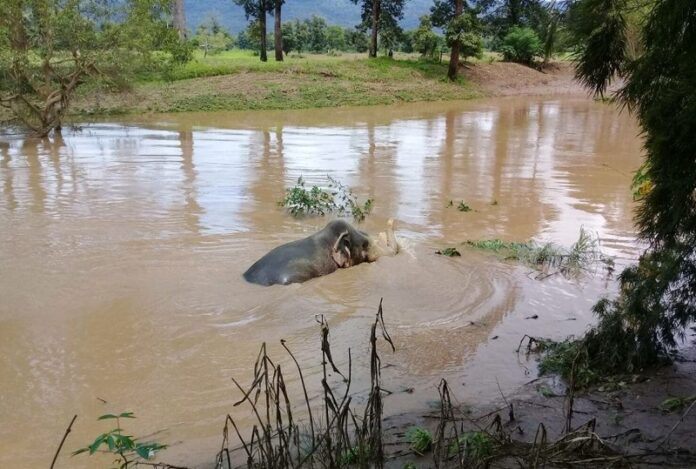
A female elephant struggles to keep her head above the water of a creek she was swept into Tuesday in Phitsanulok province.

Update: The elephant was rescued Wednesday afternoon, according to media reports. She was being taken to an elephant hospital in Lampang province for treatment before being freed back into the wild.

PHITSANULOK Park rangers were still trying to rescue an elephant trapped in a Phitsanulok province creek it was swept into Tuesday by flash flooding that killed a park official elsewhere.

After an overnight rescue operation, rangers Wednesday were able to move the elephant closer to shore. She appeared to be exhausted and could not climb out herself. One of her legs appeared to be injured, and she had trouble keeping her head above water.

The elephant was found by local residents a kilometer from the entrance of the Thung Salaeng Luang National Park. She was among many victims affected by heavy rain and flash floods which have inundated 500 households in the northern province’s Noen Maprang district since yesterday. Some residents have been evacuated.

Before the flooding hit, disaster officials had warned 34 provinces in the northern, northeastern and central regions – Phitsanulok included – to prepare for rising water levels, but no evacuation warnings were given.

The head of the Pha Daeng National Park in Phetchabun province was found dead yesterday after a flash flood swept away his pickup truck.

Six people have been killed in the ongoing flooding since Oct. 10, disaster department Director-General Chayaphol Thitisak said today. It has affected almost 200,000 people in 13 provinces.

flood 1
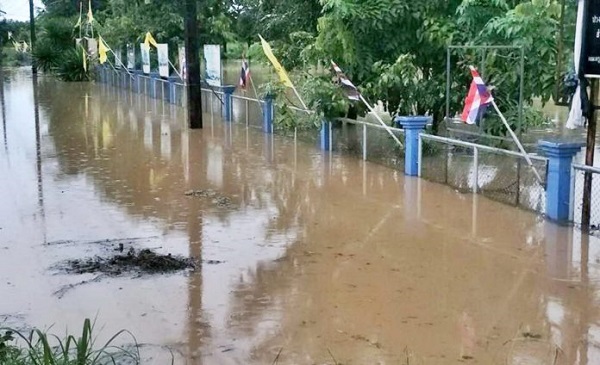
A flooded school in Noen Maprang district of the northern Phitsanulok province after flash flooding hit Tuesday.

Related stories:

Why Was Bangkok Not Warned of Flooding?

Heavy Rains Leave Bangkok Swimming in Floods

As North Floods, Major Dam at 100% Capacity


Advertisement

‘Pink Fire’ Jellyfish Swarm Off Krabi Islands (Video)

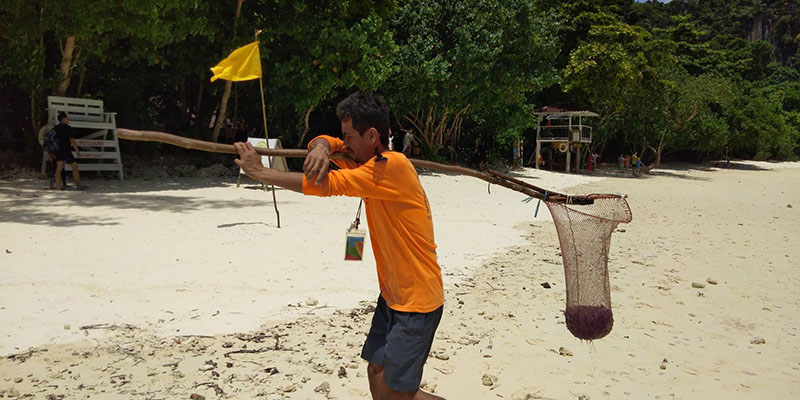
Poisonous Pelagia panopyra jellyfish Tuesday at the beach at Koh Hong.

KRABI — Rangers warned tourists Wednesday not to swim at certain beaches on Koh Hong and surrounding islands after several Chinese tourists were stung by poisonous jellyfish.

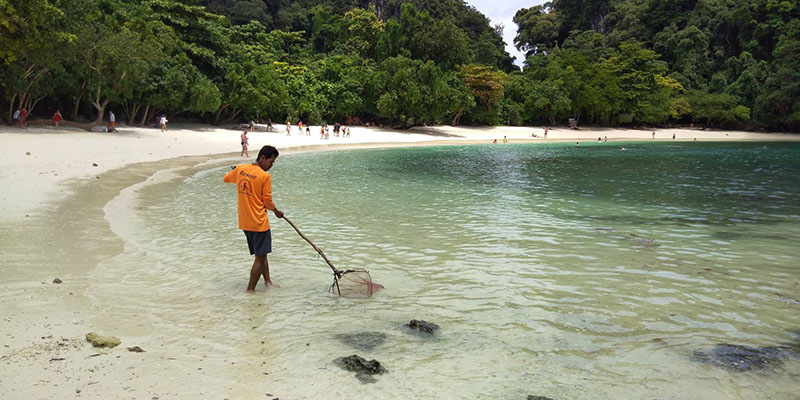
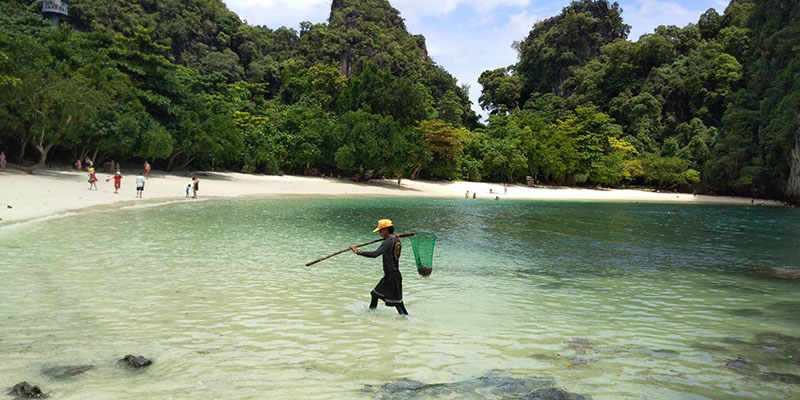
The three tourists were stung Tuesday after clouds of poisonous purple jellyfish appeared just off the shores of Koh Hong and Koh Lao Lading in the Than Bok Khorani National Park in Phang Nga Bay. Rangers cleared the shorelines of as many jellyfish as they could.

“Our rangers have prepared first aid and vinegar,” said Jampen Phomphakdi, ranger captain of the national park. “Many tourists have gotten stung before in the past. The jellyfish will probably float around Koh Lao Lading for at two days before swimming away.”

Jampen said that any tourists who get stung should quickly exit the water and find a ranger who will administer first aid by pouring vinegar on the burn. If burns are too large, they will be sent to the hospital.

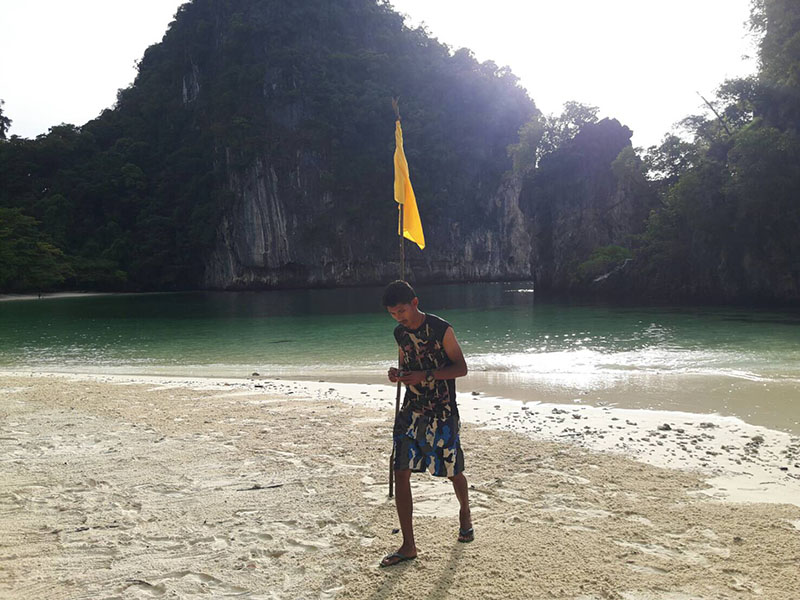
Tourists should refrain from swimming at beaches with yellow flags. Although there are no signs specifically warning of jellyfish, Jampen said his rangers inform tourists and tour guides about them face-to-face.

The islands around Koh Hong are popular tourist destinations, with Jampen estimating they receive at least 300 daily visitors – mostly from Chinese tour groups.

The jellyfish are purple Pelagia panopyra, or pink fire jellyfish, according to the Department of Marine and Coastal Resources. Although their toxins are not fatal, skin contact causes a burning sensation. Jellyfish appear seasonally on the shores of southern islands during the monsoon season.

The department recommends stings be treated by pouring vinegar over the affected area from 30 seconds to a minute. It advises against using water or rubbing the area with sand.

IMG 1744

IMG 1745
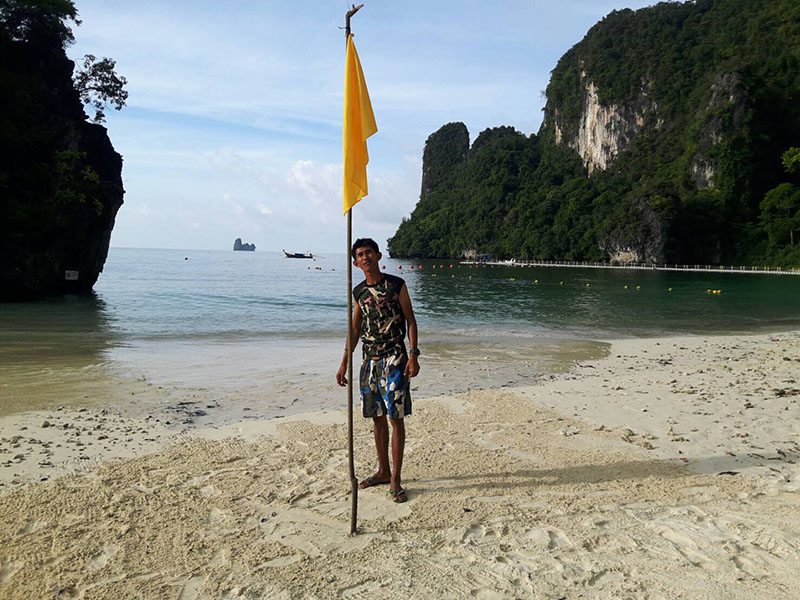
A ranger with yellow flags marks dangerous beaches Tuesday on Koh Hong.

471 469

470

SCOOPBLOOP
Rangers scoop up poisonous jellyfish Tuesday.
IMG 1740
Rangers scoop up poisonous jellyfish Tuesday.
Advertisement

Buffets Over Bangkok: ‘Dinner in the Sky’ Coming to EmQuartier

Update March 7: Dinner in the Sky said they will operate through the end of April.

Update Nov. 23: Dinner in the Sky said tickets will go on sale online at 6pm today for two one-hour meals, a 6pm “sunset” meal and 7:30pm “city lights” meal, daily Dec. 20 through the end of February. Four-course meals will be prepared by the Sheraton Grande Sukhumvit. They also answered a burning question: No access to toilets during the meal, so diners had best void themselves of all waste in advance.

BANGKOK — Upscale dining in the capital will literally soar to new heights.

Bangkok is the next destination for Belgian novelty restaurant service Dinner in the Sky, which will raise a crane to hoist 22 strapped-in diners, chefs and waiters up to 55 meters above street-level.

After crisscrossing the skies of more than 50 countries, the company confirmed Wednesday it is coming to a luxury Bangkok shopping mall in December.

“[Dinner in the Sky] will happen soon in Thailand indeed (December 2017 at EmQuartier),” owner David Ghysels wrote.

More details including pricing will be announced later – but expect nose-bleed heights there as well. In Las Vegas it cost USD$290 for a 90-minute, five-course meal and souvenir photo.

Dinner is the Sky is the brainchild of Ghysels and Stefan Kerkhofs. It has been staged in cities such as Paris, Las Vegas, Sydney, Kuala Lumpur, Dubai and Shanghai.

Advertisement

Hot News

LATEST NEWS

Bangkok
overcast clouds
27.2 ° C
31.6 °
27.2 °
85 %
5.4kmh
100 %
Mon
27 °
Tue
33 °
Wed
31 °
Thu
32 °
Fri
32 °