SINGAPORE – Amazon has introduced express delivery in Singapore in its first direct effort to win over Southeast Asian digital natives and new internet users.
The American e-commerce company announced Thursday it will begin operating a 100,000 square foot (9,290 square meter) distribution facility in the wealthy island nation. It promises to deliver tens of thousands of items within two hours for free, if customers spend at least 40 Singapore dollars ($29.52).
It’s a step up from international shipping options offered by select retailers, where items can take weeks to arrive.
Amazon is late to capitalize on the region’s rising middle class. Lazada, its closest competitor backed by Chinese giant Alibaba, launched in the region in 2012 and operates in Indonesia, Malaysia, Thailand, the Philippines, Vietnam and Singapore.
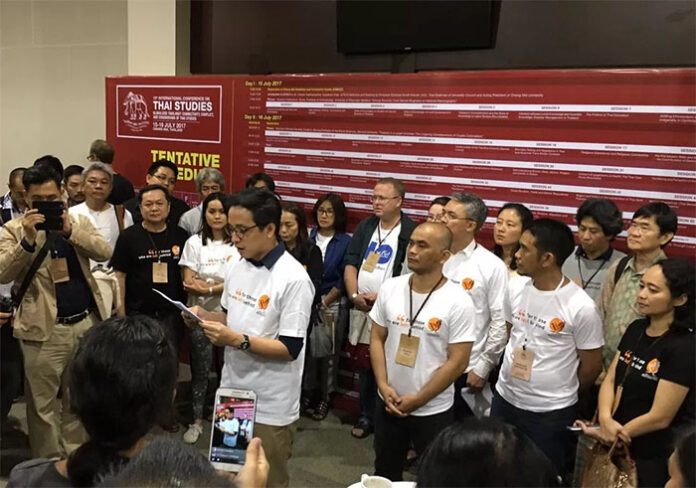
A joint statement calling for academic freedom, freedom of expression and returning power to the people is read July 17 at the 13th International Conference on Thai Studies in Chiang Mai. Photo: Thai Lawyers for Human Rights / Facebook
BANGKOK — Three years on, those most challenging military rule have been the nation’s academics and intellectuals.
This is partly due to the fact academics are respected, better known than ordinary citizens and enjoy a historical role in countering totalitarianism, according to those involved. But resistance led from the ivory tower has a pro-democracy activist convinced they steal the spotlight and exclude the masses from playing a vital role in favor of what an exiled former academic describes as an impotent movement.
July 17 saw academics test the waters again when they met in Chiang Mai for an annual conference. The 176 Thai and foreign scholars at the 13th International Conference on Thai Studies jointly signed a declaration calling for academic freedom, free expression and a swift return of sovereignty to the people.
“We view the suppression of free thought in Thai society to be of concern because it will result in the deterioration of knowledge, as it renders the people unable to access the truth and search for information to move forward,” a passage in the declaration read.
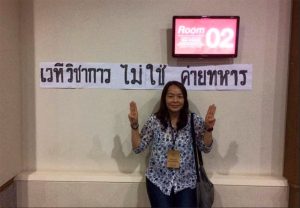
Pakavadi Veerapasapong makes three-finger salutes associated with opposing the military regime at an academic forum before a banner asserting the event ‘is not a military barracks’ earlier this month in Chiang Mai. Photo: Pakavadi Veerapasapong / Facebook
The conference attracted more attention when someone unhappy with intrusive security forces unfurled a banner asserting their “academic forum is not a military barracks,” images of which spread on social media. That led a Chiang Mai deputy governor to write a letter suggesting three people seen in one of the photos be brought in for questioning by the military.
Catching Fire
One of the three he identified was writer and translator Pakavadi Veerapasapong. The 52-year-old Chiang Mai writer was a panelist at the conference. She said they devised the motto after plainclothes soldiers and police kept intruding into and monitoring various panel discussions there. Since the soldiers generally couldn’t understand English, they monopolized use of the few interpretation machines which had been made available.
“It was such a nuisance and unsettling,” Pakavadi said, speaking from the northern province. She recognized some of the men and could identify others from how they were dressed or just recognized them as regular interlopers at talks and seminars in Chiang Mai. She added that while others carried passes, these soldiers walked around without identification.
“The problem is that these plainclothes soldiers kept taking photos and using the [interpretation] headphones. The organizers had provided [participants] with interpreters, and there weren’t that many devices available,” Pakavadi said.
The soldiers allegedly took the devices despite neither paying the registration fee to attend the event – causing shortages for participants who needed the machines.
“What’s bothersome is that sometimes these people can’t even understand [academic] Thai language. They have no knowledge of humanities or anything academic. Sometimes they asked academics to summarize things for them so they can write a report [to their commander],” the academic added.
Asked if well-known thinkers and prominent academics get more mass media coverage and outshine ordinary activists, Pakavadi, who belongs to the 400-strong Thai Academic Network for Civil Rights, said they often do. However, she said the academics are more organized, and the junta seems less tolerant of ordinary dissenters.
“When they deal with ordinary folks, it tends to be harsher. They don’t have a protective shield, so they don’t want to take risks,” she said, referring to being shielded from worse treatment by universities or their status. “But academics can only do so much. They can’t even protect academic freedom.”
Pakavadi said she wishes more could unite to fight against dictatorship.
“Maybe we have to wait until we reach the point where people feet enough is enough and take to the streets,” she said.
Or Sucking Up Oxygen?
Pansak Srithep, a member of a pro-democracy group that has staged street protests, said graduating from college doesn’t make him an intellectual. And his primary affiliation isn’t with the group, Resistant Citizen, but the Bang Bua Thong Taxi Cooperative in northwest metro Bangkok.
Pansak, who drives a taxi, is known for bold and direct protests. He criticized some prominent academics who took fellowships or sabbaticals at foreign universities to get out of Thailand following the 2014 coup.
“They simply vanished. Some could be described as half-fleeing. Now that they are back, we’re back to the same cycle in which ordinary victims of junta persecution are treated like a case study,” he said.
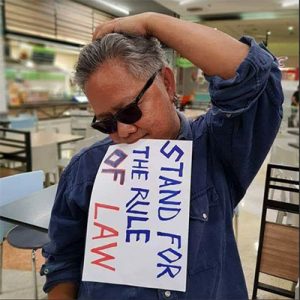
Pansak Srithep in an image posted to his Facebook account.
Pansak – who face charges including sedition for holding public protests against the junta – added that ordinary citizens have to push harder for media recognition. It was the killing of his teen son by an unidentified gunman during 2010 Redshirt protests and his subsequent calls for justice that made him a known face in the media, despite his non-academic status.
Not only is it harder for ordinary citizens to be be noticed, but once persecuted by the National Council for Peace and Order, as the junta calls itself, they are quickly forgotten by the media and the public while their court cases drag on for years.
When they are invited to join a panel critical of the regime, regular citizens tend to be presented as token speakers or cases to be studied by academics, Pansak said.
“Organizing a panel is what academics are comfortable with. Even at academic forums, there exist hierarchies among them as to who will get to speak,” he said, saying some star academics get to speak the most speaking time. “For ordinary folks who want to speak out, if they’re not really good, they won’t have any space. Academics should support them and not speak on their behalf.”
However, Pansak said he doesn’t think academics and intellectuals intend to really steal the limelight. He believes it’s a problem of two groups being unable to work in tandem with one another. “They want to maintain academic impartiality, which doesn’t exist anyhow.”
Fulfilling ‘Historical Mission’ or ‘Limp and Meaningless?’
Anusorn Unno, coordinator of the civil rights network, can speak at length about what is wrong under military rule. He led the reading of the declaration at last week’s conference in Thai and English.
“We don’t have the power to make the state obey. However, in a situation where people are being muzzled, we do speak,” said Anusorn, 45, an anthropologist and dean of Thammasat University’s Faculty of Sociology and Anthropology. He said Thailand is facing an attempt to reverse the political progress the kingdom made since the end of absolute monarchy in 1932. Concerned academics, both here and abroad, both Thai and foreign, are simply trying to resist, he added.
“Thailand has this [historical] specificity wherein academics and intellectuals are expected to deliver,” Anusorn said, referring to political struggles spearheaded by students, academics and intellectuals dating back at least to the October 1973 popular revolt which ousted the regime of Field Marshal Thanom Kittikachorn. Since then, Anusorn said, it has been a “mission” for concerned academics and intellectuals to maintain this role.
“It’s like we have a shield protecting us more than ordinary folks. This demands that one exercise bravery even more. Ordinary folks don’t have any shield. So we need to fulfill our mission. It’s not like whatever academics say is correct or that we have a privilege while others can’t speak,” Anusorn said.
The domination of academics is such that even the strongest criticism against the declaration didn’t come from the military junta but from a former anti-junta peer. While junta secretary and Army Chief Gen. Chalermchai Sittisart insisted July 20 that Pakavadi and her colleagues would not be called in for questioning – but merely asked not to disturb the peace and order until the big royal events at the end of the year are complete, an exiled political scientist launched into strong criticism of his fellows, particularly the foreign scholars who signed or did not sign the declaration.
The declaration was “limp and meaningless,” wrote political scientist Giles Ji Ungpakorn, who lives in England to avoid prosecution on charges of defaming the monarchy.
“A much more powerful message to the junta would have been the total boycott of such a conference held in Thailand,” Giles wrote Sunday on his blog. “They could have organized an alternative conference outside the country and purposely invited those Thai academics in exile to speak, all expenses paid.”
“I say ‘all expenses paid’ because many of the exiled Thai academics in Europe and elsewhere, who are on the junta’s ‘wanted list,’ have had to give up their academic jobs and now survive on low incomes,” added Giles, who taught at Chulalongkorn University before he fled to evade what he says is persecution.
Giles wrote that foreign academics who attended the conference and spoke helped legitimize the junta and were due for particular criticism.
“The bottom line is that there is no such thing as academic freedom in Thailand today. The exception is the select few privileged foreign academics who haunt the Thai Studies conferences, making sure that they don’t upset the people who are in power,” Giles wrote. “For these pathetic people, their careers and visas to visit Thailand are more important than freedom, democracy and human rights among the very people they claim to study.”
Prachatai video of the statement read July 14 at the Chiang Mai conference.
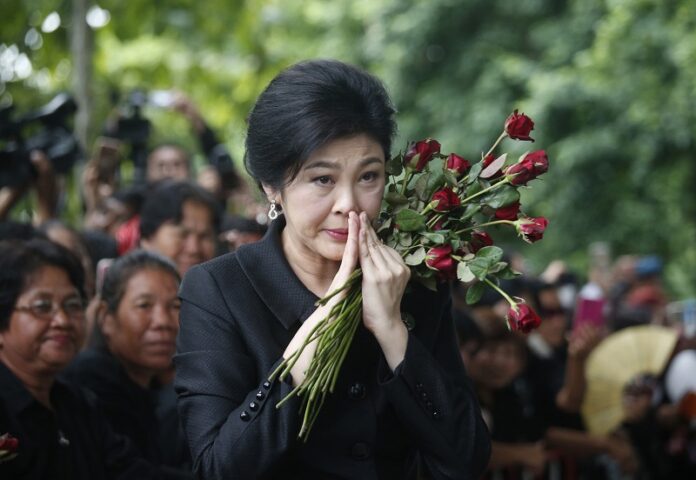
Former Prime Minister Yingluck Shinawatra arrives July 21 at the Supreme Court for the last day of her hearing in Bangkok. Photo: Associated Press
BANGKOK — Prime Minister Prayuth Chan-ocha said Thursday his government was right to confiscate the bank accounts of former Prime Minister Yingluck Shinawatra as it was a separate matter than her malfeasance trial, which has yet to render a verdict.
Prayuth said the order to fine Yingluck 35.7 billion baht was issued because the former prime minister must be held accountable for losses of an agricultural subsidy enacted by her government. He said it was irrelevant that her guilt has not yet been established by the court, which is expected to give its decision on Aug. 25.
“I ask you not to mix these two stories up to instigate the people,” Prayuth told reporters Thursday. “Or to distort that we mistreated her by confiscating her assets, because it’s a different story.”
Yingluck is due to give closing statements Tuesday in her trial over allegations she ignored the massive corruption in her administration’s rice subsidy program. The Supreme Court’s Criminal Division for Person [sic] Holding Political Positions will then hand out the verdict on Aug. 25.
The Finance Ministry already ordered her in October to personally compensate the state for the 35.7 billion baht. The order remains in effect for 10 years before expiring.
A day before he would be contradicted by his own deputy, Prayuth on Wednesday apparently misunderstood what was happening. He said the accounts were yet been confiscated, as the the authorities were only preparing a list of her bank accounts in case the court finds her guilty.
“To confiscate is not today’s issue but preparation by the authorities,” he said. “She is not guilty until the court makes a ruling … If she is acquitted, then it’s end. We can’t confiscate anything.”
In his comments this morning he acknowledged the seizure had been completed but blamed reporters for confusing different issues.
Meanwhile, the agency responsible for enforcing the will of the courts said Monday it began the process of seizing 12 bank accounts to satisfy the order. The ousted prime minister said early Wednesday morning that she has already lost her accounts and the money held in them.
“It is not true what NCPO leader said, that seizure of my assets was only in preparation,” Yingluck tweeted Wednesday. “My bank accounts have already been confiscated.”
It is not true what NCPO leader said that seizure of my asset is only in preparation, my bank accounts have already been confiscated. https://t.co/FAIPWb7oe5
Deputy Prime Minister Wissanu Krea-ngam said Thursday that authorities only froze her accounts – he numbered them at 16 – but have yet transfer her money to the state.
He said money in the amount of “hundreds of thousands” of baht was withdrawn from five of her frozen accounts but not yet given to the treasury. He said the other 11 accounts remain untouched.
Wissanu said 37 properties belong to Yingluck, the department already coordinated with the Lands Department to prevent her from selling or transferring it. The legal rights remain with Yingluck, for now.
Asked why the authorities appeared to enforce a nearly year-old order at the end of her trial, with a verdict nearly due, Wissanu said the concern was irrelevant. He said agents tasked with carrying out the order had just completed their discovery of her assets and needed to take immediate action or risk being guilty of negligence.
Saying the seizure was unprecedented, Yingluck’s lawyer Noppadol Laothong filed a motion with the Administrative Court.
In response, court spokesman Terdphong Kongchan said the Finance Ministry and related agencies were ordered Monday to submit an explanation within 15 days for why it was necessary to seize Yingluck’s assets.
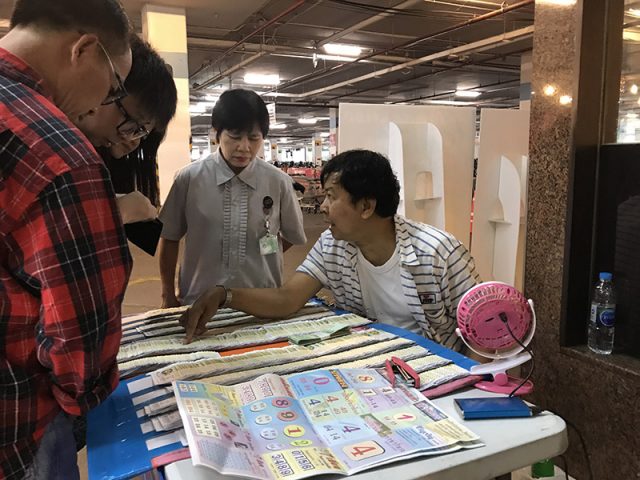
A Chiang Mai lottery ticket vendor points out some tickets Thursday morning for his customers.
CHIANG MAI — Residents were sweeping up lottery tickets Thursday with numbers they associated with King Rama X on the eve of his first birthday to be celebrated as a national holiday under his reign.
People across Chiang Mai gathered at markets this morning to buy tickets with numbers deemed auspicious and numerologically relevant to Rama X, believing his Friday birthday could provide a boost of lucky to their gambling.
“Numbers that citizens are asking for a lot are royal numbers. Booths are completely swept clean of these numbers for lottery rounds through the end of the year. Even if they don’t win, they buy more and more tickets to keep for the next round,” Chatri Khun-in, head of a group of lottery ticket sellers in the northern province, who himself plies a Big C Extra in Chiang Mai city.
Since Rama X was born on July 28, in Buddhist year 2495 and turns 65 tomorrow, the public has reportedly bought up numbers with any combination of related digits, such as 28, 10, 65, 95, 710, 765, 495 and 728.
Markets in Chiang Mai where the royal numbers have sold well reportedly included the Warorot Market, Bumrung Buri Night Market and local train station markets.
Chatri said folks believe these numbers will hit sometime this year – and the lotto round to be announced Tuesday, four days after the royal birthday, is as good a time as any.
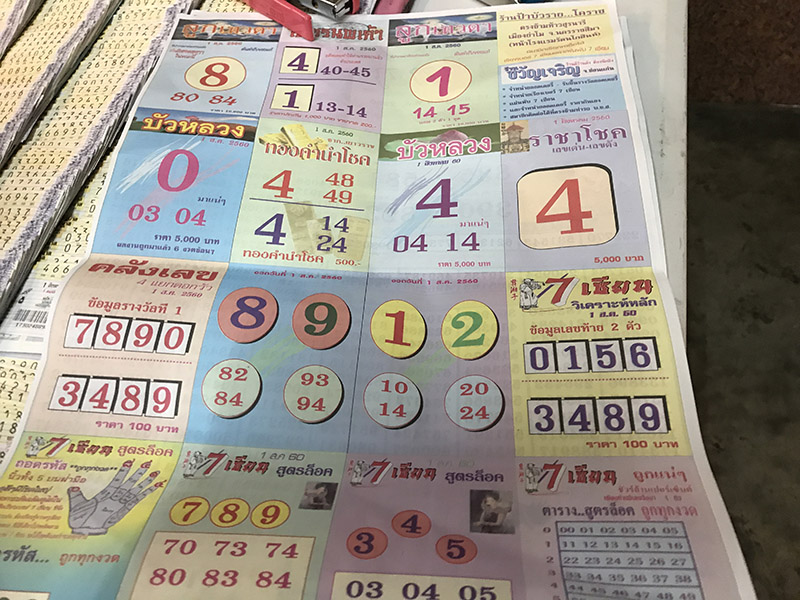
Local “lottery numerologists” have also advised citizens to purchase tickets with a 0 or 4, contending they will yield cash.
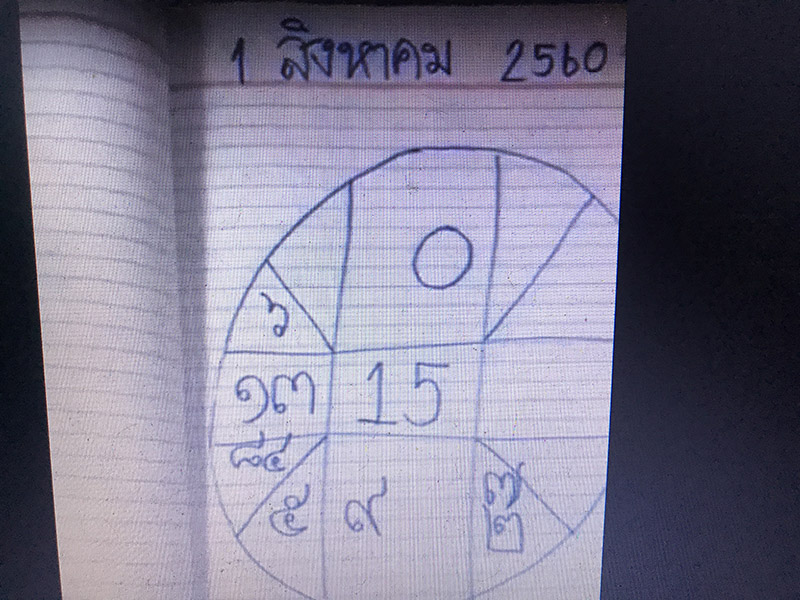
A lottery numerologist brochure detailing lucky numbers Thursday in Chiang Mai.A photo of a local lottery numerologist’s prediction of lucky numbers for the 1 Aug. lottery round
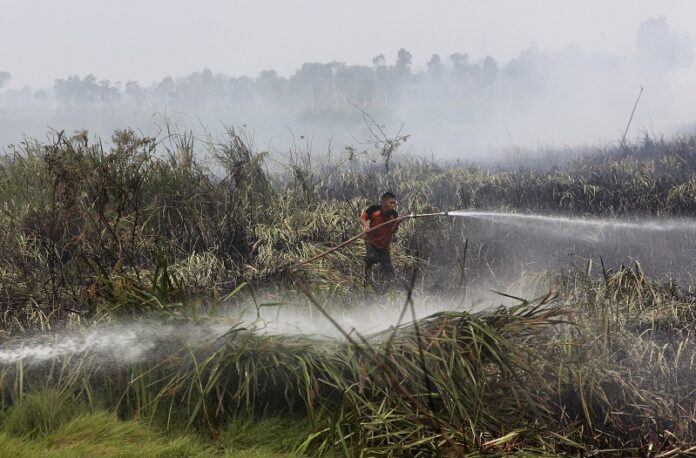
A fireman sprays water to extinguish forest fire at a peatland field in 2015 in Ogan Ilir, South Sumatra, Indonesia. Photo: Tatan Syuflana / Associated Press
JAKARTA — Five Indonesian provinces have declared states of emergency as peatlands burn in Aceh and the risk of fires spreading elsewhere increases during the annual dry season, an official said Wednesday.
National Disaster Mitigation Agency spokesman Sutopo Purwo Nugroho said 18 helicopters have been deployed to help extinguish fires in Sumatra and Kalimantan.
Satellite images show that the number of fires increased from 150 on Sunday to 179 on Tuesday, he said.
Nugroho said the provinces of Riau, Jambi, South Sumatra, West Kalimantan and South Kalimantan have declared emergencies in anticipation of a worsening of the fires and to mitigate the choking smoke that peatlands generate when burned.
A state of emergency was earlier declared in West Aceh district, where fires on peatland expanded over 70 hectares (170 acres) within a week.
Devastating dry-season fires in 2015 burned through 2.6 million hectares (6.4 million acres) and blanketed Sumatra, Borneo, Singapore, Malaysia and southern Thailand in health-damaging haze. Plantation companies and villagers set the illegal fires because it is a faster and, for them, less expensive way to clear land than using machinery.
The 2015 disaster, which the World Bank estimated caused $16 billion in losses, was worsened by El Nino drought conditions but also showed the risks that palm oil and pulp wood companies have taken in draining Indonesia’s peatlands for use as industrial plantations, making them highly combustible.
Yusmadi, chief of Aceh’s disaster agency, said at least 23 villagers are being treated at hospitals due to respiratory problems.
Nugroho earlier warned that forest and peatland fires would worsen in the coming months, with the peak of the dry season expected in August and September.
Authorities stand near the Fire Ball amusement ride after the ride malfunctioned injuring several at the Ohio State Fair, Wednesday, July 26, 2017, in Columbus, Ohio. Some of the victims were thrown from the ride when it malfunctioned Wednesday night, said Columbus Fire Battalion Chief Steve Martin. Photo: Jim Woods / The Columbus Dispatch via Associated Press
COLUMBUS, Ohio — A swinging and spinning amusement park ride called the Fire Ball broke apart on the opening day of the Ohio State Fair on Wednesday, hurtling people through the air, killing at least one and injuring seven others.
Three of the injured remained hospitalized in critical condition Wednesday night, authorities said at a late-night news conference.
“The fair is about the best things in life, and tonight with this accident it becomes a terrible, terrible tragedy,” said Republican Gov. John Kasich.
The man who was killed was one of several people who were thrown when the ride malfunctioned, Columbus Fire Battalion Chief Steve Martin said earlier.
Dramatic video captured by a bystander shows the ride swinging back and forth like a pendulum and spinning in the air when it crashes into something and part of the ride flies off, throwing riders to the ground.
A company providing rides at the fair this year describes the Fire Ball as an “aggressive thrill” ride.
On its website, Amusements of America says that since its debut in 2002, the Fire Ball has become “one of the most popular thrill rides on the AOA Midway.” The company description of the ride says it swings riders 40 feet (12 meters) above the midway while spinning them at 13 revolutions per minute.
The company did not immediately return a phone message seeking comment.
“All of the rides at the fair are checked several times when they are being set up to ensure they are set up the way the manufacturer intended,” said Director of Agriculture David Daniels, adding that the Fire Ball passed its inspections.
“We started out today with 11 rides that did not open because the inspection work was not done on them,” said Daniels. Four rides will not be operating because they do not meet the mechanical test, he said.
Kasich has ordered that all of the rides be shut down until additional safety inspections can be completed.
Search boats on Wednesday night near Chumphon’s Ko Ngam Yai island.
CHUMPHON — Four members of a group who headed out from Bangkok to learn scuba diving died Wednesday night along with one instructor after their boat capsized during a heavy rainstorm in the Gulf of Thailand.
The bodies of four women and one man, all in their 30s and 40s, were recovered from under the vessel near Koh Ngam Yai early Thursday following several hours of searching by marine police.
According to Col. Paisarn Sangtep of Pak Nam Chumphon police, the five people were among a group of 13 people, scuba diving students and instructors, who hired a boat to go out into the sea for a diving and undersea photography lessons.
The boat was operating in the gulf despite a foul weather advisory that small vessels should stay ashore. Paisarn said the boat’s operators would be charged for recklessness resulting in death.
The five victims were Mahassana Kanchanapakorn, Teechaya Methamongkol, Chandara Tubchan, Thapanee Vorawatanakul and Sumassana Sutthanurak. Wednesday was to be the third day of their lessons.
BANGKOK — Head out the foam and froth with a globally valid excuse next week.
The first Friday of August is International Beer Day, and several Bangkok bars are pouring out offers and events involving booze and games.
International Beer Day was started by a group of beer boosters in Santa Cruz, California. The occasion later has grown to be celebrated in more than 200 cities today.
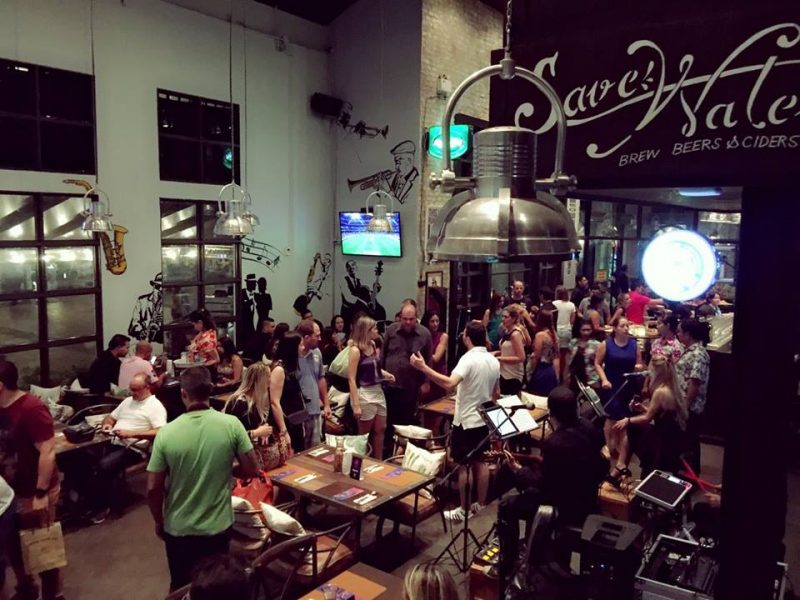
Brick Bistro at Asiatique The Riverfront
Photo: Brick Bistro Asiatique The Riverfront / Facebook
A beer bar located next to the river will host a drinking contest and lucky draw game every beer lover can join.
Win a drinking contest for a beer tower and 1,000 baht gift voucher. Raffle winners will get some bottles to take home.
The event takes place Aug. 4 at Brick Bistro Asiatique The Riverfront. Book a table before Aug. 3 to get a 15 percent discount on food and beverages. Commuters can reach the venue by taxi from BTS Saphan Taksin or take a boat shuttle beneath the Skytrain station at Sathorn Pier.
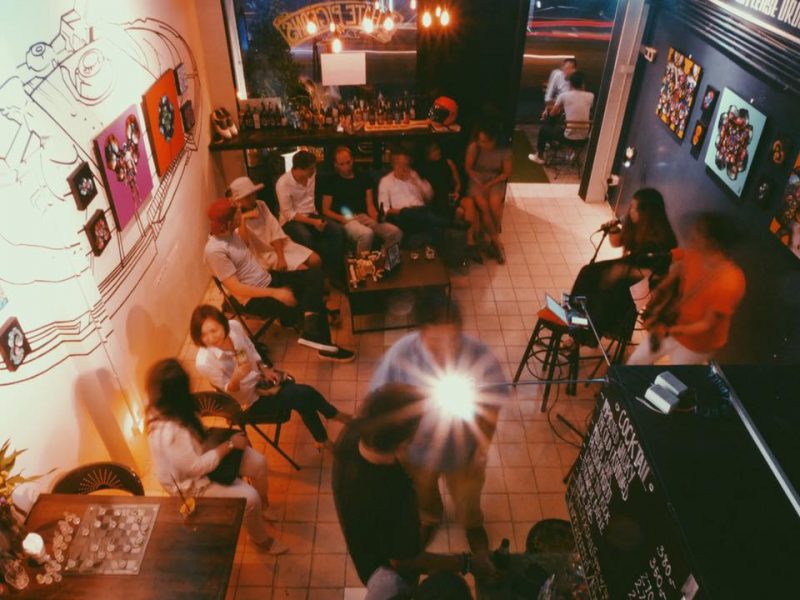
I Hate Pigeons
Photo: I Hate Pigeons / Facebook
Gather as a group and hang out at an oddly named Sathorn area bar where a buy-four-get-one drink offer will be in effect.
Four taps of beer and a range of rare craft beer bottles are available there.
I Hate Pigeons sits on Soi Sribumphen, near Soi Sathorn 1, about one kilometer from MRT Lumphini.
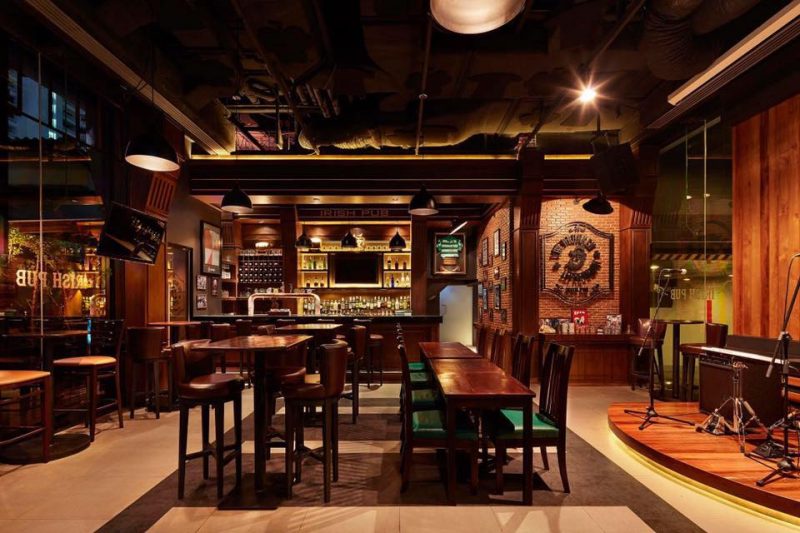
The Drunken Leprechaun
Photo: The Drunken Leprechaun Bangkok / Facebook
Head to a wood-heavy, Irish-themed bar to taste a sampling of special beers served with battered sausage for 320 baht.
A variety of drinks are available including the Drunken Leprechaun Lager. Every order includes a chance to win a 24-bottle crate of beer.
The event starts at 4pm on Aug. 4. The Drunken Leprechaun is on Soi Sukhumvit 15 and can be reached from BTS Nana, BTS Asok or MRT Sukhumvit.
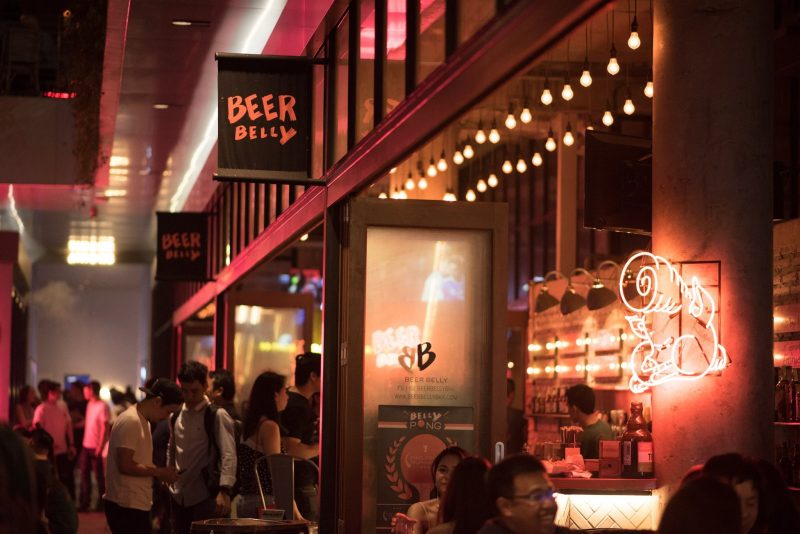
Beer Belly BKK
Photo: Beer Belly / Facebook
Buy one pint of beer and get another one for free!
Selection of eight beer brands from Germany’s Weihenstephaner, Australia’s Little Creatures to Japan’s Coedo Shiro and Thailand’s Mahanakhon will be available at Beer Belly, a craft beer bar inside the 72 Courtyard community mall.
The event runs Aug. 4 and Aug. 5. Beer Belly BKK is located inside 72 Courtyard on Sukhumvit Soi 55 and can be reached from BTS Thong Lo.
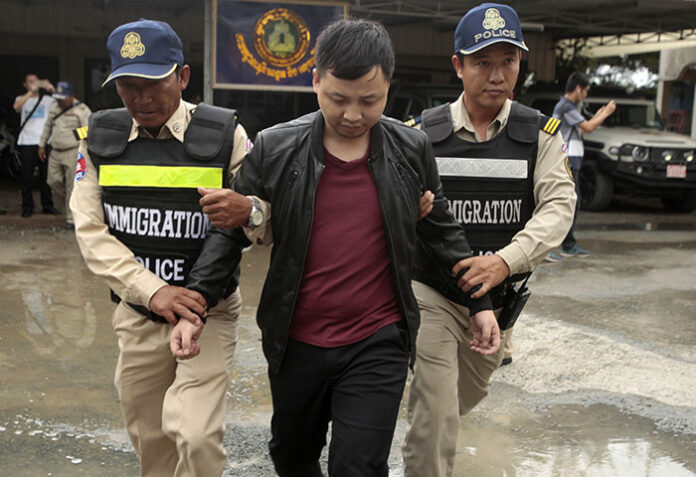
A Chinese national arrested over an alleged internet scam is escorted by police on his way to deportation at the immigration office in 2017 in Phnom Penh. Photo: Heng Sinith / Associated Press
PHNOM PENH — Police in Cambodia have deported to China 17 telephone fraud suspects, among hundreds of alleged scam artists who have been caught and expelled in recent years.
The 17 were flown out Wednesday from the airport in Sihanoukville in southern Cambodia, said the Interior Ministry’s immigration investigation chief, Gen. Ouk Haiseila. Another 14 suspects are scheduled to leave this weekend from Siem Reap in the northwest, he said.
The two groups were being repatriated on commercial flights to different Chinese provinces for prosecution, he said.
The gang would target rich people and civil servants in China, contact women over social media, trick them into exchanging nude or sexy photos then extort money from them by threatening to circulate the pictures online, he said. They also used phone calls made over the internet for their activities, he said.
Phone scams come in many variations. When the authorities in Thailand this week announced the arrests of 44 people — 19 Chinese citizens and 25 Taiwanese — suspected of running a telephone scam, they said the perpetrators made calls over the internet in which they claimed to be banking officials and accused their targets of financial crimes.
The targets would then be put in touch with a fake police officer — also at the gang’s headquarters — and be told they could escape arrest by transferring the allegedly stolen money to a bank account belonging to the scammers.
Ouk Haiseila said police initially identified seven of the group detained in Cambodia as Taiwanese, but Chinese police said they were all Chinese citizens. It was not clear if the Chinese assertion was based on Beijing’s long-maintained claim that Taiwan is one of its provinces.
Cambodia last September deported 63 suspects, including 13 Taiwanese, to China over an alleged internet scam. Kenya and Malaysia have also deported Taiwanese internet scam suspects to China despite protests by Taiwanese officials.
Rights activists and Taiwanese authorities say such deportations reflect the great influence China exercises over Cambodia through aid and investment.
An army organised concert in Siam Paragon on 26 June 2014.
BANGKOK — Think of “advertising” and it usually conjures TV spots and billboards touting insurance, sugary drinks and skin products.
That’s why many were surprised to learn the nation’s fourth largest advertiser last month was the Prime Minister’s Office, which spent 129.4 million baht in June. The same agency spent 205.6 million baht in June 2016, more than Coca Cola (135.1 million baht) and Toyota (197.7 million baht).
The report, published recently by international media monitoring and ratings firm Nielsen, also found the government spends more on advertising than megacorps such as Isuzu and ThaiBev. The only advertiser consistently outspending the office in the time periods tracked was Unilever, which spent 329.1 million baht last month and 448.8 million baht in June 2016.
A government spokesman said Wednesday that the data is misleading.
“The information does not convey reality,” Lt. Gen. Sansern Kaewkamnerd said by phone.
According to Sansern, the paper lumped together numerous agencies that answer to the prime minister, such as the Thai Health Foundation, Royal Thai Police and Office of the Narcotics Control Board.
“In the past, they were part of the Prime Minister’s Office, but at present, they are separate entities. They have their own structures and planning,” Sansern said, adding that the Thai Health Foundation alone accounted for 29 million baht of ad spending.
But transparency activist Srisuwan Janya questioned why the government must pay for publicity in the first place when it already has broadcasting agencies for its own use.
“It’s strange, because the state has many media agencies in its own hands, such as the National News Agencies, MCOT and the military radio network,” said Srisuwan, who often denounces financial irregularities in government.
Srisuwan also said the constitution requires the state to only publicize information that is “beneficial” to the public, and not publicity campaigns for any particular government or official.
“They have to tell people what the state will be doing, where and how,” the activist said. “If they do PR to improve the image of the prime minister, the ministers or certain state agencies, it may violate the constitution.”
Government spokesman Sansern wouldn’t say how much the Prime Minister’s Office has actually spent on publicity.
“If you want that information, you can always file a request to see it,” he said.
Anytime a government engages in marketing efforts it risks propagandizing.
In February 2016, the military government spent an undisclosed amount to wrap several major newspapers in advertorial covers promoting its plans and burnishing its image.
Critics of successive governments have long made nonpartisan complaints that taxpayer money has been used on publicity campaigns verging on propaganda. And state-sponsored ads are highly coveted by media agencies as a lucrative source of income.
The current military government has frequently launched public relations blitzes aimed at winning hearts and minds.
They have included a film promoting junta chairman Prayuth Chan-ocha’s “12 Values,” daily TV and radio programs promoting the work of the junta and “happiness fairs” around the country.
June’s top 10 advertisers by spending, excluding classifieds and real estate, per Nielsen:
1. UNILEVER (THAI) HOLDINGS 329.1 million baht
2. TOYOTA MOTOR THAILAND CO.,LTD. 147.1 million baht
3. COCA-COLA (THAILAND) 135.1 million baht
4. OFFICE OF THE PRIME MINISTER 129.4 million baht
5. TRI PETCH ISUZU SALES CO.,LTD. 129 million baht
6. THAI LIFE INSURANCE PCL. 103.7 million baht
7. PROCTER & GAMBLE (THAILAND) 103.6 million baht
8. THAI BEVERAGE (PUBLIC) CO.,LTD. 99.4 million baht
9. ADVANCE INFO SERVICE PCL. 98.2 million baht
10. COLGATE-PALMOLIVE (THAILAND) LTD 95 million baht