33.3 C
Bangkok
Sunday, June 21, 2026
Home Blog Page 2287

US Woman Fatally Shoots Boyfriend in Failed YouTube Stunt

Image: Wochit News / YouTube

HALSTAD, Minnesota — A Minnesota woman charged in the fatal shooting of her boyfriend told authorities it was a video stunt gone wrong.

Monalisa Perez, of Halstad, was charged Wednesday with second-degree manslaughter in the death of Pedro Ruiz III.

According to a criminal complaint, the 19-year-old Perez told authorities Ruiz wanted to make a YouTube video of her shooting a bullet into a book he was holding against his chest. She says she fired from about a foot (0.3 meters) away.

https://twitter.com/MonalisaPerez5/status/879459393145888768

Authorities say Ruiz died from a single gunshot wound to the chest.

The victim’s aunt, Claudia Ruiz, tells WDAY-TV that the couple played pranks and put them on YouTube.

Perez was granted a public defender and released on USD $7,000 bail.

The charge carries a maximum penalty of 10 years in prison.

Advertisement

Rare Siamese Croc Eggs Found in Cambodia, a Hope to Their Survival

A Siamese crocodile seen here in 2012 in Khao Yai. Photo: Tontan Travel / Flickr

PHNOM PENH — Wildlife researchers in Cambodia say they’ve found a clutch of eggs from one of the world’s most endangered crocodiles, raising hopes of its continuing survival in the wild.

The New York-based Wildlife Conservation Society said in a statement Wednesday that its researchers, along with Fisheries Administration employees and local residents, found six eggs of the Siamese Crocodile in Sre Ambel District in the southern province of Koh Kong as they were exploring for tracks, signs and dung of the reptile. It said it was the first Siamese Crocodile nest recorded in six years of research and protection in the Sre Ambel area.

The group says the crocodile, with an estimated global population of about 410, is found only in Cambodia, Malaysia, Myanmar, Thailand and Vietnam, with the greatest number in Cambodia. The species is listed as critically endangered by the International Union for Conservation of Nature because its numbers are rapidly shrinking.

“To avoid any threats, we moved the eggs to a safe place to hatch and track their progress,” the statement quoted In Hul, a staff member of the Fisheries Administration, as saying.

Such threats, said the statement, “include illegal hunting of adults and hatchlings and collecting of eggs to supply crocodile farms in Cambodia and Thailand, especially during the last two decades.”

Other threats include the “degradation of habitats, decrease of natural food, low chance of breeding in the wild due to low number of individuals in the wild and weak law enforcement such as regulations on crocodile farming and trading.”

Advertisement

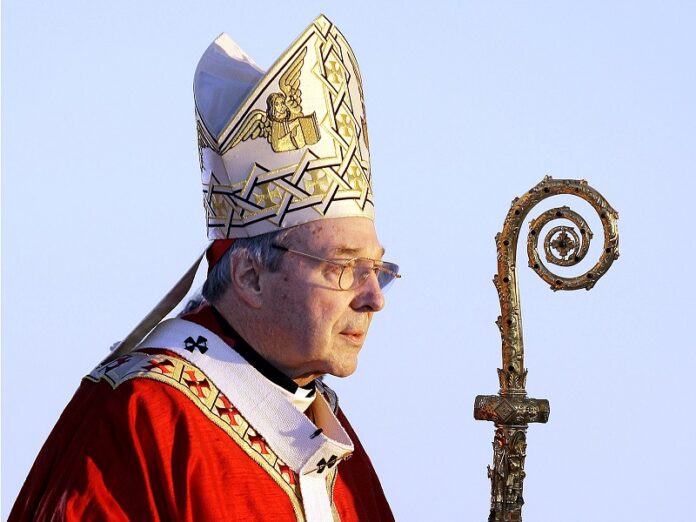
Australian Police Charge Vatican Cardinal with Sex Offenses

Cardinal George Pell walks onto the stage for the opening mass for World Youth Day in 2008 in Sydney, Australia. Photo: Rick Rycroft / Associated Press

SYDNEY — Australian police charged a top Vatican cardinal on Thursday with multiple counts of historical sexual assault offenses, a stunning decision certain to rock the highest levels of the Holy See.

Cardinal George Pell, Pope Francis’ chief financial adviser and Australia’s most senior Catholic, is the highest-ranking Vatican official to ever be charged in the church’s long-running sexual abuse scandal. Pell said he would return to Australia to fight the charges.

Victoria state Police Deputy Commissioner Shane Patton said police have summonsed Pell to appear in an Australian court to face multiple charges of “historical sexual assault offenses,” meaning offenses that generally occurred some time ago. Patton said there are multiple complainants against Pell, but gave no other details on the allegations against the cardinal. Pell was ordered to appear in Melbourne Magistrates Court on July 18.

For years, Pell has faced allegations that he mishandled cases of clergy abuse when he was archbishop of Melbourne and, later, Sydney. But more recently, Pell himself became the focus of a clergy sex abuse investigation, with Victoria detectives flying to the Vatican last year to interview the cardinal. It is unclear what allegations the charges announced Thursday relate to, but two men, now in their 40s, have said that Pell touched them inappropriately at a swimming pool in the late 1970s, when Pell was a senior priest in Melbourne.

The Catholic Archdiocese of Sydney issued a statement on behalf of Pell, saying the 76-year-old cardinal “strenuously denied all allegations” and would return to Australia to clear his name.

“He said he is looking forward to his day in court and will defend the charges vigorously,” the statement said.

Patton told reporters in Melbourne that none of the allegations against Pell had been tested in any court, adding: “Cardinal Pell, like any other defendant, has a right to due process.”

The charges are a new and serious blow to Pope Francis, who has already suffered several credibility setbacks in his promised “zero tolerance” policy about sex abuse.

Pell’s actions as archbishop came under intense scrutiny in recent years by a government-authorized investigation into how the Catholic Church and other institutions have responded to the sexual abuse of children. Australia’s Royal Commission into Institutional Responses to Child Sexual Abuse  the nation’s highest form of inquiry  has found shocking levels of abuse in Australia’s Catholic Church, revealing earlier this year that 7 percent of Catholic priests were accused of sexually abusing children over the past several decades.

Last year, Pell acknowledged during his testimony to the commission that the Catholic Church had made “enormous mistakes” in allowing thousands of children to be raped and molested by priests over centuries. He conceded that he, too, had erred by often believing the priests over victims who alleged abuse. And he vowed to help end a rash of suicides that has plagued church abuse victims in his Australian hometown of Ballarat.

Australia has no extradition treaty with the Vatican. But in the statement from the Sydney Archdiocese, Pell said he would return to Australia “as soon as possible,” following advice and approval by his doctors. Last year, Pell declined to return to Australia to testify for the third time before the Royal Commission, saying he was too ill to fly. He instead testified via video conference from Rome.

The charges put Pope Francis in a thorny position. In 2014, Francis won cautious praise from victims’ advocacy groups when he created a commission of outside experts to advise him and the broader church about “best practices” to fight abuse and protect children.

But the commission has since lost much of its credibility after its two members who were survivors of abuse left. Francis also scrapped the commission’s signature proposal  a tribunal section to hear cases of bishops who covered up for abuse  after Vatican officials objected.

In addition, Francis drew heated criticism for his 2015 appointment of a Chilean bishop accused by victims of helping cover up for Chile’s most notorious pedophile. The pope was later caught on videotape labeling the parishioners who opposed the nomination of being “leftists” and “stupid.”

When Francis was asked last year about the accusations against Pell, he said he wanted to wait for Australian justice to take its course before judging. “It’s true, there is a doubt,” he told reporters en route home from Poland. “We have to wait for justice and not first make a mediatic judgment  a judgment of gossip  because that won’t help.”

“Once justice has spoken, I will speak,” he said.

Francis appointed Pell in 2014 to a five-year term to head the Vatican’s new economy secretariat, giving him broad rein to control all economic, administrative, personnel and procurement functions of the Holy See. The mandate has since been restricted to performing more of an oversight role.

It remains to be seen how the pope will respond to Thursday’s developments.

Given Francis’ credibility is on the line, any decision to keep Pell on as prefect while facing charges would reflect poorly on Francis, given he remains one of the pope’s top advisers.

At the same time, the Vatican has a history of shielding its own: When Cardinal Bernard Law resigned in disgrace in 2002 over his cover-up of abuse in Boston, victims expressed outrage that St. John Paul II gave him a plum position as archpriest of a Rome basilica.

The transfer spared Law what would likely have been years of litigation and testimony in U.S. courts as victims sued the archdioceses for their abuse, though Law himself was never criminally charged with wrongdoing.

In the 1980s, the Vatican refused to cooperate with Italian investigators when one of its officials, Archbishop Paul C. Marcinkus, was indicted over a banking scandal. The Vatican successfully cited his diplomatic immunity.

Story: Kristen Gelineau

Advertisement

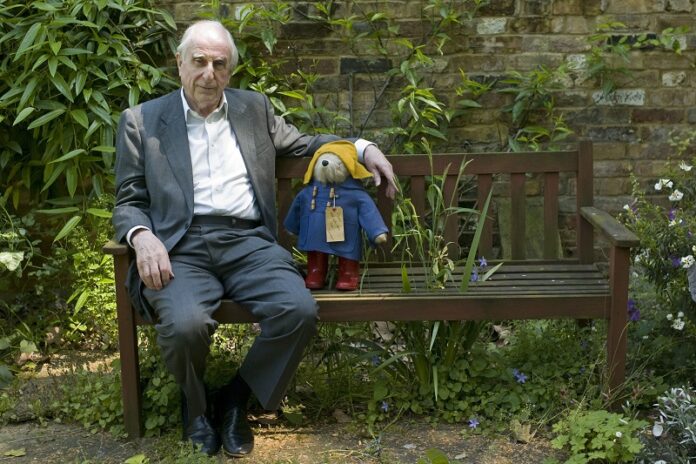
Michael Bond, Brought Paddington Bear to Life, 91

British author Michael Bond sits with a Paddington Bear toy on June 5, 2008, during an interview with The Associated Press in London. Photo: Sang Tan / Associated Press

LONDON — Michael Bond, creator of marmalade-loving children’s favorite Paddington bear, has died aged 91, his publisher said Wednesday.

HarperCollins said Bond died at his home the previous day after a short illness.

Ann-Janine Murtagh, executive publisher of HarperCollins Children’s Books, said the duffel-coated, Wellington boot-wearing bear “touched my own heart as a child and will live on in the hearts of future generations.”

The furry adventurer first appeared in “A Bear Called Paddington” in 1958 — a stowaway from “Darkest Peru” who arrived at London’s Paddington train station wearing a sign saying “Please look after this bear. Thank you.”

Adopted by the Brown family, the misadventure-prone bear went on to star in some 20 books, a television series and a feature film.

The books have sold some 35 million copies worldwide and have been translated into 40 languages, including Latin (“Ursus Nomine Paddington”).

Bond said he based the character on a teddy bear that he bought for his wife as a stocking filler, and named him after the station he used for daily commutes.

Today, countless stuffed Paddingtons are for sale in toy stores and souvenir stands around Britain, and a statue of the iconic bear stands at the station.

Explaining the character’s enduring appeal in 2008, Bond said “there’s something about bears which sets them apart from the other toys.”

“I think dolls are always wondering what they’re going to wear next,” he told The Associated Press. “Bears have this quality that children in particular feel they can tell their secrets to and they won’t pass them on.”

Advertisement

Phuket Vows to Become Thailand’s 1st Corruption-Free Province

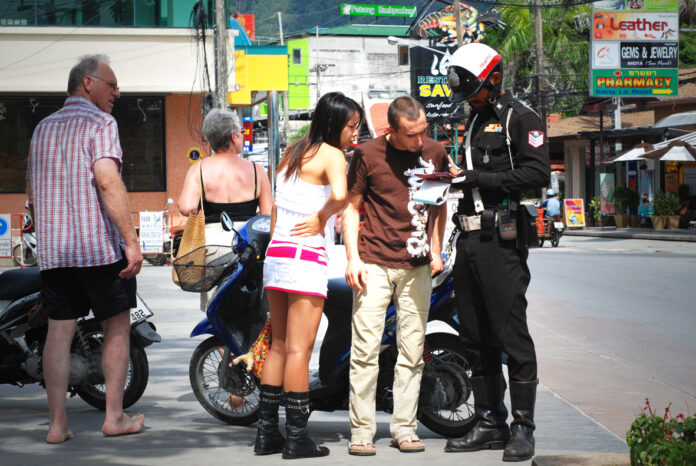
Tourists are fined for riding a motorbike without wearing helmets in 2008 in Phuket. Photo: William Cho/ Flickr.

PHUKET — The governor of a popular island in the Andaman Sea promised to make it Thailand’s first province to end corruption after he signed an agreement with anti-corruption officials Tuesday.

Phuket Gov. Norraphat Plodthong signed a memorandum of understanding with the Office of Public Sector Anti-Corruption Commission – which operates under the Ministry of Justice – by which he agreed to implement policies to tackle corrupt practices in the island.

Prayong Preeyachitt, secretary-general of the commission, said Phuket aims to take action to lower the risk of bribery and corruption.

In February, the Anti-Corruption Organization published an article about corruption on Phuket which its secretary-general, Mana Nimitmongkol, discussed bribery on the island and said some foreign businessmen faced problems obtaining licenses. Mana said the businessmen resorted to bribing authorities due to the sluggishness of the process and incompetence of the officials.

Advertisement

Govt Ditches Open Bidding to Gift Megaproject to Developer

A concept design for Bangkok Observation Tower. Image: Bangkok Observation Tower Foundation

BANGKOK — The government on Tuesday exempted construction of a multi-billion baht tourist attraction from mandatory competitive bidding, saying such a hassle might cause delay.

Rather than open bidding, which is required for firms that invest in government projects, construction of the upcoming 459-meter high Bangkok Observation Tower was directly handed over to a private entity linked to a luxury high-rise complex being built right next door.

“If we open it for bidding to find a private developer, I don’t know if anyone would be interested, because the project value is quite high,” Finance Minister Apisak Tantivorawong told reporters Wednesday. “And they wouldn’t know if it would be worth their investment.”

Private companies that invest with the state are typically required to compete with other firms in open bidding to ensure transparency and discourage graft.

Under the agreement approved by the cabinet, a plot of land owned by the treasury department will be leased to a private entity called Bangkok Observation Tower Foundation over the next 30 years at the fee of 198 million baht – about 6.6 million baht per year. The landmark is located in the Khlong San district on the west bank of the Chao Phraya River.

The Bangkok Observation Tower Foundation has no website or listed phone number.

Media reports named its chairman as Panas Simasathien, a veteran businessman who’s serving as a board director of Siam Piwat group, a land developer behind Siam Paragon and Siam Center shopping malls.

The same developer is also building a residence and shopping mall complex called Icon Siam next to the the site where the observation tower will be constructed, though one official maintained they are owned by different entities.

“It doesn’t belong to Icon Siam,” Pachara Anuntasilpa, director of the Treasury Department, which owned the land earmarked for the observation tower construction.

It was the second time the military government has subverted the procurement process this month. On June 15, Gen. Prayuth Chan-ocha used his absolute power to skirt 10 laws and regulations, including those related to bidding, to expedite construction of a stalled Sino-Thai railway project.

The tower project is part of a plan by the government to construct the so-called observation towers in 10 provinces with the stated aim of promoting tourism with their panoramic view of the cities. While towers in other provinces are operated and built by regional authorities, the one in the capital city will be overseen by the private foundation.

Construction of the tower is estimated to cost 4.5 billion baht, 198 million baht of which will be paid to the Treasury Department as rent. The Cabinet minute says the cost will be entirely covered by the foundation and the private firm selected for the project. Apisak, the finance minister, said it won’t cost the state a single baht.

Any entry fees collected would also be used to maintain the observation tower and not distributed among investors, the minister added.

Apart from the observation deck, the tower will feature an exhibition hall dedicated to the life and work of the late King Bhumibol, he said.

Related stories:

Oil Extraction on Protected Land Resumes Under Junta’s Shield

Junta to Sidestep 5 Laws to Move Stalled Railway Project

Advertisement

New Anti-Torture Committee Greeted with Skepticism, Criticism

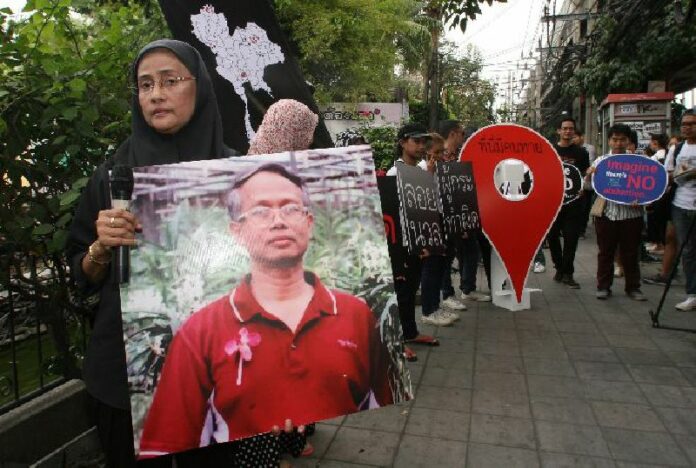
Activists mark the 11th anniversary of the abduction of human rights lawyer Somchai Neelapaijit in 2015 in Bangkok.

BANGKOK — As Thailand has delayed passage of legislation to criminalize torture and enforced disappearances, a committee created by the junta leader to investigate the matter met for the first time Monday.

The committee, chaired by Justice Minister Suwaphan Tanyuvardhana, was set up under Gen. Prayuth Chan-ocha’s capacity as prime minister on May 23. At its first meeting, the 15-member committee resolved to create three subcommittees tasked with examining allegations of torture and enforced disappearance, means of prevention, and the rehabilitation and compensation of victims.

“I don’t think the Thai government can shirk [on its international obligations]. Because it’s a commitment made to the international community,” said Pitikarn Sitthidej, director general of the Rights and Liberties Protection Department and a default member of the committee.

But Critics are largely skeptical as to what the new body can accomplish, particularly under military rule, where secret detentions remain in routine practice and no legal definition of torture exists.

“This initiative can’t be taken seriously. Without a law recognizing these crimes, the new committee can do little beyond providing compensation for victims and their families. Abusive officials will remain untouchable and could carry on the brutal practices without fear of punishment,” said Human Right’s Watch senior researcher Sunai Phasuk on Tuesday in reaction to the new committee. “Gen. Prayuth is talking with both sides of his mouth. While giving pledges to end torture and enforced disappearance, his regime has routinely put people in secret incommunicado detention and interrogated them without safeguards against abuse.”

But Pitikarn, who will head the subcommittee on rehabilitation and compensation, was upbeat when interviewed Monday.

“Although there’s no law criminalizing torture as of yet, there exist laws stating that severely causing injuries to someone is illegal. It’s just that there has been no definition on what constitutes as torture,” Pitikarn said.

A subcommittee, she said, will pursue and examine complaints as if the yet-unpassed law was already in effect.


10 Years of Waiting

On Monday, just as the new committee met for the first time, two international rights groups issued a statement urging the Thai government not to further delay the enactment of laws against torture and enforced disappearances.

Marking the 30th anniversary of the UN Convention against Torture and Other Cruel, Inhuman or Degrading Treatment or Punishment; Amnesty International and the International Commission of Jurists urged the Thai government on Monday “to ensure no further delay in implementing these undertakings.” It noted that October 2017 will mark the passage of 10 years since Thailand pledged to respect and protect the rights of all people to be free from torture and other ill-treatment by ratifying the convention against torture.

“Torture is impermissible in all circumstances, including during public emergencies or in the context of threats to public security,” the joint statement said. The two organizations also urged Thailand to ratify the Optional Protocol to the Convention against Torture which would establish a national preventive mechanism, including “an independent expert body authorised to visit places of detention, including by carrying out unannounced visits – as well as to allow such visits by an international expert body.”

Both organizations argued that such independent scrutiny is critical in the prevention of torture and other ill-treatment. What’s more, they urged Thailand to allow the inspection of detention centers in line with the UN Standard Minimum Rules for the Treatment of Prisoners, also known as the Nelson Mandela Rules.

“The Thai government has yet to ensure in law, policy and practice that individuals are not held in conditions that increase the risk of torture,” the joint statement read. “In particularly, laws and executive orders allowing individuals to be held by the military personnel in unofficial places of detention, without judicial authorization or access to lawyers, family members or medical personnel for up to a week, create conditions that facilitate torture and other ill-treatment.”

The organizations said this would require the National Council for Peace and Order, as the junta calls itself, to repeal Order No. 3/2015 which was enacted by the junta leader along with existing emergency laws. It also called for a credible report on torture to be written and made public.

Pitikarn said there’s no telling when the anti-torture bill – currently back at the Justice Ministry for revision – would be considered by the junta-appointed National Legislative Assembly, or if it would be enacted prior to the promised elections vaguely slated for 2018. She said the revision is required under Article 77 of the new constitution enacted in April.

Pitikarn added that while the law may not exist as yet, but that “the intent” of the government was reflected in the creation of the committee.

“There is no existing idea that supports torture because it’s a crime against humanity. It’s bad for the image [of Thailand],” she stressed.


Rights Groups Unimpressed

To, Pornpen Khongkachonkiet chairwoman of Amnesty International Thailand and director of Cross Cultural Foundation – a rights group working on rights issues in the deep south – the setting up of the committee cannot make up for the lack of anti-torture laws. She said setting up the committee is a mere tactic to buy time.

“It’s just there to buy time. The prime minister must have been briefed that the international community is keen [on the issue], so he set up the committee, which is only created under his order. Whether it works or not, there’s only half a political will present.”

Pornpenh said there exist 150 alleged torture cases compiled since 2012 in the three southern-most provinces alone waiting to be resolved. However, the committee used different stats. The committee’s chair and Justice Minister Suphawan on Monday cited UN figures which stated that 82 people have been tortured or forcibly made to disappear in Thailand.

On Tuesday, Kingsley Abbott, a Bangkok-based senior international legal advisor for the commission of jurists, tried to drop a compliment before piling the skepticism.

“While Thailand should be commended for any steps it takes, in good faith, to address torture and enforced disappearance, it is concerning that the committee was established shortly after the National Legislative Assembly returned the draft Prevention and Suppression of Torture and Enforced Disappearance Act to the Cabinet for more consultation, effectively prolonging the passage indefinitely,” Abbott said, adding that the establishment of the committee could not be used to supplant a law complying with the country’s international human rights obligations.

He said the criminalization of torture and other forms of ill-treatment were among such obligations along with the “provision of other safeguards against these acts, conducting independent, impartial and effective investigations to bring perpetrators to justice and providing remedies and reparations to victims.”

The list of critics seems endless. Ekapan Pinthavanit, director of Mahidol University’s Institute of Human Rights and Peace Studies, questioned the authority, legitimacy and longevity of the committee. He said that if there exists a law, criminalization of torture would be legally binding to all state organs while this could not be possible with a committee but without a legislation.

Even the wife of a famous Muslim rights lawyer who went missing – whose case the new committee vowed to tackle, wasn’t convinced.

“You may set up a committee, but without the law [criminalizing torture] you can’t do anything. There’s no legal definition in the Penal Code,” explained Angkhana Neelapajit, a National Human Rights Commissioner in charge of civil and political rights and whose husband – rights lawyer Somchai Neelapajit – went missing in 2004 during the Thaksin Shinawatra administration.

Somchai represented some Muslim defendants in cases of terrorism. He was last seen 13 years ago on March 2 in Ramkhamhaeng area in Bangkok, close to a police station, where eyewitnesses saw four men drag him from his car.

Angkhana said without the law criminalizing torture and enforced disappearance, she – as Somchai’s wife – could not even take legal action. The Department of Special Investigation declared the case closed after a decade last year in 2016. The new committee vowed to investigate it.

Angkhana said she doubts the committee’s authority, adding that the best it can do is to provide monetary compensation to victims and some rehabilitation.


Committee There to Fill the Legal Gap

Narong Jaiharn, a law professor at Thammasat University who specializes in criminal law and  who is also a member of the committee and chair of its subcommittee on prevention, insisted the organ was there to fill the gap while it waited for the law to be enacted.

Narong said alleged victims of torture or relatives of those suspected to have forcibly disappeared, can petition the committee, who will coordinate with related agencies. Narong added the committee would meet once every two months and that it was considering setting up a system to accept complaints upcountry so that affected people were not required to travel to Bangkok.

“We may also inspect prisons and places of temporary detention,” he said.

Narong stressed that the committee would also examine detention facilities and determine the attitude of security officials – both commanders and subordinates – when it came to torture and enforced disappearances.

“Enforced disappearance is something that shouldn’t occur or should be forbidden… Fostering such consciousness will be the next step,” he said.

Asked if the committee would inspect Bangkok’s infamous 11th Army Circle – used since the coup to detain opponents of the military regime for up to seven-day without charge – Narong said it wasn’t sure yet.


Advertisement

Citing Trump and Prayuth, Student Activist Rejects American Invite

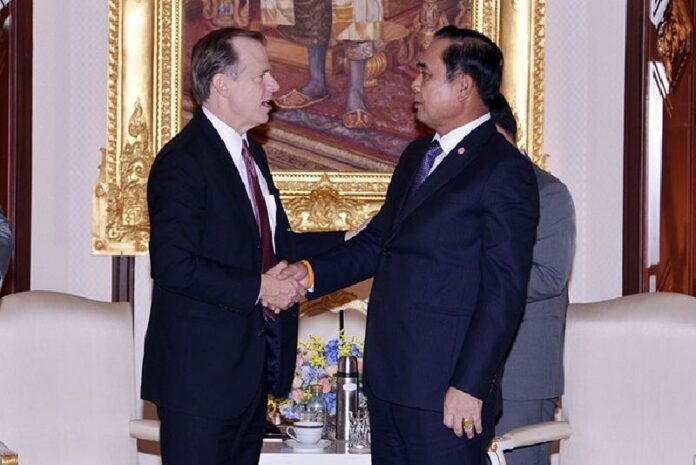
U.S. Ambassador Glyn Davies meets with junta chairman Gen. Prayuth Chan-ocha in 2015 at Government House.

BANGKOK — It may be an invitation coveted by many Thais, but pro-democracy student leader Netiwit Chotiphatphaisal publicly turned down an invitation by US Ambassador Glyn Davies to attend this year’s Fourth of July reception.

Netiwit, a 20-year-old Chulalongkorn University sophomore and arguably the most famous anti-junta student activist of his generation, said Wednesday that he wanted to send a message to the United States about the Trump administration’s cozy relationship with “dictator” Gen. Prayuth Chan-ocha, who staged the 2014 coup and installed himself as prime minister.

“I must speak out so they will understand how the democratic side [in Thailand] feels,” Netiwit said.

Netiwit, who’s president of his university’s student council and a second-year political science major, said he had informed a US embassy staff member that he was rejecting the invitation through a Line message. Netiwit then posted on Tuesday evening a dressing-down in Thai on his Facebook page, along with a photo of the invitation. The reception to which he was invited – the first Netiwit had be invited to attend by the embassy – is slated for Thursday evening.

In his Facebook post, Netiwit criticized Trump’s decision to invite Prayuth to the White House as contradictory to the American stance on democracy.

“Is this not contradictory if the US truly cares for human rights and democracy?” Netiwit wrote, adding that Prayuth is responsible for various human rights violations, including the detention of people who disagree with his regime. He also said Prayuth has destroyed the rule of law, and curbed freedom of expression.

“Why did the United States, under the current president, take no stance in criticizing these things and not warn the junta, which is trampling upon the Thai people? The people of the United States should very well know how important rights and liberties are to them, and that it’s crucial for the development of its nation and citizens as expressed in the slogan of ‘Give me liberty or death,’” Netiwit wrote.

The post on his Facebook account “Netiwit Ntw,” which is followed by more than 92,000 people, was shared more than 1,100 times and attracted more than 500 comments and 7,200 likes as of Wednesday morning.

“Very well written,” Facebook user Thanongsak Rataanasukon wrote in reply. “The declination was reasonable and smooth. The logic is solid.”

“Diplomacy is diplomacy. America is America. They are hypocrites,” Facebook user Kritsanapol Sriburapa wrote.

The move comes at a time when deputy junta leader Gen. Prawit Wongsuwan – instructed the military chief on Monday to draw a list of arms for possible purchase from the United States while Prayuth visits Washington, a trip originally scheduled for next month.

Prayuth last visited the states in February 2016 by invitation of the Obama administration for an ASEAN-U.S. Special Leaders’ Summit in Rancho Mirage, California.

Netiwit nonetheless thanked the US ambassador for having expressed pro-democracy sentiments in the past and for the invitation.

Messages to Davies’ Twitter account @GlynTDavies went unanswered as of Wednesday morning. Embassy spokesman Melissa Sweeney said she “hasn’t seen that” post. Sweeney later said that “the United States strongly supports freedom of expression and respects the rights of all individuals to express their opinions,” adding that Prayuth’s visit to the states was “an important opportunity” for him and Trump to “discuss the broad scope [their] partnership.”

Asked how the embassy staff member reacted to his message, Netiwit said “the male staffer said it was okay, that these kinds of things happen every year when both sides [of the political divide] are invited.”

Advertisement

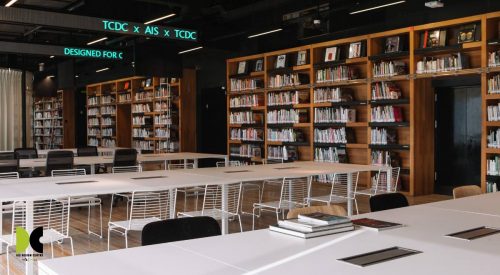
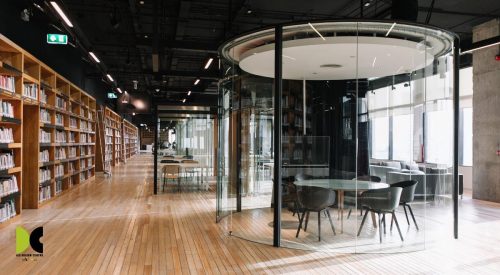
Emporium TCDC Reborn as AIS Design Centre

An image of AIS D.C. posted June 19. Photo: AIS D.C. / Facebook.

BANGKOK — A new design center opened June 21 at Emporium in the space formerly used by the Thailand Creative and Design Center, or TCDC, which moved its base to the Grand Postal Building in Charoenkrung last month.

The AIS Design Centre, or AIS D.C., has partially opened on the fifth floor of Emporium shopping mall to welcome new startups and those who interested in design and creative endeavors.

As its name suggests, the new place is a collaboration between mobile operator Advance Info Service, or AIS, and TCDC.

Read: Virtual Thailand: Tour TCDC’s New Riverside Home (VR)

The space is separated into various sections such as a library with more than 10,000 design and technology magazines, a playground area where creators can try new technologies on their products with consultation from experts, meeting rooms and a rental production studio.

There will also be many intensive courses for startups to attend, from technology and design to business.

Making use of the space requires an annual membership which costs 1,200 baht for adults and 600 baht for students. Entry is free for now until its official opening on July 18.

More information is available online.

AIS D.C. open daily from 10:30am to 9pm and is located on the fifth floor of Emporium, which can be reached from exit No. 2 of BTS Phrom Phong.

19221620 1869177470000377 6520273033255006114 o
An image of AIS D.C. posted June 19. Photo: AIS D.C. / Facebook.
19388516 1869177473333710 2985591576854173976 o
An image of AIS D.C. posted June 19. Photo: AIS D.C. / Facebook.

Advertisement

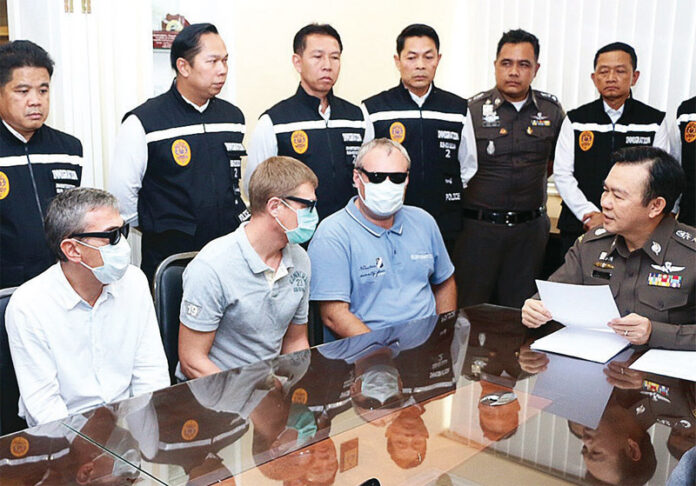
Visa Violators Threaten Thai Lives, Property: Labor Ministry

Police question three Russian men arrested March 21 on suspicion of overstaying their visas and extorting Thai businesses in Pattaya .

BANGKOK — A new set of harsher punishments for foreigners who work illegally is necessary in the name of protecting the “lives and property of Thai people,” a Labor Ministry spokesman said Wednesday

The revised labor law, which came into effect Friday, prescribes tougher jail terms and fines for both foreign employees and their Thai employers who violate visa and work permit regulations. The same law also added more severe punishment for those engaged in human trafficking.

“This new law will be applied to foreigners of all nationalities, not just the three neighboring countries,” spokesman Ananchai Uthaipatanacheep said by phone. “Whether you are from Vietnam or Russia, if you do something wrong, you will get the tougher punishment.”

Foreigners caught working in Thailand without a work permit face a maximum jail terms of five years and fines up to 100,000 baht. Foreigners who are employed in occupations other than what’s registered on their work permit risk fines up to 100,000 baht, five times as much as previously.

Meanwhile, employers convicted of hiring foreigners without proper registration face a maximum fine of 800,000 baht per worker, or eight times the previous fine of 100,000 baht.

Ananchai said the harsher penalties will weed out foreigners who live or work in Thailand without registering with the authorities, which can threaten the “safety and lives and property of Thai people.”

The spokesman said expats who have valid visas and work permits need not worry.

“If you enter the kingdom legally, and if you possess the proper passports, visas and work permits, I can guarantee you that this new law won’t affect you,” he said.

Related stories:

Gov’t Approves 10-Year Visas for Foreigners Over 50

Free Tourist Visas Extended Through August

Advertisement

Hot News

LATEST NEWS

Bangkok
broken clouds
33.3 ° C
33.3 °
32.7 °
59 %
1.3kmh
70 %
Sun
36 °
Mon
37 °
Tue
36 °
Wed
37 °
Thu
36 °