






























32.7 C
Bangkok
Friday, June 5, 2026
Home Blog Page 2336

Thai Free Press Sinking Into the Abyss

'Stop the licensing of media. Stop manipulating people,' reads this image from a social media campaign against the so-called 'media reform bill.' Photo: Chavarong Limpattamapanee

retention.column

In a dictator’s wildest dreams, there will only be friendly journalists acting as de facto propaganda mouthpiece who will occasionally sing along in karaoke sessions. Those critical of the dictatorial state would be banned from practicing journalism.

Such a dream is not a fantasy but looks increasingly real for Thailand. If the deceptive “media-reform bill” gets a nod by the cabinet next week and soon after by the junta-appointed National Legislative Assembly, a rubber-stamp parliament, all Thai journalists will be required to possess a license to practice their craft. A committee, filled with senior government officials and media professionals friendly to the state will decide who will qualify for a professional license and whose licenses should be renewed.

The yet-to-be-established 13-person “national media professional council” will contain four council members who are top bureaucrats from four ministries, namely permanent secretaries from the ministries of digital economy, finance, culture and the Prime Minister’s Office.

Put simply, if the bill is passed, journalists who question the illegitimate junta power or future elected regimes may find themselves unable to attain a license while those who flatter those in power enough will have no problem.

Even newspapers such as the Thai Post, for nearly three years a beacon of pro-junta journalism, has come to a rude awakening. On Thursday, the paper denounced the proposed bill as an attempt to suppress press freedom at the top of its front page. It may be too little too late. Those drafting the bill and those who will ultimately consider the bill are all appointed by the junta leader Gen. Prayuth Chan-ocha, who led the May 2014 coup.
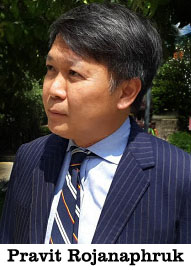
Pravit.mug .column.finalCiting one of the world’s worst places for free press, Air Chief Marshal Kanit Suwannate, chairman of the National Reform Steering Assembly’s Media Reform subcommittee who drafted the proposed bill looked to Singapore as a model to emulate.

Kanit was quoted in the media Friday saying, “Licensing under this bill will keep the press in order like in Singapore.”

Late last night, Human Rights Watch had this to say:

“The misnamed media rights and freedom law is the junta’s latest attempt to increase government interference and control of any independent news reporting,” Brad Adams, its Asia director wrote. “Passage of this draft law would mean that reporters in Thailand will be constantly looking over their shoulder at a government-appointed panel that can have them jailed.”

According to Paris-based Reporters Without Borders’s latest annual World Press Freedom Index for 2017, Singapore currently was ranked even lower than Juntaland Thailand, at number 151 out of 180 nations. North Korea came in at 180, in case you wonder.

Thailand fell six places this year to No. 142, which is still nine ahead of Singapore – but maybe not for long.

Here’s how RSF describes press freedom, or the lack of it, in Singapore, which Kanit seems to admire and want to emulate:

“Prime Minister Lee Hsien Loong’s government responds vigorously to criticism from journalists and does not hesitate to sue its detractors and apply pressure to make them unemployable, or even force them to leave the country. The Media Development Authority has the power to censor journalistic content, both in the traditional media and online. Defamation suits are common in the city-state and may sometimes be accompanied by a charge of sedition, which is punishable by up to 21 years in prison. The range of issues and public figures that are off limits for the media is growing.  Journalists refer to the red lines as “OB markers” (for out-of-bounds markers.)”

For decades, Thailand already has its OB markers from its draconian lese majeste law, making any criticism of the monarchy, no matter how gentle or well-intended, or sharing critical content, a crime punishable by 15 years in jail. Since the 2014 coup, the junta has made the Computer Crime Act even harsher. Now, the deceptively-named Media-Reform Bill could be the nail in the coffin.

The proposed bill will control not just the press but online media that’s not traditionally counted as proper media organizations. It restricts the public’s right to be informed as well.

It may take many years before the Thai press will recover its lost ground, taken away by the National Council for Peace and Order, if ever.

Thailand, or Juntaland, is definitely heading backward, regressively, when it comes to press freedom and freedom of expression.

The repressive abyss where a free press is illegal is looking increasingly like the junta’s preferred final destination for Thailand.

Advertisement

Sony Back in Black on Strong Chip, Game, Battery Sales

People walk out from the headquarters of Sony Corp. in Tokyo on Friday. Photo: Shuji Kajiyama / Associated Press

TOKYO — Sony Corp. reported Friday a January-March profit of 27.7 billion yen (8.6 billion baht) on the back of healthy sales of image sensors, PlayStation 4 game software and batteries for mobile devices, marking a recovery from its red ink a year ago.

Tokyo-based Sony had an 88 billion yen loss in the same period last year, although that was a fraction of the red ink it had posted in years before as it contended with competition from rivals like Apple and Samsung in smartphones and other electronics devices.

Quarterly sales rose 4.4 percent to 1.9 trillion yen (USD$17 billion).

For the fiscal year through March, Sony’s profit fell 50 percent to 73.3 billion yen ($660 million) from 148 billion yen, partly because of costs related to repair of damage from a major earthquake that hit southwestern Japan in April 2016.

The quake shut down Sony’s semiconductor manufacturing facility. An unfavorable exchange rate also damaged Sony’s results.

Also hurting the annual results was the write-down Sony took earlier this year on its movie division, or what’s called “goodwill impairment,” stemming from its acquisition of Columbia Pictures in 1989.

Sony is projecting a three-fold recovery for the fiscal year through March 2018, because of the absence of quake- and movie-related costs, at 255 billion yen ($2.3 billion), although it warned currency fluctuations could hurt results.

Sony has been reshaping its business by focusing on high-end cameras and video games. It has already sold some assets, including its Vaio personal computer business. Its TV division lost money for years but has recently recovered.

In its movie business, “Resident Evil: The Final Chapter,” released in the January-March quarter was one of its biggest successes in recent quarters, especially with the international box office. Best-selling titles for the year in its music division included Beyonce’s “Lemonade” and Sia’s “This Is Acting.”

Story: Yuri Kageyama

Advertisement

ASEAN Alarm Over N. Korea, Sea Feud in Summit Spotlight

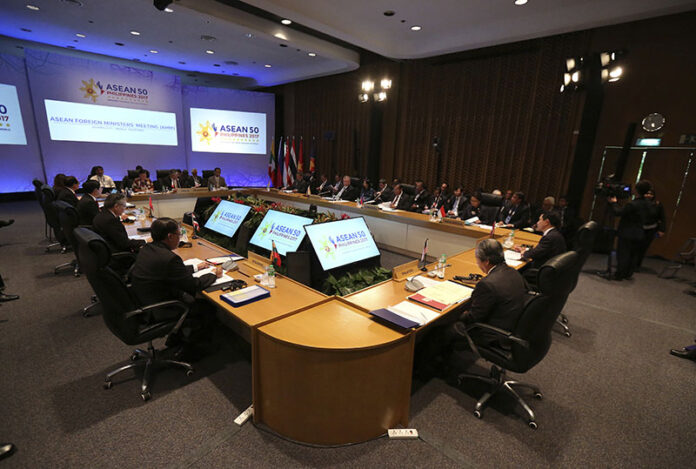
ASEAN Foreign Ministers talk during the ASEAN Foreign Ministers Meeting in metropolitan Manila on Friday. Photo: Aaron Favila / Associated Press

MANILA — Alarm over North Korea’s nuclear ambitions and its intensifying standoff with the United States, and tensions over China’s assertive territorial claims in the South China Sea are under the spotlight at an annual summit of Southeast Asian nations in Manila.

Foreign ministers of the Association of Southeast Asian Nations met under extra heavy security in the Philippine capital on Friday, the eve of the summit of the 10-nation bloc, to discuss regional security and efforts to integrate their economies in response to growing Chinese clout.

Philippine President Rodrigo Duterte is also under the limelight as he hosts his first regional summit amid sharp criticism by Western governments and human rights groups of his bloody crackdown on illegal drugs that has left thousands of suspects dead.

The ASEAN foreign ministers issued a statement expressing “grave concern” over North Korea’s nuclear missile tests, despite a plea from the North not to be subjected to such pressure.

They said instability on the Korean Peninsula “seriously impacts the region and beyond.”

ASEAN also urged North Korea and all parties concerned “to exercise self-restraint in order to de-escalate the tension and refrain from actions that may aggravate the situation,” adding its voice to growing international alarm over the crisis involving the North and its rivals, led by the United States.

President Donald Trump’s administration has declared that all options, including a targeted military strike, remain on the table. But a pre-emptive attack isn’t likely, U.S. officials have said, and the administration is pursuing a strategy of boosting pressure on North Korea with assistance from China, the North’s main trading partner and economic lifeline.

North Korea has been reaching out to other nations to ease criticism amid the U.S. threats, according to a Philippine official.

North Korea sent its Thailand-based ambassador to Manila recently “to suggest that North Korea not be put under pressure” during the ASEAN meetings hosted by the Philippines, said the official, who spoke on condition of anonymity because he wasn’t authorized to discuss the matter with the media.

The ASEAN foreign ministers also discussed long-simmering territorial disputes in the busy South China Sea involving ASEAN members Brunei, Malaysia, the Philippines and Vietnam. The most powerful claimant, China, is pressuring ASEAN not to mention an arbitration decision last year that invalidated Beijing’s claims to most of the disputed waters, according to three Philippine officials who spoke to the AP on the issue.

A draft of an ASEAN communique to be issued by Duterte at the end of the summit on Saturday does not mention the Philippines’ arbitration victory but calls for “full respect for legal and diplomatic processes,” which the Chinese also wanted removed because they believe it referred to the ruling, the officials said.

The three officials spoke on condition of anonymity because of the sensitivity of the issue.

Chinese Embassy officials did not immediately respond to a request for comment. Duterte told reporters Thursday that he would not raise the arbitration ruling at the summit, a stance critics say is subservient to Beijing.

Duterte, who has reached out to China to boost trade and seek infrastructure funding, said the ruling is an issue between China and the Philippines and does not concern other ASEAN member states.

Duterte, 72, will also be under the summit spotlight. Just less than a year in power, he faces a mass murder complaint before the International Criminal Court and an impeachment bid at home as bodies continue to pile up in his war on illegal drugs.

Duterte, however, is likely to find solace from the storm of criticism during ASEAN, which has a bedrock policy forbidding member states from meddling in each other’s domestic affairs.

That has fostered the 10-nation bloc, founded half a century ago, as it evolved into an unwieldy collective of dictatorships, authoritarian states and a monarchy, along with fledgling democracies.

“The ratbag of dictators, autocrats and juntas that dominate ASEAN’s ranks perceive transparency, accountability and rule of law as existential threats rather than foundations of good governance,” said Phelim Kine of the U.S.-based group Human Rights Watch.

“Expect ASEAN leaders to yet again throw the human rights of an Asian country under the bus by remaining silent about Duterte’s abusive drug war by implicitly or explicitly invoking the organization’s ‘non-interference’ principle,'” Kine said.

Once a government prosecutor who fought outlaws and insurgents, Duterte became a longtime mayor of southern Davao city, where he received the nickname “Duterte Harry,” after Clint Eastwood’s Dirty Harry movie character, for his deadly anti-crime campaign.

Since becoming president last June, his crackdown on suspected drug dealers and users has left nearly 2,800 people dead purportedly in gunbattles with police. Another 6,000 deaths are being investigated.

Story: Jim Gomez, Teresa Cerojano

Advertisement

‘Fyre Festival’ for Ultra Wealthy Proves Epic Disaster

Photo: @Rwhiteruff / Twitter

MIAMI — Organizers of a much-hyped music festival in the Bahamas canceled the weekend event at the last minute Friday after many people had already arrived and spent thousands of dollars on tickets and travel.

Fyre Festival organizers announced the cancellation of what they previously billed as a “once-in-a-lifetime” concert along the lines of the Coachella Valley Music and Arts Festival in Southern California. People had already begun arriving in the Exuma islands for the first of two weekends that was to include performances by Blink-182 and others.

A statement cited “circumstances out of our control,” for their inability to prepare the “physical infrastructure” for the event in the largely undeveloped Exumas. Photos published on social media showed tents, wooden stalls and portable lavatories had been brought in for the festival, which was produced by a partnership that includes rapper Ja Rule.

“I’m heartbroken at this moment,” Ja Rule, whose real name is Jeffrey Atkins, said on Twitter. “I wanted this to be an amazing event. It was not a scam as everyone is reporting.”

The event also proved a popular topic for ridicule on social media.

https://twitter.com/dustinrefill/status/858077447614377984


The Fyre Festival had promised “culinary delights and luxury” over this weekend and the second one in May. Organizers had relied on models and other minor celebrities to heavily promote the festival as a glitzy destination event. It was unclear from the website if the second weekend would also be canceled.

The Bahamas tourism ministry had expected it to be one of the largest such events ever held in the island chain east of Florida. But attendees complained bitterly in social media posts about disorganization, a lack of accommodations and inadequate food.

Advertisement

Famous Fat Macaque May Not be Fat After All: Vets

Uncle Fatty drinks milk in a photo posted Friday morning. Photo: Steadfast Monkey Lovers / Facebook

BANGKOK — Uncle Fatty, a macaque whose giant gut has brought him social media stardom, may actually have cancer, veterinarians said Friday.

After photos of Uncle Fatty’s swollen belly went viral earlier this week, national wildlife vets hunted down the 10-year-old animal in the Bang Khun Thian district to bring him in for evaluation.

They found tumors in Uncle Fatty’s stomach and are testing them to find out whether they are cancerous or benign. Uncle Fatty is under the care of wildlife officials as he awaits his test results, which will take about a week. The 26-kilogram macaque will also be tested for herpes, tuberculosis, liver disease and parasites. However, he definitely has a lung infection.

“Uncle Fatty loves the baby monkeys around him. He’s like a fat old gramps that the kids just love to climb all over because he hides food under his belly,” read a Friday morning post in Steadfast Monkey Lovers, a Facebook group of simian enthusiasts. “Sometimes he teaches the kids to swim, climb trees and find lice.”

He’s become a fixture of Bang Khun Thian, and many people have expressed concern about his health.

“I love Uncle Fatty with all of my heart,” Facebook user Prarawin Sukarin said.

Advertisement

Samet Residents Complain Island Music Fest an Unwelcome Mess

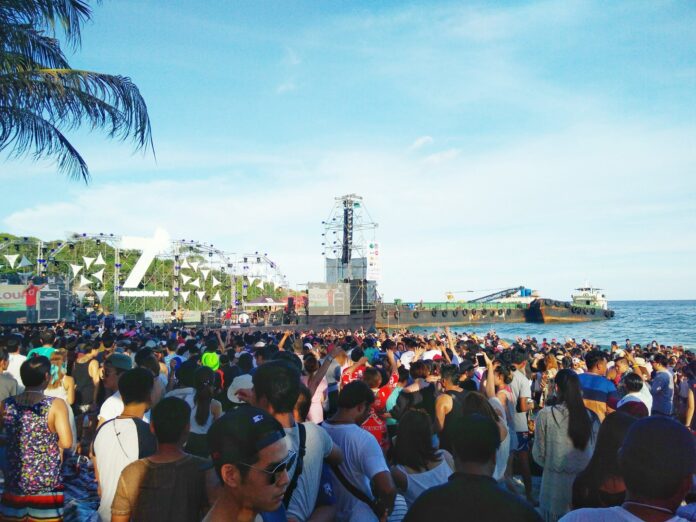
A photo of the 2016 Samed in Love Music Festival posted on June 4, 2016. Photo: Samed in Love / Facebook.

RAYONG — A music festival on Ko Samet suspended ticket sales Thursday after the island community complained it benefits only the organizer and leaves behind nothing but garbage.

Prayoon Pongphan, head of the national park where the island is situated, said Friday that he fielded complaints about the environmental impact and appropriateness of the Samed in Love Music Festival, which is scheduled to take place in June.

“Locals said that for the past seven years, garbage piles of plastic bags and bottles from the festival still remain and have increased,” said Prayoon, chief of the Khao Laem Ya–Mu Ko Samet National Park.

Read: Banana Boats, Parasails Banned From Samet Beaches

On Wednesday, Prayoon, who replaced the park’s former head in September in a bid to stem corruption, presided over a meeting where the objections were raised.

Environmental issues topped concerns at the meeting, as did the national mourning period for King Bhumibol. The residents asked that the festival be barred from taking place this year.

The islanders said they don’t benefit financially from the festival, as its organizer prevents them from selling anything there. Resort owners complained rooms booked for two were used to cram in six guests.

Others suggested it was a double-standard.

“They also questioned how music could be played almost all night at the festival while it’s not allowed at the pubs, bars and restaurants on the island after 11pm, and they must close at midnight since the coup,” Prayoon said, adding that their comments have been forwarded to the National Parks, Wildlife and Plant Conservation Department.

The festival organizer said it has sought to address the issues, according to a Thursday post on Samed in Love’s Facebook page, and suspended ticket sales, which began April 8.

“There are no tickets selling as of now,” it said.

The chief said the music festival was against the law under Section 16 of the 2010 National Park Act, which prohibits causing loud disturbances or disturbing others within a park.

Since the 2014 coup, the authorities have sought to rein in Ko Samet’s reputation as an LGBT-friendly party destination by imposing a nightlife curfew and banning other activities from the island, which is part of a national park.

Previously, it was Rayong Gov. Surasak Charoensirichok who filed the request to allow the festival with the national parks department. Its director-general, Thanya Netithammakun, declined to sign the deal and asked the organizer to consider whether the festival should be held.

Prayoon said Friday he had no recommendations to offer the festival organizers, as their event is technically against the law.

“We have to protect the law,” he said.

The festival is set for June 3 at Silver Sands Beach on Ko Samet.

In September 2016, Prayoon was transferred to the position to replace Thanit Chantadech as part of a mass transfer of 80 officials to combat organized crime, which allegedly demanded money from businesses such as banana boat operators, masseuses and fire dancers.


Related stories:

Banana Boats, Parasails Banned From Samet Beaches

Business Owners Decry Koh Samet Nightlife Curfew


Advertisement

Vietnam Court Condemns 8 to Death for Heroin Trafficking

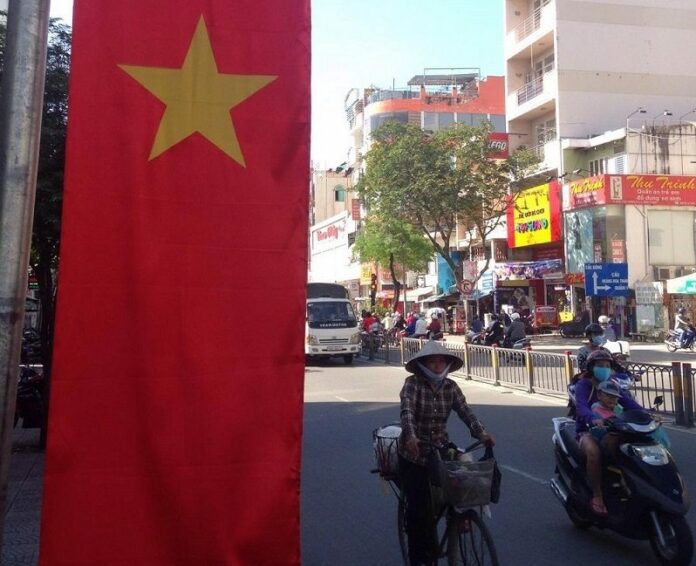
A woman cycles past one of the many banners depicting the Vietnamese flag, November 2016 in the streets of Ho Chi Minh City, Vietnam.

HANOI  Vietnamese state media say a court in Hanoi has condemned eight people to death for heroin trafficking.

The Hanoi People’s Court on Thursday convicted 11 people of trafficking 303 kilograms (666 pounds) of heroin to China between 2004 until the ring was broken up in 2015.

The People’s Police newspaper reported Friday that eight of the 11 were condemned to death. The three others were sentenced to life imprisonment, including ringleader Dang Minh Chau, whose penalty was reduced because she has a child under 3 years of age.

Vietnam has some of the world’s toughest drug laws. Possessing or trafficking 100 grams (3 ½ ounces) of heroin or 20 kilograms (44 pounds) of opium is punishable by death.

The country shifted executions from firing squads to lethal injection in 2013.

Advertisement

New Shuttle Routes to Don Mueang Airport to Open Monday

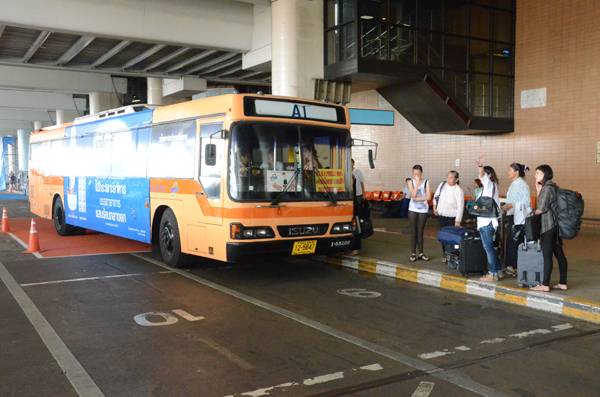
The A1 airport shuttle at Don Mueang Airport. Photo: Don Mueang Airport Thai

BANGKOK — Getting between downtown to Don Mueang International Airport will become easier when two new airport shuttle routes launch Monday.

For 50 baht, travel between the airport and two new destinations: Lumphini Park downtown and Sanam Luang in the old quarter.

The A3 service will stop at Lumphini Park, Ratchaprasong, Pratunam and Din Daeng before heading to the airport by tollway.

The A4 line runs between the airport and Sanam Luang (Royal Grounds), stopping at Khaosan Road, the Democracy Monument, the Phanfa Bridge, Lan Luang, Yommarat, Tha Prachan and Tha Chang along the way.

The two lines come two years after the introduction of bus routes between the Bangkok Bus Terminal (A1) and Victory Monument (A2).

They are more affordable options than the Airport Limo Bus service, which can be booked online for 150 baht per person.

The routes launch May 1 and will operate 7am to 11pm daily.

At the airport, find the buses outside Terminal 1’s exit No. 6 or exit No. 12 in Terminal 2.

The new A3 bus route begins at Lumphini Park

The new A4 bus route begins across from the National Theatre


Update:
 Bangkok Mass Transit Authority announced Saturday morning to increase the fare for A3 and A4 lines from 30 baht to 50 baht.

Advertisement

Court Approves Warrant to Arrest Red Bull Heir

Vorayuth "Boss" Yoovidhya, whose grandfather co-founded energy drink company Red Bull, walks to get in a car as he leaves a house in London, Wednesday, April 5, 2017. Photo: Matt Dunham / Associated Press

BANGKOK — For the first time since millionaire Vorayuth “Boss” Yoovidhya killed a policeman with his Ferrari nearly five years ago, a warrant for his arrest was approved by a court Friday.

Prodded by public attention, the authorities won court approval for a warrant for his arrest, a necessary step to eventually moved seeking extradition of the 32-year-old grandson of the man who started the Red Bull energy drink empire.

“We have already applied for a warrant from the court,” Achawin Boonthamcharoen, chief investigator of Thonglor Police Station, which oversees the investigation, said by telephone prior to the court’s swift action.

Read: Red Bull Heir’s No Show Prompts Pledge of Extradition

The move comes one day after Vorayuth failed to appear yet again before authorities in Bangkok.

If a warrant is issued, officers will notify the immigration bureau to apprehend Vorayuth if he ever returns to Thailand, Lt. Col. Achawin said. He said police will also instruct prosecutors to start the process of extradition.

“Based on preliminary reports, it appears he is outside Thailand,” Achawin said of Vorayuth, who recently moved out from an address in London.

Vorayuth left the country soon after the September 2012 car crash that killed Sgt. Maj. Wichian Klanprasert, ostensibly to seek medical treatment in Singapore. He has lived in Bangkok and abroad for the past four years, during which time he has repeatedly ignored summonses from prosecutors, citing claims of unfair treatment.

Asked whether an arrest warrant would prompt police to raid Vorayuth’s home in Bangkok to search for him, Achawin ruled it out.

“I don’t think we will go that far,” he said.

For the deadly crash, Vorayuth was charged with fatal reckless driving, failure to report an accident to the police, speeding and damaging property. The two latter charges have already expired, while the count of hit-and-run is due to expire in September. The statute of limitations for the most serious charge – fatal reckless driving – is valid until 2027.

Related stories:

Cops Say No Cause to Arrest Red Bull Heir Living Openly in Bangkok

In UK, Red Bull ‘Boss’ Silent About Thai Crash Case

Red Bull Heir Enjoys Jet-Set Life 4 Years After Hit-and-Run

Advertisement

Pride in Produce Puts Bangkok’s Or Tor Kor Market Among World’s Best

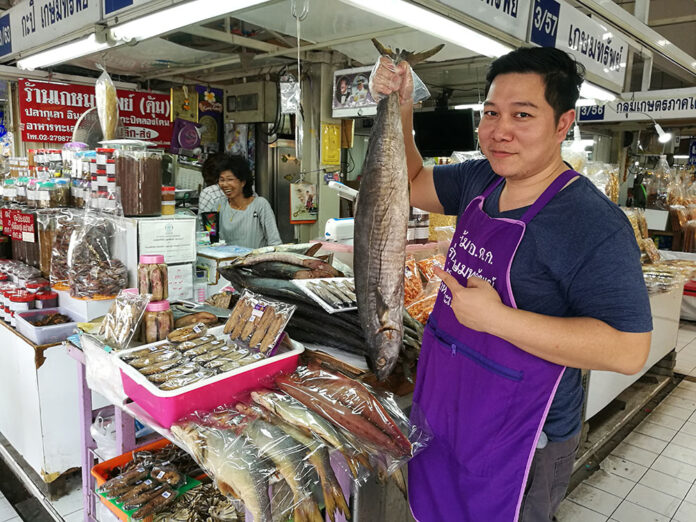
Songkom Rattanapongtara shows off his salted king mackerel, or 'plaa in see' on Tuesday at Bangkok's Or Tor Kor Market.

Top: Songkom Rattanapongtara shows off his salted king mackerel, or ‘plaa in see’ on Tuesday at Bangkok’s Or Tor Kor Market.

BANGKOK — Merchants at the Or Tor Kor Market say premium quality produce, long experience and wealthy customers means they were not surprised to learn it was recently ranked among the world’s best fresh markets.

Or Tor Kor placed fourth by CNN Travel when the results were revealed April 18. That put the upscale Bangkok market – next to the famous Chatuchak Weekend Market – just behind Barcelona’s La Boqueria at No. 1, Tokyo’s Tsukiji Fish Market  and New York City’s Union Square Farmer’s Market.

“Located next to Bangkok’s busy Chatuchak weekend market, Or Tor Kor Market is as packed with perfect produce as its neighbors with souvenirs and tchotchkes. Or Tor Kor displays exotic fruits and vegetables that are unique to Thailand, as well as imported specialties from around Asia,” CNN Travel said. “The market is immaculate and brightly lit, allowing shoppers to easily cruise for seafood, sweets and cooked foods. Tourists will enjoy Or Tor Kor’s wide selection of prepared curry pastes and spices to take back home, and a food court filled with Thai specialties.”

The sense of pride was palpable Tuesday during a visit to talk to some of the market’s merchants.

“I am proud. But we will be happier if we make it to No. 3,” said Songkom Rattanapongtara, a third-generation salted fish, dried shrimp and shrimp paste dealer at the Kapi Kasemsab stall, marked as kiosk No. 3/64 at the southeastern edge of the market.

IMG 20170425 154331
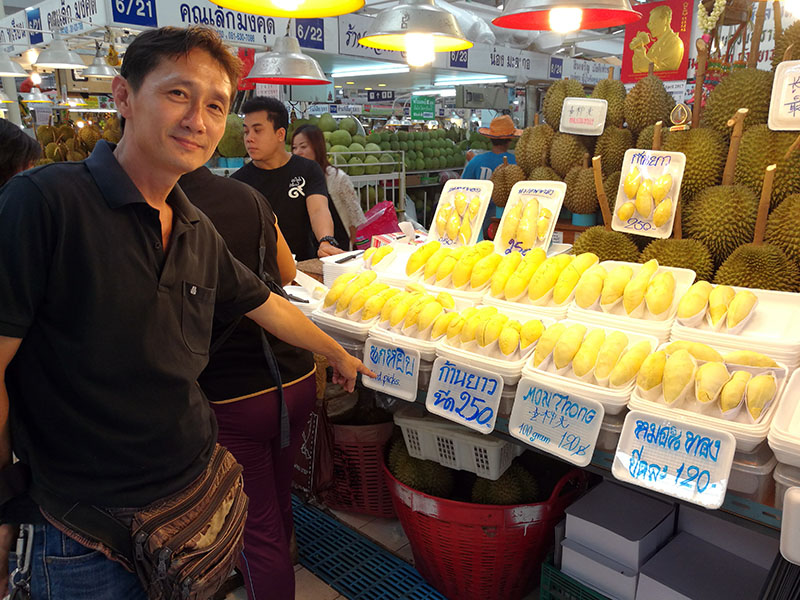
Somnuk Thipayavarawan shows his spread of premium durian Tuesday at Bangkok’s Or Tor Kor Market.

Songkom, 33, said wat distinguishes Or Tor Kor from other fresh markets are vendors with experience, buyers who prioritize quality over cost, and a high concentration of premium goods and produce. The market is owned and operated by the Ministry of Agriculture.

Songkom grabbed nearly three kilograms of handsome-looking salted king mackerel, or plaa in see, from the Gulf of Thailand as an example. When it comes to shrimp paste, or kapi, an ingredient essential to many traditional Thai dishes, Songkom offers five, premium-grade types of the stuff. One is from Koh Chang, better known by tourists these days as a beach destination, while another made of black-eyed krill – a rare small-sized shrimp – is from Samut Songkhram province.

“In terms of quality, we are second to none. Even when compared to buying from merchants at the source. This is because of our experience,” said Songkom, who grew up learning about the profession from his parents and grandparents.

During Tuesday’s visit, a limousine halted at the kiosk. It carried a regular customer there for two slices of salted king mackerel. Eighty percent of Songkom’s customers are Thai, while the rest are mostly Asians, particularly Chinese and Indonesians. When asked what could be improved at the market, Songkom said the market operator could be more helpful packaging goods for foreign clients to be sent abroad, provide for more parking space and rubbish bins. He said the number of trash bins was actually reduced due to Chinese tour groups dumping so much garbage, but he argued that the market operator should not be stingy.

Somnuk Thipayavarawan has been running Tum Durian at kiosk No. 6/20 the past 30 years despite being trained as an electrician. Contrary to the salted fish seller, 80 percent of the customers at his shop, which sells top-quality durian, are East Asians. He decried the fact that demand from Thai customers for premium-grade durian has diminished over the years. These days, people from China and Hong Kong are his major customers.

A rare piece of nok yip durian weighs less than 100 grams and sells for 200 baht. Cracking one open, the flesh was creamy and rich. This type of durian is rarely available elsewhere in Bangkok. It comes from Prachinburi province, close to the Thai-Cambodian border, and only grows April to May.

Somnuk said the secret is not just piling the best durians but having the experience to determine their quality and knowing trusted growers that makes for a regular stream of customers.

“Fruit and food here are already perfect,” said Somnuk, reacting to the news of Or Tor Kor being ranked fourth best in the world. Asked if air conditioning the whole place would improve the market, he said yes and no.

“Sellers would be more comfortable, but my durian would become stunted,” he said, explaining the fruit is best kept at room temperature.

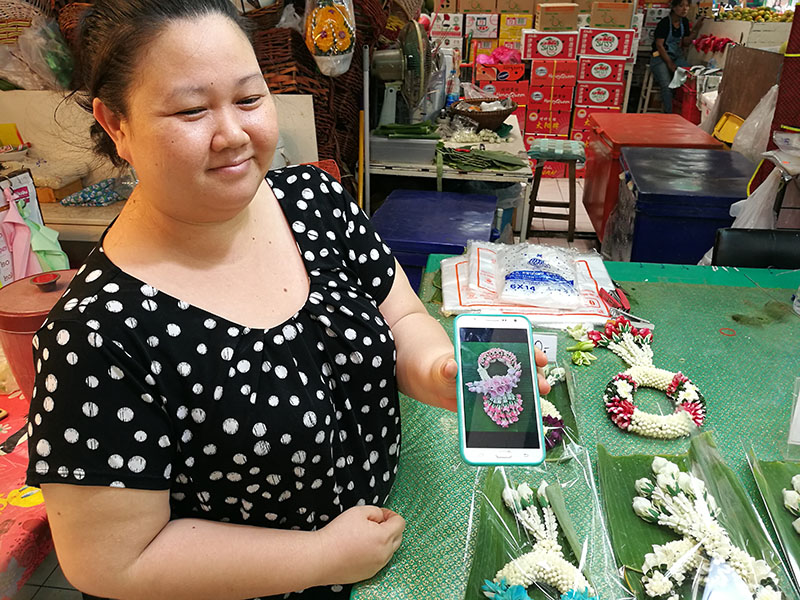
A minute’s walk away at kiosk No. 4/29 was garland seller Rin Komongming’s Pah Taew shop. It was late afternoon and one of her elaborate flower garlands was now reduced to 380 baht from the original 400 baht. Now, 380 baht is roughly equivalent to the daily minimum wage, which says a lot about the purchasing power of her customers.

IMG 20170425 161754
Rin Komongming holds a garland sold at her Pah Taew shop.

Rin, who seemed less than keen to talk, said some bought a few to present to a member of the royal family at an audience on Thursday. This is not your typical garland found at typical fresh markets in Bangkok or elsewhere.

But that’s not all. If customers ever want something grander, Rin showed a photo of an even more elaborate pink flower garland priced at 1,000 baht. Such garlands can be made to order two days in advance, she added, assuring she has as many Thai customers as foreign.

“Everything is good,” said Rin, when asked if the place should have air conditioning. “The place wouldn’t be like a fresh market with aircon.”

The Or Tor Kor opens 6am to 6pm every day and is located in the Chatuchak district. It can be reached via a three minute walk from MRT Kamphaeng Phet’s Exit No. 3.

Advertisement

Hot News

LATEST NEWS

Bangkok
overcast clouds
32.7 ° C
33.9 °
31.1 °
68 %
7.5kmh
100 %
Fri
35 °
Sat
36 °
Sun
35 °
Mon
35 °
Tue
33 °