


































31.6 C
Bangkok
Friday, June 19, 2026
Home Blog Page 2521

Plus is More: Fashion Without Boundaries for Bigger Times

Photo: Fashion Killer / Facebook

BANGKOK — Every Wednesday at 8pm, find many women glued to their screens for a chance to seize the latest selections going on sale.

They’re not shopping for the latest cosmetics or accessories but a rare supply of clothes made to fit their body.

Under any circumstances, it’s not easy to find the right clothes to look good. In tiny  Thailand, where clothes are range from petite-small to petite-large, it’s even more difficult. But as changing nutrition and habits are expanding the national waistline, Kewalin “Goft” Kowhakul not only understands how it feels to be a plus-size consumer but has been making a killing since 2011 with her Fashion Killer shop.

“I’ve been into fashion since high school, but it was hard to find a decent shop for fashionable clothes,” Golf said.

Among the pioneers in the business, her page today has won more than 100,000 likes and now she’s earning more than 1 million baht in revenues each month from selling brand-name duds and her own designs for plus-sized women, new selections of which are posted Wednesday nights.

“They told me I’ve inspired them to dress up and feel good in their skin,” said Golf, adding that she often fields questions about how to mix and match clothes and wear makeup.

Although the plus-sized clothes market has become more competitive with more than 10 online shops serving a nation growing heavier, that wasn’t always the case.

Pratunam has long been the main shopping district, but Golf said it lacked variety and clothes that fit her shape.

“So I started selecting brand name clothes with fine cutting for my shop, and the feedback was impressive,” she said.

Kewalin 'Golf' Kowhakul, owner of Fashion Killer, poses Nov. 15.
Kewalin ‘Golf’ Kowhakul, owner of Fashion Killer, poses Nov. 15.

What started as a hobby for the 30-year-old entrepreneur became serious business after she completed her master’s degree in innovative marketing from Ramkhamhaeng University in 2014. Since then she’s established herself in the plus-sized clothes business and last month registered her company.

Her recipe for success is simple – a focus on fashion and customers.

“We have to keep updating new trends and present them interestingly on the page to keep customers engaged,” Golf said.

The clothes range from 490 baht to 550 baht and come in classic colors such as basic black and white.

Golf puts an emphasis on providing good customer service and arranging events “to keep up the offline vibes.”

In June, she threw the first plus-sized pool party, attended by nearly 80 women. Four months later, she’s launched a model search that more than 100 women applied for. Last month she helped judge the “Thida Chang (Jumbo Queen)” International Competition at The Paseo Town on Ramkhamhaeng Road.

“Organizing events costs money, but it helps attract more people to follow what we’re doing in a fun way,” Golf said. “It’s better than paying for an ad which may make us  widely known but not impress anyone.”

Apart from the page, Golf’s also produced YouTube videos to communicate with and give beauty advice to her audience.


Growing Kingdom

Almost 35 percent of Thai teens were overweight in 2014, according to health officials, a figure which has doubled since 1991. Compared to other ASEAN countries, Thai women now rank second in obesity to Malaysia.

Considering herself plus-sized since a young age, Golf said she has never experienced bias or discrimination, but not everyone is as lucky.

“There’s no way that [plus-sized people] can be treated equally when someone still thinks obesity is an obstacle for work,” she said, explaining that her seven employees faced discrimination when applying for jobs, as some places don’t accept overweight people.

Fashion Killer owner Kewalin ‘Golf’ Kowhakul, at far left, and her crew pose at the beach in March. Photo: Fashion Killer / Facebook
Fashion Killer owner Kewalin ‘Golf’ Kowhakul, at far left, and
her crew pose at the beach in March. Photo: Fashion Killer / Facebook

Golf, who is at confident ease as she poses for a photographer, understand the still-prevalent cultural attitudes.

“Being overweight doesn’t mean we’re feeble,” she said. “There are now many plus-sized people in Thailand, and some of us also exercise to maintain our health or have some curves.”

With business growing, she is moving forward and renovating her house on Soi Sukhaphiban 5 so that her customers can shop there in the near future.

She said it’s not just the money motivating her to improve the business but the positive support from overweight women.

“Some overweight people might look down on themselves and think that they don’t look good in anything,” said Golf. “It’s important to love yourself first and try to figure out your body’s best features, along with how to present yourself. “Being confident in who you are is all it takes.”


Fourth from left, Kewalin ‘Golf’ Kowhakul, owner of Fashion Killer, and her crew poses in August. Photo: Fashion Killer / Facebook
Photo: Fashion Killer / Facebook
Advertisement

Hidden Explosive Kills Soldier in Restive Southern Thailand

Security forces secure the scene where two suspected insurgents were killed in another attack Friday in Yala province.

BANGKOK — Police say a soldier has been killed by an explosive device near an army checkpoint in southern Thailand.

They say the blast on Wednesday left three other soldiers injured. It is the latest violence in a long-simmering insurgency by Muslim separatists who have been fighting for autonomy in Buddhist-majority Thailand’s southernmost provinces of Pattani, Yala and Narathiwat. The three provinces have big Muslim populations.

Lt. Col. Chinnawat Vejthayakorn, the deputy police chief of Yala province, said six soldiers were patrolling a riverfront on motorcycles when an improvised explosive device was remotely detonated as they rode passed an army checkpoint.

Over 6,500 people have been killed in the separatist insurgency, which began in 2004.

Advertisement

Watch the Paving of Bangkok Over 30 Years From Space

BANGKOK — Watch three incredible decades of change in 12 seconds as development erupts across the delta lowlands to make the Bangkok of today.

Google released an updated Google Earth late last night which combines millions of satellite images to enable a zoomable time lapse of the entire planet spanning 33 years.

Watch the Don Muang Tollway, Sirat Expressway and other major roadways arc across the landscape as the built urban environment sprawls in all directions. Step through year-by-year and see Suvarnabhumi International Airport rise from the swamp in 1998.

One noticeable exception is the peninsula formed by the bend in the river that comprises half of Samut Prakan’s Phra Pradaeng district, where development has been slower.


Advertisement

Police Raid Hi-Low Game, Charge 20 With Gambling

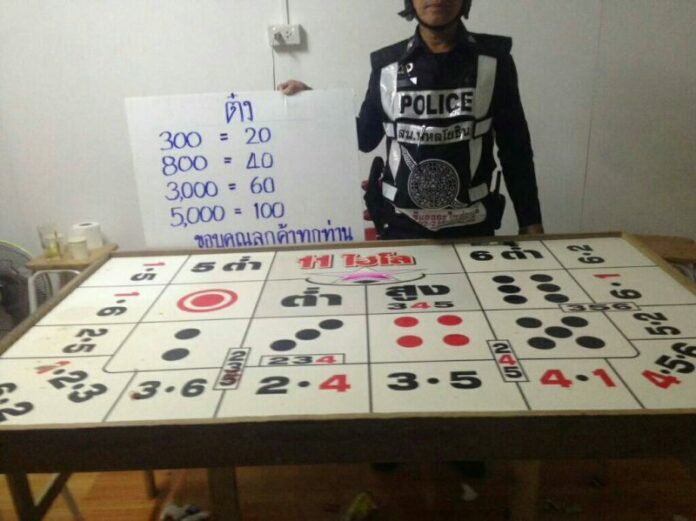
A police officer poses behind a Hi-Low gaming table seized from an alleged gambling den Tuesday night in Bangkok.

BANGKOK — It was game over Tuesday night for about 30 people when Phahon Yothin police raided their small gambling den in the Chatuchak district.

Police said they were acting on a tip when they raided the operation in Soi Ratchadaphisek 36 at about 11pm.

“We received an anonymous phone call, so we went to investigate,” said Lt. Col. Prasopchok Eeampinich.

Police said they found 20 “focused” and “stressed” gamblers age 30 to 60. Police seized the 1,500 baht in the kitty, a table, and a Hi-Low game set.

Prasert Norachan, 52, reportedly confessed to running the operation, which he said had only been open two days. All 20 people found in the den will be charged with gambling.

HiLo is a gambling game played with three dice and adding up the sums. A sum of 12 – 18 is “high,” 3 – 10 is “low,” and 11 is “Hi-Low.”

Advertisement

Dead Workers Probably at Fault for Fatal Crane Failure, Cop Says

Rescue workers respond to the scene of a crane collapse on Tuesday in Bangkok.

BANGKOK — A police investigator said Wednesday that the workers killed in a crane collapse might have been responsible for their own demise.

Five people died Tuesday afternoon at a construction site at Shrewsbury International School on Rama IX Road when the 14-meter crane toppled during the final stages of installation. Four Thais and one Cambodian worker were killed.

Yuttapan Meechai, secretary to Bangkok’s governor, said after inspecting the scene that the crane appeared to have been improperly assembled.

Asked about Yuttapan’s comment, Col. Suebpong Karuna, deputy chief of Makkasan police, said if it was true it meant the workers were responsible.

“If it was wrongly assembled, it was the dead workers who were installing it,” Suebpong said. “They were installing the crane, then the accident happened.”

However, he stressed that police have yet to ascertain the cause of the accident. Engineers were invited to assess the scene along with police investigators today, Suebpong said. The site was overseen by a construction firm called Ritta Co.

No one has been charged for the collapse or the deaths so far, Suebpong added.

Related stories:

No Charges Over Fallen Crane at BTS Phra Khanong

Advertisement

Multinationals May Calculate Taxes in Other Currencies

Photo : Philip Brewer / Flickr

BANGKOK —  International companies operating in the kingdom can now work out their tax expenses in dollars, yen, rupees or any other currency, the cabinet said Tuesday.

In a bid to attract transnational companies to Thailand, the interim cabinet approved calculation of corporate income taxes and petroleum income taxes in foreign currencies instead of converting them into Thai baht.

“From now on they can calculate tax in the currency they are operating in order to reflect real performance without being affected by currency fluctuations,” said Kobsak Pootrakool of the Prime Minister’s Office.

Kobsak said the policy would not impact tax collection. He said the regulatory relief was aimed at attracting more multinationals to establish headquarters and conduct transactions in Thailand.

Advertisement

Vietnam Grants Amnesty to More than 4,000 Prisoners

Cuba's former leader Fidel Castro, right, shakes hands with Vietnamese President Tran Dai Quang, left, in Havana, Cuba, on Nov. 15, 2016. Photo: Alex Castro / Associated Press

HANOI — Vietnam has granted amnesty to more than 4,000 prisoners, including one sentenced to five years in jail for a national security-related crime.

Giang Son, deputy chairman of the President’s Office, told reporters Wednesday that 4,384 inmates were granted amnesty under two directives signed by President Tran Dai Quang.

They will be released from their prisons starting Thursday. One of the prisoners is Bui Xuan Kim who was jailed for national security-related crime, according to Senior Lt. Police General Nguyen Van Thanh.

Kim has served three years of his sentence for organizing people to flee to neighboring Cambodia.

Fourteen foreigners will also be released.

Advertisement

A Look at British Aerospace Plane that Crashed in Colombia

A BAE 146 aircraft similar to the one which has crashed Tuesday in Colombia. Photo: David Jones / Associated Press

LONDON — The plane that crashed near Medellin, Colombia, is a short-haul aircraft that was used to land in hard-to-access airports and frequently flew soccer teams across South America.

Among the 75 people reported to have been killed in the crash Monday night of the 17-year-old plane, which was part of the British Aerospace 146 stable of aircraft, were members of the Chapecoense soccer team from Brazil.

The same plane that crashed is said to have earlier this month ferried world soccer player of the year Lionel Messi and his Argentina team from Brazil to Buenos Aires between World Cup qualifier matches.

Built and sold in 1999, it was part of the stable of British Aerospace 146, or BAE 146, planes. BAE 146s and the related Avro RJ models  of which the crashed plane was one of  can have a range of about 1,700 nautical miles (1,955 miles, 3,150 kilometers,) according to David Dorman, a spokesman for BAE.

LaMia, the Bolivian operator of the crashed plane, said on its website  which has since become inaccessible  that its three BAE 146s had a maximum range of around 2,965 kilometers. That’s about the same as the distance between Santa Cruz, Bolivia, and Medellin, the route the plane was flying when it went down. The range is not rigid and is dependent on a plane’s payload and fuel.

Colombia’s aviation authority said initial reports suggest the aircraft was suffering from electrical problems, although investigators were also looking into an account from one of the survivors that the plane ran out of fuel about five minutes from its expected landing at the Jose Maria Cordova airport outside Medellin.

Because they can take a steep approach to landing, the BAE 146 fleet can use very short runways. It has four jet engines suspended from a wing affixed to the top of the plane and typically does not carry much more than 100 passengers.

British Aerospace, which became BAE Systems in 1999, introduced the BAE 146 in 1981 and ended production in 2003 for economic reasons. A little under 400 of the fleet were built, and around 220 remain in service. Major clients have included British Airways, Swiss and Ireland’s CityJet.

Civil aviation authorities in Bolivia, where Monday’s flight originated, said LaMia got started as an airline promoting tourism in the city of Merida, Venezuela. But with the decline of the Venezuelan economy, it re-established itself in Bolivia, where in November 2015 it was granted permission to operate charter and cargo flights.

Several South American soccer teams have recently chartered flights from LaMia, including Atletico Nacional, the team Chapecoense were to play in a cup final on Wednesday.

Argentina’s state news agency said the plane that crashed had earlier been used to transport Messi and the Argentina national team earlier in November. The aircraft has also reportedly transported Venezuela’s national squad and several top teams from Bolivia.

Over the years, the model of plane has been configured for uses other than hauling passengers, including as tankers to put out forest fires. Around 30 of the original BAE 146s were built as freighters.

According to Dorman, 22 of the remaining fleet have been converted into firefighting roles, with more likely in coming years. Prominent operators include Canada’s Conair and Neptune Aviation Services.

“It’s a demonstration of the aircraft’s ability to fly in difficult terrain,” Dorman said.

The most notable crash involving the plane was in December 1987, when a Pacific Southwest Airlines flight from Los Angeles to San Francisco was hijacked by David Burke, a disgruntled ex-employee of USAir, which had recently bought Pacific. Burke is said to have shot the two pilots and three others. The plane subsequently crashed in Cayucos, California. All 43 people on board died, including Burke.

The last deadly crash involving the plane occurred in 2009, when a BAE 146 operated by Indonesia’s Aviastar Mandiri struck a hill while attempting to land in the eastern Papua province. All six onboard were killed.

Most recently, in April 2014, a BAE 146 carrying 97 people made an emergency landing shortly after takeoff from Perth, western Australia, after one of its engines caught fire. No one was injured.

BAE is responsible for checking the planes’ airworthiness and for engineering support.

The U.K. Aircraft Accidents Investigation Branch said it is sending a team to Colombia to assist local authorities with their investigation, since Britain is listed as the “state of manufacture” for the plane.

Advertisement

Designers Breathe New Life Into China’s Dying Folk Crafts

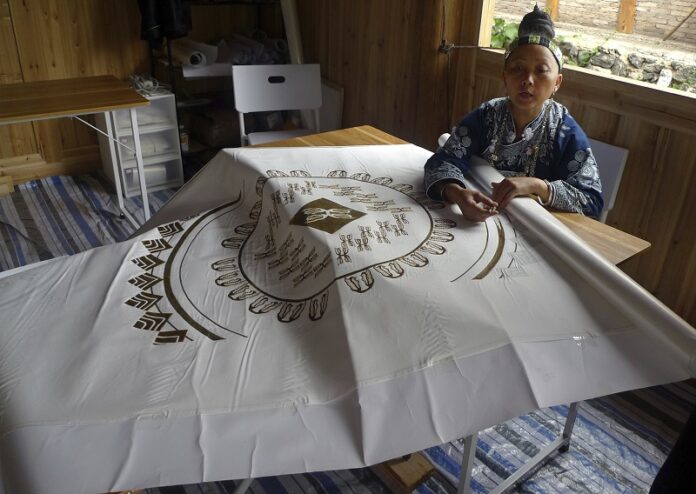
Ethnic minority artisan Pan Xiu-ying uses wax to make a batik pattern on a scarf Aug. 7 in rural Sandu in China's Guizhou province. Photo: Kelvin Chan / Associated Press

GAORONG VILLAGE, China — Dipping a brass-tipped tool into a vat of liquid wax, Pan Xiu-ying painstakingly traces an intricate design onto a white cloth.

At her workshop in a remote valley in one of China’s poorest provinces, Pan uses traditional techniques passed down for generations to create an indigo-dye batik scarf embellished with patterns inspired by her ethnic Shui minority. But her handicrafts aren’t for family members. They’re destined for affluent buyers thousands of miles away.

Pan’s employer, Hong Kong-based Elaine Ng, is among the growing number of designers focused on ecological and cultural sustainability who hope to preserve skills of rural artisans that are fast vanishing in this increasingly industrial society.

“A scarf that is made with 50 hours of love is different from one made by digital print in a factory,” said Ng, whose strategy of using artisans fits right in with Beijing’s push to shift away from low-end, cheap mass manufacturing toward higher skilled, more environmentally friendly industries.

Ng is helping to breathe new life into old crafts of minority tribes in isolated villages in south-central Guizhou province.

Many low-cost Chinese producers are fleeing to neighboring Asian countries like Vietnam, where they can pay lower wages, as the local labor pool shrinks and costs rise.

So garment makers that previously thrived churning out cheap clothes for overseas brands are revamping their sweatshops with smart, small batch production methods such as 3D printing and cloud computing.

Ng hopes her project, Un/fold, run by her design studio, The Fabrick Lab, can pioneer a business model that might appeal to young people fleeing villages for easier and better paying jobs in distant cities.

This fall, she launched a limited edition of scarves, squat wooden stools and hexagonal wooden wall tiles, the latter two decorated with batik patterns normally used only for fabrics. She’s also working with a Shanghai company to create custom furniture that uses artisanal fabrics and woodwork.

Back in the workshop, after finishing her pattern, Pan dips the silk and cotton fabric three times into a vat of organic dye made from indigo plants grown higher up the hillside. Finally, the wax is melted away to reveal the scarf’s design. It will eventually sell for $235 online or in boutiques in Hong Kong and Shanghai.

In the next room, two village women weave fabric by hand, using a wooden spinning wheel strapped on to one of them. Outside, the valley’s lush green rice terraces and wooden houses stretch into the distance.

Pan, 47, said she’s eager for more work from Ng and the steady income it provides, especially since her husband died earlier this year. She learned batik skills from her grandmother, but laments that her daughter and other young villagers are not interested.

“Young people don’t want to learn (the skills). They want to go to Guangdong,” she says, referring to the wealthy province near Hong Kong where factories still employ millions of workers from the countryside.

“If people see that we are doing it and definitely making money, then they’ll want to come and have the patience to learn,” said Pan. “Things that are machine made are cheap but they don’t look good,” she added.

Landlocked Guizhou, 2,000 kilometers (1,230 miles) from Beijing, has rich folk art traditions. More than a third of its 35 million residents are from ethnic minorities including the Shui, Miao, Dong and other tribes known for their skill with batik, embroidery, silverwork, woodwork and paper cutting.

Those arts are under threat as growth picks up in the province best known for its stunning karst limestone hills and its fiery Moutai liquor. A new high-speed rail line is opening up previously isolated towns to outside visitors, while government planners are encouraging the tech industry to make Guizhou a center for big data.

The province reported 10.5 percent economic growth in the first half of 2016, third-fastest among the country’s 31 regions.

The renaissance of traditional apparel workshops is partly driven by a backlash against so-called “fast fashion” seen in retail chains like Forever 21 and H&M, said Christina Dean, founder of Redress, a non-governmental organization that promotes sustainability in the fashion industry. Similar trends are at play even in affluent Japan, which has rich textile and woodworking traditions of its own.

“By and large, the mainstream fashion industry has become so bland, it’s become a polyester rag,” Dean said. “So we’re seeing more and more emerging brands really revive artisanal craftsmanship around the world.”

Guizhou is attracting other independent designers. Sharon de Lyster, also based in Hong Kong, has scoured its markets for her label, Narrative Made.

“This is stuff they have been doing for generations but it really is dying,” said de Lyster. She said young people see no way to make money, so they don’t invest time and energy in advancing those traditional crafts.

The cuffs on one of de Lyster’s $190 silk shirts have a black and white chili pepper flower pattern by a Miao master embroiderer with cross stitching that produces an identical pattern on both sides. The Miao and some other tribes have no written language of their own so they use embroidery to communicate their myths and folklore.

New York-based designer Angel Chang spent a year in Guizhou collaborating with Miao and Dong artisans for a 2013 capsule collection. Fashion editors loved her biker-style jacket, $1,000 but now sold out, in cotton damask featuring hypnotic blue and white zig-zags and geometric birds.

It’s a race against time: Only three grandmothers in the Dong village of Zhaoxing can weave that pattern, Chang said.

“Young people can’t do it. So you have a knowledge that is already in decline,” she said. “The current generation can’t explain what all the symbols mean and the stories in the clothing.”

Chang is partnering with two NGOs to pass on traditional textile-making techniques. She’s also working on a new Guizhou-inspired collection, which requires establishing a proper supply chain.

“You have to realize there’s no industry there. They’ve never really sold to anyone outside of their families. They don’t know how to price these things,” she said. “It’s not like I can just say I need 100 meters in this color and it’s here in two days. It’s really starting from scratch.”

Story: Kelvin Chan

Advertisement

Indonesian Lower Court Rejects Bid to Protect Prized Forest

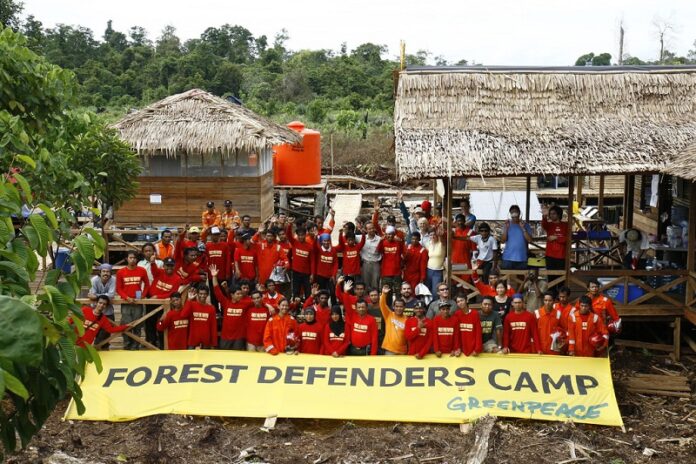
Greenpeace activists pose for a photograph in 2007 in Riau, Indonesia. Photo: H Dragon / Flickr

JAKARTA — An Indonesian court has rejected a case brought by Acehnese community leaders who want one of the country’s most prized tropical forests to be protected from exploitation by mining and plantation companies.

Nurul Ikhsan, chief lawyer for the plaintiffs, said the Central Jakarta District Court rejected the case on Tuesday because the Aceh province bylaw at issue caused no material losses to them.

Aceh, which has considerable autonomy under a 2005 peace deal with insurgents, introduced a land use plan in 2013 that conflicts with the Leuser forest’s protection under national law.

Nine community leaders filed the lawsuit in January, asking the court to order the Home Affairs Ministry to revoke the bylaw.

They said the bylaw threatens the Leuser ecosystem by allowing diversion of the region into industrial and mining forests. The local government so far has issued 23 mining permits within the area, they said.

Conservationists say the 1.8 million-hectare (4.4 million-acre) forest, which spans Aceh and North Sumatra provinces, is the only place in the world where orangutans, rhinos, elephants and tigers share the same wild environment. Each of those four Sumatran species is endangered.

Ikhsan said the ruling would be appealed.

Indonesia has a moratorium on new licenses for logging in virgin forests but deforestation has continued largely unabated. Large swaths are burned every year for palm oil and pulp wood plantations. Illegal logging also takes a toll.

A study in the journal Nature Climate Change estimated that by 2012, Indonesia was clearing 840,000 hectares (2 million acres) of forests a year, more than any other country.

Advertisement

Hot News

LATEST NEWS

Bangkok
overcast clouds
31.6 ° C
32.2 °
31.6 °
68 %
2kmh
100 %
Fri
33 °
Sat
29 °
Sun
35 °
Mon
36 °
Tue
37 °