
























36.8 C
Bangkok
Saturday, June 13, 2026
Home Blog Page 2531

New ‘Ghost Rider’ Clips Emerge as Police Zero in on Driver

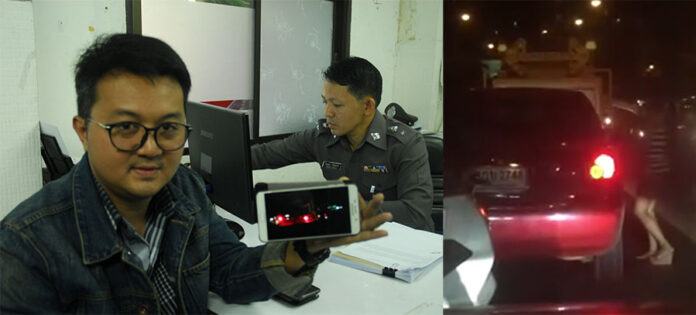
Pawarit Kasakul, 30, offers his testimony at the Hua Mak Police Station Monday. Right, the latest clip of the taxi hood-riding woman whacking the car window.

BANGKOK — A mysterious woman who rode the back of a car into imaginations everywhere has been seen at it again, and police said Wednesday they are close to zeroing in on the identity of her driver accomplice.

Since a clip of the woman sitting casually atop the back of a car speeding along Rama IX Road sent netizens into a tizzy Sunday, police working to crack the case said more eyewitness accounts and clips have surfaced, leading investigators closer to finding the owner of the vehicle.

“There are three clips in all now, and you can find them all on YouTube,” Lt. Col. Nopphorn Srisuchart of Hua Mak police said. “The clips clearly show us the license plate, so we have the name of the owner now and are looking for them.”

Read: Internet Puzzled By Woman’s Open-Air Taxi Ride Video

Nopphorn said the red Toyota Corolla Altis’ license plates were taken from a brown Opel, suggesting someone was using stolen plates.

“The third clip is especially helpful. That’s the one where the woman gets down from the car in her wedge heels and whacks the car window,” he said, referring to the latest clip to surface.

Meanwhile by Wednesday some online had turned from suspecting she was a ghost to believing it was a guerilla marketing stunt.

On Monday, the man who filmed Sunday’s clip now watched more than 2.5 million times, went to Hua Mak police to give his account. Pawarit Kasakul, a 30-year-old MCOT photographer, had just returned from a trip to Indonesia and was riding shotgun along Rama IX Road from the airport when they spotted the woman.

According to Nopphorn, the driver could be charged with reckless driving, a crime punishable with up to three years in jail and / or a 10,000 baht fine. The woman could be charged with clinging to a moving vehicle, a minor infraction incurring no more than a fine of 500 baht.

Two other clips appeared online Tuesday. One posted by meme clearinghouse Drama-addict shows a woman riding on the back of the car while it is light out. It was also filmed on Sunday.

A second video posted Tuesday simply consists of the woman smacking the vehicle for about 20 seconds.

People have expressed suspicions the whole thing was a marketing stunt for a car brand.

“What brand or company made this viral video? Just come out and admit it,” wrote user Talardnut in the most-liked comment to the Drama-addict video. “No more bullshitting or prostrating and making trouble for others. You didn’t kill anyone, so just come out and apologize so this whole thing can be over.”
Advertisement

Elderly Writer Arrested for Lese Majeste a Year After Alleged Offense

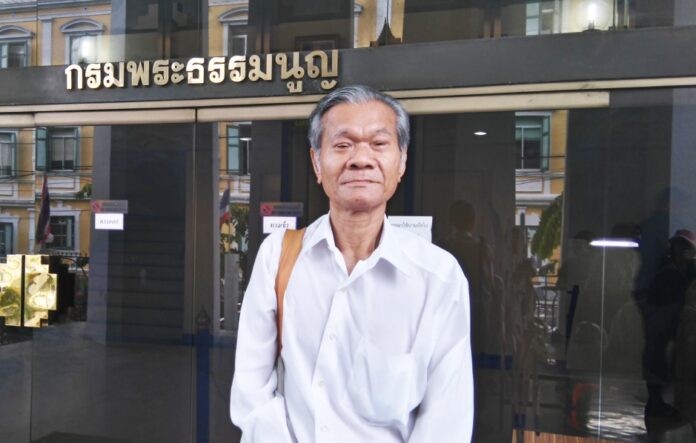
Juaseng Kow, aka Small Bundit Aneeya, poses in front of the military court in May. Image: Thai Lawyers for Human Rights

BANGKOK — A 75-year-old writer was arrested and charged with royal defamation for a speech he gave at a public forum a year ago, his lawyer said Wednesday.

Police detained Juaseng Kow, aka Small Bundit Aneeya, on Tuesday and charged him with lese majeste, which carries a maximum penalty of 15 years in jail. As of Wednesday morning, Juaseng, who’s been prosecuted numerous times on the royal libel charge, was awaiting to find out if the military tribunal would grant him bail.

Read: Writer Gets Suspended Sentence For Lese Majeste

The remark that brought the latest charge against Juaseng took place during a panel discussion on the new constitution at Thammasat University on Sept. 12, 2015, according to his attorney, Pavinee Chumsri. Pavinee, a member of Thai Lawyers for Human Rights, said a police committee on lese majeste cases only recently greenlit the legal action.

“Police explained that they sent a transcript of the video to a police committee,” Pavinee said by telephone. “They deliberated on it and ordered prosecution.”

Juaseng, who’s better known by his pen name Small Bundit, will be tried in a military court. Although the junta recently announced it would end military prosecutions of civilians, insulting the royal family is deemed a matter of national security and tribunals will continue hearing such cases.

Police took Juaseng into custody shortly after he addressed the crowd at last year’s forum on issues about human rights and the monarchy, but they did not file any charge against him at the time.

He was allowed to walk free after police lectured him not to do such a thing again, Prachatai reported.

An author by trade, Juaseng has been prosecuted for lese majeste repeatedly. The Supreme Court in 2014 found him guilty of the crime, dismissing his argument that he was mentally ill at the time of the offense. He was given a suspended jail term.

Juaseng also has another royal defamation case pending in the military court, as a result of remarks he made at a public panel discussion in November 2015.

Advertisement

Indonesia Police Name Jakarta Governor as Blasphemy Suspect

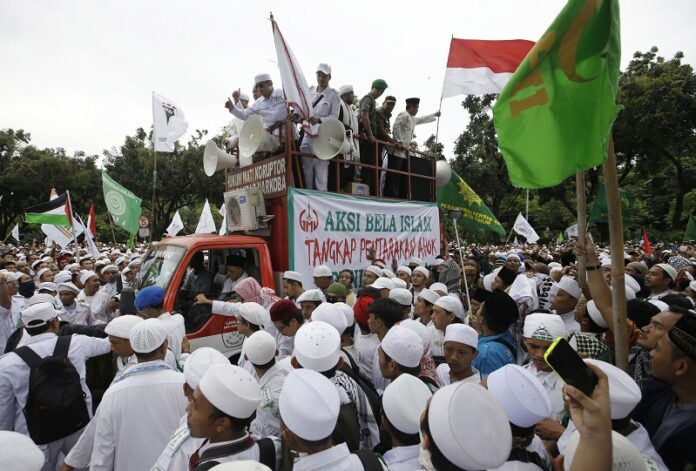
Muslim protesters gather in October with a banner calling for the arrest of Jakarta's ethic Chinese and Christian Governor Basuki Tjahaja Purnama, popularly known as "Ahok," outside the City Hall. Photo: Achmad Ibrahim / Associated Press

JAKARTA — Indonesian police on Wednesday named the minority Christian governor of the country’s capital as a suspect in a blasphemy investigation in a major test of the Muslim-majority nation’s reputation for religious toleration.

Earlier this month the capital Jakarta was rocked by a massive protest by conservative Muslims against the governor. One person died and dozens were injured in rioting.

Police announced at a press conference that the popular governor, Basuki “Ahok” Tjahaja Purnama, cannot leave the country while the investigation is underway.

The accusation of blasphemy against Ahok, an ethnic Chinese and Christian who is an ally of President Joko “Jokowi” Widodo, has galvanized Jokowi’s political opponents in the Muslim-majority nation of 250 million.

The Islamic Defenders Front, a vigilante group that wants to impose Shariah law, is demanding Ahok’s arrest after a video circulated online in which he joked to an audience about a passage in the Quran that could be interpreted as prohibiting Muslims from accepting non-Muslims as leaders. The governor has apologized for the comment.

Ahok, who is seeking a second term as Jakarta governor, is popular with the city’s middle class, but has made enemies from a tough stance against corruption and an urban renewal program that has evicted thousands of the city’s poorest from slums.

Advertisement

Prince William Arrives in Vietnam for Wildlife Meeting

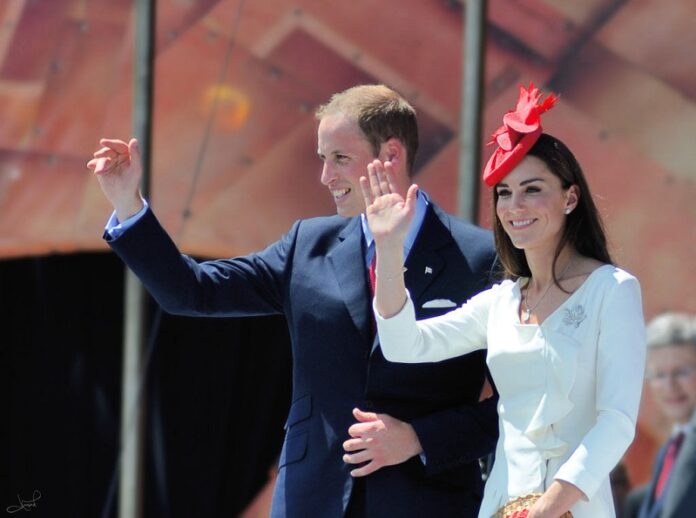
Prince William waves with he Duchess of Cambridge in England in 2011. Photo: tsaiproject / Flickr

HANOI — Britain’s Prince William has arrived on his first visit to Vietnam where he will take part in an international conference on illegal wildlife trade in the fight to protect elephants, rhinos and other endangered species from extinction.

The Duke of Cambridge, who is president of United for Wildlife, will meet Vietnamese Prime Minister Nguyen Xuan Phuc and Vice President Dang Thi Ngoc Thinh on Wednesday before attending the two-day conference starting Thursday in Hanoi.

“He knows the people of Vietnam will share his concern that we have less than 25 years to save some of our most iconic species from extinction. He believes Vietnam has a real opportunity to be leaders in wildlife conservation,” the Prince’s office said in a statement Tuesday.

On Saturday, Vietnamese authorities destroyed 2,253 kilograms (4,956 pounds) of seized elephant ivory and rhino horns, sending a message that the government wants illegal wildlife trafficking stopped.

Vietnam is one of the world’s major transit points and consumers of trafficked ivory and rhino horns.

The Hanoi conference on illegal wildlife trade will bring together leaders and senior officials from more than 40 countries as well as experts from international wildlife conservation groups.

The conference is the third of its kind after the one held in London in 2014 and another in Botswana last year.

Advertisement

Bangkok Bombing Trial: Defendants Protest Chinese Interpreters

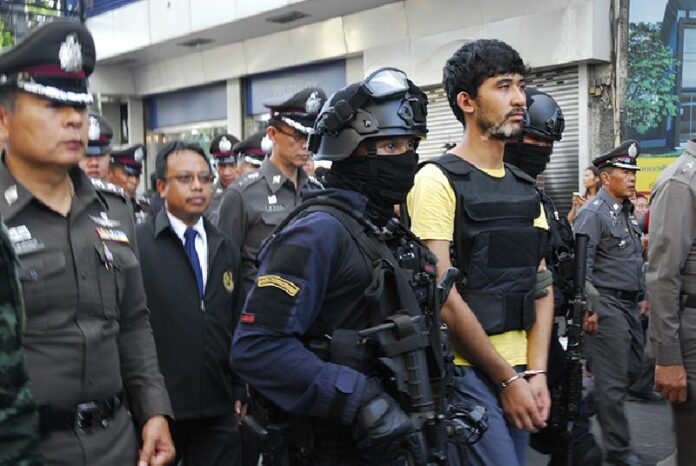
Bombing suspect Yusufu Mieraili is led through a police 're-enactment' on Sept. 9, 2015, in Bangkok.

BANGKOK — As the trial began Tuesday against two Uighur men accused of bombing a Bangkok shrine in the worst single terror attack in modern Thai history, the court-approved interpreter did not know the word “shrine.”

Abdulwali Aiyai stumbled on that and other words as he attempted to translate testimony inside the military courtroom where Yusufu Mieraili and Adem Karadag stand accused of bombing the Erawan Shrine, one of the capital’s most-trafficked religious sites, and killing 20 people.

One of his colleagues, who translated Thai to English, had to whisper explanations of what a shrine is.

Read: Cop Recounts Hunt For Bangkok Bombers as Long-Delayed Trial Opens

“It’s like a statue!” a defense lawyer chimed in helpfully.

Over the course of the two-hour session at the military tribunal, it emerged that Aiyai was also not familiar with words such as “wig,” “grey,” “arrest warrants,” or “police jurisdiction,” but his translation skills aren’t what concern the defense team.

It is his background as a reporter for Chinese state media that worries the lawyers that their clients, two members of an ethnic group persecuted by the Chinese authorities, would not receive a fair and impartial translation. Aiyai and another Uighur interpreter were employed for the trial by the Chinese embassy, whose prior objections led the court to reject other interpreters.

“Perhaps it’s his first day on the job, and he will be smoother next time,” defense attorney Schoochart Kanpai said after the court recessed.

Schoochart earlier filed a formal protest seeking the interpreter be removed on grounds of a conflict of interest.

Finding an interpreter for the case all sides agree to be qualified and impartial has been a point of prolonged contention. It’s been more than a year since the two Uighur men were arrested for the bombing, but their trial was repeatedly delayed because of hurdles providing translation.

A previous interpreter was disqualified after police arrested him on drug charges. Another interpreter, an Uzbek national in custody for immigration violations, was rejected after defendants learned she couldn’t actually speak Uighur. An interpreter requested by the defense team was turned down by the court because he belonged to a Germany-based advocacy group China said it deemed a terror organization.

Today the military judges settled with two interpreters sent by the Chinese embassy in Bangkok: Aiyai and his colleague, Truzun Niyasbilag. Shoochart, the defense attorney, said he only learned about it Tuesday morning before the trial got underway.

He immediately protested the decision, both verbally and in writing, arguing that two reporters from an Uighur-language news station in Beijing may have a conflict of interest with his clients.

“The defendants ask the court to arrange a new interpreter because China is unfair in its governance [of the Uighurs],” part of the formal protest read.

The Uighurs are a Muslim-majority ethnic group in the far-flung western province of Xinjiang, where conflict has simmered with the arrivals of ethnic Han Chinese to settle the area. Weeks before the shrine bombing, Thailand forcibly deported more than 100 Uighurs under pressure from Beijing, who then paraded them in hoods as “terrorists.”

Many analysts ascribe the attack as revenge; Thai authorities insist it was perpetrated by a criminal trafficking syndicate displeased with its crackdown on their operations.

On Tuesday the military judges rejected the defense motion on the grounds the two interpreters were of the same nationality as the defendants and could communicate well with them in Uighur. Furthermore, the judges said the pair had yet to show any “dishonest intentions” in their work.

So the first session in the trial of Erawan Shrine bombing commenced.

The first witness to take the stand was a former police investigator named Somkiat Ploytubtim. His testimony was first translated by a Thai interpreter into English which Aiyai then translated to Uighur. His colleague Niyasbilag watched silently.

Defendent Yusufu, who has a passable understanding of English, sometimes objected when he believed the translation did not match.

Once, Aiyai mistranslated “armband” as “long shirt sleeve,” and another time said one mobile phone was found inside Karadag’s residence whereas Somkiat said three.

“You translate wrong,” Yusufu said to Aiyai in English. “Some words you said different. I’m worried you will translate wrong.”

One of the three judges dismissed the complaint, saying that court documents only recorded the Thai testimony by Somkiat and not the erroneous translation.

The defense team expects the trial to conclude by early 2018.

Advertisement

Gen. Prayuth Plays Down Trump Comparisons

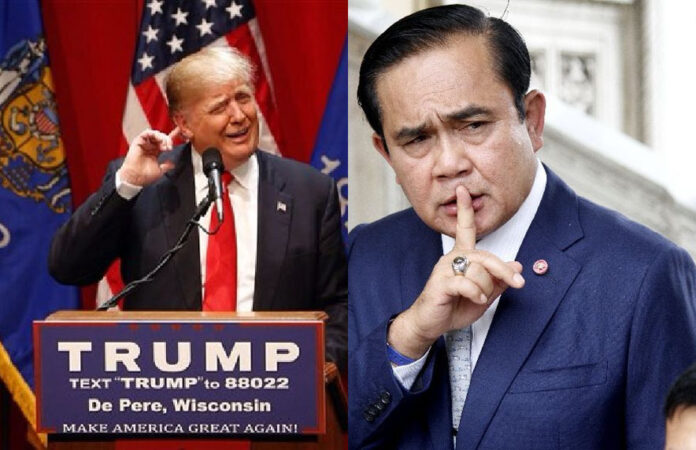
At left, then-candidate Donald Trump at a March 2016 campaign event. At right, Gen. Prayuth Chan-ocha last December.

BANGKOK — Gen. Prayuth Chan-ocha played down comparisons between him and Donald Trump on Tuesday, saying that while he may not be a politician like the U.S. president-elect, he is a straight shooter.

Asked about comparisons made between the two since the Republican’s election last week, the junta leader responded by launching into a lengthy discourse about himself and his style Tuesday at Government House.

“I don’t know if that’s good or bad, but I’m not a politician. But when I talk, I say what I believe according to my principles and the facts according to the law. Sometimes, the things I say are too true and impolite, but that’s my business.”

Prayuth, however, said that when he talks, he is sincere about his principles and true to his personality.

“However, my intentions are clear. After I say something, I don’t fester in anger at someone, because I let it go. It’s done, over. I go do something else. I might be angry again the next day because it’s who I am!

“Don’t take my bad qualities and use them as examples. I have a considerable amount of other, good qualities,” he concluded.

Advertisement

Cop Recounts Hunt For Bangkok Bombers as Long-Delayed Trial Opens

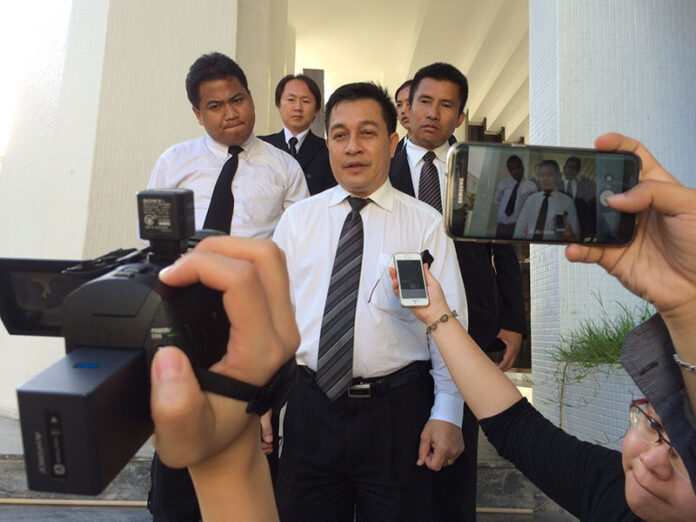
Defense attorney Schoochart Kanpai speaks to reporters outside the court Tuesday in Bangkok on the opening day of a trial against two men accused of bombing the Erawan Shrine in August 2015.

BANGKOK — A police investigator told a military court Tuesday how police tracked down the two Uighur men accused of staging a bomb attack that killed 20 people last year.

Lt. Col. Somkiat Ploytubtim took the stand as the first witness to give testimony in the case against the two defendants which opened today – more than a year after Thailand’s worst terror attack – due to long delays in finding an interpreter.

At the start of the trial, Somkiat pointed to the two defendants and identified them as the perpetrators who bombed Bangkok’s Erawan Shrine on Aug. 17, 2015.

Somkiat said that security camera footage and mobile phone signal records supported the state’s claim that one of the two, Adem Karadag, planted the explosives-filled backpack at the popular shrine minutes before the blast.

Read: Bangkok Bombing Trial in Limbo Without Interpreter

“So we took him into custody,” said Somkiat, who was an investigator at Lumpini Police Station at the time. Karadag was found in a raid on an east Bangkok apartment with what investigators said was bomb-making equipment.

Police said evidence found in that room also led to the arrest of his alleged accomplice, Yusufu Mieraili, along the Thai-Cambodian border on Sept. 1, 2015.

Both men have said they are not guilty of the charges. Karadag claims he was transiting through Thailand en route to finding a job in Malaysia.

Speaking to a reporter at the courtroom, Yusufu denied the allegations.

“Human rights! I want people to come help us. It’s been one year already,” he said as the guards shoved him away. “I am Muslim. I am innocent.”

Both men have been held at a makeshift prison facility on an army base since their arrests.

Tuesday’s hearing got underway after the court approved two interpreters provided by the Chinese embassy over the objections of the defense.

Read: Bangkok Bombing Trial: Defendants Protest Chinese Interpreters


Moving Target

Providing a glimpse into the most high-profile manhunt operation in years, Somkiat said police started their investigation with CCTV footage and records of phone use in the area of the attack.

Investigators quickly identified a man in a yellow shirt and wig who was seen leaving a backpack under a bench before walking to Lumphini Park, Somkiat said, where he changed his clothes in a public restroom.

Officers then compared moving signals in the vicinity to that of the suspected bomber as seen in the footage, which led them to a particular phone, he said.

The phone was reportedly turned on just as police were monitoring its activity, and investigators matched its location with the Poon Anan apartment in Bangkok’s Nong Chok district. That led to the Aug. 29 raid and Karadag’s arrest.

“I confirm the man I found in the room was the first defendant,” Lt. Col. Somkiat told the judges.

Following the arrest, the investigation soon moved onto raids of other properties, the arrest of Yusufu and warrants issued for more than a dozen other suspects who were never accounted for when the case was announced closed soon thereafter.

Somkiat is scheduled to continue his testimony Wednesday.

He’s one of 447 witnesses to be called, mostly by the prosecution. Schoochart Kanpai, an attorney for Karadag, said the trial will likely conclude by early 2018.

Advertisement

Court to Weigh Gold Mine’s Defamation Case Against Thai PBS

Top: An episode of Thai PBS program ‘Citizen Reporters’ which aired Sept. 1, 2015, drew a defamation complaint against the broadcaster and its reporter for saying their mine contaminated a river in Loei province.

BANGKOK — Wirada Saelim will learn Wednesday whether a 50 million baht defamation suit brought against her and a news agency by a gold mining company will go forward.

The 25-year-old reporter was named as the first defendant along with Thai Public Broadcasting Service and three directors of the public television channel in the criminal suit filed late last year by Tungkum Ltd.

On Tuesday, 14 organizations including the Southeast Asian Press Alliance, Reporters Without Borders and Fortify Rights on Tuesday issued a joint statement calling on Tungkum to withdraw all criminal proceedings against Thai PBS.

The suit was filed after Thai PBS aired a program Wirada hosted in September 2015. One sentence in the report linked the contamination of a river in Loei province to a Tungkum-operated mine.

“These six villages in Tambon Khao Luang of Wang Saphung district are environmentally affected by the gold mining industry,” was the sentence Tungkum alleged to be defamatory. “The Huay River has been contaminated and cannot be used for drinking or household consumption.”

The investigative news piece was produced by 15-year-old citizen journalist Wanpen Khunna and her friends.

Read: Masked Thugs Attack Villagers Protesting Gold Mine

Tungkum, a subsidiary of mining and property development firm Tongkah Harbour Ltd., filed suit two months later against the 15-year-old girl who narrated the report. Thai PBS, the broadcaster, was charged with criminal defamation and online defamation under the Computer Crime Act for uploading the segment to YouTube.

The company relied on Article 14 of the 2007 Computer Crime Act, a controversial provision criticized for being misused other than originally intended as a tool against online scams.

Critics such as the Thai Netizen Network, say the law is too vague and attracts abuse because its penalties – five years in jail and/or a 200,000 baht fine – are even harsher than existing defamation law under the Criminal Code.

“They live there and learned from their parents that the river used to be drinkable, and now it is not. So that’s a fact for them.”

Defamation is a criminal offense in Thailand, where the courts do not accept truth as an absolute defense. Corporations have been emboldened to go after whistleblowers by the prosecution of Andy Hall, a worker rights activist who left the country earlier this month, citing harassment.

In its complaint, the gold-mining company said the Huay River was free of pollution and doesn’t even run past its mine. Over the years it has brought more than a dozen suits against community members opposed to its operations in Loei.

Wirada, host of the “Citizen Reporters” program, said although the program was one-sided, its purpose was to provide a platform for communities to tell stories from their perspective.

“They were stakeholders,” she said Tuesday, referring to the young journalists who produced the segment. “They live there and learned from their parents that the river used to be drinkable, and now it is not. So that’s a fact for them.”

If the court accepts the case tomorrow, Wirada worries it will damage the space to support watchdogs through platforms such as her program.

In the statement issued Tuesday calling for the case to be dropped, rights organizations said the military government should see it as an example and take action to protect press freedom, decriminalize defamation and amend the controversial Computer Crime Act.

“We remain concerned about the use of criminal defamation laws and the Computer-related Crime Act to restrict the right to freedom of opinion and expression in Thailand as well as to intimidate human rights defenders and journalists,” the statement read.

The mining company has filed two suits against Wanpen, the 15-year-old whistleblower. A case filed locally in Loei province was dismissed by the juvenile court; the other in Bangkok is moving forward.

The Bangkok Criminal Court will rule Wednesday on whether it will accept the complaint against Wirada, Thai PBS and its management.

Correction: An earlier version of this article misidentified the name of the Thai PBS program as “Citizen Journalists.” In fact it was “Citizen Reporters.”

Related stories:

Worker Advocate Hall Quits Thailand Over Harassment, Threats

Poisoned Lives: After 13 Years, Klity Community Prevails Over Lead Mine

Junta Orders All Gold Mines Shut Down

Amnesty Calls on Thailand to Reopen Investigation into Activist’s Murder

Masked Thugs Attack Villagers Protesting Gold Mine

Advertisement

Zika Reports Spread to Two More Provinces

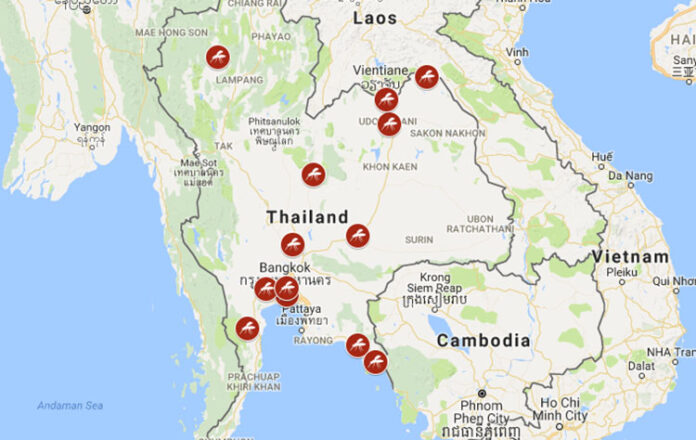
The 13 of the 15 provinces in Thailand known to have reported cases of Zika as of Tuesday. Image: Google

BANGKOK — Dozens of new Zika cases have been reported in Thailand as the disease spreads to new areas.

Thirty-three news cases were discovered last week, the Public Health Ministry announced Tuesday, with some appearing for the first time in Nakhon Pathom and Phetchaburi provinces.

Jesada Chokdamrongsuk, director-general of the Department of Disease Control, said the rate of infection had not increased and had not reached an epidemic level. Since January there have been 686 cases reported, he said, with almost all patients recovering fully.

Read: Thai Babies Born With Zika-Related Birth Defects

Health officials remain on alert, however.

In late September, the first Thai babies were born with severe birth defects associated with the disease just weeks after an outbreak hit the capital’s Sathon area.

Jesada urged the public to not spurn those infected because the virus cannot be transmitted through the air.

Zika has long been present in Thailand but there was a sharp rise in reported incidents this past year as awareness of the disease grew. The end of the rainy season should bring reduced risk of exposure.

Health officials warned pregnant women are at special risk and should be wary of catching mosquito-borne diseases such as Zika and Dengue fever. In the past year 51 of the roughly 54,000 reported Dengue cases have ended in death.

Read more:

Bangkok Moves To Contain Zika Outbreak

More Awareness, Reporting Cited for Thailand’s Rise in Reported Zika Cases

Two Provinces Still Under Zika Virus Watch: Govt

Advertisement

Report Warns of Asia Arms Race if Trump Withdraws US Forces

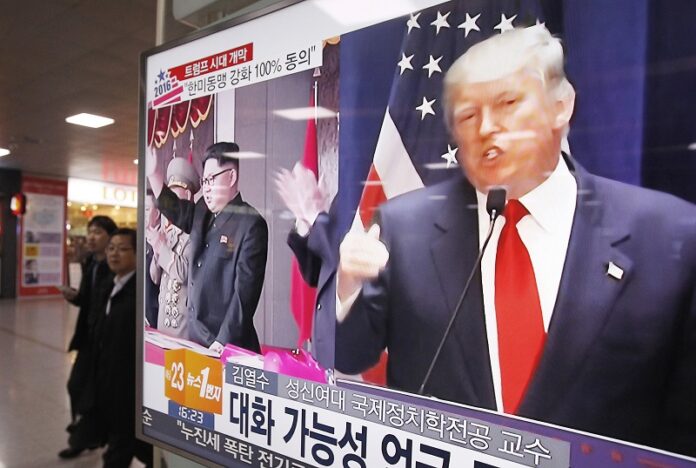
A TV screen shows pictures of U.S. President-elect Donald Trump, right, and North Korean leader Kim Jong Un, Nov. 15 at the Seoul Railway Station in Seoul, South Korea. Photo: Ahn Young-joon / Associated Press

WASHINGTON — The U.S. approach to Asia faces a major overhaul when Donald Trump takes office, but what will take its place? A new report warns of a leadership vacuum and even a nuclear arms race if the U.S. withdraws from a region threatened by a provocative North Korea.

But authors of the Asia Foundation report provided to The Associated Press ahead of its publication Tuesday also say in some parts of the region there’s hope that a shift from President Barack Obama’s signature foreign policy could be for the good.

Despite the major diplomatic capital invested by Obama in reaching out to Asia in the past eight years, his so-called “pivot” policy has yielded only modest gains in countering the rise of an assertive China. There’s been a slight increase in the U.S. military presence in the region; a political opening in former pariah state Myanmar; and better relations with old enemy Vietnam.

The main economic plank of his policy – the Trans-Pacific Partnership – is in ruins. Trump’s election victory has erased chances of early U.S. ratification of the 12-nation trade pact.

Determining what else of Trump’s populist campaign rhetoric translates into action remains a guessing game  one with high stakes for Asia.

Trump has raised the specter of withdrawing U.S. forces from South Korea and Japan unless they share more of the burden of hosting the 80,000 troops – even as neighboring North Korea has conducted nuclear and missile tests with unprecedented intensity.

The Asia Foundation report, based on consultations among academics and former officials from 20 Asian nations, warns that withdrawing U.S. forces could compel Tokyo and Seoul to seek their own nuclear deterrents – rather than rely on America’s – which in turn would “trigger massive destabilization of the regional order.”

“A precipitous reduction of engagement in Asia would be detrimental to the interests of most Asian countries as well as the United States,” the report says.

Trump has taken some early steps to allay those fears. He quickly reassured the leaders of Australia, Japan and South Korea of his commitment to U.S. alliances. On Thursday, Trump will meet in New York with Japan’s Prime Minister Shinzo Abe who is traveling to a summit of Asia-Pacific leaders in Peru.

Japan’s archrival, China, views a Trump presidency with less trepidation. It has viewed the pivot as a U.S. attempt to contain China’s rise as a military and economic power.

But Beijing is wary of Trump’s threat to impose hefty import tariffs over alleged trade and currency violations, amid fears it could stoke a trade war. President Xi Jinping Monday called Trump and told him that cooperation was needed between the world’s two biggest economies.

Thitinan Pongsudhirak, a Thai academic and one of three co-authors of the report, said that despite the uncertainty over Trump’s lack of government experience, he has something in his favor – a clean slate.

Thitinan said that’s a plus in Southeast Asia, where current U.S. policy has failed to live up to its billing and where criticism on human rights has turned off old allies like the Philippines and Thailand.

“Southeast Asian nations don’t want to be dominated by China, they don’t want to put all their eggs in the China basket, but they’ve had to because the pivot and rebalance were shallow and ultimately hollow,” he said.

Indian academic C. Raja Mohan said Trump has in his own chaotic way opened a constructive debate about how Asian nations might take a more active role to cope with the rise of China with less dependence on America.

“Unlike the European liberals’ reaction in the last few days, Asians are going to accommodate rather than object,” Mohan said. “We have to deal with who is in power in Washington.”

Once Trump fills top positions on foreign policy and defense, his intentions on Asia should become clearer. A recent commentary by two Trump advisers may offer clues.

Former Republican congressional aide Alexander Gray and University of California economist Peter Navarro advocated an Asia-Pacific policy of “peace through strength.” They cited Trump’s commitment to increase the U.S. Navy from 274 to 350 ships, saying it will reassure allies that the U.S. “remains committed in the long term to its traditional role as guarantor of the liberal order in Asia.”

But they add: “It’s only fair – and long past time – for each country to step up to the full cost-sharing plate.”

South Korea currently pays about $860 million a year – about 50 percent of non-personnel costs of the U.S. military deployment on its soil – and is paying USD $9.7 billion more for relocating U.S. military bases. Japan pays about USD $2 billion a year, about half of the cost of the stationing U.S. forces.

Despite fears of chaos if the U.S. withdraws its military, former South Korean foreign minister, Yoon Young-kwan, there will be “strong reservations” about paying more.

Story: Matthew Pennington

Advertisement

Hot News

LATEST NEWS

Bangkok
scattered clouds
36.8 ° C
37.2 °
32.7 °
47 %
2.8kmh
38 %
Sat
37 °
Sun
36 °
Mon
35 °
Tue
34 °
Wed
34 °