Missionaries of Charity nuns hold a photo of Mother Teresa in St. Peter's Square at the Vatican on Saturday during a jubilee audience for workers and volunteers of mercy led by Pope Francis. Photo: Alessandra Tarantino / Associated Press
VATICAN CITY — Pope Francis on Saturday denounced what he called the modern-day sin of indifference to hunger, exploitation and other suffering, while commending the example of Mother Teresa on the eve of a sainthood ceremony for the nun who cared for India’s destitute.
Choosing “to not see hunger, disease, exploited persons, this is a grave sin. It’s also a modern sin, a sin of today,” Francis told thousands of lay volunteers in St. Peter’s Square at a special gathering to stress the need for more mercy and caring in the world.
Francis will lead a Sunday morning canonization ceremony in the square which is expected to draw huge crowds of faithful and other admirers of Mother Teresa, who founded an order of nuns devoted like her to giving tenderness and assistance to the poor who were sick and dying in the streets of Kolkata.
Cheering the pontiff in Saturday’s crowd were many nuns from her Missionaries of Charity order, each wearing the characteristic white sari trimmed in blue that makes them easily identifiable worldwide where they care for the needy. Francis greeted a group of these nuns as he was driven through the square in his pope mobile, and one of the nuns put a blue-and-white garland around his neck.
“Tomorrow, we’ll have the joy of seeing Mother Teresa proclaimed a saint,” he said. “She deserves it!”
In his speech to the volunteers, including some who helped rescue survivors of the Aug. 24 earthquake in central Italy, he decried those who “turn the other way not to see the many forms of poverty that begs out for mercy.”
Francis hailed volunteers as “artisans of mercy,” whose hands, voices, closeness and caresses help people who suffer feel loved. While in the square, he petted Leo, the Labrador which pinpointed a 4-year-old child who had survived in a pile of quake rubble. The dog raised a paw, which Francis grasped.
Since becoming pope in 2013, Francis has been encouraging Catholic faithful and institutions to tend to the needs of marginalized people.
He said the credibility of the church to a large extent depends on the service of Catholics to the poor, the homeless, prisoners, immigrants, refugees and others in need.
“The world needs concrete signs of solidarity, above all when faced with the temptation toward indifference,” he said.
In a shop in Kolkata which sells snacks and rosaries, Muslim shopkeeper Tanveer Ahmed recalled seeing Mother Teresa and other nuns take in a leprosy patient who lay bleeding in the street while others passed by, unmoved.
“We are fighting with each other. We are killing each other. But, if you want to see love, please look at Mother Teresa,” Ahmed said. He added: “I believe Mother is next to God.”
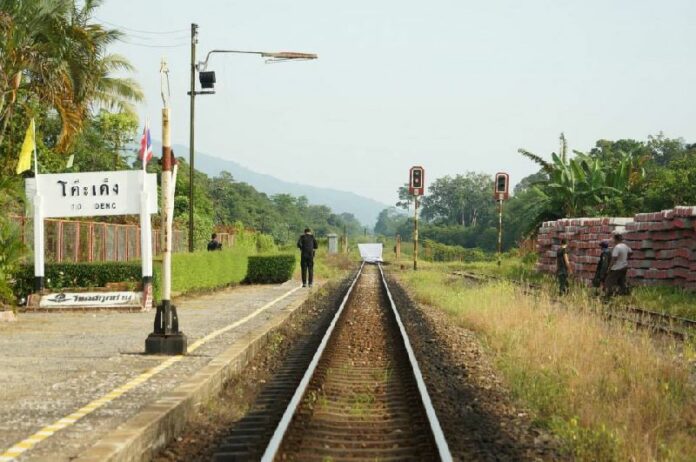
Two banners hung across a rail line in July 2015 near the To Deng train station in Narathiwat province accused the authorities of lying to the international community.
BANGKOK — Police say a bomb exploded and hit a train in southern Thailand, killing one railroad worker and injuring another.
Police Capt. Pramoj Juichuay said the bomb was placed on the tracks and exploded when the train passed over it near a station in Pattani province at around 5:30pm on Saturday. The bomb blast blew off the last carriage of the train.
The train was on its way from Sungai Golak to Hat Yai, near the border with Malaysia.
A customer holds a Samsung Galaxy Note 7 smartphone Friday at the headquarters of South Korean mobile carrier KT in Seoul, South Korea. Photo: Ahn Young-Joon / Associated Press)
SEOUL, South Korea — Samsung recalled its Galaxy Note 7 smartphones on Friday after finding some of their batteries exploded or caught fire.
Samsung’s Note 7s are being pulled from shelves in 10 countries, including South Korea and the United States, just two weeks after the product’s launch. Customers who already bought Note 7s will be able to swap them for new smartphones in about two weeks, said Koh Dong-jin, president of Samsung’s mobile business. The phone had yet to launch in Thailand.
He apologized for causing inconvenience and concern to customers.
The recall, the first for the new smartphone though not the first for a battery , comes at a crucial moment in Samsung’s mobile business. Apple is expected to announce its new iPhone next week and Samsung’s mobile division was counting on momentum from the Note 7’s strong reviews and higher-than-expected demand.
Samsung said it had confirmed 35 instances of Note 7s catching fire or exploding. There have been no reports of injuries related to the problem.
The company said it has not found a way to tell exactly which phones may endanger users out of the 2.5 million Note 7s already sold globally. It estimated that about 1 in 42,000 units may have a faulty battery.
Samsung didn’t say whether customers should stop using their phones, or whether explosions and fires could happen when the phone wasn’t charging. Consumers who complained publicly said the problem came while the phone was being charged.
“The ball is in Samsung’s court to make this right. Consumers want information about what’s going on and peace of mind that this is not going to happen again,” said Ramon Llamas, who tracks mobile devices at research firm IDC. “No one wants to wake up at 1, 2 or 3 (in the morning) and find out your smartphone’s on fire.”
He added that while phone combustions are unusual, “35 instances are 35 too many.”
This summer, Samsung ran into a quality-control issue with another smartphone, a niche model called the Galaxy S7 Active. Consumer Reports found that the phone didn’t live up to its water-resistance promises. Samsung said that relatively few phones were affected and that it had identified and fixed the manufacturing problem. Samsung said it would replace devices under warranty if it failed, but it declined to let customers swap phones otherwise or to issue a broader recall.
On the Note 7, after complaints surfaced online, Samsung found that a battery cell made by one of its two battery suppliers caused the phone to catch fire. Koh refused to name the supplier.
“There was a tiny problem in the manufacturing process, so it was very difficult to figure out,” Koh told reporters at a news conference. “It will cost us so much it makes my heart ache. Nevertheless, the reason we made this decision is because what is most important is customer safety.”
The phones start at $850 in the U.S., more expensive than most phones. In the U.S., Samsung said it will let customers downgrade to a Galaxy S7 and refund the price difference. Or customers can get a replacement Note 7 as early as next week.
Customers’ reports of scorched phones prompted Samsung to conduct extra quality controlling tests and delay shipments of the Note 7s this week before the recall.
South Korean high school teacher Park Soo-Jung said she had rushed to buy the new phone, pre-ordering and then activating it on Aug. 19, its official launch date.
The 34-year-old living in the port city of Busan said that she was bruised when she rushed out of bed after her phone burst into flames, filling her bedroom with smoke stinking of chemicals.
She’s having second thoughts about buying another newly released device, especially after losing all her personal data stored in the destroyed Note 7, she said.
“If the exploded phone had burned near my head, I would not have been able to write this post,” she said in a popular online forum Thursday, where she shared a photo of the scorched Note 7 and described dousing the flames.
China is not affected by the sales suspension. The company said it used a battery made by another supplier for the Note 7s sold in China.
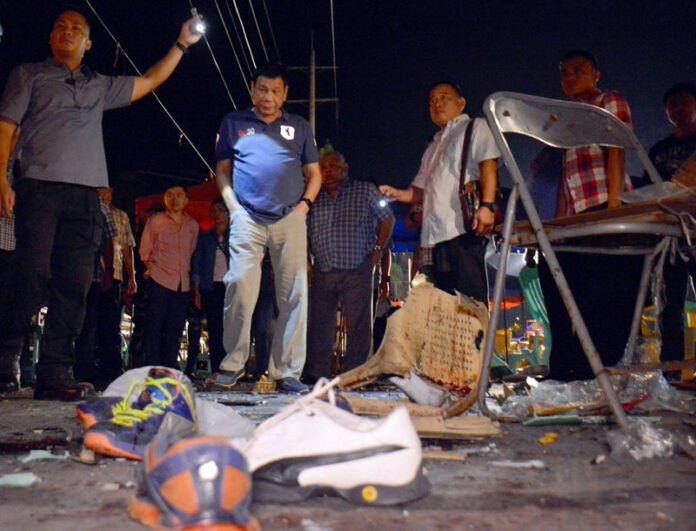
Philippine President Rodrigo Duterte, second left, on Saturday visits the site of the previous night's explosion that killed more than a dozen people and wounded others at a night market in Davao city, his hometown. Photo: Robinson Ninal / Philippines Government / Associated Press
DAVAO, Philippines — Philippine President Rodrigo Duterte declared a nationwide “state of lawlessness” Saturday after suspected Abu Sayyaf extremists detonated a bomb that killed 14 people and wounded about 70 in his southern hometown.
Duterte, who inspected the scene of Friday night’s attack at a night market in downtown Davao city, said his declaration did not amount to an imposition of martial law. It would allow troops to be deployed in urban centers to back up the police in setting up checkpoints and increasing patrols, he said.
An Abu Sayyaf spokesman, Abu Rami, claimed responsibility for the blast near the Jesuit-run Ateneo de Davao University and a five-star hotel, but Duterte said investigators were looking at other possible suspects, including drug syndicates, which he has targeted in a bloody crackdown.
“These are extraordinary times and I supposed that I’m authorized to allow the security forces of this country to do searches,” Duterte told reporters at the scene of the attack, asking the public to cooperate and be vigilant.
“We’re trying to cope up with a crisis now. There is a crisis in this country involving drugs, extrajudicial killings and there seems to be an environment of lawless violence,” said Duterte, who served as mayor of Davao for years before elected to the presidency in June.
The attack came as Philippine forces were on alert amid an ongoing military offensive against Abu Sayyaf extremists in southern Sulu province, which intensified last week after the militants beheaded a kidnapped villager. The militants threatened to launch an unspecified attack after the military said 30 of the gunmen were killed in the weeklong offensive.
Rami, the Abu Sayyaf spokesman, is the son-in-low of Mohammad Said, an influential militant commander who used the nom de guerre Amah Maas and was killed in the ongoing Sulu offensive. Davao Vice Mayor Paulo Duterte, the president’s son, also told reporters that militants linked to the Islamic State group had threatened the progressive city.
Some commanders of the Abu Sayyaf, which is blacklisted by the United States and the Philippines as a terrorist organization for deadly bombings, ransom kidnappings and beheadings, have pledged allegiance to IS. The military, however, says there has been no evidence of a direct collaboration and militant action may have been aimed at bolstering their image after years of combat setbacks.
Communications Secretary Martin Andanar said the bomb appeared to have been made from a mortar round and doctors reported many of the victims had shrapnel wounds.
Despite the emergency, Duterte said he would proceed with trips to Brunei, Laos and Indonesia starting Sunday, but a Department of Foreign Affairs official later told The Associated Press that the Brunei leg of Duterte’s first foreign visits has been postponed. At an Asian summit in the Laotian capital of Vientiane, Duterte said in jest that most of the leaders he would meet, including President Barack Obama and Russian leader Vladimir Putin, have had a taste of terrorist attacks.
Armando Morales, a 50-year-old masseur, said the explosion threw him off his chair, adding the blast had an upward force and emitted smoke but no fireball which could have killed more people. He saw at least 10 people lying bloodied on the ground, mostly fellow masseurs and their customers.
“I helped tie their wounds to prevent blood loss,” the still-dazed Morales said. “They were pale like dead already.”
Police immediately set up more checkpoints in key roads leading to the city, a regional gateway about 980 kilometers south of Manila. The police force in the capital also went on full alert at midnight.
U.S. National Security Council spokesman Ned Price said in a statement that local authorities in the Philippines continue to investigate the cause of the explosion, and the United States stands ready to provide assistance to the investigation.
Obama will have an opportunity to offer his personal condolences to Duterte when the two leaders plan to meet on the sidelines of the summit of the Association of Southeast Asian Nations leaders in Laos next week, Price said.
A sign outside the Bangkok newsroom of Prachatai. Photo: Prachatai / Courtesy
A society needs as diverse views and news as possible so people can compare, debate and learn. In Thailand, there are people who believe only certain types of media organizations should be permitted and viciously attack the alternative voices, such as what happened last month when they singled out online news site Prachatai.com.
It all began when an obscure site churning in conspiracy theories said part of Prachatai’s financial support comes from Open Society Foundations, an organization which issues grants to support progressive causes such as the rights of women and minority groups. Its founder, Hungarian-American financier George Soros, is the subject many ultra-right conspiracy theories and, closer to home, blamed by some along with the IMF for the 1997 economic crisis.
By connecting those dots, the conspiracy theorists then leap to accuse nonprofit Prachatai of being an agent of U.S. hegemonic interests that is undermining Thailand’s sovereignty because it has reportedly accepted 1.7 million baht per year from Soros’ Foundation.
As someone who’s been an unpaid columnist for Prachatai for many years, I have never doubted the good intentions and sacrifice made by its dozen-strong editorial staff. Pay is generally lower than at most mainstream Thai media outlets, and some young staff earn so little that they don’t even meet the minimum income level required to pay taxes.
One of Prachatai’s major contributions to the media landscape is arguably the most detailed and consistent news reports and interviews related to the controversial lese majeste law and so-called prisoners of conscience.
They are also very strong on covering grassroot movements upcountry, something the mainstream mass media have been uninterested or unable to do.
There’s no such thing as a free lunch, however, even at Prachatai. Its dependency on Western funding make them most vulnerable to being smeared as peddling foreign influence. This plays into the hands of those fighting the information shadow warbetween East and West.
For its part, Prachatai has consistently denied the charge, and it should be noted, it has run articles critical of American policy in the past. There’s no denying it may be difficult for Prachatai to write an article specifically scrutinizing Soros, for example, as is the case with mainstream journalists who may have to think twice before writing reports critical of their major advertisers.
As an alternative news portal trying to shed light on sensitive and controversial political issues, thus making Thai society more transparent, Prachatai should show the same transparency by disclosing all its income sources in an accessible way on its website. It’s not the first time this pressure has been brought to bear on Prachatai, and when it did many years ago I urged them to do so. They did for one financial year but since stopped – to their own detriment.
Trying to hide such information will only be detrimental to the credibility of the organization. By not being pro-actively transparent, Prachatai ends up feeding into the imaginations of conspiracy theorists and enemies of democracy. And it reflects badly on the organization.
When an organization is secretive, it is fair to be suspicious of its motives. This is definitely true in the case of New Atlas, the site twisting logic and reason to manufacture all manner of anti-Western conspiracy theories. The site makes no mention of who’s behind it or who’s paying for it (Certainly not advertisers – the site doesn’t appear to have any).
Back to Prachatai, the organization has had little success trying to raise funds locally. It should double its efforts and keep trying. More so, pro-democracy and progressive Thais should put their money where their mouths are. They’ll only have themselves to blame if they allow this decade-old alternative voice die for lack of local support. In the end, a society that does not want to invest in advancing the social and political debate and coverage will in the long run prove undeserving of it.
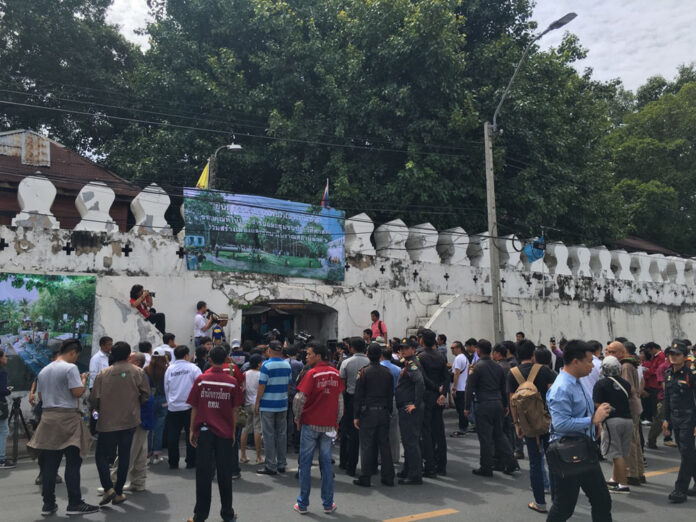
City staff and members of the media outside the gates of Pom Mahakan, which were closed Saturday morning to stymie demolition by the city.
BANGKOK — A tense showdown Saturday morning between a city demolition crew and historic community ended peacefully with an agreement allowing workers to demolish only homes whose owners had accepted compensation to leave.
The confrontation began at about 9am when Deputy Bangkok Gov. Aswin Kwanmuang led city personnel and demolition equipment to an old fort next to Wat Saket and tried to enter the community behind its wall. The residents and supporters of Pom Mahakan had already gathered to prevent the city from making good on its threat to demolish the roughly 50 residences inside.
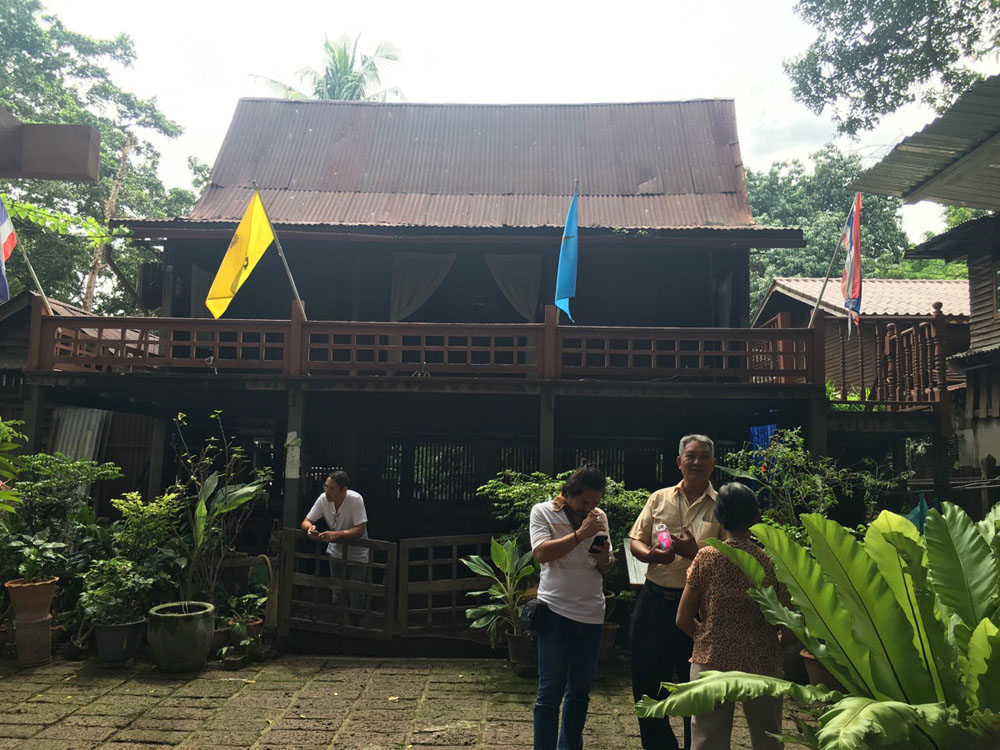
One of 13 residences whose owners had agreed to leave, this century-old building was spared from demolition under a compromise reached Saturday morning.
As the situation escalated, residents decided to close the fort for security and only allowed top city officials, academics and activists inside for discussion. Like in a siege setting befitting the fort’s historical purpose, its large doors were shut tight and people only allowed through one at a time.
Ultimately, the discussion ended with agreement that only the 12 houses whose owners had volunteered to leave would be knocked down.
“We can’t deny that some resident took the compensation on April 19, said community leader Thawatchai Woramahakhun. “It is also their rights to leave.”
The city agreed to spare a 13th home which met that condition because it was a century-old landmark in the heart of the community.
As for the rest, a committee will be formed to find an inclusive solution.
Both sides agreed to let human rights activist Angkhana Neelaphaijit, who was present, moderate further negotiations.
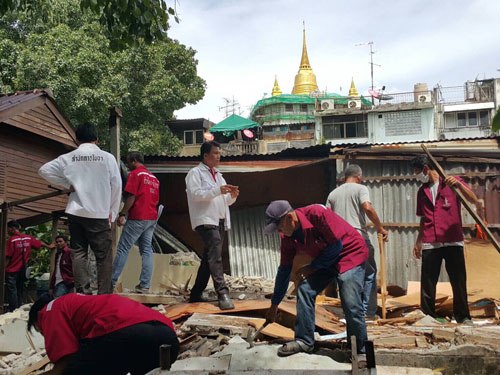
City workers dismantle one of a dozen homes inside the Pom Mahakan community Saturday in Bangkok.
In 2005 the Supreme Court ruled that City Hall had the right to clear out the century-old community and replace it with a park, as it is situated on public land.
No written agreement was made today as Aswin said staff could be guilty neglecting their duties if they signed anything contradicting the court order.
“There will not be another forcible eviction apart from these 13 houses while we are negotiating,” Aswin said.
Thais hold portraits of King Bhumibol Adulyadej and Queen Sirikit as they pray outside of the Grand Palace during the celebrations marking the 70th anniversary of his accession to the throne on June 9 in Bangkok. Photo: Sakchai Lalit / Associated Press
BANGKOK — King Bhumibol Adulyadej has been treated for a severe infection, the Royal Palace said in a statement, the latest in what have become regular medical reports about the continuously deteriorating health of the world’s longest reigning monarch.
A statement issued by the palace late Friday said the 88-year-old king was observed with a high heart beat and thick mucus. It said a test result of the mucus and blood “indicated a severe infection.” It did not elaborate.
Bhumibol has been hospitalized for a large part of the past decade, mostly with ailments associated with aging. He has not made a public appearance since January.
In the past months, official announcements about his health have increased in frequency, but their narrow and technical focus make it hard to gauge the king’s overall condition.
Friday’s statement said an X-ray revealed that the king had fluid in his lungs, which a treatment helped to reduce. The king’s low blood pressure and a fever have since improved and his medical team is continuously watching the symptoms closely, the statement said.
At various times during his hospitalization, the king was said to have been fed intravenously and given oxygen to assist his breathing.
A statement in June said that doctors drained excess fluid from his brain, the second time this procedure has been carried out on him.
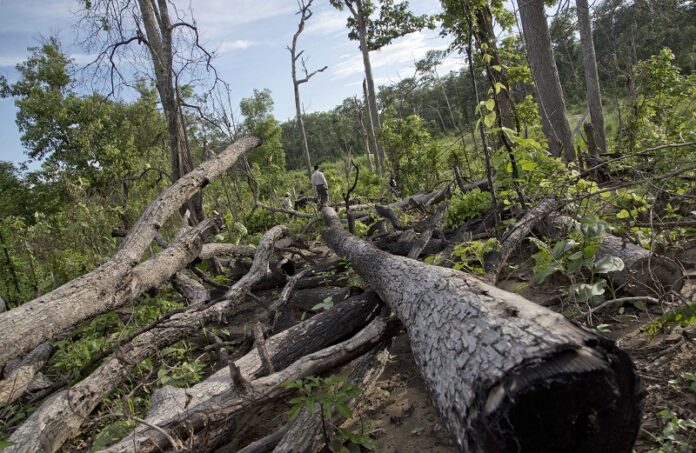
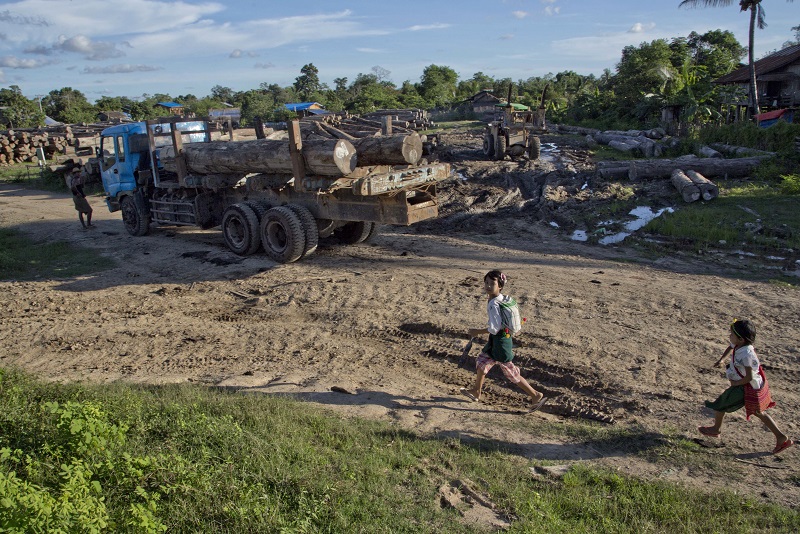
Myanmar is struggling to stop illegal logging, which has erased one-quarter of the country’s valuable forests in a generation. Photo: Gemunu Amarasinghe / Associated Press
PINLEBU, Myanmar — The hills of northern Myanmar’s Sagaing region were so legendarily thick with forests that in the days of kings, condemned criminals were ordered into the woods as a death sentence. Today illegal logging has left vast swaths of bare patches, with only a handful of old-growth stands.
Despite a temporary ban on all logging by the Southeast Asian country’s new government, the Associated Press found in a trip to the remote region that loggers are still cutting down some of the remaining old trees. The AP also saw loggers illegally chopping up the wood from already felled trees for transportation and sale. Piles of such wood have been confiscated by the government, but villagers said officials can be bribed to let it through.
Massive amounts of teak, rosewood and other hardwoods have been illegally cut and exported from Myanmar since 2011. Much of that wood was stripped from the Sagaing region, floated on the Irrawaddy River and transported to neighboring China and India.
Myanmar has lost more than a quarter of its forests since 1990, according to the U.N. The losses have been greatest in the north, in Sagaing and neighboring Shan and Kachin states. The pace of deforestation had increased under the last government, though it banned timber exports in 2014.
“Logging companies usually chop down trees more than they actually are permitted,” said Min Min, a farmer and environmental activist who previously worked transporting illegally cut logs. “According to my experience, I’ve never seen the government take action against the companies chopping down any size of trees they wanted.”
Four activists in Sagaing told The Associated Press that logging appeared to be continuing on a small scale despite the temporary ban, based on truckloads of lumber they have seen being transported. This is the rainy season in Myanmar, and an off period for the illegal timber trade in any case.
Those arrested have included members of Myanmar’s military, which no longer rules the country but remains powerful. Burmese media reported last week that nearly three tons of rosewood were seized from a military vehicle in Sagaing.
This summer, AP reporters rode jeeps and motorbikes for 20 hours over rough, muddy roads to reach villages in northern Sagaing, meeting former illegal loggers, local villagers and elephant keepers. Despite its remoteness, vast swaths of hillsides and valleys were bald patches.
Young trees, perhaps 10 years old, stand near the stumps of ancestors that were clearly many times larger. A few villages have managed to cling to old-growth stands in small community forests, but that is all.
“We used to be so afraid of coming to the forest alone because it was too forested,” said Aung Moe Kyaw, a local environmental activist. “Now, as you see, it is bald and no more big trees. The big trees are all gone now.”
Logging in Sagaing has traditionally been done with the help of elephants, and while that work has continued, heavy equipment is used much more commonly.
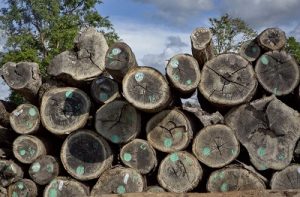
Confiscated illegal timber is piled for an auction in Paekone village in northern Sagaging division, Myanmar. Photo: Gemunu Amarasinghe / Associated Press
“If the logging was only done by the government and pulled logs by elephant, deforestation wouldn’t be that bad,” said Than Lwin, an elephant trainer, showing off two of the six elephants that work hauling felled tree trunks that weigh up to five tons. “We see that logging companies are chopping down trees as much as they want.”
Mountains of recently cut illegal timber worth millions of dollars lie in villages across the region; most of the timber the AP team saw was rosewood, coveted in China and elsewhere for its natural red color. Activists say the wood has been seized by the government mostly since late 2015, but that loggers commonly have been able to get it back by bribing officials.
The AP team traveling witnessed loggers cutting wood outside Katha, a Sagaing town that is a transit hub for the trade. An activist traveling with the journalists said the logging was illegal and contacted forest department officials, who detained the loggers and seized their equipment.
The wood-cutting operation had been set up near a mountain far from the nearest village. Because exporting lumber rather than raw timber is not illegal, clandestine wood-cutting is a way to circumvent the law.
Villagers learned of the operation and informed the activist. The leader of the logging crew looked nervous when the activists and journalists arrived. When asked where he got the timber, he said his brother recently gave him the leftover logs, and that they were only for home use.
Local environmental activists working under the EU Forest Law Enforcement, Governance and Trade, which supports efforts to combat illegal logging in developing countries, say much illegally cut timber is hauled to Katha, transported on the Irrawaddy and sent on various paths through Kachin state and the Mandalay region before it reaches China’s western Yunan province. They say bribes allow illegal loads to pass official gates.
Min Min said a former boss would bribe police and forest department officials ahead of time, so that when Min Min arrived at the gate, the officials would let him go without checking his truck.
“The officials protect us for giving bribes, and sometimes they even come with us on the truck to show us the way to get to our final destination,” he said.
Myo Min, national director of the forestry department, said Thursday the government is trying to stop corruption.
“There are many individual bribery cases but not all staff from the forest department is involved,” he said. “… We have taken action against bribe-taking staff in the past and are still working on it now.”
Myanmar police referred questions about corruption to the forestry department.
Myo Min said the department has taken action against staff in the Katha district in the past. But the district’s director, Soe Tint, denied that officials have cooperated in illegal logging.
“Because of the Chinese demand for hardwood, there could be illegal logging cooperation among businessmen,” he said.
How big is Myanmar’s smuggling? From 2011 to 2014, Myanmar reported $2.83 billion in exports of hardwood in the rough, while trading partners reported imports of $5.57 billion. Illegal logging is likely to account for some of that $2.74 billion discrepancy. Other timber-cutting is probably absent from any country’s record-keeping.
India and China are by far the biggest consumers. From 2011 to 2015, the two countries collectively imported about six times more Myanmar teak and rosewood than the rest of the world combined.
“Most of illegal timber is transported to China through Kachin state,” said Khon Ja of the activist group Kachin Peace Network. “We have witnessed how they (illegal loggers) bribe military officers and civil officers throughout the way when they carried out the illegal timber.
“It is an unnecessarily great loss. The valuable natural resources are sold for a penny,” she added.
From 2010 to 2015, Myanmar had the third-largest forest loss in the world, equivalent to an annual loss of 546,000 hectares (2,100 square miles), according to the U.N. Food and Agriculture Organization.
In 2011, Myanmar’s longtime military rulers gave way to a military-backed but quasi-civilian government led by President Thein Sein that ruled until earlier this year. That government is credited with initiating a series of political reforms and helping the country emerge from decades of international isolation, but one side effect of that new openness was that Myanmar’s vast natural resources became easier to exploit.
“The worst period was under President Thein Sein’s administration,” said Than Hlaing, a Sagaing regional lawmaker. “The government itself was cooperating with the businessmen. The illegal logging was widespread in our region.”
Since 2014, the government has banned the export of raw timber logs to protect old-growth forests. In May, the new elected government led by Aung San Suu Kyi announced a nationwide logging ban for this fiscal year, which ends March 31.
The forest department compound in Katha is now home to a fleet of trucks, buses and vans that the government has seized from illegal loggers since late last year.
Myo Min, the forestry director, said last month that the government has seized more than 16,000 tons of illegally cut logs since April, when the current government took office and that more than 1,000 criminal cases have been filed in that time. He said that continues work that began toward the end of previous government, which seized 30,000 tons of logs and filed more than 2,200 criminal cases in its last fiscal year.
According to the U.N. Food and Agriculture Organization, from 2010 to 2015, Myanmar had the third-largest forest loss in the world, equivalent to an annual loss of 546,000 hectares. (2,100 square miles). Photo: Gemunu Amarasinghe / Associated Press
At least some illegal loggers are being prosecuted, including one whom AP reporters met in Wuntho village shortly after his release from prison, where he had spent four months.
Corruption and weak law enforcement remain obstacles.
“The illegal loggers are so smart and professional, as they have been doing it for a long time,” said Min Naung, a Lower House lawmaker and a member of the Natural Resources and Environmental Conservation Committee. “They know how to transport illegal logs when and where, and they definitely know the weaknesses of the government. They know how to avoid being arrested.”
He said some officials are still taking bribes, “even if it’s less,” and that the forest department lacks muscle. “They don’t have enough people to seize logging sites and people because it can be dangerous for them, and they have no weapons but pens,” he said.
A forest department worker in Sagaing was recently killed by illegal loggers. “We could do nothing about it and we were really sad what happened to him. We couldn’t protect him,” Min Naung said.
Soe Tint, the forest official, said that although the killing was the first of its kind in the district, his workers are often threatened or even harmed, and they frequently ask for backup from police.
Though local villagers have sometimes taken part in illegal logging, they say they’ve received virtually none of the proceeds. And they say the biggest operators rely on loggers from other regions.
Even by the standards of Myanmar, one of Asia’s poorest countries, northern Sagaing is impoverished and remote. The roads are too poor for most people to travel frequently. Villagers are heavily dependent on farming, but they lack irrigation, and harvest food from the forest outside of the growing season. Villages typically have only a primary school, so further education is out of the question for most children.
“It has been always difficult for us to stop illegal loggers,” said Aung Moe Kyaw, the activist. “They have a good deal with the authorities from different levels and they benefit from it, but villagers who live by the forests are so poor.”
At the same time, he said, simply having members of Parliament pay attention to the issue is an improvement.
“If the new government could protect these forests for a few years,” he said, “it would actually give the chance for these forests to live.”
BANGKOK — A Briton who was filmed stealing from a Thai tourist in Chiang Mai was arrested Thursday at Suvarnabhumi Airport.
Stephen Antonio (transcribed from Thai) denied the allegations, though police said they have evidence he committed the crime at Doi Suthep temple on Wednesday, including security camera footage.
“He has the right to deny the charge, but we have enough evidence to implicate him,” Col. Pitipong Boonpiam, chief of Phuping Ratchaniwet Police Station, said by telephone Friday.
According to Pitipong, the suspect took more than 100,000 baht worth of items and cash from a backpack that belonged to a Thai tourist at the temple.
In video said to be from inside the temple, a man identified as Antonio is seen looking furtively around as he moves to an unattended bag which he then takes.
Tourist Police said they apprehended Antonio as he arrived at the airport in Bangkok yesterday, presumably to board his flight home. He was later taken to be held at Phuping Ratchaniwet Police Station.
The British embassy said it will send a representative to be present during during police questioning of Antonio, Pitipong said.
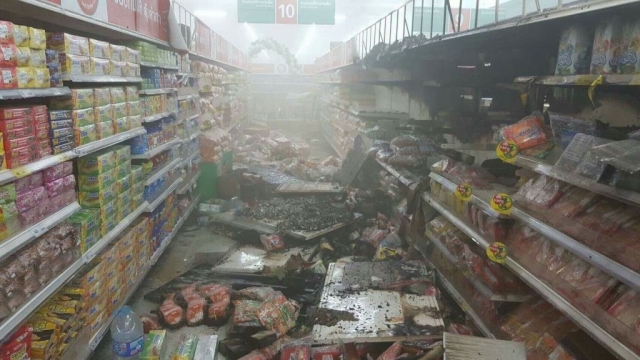
Fire struck a Tesco Lotus supermarket in the southern province of Nakhon Si Thammarat on Aug.12. No one was injured. Photo: Prachachat
BANGKOK — A second man wanted for a 2015 car bomb attack on a Koh Samui shopping mall was named Friday as the fourth suspect in the spree of attacks last month across the southern region.
A military court approved a warrant for the arrest of Hakeem Dohloh, 32 of Pattani province, in connection to the fire bombing of a Tesco Lotus in Nakhon Si Thammarat province on Aug. 12. Charges of arson and possession of explosives were filed against him.
Hakeem, like previously announced suspectAsmeen Katemmahdi, had an outstanding warrant for the April 2015 explosion in the underground parking lot of Central Festival Samui. Authorities at the time speculated the incident might be an expansion of the separatist violence typically limited to the three southernmost provinces.
Police accuse Asmeen of a bomb attack in Hua Hin on Aug.11-12 that killed 2 people. The other two named suspects are Ruslan Baima, who was also accused of being behind the Hua Hin bombing; and Ahama Lengha, who is wanted in connection with attacks in Phuket which slightly injured one people.
Another warrant issued Friday was for Abdulkadir Saleah (transcribed from Thai), a 36-year-old from Pattani province who police said has a history in the insurgency. He was said to be linked to the Aug. 12 arson attack at Lee Mart supermarket in Trang province.
Despite mounting evidence pointing to a direct link between the attacks and the long-running violence in the Deep South, police authorities have been either denied any connection or said it is too soon to tell.
All five suspects are residents of the southern border provinces and remain at large.
The Tesco Lotus fire happened at 8am on Mother’s Day was part of a series of attacks across seven southern provinces which killed four people and injured dozens. No one was injured and the fire was put out.
The day after the attack, the military pinned the blame on Chiang Mai native Sakarin Karuehat, dispatching soldiers to arrest him from an oil drilling platform in the Gulf of Thailand. He was later released without charge. Police attempts to have him re-arrested were rejected by the courts due to lack of evidence.
According to police, a witness saw Hakeem after the attack at the Nakhon Si Thammarat bus station, where he changed his clothes and boarded a bus bound to the south.
Chief police investigator Gen. Srivara Ransibrahmanakul said police have identified four people behind the Tesco Lotus attack. He said police are gathering evidence to seek warrants for the other three.
Srivara was on his way to another military court Friday afternoon to seek warrants for a suspect believed linked to the arson attack in Trang province. The name of the suspect has yet to be revealed.