Myanmar's Foreign Minister Aung San Suu Kyi greets leaders of armed ethnic groups during their meeting at a hotel last year in Naypyitaw, Myanmar. Photo: Aung Shine Oo / Associated Press
YANGON, Myanmar — Myanmar leader Aung San Suu Kyi left for a high-profile trip to China on Wednesday to discuss the fate of a jointly built dam and hydroelectric plant that Myanmar put on hold amid questions over which country will benefit from it.
According to officials, the visit will tackle a new and delicate era in relations, including development aid and Myanmar’s upcoming complex peace process involving the government, the military and ethnic armed groups.
“The intention of the five-day visit is to build better relationship, and of course China will definitely talk about continuing the dam project but it won’t be our priority of the visit,” said Aye Aye Soe, deputy director of the Foreign Affairs’ Political Department.
It is Suu Kyi’s first visit to Beijing since her National League for Democracy party took office in March.
The former military-backed government of President Thein Sein suspended work on the Myitsone Dam in northern Myanmar in 2011, because 90 percent of electricity would benefit China. Environmental concerns and the project’s impact on local communities also fed public anger over the construction of the dam.
Last week, President Htin Kyaw set up a 20-member commission to study and review dam projects on the Irrawaddy River, including Myitsone.
The chairman of the commission and the deputy speaker of the upper house, T Khun Myat, told reporters Tuesday that the commission will make field visits and inspect the project’s agreements.
The dam is to be built by the Upstream Ayeyawady Confluence Basin Hydropower Co., a joint venture between the China Power Investment Corp., Myanmar’s Ministry of Electric Power and the Asia World Co., which has links to the former military regime.
“We will only decide after our commission has reviewed the project and Myanmar government (will) probably come up with a solution by then,” said Aye Aye Soe.
Lads involved in Khaosan Road fisticuffs smiling again in an image provided by police
BANGKOK — Two guards working for a nightclub in a popular backpacker destination lost their jobs for kicking and beating two British men.
According to police, the two victims and their friends attempted to enter Brick Bar on Khaosan Road at around 3am Monday, but they were intoxicated and carrying beer bottles at the time, so the bouncers denied them entry.
Upon being refused entry, the four Britons went into a nearby restroom, where they allegedly splashed their beer on other customers, at which point the bouncers intervened, dragged two of the tourists into the street and assaulted them, said Tourist Police deputy chief Col. Nithithorn Chintakanon.
“It was definitely wrong of the guards to beat up those tourists, but the Thais were also punched few times by the [other two] tourists, but, of course, in the video it looked like a one-sided assault,” Col. Nithithorn said.
Police later arrived at the scene and arrested two bouncers working for the bar, identified as Jiranuwat Saiyadee, 23, and Preecha Pansomboon, 30. The two injured Britons were named as Amando Rodriguez and Niall Loftus.
Col. Nithitorn said the two suspects were subsequently charged and convicted of assault, given a one-year suspended jail sentence, and fined 2,000 baht each. They were later expelled by the company that owns Brick Bar, according to Nithithorn.
The four tourists were also paid 10,000 baht each in compensation by the bar, Nithithorn added.
David Key boats away from his flooded home after reviewing the damage on Tuesday in Prairieville, Louisiana. The insurance adjuster fled his home as the flood water was rising with his wife and three children and returned today to assess the damage. Photo: Max Becherer / Associated Press
DENHAM SPRINGS, La. — With an estimated 40,000 homes damaged by deadly flooding, Louisiana could be looking at its biggest housing crunch since the miserable, bumbling aftermath of Hurricane Katrina a decade ago.
People whose homes were swamped by some of the heaviest rains Louisiana has ever seen are staying in shelters, bunking with friends or relatives, or sleeping in trailers on their front lawns. Others unable or unwilling to leave their homes are living amid mud and the ever-present risk of mold in the steamy August heat.
Many victims will need an extended place to stay while they rebuild. Countless others didn’t have flood insurance and may not have the means to repair their homes. They may have to find new places altogether.
“I got nowhere else to go,” said Thomas Lee, 56, who ekes out a living as a drywall hanger — a skill that will come in handy. His sodden furniture is piled at the curb and the drywall in his rented house is puckering, but Thomas still plans to keep living there, sleeping on an air mattress.
Exactly how many will need temporary housing is unclear, but state officials are urging landlords to allow short-term leases and encouraging people to rent out any empty space.
“If you have a unit that’s an old mother-in-law suite and you can rent it out, let us know,” said Keith Cunningham, who heads the Louisiana Housing Corporation, the state housing agency.
The Federal Emergency Management Agency, whose very name became a punchline during Katrina, said it will look into lining up rental properties for those left homeless and also consider temporary housing units.
But FEMA Administrator Craig Fugate gave assurances that the temporary units won’t be the old FEMA travel trailers — a reference to the ones brought in after Hurricanes Katrina and Rita that were found to have toxic levels of formaldehyde.
The flooding that has struck the Baton Rouge and Lafayette areas has left at least 13 people dead. More than 30,000 have been rescued, and at least 70,000 have registered for federal disaster assistance. At the height, 11,000 people were staying in shelters, though that had dropped to 6,000 by Wednesday.
For the foreseeable future, home for Carolyn Smith, her husband, two grown sons and a family friend will be a 30-foot travel trailer supplied by a relative. It has one bedroom, a sofa-sleeper, four bunks and one bathroom.
It sits in the driveway of the home she and her husband lived in for 48 years in Denham Springs. Nearby lies a pile of stinking debris pulled from the flooded, one-story wood-frame home.
Smith and her husband are both in their 70s and on fixed incomes. She said she’s not sure how they will make it in coming months as they try to rebuild the house, which took on more than 4 feet of water.
“We’re starting over again. From rock bottom,” she said. “At our age that’s kind of rough.”
In a sign of the housing crunch, Livingston Parish officials are talking with FEMA about getting temporary housing for emergency and rescue workers. An estimated 75 percent of the homes in the parish of 138,000 residents were a total loss.
Those with flood insurance will be in a much better place to begin rebuilding — but there won’t be many of them.
Louisiana Insurance Commissioner Jim Donelon said that only 12 percent of the homes in hard-hit Baton Rouge were covered by flood insurance, and only 14 percent in Lafayette.
Across the flood-stricken area, many residents said they weren’t required to have flood insurance and didn’t have it, since nothing remotely like this had ever happened before.
“My father’s owned this place for 70 years. Never seen it like this. We never thought we needed it,” said Chris Bankston, owner of an auto parts place in the Livingston Parish town of Albany where workers were shoveling debris.
Water crept into his parking lot Friday night, and by Sunday his gasoline pumps were covered. Floodwaters had never come within 200 yards of the place before, he said.
FEMA said more than 9,000 flood claims have been filed with the agency.
Anyone with flood damage is eligible for FEMA aid of close to $33,000 — far less than many people without flood insurance will need to repair and replace their damaged property. The maximum payout under a home flood insurance policy is $250,000.
Joseph Bruno, a New Orleans lawyer who is a veteran of the Katrina insurance wars, fears the greatest needs could be borne by elderly residents who paid off their homes and weren’t required by their bank to carry flood insurance.
Ronald Robillard, 57, and his 65-year-old brother, William Robillard, have been living next door to each other in Baton Rouge homes owned by the older brother. Since both places flooded, they have been sleeping at a shelter at night and cleaning up the homes by day.
William owns the homes free and clear. He doesn’t have flood insurance to pay for the repairs but isn’t waiting for any government aid.
“I figure by fixing it up one room at a time, we’ll be fine,” William said.
“If they give us help, fine,” Ronald added. “We ain’t looking for a handout. Just a hand. That’s a true statement.”
Story: Michael Kunzelman, Melinda Deslatte and Kevin McGill
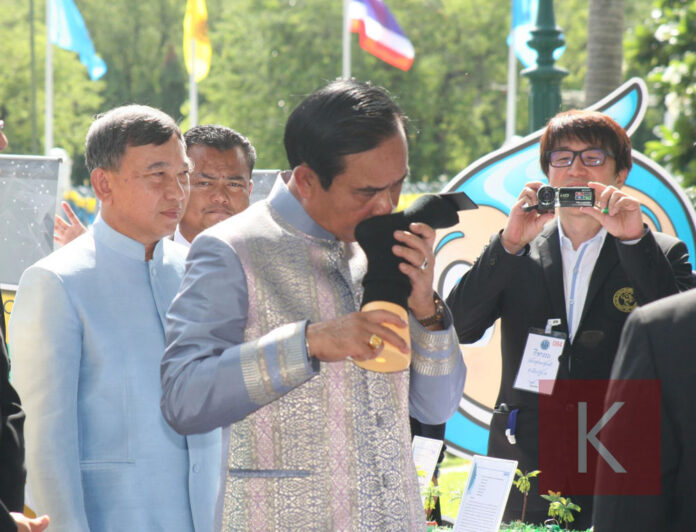
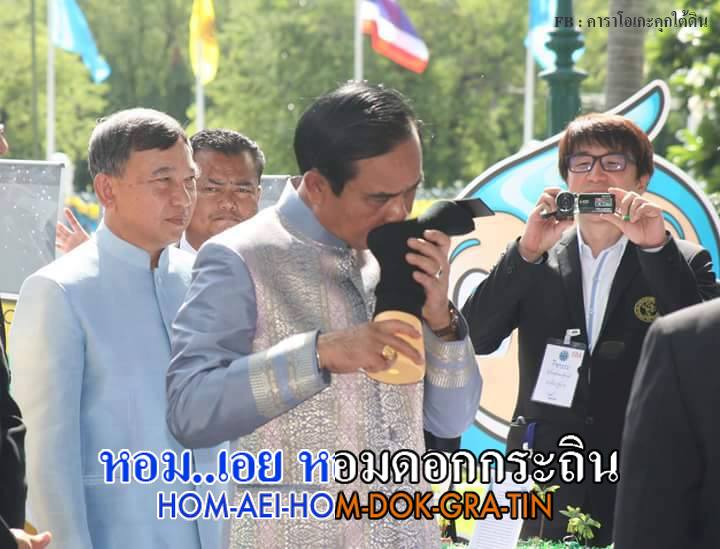
Junta chairman Prayuth Chan-ocha smells a sock at an exhibition Tuesday at Government House in Bangkok.
BANGKOK — When Khaosod English first published a photo of junta chairman Prayuth Chan-ocha inspecting a sock at a government expo Wednesday morning, we suspected it might give birth to a few memes.
By Wednesday afternoon the Facebook post had been liked 1,300 times and shared more than 700. The photo clearly prompted laughter and brought some levity to many readers.
“Why on earth did he has to sniff that thing????” Facebook user Supanich Sakcha-um asked the question asked by all the internet today.
Here’s a little context: The Prime Minister was visiting an expo in advance of National Science Day featuring “nanotech” products when a particular nanofiber sock caught the retired general’s attention. So he picked it up and gave it a good whiff just as a Khaosod photographer snapped a picture.
For Thais, the image is striking particularly because feet are considered the “low” part of the body, and people usually take care not to offend anyone with their shoes or socks in public, let alone smell them.
Unsurprisingly, the photo soon became ready meme material for the internet.
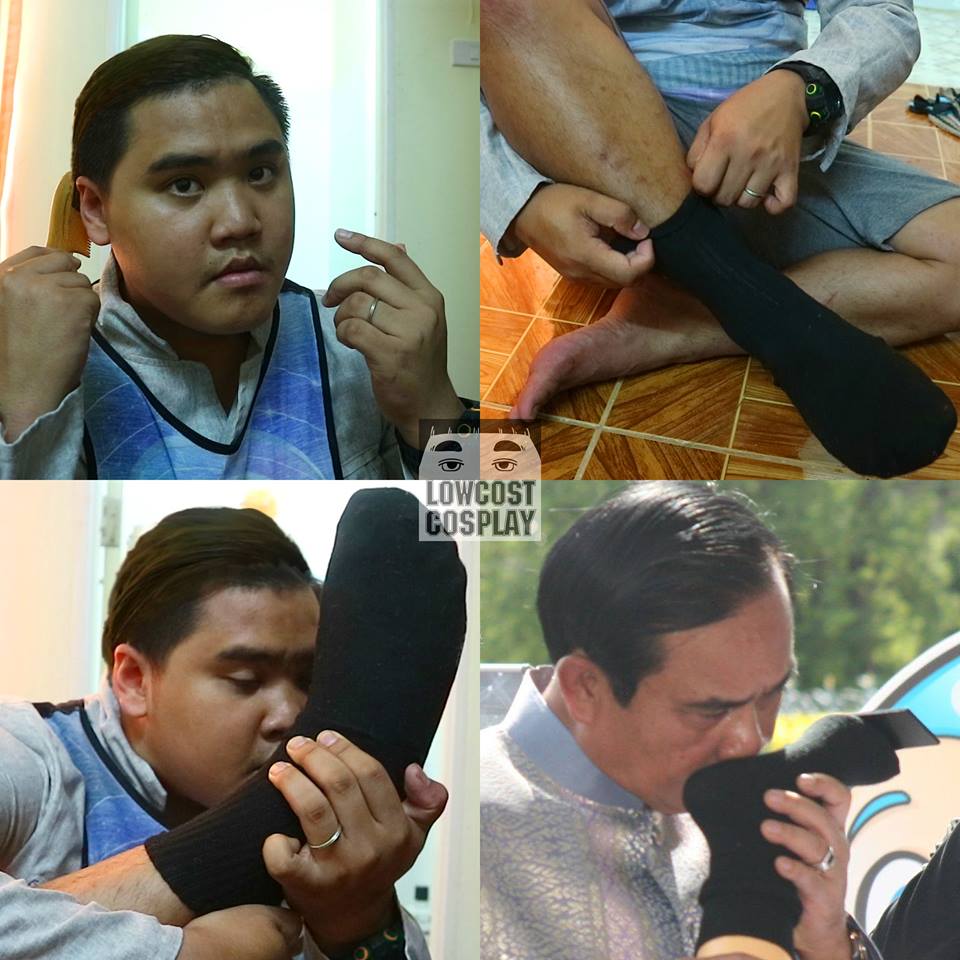
The master of creative cosplay was quick to join in. Image: LowCostCosplay / Facebook
Image: Pim Thai Mai Dai / Facebook
‘Smells so, so nice, this cassie flower,’ are the lyrics to Thai oldie “Mont Rak Luk Thung.” Image: Basement Karaoke / Facebook:
JAKARTA, Indonesia — A fuel tanker that disappeared from a Malaysian port was likely taken by its own crew in a dispute with their employer, Indonesian authorities said Wednesday.
Malaysian and Indonesian maritime authorities have been searching for the Indonesian-flagged MT Vier Harmoni after it dropped out of contact on Tuesday evening.
There were suspicions the tanker had been hijacked. For years, gangs of armed thieves have targeted small tankers operating off Southeast Asian coasts, looking for marine diesel and oil to steal and then sell. And militants in the southern Philippines have staged ransom kidnappings in the regional waters in recent months.
Indonesia’s western naval command said in a statement that it has information the captain of the vessel twice informed his employer he was taking the ship back to the Indonesian island of Batam because of an “internal management problem.”
It said there was no indication of any violence and it is coordinating with Malaysia to locate the ship.
Vier Abdul Jamal, chief executive of the ship’s owner Vierlines Asia Group, said the tanker has 10 Indonesian crew and is currently chartered by another company for two years.
The charterer lost contact with the Vier Harmoni on Tuesday evening and its tracking device has not been active since, Adbul Jamal said.
He said it would be illegal for the captain to remove the ship without clearance, notwithstanding any dispute.
The Malaysian maritime agency said the tanker was carrying 900,000 litres of diesel and left from a port in Malaysia’s southern Johor state.
Ahmad Puzi Kahar, the agency’s chief, said “internal problems” might be behind the disappearance.
The 53-meter (175 foot) long Vier Harmoni was built in 2014.
Eileen Ng reported from Kuala Lumpur, Malaysia. Ali Kotarumalos in Jakarta contributed to this report.
Visualization of what those behind plan might have envisioned. Original photo: Survivaladmin / Flickr
BANGKOK — Telecoms regulators disagree over a plan to mandate foreigners use SIM cards which can track their location, with one commissioner saying the plan has a long way to go and may end up dropping the tracking function.
Challenging assertions made last week about the plan, a member of the National Broadcasting and Telecommunications Commission’s board said the plan was unlikely to go forward as envisioned, most likely without the location-tracking of all foreigners promised.
While the commission’s top executive, Takorn Tantasith, assured that such SIM cards would not infringe on rights and privacy, commissioner Pravit Leestapornwongsa said the board sees flaws in the plan and has raised questions about its feasibility. He was also unsure to what extent Takorn pitched the idea on behalf of the state security apparatus.
“I don’t know what Takorn talked about with the national security department,” Pravit said. “But I don’t think it is technically possible.”
When the board met last week, Pravit said he asked whether existing SIM cards can already track their owners via cell-tower triangulation, and whether it could be turned off.
Don Sambandaraksa, a Telecom Asia correspondent, said there is existing technology by which a SIM card can actively and continuously report its tower-based location over the phone network, similar to how SMS messages are sent.
Pravit said he is not convinced that, without GPS, a SIM card would have the ability to identify a more accurate location.
Though the plan was approved in concept by the NBTC, Pravit stressed it was still in the early stages. Whether it would apply only to tourists or all expats living in the country was still an undecided detail, he said.
The tracking function was not the main idea, he said.
Pravit said he only supports a special SIM card for tourists that would see their unused numbers return back to the pool of available numbers more quickly, and any balances on their cards steered into government coffers.
“Currently tourists top up money to use the phone. When they leave the country, the phone operator gets the unused money,” Pravit said. “We aim to bring it back to the government instead.”
He disputed other assertions made by Takorn last week.
“Takorn said it would be the same as filling out the address form as obligated under immigration law. I explained in the meeting that it’s not,” he said. “That form is for the location I stay such as a hotel, but the government should not have the right to know where I go during the day.”
Jeffrey J. Blatt from the law firm Tilleke & Gibbins, who represented telecommunication companies for years and is based in Thailand, said the authorities already have plenty of broad laws and powers at their disposal to obtain records about individuals.
More so, he said, the plan would not enhance security.
“These new rules would seem to have limited value and have the potential to send the wrong message to both lawful resident foreigners and to visitors that the Thai government seeks to track your every move,” he said.
Even if the plan went ahead, both Pravit and Blatt agreed it would not be effective, as tourists or foreign residents or even criminals would find a way to get the normal SIM cards through Thai nationals.
“At the end of the day, there is no substitute for good old-fashioned police work to prevent, detect, investigate and stop crime,” Blatt said.
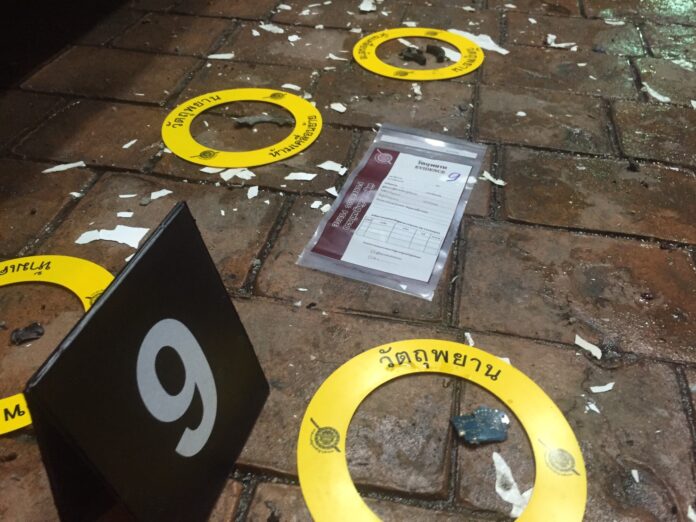
Investigators night mark evidence Thursday night at one of two bombing sites in the resort town of Hua Hin.
BANGKOK — Despite the recent coordinated attacks across seven southern provinces, the Royal Thai Army says it is committed to a peace dialogue with the separatist movement thought by many to be behind the attacks.
Stalled peace talks have been blamed by some analysts as a possible motive behind the deadly bombing spree that killed four on Thursday and Friday, the holiday season that marked Her Majesty the Queen’s Birthday and National Mother’s Day.
“I think they want to make news, and they want attention from international communities, so that their demands are accepted,” said Srisompob Jitpiromsri, a scholar who runs Deep South Watch, a research group that monitors secessionist violence in the region. “I think they were upset about the peace talk. It had grounded to a halt.”
Srisompob is among experts who believe the most likely culprits are the rebels who are aiming to form an independent state in the Muslim-majority Deep South.
Gen. Aksara Kerdpol, the man appointed by the army as its chief negotiator with the Deep South separatists, disputed that view, saying that talks between both sides have been going on as usual and will continue to take place.
“My team is still talking to them and listening to them,” Gen. Aksara said. “I don’t think there was any need for them to pressure us about it, because we’re already talking with each other all the time. It’s a mission that we will continue to pursue consistently.”
“I don’t want you to conclude this in haste. I want you to wait for the investigation first, because it may affect national security,” the general said.
Were the insurgents behind the attacks, Srisompob believes it wouldn’t shatter the hope of meaningful negotiations. On the contrary, they may even spur the authorities to return to the table, the academic said.
“I’ve heard news that in the last several days, the situation is getting better. I think it’s because of this incident,” Srisompob said. “It was a signal to warn the government that this is a big issue for them … and the government will pay more attention from now on.”
Since the insurrection began in the Deep South in 2004, there was little interest in parley in Bangkok, which prefers heavy-handed policies of troops surges and pacification campaigns. The military engaged in peace talks of its own accord.
Angkhana Neelaphaijit, who’s worked with civil rights groups in the Deep South as a member of the National Human Rights Commission, agreed the army won’t shy away from dialogue in the wake of last week bombings.
However, she warned, not all groups want to talk.
“Some of the [insurgents] don’t agree with Mara Patani, and they don’t support a peace negotiation,” Angkhana said, referring to the umbrella group speaking for the separatists in the talks. “There are many sides, and they don’t have unity.”
A collage piece by Jirapong Somphao, aka K, from the Parade of Toys exhibition. Photo: Kalwit Studio & Gallery / Courtesy.
BANGKOK — Three newcomer artists join forces in reflecting on social discrimination through pop art in Parade of Toys exhibition.
Discrimination could be found around the world, not exempting the beautiful Land of Smiles. Three Thai artists were motivated by this topic to create works reflecting superficiality of society.
“The artworks question viewers on how the surrounding affects our true selves. Does it make us see things clearer or just force us to follow others’ paths?” said Phurapol Sotaiyin aka Northyang.
After graduating from the Faculty of Painting Sculpture and Graphic Arts at Silpakorn University, Phurapol struggled to start a small business with friends, saying he was taken advantage of. Despite the drama, he learned the hard way from those experiences and channeled them into his work.
“Thai society is classified by class and dominated by favoritism and a patronage system,” the 26-year-artist said. “They force people to live according to those stereotypical standards. Only when we play the role that the society wants, we can live peacefully. But is this really what everyone wants to be?”
Apart from Phurapol, Phuwadon Thongnoum aka Phu20, and collage artist Jirapong Somphao express their points of view on society.
The opening reception starts at 7pm on Sept. 9 and runs through Nov. 12 at Kalwit Studio & Gallery on Wireless Road. It’s a moto ride or 15-minute walk from BTS Ploen Chit.
1 of 3
A painting by Phuwadon Thongnoum, aka Phu20, from the Parade of Toys exhibition. Photo: Kalwit Studio & Gallery / Courtesy
A painting by Phurapol Sotaiyin, aka Northyang, from the Parade of Toys exhibition. Photo: Kalwit Studio & Gallery / Courtesy
A collage piece by Jirapong Somphao, aka K, from the Parade of Toys exhibition. Photo: Kalwit Studio & Gallery / Courtesy.
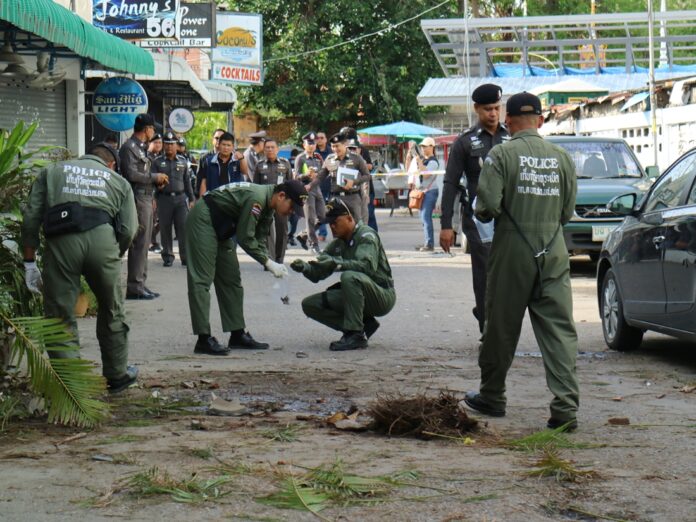
Police officers on Friday inspect scene of a bomb attack in Hua Hin.
BANGKOK — Any suspects arrested in connection to the Mother’s Day bomb and arson attacks will be tried by the military, the top police investigator in the case said Wednesday.
The announcement underscored the seemingly marginalized role of the police force in an investigation in which the military is taking the lead, a divided effort illustrated Tuesday when the same police commander backtracked on claims one perpetrator had been arrested.
“I will personally inspect all case files and all requests for arrest warrants to the courts,” police Gen. Srivara Ransibrahmanakul, the head of the investigation team, told reporters. “All case files will be under the jurisdiction of the military courts.”
Four people were killed when a series of explosions and firebombs struck seven provinces over the course of Thursday and Friday. The latter date marked Her Majesty the Queen’s Birthday and Mother’s Day in Thailand.
Since the armed forces seized power from an elected government in May 2014, military courts are given authority to try civilians in cases the junta deems matters of national security.
Srivara also told reporters the court has only approved arrest warrants for two suspects for the Mother’s Day bombings so far: Chiang Mai native Sakarin Karuehat and Narathiwat resident Ahama Lengha.
Sakarin is being held on an army base for interrogation, while Ahama’s whereabouts are unknown.
Angkhana Neelaphaijit, a member of the National Human Rights Commission, said she’s concerned by the military’s detention of Sakarin and his lack of communication with lawyers or his family.
“No matter in what situation, suspects have rights,” Angkhana said. “Otherwise, if the state detains and holds people at any location they please, without telling their relatives, it risks becoming forced disappearance. Therefore, security officers must be careful and transparent.”
Angkhana said her agency has not yet received any complaints of human rights abuses regarding Sakarin at the military base so far, and it would only attempt to inspect his the conditions of his detention if his family requested the commission do so.
An army officer at the base where Sakarin is being held said he’s doing fine.
“He’s in good health. We chat with him good naturedly,” said a high-ranking officer at the 41st Army Circle base, who refused to give his name because he’s not authorized to speak to the media. “He’s just a person of interest. We are not treating him as suspect.”
The officer also denied the assertion made by deputy police chief Sriwara that the military is keeping him in the dark about Sakarin.
“It was police who asked the court for the warrant. We only took care of the procedure,” the officer said. “If the police didn’t seek a court warrant for him, we wouldn’t have gone there to arrest him. Soldiers only follow orders from law enforcement officials.”
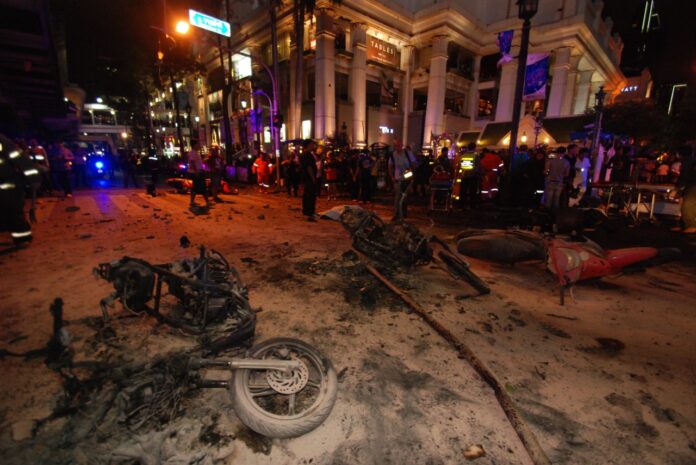
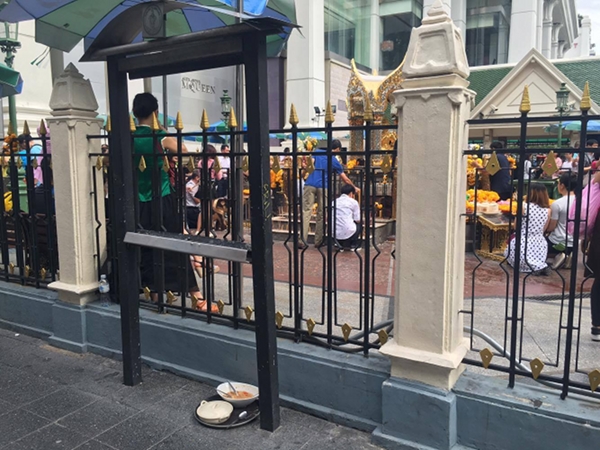
A powerful blast left a scene of devastation and killed 20 people Aug. 17, 2015, at Bangkok's Erawan Shrine. More than 100 were injured.
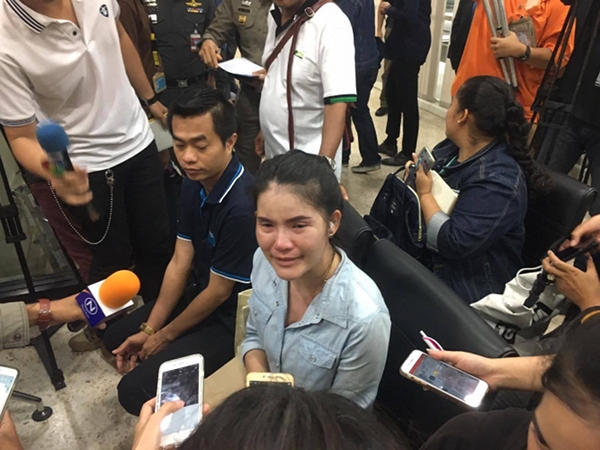
Erawan Shrine bombing victim Wichirata Duangmano, breaks down Wednesday morning at a police news conference.
BANGKOK — Wichirata Duangmano sat among reporters at a police news conference Wednesday morning. She waited until the session dedicated to Thailand’s most recent terror attack was nearly finished before posing her question.
“I would like to know, where can I ask for more help?” she said, breaking down in tears at the Royal Police Headquarters, revealing she was not a reporter but, in fact, the victim of the bomb which hit Bangkok’s Erawan Shrine one year ago today. “I submitted a letter to the Office of the Prime Minister two times, but it stayed silent.”
The 30-year-old, former freelance MC said she can’t remember the moment the bomb exploded at the Ratchaprasong intersection shrine on Aug. 17, 2015. Wichirata survived, but she suffered serious internal injuries, including severe tears to her stomach. Wide, long scars are still visible running down her leg and arm.
What she does remember is that during the two months she spent recovering in a hospital, no official ever visited her or offered help.
The mother of a 3-year-old toddler said she eventually received 100,300 baht from the Ministry of Justice and 30,000 baht from Bangkok City Hall. But even with that, life is difficult for a person who can no longer work, she said.
That’s what led Wichirata and two other two victims to the police’s news conference this morning, as it was the only place they hoped to have their voices heard.
In response, police spokesman Kritsana Pattanacharoen said a middle man would be appointed to coordinate the relevant agencies to offer further help.
Wichirata wasn’t done, however. There was one more thing she wanted.
“I want to see the face of the person who did it,” she said. “I want them all arrested!”
Forgotten Promises
As the authorities try to instill confidence in their efforts to bring another set of attackers to justice for a wave of arson and bomb attacks five days ago, Wichirata isn’t the only one frustrated by the unsatisfying resolution of the previous case.
After a total of 17 arrest warrants were issued, only two ethnic Uighur suspects were arrested. Adem Karadag, aka Bilal Mohammad, and Mieraili Yusufu are now held by the military which is also trying them. All the rest, including numerous Turkish nationals and at least two suspects holding Thai passports, remain at large.
As the anniversary came, police today tried to assure there is progress in that unfinished investigation which was declared finished and went dark 10 months ago.
“When the police chief announced the case was closed, it means the investigation ended,” said Police Maj. Gen. Piyapan Pingmuang Wednesday. “But the process of making arrests still continues.” He declined to give any further information.
He said disclosing information may affect the case, the same reason given for why officers had no details to share Wednesday about the Mother’s Day bombings.
Five days ago, when Kanya Mayoon heard about the wave of bombs which exploded across the south Friday, she could not help but be taken back to one year earlier.
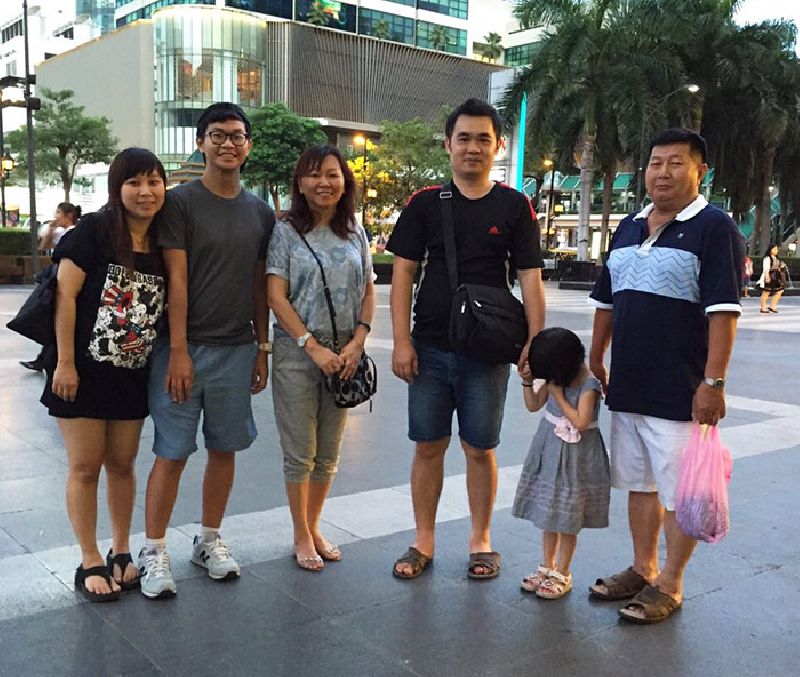
Malaysian family: From left, Ee Ling, Jai Jun, Saw Gek, Tze Siang, Jiang and Hock Guan pose for a photograph in the plaza of CentralWorld shopping mall in Bangkok, near Ratchaprasong intersection and the Erawan Shrine before the Aug. 17 blast. Five members of their family died in the attack; only Ee Ling and her father Hock Guan survived. Photo: Neoh Huey Shinn / Courtesy
One year to the day since her sister was killed by another bomb at Bangkok’s Erawan Shrine, the passage of time has done nothing to lessen the 36-year-old teacher’s anger, because it has brought neither an explanation for what happened nor assurance it won’t repeat again.
“I want the government to take care of our security,” said Kanya on Monday. “It is better than they just keep making announcements, yet this kind of incident still happens everyday. Can’t they do anything to make it better?”
On Aug. 17, 2015, Pranee ‘Kratae’ Seesuwa was among 20 people to die when a large bomb turned the shrine, a popular destination for tourists and Thais alike, into a horror of blood and human remains. It was the deadliest such attack in Thailand’s modern history.
For a year, Kanya, who lives Bueng Kan, a northeastern border province, said she closely follows news about the case as she still waits for the real perpetrators to be brought to justice.
“Last thing I heard is that the suspect previously admitted doing it, backed out and said he was tortured and threatened to confess,” she said. “And then the story went dark.”
Cases Closed or Dropped?
Kanya’s summary is accurate. After a long and fraught investigation that raised many questions about police professional competence and capacity, an adequate explanation for the attack never materialized, and the pursuit of those responsible seemed to fall off a cliff.
Today, Wednesday, no memorial service was held to honor the dead. While the shrine was rebuilt at significant expense, no plaque or marker was placed in their names.
Following the arrests of Karadag and Mieraili, and days before leaving the force to head the Thai football association, former police chief Somyot Pumpanmuang declared the case closed.
Interactive: Click through to explore the 2015 investigation
The Uighur identity of both men, who have alleged they were tortured in military custody, fit the widely held opinion of security experts that the explosion was revenge for the military government’s forcible return two months earlier of nearly 100 Uighurs to China, where they were labeled terrorists and faced persecution.
Authorities dismissed the theory, saying the explosion was not a terrorist attack – a claim hastily repeated Friday – but a result of their crackdown on human trafficking.
No further arrests were made. Police Lt. Gen. Suchart Teerasawat, who appointed to coordinate with Malaysian authorities, said Monday he hasn’t had any contact with Kuala Lumpur since the pair were arrested back in September, a month after the attack.
Though Karadag’s lawyer, Schoochart Kanpai and police said he had confessed to being involved, the suspect later told the military court in February. he was tortured into doing so.
At the time of their indictment back in September, both suspects denied all charges. Nearly a year later, not one of the 447 prosecution witnesses has testified. The first is scheduled to be called before the military tribunal on Tuesday.
Karadag’s lawyer said he expects the trial to continue until 2017.
Kanya, the sister of a victim, said she is nervous to see the case progress so slowly.
“You know those who lost someone can never forget,” Kanya said. “We are waiting for news from the government. We are watching them.”
A sign outside the Erawan Shrine remains empty a year after the attack, as seen Sunday.
Cascading Tragedy
When the bomb went off at 6:55pm on that Monday night, Pranee was not alone at the shrine. She was accompanied by her colleague from Standard Chartered Bank, Sudchada ‘Yha’ Niseeda, who shared the same roots in the northeastern region.
While little progress was made in the case during the past year, Sudchada’s death changed her 10-year-old daughter now living in Loei province.
“She turned into another person, silent,” said Thongpad Niseeda, Sudchada’s mother now caring for her daughter, Mew. “She still says she is lonely. She always says ‘Mew no longer wants to live, Mew wants to die with Mommy Yha.’”
For years, Sudchada worked in Bangkok to send money home for her girl and parents in Loei’s Chiang Khan district. Being a long-distance mom, the 32-year-old would video-call her daughter every day: once when Mew had dinner and again before Mew went to bed.
After her daughter’s death, the 59-year-old grandmother said she and her husband had to go back to work in the rice and potato fields to make ends meet. Mew, who in Grade 4 used to rank at the top of her class, now tells her grandmother she wants to quit school.
Mew is sad, while Thongpad admits she’s still angry.
“It has become silent,” she talked of the investigation progress. “I want the government to catch those who did it and punish them. They did such a terrible thing to my daughter.”
Kanya shares the same frustration and was even more angry when she learned that just five days before the attack’s one-year anniversary, another four innocent people lost their lives in serial bombings. She knows their loved ones may never get justice or even an explanation.
“No matter what the reason was for those who did it, those who lose are we, the people,” she said.