



























28.3 C
Bangkok
Monday, June 29, 2026
Home Blog Page 2635

Appeal of Authoritarianism Underscores Thailand’s Democratic Dilemma

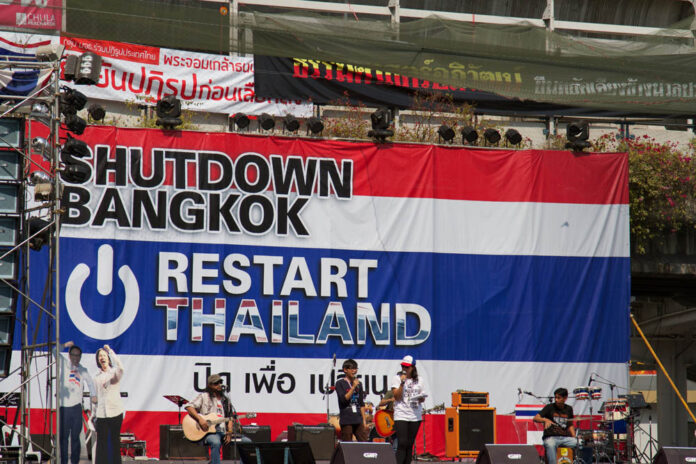
A protest stage Jan. 28, 2014, in Bangkok. Photo: Johan Fantenberg / Flickr

BANGKOK — As anti-politician sentiments continue to spread, some warn the nation is becoming addicted to the military junta’s unchecked powers. This, they say is a proof that the debate over preferred political system for Thailand is far from settled.

We talked to an array of politicos from across the spectrum and political thinkers to get there measure of how we got here.

Addicted to Unaccountable Powers

Given the 12 “successful” coups during the past eight decades of modern Thai politics, deputy Democrat Party leader Nipit Intarasombat warned that Thais are at risk of growing accustomed to unchecked military powers.

“Hatred toward politicians will definitely have repercussions for the revival of a democratic system,” Nipit said, adding that when an elected government returns to power, it will invariably be compared to unelected regimes that employed absolute power to solve things.

“They may conclude that a dictatorial system is better than a democratic system,” he said. “This is worrying.”

‘Hatred toward politicians will definitely have repercussions for the revival of a democratic system’

Nipit added the public has been fed propaganda for over two years now about the virtues of unelected governance, while information critical of the junta is hard to find in the mainstream mass media.

“This information is penetrating deep. People believe the country is damaged because of politicians and prefer another system of governance. In the long run, people will realize that the current system is more damaging in the long run, however, because it cannot be scrutinized,” Nipit said.

A prominent coup supporter played down such fear, however.

“I wouldn’t have supported the National Council for Peace and Order if politicians weren’t extremely horrible,” said Tul Sittisomwong, a well-known leader of the now inactive “multi-color” movement, referring to the May 2014 coup makers who ousted the Pheu Thai government.

“The coup was a consequence,” Tul said, insisting that bad government induces coups, and not the other way around.

Tul said now that it’s expected that the future elected government will have to share power with the junta who will be appointing members of the senate, plus a possible PM coming not from elected MP, politicians will have 5 years to “improve” themselves.

Tul said he’s not naive to the point of believing that the junta, led by Gen. Prayuth Chan-ocha, who also made himself prime minister, is squeaky clean, but he will put up with them as long as they don’t turn too ugly.


The Disillusioned

Another former Democrat MP, Thankoon Jitissara, was partly responsible for paving the coup’s way yet is critical of the coup makers. He was among leaders of the People’s Committee for Absolute Democracy with the King as Head of State, aka PCAD or PDRC, who set the stage for the eventual May 2014 coup.

Claiming to have gone up on PCAD stages virtually every day, sometimes to address the crowd for up to two hours when the movement besieged Bangkok in a failed bid to directly take over the Yingluck Shinawatra administration from October 2013 to May 2014, Thankoon said his support for the ouster of Yingluck did not extend to unchecked power for Prayuth.

“No one can say whether the junta is corrupt or not because they cannot be scrutinized,” Thankoon said.

He worries people could become used to this.

“We Thais like instant goods,” he said. “Even our type of ‘democracy’ is now ready-made [by the junta].”

The now-unemployed former MP is well-aware of the rise of anti-politician sentiments, however. When Thankoon tried to join a group recording birthday wishes for Her Majesty the Queen earlier this month, an army-controlled TV channel told him he couldn’t – because he was a politician.

“Politicians are seen as self-serving and corrupt,” Thankoon said. “It’s highly likely that anti-politician sentiments have added immunity to the dictatorship,” he said.

In reality, those in power are now politicians as well, Thankoon said, and the belief by some that soldiers don’t engage in corruption is a new ideological “disease.”


Nation Stuck Forever ‘Developing?’

Thammasat University political scientist Kasian Tejapira warned that acceptance of dictatorship reflects Thai citizens’ inability to utilize democratic processes effectively. Kasian said such citizens instead become impotent and doomed to “self-inflicted immaturity.”

By accepting a system of governance by a supposedly morally superior class and not the people themselves, Kasian said the public becomes inactive in the political process.

“They have no role in the passing of legislation that’s prone to curb political freedom and allow others to draw a line as to how much freedom they ought to have,” Kasian said. “How then can these people scrutinize politicians who were not elected?”


Unsettled Debate

Chaturon Chaisang, a former Deputy PM and former Education Minister under the former Pheu Thai government said the whole phenomenon reflects a deeper question confronting Thai society.

He stressed that society has yet to achieve a genuine consensus on what political system it desires.

“There may be anti-politician sentiments in some countries and the denouncing of politicians, but they are settled when it comes to the system,” he said.

‘We should tackle this with more democracy, not with more authoritarianism’

Like Nipit and Thankoon, he agrees that politicians face unfair comparison with an unelected military regime, but says they need to embrace political reform from within.

“We have to make political parties more acceptable. There are some who believe that people are not capable of governing themselves,” Chaturon said.

Chulalongkorn University political scientist Naruemon Thabchumpon believes society’s current response to its problematic politician class is simply wrong.

“Yes, politicians have a low level of good governance and a winner-takes-all mentality. But the way society addresses the issue is wrong. We placed hope in autocratic powers and in the belief that good people can govern [without scrutiny],” Naruemon said.

She believes the solution is greater scrutiny of the powers that be, not less.

“And no matter how well-intended you claim to be, you have a problem when it comes to legitimacy, and how you obtained power. The solution is to make politics more inclusive, not less. We should tackle this with more democracy, not with more authoritarianism. The solution is in fostering political parties that are truly linked to the people.”

In the end, Democrat Party veteran Nipit said, Thais will have to decide whether they want a democratic system or an authoritarian system, as they can’t have it both ways.

“If we don’t want a democratic system,” he said. “We’ll need another to replace it.”
Advertisement

Singapore Debuts World’s First Driverless Taxis

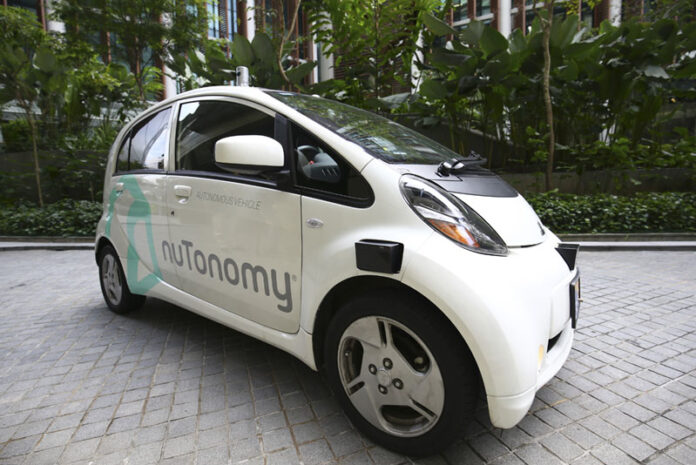
An autonomous vehicle is parked for its test drive in Singapore on Wednesday. Photo: Yong Teck Lim / Associated Press

SINGAPORE — The world’s first self-driving taxis began picking up passengers in Singapore starting Thursday.

Select members of the public can hail a free ride through their smartphones in taxis operated by nuTonomy, an autonomous vehicle software startup. While multiple companies, including Google and Volvo, have been testing self-driving cars on public roads for several years, nuTonomy says is the first to offer rides to the public.

Its launch in Singapore is beating ride-hailing service Uber, which plans to offer rides in autonomous cars in Pittsburgh, by a few weeks.

NuTonomy is starting small — six cars now, growing to a dozen by the end of the year. The ultimate goal, company executives say, is to have a fully self-driving taxi fleet in Singapore by 2018, to help cut the number of cars on Singapore’s congested roads. Eventually, the model could be adopted in cities around the world, nuTonomy hopes.

For now, the taxis only run in a 6.5 square kilometer business and residential district called “one-north,” and pick-ups and drop-offs are limited to specified locations. Riders must have an invitation from nuTonomy to use the service. The company says dozens have signed up for the launch, and it plans to expand that list to thousands of people within a few months.

The cars — modified Renault Zoe and Mitsubishi i-MiEV electrics — have a driver in front who is prepared to take back the wheel and a researcher in back who watches the car’s computers. Each car is fitted with six sets of Lidar — a detection system that uses lasers to operate like radar — including one that constantly spins on the roof. There are also two cameras on the dashboard to scan for obstacles and detect changes in traffic lights.

The testing time-frame is open-ended, said nuTonomy CEO Karl Iagnemma. Eventually, riders may start paying for the service, and more pick-up and drop-off points will be added. NuTonomy also is working on testing similar taxi services in other Asian cities, the U.S. and Europe, but he wouldn’t say when.

“I don’t expect there to be a time where we say, ‘We’ve learned enough,'” Iagnemma said.

Doug Parker, nuTonomy’s chief operating officer, said autonomous taxis could ultimately reduce the number of cars on Singapore’s roads from 900,000 to 300,000.

“When you are able to take that many cars off the road, it creates a lot of possibilities. You can create smaller roads, you can create much smaller car parks,” Parker said. “I think it will change how people interact with the city going forward.”

NuTonomy, a 50-person company with offices in Massachusetts and Singapore, was formed in 2013 by Iagnemma and Emilio Frazzoli, Massachusetts Institute of Technology researchers who were studying robotics and developing autonomous vehicles for the Defense Department. Earlier this year, the company was the first to win approval from Singapore’s government to test self-driving cars in one-north. NuTonomy announced a research partnership with Singapore’s Land Transport Authority earlier this month.

Singapore is ideal because it has good weather, great infrastructure and drivers who tend to obey traffic rules, Iagnemma says. As a land-locked island, the city of 5.4 million people is seeking creative ways to grow its economy, so it’s been supportive of autonomous vehicle research.

Auto supplier Delphi Corp., which also is working on autonomous vehicle software, was recently selected to test autonomous vehicles on the island and plans to start next year.

“We face constraints in land and manpower. We want to take advantage of self-driving technology to overcome such constraints,” said Pang Kin Keong, Singapore’s Permanent Secretary for Transport and the chairman of its committee on autonomous driving.

Olivia Seow, 25, works in startup partnerships in one-north and is one of the riders nuTonomy selected, took a test ride of less than a mile on Monday. She said she was nervous when she got into the car, and then surprised as she watched the steering wheel turn by itself.

“It felt like there was a ghost or something,” she said.

But she quickly relaxed. The ride was smooth and controlled, she said, and she was relieved to see that the car recognized even small obstacles like birds and motorcycles parked in the distance.

“I couldn’t see them with my human eye, but the car could, so I knew that I could trust the car,” said Seow, who hopes to use the time freed up during her commute, thanks to the technology, or use the service to help her father get around town as he grows older.

An Associated Press reporter taking a ride Wednesday saw the safety driver step on the brakes once, when a car was obstructing the test car’s lane and another vehicle, which had appeared to be parked, suddenly began moving in the oncoming lane.

Iagnemma said the company is confident that its software can make good decisions. The company hopes its head start in autonomous driving will eventually lead to partnerships with automakers, tech companies, logistics companies and others.

“What we’re finding is the number of interested parties is really overwhelming,” he said.

Story: Annabelle Liang, Dee-Ann Durbin

Advertisement

Malaysian Students Rally to Demand PM Najib’s Arrest

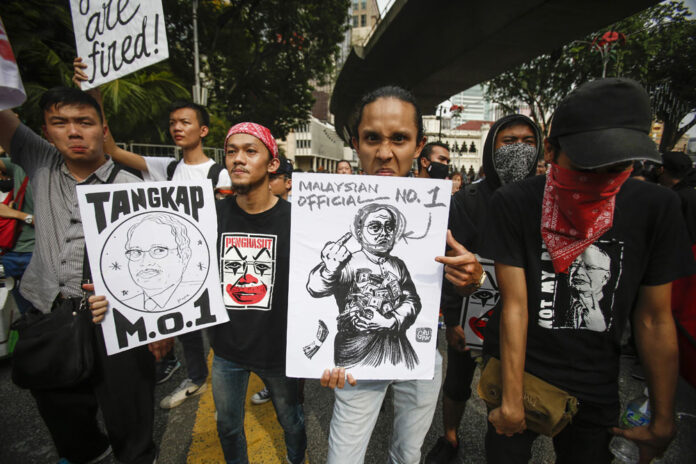
Student activists holds up caricatures of Malaysian Prime Minister Najib Razak during a rally calling for his arrest Saturday in Kuala Lumpur. Photo: Joshua Paul / Associated Press

KUALA LUMPUR — Malaysian student activists have rallied to demand the arrest of Prime Minister Najib Razak, who has been implicated in a U.S. government probe into a massive fraud in a Malaysian investment fund.

More than 1,000 people defied a police ban as they congregated at two locations in Kuala Lumpur on Saturday, holding posters and caricatures of Najib.

The U.S. Department of Justice said last month that at least USD$3.5 billion has been stolen from the Malaysian fund founded by Najib. It has initiated action to seize USD$1.3 billion it said was used to buy assets in the U.S.

It said in court filings that more than USD$700 million had landed in a Malaysian official’s accounts. It didn’t name the official, but appeared to be referring to Najib.

Advertisement

Deep South Conflict Perpetuated by Willful Ignorance

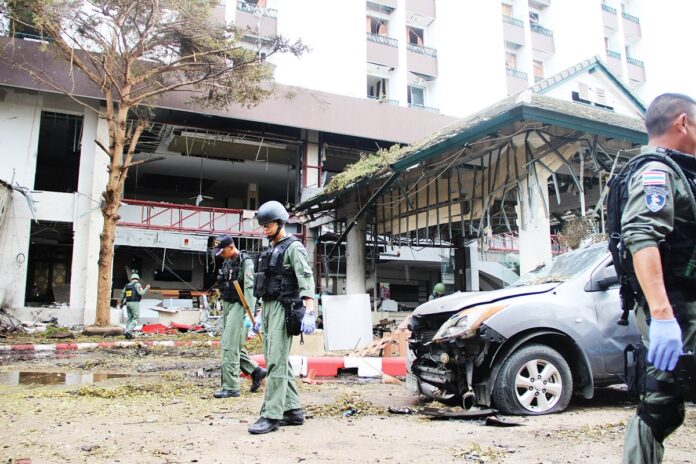
Police officers on Wedneday morning inspect the site of the deadly twin car bomb that struck a hotel in Pattani province.

Retention

BANGKOK — A group often overlooked when considering the Deep South’s ongoing separatist conflict is the kingdom’s majority Thai Buddhists.

When I spoke recently to a senior human rights lawyer facing criminal charges over a report on alleged torture there, he said the Buddhist majority’s poor understanding of the conflict is a profound obstacle to finding solutions in Bangkok.

“They don’t really understand the conflict in the south. It’s a big obstacle to any government, even elected government to solve problems in the south,” Somchai Hom-laor said.

This is further complicated now as the nation’s attention is wrested by the insurgency suspected of unleashing a wave of attacks earlier this month which killed four outside their usual operational area of Yala, Pattani and Narathiwat provinces.

“Everyone in the Deep South is being blamed although only a small group of people were involved,” Somchai said.

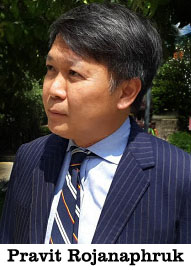
Pravit RojanaphrukIgnorance, bias, apathy, cultural chauvinism, you name it – a good number of Thais who aren’t Muslim or Malay harbor these.

One of the sickest attitudes among some Thai Buddhists is to declare or state on social media that if these Muslims people in the deep south are not happy, they should feel free to leave Thailand.

It shows a poor understanding of history. In the past, those provinces of Pattani, Yala, and Narathiwat and parts of Songkhla, were known as The Sultanate of Patani Darussalam and part of a Malay-Muslim heartland which was vassal state to the Ayutthaya kingdom. That is until Siamese conquest in 1785 and eventual annexation as part of Thailand. (Parts of it became northern Malaysia and Siamese rule was officially acknowledged as recently as 1909 under the Anglo-Siamese Treaty negotiated with the British Empire.)

These Thai-Malay Muslims are not occupiers, they lived there prior to Siamese subjugation, so it is sick and ignorant to tell these people “love it or leave it” when the former means accepting a militarized life where detention without charge for seven days was the norm long before it spread to the rest of the kingdom thanks to the 2014 coup makers.

And to label them Thai Muslims, as many mainstream Thai-language media outlets do, denies their Malay identity, which is still very alive in both language and culture. Why then not refer to them as Thai-Malay Muslims?

To make matters worse, some mainstream mass media continue obfuscating the issue, intentionally or not, by referring to separatist insurgents as “southern bandits” (โจรใต้), such as conservative paper Daily News did in a Thursday editorial. Such references mislead the public into thinking these are just bad folks with no ideology out to steal something, while in fact these “bandits” probably see themselves as freedom fighters. (These are the perceptions, and I don’t condone violence perpetrated by any party in the Deep South and consider Tuesday’s use of an ambulance as a car bomb by alleged separatists a new low.)

Bangkok seems so far away from the weekly violence in the Deep South. We watch it on TV from somewhere remote, and it appears like just another news item. This despite the fact that more than 6,500 people have been killed over the past dozen years and many families have lost loved ones.

It’s clear that a decade-plus of militarization has failed to provide any peaceful solutions, and the situation will likely not change unless a majority of the Thai people become more engaged in the issue instead of leaving it to a few experts and activists.

In a marriage, if one party is not happy, he or she should have the right to divorce. Unfortunately Pattani’s marriage to Thailand was a shotgun wedding, if not rape. People there deserve better.

Advertisement

Oregon Fair Generates Buzz with 1st Legal Pot Display in US

Fairgoers look at marijuana plants at the Oregon State Fair during the first day of an exhibit of living pot plants on Friday in Salem, Oregon. Photo: Gillian Flaccus / Associated Press

SALEM, Ore. — Living marijuana plants went on display Friday at the Oregon State Fair, with organizers saying it’s the first state fair in the nation to allow cannabis for public viewing.

The state voted to legalize recreational marijuana in late 2014. Here are a few things to know about legal pot in Oregon and the display at the fair:

WHAT’S THE BUZZ?

The Oregon State Fair allowed a display about marijuana without any living plants last year and it generated no complaints. So this year, the organization took the next step and agreed to let marijuana growers display live plants.

The Oregon Cannabis Business Council, which is sponsoring the display, says it’s the first time living pot plants have been open for public viewing at any state fair nationwide.

The council is renting space in an exhibit hall for its tent and selected nine plants for the display at an industry event two weeks ago.

WILL FAIRGOERS GET HIGH?

No. While the tent holding the display smells strongly of weed, fair authorities are only allowing immature plants — that is, pot plants without flowers.

Marijuana leaves are much less potent than the flowers, or buds, and it’s not yet legal to transport flowering plants within the state anyway.

Donald Morse, director of the Oregon Cannabis Business Council, said his group hopes to get permission to display flowering pot plants next year, but the details aren’t finalized.

CAN ANYONE SEE THE PLANTS?

No. The exhibit is in a translucent tent and both the entrance and exit are monitored. Anyone entering must present identification proving they are 21 or over.

AREN’T STATE FAIRS FOR GIANT PUMPKINS, PIGS AND APPLE PIE?

The way people think about marijuana in Oregon is changing, and recreational grow sites are recognized under state law as farm crops.

The Oregon Liquor Control Commission is in the process of licensing recreational marijuana in much the same way it already controls the sale and use of alcohol.

Fair spokesman Dan Cox says the event must adapt to changing cultural and societal values and allowing the display is one part of that shift.

A CASH CROP

Oregonians voted to legalize marijuana in 2014 and the state allowed the sale of marijuana “edibles,” such as pot-infused candies and confections, earlier this year.

This week, the state said it had processed $25.5 million in taxes on recreational pot since January 2016.

Anticipated state revenue through June 2017 was recently quadrupled by Oregon’s Legislative Revenue Office, from $8.4 million to $35 million.

BUT IT’S ILLEGAL, RIGHT?

Recreational marijuana is still illegal in 46 states and is banned by the federal government.

Story: Gillian Flaccus

Advertisement

Top French Court Rules Burkini Bans Violate Basic Freedoms

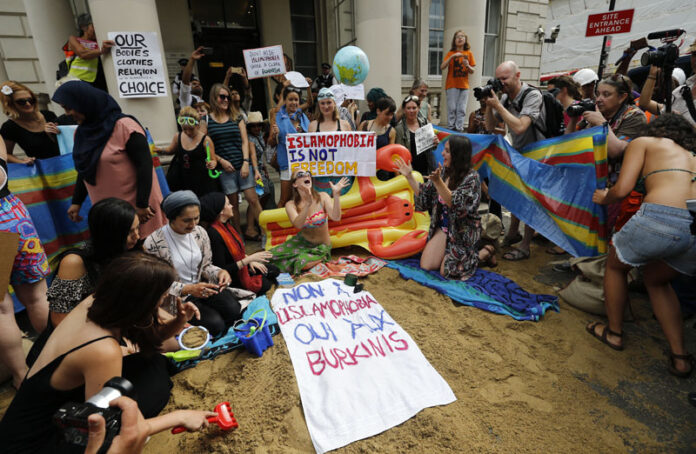
'No to Islamophobia, yes to Burkinis,' reads the blanket spread by activists outside the French embassy in London during the "wear what you want beach party" Thursday to protest the French authorities' clampdown on Muslim women wearing burkinis on the beach. Photo: Frank Augstein / Associated Press

PARIS — France’s top administrative court on Friday overturned a ban on burkinis in a Mediterranean beach resort, effectively meaning that towns can no longer issue bans on the swimsuits that have divided the country and brought world attention to its fraught relationship with Muslims.

The ruling by the Council of State specifically concerns a ban on the Muslim garment in the Riviera town of Villeneuve-Loubet, but the binding decision is expected to impact all the 30 or so French resort municipalities that have issued similar decrees.

The bans grew increasingly controversial as images circulated online of some Muslim women being ordered to remove body-concealing garments on French Riviera beaches.

Lawyers for a human rights group and a Muslim collective challenged the legality of the ban to the top court, saying the orders infringe on basic freedoms and that mayors have overstepped their powers by telling women what to wear on beaches.

Despite the court victory, the debate was unlikely to go away. Prime Minister Manual Valls, who supported the bans, called the debate “fundamental” for secular France, where religious displays are unwelcome in the public space.

Valls wrote on his Facebook page that denouncing the burkini “in no way puts into question individual freedom” and is really about denouncing “fatal, retrograde Islamism.” The burkini, he wrote, “is the affirmation of political Islam in the public space.”

Mayors had cited multiple reasons for the bans, including security after a string of Islamic extremist attacks, risk to public order, and France’s strict rules on secularism in public life.

The Council of State ruled that, “The emotion and concerns arising from the terrorist attacks, notably the one perpetrated in Nice on July 14, cannot suffice to justify in law the contested prohibition measure.”

It ruled that the mayor of Villeneuve-Loubet overstepped his powers by enacting measures that are not justified by “proven risks of disruptions to public order nor, moreover, on reasons of hygiene or decency.”

“The contested decree has thus brought a serious and manifestly illegal infringement on basic freedoms such as freedom to come and go, freedom of conscience and personal freedom,” the ruling read.

Lawyer Patrice Spinosi, representing the Human Rights League, said that women who have already received fines can protest them based on Friday’s decision. He told The Associated Press the group plans to ask all French mayors who bannedburkinis to withdraw their orders and, if they refuse to do so, he will systematically take each case to court.

“It is a decision that is meant to set legal precedent,” Spinosi said to reporters earlier outside the court. “Today all the ordinances taken should conform to the decision of the Council of State. Logically the mayors should withdraw these ordinances. If not, legal actions could be taken” against those towns.

The head of the Collective Against Islamophobia in France, the other group that appealed to the top court, hailed the decision but lamented that the crackdown “will remain engraved in the history of our country.”

“One cannot take back the harm which was caused, humiliations that were provoked,” Marwan Muhammad told reporters outside the court.

The bans have become a symbol of tensions around the place of Islam in secular France and the heated debate has brought about divisions even among cabinet ministers.

While Valls argued that burkinis oppress women, two ministers in his cabinet, Education Minister Najat Vallaud-Belkacem and Health Minister Marisol Touraine, have said banning burkinis is not a good option. Vallaud-Belkacem, a feminist with North African roots, argued that while she doesn’t like the burkini swimsuit, banning the garment amounted to a politically driven act that encouraged racism.

Interior Minister Bernard Cazeneuve, who is also in charge of faiths, said that “it is now up to everyone to seek calm.”

The conservative mayor of Villeneuve-Loubet, Lionnel Luca, said that “far from calming, this decision can only heighten passions and tensions, with the risk of trouble we wanted to avoid.”

Luca, also a lawmaker, said that now only a law can stop troubles. He denounced a “rampant Islamization” in the country and said that, with Friday’s ruling, “they’ve gained a small additional step.”

While addressing only one local ban, the Council of State sets general principles in its ruling that any mayors will now have to abide by when using their powers in the future.

Technically, other local bans are still in effect until mayors revoke them or groups contest them in courts. But de facto the town decrees are hollow because burkini fines can be contested.

Nevertheless, the mayor of the Corsican town of Sisco said he wouldn’t lift the ban he imposed after an Aug. 13 clash on a beach. “Here the tension is very, very, very high and I won’t withdraw it,” Ange-Pierre Vivoni said on BFM-TV.

Former President Nicolas Sarkozy, who announced this week he’s seeking the conservative nomination for the 2017 race, said at a rally Thursday night in southern France that he wants a law banning the burkini “on the entire territory of the Republic.”

Far-right National Front leader Marine Le Pen said the battle is not over. She said in a statement that lawmakers must vote “as quickly as possible” to extend a 2004 law that bans Muslim headscarves and other ostentatious religious symbols in classrooms to include all public spaces.

“The burkini would obviously be part of it,” said Le Pen, who is running for president in the 2017 race.

President Francois Hollande has remained neutral on the issue, arguing that society “presumes that each person conforms to the rules, and that there is neither provocation nor stigmatization.”

But critics said the bans had been feeding a racist political agenda.

Amnesty International praised the court decision Friday, calling the local decrees “invasive and discriminatory” and saying their enforcement has led to “abuses and the degrading treatment of Muslim women and girls.”

Story: Philippe Sotto

Advertisement

‘Wolf Bride’ and ‘Da Torpedo’ Freed From Prison

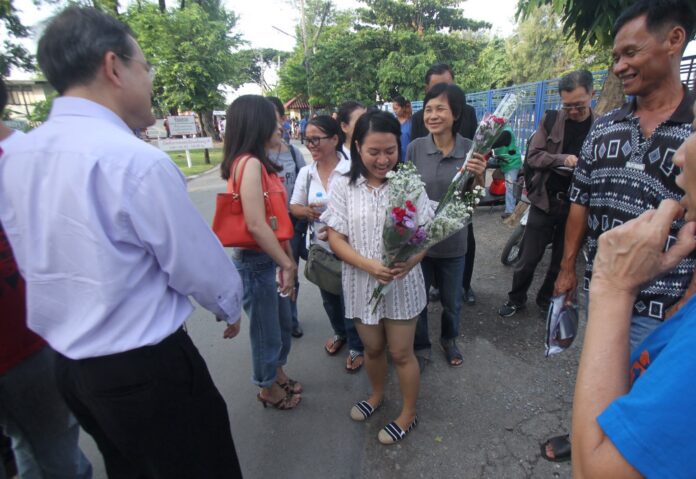
Pornthip Munkong, in white with flowers, and Daranee Charnchoensilpakul, in grey with flowers, outside the central prison Saturday morning in Bangkok. Photo: Matichon

BANGKOK — The patience of family, friends and supporters was rewarded Saturday when an activist performer and Redshirt firebrand were among 138 women to walk out prison Saturday morning.

Pornthip Munkong, a 28-year-old activist convicted over a 2013 student play; and Daranee Charncherngsilpakul, aka “Da Torpedo;” were released at about 6:45am on Saturday morning from the Central Women’s Correctional Institution in Bangkok.

Both women were jailed for actions deemed insulting to the monarchy. Pornthip was arrested soon after the 2014 coup and later convicted for performing in “The Wolf Bride,” a 2013 play staged at Thammasat University.

Daranee, 58, is a former Redshirt activist who campaigned against the 2006 military coup. She was convicted of three offenses under Section 112 of the penal code, a crime known as lese majeste, in 2008 for three speeches in the Sanam Luang denouncing the 2006 coup and monarchy.

Both women were freed under annual royal pardons. While Pornthip was to be released soon, Daranee had another decade to her sentence.

According to Weeranan Huadsri, an activist and Pornthip’s boyfriend, a total of 138 female prisoners were released this morning. No notification was posted outside the prison, however.

“The welfare work staff had to call the prisoners’ families,” Weeranan said.

Related stories:

Political Prisoners Among 476 Inmates to Be Freed Saturday

Wait Not Over For Loved Ones of Jailed ‘Wolf Bride’ Actress

Exasperating Wait For Release of Loved Ones From Prison

Theater Activists Jailed Over Satirical Play About Monarchy

Activists Charged With Lese Majeste After 70-Day Detention

Advertisement

Funk All Night With Bangkok’s ‘Gramaphone Children’

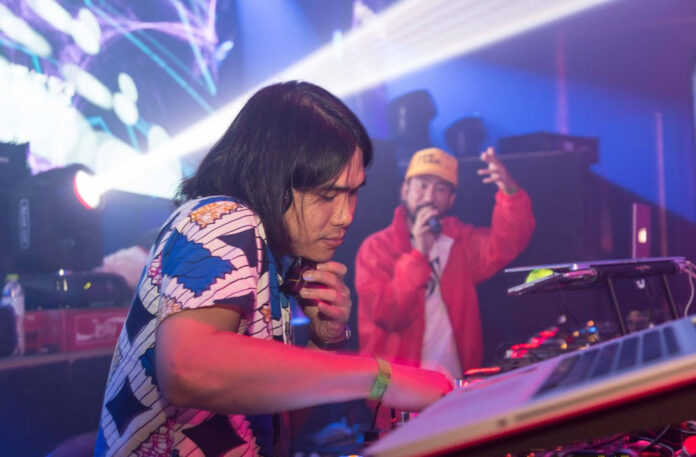
Jaree Thanapura, aka Gramaphone Children at left with MC Sinnamon on Aug. 25 at Live RCA Bangkok.

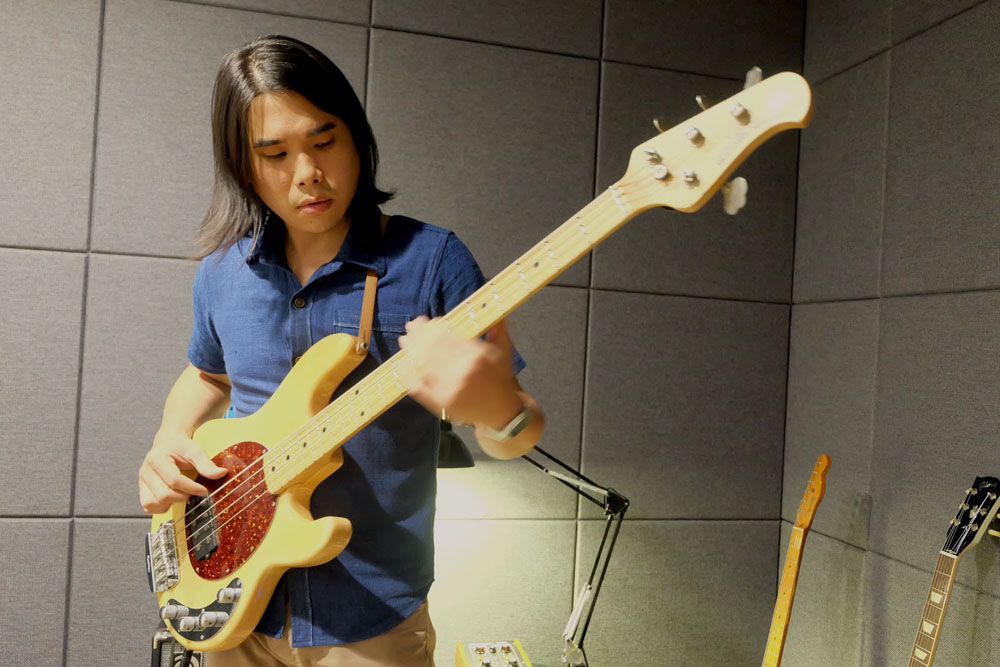
Top: Jaree Thanapura, aka Gramaphone Children, at left, with MC Sinnamon on Aug. 25 at Live RCA Bangkok.

Since originating in the good ol’ U-S-of-A, funk music spread across the world. Thailand was no exception, where a small but vibrant scene emerged in the Sixties. While much of that early music has been lost, folks such as Zudrangma Records spread the gospel to a new generation along with artists such as NYTE, Cyndi Seui and one American-born dude named Jaree Thanapura.

Notes from the Underground - Mongkorn 'DJ Dragon' TimkulJaree, better known as Gramaphone Children, has led the way for Thailand’s Funk scene since his label debut in 2001.

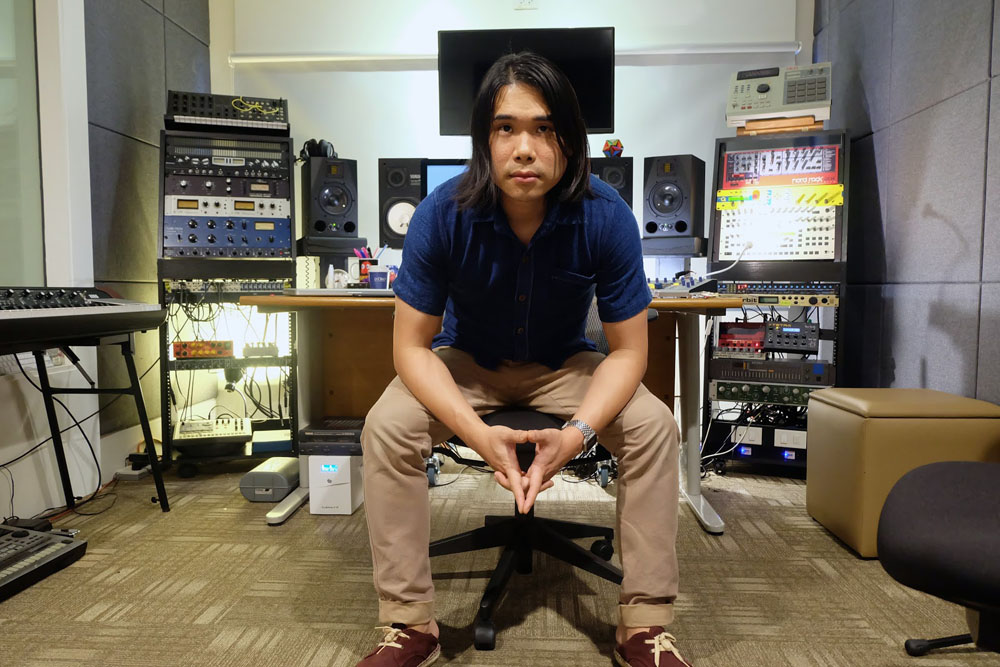
Speaking English in a husky drawl somewhere between his native Kentucky and Malibu beach, Jaree is a mass of contradictions happily occupying one loud shirt at a time. His mop of long hair and slacker aesthetic belie a technical perfectionist who hovers over every knob, slider and setting in his studio to get it all just right.

In American slang, he explains how he got into music after going from ‘80s American kid to ‘90s teen of Bangkok, and eventually, in-demand DJ of the now at venues such as Bad Motel and Studio Lam.

“When I first arrived to Thailand from the states, I solved boredom by learning guitar and drums on my own,” said Jaree, now 38. “I literally took a couple guitar lessons at first though, and got really turned off when my instructor started reading the paper while simultaneously eating nuts, leaving me to practice the melody of ‘Old MacDonald’ on a classical guitar. I went twice and never went back.”

Jaree Thanapura at his Sky Tone music production studio. Photo: Gramaphone Children / Courtesy

Those two guitar lessons and 30 releases later, the producer’s latest offering “Slice & Dice Vol. 01” is due in September. The album will be released on his label Kitsch Kat and will see him flex his production muscles to the fullest with a nine-track album of sophisticated and stylish grooves.

This is some of his best work yet. It raises the standard of funk produced in the kingdom to an international level along with the likes of George Clinton, Breakbot and Dam Funk.

What is the madness to this producer’s method for cooking up such delicious beats in the studio?

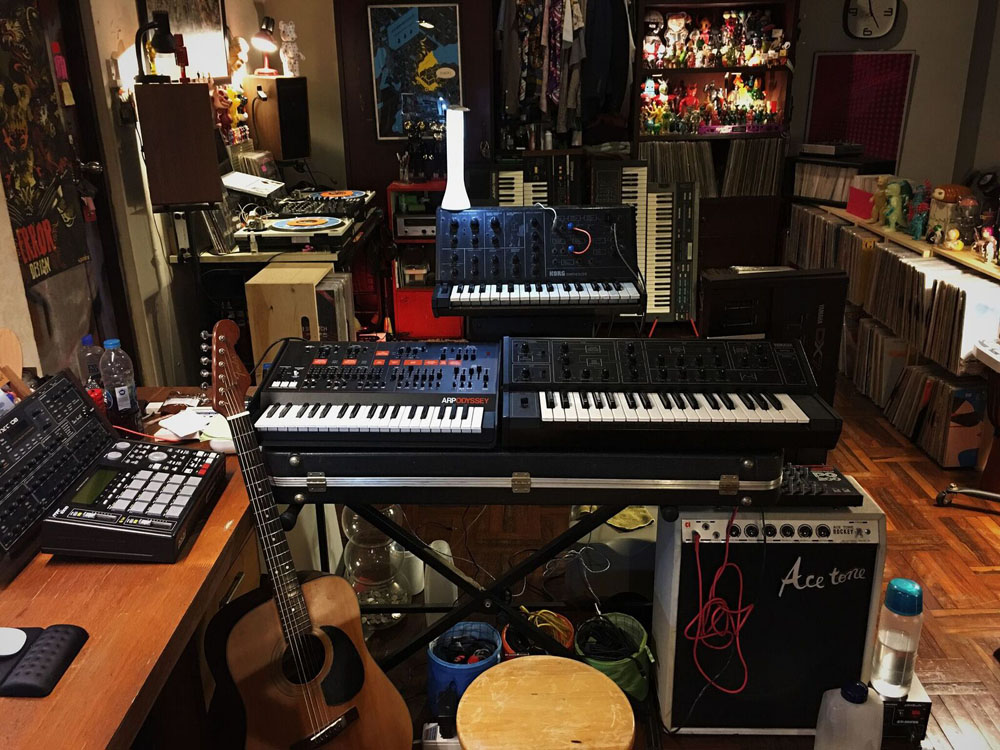
“I stared countless hours at a tiny black-and-greenish LCD screen with tiny buttons and knobs that incorporated a 16-step sequencer,” he says, arcanely. “It was a great experience which allowed me to create new ideas with a different kind of workflow since there were limitations. But these limitations made me think out of the box and that was the beauty of it.”

With Jaree building the album’s beat framework, the vocals came by way of Bangkok city’s own MC Sinnamon, a longtime collaborator of your’s truly, and up-and-coming songstress Pyra. On the track “Jelly Beato,” Sinnamon flips an old school hook ala Kurtis Blow and turns it into Thai-style block rockin’ party rap. Pyra’s contribution to the album come in two tracks, with her in full B-girl rap mode for “Trouble Makers.” But it’s “Move Slowly” where her sultry vocals shine.

Jaree is just as process-oriented when it comes to collaborating with people as formulating his sounds.

'Pyra' lends vocals to Gramaphone Children's latest dropping Sept. 1.
‘Pyra’ lends vocals to Gramaphone Children’s latest dropping Sept. 1.

“I tend to plan ahead of time before I meet vocalists and musicians who come and collab with me,” Jaree says. “I’ll lay down a melody guide, or I’ll brief them about the storyline, as well as mood and tone before we record. With Pyra I sent her a demo first and when we met, we went through the lyrics on ‘Move Slowly’ and finalized it together.”

To fully experience the Gramaphone Children vibe, Jaree regularly brings it out of the studio and to the dance floor. He’s a featured DJ every month at Studio Lam’s Nite Ride, a funk/boogie get-down along with DJs Lows and Boogie G. In the past year, Nite Ride has made a name for itself as one of the most full-on, dedicated funk nights in Bangkok. Get ready for the next edition on Sept. 16.

“Slice & Dice Vol. 01” will be available Sept. 1 at all major digital stores, through Bandcamp and with a run of CDs printed. Get updates at Gramaphone Children on Facebook.

Funk in Bangkok has a bright future thanks to producers like Jaree, who says the city finds its way into the music.

“The more you listen to music, especially the roots of any genre, it naturally gives you ideas subliminally. Or sometimes a particular synth sound or bassline might inspire me and open a door in my mind,” he explains. “Bangkok traffic also helps, there’s not much to do in a taxi or car, so I’ll think of something in my head, hum a small riff and beat into my phone and develop something when I arrive home.”

Until next time, may the funk be with you!

Jaree Thanapura in his studio. Photo: Gramaphone Children / Courtesy
Jaree Thanapura's tricked-out home studio. Photo: Gramaphone Children / Courtesy
Jaree Thanapura’s tricked-out home studio. Photo: Gramaphone Children / Courtesy
Advertisement

Political Prisoners Among 476 Inmates to Be Freed Saturday

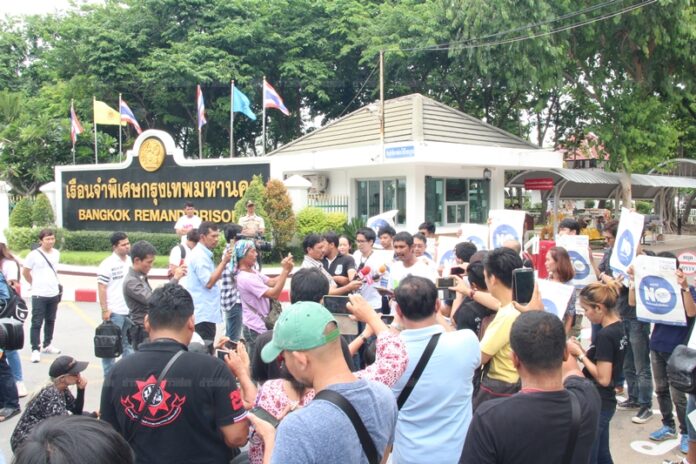
Dozens of people protest outside the Bangkok Remand Prison in June demanding the release of seven activists.

BANGKOK — An elderly man jailed for bathroom graffiti and Redshirt guards from 2010  are among 476 convicts expected to be freed Saturday, according to information reportedly released by corrections officials.

Two weeks after the first batch of pardoned prisoners walked out of the Bangkok Remand Prison, an activist working with prisoners of conscience said Friday that prison officials have posted a list of prisoners to be released at 9am tomorrow as part of a second wave of royal pardons.

“I’m 100 percent certain about the listed names, as they’re on the board at the Bangkok Remand Prison,” said Ekachai Hongkangwan, who said it was there when he visited the prison in Bangkok’s Chatuchak district this morning.

Ekachai, who works with the For Friends Association, posted online Thursday the list of 476 prisoners who received a second batch of royal pardons and will be released at 9am on Saturday.

Earlier this month, he had raised hopes among some loved ones by sharing a list of names he’d obtained, but some of them were not released.

Among the 476 names are two people convicted of insulting the monarchy, a crime known as lese majeste: Phuchit Wongtanarat and Opas Chansuksai. Opas, 69, was jailed for a year and half for writing something on the wall of a mall restroom deemed offensive to the monarchy.

Also to be released is Pornchai Aksornwit, who was convicted of plotting with two other men to blow up major buildings on Silom Road in 2009. Kowit Yaemprasert and Prasong Maneein were two Redshirt guards jailed since the 2010 unrest. Wanlop Ratanarung was convicted of carrying explosives near an anti-government protest site in 2014.

Lists of prisoners to be released are normally posted so their families can come pick them up on the appointed date. However no such list was posted Aug. 12 when a number of prisoners were released, including one of two actors convicted of lese majeste over a 2013 student play.

At the time, corrections officials would neither confirm or deny any further prisoners would be released, saying it would post notice when and if any more were forthcoming.

Ekachai noted that the Department of Corrections has changed its process and now requires inmates be interviewed prior to release about where they will be staying. He mentioned that a third batch of prisoners would follow within two weeks, as they were interviewed Wednesday.

Asked if any women would be released from the women’s facility, Ekachai said no list has been posted there. The two prisons follow different systems, he added.

“It’s already bad being in the men’s Prison, but the women’s is worse,” he said.


Related stories:

Wait Not Over For Loved Ones of Jailed ‘Wolf Bride’ Actress

Exasperating Wait For Release of Loved Ones From Prison

Advertisement

Prayuth to Add 30 ‘Mostly Military’ to Rubber-Stamp Parliament

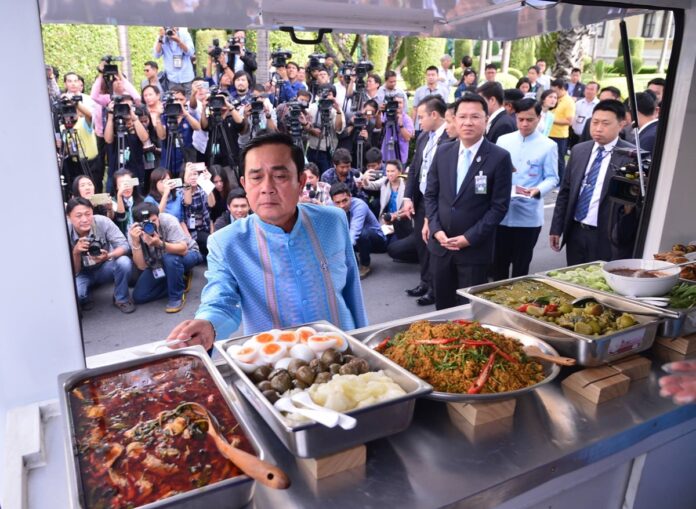
Junta chairman Prayuth Chan-ocha on Tuesday chooses food from a truck at Government House in Bangkok. He’s set to pick 30 new members of the interim parliament next month.

BANGKOK — The interim parliament on Friday voted unanimously to increase its membership from 220 to 250 in line with the military government’s request for more lawmakers to move a backlog of legislation before next year’s election.

All new members of the National Legislative Assembly will be handpicked by junta chairman Prayuth Chan-ocha, a move that led some in the opposition to accuse the regime of tightening its grip on power before a new civilian government takes charge.

Prayuth Promises 2017 Election

The regime has not yet said who will be appointed, but Prayuth mentioned Tuesday that they would be “mostly military officers.”

The remark raised alarm among junta critics such as former Pheu Thai MP Chusak Sirinil, who said the military government is giving jobs to its favorites to expand its power.

“Personally, I don’t see any reason to increase the number of the NLA,” Chusak said Thursday. “I think that their legislative work is not complicated or sophisticated like in a normal situation. Take a look at the NLA’s motions: each law they deliberate upon has barely any opposition.”

The plan was approved by a 189-0 vote in Friday’s assembly session, with three abstentions. The lawmakers will now work on amending the current interim charter to allow for the new members, which will take about 30 days.

Speaking before the vote, deputy Prime Minister Visanu Krua-ngarm said the extra manpower is needed to approve laws and government policies prior to the election expected in late 2017.

“The current 200 members of the NLA may not be sufficient to perform their important duties, because I expect that in the remaining year and four months, there will be about 100 laws … flowing into deliberation sessions of the NLA,” Visanu told the parliament.

But, he stressed, the government has no agenda beyond needing more hands on deck.

“We are not appointing them to do any other thing, and they are not going to stay long either,” Visanu said Wednesday.

Related stories:

Senate Will Only Nominate a PM in Event of Deadlock, Lawmakers Say

Advertisement

Hot News

LATEST NEWS

Bangkok
overcast clouds
28.3 ° C
28.3 °
28.3 °
79 %
4.1kmh
100 %
Sun
28 °
Mon
34 °
Tue
34 °
Wed
32 °
Thu
33 °