29.4 C
Bangkok
Friday, June 26, 2026
Home Blog Page 2669

Israel Demolishes Home of Palestinian Linked to Attack

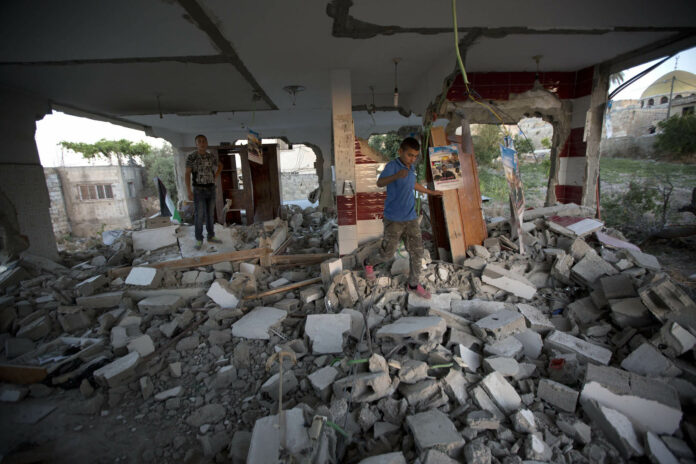
Palestinians inspect the house of Bashar Masalha after it was demolished by the Israeli army in the village of Hajja, near the West Bank city of Nablus, Tuesday, June 21, 2016. Photo: Associated Press

JERUSALEM — The Israeli military says it has demolished the home of a Palestinian who it says served as an accomplice to a deadly attack earlier this year.

The military says the home of Bilal Abu Zeid in the West Bank village of Qabatiya was demolished early Monday.

Abu Zeid is said to have been involved in an attack in Jerusalem in February that killed an Israeli paramilitary police officer. The military did not disclose what role Abu Zeid allegedly played in the attack.

The military says clashes erupted as it was carrying out the demolition and that Palestinians opened fire and lobbed explosives. The military responded with live fire.

The Palestinian Health Ministry says five people were wounded, one seriously.


Advertisement

Crocodile Feeding Frenzy Tourist Attraction Shut Down

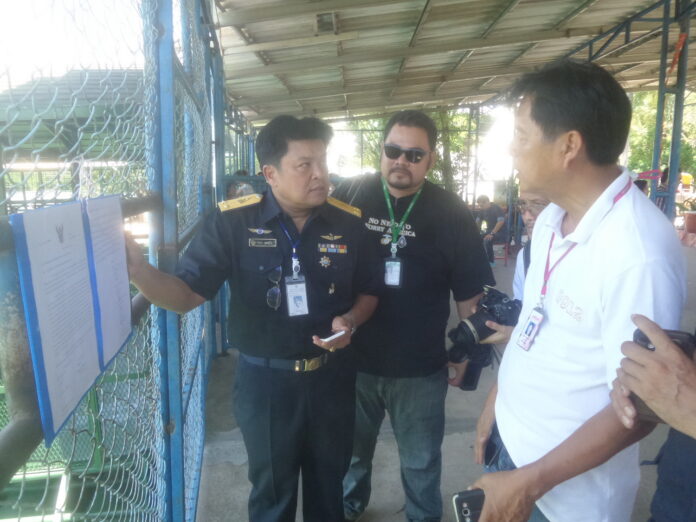
Fishery department chief Bancha Sukkaew posts a shutdown order Sunday at the crocodile feeding attraction at Elephant Kingdom in Chonburi province.

PATTAYA  —  Officials on Sunday ordered an animal attraction near Pattaya where tourists were surrounded by hungry crocodiles to close down, though its owner vowed to contest the decision.

The crocodile adventure at Elephant Kingdom made national news Friday after photos and videos of Chinese tourists feeding the snapping reptiles from a raft trended online, eventually winning statements of concern by officials who said it might not be the best idea for tourism.

Source: Apicha Phet Sawetwuttibarami / Facebook

Fearing potential accidents, officials visited the site Sunday, ruled the attraction too dangerous and ordered staff to shut it down for 90 days.

“Let me stress that we aren’t here to close down [the animal park],” Fishery department chief Bancha Sukkaew told reporters. “We only suspended the license for the crocodile-feeding activity temporarily. Other activities, such as elephant riding and the zoo are open as normal.”

In the meantime, Bancha said, officials will debate whether the attraction is safe enough to reopen, and whether all of the crocodiles were bought legally. The park owner has the right to appeal the order within 15 days, he added.

That’s exactly what owner Uthane Yangpraphakorn said he would do.

“I do not accept this order, because I don’t know what I did wrong,” Uthane said. “If the officials are unsure about safety, the Fishery Department should issue us a letter of warning, instead of suspending my license like this. I don’t know if there’s any justice left in this country.”

Uthane said he’s consulting with his lawyer how to best overturn the shutdown order, adding that there have been no accidents since his park opened 12 years ago.

Related stories:

No Safety Net for Unregulated Ziplines

Despite Safety Assurances, More Tourists Hurt at Adventure Attractions

Elephant Kills Scotsman, Injures Teen Daughter

Advertisement

Human Hearts Singed by Southern Conflict, Seen Through Female Director’s Lens in ‘Island Funeral’

BANGKOK — Laila, a young Muslim woman from Bangkok, and her younger brother set out to find their aunt along with a Buddhist friend. Their search leads them to a remote and peculiar island off the coast of Thailand, where their assumptions are challenged.

“Island Funeral,” might be the kind of road trip movie common to the summer cinema, were it not hemmed in by the conflict in the Deep South and for the clear message at its heart. On Thursday, the film eight years in the making and shot on location will open in Bangkok, where its director hopes it will counter the media-fed narrative of violence and fear.

Promotional still from ‘The Island Funeral.’ Photo: Extra Virgin / Courtesy

It’s rare to see a Thai film about the conflict in the three southernmost border provinces of Narathiwat, Yala and Pattani, which has claimed thousands of lives in a dozen years. But director Pimpaka Towira chose to bring the issues to the big screen in “Island Funeral” to pose questions about the vicious cycle.

“The film represents one part of conflict in Thailand, and how we react to those problems. Even though the main characters in my film seem connected to the southern society as Muslims, in fact they’re alienated,” she said. “Soldiers are total strangers who know nothing about the province but have to be there to work.”

Actress Sasithorn "Heen" Panichnok with director Pimpaka Towira at the Thailand premiere of “The Island Funeral” Wednesday at SFW, CentralWorld. Photo: SF Cinema / Courtesy
Actress Sasithorn “Heen” Panichnok with director Pimpaka Towira at the Thailand premiere of “The Island Funeral” Wednesday at SFW, CentralWorld. Photo: SF Cinema / Courtesy

The 49-year-old director said she didn’t thoroughly understood the conflict prior to making the film despite having visited Pattani several times. That inspired her to explore and learn more about the province and its people, and begin researching with her script writing partner Kong Rithdee, the film critic. She talked to Muslims in Bangkok and Pattani, as well as the soldiers deployed to the south.

“From my research, I discovered that everyone involved in the resolution process now are outsiders, while local people have no participation,” the director said.

It’s Pimpaka’s second feature after the 2003 drama-thriller “One Night Husband.”

The film was shot on 16mm film and won Best Asian Future Award at the Tokyo International Film Festival in 2015, and other awards at festivals in Rotterdam, Netherlands, Hong Kong and Shanghai.

“‘The Island Funeral’ not only reflects problems in Thailand but also every country around the world,” said Sasithorn “Heen” Panichnok, who plays the female lead. “The conflicts are universal. We shouldn’t judge others or try to solve others’ problems. The minority isn’t different from the rest. The solution is just to learn how to accept one another and learn to live together.”

Having never visited Pattani prior to filming, Sasithorn said she didn’t fear going there as she didn’t think news reports reflect what really goes on. She said she was impressed by the residents and grew up along with the character she played during the three years of shooting.

Pimpaka said her film doesn’t instruct on how to solve the conflict, but she hopes it will draw people closer to the issue with something constructive to talk about.

“We shouldn’t treat the problem as something distant, like the distance between the provinces,” she said. “… We cannot use the same ideologies and perceptions to solve every problem. Instead, we should let the local people participate in the process too.”

She points to the eight years it took to make the film.

“Although my film is finished, the unrest in the three provinces remains,” she said. “Does this imply the problem hasn’t been correctly solved?”

Opening Thursday only at SFW CentralWorld, “The Island Funeral” will be shown in Thai with English subtitles.

Still from 'The Island Funeral.' Photo: Extra Virgin / Courtesy
Still from ‘The Island Funeral.’ Photo: Extra Virgin / Courtesy

Correction: An earlier version of this story misidentified the character Laila as being from Pattani, when in fact in the movie she is from Bangkok.

Advertisement

Bar Owner Allegedy Extorted by Cop, Calls Police Chief to Intervene

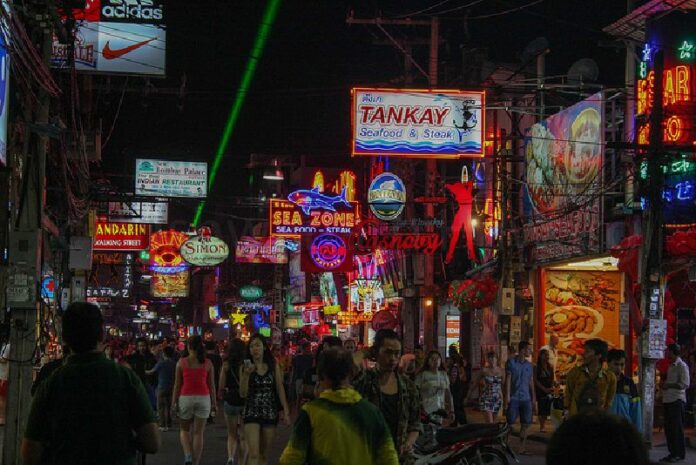
Pattaya's Walking Street in a 2013 photo. Photo: Vishwanath Hawargi / Flickr

PATTAYA — If there’s a cop demanding bribes, and it don’t look good, who you gonna call?

For bar owner Paranisa Chaiyanapanichkul, it was Chakthip Chaijinda, commissioner of the Royal Thai Police, she rang for help when a police inspector reportedly tried to extort 20,000 baht from her, leading to his suspension Sunday.

For the alleged extortion attempt on Thursday night at Nang Fa Karaoke Bar in Pattaya, Lt. Col. Narawuth Karamahito was moved to an inactive post while criminal and administrative inquiries were launched.

Prior to the disciplinary punishment, Narawuth served as an inspector for Chonburi’s regional police force. His transfer came two days after Paranisa filed a criminal complaint Friday at Pattaya Police Station.

According to the complaint, Narawuth visited the bar Thursday and accused Paranisa of running a prostitution and human trafficking ring. When Parasina denied the charge, the police inspector reportedly offered to let her walk free for 20,000 baht.

But Paranisa refused. Instead, she said, she phoned national police chief Gen. Chakthip for help, and he in turn told Narawuth’s supervisor to call the inspector’s cellphone.

Narawuth left the place after his boss, Chonburi police commissioner Amphon Buarubporn, called him and asked what he was doing, Paranisa said.

The police inspector has been charged with illegal detention, extortion and malfeasance. He’s also placed under disciplinary investigation, though police have not said how long the inquiry would take.

Advertisement

Badminton Star May Ratchanok Cleared of Doping Allegations

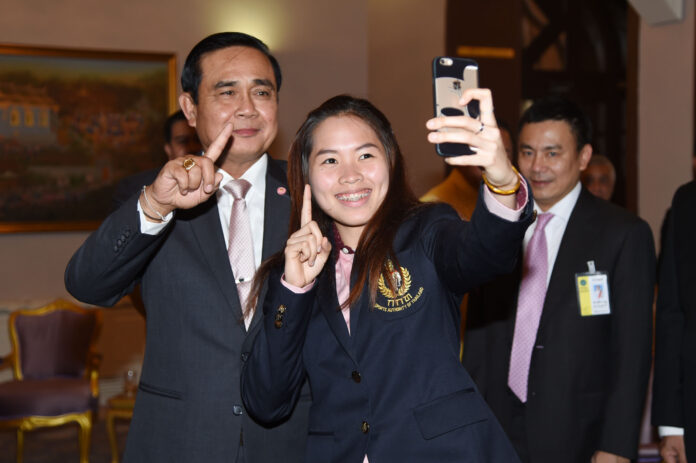
Ratchanok 'May' Intanon takes a selfie with junta chairman Prayuth Chan-ocha on April 20 at Government House in Bangkok. Photo: Matichon

BANGKOKThe Badminton World Federation on Monday announced that star badminton player Ratchanok “May” Intanon did not use any banned substances as earlier suspected.

The inquiry result means a provisional ban on Ratchanok was immediately lifted and she was back on track to compete in the upcoming 2016 Summer Olympics in Rio De Janeiro.

Read: Doping Allegations Cloud Badminton Star’s Olympic Dreams

On its website, the badminton’s world governing body said the stimulant substance found in a May 15 test of Ratchanok’s urine in China was in fact the result of routine medical treatment.

“The panel concluded that because the route of administration of the substance in the medical treatment process was intratendinous – an authorized administration route – no violation of the regulations was committed,” read the statement posted 9am.

“I had to endure it all. I was ordered to stop training by the BWF,” said the 21-year-old athlete, using acronym of the Badminton World Federation. “But I was always confident of my innocence. I didn’t do anything wrong.”

When news emerged last week that Ratchanok was suspended from all matches by the world federation following the May test result, it appeared she would miss her ticket to the games in Rio, which were only three weeks away.

But Thailand’s Badminton Association filed for a retest, and today’s result means Ratchanok can compete for the Thai national team at Rio, said association president Patama Leeswadtrakul.

“We have endured so much so that Ratchanok and other Olympian athletes can compete in Rio,” Patama said at Monday’s news conference. “We do this for the nation. We want to fulfill dreams of Thai people to see her getting a medal.”

In 2013, Ratchanok became the first Thai athlete to hold the title of No. 1 in Women’s singles. She’s currently ranked No. 4.

Advertisement

3 Police Killed, 3 Wounded in Louisiana Shooting

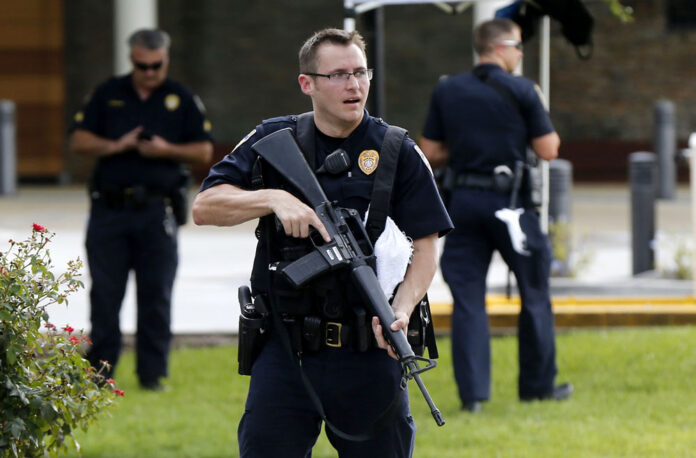
Police guard the emergency room entrance of Our Lady Of The Lake Medical Center, where wounded officers were brought, in Baton Rouge, La., on Sunday. Photo: Gerald Herbert / Associated Press

BATON ROUGE, Louisiana — Three Baton Rouge law enforcement officers were killed and three others wounded Sunday, less than two weeks after a black man was shot and killed by police here in a confrontation that sparked nightly protests across the city that reverberated nationwide.

One suspect was killed and two others might still be at large, said Casey Rayborn Hicks, a spokeswoman for the East Baton Rouge Sheriff’s Office. The city was on high alert, officials said.

The shooting — which took place just before 9 a.m., less than a mile from police headquarters — came amid escalating tensions across the country between the black community and police. The races of the suspects and the officers were not immediately known.

It was the fourth high-profile deadly encounter in the United States involving police over the past two weeks. The violence has left 12 people dead, including eight police officers, and sparked a national conversation over race and policing.

President Barack Obama said the slayings were attacks “on the rule of law and on civilized society, and they have to stop.” He said there was no justification for violence against law enforcement and that the attacks are the work of cowards who speak for no one.

The attack began at a gas station on Airline Highway. The slain shooter’s body was next door, outside a fitness center. Policesaid they were using a specialized robot to check for explosives near the body.

Gov. John Bel Edwards rushed to the hospital where the shot officers were taken.

“Rest assured, every resource available to the State of Louisiana will be used to ensure the perpetrators are swiftly brought to justice,” Edwards said in a statement.

On Sunday afternoon, more than a dozen police cars with lights flashing were massed near a commercial area of car dealerships and chain restaurants on the highway. Police armed with long guns stopped at least two vehicles driving away from the scene and checked their trunks.

That area was about a quarter of a mile from a gas station, where almost nightly protests had been taking place.

Five officers were rushed to Our Lady of the Lake Regional Medical Center, hospital spokeswoman Ashley Mendoza said.

Of the two who survived the shooting, one was in critical condition and the other was in fair condition. Multiple policevehicles were stationed at the hospital, and a police officer with a long gun was blocking the parking lot at the emergency room.

One officer was sent to Baton Rouge General Medical Center and was being treated for non-life-threatening injuries, spokeswoman Meghan Parrish said.

Officers and deputies from the Baton Rouge Police Department and East Baton Rouge Sheriff’s Office were involved, Hicks said.

Police-community relations in Baton Rouge have been especially tense since the death of 37-year-old Alton Sterling, a black man killed by white officers July 5 after a scuffle at a convenience store. The killing was captured on widely circulated cellphone video.

It was followed a day later by the shooting death of another black man in Minnesota, whose girlfriend livestreamed the aftermath of his death on Facebook. The next day, a black gunman in Dallas opened fire on police at a protest about thepolice shootings, killing five officers and heightening tensions even further.

Thousands of people have protested Sterling’s death and Baton Rouge police arrested more than 200 demonstrators.

Sterling’s nephew condemned the killing of the three officers.

Terrance Carter spoke Sunday to The Associated Press by telephone, saying the family just wants peace and that his uncle would not want this violence.

Michelle Rogers said Sunday the pastor at her church had led prayers Sunday for Sterling’s family and police officers, asking members of the congregation to stand up if they knew an officer.

Rogers said an officer in the congregation hastily left the church near the end of the service, and a pastor announced that “something had happened.”

“But he didn’t say what. Then we started getting texts about officers down,” she said.

Rogers and her husband drove near the scene, but were blocked at an intersection closed down by police.

“I can’t explain what brought us here,” she said. “We just said a prayer in the car for the families.”

Story: Mike Kunzelman

Advertisement

Auguring Aug. 8: Rejecting Charter Courts Uncertain Scenarios

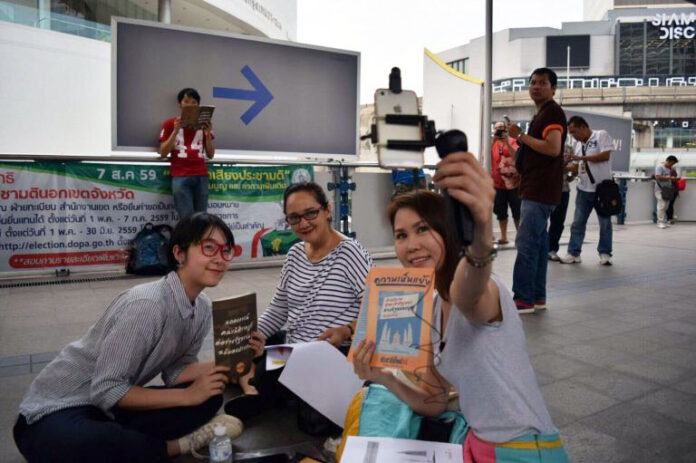
'Vote No' campaigners pause to take a selfie during a sit-in on Saturday on the skywalk near BTS National Stadium in Bangkok. Photo: Matichon

BANGKOK — Three Sundays from now, the polls will open for the public to vote on the controversial charter drafted under junta guidance, and one of the biggest guessing games is what will happen if it’s rejected.

The military government has kept its cards close to the vest, with the strongest signal coming June 29 from junta leader Prayuth Chan-ocha, when he told reporters the drafting process would simply begin for a third time. A few days ago, he added that he would write it himself, only to then say he wasn’t serious.

Asked for their best suggestions, five critics and politicos from across the board differed on the specifics of what should happen but for one point of agreement: They want to see the junta play a lesser role.

Their suggestions ranged from reviving and amending a more acceptable charter from the past or pushing for a speedy election to a sense of despair that Thailand will be trapped without recourse in a crisis of the junta’s making.

Gothom Arya said the public would embrace a former constitution such as that enacted the year he joined the first Election Commission in 1997, a charter considered Thailand’s most progressive to date, or even the junta-sponsored 2007 version which succeeded it and endured until the 2014 coup.

Either should be revived by the National Council for Peace and Order, he said, then amended to enable a quick election that would pave way for a constitution drafting assembly to be created after a general election. Gothom said the junta, which calls itself the National Council for Peace and Order, should not even think of replicating the rejected first or second drafts under the same process, however.

Whatever they do, he added, that need to talk about it.

“They should be clearer about it,” Gothom says.

One of the men who served as a junta-appointed drafter said “there should be another referendum round” but that it should rely on fewer people like him.

Jade Donavanik, who helped write the stillborn first draft, said he would like to see no more than one-third of drafters hand-picked by the junta, with the rest appointed from various sectors in society, as well as the junta-appointed national reform body.

Sawatree Suksri, a Thammasat University law lecturer and member of a group of professors who have advocated for legal reforms also thinks the junta should abandon any thought of appoint another charter drafting committee to pen a third draft.

If rejected, the current draft could be quickly amended instead, Sawatree said, with a clause stipulating a time frame for a newly elected government to complete a new draft constitution.

The suggestions came as call for the regime to ensure a free and fair referendum were issued by the heads of 20 embassies of E.U. member states, the head of the E.U. delegation to Thailand and the ambassadors from the United States and Canada.

“[We] are concerned that prohibitions on the peaceful public expression of views inhibit debate and increase tensions,” read their joint statement Thursday.

It went on to point out “several troubling actions” such as arrests of activists, the shutdown of opposition media and restrictions of free expression in the lead up to the Aug. 7 referendum.

Chaturon Chaisaeng, an MP who served as Education Minister for the deposed Pheu Thai-led government, said public rejection would demand building consensus, with stakeholders meeting to decide how to write the new draft and when to set elections.

Not all think the situation can be salvaged anymore.

Kraisak Choonhavan, a progressive voice in the Democrat Party who served on the Senate from 2000 to 2006  said rejection would come past the point of no return.

“I have been disappointed from the start with the Referendum Act penalty of 10 years imprisonment,” he said, referring to a law passed in late April which effectively criminalized campaigning in public. “This is against the principle of holding a referendum, according to the world’s standards. It’s too late. What would you want me to suggest?

He believes most of his fellow Democrats oppose the way the referendum process has been handled.

“The principle was wrong from the beginning,” Kraisak said.

Related stories:

Referendum Law Upheld as Prayuth Unveils ‘Plan B’
Prayuth Rules Out Resigning If Public Rejects Charter 

Advertisement

US-Turkish Tensions Rise As Erdogan Demands Cleric’s Extradition

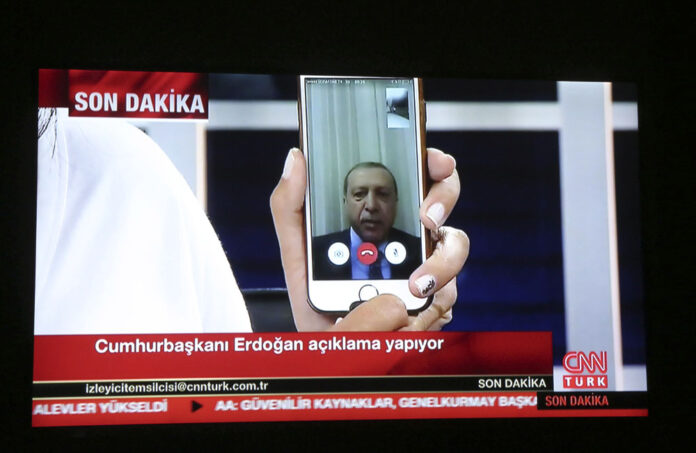
A live broadcast shows Turkish President Recep Tayyip Erdogan addressing the nation early Saturday from an undisclosed location via livestream from his smartphone. Photo: Depo / Associated Press

LUXEMBOURG — U.S.-Turkish tensions escalated Saturday after a quashed coup in Turkey, as the country’s leader bluntly demanded the extradition of a U.S.-based cleric he accused of orchestrating the violence. Another senior official directly blamed the United States.

After strongly supporting Turkish President Recep Tayyip Erdogan when it seemed his government might topple and then opening the door to sending home the cleric, a stung Obama administration fired back at its NATO ally.

“Public insinuations or claims about any role by the United States in the failed coup attempt are utterly false and harmful to our bilateral relations,” U.S. Secretary of State John Kerry told his Turkish counterpart, according to the State Department’s readout of their telephone call.

The back-and-forth occurred against the backdrop of Turkey closing its airspace, effectively grounding U.S. warplanes that had been targeting Islamic State forces in neighboring Syria and Iraq.

At the center of the controversy stood Fethullah Gulen, who lives in exile in Pennsylvania and promotes a philosophy that blends a mystical form of Islam with staunch advocacy of democracy, education, science and interfaith dialogue.

Gulen quickly condemned Friday night’s coup attempt by military officers that resulted in a night of explosions, air battles and gunfire that left dozens dead. Erdogan’s government said Gulen directed the coup all the same.

In a televised speech Saturday, Erdogan said Turkey had never rejected a U.S. extradition request for “terrorists.” Addressing Washington, he requested the handover of Gulen and said, “If we are strategic partners, then you should bring about our request.”

Although he didn’t outline any threat, Erdogan’s emphasis on U.S.-Turkish counterterrorism cooperation raised the prospect of a prolonged closure of the Incirlik air base in southern Turkey if he didn’t get his way. The Pentagon said it was trying to get permission to resume air operations from the base, while adjusting mission operations in the meantime.

Suleyman Soylu, Turkey’s labor minister, went further than Erdogan, suggesting the U.S. was behind the coup.

In their second call in as many days, Turkish Foreign Minister Mevlut Cavosoglu told Kerry the government was in control of state institutions.

Kerry reiterated U.S. support for Turkey’s democratically elected government, according to the State Department readout, and urged authorities to respect the rule of law and safeguard civilian life as they respond to the coup attempt. Kerry also said Turkey needed to respect due process as it investigates those it believes were involved in the plot.

Earlier, on a visit to Luxembourg, Kerry told reporters the U.S. would entertain an extradition request for Gulen if the Turks provided evidence of wrongdoing. Erdogan has long accused Gulen, a former ally, of trying to overthrow the government, but Washington has never found the claims compelling.

“We fully anticipate that there will be questions raised about Mr. Gulen,” Kerry told reporters. “And obviously we would invite the government of Turkey, as we always do, to present us with any legitimate evidence that withstands scrutiny. And the United States will accept that and look at it and make judgments about it appropriately.”

Gulen is understood to maintain significant support among some members of the military and mid-level bureaucrats. His movement called Hizmet includes think tanks, schools and various media enterprises. Gulen and Erdogan only became estranged in recent years.

A Turkish official, speaking on condition of anonymity in line with government regulations, said Turkey was preparing a formal extradition request with detailed information about Gulen’s involvement in illegal activities. He said the coup attempt was seen as “one more thing to add to an already extensive list.”

In a statement, Gulen said he condemned, “in the strongest terms, the attempted military coup in Turkey” and sharply rejected any responsibility or knowledge of who might be involved.

At a news briefing Saturday in Saylorsburg, Pennsylvania, the cleric noted that he has been away from Turkey for more than 15 years and would not have returned if the coup had succeeded. He cited greater freedoms in the United States as a reason.

“In brief, I don’t even know who my followers are,” the frail-looking cleric said through an interpreter. “You can think about many motivations of people who staged this coup.”

The coup failed after appearing not to have been backed by the most senior ranks of the military. Turkey’s main opposition parties, too, condemned the attempted overthrow of the government. Prime Minister Benali Yildirim said 161 people were killed and 1,440 wounded in the overnight violence. He said 2,839 plotters were detained.

Kerry said the U.S. had no indication beforehand of the coup attempt, which began as he and Russia’s foreign minister were in a Russian government villa in Moscow, locked in negotiations over Syria.

“If you’re planning a coup, you don’t exactly advertise to your partners in NATO,” Kerry said. “So it surprised everyone. It does not appear to be a very brilliantly planned or executed event.”

Story: Bradley Klapper with Suzan Fraser, Dominique Soguel and Michael Rubinkam

Advertisement

Myanmar Gov’t Criticizes Buddhist Nationalist Group

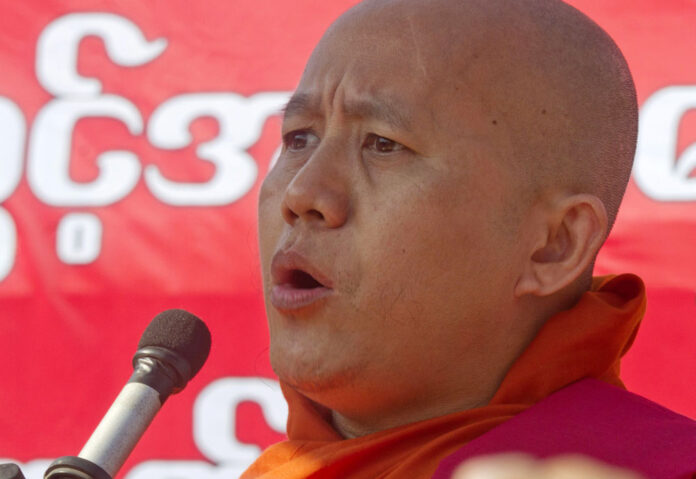
Ultranationalist Buddhist monk Wirathu speaks Jan. 16, 2015, at a rally to protest a resolution adopted by the U.N. General Assembly calling on Myanmar to grant citizenship to Rohingya, in Yangon, Myanmar. Photo: Khin Maung Win / Associated Press

YANGON — Myanmar’s government has denounced an influential Buddhist nationalist group after failing earlier to speak strongly against it though others were accusing it of using hate speech and inspiring violence against Muslims.

The Ma Ba Tha organization’s charismatic leader, the monk Wirathu, responded Wednesday by calling the country’s de facto leader, Aung San Suu Kyi, a “dictatorial woman.”

The Sangha Council, a state institution that oversees Buddhist monastic discipline, declared Tuesday that it did not recognize Ma Ba Tha as a member of the country’s Buddhist order. Last week, the government’s minister for Yangon, Phyo Min Thein, said the group shouldn’t exist, rejecting Ma Ba Tha’s demands on official policy toward the Muslim Rohingya minority. The group planned, then called a protest against the minister.

Most politicians have been reluctant to criticize the group because its nationalist message seemed popular in overwhelmingly Buddhist Myanmar. Even Suu Kyi disappointed admirers of her decades-long nonviolent struggle for democracy by failing to crack down on the group, which has been blamed for stirring up deadly violence.

Suu Kyi’s National League for Democracy party took power in March, and she was named State Counselor, a position created just for her because the military-drafted constitution bars her from being president.

“I’ve realized that the ruling party and the new government are targeting me as their ‘enemy number one’ to dismantle the whole Ma Ba Tha,” Wirathu said in his Wednesday statement. “A dictatorial woman’s government is going to put me in prison.” His group was hostile to Suu Kyi’s party even ahead of last November’s election but didn’t stem its landslide victory.

Ma Ba Tha — more formally known as Association for the Protection of Race and Religion — “was never recognized as a real Buddhist organization,” Win Htein, a spokesman for Suu Kyi’s ruling party and government legal affairs expert said Friday. “Now the Sangha Council finally has to denounce them because they have become uncontrollable.”

He said the government was reluctant to act ahead of the council’s action, but now was less constrained.

Minister of Culture and Religion Aung Ko told reporters Thursday that the government plans to ask the Sangha Council to deal with cases of hate speech.

Ma Ba Tha has built networks across Myanmar after initial violence against Muslim Rohingyas in western Rakhine state in 2012. As recently as June, there were two mob attacks on Muslim religious institutions in other parts of the country.

Aside from any violence it may have directly incited, Ma Ba Tha successfully lobbied the previous military-backed government for a series of laws that rights groups say discriminate against women and religious minorities.

Tun Kyi, a prominent Muslim peace activist and former political prisoner, said the government’s challenges to Ma Ba Tha come too late.

“They had had caused violence, death and forcing people from their homes, and that shows the lack of rule of law in this country,” he said.

Advertisement

The Case For Illogical Logic and The Absurd in Juntaland

Junta chief Prayuth Chan-ocha demos 'Magic Eyes' industrial goggles at Industry Expo in Bangkok.

Retention

Red bowls, balloons, leaflets attack the charter underwritten by the military. Toys with messages call for freedom and democracy, while people stand still in public, read George Orwell’s 1984 or even eat sandwiches.

These are the things deemed a threat to national security?

Some wonder, could things get even zanier?

The answer is yes.

A Prachatai.com news reporter was arrested July 3 and charged with violating the Referendum Act, which forbade campaigning before the Aug. 7 charter referendum and disseminating documents deemed “misleading” to the public about its contents.

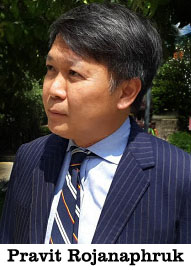
Pravit RojanaphrukAll the reporter, Taweesak Kerdpoka, did was “embed” himself in a car belonging to the New Democracy Movement campaigners who had anti-charter documents inside the vehicle.

This led Paris-based Reporters Without Borders’ regional head Benjamin Ismail to not only demand the charge be dropped but ask where such exercise of power would end.

“As if violating the fundamental freedoms of assembly and opinion were not enough, the authorities are compounding their crimes by also violating freedom of information and media freedom. What will come next? Arresting the journalists who cover these arbitrary arrests?”

Absurd though situation may be, there’s an underlying logic in the the exercise of illogical dictatorial power, however. Those perplexed by the increasingly illogical dictates of the junta should recognize that effective dictatorial power must by nature be illogical.

The more absurd the use of dictatorial power is, the more effective it becomes

Because dictatorial power is illegitimate, it cannot withstand scrutiny or objection. Thus people under a dictatorial regime must be tamed into customary obedience. Like a prisoner. It helps to quickly adjust and accept the new reality without asking why the conditions are so bad.

The more absurd the use of dictatorial power is, the more effective it becomes, as people are likely to become jaded and eventually abandon rational scrutiny of such power.

The logic of dictatorial power is thus: The more absurd and illogical the order the better, for people will end up accustomed to following the next and the next one. Such absurd orders must be given out often and repeatedly because dictators are permanently insecure in their power due to the awareness they are without legitimacy.

Of course a dictator’s power is most effective when clothed in the language of law.

It always sounds good for anyone to be a law-abiding citizen, and dictators can simply say they are maintaining the sacrosanct nature of the law – never mind they are arbitrary dictums from an unlawful squatter.

Making dictatorial rules camouflages the illegal and illegitimate natures of the coup makers.

The dictator, in this case Gen. Prayuth Chan-ocha, can always say that no harm will ever befall you if you don’t break the law. This should actually read like – you will be free and fine as long as you don’t challenge or break Prayuth’s law.

For those intellectually inclined, there’s always the excuse the junta is just in power reluctantly and temporarily (as Prayuth’s song once reminded, “please give us a little more time” for nearly two years), so please bear with them and do not point out the obvious absurdity of the whole situation.

There are people who remain unconvinced by the absurdity of dictatorial power, however. These people ask logical questions such as, why was any public campaign for or against the junta-sponsored charter draft criminalized? Is this not absurd? To these people, the dictator could rely on the standard autocratic rhetoric reminding them that: “I am the law,” “I have absolute power,” “Don’t dare question or challenge me!” blah, blah, blah.

Advertisement

Hot News

LATEST NEWS

Bangkok
broken clouds
29.4 ° C
32.2 °
29.4 °
74 %
5.4kmh
58 %
Fri
29 °
Sat
36 °
Sun
37 °
Mon
37 °
Tue
32 °