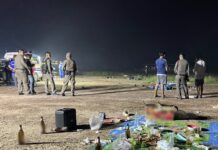
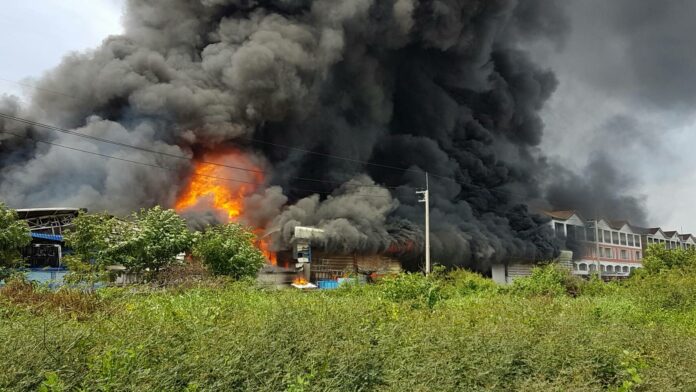
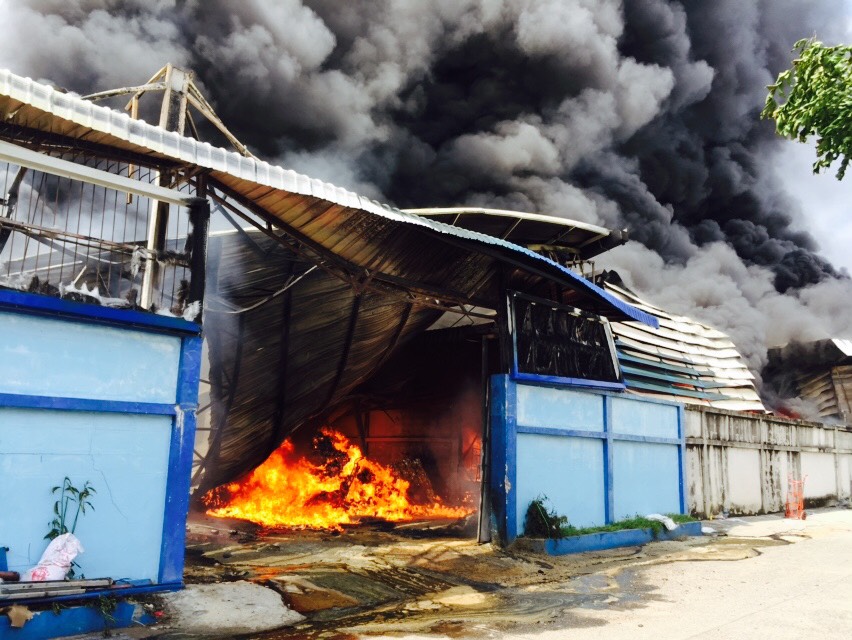
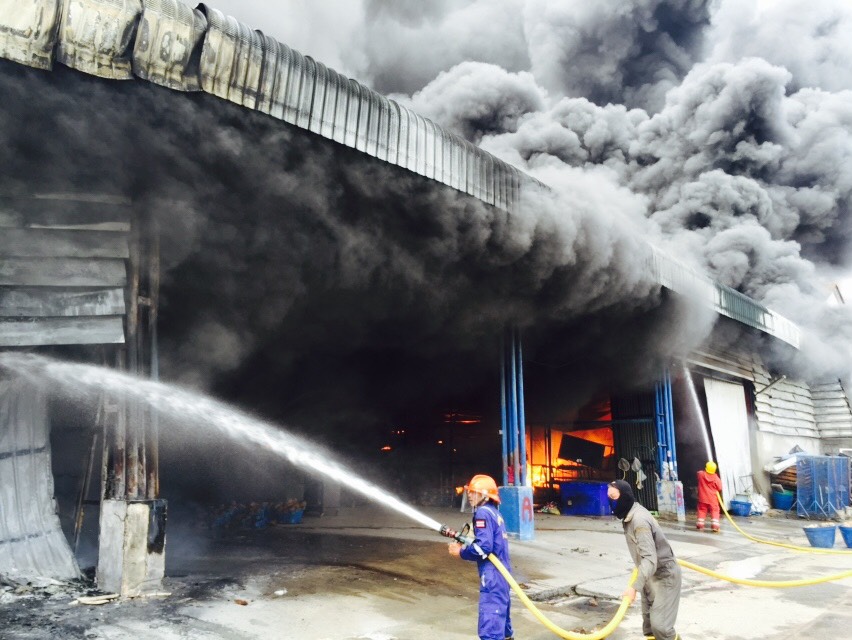
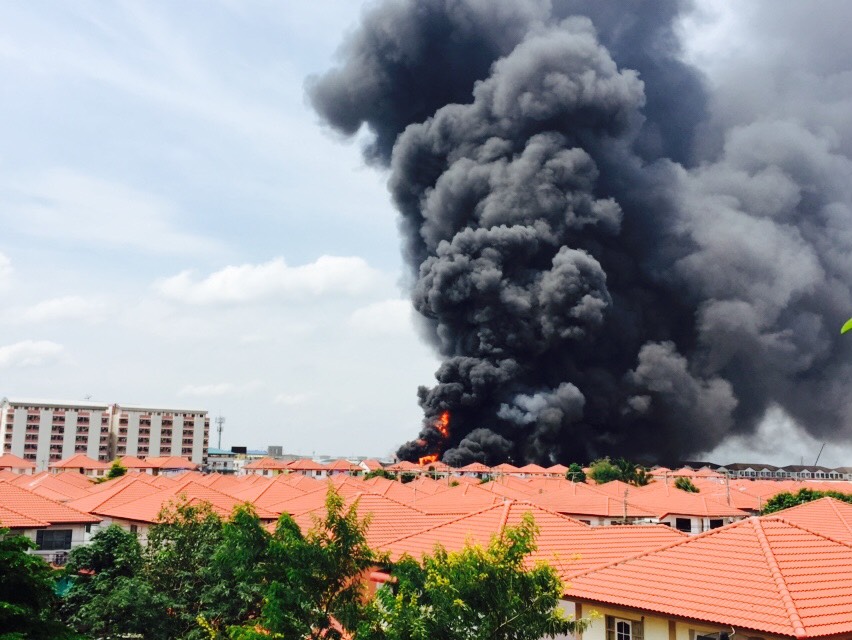
Smoke fills the afternoon sky Tuesday from a fire burning out of control at a factory near Talad Thai in Pathum Thani province.
PATHUM THANI — A fire broke out at a factory near Thailand’s largest agricultural market Talaad Thai on Tuesday afternoon.
The fire was reported about 2pm at a coconuts-filled warehouse in Soi Thepkunchorn 14 near Talaad Thai north of Bangkok in Pathum Thani province. It was fueled by coconut husks stored inside, and was brought under control after about two hours. There were no immediate reports of injury.
There building is surrounded by townhouses and commercial buildings, and there were concerns it would spread.
Copies of the draft constitution published by the Election Commission were displayed to the media Monday in Bangkok. Photo: Matichon
BANGKOK — Two days after the military government of Gen. Prayuth Chan-ocha set up what it calls “peace centers” across the nation to enforce the Election Commission’s referendum law, even the head of that body is unclear what their mandate is.
Playing down concerns the centers, manned by officials and soldiers, will be used to hijack the polls, the man in charge of staging the referendum on the junta-backed draft charter said they were akin to “security guards” and would not overstep the electoral body’s authority.
“The centers are like security guards, while we are the owner of the company. They just offer us guards to look after [the referendum],” Somchai said Tuesday.
As to how the centers will coordinate with his commission, Somchai said he is clueless at this stage. No letter had been sent yet, and Somchai was not quite sure who was actually running the centers except for possibly the governors of each province.
However the commissioner said the centers, set up at both the provincial and district levels throughout the kingdom Sunday, cannot manipulate the vote counting process as alleged by some critics.
“That’s not possible. Holding a referendum is the work of the commission,” he said. “I don’t think they have anything to do with the referendum vote.”
“I think the media know more details [than I do],” Somchai admitted, adding that he hopes the centers should invite representatives of the EC at provincial level to discuss plans in order to make their work “complete.”
Critics such as Chiang Mai University law lecturer Somchai Preechasilpakul said the government-run centers “further undermine the credibility” of the whole referendum process, however.
“This is a center set up to monitor those who oppose the draft charter,” he said.
And, he added, the junta-led government can hardly be considered a neutral party at this point.
“It’s clear that the government is a party to the conflict,” Somchai said.
Col. Winthai Suvari, spokesman for the junta known as the National Council for Peace and Order, also played down concerns the centers could be used to affect the outcome by influencing voters or suppressing opponents of the charter draft.
“This is an ad hoc unit to ensure that the situation is orderly, and all state mechanisms support it,” Winthai said. “Soldiers are just there to beef up security.”
They are operated under are the Interior Ministry, Winthai said, and may call upon soldiers and police to assist with ensuring an orderly environment for the Aug. 7 referendum.
The move is unlikely to bolster the confidence of neutral elections observers concerned the suppression of debate and criminalization of campaigning will make for “free and fair” elections.
The referendum law outright criminalized campaigning for or against the charter, but only the handful of people publicly opposing it have been arrested and prosecuted.
Former Election Commissioner Gothom Arya said it’s unfortunate the law disallowed citizens to participate in monitoring the polls and expressed concern about the ad hoc centers.
“I don’t know how district chiefs will coordinate with the commission because the truth is, the job of ensuring that elections are clean, fair and orderly falls to the Election Commission,” Gothom said.
He added that authorities need to ensure there are no overlapping roles between the two, and any soldiers involved need to not overstep their roles.
Commissioner Somchai said he thinks the centers will deal with those breaking laws, such as holding public rallies, which was forbidden by the referendum law.
He didn’t believe those at the centers will be responsible for deciding whether what one says about the charter draft is truthful or vulgar, and thus legal or not, however.
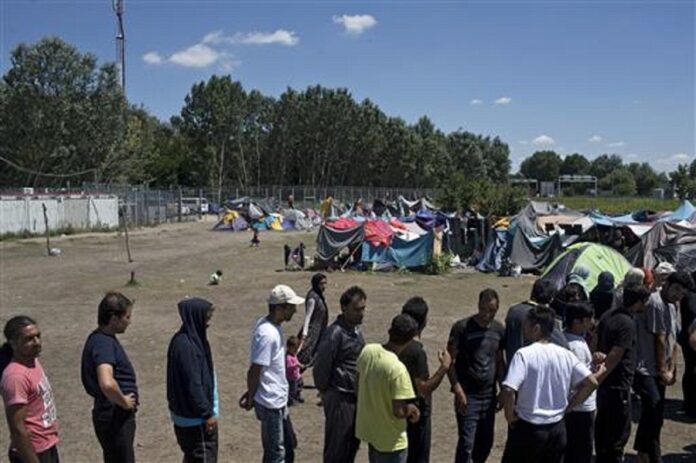
People queue to receive aid packages at a makeshift migrant and refugee camp situated meters away from the Serbian border with Hungary, in Horgos, Serbia, Monday, July 4, 2016.
HORGOS, Serbia — The snakes come out at night, and so do the mosquitoes.
There’s only one tap with running water in the makeshift refugee camp on Serbia’s border with Hungary, where hundreds fleeing war and poverty wait daily to cross over into the European Union. No toilets, no showers, but plenty of uncertainty and desperation.
The refugees are from Syria, Afghanistan, Iraq and other war-torn states who have decided to use the traditional Balkan migration route despite its closure in March, rather than trying the hazardous Mediterranean Sea crossing between Libya and Italy, where thousands daily risk their lives.
On the no man’s land between Serbia and Hungary, there’s little to fend off the scorching summer heat. A boy cries loudly as cold water is splashed on him and his mother rubs him with soap. Another small child and several other migrants stand by patiently, holding plastic water bottles or clothes they want to wash, as the runoff washes down a filthy gutter.
Small tents are grouped in a dusty field, many with blankets spread over them to protect from the sun. Some lucky migrants are camped out under the rare trees on the field’s edge.
The migrants have been camping outside the Hungarian barbed-wire fence — many for days or weeks — waiting for Hungarian authorities to allow them in. It’s a gamble: Hungary has been letting in only about 15 people a day from this camp — mostly families with small children. Starting Tuesday, Hungarian authorities will apply even harsher rules designed to reduce the number of people seeking asylum in the EU nation to a minimum.
Migrants and refugees detained within 8 kilometers of the border will be taken to the Serbian side of the fence — the one visited by an Associated Press crew on Monday — where they will wait to make their requests for asylum with Hungarian authorities. Few are expected to get in.
The tighter rules are likely to increase the pileup of people on the border between Serbia and Hungary, where authorities said Monday they have caught 17,062 migrants trying to illegally cross the border so far this year.
One Afghan couple has been at the Horgos camp for a week. They said they had fled their home more than a month ago because they both had worked for international organizations and received threats from the Taliban. Now they have no idea when or even if they will be allowed into Hungary.
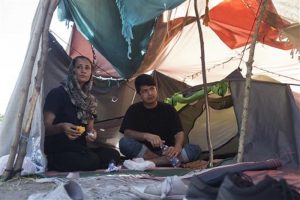
Azada Sayed, 23, left, and her husband, Hameed, 28, sit in their tent at a makeshift camp for migrants and refugees situated meters away from the Serbian border with Hungary, in Horgos, Serbia, Monday, July 4, 2016
“We don’t have the facilities, no shower, no toilets,” said Hameed Sayed, 28. “I didn’t take any shower for four days.”
His wife Azada, 23, complained that “during the days it’s so hot, during the night it’s so cold.” She said the migrants have had to cope with mosquitoes, other biting insects and even snakes.
The couple said they had applied for entry into Hungary, but haven’t had any feedback. Sayed wanted to enter the EU legally and seek asylum rather than try his luck with the surge of people-smugglers plying their trade along the Balkans.
More than 1 million people entered Europe last year and nations have been closing their borders since March to curb the influx.
On Monday, Serbian police said they arrested eight suspected people-smugglers as part of efforts to curb the illegal transfer of migrants toward Western Europe. Police said the smugglers were charging up to EUR1,200 (around 47,000 baht) to deliver each migrant from Serbia to Austria, via Hungary.
Ahmad Shahim arrived Monday at the camp along with 11 family members, including his children, his sister’s children and their mother. The family had spent four months in Greece and Shahim expressed hope they will not wait longer than 15 days to enter Hungary.
“I will write my name on the list, we are not sure,” he said as other family members unfolded a gray blanket in the dusty camp and sat down.
“European countries are mostly changing their laws,” he complained. “Maybe we will be pushed back to Macedonia or Greece.”
Aid workers say many migrants in the camp are sick, particularly the children. Junaid Chakerzehi, from the Humanitarian Center for Integration and Tolerance group, said aid groups are also uncertain about the effects of the new Hungarian rules.
As aid workers distributed food packages, migrants lined up, many putting cloths on their heads to fend off the blazing sun. Other searched for shade in the tents or rested in makeshift hammocks spread between the trees.
Some children played with a small, light-colored dog named Rex. It’s owner, a 25-year-old from Afghanistan who gave only his first name, Baba, fearing retaliation against his relatives back home, said he had brought the dog over from Greece and hoped he could take it into Hungary along with his wife and two children.
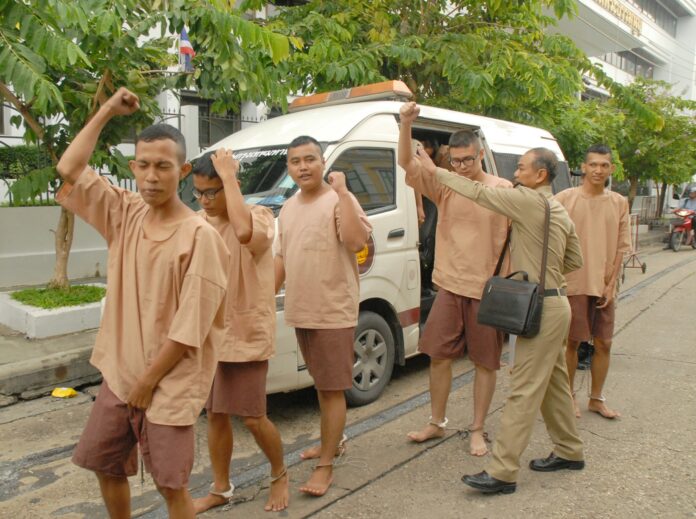
Shouting, ‘Voting no is our right, it's not illegal!’ jailed activists were escorted to a military court Tuesday morning in Bangkok.
BANGKOK — Military judges Tuesday afternoon ordered all 13 activists be released without bail.
The military court ruled they should be freed to await trial without posting bail, as police investigators had already examined witnesses and evidence. Though they prevailed in winning release without posting bail, the activists played down the outcome.
“Although this is not a victory for us, it shows that there are still ways to fight the state’s habit of putting people in jail on unreasonable grounds,” defense lawyer Krisadang Nutcharus said after the ruling was made.
They will be released at 8am on Wednesday.
The seven activists had refused to post bonds and seek release on bail in a challenge to the legitimacy of the charges against them.
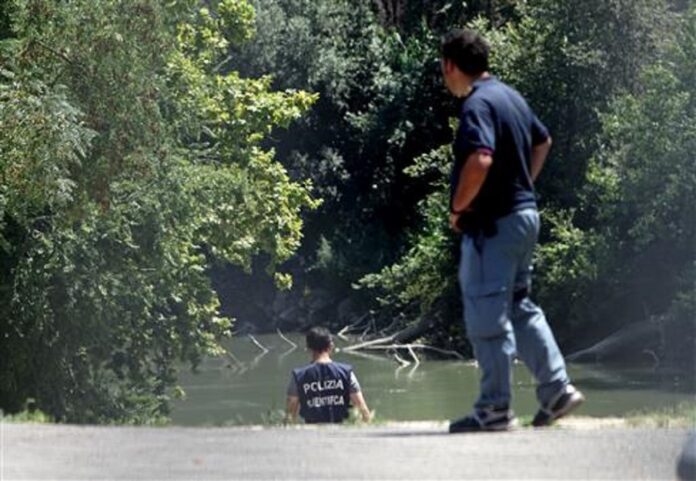
Italian Police inspect the banks of the Tiber river in Rome where the body of a young man was found, Monday, July 4, 2016. Italian authorities on Monday were investigating the disappearance of a Wisconsin student in Rome a day after he arrived in the Italian capital.
ROME — Italian police say they have detained a homeless man in the death of an American student whose body was found in the Tiber River.
Police identified the suspect as Massimo Galioto, a 40-year-old man from Rome. In a statement Tuesday, police said he was taken into custody because he was “seriously implicated” in the murder.
Police on Monday pulled the body of Beau Solomon from the Tiber River. The 19-year-old student from Wisconsin had last been seen early Friday morning at a pub, shortly after arriving in Rome.
John Cabot University, an English university in the Italian capital, confirmed his death on Monday evening.
Solomon had recently completed his first year as a personal finance major at the University of Wisconsin-Madison.
“We express our most heartfelt condolences to the Solomon family and to all those who loved Beau,” said a statement from the Rome-based English-language university where Solomon had just arrived for an exchange program.
An earlier statement from the university said it was “alerted by his roommate, who reported that he had lost contact with Beau around 1 a.m. … and was worried when he did not see Beau at orientation” Friday morning.
Cole Solomon, Beau Solomon’s 23-year-old brother, told the Milwaukee Journal Sentinel on Monday that investigators were treating the incident as a murder. He said his brother’s body was found with a head wound and blood on his shirt. He added that thousands of dollars were charged to Beau Solomon’s credit card after his disappearance.
Cole Solomon and Beau Solomon’s father, Nick, didn’t immediately respond to messages The Associated Press left for them on social media Monday. No residential telephone listing could be found for Cole Solomon and calls to two possible listings for Nick Solomon rang unanswered.
Italian state TV said EUR1,500 (about 58,800 baht) were run up on the cards at a Milan store, the day after, and hundreds of miles (kilometers) away from where he was reported last seen in Rome. The TV report said investigators will check security cameras near the store for any possible image of who might have used the cards.
Solomon’s family was in Italy and John Cabot University was in contact with Italian authorities, the U.S. Embassy and his U.S. college, its President Franco Pavoncello told The Associated Press.
Without citing sources or names, the Italian news agency ANSA said two people claimed to have seen a man throw a person into the Tiber the night Solomon disappeared. Later ANSA said the witnesses were two Italians.
Sky TG24 TV said the witnesses reported seeing someone pushed into the area on the Tiber near Garibaldi Bridge. That bridge is heavily trafficked, and in that area of the Tiber’s banks, an annual summer fair featuring artisans selling wares and booths offering food is drawing big crowds nightly.
While the cause of Solomon’s death is unclear, there have been several recent cases of American students in Rome running into trouble, especially during a night out drinking. Many American students are surprised to find that alcohol can be easily acquired in Italian supermarkets, bars or restaurants.
In 2012, a U.S. student was allegedly stabbed by his roommate, a fellow student at John Cabot University, after what police said was a night of alcohol and possible drug use. The stabbed student survived.
Also in recent years, a young American man recently arrived in Rome for studies died after falling off a low, street-side wall where people sit at nighttime and landing on the concrete banks yards (meters) below. Another young American male student, who had been reported missing after leaving a bar, was found dead near train tracks in a Rome tunnel, apparently hit by a train in the early morning hours.
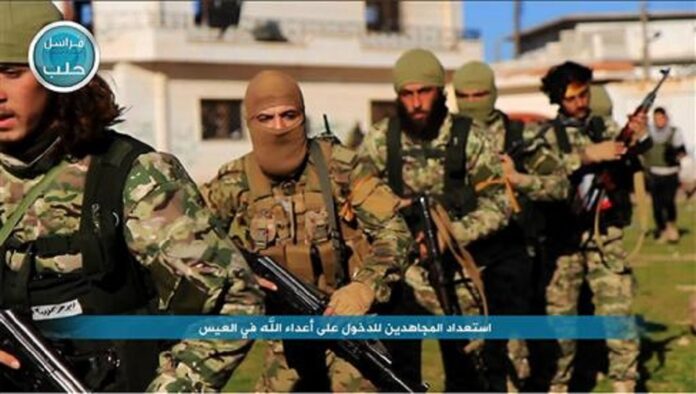
This file photo posted on the Twitter page of Syria's al-Qaida-linked Nusra Front on April 1, 2016, shows fighters from al-Qaida's branch in Syria, the Nusra Front, marching toward the northern village of al-Ais in Aleppo province, Syria.
Photo: Al-Nusra Front
BEIRUT — Some Syrian opposition groups have adopted methods of abuse similar to those employed by the government of President Bashar Assad, Amnesty International said in a new report Tuesday that documents a “chilling” wave of torture, abductions and summary killings in insurgent-controlled areas.
The report is based on interviews with some 70 individuals living or working in the northern provinces of Idlib and parts of Aleppo, areas controlled by insurgents.
The abuses were committed over four years by five armed groups, including some backed by the United States and other regional powers, and al-Qaida’s branch in Syria, Amnesty said.
“While some civilians in areas controlled by armed opposition groups may at first have welcomed an escape from brutal Syrian government rule, hopes that these armed groups would respect rights have faded as they have increasingly taken the law into their own hands and committed serious abuses,” said Philip Luther, director of Amnesty’s Middle East program.
The report documents at least 24 abductions of activists, ethnic and religious minorities, as well as three children, two of whom remain missing as of last week.
Amnesty also documented summary killings by gunfire, some in public, of pro-government fighters, which it said constitute war crimes. It called on international backers to cease arms transfers to groups implicated in abuse.
Some people were abducted because of their criticism of the armed groups or simply for playing music. Media activists reported receiving threats for critical reporting. Some said they were suspended for hours from their wrists or were squeezed into a tire with their hands bound behind their backs and beaten, methods of torture also used by the Syrian government.
One of the groups, Ahrar al-Sham, said in a letter that it would like to meet with Amnesty to clarify the issues. It did not respond to the allegations.
Still image from a security camera of the suspect police are seeking for the sexual assault of a 20-year-old student inside a public toilet June 26 near Bangkok’s Bang Na Junction.
BANGKOK — Police are searching for a man wanted in connection with the sexual assault of a woman in a public restroom.
Police are publicizing images first released Sunday of the suspect they believe entered a unisex public toilet on June 26 near Bang Na junction and raped a 20-year-old female university student.
Built on the first floor of a four-story building, the five toilets were accessed by putting three baht into an automatic entry door. The building was shut down by local district officials Sunday.
Police said the suspect seen in the CCTV footage was 165 centimeters tall.
Interim metro police chief Sanit Mahathavorn said they expect an arrest to be made soon but offered no further comment on the case beyond the released photo.
Responding to an outpouring of concern about public safety following the case, Sanit also said anyone is welcomed to use the toilets at any police station nationwide, 24 hours a day.
In this March 23, 2015 file photo, this aerial view shows a boat leaking oil in the waters of Guanabara Bay in Rio de Janeiro, Brazil. A new pollution problem has surfaced in Guanabara Bay, the venue for sailing in the Rio de Janeiro Olympics.
RIO DE JANEIRO — A new pollution problem has surfaced in Guanabara Bay, the venue for sailing in the Rio de Janeiro Olympics.
Sailors complained Monday about an oil slick that turned white boats brown with crews in town practicing for the Olympics, which open in a month.
“We’ve never seen anything like this. It was all over the place,” said Finnish sailor Camilla Cedercreutz. “There was no way you could avoid it.”
It’s yet another in a long list of problems confronting South America’s first games: the Zika virus, rising crime and violence, budget cuts, and slow ticket sales.
The games will also open with Brazilian President Dilma Rousseff facing an impeachment trial, and Brazil mired in its deepest recession in decades.
Cedercreutz said the slick filled part of the bay on Sunday, staining her boat from bow to stern.
“This is only our second time in Rio,” said Cedercreutz, who has qualified in the 49erFX class. “We’ve heard it was really bad, You get mad because it shouldn’t be like this anywhere. It shouldn’t be this dirty. But there’s nothing we can do about it.”
Cedercreutz’s sailing partner Noora Ruskola said other sailors told her: “Your boat looks like a toilet.”
Guanabara Bay is severely polluted, filled with bacteria and viruses. However, sailors have less frequently complained about industrial pollution in the giant bay.
Spanish sailor Jordi Xammar, who will compete in the 470 class, said he saw the slick “and tried to avoid it.”
“The boats were completely brown,” he said. “But the worst thing was we saw a lot of dead fish.”
Xammar said this is his fourth time in Rio, and he’s seen the water “improve a bit. It was yellow-green last year.”
Rio organizing committee officials say the venue is safe, although independent studies by The Associated Press show high level of pathogens in waters that Rio is using for sailing, rowing, canoeing and open-water swimming.
World Sailing, the governing body of the sport, said Monday it was “not in a position to comment.”
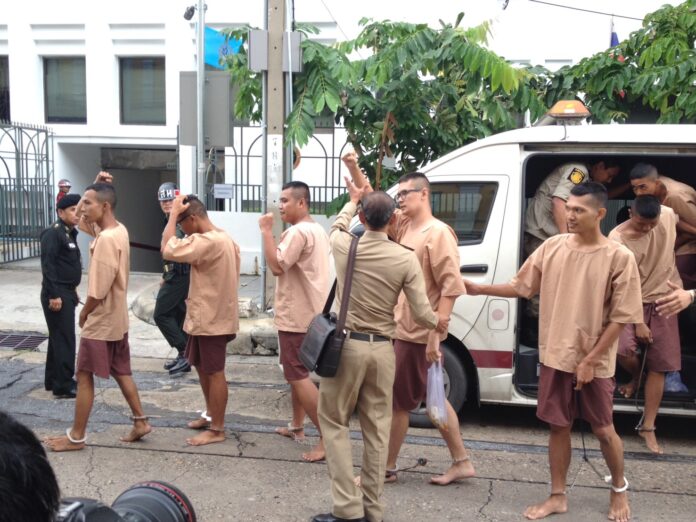
'Voting no is our right, it's not illegal!' activists opposed to the junta-backed charter referendum shout as they were brought to a military court Tuesday in Bangkok.
BANGKOK — Seven activists imprisoned for campaigning against the junta’s draft charter said today they will accept no less than immediate, unconditional release.
In the military courtroom Tuesday to hear whether the judges order them held another 12 days, the defendants held to their position that the court lacks the legitimacy to try them or require them to post bail.
“We seven have to endure these conditions. It’s not an easy life; I have lost 13 kilograms in prison” said activist Rangsiman Rome, wearing shackles and brown prisoner garb. “But we won’t seek bail because we did nothing wrong.”
He added that he and other activists are still in good spirits and will continue to oppose the junta.
“All of us can still smile,” Rangsiman said, while other activists on the defendants’ bench nodded.
The court was originally scheduled to issue its ruling at 9am, but police investigators abruptly notified the court they would show up at 1pm, postponing the session several hours.
The defendants have already been jailed at Bangkok Remand Prison for 12 days; they can be held up to 84 days before prosecutors file or drop charges.
The seven prisoners were among 13 people arrested in a southeastern Bangkok suburb on June 23 for handing out leaflets urging the public to reject the junta-backed constitution draft when its put to referendum on August 7.
They are all charged with violating the juntas ban on protest and referendum law; the latter outlaws any campaign for or against the charter.
Their lawyer, Krisadang Nutcharus, said although he hopes the court will free them while they await trial, he’s not optimistic.
“We don’t have much hope today,” Krisadang said.
While Rangsiman and his fellow activists refused to post bonds, six other suspects did so.
Phanthip Saeng-athit, 22, is one of those six. Asked to comment on the seven activists’ hardline stance of unconditional release, she said she respects their “sacrifice.”
“They are making a sacrifice. They want the public to have their eyes opened and see this injustice,” said Phanthip, who just graduated from Thammasat University’s Political Science several months ago.
Despite her bail condition which forbids any political activism, Phanthip said she will try to find a way to continue her campaign against the junta’s charter.
Rangsiman said he wants the public to look at how the regime treats its dissidents when they decide whether to vote yes or no on the Aug. 7 referendum.
“It’s been clear since the beginning that this won’t be a free and fair referendum, but our arrests and imprisonment are a practical proof of that,” Rangsiman said. “People should ask themselves: what kind of a constitution gets passed by putting people in prison? How can it be good?”
In an Aug. 28, 2008 file photo, acclaimed Iranian film director Abbas Kiarostami poses during the photo call of his movie 'Shirin' (My sweet Shirin) at the 65th edition of the Venice Film Festival in Venice, Italy.
Photo: Domenico Stinelli
TEHRAN, Iran — Iranian director Abbas Kiarostami, whose 1997 film “Taste of Cherry” won the prestigious Palme d’Or and who kept working despite government resistance, died Monday. He was 76.
Iran’s official news agency IRNA said Kiarostami died in Paris, where he had gone for cancer treatment last week after undergoing surgery in Iran earlier this year.
He wrote and directed dozens of films over a career spanning more than 40 years. “Taste of Cherry,” which told the story of an Iranian man looking for someone to bury him after he killed himself, won the top award at the Cannes Film Festival. Kiarostami also wrote and directed “Certified Copy,” a 2010 film starring Juliette Binoche.
He said at a 2014 appearance in Syracuse that “Taste of Cherry” was his only film he had not watched since he made it. He said it took him back to a period in his life he preferred not to think about. His film was banned in Iran for supposedly encouraging suicide.
“But in truth,” he said, “it is a suggestion to live.”
Among his other films was “Close-Up” from 1990, which told the true story of a man who impersonated a filmmaker and tricked a family into believing that he would put them in a film. His 1987 film “Where is the Friend’s Home” is a story of honor, about a boy who tries to return schoolwork to a friend. The 2000 film “The Wind Will Carry Us” is about journalists from a city who go to a village to write about the death of an old woman, but they have time to learn about and appreciate rural life as the woman lives longer than expected.
“Ten,” from 2002, features a female taxi driver in Tehran and her conversations with passengers. While it attracted some strong reviews, critic Roger Ebert wrote, “I am unable to grasp the greatness of Abbas Kiarostami.” He said the filmmaker’s critical reputation was unmatched, but his films “are meant not so much to be watched as to be written about; his reviews make his points better than he does.”
Filmmaker Martin Scorsese said some people referred to Kiarostami’s pictures as minimalist, but he thought it was the opposite. Every scene in “Taste of Cherry” and “Where is the Friend’s House” are overflowing with beauty and surprise, he said.
“I got to know Abbas over the last 10 or 15 years,” he said. “He was a very special human being: quiet, elegant, modest, articulate and quite observant. I don’t think he missed anything. Our paths crossed too seldom, and I was always glad when they did. He was a true gentleman and, truly, one of our great artists.”
In “Certified Copy,” Binoche plays a French woman who goes on what appears to be a first date with a British writer. Tensions quickly erupt between the two, and eventually viewers start to suspect that these two may actually know each other — and perhaps had once been married.
For that film and others, Kiarostami had to work outside Iran because of the difficulties in making movies there.
“For a long time, the Iranian government has put a spoke in the wheel of independent filmmakers,” he said at a 2010 news conference.
Kiarostami is survived by two sons, Ahmad and Bahman Kiarostami, who work in multimedia and documentary film.