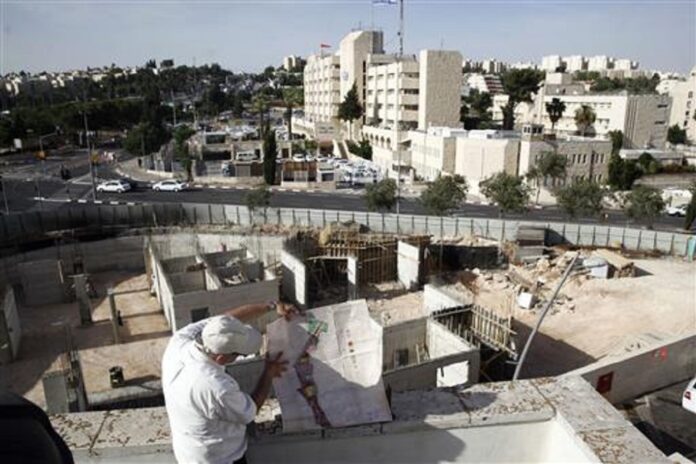
In this May 17, 2016 photo, Israeli lawyer Stephen Berman inspects a construction site on land owned by Palestinian Mohammad Abu Ta’a, in east Jerusalem.
JERUSALEM — Prime Minister Benjamin Netanyahu has authorized construction of hundreds of new homes in Jewish settlements in the West Bank and east Jerusalem, an Israeli official confirmed Tuesday.
The government has presented the move as a response to a series of deadly Palestinian attacks against Jewish settlers. The Palestinians have long viewed settlement construction as the biggest obstacle to the stalled peace process.
The official said construction would include 560 new homes in Maale Adumim, just outside Jerusalem, as well as nearly 200 in the city itself. The plan also called for over 600 new homes in an Arab neighborhood of east Jerusalem.
The official spoke on condition of anonymity because he was not authorized to discuss the matter with reporters.
Israel captured the West Bank and east Jerusalem in the 1967 war. Most of the world opposes settlement construction in these areas, where the Palestinians hope to establish an independent state.
U.N. Secretary-General Ban Ki-moon said the Israeli plans raise “legitimate questions” about the country’s long-term intentions. Palestinian official Hanan Ashrawi said Israel is “bent on destroying the viability, integrity and territorial contiguity of a future Palestinian state.”
U.S. State Department spokesman John Kirby criticized the steps announced by the Israeli government. He said they are “fundamentally undermining the prospects for a two-state solution” and are “counterproductive to the cause of peace in general.”
Palestinians have carried out dozens of attacks since September, killing 34 Israelis and two visiting Americans. Some 200 Palestinians were killed during the same period, most said by Israel to be attackers.
The Israeli military said a Palestinian attempted to stab a soldier in the West Bank on Tuesday before troops opened fire, wounding the attacker. No soldiers were wounded.
Also Tuesday, Israel’s Shin Bet security service said it has arrested two Palestinians from the Gaza Strip who allegedly smuggled money for the Hamas militant group.
It said the men, who held special permits allowing them to conduct business in Israel, were caught with thousands of euros hidden in their shoes destined for Hamas members in the West Bank.
Israel and Egypt imposed a blockade on Gaza in 2007 after Hamas ousted forces loyal to Palestinian President Mahmoud Abbas. The Palestinian leader now governs in the West Bank, while Hamas remains in control of Gaza.
Israel said the two businessmen revealed information about Hamas tunnels located under homes and mosques in Gaza. It also said they provided information about Hamas rocket launchers hidden in civilian areas.
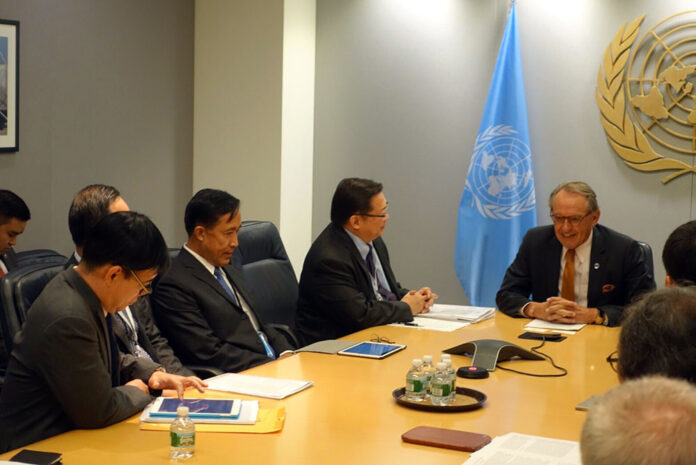
Photo of a June 29 meeting held between UN Deputy-Secretary General Jan Eliasson, seated at right, and Thai Foreign Affairs Vice Minister Virasakdi Futrakul, and former Pemanent Secretary Norachit Sinhaseni. Photo: Prime Minister's Office
BANGKOK — The Office of U.N. Secretary-General Ban Ki-moon took the highly unusual step of refuting a Thai delegation’s account of a meeting held late last month on the referendum and freedom of expression.
In the statement released Tuesday, the U.N. said Thai officials mischaracterized to Thai media the meeting held 29 June between Deputy Secretary-General Jan Eliasson and Virasakdi Futrakul, Foreign Affairs vice minister.
“The statements made to the Thai press by some members of the delegation and reflected in reporting in the press that the [deputy secretary-general] ‘is not concerned’ about the referendum did not accurately reflect the conversation that took place, where he clearly raised concerns, including about freedom of expression and the need for an open dialogue ahead of the referendum,” wrote Michael Bak, adviser to the UN resident coordinator.
The statement sought to set the record straight after Thai representative to the U.N. and former permanent secretary Norachit Sinhaseni was reported in several media outlets saying the global body was “not concerned” about the situation in Thailand in the run-up to a public referendum on the next constitution.
“The DSG said he fully understands the situation in Thailand and is not concerned with the Referendum Act,” Norachit was quoted by INN News on Monday.
On the same day, he was also quoted by Parliament Radio Station: “Mr. Norachit also added that the United Nations did not oppose the Referendum Act…”
Reached for contact Wednesday morning, Norachit said he had not read the statement yet and therefore had no comment.
Passed in late April, the Referendum Act contained a number of controversial provisions, but none more so than the criminalization of any campaigning for or against the charter amid a wider suppression of speech.
The U.N. statement described the June meeting differently.
“The Deputy Secretary-General expressed concerns about the recent reports of restrictions on the freedoms of expression and assembly ahead of the referendum on the draft constitution to be held on Aug. 7. Stressing the importance of the partnership between Thailand and the United Nations and welcoming the human rights and rule of law are important elements for sustainable development and emphasized the need for open and inclusive dialogues to promote democracy and support national reconciliation,” it said of the meeting, which was also attended by Norachit.
Military government officials have repeatedly returned from overseas visits claiming to have successfully made their case in the international community, despite conflicting messages from their hosts.
In October 2014 it went so far as to claim images of a sizable protest against Gen. Prayuth Chan-ocha on his first trip overseas to an Asian-European summit in Milan, Italy, were faked.
In this Thursday Dec. 22, 2005 file photo, the then Britain's Prime Minister Tony Blair meets soldiers at Shaibah logistics base, Basra, Iraq.
LONDON — Thirteen years after British troops marched into Iraq and seven years after they left a country that’s still mired in violence, a mammoth official report is about to address the lingering question: What went wrong?
On Wednesday, retired civil servant John Chilcot will publish his long-delayed, 2.6 million-word report on the divisive war and its chaotic aftermath. The U.S.-led conflict killed 179 British troops and some 4,500 American personnel. It also helped trigger violence that killed hundreds of thousands of Iraqis and still rocks the Middle East.
And it overshadows the legacy of former Prime Minister Tony Blair.
“Despite all the many other things he did — and many people would argue lots of positive achievements — he will always be remembered for this fateful decision in 2003,” said Malcolm Chalmers, deputy director-general of defense think tank the Royal United Services Institute.
Opponents of the war hope Chilcot will find that Blair agreed to support President George W. Bush’s invasion and then used deception to persuade Parliament and the public to back it.
Such a stark finding is unlikely. But senior politicians, diplomats, intelligence officials and military officers are bracing for criticism over the flawed arguments that led to the invasion, and the lack of planning for the occupation that followed.
“I think it will probably shy away from saying, ‘This is what happened and this is who is to blame and this is what we should then do to them,'” said Gareth Stansfield, professor of Middle East politics at the University of Exeter.
“I think it will address key lessons in how intelligence was generated and then used and manipulated in the political system.”
Chilcot’s inquiry held public hearings between 2009 and 2011, taking evidence from more than 150 witnesses — including Blair, who has served as an international business consultant and Mideast peace envoy since he stepped down in 2007.
The inquiry has analyzed 150,000 documents and cost more than 10 million pounds (around 40 million baht), but its report has been repeatedly delayed, in part by wrangling over the inclusion of classified material — including conversations between Blair and Bush. Some of Blair’s pre-war letters to the president are expected to be published by Chilcot.
Chilcot said in an interview broadcast Tuesday that it took far longer than expected to “get to the bottom of what happened over a nine-year period with all the legal, military, diplomatic and intelligence aspects.”
He said the goal was to produce “a really reliable account” and that meant negotiating agreement with the government over publishing details of Cabinet meetings, discussions with heads of state and other sensitive issues.
He said the report would be critical.
“I made very clear right at the start of the inquiry that if we came across decisions or behavior which deserved criticism then we wouldn’t shy away from making it,” Chilcot said. “And indeed, there have been more than a few instances where we are bound to do that.”
Opponents of the war claim Blair’s government exaggerated evidence that Iraqi leader Saddam Hussein had weapons of mass destruction that threatened the West — the foundation of the case for war. No chemical, biological or nuclear weapons were found in Iraq.
A U.S. Senate Intelligence Committee investigation found pre-war intelligence failings and concluded that politicians had overstated the evidence for weapons of mass destructions and ignored warnings about the violence that could follow an invasion.
Previous, more limited, British inquiries largely absolved the government of blame. A 2004 report by former civil service chief Robin Butler concluded that British intelligence was flawed, unreliable and incomplete, but cleared the government of deliberately misusing it.
“No one lied, no one made up the intelligence,” Blair said at the time, a stance he has stuck to ever since. Blair says he won’t comment on the report until it is published.
Some senior officials, though, say the decision to go to war was made long before Parliament voted to approve it on March 18, 2003.
Alan West, who was head of the Royal Navy at the time, said “I think there had been a decision that we were going to invade Iraq, that that was going to happen, but they were looking for a reason to actually do it.”
“They’d bloody decided, that’s the reality,” West told political magazine The House.
Anti-war activists hope Chilcot will find the conflict illegal, opening the way for Blair to be prosecuted for war crimes. They will probably be disappointed. Chilcot has stressed that his inquiry is not a court of law, and the International Criminal Court has said that the “decision by the U.K. to go to war in Iraq falls outside the court’s jurisdiction.”
Some British lawmakers hope to deploy an obscure statute last used 200 years ago to impeach Blair and put him on trial before the House of Lords — again, an unlikely outcome.
The inquiry’s main achievement may be to make public historic decisions taken behind closed doors.
Stansfield said the families of British troops killed in Iraq deserve to learn “why Blair made the decisions that he did.”
But he said the report’s most important lessons would be about how the aftermath of the invasion went so disastrously wrong.
Iraq descended into sectarian strife after the occupiers dismantled Saddam’s government and military apparatus, unleashing chaos that helped give rise to the Sunni extremist militants of the Islamic State group.
“In many ways the really important question is, how do we manage post-conflict environments more effectively?” Stansfield said. “We need to learn those lessons from Iraq desperately quickly.”
For many relatives of dead British soldiers, the report is likely to provide little solace.
“People say this should bring closure, but it won’t,” said David Godfrey, whose 21-year-old grandson Daniel Coffey was killed in Iraq in 2007.
“It can’t bring anybody back and won’t stop us feeling what we feel. It’s just another step forward on another long journey.”
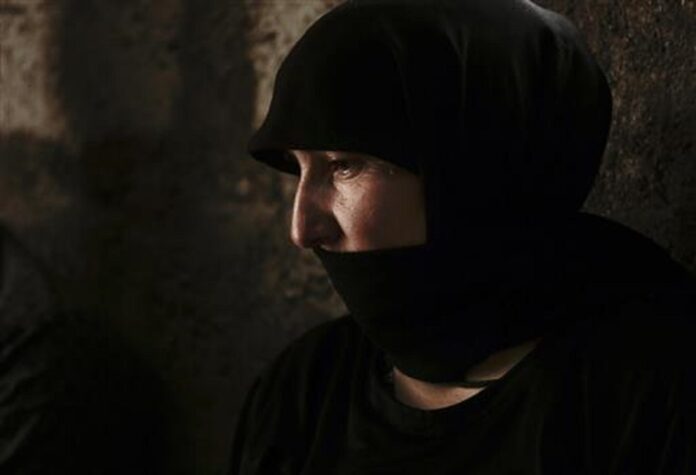
Nuri Murat, a Yazidi woman, speaks to The Associated Press at Kankhe Camp for the internally displaced in Dahuk, northern Iraq, in this May 18, 2016, photo. Photo: Maya Alleruzzo
KHANKE, Iraq — The advertisement on the Telegram app is as chilling as it is incongruous: A girl for sale is “Virgin. Beautiful. 12 years old…. Her price has reached $12,500 (around 440,000 baht) and she will be sold soon.”
The posting in Arabic appeared on an encrypted conversation along with ads for kittens, weapons and tactical gear. It was shared with The Associated Press by an activist with the minority Yazidi community, whose women and children are being held as sex slaves by the extremists.
While the Islamic State group is losing territory in its self-styled caliphate, it is tightening its grip on the estimated 3,000 women and girls held as sex slaves. In a fusion of ancient barbaric practices and modern technology, IS sells the women like chattel on smart phone apps and shares databases that contain their photographs and the names of their “owners” to prevent their escape through IS checkpoints. The fighters are assassinating smugglers who rescue the captives, just as funds to buy the women out of slavery are drying up.
The thousands of Yazidi women and children were taken prisoner in August 2014, when IS fighters overran their villages in northern Iraq with the aim to eliminate the Kurdish-speaking minority because of its ancient faith. Since then, Arab and Kurdish smugglers managed to free an average of 134 people a month. But by May, an IS crackdown reduced those numbers to just 39 in the last six weeks, according to figures provided by the Kurdistan regional government.
Mirza Danai, founder of the German-Iraqi aid organization Luftbrucke Irak, said in the last two or three months, escape has become more difficult and dangerous.
“They register every slave, every person under their owner, and therefore if she escapes, every Daesh control or checkpoint, or security force – they know that this girl … has escaped from this owner,” he said, using the Arabic acronym for the group.
U.S. State Department spokesman John Kirby told the AP that the U.S. continues “to be appalled by credible reports that Daesh is trafficking in human beings, and sex slavery in particular.”
“This depravity not only speaks to the degree to which Daesh cheapens life and repudiates the Islamic faith, it also strengthens our resolve to defeat them,” he said.
The AP has obtained a batch of 48 head shots of the captives, smuggled out of the IS-controlled region by an escapee, which people familiar with them say are similar to those in the extremists’ slave database and the smartphone apps.
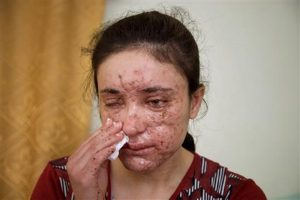
Lamiya Aji Bashar tried to flee four times before finally escaping in March, racing to government-controlled territory with Islamic State group fighters in pursuit. A land mine exploded, killing her companions, 8-year-old Almas and Katherine, 20. She never learned their last names.
The explosion left Lamiya blind in her right eye, her face scarred by melted skin. Saved by the man who smuggled her out, she counts herself among the lucky.
Lamiya Aji Bashar, an 18-year-old Yazidi girl who escaped her Islamic State group enslavers, talks to The Associated Press in northern Iraq in this May 5, 2016 photo.
“I managed in the end, thanks to God, I managed to get away from those infidels,” the 18-year-told the AP from a bed at her uncle’s home in the northern Iraqi town of Baadre. “Even if I had lost both eyes, it would have been worth it, because I have survived them.”
The Sunni extremists view the Yazidis as barely human. The Yazidi faith combines elements of Islam, Christianity and Zoroastrianism, an ancient Persian religion. Their pre-war population in Iraq was estimated around 500,000. Their number today is unknown.
Nadia Mourad, an escapee, has appeared before the U.S. Congress and the European Parliament to appeal for international help.
“Daesh is proud of what it’s done to the Yazidis,” she said to Parliament. “They are being used has human shields. They are not allowed to escape or flee. Probably they will be assassinated. Where is the world in all this? Where is humanity?”
IS relies on encrypted apps to sell the women and girls, according to an activist is documenting the transactions and asked not to be named for fear of his safety.
The activist showed AP the negotiations for the captives in encrypted conversations as they were occurring in real time.
The postings appear primarily on Telegram and on Facebook and WhatsApp to a lesser degree, he said.
Both Facebook-owned WhatsApp and Telegram use end-to-end encryption to protect users’ privacy. Both have said they consider protecting private conversations and data paramount, and that they themselves cannot access users’ content.
“Telegram is extremely popular in the Middle East, among other regions,” said Telegram spokesman Markus Ra. “This, unfortunately, includes the more marginal elements and the broadest law-abiding masses alike.” He added the company is committed to prevent abuse of the service and that it routinely removes public channels used by IS.
In addition to the posting for the 12-year-old in a group with hundreds of members, the AP viewed an ad on WhatsApp for a mother with a 3-year-old and a 7-month old baby, with a price of $3,700 (around 130,000 baht). “She wants her owner to sell her,”.
An activist looks at an Islamic State group marketplace on the encrypted app Telegram, advertising a 12-year-old Yazidi girl as a slave for the price of $12,500, in a photo taken in northern Iraq on May 22, 2016. “Peace be upon you and the mercy and blessings of God,” the text reads in Arabic. “There is a female slave – Virgin – Beautiful – 12 years old – Her Arabic is weak – Clean – Her price has reached $12,500, and she will be sold soon.
“We have zero tolerance for this type of behavior and disable accounts when provided with evidence of activity that violates our terms. We encourage people to use our reporting tools if they encounter this type of behavior,” said Matt Steinfeld, a spokesman for WhatsApp.
Like the Bible, some passages of the Quran implicitly condone slavery, which was widespread when the holy book emerged. It also allows men to have sex with both their wives and “those they possess with their right hands,” taken by interpreters to refer to female slaves.
In the 19th and early 20th centuries, most Muslim scholars backed the banning of slavery, citing Quranic verses that say freeing them is a blessing. Some hard-liners, however, continued to insist that under Shariah sex slavery must be permitted, though the Islamic State group is the first in the modern era to bring it into organized practice.
In the images obtained by AP, many of the women and girls are dressed in finery, some in heavy makeup. All look directly at the camera, standing in front of overstuffed chairs or brocade curtains in what resembles a shabby hotel ballroom. Some are barely out of elementary school. Not one looks older than 30.
One of them is Nazdar Murat, who was about 16 when she was abducted two years ago — one of more than two dozen young women taken away by the extremists in a single day in August 2014. Her father and uncles were among about 40 people killed when IS took over the Sinjar area, the heart of the Yazidi homeland.
Inside an immaculately kept tent in a displaced persons camp outside the northern Iraqi town of Dahuk, Nazdar’s mother said her daughter managed to call once, six months ago.
“We spoke for a few seconds. She said she was in Mosul,” said Murat, referring to Iraq’s second-largest city. “Every time someone comes back, we ask them what happened to her and no one recognizes her. Some people told me she committed suicide.”
The family keeps the file of missing Yazidis on a mobile phone. They show it to those who have escaped the caliphate, to find out if anyone has seen her, and to other families looking for a thread of hope they’ll see their own missing relatives again.
The odds of rescue, however, grow slimmer by the day. The smuggling networks that have freed the captives are being targeted by IS leaders, who are fighting to keep the Yazidis at nearly any cost, said Andrew Slater of the non-profit group Yazda, which helps document crimes against the community and organizes refuge for those who have fled.
Kurdistan’s regional government had been reimbursing impoverished Yazidi families who paid up to $15,000 (around 520,000 baht) in fees to smugglers to rescue their relatives, or the ransoms demanded by individual fighters to give up the captives. But the Kurdish regional government no longer has the funds. For the past year, Kurdistan has been mired in an economic crisis brought on by the collapse of oil prices, a dispute with Iraq’s central government over revenues, and the fallout from the war against the Islamic State.
Even when IS retreats from towns like Ramadi or Fallujah, the missing girls are nowhere to be found.
“Rescues are slowing. They’re going to stop. People are running out of money, I have dozens of families who are tens of thousands of dollars in debt,” Slater said. “There are still thousands of women and kids in captivity but it’s getting harder and harder to get them out.”
Lamiya was abducted from the village of Kocho, near the town of Sinjar, in the summer of 2014. Her parents are presumed dead. Somewhere, she said, her 9-year-old sister Mayada remains captive. One photo she managed to send to the family shows the little girl standing in front of an IS flag.
Five other sisters all managed to escape and later were relocated to Germany. A younger brother, kept for months in an IS training camp in Mosul, also slipped away and is now staying with other relatives in Dahuk, a city in the Iraqi Kurdish region.
Sitting very still and speaking in a monotone, Lamiya recounted her captivity, describing how she was passed from one IS follower to another, all of whom beat and violated her. She was determined to escape.
She said her first “owner” was an Iraqi IS commander who went by the name Abu Mansour in the city of Raqqa, the de-facto IS capital deep in Syria. He brutalized her, often keeping her handcuffed.
She tried to run away twice but was caught, beaten and raped repeatedly. After a month, she said, she was sold to another IS extremist in Mosul. After she spent two months with him, she was sold again, this time to an IS bomb-maker who Lamiya said forced her to help him make suicide vests and car bombs.
“I tried to escape from him,” she said. “And he captured me, too, and he beat me.”
When the bomb-maker grew bored with her, she was handed over to an IS doctor in Hawija, a small IS-controlled Iraqi town. She said the doctor, who was the IS head of the town hospital, also abused her.
From there, after more than a year, she managed to contact her relatives in secret.
Her uncle said the family paid local smugglers $800 to arrange Lamiya’s escape. She will be reunited with her siblings in Germany, but despite everything, her heart remains in Iraq.
“We had a nice house with a big farm … I was going to school,” she said. “It was beautiful.”
Story by: Lori Hinnant, Maya Alleruzzo, Balint Szlanko
BANGKOK — Step up to the second floor of WTF and drown in facades of Bangkok shophouses.
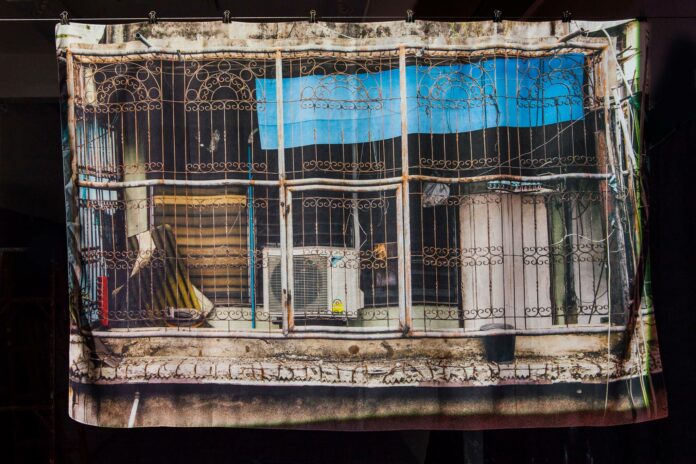
Based in the capital for more than 15 years, photographer Christopher Wise wandered around Bangkok’s streets and documented its old, rusted and rain-stained edifices, the bleak-yet-homey fruits of which will be shown off at “The Way of Quality Living.”
Wise’s photos portray the decaying language of ‘70s architecture and nostalgic longing. They also show contemporary Bangkok’s ongoing social, economic and political issues in an offbeat way Wise described as “other than prints matted and framed behind glass.”
“I wanted to observe Bangkok,” said Wise, co-owner of WTF Bar & Gallery. “I suspect that most all of the protective gates and cages came long after the buildings were completed. Were they a reaction to the flood of new arrivals to the city, or an evolving response to the boom and bust cycles of hope, disappointment, failure, desperation, crime?”
Instead of hanging framed photos on the walls like most photo exhibitions, Wise said his images will be printed on fabric and hung at the center of the gallery so his audience can experience the real “Old Bangkok.”
“The fabric printing itself creates a veil or covering, so that were one to dispense with its display, one would be able to literally enwrap oneself up in the gauze of old Bangkok,” Wise wrote in a reply.
The opening party starts at 7pm on Saturday. The installation runs until Aug. 14.
Admission is free. The three-storey WTF is located just off Soi Sukhumvit 51, which can be reached on foot from BTS Thong Lo exit No.1. The shophouse-bar-gallery is open 4pm to 10pm, Tuesday through Sunday.
Wise’s previous works include “Pattayaland,” part of the Angkor Photography Festival in Cambodia in 2007 and exhibited locally in 2009 in Silom Road’s Kathmandu Gallery.
BANGKOK — As virtual reality becomes available to the masses, a group of Bangkok designers wants to answer the technology’s promise by using it for a form of communal art-therapy.
Visual design firm Eyedropper Fill wants to embrace the transhuman future with abundant humanity with “Dreamscape II,” in which participants would imagine a more ideal world using virtual reality’s immersive, sensory experience.
“We are taught to believe in ‘impossibility.’ But in fact, we’re all able to construct our own dreams,” Creative Director Wattanapume “Best” Laisuwanchai said. “By turning dreams into reality, our imaginations won’t be suppressed; we’ll be empowered.”
By weaving technology and art, Dreamscape II would fuse imagination with reality. The team, which is seeking crowdfunding, will interview people from the slums to the heights, then art therapists would help them express their ideas of a dream city on a shared, circular canvas.
The resulting mandala paintings would then be rendered into virtual reality environments for VR platforms.
“Dreamscape II is not only a collaboration between communities and our team, but also a collaboration among creators from different fields whose knowledge and experience will be exchanged,” Best said.
If the Dreamscape Project II gains enough funding, they plan to show all the visuals at an exhibition which could be Thailand’s first VR exhibition.
“Visitors will have an opportunity to exchange opinions on how we could change our society. Also, we would like the government sectors to join so that they can hear the unheard opinions from real people,” Best said.
Eyedropper Fill’s creative director Wattanapume “Best” Laisuwanchai and producer Nuntawat “Nut” Jarusruangnil with a mandala. Photo: Asiola / Courtesy
The team needs 800,000 baht to realize the full project, but they have started crowdfunding with a more modest target of 300,000 baht to begin the first phase.
Supporters will be credited and get cool merch such as a documentary DVD, tote bag, booklet and even their own personal VR dreamworld.
The Dreamscape project began in 2015 with “Intimate Politik,” an exhibition at Speedy Grandma where people were asked to draw their dreams on paper to be beamed onto walls and streets via projectors. A documentary on the project won awards at the 19th annual Thai Short Film & Video Festival in 2015.
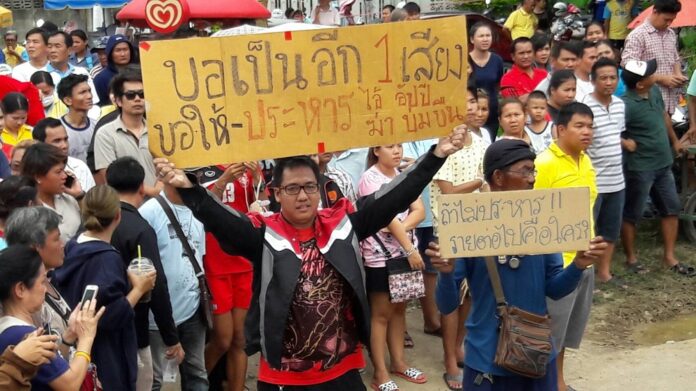
Demonstrators demand the death sentence for Chatree Ruamsungnoen, suspected of murdering and raping a teacher in Saraburi province, as police led him through a 're-enactment' of his alleged crime last July.
BANGKOK — The Justice Ministry says it has no plan to execute rapists who murder their victims, saying such a harsh penalty would provoke more rapists to kill.
The ministry’s third-ranking official, Tawatchai Thaikyo, posted the comments Monday on his Facebook page amid growing outrage over the suspected rape and murder of a 27-year-old teacher, whose alleged attacker was a convicted rapist who lived in her apartment building. The woman’s death has prompted calls for harsher penalties for rapes and capital punishment for fatal rapes.
Capital punishment is legal in Thailand for 35 different crimes, including drug offenses, terrorism, national security crimes, murder and fatal rapes. But in practice, the death penalty is rarely used. The last execution was carried out in 2009 for two drug traffickers.
“If raping equals the death penalty, it would encourage rapists to kill all victims to shut their mouths,” said Justice Ministry deputy permanent secretary Tawatchai Thaikyo. “Wouldn’t it be better if we require all convicted rapists to undergo a rehabilitation program and give them support to prevent them from committing such crimes again?”
Part of the public anger is over the prison system’s failure, in this case, to rehabilitate. The main suspect in the attack Friday is a 27-year-old factory worker who was released from prison last August after serving less than two years behind bars for raping a friend’s wife.
He initially told police that he lived a few doors down from the teacher and knew her apartment door was broken, so he sneaked in late Friday with the intention of raping her but she fought back so he killed her, local media reported. He later changed his confession to say he had no intention of raping but only wanted to rob the teacher. Another neighbor found the woman’s naked body, her throat slashed, the day after the attack.
The suspect, identified as Chatree Ruamsungnoen, was arrested Saturday and police canceled a subsequent reenactment of the crime, which is common in Thailand when suspects confess, over concern he would be attacked by angry mobs.
The head of Thailand’s military government also commented on the case, saying he disagreed with the calls for capital punishment.
“Look at what other countries are doing globally. Human rights laws have stopped capital punishment in many countries around the world,” Prime Minister Prayuth Chan-ocha said, adding that severe penalties alone won’t prevent rapes. Even if the punishment were “three executions” it still might not be enough to deter criminals, he said.
“Society has to help pressure them,” Prayuth added, saying public condemnation could be a greater deterrent than the death penalty.
Rights groups say rape in Thailand goes largely unreported and unpunished, partly because police often don’t take complaints seriously.
Thai police receive about 4,000 rape complaints a year and make about 2,400 arrests, according to the Thailand Development Research Institute, a public policy research institute that gets data from the Justice Ministry.
The number of unreported rape cases is estimated at 30,000 per year, the institute says, amounting to a case every 15 minutes.
The victim’s father added his voice to the calls for capital punishment at a news conference after his daughter’s death.
“I don’t want to see laws kill a person,” the father said Monday. “But if we let such a bad guy go free, he will kill again.”
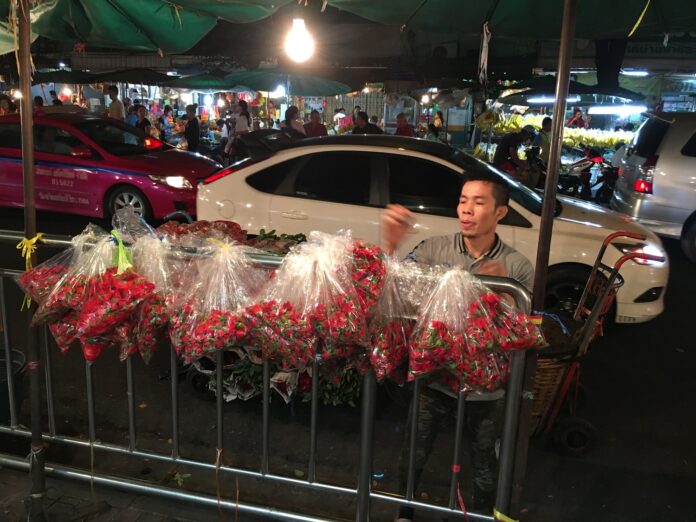
City Hall no longer compromises Pak Khlong Talad vendors to set their street stalls along the sidewalk after 8:30pm since July 1.
BANGKOK — Bangkok’s own War of the Roses wasn’t any closer to being settled six months after it began, with the city today sending heavy equipment into the streets where the vendors of Pak Khlong Talad rose up in revolt recently.
Small backhoes were parked Tuesday morning along the roads where the historic flower market has operated for decades, despite a petition from vendors seeking a hold on their eviction from the street market.
The city’s move came after what happened there Friday after its deadline for vendors to remove their stalls passed, when flower sellers dumped flowers in the road to block traffic and demanded an audience with Bangkok Gov. Sukhumbhand Paribatra.
Soldiers, police and municipal officers have kept the peace in the area since then.
Dozens of vendors Monday went to City Hall to ask for another three-month extension, offering to only set up shop from 8:30pm to 4am.
Though a number had already moved inside the nearby Yodpiman and Pak Khlong Triphet markets only a few minutes walk away, vendor spokesman Pirome Chitkorn insisted they can not make a living selling inside the building away from foot traffic.
Answering for the city, Vallop Suwandee of the Bangkok Metropolitan Administration said several stays of eviction had been granted before, and authorities were out of patience. He said only 50 vendors remain selling on the footpaths.
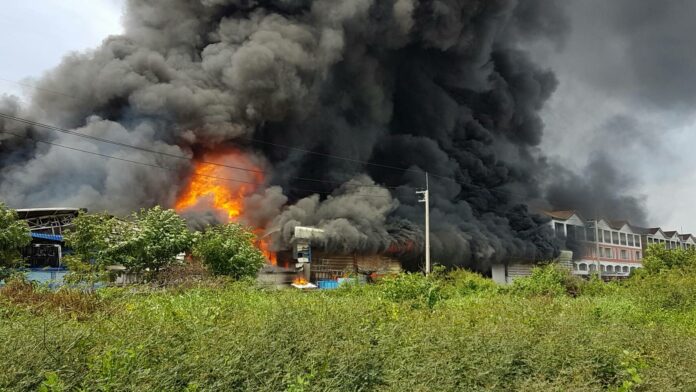
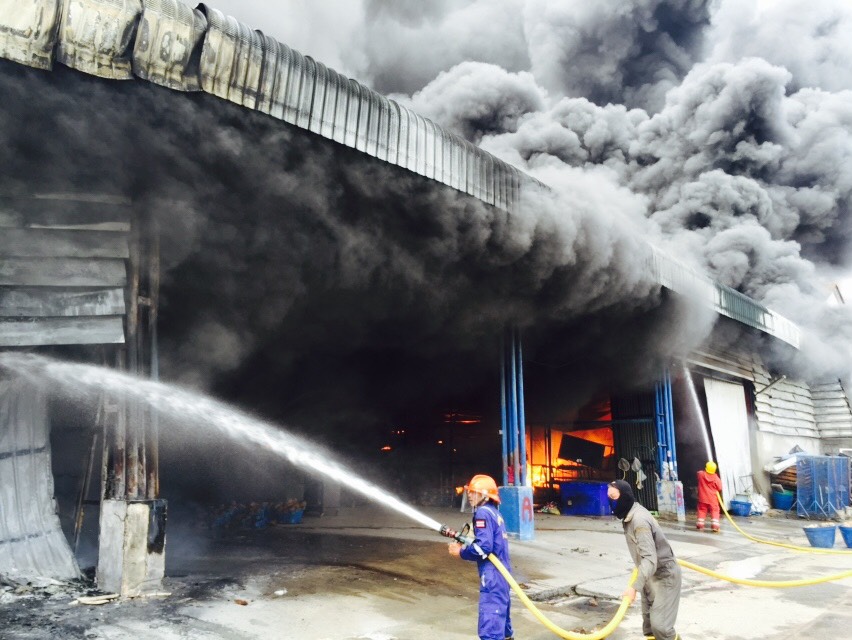
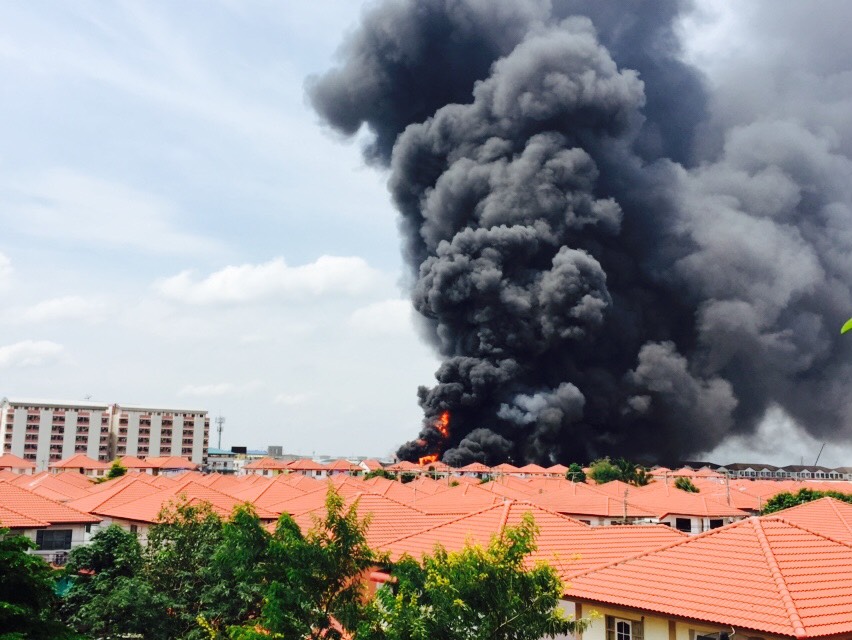
Smoke fills the afternoon sky Tuesday from a fire burning out of control at a factory near Talad Thai in Pathum Thani province.
PATHUM THANI — A fire broke out at a factory near Thailand’s largest agricultural market Talaad Thai on Tuesday afternoon.
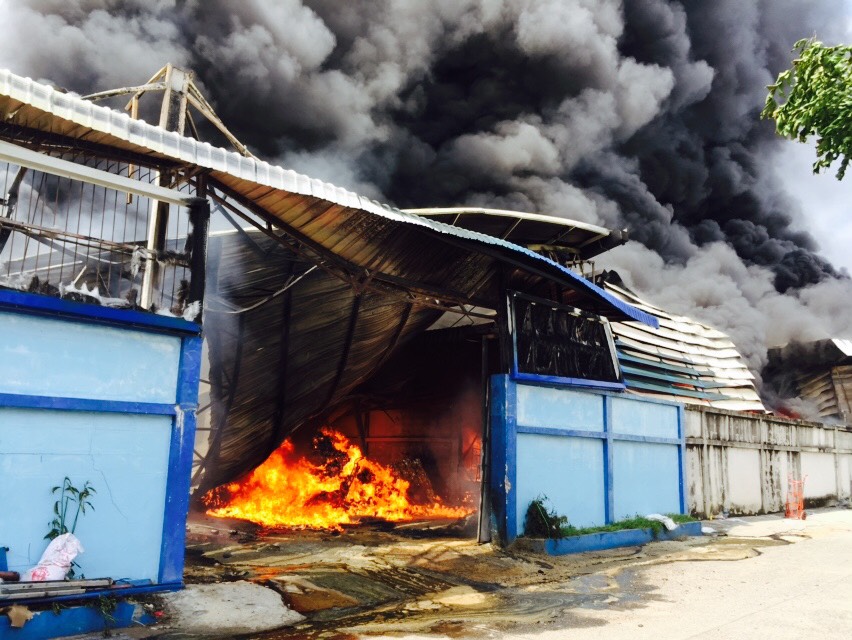
The fire was reported about 2pm at a coconuts-filled warehouse in Soi Thepkunchorn 14 near Talaad Thai north of Bangkok in Pathum Thani province. It was fueled by coconut husks stored inside, and was brought under control after about two hours. There were no immediate reports of injury.
There building is surrounded by townhouses and commercial buildings, and there were concerns it would spread.
Copies of the draft constitution published by the Election Commission were displayed to the media Monday in Bangkok. Photo: Matichon
BANGKOK — Two days after the military government of Gen. Prayuth Chan-ocha set up what it calls “peace centers” across the nation to enforce the Election Commission’s referendum law, even the head of that body is unclear what their mandate is.
Playing down concerns the centers, manned by officials and soldiers, will be used to hijack the polls, the man in charge of staging the referendum on the junta-backed draft charter said they were akin to “security guards” and would not overstep the electoral body’s authority.
“The centers are like security guards, while we are the owner of the company. They just offer us guards to look after [the referendum],” Somchai said Tuesday.
As to how the centers will coordinate with his commission, Somchai said he is clueless at this stage. No letter had been sent yet, and Somchai was not quite sure who was actually running the centers except for possibly the governors of each province.
However the commissioner said the centers, set up at both the provincial and district levels throughout the kingdom Sunday, cannot manipulate the vote counting process as alleged by some critics.
“That’s not possible. Holding a referendum is the work of the commission,” he said. “I don’t think they have anything to do with the referendum vote.”
“I think the media know more details [than I do],” Somchai admitted, adding that he hopes the centers should invite representatives of the EC at provincial level to discuss plans in order to make their work “complete.”
Critics such as Chiang Mai University law lecturer Somchai Preechasilpakul said the government-run centers “further undermine the credibility” of the whole referendum process, however.
“This is a center set up to monitor those who oppose the draft charter,” he said.
And, he added, the junta-led government can hardly be considered a neutral party at this point.
“It’s clear that the government is a party to the conflict,” Somchai said.
Col. Winthai Suvari, spokesman for the junta known as the National Council for Peace and Order, also played down concerns the centers could be used to affect the outcome by influencing voters or suppressing opponents of the charter draft.
“This is an ad hoc unit to ensure that the situation is orderly, and all state mechanisms support it,” Winthai said. “Soldiers are just there to beef up security.”
They are operated under are the Interior Ministry, Winthai said, and may call upon soldiers and police to assist with ensuring an orderly environment for the Aug. 7 referendum.
The move is unlikely to bolster the confidence of neutral elections observers concerned the suppression of debate and criminalization of campaigning will make for “free and fair” elections.
The referendum law outright criminalized campaigning for or against the charter, but only the handful of people publicly opposing it have been arrested and prosecuted.
Former Election Commissioner Gothom Arya said it’s unfortunate the law disallowed citizens to participate in monitoring the polls and expressed concern about the ad hoc centers.
“I don’t know how district chiefs will coordinate with the commission because the truth is, the job of ensuring that elections are clean, fair and orderly falls to the Election Commission,” Gothom said.
He added that authorities need to ensure there are no overlapping roles between the two, and any soldiers involved need to not overstep their roles.
Commissioner Somchai said he thinks the centers will deal with those breaking laws, such as holding public rallies, which was forbidden by the referendum law.
He didn’t believe those at the centers will be responsible for deciding whether what one says about the charter draft is truthful or vulgar, and thus legal or not, however.