30.5 C
Bangkok
Wednesday, June 24, 2026
Home Blog Page 2798

Thaksin Warns on Economy, Says No Deal With Military

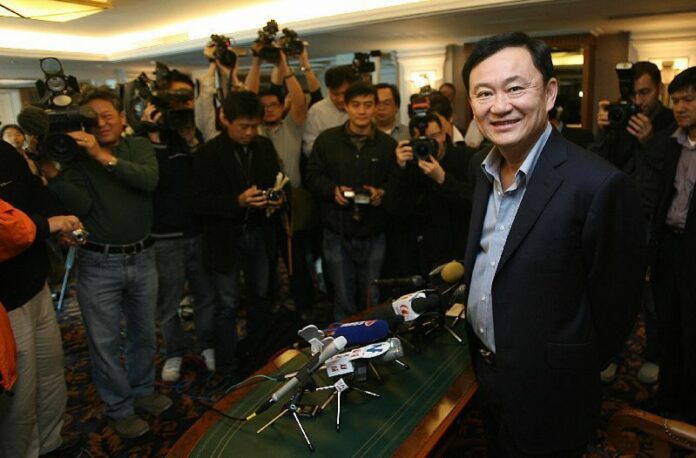
File photo of former PM Thaksin Shinawatra in Hong Kong in 2007.

By Amy Sawitta Lefevre and Panarat Thepgumpanat
Reuters

SINGAPORE — Fugitive former Thai Prime Minister Thaksin Shinawatra warned Thailand's ruling generals on Tuesday that a prolonged stay in power will only worsen economic hardship in Southeast Asia's second-largest economy.

The junta, which took power following a May 2014 coup, has struggled to revive Southeast Asia's second-largest economy amid falling exports and high household debt and critics say economic mismanagement is the biggest threat to its hold on power.

Speaking to Reuters in Singapore, Thaksin, 66, said the junta lacked the vision and talent to fix an economy in disarray.

"It is a government with no freedom and no pool of talent to drive the economy," Thaksin told Reuters. "The longer they stay, the longer economic hardship is going to be there."

Thaksin on Tuesday denied long-standing reports he had struck a backroom deal with the military to leave his personal and family interests untouched in exchange for a retreat from politics.

"We are not talking. I have never telephoned anyone. I don't know why I would get in touch with them and I have no need to," Thaksin said.

Thaksin has lived in self-imposed exile for nearly eight years, mainly in Dubai.

In 2010, he urged his "red shirt" followers to mobilize protests calling for elections that ended in a bloody confrontation with the military in which more than 90 people died. His legacy of village welfare and cheap rural loans made him a hero in red shirt country in the rural north and northeast where he still commands huge respect.

But critics, including the urban elite, accuse Thaksin, a former police colonel turned telecoms tycoon, of widespread corruption. He was sentenced to two years in prison in 2008 for graft in a land purchase case, which he says was politically-motivated.

Thailand has gone through six prime ministers since Thaksin was removed in a 2006 coup and finds itself once again at a crucial political juncture.

The junta has promised elections next year. But some critics are skeptical, saying the military's objective is to block Thaksin's allies from returning to power and to consolidate the military's own powers by writing them into a new constitution.

Thaksin's decision to speak to media this week has riled the junta.

"He remains a person without credibility who thinks he is above the law," government spokesman Major General Sansern Kaewkamnerd told reporters.

The government has rejected Thaksin's offer to hold formal talks on the country's political future.

"They said they can't talk to me because of the cases against me but a coup is a bigger crime," Thaksin said.

Thaksin, who said he spends his time meeting up with old friends including former heads of state, said he has adjusted to his nomadic life and makes, on average, 120 landings a year in his private jet.

He believes he will return to Thailand one day but won't go back to face charges or live under house arrest because of previous assassination attempts.

"I am confident I can return," he said. "I am not the bad person I am accused of being."

Advertisement

Tough Media Visa Rules Meant to Discourage ‘Inaccurate Reporting’

A crowd of foreign correspondents take photos of former Prime Minister Yingluck Shinawatra on Feb. 12 at her residence in Bangkok.

BANGKOK — The Thai military government today explained that it placed new restrictions on the application of foreign journalist visas as a measure to crack down on ‘inaccurate reporting’ about Thailand.

The tougher media visa regulation will only target ‘fake reporters’ and those who cause damage to Thailand with their coverage, said Ministry of Foreign Affairs spokesman Don Pramudwinai. 

“Many foreign correspondents who live in Thailand are not proper reporters. They don’t have agencies,” Don told reporters at Government House on Tuesday. “Sometimes, they report inaccurate information that causes damage to Thailand.” 


Ministry Denies Targeting Foreign Media With New Rules


He added, “As far as I know, of all the 500 foreign correspondents in Thailand, only 10 percent have issues. But it doesn’t mean all of them won’t be able to extend their visas. If these 10 percenter can explain about their agencies, they will be able to extend their visas.”

Enacted on Feb. 18, the new visa rule effectively bans freelance journalists from working in Thailand, as it requires applicants to work “full time as a correspondent of a news agency” and be  “employed by a news agency registered with the competent agency of either Thai or foreign government.”

The rule also includes a vaguely-worded ban on “work or behavior which indicates possible harm to the public or constituting any disruption to the public order or to the security of the Kingdom.”

In response to the new regulations, the Foreign Correspondent's Club of Thailand issued a statement expressing concern over the policy, which may “impede freedom of reporting.”

“We urge the Thai authorities to interpret the guidelines in a way that enables all bona fide journalists to be properly accredited and report freely and fairly,” the Feb. 18 statement said. “Thailand has long been a media hub for the region, and foreign journalists based in Bangkok have contributed to a better global understanding of the Asia-Pacific region.”

But spokesman Don said today freedom of reporting won’t be affected by the new restrictions. 

“I believe that these restrictions won’t make foreigners think we restrict foreign media rights,” Don said. “Quite the contrary. Thailand has the most media freedom in the Asian region, because Thais are compassionate and relaxed. We are not strict like Indonesia or Vietnam.”

Related Stories:

Thai Press Suffering but Not Worst in Asia – For Now

Junta Tells Reporters to Stop Asking Confrontational Questions

‘Reporters Without Borders’ Bashes Junta on Press Freedom


Teeranai Charuvastra can be reached at [email protected] and @Teeranai_C.


\

Advertisement

N. Korean Restaurants in Bangkok and Beijing Emptier Amid Standoff with South

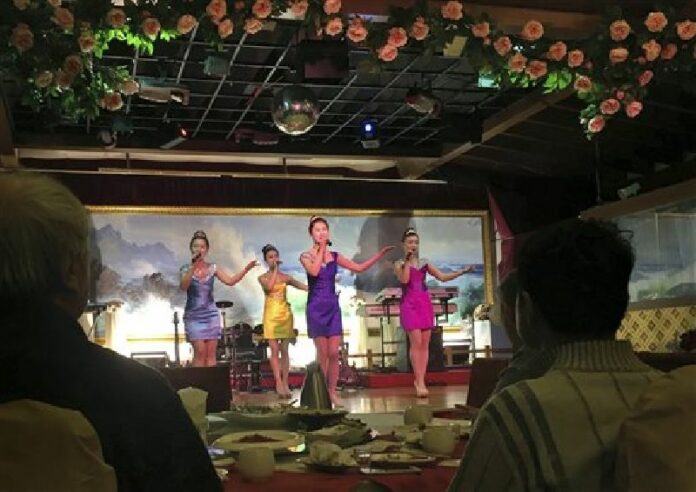
In this Feb. 18, 2016, photo, North Korean performers entertain customers at the Okryugwan restaurant in Beijing. Photo: Ng Han Guan / Associated Press

BEIJING — Shortly after 7:30pm, the servers at China's biggest North Korean restaurant become singers. They emerge for their nightly performances in orange and purple satin dresses and stiletto heels, belting out ballads with their arms extended, would-be divas shimmering under hot lights.

On some other night, when the house is packed and the soju flowing, this might set off a drunken singalong, with tables of South Korean tourists clapping wholesomely in the front and smoky huddles of their expat businessmen compatriots leering not-so-wholesomely from the back.

But not tonight.

In the northeast corner of Beijing, the Okryugwan restaurant is feeling the far-flung effects of the latest standoff on the Korean Peninsula. Since the North conducted a nuclear test in January and went ahead with a rocket launch earlier this month, Seoul has instructed its citizens to not patronize the government-affiliated North Korean restaurants that usually pull in a steady stream of curious South Korean travelers, and their precious foreign currency.

"We usually have many tables of South Korean tourists, but business is not good," North Korean waitress Han Ahn Min said as she poured tea at one of just a handful of occupied tables in a high-ceilinged dining hall capable of welcoming visitors by the busload.

"The weather is bad," she said in smooth Mandarin and smiled.

"There are the other factors right now, too."

That was as close as Han, a talkative 24-year-old with a ready routine of questions and answers, would get to discussing the South or politics. But there is little question that Seoul's government has targeted restaurants that North Korea operates in other Asian countries, mostly in China. The Okryugwan is an offshoot of a well-known eatery on the bank of the Taedong River in central Pyongyang.

South Korean intelligence estimates North Korea runs about 130 overseas restaurants that generate more than USD$100 million (3.6 billion baht) annually, a figure that would approach what 45,000 North Korean laborers made last year at the jointly-run Kaesong industrial park near the border between the two neighbors. The South believes the North's overseas businesses bring in critical foreign currency for its weapons program, among other things, and recently shut down the Kaesong complex while calling for more stringent economic sanctions.

Seoul's campaign to starve the North's restaurant business appears to be well-communicated, if not always well-heeded. A wholly unscientific survey of the Okryugwan clientele one recent night showed that two of the five occupied tables were seated with South Koreans, all of whom knew about the government warning. Elderly Chinese lined another table, while yet another was seated with several North Koreans, wait staff said, including, briefly at one point, one of the cooks.

Despite the small, tepid crowd, the performers powered through several songs and wardrobe changes, swapping form-fitting satin dresses for flowing traditional choson-ot robes. They launched into Korean and Chinese songs and showed off — or at least mimicked — dazzling technique on accordions, guitars and saxophones, all against a looming, painted backdrop of turquoise waves crashing against cliffs.

Over thin applause, the soprano who gamely closed out the night's show received a bouquet of flowers from what appeared to be another employee who shuffled over from the back.

A cursory peek this week into a cozier, second-floor bar and restaurant popular with hard-drinking South Korean businessmen suggested other North Korean locations in town weren't better off. Branches in Bangkok and Phnom Penh were relatively deserted, too.

The Bangkok show was a half-hour of skilled performances and lightning-fast costume changes, from traditional hanboks to sparkly short dresses in the style of K-pop girl bands. A slideshow in the background depicted flowers, landscapes, tundra and a river full of dead fish.

\

In this Feb. 18, 2016, photo, North Koreans, who are also the waitresses and the singers, perform K-pop dancing and sing at the Pyongyang A Ri Rang Restaurant in Bangkok. Photo: Associated Press

The server/performers played instruments including a guitar, saxophone and a 12-stringed, zither-like gayageum with cool precision. When off stage, as they engaged elderly patrons in conversation, their smiles vanished as soon as they turned around.

Known for highly attentive service and decent food, the restaurants have long been a popular stop for South Korean travelers seeking a glimpse into their isolated neighbor and a modicum of open dialogue with well-trained servers who give straightforward answers to many questions while skillfully eluding sensitive ones.

The establishments serve as listening posts and cultural outposts, experts say. Well-educated employees like Han, who studied business and must return to North Korea after a three-to-four-year stint, gauge local sentiment as they aggressively push domestic products like Daedongjiang beer (215 baht a bottle), Daedongjiang cigarettes (180 baht a pack), and collectible stamp books (3,560 baht each).

The menu, while not terribly expansive, wasn't cheap either, featuring 700 baht sushi platters, 350 baht dog meat stews and pricey grilled steak cuts calculated by weight.

"What do Chinese think of North Korea?" Han asked — a typical question — once the lights went up. After the audience responded she exclaimed, "Korean-Chinese friendship!" and touted the stamp collection, with illustrations of North Korean founder Kim Il Sung and China's Mao Zedong, two old Communist allies.

Lee Seunghyun, a 25-year-old who works in the furniture business in Beijing, was sitting at a rear table with a friend on a weeklong visit from Seoul. Despite government warnings, the friend made a point of checking out the restaurant because Lee's grandparents had left North Korea before the split.

"We saw the warnings but he was very curious," Lee said as her friend pulled out his smartphone to show a series of cautionary text messages sent by the South Korean foreign ministry to citizens traveling in China.

Although they found the experience "interesting," the Seoulites said they were ready to leave after their waitresses, who initially spoke relatively openly about the slow business and agreed to take selfies together, turned cold after the pair declined to buy entire cases of beer or whole cartons of cigarettes.

After that, there was only one table of South Koreans left.

Puffing on a cigarette outside the restaurant, a local assistant to a South Korean broadcaster confided that the table was a crew filming a program in China, all well aware that they shouldn't be patronizing the establishment. He grimaced once he learned he was speaking to a reporter but kept talking. Finally he pleaded, forget this conversation.

"Come on, do a favor for a fellow journalist," he said as he walked back into an emptying restaurant. "We're really not supposed to be here."

Story: Gerry Shih / Associated Press

Related Stories:

North Korean Follows Path to Freedom in Bangkok

Advertisement

'Missing' British Backpacker Found at Krabi Airport

Security officers question Grace Taylor at Krabi International Airport on Feb. 23.

KRABI — A British backpacker reported missing by her mother has been found at Krabi International Airport, police said.

Grace Taylor, 21, was using a computer at Black Canyon cafe and “blowing a whistle” when police officers recognized her as the missing tourist on Tuesday afternoon, said the commander of the police force that covers Krabi airport. 

“There’s nothing serious. We found her,” said Col. Thaksin Pochakorn. “She was sitting alone in the airport, blowing a whistle inside Black Canyon. I think she may have some kind of mental disorder.”

\

An undated file photo of Grace Taylor supplied by her mother. Photo: Sam Taylor / Facebook

Taylor refused to cooperate with the police or answer their questions, so the officers decided to send her to a tourist help center in Krabi city center, Col. Thaksin told Khaosod English. He added that the backpacker does not appear to have been hurt.

“She is now in the care of Tourism Authority of Thailand,” the police colonel said.

Taylor had been missing since Feb. 16, her mother Sam Taylor posted on Facebook. In her public Facebook post, Mrs Taylor appealed to the backpacker community to help locate her daughter.

The BBC reported that Taylor’s family filed a missing person report to British police on 21 Feb. 


Teeranai Charuvastra can be reached at [email protected] and @Teeranai_C.


\


Advertisement

Reported Serial Killer Book Removed From Amazon Amid Outrage

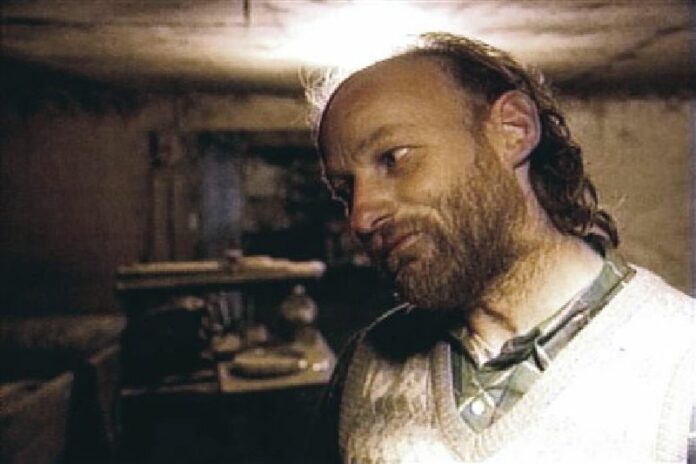
This undated file image made from video shows Robert Pickton, who was convicted in 2007 of six counts of second-degree murder in the deaths of sex workers. Photo: BCTV-Vancouver / Canadian Press / Associated Press

VANCOUVER, British Columbia — A book reportedly written by a Canadian serial killer was removed Monday from Amazon's website a day after being put on sale online following protests by British Columbia authorities.

Outskirts Press, which published the book, issued a statement saying it had asked Amazon to remove the book from its website.

"Outskirts Press apologizes to the families of the victims for any additional heartache this may have caused," the statement said.

Robert Pickton, now 66, was convicted in 2007 of six counts of second-degree murder in the deaths of sex workers. Pickton slaughtered the women at his pig farm and fed some remains to his pigs. He was sentenced to life in prison.

By Monday afternoon, the 144-page memoir titled "Pickton: In His Own Words" was no longer available from the online retailer's Canadian website. In the book, Pickton claimed he was innocent and was framed by the police for the killings, the Toronto Sun reported.

More than 50,000 people signed a petition on the Change.org website urging Amazon to remove the book from its website to respect "the families who were affected by the horrible crimes of this predator … and who are still going through their healing processes."

Canadian Public Safety Minister Ralph Goodale told Parliament that the Correctional Service of Canada is investigating how the manuscript was smuggled out of the Kent Institution maximum security prison near Agassiz, British Columbia.

Authorities in British Columbia promised to introduce a law to prevent offenders from profiting from their crimes.

"I am at a loss for words. To think about the pain that he's prepared to willingly cause all of the families of those people who he murdered," British Columbia Premier Christy Clark told reporters in Vancouver.

"I have trouble understanding it and I think people will want to know that their government is doing everything it can to want to stop him from profiting from this at the very least."

British Columbia Solicitor General Mike Morris had asked Amazon to stop carrying the book, saying he considers it "despicable" that someone could profit from their crimes.

There is no confirmation that Pickton actually wrote the book, but a statement from Morris said the province is investigating every means possible to ensure that the 66-year-old from Port Coquitlam will not profit in any way.

While Pickton was convicted of six counts of second-degree murder, 20 other charges of first-degree murder were stayed. Pickton picked the women up from Vancouver's Downtown Eastside, several square blocks of squalid hotels, drug dealers and street-level, survival prostitution. He lured them to his muddy, garbage-strewn farm with promises of money, alcohol and drugs.

Story: Associated Press

Advertisement

Singer Apologizes for Vandalizing Thai-Laotian Border Marker

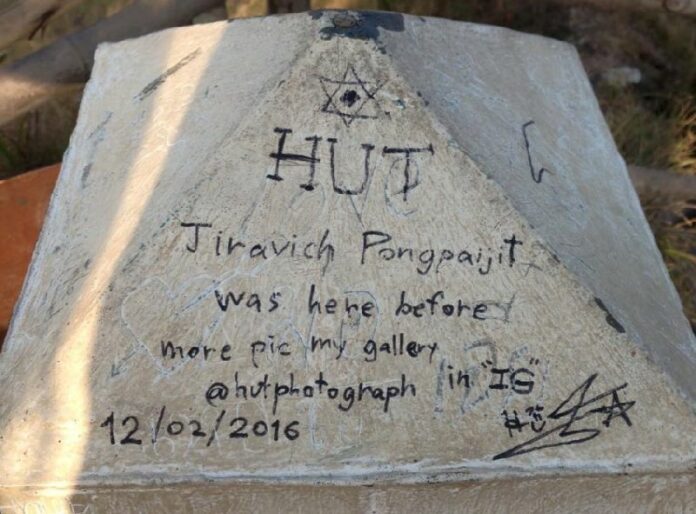
Photo of the vandalized border stone posted to Pantip webboard by user ‘morfun klangna’ / Pantip

BANGKOK — A famous singer has apologized for vandalizing a stone that marked the Thai-Laotian border in northern Thailand, following a storm of criticism on social media.

Jiravich ‘Hut’ Pongpaijit, who claimed earlier on Instagram that this was done to promote local tourism, said on Monday he now regretted the graffiti that he scrawled on the stone, which sits atop Chee Dao Peak in Chiang Rai province. 

“I wrote on it because I saw that someone else had already written on it, and I didn’t know it would be this big issue,” Jiravich, who is better known by his stage name ‘Hut the Star,’ told reporters at Don Mueang Airport on Monday. "Today I am traveling to meet the village chief and his deputy to apologize for and erase what I have done.”

The controversy arose on Saturday when a member of Pantip webforum posted a photo of the stone on Chee Dao Peak, a popular hiking destination on Thai-Laotian border. The photo shows the stone with graffiti that says in English: “HUT Jiravich  Pongpaijit was here before. more pic see my gallery @hutphotograph in ‘IG’ 12/02/2016.”

“So this is how they promote their IG these days?” commented Pantip user 1995078 in the thread, which was soon widely shared on social media. 

\

Photo of the vandalized border stone posted to Pantip webboard by user ‘morfun klangna’ / Pantip

Jiravich also posted his own photo of Chee Dao Peak on his Instagram account, but did not show the graffiti. “My plan to promote Chee Dao Peak has been accomplished,” Jiravich wrote. 

When another Instagram user chastised Jiravich for vandalizing public property in the name of a tourism campaign, the singer responded harshly.

“You should ask the pioneers of Chee Dao and the village chief in that district why they allowed me to write on it,” Jiravich wrote, using the Thai derogative word ‘mueng.’ “If I am not allowed to write it, why would I be stupid enough to do it?” 

But Tassanai Suthaphot, chief of Vieng Kaen district, told reporters he talked to village chiefs and not one of them said they told Jiravich to do such a thing. 

“They all said the same thing: they didn’t tell anybody to write that message,” Tassanai was quoted as saying by local media. The district chief also said he has ordered the border stone to be repainted. 

The Instagram post appears to have been deleted by Tuesday. 

In his news conference on Monday, Jiravich admitted no one told him to leave the graffiti as he claimed earlier on his now-removed Instagram post.

“As for the exchange in the comments in which I said someone ordered me to write it,” Jiravich said. “Actually, I mean someone asked for my help to promote the attraction, but no one ordered me to write it. When I was there, I was with my mother. My intention is to promote Chee Dao Peak, because it’s a new tourist attraction of Chiang Rai … I had  good intentions.”

The 24-year-old singer rose to prominence after he joined a reality TV singing competition called The Star in 2012. Since then he has starred in a number of soap operas and films, including the 2015 erotic flick Mae bia


Teeranai Charuvastra can be reached at [email protected] and @Teeranai_C.


\

Advertisement

Fiji Cyclone Death Toll Reaches 29 After Island Leveled

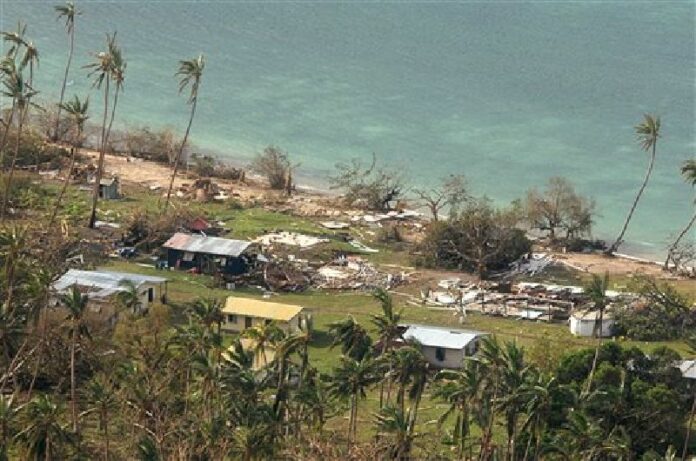
In this Sunday, Feb. 21, 2016 aerial photo supplied by the New Zealand Defense Force, debris is scattered around damaged buildings at Susui village in Fiji, after Cyclone Winston tore through the island nation. Photo: New Zealand Defense Force / Associated Press

WELLINGTON, New Zealand — Ten people have died on a single small island in Fiji as the total death toll from a powerful cyclone climbed to 29, officials said Tuesday.

Government spokesman Ewan Perrin said the death toll on Koro Island had reached double figures and that most buildings there had been heavily damaged or flattened.

He said a relief vessel with about 30 people aboard had arrived at the island with medical supplies, food and water, and teams were helping build temporary shelters for the 4,500 residents.

"It's one of the worst hit," Perrin said.

He said officials also have fears about nearby Taveuni Island, home to about 12,000 people, because they've managed to have only limited contact with people there.

Winds from Cyclone Winston, which tore through the Pacific Island chain Saturday and early Sunday, reached 177 miles (285 kilometers) per hour, making it the strongest storm in Fiji's recorded history.

Getting emergency supplies to the group's far-flung islands and remote communities has been the Fiji government's top priority.

Alice Clements, a spokeswoman for UNICEF, said the aerial footage coming in showed a corridor of destruction over places like Koro Island.

"The imagery is heartbreaking," she said. "You're looking down and expecting to see a village and instead you're seeing a field of debris."

She said one priority is to ensure children get back to school because studies have shown it helps them recover faster emotionally.

United Nations Under-Secretary-General Stephen O'Brien said in a statement he was concerned by the devastating impact the cyclone was having on Fiji.

"Whole villages have been destroyed, homes and crops have been damaged, power lines have been cut and more than 8,100 people are currently sheltering in over 70 evacuation centers," O'Brien said.

O'Brien said Fiji was leading the response and had asked for international help. Australia has so far pledged 5 million Australian dollars (129 million baht) in aid and New Zealand has pledged 2 million New Zealand dollars (46 million baht).

Perrin said France, the U.S. and China have also provided or pledged support. He said relief agencies, including Oxfam and the Red Cross, have been helping with humanitarian efforts and that the Fijian government has set up a disaster relief fund.

Home to 900,000 people, Fiji has more than 100 inhabited islands, and authorities are having difficulty communicating with some of the more remote islands in the wake of the cyclone.

Phone communications have been rapidly restored in many areas but in other areas the damage was severe and would take longer to fix, Perrin said.

He said the electricity network across Fiji remained patchy, and in some cases power had been deliberately cut to prevent further damage. He said clean water was also a challenge, and people were being asked to boil their water, treat it with chemicals or drink bottled water.

Story: Nick Perry / Associated Press

Advertisement

Ministry Denies Targeting Foreign Media With New Rules

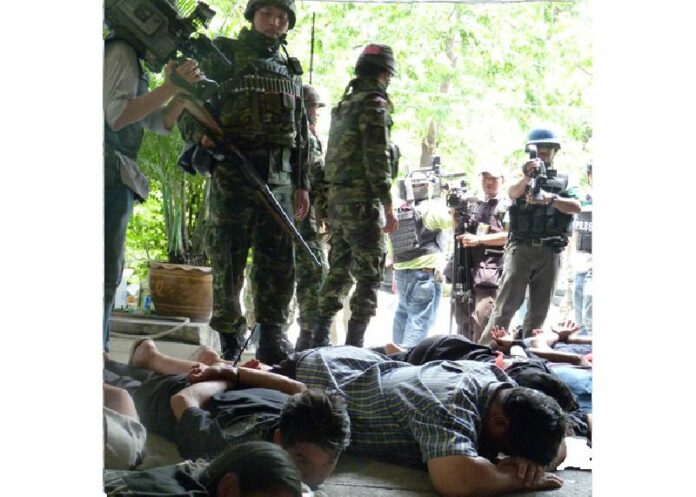
Foreign media film Thai soldiers take civilians into custody May 19, 2010, during a military crackdown on Redshirt demonstrations at Sarasin intersection near Lumpini Park in Bangkok.

By Pravit Rojanaphruk
Senior Staff Writer

BANGKOK — The Foreign Correspondents’ Club of Thailand will take up with the Foreign Ministry ambiguous new guidelines it has issued for approving media visas deemed as a possible means of keeping out critical reporters.

The club’s leadership said Saturday it would raise the matter in response to inquiries made by anxious foreign correspondents, particularly freelancers, since the revised rules came out Thursday with a vaguely worded cause for denying media visas to applicants.

“The latitude the Royal Thai government has in deciding what constitute grounds for rejecting the visa is a matter of concern,” FCCT President Nirmal Ghosh told Khaosod English by phone today. Ghosh said ministry spokesman Sek Wannamethee has assured him there is no attempt to restrict the media.

“We hope and trust he means what he said. However, we are watching it closely. Other organizations are watching it closely too,” he said.

At the heart of the matter is the first sentence regulation No. 4 which states that visas will be issued only if the applicant “has no work or behavior which indicates possible harm to the public or constituting any disruption to the public order or to the security of the Kingdom.”

Those concerned include commentators such as veteran German writer Nick Nostitz, who’s spent 23 years in Thailand and says such vague language can be readily abused to shut out critical voices.

“I have concerns about points 4 and 5, which mentions undefined and intimidating terms of ‘harm to the public,’ ‘disruption to the public order’ and ‘intentional distortion of information.’ These terms have been abused many times in the past by political factions during hate campaigns, and I in particular have been accused, wrongly, of such on numerous occasions,” said Nostitz, who wants the FCCT to do more. “What ensures us that these terms will not be abused to quell critical reporting?”

Rule No. 5 disqualifies applicants who have intentionally distorted information in previous media visa applications.

Nostitz also said he was concerned that, as a freelancer not employed by any news agency, he would qualify for a media visa under the new rules.

Former FCCT President Jonathan Head, who now leads its professional committee, said today he will seek a third meeting with Sek to question and seek assurances about how qualifications are being interpreted.

Head, a veteran BBC correspondent in Southeast Asia who lives in Bangkok, warned the regulations could cost Thailand its status as the regional hub for foreign journalists.

“The way the guidelines have been written have alarmed a number of journalists who believe they’ll be used to withdraw accreditations from critical journalists. We’re pleased that [the Ministry] has said it has no such intention.”

A Foreign Ministry statement on Saturday stated that in January, there were more than 500 foreign journalists who applied for media visas.

“Approximately not more than 5 percent of total journalists would eventually be ineligible to apply for a media visa following the revised guidelines,” it read.

Head said he’s still clueless as to why the Foreign Ministry would want to shed 5 percent of correspondents in Thailand beyond those who are not bona fide journalists.

“There are many foreign journalists who made their lives here and who have had M Visas for years,” he said. “They are now anxious whether they will get an M visa or any kind of visa in the future.”

Head cited an example of a European news photographer, whose name he withheld, who has lived in Thailand for more than 20 years and now teaches journalism with some photography work on the side. Last month the man lost his accreditation.

“This is a valuable member of the international media community,” Head stressed, adding that Thailand “should take pride” in being the hub of foreign correspondents despite the current political difficulties under the military regime.

“I genuinely believe this is an attempt to reduce the number of journalists and not to censor them… [but] we don’t really understand why… Why cause the enormous uproar? It’s a great shame,” he said.

It’s no secret that the military government has been unhappy with coverage by foreign media, particularly of junta leader Gen. Prayuth Chan-ocha, who led the coup in May 2014.

Head declined to say whether he thinks that has anything to do with the revised guidelines.

Related stories:

Foreign Affairs Says Cartoonist ‘Stephff’ Failed to Follow Regs

Longtime Political Cartoonist ‘Stephff’ Loses Work Permit & Visa

.


Pravit Rojanaphruk can be reached at [email protected] and @PravitR.

Follow Khaosod English on Facebook and Twitter for news, politics and more from Thailand. To reach Khaosod English about this article or another matter, please contact us by e-mail at [email protected].


Follow @KhaosodEnglish

\

Advertisement

Italian Man Shoots Ex-Wife and Himself

CHIANG MAI — An Italian man killed his ex-wife before turning the gun on himself yesterday in Chiang Mai’s Hang Dong district.

Gianluca Maynardi, 49, reportedly was quarreling with his former wife, Somjit Phanphon, over their 8-year-old son when he shot her to death and then committed suicide.

According to police Lt. Col. Wichien Chaichompoo, Maynardi and Somjit had a son together. After the couple divorced last year, they agreed to take turns caring for the boy, Wichien said. Somjit had left the man because she said he was abusive, the officer said.


\
Photo: Chiang Mai Citylife

On Sunday afternoon, Somsri came to the Maynardi’s house to pick up the boy, Wichien said, but the Italian man said he took the boy to a friend’s house, which led to Somjit becoming agitated and eventually an argument erupted. It turned physical, and according to an unidentified witness, Maynardi kicked Somjit several times.

At that point the woman pulled out a .380 pistol to defend herself, according to the witness, before she fled by running outside of the house. The Italian man chased after her, snatched the pistol from her hand and shot his ex-wife three times, Wichien said.

Then he shot himself.

Maynardi was a retired Muay Thai coach who had lived in Thailand on-and-off for many years, according to a report in Chiang Mai Citylife.


Advertisement

New Zealand Marks 5 Years After Quake

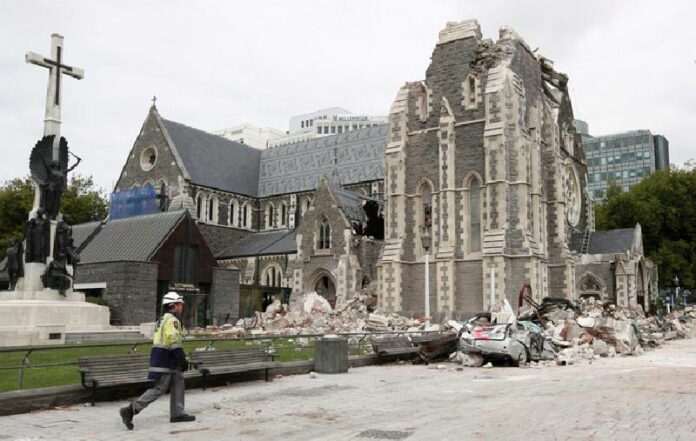
A relief worker walks past the earthquake-damaged ChristChurch Cathedral on Feb. 26, 2011, in Christchurch, New Zealand. Photo: Mark Baker / Associated Press

WELLINGTON, New Zealand — A service to commemorate the fifth anniversary of a deadly earthquake in the New Zealand city of Christchurch turned ugly Monday when someone threw goop over the government minister responsible for quake recovery efforts.

Hundreds of people attended the botanical gardens service in New Zealand's second-largest city to memorialize the magnitude-6.1 quake that killed 185 people on Feb 22, 2011.

As people chatted after the service ended, somebody tossed the unidentified goop from a plastic ice cream container over Earthquake Recovery Minister Gerry Brownlee, his spokesman confirmed.

Police said they arrested a 41-year-old man in connection with the incident and charged him with assault. Police said the man had left the service but was found a short time later.

\
Someone tipped ice cream onto Earthquake Recovery Minister Gerry Brownloee. Source: News Hub

Brownlee has proved a polarizing figure in the rebuilding of Christchurch. Many people frustrated at delays in collecting insurance or at the slow pace of the downtown reconstruction have blamed him.

Earlier in the day, Brownlee was heckled by a man during an outdoor radio interview: "You've done a bad job. A bad, bad job," the man yelled after first shouting an insult. On air, Brownlee laughed off the incident.

Brownlee's spokesman, Nick Bryant, said the lawmaker didn't wish to comment on the incident at the service because it had become a legal matter.

It's the second time this month that somebody has thrown something at a New Zealand lawmaker. On Feb. 6, a woman threw a pink toy penis at Economic Development Minister Steven Joyce to protest an international free trade deal.

Earlier during Monday's memorial service, speakers made the point that while there had been big progress since the quake, there was much left to be done.

"There is still some way to go until Christchurch is truly reborn," said Governor-General Jerry Mateparae.

\
A plaque commemorates those killed in a mall during the 2011 earthquake in Christchurch, New Zealand. Photo: Nick Perry / Associated Press


Speakers also mentioned the disquiet they felt when the region was rattled again last week by an earthquake, one of the strongest since 2011. Last week's quake knocked items from shelves and triggered rock falls, but didn't cause major damage.

Emergency responders and officials representing more than a dozen foreign nations were among those who read out the names of each of the victims who died in the quake.

Mateparae said it changed the region forever.

"We recall the ordered streets and gracious buildings of a city renowned for its style and substance," he said. "We recall how, in an instant, that physical landscape was shattered. We recall how dust and the sound of sirens filled the air."

He said many people have faced exhaustion, stress, frustration and financial hardship in the years since, but that he hopes the end of that period is fast approaching and people can look at their city with renewed optimism and energy.

Christchurch Mayor Lianne Dalziel said there was an incredible opportunity to reimagine and reinvent the city.

"But we must acknowledge there are still many people who have unanswered questions," she said. "People with unresolved insurance claims, people who are still living in the houses that were damaged five years ago. None of them with any certainty of when they will find closure."

Story: Nick Perry / Associated Press

Advertisement

Hot News

LATEST NEWS

Bangkok

overcast clouds
30.5 ° C
30.5 °
30.5 °
79 %
4.1kmh
100 %
Wed
31 °
Thu
36 °
Fri
38 °
Sat
37 °
Sun
36 °