27.7 C
Bangkok
Friday, June 19, 2026
Home Blog Page 2822

Chinese Journalist Who Defected is Missing From Thailand

Chinese journalist Li Xin in New Delhi, India, Nov. 20, 2015. Photo: Saurabh Das / AP

BEIJING ― A Chinese journalist who said he was fed up with a life as a government informant and fled China last year has been missing from Thailand since Jan. 11, his wife said Friday, raising concerns he might have been abducted by Chinese agents.

He Fangmei said she last spoke to her husband, Li Xin, when he was riding a train from Bangkok to Nong Khai. She said she fears the journalist was taken back to China.

Li, formerly a website editor for a Chinese media group, fled last October to India, where he told The Associated Press that he could no longer bear working as a secret informant for the Chinese government. He later traveled to Thailand.

Li's wife said he was planning to seek asylum before he went missing.

The journalist's vanishing is the latest in a string of disappearances of China-related activists in Southeast Asia that have raised suspicions of Chinese government involvement.

Last October, Hong Kong publisher Gui Minhai suddenly disappeared from his apartment in Pattaya. Gui reappeared this week on Chinese state TV, where he said he returned to China to turn himself in for an old crime. His friends insist Gui was forcibly taken away.

Four other people connected to the same Hong Kong publishing company, which sells books banned in China about Chinese politics and politicians, have disappeared.

One of them, Lee Bo, said he returned voluntarily to mainland China in notes to his wife, but supporters believe he was kidnapped and smuggled to the mainland.

Beijing also took back the teenage son of a detained rights lawyer after he fled from China to Myanmar.


After arriving in India, Li, 37, revealed that he was an informant for the government. He said he was coerced into gathering information about fellow activists and journalists after the government detained him for sharing information with the rival Taiwanese government and threatened to imprison him.

Li began his activism when he set up a website devoted to building civil society in 2007. The next year, he signed the '08 Charter, a pro-democracy document written by Nobel Peace Prize laureate Liu Xiaobo. The document landed Liu an 11-year prison sentence on a conviction of inciting to overturn the state, and many signees went on the government's blacklist.

An active member of China's circle of activists, Li worked as an opinion editor for the website of the influential newspaper Southern Metropolis.

Compelled by a desire to change China, Li said he fed information to the Taiwanese government about China's control of the Internet, although Taiwan's foreign ministry declined to verify Li's claim.

Li said he attracted the attention of state security, who asked him to be an informant. After he provided no useful information, Li said he was detained in June 2013 for involvement with Taiwan and had to cave in or risk going to jail.

But he said he was still reluctant to report on other activists and journalists.

"I was very fearful. They could drag me back (to jail) anytime," Li said in an interview in New Delhi. "I did not want to work for them, but I felt I had no choice."

"I believe there are many people like me who are working on behalf of the authoritarian government. But I cannot be one of them," Li said.

Untold numbers of informants help China's government keep tabs on anyone who may pose a threat to the regime, a task authorities have pursued more intensely under President Xi Jinping than they have in decades.

Last year, six Canadian citizens who are members of the Chinese ethnic Uighur Muslim minority told the Globe and Mail newspaper that they were detained while visiting China, blackmailed and bribed by Chinese authorities to spy on activists sympathetic to the Uighur cause in Canada. Uighurs in China have long complained of discrimination and suppression of their religion and culture.

Story: Associated Press


To reach us about this article or another matter, please contact us by e-mail at: [email protected].

Follow Khaosod English on Facebook and Twitter for news, politics and more from Thailand.

Follow @KhaosodEnglish

\

Advertisement

Kanchanaburi Resort Files Charge Against Fake Khaosod Site

Image of the alleged crocodile attack as reported by hoax news site Khaosod.Online, which poses as the legit news site Khaosod Online

BANGKOK — A resort in western Thailand yesterday pressed charges against a hoax news site for reporting about a non-existent crocodile attack at the hotel.

Naruebodin Ritthitharadon, a legal representative for Lake Heaven Resort in Kanchanaburi province, told technology crime police in Bangkok that the fake story was widely shared on social media and has caused financial damage to the hotel.

“It caused a lot of damage to the resort,” Naruebodin said. “Many customers who had booked rooms canceled their reservations. Furthermore, the post continues to be shared on many websites, such as Pantip and Facebook.” 

The fake news article in question was first published by Khaosod.Online, a site that poses as Khaosod Online, one of the most-read news websites in Thailand. Khaosod and Khaosod English are owned by the same company, Matichon Publishing Group. 

According to the Jan. 20 article, a 15-year-old boy was attacked by a crocodile at Heaven Lake Resort, prompting junta chairman Prayuth Chan-ocha to order all resorts along Khwae River to close down, pending investigation. The article was published along with a photo of what appears to be rescue workers removing a human arm from a crocodile’s body. 

However, no such incident occurred at the resort Naruebodin said. The Tourism Authority of Thailand’s Kanchanburi office also posted on its Facebook page that it has not received reports of any crocodile attacks in the province. 

The photo appears to be lifted from an unrelated news article about an alligator attack in the U.S. in 2007. 

Naruebodin, the legal rep for Heaven Lake, urged police to find those responsible for the hoax news site and prosecute them under the Computer Crime Act, which forbids dissemination of false information on the internet. 

It’s not the first mischief caused by Khaosod.Online. In December, the site fooled many readers on social media by reporting the premature death of actor Thrissadee "Por" Sahawong, who was in a coma at the time. Thrissadee died on Monday. 


Related stories:

'Por Thrisadee,’ Beloved Television Heartthrob, 35

Porn Site’s Poor-Taste ‘Por’ Scam Spreads

Porn Purveyor Tricks for Clicks with Bogus ‘Por’ Obit 


To reach us about this article or another matter, please contact us by e-mail at: [email protected].

Follow Khaosod English on and Twitter for news, politics and more from Thailand.

\

Advertisement

Court Warns Against Sharing Videos of Raging Judge

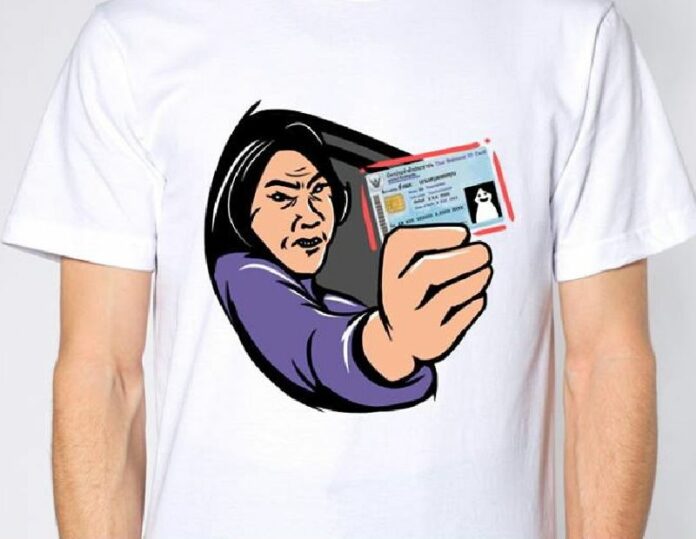
Judge Chidchanok Paensuwan is parodied in this t-shirt sold at an online shop. Photo: “We Sell Everything in the Universe” / Facebook

By Teeranai Charuvastra
Staff Reporter

BANGKOK — Those sharing videos of an allegedly mentally ill judge going on a rampage may face prosecution, according to a court spokesman.

Chidchanok Paensuwan, who was seen yelling and throwing a plastic water bottle at civil servants in a now-viral video, has a mental disorder and is therefore protected by law from public humiliation, spokesman Suebpong Sripongkul said.

Suebpong cited Article 16 of the 2008 Mental Health Act, which stated that “No person shall disclose information relating to the health of a patient in a manner that may cause damage to them.”

“Therefore, those who posted video clips of Ms. Chidchanok with messages that potentially cause damage to her will be considered as breaking the law,” Suebpong was quoted as saying by Spring News yesterday. “They may face both jail terms and fines.” 

Video of 45-year-old Chidchanok throwing a tantrum at officials at the Department of Land Transport in Bangkok was posted on the internet Wednesday. According to the person who filmed the video, Piyawat Suwanwong, Chidchanok lost her cool after she was ticketed for parking in a restricted area. 

“Bear in mind that I am your fucking boss!” Chidchanok was heard yelling at the civil servants. The incident has now become a subject of parodies on social media; there’s even an online shop selling T-Shirts with a cartoonish rendition of the event. 

Another video of her antics surfaced Friday, showing her screaming at civil servants at the Metropolitan Electricity Authority and at one point climbing onto a table in rage. It is unclear when the video was filmed. 

Chidchanok was previously arrested and found guilty by the court in 2013 for throwing a box of rice at the car of Lt.Gen. Kamronwit Thoopkrachang, the commander of the Bangkok police force at the time. 

Suebpong said he has seen the new video and has ordered Chidchanok to seek treatment at Chulalongkorn Hospital. He stressed that the judge does not preside over trials due to the record of her mental health. 

Nevertheless, a committee has been set up to determine whether Chidchanok is still fit for duty as a judge. “If the fact-finding committee rules that she is unfit to work, she will have to leave the bureaucracy,” Suebpong said. 


To reach us about this article or another matter, please contact us by e-mail at: [email protected].

Follow Khaosod English on and Twitter for news, politics and more from Thailand.

\

Advertisement

Myanmar Frees 20 Political Prisoners

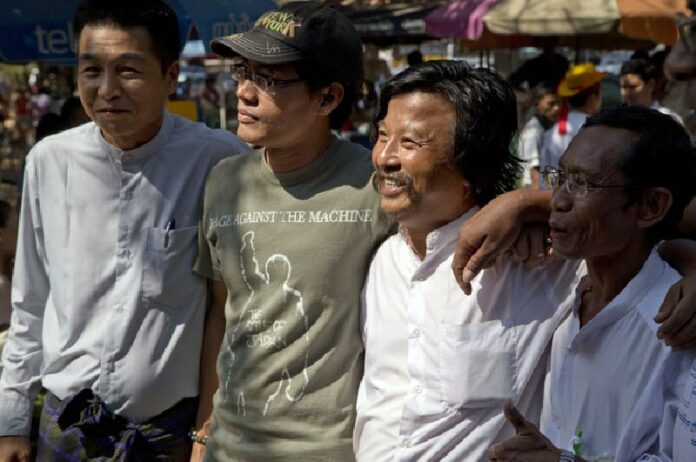
Soe Soe, second right, an activist who demands the rule of law and a political prisoner just released from Insein Prison, poses Friday for a picture outside the prison in Yangon, Myanmar. Photo: Gemunu Amarasinghe / Associated Press

YANGON — Myanmar's military-backed government released at least 20 political prisoners Friday, just a few months before it is scheduled to hand over power to an elected, pro-democracy party.

But human rights groups hedged their praise, noting that a court on the same day sentenced a peace activist to prison for a Facebook posting.

The released detainees said prison authorities declared that they were among 101 prisoners including common criminals who were released from Insein Prison in Yangon's northern outskirts.

Among those freed, according to a prison official contacted by phone who refused to give his name, was New Zealander Philip Blackwood, who managed a bar in Yangon and last March was sentenced to 2 1/2 years in prison for insulting Buddhism in an online advertisement that showed a psychedelic depiction of Buddha wearing headphones. Blackwood's whereabouts Friday were not known.

Myanmar is overwhelmingly Buddhist, and in recent years has seen a strain of extremist Buddhist nationalism emerge in reaction to tensions with the country's Muslim minority.

"Early this morning, the prison guards called the names of 20 political prisoners and told us to pack up and get ready to go back home," said Soe Zaw, a 44 year-old political prisoner released Friday after 14 months in prison. "Our families were not informed."

More than 1,300 political prisoners have been freed by President Thein Sein's military-backed government, which took power in 2011 after an election that ended almost five decades of direct military rule. Activists say several hundred political offenders are still detained or await trial.

The latest such case involved a peace activist sentenced to six months in prison for a Facebook post that was deemed defamatory. Patrick Kum Jaa Lee, a social worker from the Kachin ethnic minority, was arrested in October for the post showing someone stepping on a photo of the military's commander-in-chief, Senior Gen. Min Aung Hlaing.

"This is not fair. I am imprisoned as an example to threaten all citizens who are using social media," he said from behind bars at the court. "We have to fight back for the truth and fight for the rights of the citizens who use social media."

At least four activists have been detained over Facebook posts in the last few months. One received a six-month prison sentence in late December.

Visiting U.S. Deputy Secretary of State Antony Blinken earlier this week urged the government release all remaining political prisoners.

Myanmar is set for a change of government after the National League for Democracy party of Nobel laureate Aung San Suu Kyi won an easy majority in last November's general election, dislodging Thein Sein's Union Solidarity and Development party, which was widely considered a proxy for the military.

"There shouldn't be any political activists in prison in this government's so-called democratic country," said Aung Myo Kyaw, a spokesperson for the Assistance Association for Political Prisoners, an independent human rights organization.

According to the group, 272 political activists were arrested in 2015, of whom 180 have been imprisoned.

"There are a lot of political prisoners still in prison. I cannot be happy because many of our fellows are still inside," said Ba Myint, a political prisoner released Friday. "We hope other political prisoners are released soon, too."

By Esther Htusan / Associated Press

Advertisement

Celebrity Dies, Paparazzi Frenzies, Public Rages Against Media Machine

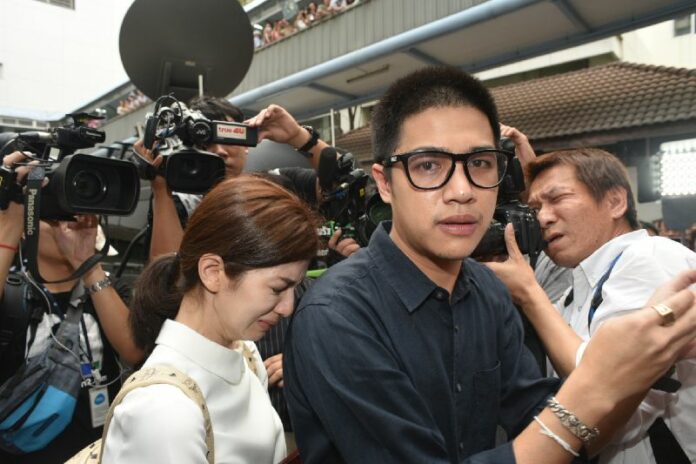
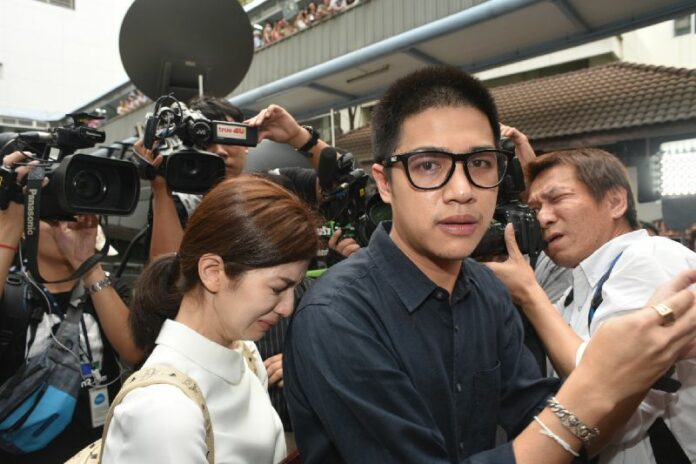
Reporters swarm Vanda 'Bow' Sahawong and Chawanan 'Pin' Sahawong, wife and brother of late actor Thrisadee 'Por' Sahawong, as they tried to lead a ceremonial procession Tuesday to accompany the late actor’s body as it was transferred from Ramathibodi Hospital in Bangkok.

BANGKOK — Wind the clock back three months ago to a time when many people, especially those who don’t watch lakorn, had never heard of Thrissadee “Por” Sahawong.

That changed when he was stricken with dengue fever and fell into a coma in November. For the next 71 days, Thrissadee’s struggle for survival was beamed into every living room and onto every screen as an object of obsessive media attention, thanks to crowds of reporters camped right outside his ward at Bangkok’s Ramathibodi Hospital.

The frenzy reached its zenith when Thrissadee finally died Monday. TV reporters and photographers mobbed his family as they carried his body from the hospital. One photographer even pressed his camera lens against an incense pot held by Thrissadee’s brother, which was supposed to lead the late celebrity’s spirit back home.

“It was a scrum. Everyone wanted a good photo, so they fought with each other. It made us forget about news value, or rights or privacy,” said Weeranan Kanhar, a senior reporter with Voice TV, who described it as one of the worst days in his career. 

The backlash was swift. As though their patience with the press finally snapped, social media users condemned the obsession with Por and their disregard for his family’s privacy. 


Media Associations Apologize to Por’s Family


While the coverage of Thrissadee’s illness and death invited the broadest condemnation, it was business as usual for a media culture out of line with international norms or human decency, where concerns of privacy and professional ethics are afterthoughts at best.

Graphic photos of car crash fatalities can be found both in print and online. Home addresses of crime suspects are routinely published. Even rape victims have had their photos plastered onto the front page of major media organizations.

The media’s effort to milk the news out of Thrissadee also continues well after his death. Articles after articles published in recent days detail the family’s grieving for Thrissadee, his daughter’s tears, anecdotes about his memories and even supernatural occurrences attributed to the late actor’s spirit.

\

Strong Interest, Good Business

Suriwong Aurepatipan, editor of Khaosod newspaper, said coverage of Thrissadee outlived the actor because his story took dramatic turns during the last 71 days of his life.

There was originally a news dimension to the story, as Thrissadee fell victim to the current dengue fever epidemic, which killed more than 130 people last year. But the real drama began after it emerged on Nov. 13 he had a two-year-old daughter even his most dedicated fans never knew about.

That drama wasn’t lost on the tabloid media. On Nov. 28 Manager Online reported Thrissadee miraculously regained some consciousness after hearing Mali’s voice, and she began the subject of countless stories and web galleries. 

“During his illness, his daughter and wife emerged. Usually, celebrities kept their spouses and children from public view,” Suriwong said. “And it turned out that his wife and daughter were adorable people. They became the color of the news, and they attracted a lot of attention from the readers.”

Khaosod and Khaosod English are both part of the Matichon Group. They have separate editorial teams.

The boon to business was clear. According to Suriwong, readers number increase by 100 percent during the 71 days that Por was in coma. On the day his body was removed at Ramathibodi Hospital, Suriwong said, Khaosod counted at least 1.8 million unique visitors to its site, briefly making Khaosod Online the most visited website in Thailand.

“It means that people are interested in the story. There’s been a clear response,” Suriwong said.

Because of the overwhelming response from readers, Suriwong said, Khaosod will continue to provide blanket coverage of Por’s funeral in the upcoming days. “We will continue to report about it. It’s our duty. Actually, it would be against our duty if we don’t report about it, because readers are waiting to read the story,” Suriwong said.

Subhatra Bhumiprabhas, director of media watchdog group Media Inside Out, said demand for a story doesn’t justify unethical behavior.

“I don’t buy that kind of reasoning,” Subhatra said. “Is it really that necessary to do this news? The kind of reason means your ability to sell news is so poor that you have no other option.”

Subhatra said she was aghast to see reporters intruding on Por’s family and crowding the hospital to get the story.

“The media shouldn’t do things like that. The media must report news as it really happened,” she said. “They can’t infringe on other people’s privacy. They can’t bother people in hospital … Competition is necessary, but you need to have principles, too.”

\

Same Old, Same Old

For Subhatra, the real surprise is that the media just hasn’t learned the lesson.

On Feb. 22, 2015, Channel 7 broadcast a news segment about a rape in Chonburi which showed an arrest warrant which included the full name and phone number of his alleged victim. Last week, the state-owned Thai News Agency reported the rape of a woman in Kalasin province with footage of her own home, where the rape reportedly took place. 

As a part of Thai media’s taste for graphic photos in the news, Manager Online on Jan. 12 published on its website a photo of a hanged man that showed his bare buttocks. 

“We have been talking about this all the time,” said Subhatra, whose organization regularly hosts media ethics discussions. “Experts, editors, everyone in the media industry have been talking about this. This is not the first case.”

Just this past August there was an outpouring of netizen outrage over the media’s aggressive coverage of the suicide of 31-year-old guitarist Prachatip “Singha” Musikapong, a popular figure from the Bangkok music scene best known as the guitarist for indie-rock band Sqweez Animal.

Then, as with Por, reporters got into a melee over photographing Prachatip’s body, hyped the story for weeks and chased after interviews his family and girlfriend to maximize the heart-rending effect.

In response to that, Subhatra said the director of the Thai Journalist Association promised her in person that the organization would be “serious” about imposing its code of conduct.

“Yet it happened again. So it reflects that there’s only talk but no real implementation,” Subhatra said.

Association director Wanchai Wongmeechai admitted his organization has failed to improve ethical standards. He said in an interview with Khaosod English that while the association has a lengthy code of conduct, “no one bothers to read it.”

He vowed to do more, such as hosting a panel discussion for reporters and photographers to brainstorm ideas for a more ethical media. 

“Society thinks our past efforts have not been enough. We criticized each other, yet the same mistakes still happened,” Wanchai said. “So this time, we will do more.”  

He blamed fierce competition among media agencies and new troops of untrained reporters for the low standards of ethics in the media landscape.

Weeranan, the Voice TV reporter who was at the hospital when Thrissadee died, said he noticed more photographers and reporters than ever at the scene, a phenomenon he attributed to all the new “digital TV” channels in business.

“It’s inevitable. There are more media, but the size of audience stays the same,” Weeranan said. 

\

Change at the Top

Both Wanchai and Subhatra said it’s up to the editors, supervisors and owners of each media agency to enforce ethical guidelines on their staff. 

“Editors must tell them: Don’t do this, don’t do that. If editors say don’t do it, reporters won’t do it,” Subhatra said.

Asked how his association will convince editors and media owners to hew to the same ethical and quality standards, Wanchai said the organization is planning to offer workshops and courses for news executives. He said the program will begin soon, though he gave no specific date.

Weeranan agreed. According to the reporter, he didn’t feel pressure as much as many other reporters at the scene because his editors did not demand him to act like a paparazzi. 

“The only thing they wanted was an update of [Thrissadee’s] conditions. They wanted to know whether he was going to be better or worse. They wanted to know about how doctors will cure him,” Weeranan said. “They didn’t want gossip, which celebrities came to visit today, they didn’t want photos of Vanda or Mali.” 

But even so, Weeranan said his competitive instinct to get the story took hold in the throes of the mob and made him act in a way he later regretted. During the scrum in front of the hospital, Por’s wife, Vanda, walked past him. So he took out his smartphone and snapped a photo of her at close range, then tweeted it.

“I felt like I was showing to the audience how the event was unfolding,” he said of his rationale at the time.

The audience did not like it however. They criticized Weeranan for intruding on Vanda’s moment of grief and accused him of using desperate measures to build his following on Twitter.

The unexpected reaction made him realize that what journalists think the audience wants to see, and what they actually want to see, are different.

“I got to see that people are now very serious about media ethics,” he said. “It made me learn. It made me more conscious about the issue.” 

To reach us about this article or another matter, please contact us by e-mail at: [email protected].

Follow Khaosod English on and Twitter for news, politics and more from Thailand.

\

Advertisement

Celebrity Dies, Paparazzi Frenzies, Public Rages Against Media Machine

Reporters swarm Vanda 'Bow' Sahawong and Chawanan 'Pin' Sahawong, wife and brother of late actor Thrisadee 'Por' Sahawong, as they tried to lead a ceremonial procession Tuesday to accompany the late actor’s body as it was transferred from Ramathibodi Hospital in Bangkok.

BANGKOK — Wind the clock back three months ago to a time when many people, especially those who don’t watch lakorn, had never heard of Thrissadee “Por” Sahawong.

That changed when he was stricken with dengue fever and fell into a coma in November. For the next 71 days, Thrissadee’s struggle for survival was beamed into every living room and onto every screen as an object of obsessive media attention, thanks to crowds of reporters camped right outside his ward at Bangkok’s Ramathibodi Hospital.

The frenzy reached its zenith when Thrissadee finally died Monday. TV reporters and photographers mobbed his family as they carried his body from the hospital. One photographer even pressed his camera lens against an incense pot held by Thrissadee’s brother, which was supposed to lead the late celebrity’s spirit back home.

“It was a scrum. Everyone wanted a good photo, so they fought with each other. It made us forget about news value, or rights or privacy,” said Weeranan Kanhar, a senior reporter with Voice TV, who described it as one of the worst days in his career. 

The backlash was swift. As though their patience with the press finally snapped, social media users condemned the obsession with Por and their disregard for his family’s privacy. 


Media Associations Apologize to Por’s Family


While the coverage of Thrissadee’s illness and death invited the broadest condemnation, it was business as usual for a media culture out of line with international norms or human decency, where concerns of privacy and professional ethics are afterthoughts at best.

Graphic photos of car crash fatalities can be found both in print and online. Home addresses of crime suspects are routinely published. Even rape victims have had their photos plastered onto the front page of major media organizations.

The media’s effort to milk the news out of Thrissadee also continues well after his death. Articles after articles published in recent days detail the family’s grieving for Thrissadee, his daughter’s tears, anecdotes about his memories and even supernatural occurrences attributed to the late actor’s spirit.

\

Strong Interest, Good Business

Suriwong Aurepatipan, editor of Khaosod newspaper, said coverage of Thrissadee outlived the actor because his story took dramatic turns during the last 71 days of his life.

There was originally a news dimension to the story, as Thrissadee fell victim to the current dengue fever epidemic, which killed more than 130 people last year. But the real drama began after it emerged on Nov. 13 he had a two-year-old daughter even his most dedicated fans never knew about.

That drama wasn’t lost on the tabloid media. On Nov. 28 Manager Online reported Thrissadee miraculously regained some consciousness after hearing Mali’s voice, and she began the subject of countless stories and web galleries. 

“During his illness, his daughter and wife emerged. Usually, celebrities kept their spouses and children from public view,” Suriwong said. “And it turned out that his wife and daughter were adorable people. They became the color of the news, and they attracted a lot of attention from the readers.”

Khaosod and Khaosod English are both part of the Matichon Group. They have separate editorial teams.

The boon to business was clear. According to Suriwong, readers number increase by 100 percent during the 71 days that Por was in coma. On the day his body was removed at Ramathibodi Hospital, Suriwong said, Khaosod counted at least 1.8 million unique visitors to its site, briefly making Khaosod Online the most visited website in Thailand.

“It means that people are interested in the story. There’s been a clear response,” Suriwong said.

Because of the overwhelming response from readers, Suriwong said, Khaosod will continue to provide blanket coverage of Por’s funeral in the upcoming days. “We will continue to report about it. It’s our duty. Actually, it would be against our duty if we don’t report about it, because readers are waiting to read the story,” Suriwong said.

Subhatra Bhumiprabhas, director of media watchdog group Media Inside Out, said demand for a story doesn’t justify unethical behavior.

“I don’t buy that kind of reasoning,” Subhatra said. “Is it really that necessary to do this news? The kind of reason means your ability to sell news is so poor that you have no other option.”

Subhatra said she was aghast to see reporters intruding on Por’s family and crowding the hospital to get the story.

“The media shouldn’t do things like that. The media must report news as it really happened,” she said. “They can’t infringe on other people’s privacy. They can’t bother people in hospital … Competition is necessary, but you need to have principles, too.”

\

Same Old, Same Old

For Subhatra, the real surprise is that the media just hasn’t learned the lesson.

On Feb. 22, 2015, Channel 7 broadcast a news segment about a rape in Chonburi which showed an arrest warrant which included the full name and phone number of his alleged victim. Last week, the state-owned Thai News Agency reported the rape of a woman in Kalasin province with footage of her own home, where the rape reportedly took place. 

As a part of Thai media’s taste for graphic photos in the news, Manager Online on Jan. 12 published on its website a photo of a hanged man that showed his bare buttocks. 

“We have been talking about this all the time,” said Subhatra, whose organization regularly hosts media ethics discussions. “Experts, editors, everyone in the media industry have been talking about this. This is not the first case.”

Just this past August there was an outpouring of netizen outrage over the media’s aggressive coverage of the suicide of 31-year-old guitarist Prachatip “Singha” Musikapong, a popular figure from the Bangkok music scene best known as the guitarist for indie-rock band Sqweez Animal.

Then, as with Por, reporters got into a melee over photographing Prachatip’s body, hyped the story for weeks and chased after interviews his family and girlfriend to maximize the heart-rending effect.

In response to that, Subhatra said the director of the Thai Journalist Association promised her in person that the organization would be “serious” about imposing its code of conduct.

“Yet it happened again. So it reflects that there’s only talk but no real implementation,” Subhatra said.

Association director Wanchai Wongmeechai admitted his organization has failed to improve ethical standards. He said in an interview with Khaosod English that while the association has a lengthy code of conduct, “no one bothers to read it.”

He vowed to do more, such as hosting a panel discussion for reporters and photographers to brainstorm ideas for a more ethical media. 

“Society thinks our past efforts have not been enough. We criticized each other, yet the same mistakes still happened,” Wanchai said. “So this time, we will do more.”  

He blamed fierce competition among media agencies and new troops of untrained reporters for the low standards of ethics in the media landscape.

Weeranan, the Voice TV reporter who was at the hospital when Thrissadee died, said he noticed more photographers and reporters than ever at the scene, a phenomenon he attributed to all the new “digital TV” channels in business.

“It’s inevitable. There are more media, but the size of audience stays the same,” Weeranan said. 

\

Change at the Top

Both Wanchai and Subhatra said it’s up to the editors, supervisors and owners of each media agency to enforce ethical guidelines on their staff. 

“Editors must tell them: Don’t do this, don’t do that. If editors say don’t do it, reporters won’t do it,” Subhatra said.

Asked how his association will convince editors and media owners to hew to the same ethical and quality standards, Wanchai said the organization is planning to offer workshops and courses for news executives. He said the program will begin soon, though he gave no specific date.

Weeranan agreed. According to the reporter, he didn’t feel pressure as much as many other reporters at the scene because his editors did not demand him to act like a paparazzi. 

“The only thing they wanted was an update of [Thrissadee’s] conditions. They wanted to know whether he was going to be better or worse. They wanted to know about how doctors will cure him,” Weeranan said. “They didn’t want gossip, which celebrities came to visit today, they didn’t want photos of Vanda or Mali.” 

But even so, Weeranan said his competitive instinct to get the story took hold in the throes of the mob and made him act in a way he later regretted. During the scrum in front of the hospital, Por’s wife, Vanda, walked past him. So he took out his smartphone and snapped a photo of her at close range, then tweeted it.

“I felt like I was showing to the audience how the event was unfolding,” he said of his rationale at the time.

The audience did not like it however. They criticized Weeranan for intruding on Vanda’s moment of grief and accused him of using desperate measures to build his following on Twitter.

The unexpected reaction made him realize that what journalists think the audience wants to see, and what they actually want to see, are different.

“I got to see that people are now very serious about media ethics,” he said. “It made me learn. It made me more conscious about the issue.” 


To reach us about this article or another matter, please contact us by e-mail at: [email protected].

Follow Khaosod English on and Twitter for news, politics and more from Thailand.

\

Advertisement

Disowned by His Party, Bangkok Gov. Remains in Democrat Leadership

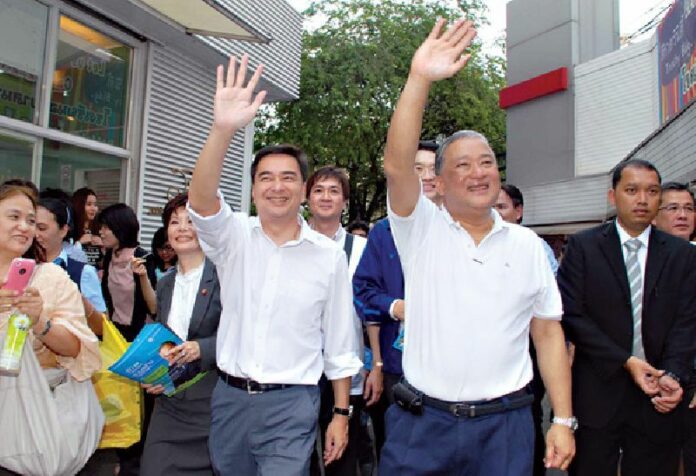
Democrat Party Chairman Abhisit Vejjajiva, at left, and Bangkok Gov. Sukhumbhand Paribatra on the campaign trail in January 2013. Photo : Matichon

BANGKOK — Two-term Bangkok Gov. Sukhumbhand Paribatra will not step down despite being disowned by his own political party, his team announced today.

Following Thursday’s announcement by two Democrat Party officials that the party will no longer be responsible for Sukhumbhand’s actions, the governor himself sent word from Portugal – where he is currently traveling – that he is still a member of the party and welcomes any investigation.

His deputy also dismissed persistent rumors there is an effort to urge junta leader Prayuth Chan-ocha to exercise his absolute power under Article 44 to remove Sukhumbhand from City Hall.

Democrat Party secretary Juti Krai-rirk and deputy leader Ongart Klampaiboon said Thursday the party was cutting off Sukhumbhand because he had essentially gone rogue. Juti said it was down to the governor to decide whether to resign from the party.

The party has been unable to hold an official meeting to take any formal positions due to the junta’s ban on political gatherings, so the governor still remains as deputy party leader.


Related stories:

Suthep Denies Planning New Party with Sukhumbhand

Democrats Deny Ousting Bangkok Governor

Billions of Baht Later, Doubts Persist About Bangkok CCTV


Advertisement

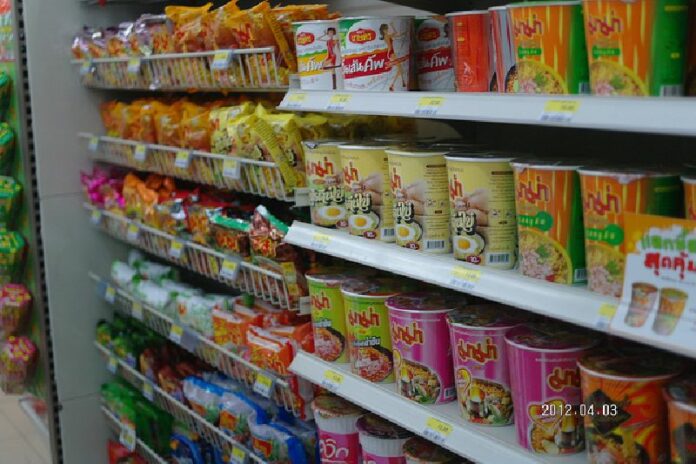
The Wonderful Horrible Ramifications of Mama Ramen

Photo: Twentyfour Students / Flickr

BANGKOK — When the biggest player in the instant noodle market said its growth had fallen to 0.4 percent, the lowest in its 44 years, the media seemed to hear things differently.

Instead of tea leaves, those reading Thailand's economic vitality have for years turned to their Mama, that beloved brand of dry instant noodles, as a kind of unofficial economic indicator, with higher sales of the inexpensive staple being pegged to bad times.

“Mama Index shows economy is recovering,” read the resulting headline from Post Today, while Matichon topped its story, “Sales of instant noodles hit worst point in 44 years; economy down; people don’t have enough money; turn to eating riceballs.”

These interpretations came despite the noodle-maker’s best effort Thursday to get ahead of the pundits and set the record straight when announcing its earnings Thursday.

“The economy has been contracting for the past two years, but the consumption of Mama, or the ‘Mama Index’ has also been decreasing,” said Vathit Chokwatana, vice president at manufacturer Saha Pathanapibul.

For Matichon, the news meant the current economic landscape is actually even far worse.

“It reflects that people on a low income, which are the main customers of Mama, are severely affected by economic problems,” Vathit was selectively quoted in the newspaper. “It was because the cost of agricultural products, especially rubber prices, were affected by world oil prices.”

Vathit said his customers have turned to even cheaper food than its 6-baht instant noodles, such as instant rice.

Yet in Khaosod and Dailynews, Vathit was cited saying that people should stop reading so much into bags of noodles.

“Mama isn’t an economic indicator like in the past,” he was quoted saying.

Most, but not all media outlets included Vathit’s further statements that spoke optimistically of the broader economy. The noodle chief said his company’s sales would bounce back this year due to economic stimulation by the military government and the newly opened AEC community.


Advertisement

What, When, Where: Guide to Enjoying the Bukruk Urban Arts Festival

By Todd Ruiz
Editor

BANGKOK — Some of the world’s most famed street artists are converging on Bangkok to use the capital city as their canvas for new, original works starting tomorrow.

But with the Bukruk Urban Arts Festival playing out over nine days in different locations, where to begin?

Here is Khaosod English’s day-by-day guide to getting the most out of the event. Its slant toward visiting artists and musicians should not be taken as any slight against the awesome stack of local talents in play, but a function of opportunity cost.

Read: 9 Things You Must See at Bukruk

SATURDAY, Jan. 23

Much like Bukruk’s first outing in 2013 is best remembered for its opening party, tomorrow brings 18 acts from down the soi and around the world to The Jam Factory. There’s going to be so much good music, but don’t know your French trip-hop from your Spanish indie rock? That’s okay, here are some of the must-see-hear acts:
El Guincho, 9:45pm, Main Stage

Difficult to claim to have a heart unmoved by the syncopated steel drum beats of El Guincho’s 2010 track “Bombay.” From Barcelona producer Pablo Diaz-Reixa comes just as he’s releasing a new El Guincho album six years after “Pop Negro.”
La Fine Equipe, 8:30pm, Garden Stage

Feast on a French Boulangerie of trip hop courtesy of Blanka, Chomsky, Mr. Gib and Oogo; the quartet of beatmasters collectively known as La Fine Equipe.
Side Effect, 7:15pm, Main Stage

Coming from Yangon for the first time to Bangkok comes the Myanmar punk rock trio of Side Effect. Side Effect has been pounding out politically charged rock for more than a decade.
Alek et les Japonaises, 5:15pm, Garden Stage

This Belgian-Japanese duo has been described as Disco Deerhoof and are delightfully weird. It’s said catching their live show is like an audience with the Pope: leaves you both mystified and delirious.
Paradise Bangkok, 8:30pm, Main Stage

As they take their show on the global road, it’s becoming increasingly rare to see Paradise Bangkok back home where they built a scene by making the charging heart of Isaan music popular among too-cool-for-country city slickers. Don’t miss it.

From Apartment Khunpa to Gramaphone Children and DCXNTR, there’s a lot of other great music to see Saturday, but we still have eight more days to get through.
\

The Bukruk Music Festival runs 2pm to midnight Saturday at The Jam Factory. Tickets at the door are 900 baht.


SUNDAY (Jan. 24 – Jan. 31)


Bukruk is all about the walls. All other the high-culture ambitions aside, the festival is about watching 13 artists from Asia and Europe transform 13 walls in our sublime city into fantastic works.

They get to work on Sunday, but don’t expect to see much for a few days: This is painstaking and time-consuming work. Check out your favorites, and also note how differently they work.

Here are our top picks:


Aryz, Barcelona

From brush to spray to graphics, Aryz does it all, and that’s why he’s become one of the world’s most sought-after talents. A truly contemporary artist, Aryz is constantly tearing up his own past to reinvent and break with his own style. But you’ve got to see him work. No sketching, no tracing, he just runs up a wall and attacks it will rollers of paint. Aryz doesn’t do every festival and getting him to Bangkok is a big deal. For Bukruk, Aryz is not exhibiting, just leaving his wall behind.

Aryz will be spraying a wall at 1390 Song Wat road, Samphanthawong.


Nychos, Styria

\
Photo: Nychos / Facebook

Nychos wants to take a look inside you. Nychos also likes to look inside horses, snakes, chicken, killer whales. There is folklore and myth writ large in old-school graffiti sprayed with incredible, gory detail.

Nychos was originally given a wall at the Bangkok Docklands, the original venue for Saturday’s opening party before the Navy pulled the plug at the last minute. This location may change.


Daan Botlek, Rotterdam

\
Photo: Daan Botlek / Facebook

Dutch artist Daan Botlek is no stranger to Bangkok. His mural from Bukruk 2013 still perplexes passers-by on a wall in the southeast corner of Siam Square, and he completed a residency at Toot Yung Art Center in 2014. He returns for Bukruk II to amuse and disturb with his magic-real brand of weird and wonderful next week.

Daan Botlek is painting somewhere near the Shangri-La Hotel.


Motomichi Nakamura, Tokyo

\
A Chao Phraya riverboat painted by Motomichi Nakamura. Photo: Motomichi Nakamura / Facebook

Graphics and animation supergeek Motomichi Nakamura touches primal nerves in bold colors. Be thrilled and possibly terrified as his work unfolds on Decho Road off lower Silom Road. And keep an eye out for a Chao Phraya Express boat currently afloat with a sweet paint job by Nakamura.

Motomichi Nakamura is painting a wall on Decho Road.

Aitch/Saddo, Romania

\
Saddo’s Siam Square mural under progress in 2013.

Muralists and illustrators Saddo and Aitch are partners in vivid fantasy dream allegories. They each have their own wall: Which will finish first?

Aitch is painting at 1121-23 Song Wat Road in the Samphanthawong district. Saddo should be devouring a compound wall at the French Embassy at 186 Soi Charoen Krung 36.


Interactive map to all 13 mural locations:


TUESDAY, Jan. 26

\
Courtesy Roa / Facebook

The first of six exhibitions of Bukruk artists starts Tuesday night at Bridge Art Space. Check out the illustrations of Bangkok illustrator Kult and Belgian graffiti artist Roa, a visual (cruelty-free) animal vivisectionist.


WEDNESDAY, Jan. 27

\
Courtesy: Fikos / Facebook

Three artists’ exhibitions open at Serindia Gallery. Romanian muralists and illustrators Aitch and Saddo will show their work along with Greek artist Fikos, a graffiti artist who studied Byzantine technique and came up painting murals in Orthodox Christian churches.


THURSDAY, Jan. 28

\
Courtesy Daan Botlek / Toot Yung Nomad

Returning Bukruk artist Daan Botlek opens his exhibition at P. Tendercool. Be delighted, be confused and possibly disquieted by the Rotterdam muralist’s warped wonders.


FRIDAY, Jan. 29

\
Lolay sculpture outside the Bangkok Art and Culture Centre

Japanese illustrator Motomichi Nakamura is aggressive but his work is stridently minimal. His exhibition opens Friday night at Soy Sauce Factory. He’s showing with eminent Thai artist Lolay, an illustrator also known for large fiberglass sculptures you’ve probably seen around Bangkok.


SATURDAY, Jan. 30

\

Drink in the dark feminism of French mixed media artist Florence Lucas, whose show opens 5pm at The Jam Factory, but the main thing not to miss Saturday is Animation Night, to be held at the same venue. Watch award-winning and cult-classic animation shorts by 16 selected animators from around the world and locally.


SUNDAY, Jan. 31

Party, again. Head to the old Central Post Office building on Charoen Krung Road where Bukruk will hold its last hurrah. On the deck from Luxembourg, Sun Glitters will officiate with electro pop set to fun, while Motomichi Nakamura brings the historic building to life with his zany projection mapping.


Related stories:

Bukruk Fest Moves Opening Day to Jam Factory

Bangkok the Canvas for Urban Art to Shine for 10 Days of ‘Bukruk II’

Advertisement

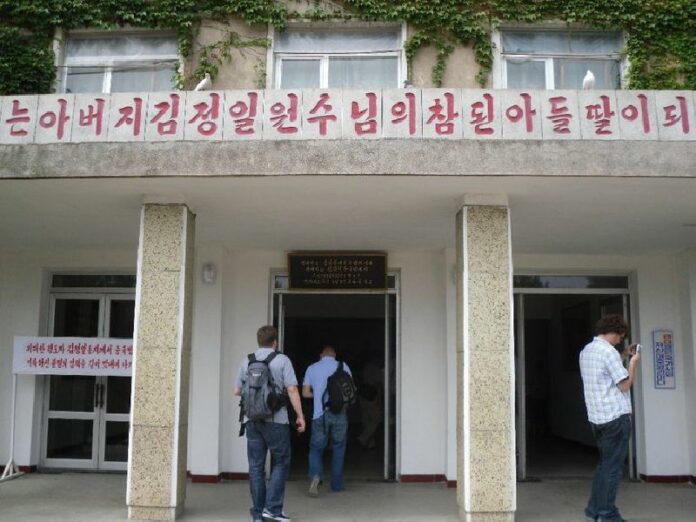
North Korea Says US Student Detained For 'Hostile Act'

Foreign tourists visit a school in Pyongyang, North Korea, Sep. 9, 2010. Photo: Simon Duncan

SEOUL — North Korea said on Friday it had detained a U.S. university student for committing a "hostile act" against the country who, if confirmed, would be the third western citizen known to be held currently in the isolated state.

The North's state-run KCNA news agency said the person entered North Korea as a tourist and was "was caught committing a hostile act against the state," which it said was "tolerated and manipulated by the U.S. government".

The Korean-language KCNA report said the detainee was a Virginia university student and had entered the country with an "aim to destroy the country's unity". It did not elaborate.

An official at the U.S. embassy in the South Korean capital Seoul said it was aware of the reported arrest.

A South Korean-born Canadian pastor was arrested in North Korea last year and given a life sentence for subversion. Earlier this month, a Korean-American man told CNN in Pyongyang that he was being held by the state for spying.

South Korea warned that the United States and its allies were working on further sanctions to inflict "bone-numbing pain" on the North after its latest nuclear test this month, in contravention of U.N. Security Council resolutions, and urged China to do its part to rein in its isolated neighbor.

Additional Reporting Ju-min Park and James Pearson


Advertisement

Hot News

LATEST NEWS

Bangkok
overcast clouds
27.7 ° C
31.1 °
27.7 °
89 %
1.5kmh
100 %
Fri
35 °
Sat
32 °
Sun
36 °
Mon
37 °
Tue
36 °