27.2 C
Bangkok
Saturday, July 25, 2026
Home Blog Page 2939

Indian Uber Driver Convicted of Rape

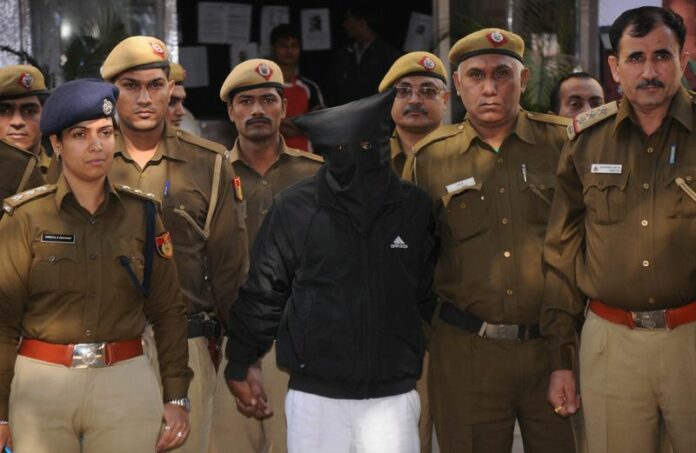
Shiv Kumar Yadav in custody in a December 2014 file photo. Photo: EPA

NEW DELHI — An Indian Uber taxi driver was found guilty of raping his passenger a year ago by an Indian court Tuesday, lawyers said.

Shiv Kumar Yadav faces up to life imprisonment in the sentencing due Friday, his lawyer DK Mishra said.

The 25-year-old female passenger said that she fell asleep in the cab when the driver stopped a remote spot and raped her.

The incident happened in Dec. 5 when the woman, a finance executive, was traveling from her workplace in Gurgaon, a suburb of Delhi, to her home in the north of the city.

Yadav was arrested two days later at a nearby town.

Delhi police filed charges and temporarily banned the U.S.-based online car-sharing company Uber saying it had failed to conduct basic safety checks.

"The accused has been convicted of all charges against him," said DK Mishra, a lawyer acting for Yadav. "The prosecution said the alleged victim's sole testimony was sufficient to convict him and the honorable court agreed."

He was convicted of rape, abduction and causing grievous hurt.

Attacks on women and sexual violence have been a focus of public attention in India since the fatal gang rape of a student on a bus in New Delhi in 2012, which triggered mass protests.

Story: DPA

Advertisement

Booze Regulator Warns Public on ‘Instant Beer’

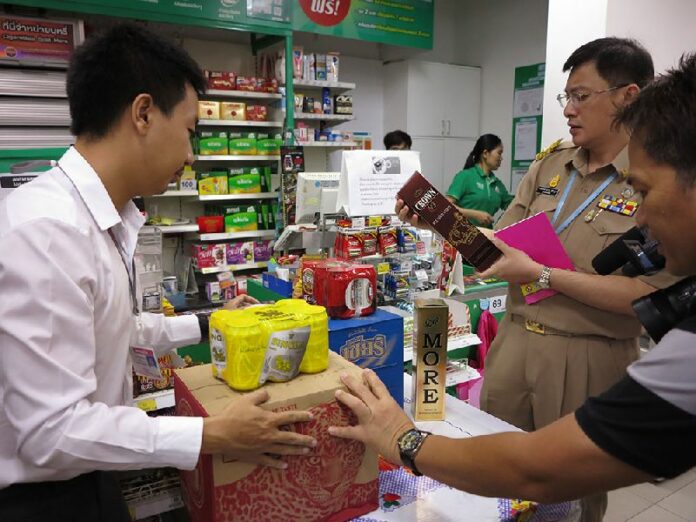
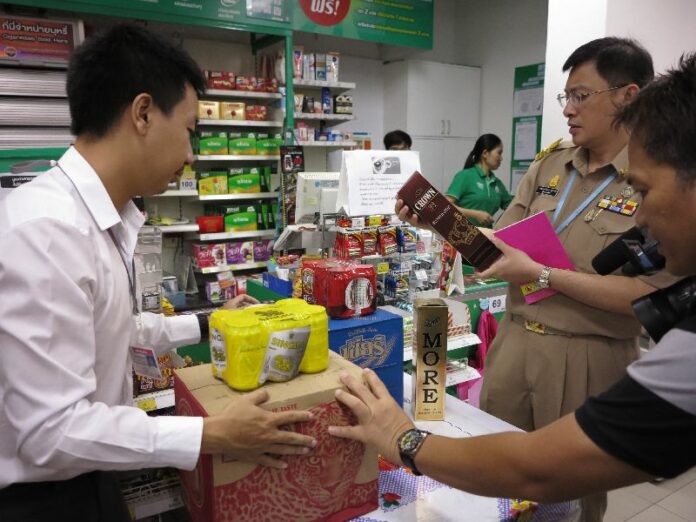
Samarn Footrakul, in uniform, raids a Tesco Lotus Express yesterday to look for brands running afoul of the latest alcohol restrictions he helped introduce.

BANGKOK — Thailand’s top anti-alcohol crusader pre-emptively warned the public today about a product most have likely never heard of.

Samarn Footrakul, head of the Alcohol Control Board, warned that imports of so-called “instant beer” will require permits from both the Customs and Excise Tax departments because it is considered a “special good” under the 2008 Alcohol Control Act, which places broad restrictions on the sale, labeling and advertisement of alcohol.

Samarn, the chief architect of several anti-booze laws, said he became aware of the innovation by watching an online video in which a group of Chinese-speaking men try out a packet of instant beer.


Samarn said he’s unaware of the product being sold anywhere in Thailand. However, he’s worried that Thai tourists visiting other countries may return with some. In that case only a small amount for personal use is acceptable, he said.

“If they don’t appear to have a commercial purpose, they may be exempted,” he said of anyone bringing it into the kingdom. “But it depends on the quantity.”

Samarn said he’s concerned it may be the beginning of “a new form of alcoholic product” and said officials are “monitoring the news.”

Instant beer seems to have first appeared on the market in 2013. It’s essentially beer in powder form that is rehydrated and re-carbonated with a catalyst. It’s marketed toward outdoor types because it is lighter and easier to carry. Pat’s Backcountry Beverages in the United States is one maker, but the product does not seem to be widespread.

Samarn’s comment came as his agency further curbs the visibility of alcohol in the country. Just yesterday Samarn led officials to raid a Tesco Lotus Express in Nonthaburi province to ensure that new regulations enacted by his office are being enforced.

The regulation, which came to effect yesterday, bans alcohol producers from making certain statements on labels of their beverage, such as promises of “success in social or sexual life” and any remarks that lead to "degradation of the national culture" or "division or loss of unity among the people."

Violation of the regulation carries a maximum penalty of one year in prison and a 100,000-baht fine.

In yesterday’s raid, officials found five brands of alcoholic beverages they said violated the new rules, Samarn said, without elaborating on the specific nature of their offense.

The offending products were from three of the biggest domestic beer brands: Singha, Cheer and Leo, as well as two whiskey brands: Crown and One More. Officials confiscated them from the supermarket as evidence for prosecution of the companies, Samarn said.

“We are working with Ministry of Health to inspect labels on packages and bottles of beer and spirits to ensure that there is no message that is unfair to consumers or entices people to drink,” the official said.

On Oct. 13 Samarn also told reporters that internet users who posted photos of alcoholic beverages on social media may be prosecuted for violating the 2008 Alcohol Control Act, which bans any effort to “entice” others to consume alcohol.


Related stories:

Anyone Posting Booze Pics Will be Prosecuted, Anti-Booze Official Says


To reach us about this article or another matter, please contact us by e-mail at: [email protected].

Follow Khaosod English on and Twitter for news, politics and more from Thailand.

\

Advertisement

Booze Regulator Warns Public on ‘Instant Beer’

Samarn Footrakul, in uniform, raids a Tesco Lotus Express Oct. 19, 2015, to look for brands running afoul of the latest alcohol restrictions he helped introduce.

BANGKOK — Thailand’s top anti-alcohol crusader pre-emptively warned the public today about a product most have likely never heard of.

Samarn Footrakul, head of the Alcohol Control Board, warned that imports of so-called “instant beer” will require permits from both the Customs and Excise Tax departments because it is considered a “special good” under the 2008 Alcohol Control Act, which places broad restrictions on the sale, labeling and advertisement of alcohol.

Samarn, the chief architect of several anti-booze laws, said he became aware of the innovation by watching an online video in which a group of Chinese-speaking men try out a packet of instant beer.


Samarn said he’s unaware of the product being sold anywhere in Thailand. However, he’s worried that Thai tourists visiting other countries may return with some. In that case only a small amount for personal use is acceptable, he said.

“If they don’t appear to have a commercial purpose, they may be exempted,” he said of anyone bringing it into the kingdom. “But it depends on the quantity.”

Samarn said he’s concerned it may be the beginning of “a new form of alcoholic product” and said officials are “monitoring the news.”

Instant beer seems to have first appeared on the market in 2013. It’s essentially beer in powder form that is rehydrated and re-carbonated with a catalyst. It’s marketed toward outdoor types because it is lighter and easier to carry. Pat’s Backcountry Beverages in the United States is one maker, but the product does not seem to be widespread.

Samarn’s comment came as his agency further curbs the visibility of alcohol in the country. Just yesterday Samarn led officials to raid a Tesco Lotus Express in Nonthaburi province to ensure that new regulations enacted by his office are being enforced.

The regulation, which came to effect yesterday, bans alcohol producers from making certain statements on labels of their beverage, such as promises of “success in social or sexual life” and any remarks that lead to "degradation of the national culture" or "division or loss of unity among the people."

Violation of the regulation carries a maximum penalty of one year in prison and a 100,000-baht fine.

In yesterday’s raid, officials found five brands of alcoholic beverages they said violated the new rules, Samarn said, without elaborating on the specific nature of their offense.

The offending products were from three of the biggest domestic beer brands: Singha, Cheer and Leo, as well as two whiskey brands: Crown and One More. Officials confiscated them from the supermarket as evidence for prosecution of the companies, Samarn said.

“We are working with Ministry of Health to inspect labels on packages and bottles of beer and spirits to ensure that there is no message that is unfair to consumers or entices people to drink,” the official said.

On Oct. 13 Samarn also told reporters that internet users who posted photos of alcoholic beverages on social media may be prosecuted for violating the 2008 Alcohol Control Act, which bans any effort to “entice” others to consume alcohol.


Related stories:

Anyone Posting Booze Pics Will be Prosecuted, Anti-Booze Official Says

Advertisement

Demolition Day: Dismantling of Saphan Lek Begins

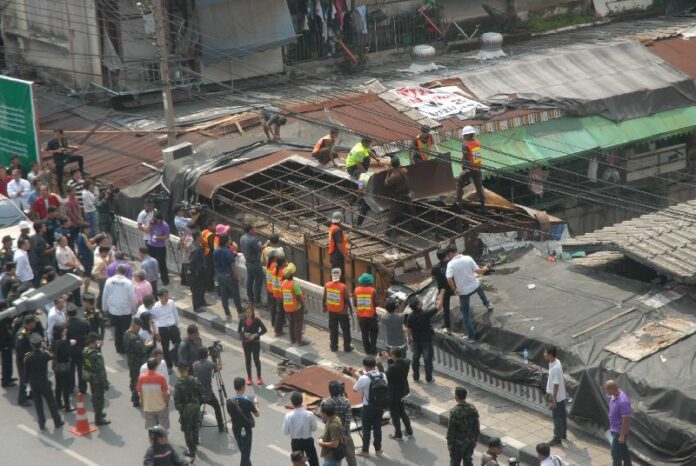
Workers today began dismantling structures near the Saphan Lek market in Bangkok's Chinatown area.

BANGKOK — Negotiations and flowers failed to win a reprieve for Saphan Lek vendors today as city workers today began demolishing the historic market situated on the west side of Bangkok’s Chinatown.

Hundreds of vendors gathered in white T-shirts this morning to give officials flowers in an attempt to win another 90 days time to clear stock and relocate, but before noon workers moved in and began stripping the roofing to dismantle approximately 500 structures which for three decades provided a claustrophobic warren of stalls selling electronics, games and toys.

“We think it is really an injustice. Anybody who has been here will know it is impossible to move all the stalls out under such short notice,” vendor Chanya Surawutthinak said. “Today they made a decision based on their papers, but they have to look into the reality.”

The Bangkok Metropolitan Administration today led teams to the location at the end of Yaowarat Road to begin what city hall said is part of a campaign to reclaim public space, particularly the historic canal the market was built over. Just around the corner, an advisor to Bangkok’s governor said demolition began at Saphan Han, an old Chinese trading community where the tenants had vacated.


\

Workers began taking apart a structure today at Saphan Han.


The vendors had complained the two-weeks notice given by the city was insufficient for them to sell their stock and move. They also said it came at a bad time, as the New Year holiday period saw their best sales of the year.

Last week they petitioned the Ministry of Interior to intervene on their behalf and win another year’s time, a call supported by Thailand’s Human Rights Commission, which organized a panel discussion on Friday.

Disappointed vendors today went to the Government House this afternoon to call for help.

Maj. Gen. Wichai Sangprapai, advisor to Bangkok Gov. Sukhumbhand Paribatra, said he would raise the matter of an extension with city officials Wednesday. However Bangkok Deputy Governor police Gen. Assawin Kwanmuang insisted the land could not be allowed for commercial purposes once it is redeveloped into a recreation area. The canal will be used for transportation.

The BMA first announced it would demolish the market to reclaim the area Sept. 28, saying the market obstructs the canal and encroaches on public land. City hall threatened to forcibly remove the stalls illegally built into the canal if the vendors refuse to leave within 15 days.

Vendors accused the city of colluding with a land developer to force them out and onto land sold to the developer by the family of Sukhumbhand.

The governor’s advisor, Maj. Gen. Wichai, dismissed those accusations as groundless.

At Friday’s public discussion, Human Rights Commissioner Niran Pitakwatchara urged Gov. Sukhumbhand to grant the extra year sought by the vendors to avoid the appearance of any impropriety.

An eyesore to those who want to see a tidier capital city and an icon of its charm to others, Saphan Lek is the latest such landmark to be eliminated.

In February, the nearby Khlong Thom was shut down. Elsewhere, street vendors have been removed or restricted as part of the BMA’s “reorganization” campaign.

The metro administration has said it is carrying out the military government’s policy to reclaim public space and walkways.


Related stories:

One-Year Reprieve Sought for Saphan Lek Market

City Hall Denies Colluding With Developer to Demolish Saphan Lek

Vendors Revolt as BMA Moves to Demolish ‘Saphan Lek’

Advertisement

Storm Drives More Indonesian Smog Over Thai South

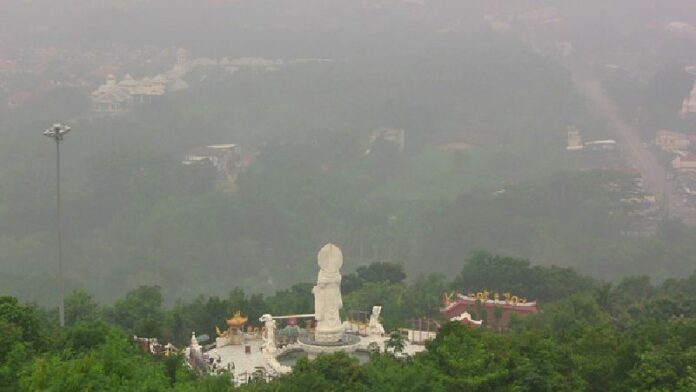
Heavy smoke in Hat Yai city today in this photo from the Khao Kho Hong mountain peak.

SONGKHLA — Smog from Indonesian forest fires worsened across large parts of southern Thailand today, driven by tropical storm Koppu, which has moved on from the Philippines and is bearing down on Taiwan.

The storm, combined with a weakening high pressure system over northern Thailand, has effective pushed more smoke over from Sumatra to Songkhla, according to meteorologist Nongyao Muengngam.

Conditions will lessen when the storm moves inland on Oct. 22 or Oct. 23. Rain is forecast for 60 percent of the Thai south, which will also help clear the air.

Even though Hat Yai was blanketed in smoke again today, regional environmental official Halem Jemarigun said the situation was less severe than before. The air quality is still under the safety standard and would cover the city for only few days.

Indonesian President Joko Widodo said his country has “gone to great lengths” to tackle the problem, though experts yesterday conceded failed efforts to put the fires out mean they will keep burning into next year.


Related stories:

Southeast Asia to Choke on Smoke for Months as Indonesia Fails to Douse Fires

Indonesian Smoke Spreads to Thai South, Sickening Hundreds

Indonesian Haze Forces Singapore to Close Schools


Advertisement

Wonderfruit Festival Returns to Save the World (With Music) Again

Wonderfruit 2014 unfolded over several days last year in Pattya, Chonburi province. Photo: Courtesy Wonderfruit Fetival

By Lisnaree Vichitsorasatra
Staff Writer

Take another bite of Wonderfruit, a music festival with an environmentally friendly message, when it returns in December for its second outing.

The festival promises an international musical experience with four stages of music and a range of en vogue lifestyle offerings, including a culinary farm, health and wellness experiences and green workshops.

That’s well and good, but fans may be more excited to know who’s playing than how to compost their underwear. There are no major wow-factor names in the roster released so far. Instead,  this year’s lineup seems more intent on tapping into passionate bases of subgenre fandom with a number of strong acts worth the roadtrip to Chonburi.

This year sees an invasion from that other City of Angels. Hip-hopsters can look forward to the politically conscious stylings of Los Angeles’ Yasiin Bey, the artist formerly (and still better) known as Mos Def. Also from L.A. comes Canadian-Danish, alt-R&B duo Rhye. Mix some Burning Man-style performance art with the Las Vegas sensuality-lite theatrics of Cirque du Soleil and you get Lucent Dossier Experience. Steampunk-swaddled Aldred “Daedalus” Darlington, a monome-conducting electronic musician rounds out the Southern Californian faction.

Lucent Dossier Experience

American indie-rock ala The Faint and a seven-piece band from England, The Submotion Orchestra fill out the international line-up along with Heartthrob, Elektro Guzzi, Goldroom, Viceroy, Com Truise, Papercutz, Anchorsong, Arjun Vagale, Ocean Lam and Gaby Endo. Composer Jon Hopkins and lighting artist Chris Levine will repeat a collaboration popular among the induced altered-state crowds at the Glastonbury Festival.

Locals acts for the “Soi Stage” include the dreamy grunge of Desktop Error, seven-dude-strong electro act Mahajamreon and synthpop collective Polycat, who were one of the few authentically local things to appear in “The Hangover Part II.”

Want DJs? A deep deck of operators from around the world will be on tap, including the UK’s Howie B, German minimalista Dapayk Solo, and London-based producer and DJ ‘Catching Flies.’

Check out what’s known of the full line-up online.

'History ft. Talib Kweli' by Mos Def

Wonderfruit began as a combination of commerce and entertainment. Festival co-founder Pranitan “Pete” Phornprapha, Siam Motors Group scion, said he came up with the idea after working on a corporate social responsibility project named for his father, Phornthep Phornprapha. After traveling the world and attending many festivals, he started Sratch First productions who puts on the event with Secret Productions, the London-based organizer known for the Wilderness Festival. Pete wanted a vehicle to promote and build awareness of sustainable development in a fun setting.

From his riverside design fortress of The Jam Factory, architect Duangrit Bunnag is behind “The Pavilion,” which will be transformed into a garden of reclaimed materials.

Last year’s event was a spectacle that delivered on building an impressive environment, but attendance seemed less than hoped.

Wonderfruit the Second will play out over four days, Dec. 17 to 20, at The Fields at Siam Country at Pattaya, Chonburi province.

The festival is offering different ticket options for one, two or four days. For adults that means 5,500 baht (four days), 4,500 baht (Saturday/Sunday) and 3,500 baht (Sunday). Teen prices are available. Want to bring your dog? He’ll need a ticket too: 800 baht. Group pricing and other options available online.

Wonderfruit Festival 2014 promotional video

Advertisement

Big Bikes Bad for Elephants, Says Videographer of Khao Yai Confrontation

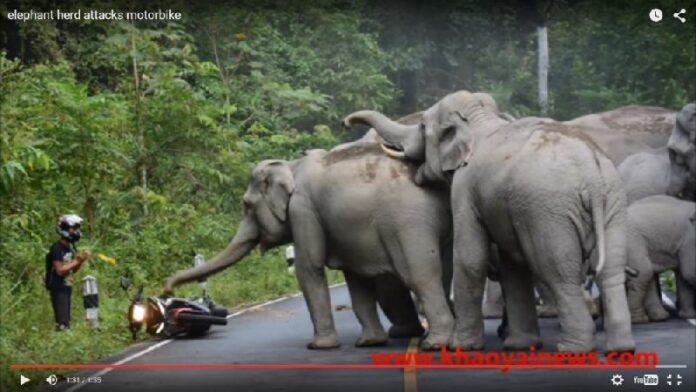
Still image from the Sunday incident in which a herd of agitated wild elephants chased down a motorcyclist. He escaped unharmed. Image: Khao Yai News

NAKHON RATCHASIMA — The man who who captured a tense pachyderm-on-motorcyclist encounter on video said Khao Yai National Park should ban big bikes as they are responsible for upsetting the park’s more important residents.

After his video of a cornered biker escaping death-by-angry-elephant with a wai and a prayer went viral, cameraman Andy Merk said a group of four riders on large, loud motorcycles were responsible for irritating the elephants, which nearly took out their frustration on another unlucky rider who just happened to come along on a smaller motorcycle.

“Big bikes are a serious problem in Khao Yai National Park; they are there for racing, not for nature,” Merk wrote on his Khao Yai News website today. “No other park in Thailand allows big bikes in, and in other countries they are banned as well.”


In the video he posted Sunday, a herd of angry elephants chases after a man on a small motorcycle. The man ditches the bike and stands on the side of the road, paying respect with a wai the same way Thais reflexively perform for someone older or of higher status. The elephants eventually left without touching either the man or his bike.

Merk said he was on his way back from photographing insects in the park when he spotted the incident. The Khao Yai News owner said officers were trying to move eight elephants out of the road and back into the forest, as they were blocking traffic. Suddenly four large motorcycles passed at high speed, upsetting the wild elephants.

Park chief Kanchit Srinoppawan stressed that tourists should drive carefully along the road which runs through the park.

A series of elephant-related incidents, including several cars getting stomped, happened in January and February. Park officials considered closing or limiting access to the road but ultimately shortened park hours to close earlier to avoid encounters between tourists and animals going out to feed at night. Since Feb. 5, the park's closing time has moved up to 6pm from 9pm.

Correction: An earlier version of this story misstated the park operating hours. Since February, the park has closed at 6pm instead of 9pm.


Related stories:

Tourists Urged to Respect Park Rules Protecting Elephants

In Thailand, Unruly Elephants Threaten Traffic During Mating Season

Advertisement

Southeast Asia to Choke on Smoke for Months as Indonesia Fails to Douse Fires

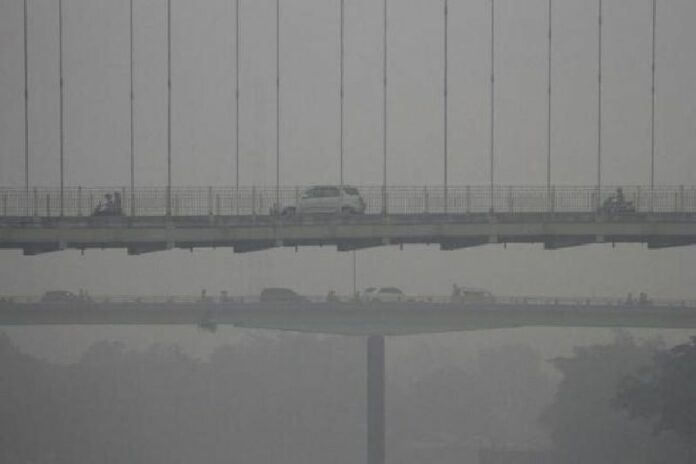
Vehicles drive along Siak Bridge on Oct. 11 in Indonesia's Riau province. Photo: Reuters / Rony Muharrman, Antara Foto

By Michael Taylor
Reuters

JAKARTA — Indonesian forest fires that have caused choking smoke to drift across Southeast Asia are spreading to new areas and are unlikely to be put out until next year, experts said on Monday.

Indonesia has come under increased pressure from its neighbours to contain the annual "haze" crisis, which is caused by slash-and-burn agriculture practices, largely on Sumatra and Kalimantan.

But it has failed to put out the fires, with hot spots growing in eastern parts of the country and industry officials and analysts estimating the smoke will last until early 2016.

"Maybe it will last until December and January," said Herry Purnomo, a scientist at the Center for International Forestry Research, adding that hot spots had reached Papua, a region that usually avoids widespread fires.

"It is because people are opening new agriculture areas, like palm oil," he said.

A senior official at a company active in Indonesia's forested areas said the haze could continue until March.

Indonesia usually enters its wet season in October and November, but this year the country is expected to face moderate El Nino dry conditions which could strengthen until December and may hinder efforts to control the fires.

Indonesia's national disaster management agency has made several forecasts for when the forest fires will be brought under control, many of which have now passed, but their latest target date is early November.

Indonesia has revoked the land licences of PT Mega Alam Sentosa and state-owned PT Dyera Hutan Lestari, Rasio Rido Sani, the director general for law enforcement at the forestry ministry, told reporters late on Monday.

Both firms could not be reached for comment.

Last month, Indonesia ordered four companies to suspend operations for allegedly causing forest fires.

On the ground, NASA satellites detected 1,729 fire alerts across Indonesia on Wednesday, a national holiday, more than any single day in the last two years.

About half of the fires during the last week have been on carbon-rich peat land areas, mostly in South Sumatra, South and Central Kalimantan, Sulawesi and Papua.

Indonesian President Joko Widodo has increased government efforts to tackle the haze in recent weeks, making several visits to the worst-hit areas and asking other countries for help, but apparently to little avail.

"We all know that the burned areas are now widening beyond normal conditions," Widodo told reporters on Sunday. " … the efforts to extinguish the fires are ongoing now both by land and air. We have to be patient because the burned areas is now wide."

Additional reporting Cindy Silviana, Bernadette Christina and Agustinus Beo Da Costa

Advertisement

Police to Reveal Identities of ‘Royal Imposters’ Wednesday

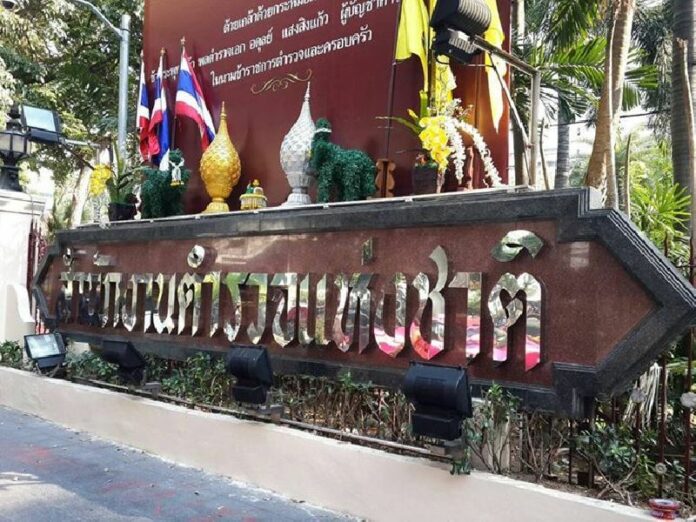
The entrance of the Royal Thai Police headquarters in Bangkok in a March 2014 file photo.

BANGKOK — Police will disclose the identities of those under investigation for flaunting ties to the Royal Family on Wednesday when they are brought to court, the officer in charge of the investigation said yesterday.

After announcing Sunday a crackdown on “a group of individuals who have been falsely claiming [ties to] the High Institution to commit inappropriate acts” without naming suspects, the lead investigator and head of Bangkok metro police said the suspense will come to an end tomorrow.

“We have already asked the court for arrest warrants for suspects in this case, but I don’t want to disclose the identities, number or details of their behavior,” police Lt. Gen. Sriwarah Rangsipramnakul said. “Everything is in the case file. You will know about it when we take them for a remand, and we expect to remand them on Oct. 21.” 

The investigation came to light on Sunday when police published the order establishing a 19-member taskforce, led by Sriwarah, to prosecute the alleged royal imposters, but no other details were given. The letter also appeared to be signed on Friday, two days before the information was made public.

According to Sriwarah, it was the military who filed criminal complaints against the suspects, accusing them of lese majeste (insulting the monarchy), a crime punishable under Section 112 of the Thai Penal Code. He confirmed that the suspects have been charged with lese majeste, which carries a maximum penalty of 15 years in prison per offense.

National police chief Chakthip Chaijinda was similarly tight-lipped about the investigation when quizzed by reporters yesterday. He declined to name any of the suspects.

“If we find that anyone is involved, we will take action against them. Today, I will talk with Police Lt. Gen. Sriwarah about prosecuting this case, which has to be proceed in accordance with facts and laws,” Police Gen. Chakthip said Monday. “Personally, I don’t feel worried about this case, because we have laws [that support] the prosecution.” 

Open discussion about the Royal Family is considered a taboo in Thailand; legal cases involving the monarchy and lese majeste offenses are often shrouded in secrecy.

Last November, police launched a similar crackdown on what they described as a criminal network that falsely claimed ties to the monarchy. Nearly 30 people were arrested in connection with the network, including Pongpat Chayaphan, then chief of the Central Investigation Bureau, and family members of former Princess Srirasmi, who was the wife of the Crown Prince at the time. 

Pongpat and his alleged accomplices were subsequently found guilty of lese majeste and other criminal activities. They are believed to be serving jail terms.

After the scandal broke out in November 2014, Crown Prince Vajiralongkorn stripped Srisasmi’s family of their royally-bestowed surname “Akharaphongpreecha,” forcing them to revert to their commoner surname of “Suwadee.” 

Srirasmi later resigned from all royal titles and adopted life as a commoner. She was last seen in public in December 2014. 

When reporters asked police chief Chakthip yesterday whether the ongoing investigation is targeting a group as large as Pongpat’s, he replied, “Let us inspect details first. This matter needs to be investigated first.” 

Chakthip also declined to say whether a police order transferring eight police officers on Sunday was related to the investigation. Nevertheless, he added that any police officer involved in the case would be expelled from the force. “Because this is a serious case,” Chakthip said. 

Related stories:

Ex-CIB Chief Gets 6 Years for Defaming Thai Crown Prince

Hundreds of Police Officers Linked To Former CIB Chief Transferred

Brothers of Ex-Princess Imprisoned for Defaming Royal Family


To reach us about this article or another matter, please contact us by e-mail at: [email protected].

Follow Khaosod English on and Twitter for news, politics and more from Thailand.

\

Advertisement

Return of Dollar Black Market Shows Limits of Myanmar Reforms

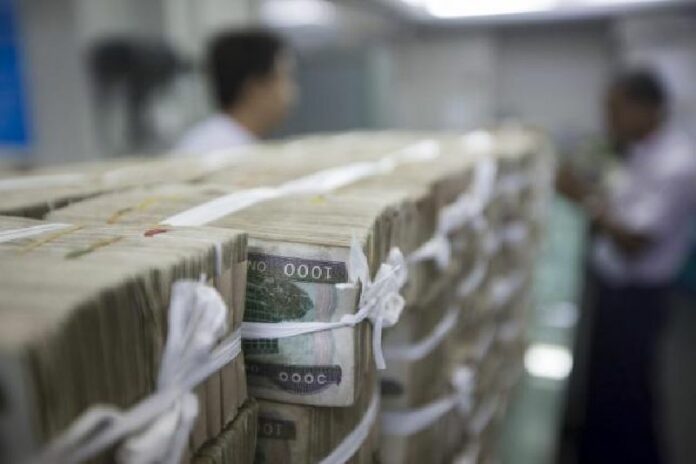
Stacks of Myanmar kyat are seen on a counter Monday before a client collects them at a bank in Yangon, Myanmar. Photo: Reuters/Minzayar

By Antoni Slodkowski and Simon Webb
Reuters

YANGON — Banks in Myanmar bought hundreds of millions of dollars in the black market this year, banking sources said, in a resurgence of an unregulated trade that flourished under military rule and has raised fears among foreign investors of backsliding on reforms.

Lenders say they were forced to turn to unlicensed brokers for scarce dollars to keep the wheels of trade turning, as the central bank's efforts to prop up the kyat currency threatened to freeze up the nascent financial system.

"We deliberately made our currency appreciate, while there was an actual depreciation happening," said a senior central bank official. "The whole informal market re-emerged, no transactions were happening through the banks any more. That's when we came to the brink of collapse."

The episode underscores the fragility of reforms introduced since a semi-civilian government took power in 2011 after decades of isolation from the international financial system.

Sources said the main motive for rolling back on reforms that introduced a managed kyat float in 2012 was to avoid inflation becoming an issue that could damage the government's standing ahead of a historic election on Nov. 8.

The Central Bank of Myanmar did not respond to Reuters requests for official comment.

Strains emerged in early 2015 as the central banks' official exchange rate diverged further and further from the rate offered on the black market.

International trade has grown quickly during the reform period, and as imports outpaced exports the trade deficit jumped to USD$4.9 billion (173.8 billion baht) in the fiscal year ending March 31, from just under USD$92 million (3.3 billion baht) two years earlier, according to official data.

That has tightened the supply of dollars, with rising foreign direct investment and tourism not enough to fully plug the gap.

The chronic shortage of dollars worsened mid-year as exporters either held back dollars in the expectation of an eventual kyat devaluation or refused to sell at the official rate.

Banks turned instead to the informal market, using well-established brokers with systems that were put in place to skirt sanctions when Myanmar was an international pariah.

"They call it the black market but it's the real market," said Win Lwin, a senior manager at KBZ Bank. "It's very difficult for the banks to follow the rules."


Banks 'Have No Choice'

In interviews with Reuters, executives and traders at three Myanmar banks said they had bought dollars in the informal market for clients needing to make international trade payments. All declined to be named, but said the practice was widespread.

"We have no choice," said one foreign exchange trader at a local bank. "We have to go to the black market."

Banks bought as much as USD$15 million (532 million baht) a day through brokers, traders and executives estimated. The informal market purchases peaked in June and July when a dollar would buy you as much as 16 percent more kyat on the informal market.

Under pressure from the International Monetary Fund (IMF) and the World Bank, the central bank abandoned its defense of the currency after 10 months in July, allowing the kyat to devalue and increasing dollar supply.

The kyat is now down more than 20 percent for the year, making it one of the worst-performing frontier market currencies in 2015.

But without wider reforms to allow foreign banks to sell dollars in Myanmar, some traders and bankers believe it is only a matter of time before they are forced back into the informal dollar market.

"This whole thing could turn on a dime," said an executive at one of Myanmar's banks. "We all know how limited the central bank is for dollar supplies. They could say overnight – the party's over, we've run out of reserves."

The IMF estimates central bank reserves in dollar terms will reach around USD$5 billion (177.3 billion baht) at the end of this fiscal year, equivalent to around 2.5 percent of imports. The central bank declined to provide data on actual reserves.


Offshore Network

Myanmar's banks hold offshore accounts in Singapore to settle international trade.

To get dollars to those accounts, the banks paid brokers in Myanmar in kyat, the executives and traders said. Those brokers then used registered companies in Singapore to transfer dollars into the banks' offshore accounts.

The Monetary Authority of Singapore did not reply to questions on whether it was aware of the trades, had taken any action to prevent them or planned to do so.

"Financial institutions are required to monitor for and report any suspicious transactions," MAS said in an e-mail.

Electoral calculation may have played a part in the crisis, with the ruling Union Solidarity and Development Party expected to fare poorly in what is being touted as Myanmar's first free and fair election in 25 years.

"The difficulty with the authorities was that they were of course concerned about inflation if the exchange rate depreciates," said Yongzheng Yang, who oversees Myanmar for the IMF and led a mission to Myanmar in June.

While banks are no longer buying black market dollars, many importers and exporters continue to do informal bilateral deals, said U Mya Than, chairman of Myanmar Oriental Bank and of the Yangon Foreign Exchange Market Committee.

"There is no scrutiny of transactions and no enforcement," he said.

That is a red flag for international banks entering Myanmar on the first licenses granted since the reforms.

"The central bank should crack down on the black market," said the head of the treasury department at a foreign bank that has recently launched in Myanmar. "It's impossible to build a normal financial system if we have it here."

Additional reporting Timothy McLaughlin and Aung Hla Tun

Advertisement

Hot News

LATEST NEWS

Bangkok
overcast clouds
27.2 ° C
27.2 °
24.4 °
81 %
2.7kmh
99 %
Sat
36 °
Sun
32 °
Mon
30 °
Tue
31 °
Wed
30 °