An artificial island under construction in the Spratly Islands as seen in a May 2015 file photo. Photo: EPA pool / Ritchie B. Tongo
HANOI — Vietnam accused China of another violation of its maritime territory today, protesting the construction of two lighthouses on the disputed Spratly Islands between Vietnam and the Philippines.
China's projects on the Cuateron and South Johnson reefs have complicated diplomatic efforts to resolve the disputes, Viet Nam News reported, quoting Foreign Ministry spokesman Le Hai Binh.
"Vietnam resolutely rejects and strongly protests China's actions," Binh said.
"Once again, we affirm that Vietnam has full legal and historical evidence for its indisputable sovereignty over the Truong Sa and Hoang Sa archipelagos," he added, using the Vietnamese terms for the Spratlys and Paracel Islands.
China's land reclamation operations in the Spratlys – where a number of artificial islands have been constructed Beijing now claims as sovereign territory – has also been protested by the Philippines and other Southeast Asian countries.
The United States, Japan and other nations have raised concern over freedom of navigation in busy international shipping lanes that run through the area.
A Saphan Lek vendor, at center, gestures toward Khlong Ong Ang with Deputy Secretary General of the national Ombudsman’s office Thavin Injamnong, second from left, who visited Saphan Lek and the nearby area today for an inspection after vendors filed a complaint Friday with his office.
BANGKOK — More than 100 vendors from Bangkok’s Saphan Lek market yesterday filed a complaint at the Ministry of the Interior to block the city’s bid to remove them.
The vendors appealed for help to stay in the community they’ve called home for 30 years and accused city hall of forcing their relocation for the financial benefit of a developer with ties to top city officials.
In a copy of the complaint seen by Khaosod English, the vendors alleged the city’s Sept. 28 ultimatum, which gave them two weeks to abandon the famous Chinatown market, is an attempt to push them into occupying land developed by an investor linked to city hall and the provincial governor.
“We were previously informed by newspaper and online media reports in 2012 that a developer bought the area around Woeng Nakhon Kasem and buildings along Saphan Lek from a prominent family of the Bangkok administration,” the statement read.
An adviser to Bangkok Gov. Sukhumbhand Paribatra flatly rejected that claim. The Bangkok Metropolitan Administration said the 30-year-old market is illegally squatting on public land and clogs the flow of water in the canal it sits atop.
Most shops were open as usual Tuesday despite that being city hall’s deadline for vendors to quit the market. The city plans to clear out more than 500 houses and stalls erected above Khlong Ong Ang.
For 30 years, Saphan Lek has been a popular market for electronics, toys and games due to its inexpensive prices compared to those found in shopping malls. A maze of vendors sell a wide range of goods and speciality items the market has become known for.
Following the February demolition of the nearby Khlong Thom market, another bustling icon of Chinatown, Saphan Lek became the latest target of the city’s clean-up campaign last month.
The maze-like market is known for cheap electronics, toys and games. The BMA said it will demolish the site beginning Tuesday.
Vendors said they became suspicious after leaflets appeared at every stall overnight, just after the city erected a billboard ordering them to leave, but two days before the formal order to vacate arrived. For one, the leaflets claimed to be co-written by sellers from Saphan Lek and a recently redeveloped area at Woeng Nakhon Kasem, known as the old music instrument market.
“Together please move to Boripat Road, and we will ask Bangkok to organize a walking street on the weekend,” it read. We shall unite to develop Boripat Road to be our new place to earn a living, replacing the old one which will soon be reclaimed.”
The vendors said no one at either site has said they were involved.
Leaflets distributed Sept. 27 urging the community to relocate to a nearby market on Boripat Road. Tenants said they appeared at every stall the morning after a billboard appeared ordering them to move.
Surrounded by her inventory of toys and games, the owner of a shop called Diamonds in Saphan Lek 17 said yesterday the move would be a raw deal.
“The price they offer for rent at Woeng Nakhon Kasem is 10 times more expensive than what we pay here,” said the shop owner, who would only identify herself by her nickname Toy. “How can we afford to make a living?”
A shop owner named Yoo, who has led the vendors to petition several government agencies recently, said the covered labyrinth that is Saphan Lek is suited to their wares.
“We are all doing fine selling in our permanent stalls, why would we want to move to a walking street?” she said, declining to give her full name for fear of reprisal. “Our goods are all electronics that can’t be touched by rain and sunlight.”
Boripat Road
For those who see conspiracy, the road which shares a name with Bangkok’s governor is no coincidence.
According to news accounts, including a report in Prachachat, the family of Bangkok Gov. Sukhumphand Paribatra, who spells his family name differently in English, sold 14 rai of land (about 5.5 acres) around Woeng Nakhon Kasem on Boripat Road in June 2012 to real estate developer TCC Land for 4.5 billion baht.
TCC Land, a division of multinational conglomerate TCC Holding Co., Ltd., has not responded to numerous telephone calls and several emails seeking comment yesterday and today. Several people answering the phone said they were not familiar with the issue and would refer the matter to a company representative. A telephone number listed for press inquiries was not answered.
On Friday, the vendors said they will present evidence supporting their accusations at a public discussion hosted by the National Human Rights Commission.
Maj. Gen. Wichai Sangprapai, an adviser to Gov. Sukhumbhand, said public policy – not special interest – is behind the move to demolish the market.
“I have reorganized 37 spots around the city, not just here,” he said. “It’s just their excuse.”
He added that TCC Land is not interested in the vendors.
“And in fact they don’t want these vendors, as their market is already fully rented out.”
Wichai will also join the Friday panel, where he plans to present the legal case for removing the vendors and the market. He said it’s about enforcing the law and respecting the rights of others, as the canal is a public area and national historic site.
Klong Ong Ang, a historic canal above which the Saphan Lek market was built, was registered as a historic site by the Fine Arts Department in 1976.
After the military government made it a policy to reclaim public space last year, the Bangkok Metropolitan Administration has targeted many iconic street markets for intruding onto sidewalks and roads.
Some welcome it as much-needed reorganization to the city’s chaos and miserable traffic; others complain it’s sanitizing the capital’s appeal or another kind of land-grab.
The charm Bangkok’s street food and market scenes is often cited in polls placing it as a top tourist destination.
29-year-old Kath Khangpiboon has filed a discrimination lawsuit against Thammasat University for withdrawing an offer of employment nine months after it was extended. Photo: Matichon
BANGKOK — Thammasat University’s rector yesterday defended his board’s refusal to employ a transgender academic, saying it was due to an inappropriate photo she posted online, not her sexuality.
Although Kath Khangpiboon, 29, had passed all necessary examinations, rector Somkid Lertpaitoon insisted a photo of a penis-shaped tube of lipstick posted to Instagram nearly a year ago was a sign of her improper conduct online and an indicator she would not be a good teacher.
“Apart from matching all the required qualifications identified by the university, such as grades, we also take an individual’s behavior into consideration. The committee unanimously agreed not to employ Mr. Kath,” Somkid said, referring to Kath’s gender at birth.
Kath said she posted the photo of the anatomically shaped lipstick to thank the person who gave it to her and educate the online community about sexuality.
Thammasat blamed this photo posted to Instagram nearly a year ago for its decision to revoke employment to a transgender lecturer.
On Monday she filed a lawsuit against the university, accusing its hiring committee of discrimination and violating her human dignity. She said she wants to set a higher standard for sexual equality in society.
Jetsada Taesombat of the Thai Transgender Alliance praised Kath for taking her discrimination case to court because it would set a legal precedent. According to Jetsada, many other transgender people were refused jobs because of their gender identity but were reluctant to sue in the court.
"We have to thank Ajarn Kath, because there have been many other cases, but they don't want to fight it in the court, because it's a burden for their lives, and it's expensive to hire lawyers and go through all the procedures," she said.
She added that transgenders are the most discriminated group among LGBT communities when it comes to employment.
Her organization has been campaigning on behalf of Kath.
Kath alleges the university discriminated against her during the hiring process due to her gender identity. She was originally offered a position in June 2014, then her employment was placed on hold before the offer was withdrawn in March.
The academic said she was informed after an unprecedented 244-day process that her employment was terminated. She also said the reason to deny employment had not been used before to disqualify a professor.
Long an activist for transgender issues, Kath had been teaching as a guest lecturer in the Faculty of Social Administration when she left an NGO job to apply for the full-time position at Thammasat last June.
In her lawsuit, Kath asked the court to dismiss the university board’s resolution and order it to accept as a lecturer. Her lawsuit also seeks 363,000 baht in damages and 23,700 baht per month in salary compensation until she is reinstated.
Historically a progressive institution, Thammasat University has undergone a shift to the right in recent years. Once famous for championing democratic causes, the university invited criticism for quashing student criticism of the 2014 military coup, and some of its administrators, including Somkid, were accused of being too cozy with those calling for the removal of the previous civilian government.
Although Thailand is largely tolerant on matters of sexual orientation and gender identity – especially compared its ultraconservative neighbors such as Myanmar and Malaysia – there have nevertheless been reports of occasional discrimination.
A 2014 report on LGBT rights in Thailand compiled by United States Agency for International Development, or USAID, named workplace and job discrimination as one of the obstacles for transgender people in the kingdom, citing instances of individuals being denied promotions or fired from their jobs.
"Transgender people who cannot easily hide their identities suffer the most employment discrimination in Thailand, and are often limited to working in roles in hospitality, entertainment or the sex work industry," the USAID report said.
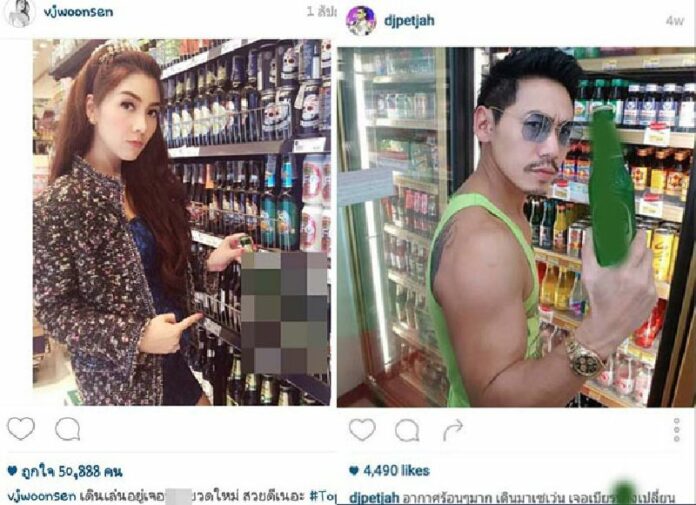
Photos posing with Chang beer posted to Instagram by Virithipa 'Woonsen' Phakdeeprasong (left) and Wichian 'DJ Petjah' Kusolmanomai (right). They have since been deleted.
BANGKOK — Police are still weighing charges against celebrities who posted photos appearing to promote a beer brand on their Instagram accounts, while the head of the alcohol control board insists members of the public will be prosecuted for doing the same.
Over 30 actors, actresses and singers are currently under investigation by police for violating the 2008 Alcohol Control Act, which forbids advertising alcohol by even showing brand logos or “enticing” others to drink.
Samarn Futrakul, head of the Alcohol Control Board and the chief author of the act, said the celebrities must face legal consequences for posting photos of themselves posing with or drinking Chang beer on Instagram.
“Getting celebrities and artists to post photos of themselves with alcoholic beverages on Facebook and IG like this is against the law,” Samarn said Monday.
Although the photos had every appearance of being part of a coordinated campaign to promote Chang's newly rebranded product – Chang Classic – the celebrities in question have repeatedly denied being compensated for posting the photos.
In the images, most of which were posted about the same time several weeks ago, the bottles are carefully turned so their labels are clearly visible. Similar captions extol the brand.
Samarn was unconvinced.
“Whenever there’s a problem, they always say that,” he said. “But law enforcement officers under the Alcohol Control Act and police officers can exercise their judgment: Whether to fine them or send them to court, because if they keep repeating the offense, they cannot be merely fined.”
The celebrities deleted their beer photos soon after investigation was launched last week.
Shared Peril?
Since the scandal erupted, Samarn has insisted private citizens will also be prosecuted for posting photos showing alcohol.
“These people will also be held accountable, because they cannot defy the law,” he said, referring to anyone who posts such photos.
The law does not only prohibit traditional advertising, but also any effort to “encourage people indirectly” to drink alcohol, Samarn said.
“If they have no intention to do that, they won’t be guilty,” Samarn said. “However, people shouldn’t post photos of themselves with alcoholic beverages anyway, because it’s a sinful product. It’s an immoral product. They shouldn’t pose with that product, because it’s not good for them.”
Samarn is a deeply conservative Buddhist and high-profile prohibitionist. He has helped write drafts of a number of laws and regulations aimed to restrict the availability of alcoholic beverage, including the 2008 Alcohol Control Act.
Consumption of alcohol is considered a sin under Buddhism. However, in practice, restrictions on alcohol sales are selectively enforced, and drinking is commonplace in Thailand.
Deputy police chief Pongsapat Pongcharoen also stressed that members of public may be held liable for posting photos of alcohol, but only those doing so for commercial purposes.
“The Royal Thai Police has an agency that monitors social media. We monitor every website. If it fits the definition, it will be considered wrongdoing,” Gen. Pongsapat said. “Therefore, we are not only prosecuting celebrities. Every other profession that fits the definition of wrongdoing will be prosecuted as well. But if they have no intention for commercial interest, they need not worry.”
The investigation appears to have been launched after Piti Bhirombhakdi, heir to Singha Beer conglomerate, complained online that his rival brewery was using celebrities to post photos of themselves with Chang Beer. In a Facebook post, Piti accused Chang of employing “unethical” marketing schemes.
Samarn confirmed that Piti had filed a complaint to the Alcohol Control Board and would be summoned to testify to the board within the next two weeks.
Meanwhile, actors and actresses who joined Chang’s campaign have insisted to the press in recent days that they were not paid for showing off Chang Classic in their Instagram accounts.
“I am not worried because I have genuinely innocent intention,” actor Pakorn Lam told reporters yesterday after being asked whether he’s concerned by the ongoing investigation. “I have made it clear that I was not paid to do it. But I admit that I feel really, because I have been in this career for 20 years. I want to be a good role model for everyone.”
Asked to explain how so many of her peers posted similar photos at roughly the same time, actress Virithipa “Woonsen” Phakdeeprasong said Monday it was just an unplanned coincidence.
“We didn’t talk to each other about whether we will post the photos,” she said.
Celebrities in Thailand often supplement their incomes by promoting products on social media. Woonsen said not everything she promotes is done for money.
“There are some goods that I get paid for, and many others that I don’t get paid. I didn’t get paid for this one,” she said. “So I feel really bummed that I have to go through all this trouble, and I don’t even get paid for it.”
Playboy image announcing its plan to strip nudity from its pages starting with its March 2016 issue. Photo: Playboy
Now readers of Playboy, the glossy men's magazine known for its nude fold-outs, can honestly say they are buying the magazine for its articles.
Playboy will no longer publish nude photographs of women, the New York Times reported on Monday in an article quoting Scott Flanders, the company's chief executive.
Founder and editor-in-chief Hugh Hefner, 89, who in his trademark silk pajamas has embodied the Playboy lifestyle, agreed last month with a suggestion by top editor Cory Jones to stop publishing images of naked women, the Times said.
At a time when every teenage boy has an Internet connected phone and the web is rife with pornography, the magazine has opted to continue featuring women in provocative poses, just not completely nude, the Times said.
"You're now one click away from every sex act imaginable for free," Flanders was quoted as saying in the Times. "And so it's just passe at this juncture."
The magazine that featured Marilyn Monroe on its debut cover in 1953 is making the changes after circulation dropped from 5.6 million in 1975 to about 800,000 now, the Times said.
After its initial success, the magazine was attacked from the political right because of the nudity and from the left by feminists who said it reduced women to sex objects.
Some changes are still under debate, including whether there will continue to be a centerfold. Playboy magazine's sex columnist will be a woman, who writes enthusiastically about sex, Jones told the Times.
The magazine has always had intellectual appeal with top writers such as Kurt Vonnegut, Joyce Carol Oates, Vladimir Nabokov, James Baldwin and Alex Haley for men who liked to say they did not buy the magazine just for the pictures.
In-depth interviews with historic figures such as Fidel Castro, Martin Luther King Jr., Malcolm X and John Lennon also were a regular feature.
“Don’t get me wrong,” Mr. Jones said of the decision to eliminate nude pictures, “12-year-old me is very disappointed in current me. But it’s the right thing to do.”
Playboy did not immediately respond to a Reuters request for comment.
Story: Reuters / Barbara Goldberg
To reach us about this article or another matter, please contact us by e-mail at:[email protected].
Follow Khaosod English onFacebookand Twitterfor news, politics and more from Thailand.
Myanmar opposition supporters at a campaign rally in an undated photo. Photo: EPA / Nyein Chan Naing
BANGKOK — Myanmar's election commission said Tuesday it will proceed with elections as planned next month, a reversal after a recent request to postpone polls.
The Union Election Commission, the body responsible for organizing elections in Myanmar, said on the state-run MRTV broadcaster late Tuesday that it would proceed with elections on Nov. 8 as planned.
The body had earlier Tuesday said it wanted to postpone next month's general election due to pervasive flooding and landslides throughout the country, which could prevent voters from reaching polling stations.
The commission had urged the major political parties to agree to the postponement.
Four parties agreed to the postponement, including the ruling army-backed Union Solidarity and Development Party, according the Myanmar Times.
But the National League for Democracy of opposition leader Aung San Suu Kyi refused to accept the delay, according to the report. The party did not issue a statement on the matter.
Myanmar has experienced one of its worst monsoon seasons in 2015, with widespread flooding affecting over 1.5 million people, according to state media.
On Monday, heavy rains triggered mudslides which killed 17 people and forced the relocation of hundreds.
Myanmar came under criticism in 2008 when the army went ahead with a nationwide referendum three weeks after Cyclone Nargis killed more than 100,000 people.
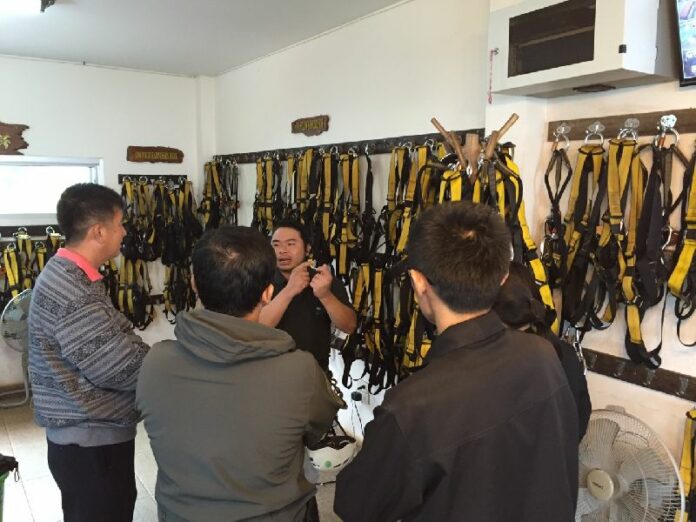
Police inspect equipment at Flying Squirrels zipline adventure in Chiang Mai province.
CHIANG MAI — A Chinese tourist died at a zipline attraction in Chiang Mai on Sunday, the second this year to die in the northern province under similar circumstances.
Criminal negligence charges may be filed against the owners and operators of the Flying Squirrels zipline operation after news of the fatal incident emerged yesterday from a local police commander, who told reporters his unit were notified Sunday evening about an unconscious 32-year-old tourist, who was later pronounced dead.
Police Col. Adul Somnuek said the deceased tourist’s friends complained to the Chinese consulate in Chiang Mai because Flying Squirrel initially told police the victim may have died of heart failure. At that point the consulate urged Thai police to investigate the matter, he said. The consulate has not responded to requests for comment.
Khaosod English is withholding identity of the deceased until her next of kin has been notified.
Speaking to Khaosod English today, Adul said an initial autopsy revealed the tourist died from a broken neck.
“The neck was snapped, breaking it,” said Adul, who heads the Mae Rim Police Station. “We just knew yesterday that the neck was broken. At first we were told that [the deceased] lost consciousness in the harness. When we reached the scene, officers didn’t know what really happened. It was deep in the forest. So we were told that she feinted or had some kind of a shock.”
He added that a more detailed autopsy will be concluded “within three days.”
A photo posted on Flying Squirrels' Facebook page indicates authorities held a "confidence in safety in the lives and property of tourists" there on Sept. 11. Photo: Flying Squirrels / Facebook
Amphika Masanong, assistant manager of Flying Squirrels, said by telephone today the tourist must have broken her neck after coming to an abrupt stop.
She said the incident took place after the deceased and another person on the tour were placed together for a zipline ride, which is usually reserved for one person at a time.
Staff decided to put the pair together, Amphika said, because another tourist could not make it to the end of the line, and the staff determined the deceased didn’t weigh enough to reach the platform on her own.
Just as she was coming to the platform, the tourist started to panic and flapped her arms about, Amphika said, preventing staff from catching her in time. She came to a halt at the end of the line, Amphika said, speculating the sudden stop must have snapped her neck.
She said the company only learned yesterday from the autopsy report that the woman died of a broken neck, saying they had no intention of distorting information.
“There was no visible wound on her body at the time, and she looked pale. We thought she was in shock, or she was about to feint, so we applied first aid and called the ambulance,” Amphika said.
Though police have not filed any charges yet, she said the company is prepared to “take all responsibility.”
Adul said police expect to take legal action soon based on the results of their investigation.
“We believe it was caused by negligence on the part of the operators,” he said.
Police Maj. Gen. Pacha Rattanapat, deputy commander of police in northern Thailand, said yesterday that police will press charges of negligence resulting in the death of others against the company.
The Sunday incident came about three months after a 44-year-old Chinese tourist fell to her death from a zipline operated by another company in Chiang Mai.
The previous fatal accident took place June 29 at the Skyline Adventure zipline company. It was initially withheld from the media because it coincided with the arrival of junta chairman Prayuth Chan-ocha, who was touring Chiang Mai province at the time. Local authorities did not want “negative news” to emerge during his trip.
In July, a Chinese woman and American woman were seriously injured in a head-on zipline collision at a popular zipline attraction in Chiang Mai's Mae Kam Pong district.
Flying Squirrels will be shut down for three days starting Wednesday, Adul said, while Skyline Adventure has returned to business after a brief suspension.
To reach us about this article or another matter, please contact us by e-mail at:[email protected].
Follow Khaosod English onand Twitterfor news, politics and more from Thailand.
Customers today at Flying Squirrels zipline adventure in Chiang Mai province as police arrived to investigate the Sunday death of a Chinese national.
CHIANG MAI — A Chinese tourist died at a zipline attraction in Chiang Mai on Sunday, the second this year to die in the northern province under similar circumstances.
Criminal negligence charges may be filed against the owners and operators of the Flying Squirrels zipline operation after news of the fatal incident emerged yesterday from a local police commander, who told reporters his unit were notified Sunday evening about an unconscious 32-year-old tourist, who was later pronounced dead.
Police Col. Adul Somnuek said the deceased tourist’s friends complained to the Chinese consulate in Chiang Mai because Flying Squirrel initially told police the victim may have died of heart failure. At that point the consulate urged Thai police to investigate the matter, he said. The consulate has not responded to requests for comment.
Khaosod English is withholding identity of the deceased until her next of kin has been notified.
Speaking to Khaosod English today, Adul said an initial autopsy revealed the tourist died from a broken neck.
“The neck was snapped, breaking it,” said Adul, who heads the Mae Rim Police Station. “We just knew yesterday that the neck was broken. At first we were told that [the deceased] lost consciousness in the harness. When we reached the scene, officers didn’t know what really happened. It was deep in the forest. So we were told that she feinted or had some kind of a shock.”
He added that a more detailed autopsy will be concluded “within three days.”
A photo posted on Flying Squirrels' Facebook page indicates authorities held a "confidence in safety in the lives and property of tourists" there on Sept. 11. Photo: Flying Squirrels / Facebook
Amphika Masanong, assistant manager of Flying Squirrels, said by telephone today the tourist must have broken her neck after coming to an abrupt stop.
She said the incident took place after the deceased and another person on the tour were placed together for a zipline ride, which is usually reserved for one person at a time.
Staff decided to put the pair together, Amphika said, because another tourist could not make it to the end of the line, and the staff determined the deceased didn’t weigh enough to reach the platform on her own.
Just as she was coming to the platform, the tourist started to panic and flapped her arms about, Amphika said, preventing staff from catching her in time. She came to a halt at the end of the line, Amphika said, speculating the sudden stop must have snapped her neck.
She said the company only learned yesterday from the autopsy report that the woman died of a broken neck, saying they had no intention of distorting information.
“There was no visible wound on her body at the time, and she looked pale. We thought she was in shock, or she was about to feint, so we applied first aid and called the ambulance,” Amphika said.
Though police have not filed any charges yet, she said the company is prepared to “take all responsibility.”
Adul said police expect to take legal action soon based on the results of their investigation.
“We believe it was caused by negligence on the part of the operators,” he said.
Police Maj. Gen. Pacha Rattanapat, deputy commander of police in northern Thailand, said yesterday that police will press charges of negligence resulting in the death of others against the company.
The Sunday incident came about three months after a 44-year-old Chinese tourist fell to her death from a zipline operated by another company in Chiang Mai.
The previous fatal accident took place June 29 at the Skyline Adventure zipline company. It was initially withheld from the media because it coincided with the arrival of junta chairman Prayuth Chan-ocha, who was touring Chiang Mai province at the time. Local authorities did not want “negative news” to emerge during his trip.
In July, a Chinese woman and American woman were seriously injured in a head-on zipline collision at a popular zipline attraction in Chiang Mai's Mae Kam Pong district.
Flying Squirrels will be shut down for three days starting Wednesday, Adul said, while Skyline Adventure has returned to business after a brief suspension.
To reach us about this article or another matter, please contact us by e-mail at:[email protected].
Follow Khaosod English onFacebookand Twitterfor news, politics and more from Thailand.
BANGKOK — They fiddled with plastic cups, arranging them carefully to set an eco-art look. Musicians arrived early for sound check, and as their music filled the air, the crew of Sofar Sounds seemed to embrace the energy as they transformed a Bangkok living room into a stage.
Sofar Sounds Bangkok celebrated its first birthday Saturday at the fifth “secret show” in its ongoing mission to foster discovery and surprise by staging concerts with a catch: Audiences have no idea who will be there.
Although Sofar proved Saturday it can woo an enthusiastic Thai and international audience, its commitment to the concept of intimate, passionate shows for only 200 people – no big sponsors, no big marketing – means that a year later it has pushed up against the limits of its ambitions.
“We don’t want to sell out,” said Adam Sharpe, director of Sofar Sounds Bangkok.
Big hotels and alcohol brands have wanted to sponsor Sofar, but Sharpe is adamant it needs to retain the original concept by keeping each party to no more than 200 people. So don’t expect to see them on RCA anytime soon.
That’s because most corporate sponsors want a big show with their banners and logos plastered on every wall. Not to say Saturday’s event was sponsor-free. For the event, held inside a private residence out on Soi Ramkhamhaeng 118, the team partnered with Bangkok microbrew Sandport, Uber and Two Angels Taco truck.
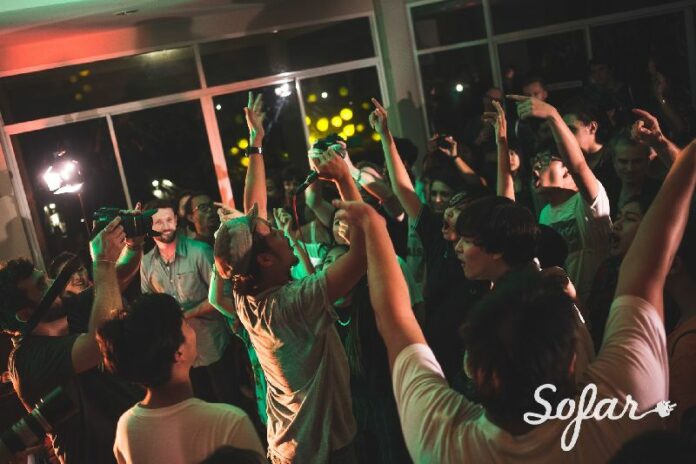
A lofty, wood-floored living room surrounded by large glass windows proved a love nest for about 200 passionate music fans interested in a break from the usual commerce-driven format. The crowd was a healthy mix of both Thais and foreigners.
One by one bands took the stage for well-received sets.
One of the most respected bands of this alternative music community, Plastic Section, shook the room with a frenzy of rock. Yanin, characterized by its deep-voiced lead singer and somber lyrics was described by someone as an “contempory folk music/songs for life.” Fwends fronted a lead singer with sweet sounds but an alt-rock twist. Closing out the party was Srirajah Rockers, who ended the night with a reggae-fused vibe and hidden Buddhist messages that sat well with the audience.
It’s a testament to the evolving music scene that the whole thing wasn’t dominated by the customary acoustic and indie flavors. In fact, Sharpe said the genres of new Bangkok music blend into one at Sofar Sounds Bangkok.
But still, it’s a thing that as an event is unlikely to catch fire beyond its existing fans.
Photo courtesy Sofar Sounds Bangkok, Vincent Roazzi.
Lead singer of Sirajah Rockers, Win Chujitarom, said that at first he didn’t understand why Sofar didn’t want more mass promotion and audiences, but he grew to embrace the concept.
“It’s held in a way in which the audience doesn’t really attach itself to the identity of the singer, but attach themselves solely to the music,” he said.
The whole Sofar Sounds thing started six years ago in London, where three guys wanted to stage more intimate music gatherings after attending a gig at a bar drowned out by chatter and ringing phones. Sofar, or Songs From a Room, launched in Bangkok in 2014 when Sharpe, a big fan of local acts such as Slot Machine, got wind of the idea.
He said the money comes mostly from their own pockets and donations from attendees. Crew members are volunteers with day jobs.
Pakarn Kiatpinyo, the group’s managing director, said they wanted everything to go slowly. He doesn’t regret that they couldn’t collaborate with big brands because it would mean changing the vision for Sofar. He said its premise is an opportunity, not an obstacle.
“Why would we want to be like the others?” he said, referring to the corporate music interests that place profit above art and community.
Luise Ganser, who produces Sofar’s videos, said she no longer feels anything at mega-concerts but gets goosebumps listening to bands at a Sofar show.
She remembers an audience being reduced to tears when the lead singer of Jinta sang a cover of “Reverse,” a song by a close friend who'd recently died, Wanarat Chaiyapan of Assajan Jakgawan. You could fill stadium after stadium with megastar performances and still fail to deliver an emotional moment like that.
Though there are plans to stage a larger concert that could accommodate 1,000 people, they want it to maintain the same intimate feeling. Maybe in a forest, they’re thinking.
On the biz side, they’ve recently partnered with Fungjai, a streaming music service for independent Thai musicians, to feature Sofar videos and music.
Sofar fans can enjoy an encore or catch shows they missed through Fungjai, potentially expanding the fan base and giving local musicians another platform to be heard. About 100,000 people are using Fungjai and its online zine, according to co-founder Piyapong Muenprasertdee.
“With the collaboration of Fungjai and Sofar, Fungjai hopes to reach a larger international audience, as Sofar Sounds has an international platform in 140 cities around the world,” Piyapong said.
So while the shows may be small and Sofar unlikely to grow beyond its niche, it may help boost Bangkok’s booming, underground alt-rock scene.
A performance by well-liked band Jelly Rocket, she said, racked up more than 50,000 views on YouTube since April.
That’s a start, and Sharpe hopes to build an platform for the music to get international exposure, but he admits that’s a challenge without the kind of overt marketing they are uneasy with.
Whether or not the tight-knit Sofar scene will endure in its present form, it seems to have tapped into the passion needed to build something that, although small, could build the jam for Bangkok’s flourishing alternative scene through Sofar’s international appeal.
Sofar Sounds next show is expected to be held late February. Learn more at Sofar Sounds Bangkok on Facebook.
Correction: An earlier version of this story incorrectly identified the singer of "Reverse" as Assajan Jakgawan. The song was originally sang by Wanarat Chaiyapan of the band Assajan Jakgawan.
To reach us about this article or another matter, please contact us by e-mail at:[email protected].
Follow Khaosod English onFacebookand Twitterfor news, politics and more from Thailand.
Actors Charlie Trairat and Ploy Sornarin in a scene from 'Arbat.' Photo: Sahamongkol Film International
BANGKOK — Sahamongkol Film International announced today it will re-edit a horror film banned by state censors yesterday for a number of scenes portraying a novice monk behaving inappropriately.
Two days before the film was to open nationwide, the studio said today it would re-submit an edited version of “Arbat” (Sin of a Monk) to the Film Censorship Board after it voted 4-to-2 to block the release of the film, stating the substance of the film would defame Buddhism by showing its lead character breaking his vows.
“If the film was screened, audiences would separate into two groups: those who would gain wisdom, and another group who would loathe the monks,” said Khajornsak Bhudhanubharb, chief of the Film Censorship Board. “Making a movie about religion can sometimes lead to social chaos, as we have seen from many countries.”
The board determined the film warranted banning under the 2010 Film Act for scenes including a novice drinking alcohol, smoking cigarettes, getting high on weed, having sexually explicit conversations, being violent and disrespecting Buddha images.
Ar-Bat, which means an ecclesiastical violation of the rules for monks and novices, is about a boy forced to become a novice by his father due to his bad behavior. The unwilling novice also becomes romantically involved with a local girl. According to the trailer, he is then haunted by his malevolent spirits for his misbehavior.
Sahamongkol wrote on Facebook that it would recut the film but will maintain its core substance and the intentions of director Kanittha Kwunyoo and its producers.
"Personally, I sympathize with the producers of this film, because they invested a lot of money in it, but if this film is screened – especially in other countries, which have no understanding of Buddhist principles – it may create the wrong understanding of Buddhism," Minister of Culture Vira Rojpojchanarat said today. "Even other religions defend their faiths; we have to defend our own, too."
Buddhist hardliners first urged the Ministry of Culture to ban the film last month. The Supreme Sangha Council, Thailand’s appointed defenders of the faith, made no statement about the film.
Religion and the monkhood are deeply revered in Thailand, but recent years have seen frequent, headline-grabbing scandals of monks in trouble for gambling, prostitution, drug use and abuse of position to amass material wealth.
There was considerable dismay expressed online today at the decision to ban the film. Many comments online expressed anger, saying banning was not necessary as Thailand already has a rating system to label movies.
“In a world where information is free, everything is available by internet streaming and downloading,” well-known film critic Kong Rithdee wrote online. “Everyone has their own screen and own thoughts, so banning is the most primitive reaction of someone who does not realize that the world can only go one way, a way better forward.”
Even a celebrity internet expat, famous for his ability to slink Thai profanity, weighed in.
“I am depressed after I learned that some people have the power to decide which movies I can't watch, even if I am almost 80 years old,” wrote online humorist Nelson S. Howe.
All films are subject to scrutiny by the Ministry of Culture’s censor board before they are released domestically. The board has a record of censoring films on the grounds of religious sensitivity and national security.
In 2006, the board ordered award-winning director Apichatpong Weerasethakul to cut scenes showing a monk playing guitar in his film “Syndromes and a Century.”
Apichatpong refused and withdrew it from domestic release.