27.7 C
Bangkok
Saturday, July 25, 2026
Home Blog Page 2945

Hiring Assistant Editor for Khaosod English

(Update: The position is now closed)

BANGKOK — Khaosod Public Co. Ltd. is looking for erudite news pros with judgment and flexibility to cover everything from street crime and politics to development and nightlife in Bangkok.


Assistant Editor – Khaosod English

Khaosod English is looking for a full-time, English-fluent assistant editor for its Bangkok newsroom.

Does digging into daily news copy under deadline pressure put you in a subjunctive mood? Do you hold clear, crisp prose sacred and consider mistakes a personal failure?

Khaosod English is seeking a syntax/grammar crusader with a keen interest in news to help ensure high quality content for our readers. Candidates should bring a 21st century execution to the best traditions and principles of newsgathering.

Primary duties include proofing/fact-checking stories, coordinating with senior editor/staff reporters, and publishing stories and content on multiple platforms. Editors will have opportunities to write stories for publication.

An ideal candidate has several years of professional journalism experience, a relevant degree, passion for excellence and some tech savvy.

Khaosod English prizes newsroom diversity as essential to best serving our readers. Applications will be received until position are filled. Candidates should send a letter of inquiry, CV and work samples to Todd Ruiz at [email protected].

\


To reach us about this article or another matter, please contact us by e-mail at: [email protected].

Follow Khaosod English on Facebook and Twitter for news, politics and more from Thailand.

Follow @KhaosodEnglish

\

Advertisement

Chang, Celebs Panned for Pitching Beer On Instagram

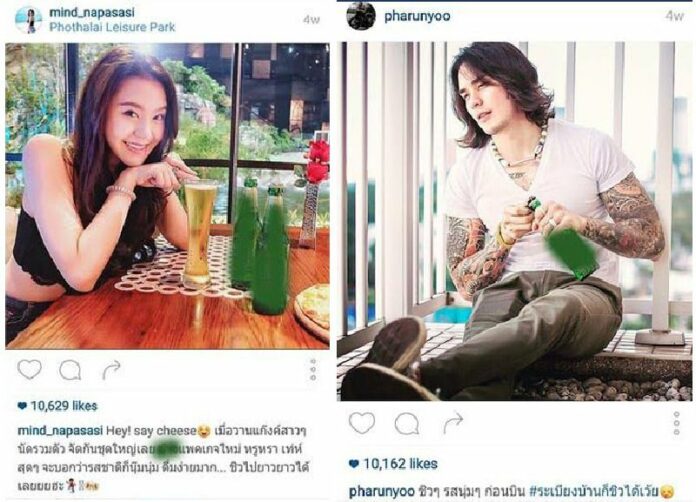
Similar images posted recently on the Instagram accounts of celebs Napasasi "Mind" Surawan and Pharunyoo “Tack” Rojanawuttitham. They've since been removed after coming under scrutiny.


BANGKOK — The photos are made to look spontaneous and amateur, but the composition – brand labels carefully turned toward the lens – suggested otherwise.

The Ministry of Health said yesterday it will look into complaints by anti-alcohol groups that celebrities have been skirting the law in photos posted to Instagram.

“If the actors and singers say they didn’t make money posting photos of alcoholic beverages, with clear brand logos plus captions encouraging drinking, or even just the photo alone, they would then, as an individual, be guilty of alcohol advertisement,” said Kittisak Klubdee, an adviser to the public health minister. “But if they were hired, the beer company will also be punished.”

In recent days, similar photos began appearing on the Instagram accounts of a number of stars including Virithipa “Woonsen” Pakdeeprasong, Yae “Non” Nonthaporn and Pharunyoo “Tack” Rojanawuttitham.

In all of them, a popular personality with a big online following holds bottles of beer in their hands along with an alluring caption aimed to praise Chang’s new bottle design.

On Oct. 1, singer Pakorn “Dome” Lam posted a photo of him pouring a foamy glass of Chang with the caption “Let’s the party begins.” The singer later removed the photo from his account and insisted he did not get paid for it.


\

Similar images posted to Instagram accounts of Poomjai Tangsanga and Dome Pakorn Lam.


In a country that is heavily engaged in social media, it is common for entertainers to supplement their incomes by promoting products online. However advertising alcohol, or even showing a brand’s logo to indirectly encourage drinking, is illegal under Section 32 of Thailand’s 2008 Alcohol Control Act.

First bringing attention to the suspected marketing campaign was Facebook user Todd Piti, who called on related organizations to investigate.

Wearing a baseball cap turned around to show the Singha beer logo in his photo, “Todd Piti” is believed to be Piti Bhirombhakdi, heir to rival Singha Corp.

Singha is produced by Boon Rawd Brewery and Chang by ThaiBev. They are the two biggest competitors in Thailand’s growing beverage business, expected to be more than 137,000 million baht worth in 2015.

According to Positioning magazine, Boon Rawd outperformed ThaiBev in 2014 with Singha holding a 58 percent share in the premium beer market and its Leo brand accounting for 72 percent of the mass market.

\


To reach us about this article or another matter, please contact us by e-mail at: [email protected].

Follow Khaosod English on Facebook and Twitter for news, politics and more from Thailand.

Follow @KhaosodEnglish

\

Advertisement

China’s Monetary-Policy Choice

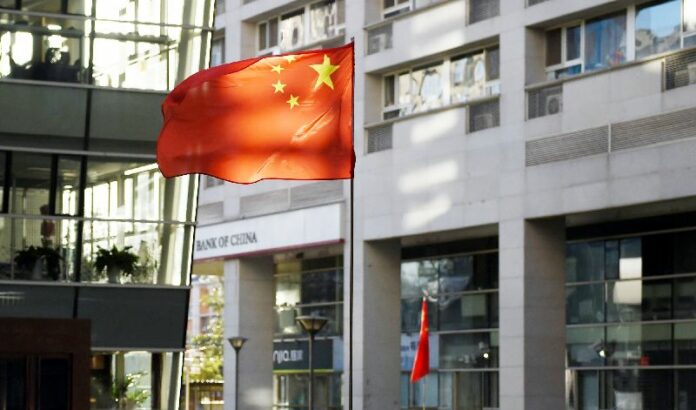
AFP PHOTO

By Zhang Jun

SHANGHAI – China’s economy has followed a remarkable course in recent years: from record-breaking powerhouse to major global risk, at least in the eyes of some. Indeed, with GDP growth this year almost certain not to reach the authorities’ 7% target, the world is now watching closely for signs of crisis and a much sharper slowdown. How did China get here, and can it put its economic growth back on track?


China’s growth has been unsustainable for a while. A stimulus package of less-than-prudent fixed-asset investment, adopted in response to the 2008 global financial crisis, sustained 9% GDP growth for two years. But, after 2011, stimulus turned to macroeconomic tightening, causing investment growth to plummet from a nominal rate of over 30% to about 10% recently. This prevents full utilization of production capacity and resources, and explains why GDP growth above 7% is simply not possible.


Excess capacity and falling growth are mutually reinforcing. Not only does excess capacity have a negative impact on growth; perhaps more important, sharply declining growth also contributes to massive redundancy in some industries (especially resources and the heavy and chemical industries).


The question is why growth continues to slow. One popular line of thinking focuses on long-term structural factors, such as demographic transition. But, so far, few studies have indicated that structural factors are adequate to explain the extent of the decline in China’s potential growth rate over the last couple of years.


A more convincing answer lies in China’s monetary-policy stance. Since assuming office in 2013, Premier Li Keqiang’s government has chosen not to loosen the previous government’s rigorous macro policies, instead hoping that the resulting pressure on existing industries might help to stimulate the authorities’ sought-after structural shift toward household consumption and services. Economists welcomed this ostensibly reasonable approach, which would slow the expansion of credit that had enabled a massive debt build-up in 2008-2010. China’s lower growth trajectory was dubbed the “new normal.”


But, for this approach to work, GDP growth would have had to remain steady, rather than decline sharply. And that is not what has happened. Indeed, although structural adjustment continues in China, the economy is facing an increasingly serious contraction in demand and continued deflation. The consumer price index (CPI) has remained below 2%, and the producer price index (PPI) has been negative, for 44 months.


In a country with a huge amount of liquidity – M2 (a common measure of the money supply) amounts to double China’s GDP – and still-rising borrowing costs, this makes little sense. The problem is that the government has maintained a PPI-adjusted benchmark interest rate that exceeds 11%. Interest rates reach a ludicrous 20% in the shadow banking sector, and run even higher for some private lending.


The result is excessively high financing costs, which have made it impossible for firms in many manufacturing industries to maintain marginal profitability. Moreover, the closure of local-government financing platforms, together with the credit ceiling imposed by the central government, has caused local capital spending on investment in infrastructure to drop to a historic low. And tightening financial constraints have weakened growth in the real-estate sector considerably. With local governments and companies struggling to make interest payments, they are forced into a vicious cycle, borrowing from the shadow banking sector to meet their obligations, thereby raising the risk-free interest rate further.


If excessively high real interest rates are undermining the domestic demand that China needs to reverse the economic slowdown, one naturally wonders why the government does not take steps to lower them. The apparent answer is the government’s overriding commitment to shifting the economy away from investment- and export-led growth.


But it is doubtful that China can achieve the consumption-driven rebalancing that it seeks. After all, no high-performing East Asian economy has achieved such a rebalancing in the past, and China has a similar growth model.


Given this, China’s current deflation should motivate its policymakers to pursue monetary easing, reducing real interest rates to a much lower level, even zero. Such a move – for which China has plenty of room – would not only enable the reduction of existing debt burdens; perhaps more important, it would also allow for the rollover of debt as the economy accelerates.


Indeed, because most bank loans in China – unlike, say, in Europe – are now locked up in infrastructure and other physical assets, boosting demand is preferable to deleveraging. The key is to lower interest rates enough to mitigate the financial risks of high leverage and enable the restructuring of local-government debts. Lower borrowing costs would also boost China’s capital market, which is critical to provide equity financing to innovative small and medium-size businesses.


Of course, China needs to continue debt write-offs and swaps, and it must remain on the path of gradual structural reform. But policymakers must recognize the damage being done by excessively high real interest rates. Monetary loosening is vital to prevent growth from slowing further, and thus to ensure economic stability at home and maintain the momentum of recovery worldwide.


Zhang Jun is Professor of Economics and Director of the China Center for Economic Studies at Fudan University.


Copyright: Project Syndicate, 2015.
www.project-syndicate.org

Advertisement

Vendors Revolt as BMA Moves to Demolish ‘Saphan Lek’

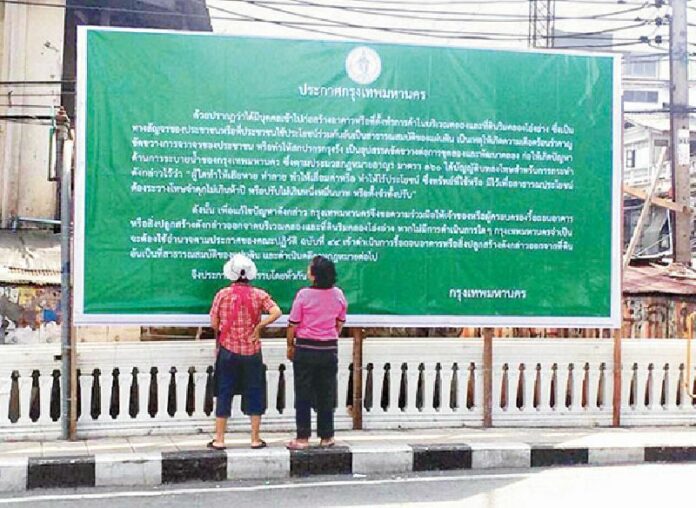
A billboard ordering vendors out of Bangkok's famed Saphan Lek market as seen Monday. Photo: Matichon


BANGKOK — A maze-like warren of cheap electronics, toys and other goods is the latest target of a government campaign to reclaim public space, and once again the vendors who’ve long called it home are not leaving without a fight.

Thailand’s National Human Rights Commission said today it will review a city hall order giving vendors until Tuesday to clear out from the famed Saphan Lek market after several filed a complaint against the Bangkok Metropolitan Administration, or BMA.

“I will invite every party, from the BMA, vendors and experts to join a discussion into whether the demolition process is legal,” Commissioner Niran Pitakwatchara said.

Situated on the west side of Bangkok’s Chinatown, Saphan Lek is unique among other street markets. It’s situated over a canal, next to the metal bridge which its name was given. It’s the kind of place one readily finds inexpensive imported toys, knock-offs and game systems modified to circumvent copy protection.

\

A vendor sells electronic toys in Bangkok's Saphan Lek market on Monday. Photo: Matichon

The BMA said the market affects water management because it sits over Khlong Ong Ang, which is registered as a historical site. They plan to demolish it.

But the stall owners nestled there, some for more than 30 years, said they’ve always paid rent to a private agency with a BMA concession.

Hatairat Sinthaw, a 47-year-old representative of the vendors, said after the order was issued that it didn’t make sense for city hall to one day approve their tenancy then claim it was illegal the next.

“Then how come the vendors could previously get permits from the district office?” she said.

The order to cut off the market’s supply of electricity and water before demolishing it came only 11 days ago. Vendors said the order infringes on the community’s rights, and their right to earn a living.

Come Oct. 13, the BMA said it has the authority to forcibly remove the vendors under a 1959 law established after a coup led by dictator Gen. Sarit Dhanarajata which authorized the clearing of public space.

More than 500 houses and stalls there are illegally located on public land, where they clog the waterway and encroach onto the historic canal, according to police Maj. Gen. Wichai Sangprapai, adviser to Bangkok Gov. Sukhumbhand Paribatra.

Nearly 100 Saphan Lek vendors also went to the government ombudsman’s office to call for it to intervene.

An unwelcome eyesore to some and landmark fixture to others, Saphan Lek is the latest icon of chaotic Bangkok to face elimination.

In February, Bangkok’s largest grey-black market, Khlong Thom, was shut down not far away. Elsewhere, vendors have been cleared out from locations or restricted in operating, such as on Silom Road. BMA now sweeps their cleanup campaign to reclaim the public space from many iconic street markets.

Each time vendors have mounted resistance but were only able to win small concessions in how they would be accommodated.

Clearing out Saphan Lek would make for about 2,700 vendors displaced, including those earlier pushed out of the Khlong Thom market.

These actions have been euphemistically referred to as “reorganization,” but mostly have involved removing vendors from an area and offering them distant, alternative selling spaces many have rejected as impractical.

\

A man walks between stalls in Bangkok's Saphan Lek market on Monday. Photo: Matichon

The BMA has said it is carrying out the military government’s policy to reclaim the city’s public space and walkways.

Next it plans to dismantle well-known street stalls at the Banglamphu Market, as well as those at Phra Arthit and Chang piers along the Chao Phraya River.


To reach us about this article or another matter, please contact us by e-mail at: [email protected].

Follow Khaosod English on Facebook and Twitter for news, politics and more from Thailand.

Follow @KhaosodEnglish

\

Advertisement

Indonesia Seeks Help to Put Out Fires

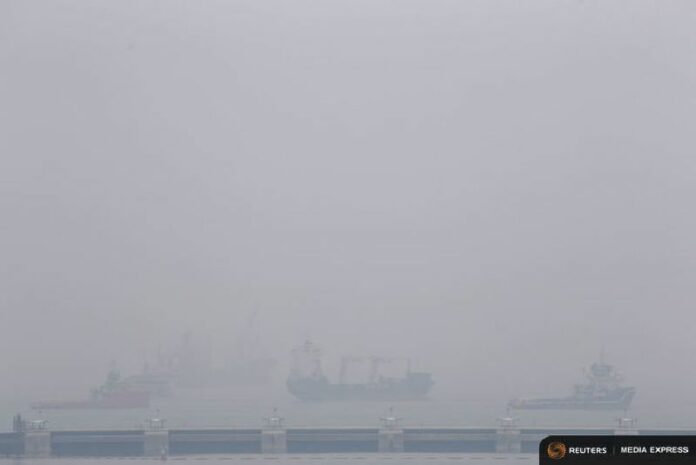
Vessels line the anchorage area in the southern coast of Singapore on Monday. Photo: Reuters / Edgar Su

JAKARTA — Indonesia on Thursday asked several countries including China, Singapore, Russia and Japan for help to put out fires that have sent choking smoke drifting across the region for weeks.

Indonesia had repeatedly declined offers of outside help to tackle the smoke, which is mostly caused by companies using fire to clear land for palm oil and pulp wood plantations on Sumatra island and its part of Borneo island.

"We have asked for help," President Joko Widodo said in a statement, adding that Indonesia was hoping for at least three aircraft from Singapore and Russia to help douse the fires that often smolder underground for weeks in peat deposits.

"What we need now are planes that can carry 12-15 tons of water, not like the 2-3 tons we have now," Widodo said. "We hope this will speed up the process because fires on peat land is different from regular forest fires."

\

A portion of the front page of Jakarta-based newspaper Republika, which covered its front page Thursday with smoke.


Indonesia was also in talks with Australia and Malaysia about how they might help, said foreign ministry spokesman Armanatha Nasir.

"We have been using all our resources but what we see is our progress is not quick enough," Nasir told Reuters, adding that Indonesia was exploring what roles the countries could play and what equipment they could provide.

They aimed to finalize details "as soon as possible," he said.

Indonesian officials did not elaborate on why the government had now decided to seek foreign help. It had faced criticism for turning down offers from Singapore.

The smoke has pushed up pollution to dangerous levels across parts of Indonesia, Malaysia, Singapore and southern Thailand, disrupted flights and closed schools on bad days.

Tourism operators are fretting and health authorities across the region have warned people to avoid exercise when the smoke is heavy.

Indonesia routinely brushes off complaints while vowing to act to stop the burning. But year after year, the problem flares in the dry season.

It has been exacerbated this year by the El Nino weather phenomenon which has brought unusually dry conditions.

Indonesia's national disaster management agency said last week it was hoping for rain to help douse the fires by early November, when the northeast monsoon usually starts.

Foreign Minister Retno Marsudi is expected to meet her Malaysian counterpart on Friday to discuss the problem.

Singapore's foreign minister, Vivian Balakrishnan, said on his Facebook page the city-state had offered personnel, aircraft, and satellite imaging.

Story: Reuters / Gayatri Suroyo and Kanupriya Kapoor


To reach us about this article or another matter, please contact us by e-mail at: [email protected].

Follow Khaosod English on Facebook and Twitter for news, politics and more from Thailand.

Follow @KhaosodEnglish

\

Advertisement

EU Parliament Slams Thai Junta For Rights Abuses

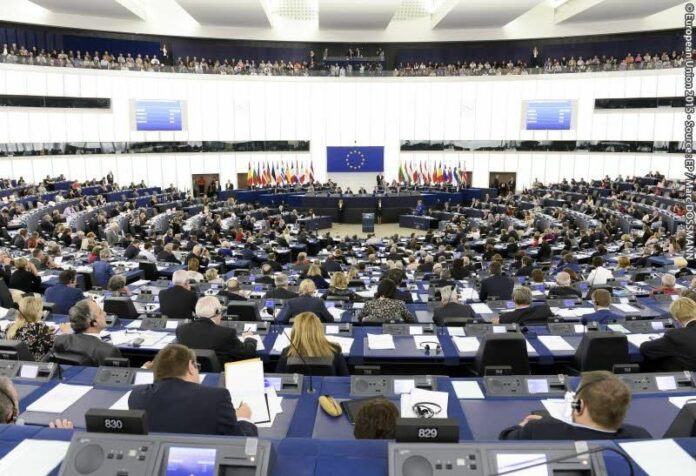
EU Parliament in session on Wednesday. Photo: European Parliament


STRASBOURG — The EU Parliament on Thursday condemned human rights abuses in Thailand and called on its military government to return the country to civilian rule.

In a nonbinding resolution, the parliament expressed its concern over Thailand’s deteriorating human rights situation since the military seized power in 2014 and issued specific calls urging the country to “lift repressive restrictions on the right to liberty and the peaceful exercise of other human rights.”

“Thailand must hear very clearly a strong demand on part of the European Parliament that democracy must be reinstated there, which the country deserves,” said Polish Vice President of the parliament Ryszard Czarnecki. “… We should not only monitor the situation in Thailand up close, we should indicate that our economic cooperation may actually be hinged on Thailand’s cooperation with human rights.”

The motion was passed 581-to-35 with 35 abstentions.

Thailand’s Ministry of Foreign Affairs expressed disappointment with the resolution this morning, saying the EU Parliament “misunderstands” Thailand’s determination and commitment to protecting and uplifting human rights, and respecting its international obligations. The Ministry insisted Thailand is strictly following its roadmap to election.

“Thailand welcomes all constructive and balanced suggestions that are based on correct information and is ready to cooperate with the EU on every level over issues,” read the statement from ministry spokesman Sek Wannamethee.

The EU resolution welcomed last month’s rejection of a draft constitution which would have “seriously undermined Thailand’s democratic development,” and called for an inclusive process in redrafting the constitution.

It also said Thailand should overturn convictions and release those who have been sentenced or charged for peaceful expression or assembly.

Junta critics, many of whom are members or supporters of the civilian government removed from power by the May 2014 coup d’etat, have been ordered to report for “attitude adjustment” sessions under the sweeping powers the military government has granted to itself.

All political activities have been banned, as have rallies and demonstrations.

The 23-point resolution also mentioned human trafficking, slave labor in the fishing industry, media freedom, censorship and the kingdom’s lese majeste law, which imposes strong penalties and long prison sentences for defaming the monarchy.

Despite the long list of EU concerns, Thailand’s statement this morning welcomed several points in the motion praising Thailand’s progress in certain areas, such as gender equality.

Ignazio Corrao of the EU’s Europe of Freedom and Direct Democracy group said “there’s been an escalation of violence and repression since the coup last year and anyone who opposes the junta now finds themselves persecuted and imprisoned.”

“The EU is still in a position to exert pressure on the junta, to use our economic might and political skills to push the it towards restoring democracy,” he said.

The European Union will decide in December whether to follow through on a threat to ban Thai seafood imports, which would be a damaging blow to what is a valuable sector in the kingdom’s economy.

The resolution was one of four passed yesterday concerning human rights, democracy and the rule of law. Others addressed issues in Saudi Arabia, Nigeria and the Central African Republic.


To reach us about this article or another matter, please contact us by e-mail at: [email protected].

Follow Khaosod English on Facebook and Twitter for news, politics and more from Thailand.

Follow @KhaosodEnglish

\

Advertisement

Cyberactivists, Govt Don’t Blink on ‘Single Gateway’

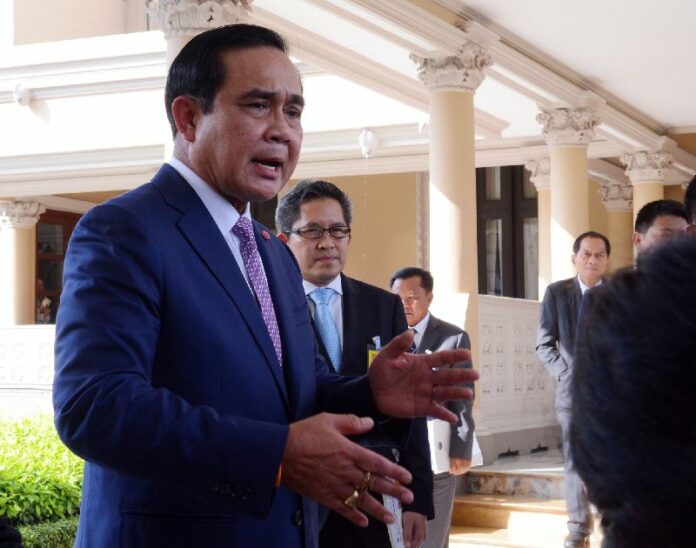
Gen. Prayuth Chan-ocha yesterday at Government House in Bangkok.

BANGKOK — Six days before online dissidents threaten escalated attacks on government web servers, Thailand’s military government insists it is impossible to meet their demands.

A government spokesman today repeated that the project to route all internet traffic through a single point of control cannot be rescinded – as online activists demand – because it was never authorized in the first place.

“I insist the prime minister has never ordered the single gateway to be implemented,” Maj. Gen. Sansern Kaewkamnerd said. “It was only mentioned as an interesting example for discussion. There were also other topics that were talked about but never put on the record.”

Read: Gamers, Geeks on Epic Quest for Internet Freedom

Since Oct. 2, those organized online against the project have insisted the government capitulate by issuing a cabinet resolution canceling plans for the project to funnel all IP traffic through a single gateway. They point to a series of legally binding resolutions issued since June 30 which authorized the project and urged responsible agencies to “speed up” its implementation.

If that doesn’t happen, they have vowed to take down government web services, as they succeeded doing in a coordinated, crude attack on Sept. 30. A number of agencies’ services failed after they were overwhelmed by users reloading the sites in their browsers.

The response from a chorus of officials has been equally intransigent. From the top down, they have denied the project ever got past the “concept” phase. On Tuesday the Foreign Correspondents Club of Thailand said the government telecommunications ministry backed out of a discussion panel at because it would not discuss the issue.

Over the past weekend, however, someone did remove from the cabinet’s site the first of four resolutions related to the project. It defined the project’s purpose in no uncertain terms: “to control inappropriate websites, and flow of news and information from overseas through the internet.”

Junta chairman Prayuth Chan-ocha today cast blame on the unnamed staff member responsible for typing cabinet minutes and resolutions for possibly “misleading society.”

He said the cabinet only discussed how to protect the internet from threats in keeping with the law and without infringing on human rights.

“Do we still have a problem? Students can access porn photos all they want. What should we do about this?” he was quoted saying in Prachachat. “Not that I mean the single gateway can solve all problems.”

He told reporters to stop asking him about the issue.

None of this has cooled the rage online, where the frenzied internet crowd describes the government’s response as “empty words.” Activists, many anonymous, call for taking down more government functions Oct. 14.

“When they don’t know how to end the #SingleGateway story, it’s bad luck for the small person blamed for making a mistake in taking cabinet meeting notes,” wrote the anonymous author of politically charged Facebook page The Prophet. “The question is how can it be a mistake when apparently the document showed it was ordered four or five times. Would it be possible that the staff misunderstood what was said every time?”


Legal Consequences Threatened

Maj. Gen. Rittee Intravudh, director of the army’s cyber unit has said his team was collecting IP addresses from recent attacks to track users for possible prosecution under the Computer Crime Act.

Were investigators able to somehow separate innocuous web traffic from hostile web traffic, they could seek prosecution under the act.

Although activists such as Arthit Suriyawongkul of the Thai Netizen Network liken the online campaign to virtual civil disobedience, a law professor at the University of the Thai Chamber of Commerce was not sure that would protect anyone from prosecution.

Jompon Pitaksantayothin wrote last week their actions might considered illegal under the law if someone accessed the site with intent to disturb the system.

“A virtual sit-in might be illegal, but we have to remember that it is also a social movement for voicing one’s opinion against public policy that affects them,” the law lecturer wrote. “… We can also say it is a confrontation between the letter of the law and social legitimacy.”

Jompon said the government’s refusal to openly discuss the issue and take input from the people is the main cause for netizens, young or old, to join the opposition and take action to protect their shared interests.

It’s different from the offline protests the government can move to quash any time, Jompon said:

“No one has absolute power in cyberspace.”


Related stories:

Gamers, Geeks on Epic Quest for Internet Freedom

Activists Issue Ultimatum to Junta over ‘Single Gateway’

Govt ‘Gateway’ Denials Contradict Cabinet Resolutions

Cyber Activists Bring Down Govt Sites to Protest ‘Single Gateway’

Single Gateway for Internet Still Under Study, Minister Says

Advertisement

Yes, Miss Universe Thailand Will Wear a Tuk-Tuk

Miss Universe Thailand Aniporn Chalermburanawong poses in the tuk-tuk themed dress she will wear at the pageant this year. Photo: Miss Universe Thailand fanpage / Facebook


BANGKOK — When Thailand’s contender for the Miss Universe crown takes the stage later this year at the international beauty pageant, she will arrive in a tuk-tuk.

A dress inspired by the iconic, three-wheeled wonder was selected from 356 entries as the national costume for Aniporn Chalermburanawong to wear this December at the Miss Universe pageant in United States, organizers announced yesterday.

“I believe this Tuk-Tuk dress will make our representative more visible on stage and different from our past costumes with its pop-art design,” said its 35-year-old designer, Hirankrit Pattaraboriboonkul.

\

Costume chosen for Miss Universe Thailand 2013, Lita Chalita.

Familiar to audiences around the world, the tuk-tuk dress is a break from the usual reimagined takes on traditional Thai costume. Best of all, it has functioning lights that can be activated while Aniporn is on stage.

Miss Universe is under new management this year after its former owner, real estate tycoon and U.S. presidential candidate Donald Trump, introduced his candidacy blaming crime on immigrants. A number of business partners including his pageant broadcast partners distanced themselves from Trump, and he sold it to two U.S. talent agencies.

Hirankrit said he decided to break from the past with a fresh and direct pop approach.

“I spent three days designing this dress and researching national costumes from previous years,” he said. “This is my first year joining the competition.”

For her part, Apiporn agreed the costume would help a foreign audience recognize she is from Thailand. And, she added, the clean design will be easy for her to manage on the stage.


To reach us about this article or another matter, please contact us by e-mail at: [email protected].

Follow Khaosod English on Facebook and Twitter for news, politics and more from Thailand.

Follow @KhaosodEnglish

\

Advertisement

Singapore Pressures Firms Linked to Indonesian Smog

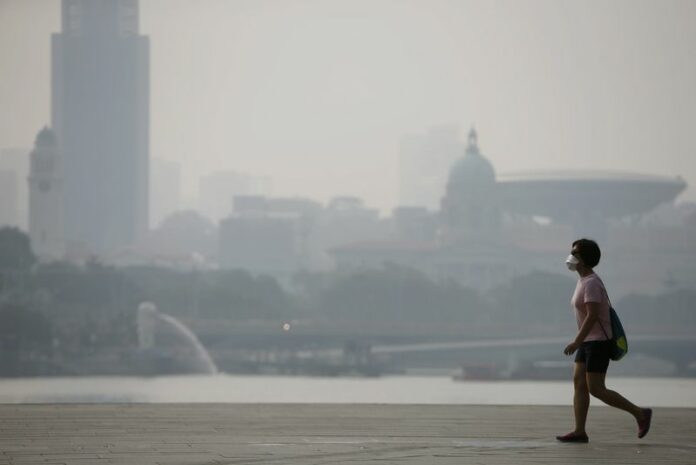
A pedestrian wears a face mask in smog-choked Singapore in this undated file photo. Photo: DPA / Wallace Woon

SINGAPORE — Major retailers in Singapore are being asked to declare that they are not buying or using wood, paper or pulp materials from companies accused of causing fires to clear land in Indonesia that have led to haze blanketing parts of the region.

The Singapore Environment Council and Consumers Association of Singapore said Wednesday that major supermarkets, pharmacies and furniture retailers have been sent declaration forms to confirm that they have not procured materials from "unsustainable sources."

"These major supermarkets, pharmacies and furniture retailers operate several outlets from which consumers purchase paper-based products," the statement said. "They are a good starting point for retailers to commit to a green procurement process and for consumers to show their support for brands that have environmentally friendly practices."

Twelve companies have responded so far, among them Fuji Xerox Singapore Pte Ltd and Canon Singapore Pte Ltd, saying that their products have not been sourced from companies suspected to be responsible for the air pollution over parts of Indonesia, Singapore and Malaysia.

Major supermarket chain NTUC FairPrice also announced on Wednesday that they have withdrawn all products sourced by Asia Pulp & Paper Group after the environment council temporarily restricted use of the Singapore Green Label certification for all the company's products.


Choking on Smog

In Thailand haze-related problems caused four flights, inluding two international flights, to be diverted from Phuket Island in the country's south.

"A Jet Star flight flying from Singapore and a Malaysia Airlines flight from Kuala Lumpur were both diverted to Penang in Malaysia," Phuket Airport director Thanin Kamnansingha said.

The official also revealed that 11 more planes had to enter holding patterns around the airport before being allowed to land.

It is the first time that haze-related problems had affected airline activity in Thailand.

Haze from forest fires is an annual hazard in Indonesia and often spreads to other parts of Southeast Asia, including Singapore. The practice of open burning to clear land is illegal but is common in Indonesia.


Related stories:

Indonesian Smoke Spreads to Thai South, Sickening Hundreds

Indonesian Haze Forces Singapore to Close Schools


To reach us about this article or another matter, please contact us by e-mail at: [email protected].

Follow Khaosod English on Facebook and Twitter for news, politics and more from Thailand.

Follow @KhaosodEnglish

\

Advertisement

Over 90 Political Prisoners Behind Bars in Myanmar, Amnesty says

Amnesty International

YANGON — Myanmar has detained 91 political prisoners as part of "chilling crackdown" on human rights, campaign group Amnesty International said Thursday.

Amnesty accuses the Myanmar authorities of seeking to restrict freedom of expression over the past two years, and in particular ahead of general elections in a month's time.

In 2013, there were just two "prisoners of conscience" behind bars in Myanmar, the group said in a briefing document.

Myanmar had at the time vowed to undertake a series of political reforms, including releasing all political prisoners by the end of 2013. Those promises resulted in the lifting of many international sanctions.

However, rights groups say about 20 political prisoners were among those freed in a mass amnesty of 7,000 inmates in July this year, and many more are still in jail.

"Myanmar's government is trying to spin an alternate reality where all is rosy for human rights, which the international community is far too eager to accept," Laura Haigh, Amnesty International's Myanmar Researcher, said in a statement.

The group said it had documented fewer releases on bail, longer prison sentences, as well as surveillance and harassment of individuals deemed a danger to the state.

The Thailand-based Assistance Association for Political Prisoners in Myanmar has also called for the release of political prisoners ahead of the November 8 elections, saying they number 95 people, with hundreds more on trial.

Story: DPA


To reach us about this article or another matter, please contact us by e-mail at: [email protected].

Follow Khaosod English on Facebook and Twitter for news, politics and more from Thailand.

Follow @KhaosodEnglish

\

Advertisement

Hot News

LATEST NEWS

Bangkok
overcast clouds
27.7 ° C
27.7 °
24.4 °
83 %
3.3kmh
100 %
Fri
29 °
Sat
35 °
Sun
33 °
Mon
32 °
Tue
31 °