
































26.6 C
Bangkok
Friday, July 24, 2026
Home Blog Page 2949

Rising Anger in Boom-to-Bust Isaan

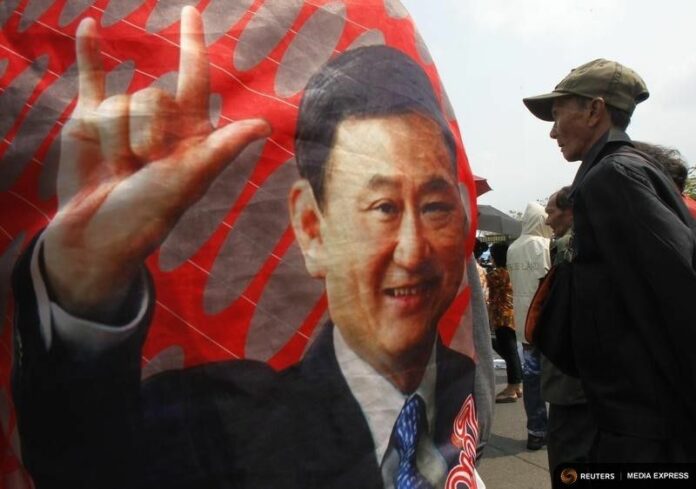
A government supporter stands next to a picture of former Thai Prime Minister Thaksin Shinawatra during a rally outside the National Anti-Corruption Commission office in Nonthaburi province, on the outskirts of Bangkok on 27 Feb., 2014. Photo: Reuters / Chaiwat Subprasom

KHON KAEN — The rural heartland of deposed leader Yingluck Shinawatra and her exiled billionaire brother Thaksin is hurting as a result of the military government's economic policies, stirring discontent and the threat of protests.

The removal of generous agricultural subsidies has left rice farmers in northeast Thailand struggling with mounting debts, and they will get little relief when they sell their crop in coming months with rice prices near an eight-year low.

Petty crime is on the rise and retailers are struggling. The vast Platinum 168 shopping mall on the outskirts of the provincial capital of Udon Thani was built during the boom, but it is now less than a third occupied and no longer charging tenants rent.

"People are complaining about the rising costs of living, of having no money for spending," said Teerasak Teecayuphan, mayor of the neighboring provincial capital of Khon Kaen. "Their patience will gradually run out. Sooner or later this pot will boil over."

Thaksin's Redshirt supporters, many of whom hail from the northeast, have punctuated a decade of political turmoil in Thailand with protests on the capital's streets.

Military attempts to disperse 10 weeks of protests in 2010 left scores dead and sparked arson and riots.

Thaksin recently told his supporters to stay calm and "play dead," but some in Thailand's poorest region say it is only a matter of time before discontent overcomes fear of the military and people again take to the streets.

"People want to protest," said Sabina Shah, a local leader of Thaksin's Redshirt supporters in Khon Kaen.

"But we have to wait for the right trigger. If we come out now in small numbers it's suicide. We are just lying low and waiting for the opportunity – when the government argue among themselves."

The military toppled Yingluck's government in a May 2014 coup and have zealously enforced a ban on their political activity.

Both Shinawatras mobilized the rural poor to deliver landslide electoral victories with a mixture of development projects, social benefits and subsidies.

Many in the northeast, known as Isaan, think they are paying an economic price for their political allegiance.

Coup leader and Prime Minister Prayuth Chan-ocha represents a largely Bangkok-based establishment that reviles the Shinawatras' populist policies and is threatened by their rural support base.

His government has been austere in support for agriculture, which accounts for just under 10 percent of the country's economy.

"It is quite bad for farmers, we have heavy debt," said Pursudar Koyto, in Ban Kampom, a village surrounded by verdant rice paddy fields nearly ready to harvest. "Prayuth's government could have done more, like what they did in the Thaksin era."

While incomes improved under the Shinawatras, household incomes in Isaan are still the lowest in Thailand at just over 19,000 baht (USD$522.98) per month. That is less than half the 43,000 baht of the Bangkok region, according to government statistics for 2013, the latest data available.

\

Closed stores at Platinum shopping mall in Udon Thani province on 15 Sept., 2015. Photo: Reuters / Jorge Silva
 

Military Warns of National Fallout

The junta has now made an about-turn on policy to breathe life into a moribund economy and head off rising discontent.

Prayuth in August appointed Somkid Jatusripitak – one of the architects of Thaksin's policies – as his economic czar.

Somkid has prioritized reviving the rural economy, which employs nearly 40 percent of the workforce.

"They are suffering," he told Reuters in an interview. "If these people don't have enough purchasing power it will hurt the whole system."

Southeast Asia's second-largest economy has undershot government targets. The central bank cut its GDP growth forecast to 2.7 percent from 3 percent on Sept. 25, and to 3.7 percent from 4.1 percent for 2016. In 2014, growth was the slowest in three years at 0.9 percent.

Somkid has announced a raft of measures, including soft loans through village funds, but the jury is still out on whether he can spur more growth. Somkid said he would inject more cash into the rural economy if needed.

\

Rice mill workers check and classify rice quality in a rice mill in Khon Kaen province on 14 Sept., 2015. Photo: Reuters / Jorge Silva

Worse to Come

The signs of economic malaise in Isaan are widespread. Private investment, vehicle sales and property values have all fallen and farmers in the world's second-largest rice exporter expect things to get worse before they get better.

Cash is already running out and many are selling cars and land to repay loans. Credit is scarce as banks tighten lending to battle rising bad debt.

"I have to borrow to pay some debt back every year," said rice farmer Khamkong Banphod, in the village of Ku Kaew near Udon Thani.

"Those facing hardship are the people who invested a lot of money and are now facing losses. They have their debt problems and are angry with the government."

The margin for millers has been razor-thin since subsidies ended, said Somsak Tungphitukkul, who owns rice mills in Khon Kaen province. Many mills cannot turn a profit and have been mothballed or closed, he said.

"It's going to be a nightmare for the rice industry if the government doesn't do something when the new crop comes in," he said.

Story: Reuters / Pairat Temphairojana and Simon Webb


To reach us about this article or another matter, please contact us by e-mail at: [email protected].

Follow Khaosod English on Facebook and Twitter for news, politics and more from Thailand.

Follow @KhaosodEnglish

\


Advertisement

Cyber Activists Bring Down Govt Sites to Protest ‘Single Gateway’

Fan art from Facebook page DrawAndDxng depicting the single gateway as an evil character wearing a coconut shell controlling all the data streams.

BANGKOK — Of the different stakeholders opposed to a government-managed “single gateway” for internet traffic, it was some of the net's most zealous users which instigated a crude but effective cyberattack last night to protest the plan.

To express dissent – and highlight the vulnerability of government systems – a community of online gamers opposed the government’s plan to police all internet traffic knocked offline websites of several state agencies, including the telecommunication ministry.

No sophisticated hacking seemed involved. Instead it was conducted using a simple yet reliable method to cripple targeted web servers. Activists circulated messages on Facebook last night urging supporters to mass-click and refresh the websites of specific government agencies at 10pm in what proved a successful bid to bring down services – a common method known as a distributed denial of service attack, or DDOS.

“Today after 10pm, people who are united to oppose the single gateway system will launch a symbolic attack by method of DDOS, which is a symbolic method [of expression], since it is a method that everyone with a mobile phone and internet can do,” the post reads. “It is a demonstration of the power of the people.”

\


The Facebook message said the attacks were meant to show dissent against the military government’s plan to implement a single gateway to control and monitor all internet traffic in the kingdom.

Websites named as targets of the DDOS include the Ministry of Information and Communication Technology (ICT), CAT Telecom, Ministry of Defense, Government House, Internal Security Operation Command, and Democrat Party.

Starting at about 9:30pm, the targeted websites were quickly brought down. Most services returned by Thursday afternoon, except the Ministry of Defense website. The ICT website was down intermittently throughout the morning.

It appears the campaign was first initiated by a Facebook group called “Mobilizing Gamers to Take Back CAT Tower From the Mob” – a community of online gamers angered by an anti-government protest that seized control of CAT Telecom building and cut its power supply in November 2013, which briefly disrupted internet service in some parts of Thailand.

The campaign was soon picked up by other communities opposed to the single gateway.

Many Thai government agencies’ websites are outdated and poorly maintained, making them ripe targets for crude cyberattacks in the past; in August websites of several local administrative offices were hacked by an online group that claimed to represent a Tunisian Islamist movement.

Arthit Suriyawongkul, coordinator of internet freedom advocacy group Thai Netizen Network, described the campaign as virtual civil disobedience akin to non-violent resistance by civil rights groups in the United States.

"DDOS attack tends to be linked to criminality," Arthit wrote on Facebook. "A more appropriate word is virtual sit-in or virtual blockade, which is a form of electronic civil disobedience. Well, strictly speaking, civil disobedience is about breaking the laws, but it is about breaking the laws in order to achieve principles that people believe to be more noble."

Somsak Khaosuwan, deputy permanent secretary to the ICT, criticized last night’s DDOS attacks in an interview with Matichon.

“I want to ask people behind this, what are they doing it for? The Ministry has not proceeded with anything [about single gateway]. Why are they not joining a discussion to solve problem together? It’s better than inviting people to cause damage to the state,” Somsak said. 

He continued, “Do you know what ICT has done as of today? We have done nothing. If you have any objection, let’s talk and discuss together. I’d like them to think of the state and the society. Use their knowledge and ability to help create safety for our society. By doing this, how does it benefit society?”

The military junta introduced the idea of the single gateway soon after it seized power from an elected government in May 2014. There had been no progress in the project until the cabinet ordered officials to “speed up” its implementation in August.

Government officials insist that channeling all internet traffic into a single point of control would allow law enforcement officers to easily track down individuals who commit online crimes and post messages deemed harmful to national security.

But civil rights activists warn that a single gateway would eliminate privacy and freedom of expression for internet users in Thailand, as well as hurt business by creating an insecure system unappealing to commercial interests.

An online petition opposing the single gateway has received more than 129,000 signatures since it was created a week ago.


Related stories:

Single Gateway for Internet Still Under Study, Minister Says

Junta Readies ‘Great Firewall of Thailand’


To reach us about this article or another matter, please contact us by e-mail at: [email protected].

Follow Khaosod English on Facebook and Twitter for news, politics and more from Thailand.

Follow @KhaosodEnglish

\

Advertisement

Despite Record Numbers, Myanmar’s Women Candidates Face Hurdles

Nyo Nyo Thin, an independent lawmaker representing Yangon’s Bahan Township in the Yangon Region Parliament, campaigns in her constituency in this undated photo. She is contesting a Lower House seat in the upcoming elections. Photo: Myanmar Now

By Ei Cherry Aung

YANGON — When Nang May Oo told her husband a few weeks ago she planned to stand as a candidate in Myanmar's 8 Nov. general elections, he was less than thrilled.

“Will you contest in Taunggyi? No way!” she said was his response to her plan to contest a state parliament seat in the Shan State capital of Taunggyi as a candidate for the Shan National League for Democracy, or SNLD.

After arguing that she was the best hope for a Shan party victory in the area, he relented and agreed she could run, despite his concerns for her safety while campaigning in the region, which has long been destabilised by low-level ethnic conflict and a rampant trade in illicit drugs.

“My husband tried to stop me but I didn’t care, I want to get into parliament with the SNLD,” said the 46-year-old mother of one. “I want to improve the situation of my Shan people.”

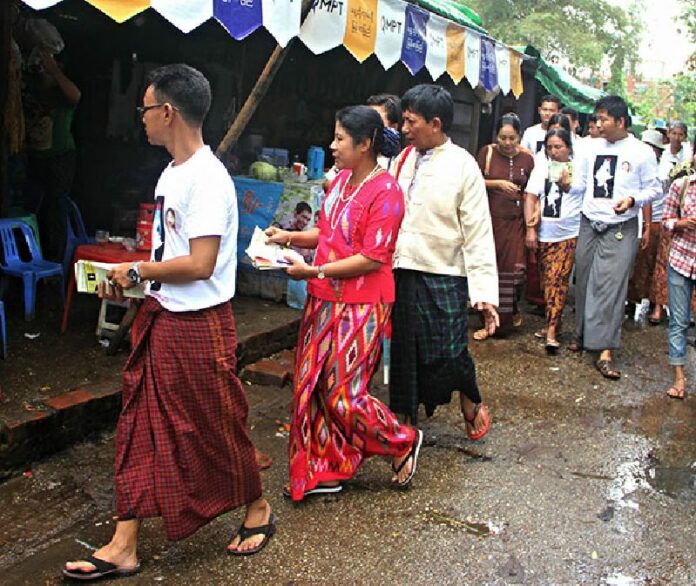
Like Nang Mya Oo, many female candidates in Myanmar’s election – the first in decades to be contested by all main opposition parties – told Myanmar Now they are keen to exercise new political rights following the end of military rule, but face pressure not to run from concerned husbands and family members.

Although the country’s most famous politician, opposition leader Aung San Suu Kyi, is a woman, Myanmar’s conservative society presents significant hurdles to women’s participation in politics.

Women who do gain the support of their families to run as candidates said they subsequently had to endure insults, rumors and political attacks based on negative gender stereotypes.

“Our society still cannot come to terms with the fact that women can also play a leadership role,” said May Sabai Phyu, director of Gender Equality Network Myanmar.

Just 13 percent of the 6,074 candidates in the November parliamentary election are women, according to the Union Election Commission, although their participation is considerably higher than in all previous polls.


\

Nyo Nyo Thin, an independent lawmaker representing Yangon’s Bahan Township in the Yangon Region Parliament, campaigns in her constituency in this undated photo. She is contesting a Lower House seat in the upcoming elections. Photo: Myanmar Now


Dropping Out

Nan Shwe Kyar, secretary of the Mandalay-based Wun Thar Nu Democratic Party, said her small party approached 20 women several months ago and asked them to run as candidates, but only three made the final list. The others stepped aside after their families voiced concerns.

In the 2010 general elections – which many believe were rigged by the then-junta – 45 out of 101 female candidates were voted in as lawmakers. In the 2012 by-elections, 26 women ran for political office, 13 of whom were elected as representatives, according to figures from the commission.

In the upcoming elections, 228 Myanmar women will run for seats in the Lower House, 119 for seats in the Upper House and 444 for a role in the legislatures of the states and regions, according the Union Election Commission.

“The number of woman candidates has increased compared with the previous elections but the percentage remains low,” said Devi Thant Cin, spokeswoman for Myanmar Green Network, an environmental NGO. “Capable women should be welcomed into politics.”

The opposition National League for Democracy of Aung San Suu Kyi is the party fielding the most women candidates at 168, while 72 women are running for the ruling Union Solidarity and Development Party (USDP).


Rumors and Insults

Women candidates say they have to endure slurs and malicious rumors, while some also fear for their safety as they campaign in their constituencies.

“My male rivals looked down on me because I’m a woman. They sometimes said nasty things to me,” said Nyo Nyo Thin, a respected, independent lawmaker representing Yangon’s Bahan Township who is contesting a Lower House seat. She added that she would file an official complaint with the Union Election Commission if she suffered any insults based on her gender.

Cheery Zahau, a candidate for the Chin Progressive Party in Chin State’s Falam Township, said rumors were spread about her because she is an unmarried woman living alone.

“One thing about being a young, single and a woman is that I have to endure a lot of smears and attacks on my integrity. I was accused of getting pregnant and then having an abortion. I was also accused of having affairs with this person or that,” said the 34 year old.

“It’s still happening,” she said. “I don’t have time to deal with them so I just focus on my work. I know the truth.”

Bawk Jar, the chairperson of the small opposition National Democratic Force in Kachin State who is contesting a Lower House seat in Myitkyina Township, said she faced similar problems while campaigning in parts of the remote, northern state. “As I was accompanied by some male colleagues during the campaign trips, some people claimed we were having relations,” she said.

Personal safety is also a concern. Phyu Phyu Thin, a candidate for the NLD in Yangon’s Mingalar Taung Nyunt Township, said: “I am not very confident about my safety in Yangon during the campaign – the situation would be even worse for women in the conflict-affected areas.”

But Toe Nandar Tin, a female candidate for the ruling USDP, also running in a Yangon constituency, said she did not feel troubled by negative gender stereotypes as she was confident of the skills she acquired while working in business and traveling abroad.

“I will contest in the upcoming elections and serve the country and people with my knowledge and international experience,” she said. “I will promote equal rights for women and am confident of my experience when compared with the men.”


Supporting Women in Politics

Women candidates and activists said there is an urgent need to address negative attitudes toward women and girls in Myanmar.

“Our society – the whole of Myanmar – has double standards. There isn’t a system to support women who want to do this (politics). You have to struggle on your own,” Cheery Zahau said.

“I wouldn’t be like this if it wasn’t for my father. He never treated me differently because I was a girl… But many families would tell their daughters to behave a certain way and stay at home. When you are treated like that from the age of two, it’s difficult to expect them to be assertive later.”

Khon Ja, an activist with the Kachin Peace Network, said it was crucial for more women to be elected so that they can promote the rights of women and children in parliament. She said it was unclear how many women would be running for ethnic minority parties, which are expected to form a significant bloc in the next parliament.

Mar Mar Oo, deputy chief of labor affairs at 88 Generation Peace and Open Society, said: “The capacity of women should be promoted for more woman candidates to enter parliament.

“Unfortunately, many graduate women in Myanmar are now housewives and dependent on their husbands. More opportunities should be opened up for such women.”

Story: Myanmar Now


Myanmar Now is an independent news service providing free, accurate and unbiased news to the people of Myanmar in Burmese and English. It is supported by Thomson Reuters Foundation.


To reach us about this article or another matter, please contact us by e-mail at: [email protected].

Follow Khaosod English on Facebook and Twitter for news, politics and more from Thailand.

Follow @KhaosodEnglish

\

Advertisement

Two Cops Fired for Allegedly Extorting Japanese Businessman

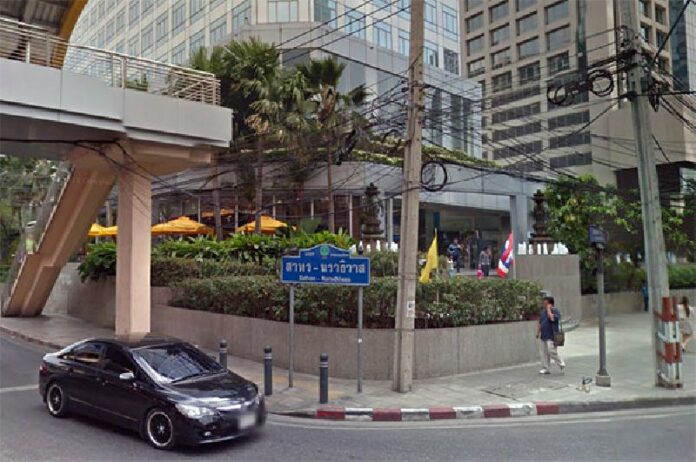
Police officers allegedly kidnapped 36-year-old Kikucho Masato earlier this month from his condominium near Sathorn Road in Bangkok. Photo: Google

BANGKOK — Two police officers accused of kidnapping a Japanese businessman and demanding 3 million baht to free him have been sacked but remain on the loose, police confirmed today.

Police Lt. Col. Pongthawat Kongsuea and Police Lt. Cpt. Kritpakorn Niamsorn were expelled from the Metropolitan Police Bureau yesterday, metro police commander Sriwarah Rangsipramnakul said, after the men failed to appear when summoned by their superiors.

“They didn’t come to work. They didn’t show up to acknowledge their charges, so we fired them, in accordance with disciplinary regulations,” said Police Gen. Sriwarah. “Now that arrest warrants have been issued on them, police can arrest them anywhere they are found.”

Both officers are accused of detaining 36-year-old Kikuchi Masato in his condominium in Bangkok’s Sathorn area on 5 Sept. and ordering him to pay 3 million baht in exchange for his freedom.

Police said the suspects first told the Japanese man that they had to search his room, then detained him and his Thai wife, claiming that she was involved in selling illegal drugs. He and his wife were reportedly taken to a safehouse and held until he agreed to pay the officers a reduced ransom of 1 million baht.

On 21 Sept. the court issued arrest warrants for Pongthawat, Kritpakorn and another police officer from the Phra Khanong Police Station, who allegedly assisted the pair in the scheme. The three have been charged with armed extortion, demanding bribes and official malfeasance.

According to Sriwarah, Pongthawat and Kritipakorn refused to show up when summoned, prompting police to expel them from their ranks.

It is unclear whether the third officer, Police Senior Sgt. Maj. Weerasak Phaosu, was expelled as well.

Sriwarah also urged police officers not to follow the trio’s example. “Please don’t commit that kind of action,” he said.


To reach us about this article or another matter, please contact us by e-mail at: [email protected].
Follow Khaosod English on Facebook and Twitter for news, politics and more from Thailand.

Follow @KhaosodEnglish

\

Advertisement

Redshirts Slam AG for Inaction on PCAD Insurrection Charges

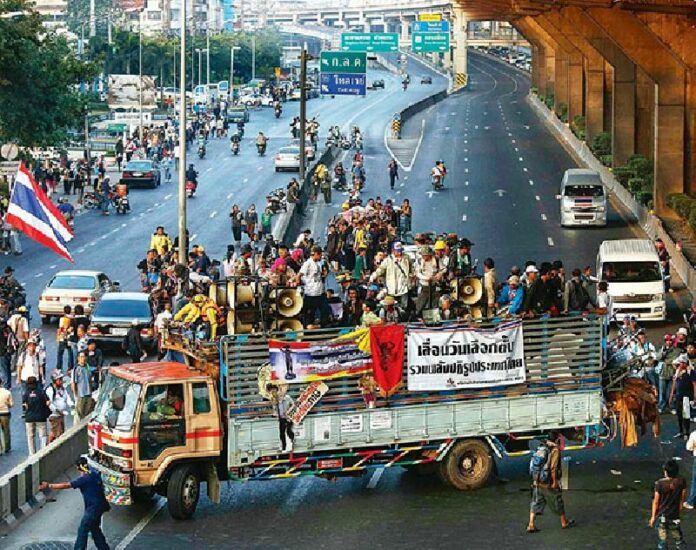
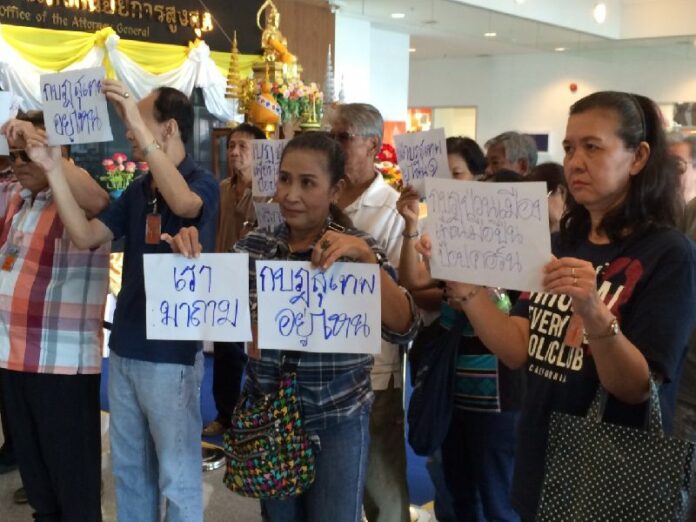
PCAD demonstrators briefly blocked Viphavadee Road in Bangkok to protest the snap election called by then-PM Yingluck Shinawatra in this 26 Dec., 2013, file photo.

BANGKOK — A group of Redshirts wants to know why those who helped pave the way for the 2014 coup have yet to answer outstanding charges of insurrection more than a year after they were filed.

Around 20 Redshirts rallied in front of the Attorney General’s office today in defiance of the junta’s ban on protests to demand an explanation for the delay in prosecuting 31 leaders and activists of the People’s Committee for Absolute Democracy With the King As Head of State, or PCAD, which campaigned against the Redshirt-backed government from November 2013 to May 2014.

“We are here to ask, where is that rebel Suthep?” read one placard held by a Redshirt, referring to PCAD leader Suthep Thaugsuban.

Suthep, who left a leadership post in the Democrat Party to lead the protests, was the public face of the movement, which camped out in major streets to “shut down” Bangkok, besieged and occupied state agencies to disrupt government functions and blocked voters from casting ballots in a snap election, among other activities.

All 31 have been charged with insurrection, illegal assembly, inciting unrest, intrusion into state buildings and obstructing election for their six-month campaign against then-Prime Minister Yingluck Shinawatra.

Winyat Chartmontri, a lawyer allied to the Redshirt movement, said at the rally although the movement’s leaders surrendered themselves to authorities in June 2014, a few weeks after the military seized power, prosecutors have yet to bring their cases to court.

“I believe many people are interested in this case. Naturally, they are suspicious toward the procedures of the Attorney General’s Office, which is responsible for this case,” Winyat said. “Why have they not sent the suspects to the Criminal Court?”

The Office of Attorney-General has not yet publicly responded to the protest.

Winyat said the office’s silence would perpetuate social friction.

“In order to save law enforcement officials from doubt and accusation, which will cause a new round of endless conflict in this country, I’d like to ask the prosecutors to explain to the people the developments in their case deliberations.”

Although the protests were initially aiming at opposing an amnesty bill engineered by the Yingluck government that would have absolved the corruption conviction of her brother, former PM Thaksin Shinawatra, PCAD later escalated its campaign into a full-blown effort to oust the entire administration it accused of being deeply corrupt.

In response to the protests, Yingluck dissolved the House in December 2013 and called a snap election for early February 2014. However, PCAD boycotted the election and led organized efforts to block many polling stations, insisting an unelected “People’s Council” be installed to implement national reforms prior to any election.

The Constitutional Court soon moved to invalidate the election results on the grounds some polling stations had been unable to open, and in May the military removed the government in a coup d’etat.

Complying with the ruling junta’s ban on political activities and protests, PCAD leaders kept a low profile after the military takeover, with Suthep entering the monkhood at a secluded forest monastery in southern Thailand for a year.

However, top PCAD leaders have since returned to spotlight. At a high-profile press conference in July, Suthep urged the military junta to further delay an election until its mission of national reform is accomplished.


To reach us about this article or another matter, please contact us by e-mail at: [email protected].

Follow Khaosod English on and Twitter for news, politics and more from Thailand.

Follow @KhaosodEnglish

\

Advertisement

Redshirts Slam AG for Inaction on PCAD Insurrection Charges

Redshirt supporters at the Office of the Attorney General in Bangkok today call for an explanation of why charges have languished against leaders of the former anti-government movement.

BANGKOK — A group of Redshirts wants to know why those who helped pave the way for the 2014 coup have yet to answer outstanding charges of insurrection more than a year after they were filed.

Around 20 Redshirts rallied in front of the Attorney General’s office today in defiance of the junta’s ban on protests to demand an explanation for the delay in prosecuting 31 leaders and activists of the People’s Committee for Absolute Democracy With the King As Head of State, or PCAD, which campaigned against the Redshirt-backed government from November 2013 to May 2014.

“We are here to ask, where is that rebel Suthep?” read one placard held by a Redshirt, referring to PCAD leader Suthep Thaugsuban.

Suthep, who left a leadership post in the Democrat Party to lead the protests, was the public face of the movement, which camped out in major streets to “shut down” Bangkok, besieged and occupied state agencies to disrupt government functions and blocked voters from casting ballots in a snap election, among other activities.


\

PCAD demonstrators briefly blocked Viphavadee Road in Bangkok to protest the snap election called by then-PM Yingluck Shinawatra in this 26 Dec., 2013, file photo.

All 31 have been charged with insurrection, illegal assembly, inciting unrest, intrusion into state buildings and obstructing election for their six-month campaign against then-Prime Minister Yingluck Shinawatra.

Winyat Chartmontri, a lawyer allied to the Redshirt movement, said at the rally although the movement’s leaders surrendered themselves to authorities in June 2014, a few weeks after the military seized power, prosecutors have yet to bring their cases to court.

“I believe many people are interested in this case. Naturally, they are suspicious toward the procedures of the Attorney General’s Office, which is responsible for this case,” Winyat said. “Why have they not sent the suspects to the Criminal Court?”

The Office of Attorney-General has not yet publicly responded to the protest.

Winyat said the office’s silence would perpetuate social friction.

“In order to save law enforcement officials from doubt and accusation, which will cause a new round of endless conflict in this country, I’d like to ask the prosecutors to explain to the people the developments in their case deliberations.”

Although the protests were initially aiming at opposing an amnesty bill engineered by the Yingluck government that would have absolved the corruption conviction of her brother, former PM Thaksin Shinawatra, PCAD later escalated its campaign into a full-blown effort to oust the entire administration it accused of being deeply corrupt.

In response to the protests, Yingluck dissolved the House in December 2013 and called a snap election for early February 2014. However, PCAD boycotted the election and led organized efforts to block many polling stations, insisting an unelected “People’s Council” be installed to implement national reforms prior to any election.

The Constitutional Court soon moved to invalidate the election results on the grounds some polling stations had been unable to open, and in May the military removed the government in a coup d’etat.

Complying with the ruling junta’s ban on political activities and protests, PCAD leaders kept a low profile after the military takeover, with Suthep entering the monkhood at a secluded forest monastery in southern Thailand for a year.

However, top PCAD leaders have since returned to spotlight. At a high-profile press conference in July, Suthep urged the military junta to further delay an election until its mission of national reform is accomplished.


To reach us about this article or another matter, please contact us by e-mail at: [email protected].
Follow Khaosod English on Facebook and Twitter for news, politics and more from Thailand.

Follow @KhaosodEnglish

\

Advertisement

Police Shelve ‘Solved’ Human Trafficking Investigation

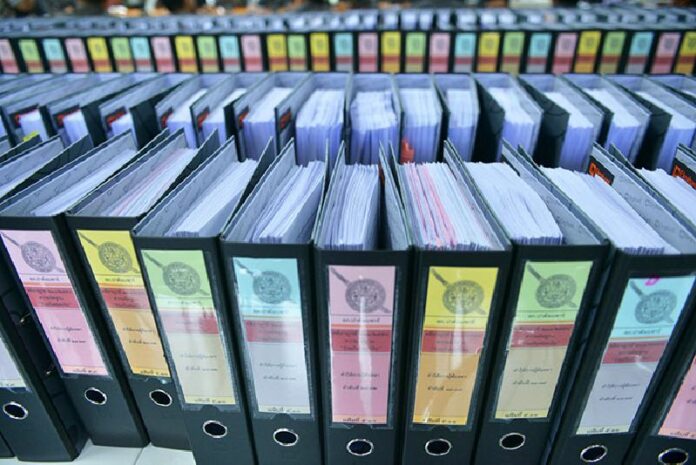
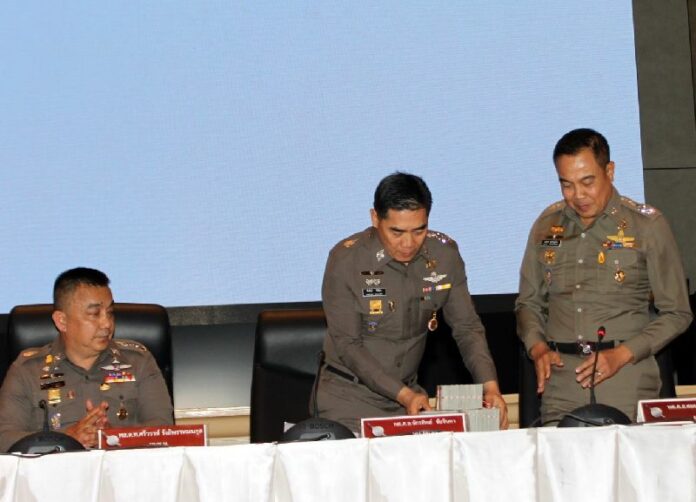
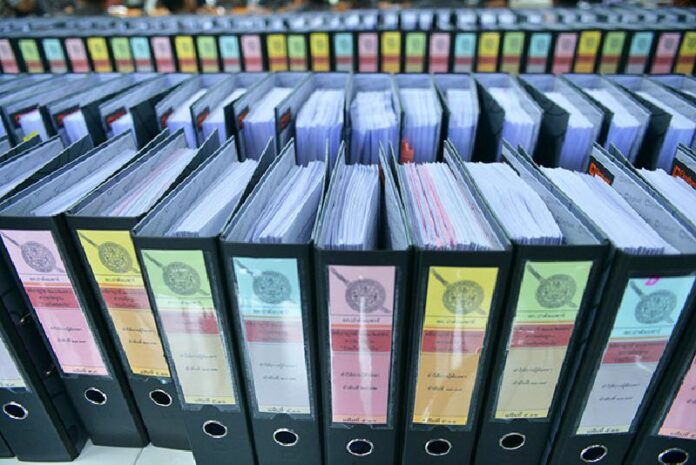
Police yesterday displayed binders and boxes said to contain the work product of their five-month investigation into human trafficking in Thailand.

SONGKHLA — Police say they are done investigating the networks behind massive human trafficking operations in southern Thailand.

The investigation launched after the discovery in May of trafficker’s prison camps along the Thai-Malaysian border led to 131 arrests, a deputy regional police commander said today as he declared the case solved – and placed on hold because its lead has left for a new post in the prime minister’s office.

“The investigation team has been devoting their physical and mental efforts in this case for five months, without holidays, for the sake of justice and humanitarian values, regardless of the victims’ races and religions,” Police Maj. Gen. Paween Pongsiri told reporters yesterday. “We want to eradicate this evil crime, human trafficking, from Thailand.”

He said 153 of the warrants and 91 of the arrests were for suspects implicated in trafficking operations, while the remainder – 79 warrants and 40 suspects – involved money laundry charges related to trafficking activity.

Although police now consider the case solved on Thailand’s long-running and endemic trafficking problem, Paween said they will continue to seek prosecution of suspects.

However, he said further investigation is on hold until a new leader of their team is appointed. The previous officer in charge, Police Gen. Aek Angsananont, was promoted to a post at the Prime Minister’s Office in Bangkok. He begins tomorrow.

“So, these two cases [human trafficking and related money laundering] have no leader responsible for them right now,” Paween said yesterday. “We have to wait for orders from the Royal Thai Police as to how will these two cases proceed, and who will be assigned to oversee them.”

One of the investigators is also leaving his post due to mandatory retirement and has yet to be replaced, Paween added.

In June officials said just examining the body of testimony from witnesses would take at least five years to complete.

Sunai Phasuk, a coordinator of Human Rights Watch’s office in Thailand, praised the results as a “positive development,” noting that not long ago Thai security officers refused to acknowledge the problem existed.

But he also urged the police to not drop the investigation.

“It would be better if they continue this. They can’t just close the case now. They should tell the public what they’re going to do about it next,” Sunai said.

According to Sunai, trafficking or smuggling of Rohingya refugees has not been stamped out but continues despite the crackdown.

“We want to see continuity,” he told Khaosod English. “A new set of investigators should be appointed to work on this, on an ongoing basis. We want to see a clear stance from the police on this. We want to see their acknowledgment that the problem is not yet over.”


\

Police Maj. Gen. Paween Pongsiri, at center, summarized yesterday the five-month investigation into human trafficking in Thailand. He said the investigation was on hold until new leadership is appointed by police command.


Human rights activists have accused Thai security forces of turning blind eye to human trafficking operations in southern Thailand for years.

According to reports from international media and watchdog groups, traffickers have been aided and abetted by Thai officials, including members of the military.

A documentary produced by the BBC earlier this year found that "entire communities" assisted human traffickers in some parts of southern Thailand, with residents taking up jobs from the slavers to help run the detention camps.

In July, the US State Department relegated Thailand to its lowest ranking for a second year in its annual report on global human trafficking. It said civilian and military officials were involved with, profited from and provided protection to traffickers, even assisting in selling asylum seekers into slavery.

Without elaborating, Paween said the investigation persevered despite challenges from vested interests.

“Even though we have been intimidated by those who’ve lost business, by some of the suspects and by groups of influential people, we are undaunted.”

The first of the detention camps was discovered 1 May deep in the jungles of Songkhla province, which borders Malaysia. Several more camps were discovered in the following weeks – all of them recently deserted – with mass graves unearthed nearby.

Police believe human traffickers used the camps to house migrants who had been smuggled or kidnapped from neighboring countries, namely Myanmar and Bangladesh, before they were taken to Malaysia. Many of the migrants were also held hostage by the traffickers until their families paid up exorbitant amounts of ransom money, police said.

Survivors from the camps told of harsh conditions, brutal guards who beat and raped victims and migrants murdered because their families failed to pay.

Many of the trafficked victims were the Rohingya, a largely-Muslim ethnic minority that hails from western Myanmar where they are persecuted by local Buddhists.

Other trafficking involved a Chinese ethnic group that similarly complains of persecution at home. Investigators have attributed August’s bombing in Bangkok to traffickers of Chinese Uighurs, seeking revenge for a crackdown on their operations. No motive has been claimed publicly by those responsible for the attack.


Related stories:

Navy, Army Officers Charged with Human Trafficking

Court Dismisses Charges Against Phuketwan Journalists

Abuse and Suicide Common Among Trafficked Children

Mass Graves of Trafficking Victims Found in Malaysia Near Thai Border

Thai Govt: US Should Clarify Human Trafficking Rankings

Examination of Human Trafficking Witnesses to Take 5 Years: Police


To reach us about this article or another matter, please contact us by e-mail at: [email protected].
Follow Khaosod English on Facebook and Twitter for news, politics and more from Thailand.

Follow @KhaosodEnglish

\

Advertisement

Police Shelve ‘Solved’ Human Trafficking Investigation

Police yesterday displayed binders and boxes said to contain the work product of their five-month investigation into human trafficking in Thailand.

SONGKHLA — Police say they are done investigating the networks behind massive human trafficking operations in southern Thailand.

The investigation launched after the discovery in May of trafficker’s prison camps along the Thai-Malaysian border led to 131 arrests, a deputy regional police commander said today as he declared the case solved – and placed on hold because its lead has left for a new post in the prime minister’s office.

“The investigation team has been devoting their physical and mental efforts in this case for five months, without holidays, for the sake of justice and humanitarian values, regardless of the victims’ races and religions,” Police Maj. Gen. Paween Pongsirin told reporters yesterday. “We want to eradicate this evil crime, human trafficking, from Thailand.”

He said 153 of the warrants and 91 of the arrests were for suspects implicated in trafficking operations, while the remainder – 79 warrants and 40 suspects – involved money laundry charges related to trafficking activity.

Although police now consider the case solved on Thailand’s long-running and endemic trafficking problem, Paween said they will continue to seek prosecution of suspects.

However, he said further investigation is on hold until a new leader of their team is appointed. The previous officer in charge, Police Gen. Aek Angsananont, was promoted to a post at the Prime Minister’s Office in Bangkok. He begins tomorrow.

“So, these two cases [human trafficking and related money laundering] have no leader responsible for them right now,” Paween said yesterday. “We have to wait for orders from the Royal Thai Police as to how will these two cases proceed, and who will be assigned to oversee them.”

One of the investigators is also leaving his post due to mandatory retirement and has yet to be replaced, Paween added.

In June officials said just examining the body of testimony from witnesses would take at least five years to complete.

Sunai Phasuk, a coordinator of Human Rights Watch’s office in Thailand, praised the results as a “positive development,” noting that not long ago Thai security officers refused to acknowledge the problem existed.

But he also urged the police to not drop the investigation.

“It would be better if they continue this. They can’t just close the case now. They should tell the public what they’re going to do about it next,” Sunai said.

According to Sunai, trafficking or smuggling of Rohingya refugees has not been stamped out but continues despite the crackdown.

“We want to see continuity,” he told Khaosod English. “A new set of investigators should be appointed to work on this, on an ongoing basis. We want to see a clear stance from the police on this. We want to see their acknowledgment that the problem is not yet over.”


\

Police Maj. Gen. Paween Pongsiri, at center, summarized yesterday the five-month investigation into human trafficking in Thailand. He said the investigation was on hold until new leadership is appointed by police command.


Human rights activists have accused Thai security forces of turning blind eye to human trafficking operations in southern Thailand for years.

According to reports from international media and watchdog groups, traffickers have been aided and abetted by Thai officials, including members of the military.

A documentary produced by the BBC earlier this year found that "entire communities" assisted human traffickers in some parts of southern Thailand, with residents taking up jobs from the slavers to help run the detention camps.

In July, the US State Department relegated Thailand to its lowest ranking for a second year in its annual report on global human trafficking. It said civilian and military officials were involved with, profited from and provided protection to traffickers, even assisting in selling asylum seekers into slavery.

Without elaborating, Paween said the investigation persevered despite challenges from vested interests.

“Even though we have been intimidated by those who’ve lost business, by some of the suspects and by groups of influential people, we are undaunted.”

The first of the detention camps was discovered 1 May deep in the jungles of Songkhla province, which borders Malaysia. Several more camps were discovered in the following weeks – all of them recently deserted – with mass graves unearthed nearby.

Police believe human traffickers used the camps to house migrants who had been smuggled or kidnapped from neighboring countries, namely Myanmar and Bangladesh, before they were taken to Malaysia. Many of the migrants were also held hostage by the traffickers until their families paid up exorbitant amounts of ransom money, police said.

Survivors from the camps told of harsh conditions, brutal guards who beat and raped victims and migrants murdered because their families failed to pay.

Many of the trafficked victims were the Rohingya, a largely-Muslim ethnic minority that hails from western Myanmar where they are persecuted by local Buddhists.

Other trafficking involved a Chinese ethnic group that similarly complains of persecution at home. Investigators have attributed August’s bombing in Bangkok to traffickers of Chinese Uighurs, seeking revenge for a crackdown on their operations. No motive has been claimed publicly by those responsible for the attack.


Related stories:

Navy, Army Officers Charged with Human Trafficking

Court Dismisses Charges Against Phuketwan Journalists

Abuse and Suicide Common Among Trafficked Children

Mass Graves of Trafficking Victims Found in Malaysia Near Thai Border

Thai Govt: US Should Clarify Human Trafficking Rankings

Examination of Human Trafficking Witnesses to Take 5 Years: Police


To reach us about this article or another matter, please contact us by e-mail at: [email protected].
Follow Khaosod English on Facebook and Twitter for news, politics and more from Thailand.

Follow @KhaosodEnglish

\

Advertisement

Redshirt Leaders Doubt Alleged Bombing Link

Bangkok metro police chief Sriwarah Rangsipramnakul claps as deputy police chief Chakthip Chaijinda receives a 3 million-baht cash reward from police chief Somyot Pumpanmuang for 'solving' the Erawan Shrine bombing case yesterday at a news conference in Bangkok.

BANGKOK — Top Redshirt activists have urged the national police commander to be careful with allegations a radical Redshirt had a role in engineering the bomb attack that killed 20 people in Bangkok last month.

Jatuporn Prompan, chairman of the United Front of Democracy Against Dictatorship, or UDD, today challenged yesterday’s account by Royal Thai Police chief Somyot Pumpanmuang that a Redshirt supporter aided the bombing conspirators by purchasing food and bomb components for them.

Writing on Facebook, Jatuporn said Somyot used the man to unfairly link the Erawan Shrine bombing to the Redshirts by claiming Yongyuth belonged to a radical faction involved in previous bomb incidents in Bangkok’s outskirts. He also questioned whether Yongyuth actually exists.

Jatuporn said he was unaware of Yongyuth and questioned a claim by Somyot that Yongyuth did not carry a national ID card, despite police officials claiming he’d been convicted by a court and given a one-year suspended jail sentence for a role in a 2010 bombing that killed four people.

“How can he be a Thai person who has no national ID number? It’s impossible,” Jatuporn wrote. “But since police are trying to bend it into a politically-motivated incident, I’d like to condemn any political groups or parties that conspired to stage this bomb attack. They are inhuman. Nevertheless, I am still curious what would any political group gain from doing this? It doesn’t make sense.”

Redshirts widely supported the elected government toppled in a military coup by the current junta in May 2014. Since the military takeover, the junta has been attempting to dismantle Redshirt influence, chiefly by banning their political activities and asking its leaders to “cooperate” with the government.

The abrupt announcement yesterday of a Redshirt link to the international plot came as a surprise yesterday, as police had consistently been telling the media and public they believed human traffickers staged the incident in revenge for a crackdown on their operation.

\

Police lead bombing suspect Mohammed Bilal, aka Adem Karadag, through a customary 're-enactment' of his alleged role Saturday in the 17 Aug. bombing of the Erawan Shrine in Bangkok.

The assertion was made by top police brass in a nationally televised address that seemed to be their wrap-up to the six-week investigation.

Bangkok police commander Sriwarah Rangsipramnakul said today that Yutthapong is wanted by police on a number of charges, including an alleged role in a 2014 incident in Bangokk’s Min Buri district, in which two suspected Redshirt militants died when a homemade bomb they were transporting by motorcycle exploded.

“We have been trying to track down and arrest him for a week now,” Police Lt. Gen. Sriwarah said. “I cannot confirm whether he is still in Thailand.”

Asked whether it is possible for Yongyuth to have been prosecuted by the court and yet have no ID card, Sriwarah said simply, “It was already possible for him. I don’t know how many similar other cases there are.”

Nattawut Saikua, another leader of the UDD, warned that Somyot’s claim the attack is linked to domestic politics may end up damaging Thailand’s reputation.

“He’s not being straightforward about this, and he’s bending all the issues. It will make all the nations who are watching Thailand right now lose their confidence in the Thai justice system,” Nattawut also wrote on Facebook.

He called on Somyot to disclose any relevant information about the alleged link “in a straightforward way."


Related stories:

Police Link Bomb Attack to Uighurs, Deep South and Thai Politics


To reach us about this article or another matter, please contact us by e-mail at: [email protected].

Follow Khaosod English on Facebook and Twitter for news, politics and more from Thailand.

Follow @KhaosodEnglish

\

Advertisement

Spinster Suckers Senior Saps with Sex Scam, Police Say

Suspect Pattana Kruengkam, 46, is accused of luring lustful old men into sexual liaisons that consisted only of her stealing their stuff, some of which she is accused of selling at this Chiang Mai gold shop where police said she is seen in this CCTV image.

CHIANG MAI — A 46-year-old woman is accused of devising a particularly effective scheme for robbing men, one they might be too embarrassed to tell anyone about – especially their wives.

Chiang Mai police yesterday arrested Pattana Kruengkam, ending what they said was a serial scam using her “trick as a woman” to lure elderly men on various pretexts – even claiming she was dying and wanted a final fling – and then steal from them.

“The suspect used her trick as a woman to approach victims in many places, such as hospitals and markets,” said Police Col. Weerayuth Prasopchokechai of the Chiang Mai city police. “The suspect would say she was lonely, unmarried and looking for someone to sleep with. After that, she would steal from them. Some victims got locked inside bathrooms. The perpetrator would just grab their belongings and run away.”

During the past year, police said they’ve received at least 11 similar complaints from men between 55 and 70. All said they had been promised a sexual encounter by the suspect, who then stole their money and other items and fled without consummating the original offer.

Weerayuth said Pattana’s arrest came just one week after she scammed her last victim. The 72-year-old man, who requested anonymity, told police Pattana approached him at a public hospital on 21 Sep. and told him that she was in the final stage of cancer and just wanted someone to make love to her.

The man said Pattana led him to a guesthouse room, asked him to take a shower, then immediately locked him inside the bathroom. The victim said he managed to get out by climbing through a window and called police for help.

He clarified to reporters at a police news conference his reason for only speaking on condition of anonymity.

“I was worried that if my wife knew about this, I would be in big trouble,” he said, without indicating whether his wife is now aware of what happened.

After the man’s complaint led police to arrest Pattana on suspicion of the crime, three other victims arrived at the police station station today, identified themselves as Pattana’s victims and filed charges against her.

Pattana allegedly made off with cash, gold necklaces and amulets, which Weerayuth said she later sold to a gold shop.

According to the officer, police tracked her down from security camera footage, including from the gold store where she reportedly sold the stolen items.

Pattana has been charged with theft. She confessed to the charge, but insisted that some of her victims willingly gave the money to her.


To reach us about this article or another matter, please contact us by e-mail at: [email protected].
Follow Khaosod English on Facebook and Twitter for news, politics and more from Thailand.

Follow @KhaosodEnglish

\

Advertisement

Hot News

LATEST NEWS

Bangkok
moderate rain
26.6 ° C
27.2 °
26.6 °
88 %
4.8kmh
89 %
Fri
32 °
Sat
36 °
Sun
34 °
Mon
31 °
Tue
31 °