28.3 C
Bangkok
Friday, July 24, 2026
Home Blog Page 2963

New 'Boat People' Crisis Feared Once Rains End by UNHCR

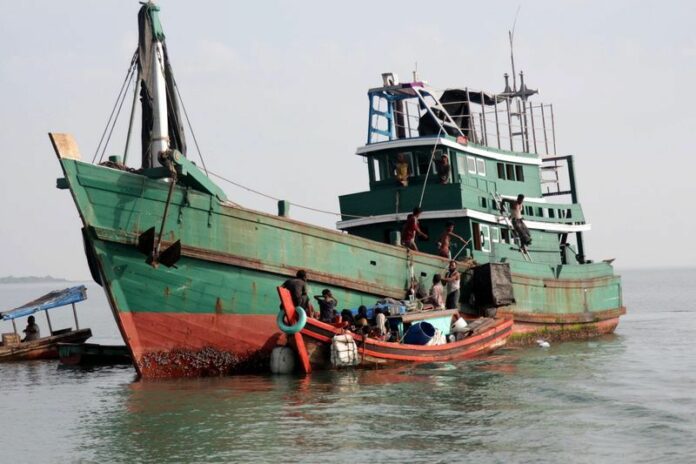
Refugees from Myanmar and Bangladesh are rescued by Aceh fisherman in Julok, East Aceh, Sumatra, Indonesia, in this 20 May, 2015, file photo. Photo: EPA/STR

GENEVA — A fresh surge of refugees and migrants from Myanmar and Bangladesh is expected to set out in smugglers' rickety boats for southeast Asia when the monsoon season ends in about a month, the United Nations said on Friday.

Boatloads of minority Rohingya Muslims fleeing persecution in Myanmar and Bangladeshis escaping poverty at home were turned away or towed further from the shores of Thailand, Indonesia and Malaysia earlier this year, triggering a humanitarian crisis.

"UNHCR is calling for urgent action before the end of the monsoon season unleashes a new wave of people leaving on boats from the Bay of Bengal," spokeswoman Melissa Fleming of the U.N. High Commissioner for Refugees (UNHCR) told a news briefing.

"We expect this to resume again in about a month," she said.

In a report, the UNHCR urged regional governments to avert another crisis in the Bay of Bengal and Andaman Sea by implementing steps agreed in May to boost search and rescue operations and establish safe places of disembarkation with better reception facilities.

"There are appalling conditions on these boats and a bit of ping pong, and real concerns about access to territory," Fleming said.

An estimated 31,000 Rohingya and Bangladeshis departed from the Bay of Bangal by boat in the first half of this year, a 34 percent increase over the same period in 2014, the agency said.

In all, 94,000 people are estimated to have risked their lives making the journey since 2014. At least 1,100 others are believed to have drowned, including 370 so far this year.

Many who made it ashore were members of Myanmar's 1.1 million Rohingya minority who live in apartheid-like conditions in the country's western Rakhine state.

Myanmar does not recognize them as citizens, even though many have lived there for generations. The government refers to them as "Bengalis" and considers them illegal immigrants. It denies their claim that they are fleeing persecution.

The Thai government launched a crackdown on people-smuggling gangs in May after the discovery of mass graves of people who died from abuse or deprivation in smugglers' camps along the heavily-forested Thai-Malay border, a transit point.

"Last weekend's discovery of 24 more bodies in north-western Malaysia is a reminder about the ruthlessness of the smugglers," Fleming said.

Story: Reuters / Stephanie Nebehay

Advertisement

Floundering Bomb Investigation Deepens Doubts About Competency

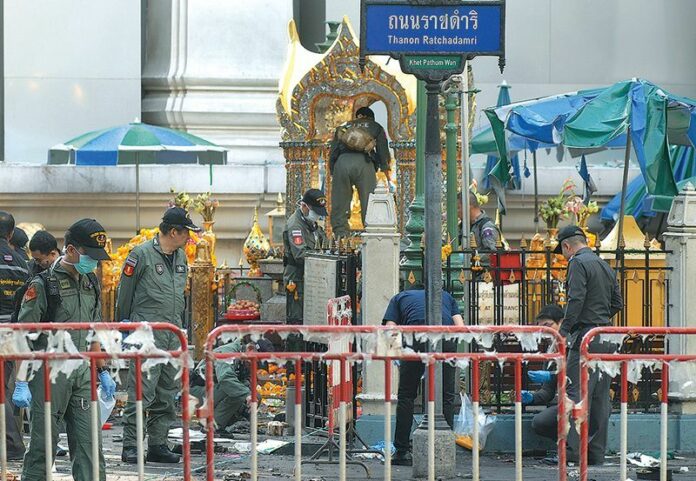
Investigators canvas the scene after the 17-Aug bombing of Bangkok's Erawan Shrine.

By Todd Ruiz

BANGKOK — Less than a year after Thailand’s last high-profile criminal investigation left observers scratching their heads, the competency and professionalism of its police are under a new level of scrutiny, only this time much more is at stake.

Eleven months on from a widely-panned investigation into the murders of two tourists on a resort island, those hoping last week’s horrific bombing of Bangkok’s Erawan Shrine would bring gravitas and professionalism to the ensuing investigation have instead seen the same baffling pronouncements and self-contradictory assertions.

“When you consider this follows on the back of a number of high-profile incidents in which the competency of Thai authorities has been called into question, this was the chance to set that narrative correct,” said Gregory Poling of the Center for Strategic and International Studies in Washington D.C.


Bangkok Shrine Bombing: Those Who Died


Fourteen of the 20 people killed 17 Aug. hailed from outside the kingdom, leaving regional partners waiting for answers that so far have been in short supply from a state apparatus with “poor message management,” said Poling, the center’s Sumitro Chair for Southeast Asia Studies.

“The most important thing is that people are watching, and you see frustration building over notions of whether Thai authorities are really capable of investigating this professionally,” he said.

As much as during the height of the investigation into the murder of two Britons on Koh Tao, priorities have seemed obsessed with optics instead of substance.

This has left the public to settle for briefings that sometimes fall short of deductive reasoning.

“I don’t believe Thai people are the perpetrators … because the incident is a behavior that is too cruel for Thai people with Thai hearts to do to their fellow Thais,” Deputy Police Chief Chaktip Chaijinda said yesterday.

In a short span of days, top officials alternately have implied the attack was carried out by domestic elements, speculated it was a foreign operation, discounted that theory and said they have no idea.

A state media report today quoted police chief Somyot Pumpanmuang saying no one could be ruled out. It also  mentioned police interrogation of three Uighurs in the eastern province of Sakaew, “not because they are accusing the trio of involving in the two explosions in Bangkok, but police need information from all sources they could find in order to solve the case.”

Unable to control the message in the social media age, authorities have made increasingly aggressive demands they be entrusted as the source of information while failing to satisfactorily deliver it.

Somyot on Monday said police would seek the prosecution of anyone spreading false information, whether it was spread through a smartphone or television broadcast.

Meanwhile the investigation seems to have run into a wall. The biggest development this week was the release of an arrest warrant yesterday for the suspected Sathorn Pier bomber. A warrant that describes the man only as “Asian” between 25 and 30, 170 centimeters in height. Police Chief Somyot today expressed confidence it would “lead to his arrest,” despite lacking a nationality or name.

That lack of visible progress, aggravated by conflicting statements and off-the-cuff speculation, have left the public and media to speculate – sometimes wildly.


Vectors of Blame

Within hours of the attack, gut-check blame was extended to the Uighurs, a Turkic Muslim ethnic group in western China. In July, Turkish nationalists had stormed the Thai consulate in Istanbul, Turkey, in response to Thailand’s decision to deport more than 100 of them back to China against their will.

A pattern of circumstantial evidence, such as reports investigators were looking for a person of interest who might have used a fake Turkish passport, fueled theories the attack could have been an act of revenge.

At a Monday evening panel hosted by the Foreign Correspondents Club, a regional security expert laid out his leading hypothesis: The attack was perpetrated by far-right Turkish fascists known as the “Grey Wolves.”

For nearly five decades, the Grey Wolves have carried out assassinations and terror in the name of Turkish supremacy, mostly against Kurds, and have reached out to Uighurs in China’s Xinjiang province.

Anthony Davis, an analyst with IHS Jane's, said they were one of the only groups with both the motive and the means.

Starved for developments, international and local media issued a volley of reports on that speculation in the likes of Forbes, Financial Times and Reuters. Reuters yesterday reported Turkey saying it had received no inquiries from Thai authorities.

Saying nobody could be ruled out, the center’s Poling said the involvement of the Grey Wolves was as likely or unlikely as other group. He said the attack didn’t fit their pattern, just as it didn’t fit that of yellow-red political violence or the southern insurgency.

“What would be the point of carrying out an international attack and then not take credit for it?” he said.

Only five weeks passed between Thailand’s widely criticized move to deport the Uighurs and the Erawan Shrine bombing. And some by some accounts the perpetrators might have been in Bangkok for at least eight months.

International Relations Prof. Paul Chambers dismissed speculation of Uighur involvement as “empty smoke” and a false lead chased by police fixed on finding an Arab suspect.

“Uighurs are treated badly in Cambodia, too,” said Chambers, who teaches at the Institute of South East Asian Affairs. “But why not bomb buildings in Cambodia?”


A Challenge to Legitimacy?

The attack, compounded by the failure to convince the public it is being investigated competently, is drawing frustration both within and without Thailand, Poling said, which could pose a threat to the military government’s stated raison d’etre.

“It undercuts the junta’s claim to legitimacy. They’re saying that, whatever else, ‘We've brought stability,’” he said. “If that narrative gets undermined, then who knows what the reaction might be?”

Chambers sees it differently. His most likely suspect in the attack is some element within the state apparatus, whether military or police. He said of all the players on the board, Thai security forces had the most to gain and the greatest capacity to carry out the attack.

“It will actually enable junta to rationalize their rule to stay in power longer,” he said.

Government representatives have dismissed out of hand any suggestion they might have been complicit in the attack.

Not knowing who attacked the nation and why makes it difficult to anticipate whether to expect or prepare for future attacks.

Poling said the Erawan Shrine bombing was likely an “outlier” that doesn't necessarily put international terror on the threat board.

“Do I think this is a harbinger of a future where Thailand has to worry about being a front in Islamic terror? Probably not.”

Additional reporting Teeranai Charuvastra.


Related stories:

No Longer Whole, a Family Buries its Dead and Waits for Answers

City Officials Bridle at Claims of Broken CCTVs

Bangkok Bombing Dragnet Yields 142 Unrelated Arrests

Bangkok Bomber May Have Fled Thailand: Police

Man Dropped Bag into Water Night Before Sathorn Pier Blast

Seen Often on Sathorn 10, Suspect Thought to Use Fake Turkish Passport

Leaked Police Report Tracks Lead Suspect Before, After Bombing

1M Baht Bounty for Bangkok Bomb Suspect

Police Widen Hunt for Bombing ‘Network’

Bangkok Shrine Bombing: Those Who Died

Day in Photos: Expressions of Grief, Unity After Terror Attacks

Briton Dies in Bangkok Shrine Bombing

Despite Lack of Evidence, Thai Media Points Blame at Uighurs

Tourists Narrowly Escape Second Bangkok Bombing in 24 Hours

Bangkok Shrine Bombing: Police Hunt Backpack Man

Tourists Among 19 Killed by Bomb at Bangkok's Erawan Shrine


To reach us about this article or another matter, please contact us by e-mail at: [email protected].

Follow Khaosod English on Facebook and Twitter for news, politics and more from Thailand.

Follow @KhaosodEnglish

\

Advertisement

Soldiers Bust Illegal Sidewalk Bars in Pattaya

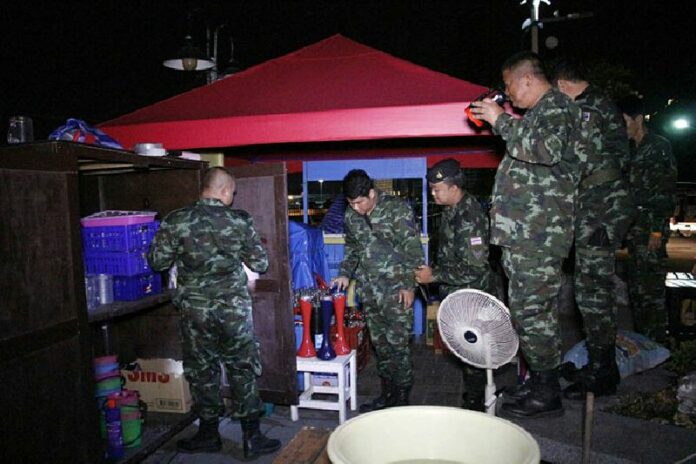
CHONBURI — Thirty soldiers and city workers dismantled streetside bar stalls said to be operating without a license in the resort town of Pattaya last night.

The bars – which consist mostly of drink stalls, tables and stools – were located on the sidewalks near Bali Hai Pier south of Pattaya. Lt. Winai Duangthong, an officer from the 14th Military District who led last night’s raid, said the bars did not have any permission to use the public space.

According to Winai, his unit was responding to complaints from the public that these bars obstruct sidewalks at night and tap electricity from the public lighting system without permission, which caused nearby street lamps to overload and fail.

Winai said his military unit last week gave the bar owners a one-week deadline to leave the area. Some owners complied, but the rest refused, so soldiers and city workers from Pattaya Municipal Office conducted the raid last night, Winai told reporters.

“We have confiscated the tables and chairs as evidence. They are being kept [at City Hall],” Lieutenant Winai said. “We have also filed complaint against [bar owners] for obstructing public space with their goods.”

The charge carries maximum penalty of 10,000 baht, the lieutenant said, adding that security officers are also inspecting whether the bar owners have indeed illegally tapped electricity from street lamps as alleged in the complaints.

No police were involved in the operation.


To reach us about this article or another matter, please contact us by e-mail at: [email protected].

Follow Khaosod English on and Twitter for news, politics and more from Thailand.

\

Advertisement

Police Refute Report Linking Escaped Uighurs to Bangkok Bombing

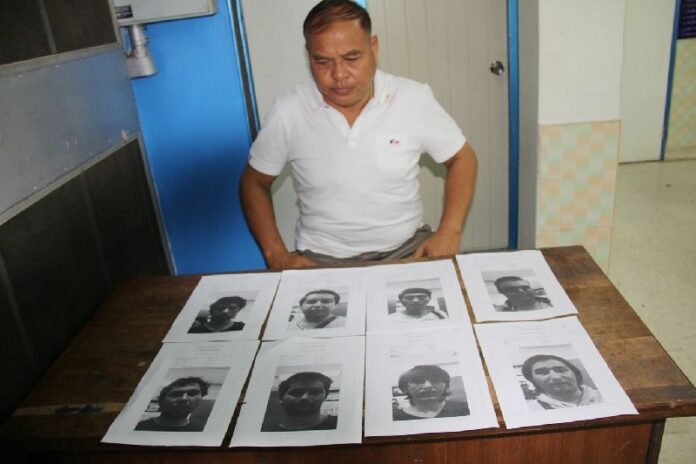
A detention facility staff in Sa Kaeo looks at photos of eight Uighurs who allegedly entered Thailand illegally and escaped from their holding cell on 28 April, 2015.

SA KAEO — Three Uighur refugees who escaped from a detention facility in Sa Kaeo province in April were not related to the bombing of the Erawan Shrine in Bangkok, police asserted today, contradicting a newspaper claim.

A Daily News report published yesterday quoted an unnamed police officer saying investigators suspected the three refugees were involved in the 17-Aug attack, prompting the chief of Sa Kaeo provincial police today to say that was very unlikely.

“The newspaper published news inaccurately,” said Police Maj. Gen. Yingyot Thepchamnong, commander of Sa Kaeo police force. “The appearance of the three Uighurs who have escaped do not match the CCTV footage of the attack at all. I don’t know where that newspaper got its information from.”

The jailbreak took place at around 4am on 29 April, when 17 Uighurs escaped the detention center through a restroom and roof. Police later rounded up all of the men except for the three, identified as Ali, 26; Nallurah, 22; and Bilam, 25.


Related stories:

8 Uighurs Escape Sa Kaeo Detention Center


To reach us about this article or another matter, please contact us by e-mail at: [email protected].

Follow Khaosod English on Facebook and Twitter for news, politics and more from Thailand.

Follow @KhaosodEnglish

\

Advertisement

Rape, Robbery Suspect Kills Himself After Hot Pursuit in Songkhla

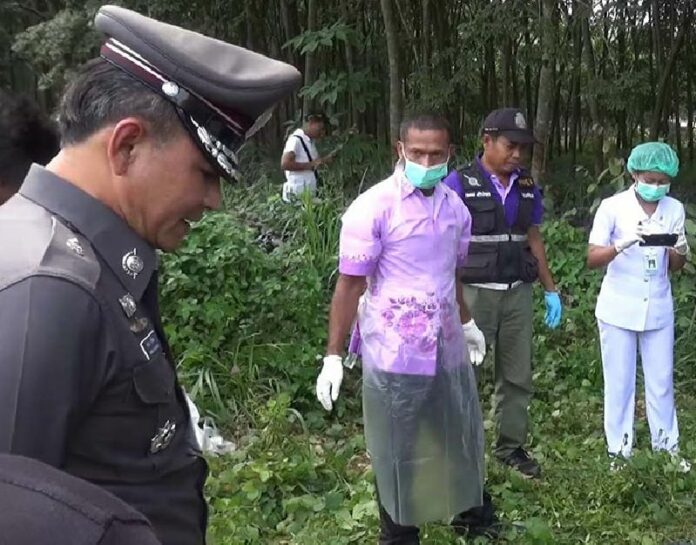
A police officer and medical personnel at the scene where Sutthichai Srithongsuk reportedly took his life after a running gunbattle with police.

SONGKHLA — A police pursuit for a man wanted on rape, theft and robbery charges ended in the suicide of the suspect in southern Thailand yesterday.

After attempting to surround and arrest Sutthichai Srithongsuk, 23, at his home in Namom district at around 4pm, police said their chase began after he opened fire with a handgun and sped away on a motorcycle.

Police, who had four separate arrest warrants for his arrest, reportedly gave pursuit on Asia Road.

He was wanted for rape, motorcycle theft, gun theft and robbery.

Sutthichai later abandoned his motorcycle and hid himself on a rubber farm, where police officers again surrounded the area and told him to surrender. However, Sutthichai continuted firing shots at police. One last shot was fired and police said they discovered him dead with a bullet in the head.

“In the end, he decided to commit suicide to escape his crimes,” said Police Maj.Gen. Amphol Buarupporn, commander of Songkhla police force.

He was pronounced dead on the scene. No police officer was injured in the confrontation.

Amphol said Sutthichai’s crimes were committed around Songkhla during a single month. He did not elaborate on the motives behind the alleged crimes.


To reach us about this article or another matter, please contact us by e-mail at: [email protected].

Follow Khaosod English on Facebook and Twitter for news, politics and more from Thailand.

Follow @KhaosodEnglish

\

Advertisement

Thai Negotiator Declares Meeting with Southern Separatists a 'Success'

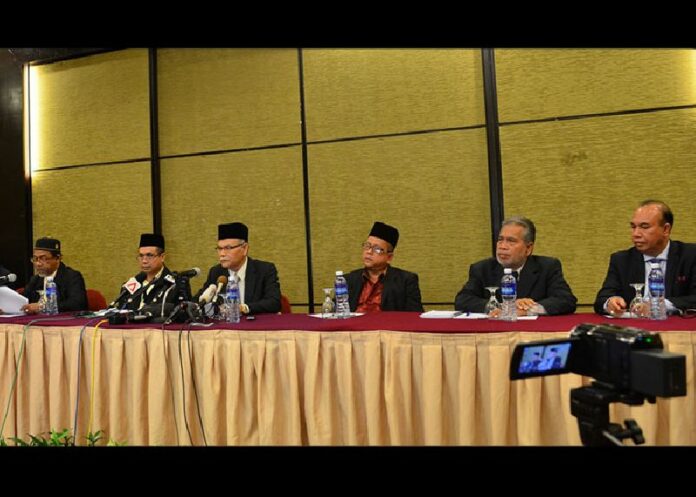
Representatives of six southern separatist groups speak to members of the Thai media yesterday. Coming together under the umbrella of 'Mara Patani,' the men held preliminary peace talks Tuesday with a delegation dispatched by Thailand's military government.

BANGKOK — The head of a team of negotiators dispatched to Malaysia to parley with a group purportedly representing southern insurgents declared his mission a success today.

Gen. Aksara Kerdphol, who headed the Thai delegation in Tuesday’s preliminary talks, made positive statements about his dialogue with insurgency representatives who outlined three things needed to return them to the negotiating table.

“I have informed the prime minister that the three demands are clearly endorsed by academic work and research,” Aksara said. “I also assured that people of all careers and religions support the negotiation process. It confirms that the people are standing on the side of peace. I also said that to the dissidents.”

He said the Thai government is deliberating on the three demands put forth by the group operating under umbrella group Mara Patani: formally establishing the talks as a parliamentary matter, recognizing Mara Patani as the legitimate negotiating party and granting immunity to its representatives so they can travel and participate in the peace process.

Mara Patani consists of representatives from six militant networks who are aiming to secede the three southernmost border provinces from Bangkok’s rule. Mara Patani met with Thai officials on Tuesday for informal talks in Kuala Lumpur, where they presented three preliminary demands to the Thai negotiators.

Speaking to Thai reporters at the same location yesterday, a Mara Patani member expressed their desire for peace.

“The use of violence and weapons has to go through steps to end violence from both sides,” said Awang Jabal of the Barisan Revolusi Nasional, or BRN. “It depends on mutual understanding and trust.”

Aksara said he briefed Gen. Prayuth that the three demands are backed by experts, and that the peacemaking effort enjoys public support.

Aksara said the government had three demands of its own to make involving jointly establishing safe zones, regional development and justice.

Without elaborating on those terms, he said Mara Patani told him they would not consider the Thai government’s proposals as long as their demands went unanswered by Bangkok.

Nevertheless, Aksara said he considered the informal talks a “success,” saying the militants brought to the negotiating table pledges to limit use of force only to “defend themselves and counter those who use violence against them.”

The number of insurgent attacks during the holy month of Ramadan this year also decreased when compared to previous years, Aksara said, crediting the reduction to Mara Patani’s willingness to pave way for peace talk.

“I’d like to thank the dissidents for cooperating with us and refraining from causing incidents in the previous Ramadan,” Aksara told reporters. “We are trying everything to meet your wishes. We recognize you as oversea dissidents. As for effort to build mutual sincerity, it has yet to be proven. Now that you have revealed yourself, whether the situation will be good or bad from now, I do not know, but we are ready for any situation that will bring positivity for people in the region.”


Related stories:

Southern Separatist Leaders State Their Case to ‘End Violence’


To reach us about this article or another matter, please contact us by e-mail at: [email protected].

Follow Khaosod English on Facebook and Twitter for news, politics and more from Thailand.

Follow @KhaosodEnglish

\

Advertisement

Referendum Campaign Ban Extends to Social Media, Line, SMS

'Crayon Shin-chan' Line stickers.

BANGKOK — The ban on “campaigning” for or against the new constitution will include uses of social media, a government official said today.

Deputy Prime Minister Visanu Krue-ngam, elaborating on earlier comments authorities would forbid campaigning in the run-up to a public vote, said today the ban will also cover using social media to “mobilize supporters” in support or opposition to the new constitution.

“Mobilizing people – whether to tell them to accept or reject it – cannot be done. It’s forbidden, because it will amount to violating the orders of the National Council for Peace and Order,” Visanu said, referring to the junta’s formal name. “If you send Line or SMS messages in ways that incite, mobilize, use rude words, use violent terms, or use aggressive terms; you cannot do that. It’s against the law.”

Yesterday Visanu told reporters that the proposed charter’s boosters and critics would only be allowed to express their opinions through mainstream media, such as television programs, and forums sanctioned and organized by authorities.

While Visanu did not clearly articulate who the ban would apply to, his comments came following statements by civilian politicians critical of junta-drafted charter.

Such rallies or other forms of campaigning would be considered political activity, Visanu said yesterday, which has been banned since the junta seized power in May 2014.

He said people who use social media to try and influence opinion on the draft constitution before it goes to a vote, possibly in January, would be prosecuted.

“This includes sending video clips that break the laws. If we catch you doing it, we will arrest you. The principle is that: you cannot mobilize or incite that cause divisions. If you express your opinion in a normal way, it’s fine, for example, by expressing opinions on TV shows.”

Leaders of Thailand’s two major parties have already publicly slammed the new charter, citing clauses in the new charter that they believe would be a setback to democracy and destabilize elected administrations in the future.

In recent days, former prime ministers Abhisit Vejjajiva of the Democrat Party and Yingluck Shinawatra of Pheu Thai have said the charter is undemocratic and would enshrine the military’s hold on power.

Gen. Udomdet Sitabutr, chief of the Royal Thai Army, said he could not “interfere” with those opinions because the army is a part of the military government.

“But I think the Constitution Drafting Committee will try to fix the existing problems and see what it can do to benefit the nation the most,” Gen. Udomdet said.

He said he’d like to support political expression, so long as it doesn’t pose a threat to security.

“If we see that it wouldn’t lead to problems about unrest, we will permit them and let them proceed,” he said. “I want to support them, but I have to see details first.”

The last time a new charter was drafted under the purview of the military, in 2007, it went to a public referendum during which open campaigning was allowed.

It passed, only to be dissolved by the military in May 2014 after it staged the coup d’etat against the elected government. The military government then convened a body to write a new one. Another junta-appointed body will deliberate and vote on their draft 6 Sept.

Should the draft pass win approval, it will go to national referendum in early January. A new election will be held later in the same year if the draft is approved by the referendum. If it goes down, the whole process will begin again.


Related stories:

In Run-Up to Charter Vote, Govt Forbids Campaigning

Prayuth Fumes at Politicians Critical of Charter


To reach us about this article or another matter, please contact us by e-mail at: [email protected].

Follow Khaosod English on Facebook and Twitter for news, politics and more from Thailand.

Follow @KhaosodEnglish

\

Advertisement

Line Puts off IPO Until Markets Improve

SEOUL — South Korea's largest web portal operator Naver Corp won't decide on when to IPO its messenger app service unit Line Corp until its earnings and market conditions improve, Naver's CFO said today.

Hwang's comments were in answer to questions prompted by a Wall Street Journal report on Thursday that said that Japan-based Line had scrapped its plans for an initial public offering.

Documents for Line's IPO continue to be under review by authorities in both the United States and Japan, CFO Hwang In-joon told Reuters, but said markets were currently too volatile to give a timetable for the listing.

"When choosing when to go to market, we need to consider whether we'll take our second quarter performance results with us, or third quarter or fourth quarter results. Our results in the second quarter were not that great," Hwang said.

Naver Corp reported weaker-than-expected second-quarter profit in July, weighed in part by lower revenues at Line Corp due to falling advertising sales.

Line, which operates the No.1 chat app in Japan, Taiwan and Thailand by number of users, reported second-quarter revenue of 27.8 billion yen, down from 28.1 billion yen the previous quarter, after at least three straight quarters of revenue growth.

Naver decided not to list the unit last year, on the belief that Line could command a better valuation by further building its revenue and profit.

Story: Reuters / Joyce Lee

Advertisement

Thailand to Return Smuggled Orangutans to Indonesia After Five Years

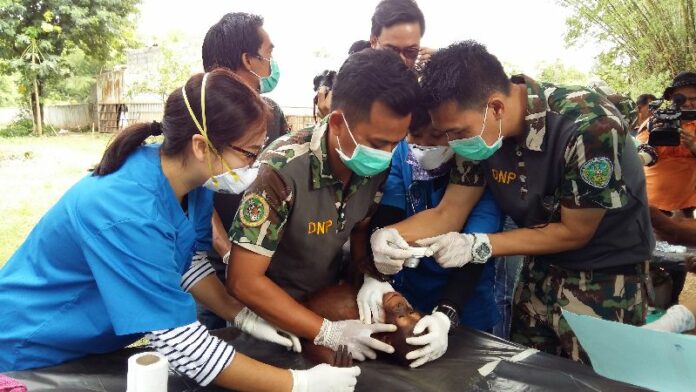
A young orangutan confiscated from tourist attractions undergo health checks by Thai wildlife officers in Kao Pratubchang Conservation Center in Rachaburi. KHAOSOD

BANGKOK (DPA) – Fourteen Indonesian orangutans held in Thailand for five years are finally to head home, an official said Thursday.

Thai authorities found 13 animals left in cages by a roadside in Phuket in 2010, apparently bound for a private zoo, according to an official at the secretariat of the Convention on International Trade in Endangered Species, who requested anonymity. 

\


They were recognised as Sumatran orangutans, distinguishable from their Borneo cousins for being slimmer and having paler, longer hair.

They were held in a wildlife rehabilitation centre for five years, while Indonesia declined to have them repatriated, and where they bred one more orangutan.


\

But Jakarta wrote this month to request their return, and has agreed to foot the transport bill. The primates were to be flown back to Indonesia in September by the Indonesian military.

Orangutans are listed as endangered by the International Union for the Conservation of Nature. The Sumatran species is the rarer of the two, with a population of just over 7,000 according to the World Wide Fund for Nature.


To reach us about this article or another matter, please contact us by e-mail at: [email protected].

Follow Khaosod English on and Twitter for news, politics and more from Thailand.

Advertisement

Southern Separatist Leaders State Their Case to ‘End Violence’

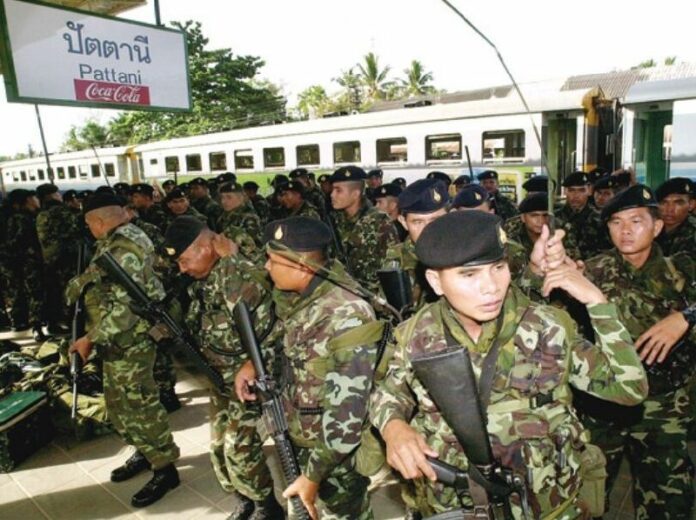
Embarking on a campaign of pacification under the government of former Prime Minister Thaksin Shinawatra, the first wave of soldiers arrive in Pattani in this May 2004 file photo.

KUALA LUMPUR — Stepping out of the shadows of their long war against the Thai state, representatives from six separatist groups in southern Thailand said they are willing to lay down their arms if Bangkok formalizes peace talks as a national priority.

In a historic news conference, the representatives spoke with Thai reporters at the Premiera Hotel in Kuala Lumpur, Malaysia, to lay out their aims and expectations after wrapping up talks there with negotiators from Thailand’s military government.

“We formed Mara Patani to make our struggle a peaceful one,” said Awang Jabal, chairman of umbrella organization Mara Patani. “The use of violence and weapons has to go through steps to end violence from both sides. It depends on mutual understanding and trust.”

The Mara Patani delegation was comprised of representatives from the six groups which have been struggling for the secession of Thailand’s three southern border provinces for the past decade. They included: Barisan Revolusi Nasional (BRN), Gerakan Mujahidin Islam Patani (GMIP), Barisan Islam Pembebasan Patani (BIPP), PULO-DSPP, PULO-MKP and PULO-P4.

Awang, also representing the BRN, said he invited Thai media so they could “understand the true ways of Mara Patani, which are transparent matters,” and to help support a dialogue to bring peace to the three southern provinces of Yala, Pattani and Narathiwat.

Ariee Muktar of PULO-MKP said an accurate portrayal of the negotiations by Thai media would help bring peace to the Deep South.

Sukree Hari, a BRN representative, outlined the proposals he said were offered Tuesday to the Thai government team, which has yet to comment on the talks.

Sukree said Mara Patani submitted three preliminary proposals as a condition for peace. Firstly, the Thai government must place the negotiations on the national agenda, which would bring them to the parliament, thus ensuring changes in Thailand’s government would not disrupt the process, as happened the last time talks were brokered.

“Setting this issue as a national agenda is an important matter, because if it is not a national agenda, there will be no continuity in the dialogue,” Sukree said.

They also asked for recognition of Mara Patani as the legitimate negotiating party and legal immunity for its leaders.

\

The aftermath of a roadside bomb attack in Narathiwat province in December 2014.

An array of shadowy militant groups are currently battling to secede the provinces of Pattani, Narathiwat and Yala from Bangkok’s rule. The Muslim-majority region, known colloquially as the Deep South, was an independent Islamic nation called Patani before it was annexed by Thailand in the early 20th century.

More than 6,200 people have died since the latest wave of secessionist violence broke out in January 2004, according to data compiled by rights groups.

In 2013 the government of Prime Minister Yingluck Shinawatra sought a dialogue with the BRN. However, the discussion was never declared a national agenda – as demanded by BRN at the time – and the two parties failed to reach any substantial conclusion. Issues about autonomy and possible independence of Patani were hardly discussed.

Further dialogue was quashed when anti-government protests broke out in Bangkok in November 2013. The military later seized power from in a coup d’etat in May 2014.

The military junta later expressed its willingness to restart talks and on Tuesday dispatched a team of negotiators to the meeting in Kuala Lumpur. The team, led by a Thai general and junta adviser, has not publicly commented on the dialogue so far.


Group May not Speak for All

The extent of Mara Patani’s sway over the splintered insurgency is unclear, but its leadership made clear their desire to bring all parties into the fold.

At today’s press conference, the BRN’s Awang said other civil groups were welcome at the negotiating table.

“Mara Patani is open for all groups to join us. It’s not only confined to these six groups. NGOs and other civic movements can join us,” said Awang, the Mara Patani chairman. “If all groups are in Mara Patani, incidents will decrease. But it will take some time.”

He acknowledged divisions within the independence movement over strategy.

“I believe there will be groups who are opposed to dialogue, but we have to move forward with it,” he said.

Founded five decades ago, the BRN is thought to be responsible for many attacks in the Deep South, where it claims to have 9,000 active insurgents operating.

BRN representative Sukree admitted his group has been waging armed struggle against security forces for years but insisted it does not intentionally target civilians.

“We have no policy of attacking soft targets,” he said.“We focus on hard targets. Sometimes, soft targets are affected, but they are victims of collateral damages.”

He also acknowledged BRN wasn’t the only group at the table engaged in the violence.

“Other groups like PULO, GMIP, BIPP have two branches like us: a political branch and an armed branch,”  he said.


To reach us about this article or another matter, please contact us by e-mail at: [email protected].

Follow Khaosod English on Facebook and Twitter for news, politics and more from Thailand.

Follow @KhaosodEnglish
\

Advertisement

Hot News

LATEST NEWS

Bangkok
overcast clouds
28.3 ° C
28.3 °
25.5 °
81 %
3.1kmh
100 %
Thu
27 °
Fri
36 °
Sat
37 °
Sun
31 °
Mon
34 °