
























28.8 C
Bangkok
Saturday, July 25, 2026
Home Blog Page 3051

Raid on Southern Fishing Pier Finds No Human Trafficking: Police

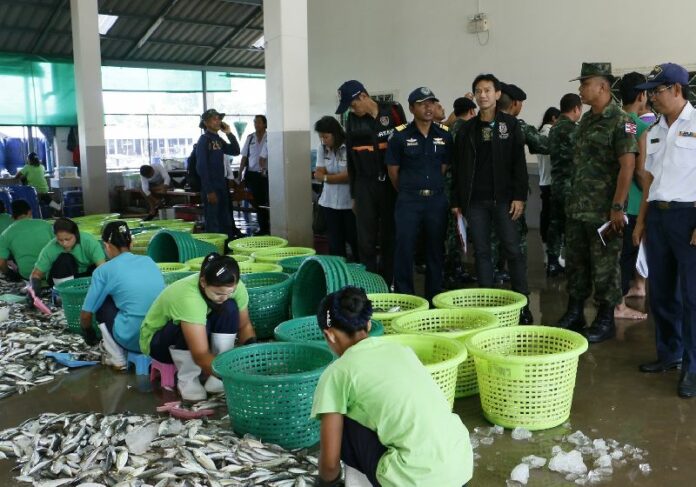
Officials investigate Saphan Pla pier in Ranong province, 27 April 2015.

RANONG — Police in southern Thailand say they did not find any illegal activity during an inspection of a fishing port in Ranong province today, conducted as part of a nationwide effort to stave off the European Union's impending ban on Thai seafood.

Police and other government officials inspected workers at Saphan Pla pier, a major fish market and distribution hub, in compliance with the government’s orders to crack down on illegal, unreported, and unregulated fishing (IUU), and human trafficking.

The EU announced last week that Thailand has six months to implement new measures to counter illegal fishing, or else face a potential import ban that could cost the country at least 20 billion baht in lost revenue. 

\
Officials investigate Saphan Pla pier in Ranong province, 27 April 2015.

The raid was jointly led by the Ministry of Social Development and Human Security officials, anti-trafficking police, marine police, the counter-insurgency agency Internal Security Operation Command (ISOC), among others.

Police said all of the workers on Saphan Pla pier, most of whom are from Myanmar, are properly registered.  

"They have established employers," a police officer said. "They were neither coerced nor enslaved." 

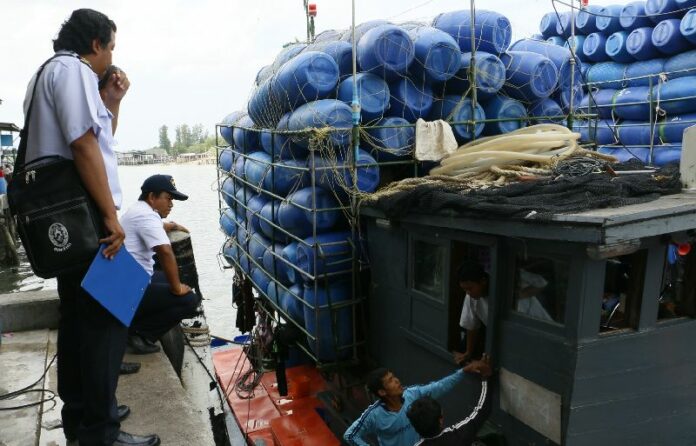
Operators of fishing boats in the area have also been instructed to register their port calls, fishing areas, crew lists, and licenses with local authorities, police said.

Experts say many Thai fishing boats are unregistered, and there is no effective record of where fish is caught, or who is working on the boats.

The lack of oversight has allowed Thai boats to fish in neighboring countries' waters, and also staff their ships with illegal and often abused labor. Thailand was downgraded last year in the US’s annual human trafficking report, which cited the widespread use of trafficked labor in the Thai seafood industry and the complicity of some Thai officials.

Junta chairman and Prime Minister Prayuth Chan-ocha told the nation in a televised address last Friday that Thailand is likely to miss the EU's deadline.

"We won't be able to meet [the EU’s deadline] because the issues are so numerous," Gen. Prayuth said, "Registering fishing boats alone is already difficult. In few days, in few months, we cannot do all of this. And we have received little cooperation so far, too."

Thailand is the world's third-largest exporter of seafood.  

For comments, or corrections to this article please contact: [email protected]

You can also find Khaosod English on Twitter and Facebook
http://twitter.com/KhaosodEnglish
http://www.facebook.com/KhaosodEnglish
Advertisement

Raid on Southern Fishing Pier Finds No Human Trafficking: Police

Officials investigate workers at Saphan Pla pier in Ranong province, 27 April 2015.

RANONG — Police in southern Thailand say they did not find any illegal activity during an inspection of a fishing port in Ranong province today, conducted as part of a nationwide effort to stave off the European Union's impending ban on Thai seafood.

Police and other government officials inspected workers at Saphan Pla pier, a major fish market and distribution hub, in compliance with the government’s orders to crack down on illegal, unreported, and unregulated fishing (IUU), and human trafficking.

The EU announced last week that Thailand has six months to implement new measures to counter illegal fishing, or else face a potential import ban that could cost the country at least 20 billion baht in lost revenue. 

\
Officials investigate workers at Saphan Pla pier in Ranong province, 27 April 2015.

The raid was jointly led by the Ministry of Social Development and Human Security officials, anti-trafficking police, marine police, the counter-insurgency agency Internal Security Operation Command (ISOC), among others.

Police said all of the workers on Saphan Pla pier, most of whom are from Myanmar, are properly registered.  

"They have established employers," a police officer said. "They were neither coerced nor enslaved." 

Operators of fishing boats in the area have also been instructed to register their port calls, fishing areas, crew lists, and licenses with local authorities, police said.

Experts say many Thai fishing boats are unregistered, and there is no effective record of where fish is caught, or who is working on the boats.

The lack of oversight has allowed Thai boats to fish in neighboring countries' waters, and also staff their ships with illegal and often abused labor. Thailand was downgraded last year in the US’s annual human trafficking report, which cited the widespread use of trafficked labor in the Thai seafood industry and the complicity of some Thai officials.

Junta chairman and Prime Minister Prayuth Chan-ocha told the nation in a televised address last Friday that Thailand is likely to miss the EU's deadline.

"We won't be able to meet [the EU’s deadline] because the issues are so numerous," Gen. Prayuth said, "Registering fishing boats alone is already difficult. In few days, in few months, we cannot do all of this. And we have received little cooperation so far, too."

Thailand is the world's third-largest exporter of seafood.  

Related coverage:
Prayuth: Article 44 Not Enough to Tackle EU Sanctions


For comments, or corrections to this article please contact: [email protected]

You can also find Khaosod English on Twitter and Facebook
http://twitter.com/KhaosodEnglish
http://www.facebook.com/KhaosodEnglish

Advertisement

Southern Army Chief Pleads Militants to Stop Targeting Civilians

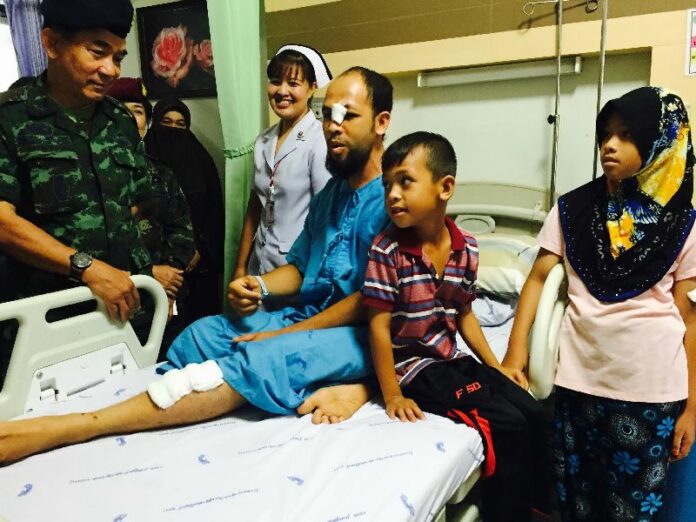
Lt. Gen. Prakarn Chollayuth  visiting a man and his  three children who were injured by a bomb in Narathiwat province. 27 April 2015.

NARATHIWAT — The commander of the Fourth Region Army has urged insurgents in Thailand's southern border provinces stop targeting civilians, especially children.

Lt.Gen. Prakarn Chollayuth made the plea while he was visiting a Muslim man and three children who were injured by a bomb in Narathiwat province on 24 April. The family was leaving a picnic on the beach when the roadside bomb exploded, police say. Authorities suspect the explosive was one of many planted by local militants who are aiming to create a breakaway Islamic state in the three southern border provinces of Narathiwat, Yala, and Pattani. 

\
Lt. Gen. Prakarn Chollayuth  visiting a man and his  three children who were injured by a bomb in Narathiwat province. 27 April 2015.

"I'd like to tell them, please stop harming innocent civilians. There are only negative consequences," Lt.Gen. Prakarn said at the hospital this morning. "Especially children. They are important strength for the country's future. They should not harm children."

Lt.Gen. Prakarn said medical workers at the hospital are also providing counsel to the three children for the psychological trauma caused by the incident.

A network of shadowy insurgents has been locked in a bloody conflict with Thai authorities since early 2004, claiming more than 6,200 lives. In addition to attacking security officers, separatists also regularly target public schools and teachers, presumably because they are viewed as instruments of the Thai Buddhist state. 

Experts say the conflict is mostly fueled by ethnic and religious differences. While the vast majority of Thailand is Buddhist, the three southern border provinces are dominated by Malay Muslims who speak a distinct dialect and trace their ancestry back to the sultanate of Patani, which was annexed by Thailand in early 20th century.  

Approximately 60,000 security officers have been stationed in the Deep South to combat the militants. The counter-insurgency is mainly led by the Fourth Region Army, whose commander, Lt.Gen. Prakarn also visited local Muslim clerics in Narathiwat earlier today.

In a meeting at Nurul Huda mosque, Lt.Gen. Prakarn said authorities are focused on rehabilitating former insurgents and helping them return to their normal lives in society. 

"We are giving opportunities for the misguided to meet with security officers," Lt.Gen. Prakarn explained to the clerics, using a military term that refers to members of the separatist movement. "The misguided will receive lectures in political schools that we have established in the region, so that their attitude about many issues can be adjusted. I insist that those who went through the program will be able to live their lives normally again. They can leave the country for Hajj."

He continued, "The violent situation has been happening in this region for 11 years now. It only causes losses to the region. Therefore, I ask all of you to help create peace in this region, especially by cooperating with security forces, so that we can move forward to building peace together." 

Thai authorities have been criticized for their heavy-handed tactics in the region, which has been governed under martial law for the past nine years. Lt.Gen. Prakarn recently apologized for a military raid on a village in Pattani province last month that left four civilians dead. An independent panel later determined that the four men had no connection to the insurgency.

\
The site of roadside bombing in Pattani province, 27 April 2015.

This morning, a roadside bomb exploded in Khok Po district of Pattani province at around 8 am and injured two soldiers on patrol. One later died at the hospital. The deceased was identified as Master Sergeant Niphon Niyomchai, a 55-year-old native of Nakhon Ratchasima in northeastern Thailand. 

For comments, or corrections to this article please contact: [email protected]

You can also find Khaosod English on Twitter and Facebook
http://twitter.com/KhaosodEnglish
http://www.facebook.com/KhaosodEnglish
Advertisement

Southern Army Chief Pleads Militants to Stop Targeting Civilians

Lt.Gen. Prakarn Chollayuth met with Muslim cleris at Nurul Huda mosque in Narathiwat, 27 April 2015

NARATHIWAT — The commander of the Fourth Region Army has urged insurgents in Thailand's southern border provinces stop targeting civilians, especially children.

Lt.Gen. Prakarn Chollayuth made the plea while he was visiting a Muslim man and three children who were injured by a bomb in Narathiwat province on 24 April. The family was leaving a picnic on the beach when the roadside bomb exploded, police say. Authorities suspect the explosive was one of many planted by local militants who are aiming to create a breakaway Islamic state in the three southern border provinces of Narathiwat, Yala, and Pattani. 

\
Lt. Gen. Prakarn Chollayuth  visiting a man and his  three children who were injured by a bomb in Narathiwat province. 27 April 2015.

"I'd like to tell them, please stop harming innocent civilians. There are only negative consequences," Lt.Gen. Prakarn said at the hospital this morning. "Especially children. They are important strength for the country's future. They should not harm children."

Lt.Gen. Prakarn said medical workers at the hospital are also providing counsel to the three children for the psychological trauma caused by the incident.

A network of shadowy insurgents has been locked in a bloody conflict with Thai authorities since early 2004, claiming more than 6,200 lives. In addition to attacking security officers, separatists also regularly target public schools and teachers, presumably because they are viewed as instruments of the Thai Buddhist state. 

Experts say the conflict is mostly fueled by ethnic and religious differences. While the vast majority of Thailand is Buddhist, the three southern border provinces are dominated by Malay Muslims who speak a distinct dialect and trace their ancestry back to the sultanate of Patani, which was annexed by Thailand in early 20th century.  

Approximately 60,000 security officers have been stationed in the Deep South to combat the militants. The counter-insurgency is mainly led by the Fourth Region Army, whose commander, Lt.Gen. Prakarn also visited local Muslim clerics in Narathiwat earlier today.

In a meeting at Nurul Huda mosque, Lt.Gen. Prakarn said authorities are focused on rehabilitating former insurgents and helping them return to their normal lives in society. 

"We are giving opportunities for the misguided to meet with security officers," Lt.Gen. Prakarn explained to the clerics, using a military term that refers to members of the separatist movement. "The misguided will receive lectures in political schools that we have established in the region, so that their attitude about many issues can be adjusted. I insist that those who went through the program will be able to live their lives normally again. They can leave the country for Hajj."

He continued, "The violent situation has been happening in this region for 11 years now. It only causes losses to the region. Therefore, I ask all of you to help create peace in this region, especially by cooperating with security forces, so that we can move forward to building peace together." 

Thai authorities have been criticized for their heavy-handed tactics in the region, which has been governed under martial law for the past nine years. Lt.Gen. Prakarn recently apologized for a military raid on a village in Pattani province last month that left four civilians dead. An independent panel later determined that the four men had no connection to the insurgency.

\
The site of roadside bombing in Pattani province, 27 April 2015.

This morning, a roadside bomb exploded in Khok Po district of Pattani province at around 8 am and injured two soldiers on patrol. One later died at the hospital. The deceased was identified as Master Sergeant Niphon Niyomchai, a 55-year-old native of Nakhon Ratchasima in northeastern Thailand. 

For comments, or corrections to this article please contact: [email protected]

You can also find Khaosod English on Twitter and Facebook
http://twitter.com/KhaosodEnglish
http://www.facebook.com/KhaosodEnglish

Advertisement

Prayuth: Politicians Cannot Change Election Date

Gen. Prayuth Chan-ocha at the Air Force Base in Bangkok, 26 April 2015.

BANGKOK — Junta chairman and Prime Minister Prayuth Chan-ocha expressed resistance to postponing the election scheduled for early next year, citing the time frame outlined in the interim constitution.

Gen. Prayuth's remark came after politicians from across the political spectrum called for a delaying the poll in order to change what they see as a flawed charter, which was drafted by a junta-appointed council.

\
Gen. Prayuth Chan-ocha at the Air Force Base in Bangkok, 26 April 2015.

"Who said that? What power do politicians have to do that?" Gen. Prayuth quipped at a reporter who asked him to comment on the issue yesterday, "What does the Constitution say?"

Answering his own question, Prayuth continued, "The [interim] constitution has already been written … this is my road map. We have 60 days, 90 days, it has to be like that. If it can be different, find me a way. How can I amend that?"

According to the time frame outlined in the junta’s interim charter, the draft of the new constitution must be finished in early August. The junta has said it will promulgate the new charter – Thailand’s 20th – by 4 September and hold a new election 150 days afterwards, estimated to be in February 2016. 

The charter draft was written by the Constitution Drafting Committee (CDC), whose members were chosen by the junta last year. The draft is currently under deliberation by the National Reform Council (NRC), another junta-appointed body.

Last week, Jatuporn Prompan, leader of the Redshirt movement's official umbrella organization, called for postponing the election in order to address the new charter’s “undemocratic” nature, including a  clause that allows MPs to appoint an unelected Prime Minister, the establishment of an unelected Senate, and the establishment of powerful unelected "independent" agencies.

"Do not be afraid that a delayed election will damage the country," Jatuporn wrote on his official Facebook account. "Be afraid that a quick election under undemocratic rules will cause far more damages, in an unmatched way. We all wish to see a good, correct, and fair constitution, with rights and liberty that will lead to equality and fraternity that will take place in this society."

Other politicians from Thailand's both primary parties, Pheu Thai and Democrat, also urged postponing the election. 

In the press conference yesterday, Gen. Prayuth also spoke about other issues, including:

Media freedom

"The media has to write well. I will keep my eyes on what you write. You understand when I talk to you, but when you write, it turns out to be something different. I circle so many passages from newspapers when I am in the car. You are all geniuses. You suggest that I fix this issue and that issue. What kind of [professional] background do you have? I ask you. Those people who criticize me, have you ever done anything successful? Or you are only at good working for newspapers, since you were a baby, until you are old? You keep criticizing the government harshly. But this is a government that seized power. Don't criticize me like I'm a normal government. You cannot. We do everything for you. We fix everything. But you still criticize me. What the hell is matter with you? Am I being too kind? I don't know."

Decentralization

"Can [decentralization] be done? Today, we have decentralized a lot. We have PAOs [Provincial Administrative Organizations], we have SAOs [Subdistrict Administrative Organizations]. We have good ones and bad ones. Today, you may not want Governors, that's okay, but on that day, the country will be divided and there will be a war. Believe me, that will happen if you keep thinking like that. If you are ready, I'm fine with it. You may want something like the United States of America. But ask them how far apart each district, subdistrict, village, and state is to each other. It takes 5-6 hours on a plane ride. Is Thailand that far apart? Today we have DLA [Department of Local Administration], we have Municipal Offices. They are already good. It's just we need to improve their quality and rearrange works. What will people have? Where will be the budget come from? Today you say you want decentralization, but even without decentralization, things are a mess already. How far do you want it to be decentralized?"

The new background for his weekly TV show 

\
Gen. Prayuth used a new background for his weekly television show on 24 April 2015.

"I want to convey a message that forests are beautiful. Thailand should preserve its forests. Think, think! I want people to see that Thailand has beautiful forests, that we have an orderly society. Or do you want me to use something bad for the background? Do you want that?" 


For comments, or corrections to this article please contact: [email protected]

You can also find Khaosod English on Twitter and Facebook
http://twitter.com/KhaosodEnglish
http://www.facebook.com/KhaosodEnglish

Advertisement

Prayuth: Politicians Cannot Change Election Date

Gen. Prayuth Chan-ocha at the Air Force Base in Bangkok, 26 April 2015.

BANGKOK — Junta chairman and Prime Minister Prayuth Chan-ocha expressed resistance to postponing the election scheduled for early next year, citing the time frame outlined in the interim constitution.

Gen. Prayuth's remark came after politicians from across the political spectrum called for a delaying the poll in order to change what they see as a flawed charter, which was drafted by a junta-appointed council.

\
Gen. Prayuth Chan-ocha at the Air Force Base in Bangkok, 26 April 2015.

"Who said that? What power do politicians have to do that?" Gen. Prayuth quipped at a reporter who asked him to comment on the issue yesterday, "What does the Constitution say?"

Answering his own question, Prayuth continued, "The [interim] constitution has already been written … this is my road map. We have 60 days, 90 days, it has to be like that. If it can be different, find me a way. How can I amend that?"

According to the time frame outlined in the junta’s interim charter, the draft of the new constitution must be finished in early August. The junta has said it will promulgate the new charter – Thailand’s 20th – by 4 September and hold a new election 150 days afterwards, estimated to be in February 2016. 

The charter draft was written by the Constitution Drafting Committee (CDC), whose members were chosen by the junta last year. The draft is currently under deliberation by the National Reform Council (NRC), another junta-appointed body.

Last week, Jatuporn Prompan, leader of the Redshirt movement's official umbrella organization, called for postponing the election in order to address the new charter’s “undemocratic” nature, including a  clause that allows MPs to appoint an unelected Prime Minister, the establishment of an unelected Senate, and the establishment of powerful unelected "independent" agencies.

"Do not be afraid that a delayed election will damage the country," Jatuporn wrote on his official Facebook account. "Be afraid that a quick election under undemocratic rules will cause far more damages, in an unmatched way. We all wish to see a good, correct, and fair constitution, with rights and liberty that will lead to equality and fraternity that will take place in this society."

Other politicians from Thailand's both primary parties, Pheu Thai and Democrat, also urged postponing the election. 

In the press conference yesterday, Gen. Prayuth also spoke about other issues, including:

Media freedom

"The media has to write well. I will keep my eyes on what you write. You understand when I talk to you, but when you write, it turns out to be something different. I circle so many passages from newspapers when I am in the car. You are all geniuses. You suggest that I fix this issue and that issue. What kind of [professional] background do you have? I ask you. Those people who criticize me, have you ever done anything successful? Or you are only at good working for newspapers, since you were a baby, until you are old? You keep criticizing the government harshly. But this is a government that seized power. Don't criticize me like I'm a normal government. You cannot. We do everything for you. We fix everything. But you still criticize me. What the hell is matter with you? Am I being too kind? I don't know."

Decentralization

"Can [decentralization] be done? Today, we have decentralized a lot. We have PAOs [Provincial Administrative Organizations], we have SAOs [Subdistrict Administrative Organizations]. We have good ones and bad ones. Today, you may not want Governors, that's okay, but on that day, the country will be divided and there will be a war. Believe me, that will happen if you keep thinking like that. If you are ready, I'm fine with it. You may want something like the United States of America. But ask them how far apart each district, subdistrict, village, and state is to each other. It takes 5-6 hours on a plane ride. Is Thailand that far apart? Today we have DLA [Department of Local Administration], we have Municipal Offices. They are already good. It's just we need to improve their quality and rearrange works. What will people have? Where will be the budget come from? Today you say you want decentralization, but even without decentralization, things are a mess already. How far do you want it to be decentralized?"

The new background for his weekly TV show 

\
Gen. Prayuth used a new background for his weekly television show on 24 April 2015.

"I want to convey a message that forests are beautiful. Thailand should preserve its forests. Think, think! I want people to see that Thailand has beautiful forests, that we have an orderly society. Or do you want me to use something bad for the background? Do you want that?" 


For comments, or corrections to this article please contact: [email protected]

You can also find Khaosod English on Twitter and Facebook
http://twitter.com/KhaosodEnglish
http://www.facebook.com/KhaosodEnglish
Advertisement

Nepal Struggles to Help Injured, Homeless Amid Quake Rubble

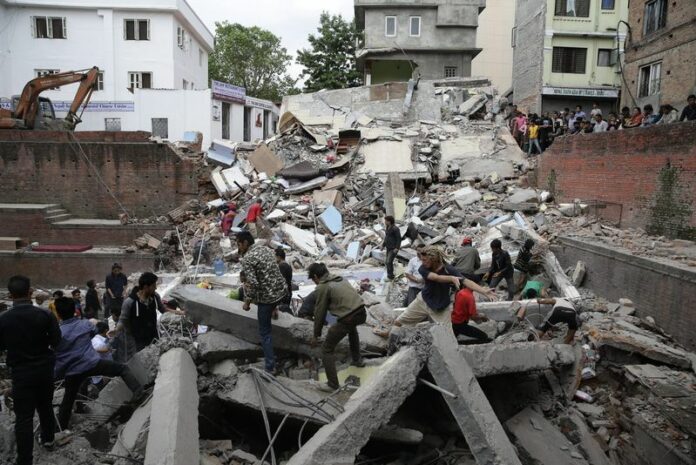
People search for survivors stuck under the rubble of a destroyed building, after an earthquake caused serious damage in Kathmandu, Nepal, April 25, 2015. A 7.9-magnitude earthquake rocked Nepal destroying buildings in Kathmandu and surrounding areas, with hundreds of casualties expected. The epicentre was 80 kilometres north-west of Kathmandu, according to the United States Geological Survey. Strong tremors were also felt in large areas of northern and eastern India and Bangladesh. EPA/NARENDRA SHRESTHA

KATHMANDU (DPA) — The death toll from the 7.8-magnitude earthquake at the weekend in Nepal was upped to 2,847, the Interior Ministry said Monday.

\

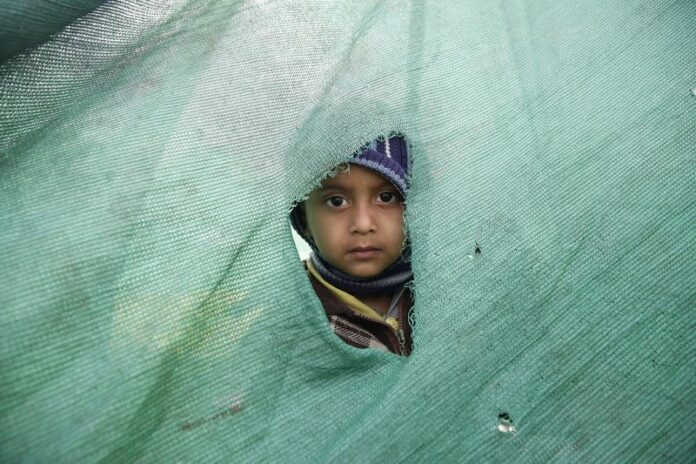
A child looks out of a hole in a temporary tent in Kathmandu after a powerful earthquake and aftershocks struck Nepal, in Kathmandu, Nepal, 27 April 2015. EPA/NARENDRA SHRESTHA

Around 6,238 people were injured in the quake that hit on Saturday, according to the government.

Communications Minister Minendra Rizal told people not to panic over rumours and to pay attention to safety.

Chief Secretary Lilamani Poudel asked all government employees and bodies to work on a "war footing" to help the injured and the displaced.

\
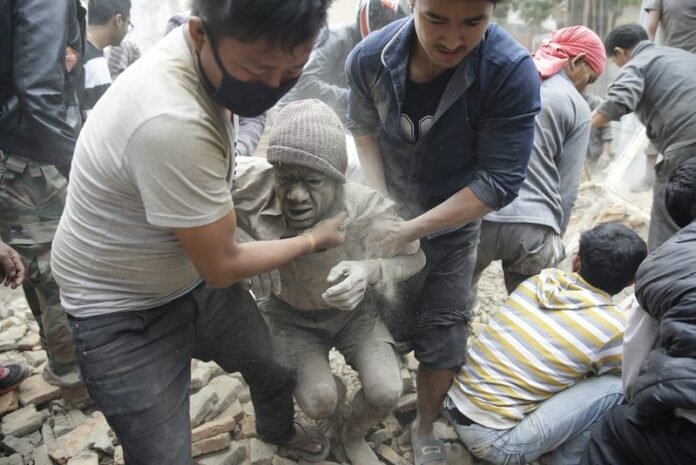
People try to free a man from the rubble of a destroyed building after an earthquake hit Nepal, Kathmandu, Nepal, April 25, 2015.​

The Tourism Ministry said it was also focusing on rescuing the foreigners trapped around the country.

"We rescued around 82 people from the Everest Base Camp yesterday," ministry secretary Suresh Man Shrestha said.

"There are 18 dead bodies on Mount Everest but we brought down only the wounded. Hopefully there will be no more casualties."

"We are also using smaller helicopters and those from the Indian army too for rescue. We are focused on the Everest region and on Gorkha, Dhading, Nuwakot and Sindupalchowk districts."

\
People search for survivors stuck under the rubble of a destroyed building, after an earthquake caused serious damage in Kathmandu, Nepal, April 25, 2015.

The Nepal Army has also deployed forces.

"We have mobilized 90 per cent of our resources," military official Jagdish Chandra Pokharel said. "We're working on a war footing and we request people to do what they can to help people around them."

Prime Minister Sushil Koirala arrived back in Nepal on Sunday after cutting short a visit to Indonesia.

Authorities were struggling with limited capacity to respond to the crisis, he said.

"But we are expecting more foreign help now and now need to work on cremating people, on sanitation, on clean drinking water."

Efforts were also under way to fix phone lines and restore power on Monday, he said.

Reporting by Pratibha Tuladhar


For comments, or corrections to this article please contact: [email protected]

You can also find Khaosod English on Twitter and Facebook
http://twitter.com/KhaosodEnglish
http://www.facebook.com/KhaosodEnglish
Advertisement

Nepal Cremates its Dead, Searches for Earthquake Survivors

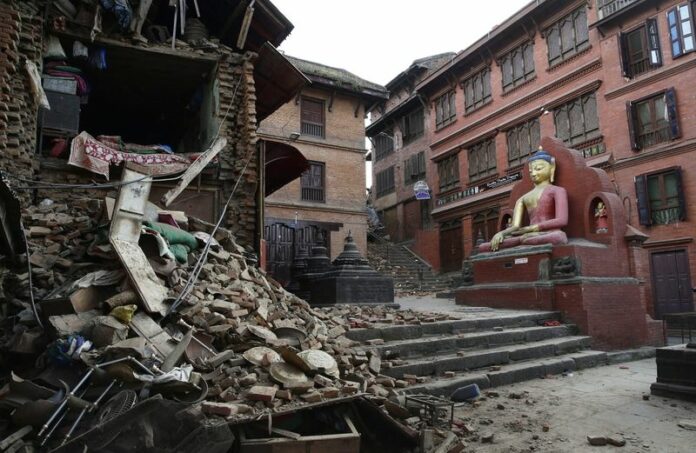
Syambhunaath Stupa, a heritage site in Kathmandu also known as monkey temple, has been severly damaged by Saturday's 7.8-magnitude earthquake. EPA/NARENDRA SHRESTHA

KATHMANDU (DPA) – Rescue workers in Nepal on Sunday searched through rubble for survivors as the death toll from the worst earthquake in more than 80 years reached 2,450 and new tremors sent people rushing outdoors.

Many people slept outside fearing aftershocks, which have forced some hospitals to treat the injured in the streets.

\
People try to free a man from the rubble of a destroyed building after an earthquake hit Nepal, Kathmandu, Nepal, April 25, 2015.​

A magnitude-6.7 aftershock, the strongest tremor after Saturday's magnitude-7.8 earthquake, sent people running for safety into the open streets and hampered rescue efforts that were starting to intensify as international rescue teams and relief aid arrived.

In the ancient city of Bhaktapur, a few kilometres south-east of Kathmandu, the dead were cremated by friends and relatives in open fields. Women wept as men brought stacks of hay and wood. Dead bodies lay on wooden slabs.

The earthquake, the worst to hit Nepal since a 1934 tremor in the Himalaya region killed 17,000 people, prompted avalanches on Mount Everest that killed 19 people. Many others are missing,

More avalanches were reported on Sunday following aftershocks.

Nepal's Interior Ministry said 2,352 had been killed, with most of the victims reported in the capital, Kathmandu. A further 50 have died in neighbouring India, while casualties have also been reported in China and Bangladesh.

Most of the deaths were caused by roof and wall collapses.

Some 6.6 million people live in areas affected by the earthquake, UN emergency aid spokesman Jens Laerke told dpa from Geneva. The worst-hit areas are in the Kathmandu valley.

With roads and communication lines destroyed, officials said the overall death toll in Nepal was expected to rise as reports came in from remote districts, where entire villages were said to have been reduced to rubble. More than 5,000 people have been injured.

"Every house is a pile of bricks and frames in our village," said a resident from Dharampur, a small town on the outskirts of Kathmandu, said.

In Kathmandu, relief workers were seen moving iron roofs and broken walls with their bare hands to reach people trapped in the debris.

Buildings and historic monuments had been reduced to piles of rubble, including in some of the country's most ancient districts such as Kathmandu's historic centre and the royal square in nearby Bhaktapur.

"We have been hearing that another 9-magnitude earthquake is going to hit," said Anuj Shrestha, who was camping with his two daughters and wife in an open space in Kathmandu.

According to Winfried Hanka, a seismologist at the German Geological Research Centre in Potsdam, near Berlin, more aftershocks should be expected.

"It will certainly continue like this for weeks or months and only slowly die down," Hanka told dpa.

In some villages, entire families were buried under the rubble of their homes, according to distress calls that people sent to local media.

"Help is not arriving. We are here in Sindupalchowk, Bhotang-2. Nine villages without food, and homeless," a woman identifying herself as Puja said.

The Nepalese government was scrambling to deal with the disaster.

Prime Minister Sushil Koirala said the country would overcome "these dark times, whatever the cost."

The Nepalese army said in a statement that 90 per cent of its personnel was taking part in rescue operation and providing security. The government has said it would award some 400 dollars to the family of each person killed in the earthquake.

The power supply has been cut indefinitely in many parts of the country due to damaged reservoirs feeding hydropower production. Water supplies have also been affected.

The Pashupati Area Development Trust, which oversees the biggest cremation ground in Nepal, said they were doing their best to manage.

In hospitals, doctors were running blood donation camps and working on "war footing."

"We don't know if there will be another quake, but what we do know is that we need to take steps now to take care of the people who were injured," said Ananta Shrestha, a physician at Kathmandu hospital.

"There are flies in places where we're treating the injured, people are living in groups and sharing limited resources, there are hygiene problems. If we do not take precaution now, we'll be facing an epidemic and that might kill more than the earthquake already has."

Rescue operations could be hampered by heavy rain, which is forecast to hit Nepal over the next two days.

Some 65 people injured in avalanches on Mount Everest were flown to Kathmandu, rescuers said. Santa Bir Lama, of the Nepal Mountaineering Association, told dpa that rescuers were trying to establish contact with 100 to 150 climbers. He refused to say they were missing.

In 1934, a magnitude-8.2 quake killed at least 10,000 in Nepal and a further 7,000 in Bihar.

A magnitude 6.7 tremor in 1988 killed 750 people.

Reporting by Pratibha Tuladhar


For comments, or corrections to this article please contact: [email protected]

You can also find Khaosod English on Twitter and Facebook
http://twitter.com/KhaosodEnglish
http://www.facebook.com/KhaosodEnglish

Advertisement

Nepal Struggles to Help Injured, Homeless Amid Quake Rubble

A child looks out of a hole in a temporary tent in Kathmandu after a powerful earthquake and aftershocks struck Nepal, in Kathmandu, Nepal, 27 April 2015. EPA/NARENDRA SHRESTHA

KATHMANDU (DPA) — The death toll from the 7.8-magnitude earthquake at the weekend in Nepal was upped to 2,847, the Interior Ministry said Monday.

\
A child looks out of a hole in a temporary tent in Kathmandu after a powerful earthquake and aftershocks struck Nepal, in Kathmandu, Nepal, 27 April 2015. EPA/NARENDRA SHRESTHA

Around 6,238 people were injured in the quake that hit on Saturday, according to the government.

Communications Minister Minendra Rizal told people not to panic over rumours and to pay attention to safety.

Chief Secretary Lilamani Poudel asked all government employees and bodies to work on a "war footing" to help the injured and the displaced.

\
People try to free a man from the rubble of a destroyed building after an earthquake hit Nepal, Kathmandu, Nepal, April 25, 2015.​

The Tourism Ministry said it was also focusing on rescuing the foreigners trapped around the country.

"We rescued around 82 people from the Everest Base Camp yesterday," ministry secretary Suresh Man Shrestha said.

"There are 18 dead bodies on Mount Everest but we brought down only the wounded. Hopefully there will be no more casualties."

"We are also using smaller helicopters and those from the Indian army too for rescue. We are focused on the Everest region and on Gorkha, Dhading, Nuwakot and Sindupalchowk districts."

\
People search for survivors stuck under the rubble of a destroyed building, after an earthquake caused serious damage in Kathmandu, Nepal, April 25, 2015.

The Nepal Army has also deployed forces.

"We have mobilized 90 per cent of our resources," military official Jagdish Chandra Pokharel said. "We're working on a war footing and we request people to do what they can to help people around them."

Prime Minister Sushil Koirala arrived back in Nepal on Sunday after cutting short a visit to Indonesia.

Authorities were struggling with limited capacity to respond to the crisis, he said.

"But we are expecting more foreign help now and now need to work on cremating people, on sanitation, on clean drinking water."

Efforts were also under way to fix phone lines and restore power on Monday, he said.

Reporting by Pratibha Tuladhar


For comments, or corrections to this article please contact: [email protected]

You can also find Khaosod English on Twitter and Facebook
http://twitter.com/KhaosodEnglish
http://www.facebook.com/KhaosodEnglish


Advertisement

Hundreds Dead in Nepal Earthquake

People free a man from the rubble of a destroyed building after an earthquake hit Nepal, in Kathmandu, Nepal, April 25, 2015.

KATHMANDU (DPA) — Hundreds of people died and many more were feared buried under rubble Saturday after a 7.9-magnitude earthquake devastated Nepal's capital and provoked a deadly avalanche on Mount Everest.

The earthquake hit at 0611 GMT, with its epicentre about 80 kilometres north-west of Kathmandu, according to the United States Geological Survey (USGS).

\
People try to free a man from the rubble of a destroyed building after an earthquake hit Nepal, Kathmandu, Nepal, April 25, 2015.​

A spokesman for the Nepalese Interior Ministry said the provisional death toll stood at around 700 by early evening.

The tremor was the worst to hit Nepal since 1934, when a similarly powerful quake killed 17,000 people, mostly in Kathmandu. Saturday's tremor was also felt in India, China, Pakistan and Bangladesh. Over 40 deaths were reported in those countries, with most of the casualties occurring in India's eastern Bihar state, which borders Nepal.

Most of the deaths were caused by building and wall collapses.

\
People search for survivors stuck under the rubble of a destroyed building, after an earthquake caused serious damage in Kathmandu, Nepal, April 25, 2015.

The ancient historic centre of Kathmandu was a picture of devastation, with roads cracked wide, buildings collapsed into rubble and panicked people standing on roads as a series of aftershocks followed the quake.

"There is devastation everywhere. I saw two people get hit by bits of a falling building and die in New Road," said Yogesh Sitaula as he walked through the city. "There are fallen buildings and walls all over. People are being treated on streets. Hospitals are crammed."

The city's international airport was briefly closed as a precaution, with flights diverted to airports in India.

No commercial flights were operating from the Kathmandu airport, but Indian aircraft with relief materials and rescue equipment were landing, India's Foreign Secretary S Jaishankar said.

The main earthquake was followed by 14 aftershocks ranging from 6.6 to 5 in magnitude.

Buildings in Durbar Square, a UNESCO World Heritage site in the centre of Kathmandu, were destroyed, leaving mounds of timber and rubble, Nepal's Kantipur television reported.

Television images showed scores of injured people being treated outside hospitals in the capital.

"I saw people who were very scared but also helping each other. A lot of people are feared buried under these old houses, some of them are 100 years old," Kathmandu-based journalist Kashish Shreshtha added.

"Kathmandu Durbar Square, a historic UNESCO heritage site, has turned into a rubble. All the temples are destroyed. There was a blood donation camp ongoing at one of the heritage sites. The building collapsed and it seems everyone is dead," Shreshtha added.

The earthquake also triggered avalanches on Mount Everest, a popular destination for climbers. At least eight people were killed in one such avalanche near the Everest base camp.

"The communication is not very good up there, and the toll could still go up," Gyanendra Shrestha, a tourism official, told dpa.

"We are not certain about the nationality of those killed. Several hundred climbers were in the base camp area."

Daniel Mazur, a climber, said on Twitter that the camp had been "severely damaged."

Nepal's Prime Minister Sushil Koirala cut short his trip to Bangkok and Jakarta, where he was due to attend a meeting of Asian and African leaders on Sunday.

Reporting by Prateebha Tuladhar

 
For comments, or corrections to this article please contact: [email protected]

You can also find Khaosod English on Twitter and Facebook
http://twitter.com/KhaosodEnglish
http://www.facebook.com/KhaosodEnglish
Advertisement

Hot News

LATEST NEWS

Bangkok
light rain
28.8 ° C
28.8 °
28.8 °
84 %
4.6kmh
98 %
Sat
30 °
Sun
33 °
Mon
33 °
Tue
29 °
Wed
27 °