






















27.7 C
Bangkok
Thursday, July 23, 2026
Home Blog Page 3197

UN Budget Committee Approves Funding for UN Ebola Response Mission

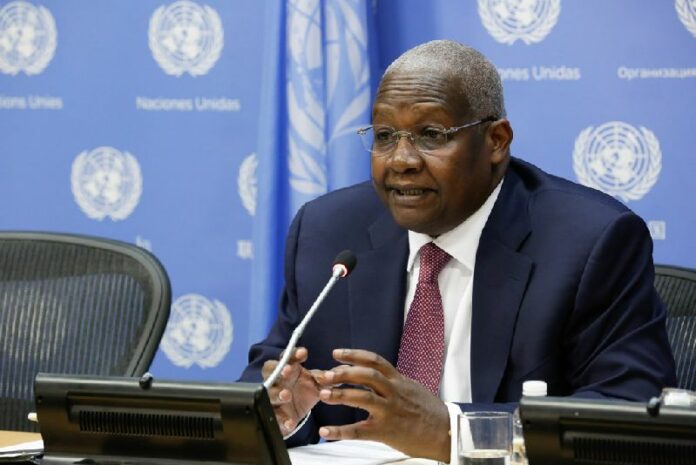
General Assembly President Sam Kutesa. [UN Photo/Evan Schneider]

(UN News Centre)

GENEVA – The United Nations committee that deals with administrative and budgetary issues today adopted a resolution allocating funding for the newly established UN Mission for Ebola Emergency Response (UNMEER) and the Office of the Special Envoy on Ebola.

“The Fifth Committee is sending a strong message on its ability to effectively and expeditiously deliver on critical and pressing global issues,” the President of the General Assembly, Sam Kutesa, told the group’s second formal meeting in New York.

At the Committee’s first meeting on Friday, Secretary-General Ban Ki-moon’s Chef de Cabinet, Susana Malcorra, presented his preliminary funding proposal requesting $49.9 million for the rest of the year.

The Advisory Committee on Administrative and Budgetary Questions (ACABQ) endorsed that amount and recommended that the General Assembly approve it.

UNMEER teams have already deployed to the Mission headquarters in Accra, Ghana, and to offices in Guinea, Liberia and Sierra Leone.

“The establishment of UNMEER is the first step in the global efforts to contain the outbreak, which must be further strengthened by a wide range of actions and measures at all levels,” Mr. Kutesa said, highlighting efforts to mobilize required financial, medical and humanitarian assistance.

Mr. Kutesa, who last month took over the presidency of the 193-member General Assembly, noted the quickness with which the Fifth Committee acted on UNMEER’s budget, and strongly encouraged it to build on this momentum to develop greater trust among the membership and deliver on expected timeframes.

“The challenge will be to reconcile the need for the transparent, effective and efficient utilization of resources with demands for effective and expeditious delivery on the ground,” he said.

More than 6,500 people have been believed to be infected, and more than 3,300 have died since the latest outbreak of the disease was confirmed in March.

Aside from the UNMEER funding, the UN Office for the Coordination of Humanitarian Affairs (OCHA) has said that it needs $988 to respond to the outbreak. So far, $257 million – or 26 per cent – has been raised.

Meanwhile, the UN Development Programme (UNDP) is warning that the Ebola health crisis that has claimed thousands of lives must not be allowed to become a crippling socio-economic crisis as well, as two of its officials began a visit to Guinea, Sierra Leone and Liberia.

“This devastating health crisis is destroying lives and communities. It is also impairing national economies, wiping out livelihoods and basic services, and could undo years of efforts to stabilize West Africa,” said Magdy Martínez-Solimán, Director of UNDP’s Bureau for Policy and Programme Support.

“As we work together to end the outbreak, now is the time to ensure these countries can also continue to function and swiftly get back on their feet,” he added.

UNDP noted in a news release that Guinea, Liberia and Sierra Leone, already suffering from some of the lowest levels of human development in the world, had emerged from years of civil conflict and political instability and were starting to make encouraging progress.

Gross domestic product growth in Guinea, Sierra Leone and Liberia has shrunk by two to three percentage points, the agency said. The countries are now projected to lose a total of $13 billion as a result of Ebola. People’s livelihoods are shrinking from lost wages and decreased productivity.

The outbreak has also had an impact on social services across the region. In Guinea, primary and secondary schools and universities are closed. In Liberia, vaccine coverage shrank by 50 per cent in the first few months of the epidemic.

Food security has also been affected, with fewer women and men able to plant and harvest. As a result, the price of rice has risen by at least 30 per cent in Sierra Leone, and in Guinea national rice production is already down 10 per cent.

UNDP’s efforts are focused on early recovery – containing the disease and protecting peace dividends and development gains. The agency is realigning its programmes in the three most-affected countries to focus on the crisis, deploying an extra 47 staff, and working closely with the governments to bolster their ability to cope with the crisis.

During the trip, Mr. Martínez-Solimán and Ruby Sandhu-Rojon, the Deputy Director of UNDP’s Regional Bureau for Africa, will hold talks with the Secretary-General’s Special Representative and head of UNMEER, Anthony Banbury.

Mr. Banbury, who has been visiting the most affected countries since last week, is today in Conakry, Guinea, where he is meeting with government officials and partners to assess the needs in the country.
Advertisement

Court dismisses appeal in Deep South torture case because 2007 charter no longer exist

(Prachatai English)

BANGKOK – The court rejected an appeal request to investigate the alleged torture case in Pattani on ground that the 2007 Constitution can no longer use to claim about the citizen’s basic rights, according to the Muslim Attorney Center Foundation.
 
On 7 September, the Pattani Provincial Court rejected an appeal request of Rohima Huseng, who alleged the security officers in Pattani of torturing her brother, Hasan Huseng, during interrogation.
 
Hasan Huseng, a suspected insurgent, was captured by the Special Taskforce 30 of Narathiwat on 13 April and detained without charges for seven days. The Task Force later handed him to the Interrogation Centre at the Inkhayut Military Camp in Pattani, where he was detained for another 20 days. 
Read more here.

Note: Khaosod English is not responsible for content on other websites.

Advertisement

Policeman Rewarded 10,000 Baht For Declining Bribe

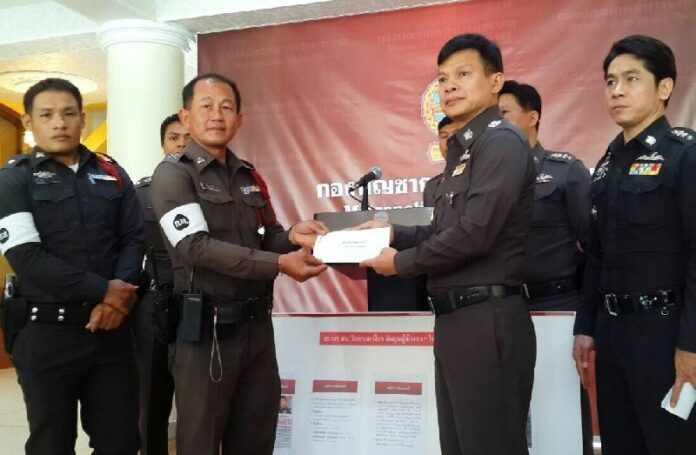
Pol.Sgt. Narin Fakbumrung (L) receiving a 10,000 baht reward for refusing to accept a 100 baht bribe from a motorcyclist, 8 October 2014.

BANGKOK — In a new effort to combat corruption among Thailand’s law enforcement agencies, the Metropolitan Police department has started giving out monetary rewards to officers who refuse to accept bribes.

Today, a traffic police officer received a 10,000 baht reward for declining a 100 baht bribe from a motorcyclist.

According to police, the motorcyclist, identified as Banterng Thongpaan, was about to be fined for making an illegal left turn when he offered Pol.Sgt. Narin Fakbumrung 100 baht to let him off without any charges.

“Pol.Sgt. Narin  immediately photographed the bribery attempt with his mobile phone and escorted the suspect to the police station for legal procedure,” said Pol.Maj.Gen. Adul Narongsak, deputy commander of the Metropolitan Police.

He said Banterng has been charged with bribing state officials.

Traffic police officer Pol.Sgt. Narin said he regularly turns down bribes from motorists.

“I always tell them, please don’t give me bribes because I have to arrest you,” Pol.Sgt. Narin said. “In this latest case, too, I told him please don’t do it.”

He said he wasn’t aware of the 10,000 baht reward campaign when he confronted Banterng, but welcomed the idea because it could help incentivise police officers to perform their duties more strictly.

Under Thai laws, those found guilty of bribing state officials can face up to five years in prison, while accepting bribes from the public can land state officials in jail for life.

However, in reality bribery is extremely common among the Thai police force, and traffic laws are often poorly enforced.

Pol.Maj.Gen. Adul said the campaign was launched on 4 October to encourage “honesty and dignity.”

“I’d like to tell the public to strictly follow the traffic laws,” Pol.Maj.Gen. Adul said. “When they are lawfully arrested, please proceed to pay the fine in a legal manner. Do not try to bribe the police.”


For comments, or corrections to this article please contact: [email protected]

You can also find Khaosod English on Twitter and Facebook
http://twitter.com/KhaosodEnglish
http://www.facebook.com/KhaosodEnglish


Advertisement

Photo Essay: The Gods Among Us At Navaratri Festival

By Gerrit Phil Baumann

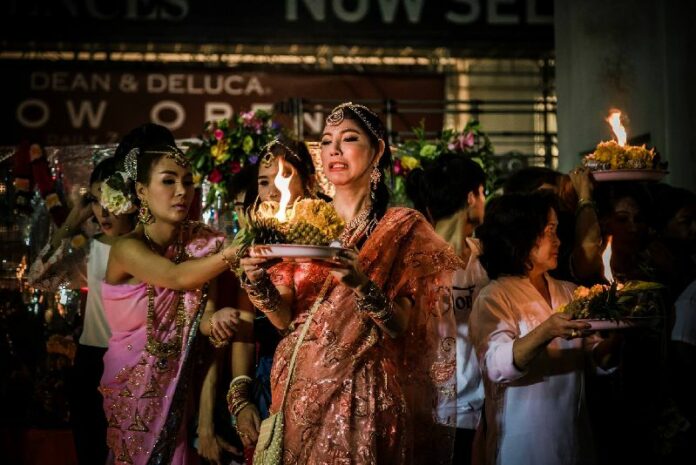
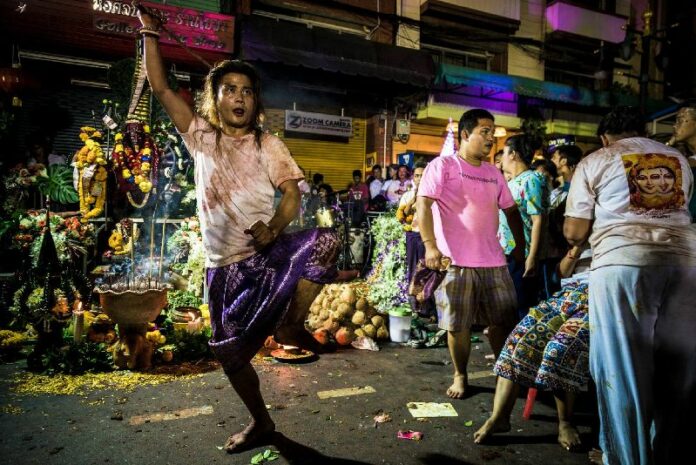
On 4 October, Thais from across the country gathered in Bangkok to participate in Vijayadashami,  the dawn-til-dusk celebration that ends the nine-day Hindu festival of Navaratri.  Khaosod English photographer Gerrit Phil Baumann brought his camera to follow the procession in Bangkok, which featured Brahmin priests, sacred powders, and spirit-possessed dancers. 

\
The half-moon night of Vijayadashami ends Navaratri, one of the holiest festivals in the Hindu religion. Although 96% of Thais identify as Buddhists, many of them also worship Hindu gods and holidays. 

\
Devotees come to Bangkok from all corners of the kingdom to receive a blessing. Shrines are organized by groups of friends and neighborhoods.

\
 In Thailand, it's especially common for artists and creatives – such as this professional dancer – to worship Hindu deities.

\
A Brahmin priest arrives to bless the crowds with sacred powder.

\
Devotees wait with offerings for the another Brahmin to pass.

\
The Brahmins walk by in a trance-like state, appearing to feel no pain from the spears piercing their cheeks.

\
After the Brahmins pass, a marching band heralds the arrival of a wagon carrying a statue from inside a Hindu temple on Silom road.

\
Devotees queue up to present offerings to the statues.

\
The offerings contain fruits, nuts, spices, and flower garlands. 

\
Security officers hectically order people to vacate the pedestrian bridge as no human is supposed to stand above sacred object.

\
The statues are guarded by military police. In 2006, the statue of Phra Phrom was destroyed by a mentally ill man who was then beaten to death by angry bystanders.

\
Brahmins collect garland offerings from believers. 

\
A group of fortune tellers perform a rite inviting the deities to take over their bodies.

\
The gods have taken over and the mediums dance and speak in their voices.

\

\
Once the gods choose to leave the body of the mediums, they collapse in total exhaustion.


For comments, or corrections to this article please contact: [email protected]

You can also find Khaosod English on Twitter and Facebook
http://twitter.com/KhaosodEnglish
http://www.facebook.com/KhaosodEnglish

Advertisement

University Rector Resigns To Keep Seat In Junta Govt

Sukree Charoensuk, the dean of Mahidol University's College of Music, staged a public protest on 10 Sept 2014 calling on Rajata to choose between his post as rector and Cabinet minister.

BANGKOK — The rector of Mahidol University has resigned from his post in order to keep his position as Minister of Public Health in the junta-appointed interim government.

A number of professors at Mahidol University have been pressuring Rajata Rajatanavin to choose between the two positions, as university regulations prohibit the rector from holding political office. 

Rajata announced his resignation as rector this morning during a deans meeting at Mahidol's Salaya campus. 

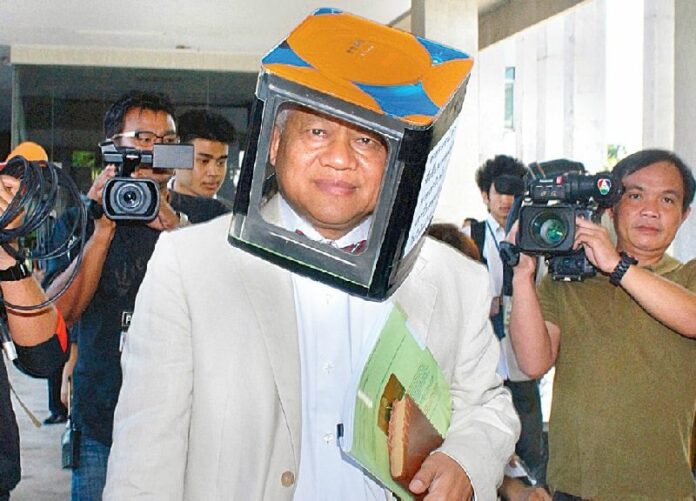
Shortly after it was announced in late August that Rajata was chosen to be Minister of Public Health in junta-leader and Prime Minister Gen. Prayuth Chan-ocha's Cabinet, Sukree Charoensuk, the dean of Mahidol University's College of Music, staged a public protest calling on Rajata to honour the university's regulations. 

When Rajata initially refused, Sukree wore a metal box on his head in a symbolic protest during a meeting with the rector. The metal box was a reference to the Thai idiom "putting a metal box over one's head," which describes feeling ashamed. Other Mahidol academics soon joined Sukree's campaign and urged Rajata to make a decision. 

A similar controversy broke out at Thammasat University when its rector, Somkid Lertpaithoon, accepted the military junta's appointment to join the National Legislative Assembly (NLA).

Progressive student activists at the university, which is traditionally known as a hotbed of pro-democracy movements in Thailand,  have denounced Somkid for collaborating with what they call the military regime’s "rubber stamp parliament.” 

Mysterious posters criticising Somkid's NLA appointment appeared briefly in several lecture halls of Thammsat University's Rangsit Campus before they were taken down by university security guards. 


For comments, or corrections to this article please contact[email protected]

You can also find Khaosod English on Twitter and Facebook
http://twitter.com/KhaosodEnglish
http://www.facebook.com/KhaosodEnglish


Advertisement

Photo Essay: The Gods Among Us At Navaratri Festival

By Gerrit Phil Baumann

On 4 October, Thais from across the country gathered in Bangkok to participate in Vijayadashami,  the dawn-til-dusk celebration that ends the nine-day Hindu festival of Navatri.  Khaosod English photographer Gerrit Phil Baumann brought his camera to follow the procession in Bangkok, which featured Brahmin priests, sacred powders, and spirit-possessed dancers. 

\
The half-moon night of Vijayadashami ends Navaratri, one of the holiest festivals in the Hindu religion. Although 96% of Thais identify as Buddhists, many of them also worship Hindu gods and holidays. 

\
Devotees come to Bangkok from all corners of the kingdom to receive a blessing. Shrines are organized by groups of friends and neighborhoods.

\
 In Thailand, it's especially common for artists and creatives – such as this professional dancer – to worship Hindu deities.

\
A Brahmin priest arrives to bless the crowds with sacred powder.

\
Devotees wait with offerings for the another Brahmin to pass.

\
The Brahmins walk by in a trance-like state, appearing to feel no pain from the spears piercing their cheeks.

\
After the Brahmins pass, a marching band heralds the arrival of a wagon carrying a statue from inside a Hindu temple on Silom road.

\
Devotees queue up to present offerings to the statues.

\
The offerings contain fruits, nuts, spices, and flower garlands. 

\
Security officers hectically order people to vacate the pedestrian bridge as no human is supposed to stand above sacred object.

\
The statues are guarded by military police. In 2006, the statue of Phra Phrom was destroyed by a mentally ill man who was then beaten to death by angry bystanders.

\
Brahmins collect garland offerings from believers. 

\
A group of fortune tellers perform a rite inviting the deities to take over their bodies.

\
The gods have taken over and the mediums dance and speak in their voices.

\

\
Once the gods choose to leave the body of the mediums, they collapse in total exhaustion.


For comments, or corrections to this article please contact[email protected]

You can also find Khaosod English on Twitter and Facebook
http://twitter.com/KhaosodEnglish
http://www.facebook.com/KhaosodEnglish

Advertisement

HM King 'Conscious' After Gallbladder Surgery

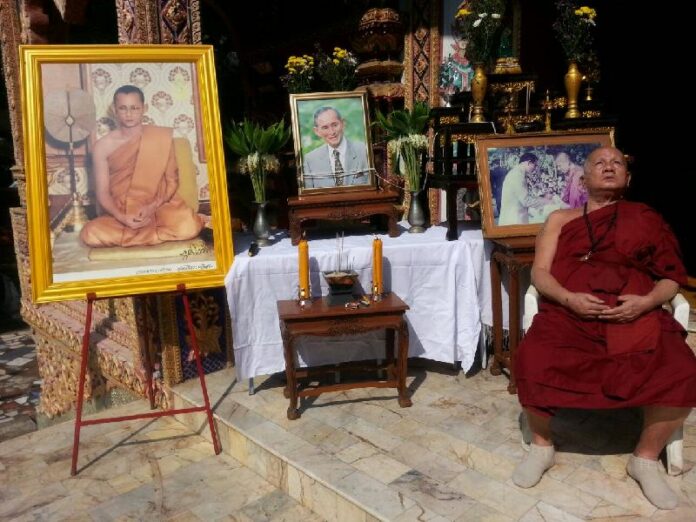
Phra Kru Suthep Sittikhun, the abbot of Wat Sri Boon Rueng Temple in Chiang Mai province, stared at the sun for 30 minutes to ask for the Sun God Suriyathep's help in speeding the recovery of His Majesty the King, who recently had his gallbladder removed, 7 October 2014.

BANGKOK — The King of Thailand is gradually recovering from a recent operation to remove his gallbladder, though he is still affected by an occasional fever, the palace said in a statement last night.

The 86-year-old monarch underwent surgery on 5 October to remove his gallbladder, which doctors said was severely inflamed.

According to the Royal Household Bureau, King Bhumibol is "conscious" after the surgery. 

"His breathing is normal. There is still occasional fever. His heartbeat rate has lowered, approaching a normal level. Regular examination of his heart did not indicate any abnormalities," the statement said. "His Majesty still feels pain around the wound where the surgery to remove his gallbladder took place. The medical team is closely assisting His Majesty."

Examination of the removed gallbladder confirmed that the organ was infected, the palace said.

King Bhumibol was driven to the Bangkok hospital from his summer palace in Prachuap Kiri Khan province on 3 October with a high fever and rapid heartbeat. 

His Majesty the King's frail health is a cause of anxiety for many Thais. The monarch has been on the throne for more than 60 years and is widely credited with bringing stability to the kingdom. Thailand's stock dropped 1.4 percent when it opened on Monday, presumably in response to the news of King Bhumibol's hospitalisation. 

Temples, state agencies, and groups of loyal Thais across the country have been organising prayer sessions to wish for the king's return to good health. Yesterday, a temple abbot in Chiang Mai province stared at the sun for 30 minutes to ask for the Sun God Suriyathep's help in speeding His Majesty's recovery. 


For comments, or corrections to this article please contact: [email protected]

You can also find Khaosod English on Twitter and Facebook
http://twitter.com/KhaosodEnglish
http://www.facebook.com/KhaosodEnglish

Advertisement

Reform Council Stacked With Engineers of Pre-Coup Protests

NRC-member and former PCAD leader Sombat Thamrongthanyawong was detained by police in the parking lot of the university where he used to work as a rector, the National Institute of Development Administration (NIDA), on 16 May 2014.

BANGKOK — Thailand’s military junta has appointed a 250-member reform body that is heavily stacked with traditional elites and allies of the country’s conservative establishment.

According to the military junta’s 2014 Interim Constitution, the National Reform Council (NRC) will propose reforms across various fields to the Cabinet and National Legislative Assembly (NLA), whose members were also handpicked by the junta.

Although coup-leader turned Prime Minister Gen. Prayuth Chan-ocha insisted that the NRC would represent a balanced cross-section of society, the final list of members published yesterday evening is dominated by conservative hardliners opposed to the former government.

Among them were nine leaders from the anti-government protests that preceded the coup, including Naowarat Pongpaiboon, Sombat Thamrongthanyawong, and Charas Suwanmala.

The protest group, known as the People's Committee for Absolute Democracy With the King As Head of State (PCAD), campaigned against the former government for seven months until the military intervened and launched a coup in May. 

Eleven of the 'Forty Senators' clique – a group of unelected Senators who opposed the former government – also made the final cut, such as Rosana Tositrakul, Kamnoon Sitthisaman, and Pramote Maiklat. The so-called Forty Senators played an active role in the PCAD's campaign to unseat then-Prime Minister Yingluck Shinawatra and replace her with a royally-appointed PM. 

In addition, 31 retired military officers were added to the reform council, as well as nine members of the governing bodies appointed by the previous coup-makers in 2006.

Three members of the former government were included in the reform body, but not a single representative of the pro-government Redshirt movement was selected.

The National Legislative Assembly (NLA) is similarly dominated by  military and police officers, conservative politicians, and bureaucrats. 

Chertchai Tantisirin, a Redshirt activist and former Pheu Thai Party MP, said he is dismayed by the composition of the NRC.

"They are all the same group who opposed the government, and now they are joined by the people who drafted the [now-defunct] 2007 Constitution," Chertchai said.

He expressed concern that the reforms they pursue will not be inclusive because of the group's partisan nature.

"I'd like to tell the NRC to be open-minded and accept criticism from the people. Don't act like puppet [of the junta]," Chertchai said."Redshirts will be closely watching you."

The junta initially planned to set up a separate committee of experts to select the NRC members from a pool of 6,000 applicants. However, the coup-makers scrapped the plan last month and announced they would directly pick the council’s members instead.

The NRC will also be tasked with forming a committee to draft a new constitution to replace the charter dissolved by the junta in May.  

For comments, or corrections to this article please contact: [email protected]

You can also find Khaosod English on Twitter and Facebook
http://twitter.com/KhaosodEnglish
http://www.facebook.com/KhaosodEnglish

Advertisement

Reform Council Stacked With Engineers of Pre-Coup Protests

Anti-government Senators welcome PCAD leader Suthep Thaugsuban to the House of Parliament to discuss plans for an appointed PM, 12 May 2014.

BANGKOK — Thailand’s military junta has appointed a 250-member reform body that is heavily stacked with traditional elites and allies of the country’s conservative establishment.

According to the military junta’s 2014 Interim Constitution, the National Reform Council (NRC) will propose reforms across various fields to the Cabinet and National Legislative Assembly (NLA), whose members were also handpicked by the junta.

Although coup-leader turned Prime Minister Gen. Prayuth Chan-ocha insisted that the NRC would represent a balanced cross-section of society, the final list of members published yesterday evening is dominated by conservative hardliners opposed to the former government.

Among them were nine leaders from the anti-government protests that preceded the coup, including Naowarat Pongpaiboon, Sombat Thamrongthanyawong, and Charas Suwanmala.

The protest group, known as the People's Committee for Absolute Democracy With the King As Head of State (PCAD), campaigned against the former government for seven months until the military intervened and launched a coup in May. 

Eleven of the 'Forty Senators' clique – a group of unelected Senators who opposed the former government – also made the final cut, such as Rosana Tositrakul, Kamnoon Sitthisaman, and Pramote Maiklat. The so-called Forty Senators played an active role in the PCAD's campaign to unseat then-Prime Minister Yingluck Shinawatra and replace her with a royally-appointed PM. 

In addition, 31 retired military officers were added to the reform council, as well as nine members of the governing bodies appointed by the previous coup-makers in 2006.

Three members of the former government were included in the reform body, but not a single representative of the pro-government Redshirt movement was selected.

The National Legislative Assembly (NLA) is similarly dominated by  military and police officers, conservative politicians, and bureaucrats. 

Chertchai Tantisirin, a Redshirt activist and former Pheu Thai Party MP, said he is dismayed by the composition of the NRC.

"They are all the same group who opposed the government, and now they are joined by the people who drafted the [now-defunct] 2007 Constitution," Chertchai said.

He expressed concern that the reforms they pursue will not be inclusive because of the group's partisan nature.

"I'd like to tell the NRC to be open-minded and accept criticism from the people. Don't act like puppet [of the junta]," Chertchai said."Redshirts will be closely watching you."

The junta initially planned to set up a separate committee of experts to select the NRC members from a pool of 6,000 applicants. However, the coup-makers scrapped the plan last month and announced they would directly pick the council’s members instead.

The NRC will also be tasked with forming a committee to draft a new constitution to replace the charter dissolved by the junta in May.  

For comments, or corrections to this article please contact: [email protected]

You can also find Khaosod English on Twitter and Facebook
http://twitter.com/KhaosodEnglish
http://www.facebook.com/KhaosodEnglish

Advertisement

Redshirt 'Mascot' Removed From LINE Sticker Store

An announcement posted on the creator of the sticker's Facebook page.

BANGKOK — The popular messenger application LINE has withdrawn emoticons depicting a red buffalo, the unofficial mascot of the Redshirt movement.

Originally, red buffalo (kwai daeng) was a nickname used to insult supporters of the Redshirt movement, as buffalos are considered a symbol of stupidity in Thai culture. However, in recent years many Redshirts have embraced the nickname in good jest and produced several products based on the unofficial mascot, including the LINE emoticon, or ‘sticker’ set, created by a Redshirt activist.

But the anonymous administrator of the "Red Buffalo" Facebook page, who created the stickers, posted an announcement today explaining that LINE has removed the stickers because of their 'slanderous' nature. The stickers were only available for 24 hours before they were removed.

According to the creator, LINE said they have the right to remove any "Stickers that may slander, injure, or attack the reputation of a particular person, nationality, or a group."

While some commentators said they managed to download the sticker set before it was removed, many expressed disappointment about missing the brief window. One of the commentators raised suspicions that Yellowshirts – political rivals of the Redshirts – may have "reported" the sticker in an attempt to have it banned.

In May, soldiers in Chiang Mai were dispatched to remove T-shirts depicting a red buffalo stamping on a cockroach – a symbol for the opposition Democrat Party – from all of the city's markets. 

LINE is one of the most popular messenger applications in social media obsessed Thailand. According to the Japan-based company, there are at least 24 million registered LINE users in Thailand out of a population of 65 million.

In the past, authorities have attempted to curtail and monitor the use of Thailand's social media-sphere, which has a reputation as a destructive rumour mill and forum for hate speech between the country's political rivals. Authorities have expressed specific concern about negative discussion of the monarchy and the military junta.

In June, Thai police announced they would ask for "cooperation" from LINE headquarters to suspend accounts of anti-coup dissenters and "spy" on numerous chatrooms to look for criminal messages. The plan did not appear to come to fruition. 


For comments, or corrections to this article please contact: [email protected]

You can also find Khaosod English on Twitter and Facebook
http://twitter.com/KhaosodEnglish
http://www.facebook.com/KhaosodEnglish

Advertisement

Hot News

LATEST NEWS

Bangkok
overcast clouds
27.7 ° C
27.7 °
26.6 °
82 %
0.5kmh
92 %
Thu
34 °
Fri
34 °
Sat
35 °
Sun
35 °
Mon
33 °