
























29.2 C
Bangkok
Saturday, August 29, 2026
Home Blog Page 3324

Trafficker of Rose-Selling Children on Khaosan Road Arrested

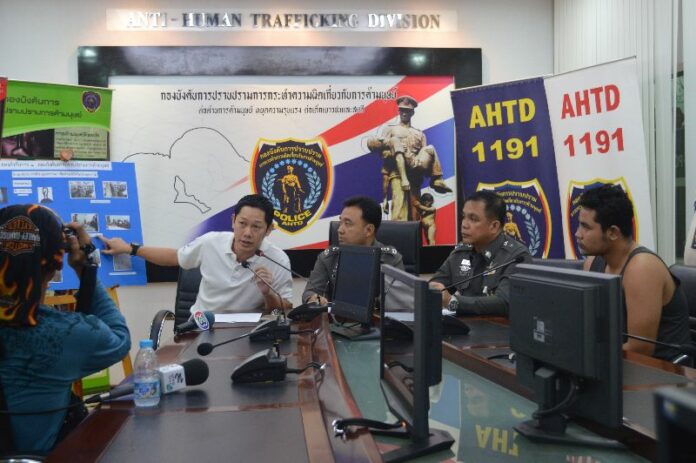
Police press conference on 21 June, 2014 at Crime Suppression Division HQ in Bangkok. [Photo by Rachel Kessler].

BANGKOK — Thai police have arrested a man who admitted to trafficking young Burmese children to sell flowers to foreign tourists in one of Bangkok's most popular tourist locales.

The arrest followed Khaosod English's request to interview the Anti-Human Trafficking Division (AHTD) about children who peddle roses to tourists until 3am every night on Khaosan Road, a notorious watering-hole for backpackers and late-night revelers in downtown Bangkok.  

Khaosod English and independent filmmaker Rachel Kessler have been investigating the story of these children for several weeks. Interviews with NGOs, business owners on Khaosan Road, and many of the children have suggested that at least some of them are victims of human trafficking.

This morning, Khaosod English was informed that its inquiry on Wednesday prompted police to investigate the area last night and bring five rose-selling children back to the police headquarters. All five children, ranging from age five to fourteen, are Burmese.

One of the children, a seven-year-old boy, told police he was purchased from his family on the Thai-Burmese border and is living with a caretaker in Bangkok who he referred to as his “boss.”

"From what the child told us, there was a transaction between the parents and the dealer beforehand," said Pol.Col. Chitpop Tomuan, a superintendent of the AHTD.

This morning, police tracked down and arrested the "boss" at a residential building near Khaosan Road, where officers found two more children living in the home. The 22-year-old suspect, who is also Burmese, confessed that he paid the children’s parents 50,000 Burmese kyat ($51.14 USD) for each child, Pol.Col. Chitpop said.

According to Witanapat Rutanavaleepong, the head of the Mirror Foundations Stop Child Begging project, hundreds of Burmese children are trafficked from communities along the Thai-Burmese border to sell roses in Bangkok and other popular tourist locations in Thailand. The Mirror Foundation has helped return a number of these children back to their families.

Many Burmese families living illegally in western Thailand’s border towns sell their children out of financial desperation, Mr. Witanapat said. Most of them live in extreme poverty and some have been forced to flee Myanmar to avoid ethnic and religious persecution.

According to Mr. Witanapat, families are approached by middlemen who offer a lump sum to take one of their children to sell roses in Bangkok with promises to send back monthly payments of around 1,500 baht. However, the children on Khaosan Road typically ring in around 1,000 baht per night, selling roses at 20 baht a piece. It is suspected that most of the money goes to their caretakers and traffickers.

Mr. Witanapat cited several cases in which families stopped receiving payments after the first few months and eventually lost contact with their children.  

“Most of them start with an agreement of how much money they will they get monthly and when the kid will be back,” said Mr. Witanapat said. “But then it becomes human trafficking because the handlers stop paying the families and refuse to return the child.”

According to Mr. Witanapat, only 20% of children sold into the rose-selling business are ever returned home.

This afternoon, the three children who told police they were purchased from their families were moved to a state-owned children’s shelter while police work on locating their parents.

“In the past several hours they have shown great improvement in their mental condition,” Pol.Col. Chitpop said. "They were frightened at first, but they are improving."

The children, who Khaosod English has spoken to on previous occasions and visited at the police headquarters this morning, appeared cheerful and relaxed.

Police are still questioning the four other children in their custody who claim to be selling roses voluntarily. Pol. Col. Chitpot said he suspects they have been trained to lie about their circumstances.

“They may have been threatened not to share any information,” he said.

Pol. Col. Chitpot said police are trying to contact their families to establish whether or not the children are victims of trafficking, but noted that their parents may be unwilling to step forward if they are living in Thailand illegally.  

There are at least eight more Burmese children, who Khaosod English has spoken to, that regularly sell roses on Khaosan Road and are not yet in police custody.

Today’s arrest came as Thailand’s military government scrambles to make up for a year of bad press surrounding the country’s dismal record of combatting human trafficking.  Tens of thousands of migrants from neighboring countries are trafficked across Thailand’s borders every year and many of them are forced into slavery or exploited in the sex industry. Recent reports by Reuters and The Guardian have thrust a global spotlight on the tragic fate of many trafficking victims, as well as the complicity of some Thai officials.

On Friday, the US State Department downgraded Thailand to the lowest rank in its annual Trafficking in Persons Report (TIP) for not complying with the minimum standards for eliminating human trafficking.  Thailand is now a member of the “Tier 3” category alongside countries like Iran, Syria, and North Korea.

According to the report, in 2014 Thailand’s “overall anti-trafficking law enforcement efforts remained insufficient compared with the size of the problem in Thailand, and corruption at all levels hampered the success of these efforts.”

Police are expected to hold a press conference about today’s arrest of the trafficking supsect at 10 a.m. tomorrow at the headquarters of the Crime Suppression Division. 

“It just feels good to know that these kids are going to go to bed at a normal hour tonight,” said Rachel Kessler, who is filming a documentary about the children who are trafficked to sell roses on Khaosan Road. Ms. Kessler has been researching the story of these children since last October. Her documentary, titled20 ฿AHT, is scheduled to release in 2015. 

(Reporting by Sally Mairs)


For comments, or corrections to this article please contact: [email protected]

You can also find Khaosod English on Twitter and Facebook
http://twitter.com/KhaosodEnglish
http://www.facebook.com/KhaosodEnglish
Advertisement

Trafficker of Rose-Selling Children on Khaosan Road Arrested

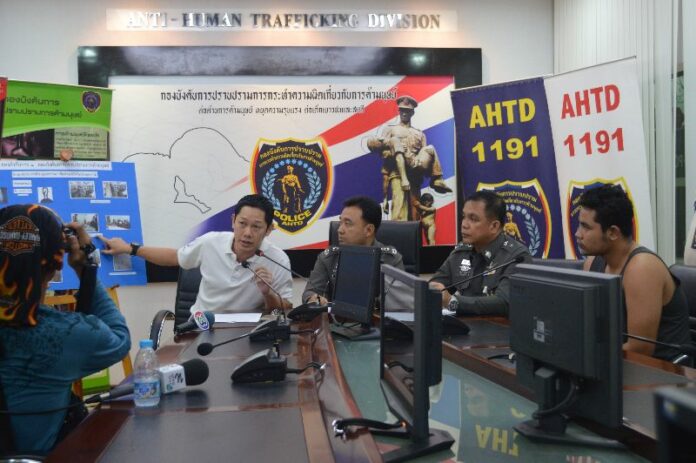
Police press conference on 21 June, 2014 at Crime Suppression Division HQ in Bangkok. [Photo by Rachel Kessler].

BANGKOK — Thai police have arrested a man who admitted to trafficking young Burmese children to sell flowers to foreign tourists in one of Bangkok's most popular tourist locales.

The arrest followed Khaosod English's request to interview the Anti-Human Trafficking Division (AHTD) about children who peddle roses to tourists until 3am every night on Khaosan Road, a notorious watering-hole for backpackers and late-night revelers in downtown Bangkok.  

Khaosod English and independent filmmaker Rachel Kessler have been investigating the story of these children for several weeks. Interviews with NGOs, business owners on Khaosan Road, and many of the children have suggested that at least some of them are victims of human trafficking.

This morning, Khaosod English was informed that its inquiry on Wednesday prompted police to investigate the area last night and bring five rose-selling children back to the police headquarters. All five children, ranging from age five to fourteen, are Burmese.

One of the children, a seven-year-old boy, told police he was purchased from his family on the Thai-Burmese border and is living with a caretaker in Bangkok who he referred to as his “boss.”

"From what the child told us, there was a transaction between the parents and the dealer beforehand," said Pol.Col. Chitpop Tomuan, a superintendent of the AHTD.

This morning, police tracked down and arrested the "boss" at a residential building near Khaosan Road, where officers found two more children living in the home. The 22-year-old suspect, who is also Burmese, confessed that he paid the children’s parents 50,000 Burmese kyat ($51.14 USD) for each child, Pol.Col. Chitpop said.

According to Witanapat Rutanavaleepong, the head of the Mirror Foundations Stop Child Begging project, hundreds of Burmese children are trafficked from communities along the Thai-Burmese border to sell roses in Bangkok and other popular tourist locations in Thailand. The Mirror Foundation has helped return a number of these children back to their families.

Many Burmese families living illegally in western Thailand’s border towns sell their children out of financial desperation, Mr. Witanapat said. Most of them live in extreme poverty and some have been forced to flee Myanmar to avoid ethnic and religious persecution.

According to Mr. Witanapat, families are approached by middlemen who offer a lump sum to take one of their children to sell roses in Bangkok with promises to send back monthly payments of around 1,500 baht. However, the children on Khaosan Road typically ring in around 1,000 baht per night, selling roses at 20 baht a piece. It is suspected that most of the money goes to their caretakers and traffickers.

Mr. Witanapat cited several cases in which families stopped receiving payments after the first few months and eventually lost contact with their children.  

“Most of them start with an agreement of how much money they will they get monthly and when the kid will be back,” said Mr. Witanapat said. “But then it becomes human trafficking because the handlers stop paying the families and refuse to return the child.”

According to Mr. Witanapat, only 20% of children sold into the rose-selling business are ever returned home.

This afternoon, the three children who told police they were purchased from their families were moved to a state-owned children’s shelter while police work on locating their parents.

“In the past several hours they have shown great improvement in their mental condition,” Pol.Col. Chitpop said. "They were frightened at first, but they are improving."

The children, who Khaosod English has spoken to on previous occasions and visited at the police headquarters this morning, appeared cheerful and relaxed.

Police are still questioning the four other children in their custody who claim to be selling roses voluntarily. Pol. Col. Chitpot said he suspects they have been trained to lie about their circumstances.

“They may have been threatened not to share any information,” he said.

Pol. Col. Chitpot said police are trying to contact their families to establish whether or not the children are victims of trafficking, but noted that their parents may be unwilling to step forward if they are living in Thailand illegally.  

There are at least eight more Burmese children, who Khaosod English has spoken to, that regularly sell roses on Khaosan Road and are not yet in police custody.

Today’s arrest came as Thailand’s military government scrambles to make up for a year of bad press surrounding the country’s dismal record of combatting human trafficking.  Tens of thousands of migrants from neighboring countries are trafficked across Thailand’s borders every year and many of them are forced into slavery or exploited in the sex industry. Recent reports by Reuters and The Guardian have thrust a global spotlight on the tragic fate of many trafficking victims, as well as the complicity of some Thai officials.

On Friday, the US State Department downgraded Thailand to the lowest rank in its annual Trafficking in Persons Report (TIP) for not complying with the minimum standards for eliminating human trafficking.  Thailand is now a member of the “Tier 3” category, alongside countries like Iran, Syria, and North Korea.

According to the report, in 2014 Thailand’s “overall anti-trafficking law enforcement efforts remained insufficient compared with the size of the problem in Thailand, and corruption at all levels hampered the success of these efforts.”

Police are expected to hold a press conference about today’s arrest of the trafficking supsect at 10 a.m. tomorrow at the headquarters of the Crime Suppression Division. 

“It just feels good to know that these kids are going to go to bed at a normal hour tonight,” said Rachel Kessler, who is filming a documentary about the children who are trafficked to sell roses on Khaosan Road. Ms. Kessler has been researching the story of these children since last October. Her documentary, titled 20 ฿AHT, is scheduled to release in 2015. 


For comments, or corrections to this article please contact: [email protected]

You can also find Khaosod English on Twitter and Facebook
http://twitter.com/KhaosodEnglish
http://www.facebook.com/KhaosodEnglish
Advertisement

US Downgrades Thailand After Human Trafficking, Slavery Revelations

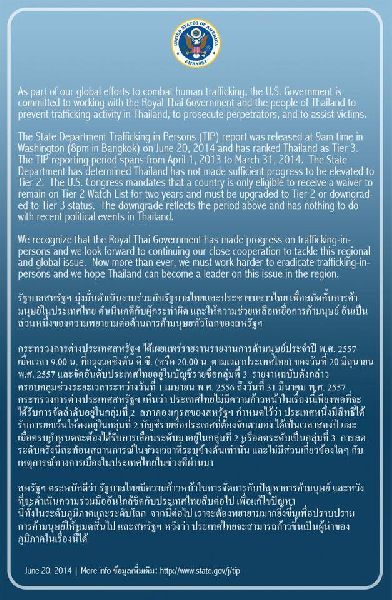
statement on U.S. Embassy Bangkok facebook

By Cod Satrusayang (DPA)

BANGKOK (DPA) – The United States has downgraded Thailand in its annual human trafficking report after revelations of slavery in the country's shrimp industry.

Thailand was downgraded to the lowest rank in the State Department's Trafficking in Persons report (TIP), putting it on the same level as Iran, Cuba, Zimbabwe and North Korea.

The report cites the recruitment of young women into the sex trade, slavery within the seafood industry, as well as the trafficking of Rohingya refugees from Myanmar.

The report points to corruption as a major barrier to fighting such abuses, adding that officials and police were in many cases complicit in forced labour and sex slavery.

The military junta which governs Thailand has acknowledged that trafficking is a real problem. In his weekly address to the nation on Friday, junta leader Prayuth Chan-Ocha stated that the government was working to "address the issue."

In a meeting with the US ambassador, Thailand's acting foreign minister stressed that the country places "great importance on combatting and eradicating human trafficking."

An expose in Britain's Guardian newspaper last week revealed that Thailand's shrimp farmers were buying feed made from fish caught using forced labour.

"Large numbers of men [are] bought and sold like animals and held against their will on fishing boats off Thailand," the report stated.

Last week Thailand was the only country to vote against a motion that would enforce the International Labour Organization's convention against slave labour, citing that local conditions may not be ready to implement such a measure.

The reaction from NGOs and rights groups was harsh, with the executive director of the Environmental Justice Foundation calling the decision an "absolute disgrace and one that brings further shame on to an already embattled government."

Thailand subsequently rescinded its abstention and voted in favour of the protocol.

Thailand's downgrade to the lowest tier of the TIP report means that it may face economic sanctions and the withdrawal of aid.

Multinational companies will now be encouraged to stop trading in industries where forced labour may play a role.


Advertisement

Thai Women Scammed For 3 Million Baht By German 'Lover'

A German man has swindled over 3 million baht from Thai women who he fooled into marrying him and ordering non-existent iPhones from Germany, police say.

BANGKOK — A German man has swindled over 3 million baht from Thai women who he fooled into marrying him and ordering non-existent iPhones from Germany, police say.

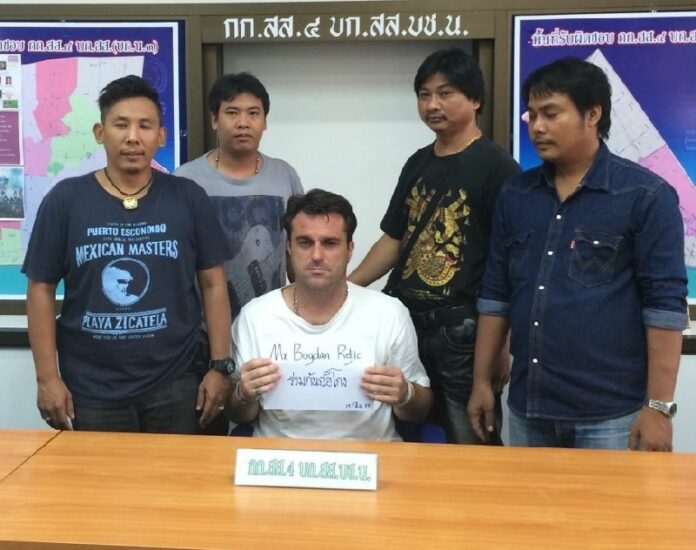
Bogdan Rejic was arrested earlier this week by Bangkok Metropolitan Police and charged with various counts of fraud.

Pol.Maj.Gen. Nopparat Sinma said yesterday that many Thai women complained to the police that Mr. Bogdaan flirted with them on a dating mobile phone app and claimed to be a German expat working for the state-owned petroleum company PTT. 

The women began dating Mr. Rejik and some of them even married him, Pol.Maj.Gen. Nopparat said. According to Pol.Maj.Gen. Nopparat, Mr. Rejik later convinced them they could order shipments of iPhones at a low price from Germany to be sold for a profit in Thailand.

"Many people fell for it and transferred money to a bank account provided by Mr. Bogdaan, which is registered under the name of someone called Gez," Pol.Maj.Gen. Nopparat said. "But when it was time for the phone delivery, he would avoid [the women]. So the victims decided to file complaints."

Pol.Maj.Gen. Nopparat estimated that Mr. Rejik has collected over 3 million baht through this scheme. He did not say how many women filed complaints.

The police investigation revealed that Mr. Rejik arrived in Thailand in 2000 and has overstayed his visa ever since. Pol.Maj.Gen. Nopparat said the court issued an arrest warrant on the suspect in March and eventually arrested him in Bangkok's Prawet district this week. 

Mr. Rejik has appeared in a number of movies as an extra actor, our correspondent said. His latest appearance was in the horror film "Hong Hoon" which premiered in cinema on 19 June. 


For comments, or corrections to this article please contact: [email protected]

You can also find Khaosod English on Twitter and Facebook
http://twitter.com/KhaosodEnglish
http://www.facebook.com/KhaosodEnglish
 

Advertisement

Officials to Revise Textbooks, Increase Study Hours on Patriotism

(Prachatai English)

BANGKOK — Thailand's Basic Education Commission plans to increase study hours on Thainess and patriotism for primary and secondary school students for up to 40 hours per year. 

Read more of the story here.


Note: Khaosod English is not responsible for content on other websites.

Advertisement

Armed Navy personnel lead 200-strong Phuket land raid

(Phuket Gazette)

PHUKET: More than 200 officers under armed escort by Royal Thai Navy personnel arrested five suspects for violent intimidation of villagers in Phuket’s Soi Palai area early this morning.

Read more of the story here.


Note: Khaosod English is not responsible for content on other websites.


Advertisement

Defender of Fake Bomb Detector Appointed Top Forensic Science Job

Soldiers in Pathani province display the GT200 in 2010.

BANGKOK — A previously-vocal supporter of fake bomb detectors has been re-appointed as the head of the Central Institute of Forensic Science in Thailand.

Porntip Rojanasunan confirmed to Khaosod English today that the military junta’s National Council for Peace and Order (NCPO) approved her reinstatement on Tuesday, but the official order was only relayed to the Ministry of Justice yesterday.

“I am a bureaucrat. I am ready to work to my best ability,” Ms. Porntip replied when asked how she felt about the reinstatement. “I would also like to thank the NCPO for giving me this opportunity.”

Ms. Porntip’s return to the helm of the forensic science institute did not come as a surprise to many. Ms. Porntip was a staunch supporter of the political faction that protested against the previous government and widely celebrated the military’s coup d’etat on 22 May.

After seizing control of the country’s government, the NCPO has removed many top officials known for their affiliation with former Prime Minister Yingluck Shinawatra and replaced them with those who are sympathetic to the coup.

Ms. Porntip’s reinstatement has also raised concerns that she may decide to resume the uses of GT200, a version of the fake bomb-detecting device sold by a British businessman to Thailand several years ago. British businessman James McCormick sold thousands of the phony detectors were at extortionate prices to countries such as Iraq, Pakistan, and Thailand.

Thai security officers used them for several years to look for potential explosives in the southern border provinces, where separatist violence has claimed over 6,000 lives since 2002.

Mr. McCormick, who was convicted of fraud and sentenced to 10 years in jail, claimed the devices could detect a wide range of substances, such as explosives or narcotics, by analysing molecular components from a distance. Mr. McCormick’s company told customers that the long dials attached to the detectors would swing and point to any suspicious materials.

In reality, the devices were completely ineffectual and modeled after $20 golf-ball finders Mr. McCormick had purchased in the United States.

After a number of scientists challenged the validity of the devices, the Thai authorities staged a scientific test of GT200 in 2010. The result established the GT200’s accuracy to be as good as random chance.

But Ms. Porntip, who was the head of the CIFS at the time, defended the effectiveness of the device. She admitted that the GT200 has failed scientific tests, but insisted that it did not matter because the devices themselves not operate on any scientific principle.

“GT200 is not scientific either, it depends on the operators. The officials of the CIFS have used it with great efficiency,” Ms. Porntip was quoted as saying in February 2010.

However, in the phone interview with Khaosod English today, Ms. Porntip claimed that the media misunderstood her position.

“I was only criticising people who criticised scientists and the military and called them stupid for having faith in the devices,” Ms. Porntip said.

She explained that she sympathised with security officers in the Deep South who trusted the devices, despite their inaccuracy, because they had no other tools to rely on.

Asked whether that means GT200 will be brought back, Ms. Porntip replied that security officers stopped using the devices a long time ago and refused to comment further on the question.

“This question is like asking for trouble,” Ms. Porntip said.

Meanwhile, former CIFS director Anek Yomchinda said he did not dispute the NCPO’s decision to replace him with Ms. Porntip.

“I am ready to follow any orders in strict manner. I do not dispute them. I have no feelings about them,” Mr. Anek said.

Advertisement

Defender of Fake Bomb Detector Appointed Top Forensic Science Job

Soldiers in Pathani province display the GT200 in 2010.

BANGKOK — A previously-vocal supporter of fake bomb detectors has been re-appointed as the head of the Central Institute of Forensic Science in Thailand.

Pornthip Rojanasunand confirmed to Khaosod English today that the military junta's National Council for Peace and Order (NCPO) approved her reinstatement on Tuesday, but the official order was only relayed to the Ministry of Justice yesterday. 

"I am a bureaucrat. I am ready to work to my best ability," Ms. Pornthip replied when asked how she felt about the reinstatement. "I would also like to thank the NCPO for giving me this opportunity."

Ms. Pornthip's return to the helm of the forensic science institute did not come as a surprise to many. Ms. Pornthip was a staunch supporter of the political faction that protested against the previous government and widely celebrated the military's coup d'etat on 22 May. 

After seizing control of the country's government, the NCPO has removed many top officials known for their affiliation with former Prime Minister Yingluck Shinawatra and replaced them with those who are sympathetic to the coup.

Ms. Pornthip’s reinstatement has also raised concerns that she may decide to resume the uses of GT200, a version of the fake bomb-detecting device sold by a British businessman to Thailand several years ago. British businessman James McCormick sold thousands of the phony detectors were at extortionate prices to countries such as Iraq, Pakistan, and Thailand. 

Thai security officers used them for several years to look for potential explosives in the southern border provinces, where separatist violence has claimed over 6,000 lives since 2002. 

Mr. McCormick, who was convicted of fraud and sentenced to 10 years in jail, claimed the devices could detect a wide range of substances, such as explosives or narcotics, by analysing molecular components from a distance. Mr. McCormick's company told customers that the long dials attached to the detectors would swing and point to any suspicious materials.

In reality, the devices were completely ineffectual and modeled after $20 golf-ball finders Mr. McCormick had purchased in the United States.

After a number of scientists challenged the validity of the devices, the Thai authorities staged a scientific test of GT200 in 2010. The result established the GT200's accuracy to be as good as random chance.

But Ms. Pornthip, who was the head of the CIFS at the time, defended the effectiveness of the device. She admitted that the GT200 has failed scientific tests, but insisted that it did not matter because the devices themselves not operate on any scientific principle.

“GT200 is not scientific either, it depends on the operators. The officials of the CIFS have used it with great efficiency,” Ms. Pornthip was quoted as saying in February 2010.

However, in the phone interview with Khaosod English today, Ms. Pornthip claimed that the media misunderstood her position.

"I was only criticising people who criticised scientists and the military and called them stupid for having faith in the devices," Ms. Pornthip said. 

She explained that she sympathised with security officers in the Deep South who trusted the devices, despite their inaccuracy, because they had no other tools to rely on. 

Asked whether that means GT200 will be brought back, Ms. Pornthip replied that security officers stopped using the devices a long time ago and refused to comment further on the question. 

"This question is like asking for trouble," Ms. Pornthip said. 

Meanwhile, former CIFS director Anek Yomchinda said he did not dispute the NCPO's decision to replace him with Ms. Pornthip. 

"I am ready to follow any orders in strict manner. I do not dispute them. I have no feelings about them," Mr. Anek said. 


For comments, or corrections to this article please contact: [email protected]

You can also find Khaosod English on Twitter and Facebook
http://twitter.com/KhaosodEnglish
http://www.facebook.com/KhaosodEnglish


Advertisement

Myanmar's Religious Affairs Minister Fired For Embezzlement

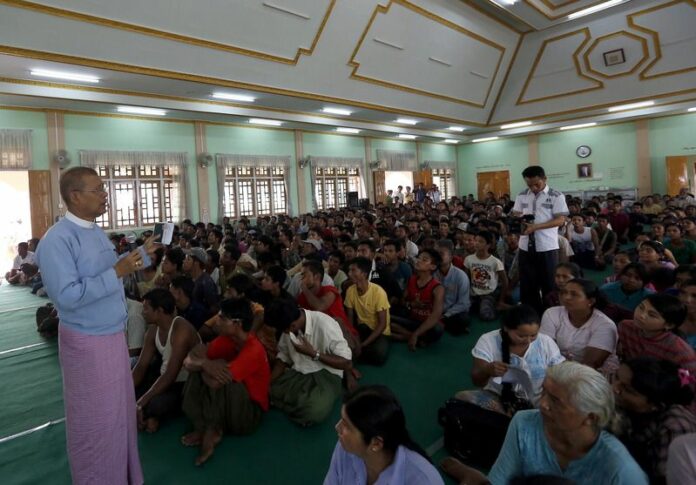
Hsan Sint (L), Myanmar's Minister of Religious Affairs, gives a speech to a group of Muslims at a temporary shelter in a Buddhist monastery in Lashio, Northern Shan State, Myanmar, 31 May 2013. Hsan Sint has been fired and charged with the misuse of around 10,000 US dollars. EPA/NYEIN CHAN NAING

YANGON (DPA) — Myanmar's minister of religious affairs has been fired and charged with the misuse of around 10,000 dollars, a government official said Friday.

The departure of Religious Affairs Minister Hsan Sint coincides with the arrest of five Buddhist monks last week after a well-known monastery was raided in a late-night operation in Yangon.

"He is now under investigation for misuse of a fund of around 10,000,000 kyat (10,225 dollars)," said a government official from the president's office who asked not to be named.

Some local media reports said Hsan Sint was sacked because opposed the monastery raid.

Officials from the Ministry of Religious Affairs, accompanied by around 300 riot police, seized the monastery in Yangon on June 10.

Its ownership is disputed between the government-appointed high-ranking Buddhist monk association, the State Sangha Maha Nayaka Committee, and the popular abbot Pyinya Wuntha.

Five senior monks were defrocked and sent to Yangon's Insein prison by the authorities on June 13. They will be charged with trespassing, police said last week.

The government also announced on state media that the chief minister of Rakhine state has retired but gave no explanation.

Rakhine state has seen a series of sectarian clashes between Buddhists and Muslims since June 2012 that has brought international criticism.


Advertisement

Anti-Coup Minister Gets New Charge, Could Face 14 Years Behind Bars

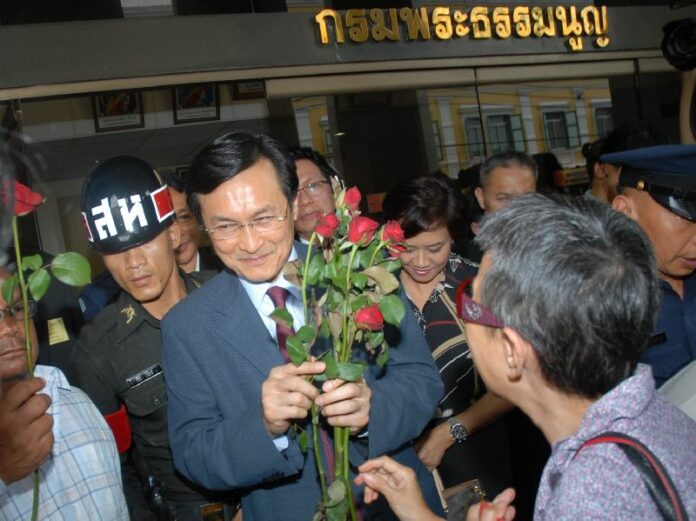
Chaturon Chaisang, former Education minister, heard a third charge of violating the Computer Crimes Act in martial court, 20 June 2014.

BANGKOK — A cabinet member of the former government could face up to 14 years in prison for the press conference he gave to foreign correspondents prior to his arrest.

Chaturon Chaisang, who served as Education Minister in the previous government, was summoned by the National Council for Peace and Order (NCPO) shortly after it staged a coup on 22 May. 

Mr. Chaturon initially refused to surrender himself and went into hiding. Five days later, he staged a press conference at the Thailand's Foreign Correspondent Club (FCCT) in Bangkok to announce that he was willing to turn himself in. 

Soldiers stormed the club and detained Mr. Chaturon as he was giving an interview to more than 100 foreign reporters. He was sent to martial court to face charges of defying the NCPO's summons order and inciting unrest, after which he was released on bail.

But at a second court hearing today Mr. Chaturon was informed that he will also be charged with violating the Computer Crimes Act. 

Mr. Chaturon told reporters that his prosecutors claimed he violated Section 14.3 of the Computer Crime Act, which criminalises “the input, into a computer system, of any computer data that is an offence related to national security or an offence related to terrorism.”

According to Mr. Chaturon, the prosecution argued that his speech at the FCCT, which he typed and distributed to the foreign press, constituted a violation of the Computer Crimes Act. His speech criticized the coup and called for an immediate return to democracy.

The three charges could amount to a maximum of 14 years in prison, Mr. Chaturon said.

"They only told me about the charge of the Computer Crimes Act 15 minutes before the hearing," Mr. Chaturon said. "I am very surprised and suspicious about this irregularity. I wonder if they intended to use it as an excuse for more witness examination so they could ask for the power to detain me."

However, the court rejected prosecutors' request to detain Mr. Chaturon for questioning and renewed the former minister’s release on bail.

Mr. Chaturon insisted that he would fight his case to the very end.

"This is the first case in 30 years of a civilian being tried in a military court for having different opinions, " said Mr. Chaturon, a former student activist who watched fellow activists stand trials in military court in late 1970s. 

He also insisted that he would continue to use his limited freedom during his bail release to develop and propose ideas for Thailand's democracy. 

"I am thinking and reading a lot at the moment, because I can't meet with anyone," Mr. Chaturon said. "When it is appropriate, I will present my ideas. As for now, I would like to comment that in order to have democracy, reforms, and reconciliation, many sides must be able to participate in the process."

The NCPO  is currently pursuing a heavy-handed campaign to bring about reconciliation, reform, and "happiness" to Thai society. To accomplish these ambitious goals, the junta has formed "reconciliation centres" for dialogues between rival political groups, established a reform committee, and staged free fairs and concerts around the country. 

The campaign has been accompanied by the NCPO's harsh crackdown on any voices of dissent. Since it seized power from the elected government last month, the military junta has summoned and detained hundreds of individuals, censored the press, banned public protests, and threatened to punish anyone who critises the junta's mission. 

Despite the junta's ban on public gatherings, moer than 100 people showed up at the military court to express their support for Mr. Chaturon this morning. 


For comments, or corrections to this article please contact: [email protected]

You can also find Khaosod English on Twitter and Facebook
http://twitter.com/KhaosodEnglish
http://www.facebook.com/KhaosodEnglish

 

Advertisement

Hot News

LATEST NEWS

Bangkok
overcast clouds
29.2 ° C
29.4 °
28.8 °
79 %
2.5kmh
100 %
Sat
36 °
Sun
34 °
Mon
27 °
Tue
28 °
Wed
32 °