30 C
Bangkok
Thursday, June 18, 2026
Home Blog Page 3426

Scores Of Tourists Stranded On Krabi Island After Storm

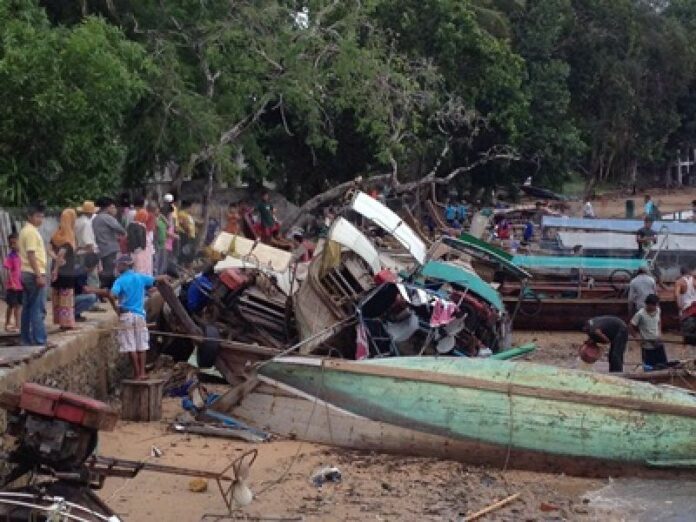
(26 May) Surges of high waves struck the sea just outside the coats of Krabi province today, damaging many boats moored along the shores and marooning over 100 tourists on small island.

The storm hit Krabi around 12.30 pm with 3-4 meter tidal waves. The surges damaged around 50 long-tailed boats anchored around Nam Mao Bay which is a popular anchor spot for boats ferrying tourists to visit the famous Ton Sai Bay, Phi Phi Islands, and Aow Nang Bay.

Witnesses said the storm lasted about 5 minutes and in some parts the waves were as high as 4 meters, and the sea was at high tide at the time. The waves hit the boats and broke some of them, with some motors floating out into the sea. The people on the boats could be seen running for their lives.

Mr. Weera Chaipattalung, 43, driver of taxi boat in Phi Phi Island said before the incident, there was the usual heavy storm, but all of a sudden a 3 meter wave hit the shore and caused so much damage.

Meanwhile, Krabi Coast Guards received reports of 10 tourist boats to Hong Island in Bokoranee National Park being damaged by the storm as well, stranding more than 100 tourists at the island. Officers have dispatched Gulf Patrol boats to the island and rescued the tourists.

Advertisement

ABAC Poll: Majority Still Backs Yingluck

(26 May) A survey says the majority of Thais support PM Yingluck Shinawatra, but a sizable population also thinks her government may place the interest of the elite over the common people.

The survey, conducted by Assumption University (ABAC Poll), gathers opinions from 2,168 subjects in 17 provinces. All respondents are over 18 year old.

According to the survey, 43.8% thinks the government is facing increasing political risk and many respondents voice their concern about the conflict between the government and independent agencies, possibly referring to the standoff between the ruling Pheu Thai Party and the Constitutional Court in recent months.

Many government officials and Redshirts say the court is impartial and biased against Pheu Thai Party. The court judges denied the accusation.

Nonetheless, when asked about their support for Ms. Yingluck as the prime minister, 52.8% say they
support her. 20.4% expressed their opposition and 26.8% say they are apathetic toward Ms. Yingluck.

Asked about their olerance toward the low quality of the politicians, 72.5% say they will tolerate them until new election. Additionally, 54.7% of the respondents say many policies under Yingluck administration are favouring the interest of the elite more than benefits of the people, but 45.3% say they believe her policies are serving the people.

Mr. Noppadol Kannika, director of the ABAC Poll, said the survey reflected important need for communication in politics. He urged the government to instill trust among the people and express their ability to handle many risks.

Mr. Noppadol added that the government and the military should cooperate like during the Great Flood in 2011 in order to lessen the tension between the two camps.

Advertisement

After Naked Bike Ride, Chiang Mai Gang Follows With Naked Dance

(26 May) The Rock Mode Gang challenges Chiang Mai police yet again by posting of men and women dancing to parody song of Gangnam Style and Harlem Shake on the internet – just after they were fined for their naked bike ride across Chiang Mai.

The gang, called ?The Rock Mode?, have filmed their own naked version of Gumnum Style (which is a Thai parody of the South Korean Gangnam Style) and Harlem Shake, with their genitals flailing about, and uploaded the clip onto Youtube and Facebook.

One of the individuals in the clip is believed to be Mr. Jatpol Chanbuntawee, 24, who was just fined by the police on charges of indecent acts after a video clip of him riding a motorcycle around Chiang Mai naked surfaced online. The uploader, said to be an individual with nickname “Ai Bomb”, has reportedly fled the country.

This latest upload has been interpreted by the the police as the Rock Mode Gang taunting the authorities, and the videos’ intent were clear that they wanted to publish them onto the online world due to the arrest of Mr.Jetpol.

A senior police official in Chiang Mai said that patrol officers have been looking for the gang members in hotels, bungalows, and other places.

Police say they will find the harshest punishment allowed for these individuals for taunting the force. A large scale investigative officers meeting will be held on 27 May to determine the actions which will be taken on the gang members.

With the toughest punishment law available, they will learn to not disobey the law again, the senior police officer said.

Advertisement

Taxi Driver Dies In Bangkok Traffic

(27 May) A taxi driver died in his car during Bangkok′s rush hour this morning.

Witnesses said they saw Mr. Pravit Ngarmsanit, 55, unconscious in his seat, with bubbles foaming at his mouth. The incident took place on Ratchapisek Road, near Criminal Court building. They soon alerted the police.

Rescue workers arrived and tried to resuscitate him, but failed. Mr. Pravit was declared dead at the scene. It is believed he also suffered seizure.

No other detail is immediately available from the police.

Advertisement

Letters To Editors: 27 May 2013

Cutting Off Electricity-Water


Dear
Khaosod Editors,

I have read the news about
a house fire in Phitsanulok which killed 2 children. The fire happened because the parents lit a candle in the house after
the Electric Authorities cut off their electricity since they did not
pay the electricity bill. I think this news should be a tragic
reminder for everyone so they can avoid such incident.

I would like to tell you about my own experience with
electricity cutting.

I live in Bangkok. One day I heard someone shouting
in front of the house next to mine.
I went out and
found an official from the Electric Authorities. Apparently he was there to cut the
electricity in that house because the homeowners did not pay.

So I told the official that the owner was away at the
moment, that I would tell him to pay
as soon as I see him, and I pleaded with the official not to cut off the electricity yet. The official agreed and left. When the home owner was
back I told him what happened, and he raced away to pay his bill.

The reason why I?m telling you this news is that: when
the officials arrive at your doorstep to cut your utility service,
don?t evade them. Confront them and tell them you
really forgot to pay, so that they would delay the cutting process. If you avoided them instead of giving them some explanation, they would have no other
choice
than cutting your electricity, because it is their duty. The same goes
with water
bill.

Thank
you,

Cape Jessamine

Replying Khun (Ms.) Cape
Jessamine

Thank you for your
practical and straightforward suggestion
. You are right to emphasize
on
dialogue and explanation. We believe
your suggestion would be useful for many readers.
At the same time, we think the officials from the Electric Authorities should take heed to this advice as well: if the residents come out and plead with
you, y
ou should give them some compromise before
resorting to final measure.

Khaosod Editorial
Team

Advertisement

Panthongtae: Thaksin's Rant Against Anti-Govt Crowd Is Fake

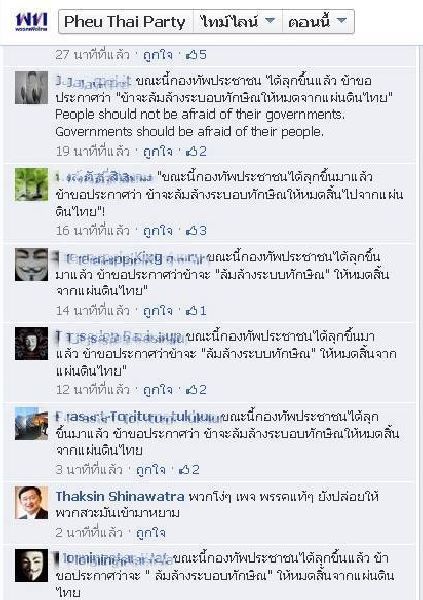
(27 May) Son of Former PM Thaksin Shinawatra denied news reports that Mr. Thaksin used his Facebook account to express his frustration with the anti-government Facebookers who spam government-related Facebook pages.

Mr. Panthongtae Shinawatra′s remark came after some media outlets reported images purported as screenshots of Thaksin′s Facebook account posting on Pheu Thai Party Facebook page. In it, the account named ?Thaksin Shinawatra? said You are dumb. How can you let these scums insult us on our Party Facebook page?\r

Today, Mr. Panthongtae said on his Facebook account that the screenshot was definitely fake. While Mr. Thaksin indeed had a Facebook account, Mr. Panthongtae said, the former prime minister has not logged in for 3-4 days now.

He added that Mr. Thaksin is now residing in the United Kingdom, having flown in from his residence in Dubai recently.

Mr. Panthongtae also derided the anti-government Facebookers who set the Guy Fawkes mask as their profile pictures, calling it a misinformed attempt to paint the current government as dictator.

Personally I don?t mind… In the past, I can?t tell from their profile pictures which sides they are on. But now I can find out within a single glance, Mr. Panthongtae wrote on his Facebook.

Advertisement

Full Script of Thai PM Speech at International conference on the Future of Asia

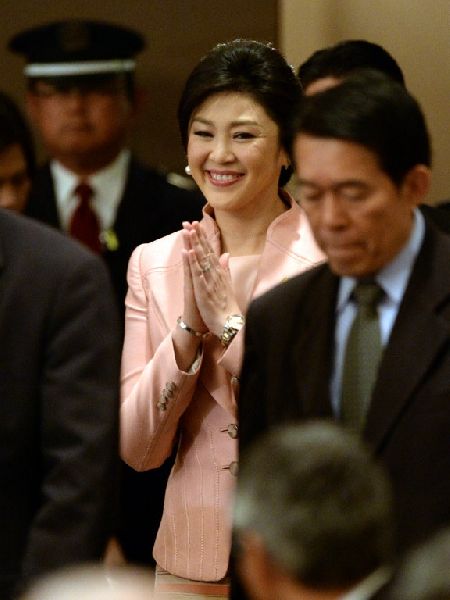
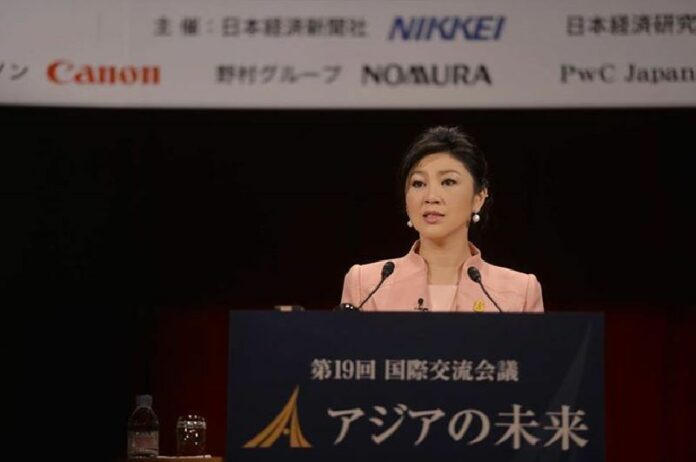
Thai Prime Minister Yingluck Shinawatra delivers her keynote speech during the two-day International conference on the Future of Asia in Tokyo on May 24, 2013.

She says : Asia is on the rise. Asia has a large population and land mass that extends to link two great oceans. This means that we have massive influence on the world.
Indeed, for many centuries, Asia has created many civilizations. And now, we are at an important junction, where the future of Asia will again define the future of the world.

In recent years, the center of world economic growth has shifted towards Asia. In the 1980’s, Japan led the Asian economies’ pack of the Republic of Korea, Singapore, Hong Kong, Taiwan and Thailand, to achieve increased wealth and prosperity. In the past decade, China and India became the new engines of growth for the world.

The IMF (International Monetary Fund) has recently forecast 5.7 percent growth for the region this year, and around 6 percent in 2014. A moderate inflation and manageable level of public debt to GDP in most Asian countries have led to stability.

At the same time, Asian innovation and creativity, together with a productive workforce supported by new technology, will promote sustainable growth for the region.

Analysts have projected that the share of Asia’s GDP to global GDP will double to 51 percent by 2050. The consumer base and spending power of Asia is also projected to grow further, where the share of Asian middle class is expected to increase from 28 percent to 66 percent of the global middle class.

In addition, Asia’s international reserves are very high at 6.4 trillion US dollars. If this is used productively, it will help bring about a true Asian Century.

On the political front, Asia has reconnected.

There are effective regional cooperation for all of Asia in the form of ACD (Asia Cooperation Dialogue). For the cooperation of sub regions of Asia, there are the GCC (Cooperation Council for the Arab States of the Gulf), SAARC (South Asian Association for Regional Cooperation), BIMSTEC (Bay of Bengal Multi-Sectoral Initiative for Technical and Economic Cooperation) and ASEAN (Association of Southeast Asian Nations). The EAS (East Asia Summit) also extends the East Asian cooperation to other regions.

This has promoted understanding between nations as well as people to people relations. Bilateral and multilateral cooperation has been strengthened because of the connectivity of modern technology and transportation. The few who chose not to join remained in the cold of lost opportunities.

So I believe the stage is set for Asia’s rise. But the road is not guaranteed to be easy. Challenges could limit growth and the promised prosperity.

I would like to share some of my thought on these challenges with you.

First, Asia is diverse. I always believe that in diversity we can find strength. Moreover, Asia is not just East Asia. But it also includes other regions of growth and potential, comprising South Asia, Central Asia and the Middle East. Close cooperation from all will promote growth.

But at the same time, I accept that when there is diversity, sometimes there can be conflicting interests. Asia needs to look beyond national interests and take into account the interests of the region as a whole.

We need to start thinking of being part of the same Asian community with an outward-looking approach that will promote shared interests and address challenges together. Because in today’s world, we are all connected.

Countries like Japan have played and can continue to play an important role in achieving this. Moreover, Japan’s recent economic revival under Prime Minister Abe’s leadership has the potential to help promote growth in the region as a whole.

For example, the continued economic challenges in Europe and the U.S. is a big test for Asia. Asia’s fundamentals are strong as I mentioned earlier. But how we act now will determine our future.

The quantitative easing measures of the U.S., U.K., EU and Japan have led to strong capital inflows into the region. And while this can be seen as a strength in our economic fundamentals, Asia needs to work together to manage the inflows productively to ensure stability in the region.

Some say funds flow like water. I believe there should be cooperation between all countries through which the water flows, so that all can benefit and grow together.


Together, we can create immunity by building a vibrant regional market to absorb goods, products and services, while at the same time, excess funds can be used for investments to benefit the whole region.

This brings me to my second point. I propose that we should direct our investments to build connectivity, both on land and sea, since Asia is mostly a large land continent covering two oceans, the Indian and the Pacific.


On land, rail link is the most effective and efficient. From ASEAN on the Southeast Asian mainland, we must build links to North and Northeast Asia. And on the opposite end, to South Asia, Central Asia and the Middle East.


A modern Silk Road to connect the region with high speed trains, and feeder tracks for cargo and passengers will become the new Asia-Euro land bridge linking the two continents, while opening up new growth areas along the way.

At the same time, we will continue to develop road links, airports and sea ports. Dawei deep seaport in Myanmar will create maritime connectivity within the Indian Ocean, and through land links to Laem Chabang port in Thailand, to connecting South China Sea and the Pacific Ocean.

On the Indian Ocean side, Dawei will link up Southeast Asia with the Middle East and Africa. The port, industrial estate and transport infrastructure will help drive economic growth and development throughout Southeast Asia.

Moreover, it will also add value to the production bases in ASEAN of many countries, in particular Japan.

In other words, Dawei is an investment in the future of Asia. In the long run, it can become a major point for transportation and connectivity to complement other port and industrial estates in Myanmar.

We look forward to participation from foreign partners for investment and also multilateral institutions such as the Asian Development Bank to help consult and assist in this regional project.

Another contribution to the region’s future is Thailand’s 66 billion U.S. dollar in infrastructure development which includes high speed rail link between Thailand, Laos and China. And we plan to link this with infrastructure investment plans of other Asian countries.

The challenge is the rising tension in the Asia-Pacific caused by the geo-politics of maritime challenges. Without a peaceful and stable security environment, there cannot be sustainable growth and a bright future for Asia.

An unstable South China Sea or maritime disputes benefit no one. It is necessary for Asia to move beyond the legacies of the past and manage challenges that can threaten maritime connectivity. Peace and security are an essential foundation for a better future.

Likewise, peace and stability are essential for land links to work. For Asia to realize our full potential, the various jigsaws must fit together.

A borderless ASEAN in 2015 will be a hurdle to jump across. But if we can move beyond 2015 to become more integrated with other sub-regions of Asia, Asia can rise together.

To help bring these jigsaws together, I suggest that we promote closer cooperation on win-win issues that will add value to Asia as a whole. Such issues include food and energy security.

Because addressing these challenges will also contribute to promoting human security for the peoples of our region as well as help reduce potential tensions caused by competition for water and oil.

Asia is rich with land suitable for agriculture. In Thailand, we are restructuring our agriculture production with zonings and post-harvest management to produce higher quality food and at the same time ensure food security, for Thailand, Asia and the world.

We are also investing in water management system that will provide enough supply for agriculture, industry and household uses. Effective measures to build water and food security, as well as protection against natural disasters, will provide a stronger foundation for growth and social harmony within our region.

Complementing this is the issue of energy security which we hope to achieve through green growth and by relying more on alternative energy. As Asia plans towards the path of sustainable growth, Asia will demand for a large amount of energy.

For Asia, I believe that there is great potential in cooperation between the regions, whereby food could be exchanged for energy between ASEAN countries in Southeast Asia and the GCC in the Middle East.

Also, since a rising Asia is outward-looking, cooperation in trade and investment must also be extended to other regions, such as Africa which is also rising. That is why we are launching a Thai-African Conference to enhance engagement with Africa.

The bottom line is that Asia and other regions, Africa, the Americas, Europe need to work together to grow together.

The future of Asia is in our hands. It is up to our generation to set the future course towards sustainable growth for all. It is a path where we work together, learn from each other and grow together, not only in our region but also with the world.


Advertisement

Early Morning Rival Gangs Clash In Ranong

(24 May) Shotguns were fired and homemade explosives thrown during early morning clashes between rival teenage gangs in Rongkluang district of Ranong province.

Mueang Ranong police received emergency call (191) at 05.00 am informing them of the sounds
of gunfires and explosives in Rongkluang district, and officers rushed to the scene to investigate.
The incident took place in front of flat buildings inside Rongkluang community when a group of
teenagers on 3 motorcycles reportedly arrived and shot at 10 teenagers sitting at a table at the
side of the road.

According to witnesses, they also launched 2 explosives which caused a
loud roar heard 1 km away. Mr.Chalermchai Niyomtum, 19, was injured in his right thigh where a
bullet fragment from a shotgun pellet. He received first aid from volunteer rescue workers and was
sent to Ranong hospital.

Initial investigations reveal that before the incident, the
teenagers in Rongkluang gang were being pursued by the teenagers gang of Bangrin and the teenagers
gang of Soi 10 on motorcycles from the district office along Ruangrat road but they were able to
escape into their community area. However, the pursuers eventually found them and chaos ensued.

Explosion marks were found on the road, along with the burns traces of nitrate. Black duct
tape and fabric scraps scattered about. A detonator device was also found lying on the floor, 10
meters from the spot were blood trails of the victim. Several shotgun shells and grain pellets were
also found at the scene.

It is suspected that the culprits have made their own explosive
using shotgun shells and grain pellets as shrapnel, wrapping it in glass or ceramic shreds, and
using nitrate as the detonator. The concoction was wrapped into a ball using black tape and fabric,
and when thrown to the floor, would have exploded instantly.

Investigative officers of
Mueang Ranong police station questioned witnesses and victims, and concluded that the attack stemmed
from the conflict between the two opposing gangs. The police say they have identified the culprits
and that they will be brought in and prosecuted by law.

Advertisement

Kanchanaburi Unemployed Man Killed Himself And His Daughter

(23 May) Kanchanaburi police received reports from a man in Nongfai district that he found a dead girl in a house. Investigative officers and on call doctor at Laokwan hospital arrive at the scene to investigate.

The officers found a 2-year old girl dead in the house, with bubbles foaming came out from
her mouth and nose. The police estimated the girl had been dead for 10 hours before their arrival.

23 May, Kanchanaburi, Laokwan police station officials received reports from Mr.Amnuay, 30,
that he found a dead girl in a house in Nongfai district. Beside the body is a bottle of insecticide
and a hand written note saying “Sorry but it is needed to be done. Don’t want to become a burden”,
signed “Chumnarn”.

Later, police found the body of Mr.Chumnarn floating in a well behind the
house. Police suspected he drank the insecticide and jumped into the well.

Mr. Amnuay (no
surname given), the brother of Mr.Chumnarn, said that the little girl is Mr.Chamnarn’s daughter.
Mr.Chamnarn, he said, lost his job and was unable to find a new one. He often complained of
financial stress and that he did not want to become a burden to his family who are now supporting
him and his daughter.

Mr.Amnuay suggested he committed suicide due to this stress by making
his daughter drink the insecticide first, and then drinking it himself and jumping into the well.

His family suspects no fowl play and the bodies were taken to undergo religious rites.

Advertisement

PM Yingluck: Future Of Asia Is In Our Hands

(24 May) On her third day of official visit to Japan, PM Yingluck Shinawatra told the audience in a Tokyo conference that Asian region has the potential to influence the course of the world in 21st century.

The Prime Minister was attending 19th Future of Asiaconference in Tokyo, organised by Nikkei Co. Ltd. and the Economic Research Center of Japan. In her speech, she cited the growing strength and population of Asia, coupled with the capital influx to the region and its long-term investment returns, as main factors that would lead to the Asian Century.

Asia has the potential to expand trade and investment into other regions and to grow together. Each country should look to the overall interests of the region rather than the interests of their own, Ms. Yingluck said.

The Prime Minister also promised to focus on investment in creating a links, both land and sea; for example, the high speed rail, the Dawei deep-sea port project, and other projects aimed at developing the infrastructure and communications in Thailand worth 2 trillion baht to connect Thailand to other countries.

She concluded in her speech that Asia′s future is in the hands of the people to determine future direction and to lead to a sustainable growth together, for both the region and the world.

Prime Minister is scheduled to attend lectures and see the local trade show in Shibuya. She will also visit a commercial project called ?D47?, where shops displayed trades from villages in the 47 provinces of Japan.

Advertisement

Hot News

LATEST NEWS

Bangkok
overcast clouds
30 ° C
30 °
30 °
75 %
2.9kmh
88 %
Wed
29 °
Thu
36 °
Fri
36 °
Sat
36 °
Sun
36 °