28.8 C
Bangkok
Sunday, June 14, 2026
Home Blog Page 3427

Man Who 'Spent 10,000 Baht On Alcohol' Told Police He Was Mugged

(12 May) Fearing the wrath of his wife, a drunk man who has wrecked his motorcycle made up a story, reporting to police he was mugged in Bangplee area of Bangkok.

This incident took place at 03.30 this
morning,
when Bangplee police station received radio reports that a mugging took place near
the gas station on Teparak Road., km.9. Police rushed to
the scene with investigative officers. 

Mr. Chachawal
Boonmeerit, 33, was standing next to his wrecked Honda motorcycle, with multiple wounds to head face
and body.

Mr. Chachawal informed police that, before the incident, he was out having drinks with his
friends and rode his motorcycle home. 3-4 men then assaulted him and took
10,000 baht cash that he had with him and escaped. He walked to the gas station and found some
rescue workers who helped contact the police.  
 
He told the police
he
was mugged in front of a restaurant 2 km away, but when the police
took him to the scene of the crime to point out the spot, he refused to do so. The security camera
footage of the area was  taken into consideration and the man was taken to the Bangplee police
station for further questioning.

Later, he admitted that he made up the whole incident
because he was very drunk, wrecked his motorcycle, and afraid his wife would be mad at him. The
10,000 baht that was allegedly stolen was spent drinking alcohol, he added.

The police eventually charged Mr. Chachawal with making false report, saying that he has caused much unnecessary
trouble for the police force and his actions should not be taken as an example. 

Advertisement

Northern Redshirts To Join Bangkok Rally

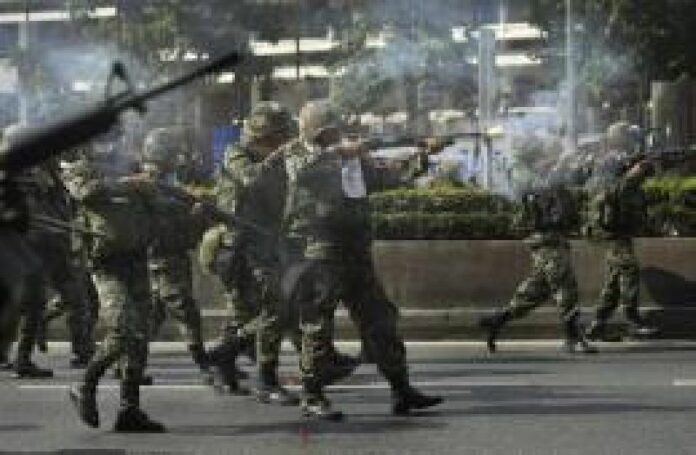
Soldiers firing shots in Bon Kai area of Bangkok, May 2010

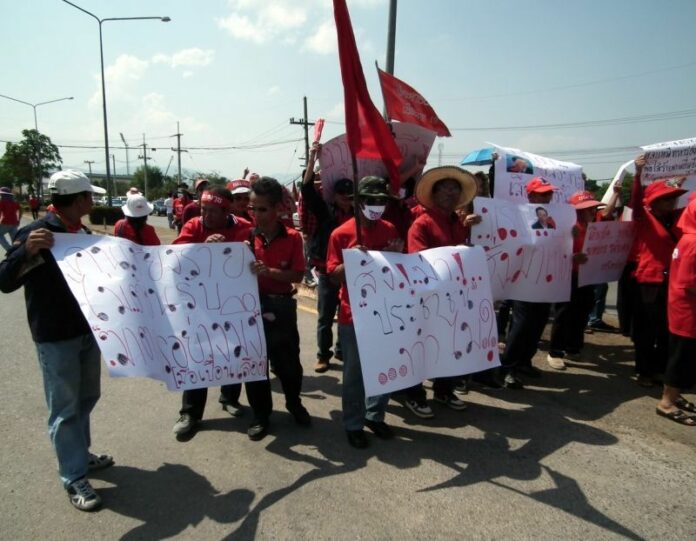
(12 May) Representatives of National United Front Of Democracy Against Dictatorship (UDD) in charge of coordinating Redshirts activities in 17 northern provinces promised a march on Bangkok this month to commemorate 3rd anniversary of the deadly military crackdown on Redshirts protests.

Those protests started in mid-March 2010 and ended on 19 May, when the military assaulted
their encampment in Ratchaprasong intersection, central Bangkok. More than 90 people were killed in
those months of political violence.

Today, leaders of the UDD northern chapters and their
associates unveiled their plan in a press conference held at Aunty Noi Grilled Chicken restaurant,
Uttaradit province.

Some of the speakers brought copies of Matichon and Khaosod newspapers
issued during the crackdown, and leafed through the pages to show pictures of the event before the
cameras, saying these should help remind Redshirts of what happpened 3 years ago.

Mr.
Pannawat Narkmool, Uttaradit′s UDD representative, said Former PM Abhisit Vejjajeeva must be held
responsible for the deaths and injuries caused by the confrontations in April-May 2010.

They have committed violent atrocities toward Redshirts as though Redshirts are not their
fellow compatriots, Mr. Pannawat said, insisting that the protesters were fighting for
democracy.

Mr. Pichit Tamool, UDD representative from Chiang Mai, said Redshirts from 17
provinces in the north will travel by 250 buses and a number of private cars to Bangkok to join the
UDD rally there, which is set to take place on 19 May. On the evening of 18 May, he said, the
protesters will gather in Nakornsawan province before setting for the capital city together.

Advertisement

'Commander Red' Admirers Remember His Death

Maj.Gen. Khattiya Sawasdipol, aka. "Commander Red"

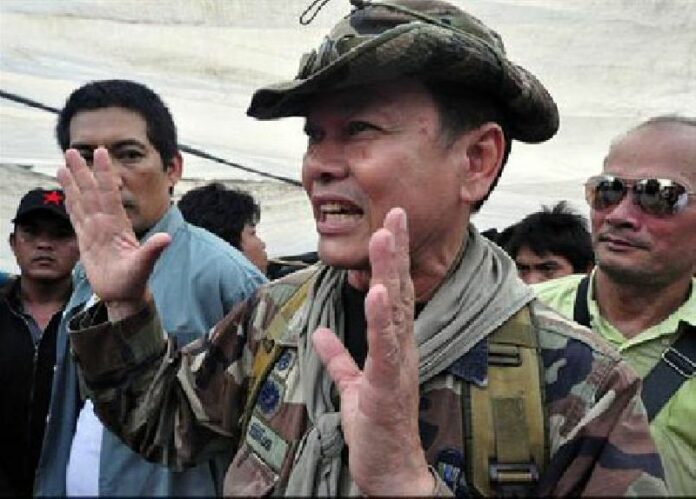
(13 May) Supporters of the rogue general who sympathized with the Redshirts during their 2010 Bangkok protests gathered to commemorate his death at the spot where he was fatally wounded by sniper fire 3 years ago.

Maj.Gen. Khattiya Sawasdipol, commonly
known as Seh Dang (Commander Red), was talking to foreign journalists
at the southern end of Redshirts
camp near Lumpini Park, on the eve of week-long military campaign to dislodge
the Redshirts,
whenhe
was shot in the head by unknown assailants. He died few days later in hospital.

Today, more than 300 Redshirts marked his death in a religious
ceremony conducted by 10 monks near the spot he was shot. His
daughter, Ms. Khattiyar Sawasdipol, was also present at the
ceremony. 

Mr. Thanakorn Maneechote, representative of Seh Dang Lovers Group which organized the event, said
there are people who remain deeply fond of Commander Red.
He said the previous anniversaries were focused on politics, but this year his group wants to
focus on messages of love, faith, and mourning.

People in our group have different memories about
Commander Red, Mr. Thanakorn said.

Mr. Thanakorn added that his group planned to
march around Lumpini Park later today to honor Commander Red and demand the government to
pass Amnesty Bill so that society can start their reconciliation. Speeches and other activities are scheduled to take place this evening as
well.

Speaking to our
correspondent, Ms. Khattiyar – who is currently a Pheu Thai Party MP – said that she was glad to see so many
Redshirts remembering her father even thought it′s been 3 years since
he passed away.

It means the Redshirts are
still waiting for justice for my father and many other martyrs who
lost their lives in the 2010 protests, Ms. Khattiyar
said.
 

Advertisement

400 Thai, Burmese Workers Clash In Nakorn Ratchasrima

(12 May) Fights broke out between hundreds of Thai and Burmese workers wielding makeshift weapons at construction site in Nakhon Ratchasima province.

The police received the report about the violence around 12.20. The workers belong to the Sino-Thai Engineering and Construction Ltd. which was assigned to constructing the offices of Charoen Pokphand Group (CP) in the area.

Reports say the workers, who live on the construction site, wielded iron pipes, wooden poles, and knives as weapons. The Burmese workers also reportedly burned down the Thai worker’s camp site.

Police then informed Nong Nam Daeng fire department and rushed to the scene with more than 100 investigative officers and rescue foundation workers. After on scene investigations, the space was undergoing construction of the mast cleat. Behind the construction site is the camp site for workers to live, housing almost 500 workers.

Burmese workers were seen standing in front of the Left camp site holding iron pipes in a large group. Room number 421-422, belonging to a Thai worker, was badly damaged by fire. A Burmese worker was also stabbed in the back and was sent to Paakchong hospital. However, our correspondent added that the injured Burmese worker would not let doctors treat his wounds, made a scene, and fled the hospital.

Meanwhile, the safety manager and the foreman of the construction crew, along with translators, were trying to cool down the incident while police looked over the area.

Mr.Nattapol Sothorn, 46, safety manager of the construction crew, informed police that the incident stemmed from Sunday, which was some of the workers’ day off. Some workers were drinking and playing loud music, then a fistfight broke out.

The translator and a Thai worker entered the area and tried to break out the fight, but chaos broke out soon after, which was during the lunch break, and one Burmese worker was stabbed by a Thai worker. Then, the Burmese workers entered the Thai worker’s camp site and started burning the camp. The workers who were on duty joined in as well, Mr. Nattapol said.

The situation at the worker’s camp site remains tense, with some of the Burmese workers forming a front, with weapons, in front of their camp. Police force remained at the scene until the management staff of Sino-Thai managed to finish negotiations with the workers.

The victim or arson was advised to press charges, calling for 10,000 baht in damages.

Advertisement

Thai Rath HQ Building Rattled By Firework Attack

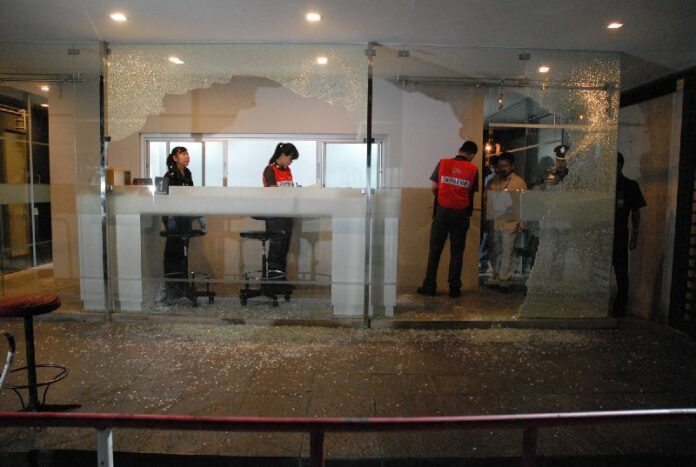
(11 May) Unknown assailants threw
metal balls and fireworks
at security guard post in Thai Rath newspaper
headquarters
this early morning, resulting in some damages and 2
security guards suffered minor injuries.


Inspecting the scene, located on Vipharvadee
Road,
the police uncovered 2
Petanque balls and pieces of firework.
All evidences were sent to the forensic department to look for any trace of
fingerprints.

A security guard told police he
was on duty when,
around 04.45, 4 people on 2 Honda Click motorcycles, all wearing
black jackets and motorcycle helmets, approached the office building.
He was about to ask who they were, he said, when the assailants threw
the metal balls into the building, followed by
the firework.
The culprits quickly escaped afterwards, he
said.

According to the police, 2 safety glasses, estimated to value at 200,000 baht, were shattered while 2
security guards were injured by flying shards of glass. The police added that CCTVs near Thai Rath building were being reparied, thus unable to record the incident.

Officialssaid
the attack might be work of ?third party? who wants to cause tension, or it could
result from Thai Rath cartoonist′s remark which compared PM Yingluck Shinawatra to a prostitute and caused much
uproar.

Advertisement

Redshirts Protest Abhisit's Northern Tour

(11 May) Groups of Redshirts showed up to protest Former PM Abhisit Vejjajeeva as he arrived in Chiang Rai airport to attend a Democrat Party′s rally in Phayao Province.

Mr. Abhisit was scheduled to give speeches on stage of the rally, which is taking place at an open air area of Nongrabu shopping ball in Phayao′s Mueang district.

Earlier today, around 150 Redshirts protesters, led by groups such as UDD Chiang Rai ?52 and Chiang Rai For Thaksin ?49, were waiting for Mr. Abhisit at the entrance of the airport. The groups said Mr. Abhisit is not welcomed here because of his role in 2010 violent crackdown on Redshirts protesters.

However, Mr. Abhisit and his entourage managed to leave the airport via secondary exits. The Redshirts then followed his convoy to Phayao province, where they joined other Redshirts who were holding separate protest near Mr. Abhisit′s speech venue.

Police said they had combed the area of any threat and would do their best to prevent violence during Mr. Abhisit′s stay in the province.

Advertisement

German Academic Says Thailand Is Coup-Risk Country

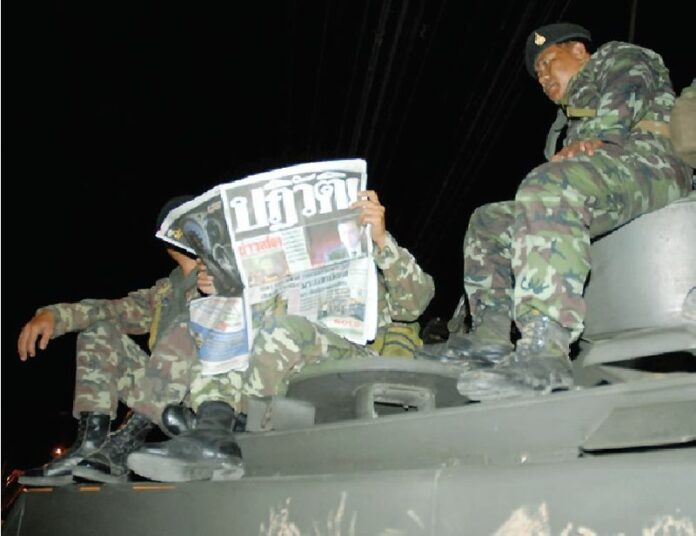
Soldiers atop a tank reading Khaosod newspaper a day after the military staged a coup against then-PM Thaksin Shinawatra on 19 September 2006. The headline reads, "COUP!"

BANGKOK – The Thai civilian governments in recent years utterly failed to rein in the influences of the military, Thailand is a ‘coup-risk’ country, and there might or might not be coup in the near future, according to a panel discussion on relationship of the military and democratisation.

The event, titled “Democratic Control of the Military: Thailand in Comparative Perspective”, also serves a book launch for Mr. Aurel Croissant’s “Democratisation and Civilian Control in Asia”. Scores of attendees– largely foreigners – crowded the venue at Prajadhipok-Rambhaibarni Building ,Chulalongkorn University.

Other panelists were Mr. Panitarn Wattanayagorn, former government spokesman under Mr. Abhisit Vejjajeeva‘s administration and Col.Teeranun Nandhakwang, deputy director of Strategic and Security Affairs Division, National Defense College.

The discussion was moderated by Mr. Thitinan Pongsudhirak, director of the Institute of Security and International Studies(ISIS) which organised the event.

* * *

Mr. Croissant, who is based at Heidelberg University’s Institute of Political Science, Germany, began his presentation by expressing his interest in Asia. The region, he said, is so diverse that it is perfect to study as a “natural laboratory”.

Countries in Asia like South Korea, Thailand, Pakistan,and Taiwan have transformed over the time from military dictatorships into“something else”, Mr. Croissant said. Some have become successful democracies,but others are not as fortunate.

One factor that seems to matter greatly in those successes (or failures) is how these emerging democracies – after such long years under autocracy imposed by the military rulers – could develop“democratic control” of the military and turn them into instruments of security of the citizens.

Mr. Croissant elaborated on the term “democratic control”. Control, he pointed out, does not equate with absence of military coups. It is entirely possible that the military in one country might refrain from staging a coup because they are already firmly in control, or because they can intervene by other means.

Furthermore,Mr.Croissant stressed that countries ruled by unelected civilian autocracies can also control the military effectively,such as Communist China and the USSR.

So, what is “democratic control”?  According to Mr. Croissant, it means the ability of the civilian government, through democratic means and good governance, to freely select the leadership of the military, set out policies and strategies for the military, and manage the structures of the military -namely the military budget.

Meanwhile,it also involves how much influence the military has in a nation’s politics, economy, society and the process of democratisation.

Among the more successful in this regard, Mr. Croissant said, are South Korea and Taiwan. Both countries manage to assert decision-making process of the civilian regimes on their armed forces effectively, despite their long history under military autocracy.

Mr. Croissant outlined some challenges that emerging democracies in Asia would face in their attempts to control the military:domestic conflicts or unrest can force the government to rely on the armed force, the unpredictable factionalism within the military can seriously complicate the control effort, and leftover conditions from pre-democratic era can also lay down the path for continual military intervention

 The “maturity” of the democratic system in the country is a crucial factor as well; if there are political parties repeatedly inviting the military to intervene, for example, the armed forces might not be kept away for long.


* * *

With all these general principles in mind, Mr. Croissant then went on to examine Thailand’s control of the military, and the verdict is not pretty.

In a slideshow, Mr. Croissant contrasted the situations in different periods to highlight his point. Thailand’s civilian control of the armed forces gradually improved after the Bloody May crackdown in 1992 toward early 2000s, reinforced by the 1997 Constitution which was widely seen as a landmark development of Thai democracy.

The trend continued during the administration of Mr.Thaksin Shinawatra – before plunging in the wake of military coup in 2006. Mr.Croissant thinks the conditions haven’t rebounded since; the situation is hampered even more by the political violence in 2010, which the military played a large role.

Currently,Mr.Croissant said, Thailand lacks an enthusiasm in the government or the public to retain influences of the military (“at least in the way I see it”), some political groups still seek support from the military, and the public is largely kept in the dark about the defense policies or mechanism of the armed force.

Thai civilian government also has no oversight or effective control over the budget, structures, and the policies of the military. One can easily think of the tug-of-war between Ms. Yingluck Shinawatra’s government and the security forces hardliners concerning the negotiation with insurgents in Deep South.

Considering such monumental failures, Mr. Croissant led the discussion toward the inevitable and always-popular topic: prospect of anew military coup.

Mr. Croissant reminds the audiences that Thailand ranks 5th in term of military coup frequency in the world, adding that the military tends to be stage a coup if they could get away with it many times inthe past.

Interestingly,he said,other famous “coup trap”countries like Syria or Argentina witnessed its last military coup 20-30 years ago, whereas Thailand’s most recent one is merely 6 years ago.

Coups are more likely in countries that lack strong pressure from civil society to dissuade the armed forces from doing so or strength of legitimacy in the current regime. Thai military, Mr. Croissant said, likes to claim itself as legitimate “solution” when it intervenes in “messy”political situation.

Therefore,in his analysis, Thailand can be categorised as a “coup-risk” country.

During the Q&A discussion, questions about possible coup were raised again. This time, however, Col. Teeranun of the National Defense College expressed his doubt that the military can ever launch a coup again.

The military always used same scheme and operation order when they stage a coup, Col. Teeranun said, and they are already too outdated in the modern Thailand society.

“Things changed,”he insisted.

Col. Teeranun also countered Mr. Croissant by saying that if there were to be a coup right now, the military would face huge resistance from the (mostly Redshirts) mass. He cited the potential ability of Redshirts community radio stations to mobilise tens of thousands of protesters in matters of hours.

That,Col.Teeranun said, is the proof that Thailand is gradually developing a civil society that serves as deterrence to the military’s ambition.

The officer also took pain to dismiss the regular cycle of coup rumors in Thailand as mere nonsense that some people like to spread.


* * *

Another question from the audiences concerns what role the Thai military might play during Thailand’s royal succession period, ie after King Rama IX passed away.

Col. Teeranun simply said that it “depends on who’s in charge” of the military at the time, before teasing that he would have undisclosed his course of action if he were appointed commander-in-chief today.

Meanwhile,Mr.Panitarn said he believed the military is well prepared for that scenario, as “change is expected when there is change to new era”.

Mr. Croissant joined in by remarking that a country in Europe – Belgium – has recently gone through a royal succession but no one ever bothers to ask what the Belgian military might do.

“I think only a few countries in the world will still ask that question nowadays, and, well, Thailand is one of them,” Mr. Croissant noted.

Minor tension ensued after Mr. Panitarn was reminded by a reporter about his role as a regular spokesman for the military operation that violently ended the Redshirts’ protests in 2010, which more than 90 lives were lost, and asked whether he would apologise for it.

Mr. Panitarn didn’t give direct answer but said that, as the case is being processed by the court, he prefers to talk about the issue in court.


 

Advertisement

Dispute Over Developers' Plan To Claim Monastery Ground

(10 May) Director of the National Office of Buddhism, along with Sakon Nakhon Administration, held a meeting to find solutions to the case of registration of abandoned monastery on Donsawun island by land developers who aim to prepare a deed to reclaim the land of almost a hundred acres.

Mr.Chakrapong Wongkalasin, leadership of “Rak Nonghan” group stated that, there will be no more deed issued on Donsawun. However, because the area is listed as an abandoned temple, one of the thousands in the country, the National Office of Buddhism of Thailand has the right to decide who the land goes to.

The people are petitioning for the 105 acres of land to remain a public area where any local citizen can share, as opposed to a group of people abusing the law and gaining profits from the land.

“Donsawun needs to remain public. What we want is to remove Donsawun from the abandoned temples list so there won’t be any more problems.” Mr.Chakapong said.

Mr.Gomut Teekananon, mayor of Sakon Nakhon indicated that the municipality is responsible for Nonghan, especially Donsawun Island, area of dispute. Nonetheless, the municipality has no power whatsoever to issue a deed to the property.

Thus, he is in accordance with the locals that no deed shall be issued. However, as for the
property’s state as an abandoned monastery, Mr.Gomut stated that it is the job of the Office of Buddhism of Thailand to decide.

Our correspondent has contacted the Office of Buddhism, Sakon Nakhon, but the head of the office was away on assignment and could not be reached. Later, our correspondent has been informed that the case has been sent to the central office. Any new developments should be announced on 1 June.

Advertisement

Air Force Nurse 'Found Murdered' In Bang Plad

(10 May) Police uncovered decomposed body of 63 year old woman in Bang Plad district of Bangkok, and they are investigating her death as murder case.

Police officers from Bang Plad police station along with Ruamkatunyu foundation workers and a medical examiner from Vajira hospital arrived at the scene, which was a 2 floor town house. The doors were locked with a metal chain, which had to be sawed off.

Once inside, they recovered the body of Ms.Payomsri Dejakup, ex-air force nurse, 63, naked with wounds to the forehead. It is estimated that she had been dead for 3-4 days. A trail of blood was found around the body.

Ms.Taengon Sanroo, 75, the person who alerted the authorities, informed the police that the deceased was a very sociable woman and would often offer her neighbors her food.

Before the body was discovered, she had not seen the deceased for 3-4 days and can smell a foul scent from the direction of the house. She then asked some neighbors to accompany her onto the premises. She looked through the window and saw the deceased’s feet poking out. She quickly called the police.

“A month ago, she often complained to me about problems she had with her relatives. She fought with her sister a lot about the deed to a property, but she never gave me the details. She was just complaining that her sister would show up often to talk about the property in Pin Klao area. Then, just like that, she’s now dead,” Ms Taengon said.

Pol.Col.Surasit stated that initial investigations revealed signs of foul play. The state of the body is quite unnatural, naked and covered with pieces of cloth. There are also wounds on the victim’s forehead and trails of blood around the house. Motives for murder may include robbery, rape, and personal conflict.

Police said autopsy needs to be done to determine the cause of death. The relatives will also have to be questioned.

Advertisement

Guan Yin Shrine 'Burglar' Arrested

(10 May) Chiang Mai police arrested an unemployed Ratchapat University graduate accused of stealing Buddha statues in a Guan Yin shrine.

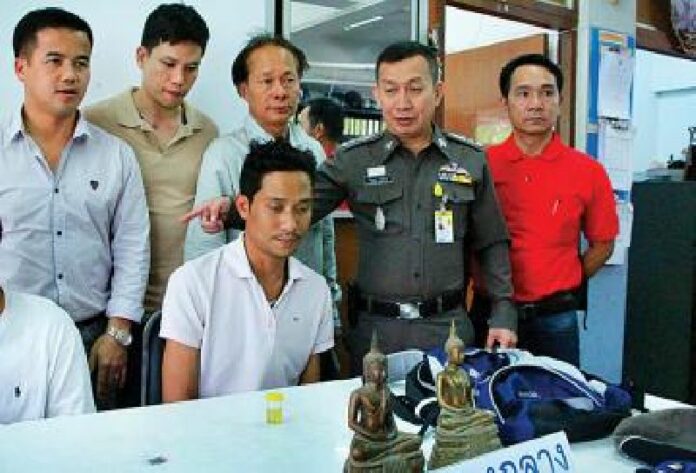
9 May, 13.00 PM, Pol.Col. Aksorn Wongyai, director of Mueang Chiang Mai police station, along with investigative officers said in a press conference that Mr.Piteeprom (Note) Petcharanasungkul, 36, was apprehended in front of Win Place Hotel. Police seized 2 Buddha statues and a grey-black Suzuki motorcycle.

Pol.Col.Aksorn revealed that investigative officers received reports from the Chinese monk at the Guan Yin shrine, Chiang Mai province, that the suspect stole Buddha statues from inside the shrine and was stopped by a security guard at Win Place hotel. The suspect was then taken to the Mueang Chiang Mai police station.

He also added that the suspect confessed to being the son of a police officer under the Narcotics Unit in the north of Thailand. He also informed police that he had graduated from Ratchapat University, and before this he used to be an insurance salesman.

Reportedly, after he lost his job, he decided to steal the statues and planned to sell them for some cash.

Guan Yong, the Chinese monk, said that before the incident, the suspect arrived via motorcycle and was carrying a large navy black pack.

He seemed fidgety, the monk said.

The monk also remembered seeing the suspect in the shrine a couple times before the incident, so he went out and took a photograph of the suspect’s motorcycle. When he saw the suspect approach the Buddha statues, he realised the suspect was picking up the statues and putting them in his bag.

The suspect then walked out in the direction of Win Place Hotel. The Chinese monk then called the security guard of that hotel for help.

Advertisement

Hot News

LATEST NEWS

Bangkok
overcast clouds
28.8 ° C
28.8 °
25.5 °
83 %
2.4kmh
100 %
Sat
29 °
Sun
35 °
Mon
35 °
Tue
34 °
Wed
32 °