In the past year, T-POP has grown exponentially and become more recognized internationally. One of them are the Latin Americas. They are a group of countries that has the largest music market and the preferred countries where Thai artists would like to perform.
It is obvious that to bring Thai music, including artists to global market involve many detailed operations and complications. It does not depend only on the artist’s talent alone, but also the timing and opportunities as well.
In Thailand, there are many promoters who are trying to take Thai music to global market. One of them is Mr.Sittiporn Huangkaewpray (Oat), Music Business Developer, the person who successfully took Thai artist and Thai music to global. He is one of the few people in Thailand who can bring Thai artist to perform in Latin America.
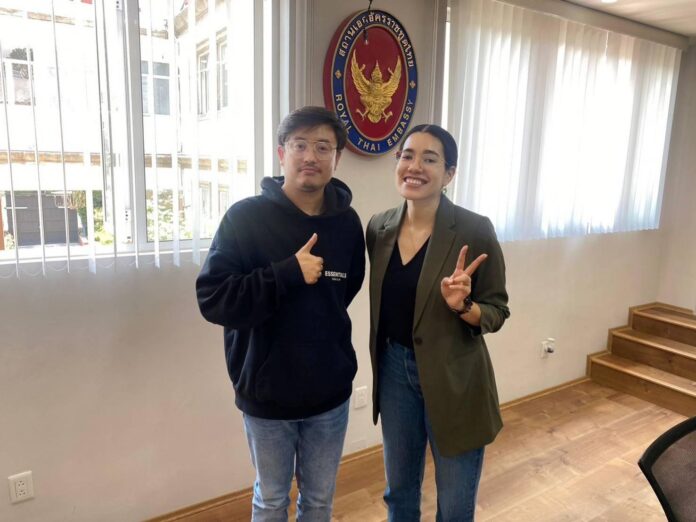
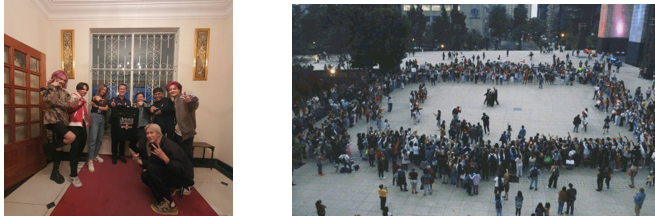
Due to the year 2023, 4MIX which a T-POP band who have a unique and distinct dance performance from other T-POP group, is very popular in Latin America countries currently. They had the opportunity to do solo concert in Mexico with the support of Thai Embassy in Mexico and had a chance to be interviewed by local media in Mexico which created a trend in Latin America countries, including U.S.A
From the trend in Mexico same year, 4MIX had the opportunity to performed at Washington, D.C supported by Thai Embassy in Washington, D.C
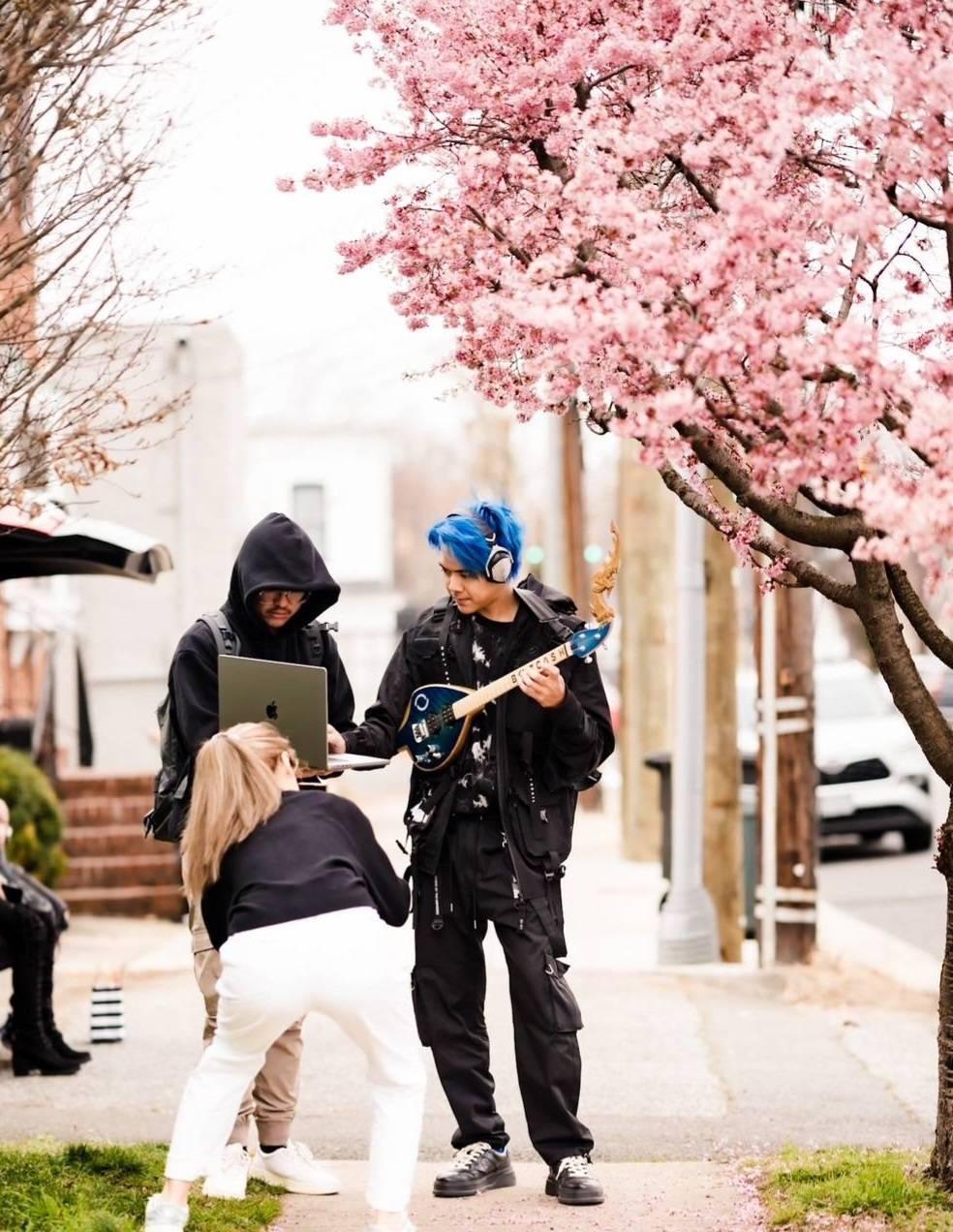
At the beginning of 2024, Mr.Oat had the opportunity to take Thai artist to perform in Washington D.C. again. For this time his objective is to spread Thai Modern Culture to the world. The artist combined between Pinn (Thai instrument) and EDM music presented by Ae BOTCASH, the talented DJ and producer that have his own unique identity.
At the end 0f 2024, Mr.Oat aiming to push Thai artist continuously. He is working on big project that will bring 4MIX to invade Latin America Market. For this time is touring concert and festival with 3 countries, such as Brazil, Mexico and Chile. It is solo concert of 4MIX all of 3 countries. We are collaborating with top 3 organizers in each country that aware of 4MIX talent so much.
This is just a small beginning of a big ambition of Sittiporn Huangkaewpray (Oat) who is still seeking for ways in other countries to bring Thai artist to global music market in their own styles, including to expanding the business of music industry, aiming to generating profit from oversea to Thailand. His expectation is not only about popularity of artist but including how to enhance music industry and showcasing the potential of the music industry is the most important objective of Mr.Oat.
Sittiporn Huangkaewpray said, “I want to combine music, art and Thai culture together in my own style and spread it to global such as 4MIX, they are known for outstanding performance and their branding also represent equality of everyone in the world. And Ae, artist, DJ and producer who is first Thai artist to combine Pinn (Thai instrument) and EDM music in his unique style. People overseas probably knows K-POP, J-POP, but T-POP is becoming more and more popular. So, I want people overseas to try open up to Thai music and creative thinking of Thai people in this industry including Thai instrument and Thai contemporary rhythm. I just want to be a small part to bring Thai artist to be recognized in a wider aspect.”
“The Latin America project enhanced the image of Thai artist, including people in the front and behind the scene, also promoting the image of Thailand to become more renowned. I have got a lot of problem when I took Thai artist to aboard. We have to study the market and culture of each country to completely organize a concert. The plan I made last year was to start by collaborating with Thai embassy in each country. After that I will approach to partner company because when we have support and advise from Thai embassy, its easier to work and also for safety reason. “
“In the past, overseas Fan club gave us a good hospitality. When I was there I’m felt so proud because I invested in my belief and in my team including the artists. I believe whole heartedly that if we have a chance to get there, according to the picture I have in mind, which I knew exactly how it is going to be or even if it doesn’t’t go to plan, I’ve prepared the solution.”
In the end when I saw a lot of fan club waiting for the artists, Its the best. It inspires me to further develop from this model. For the next project, I try see in wider perspective and proceed on my roadmap as planned. However, I will have backup plans thats prepared for every situation because now a days everything changing so fast.
I guarantee that in 2524 and more years to come, we will see T-POP artist make it big in Latin America market for sure. My ambition for Latin America and oversea project is I want the world to listen to Thai music and able to sing in Thai language. Moreover, I want to show the world that people in Thai music industry is as talented as the global artists and I want Pinn (Thai instrument) to be recognized worldwide.
At last. If I have the opportunity from government, the things that I want to do more is to have teams to research about music industry in each countries so we will have more insights to support our work and precisely identify our targets.
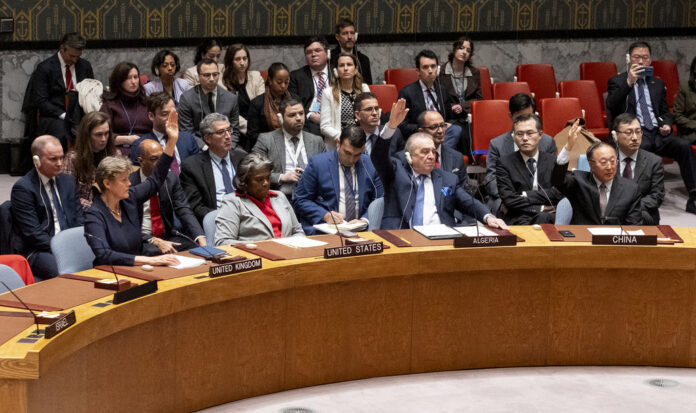
Linda Thomas-Greenfield, United States Ambassador and Representative to the United Nations, holds to abstain her vote as the United Nations Security Council passed a cease-fire resolution in Gaza during the Muslim holy month of Ramadan, its first demand to halt fighting at U.N. headquarters, Monday, March 25, 2024. (AP Photo/Craig Ruttle)
UNITED NATIONS (AP) — The United Nations Security Council on Monday issued its first demand for a cease-fire in Gaza, with the U.S. angering Israel by abstaining from the vote. Israel responded by canceling a visit to Washington by a high-level delegation in the strongest public clash between the allies since the war began.
Prime Minister Benjamin Netanyahu accused the U.S. of “retreating” from a “principled position” by allowing the vote to pass without conditioning the cease-fire on the release of hostages held by Hamas.
White House national security spokesman John Kirby said the administration was “kind of perplexed” by Netanyahu’s decision. He said the Israelis were “choosing to create a perception of daylight here when they don’t need to do that.”
Kirby and the American ambassador to the U.N. said the U.S. abstained because the resolution did not condemn Hamas. U.S. officials chose to abstain rather than veto the proposal “because it does fairly reflect our view that a cease-fire and the release of hostages come together,” Kirby said.
The 15-member council voted 14-0 to approve the resolution, which also demanded the release of all hostages taken captive during Hamas’ Oct. 7 surprise attack in southern Israel. The chamber broke into loud applause after the vote.
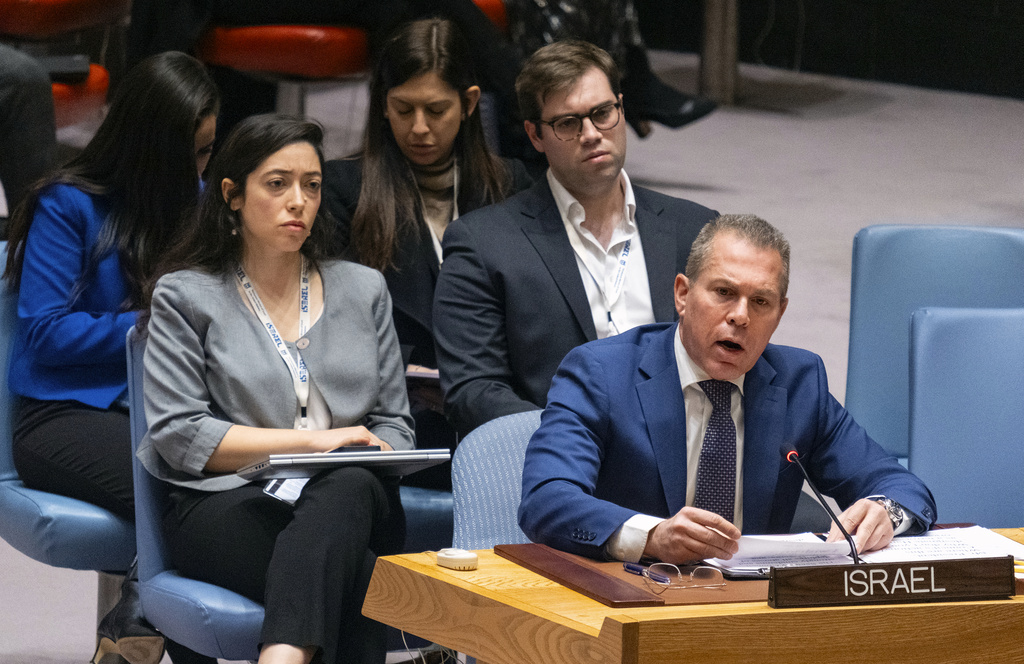
Gilad Erdan, Permanent Representative of Israel to the United Nations, addresses the United Nations Security Council at U.N. headquarters, Monday, March 25, 2024, after a vote that passed a cease-fire resolution in Gaza during the Muslim holy month of Ramadan, its first demand to halt fighting. (AP Photo/Craig Ruttle)
The U.S. vetoed past Security Council cease-fire resolutions in large part because of the failure to tie them directly to the release of hostages, the failure to condemn Hamas’ attacks and the delicacy of ongoing negotiations. American officials have argued that the cease-fire and hostage releases are linked, while Russia, China and many other council members favored unconditional calls for a cease-fire.
The resolution approved Monday demands the release of hostages but does not make it a condition for the cease-fire for the month of Ramadan, which ends in April.
Hamas said it welcomed the U.N.’s move but said the cease-fire needs to be permanent.
“We confirm our readiness to engage in an immediate prisoner exchange process that leads to the release of prisoners on both sides,” the group said. For months, the militants have sought a deal that includes a complete end to the conflict.
The U.S. decision to abstain comes at a time of growing tensions between President Joe Biden’s administration and Netanyahu over Israel’s prosecution of the war, the high number of civilian casualties and the limited amounts of humanitarian assistance reaching Gaza. The two countries have also clashed over Netanyahu’s rejection of a Palestinian state, Jewish settler violence against Palestinians in the occupied West Bank and the expansion of settlements there.
In addition, the well-known antagonism between Netanyahu and Biden — which dates from Biden’s tenure as vice president — deepened after Biden questioned Israel’s strategy in combating Hamas.
Then Senate Majority Leader Chuck Schumer, a Biden ally, suggested that Netanyahu was not operating in Israel’s best interests and called for Israel to hold new elections. Biden signaled his approval of Schumer’s remarks, prompting a rebuke from Netanyahu.
During its U.S. visit, the Israeli delegation was to present White House officials with its plans for a possible ground invasion of Rafah, a city on the Egyptian border in southern Gaza where over 1 million Palestinian civilians have sought shelter from the war.
Last week, Netanyahu rebuffed a U.S. request to halt the planned Rafah invasion – vowing during a visit by Secretary of State Antony Blinken to act alone if necessary. Blinken warned that Israel could soon face growing international isolation, while Vice President Kamala Harris said Israel could soon face unspecified consequences if it launches the ground assault.
The Security Council vote came after Russia and China vetoed a U.S.-sponsored resolution Friday that would have supported “an immediate and sustained cease-fire” in the Israeli-Hamas conflict. That resolution featured a weakened link between a cease-fire and the release of hostages, leaving it open to interpretation, and no time limit.
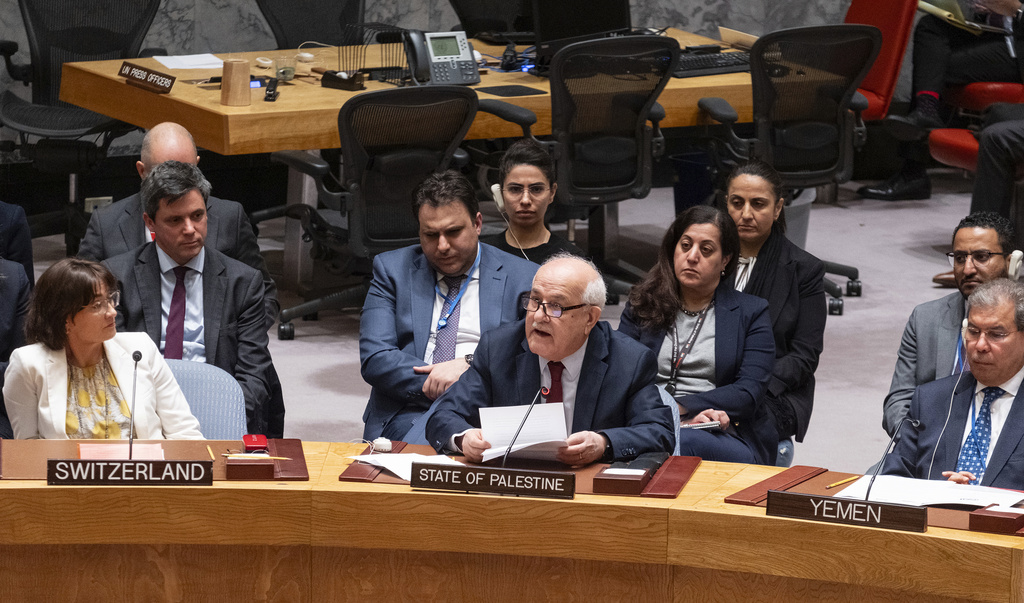
Palestinian Ambassador to the United Nations Riyad Mansour addresses United Nations Security Council at U.N. headquarters, Monday, March 25, 2024, after a vote that passed a cease-fire resolution in Gaza during the Muslim holy month of Ramadan, its first demand to halt fighting. (AP Photo/Craig Ruttle)
The United States warned that the resolution approved Monday could hurt negotiations to halt the hostilities, raising the possibility of another veto, this time by the Americans. The talks involve the U.S., Egypt and Qatar.
Because Ramadan ends April 9, the cease-fire demand would last for just two weeks, though the draft says the pause in fighting should lead to “a sustainable cease-fire.”
The U.S. ambassador to the U.N., Linda Thomas-Greenfield, said the resolution “spoke out in support of the ongoing diplomatic efforts,” adding that negotiators were “getting closer” to a deal for a cease-fire with the release of all hostages, “but we’re not there yet.”
She urged the council and U.N. members across the world to “speak out and demand unequivocally that Hamas accepts the deal on the table.”
Thomas-Greenfield said the U.S. abstained because “certain edits” the U.S. requested were ignored, including a condemnation of Hamas.
The resolution, put forward by the 10 elected council members, was backed by Russia and China and the 22-nation Arab Group at the United Nations.
Under the United Nations Charter, Security Council resolutions are legally binding on its 193 member nations, though they are often flouted.
Algeria’s U.N. ambassador, Amar Bendjama, the Arab representative on the council, thanked the council for “finally” demanding a cease-fire.
“We look forward to the commitment and the compliance of the Israeli occupying power with this resolution, for them to put an end to the bloodbath without any conditions, to end the suffering of the Palestinian people,” he said.
Riyad Mansour, the Palestinian U.N. ambassador, told the council that the vote “must be a turning point” that leads to saving lives in Gaza and ending the “assault of atrocities against our people.”
Shortly before Monday’s vote, the elected members changed the final draft resolution to drop the word “permanent” from its demand that a Ramadan cease-fire should lead to a “sustainable” halt in fighting apparently at the request of the United States.
Russia complained that dropping the word could allow Israel “to resume its military operation in the Gaza Strip at any moment” after Ramadan and proposed an amendment to restore it. That amendment was defeated because it failed to get the minimum nine “yes” votes — with three council members voting in favor, the United States voting against, and 11 countries abstaining.
Since the start of the war, the Security Council has adopted two resolutions on the worsening humanitarian situation in Gaza, but none has called for a cease-fire.
More than 32,000 Palestinians in Gaza have been killed during the fighting, according to the Gaza Health Ministry. The agency does not differentiate between civilians and combatants in its count, but says women and children make up two-thirds of the dead.
Gaza also faces a dire humanitarian emergency. A report from an international authority on hunger warned last week that “famine is imminent” in northern Gaza and that escalation of the war could push half of the territory’s 2.3 million people to the brink of starvation.
The United States has vetoed three resolutions demanding a cease-fire in Gaza, the most recent an Arab-backed measure on Feb. 20. That resolution was supported by 13 council members with one abstention, reflecting the overwhelming support for a cease-fire.
Russia and China vetoed a U.S.-sponsored resolution in late October calling for humanitarian pauses in the fighting to deliver aid, the protection of civilians and a halt to arming Hamas. They said it did not reflect global calls for a cease-fire.
They again vetoed a U.S. resolution Friday, calling it ambiguous and saying it was not the direct demand to end the fighting that much of the world seeks.
That vote became another showdown involving world powers that are locked in tense disputes elsewhere, with the United States taking criticism for not being tough enough against its ally Israel, even as tensions between the two countries rise.
Thomas-Greenfield accused Russia and China on Monday of using the Gaza conflict “as a political cudgel, to try to divide this council at a time when we need to come together.”
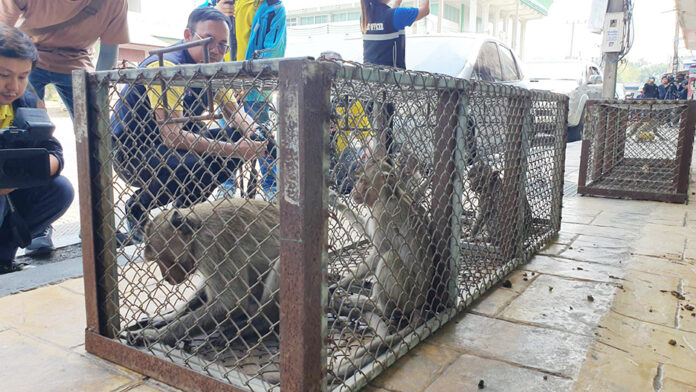
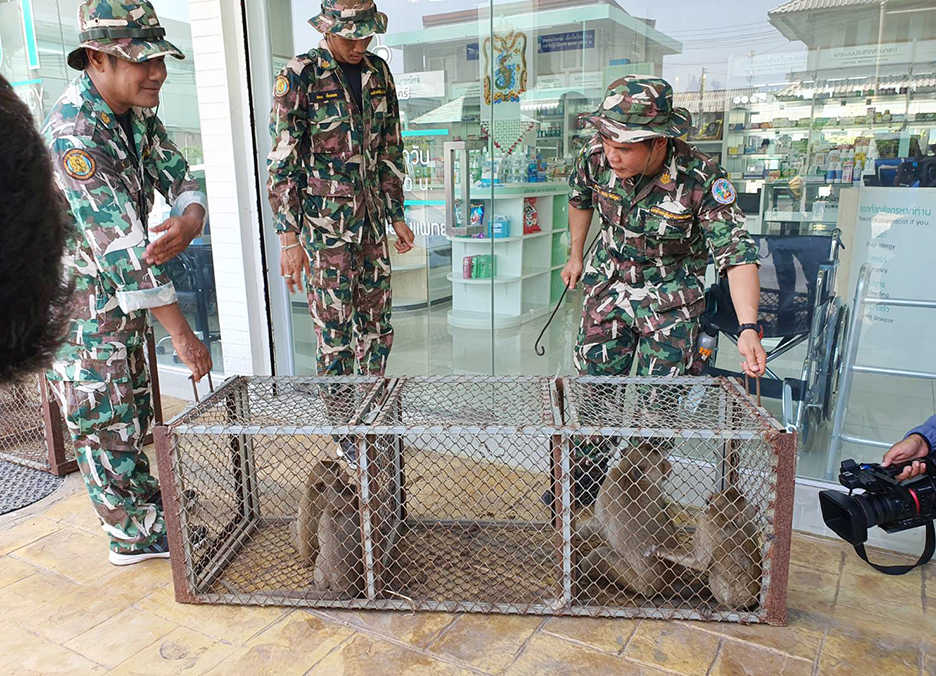
Officials lured the monkeys with food to catch them.
LOPBURI – On Monday, more than 10 officials from the Department of National Parks, Wildlife, and Plant Conservation conducted an attempt to capture monkeys in Lopburi town, particularly near Phra Prang Sam Yod and the old Malai Rama Cinema.
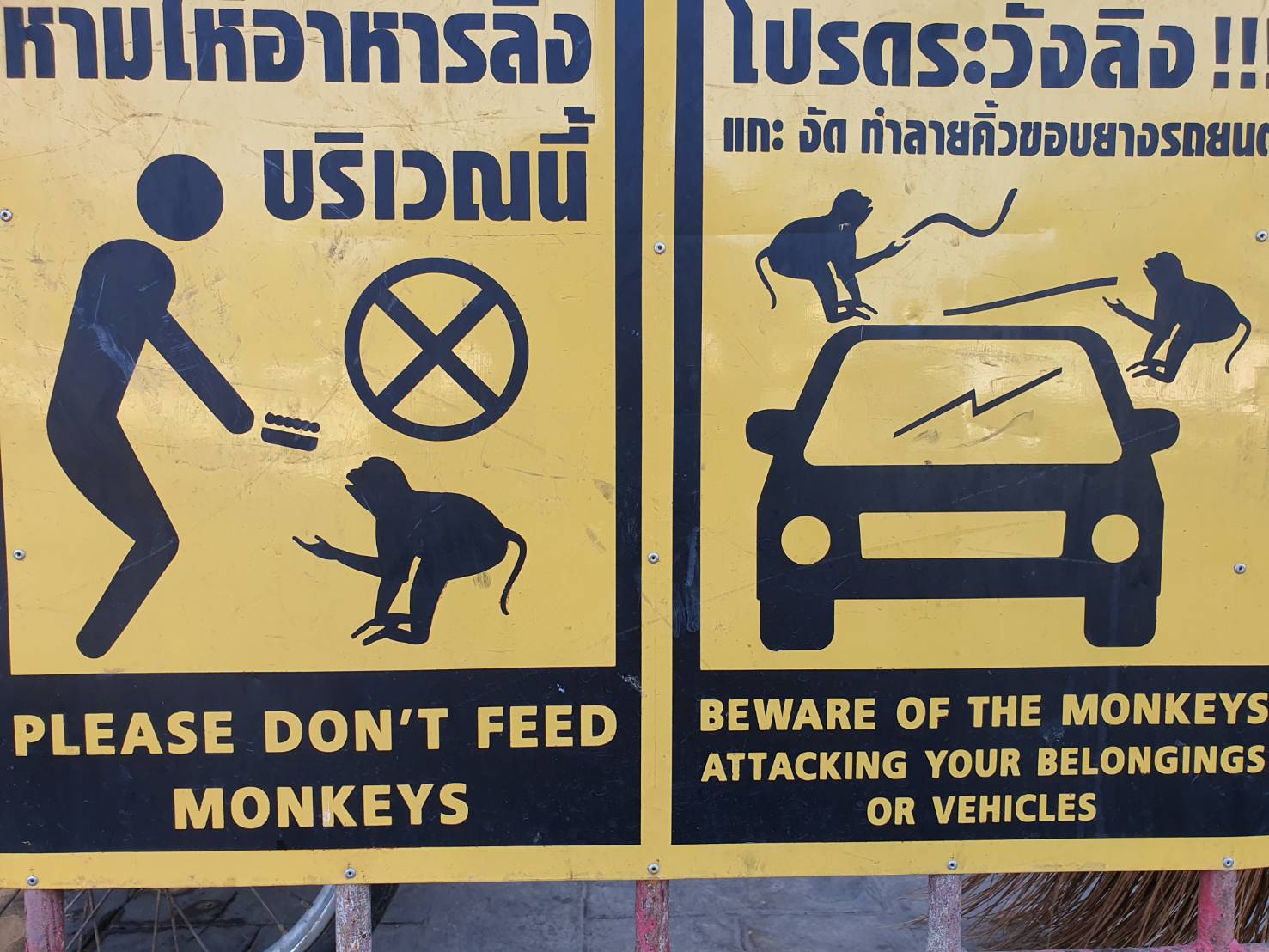
This was in response to the recent situation where some monkeys displayed aggressive behavior, took away food from local residents and caused several injuries. The operation was aimed at going from March 25 to 27, 2024, for a total of three days, with a goal of 50 monkeys.
Officials lured the monkeys with food to areas where they had previously been aggressive, such as the spot where a monkey snatched a woman’s bag of groceries on 6 March, causing her to fall and injure herself, and another spot on Ratchadamnoen Road opposite the Bank for Agriculture and Agricultural Cooperatives (BAAC) where a monkey jumped on a car on 23 March, causing an accident.
After setting up the cage for a short time and using raw corn as bait, the officials captured the first five monkeys. They were all thin and seemed unafraid of the officers or the reporters. The officials will take all the captured monkeys to the Wildlife Rescue Center in Nakhon Nayok province for care and rehabilitation while they wait for the monkey park in Lopburi to be 100 percent completed.
Kittipong Liewpairoj, 39, a local resident and owner of the video footage showing the monkey snatching a woman’s bag of groceries, thanked officials from the relevant authorities for coming to address the situation. He said this is a good sign and he wants them to be consistent in their work.
“I don’t want them to just flaunt it like they have been doing for the past 10 years, which has resulted in more than half of the residents and shopkeepers moving away from the monkeys. I still love Lopburi and the monkeys, but I want to live happily with them and restore the well-being of the people of Lopburi,” he said.
Meanwhile, the Wildlife Compensation Fund Committee approved on March 23, 2024 the application of the criteria and methods to support and compensate wildlife-affected people, including monkey-affected people, in addition to elephants, bears and cucumbers.
All the captured monkeys to the Wildlife Rescue Center in Nakhon Nayok province for care and rehabilitation.
Atthaphon Charoenchansa, Director General of the Department of National Parks, Wildlife and Plant Conservation, announced the criteria for assistance and compensation to persons who have suffered loss of life, injury or disability. The details and compensation rates for those affected by wildlife are as follows:
1. In case of injury
(1) Disability, paralysis: Receive 100,000 baht. Loss of an arm, leg, or eyesight (blindness) in both eyes, or an arm, leg, and eyesight (blindness) in two places: Receive 100,000 baht. Loss of an arm, leg, or eyesight (blindness) in one eye: Receive 50,000 baht.
(2) General injuries: Receive the actual cost of treatment, up to 30,000 baht
(3) Loss of earnings during hospitalization: Up to 180 days from the date of the injury, as certified by a doctor: Receive up to 300 baht per day
2. In case of death
(1) Compensation: 100,000 baht
Those who have been injured or killed by monkeys or other wild animals can contact the local administrative office of the protected area and apply for compensation according to the prescribed criteria.
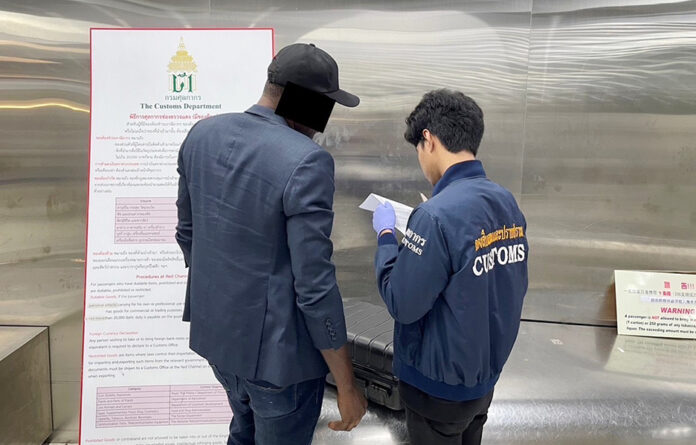
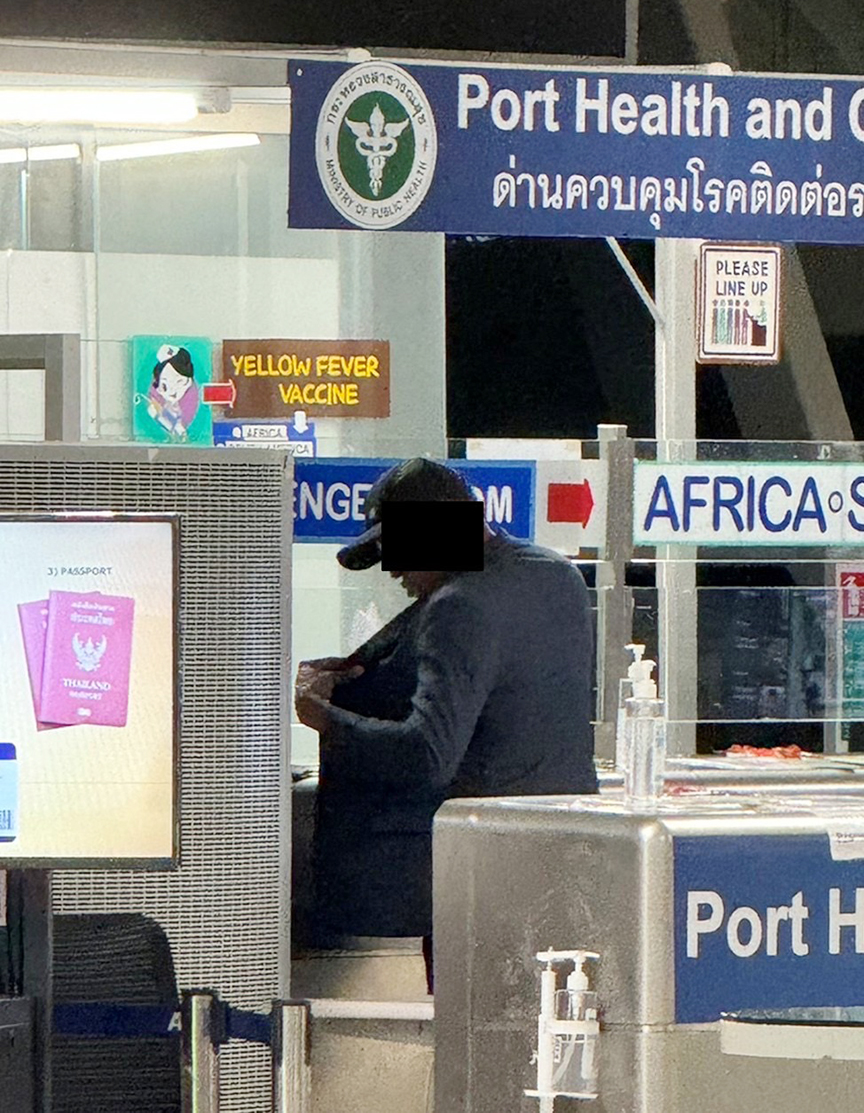
SUVARNABHUMI – On March 25, 2024, Customs officers working with the Airport Interdiction Task Force (AITF) identified a male passenger of Nigerian nationality traveling from Doha, Qatar to Suvarnabhumi Airport in Thailand.
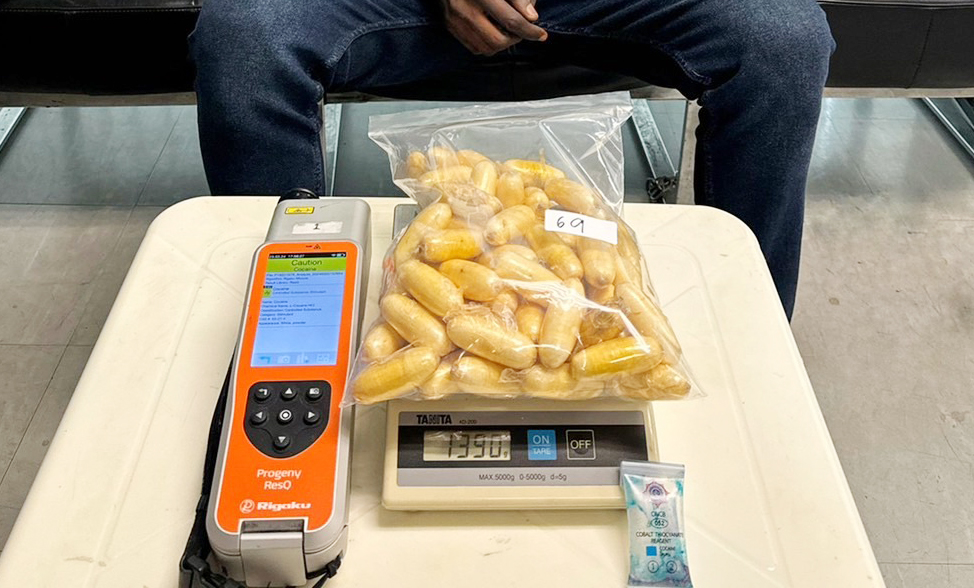
Sixty-nine cocaine lumps with a total weight of 1,390 grams and a value of 4,170,000 baht were found in Nigerian suspect’s body.
Upon arrival at Suvarnabhumi Airport, the suspect exhibited suspicious behavior and was subsequently subjected to a thorough check. Sixty-nine cocaine lumps with a total weight of 1,390 grams and a value of 4,170,000 baht were found in his body. The arresting officers documented the seizure and handed the suspect over to Suvarnabhumi Airport Police Station for further prosecution.
Mr. Thirach Attanawanich, Director General of Customs, stated that in line with the government’s strict anti-drug policy, he has directed officials to step up their vigilance in monitoring all channels for drug smuggling.
As a result, during fiscal year 2024 (October 1, 2023–March 25, 2024), the Customs Department recorded 74 drug seizures totaling approximately 412.86 million baht. In comparison, there were 185 arrests totaling 1.17 billion baht in fiscal year 2023 (October 1, 2022–September 30, 2023).
Chinese tourists pose for a group photo at Ancient Siam in Samut Prakan, Thailand, March 1, 2024. (Xinhua/Wang Teng)
TAIYUAN – Just after bidding farewell to a group of Thai teachers visiting universities in Beijing, tour guide Yang Yaoyu rushed to Shanxi Province in north China to greet another group of Thai visitors.
The seasoned Thai-speaking tour guide can attest to a recent surge in enthusiasm among Thai tourists towards China, after a mutual visa exemption agreement between the two countries took effect on March 1.
“Previously, the peak of Thai tourists to China was in April after Songkran festival. However, my schedule is now fully booked from March 3 until the end of April,” Yang said.
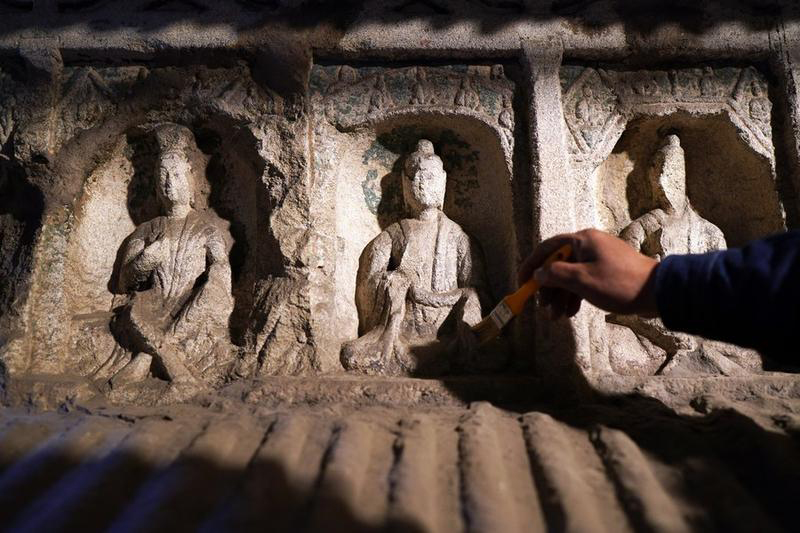
Porntip Rojansunan, together with the other 20 Thai visitors in her group, is a beneficiary of the visa waiver. After flying directly from Bangkok to Taiyuan, capital of Shanxi, on March 9, the group commenced their five-day trip by visiting three UNESCO World Heritage sites in the province, namely, Mount Wutai, Yungang Grottoes, and the ancient city of Pingyao.
A technician with the Yungang Grottoes Research Institute maintains a piece of relics at the Yungang Grottoes in Datong, north China’s Shanxi Province, May 7, 2021. (Xinhua/Zhan Yan)
“Before, I was only familiar with Chinese destinations like Beijing and Shanghai. Since coming to Shanxi, I must say how impressed I am by the profound history and rich culture here. I will undoubtedly encourage my friends and relatives to come to experience the charm of Shanxi themselves,” Porntip said.
The visa-free policy has boosted cultural exchanges between the Chinese and Thai people, and more and more Thai tourists are considering China as their first choice destination for overseas travel.
Data from China’s major online travel agency Trip.com showed that on March 1, the number of Chinese tourists to Thailand increased by more than 30 percent year on year, while travel orders from Thailand to China surged by threefold year on year, an increase of more than 160 percent compared with 2019.
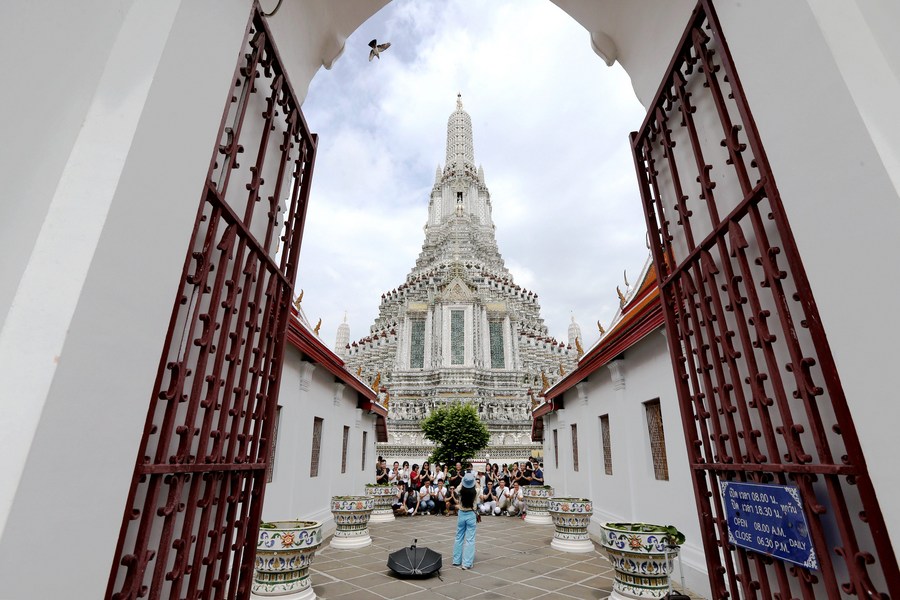
Tourists take photos at the Wat Arun in Bangkok, Thailand, on June 16, 2023. (Xinhua/Wang Teng)
China and Thailand are important tourist destinations and sources for each other, and the implementation of the mutual visa exemption holds significantly positive implications for the growth of the tourism sectors in both nations, said Qin Jing, vice president of Trip.com Group. The Chinese side can provide Thai tourists with more personalized options spanning culture, folk custom, and snow-and-ice activities, among others, Qin added.
China is persistent in its facilitation of entry for foreign nationals, promising to make itself a preferred destination for international travelers. Since the mutual visa exemption policy between China and Thailand came into effect, the number of countries that have such entry policy with China has increased to 23, including Singapore, the Maldives, and the United Arab Emirates.
In addition, China has adopted a visa-free policy for Switzerland, Ireland, Hungary, Austria, Belgium and Luxembourg on a trial basis, starting March 14. This series of measures is regarded by industry insiders as a positive signal that is conducive to promoting global economy and trade and accelerating personnel exchanges.
“The recently concluded sessions of China’s top legislature and top political advisory body, or the ‘two sessions,’ also mentioned that the country will facilitate foreign nationals to work, study, and travel within China. This indicates that the fundamentals of China’s unwavering commitment to opening up remain constant,” said Zhang Wei, secretary general of the inbound tourism branch of China Association of Travel Services.
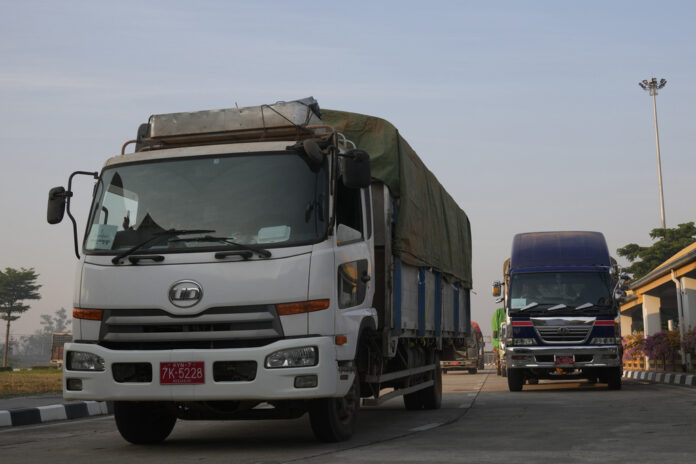
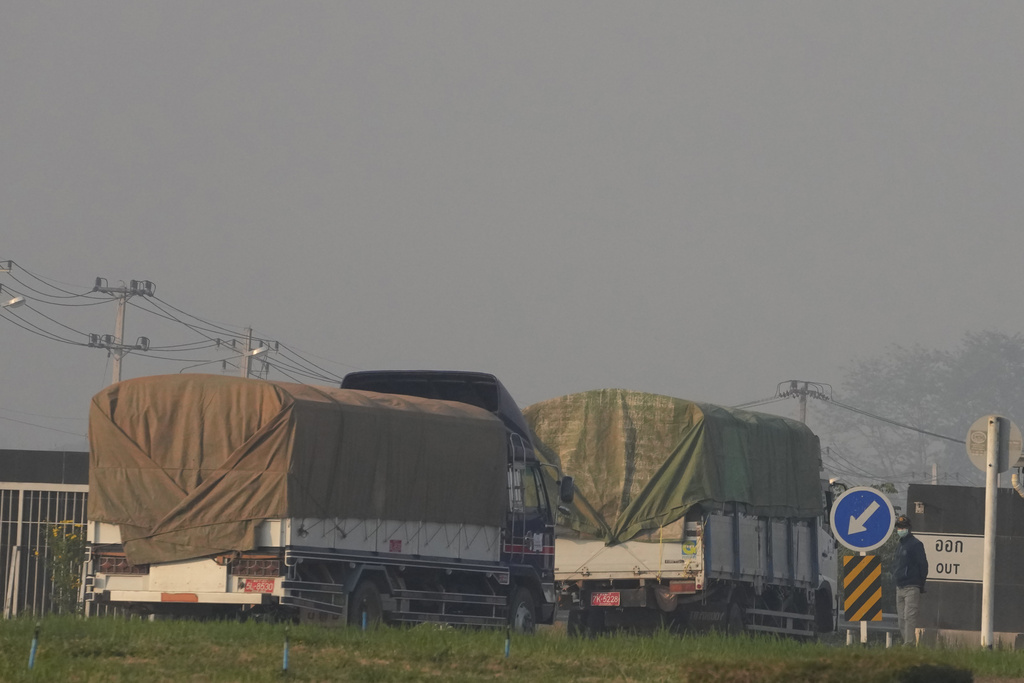
Myanmar’s trucks carrying aid leave from the customs checkpoint near the border with Myanmar, in Mae Sot, Tak province Thailand Monday, March 25, 2024. Thailand delivered its first batch of humanitarian aid to war-torn Myanmar sending ten trucks over the border from the northern province of Tak in what they hope will be a continuing effort to ease the plight of millions of people displaced by fighting. (AP Photo/Sakchai Lalit)
MAE SOT, Thailand (AP) — Thailand delivered its first batch of humanitarian aid to war-torn Myanmar on Monday, in what officials hope will be a continuing effort to ease the plight of millions of people displaced by fighting.
But critics charge that the aid will benefit only people in areas under the Myanmar military’s control, providing it with a propaganda boost while leaving the vast majority of displaced people in contested areas without access to assistance.
Myanmar is wracked by a nationwide armed conflict that began after the army ousted the elected government of Aung San Suu Kyi in February 2021 and suppressed widespread nonviolent protests that sought a return to democratic rule. The fighting has displaced millions of people and battered the economy.
Thailand sent ten trucks over the border from the northern province of Tak, carrying some 4,000 packages of aid to three towns in Kayin State, also known as Karen State, where it will be distributed to approximately 20,000 displaced people.
Myanmar’s trucks carrying aid leave from the customs checkpoint near the border with Myanmar, in Mae Sot, Tak province Thailand Monday, March 25, 2024. (AP Photo/Sakchai Lalit)
The parcels contained aid worth around 5 million baht ($138,000), mostly food, instant beverages and other basic items such as toiletries.
More than 2.8 million people in Myanmar are displaced, according to U.N. agencies, most by fighting that arose after the army’s takeover. They say 18.6 million people, including 6 million children, require humanitarian aid.
Carl Skau, Chief Operating Officer of the U.N.’s World Food Programme, said earlier this month that one in four of the displaced is at risk of acute food insecurity.
The initiative for what has been called a humanitarian corridor is being carried out by the Thai Red Cross, with funding from Thailand’s Foreign Ministry and logistical support from the army, which traditionally has played a major role in border activities.
Officials from Thailand and Myanmar’s Kayin State attended a send-off ceremony, which was presided over by Thai Vice Foreign Minister Sihasak Phuangketkeow. Myanmar’s Red Cross will handle distribution of the aid.
Drivers from Myanmar took the trucks across the 2nd Thai-Myanmar Friendship Bridge, which crosses the Moei River on the border.
“That corridor puts humanitarian aid into the hands of the junta because it goes into the hands of the junta-controlled Myanmar Red Cross,” Tom Andrews, the U.N. independent human rights expert on Myanmar, said last week.
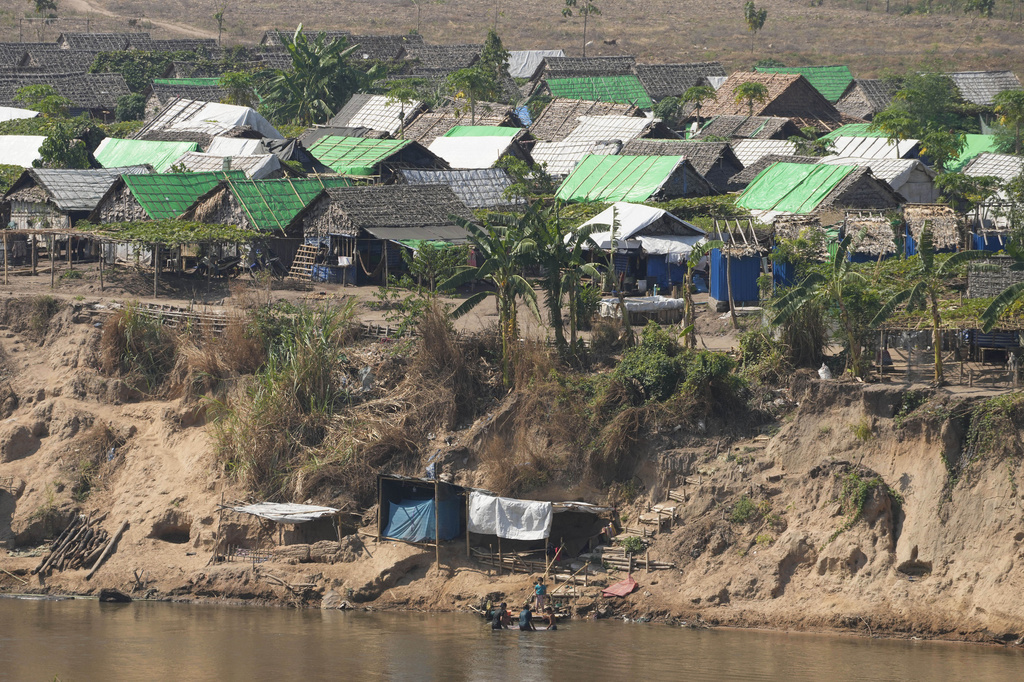
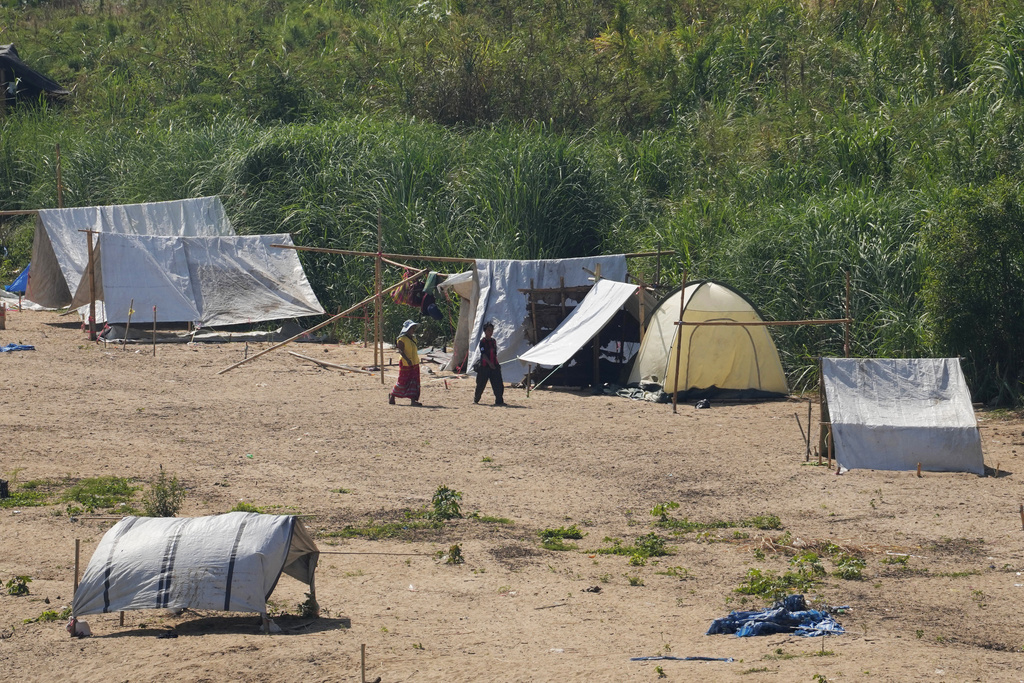
A camp for internally displaced people in Myanmar is seen across the Moei river from Mae Sot, Tak province Thailand Monday, March 25, 2024. (AP Photo/Sakchai Lalit)
“So we know that the junta takes these resources, including humanitarian, and weaponizes them, uses them for their own military strategic advantage. The fact of the matter is, is that the reason that humanitarian aid is in such desperate need is precisely because of the junta.”
Andrews said the areas in desperate need are “conflict areas in which the junta has absolutely no influence or control whatsoever. So those are the areas we need to focus on.”
Large areas of the country, especially frontier areas, are now contested or controlled by anti-military resistance forces, including pro-democracy fighters allied with armed ethnic minority organizations that have been fighting for greater autonomy for decades.
Thai officials say the process of distribution will be monitored by the ASEAN Coordinating Centre for Humanitarian Assistance on Disaster Management to ensure it reaches people fairly and equally.
Vice Foreign Minister Sihasak said after the ceremony that the aid is expected to be delivered to the three towns the same day, and that Myanmar will send photos as proof it has been delivered.
“I would like to emphasize that this is truly humanitarian aid and not related to the politics or conflicts in Myanmar. I think, now, people should think about the interests of the Myanmar people as a priority,” he said. “Of course, if the initiative today is carried out smoothly, and meets the objectives that we set, Thailand as a neighbor will see how we can expand the help to other areas.”
The humanitarian corridor project was initiated by Thailand with support from Myanmar and other fellow members of the Association of Southeast Asian Nations during an ASEAN Foreign Ministers Retreat in Laos in January.
A camp for internally displaced people in Myanmar is seen across the Moei river from Mae Sot, Tak province Thailand Monday, March 25, 2024. (AP Photo/Sakchai Lalit)
Thai Foreign Minister Parnpree Bahiddha-Nukara had said ASEAN needs to actively push to implement what it calls the Five-Points Consensus, which it agreed to just a few months after the army’s 2021 takeover.
The agreement called for an immediate end to violence, dialogue among all concerned parties, mediation by an ASEAN special envoy, provision of humanitarian aid through ASEAN channels, and a visit to Myanmar by the special envoy to meet all concerned parties.
But Myanmar’s generals, despite initially assenting to the consensus, failed to act on it, leaving ASEAN looking powerless.
Dulyapak Preecharush, a professor of Southeast Asia Studies at Bangkok’s Thammasat University, said the aid initiative is a good start for Thailand, which has been quiet and inactive” about Myanmar.
“The readiness of Thailand to deliver the aid is not an issue, but when the aid is delivered to Myanmar, it will face obstacles from violent fighting and different stakeholders who will have their gains and losses.”
Sihasak said Thailand hopes the aid will be distributed equally and transparently, and that the delivery of the aid will help create a “good atmosphere” that will contribute to the peace process in Myanmar.
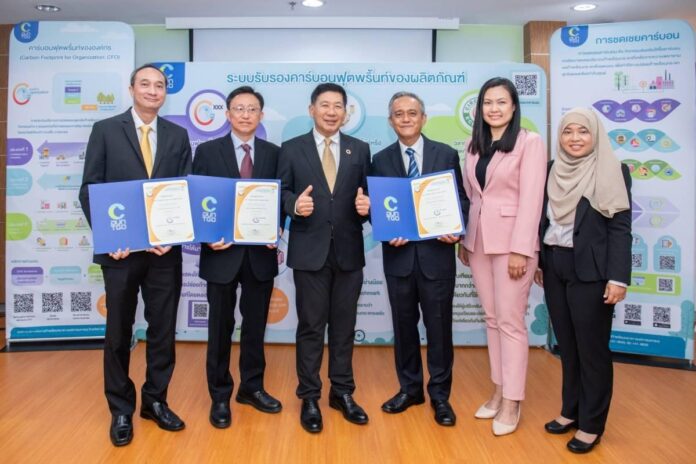
CP Foods Leads Greenhouse Gas Emission Reduction Drive; 584 Products Achieving Carbon Footprint Labels in 1Q/24
– CP Foods is dedicated to introducing lower-carbon food products to the market, catering to consumers who are concerned about the impacts of global warming and climate change.
– In the first quarter of 2024, 584 products received Carbon Footprints Certificates mainly 523 animal feed products, including swine, chicken feed, and corn used as raw materials.
-40 shrimp products spanning from shrimp feed, fresh shrimp, probiotic microorganisms, and shrimp wonton soup also received Carbon Footprint certification
Charoen Pokphand Foods Public Company Limited (CP Foods), a leading food products company, has achieved Carbon Footprint of Product (CFP) certification for its 584 products in the first quarter of this year, granted by the Thailand Greenhouse Gas Management Organization (TGO). This underscores the company’s dedication to producing low-carbon products (CP Low-carbon Products) and involving consumers in collective efforts to reduce greenhouse gas emissions.
Among the 584 certified products, CP Foods focuses on livestock feed products, totalling 523 items, including swine feed (HiGro 591), chicken feed (HiProWhite 510), and feed corn. Additionally, 40 items in the shrimp supply chain have received the carbon footprint label, comprising shrimp feed, fresh shrimp, probiotic microorganisms, and shrimp wonton soup. Furthermore, 20 items of duck products have been certified, including Hong Kong-style spiced roast duck and fried bone-in duck. A ready-to-eat chicken product under the Kitchen Joy brand has also received this label.
The Carbon Footprint certification measures the greenhouse gas emissions of a product throughout its lifecycle stages, from raw material sourcing to packaging waste management and transportation. Committed to achieving net zero emissions, CP Foods collaborates with value chain partners to offer more low-emission food choices for environmentally conscious consumers. This commitment is evident through the packaging’s Carbon Footprint, Carbon Footprint Reduction, and Carbon Neutral labels.
Since 2009, CP Foods has prioritized the development of low-carbon products, evaluating their carbon footprints in compliance with ISO 14040, ISO 14044, and ISO 14067 standards.
Currently, 880 CP Foods products have received the Carbon Footprint label, with plans to expand certification to include processed pork products under the U Farm brand in 2024, following Fresh Pork and Kurobuta Pork, which have previously received Carbon Footprint certification. Furthermore, the company intends to certify additional ready-to-eat products with the Carbon Footprint label this year.
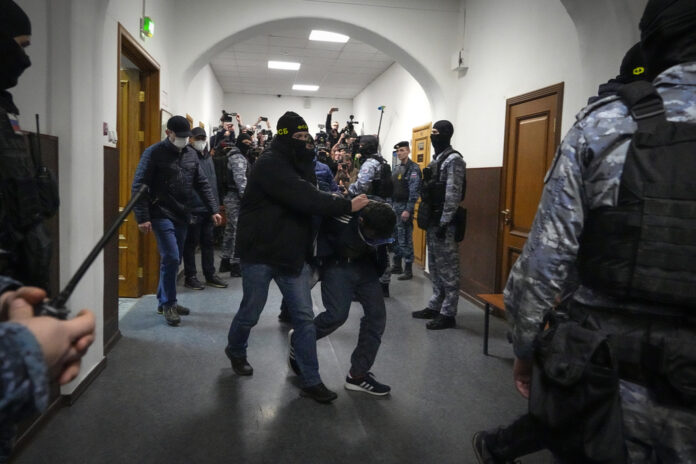
A suspect in the Crocus City Hall shooting on Friday is escorted by police officers in the Basmanny District Court, in Moscow, Russia, Sunday, March 24, 2024. (AP Photo/Alexander Zemlianichenko)
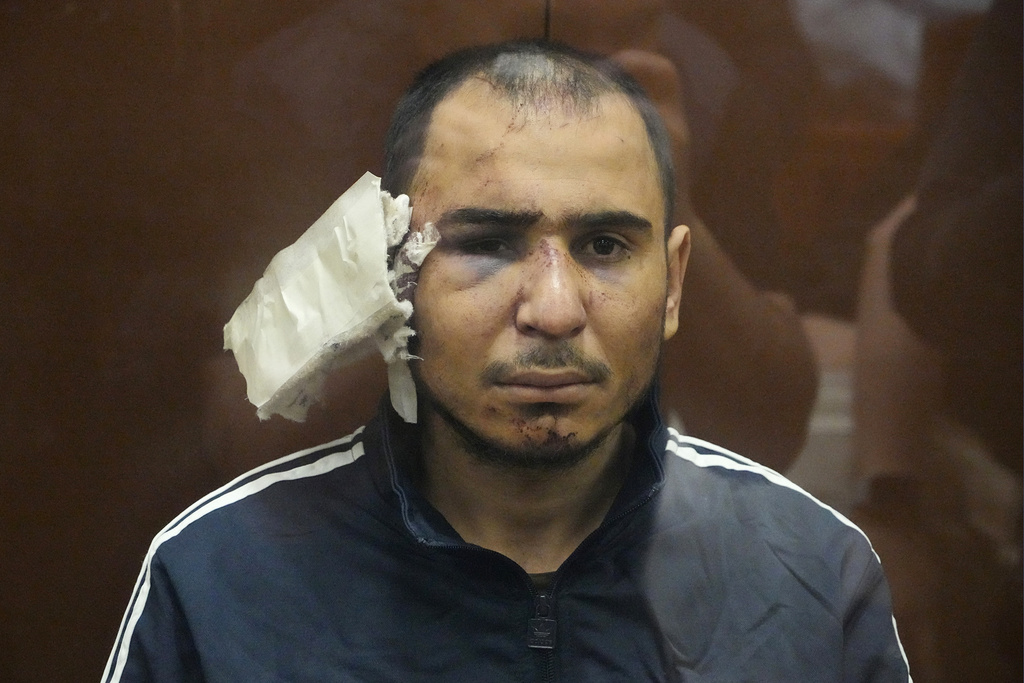
MOSCOW (AP) — Four men accused of staging the Russia concert hall attack that killed more than 130 people appeared before a Moscow court Sunday showing signs of severe beatings as they faced formal terrorism charges. One appeared to be barely conscious during the hearing.
A court statement said two of the suspects accepted their guilt in the assault after being charged in the preliminary hearing, though the men’s condition raised questions about whether they were speaking freely. There had been earlier conflicting reports in Russian media outlets that said three or all four men admitted culpability.
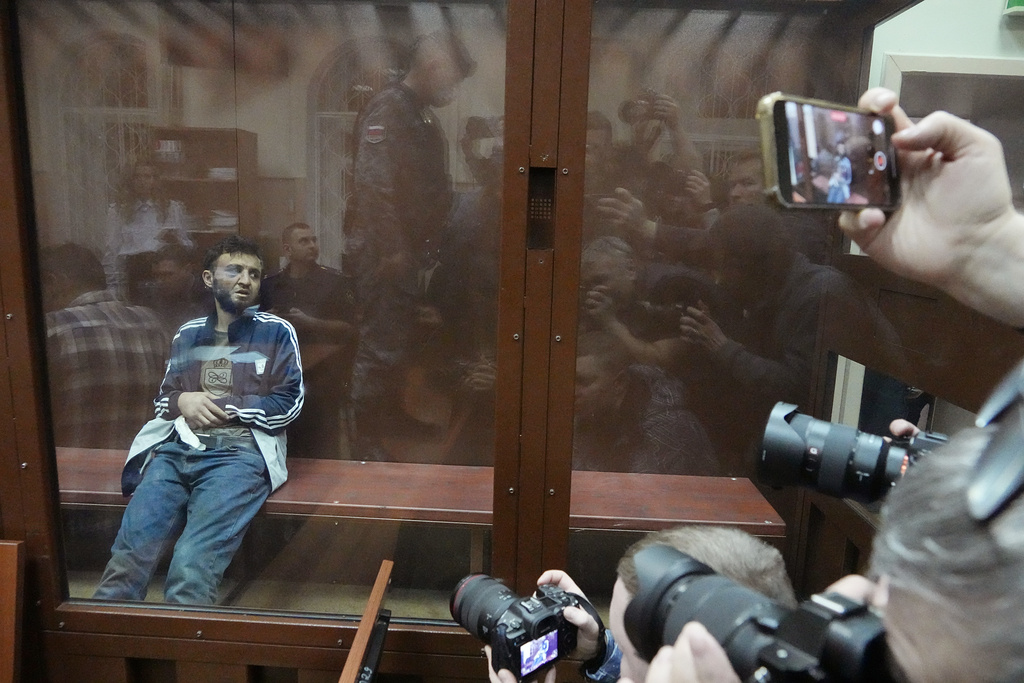
Moscow’s Basmanny District Court formally charged Dalerdzhon Mirzoyev, 32; Saidakrami Rachabalizoda, 30; Shamsidin Fariduni, 25; and Mukhammadsobir Faizov, 19, with committing a group terrorist attack resulting in the death of others. The offense carries a maximum sentence of life imprisonment.
The court ordered that the men, all of whom are citizens of Tajikistan, be held in pre-trial custody until May 22.
Saidakrami Murodali Rachabalizoda, a suspect in the Crocus City Hall shooting on Friday, sits in a glass cage in the Basmanny District Court in Moscow, Russia, Sunday, March 24, 2024. (AP Photo/Alexander Zemlianichenko)
Russian media had reported that the men were tortured during interrogation by the security services, and Mirzoyev, Rachabalizoda and Fariduni showed signs of heavy bruising, including swollen faces,
Rachabalizoda also had a heavily bandaged ear. Russian media said Saturday that one of the suspects had his ear cut off during interrogation. The Associated Press couldn’t verify the report or the videos purporting to show this.
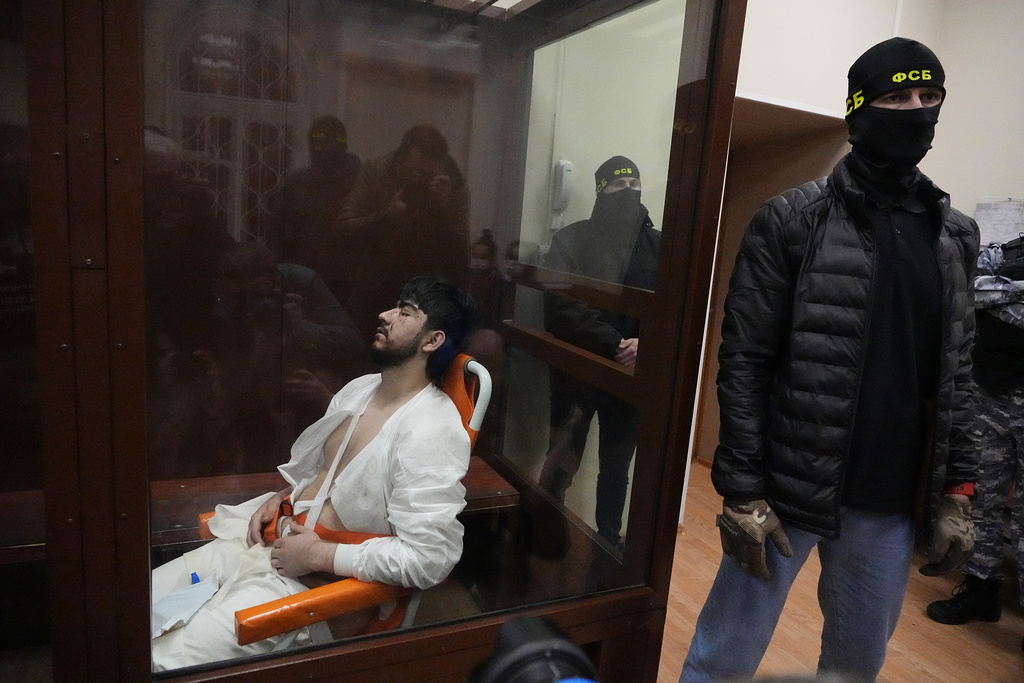
The fourth suspect, Faizov, was brought to court from a hospital in a wheelchair and sat with his eyes closed throughout the proceedings. He was attended by medics while in court, where he wore a hospital gown and trousers and was seen with multiple cuts.
Court officials said Mirzoyev and Rachabalizoda admitted guilt for the attack after being charged.
The hearing came as Russia observed a national day of mourning for the attack Friday on the suburban Crocus City Hall concert venue that killed at least 137 people.
The attack, which has been claimed by an affiliate of the Islamic State group, is the deadliest on Russian soil in years.
Mukhammadsobir Faizov, a suspect in Friday’s shooting at the Crocus City Hall, sits in a glass cage in the Basmanny District Court in Moscow, Russia, Sunday, March 24, 2024. (AP Photo/Alexander Zemlianichenko)
Russian authorities arrested the four suspected attackers Saturday, with seven more people detained on suspicion of involvement in the attack, Russian President Vladimir Putin said in an address to the nation Saturday night. He claimed they were captured while fleeing to Ukraine, something that Kyiv firmly denied.
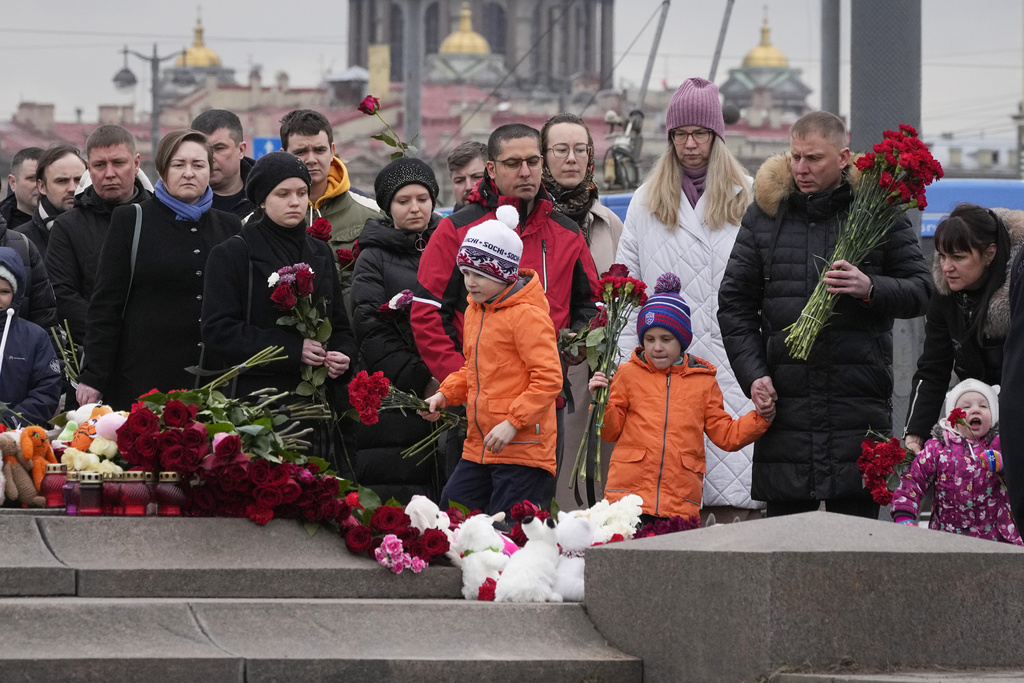
Events at cultural institutions were canceled Sunday, flags were lowered to half staff and television entertainment and advertising were suspended, according to state news agency RIA Novosti. A steady stream of people added to a makeshift memorial near the burned-out concert hall, creating a huge mound of flowers.
“People came to a concert, some people came to relax with their families, and any one of us could have been in that situation. And I want to express my condolences to all the families that were affected here and I want to pay tribute to these people,” Andrey Kondakov, one of the mourners who came to lay flowers at the memorial, told AP.
“It is a tragedy that has affected our entire country,” kindergarten employee Marina Korshunova said. “It just doesn’t even make sense that small children were affected by this event.” Three children were among the dead.
Rescuers continued to search the damaged building and the death toll rose as more bodies were found as family and friends of some of those still missing waiting for news. Moscow’s Department of Health said Sunday it had begun identifying the bodies of those killed via DNA testing, saying the process would take at least two weeks.
Igor Pogadaev was desperately seeking any details about his wife, Yana Pogadaeva, who went to the attack concert. The last he heard from her was when she sent him two photos from the Crocus City Hall music venue.
People lay flowers at a spontaneous memorial in memory of the victims of Moscow attack in St. Petersburg, Russia, Sunday, March 24, 2024. Russia observed a national day of mourning on Sunday, two days after an attack on a suburban Moscow concert hall that killed over 130 people. (AP Photo/Dmitri Lovetsky)
After Pogadaev saw the reports of gunmen opening fire on concertgoers, he rushed to the site, but couldn’t find her in the numerous ambulances or among the hundreds of people who had made their way out of the venue.
“I went around, searched, I asked everyone, I showed photographs. No one saw anything, no one could say anything,” Pogadaev told AP in a video message.
He watched flames bursting out of the building as he made frantic calls to a hotline for relatives of the victims, but received no information.
As the death toll mounted Saturday, Pogodaev scoured hospitals in the Russian capital and the Moscow region, looking for information on newly admitted patients.
His wife wasn’t among the 182 reported injured, nor on the list of 60 victims authorities had already identified, he said.
The Moscow Region’s Emergency Situations Ministry posted a video Sunday showing equipment dismantling the damaged music venue to give rescuers access.
Putin has called the attack “a bloody, barbaric terrorist act” and said Russian authorities captured the four suspects as they were trying to escape to Ukraine through a “window” prepared for them on the Ukrainian side of the border.
Russian media broadcast videos that apparently showed the detention and interrogation of the suspects, including one who told the cameras he was approached by an unidentified assistant to an Islamic preacher via a messaging app and paid to take part in the raid.
Putin didn’t mention IS in his speech to the nation, and Kyiv accused him and other Russian politicians of falsely linking Ukraine to the assault to stoke fervor for Russia’s fight in Ukraine, which recently entered its third year.
U.S. intelligence officials said they had confirmed the IS affiliate’s claim.
Dalerdzhon Mirzoyev, a suspect in the Crocus City Hall shooting on Friday sits in a glass cage in the Basmanny District Court in Moscow, Russia, Sunday, March 24, 2024. (AP Photo/Alexander Zemlianichenko)
“ISIS bears sole responsibility for this attack. There was no Ukrainian involvement whatsoever,” National Security Council spokeswoman Adrienne Watson said in a statement.
The U.S. shared information with Russia in early March about a planned terrorist attack in Moscow, and issued a public warning to Americans in Russia, Watson said.
The raid was a major embarrassment for Putin and happened just days after he cemented his grip on the country for another six years in a vote that followed the harshest crackdown on dissent since the Soviet times.
Some commentators on Russian social media questioned how authorities, who have relentlessly suppressed any opposition activities and muzzled independent media, failed to prevent the attack despite the U.S. warnings.
IS, which fought against Russia during its intervention in the Syrian civil war, has long targeted Russia. In a statement posted by the group’s Aamaq news agency, the IS Afghanistan affiliate said that it had attacked a large gathering of “Christians” in Krasnogorsk.
The group issued a new statement Saturday on Aamaq, saying the attack was carried out by four men who used automatic rifles, a pistol, knives and firebombs. It said the assailants fired at the crowd and used knives to kill some concertgoers, casting the raid as part of the Islamic State group’s ongoing war with countries that it says are fighting against Islam.
In October 2015, a bomb planted by IS downed a Russian passenger plane over Sinai, killing all 224 people on board, most of them Russian vacationers returning from Egypt.
The group, which operates mainly in Syria and Iraq but also in Afghanistan and Africa, also has claimed responsibility for several attacks in Russia’s volatile Caucasus and other regions in past years. It recruited fighters from Russia and other parts of the former Soviet Union.
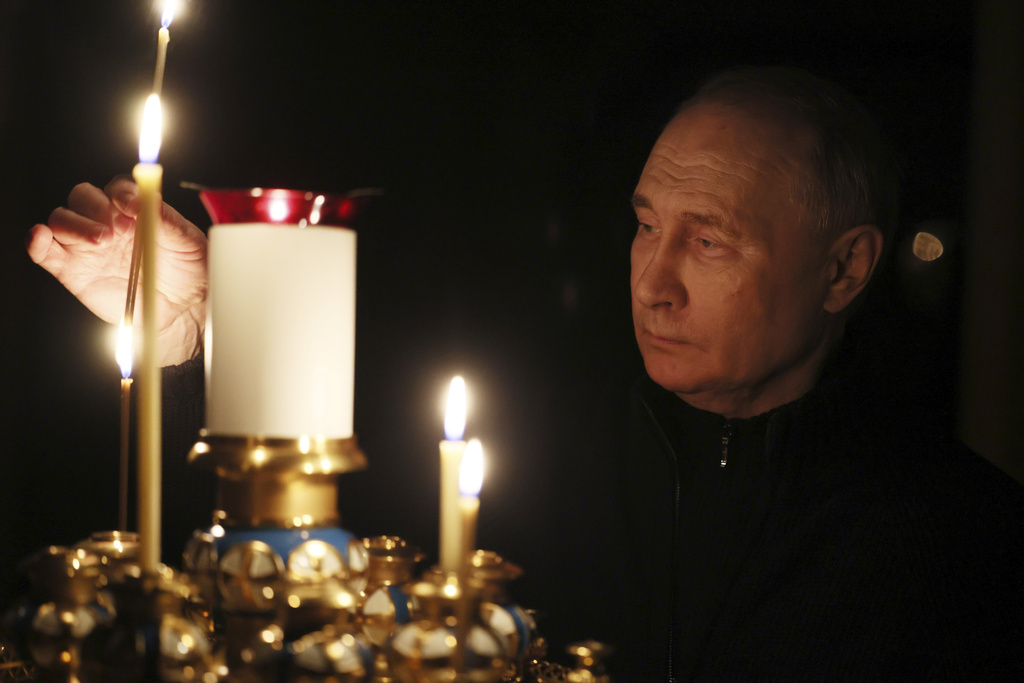
Russian President Vladimir Putin lights a candle to commemorate the victims of an attack on the Crocus City Hall concert venue, on the day of national mourning, in Russia, Sunday, March 24, 2024. (Mikhail Metzel, Sputnik, Kremlin Pool Photo via AP)
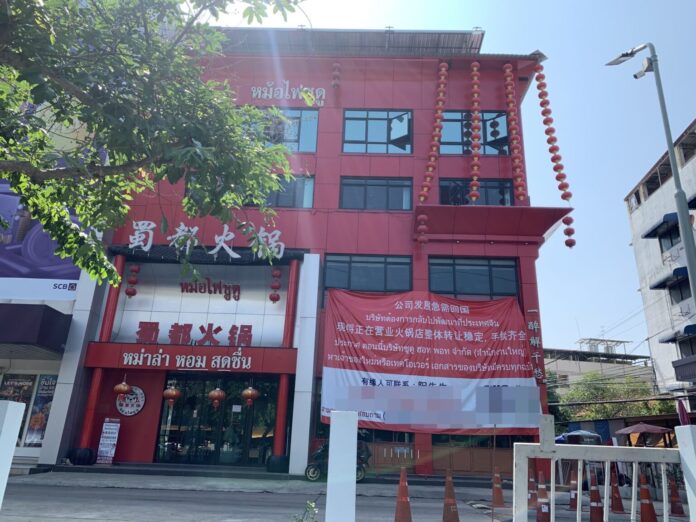
The sign in front of the restaurant reads: "The company want to return to China for development. Chudu Hot Pot Company (head office) is looking to locate a new owner or take over. "All company documents are complete." (Matichon Photo)
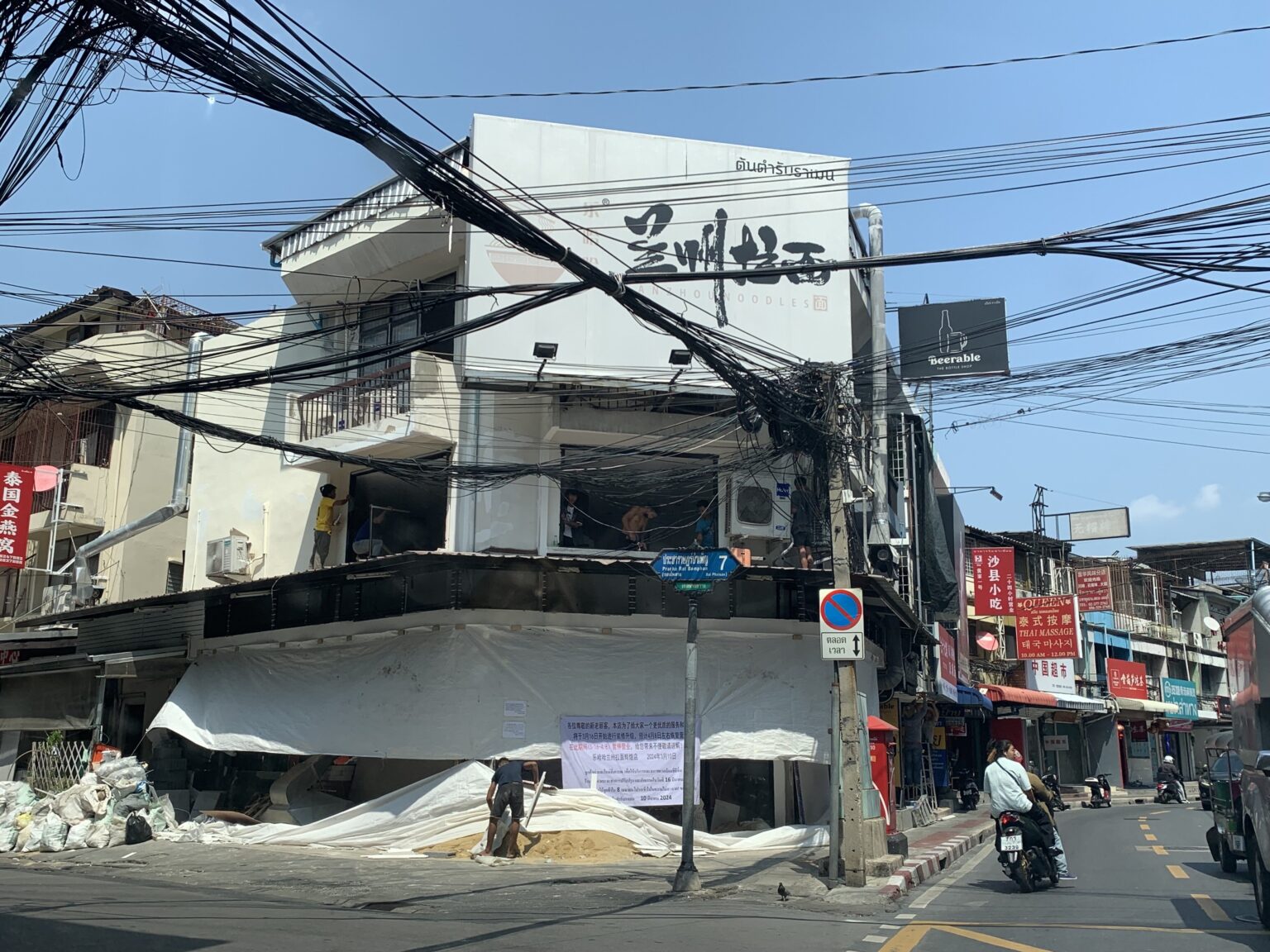
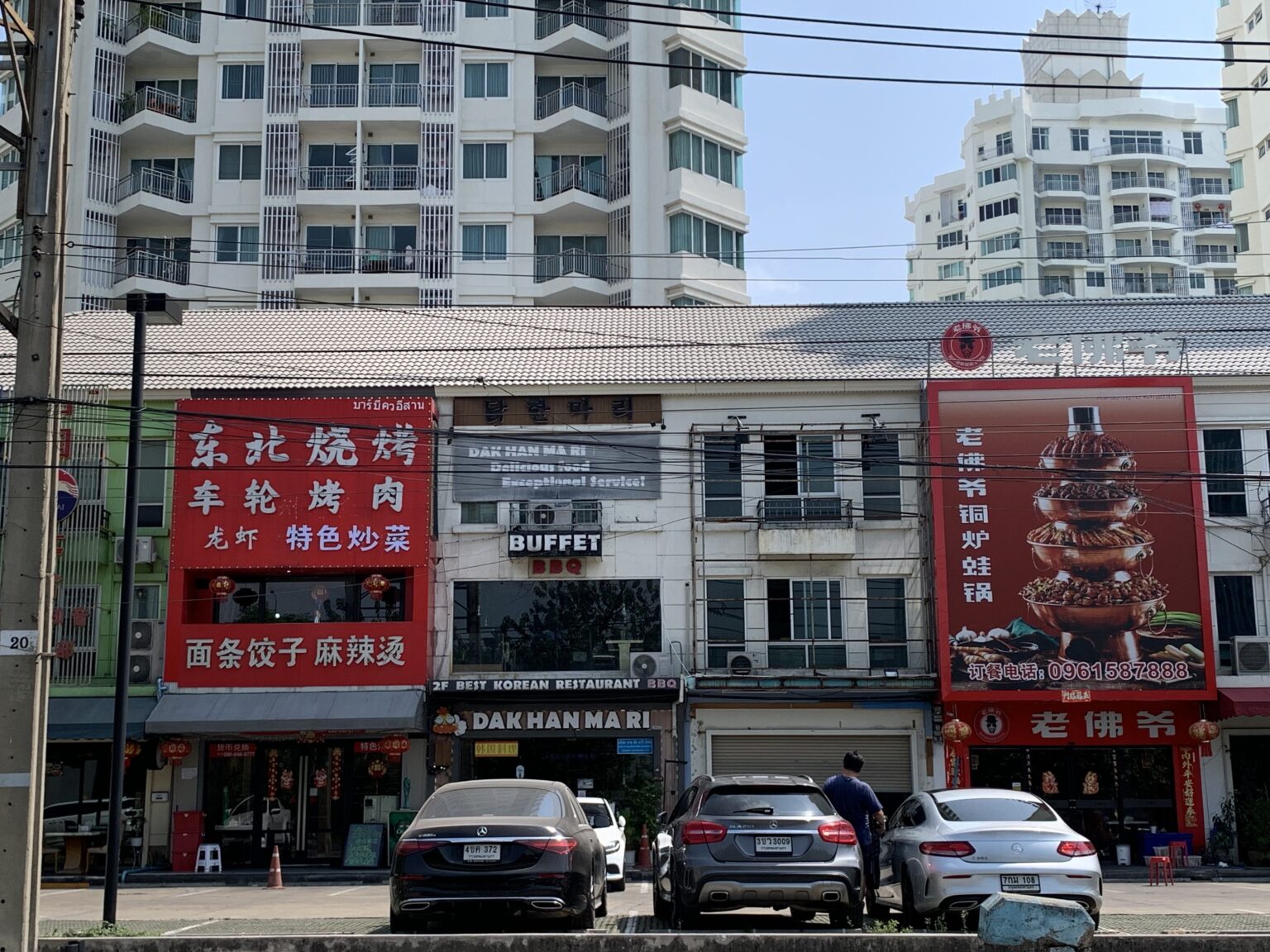
BANGKOK – The crackdown forces the closure of at least 12 Chinese restaurants in Huai Khwang district, dubbed Bangkok’s new Chinatown, according to a Prachachat Business report.
Authorities inspecting Pracharat Bamphen Road in Huai Khwang district find restaurants and supermarkets operated and funded by Chinese expats in breach of the law.
Huai Khwang district officials recently launched a crackdown on illegal operations in Chinese restaurants on Pracharat Bamphen Road, identifying then ordering the closure of least 12 restaurants and supermarkets operating in violation of the Foreign Business Act.
According to the authorities, the restaurants are: Dragon Shabu Mala, Chao Tian Men Hot Pot, JP Shabu, Mala Master, Kuanzhai Alley, Huang Ewi, Super Store, Shawn Yue, Hung Lou Meng, Tuan Sao Sao, Fuda Hot Pot, Piggy Mala, Khamoo and Fu Hwa. Most are restaurants serving Mala hot pot, a spicy and tongue-numbing dish cooked in a pot of simmering soup at the table.
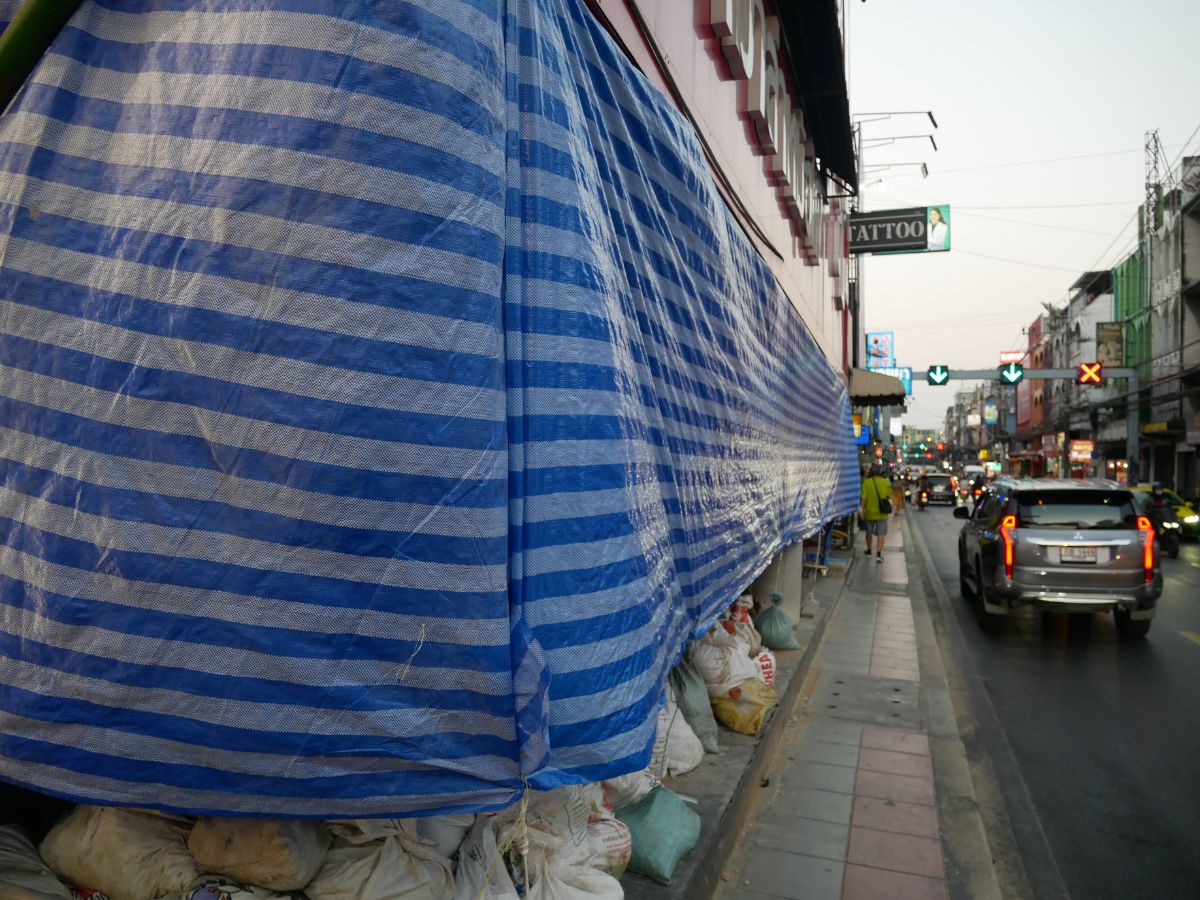
The Chinese restaurant in Huay Kwang has closed down. (Prachachat Business Photo)
A neighborhood that never sleeps becomes subdued
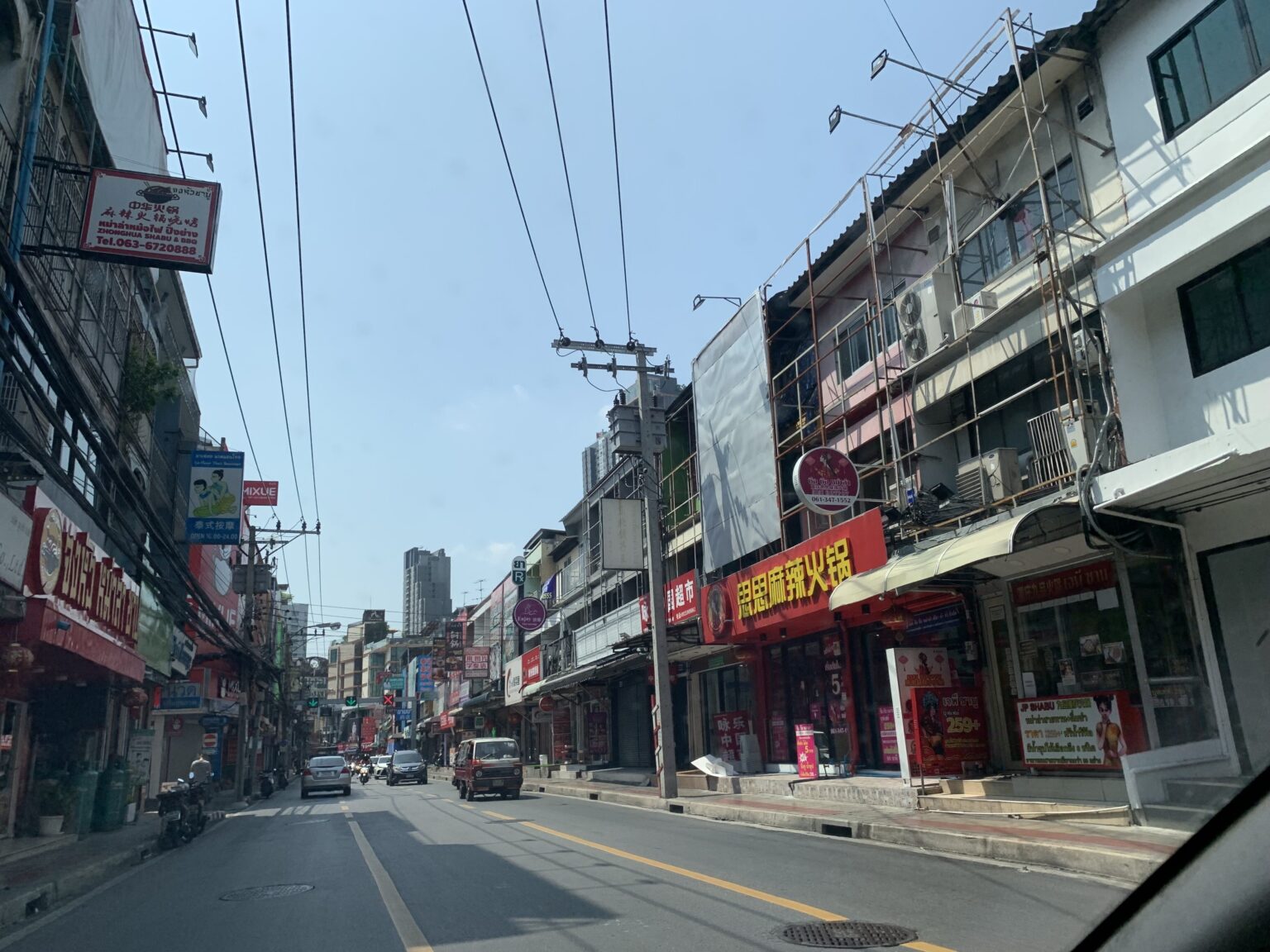
A sober mood has set in following the crackdown. The typically vibrant atmosphere of the Pracharat Bamphen Road has been replaced by an unusual silence amidst the hustle and bustle of the Huai Khwang district in the heart of the city. The road has become quiet, with relatively little traffic and fewer foreign tourists and local visitors.
The Prachachat Turakij spoke with Praphruk Hankijjakul, a member of the Bangkok Metropolitan Council who represents Huai Khwang District about the current economic climate of businesses in the neighborhood and why many Chinese restaurants are shuttered.
“Business in the area has slowed. The road is notably quieter, mainly I think due to the closures of Chinese restaurants following the inspections,” he said.
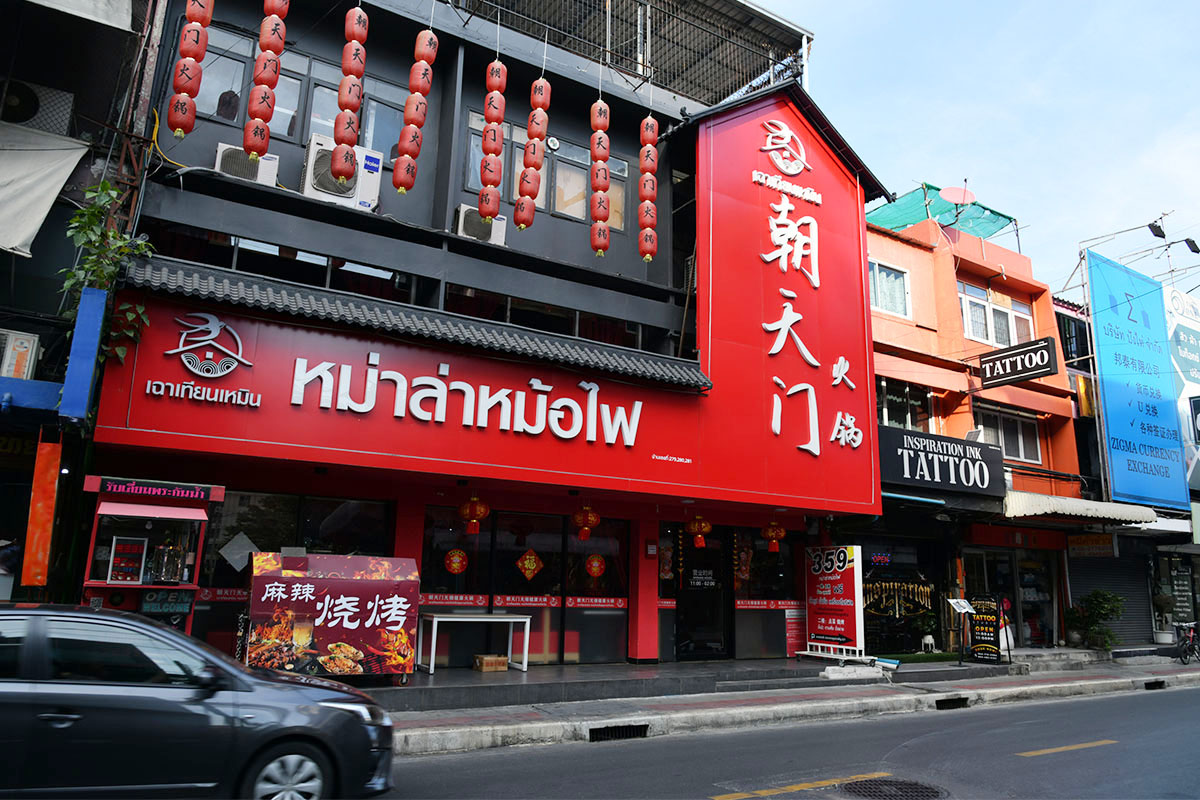
The Chao Tian Men Hot Pot Restaurant used to be in Huay Kwang, but is now closed. (Khaosod Photo, Somjit Jaichuen)
Before the Covid-19 pandemic began, Chinese expats arrived in the neighborhood en masse. They started operating a range of hospitality businesses and opened shops, stores and Mala hotpot restaurants, causing Pracharat Bamphen Road to be dubbed “Bangkok’s new Chinatown”.
The Pracharat Bamphen area drew the attention of Chinese tourists and local visitors who enjoy shopping and the nightlife, especially eating hot pot-style dishes. Due to its popularity and rapid growth, many suspected that businesses in the area are linked to Chinese ‘gray businesses’ in Thailand.
In late 2023, the Huai Khwang district authorities launched a campaign on Pracharat Bumphen Road to inspect and strictly enforce regulations on Chinese-funded businesses in the district in a bid to curb the so-called ‘gray businesses’ with a focus on restaurants.
The move came after complaints were lodged about Thai citizens acting as nominees for foreign businesses and illegal operations in the area.
Mr. Praphruk said the authorities who carried out the inspections asked owners of Chinese restaurants for their business registration document to see whether they have breached the Foreign Business Act. They were also asked whether the food they were selling to consumers had been inspected and certified by Thailand’s Food and Drug Administration.
Matichon Photo
The investigation found many owners operating restaurants in Thailand without a permit. Officials ordered them to register their businesses with authorities.
However, some restaurants opted to shut their doors instead of following the rules, Mr. Praphruk noted.
To open a restaurant, he explained that owners must adhere to specific regulations including proper installation and maintenance of a grease trap and a fire escape. Some owners refused to invest in these installations to improve operations and be in accordance with the law, saying they rented the building space to open the restaurant. It was also noted that Thailand’s economy which was significantly impacted by the Covid-19 pandemic, has yet to fully recovered and it’s unlikely that the restaurant industry will return to its pre-pandemic level any time soon.
Yet others said the layout and design of some buildings are not suitable for a restaurant. Many owners said the registration is complicated process.
“When business was thriving, new Chinese restaurants mushroomed, with no permit. Authorities ordered them to obey the law but some restaurants failed to make the required improvements,” Mr. Praphruk said
About 30% of restaurants funded by the Chinese shut
According to him, about 10 out of 40 restaurants (about 30%) in the area have been closed, mostly Mala hotpot and Shabushi restaurants.
A restaurant occupies about 1-2 units of a building and requires an investment of about 2-3 million baht. Many of them are owned by Chinese national and others are funded by Chinese investors. Some have Thai citizens acting as nominees for Chinese-owned restaurants.
Mr. Praphruk said authorities gave the owners a 15-day grace period to register their businesses. When they failed to do so, they were given another 15 day to comply. When they were found to have flouted the rules, the authorities ordered them to shut their restaurants.
If owners violate authorities’ orders, they will be liable for a fine of up to 20,000-50,000 baht per day, he noted.
Some Chinese owners whose restaurants were shut due to illegal operations asked their compatriots to operate other businesses. The buildings that cannot be re-designed are permanently closed, he added.
Chinese restaurant owners have asked Thai business partners to act as nominees or hired an interpreter to help them in applying for a permit to open a restaurant, due to the communication barrier, Mr. Praphruk said.
Matichon Photo
Truly subdued and silent
Both sides of Pracharat Bamphen Road have been in a sober mood since the Chinese-owned restaurants shut following the crackdown, he noted.
“Business is crashing. Foreign tourists and local people used to flock to visit to the Ganesh shrine at the corner of the Huai Khwang intersection. They crossed the road to the neighborhood and stopped at restaurants to enjoy foods and drinks. These days, the area is nearly empty. Chinese tourists are turning to other places,” he said.
Chinese tourists are returning, Mr. Praphruk noted, but not to Bangkok. They go to Phuket, Samui Island, Pattaya and Koh Lan instead. Bangkok has become a stopover for Chinese tourists, not a final destination as it was in the past.
“The road is eerily quiet after 8-9pm. It was busy and dynamic until midnight,” he said.
He estimated that Chinese restaurants on Pracharat Bamphen Road generated a combined monthly revenue of up to 40 million baht, helping boost the local economy. Today, the revenue is reduced by more than half or just 15 million baht.
Mr. Praphruk noted that the closures of Chinese restaurants, which typically draw thousands of foreign tourists and local people who come to dine and shop has dealt a severe blow to the local economy.
“It’s really subdued neighborhood. Businesses are not doing well although better than during Covid-19,” he said.
Mr. Prapruk said local residents are concerned that the arrival of Chinese in the Huai Khwang District caused inconvenience even though it helped stimulate economy. The majority of local residents said they have not benefitted from businesses in the area. Many said Chinese living in there are annoying.
Sometimes, they park their cars, obstructing roads, traffic and pedestrians. They create noisy quarrels. There are also noise issues during night hours as the area is surrounded by restaurants, clubs and cocktail bars, making it a place for partying and nightlife.
The restaurant closures have helped improve the environment, making it more livable and peaceful so the locals are able to enjoy peace of mind, he noted.
“The road has been quiet for a while. The usually bustling Chinese New Year festival was sober this year as the celebration was halted due to the inspections.” he said.
The District Office usually organizes a special event to celebrate the lunar New Year. The event, which features food and drink stalls, is mainly attended by Chinese who take part in the event to meet their fellows and buy products from Chinese shops and stores.
Matichon Photo
Thanapon Rittayamai, a resident of the downtown area who has seen the Huai Khwang district in its best and worst times, concurs with Mr. Praphruk’s remarks on the business situations and Chinese behaviors. He has been living there for more than five decades and owns, Sri Charoen, a drug store and a mom-and-pop store in the neighborhood.
He noted Pracharat Bamphen Road is quieter since Chinese restaurants were shuttered. Customers behaviors has changed too.
“Fewer customers come by to buy products from our shop. The evenings have become quiet. The area was packed with tourists and visitors. It was still busy at midnight,” he said.
He noted that cost of renting a building in the neighborhood is relatively high. The monthly rental rate for a unit of the building close to the road is about 30,000-50,000 baht and was higher than 50,000 baht pre-Covid.
“Many Chinese came to our shop asking if there was anywhere to rent. They showed us their money, asked to rent a space and have a lease drawn up,” Mr. Thanapon said.
He added local vendors including him had wondered why many Chinese restaurants were able to keep going with only a few customers, while many owners of restaurants and shops were struggling with the high cost of raw materials due to inflation and higher labour costs.
The Thai entrepreneur said he doesn’t see a direct positive impact of the arrival of Chinese in the area. But it can have many negative consequences when Chinese living in the area don’t obey the rules.
“Most Chinese tourists traveling to the neighborhood look for or buy products from stores and shops that are operated or funded by Chinese expats. If they cannot find a product they are looking for, they come to our stores,” he said adding that parking problems as well as traffic and noise issues would be reduced if the Chinese cared more about Thai rules.
He noted that the number of consumers had gradually dropped when the country was hit by the Covid-19 pandemic and had significantly declined since the beginning of the year.
“Vendors and entrepreneurs are already suffering. The ongoing inflation is rubbing salt in our wounds,” he said.
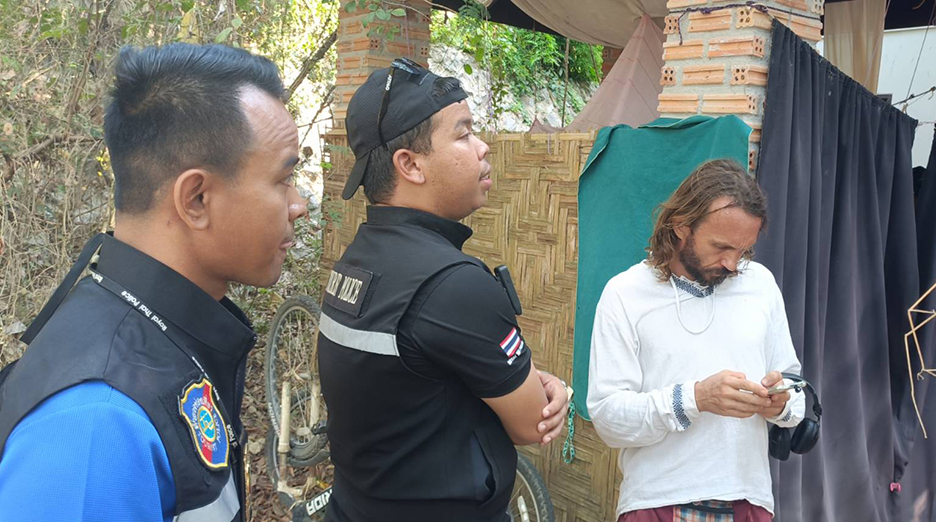
A police officer inspects the Tantra Movement in Koh Phangan District, Surat Thani Province.
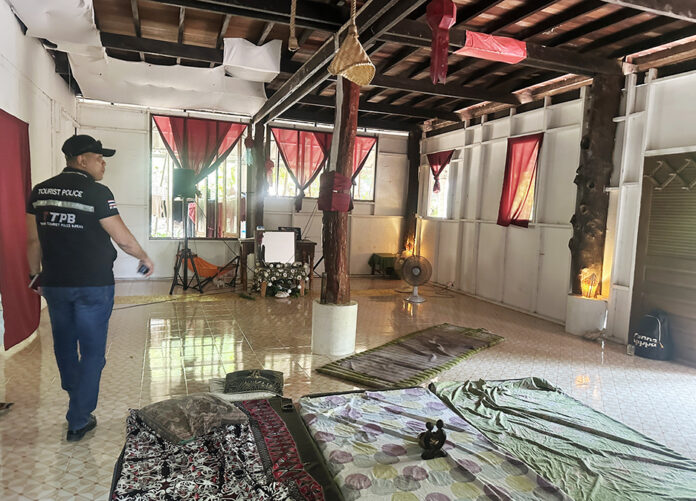
KOH PHANGAN – Tourist police on Koh Phangan arrested Michal Grygoruk, 46, a Polish sex yoga guru with 18.1 million subscribers on his YouTube channel, on Saturday for working without a permit. He admits that after the raid at a hut on the island, he has no work permit.
On March 24, officials disclosed that they had filed charges against Michal for being an foreigner working without a work permit and that he had been detained and turned over to investigators. They also asked the Immigration Bureau to consider revoking his visa as the next step.
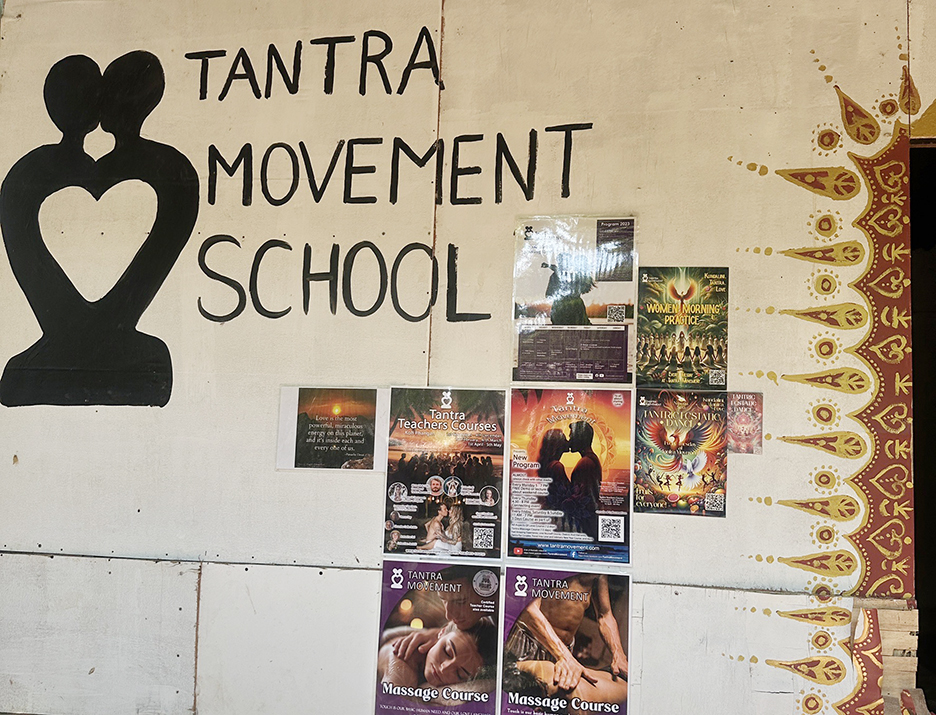
Michal Grygoruk, 46, who has 18.1 million subscribers on his YouTube channel, was arrested by tourist police on Koh Pha Ngan on March 23, 2024.The advertising for the Tantra Movement course is published on social media.
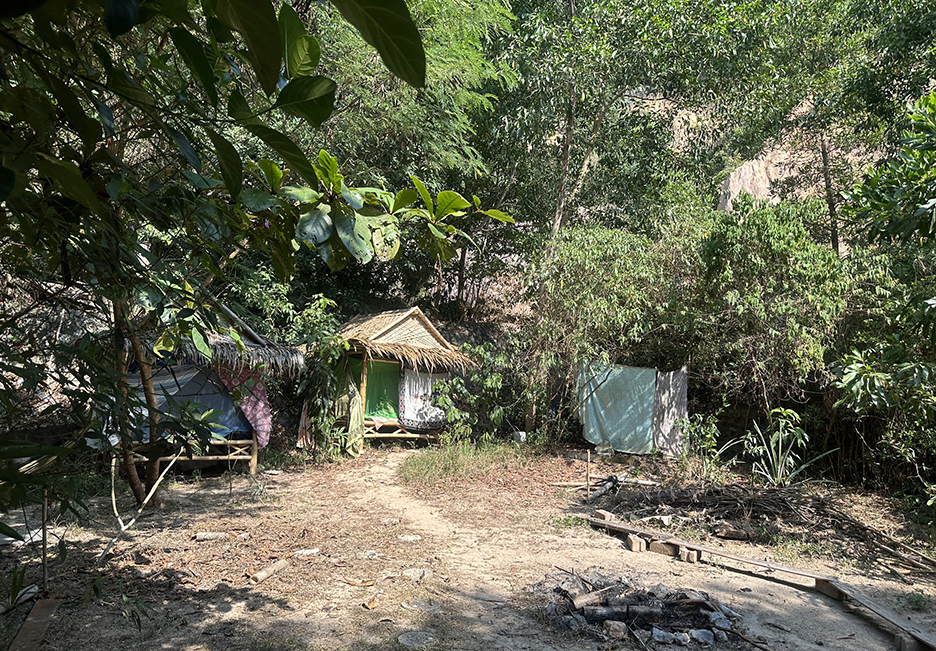
The inquiry started when the Koh Phangan Tourist Police received a complaint on social media at Tantra Movement School in Koh Phangan District in Surat Thani Province, alleging that the foreigner teaching yoga was at risk of sexual misconduct.
So they collaborated with the Surat Thani Provincial Police Investigation Division and the Surat Thani Province Immigration Police to check this spot on March 23. During the operation, authorities discovered and apprehended a few foreigners who attempted to flee. Each of them was a new consumer.
Police raided a hut where the Polish man opened business on Koh Phangan.
Later, Michal appears to identify himself as the owner of the business and to explain that he opened it as a yoga academy. He charged foreign clients between $400 and 600 US dollars, depending on the length of the Tantra Movement sessions they chose. For example: Early Bird Individual: $400 USD for three days; Early Bird Couple: 550 USD for three days, standard fee. Individual prices are 450 USD for three days, while standard costs for couples are 600 USD for three days, and so on.
After the customer has paid for the above-mentioned course, he will email the Tantra Movement coordinates to the client, who will schedule the yoga class on the specified day and time.
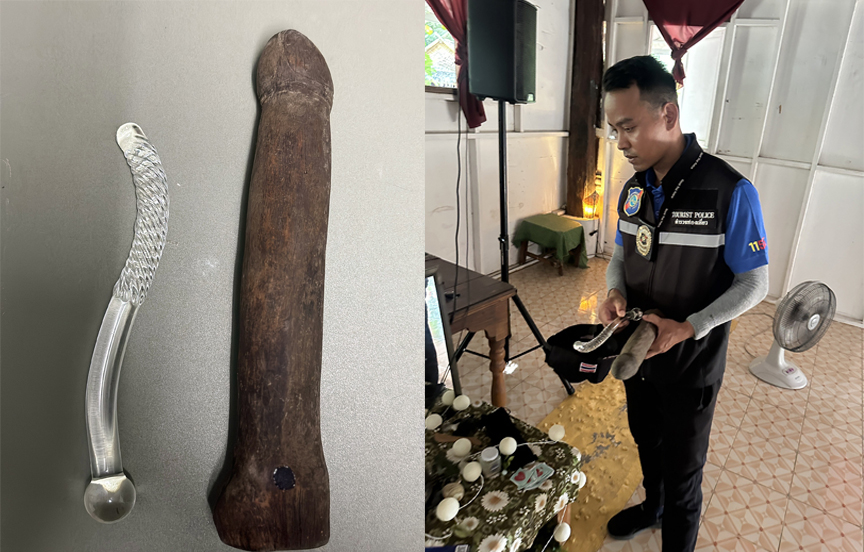
Police later arrived to investigate the yoga teaching area. They found two penis-like devices that the yoga kuru claimed to use for yoga class. The officials then took them as evidence for prosecution.
The sex guru claimed that two penis-like devices, which police found, were used in each yoga class.

































 Upon arrival at Suvarnabhumi Airport, the suspect exhibited suspicious behavior and was subsequently subjected to a thorough check. Sixty-nine cocaine lumps with a total weight of 1,390 grams and a value of 4,170,000 baht were found in his body. The arresting officers documented the seizure and handed the suspect over to Suvarnabhumi Airport Police Station for further prosecution.