

































32.3 C
Bangkok
Monday, June 8, 2026
Home Blog Page 1555

Crazy Rich Bangkokians: Viral Instagram @BougieBangkokGirl Gets Political

Image: BougieBangkokGirl / Instagram

Some of you have bkk | ldn as your Instagram bio – and it shows. One Instagram account poking fun at that dek inter life through embarrassingly accurate memes has gained more than 11,000 followers in less than four months.

Most of @BougieBangkokGirl’s followers come from millennial Thai social circles of international students (dek inter or เด็กอินเตอร์) and the overseas-educated (nak rean nok or นักเรียนนอก).

@BougieBangkokGirl – or Bougie – agreed to be interviewed anonymously via email about the Instagram account’s underlying goal to politically awaken a notoriously apolitical demographic.

Bougie Bangkokians

Bougie, and the account’s followers, “grew up with financial security, private-school educations, expectations to go abroad for college, and some sort of exposure to Western media.” In her own words, Bougie’s memes aim to show an “oversimplified and generalized lifestyle of the Bangkok upper-middle class. It is a personification and caricature of the homogenous lives we live.”

The account’s memes are uniquely relatable to this demographic. There’s memes about being stuck in traffic in your family’s Alphard with your driver while navigating between Siam Paragon and EmQuartier. Then there’s memes about family – like your auntie’s connections helping to secure a summer internship. And of course, there’s memes that poke fun at the assumption that this group is largely ignorant about Thai politics.
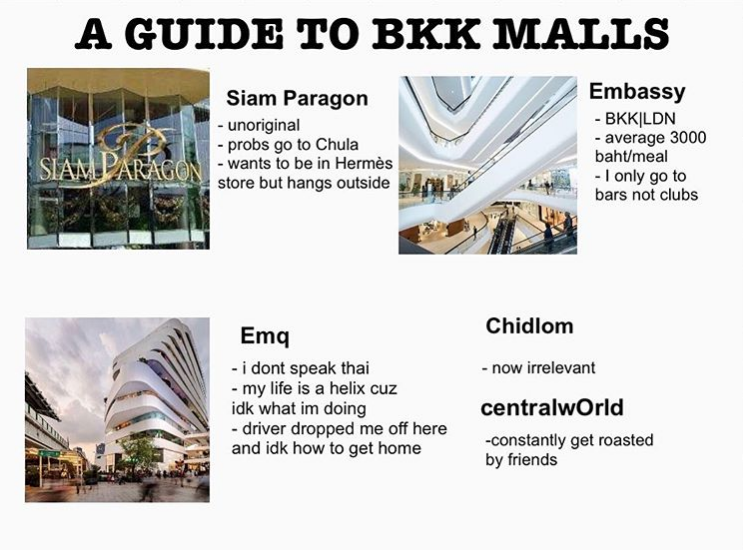
Bougie's guide to Bangkok malls. Image: BougieBangkokGirl / Instagram
Bougie’s guide to Bangkok malls. Image: BougieBangkokGirl / Instagram

But within this demographic of upper-middle class, foreign-educated millenials are more nuanced shades of Thainess.

In April 2015, Thongchai Winichakul, professor of Southeast Asian history at the University of Wisconsin-Madison, outlined a typography of “Westernized Thais” on a scale of farangness/Thainess during a keynote lecture at the Australian National University.

Some youth, despite having studied abroad, only socialized with Thais so in Thongchai’s words, “never left home while abroad.” Others become “more farang than farang,” uprooting themselves from Thai culture and completely assimilating into their new home. In the middle are those whose “Thai reads like English” but who champion local Thai wisdom, as well as the vice versa – those whose English may read like Thai, but who champion foreign wisdom.

Blissfully, Politically Ignorant

After the March 24 election, Bougie departed from memes mocking Bangkok’s upscale clubbing scene and turned to political memes oriented towards a demographic with a reputation for being politically uninterested or oblivious to Thai politics. 
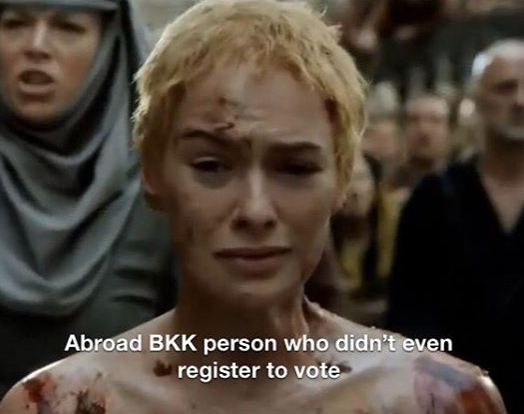
Shame! Shame! Shame! Image: BougieBangkokGirl / Instagram

“Growing up in the midst of polarization, Thai politics wasn’t exactly ‘dinner table conversation’ for the Bangkok bougies or anybody else in our generation. Most of our families try their best to steer politics away from our personal lives, telling us myths about politicians and discouraging any obvious interest in the field,” Bougie said. “Possibly a parent’s worst nightmare is to have her kid study political science with a dream to be involved in politics. Why choose a career that would threaten the family name?”

Being apolitical is a safe bet for the clan name, especially since the previous generation was “witnesses of political violence and the fight for ‘democracy’ over the years”. Not only that, disinterest is practical – as one Bird Box meme says, rich Bangkokians with influential families can “weather the political storm so they can afford to be apolitical.” 

“The bougies of Bangkok are not remotely affected by the political cycles in Thailand. Despite dropping agriculture prices or higher urban living costs, we are able to maintain the same level of wealth and lifestyle,” Bougie explained. “Our economic, and thus political, influence has kept us immune from the reality that haunts many out there.”
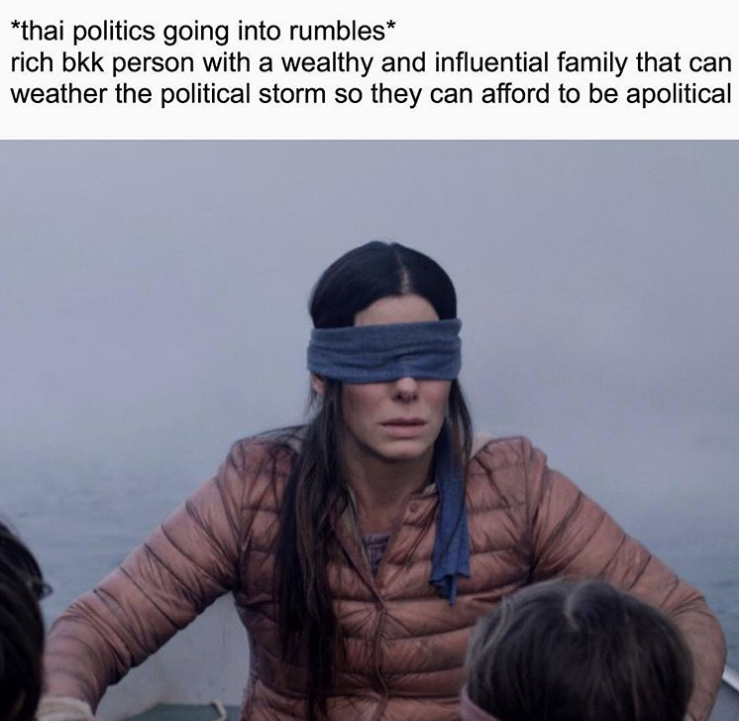
Weather that storm, girl. Image: BougieBangkokGirl / Instagram

Paradoxically, this demographic – with wealth, clout, and foreign education – has in its hands the power to push for political change in Thai society, even if it has shown little interest in doing so. Bangkok bougies and their families may have participated in the People’s Democratic Reform Committee protests of 2013 to 2014 that preempted the most recent coup, before in 2019 claiming to be sick of Uncle Tuu and screenshotting Future Forward Party social media posts for group chats.

One of Bougie’s memes roasts overseas Thai citizens who couldn’t bother to go vote with the Cersei walk of shame meme. Another post explains electoral regulations that gave pro-junta Phalang Pracharath an unfair edge through a meme of Will Smith and his wife on the red carpet.

Perhaps most ticklish is a Tinder “screenshot” that shows a match between the liberal-presenting Future Forward Party and “my college campus’ liberal social justice values that make me feel like part of the new educated elite.”

It's a Match! Image: BougieBangkokGirl / Instagram
It’s a Match! Image: BougieBangkokGirl / Instagram

All of this is not to say that bougie Bangkokians are entirely apolitical – but it’s US and world politics that captures their interest, due to easy access to global news, education oriented around understanding Western politics, and higher levels of English than Thai. Plus, it’s less tense to discuss Brexit at the dinner table.

“Without the same taboo that is put on Thai politics, we feel more at ease engaging with Western politics and forming our own opinions,” Bougie said. “For example, we are quite comfortable discussing the problems of white feminism or Bernie’s welfare state, but not as comfortable discussing violence against women in Thailand or the public health system.”
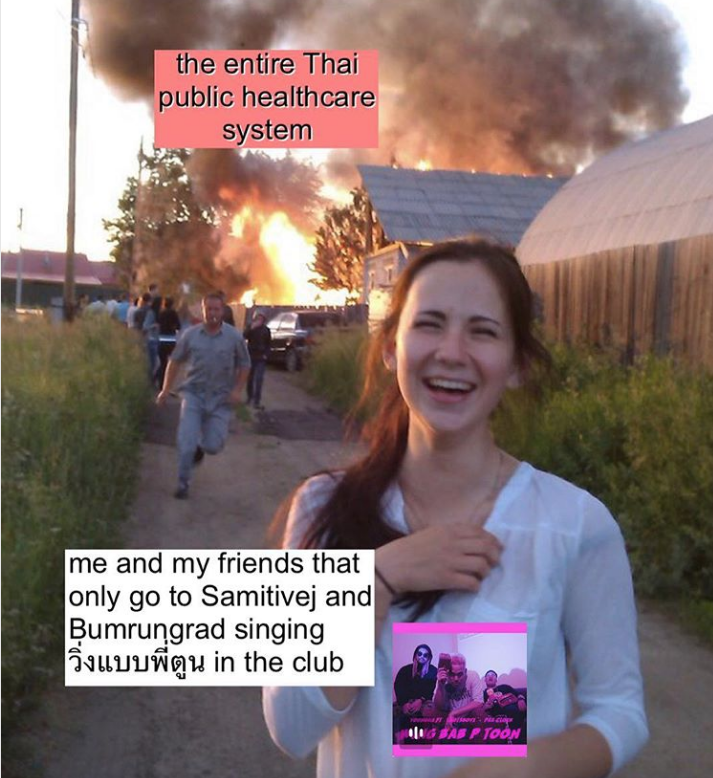
The privilege of going to Samitivej and Bumrungrad Hospitals, while others have to line up at overcrowded public hospitals. Image: BougieBangkokGirl / Instagram

Relate Yark Wa Gae

For Thai-educated Thais and foreigners, relating to Bangkok bougies may be difficult. It’s one of the unique conundrums facing the demographic: being part of multiple cultures gains one additional perspectives, but also makes it difficult to assimilate completely with either world.

Mixing with Thai-educated Thais may be a challenge due to the separation of social circles where there are small overlaps at best, Bougie says. Different schools, friendship groups and senses of humor can cause the groups to have “distorted views” of each other.

Thai-educated Thais may imagine dek inter through tropes such as the possession of scant street smarts and knowledge about Thailand and customs, and Tinglish typing skills that are sometimes the butt of jokes. Some are also munsai (a term denoting jealousy and annoyance) at the more expensive foreign education enjoyed by dek inter.

“Yet funnily enough, their lifestyles are not that different,” Bougie said. “I hope the relationship gets better and it does not become another manifestation of the class line in our society. The narrative of “the other” (Bangkok vs. Other, Elite vs. Other, etc.) has long haunted our parents’ generation, and I hope it does not continue.”
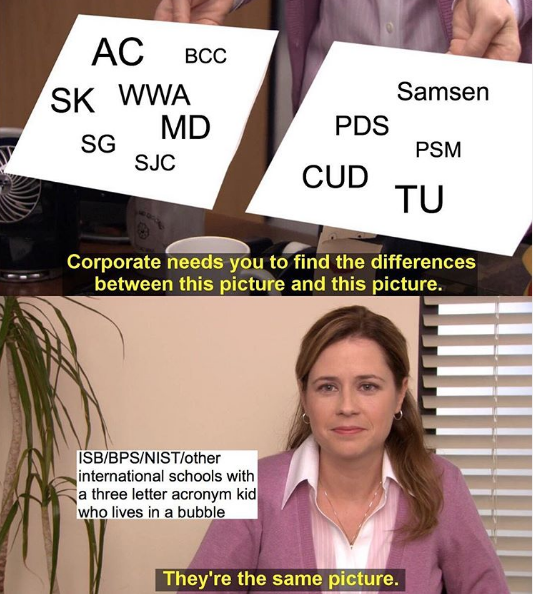
Hint: It's something about private and public schools. Image: BougieBangkokGirl / Instagram
Hint: It’s something about private and public schools. Image: BougieBangkokGirl / Instagram

Bangkok bougies may occupy a similarly liminal status among expats. Some expats may welcome them as Thai friends who refreshingly understand American sitcom humor, while others with self-loathing for Western culture may eschew bougies who aren’t “authentically” Thai – after all, the image of a millenial with a Macbook in a cafe shatters the orientalist illusion of a kind roadside auntie who gives out free som tam.

But despite the contradictions presented by dek inter, Thongchai has pointed out that Westernized Thais are not a modern invention.

“Since the mid-19th century, all notable and influential intellectuals in Siam, in one way or another, had to deal with the west,” the professor said. “For the past 150 years, they made dialogue between the Thai and the West.”

King Rama VI was an expert in Shakespearean English who translated plays into Thai, while King Rama VII’s lingua franca was English. “He was more comfortable with English than Thai. His writing was always in English,” Thongchai said. The minds behind the 1932 Siamese Revolution that ended absolute monarchy were also nak rian nok.
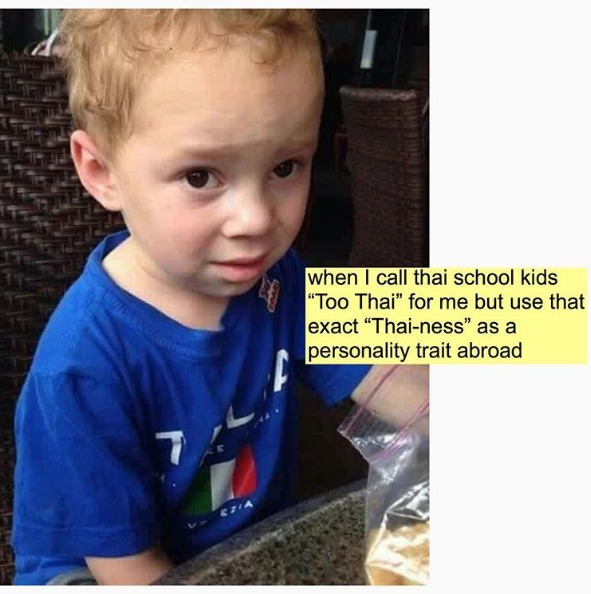
Don't we all? Image: BougieBangkokGirl / Instagram
Don’t we all? Image: BougieBangkokGirl / Instagram

The financial future of Bangkok bougies are secure, but Bougie hopes that more sympathy will come their way too. She also hopes the demographic will use their silver spoons to feed others.

“Speaking generally, I want our generation to take the effort to understand the problems hiding behind the glossy covers of this city and country. To be conscious of the things we do and what we say. To be kinder to the people around us. I think that’s really all one could ask of another being,” she said.

Thongchai ended his speech with a similar sentiment: “What type of nak rian nok do you want to be? Make sure you’re aware of who you are.”

Related stories:

Worlds Collide When Intl School Students Hazed at Thai Unis

Pim Thai Mai Dai Could Be the Most Relevant Thing Online Right Now

Advertisement

Watch the Best of German Flicks at German Film Week

A still from “The Young Karl Marx.” Image: Neue Visionen Filmverleih

BANGKOK — This year’s German Film Week will feature 11 films from Germany and guest countries, spanning love triangles to proletariat revolution.

Starting on Monday, the Goethe-Institut Thailand and various partners around Bangkok will host daily screenings of award-winning, predominantly German-language films from Germany, Austria, France, Israel, and Switzerland. 

This year’s headline film is “All About Me,” which revisits the life of German comedian Hape Kerkeling. Behind his smile lies a dark shadow that loomed over his youth, when he had to utilize his talents to energize his depressed mother.

Meanwhile “Gundermann” explores the contradicting facets of an East German miner, who is both a musician and an agent of the East German intelligence service, Stasi, on the side. The biopic, which won in the German Film Awards (Deutscher Filmpreis), examines how Gerhard Gundermann dealt with his past and influenced the former socialist republic through his music.

Shout “workers of the world, unite!” with “The Young Karl Marx.” The historical drama follows Karl Marx during his 20s when he meets Friedrich Engels, a son of a wealthy factory owner. Engels helps Marx actualize his vision of igniting a new political movement and setting another course for history.

Meet the guardians of fake news in “The Cleaners.” The documentary follows a group of content moderators whose task is to monitor and filter social media sites. In doing so, they are constantly bombarded with the worst the internet has to offer.

In “Egon Schiele: Death and the Maiden,” an Austrian erotic painter falls in love with one of his models. Meanwhile in “The Cakemaker,” an Israeli businessman begins an affair with a Berliner baker, who later uncovers the deception behind the affection. 

The details of other films and the festival schedule can be found online or at participating cinemas: the Goethe-Institut, Doc Club Theater, Cinema Oasis, Bangkok Screening Room, ChangChui, the Foreign Correspondents’ Club of Thailand, and the Film Archive.

“German Film Week 2019” will run from 8-14 July at various locations around Bangkok. Every screening will include Thai and English subtitles. Tickets can be obtained online or at the box office for 100 baht each, except screenings at the Goethe-Institut and ChangChui which will be free.

Advertisement

National Park Where Activist Disappeared Left Off UNESCO List

Porlajee “Billy” Rakchongcharoen poses with his wife and child. Photo: Courtesy of his family

BANGKOK — Unresolved questions about rights violations and border demarcation prevented the United Nations from recognizing a national park as a world heritage site, government officials said Sunday.

The bid to give Kaeng Krachan National Park UNESCO world heritage status failed because legal measures to protect ethnic communities living in the forest came into effect after a deadline mandated by the organization, the Thai delegates said.

“All information had to be submitted to the assembly by Feb. 1, 2019,” delegate chief Sihasak Phuangketkeow said. “But our solutions, including legal amendments to allow people to live side by side with the forest, were enacted in March.”

Read: 200,000 Baht Bounty for Disappeared Karen Activist

Sihasak said the Thai government will submit the proposal again when applications open next year.

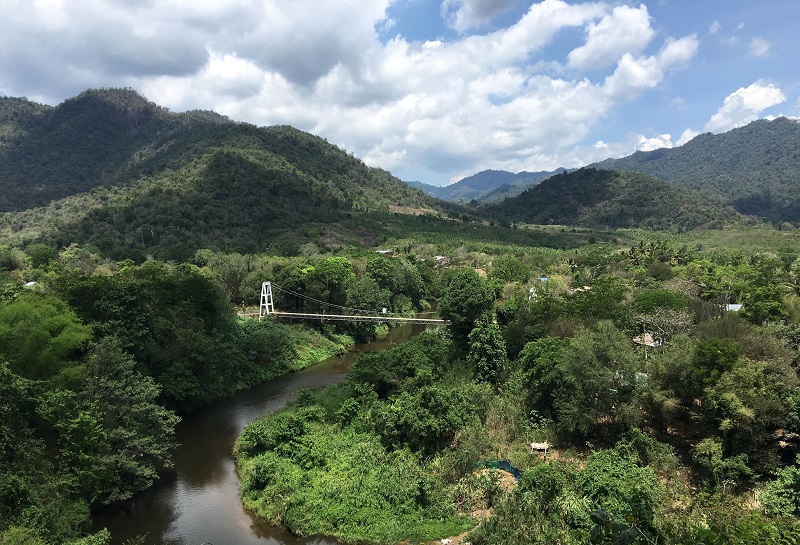
Some civic groups had criticized the push to give the 2,915 square km national park in Phetchaburi province UNESCO status due to the history of human rights violations in the area.

The forest is home to Karen communities who settled on the land before national park laws were enacted, though that did not stop Thai authorities from declaring their abodes illegal and launching several efforts to evict them.

38698751 217120725624650 6291409829101568 n
A file photo of Kaeng Krachan National Park

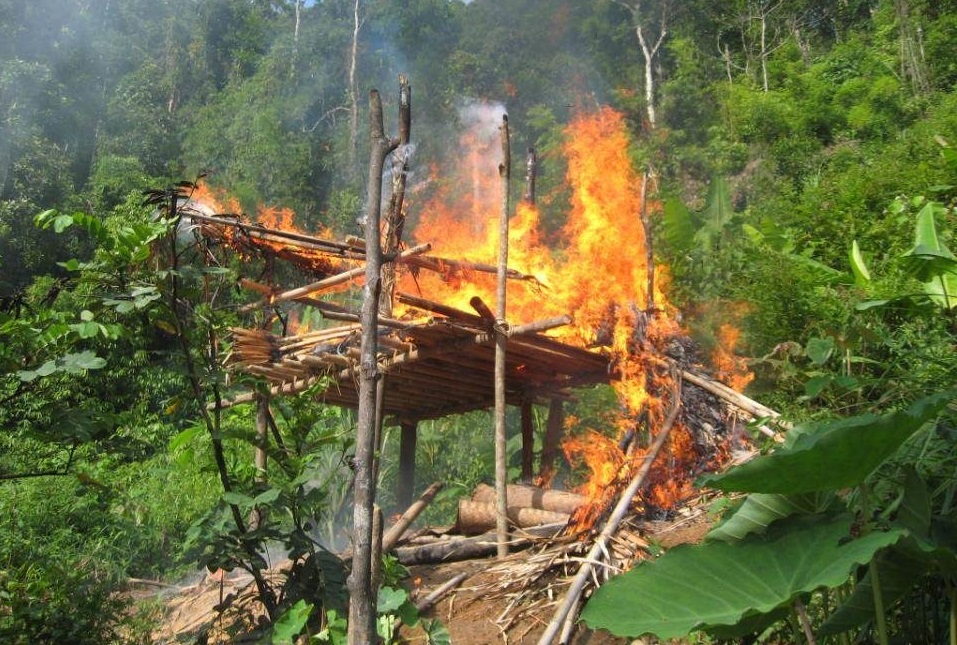
In 2012, wildlife officials torched over 90 homes of Karen villagers in Kaeng Krachan to drive them from the forest. The evicted residents won compensation six years later after judges ruled the operation was a serious violation of their constitutional rights.

Porlajee “Billy” Rakchongcharoen, a campaigner for community rights, also disappeared in the national park in 2014 and has not been seen since. His friends and family fear the 30-year-old activist was abducted and murdered for his opposition to the government’s eviction efforts.

Sihasak said representatives from six countries chaired a UNESCO committee that deliberated on Kaeng Krachan’s status: Australia, Norway, Indonesia, Cuba, Tunisia and Kuwait.

A former ambassador to France advised the committee raised three concerns over the application. They were a border demarcation dispute between Thailand and Myanmar, the shrinking size of the forest in the national park, and the civil rights of communities that settled in Kaeng Krachan.

Picture2
Wildlife officials burn homes of Karen residents in Kaeng Krachan National Park.

According to Sihasak, both the Thai and Myanmar governments have already agreed on the border, while the two other points will be clarified in next year’s bid.

“Thailand still has a good chance of proposing Kaeng Krachan forest as a world heritage site in next year’s bid,” Sihasak said.

UNESCO is currently in session in Azerbaijan to select candidates for world heritage status. Sites recognized by the agency last week include India’s Jaipur, Myanmar’s Bagan landscape, China’s archaeological ruins of Liangzhu City, and the Plain of Jars located in Laos.

There was brief confusion over Kaeng Krachan’s fate when a Facebook page operated by the ruling junta erroneously reported on Saturday that UNESCO had recognized the national park. The Facebook page later amended the text to say there was no such decision.

The UNESCO session runs through Wednesday.

Advertisement

High Schooler Kicked Into Coma During SOTUS Hazing, Family Says

Left: Pisit Kumniw in a coma. Photo: Panuwat Songsawatchai / Facebook. Right: Phra Pathom Witthayalai School. Photo: Google

NAKHON PATHOM — A 15-year-old is on life support Monday after upperclassmen kicked him into a coma during a SOTUS hazing ritual to receive a class bracelet.

Pisit Kumniw, a Matthayom 3 student at Phra Pathom Wittayalai School, was beaten into a coma by three Matthayom 6 upperclassmen on June 28 in an incident that has left him in a hospital’s ICU ward.  

On June 28, Pisit went to his upperclassmen’s dorms to take part in a “rub nong” practice, where junior students receive a bracelet with the school’s insignia and class number from senior students – in exchange for getting kicked three times. 

Read: Meet the Unlikely Band Taking on University Tradition

Obviously, Pisit endured more than three kicks. Doctors found wounds all over his body, as well as brain swelling and bruised lungs. During his hospital stay, Pisit went into cardiac arrest three times.

“I’ve visited many hazed students before, even the kid whose arm got ripped off at Maejo University. In previous cases, the kids could still talk or had a hope of waking up. But seeing this case is so painful. We can only wait and hope for a miracle,” Panuwat Songsawatchai, a member of anti-hazing activist group Anti Sotus and a Future Forward Party member, said by phone Monday. 

The three upperclassmen, all of them believed to be minors, have yet to turn themselves into the police. 

Sirisak eventually gave the class bracelet to a friend to pass on to Pisit in hospital. But Pisit’s family says Pisit will never get to wear it.

“His dad can’t go into the ICU room because he can’t bear it … Please stop these traditions. Respect everyone’s dignity,” Panuwat wrote on his Facebook page Sunday.

Pisit’s sister told the media no one has yet stepped forward to take responsibility for the injuries. She also called upon all other schools with similar hazing tradition to stop the practice immediately.

So far, Phra Pathom Wittayalai School has denied responsibility for Pisit’s state, saying the hazing did not happen on school grounds – an excuse dismissed by Panuwat and Anti Sotus. 

“Even if the school says that it’s not involved, it still needs to have measures to prevent [hazing],” Panuwat said.

Hazing according to the creed of SOTUS – Seniority, Order, Tradition, Unity, and Spirit – often involves mentally and physically abusive practices which are now spreading to high schools

In July 2018, three upperclassmen were charged with grievous bodily harm for kicking a university freshman until his spleen burst. In 2014, Pokai Saengrojrat, a 16-year-old student, died from hazing activities that involved him getting kicked at the beach.

In 2008, a student at Uthenthawai University died after he was reportedly beaten by a group of senior students during a rub nong ritual.

Panuwat’s party, Future Forward, has compared SOTUS to a “Nazi, authoritarian system.”

Related stories:

Naresuan Seniors, Alumni Defend Muddy Hazing

Students to Be Prosecuted for Bursting Spleen of Underclassman

Abusive ‘Buddhist Camp’ One of Top 10 Worst SOTUS Incidents of 2018

‘Past the Point of Saying Sorry,’ Says Family of Spleen-Ruptured Student

Uni Student Beaten Until Spleen Bursts in Hazing Ritual

Advertisement

Remixing Molam for a New Generation of Listeners

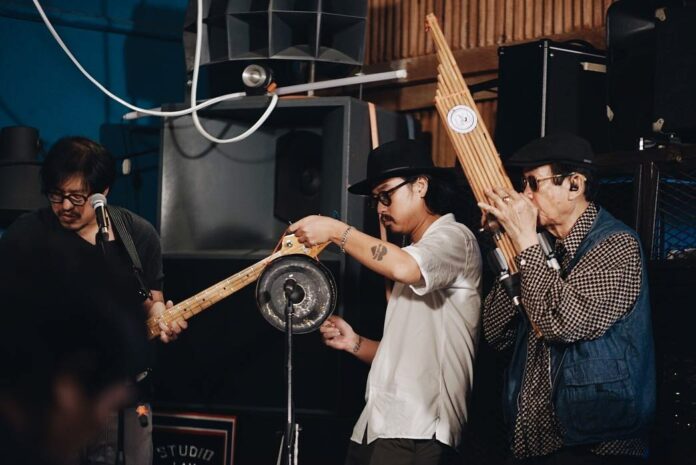
A modern take on molam music at Studio Lam bar in Bangkok's Thor Lo district. Image: Studio Lam / Facebook

BANGKOK — The explosion of tracks that fuse molam with other genres such as hip-hop and pop are exposing Bangkokian ears to the traditional folk music of Thailand’s Northeast. But are the historical and cultural underpinnings of molam being lost?

Major Bangkok-based music producers are increasingly fusing molam elements with mainstream genres to make the former palatable to younger audiences, observed Viraya Sawangchot, a music specialist and panelist at a Wednesday panel at the Foreign Correspondents’ Club of Thailand (FCCT).

The folk genre has been gaining popularity in Bangkok ever since a blossoming of interest in Molam in the West, further explained Arthit Mulsarn, the curator of the Jim Thompson Mobile Molam Bus Project, a touring, musical exhibition.

“Those [Bangkokians] in Thonglor learned about molam from farangs,” said Arthit, referring to the upscale area of Bangkok, where some clubs now play hybrid molam music as partygoers sip pricey drinks.

The “trending” popularity of molam marks a shift from a tendency among Bangkokians to look down on the predominantly ethnic-Lao Isaan region, said Arthit.

But the curator observes that Bangkokians largely savor molam as a “hip” musical genre detached from its historical, cultural and political significance in the Northeast.

“The new trend became how Western beats in the 1960s to 1980s influenced local music, be it molam or luk thung,” Arthit said, who regularly travels to the Northeast to both stage molam music and collect information about the genre in the hopes of one day establishing a molam museum.

Gridthiya Gaweewong, the artistic director at the Jim Thompson Art Center, urged the audience not to forget molam’s historical background, even while accepting that the genre is fluid and ever-changing like all artforms.

Molam is an intangible heritage of the Isaan people, she said, and was even used politically during the Cold War to spread both pro-US and pro-communist propaganda.

Whatever the consequences may be, Arthit doesn’t see the mainstreaming of northeastern folk music in Bangkok abating any time soon, citing the popularity of Isaan food as a mirror cultural phenomenon.

“It will definitely expand. Even [Thai] rappers now adopt molam elements,” said Arthit.

While molam is branching into fusion forms in Bangkok, another panelist noted that there remains a demand for traditional molam among diaspora populations abroad.

Jerenchai Chonpairot, a music specialist at Mahasarakham University’s College of Music in the Northeast, said molam performers are active performing for Thai and Laotian diaspora across Southeast Asia and in the West.

The khaen, a bamboo mouth organ, in particular often brings tears to those living abroad who long to hear its haunting sound, said Jarernchai.

“They miss their homeland… They compare the sound of khaen to that of a bird of paradise,” said Jarernchai, who also demonstrated the instrument to the mostly foreign audience at the FCCT.

Advertisement

Brazilian Bossa Nova Pioneer Joao Gilberto Dies at 88

FILE - In this June 18, 2004 file photo, Brazilian composer Joao Gilberto performs at Carnegie Hall, in New York. The Brazilian singer and composer, who is considered one of the fathers of the Bossa Nova genre, has died. His death was confirmed by his children on Saturday, July 6, 2019. Gilberto was 88 years old. Photo: Mary Altaffer / AP File

RIO DE JANEIRO — Joao Gilberto, a Brazilian singer, guitarist and songwriter considered one of the fathers of the bossa nova genre that gained global popularity in the 1960s and became an iconic sound of the South American nation, died on Saturday, his son said. He was 88.

Joao Marcelo said his father had been battling health issues though no official cause of his death in Rio de Janeiro was given. “His struggle was noble. He tried to maintain his dignity in the light of losing his independence,” Marcelo posted on Facebook.

A fusion of samba and jazz, bossa nova emerged in the late 1950s and gained a worldwide following in the 1960s, pioneered by Gilberto and Antonio Carlos Jobim, who composed the iconic The Girl From Ipanema that was performed by Gilberto and others. His wife Astrud Gilberto made her vocal debut in the song.

Self-taught, Gilberto said he discovered music at age 14 when he held a guitar in his hands for the first time. With his unique playing style and modern jazz influences, he created the beat that defined bossa nova, helping launch the genre with his song “Bim-Bom.”

By 1961, Gilberto had finished the albums that would make bossa nova known around the world: “Chega de Saudade,” ”Love, A Smile and A Flower,” and “Joao Gilberto.” His 1964 album Getz/Gilberto with U.S. saxophonist Stan Getz sold millions of copies.

“It was Joao Gilberto, the greatest genius of Brazilian music, who was the definitive influence on my music,” singer Gal Costa wrote on social media. “He will be missed but his legacy is very important to Brazil and to the world.”

Born in Bahia in northeastern Brazil, Gilberto moved to Rio de Janeiro at a young age. He was influenced by U.S. jazz greats and recorded songs in the United States where he lived for much of the 1960s and 1970.

Over his career he won two Grammy awards and was nominated for six, and the U.S. jazz magazine DownBeat in 2009 named him one of the 75 great guitarists in history and one of the five top jazz singers.

An entire subsequent generation of Brazilian musicians, including Gilberto Gil, Chico Buarque and Caetano Veloso, are considered his disciples.

Journalist and bossa nova expert Ruy Castro called the death of Gilberto a “monumental” loss.

Castro wrote in his book “The Wave that Built in the Sea” that Gilberto loved soccer and was a fan of the Fluminense club, whose games he liked to watch with a guitar in his hands.

“He managed to create a mystique about him abroad, being who he was and not even speaking English,” he told the Globo television station.

The musician had spent his final years wrapped in legal troubles, debts and disputes with his children. His last live performance was in 2008 and he canceled a commemorative show to mark his 80th year because of health problems.

With little interest in giving interviews, he’d become known as the “reclusive genius” in the streets of Leblón, the neighborhood in a southern part of Rio where he lived but was seldom seen.

His funeral is to be held on Monday. He is survived by three children.

Singer Daniela Mercury called Gilberto a “genius who revolutionized popular Brazilian music. He taught us how to sing in the most beautiful way in the world.”

“Go in peace, maestro,” she wrote.

Story: Marcelo Silva de Sousa.

Advertisement

Actor Cameron Boyce Dies at Age 20

Cameron Boyce in
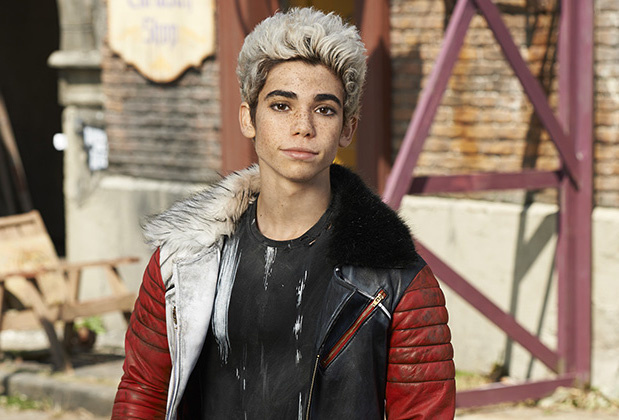
Cameron Boyce in "Descendants." Photo: Disney Channel

Actor Cameron Boyce, best known for his role as the teenage son of Cruella de Vil in the Disney Channel franchise “Descendants,” has died. He was 20 years old.

Boyce, who played Carlos de Vil in the “Descendants” movies, died Saturday at his home in Los Angeles, according to his spokesperson.

An official cause of death has not been announced, but his family released a statement Sunday saying Boyce “passed away in his sleep due to a seizure that was a result of an ongoing medical condition for which he was being treated.

“The world is now undoubtedly without one of its brightest lights, but his spirit will live on through the kindness and compassion of all who knew and loved him. We are utterly heartbroken,” the family statement said.

According to his bio on the Disney Channel, Boyce was born and raised in Los Angeles. He was a dancer who got his acting start in commercials, then television and film. Boyce starred alongside Adam Sandler in “Grown Ups” and “Grown Ups 2,” and other film credits include “Mirrors,” ”Eagle Eye” and the indie feature “Runt.” He also starred in the upcoming HBO series “Mrs. Fletcher.”

“Descendants 3” is scheduled for release in August.

His spokesperson said Sunday that Boyce was also a philanthropist who used his celebrity to advocate for those without a voice, including the homeless. Last year, he was honored for his work with the Thirst Project, bringing awareness to the global water crisis and raising more than $30,000 for the organization to build two wells in Eswatini, formerly known as Swaziland, in efforts to bring clean drinking water to the region.

In 2017, he received a Daytime Emmy Award with Disney XD for his participation in the series “Timeless Heroes_Be Inspired,” in honor of Black History Month. He appeared alongside his grandmother Jo Ann Boyce, one of 12 black teens known as the Clinton 12 who were the first to integrate into public school in Clinton, Tennessee, according to his Disney Channel biography.

A Disney Channel spokesperson released a statement Sunday saying that from a young age, Boyce dreamed of sharing his artistic talents with the world and was fueled by a desire to make a difference in peoples’ lives through his humanitarian work.

“He was an incredibly talented performer, a remarkably caring and thoughtful person and, above all else, he was a loving and dedicated son, brother, grandson and friend,” the statement said. “We offer our deepest condolences to his family, castmates and colleagues and join his many millions of fans in grieving his untimely passing. He will be dearly missed.”

Walt Disney Co. Chairman and Chief Executive Robert Iger tweeted Sunday: “The Walt Disney Company mourns the loss of #CameronBoyce, who was a friend to so many of us, and filled with so much talent, heart and life, and far too young to die. Our prayers go out to his family and his friends.”

Several of Boyce’s co-stars reacted to his death on social media Sunday.

Sandler tweeted : “Loved that kid. Cared so much about his family. Cared so much about the world. Thank you, Cameron, for all you gave to us. So much more was on the way. All our hearts are broken.”

Story: Amy Forliti

Advertisement

Iran Steps Further From Nuke Deal, Adding Pressure on Europe

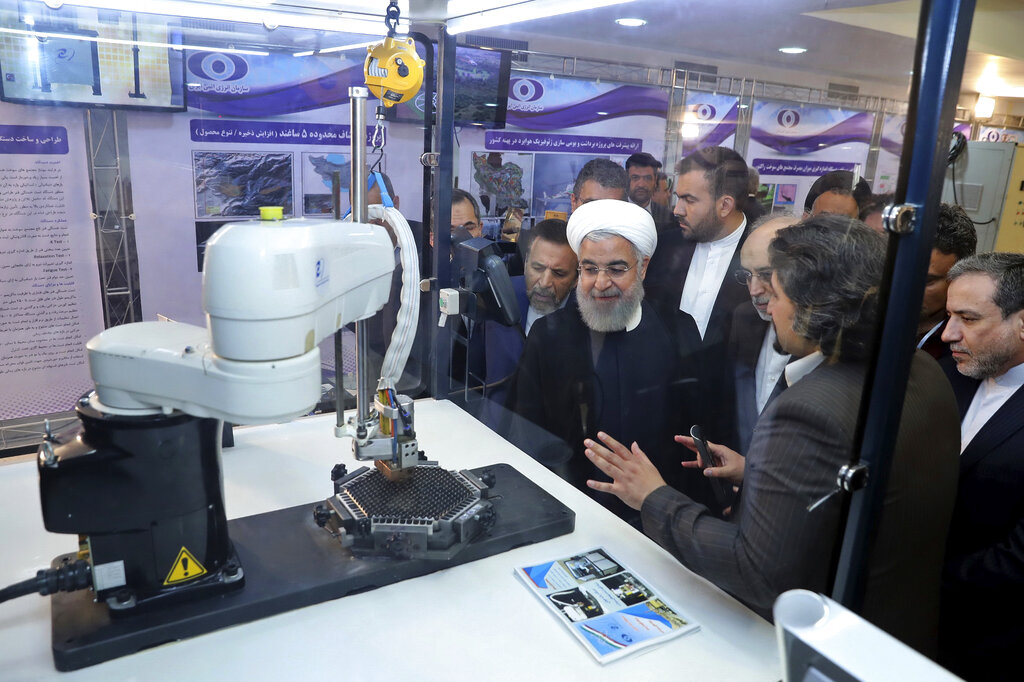
From left to right, spokesman for Iran's atomic agency Behrouz Kamalvandi, Iran's government spokesman Ali Rabiei and Iranian Deputy Foreign Minister Abbas Araghchi, attend a press briefing in Tehran, Iran, Sunday, July 7, 2019. The deputy foreign minister says that his nation considers the 2015 nuclear deal with world powers to be a
From left to right, spokesman for Iran's atomic agency Behrouz Kamalvandi, Iran's government spokesman Ali Rabiei and Iranian Deputy Foreign Minister Abbas Araghchi, attend a press briefing in Tehran, Iran, Sunday, July 7, 2019. The deputy foreign minister says that his nation considers the 2015 nuclear deal with world powers to be a "valid document" and seeks its continuation. Photo: Ebrahim Noroozi / AP

TEHRAN — Iran increased its uranium enrichment Sunday beyond the limit allowed by its 2015 nuclear deal with world powers, inching its program closer toward weapons-grade levels while calling for a diplomatic solution to a crisis heightening tensions with the U.S.

Iran’s move, coupled with earlier abandoning the deal’s limit on its low-enriched uranium stockpile, intensifies pressure on Europe to find any effective way around U.S. sanctions that block Tehran’s oil sales abroad.

But the future of the accord that President Donald Trump unilaterally pulled the U.S. from a year ago remains in question. While Iran’s recent measures could be easily reversed, Europe has struggled to respond, even after getting a 60-day warning that the increase was coming.

Meanwhile, experts fear a miscalculation in the crisis could explode into open conflict, as Trump already has nearly bombed Iran over Tehran shooting down a U.S. military surveillance drone.

Trump warned Tehran on Sunday that “Iran better be careful.” He didn’t elaborate on what actions the U.S. might consider, but Trump told reporters: “Iran’s doing a lot of bad things.”

International reaction to Iran’s decision came swiftly, with Britain warning Iran to “immediately stop and reverse all activities” violating the deal, Germany saying it is “extremely concerned,” and Israeli Prime Minister Benjamin Netanyahu, a longtime critic of the accord, urging world powers to impose so-called “snapback sanctions” on Tehran.

The European Union said parties to the deal are discussing a possible emergency meeting after Iran’s announcement, with EU spokeswoman Maja Kocijancic saying the bloc is “extremely concerned” about the move.

U.S. Secretary of State Mike Pompeo tweeted: “Iran’s latest expansion of its nuclear program will lead to further isolation and sanctions. Nations should restore the longstanding standard of no enrichment for Iran’s nuclear program. Iran’s regime, armed with nuclear weapons, would pose an even greater danger to the world.”

At a news conference, Iranian officials said the new level of uranium enrichment would be reached later in the day, but did not provide the percentage they planned to hit. Under the nuclear deal, the cap for enrichment was set at 3.67%, a percentage closely monitored by inspectors from the International Atomic Energy Agency, the U.N.’s nuclear watchdog.

“Within hours, the technical tasks will be done and enrichment above 3.67% will begin,” Iran nuclear agency spokesman Behrouz Kamalvandi said. “We predict that the IAEA measurements early tomorrow morning will show that we have gone beyond 3.67%.”

The IAEA said it was aware of Iran’s comments and “inspectors in Iran will report to our headquarters as soon as they verify the announced development.”

FILE - In this April 9, 2018, file photo, released by an official website of the office of the Iranian Presidency, President Hassan Rouhani listens to explanations on new nuclear achievements at a ceremony to mark "National Nuclear Day," in Tehran, Iran. Iranian Foreign Minister Mohammad Javad Zarif acknowledged Monday, July 1, 2019, Iran had broken the limit set on its stockpile of low-enriched uranium by the 2015 nuclear deal, marking its first major departure from the unraveling agreement a year after the U.S. unilaterally withdrew from the accord. Photo: Iranian Presidency Office via AP
FILE – In this April 9, 2018, file photo, released by an official website of the office of the Iranian Presidency, President Hassan Rouhani listens to explanations on new nuclear achievements at a ceremony to mark “National Nuclear Day,” in Tehran, Iran. Iranian Foreign Minister Mohammad Javad Zarif acknowledged Monday, July 1, 2019, Iran had broken the limit set on its stockpile of low-enriched uranium by the 2015 nuclear deal, marking its first major departure from the unraveling agreement a year after the U.S. unilaterally withdrew from the accord. Photo: Iranian Presidency Office via AP

Ali Akbar Velayati, an aide to Supreme Leader Ayatollah Ali Khamenei, made remarks in a video Saturday about Iran’s need for 5% enrichment. Bushehr, Iran’s only nuclear power plant, is now running on imported fuel from Russia that’s enriched to around 5%.

Iranian Foreign Minister Mohammad Javad Zarif sent a letter to EU foreign policy chief Federica Mogherini outlining the steps it had taken, said Abbas Araghchi, a deputy foreign minister. Discussions with European powers are continuing and ministerial-level talks are planned later this month, he said.

“We will give another 60-day period, and then we will resume the reduction of our commitments,” Araghchi said, without elaborating.

On Saturday, French President Emmanuel Macron told his Iranian counterpart, Hassan Rouhani, in a phone call that he is trying to find a way by July 15 to resume the dialogue between Iran and Western partners. It wasn’t clear if July 15 carried any importance. The U.S. has called for a special IAEA meeting for Wednesday to discuss Iran.

Kamalvandi stressed that Iran will continue to use only slower, first-generation IR-1 centrifuges to increase enrichment, as well as keep the number of centrifuges in use under the 5,060-limit set by the nuclear deal. Iran has the technical ability to build and operate advanced centrifuges that work faster but is barred from doing so under the deal.

“For the enrichment we are using the same machines with some more pressure and some special technical work,” he said. “So we don’t have an increase in the number of centrifuges for this purpose.”

But Kamalvandi stressed that Iran is able to continue enrichment “at any speed, any amount and any level.”

Enriched uranium at the 3.67% level is enough for peaceful pursuits but is far below weapons-grade levels of 90%.

The decision to ramp up uranium enrichment came less than a week after Iran acknowledged breaking the deal’s 300-kilogram (661-pound) limit on its low-enriched uranium stockpile. Experts warn higher enrichment and a growing stockpile narrow the one-year window Iran would need to have enough material for an atomic bomb, something Iran denies it wants but the deal prevented.

The steps taken so far by Iran show it is more interested in applying political pressure than moving toward a nuclear weapon, said Daryl G. Kimball, the executive director of the Washington-based Arms Control Association. He said Iran would need at least 1,050 kilograms (2,315 pounds) of low-enriched uranium to make the core of a single nuclear bomb, then would have to enrich it to 90%.

“Iran is not racing toward the bomb as some allege but these are calibrated moves,” Kimball told The Associated Press. However, “if Iran and the United States remain on the current course, the agreement is indeed in jeopardy.”

Netanyahu urged the international community to punish Iran for its decision.

“It is a very, very dangerous step,” he said. “I’m asking you, not to provoke but out of joint knowledge of history and what happens when aggressive totalitarian regimes can cross the threshold toward things that are very dangerous to us all. Take the steps that you promised. Enact the sanctions.”

However, Kimball cautioned against that.

“Iran is clearly not going to enter negotiations for a new deal if these sanctions are in place,” he said. “This a self-made, Trump administration crisis because it has been taking drastic measures to dismantle the (deal) without a viable Plan B.”

Story: Jon Gambrell and Nasser Karimi.

Advertisement

Tens of Thousands in Hong Kong Take Message to Mainlanders

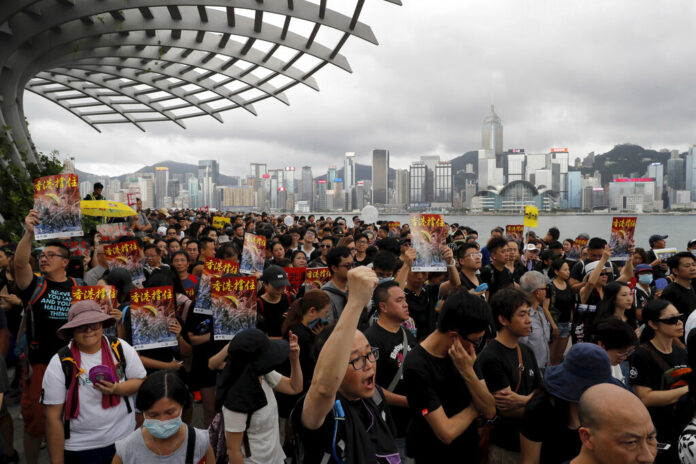
Protesters take part in a march in Hong Kong on Sunday, July 7, 2019. Protesters in Hong Kong are taking their message to visitors from mainland China on Sunday in a march to a high-speed rail station that connects to Guangdong city and other mainland destinations. Photo: Kin Cheung / AP

HONG KONG — Tens of thousands of people, many wearing black shirts and some carrying British colonial-era flags, marched in Hong Kong on Sunday, targeting a mainland Chinese audience as a month-old protest movement showed no signs of abating.

Chanting “Free Hong Kong” and words of encouragement to their fellow citizens, wave after wave of demonstrators streamed by a shopping district popular with mainland visitors on a march to the high-speed railway station that connects the semi-autonomous Chinese territory to Guangdong and other mainland cities.

Hong Kong has been riven by huge marches and sometimes disruptive protests for the past month, sparked by proposed changes to extradition laws that would have allowed suspects to be sent to the mainland to face trial. Hong Kong leader Carrie Lam suspended the bill and apologized for how it was handled, but protesters want it to be formally withdrawn and for Lam to resign.

Organizers said 230,000 people marched on Sunday, while police estimated the crowd at 56,000.

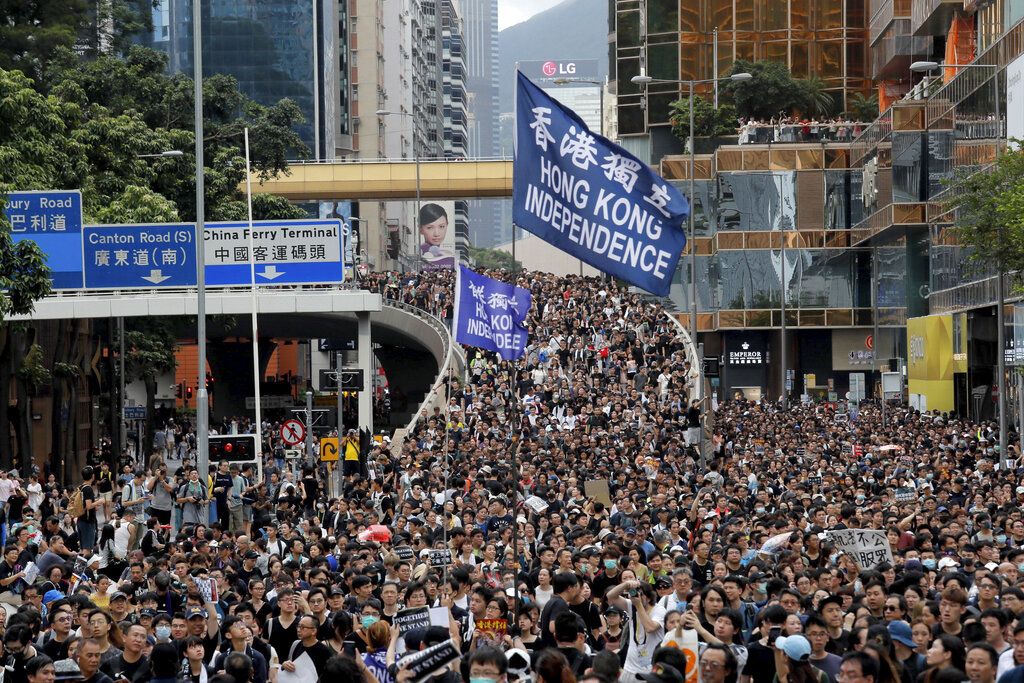
Protesters march with a flag calling for Hong Kong independence in Hong Kong on Sunday, July 7, 2019. Thousands of people, many wearing black shirts and some carrying British flags, were marching in Hong Kong on Sunday, targeting a mainland Chinese audience as a month-old protest movement showed no signs of abating. Photo: Kin Cheung / AP

“We want to show our peaceful, graceful protest to the mainland visitors because the information is rather blocked in mainland,” march organizer Ventus Lau said. “We want to show them the true image and the message of Hong Kongers.”

Chinese media have not covered the protests or their origins widely, focusing on clashes with police and damage to public property.

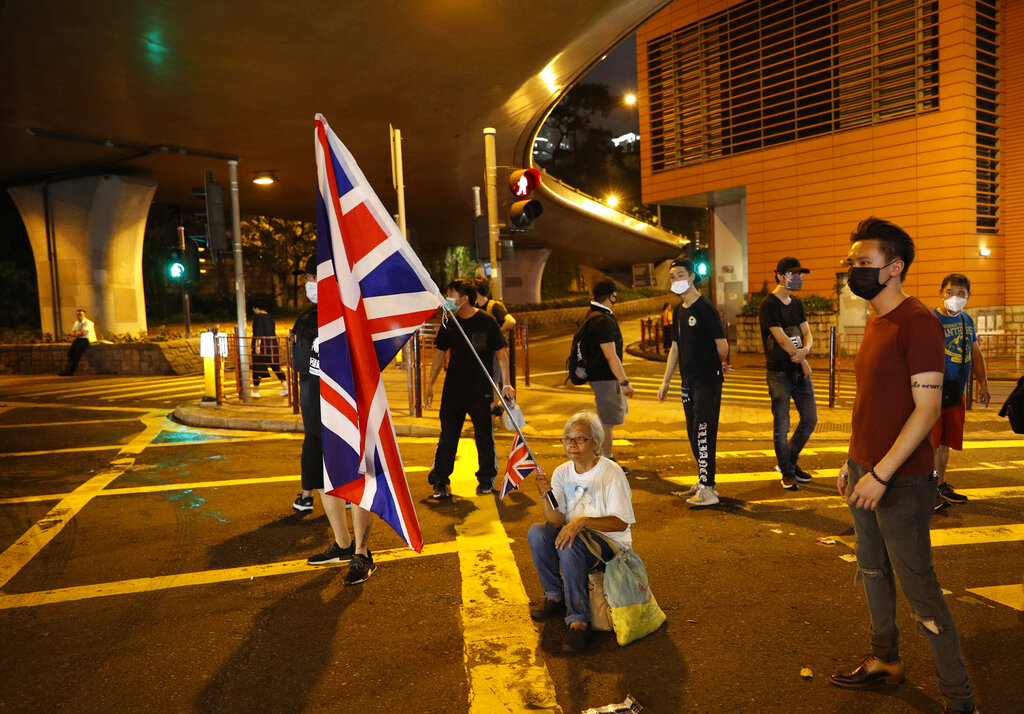
As the crowd broke up Sunday night, a few hundred remained and taunted police who had retreated behind huge barriers set up outside the railway station, while others moved to Canton Road, a street lined with luxury boutique stores. Around 11 p.m., police moved to disperse protesters who were blocking a road and arrested five people for assaulting or obstructing police officers, their statement said.

The march was the first major action since two simultaneous protests last Monday, the 22nd anniversary of the July 1, 1997, return of Hong Kong from Britain to China.

The march through central Hong Kong that’s held annually drew hundreds of thousands of people. It was overshadowed this year, however, by an assault on the legislative building by a few hundred demonstrators who shattered thick glass panels to enter the building and then wreaked havoc for three hours, spray-painting slogans on the chamber walls, overturning furniture and damaging electronic voting and fire prevention systems.

Sunday’s march was the first protest against the extradition legislation to take place on the Kowloon side of Hong Kong harbor. The previous ones were on Hong Kong Island, the city’s business and government center.

Many of the marchers were young and wore black shirts that have become the uniform of the protesters. The largely peaceful crowd also included older people carrying handheld fans in the muggy heat, as well as parents with children, including some in baby strollers.

Many held placards, including one that read “Extradite to China, disappear forever.” Some carried the British flag or the old Hong Kong flag from when it was a British colony.

“This is our fourth march because we think this government is not taking care of Hong Kong,” said Dan Lee, who joined with his wife and their three children. “We need to save Hong Kong and we need to come out for our future generations.”

The extradition legislation has raised concerns about an erosion of freedoms and rights in Hong Kong, which was guaranteed its own legal system for 50 years after its return to China in 1997.

Prior to the march, police put up large barricades blocking a main entrance to the railway station to prevent any attempt to enter it. Only passengers with train reservations were allowed into the station, the mass transit authority said, and Hong Kong media reported that ticket sales had been suspended for afternoon trains.

“The high-speed railway station is a connection between Hong Kong and China and this is the nearest place we can spread our message to China,” said Lau, the march organizer.

The station was a source of contention before it opened last September, because passengers pass through Chinese immigration and customs inside. Some opposition lawmakers said the fact that Chinese law applies in the immigration area violates the handover agreement under which Hong Kong maintains its own legal system.

Protesters also are demanding an independent investigation into a crackdown on June 12 demonstrations in which officers used tear gas and rubber bullets to disperse crowds blocking major streets. Police said the tactics, harsher than usual for Hong Kong, were justified after some protesters turned violent. Dozens were injured, both protesters and police.

The protesters are also calling for the direct election of Hong Kong’s leader. Lam was chosen by an elite committee of mainly pro-Beijing electors.

Protesters block a road after a march against government's policy on the extradition bill in Hong Kong Sunday, July 7, 2019. Protesters in Hong Kong are taking their message to visitors from mainland China on Sunday in a march to a high-speed rail station that connects to Guangdong city and other mainland destinations. Photo: Vincent Yu
Protesters block a road after a march against government’s policy on the extradition bill in Hong Kong Sunday, July 7, 2019. Protesters in Hong Kong are taking their message to visitors from mainland China on Sunday in a march to a high-speed rail station that connects to Guangdong city and other mainland destinations. Photo: Vincent Yu

Story: Ken Moritsugu and Alice Fung. Johnson Lai contributed to this report.

Advertisement

KIN+ONE presents “Thailand Rum Cocktail Week 2019”

Rum lovers are treated to a world class experience with a week-long of signature rum cocktails by international bartenders

Once again, the week of fun and joy for rum lovers is back bigger and better than before with“Thailand Rum Cocktail Week 2019”. A week that celebrates the ever-popular spirit loved by drinkers all over the world, the week aims to educate consmers through series of workshops and talks by industry experts and delight drinkers with special cocktail creations by renowned guest bartenders through venues in 5 major cities of Thailand, i.e. Bangkok, Chiang Mai, Samui, Phuket and Krabi. Don’t miss the RUM Opening Party and Rum Close Party with live performance of famous DJs between July 8-15, 2019. 

Ano Chuminhak, CEO of KIN+ONE, founder and organizer of Bangkok Rum Cocktail Week said that the 2019 edition of Bangkok Rum Cocktail Week aims to achieve greater purpose, that is raising and shaking up the bar scene in Thailand and strengthening the community of producers, traders, bartenders, bar owners and consumers by encouraging them to exchange knowledge and share memorable time together. 

872019 ๑๙๐๗๐๘ 0020

“This year, we will still have the key activity which has been a great success in the previous editions of the event, which is the rum seminars. This is a great opportunity for rum lovers to taste various different rums and indulge in decent experiences catered by top bartenders from around the world that we finely selected to participate as guest bartenders. This year, we expand the event beyond Bangkok to cover Chiang Mai, Samui, Phuket and Krabi. All of which are Thailand’s major cities that have high potential to shine in the global scene.”

In Bangkok, the seminar will take place at the Bamboo Bar, Drink World’s number 9th best bar, on July 9, 2019 with topics related to new rum. On July 10, the seminar will cover cocktail making with renowned Thai rum, Mekhong, by Luca Cinalli with Tony Pescatori heading Art and Fasion Cocktail with Praya workshop on July 11. Four more seminars are hosted as followed.

  • July 10 in Phuket at Dibuk House by Boo Jing Hang (Singapore) and Mari Nakano (Japan)
  • July 10 in Chiang Mai at Drink Smith by Jiawei Bai (Singapore)
  • July 13 in Krabi at Get Rad’s by Shingo Gokan (Japan)
  • July 14 in Samui at Tiki Box by Davide Boncimino (Singapore) 

The vibrant fun that rum lovers should not miss throughout the week of Thailand Rum 

Other 4 particiapting cities are also welcoming international guest bartenders including Shingo Gokan, Luca Cinnalli, Mari Nakano, Kentaro Satoh, Eric Adinarev and Igor Pavlov.

Thailand Rum Cocktail Week 2019 had a press conference on June 25, 2019 at Sorrento on Sathorn Road with Kayama, renowned bartender from Japan, mixing rum cocktails using top brands such as Mekhong, Phraya, Havana and Liverpool. The Rum Close Party was also announced to be held at Revolution Cocktail between 6pm to midnight, which is gaurateed to bea rum-soaked night accompanied by trendy tunes by international DJs.  The story of Thailand Rum Cocktail Week 2019 from the opening party to the closing night will later be presented for everyone to enjoy. 

Enjoy a week of rum and indulge in new experiences with fellow rum lovers at Thailand Rum Cocktail Week 2019 between July 8-15, 2019. For information and event updates, please visit https://web.facebook.com/ThailandRumCocktailWeek/


Advertisement

Hot News

LATEST NEWS

Bangkok
overcast clouds
32.3 ° C
33.3 °
30 °
80 %
5kmh
100 %
Mon
32 °
Tue
37 °
Wed
35 °
Thu
34 °
Fri
32 °