


























27.7 C
Bangkok
Friday, June 26, 2026
Home Blog Page 1820

Australia Considers Moving Embassy to Jerusalem

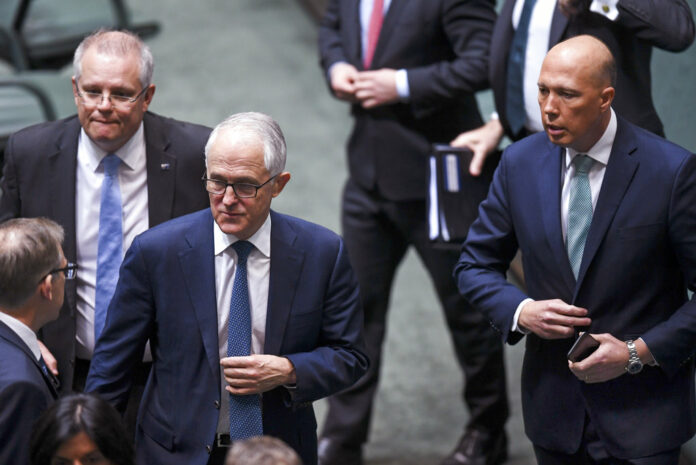
Australian Federal Treasurer Scott Morrison, second left, Prime Minister Malcolm Turnbull, center, and former Home Affairs Minister Peter Dutton, right, leave the chamber at Parliament House in August in Canberra. Photo: Lukas Coch / Associated Press

CANBERRA — Australia has raised the prospect of following the United States by relocating its embassy in Israel from Tel Aviv to Jerusalem in a policy shift that critics described Tuesday as a desperate grab for domestic political gain to win a crucial by-election.

Prime Minister Scott Morrison said the idea was suggested to him by a former ambassador to Israel, Dave Sharma, who is a candidate for the ruling conservative Liberal Party in a by-election Saturday in a Sydney electorate with a large Jewish population.

At stake is the government’s single-seat majority in the House of Representatives and Morrison’s ability to retain power without doing deals with independent lawmakers.

Morrison said Australia remained committed to finding a two-state solution to Israel’s conflict with the Palestinians.

“When sensible suggestions are put forward that are consistent with your policy positioning and in this case pursuing a two-state solution, Australia should be open-minded to this and I am open-minded to this and our government is open-minded to this,” Morrison told reporters.

Israeli Prime Minister Benjamin Netanyahu said he had recently spoken to Morrison and welcomed the Australian policy shift.

Morrison “informed me that he is considering officially recognizing Jerusalem as the capital of Israel & moving the Australian embassy to Jerusalem. I’m very thankful to him for this,” Netanyahu tweeted. “We will continue to strengthen ties” between Israel and Australia.

Australian Broadcasting Corp. reported that an unnamed Indonesian official had said Jakarta had been taken by surprise by the announcement, which could harm bilateral trade negotiations.

When Morrison became prime minister in August, he made his first overseas trip to Indonesia, a near-neighbor that is the world’s largest Muslim-majority nation.

Morrison and Indonesian President Joko “Jokowi” Widodo planned to sign an agreement this year aimed at boosting trade and investment.

Morrison told Parliament that he had briefed Jokowi overnight about the announcement.

“I’ve been pleased to be able to explain very clearly the nature of the announcements that I’ve made today and I’ve been very pleased with the response that I’ve received from President Joko Widodo,” Morrison said.

“We’ll continue to work closely and cooperatively with our allies and with our partners all around the world on these issues,” Morrison said.

Morrison also announced that Australia would vote against a United Nations resolution this week to recognize the Palestinian Authority as the chair of the Group of 77 developing countries and would review the three-year-old Iran nuclear deal.

The opposition center-left Labor Party said the announcement was a desperate attempt to win the by-election in the Wentworth electorate.

“The people of Wentworth, and all Australians, deserve a leader who puts the national interest ahead of his self-interest, and governs in the best long-term interest of the nation,” Labor lawmaker Penny Wong said.

The Trump administration turned its back on decades of U.S. policy by recognizing Jerusalem as Israel’s capital and moving the U.S. Embassy from Tel Aviv in May.

Labor reminded the government that Frances Adamson, the head of Australia’s foreign department, said in June that the U.S. move had “not been helpful” for the Middle East peace process.

George Browning, president of the Australia Palestine Advocacy Network, accused the government of “aligning itself with the most erratic, reactionary and bullish U.S. foreign policy ever.”

“This is an irresponsible policy that compromises the future of millions of people in the Middle East for a handful of votes in Wentworth,” Browning said in a statement.

Morrison denied that the United States or the by-election had influenced his announcement.

“I have made this decision without any reference to the United States. It has not come up in any discussion I have had with the president or with officials,” Morrison said.

“Australia makes its decisions about its foreign policy independently. We do so in our own national interests consistent with our own beliefs and our own values,” he added.

Story: Rod McGuirk
Advertisement

Mattis: Trump Says Defense Chief’s Job Is ‘100%’ Safe

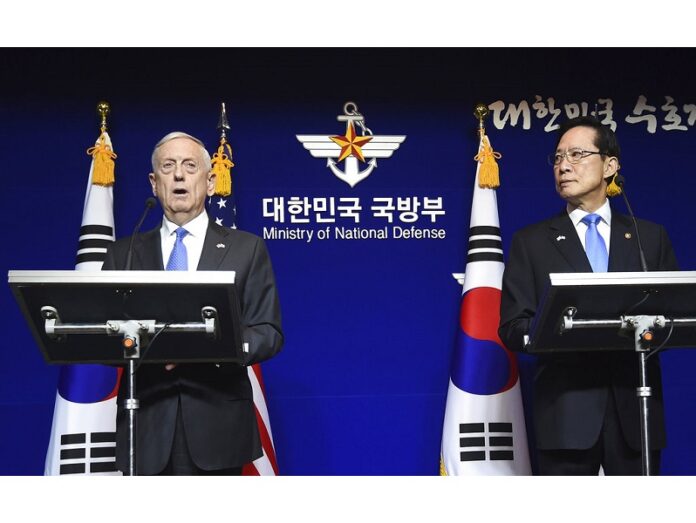
U.S. Secretary of Defense Jim Mattis, left, and South Korea's Defense Minister Song Young-moo hold a joint press conference after the Security Consultative Meeting (SCM) at the Defense Ministry in 2017 in Seoul, South Korea. Photo: Jung Yeon-Je / Associated Press

HO CHI MINH CITY — Amid speculation that he may soon be replaced, Defense Secretary Jim Mattis said President Donald Trump told him he supports the retired Marine general “100 percent.”

The assertion comes just days after Trump mused on national television about Mattis leaving his post.

Mattis said Trump gave him this assurance during a phone call while Mattis was flying from Washington to Ho Chi Minh City, Vietnam, on Tuesday. A few hours earlier, Mattis told reporters traveling with him that he and Trump had never discussed the possibility of Mattis leaving the Pentagon job.

Mattis initially was responding to reporters’ questions about Trump’s comments on CBS’ “60 Minutes” Sunday that Mattis “may leave” his administration and that he thinks the retired Marine Corps general is “sort of a Democrat.”

Asked what he made of Trump’s comments, in which the president also said he likes Mattis and that eventually all appointees move on, Mattis said, “Nothing at all,” adding, “We have never talked about me leaving.”

Later, Mattis approached reporters traveling with him to say he’d just spoken to Trump. He said he called the president aboard Air Force One to discuss damage to military bases caused by Hurricane Michael. During that conversation, Trump asked Mattis whether he had seen the “60 Minutes” interview broadcast on Sunday. Mattis said he had not. Trump then expressed his full support for Mattis and suggested Mattis let the press know this.

By telling “60 Minutes” that he suspected Mattis is “sort of a Democrat,” Trump seemed to suggest that he thinks Mattis is too moderate in his politics, although he did not say so directly or cite any area of disagreement with Mattis.

Whereas Trump has made a hardline policy on immigration a centerpiece of his agenda, Mattis has publicly cited the valuable contributions that non-citizen members of the military have made over the years. Mattis also is a staunch supporter of NATO, whereas Trump has questioned its value to America.

Mattis, who had never previously held a civilian position in government before he became defense secretary in January 2017, told reporters he has sought to carry out and reinforce Trump’s military and national security policies without regard to partisanship. Those policies, he said, are now “reaping significant bipartisan support.”

Asked directly whether he is a Democrat, Mattis said, “We’re all built on our formative experiences. When I was 18 I joined the Marine Corps, and in the U.S. military we are proudly apolitical.”

Asked if that meant he was not a registered member of either major political party, he replied, “I’ve never registered for any political party.”

Presidents in recent decades have sometimes picked a member of the opposite party to head the Pentagon. President Bill Clinton’s second-term defense secretary was William Cohen, a prominent Republican member of the Senate. And President Barack Obama’s first Pentagon chief was Robert Gates, a Republican who had served as CIA director and defense secretary in Republican administrations.

The post of defense secretary is typically the least political in a president’s Cabinet. That is because of the non-political tradition of the military and long-standing bipartisan support for U.S. military alliances such as NATO.

Mattis flew to Vietnam for his second visit this year to the country with which the U.S. fought a 10-year war. He told reporters the violent history between the two countries is a thing of the past.

“The legacy of the war has turned into actually a basis for defense cooperation,” he said.

An example of this is a U.S.-funded $390 million project to clean up war-era chemical contamination of the ground at an air base near Ho Chi Minh City.

Mattis planned to visit the base at Bien Hoa on Wednesday to see firsthand the area that is to be decontaminated in a 10-year project funded by the U.S. Agency for International Development. Barrels of Agent Orange had been staged at Bien Hoa for U.S. use as a defoliant elsewhere in Vietnam, and when the U.S. decided to stop spraying Agent Orange, the remaining barrels of toxic liquid were collected and stored at Bien Hoa before being flown out of the country.

Mattis also plans to attend a regional meeting of defense ministers in Singapore later this week. He said he may meet there with his Chinese counterpart, even though Beijing had recently told Mattis that if he came to China his counterpart would not be available to meet.

Story: Robert Burns

Advertisement

Asian Shares Up on Hopes That US, China Will Solve Dispute

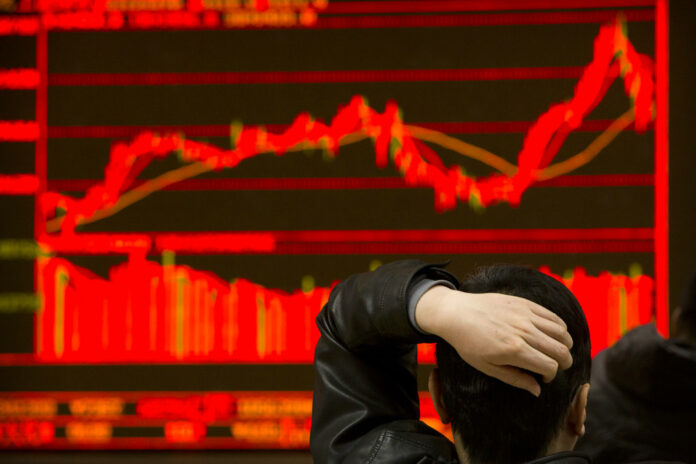
An investor monitors stock prices at a brokerage house in Beijing in February. Photo: Mark Schiefelbein / Associated Press

SINGAPORE — Asian markets were mostly higher on Tuesday, though Chinese benchmarks fell after the government reported inflation rose for the fourth straight month.


Keeping Score

Japan’s benchmark Nikkei 225 added 0.3 percent to 22,317.06. The Kospi in South Korea recovered 0.1 percent to 2,145.71. Hong Kong’s Hang Seng index, which has fallen 22 percent since early January, slipped another 0.2 percent to 25,396.19. The Shanghai Composite dropped 0.2 percent to 2,564.24. Australia’s S&P/ASX 200 gained 0.4 percent to 5,859.20. Shares rose in Taiwan, and Indonesia but fell in Singapore and Thailand.


Wall Street

Technology companies skidded and misses in corporate earnings pulled most U.S. indexes lower for the seventh time in eight days. The S&P 500 index dropped 0.6 percent to 2,750.79. The Dow Jones Industrial Average lost 0.4 percent to 25,250.55, and the Nasdaq composite skidded 0.9 percent to 7,430.74. But the Russell 2000 index of smaller-company stocks was 0.4 percent higher at 1,553.09.


Chinese Inflation

The National Bureau of Statistics said China’s consumer price index gained 2.5 percent in September from a year earlier, supported largely by fresh food prices and in line with market expectations. This follows a 2.3 percent increase in August. The country’s producer price index gained 3.6 percent from a year earlier, slowing from the previous month. Rising inflation is a double-edged sword. The central bank has tended to shrug off rising prices, but the trend could limit its room for loosening monetary policy in coming months.


Analyst’s Take

“There’s a calming of the markets. This is not an all-clear but a consolidation at lower levels,” Michael McCarthy, chief market strategist at CMC Markets in Sydney, said in an interview. “News that President Trump and Xi may meet at the G-20 summit has added to optimism that the trade dispute between the U.S. and China could be resolved,” he added.


Energy

Oil futures continued to rise on tensions in Saudi Arabia, a major oil producer, surrounding the disappearance and suspected murder of a journalist. Rising prices will squeeze bit Asian importers. U.S. crude added 7 cents to USD$71.85. The contract rose 0.6 percent to close at $71.78 in New York. Brent crude, the international standard, rose 25 cents to $81.03. It gained 0.4 percent to $80.78 in London.


Currencies

The dollar strengthened to 111.99 yen from 111.78 yen late Monday. The euro fell to $1.1576 from $1.1580.

Story: Annabelle Liang

Advertisement

Pheu Thai, Allies Could Be Disbanded, Election Official Warns

Former Pheu Thai MP and Redshirt leader Jatuporn Prompan, third from left, talks to reporters at a general meeting of Pheu Chart Party on Sunday.

BANGKOK — A Pheu Thai spokeswoman lashed out Tuesday at the Election Commission after it suggested that the party and its allies could be dissolved on the grounds of illegal collaboration.

Election Commission sec-gen Charungwit Phumma told reporters Monday that officials would look into whether Pheu Tham and Pheu Chart are serving as shell parties for Pheu Thai, which he said would violate election laws. The party’s spokeswoman called for due process if the investigation was to proceed.

“Let the laws take their course. We didn’t do anything wrong, so no one should bully us,” Sunisa Lertpakawat said in an interview. “If they would really investigate us, or prosecute us about this, they should do the same with other parties, instead of targeting only Pheu Thai.”

Read: Pheu Thai Readies Backup Party in Case it’s Dissolved

Recently unveiled to the public, both Pheu Tham and Pheu Chart are widely recognized as “proxies” for Pheu Thai in case the junta disbands it in the run-up to the February election.

Five hundred people attended a Sunday general meeting of Pheu Chart Party, including former Pheu Thai MPs Jatuporn Prompan and Worachai Hema.

At a panel discussion held Monday, Charungwit said political parties are legal entities that cannot be puppeteered by other factions or those outside.

But Sunisa accused the Election Commission of turning a blind eye to pro-junta parties who are openly receiving support even from government figures such as Palang Pracharat – which counts three cabinet members among its leaders.

“It’s so obvious that it was founded to support Gen. Prayuth [Chan-ocha] to return as prime minister,” the spokeswoman said. “Even the name resembles a government project. Could this be considered an influence from outsiders? Does the [commission] care to investigate at all?”

Charungwit could not be reached for comment as of publication time. Someone who answered the phone said he’s attending a news conference about the selection of new Senators.

Related stories:

For Thais or Friends of Thais? Pheu Thai Protests ‘Copycat’ Party

For First Time, Prayuth Confirms ‘Interest’ in Politics

Advertisement

Fire Ravages TMB Bank Branch

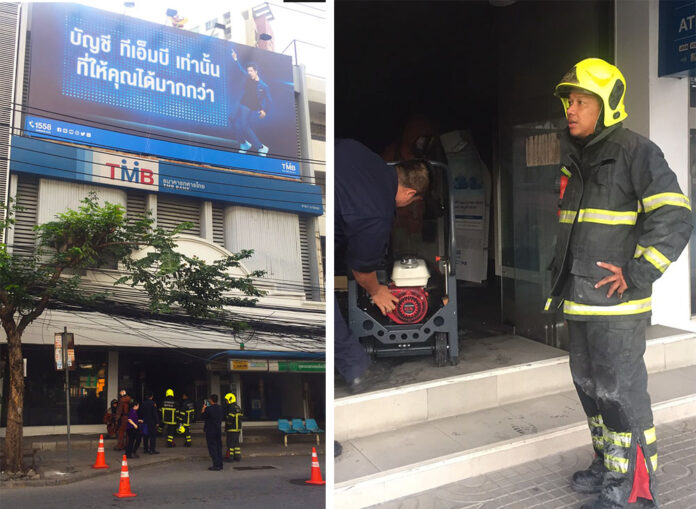
BANGKOK — Bank employees returned to work Tuesday after a long weekend to find their Chatuchak office on fire.

A Bang Khen branch of TMB Bank caught fire at about 7am on Phahonyothin Road due to a short circuit. Employees and customers escaped unscathed.

“You’ll have to ask the bank themselves for how long they’re going to close,” Col. Itthichet Wonghomnual of Phahon Yothin police said by phone.

Two fire trucks took less than 10 minutes to subdue the flames, which heavily damaged the first floor.

Employees told firefighters and police there had been a blackout Friday before the branch closed for the long weekend. An employee reportedly disabled the electricity breaker before leaving work, which burst into flames after it was re-enabled today.

Advertisement

Review: ‘A Star Is Born’ Is Dizzyingly Wonderful

This image released by Warner Bros. Pictures shows Lady Gaga, left, and Bradley Cooper in a scene from "A Star is Born." Photo: Clay Enos / Warner Bros. Pictures via AP

It’s hard not to go into ”A Star Is Born ” without a lot of prejudgments. Even if you haven’t seen the other three versions, the mere fact that they exist, and with such formidable talent, is enough to make anyone scoff at the fact that Hollywood keeps dusting off this well-worn story about fame and love and addiction.

And then you throw in the fact that it was made by a first-time director, who also happens to be a movie star, no less, and the whole thing seems even more dubious. Leave that all at the door, though, because “A Star Is Born,” is simply terrific — a big-scale cinematic delight that will have the masses singing, swooning and sobbing along with it.

It’s quite a feat from Bradley Cooper, who directed, co-wrote, produced and stars in the film. Cooper plays Jackson Maine, a massively popular singer-songwriter whose path intersects with an unknown and overlooked talent named Ally (a magnificent Lady Gaga) and the two become entangled as his star fades and hers rises.

When the film starts, Jackson is at the height of his fame, the type of fame where grocery store cashiers take photos of you without asking, where you can send a private jet to usher a girl you just met to your concert and where you can be an alcoholic teetering on the edge because you’re talented and charismatic and you make too many people too much money and, besides, you’re basically functioning aside from the tinnitus.

Cooper puts the viewer right with Jackson as he takes the stage at a big festival. His routine, you imagine, doesn’t alter that much: Pop the pills. Drink the drink. Take the hat off. Play. Sing. Exit stage left to drink some more. Only this night, he ends up somewhere a little off his regular path, at a drag bar where Ally, in full Edith Piaf costume, wakes him out of his ambling stupor with “La Vie En Rose.” And with a star-making close-up of Ally, Jackson, and the audience, falls in love.

Cooper and Gaga have incredible chemistry, the kind that makes you believe that two strangers would know in a night that they’re made for each other. Before you know it, he’s asking her to come up on stage with him to sing her song, “Shallow,” which someone films, puts on YouTube and creates a viral sensation.

The first hour of “A Star Is Born” is downright electrifying — funny, exciting, sexy and wholly lived-in. Characters you just met feel like old friends, from the drag queens at the club to Ally’s father (Andrew Dice Clay) and his fellow drivers. Sam Elliott, as Jackson’s brother, might only have 15 minutes of screen time, but it’s enough to break your heart (and probably earn him some awards love too). “A Star Is Born” is that rare film that makes you actually feel part of a world, and not just like an observer on the other side of a screen.

But like all good things, the engine of that first hour only gets the film so far, and the second half has its shortcomings. Cooper rushes through an enormous amount of story to wrap things up in a reasonable runtime. While he does accomplish this, it comes at the expense of Ally as a character who goes from earthy singer-songwriter to a Katy Perry-like pop diva in an instant without much inquiry.

This film wears its thesis on its sleeve and is trying to make a point about being an artist with “something to say” and making use of the time when people are listening. Jackson values authenticity above all else, but we never get to learn what Ally wants out of her career — all we know is that Jackson, and presumably Cooper, disapprove of the artifice.

But the actors and the filmmaking hold up “A Star Is Born” where the story cannot. Gaga is a gifted actress, natural, vulnerable and strong as she goes toe-to-toe with Cooper in what might be his best performance — the man truly disappears into Jackson Maine. And as a director, well, he is the real deal and, with this sort of introduction, definitely far from the shallow now.

“A Star Is Born,” a Warner Bros. release, is rated R by the Motion Picture Association of America for “language throughout, some sexuality/nudity and substance abuse.” Running time: 135 minutes. Three and a half stars out of four.

Story: Lindsey Bahr

Advertisement

Paul Allen, Microsoft Co-Founder, Dies at 65

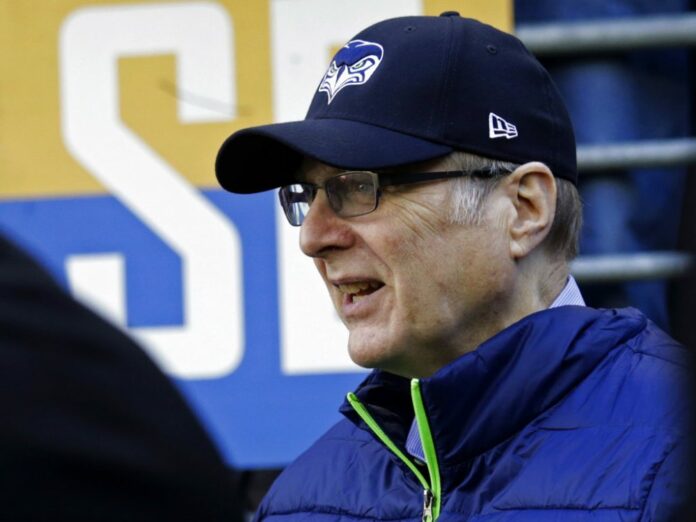
In this Dec. 31, 2017 photo, Seattle Seahawks owner Paul Allen stands near the field before an NFL football game against the Arizona Cardinals in Seattle. Photo: John Froschauer / Associated Press

SEATTLE — Paul G. Allen, who co-founded Microsoft with his childhood friend Bill Gates before becoming a billionaire philanthropist who invested in conservation, space travel, arts and culture and professional sports, died Monday. He was 65.

He died in Seattle from complications of non-Hodgkin’s lymphoma, his company Vulcan Inc. announced.

Gates said he was heartbroken about the loss of one of his “oldest and dearest friends.”

“Personal computing would not have existed without him,” Gates said in a statement.

“But Paul wasn’t content with starting one company. He channeled his intellect and compassion into a second act focused on improving people’s lives and strengthening communities in Seattle and around the world. He was fond of saying, ‘If it has the potential to do good, then we should do it,'” Gates wrote.

Microsoft CEO Satya Nadella called Allen’s contributions to the company, community and industry “indispensable.”

“As co-founder of Microsoft, in his own quiet and persistent way, he created magical products, experiences and institutions, and in doing so, he changed the world,” Nadella wrote on Twitter.

Allen, an avid sports fan, owned the Portland Trail Blazers and Seattle Seahawks.

Over the course of several decades, Allen gave more than $2 billion to a wide range of interests, including ocean health, homelessness and advancing scientific research.

“Millions of people were touched by his generosity, his persistence in pursuit of a better world, and his drive to accomplish as much as he could with the time and resources at his disposal,” Vulcan CEO Bill Hilf said in a statement.

Allen was on the list of America’s wealthiest people who pledged to give away the bulk of their fortunes to charity. “Those fortunate to achieve great wealth should put it to work for the good of humanity,” he said.

Allen and Gates met while attending a private school in north Seattle. The two friends would later drop out of college to pursue the future they envisioned: A world with a computer in every home.

Gates so strongly believed it that he left Harvard University in his junior year to devote himself full-time to his and Allen’s startup, originally called Micro-Soft. Allen spent two years at Washington State University before dropping out as well.

They founded the company in Albuquerque, New Mexico, and their first product was a computer language for the Altair hobby-kit personal computer, giving hobbyists a basic way to program and operate the machine.

After Gates and Allen found some success selling their programming language, MS-Basic, the Seattle natives moved their business in 1979 to Bellevue, Washington, not far from its eventual home in Redmond.

Microsoft’s big break came in 1980, when IBM Corp. decided to move into personal computers and asked Microsoft to provide the operating system.

Gates and Allen didn’t invent the operating system. To meet IBM’s needs, they spent $50,000 to buy one known as QDOS from another programmer, Tim Paterson. Eventually the product refined by Microsoft — and renamed DOS, for Disk Operating System — became the core of IBM PCs and their clones, catapulting Microsoft into its dominant position in the PC industry.

The first versions of two classic Microsoft products, Microsoft Word and the Windows operating system, were released in 1983. By 1991, Microsoft’s operating systems were used by 93 percent of the world’s personal computers.

The Windows operating system is now used on most of the world’s desktop computers, and Word is the cornerstone of the company’s prevalent Office products.

Gates and Allen became billionaires when Microsoft was thrust onto the throne of technology.

With his sister Jody Allen in 1986, Paul Allen founded Vulcan, the investment firm that oversees his business and philanthropic efforts. He founded the Allen Institute for Brain Science and the aerospace firm Stratolaunch, which has built a colossal airplane designed to launch satellites into orbit. He has also backed research into nuclear-fusion power.

Allen also funded maverick aerospace designer Burt Rutan’s SpaceShipOne, which in 2004 became the first privately developed manned spacecraft to reach space.

The SpaceShipOne technology was licensed by Sir Richard Branson for Virgin Galactic, which is testing a successor design to carry tourists on brief hops into lower regions of space.

Branson tweeted Monday: “So sad to hear about the passing of Paul Allen. Among many other things he was a pioneer of commercial space travel. We shared a belief that by exploring space in new ways we can improve life on Earth.”

When Allen released his 2011 memoir, “Idea Man,” he allowed 60 Minutes inside his home on Lake Washington, across the water from Seattle, revealing collections that included the guitar Jimi Hendrix played at Woodstock to vintage war planes and a 300-foot yacht with its own submarine.

Allen served as Microsoft’s executive vice president of research and new product development until 1983, when he resigned after being diagnosed with Hodgkin’s lymphoma.

“To be 30 years old and have that kind of shock — to face your mortality — really makes you feel like you should do some of the things that you haven’t done yet,” Allen said in a 2000 book, “Inside Out: Microsoft in Our Own Words.”

Two weeks ago, Allen announced that the non-Hodgkin’s lymphoma that he was treated for in 2009 had returned and he planned to fight it aggressively.

“My brother was a remarkable individual on every level,” his sister Jody Allen said in a statement. “Paul’s family and friends were blessed to experience his wit, warmth, his generosity and deep concern,” she added.

Allen never married or had children.

His influence is firmly imprinted on the cultural landscape of Seattle and the Pacific Northwest, from the bright metallic Museum of Pop Culture designed by architect Frank Gehry to the computer science center at the University of Washington that bears his name.

In 1988 at 35, he bought the Portland Trail Blazers professional basketball team. He told The Associated Press that “for a true fan of the game, this is a dream come true.”

He also was a part owner of the Seattle Sounders FC, a major league soccer team, and bought the Seattle Seahawks. Allen could sometimes be seen at games or chatting in the locker room with players.

Advertisement

When Embassies Become Places of Terror, Not Sanctuaries

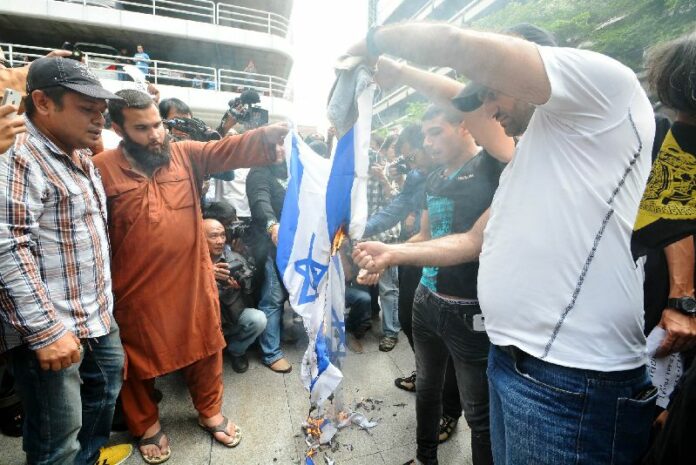
Protesters rally in 2014 in front of the Israeli embassy in Bangkok to voice their anger at Israeli air strikes in Gaza, despite the Thai military junta’s existing ban on public gatherings.

CAIRO — Embassies, consulates and diplomatic missions worldwide are often considered places of sanctuary, however, not all have been impervious to horrific incidents.

When Saudi journalist Jamal Khashoggi vanished after entering the Saudi Consulate in Istanbul last week it prompted Turkish officials and media to claim he may have been killed and even dismembered by a squad of assassins on the premises. The macabre mystery stirred memories of instances when diplomatic missions turned into places of terror.

Brutal killings, suicide bombings, militant raids and hostage crises – embassies and consulates have seen plenty of tragedy and bloodshed.

Here are just some of many examples:


Benghazi, Attack on US Compounds in Libya

Libyan extremists from the militant Ansar al-Shariah group attacked two U.S. compounds – a diplomatic post and a CIA annex nearby – in the city of Benghazi on Sept. 11, 2012, setting off a night of rampage that killed four Americans, including Ambassador Chris Stevens, and gutted the buildings. Last year, a jury in Washington convicted 47-year-old Libyan militant Ahmed Abu Khattala on multiple terrorism-related charges for his role in the attacks.


Australian Embassy Bombing in Jakarta

Suspected Muslim militants detonated a car bomb outside the Australian Embassy in Jakarta, Indonesia, on Sept. 9, 2004, killing eight people, including an embassy guard, policemen on duty, two embassy workers and a visa applicant.


Myanmar Embassy Siege in Bangkok

A shadowy group known as the Vigorous Burmese Student Warriors stormed the Myanmar Embassy in Bangkok on Oct. 7, 1999. They took 38 hostages to demand democracy in their country, also known as Burma. Thailand allowed them to fly to the border, angering Myanmar but ending the standoff without bloodshed.


US Bombing of Chinese Embassy in Belgrade

NATO bombs hit the Chinese Embassy in Belgrade by mistake on May 8, 1999, killing three Chinese reporters. In China, protesters retaliated by attacking U.S. missions.


Al-Qaida Bombings of US Embassies in East Africa

Al-Qaida launched near-simultaneous truck bombings on Aug. 7, 1998, targeting U.S. embassies in Kenya and Tanzania, killing 224 people. Most of the victims were Kenyans but 12 Americans also died. The mastermind behind the attacks, Fazul Abdullah Mohammed, eluded capture for 13 years before he was gunned down at a security checkpoint in Somalia’s capital, Mogadishu, a month after al-Qaida leader Osama bin Laden was killed by Navy SEALs in Pakistan in May 2011.


Islamic Jihad’s Attack on Egyptian Embassy in Pakistan

A suicide bomber rammed his explosive-packed truck into the Egyptian Embassy in Islamabad on Nov. 19, 1995, killing 15 people, including the second secretary of the embassy and three Egyptian security guards. Egypt handed down a death sentence in absentia to its citizen Ayman al-Zawahri, who led the militant group and later merged it with al-Qaida, for this attack. Al-Zawahri succeeded bin Laden as al-Qaida’s chief.


Japanese Embassy Hostage Crisis in Peru

Leftist Tupac Amaru rebels seized the Japanese ambassador’s residence in Lima, Peru, on Dec. 17, 1996, during a party celebrating Emperor Akihito’s birthday, taking diplomats, guests and government officials hostage and demanding the release of their imprisoned comrades. The rebels held 72 hostages for 126 days before government troops stormed the premises; one hostage, two commandos and all rebels were killed. The story inspired the best-seller “Bel Canto” by U.S. author Ann Patchett.


Attacks on Israeli Embassy, Jewish Center in Argentina

A bomb flattened the Israeli Embassy in Buenos Aires on March 18, 1992, killing 29 people, including four Israelis. Two years later, a Jewish community center in the city was bombed, killing 85 people – the deadliest bombing ever in Argentina. Israel and Argentina have long accused Iran of being behind the bombings. Iran has denied any role in the attacks.


Beirut, US Embassy Bombing 

A suicide bombing on April 18, 1983, at the U.S. Embassy in Beirut killed 63 people, including 17 Americans. The victims were mostly embassy and CIA staff, but also several U.S. soldiers and a Marine. It was the deadliest attack on an American diplomatic mission up to that time. A shadowy Shiite group calling itself Islamic Holy War took responsibility.


Iran, US Embassy in Tehran

Militant Iranian students stormed the U.S. Embassy in Tehran on Nov. 4, 1979, and took 52 Americans hostages. The attackers demanded the return of the shah to Iran to face trial. President Jimmy Carter refused and launched a failed commando raid to free the captives. Six Americans who fled the initial takeover and found refuge with the Canadian ambassador later escaped Iran with the CIA’s help. Their escape was dramatized in the 2012 film “Argo.” Iran held the hostages for 444 days, releasing them only after the 1981 inauguration of President Ronald Reagan.


West German Embassy Siege in Stockholm

German anarchists of the Red Army Faction shot their way into the West German Embassy in Stockholm on April 24, 1975, demanding the release of their comrades from prisons back home. They took 12 embassy staff hostage, including Ambassador Dietrich Stoecher. During the standoff with the Swedish police, the attackers killed the military and the economic attachés before accidentally blowing up a part of the building.


Attack on Saudi Embassy in Khartoum

The Palestinian terror group Black September attacked the Saudi Embassy in the Sudanese capital, Khartoum, during a formal reception on March 1, 1973 and took 10 diplomats hostage. After President Richard Nixon refused to negotiate with the attackers, three Western hostages were killed, including George Curtis Moore, the U.S. chargé d’affaires.


Israeli Embassy in Bangkok Hostage Crisis

The Black September faction took over the Israeli Embassy in Bangkok on Dec. 28, 1972, and held six Israeli embassy staff hostage. The hijackers agreed after negotiations to leave in exchange for safe conduct to Egypt.


Yugoslav Embassy in Stockholm

Two Croatian separatists stormed the Yugoslav Embassy in Stockholm on April 7, 1971, where they held and mortally wounded Ambassador Vladimir Rolovic. The attackers were later caught and convicted in Sweden. One of them, Miro Baresic, was released in 1972 as part of demands by Croatian hijackers of a Swedish domestic flight. He was later extradited from Paraguay to Sweden to serve the remainder of his sentence.

Story: Katarina Kratovac

Advertisement

Czech Arrested On Koh Tao After Overstaying Visa 6 Years

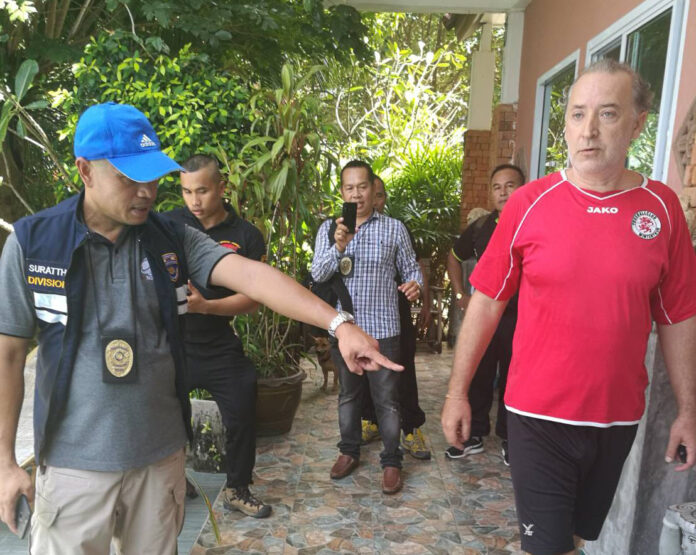
A Surat Thani immigration police officer points at Josef Ruzicka, who was arrested Monday on Koh Tao.

SURAT THANI — A european man was arrested and charged Monday with overstaying his visa for six years on Koh Tao.

As part of a nationwide crackdown on illegal immigrants, police arrested Czech national Josef Ruzicka, 47, who had overstayed his tourist visa more than 2,000 days. The operation was led by Col. Wanchana Boworaboon of Surat Thani immigration police.

“We were checking his immigration records. Usually foreigners’ records will say when they exited or entered the country. This man was already in the records, but he didn’t exit the country to go anywhere,” Police Capt. Ampai Meemattu said.

Ruzicka’s arrest is part of the “X-Ray Outlaw Foreigner” operation, in which police have targeted areas with large tourist populations to arrest foreigners overstaying their visas. The raids – first started by recently appointed Immigration Bureau commander Maj. Gen. Surachet Hakpan – began in and around Bangkok, but have since spread nationwide.

Police say they received an anonymous tip who said Ruzicka had been living on Koh Tao for six years without leaving the country. Ruzicka was caught at Sai Review Resort, where he was living with his Thai girlfriend in a hotel room.

Ruzicka overstayed his tourist visa for 2,266 days after it expired on July 2, 2012. He has been placed under Koh Tao police custody and will be deported, authorities said. The Czech national was blacklisted and banned from entering Thailand for 10 years. Ampai said Ruzicka will be fined no more than 20,000 baht.

Those who overstay their visa by less than a year face five years on the blacklist. Those who overstay for more than a year, such as Ruzicka, are blacklisted for 10 years.

Foreigners who willingly contact authorities after overstaying their visa face shorter periods on the blacklist: Those who overstay less than 90 days are not blacklisted. Overstaying one’s visa 90 to 365 days results in a one year ban. One to three years bans offenders three years, while three to five years results in a five-year ban. Overstays of five years or more result in a decade-long ban.

Related stories:

500+ Foreigners Arrested in New Nationwide Raids

Cop Behind Foreigner Crackdown Gets Top Immigration Job

Police to Investigate ‘All Nigerians’ in Thailand

74 Arrests in This Week’s Edition of ‘X-Ray Outlaw Foreigner’

35 Foreigners Arrested In This Week’s ‘X-Ray Outlaw’ Raid

Germans, Russians Netted in This Week’s ‘X-Ray’ Foreigner Raids

Advertisement

Lineup Set for Epic Indie Music Fest ‘Maho Rasop’

BANGKOK — The capital city’s music fans are more than ready for an epic 12-hour outdoor music festival which will welcome nearly 20 acts next month.

Organizers behind Maho Rasop Music Festival (“entertainment” in Thai) on Saturday announced a complete lineup consisting of 19 international and local musical acts who will take an outdoor stage in November in Phra Ram IX area.

The marquee talent among them is London quartet The Vaccines, who opened for world-famous acts such as The Rolling Stones, Muse and Arctic Monkeys. Check out some of their best songs “If You Wanna,” “Post Break-Up Sex” and “Norgaard.”

More reasons not to miss the event: UK shoegaze icons Slowdive will show off their skills through nostalgic ‘90s tracks “When the Sun Hits,” “Alison” and the recent mesmerizing “Sugar for the Pill.” American singer-songwriter Ernest Greene, known professionally as Washed Out, will bring out everything from bedroom pop to chillwave.

Upbeat Melbournian electronic group Miami Horror, soul-infused pop outfit PREP and Taiwanese three-piece math rock Elephant Gym will also join.

R&B sensation Dean, dubbed a dark horse talent among internationally famous South Korean artists, will make a comeback after performing in Bangkok last year.

The list continues with local acts highlighting tropical-inspired indie pop Gym and Swim, shoegaze group Hariguem Zaboy and up-and-coming pop quintet Temp.

The one-day event runs from noon through midnight on Nov. 17 at Live Park Rama 9, located on Rama IX Road. Tickets, which have been selling in phases, are available online for 3,990 baht.

The event was first announced in July, with 200 blind tickets sold out.

The organizers of Maho Rasop are Bangkok-based gig promoters Have You Heard?, Seen Scene Space and music streaming service Fungjai.

Related stories:

The Vaccines, Miami Horror to Play Bangkok Indie Fest

‘Maho Rasop’ Music Fest to Feature 15+ Indie Acts

Advertisement

Hot News

LATEST NEWS

Bangkok
broken clouds
27.7 ° C
27.7 °
27.7 °
81 %
2.7kmh
67 %
Fri
36 °
Sat
36 °
Sun
37 °
Mon
36 °
Tue
35 °