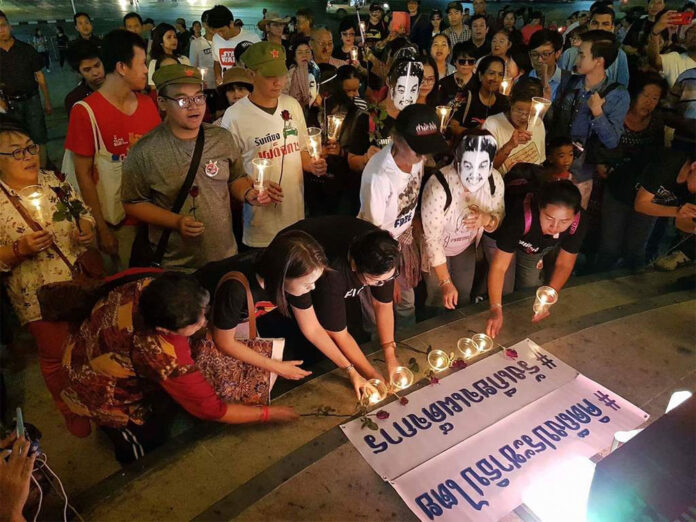
Protesters light candles Sunday at Bangkok's Democracy Monument next to posters which reading #ThinkingOfDemocracy and #DespisedDictatoship. Photo: Noppakaw Kongsuwan
BANGKOK — While the military government welcomes an EU decision to seek “gradual political re-engagement” with Thailand “at all levels,” those in the pro-democracy camp had a mixed response.
Some expressed disappointment Tuesday what they perceive to be the European Union prioritizing trade and warned of negative repercussions, while at least one activist greeted the move as good news.
Among 14 points enumerated Monday in a statement from the Council of the European Union in Brussels was the gradual resumption of political contacts “in order to facilitate meaningful dialogue on issues of mutual importance, including on human rights and fundamental freedoms, and the road towards democracy.”
It signals a reversal from the strong EU reaction three and a half years ago, when Brussels condemned the coup, suspended all official visits to the kingdom and put all important agreements on hold. Back in June 2014, EU ministers expressed “extreme concern” about the coup.
The EU statement now cited the promulgation of the 2017 military-sponsored constitution and junta leader Gen. Prayuth Chan-ocha’s promise to hold elections in November 2018 as reasons to resume ties. Another reason cited was the Thai military’s 2016 decision “to phase out the practice of prosecuting civilians before military courts” in some cases “including for offences against internal security and lese majeste offences.”
The communique also explores the possibilities of resuming talks on an EU-Thailand Free Trade Agreement. It stressed, however, that the signing of such an agreement and others could only resume with a democratically elected civilian government.
The news was hailed today by junta leader Gen. Prayuth Chan-ocha.
Some in the pro-democracy movement who want the international community to more actively oppose the junta were not happy about the news.
“Personally, I am definitely disappointed,” said Virot Ali, a Thammasat University international relations lecturer. Virot predicted it signals a weaker stance from Europe on human rights and democracy.
“While they wait [for elections], I do not want to see them close an eye [to what’s happening],” Virot said, adding that the change likely stems from a belief the carrot approach is more effective than using the stick. Virot warned that election promises should not be held as paramount as the quality of democratic institutions afterward are vital.
Virot said however it’s unfair to expect the European Union to do all the pressuring while pro-democracy Thais do nothing.
“I have chatted with a number of ambassadors,” he said. “It boils down to the point that they can’t really do anything if Thais themselves don’t make a move.”
Sharing disappointment was Titipol Phakdeewanich, dean of political science at Ubon Ratchathani University. “I think it’s bad news for democracy,” the dean said in an interview Tuesday. “The Western world is focusing more on economic interests than human rights. This may delay democratic progress in Thailand.”
Titipol said a positive reading of the news is that the announcement is an attempt to cajole anbd keep the junta to its promise of holding elections.
Still, Titipol said citing the promised election is “rather naive” on part of the EU as the junta has broken numerous electoral promises in the past.
“Even though it has been announced, there’s no confirmation. What’s more, said the dean, elections under the junta-sponsored charter are more like a mechanism to enable the military to remain in power with a veneer of legitimacy and no mechanisms to foster democracy, human rights and freedom of expression.
“The EU stated that there were positive trends on part of the military regime. I think it’s more like a justification,” Titipol said, adding that the United Kingdom, which is leaving the EU, is already doing this.
Taking a contradictory view and welcoming the move was pro-democracy activist Nuttaa Mahattana, who on Sunday helped lead about 100 demonstrators to the Democracy Monument to demand power be returned to the people.
“I think it’s good news and encouraging,” Nutta said.
The EU statement could help shine a spotlight on human rights violations in Thailand.
“Any light shining is better than none,” she said.
“It’s like there are goons in our house and someone is putting a spotlight on them. Can we really say this is not good?” said Nutta, who praised specific problems the EU statement detailed about the military regime.
“Being specific is better than being silent and allowing them to do whatever they like,” Nutta said.
One of the organizations supported by the EU is Thai Lawyers for Human Rights. Sirikan Charoensiri, a lawyer and member of the group who just attended the EU-NGO Human Rights Forum in Brussels said it’s too soon to judge the move.
Sirikan pointed out that Brussels came up with more concrete benchmarks in its demands for the military regime.
Some selections from the statement:
“The [European] Council urges the Thai authorities not to prosecute civilians before military courts including for lese majeste offences committed before 12 September 2016.”
The European Council also reiterates its call for the “urgent restoration of the democratic process in Thailand through credible and inclusive elections and the respect for human rights and fundamental freedoms.
It also noted in point No. 3 that: “The Council recalls with concern that political and civil rights and liberties have been severely curtailed in Thailand following the 2014 military coup. … The Council stresses the importance of such basic freedoms being restored as Thailand proceeds towards democracy, and reiterates the importance it attaches to the role of civil society in a functioning democracy.”
Point No. 12 of the statement also noted that relations with Thailand will be under review with particular emphases on areas such as lifting of restrictions on freedom of expression and the media as well as freedom of assembly and association, the lifting of restrictions on political activity.
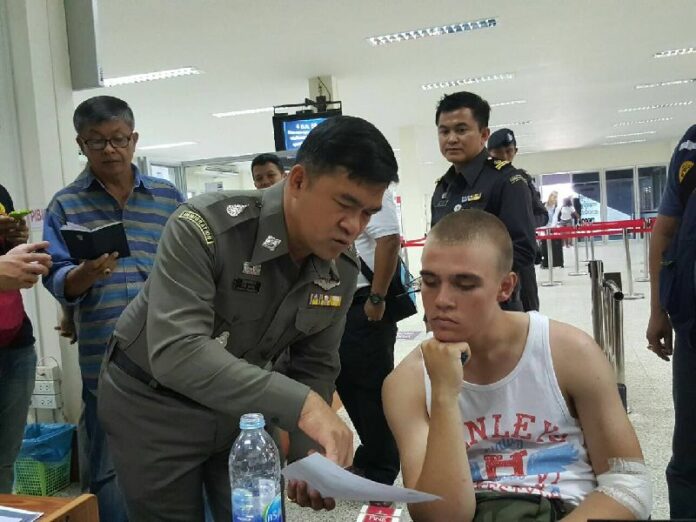
American national Tyler Gerard, then-23, is questioned by police Dec. 3 after his arrest in Sa Kaeo province.
BANGKOK — An Australian man and Thai woman arrested for allegedly running a drug trafficking ring are linked to an American convicted of murdering an Aussie underworld figure two years ago, police said Tuesday.
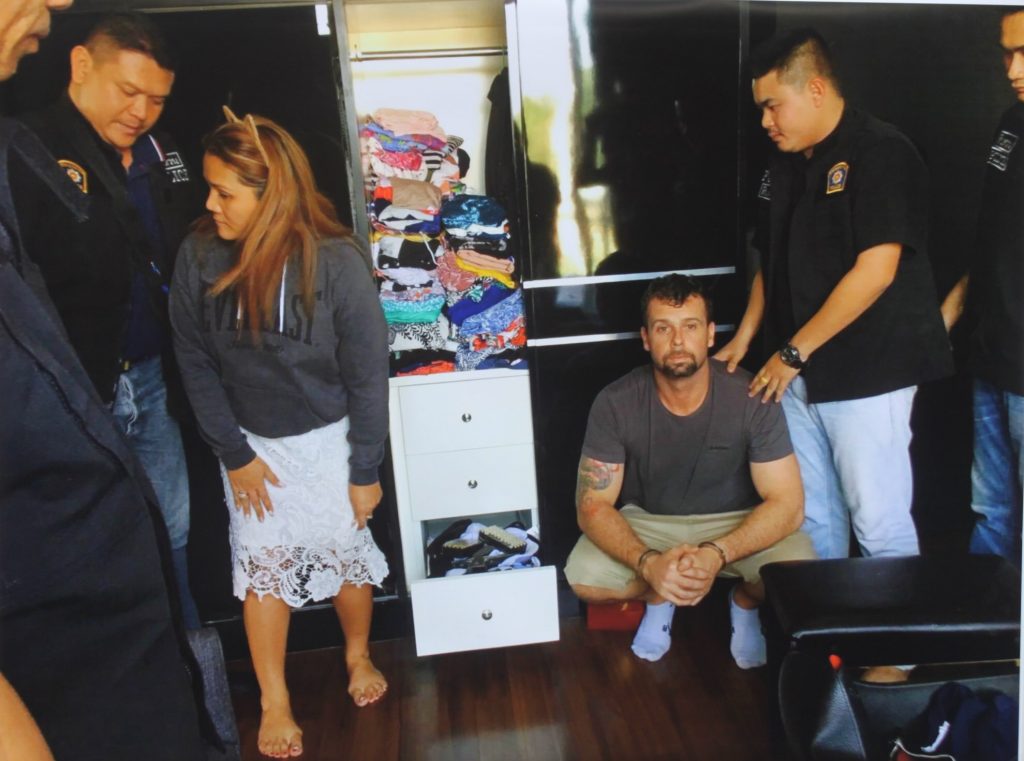
The two suspects – Joshua Cook and his wife Kanyarat Vetchpitak – arrested last night at one of Bangkok’s airports have been fingered by Tyler Gerard, 23 of the United States, as key players in a trafficking operation run out of Pattaya. Police said the two are key players in the transnational drug trade.
“These three individuals are considered ringleaders and part of a transnational drug network that has cells around the world,” Lt. Gen. Veerapong Chuengphakdi, the officer in charge of the case, said Tuesday.
Apart from Gerard, the other suspects are Cook and Kanyarat. They are being held at the Nongprue Police Station in Bangkok.
Police said the investigation began in 2015 after Australian national Wayne Schneider was abducted and executed by Tyler and another Australian in Pattaya. Both Australians – Schneider and 28-year-old Antonio Bagnato, were members of the Hells Angels, an international biker gang that rose to fame during the 1960s and is now considered a criminal enterprise by the United States.
Tyler, a US citizen, was convicted in January and sentenced to three years in prison for his role in abducting and murdering Schneider. Bagnato received the death penalty.
While Tyler has been serving his sentence, police learned about his alleged drug-running partners, Cook and Kanyarat, according to Lt. Gen. Thanitsak Thiraswadi.
A photo of Joshua Cook and his wife Kanyarat Vetchpitak released by police
Police soon gathered information, applied for warrants Saturday and arrested the pair at Suvarnabhumi Airport on Monday night, Thanitsak said. He added that they could not have done so earlier because Cook and Kanyarat were outside the country.
“We knew that both the dead and the living were involved in drugs,” Thanitsak said. “But I cannot yet speak publicly about all the details.”
The information confirms suspicions that Wayne was murdered in a business dispute, he said. Police said that Wayne was killed after threatening to report his partners to the authorities when an expected shipment of meth did not arrive to Thailand.
As part of the investigation, police have seized properties and vehicles in Pattaya belonging to Cook and Kanyarat, which were said to be worth over 30 million baht.
A 2005 file photo of former U.S. Army deserter to North Korea, Charles Jenkins, together with his daughters Mika, rear left, and Brinda at Narita International Airport, east of Tokyo. Photo: Itsuo Inouye / Associated Press
TOKYO – Charles Jenkins, a U.S Army deserter to North Korea who married a Japanese abductee and lived in Japan after their release, has died. He was 77.
Jenkins was found collapsed outside his home in Sado, northern Japan, on Monday and rushed to a hospital and later pronounced dead, a group representing families of Japanese abductees to North Koreas said Tuesday.
Japan’s NHK national television said he died of a heart failure.
Jenkins, of Rich Square, North Carolina, disappeared in January 1965 while on patrol along the Demilitarized Zone dividing North and South Korea. He later called his desertion a mistake that led to decades of deprivation and hardship in the communist country.
Jenkins met his wife Hitomi Soga, who was kidnapped by Pyeongyang in 1978, in North Korea and the couple had two daughters, Mika and Blinda. His wife was allowed to visit Japan in 2002 and stayed. Jenkins and their daughters followed in 2004.
Once in Japan, Jenkins in 2004 was subject to a U.S. court-martial in which he said he deserted because of fear of being sent to fight in Vietnam. He pleaded guilty to desertion and aiding the enemy and was dishonorably discharged and sentenced to 25 days in a U.S. military jail in Japan.
Jenkins and his family lived in Soga’s hometown of Sado, where he was a popular worker at a local souvenir shop and could often be seen posing in photos with visiting tourists.
Soga is one of 13 Japanese that Tokyo says were kidnapped to the North in the 1970s and 1980s as teachers of Japanese culture and language for agents spying on South Korea. Pyongyang acknowledged the abductions and allowed a Japan visit in 2002 for Soga and four others, who eventually stayed.
Jenkins, in his 2005 autobiographical book “To Tell the Truth,” and appearances at conferences on North Korean human rights, revealed that he had seen other American deserters living with women abducted from elsewhere including Thailand and Romania.
After settling in Japan, he visited North Carolina to see his mother and sister. But he said he had no plans to move back to the U.S.
A YouTuber tries out a bus cash machine, which refuses to give him change. Image: Beartai : YouTube
BANGKOK — A 1.6 billion baht plan to replace bus conductors with machines is in disarray because it simply isn’t working out as planned, an official said Tuesday.
After installing 800 electronic ticket machines on Bangkok buses in October, officials encountered so many errors that are halting installation of the additional 1,800 needed to phase out human staff, according to the chairman of the Bangkok Mass Transit Authority.
“At first we intended to use the machines to replace all of the 2,600 staff members, or conductors,” Nuttachat Charuchinda said in an interview. “But after we installed them, the cash boxes have problems. They are not stable yet. They are being fixed right now.”
He continued, “So, we still cannot remove the staff at this point.”
The cash machines are one of two new technologies finding their way on board Bangkok’s many buses. In November, the first card readers for holders of newly issued welfare cards began to go out.
But the cash machines were met with criticism since they were first launched two months ago. Problems included not dispensing change and passenger confusion over how much to pay. Some devices just didn’t work.
“I’d like to tell the people who came up with this idea that a majority of bus passengers want something simple – not complicated,” user Nusara Saebe wrote in a Facebook thread, adding that the authority should instead add more buses.
Nuttachat also said the machines may cause a commuter crunch during rush hours. He said officials are working to fix the 800 machines that are already installed or scheduled to be put in buses by the end of the year.
The equipment wasn’t purchased but leased on a five-year contract from a private company called Cho Thavee Co. Ltd., at a cost of 1.6 billion baht.
Since the bus authority will only install 800 of the 2,600 devices, officials are attempting to renegotiate the contract for only those machines and not the original number agreed to, Nuttachat said.
“I think we can reach some agreement,” Nuttachat said. “We have already discussed this verbally.”
Ultimately, they may not make a return at all, because the government plans to make all fares cashless by the next three years, Nuttachat said. He envisioned paying for bus fares through mobile phone QR code or other cash cards, like the Mangmoom pass, a card that’s slated to cover all forms of public transports in Bangkok in the future.
“People might not be carrying around cash anymore by that time,” he said.
In the meantime, bus conductors with their iconic clap-clap cylinders are here to stay. Nuttachat said he expects them to either retire or take up early retirement packages until all buses are equipped with cashless card readers.
Maggie Gyllenhaal in a scene from HBO's 'The Deuce.' Gyllenhaal was nominated for a Golden Globe award for best actress in a drama series or motion picture made for TV on Monday. Photo: HBO
NEW YORK — The actors from HBO’s limited series “Big Little Lies” will have quite an internal competition at the Golden Globes next month.
Powerhouse actresses Nicole Kidman and Reese Witherspoon are both nominated for best actress for a limited TV series, while colleagues Laura Dern, Shailene Woodley and Alexander Skarsgard are up for supporting awards. The Globes announced their television nominations on Monday, and the HBO series led the way with six nods.
The Globes offered 32 nominations for programs from cable networks, led by HBO’s dozen. Streaming services had 15 nominations, with Netflix on top with nine. The only broadcast networks with nominations were NBC, with five, and ABC, with three.
CBS, the most-watched network on television, was shut out.
While the Fox network also came up empty, its cable cousin FX was second only to HBO among the cable networks with eight nominations. They include Jessica Lange and Susan Sarandon, stars of “Feud: Bette and Joan.”
Netflix’s “The Crown” and “Stranger Things” are both up for best drama series. HBO’s “Game of Thrones” and Hulu’s “The Handmaid’s Tale” are also up for best drama, with NBC’s “This is Us” carrying the flag for broadcast television.
“The Good Doctor,” ABC’s series about an autistic doctor and the biggest new broadcast hit, didn’t land in the top five, although lead actor Freddie Highmore will compete for best drama actor.
“Veep” and star Julia Louis-Dreyfus are used to picking up fistfuls of Emmy awards, but they can stay home on Golden Globes night — one of the most notable snubs in the comedy category.
In a retro touch, NBC’s reboot of “Will & Grace” was nominated for best comedy or musical, with star Eric McCormack earning a nod for best actor. ABC’s “black-ish” and star Anthony Anderson will be among the competition.
Netflix’s “Master of None” and Showtime’s “Smilf” will also compete for best comedy, along with one relative surprise contender in Amazon’s “The Amazing Mrs. Maisel,” about a housewife turned comic from “Gilmore Girls” creator Amy Sherman-Palladino. Globe voters may be looking to lift the series from obscurity, since “Maisel” star Rachel Brosnahan was also nominated.
Along with Highmore, best drama actor nominees include Jason Bateman of “Ozark,” Sterling K. Brown of “This is Us,” Bob Odenkirk of “Better Call Saul” and Liev Schreiber of “Ray Donovan.”
New series are emphasized in the best actress category, where the nominees include Caitriona Balfe of “Outlander,” Claire Foy of “The Crown,” Maggie Gyllenhaal of “The Deuce,” Katherine Langford of “13 Reasons Why” and Elisabeth Moss of “The Handmaid’s Tale.”
Two prominent shows where actors were recently written out due to sexual misconduct allegations — “House of Cards” (Kevin Spacey) and “Transparent” (Jeffrey Tambor) — were both shut out of nominations. It’s unknown whether the controversy had any impact; the Globes tend to favor new work and both these series are no longer novelties.
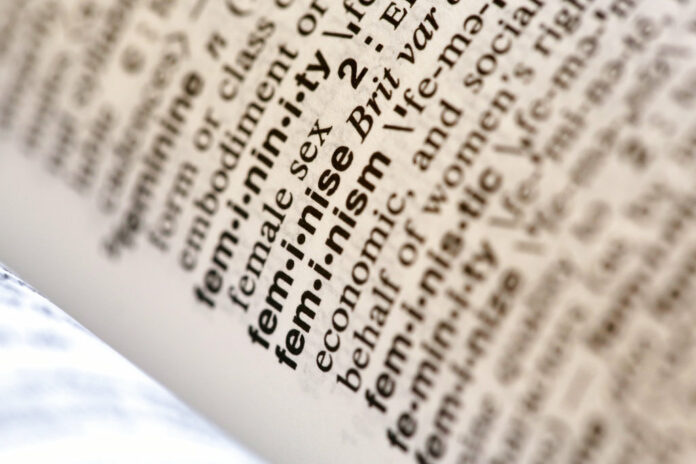
A photo taken Monday in New York shows the word feminism listed in the dictionary. Photo: Peter Morgan / Associated Press
NEW YORK — This may or may not come as a surprise: Merriam-Webster’s word of the year for 2017 is “feminism.”
Yes, it’s been a big year or two or 100 for the word. In 2017, lookups for feminism increased 70 percent over 2016 on Merriam-Webster.com and spiked several times after key events, lexicographer Peter Sokolowski, the company’s editor at large, told The Associated Press ahead of Tuesday’s annual word reveal.
There was the Women’s March on Washington in January, along with sister demonstrations around the globe. And heading into the year was Democrat Hillary Clinton’s presidential campaign and references linking her to white-clad suffragettes, along with her loss to President Donald Trump, who once boasted about grabbing women.
The “Me Too” movement rose out of Harvey Weinstein’s dust, and other “silence breakers” brought down rich and famous men of media, politics and the entertainment worlds.
Feminismhas been in Merriam-Webster’s annual Top 10 for the last few years, including sharing word-of-the-year honors with other “isms” in 2015. Socialism, fascism, racism, communism, capitalism and terrorism rounded out the bunch. Surreal was the word of the year last year.
“The word feminism was being use in a kind of general way,” Sokolowski said by phone from the company’s headquarters in Springfield, Massachusetts. “The feminism of this big protest, but it was also used in a kind of specific way: What does it mean to be a feminist in 2017? Those kinds of questions are the kinds of things, I think, that send people to the dictionary.”
Feminism’s roots are in the Latin for “woman” and the word “female,” which dates to 14th century English. Sokolowski had to look no further than his company’s founder, Noah Webster, for the first dictionary reference, in 1841, which isn’t all that old in the history of English.
“It was a very new word at that time,” Sokolowski said. “His definition is not the definition that you and I would understand today. His definition was, ‘The qualities of females,’ so basically feminism to Noah Webster meant femaleness. We do see evidence that the word was used in the 19th century in a medical sense, for the physical characteristics of a developing teenager, before it was used as a political term, if you will.”
Webster added the word in revisions to his “An American Dictionary of the English Language.” They were his last. He died in 1843. He also added the word terrorism that year.
“We had no idea he was the original dictionary source of feminism. We don’t have a lot of evidence of what he was looking at,” Sokolowski said.
Today, Merriam-Webster defines feminism as the “theory of the political, economic and social equality of the sexes” and “organized activities on behalf of women’s rights and interests.”
Another spike for the word feminism in 2017 occurred in February, after Kellyanne Conway spoke at the Conservative Political Action Committee.
“It’s difficult for me to call myself a feminist in the classic sense because it seems to be very anti-male and it certainly seems to be very pro-abortion. I’m neither anti-male or pro-abortion,” she said. “There’s an individual feminism, if you will, that you make your own choices. … I look at myself as a product of my choices, not a victim of my circumstances. And to me, that’s what conservative feminism is all about.”
She was applauded, and she sent many people to their dictionaries, Sokolowski said. The company would not release actual lookup numbers.
Other events that drew interest to the word feminism was the popular Hulu series, “The Handmaid’s Tale,” and the blockbuster movie, “Wonder Woman,” directed by a woman, Patty Jenkins, Sokolowski said.
Merriam-Webster had nine runners-up, in no particular order:
— Complicit , competitor Dictionary.com’s word of the year.
— Recuse , in reference to Jeff Sessions and the Russia investigation.
— Syzygy , the nearly straight-line configuration of three celestial bodies, such as the sun, moon and earth during a solar or lunar eclipse.
— Gyro , which can be pronounced three different ways, a phenom celebrated in a Jimmy Fallon sketch on “The Tonight Show.”
— Federalism , which Lindsey Graham referred to in discussing the future of the Affordable Care Act.
— Hurricane , which Sokolowski suspects is because people are confused about wind speed.
— Gaffe , such as what happened at the Academy Awards when the wrong best picture winner was announced. That was a go-to word for the media, Sokolowski said.
Gen. Prawit Wongsuwan flashes a watch thought to cost several million baht in a Dec. 4 photo.
Update: Just before 2pm, Gen. Prawit said he is not ready to send a letter to the anti-corruption commission. He refused to take any further questions from reporters.
BANGKOK — Deputy Prime Minister Gen. Prawit Wongsuwan will submit a letter Tuesday afternoon to anti-corruption officials clarifying how he obtained a multi-million baht watch and diamond ring that were not declared among his assets upon taking office, according to sources in the Government House.
Aides speaking on condition of anonymity said Prawit is at work but keeping mum about the controversial wristwatch by refusing to answer questions about whether he would claim the pricy items were not his.
The undeclared objects came to public attention after Prawit, who’s the junta second-in-command, flashed them while shielding his eyes from the sun while taking a group photo for the new cabinet earlier this month.
There was no record that Prawit had declared the objects, including the Richard Mille watch, when he was appointed after the 2014 coup. The least expensive Richard Mille watch available is Bangkok costs about 3 million baht.
On Tuesday, 72-year-old Prawit refused to respond when asked if he would say the watch was a loaner from a business friend and the diamond ring from his mother.
It is unclear when the National Anti-Corruption Commission, which last week gave Pravit 30 days to explain the watch, would make Prawit’s argument public.
Police respond to a report of an explosion near Times Square on Monday, Dec. 11, 2017, in New York. (AP Photo/Charles Zoeller)
NEW YORK — A man with a pipe bomb strapped to him set off the crude device in the subway near Times Square on Monday, injuring the suspect and three other people at the height of the morning rush hour.
The man and three others were being treated for non-life-threatening injuries in what the mayor and police labeled an attempted terror attack.
The explosion happened in an underground passageway under 42nd Street between 7th and 8th Avenues. The 7:30 a.m. blast caused smoke to fill the passageway, which was crowded with throngs of Monday morning commuters.
Mayor Bill de Blasio and Police Commissioner James P. O’Neill labeled it an attempted terror attack.
“Thank God the perpetrator did not achieve his ultimate goals,” de Blasio said.
The suspect was identified as 27-year-old Akayed Ullah.
Law enforcement officials said he was inspired by the Islamic State group but had apparently not had any direct contact with the group. The officials said he lives in Brooklyn and may be of Bangladeshi descent. The officials spoke to The Associated Press on condition of anonymity because they were not authorized to speak publicly about the blast.
Authorities said the bomb was a low-tech explosive device attached to the man with Velcro and plastic ties. They were investigating how it was made.
A photo publishedby the New York Post showed a bearded man crumpled on the ground with his shirt apparently blown off and black soot covering his bare midriff. A police officer is holding the man’s hands behind his back.
The explosion triggered a massive emergency response by police and firefighters both above and below ground, tangling subway and bus service at the nearby Port Authority bus terminal.
Fire officials said the suspect had burns to his hands and abodmen. The others who were injured suffered ringing in ears and headaches.
Elrana Peralta, a customer service worker for Greyhound, said she works in the Port Authority terminal complex near where the blast happened, but didn’t hear the explosion.
“All we could hear was the chaos,” she said. “We could hear people yelling, ‘Get out! Get out! Get out!'”
John Miles, 28, from Vermont, was waiting for a bus to Massachusetts. He also didn’t hear the blast, but saw police react.
“I didn’t know what was going on. Officers were running around. I was freaking out,” he said. There was an announcement that people should take their bags and leave. “They didn’t incite panic. It was fairly orderly.”
Video from above the “Crossroads of the World” showed lines of police and emergency vehicles, their lights flashing, lining the streets and no other vehicle traffic moving.
Everything around the Port Authority area was shut down — a surreal scene of still at what would ordinarily be a bustling rush hour.
New Jersey Transit buses headed to the Port Authority were diverting to other locations. NJ Transit said buses were taking passengers to Secaucus and Hoboken, where they could take trains into the city.
White House Press Secretary Sarah Sanders tweeted that President Donald Trump had been briefed on the explosion.
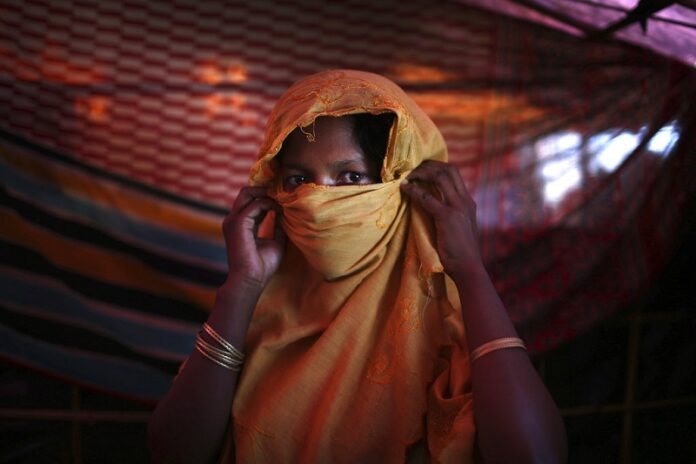
In this Thursday, Nov. 23, 2017, photo, S, 22, mother of one, who says she was raped by members of Myanmar's armed forces in late August, is photographed in her tent in Gundum refugee camp in Bangladesh. The use of rape by Myanmar's armed forces has been sweeping and methodical, the AP found in interviews with 29 Rohingya Muslim women and girls now in Bangladesh. Photo: Wong Maye-E / Associated Press
UKHIA, Bangladesh — The soldiers arrived, as they often did, long after sunset.
It was June, and the newlyweds were asleep in their home, surrounded by the fields of wheat they farmed in western Myanmar. Without warning, seven soldiers burst into the house and charged into their bedroom.
The woman, a Rohingya Muslim who agreed to be identified by her first initial, F, knew enough to be terrified. She knew the military had been attacking Rohingya villages, as part of what the United Nations has called ethnic cleansing in the mostly Buddhist nation. She heard just days before that soldiers had killed her parents, and that her brother was missing.
This time, F says, the soldiers had come for her.
The men bound her husband with rope. They ripped the scarf from her head and tied it around his mouth.
They yanked off her jewelry and tore off her clothes. They threw her to the floor.
And then the first soldier began to rape her.
She struggled against him, but four men held her down and beat her with sticks. She stared in panic at her husband, who stared back helplessly. He finally wriggled the gag out of his mouth and screamed.
And then she watched as a soldier fired a bullet into the chest of the man she had married only one month before. Another soldier slit his throat.
Her mind grew fuzzy. When the soldiers were finished, they dragged her naked body outside and set her bamboo house ablaze.
It would be two months before she realized her misery was far from over: She was pregnant.
___
The rape of Rohingya women by Myanmar’s security forces has been sweeping and methodical, the Associated Press found in interviews with 29 women and girls who fled to neighboring Bangladesh. These sexual assault survivors from several refugee camps were interviewed separately and extensively. They ranged in age from 13 to 35, came from a wide swath of villages in Myanmar’s Rakhine state and described assaults between October 2016 and mid-September.
Foreign journalists are banned from the Rohingya region of Rakhine, making it nearly impossible to independently verify each woman’s report. Yet there was a sickening sameness to their stories, with distinct patterns in their accounts, their assailants’ uniforms and the details of the rapes themselves.
The testimonies bolster the U.N.’s contention that Myanmar’s armed forces are systematically employing rape as a “calculated tool of terror” aimed at exterminating the Rohingya people. The Myanmar armed forces did not respond to multiple requests from the AP for comment, but an internal military investigation last month concluded that none of the assaults ever took place. And when journalists asked about rape allegations during a government-organized trip to Rakhine in September, Rakhine’s minister for border affairs, Phone Tint, replied: “These women were claiming they were raped, but look at their appearances — do you think they are that attractive to be raped?”
Doctors and aid workers, however, say that they are stunned at the sheer volume of rapes, and suspect only a fraction of women have come forward. Medecins Sans Frontieres doctors have treated 113 sexual violence survivors since August, a third of them under 18. The youngest was 9.
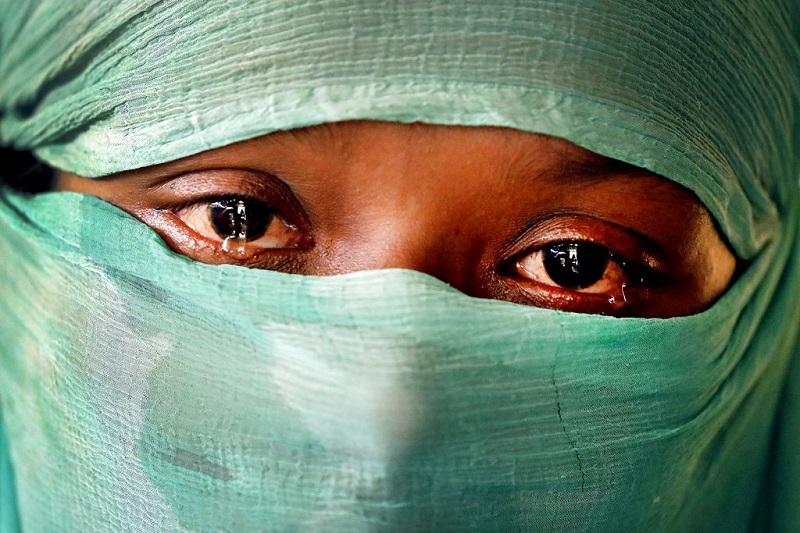
In this Wednesday, Nov. 22, 2017, photo, F, 22, who says she was raped by members of Myanmar’s armed forces in June and again in September, cries as she speaks to The Associated Press in her tent in Kutupalong refugee camp in Bangladesh. Photo: Wong Maye-E / Associated Press
The Associated Press reported this story with a grant from the Pulitzer Center on Crisis Reporting.
The U.N. has called the Rohingya the most persecuted minority on earth, with Myanmar denying them citizenship and basic rights. Hundreds of thousands of Rohingya refugees now live in sweltering tents in Bangladesh, where the stifling air smells of excrement from a lack of latrines and of smoke from wood fires to cook what little food there is. The women and girls in this story gave the AP their names but agreed to be publicly identified only by their first initial, citing fears they or their families would be killed by Myanmar’s military.
Each described attacks that involved groups of men from Myanmar’s security forces, often coupled with other forms of extreme violence. Every woman except one said the assailants wore military-style uniforms, generally dark green or camouflage. The lone woman who described her attackers as wearing plain clothes said her neighbors recognized them from the local military outpost.
Many women said the uniforms bore various patches featuring stars or, in a couple cases, arrows. Such patches represent the different units of Myanmar’s army.
The most common attack described went much like F’s. In several other cases, women said, security forces surrounded a village, separated men from women, then took the women to a second location to gang rape them.
The women spoke of seeing their children slaughtered in front of them, their husbands beaten and shot. They spoke of burying their loved ones in the darkness and leaving the bodies of their babies behind. They spoke of the searing pain of rapes that felt as if they would never end, and of days-long journeys on foot to Bangladesh while still bleeding and hobbled.
They spoke and they spoke, the words erupting from many of them in frantic, tortured bursts.
N, who says she survived a rape but lost her husband, her country and her peace, speaks because there is little else she can do — and because she hopes that somebody will listen.
“I have nothing left,” she says. “All I have left are my words.”
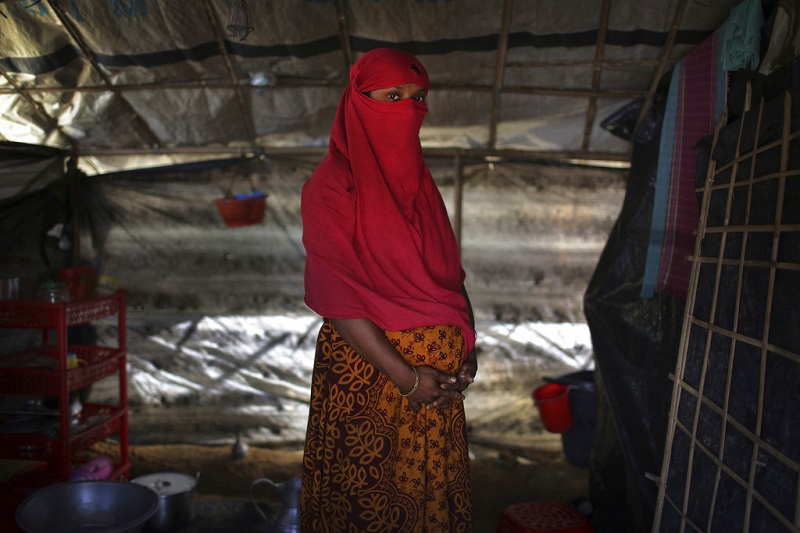
In this Monday, Nov. 20, 2017, photo, F, 22, who says she was raped by members of Myanmar’s armed forces in June and again in September, clutches her hands around her pregnant belly as she is photographed in her tent in Kutupalong refugee camp in Bangladesh. Photo: Wong Maye-E / Associated Press
Two months after the men came quietly in the night for F, they came boldly in the daytime for K.
It was late August, she says, just days after Rohingya insurgents had attacked several Myanmar police posts in northern Rakhine. Security forces responded with swift ferocity that human rights groups say left hundreds dead and scores of Rohingya villages burned to the ground.
Inside their house, K and her family were settling down to breakfast. They had only just swallowed their first mouthfuls of rice when the screams of other villagers rang out: The military was coming.
Her husband and three oldest children bolted out the door, fleeing for the nearby hills.
But K was nearly 9 months pregnant, with swollen feet and two terrified toddlers whose tiny legs could never outpace the soldiers’ strides. She had no place to hide, no time to think.
The door banged open. And the men charged in.
There were four of them, she thinks, maybe five, all in camouflage uniforms. Her young son and daughter began to wail and then, mercifully, scampered out the front door.
There was no mercy for her. The men grabbed her and threw her on the bed. They yanked off her earrings, nose ring and necklace. They found the money she had hidden in her blouse from the recent sale of her family’s cow. They ripped off her clothes, and tied down her hands and legs with rope. When she resisted, they choked her.
And then, she says, they began to rape her.
She was too terrified to move. One man held a knife to her eyeball, one more a gun to her chest. Another forced himself inside her.
When the first man finished, they switched places and the torture began again. And when the second man finished, a third man raped her.
In the midst of her agony, she thought of nothing but the baby inside her womb, just weeks away from emerging into a world that would not want him, because he was a Rohingya.
She began to bleed.
She blacked out.
As she awoke, her great aunt was there, tearfully untying her. The elder woman bathed her, clothed her and gave her a hot compress for her aching thighs.
When K’s husband returned home, he was furious: not just at the men who had raped her, but at her. Why, he demanded, had she not run away?
She was pregnant and in no condition to run, she shot back. Still, he blamed her for the assault and threatened to abandon her, because, he told her, a “non-Muslim” had raped her.
Fearful the men would return, she and her family fled to her father’s house in the hills above the village. When they saw soldiers setting fire to the houses below, they knew they had to leave for Bangladesh.
K was too crippled by pain to walk. Her husband and brother placed her inside a sling they fashioned out of a blanket and a stick, and carried her for days.
Inside her cocoon, she wept for the baby she feared was dead.
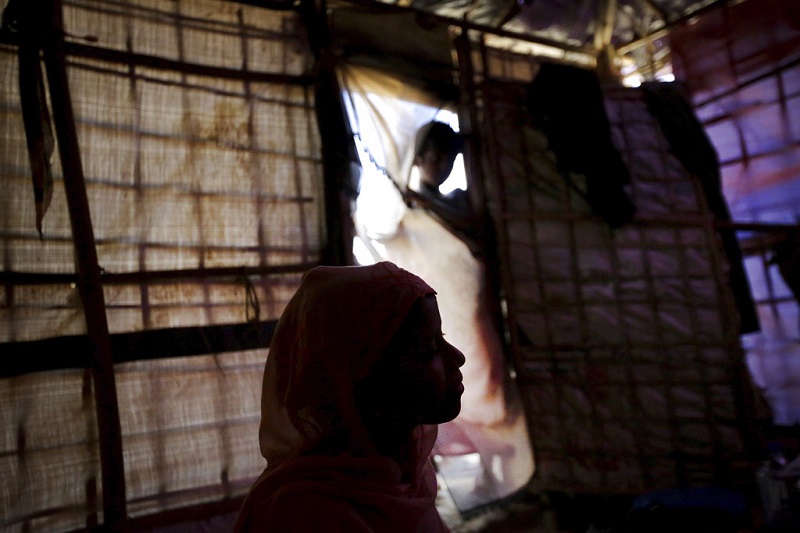
In this Sunday, Nov. 19, 2017, photo, R, 13, is seen in silhouette as she speaks to The Associated Press in her tent in Kutupalong refugee camp in Bangladesh. Photo: Wong Maye-E / Associated Press
A few days after the men burst into K’s house, 10 soldiers arrived at R’s.
She was just 13 years old, but R had already learned to fear the military men.
Her parents had warned her to steer clear of them, yet it was her father who first fell prey to their wrath. One day last year, R says, soldiers stabbed him in the head with a knife, killing him.
Yet R’s family had nowhere else to go. And so they stayed in the village. R busied herself by learning Arabic, doting on her chicken and its hatchlings and caring for her two younger brothers.
And then one day in late August, R says, the soldiers barged into her house. They snatched up her little brothers, tied them to a tree outside and began to beat them. R tried to run out the front door, but the men caught her.
Her body is barely pubescent, her limbs still gangly like a child’s. But her youth could not protect her.
R fought back against the men, but they dragged her out of the house. The skin tore away from her knees as her legs scraped along the ground.
The men tethered her arms to two trees. They ripped off her earrings and bracelets, stripped off her clothes.
R screamed at them to stop. They spit at her.
And then the first man began to rape her.
She froze. She was a virgin. The pain was excruciating.
The attack lasted for hours. She remembers all ten men forcing themselves on her before she passed out.
One of her older brothers later found her on the ground, bleeding.
R’s two little brothers were missing, but their mother had no time to search for them. She knew she had to get her daughter over the border and to a doctor quickly to get medicine in time to prevent a pregnancy.
R was barely conscious. So her two older brothers carried her across the hills and fields toward Bangladesh. R’s mother hurried alongside them, terrified for her daughter, terrified that time was running out.
___
That R’s family sought treatment for her at all is an anomaly. Despite still suffering pain, bleeding and infections months after the attacks, only a handful of the women interviewed by the AP had seen a doctor. The others had no idea free services were available, or were too ashamed to tell a doctor they were raped.
In a health center overflowing with women and wailing babies, Dr. Misbah Uddin Ahmed, a government health officer, sits at his desk looking weary. He pulls out a stack of patient histories for those treated at his clinics and begins to flick through them, reading the case summaries out loud:
Sept. 5, a patient 7 months pregnant says three soldiers burst into her home 11 days ago and raped her. Also Sept. 5, a patient says she was asleep at home when the military broke in 20 days ago and three soldiers raped her. Sept. 10, a patient says the military came to her house one month ago and beat her husband before two soldiers raped her.
Ahmed says the women who manage to overcome their fear and make it to his clinics are usually the ones in the deepest trouble. So many others, he adds, are suffering in silence.
Though the scale of these attacks is new, the use of sexual violence by Myanmar’s security forces is not. Before she became Myanmar’s civilian leader, Aung San Suu Kyi herself condemned the military’s abuses. “Rape is rife. It is used as a weapon by armed forces to intimidate the ethnic nationalities and to divide our country,” she said in a 2011 videotaped statement to the Nobel Women’s Initiative.
And yet Suu Kyi’s government has not only failed to condemn the recent accounts of rape, it has dismissed the accounts as lies. In Dec. 2016, the government issued a press release disputing Rohingya women’s reports of sexual assaults, accompanied by an image that said “Fake Rape.”
Ahmed seems bewildered that anyone would ever doubt these women. Look at what I have just shown you, he says, gesturing toward his stack of files chronicling one atrocity after another.
Gynecologist Arjina Akhter has witnessed the results of those atrocities. Since August, so many women began showing up at her two clinics, she stopped asking them to fill out patient history forms so she could treat them faster. Among other women, she estimates between 20 to 30 rape survivors visited her clinics in September and October.
She ticks off the injuries: Two women with lacerations to their cervixes they said were caused by guns shoved inside their bodies. One woman with horrific tearing she said was caused by a nail driven into her vagina. Several women with severe vaginal bleeding.
More recently, she says, women who were raped months ago have been coming to her in a panic, asking for abortions. She has to explain to them that they are too far along, but reassures them that officials will take the babies if they cannot care for them.
Still, for some Rohingya women, giving up the babies they never asked for was not an option.
Which is how it was for F.
___
More than three months had passed since the men burst into F’s home, and her despair had only deepened.
Neighbors had taken her in and cared for her. But her house was gone, her husband was dead. And the timing of the attack left little doubt that the baby growing inside her belonged to one of the men who had caused all her grief.
She could only pray that things would not get worse. And then, one night in mid-September, they did.
F was asleep along with the neighbors — a couple and their 5-year-old son — when the men broke down the door, jolting everyone awake.
There were five of them this time, she remembers. They quickly grabbed the boy and slashed his throat, and killed the man.
Then they turned to the man’s wife, and to F. And her nightmare began again.
They stripped off the women’s clothes. Two of the men noticed the swell of F’s stomach and grabbed it, squeezing hard.
They threw the women to the floor. F’s friend fought back, and the men beat her with their guns so viciously the skin on her thighs began to peel away.
But the fight had gone out of F. She felt her body go soft, felt the blood run between her legs as the first man forced himself on her, and then the second. Next to her, three men were savaging her friend.
When it was finally over and the men had gone, the two women lay immobile on the floor.
They lay there for days, so crippled by pain and catatonic from the trauma that they could not even lift themselves to use the toilet. F could smell the blood around them. As the house baked under the punishing sun, the stench from the decaying bodies of her friend’s husband and son finally overwhelmed her.
She would not die here. And neither would her baby.
She reached out for her friend’s hand and clasped it. Then F hauled herself to her feet, pulling her friend up with her. Hand in hand, the women stumbled to the next village. They spent five days recovering there and then, alongside a group of other villagers, began the 10-day journey to Bangladesh.
The monsoon season had begun, but there was nowhere to shelter. So F kept walking through the downpours. She was starving, and her battered body ached with each step. Generous strangers offered her sips of their water, and one man gave her a few sweet rolls.
One day, she came across a 9-year-old boy lying along the side of a road, wounded and alone. He had lost his parents, he told her, and the soldiers had tortured him. She took him with her.
Together, the two made it to the shores of the Naf River and boarded a boat to Bangladesh.
Which is where they live now, in a tiny bamboo shelter between two filthy latrines. And it is here that F prays her baby will be a boy — because this world is no place for a girl.
___
For now, the women are left to wonder how long they will live in the bleak limbo of Bangladesh, and if they will ever return to their homeland.
R, the teen, is not pregnant. Her mother sold all her jewelry and got her to the hospital in time. But R can’t stop thinking about her little brothers, and her sleep is plagued by nightmares.
Since the rape, she has struggled to eat, and her once-curvy frame has shrunk. Before the rape, she says softly, she was pretty.
K, who feared the baby inside her had died, gave birth to a boy on the floor of her tent in a dizzying rush of relief. She had kept her son alive through it all.
But her trauma persists. The thrum of a helicopter hovering over the camp sends her into a panic and she recites the Muslim prayer for the moments before death. She is convinced the aircraft is Myanmar’s military, coming to kill them all.
When told she is strong, she looks up with tears in her eyes.
“How can you say that?” she asks. “My husband says he is ashamed of me. How am I strong?”
F, whose body is starting to ache under the strain of her pregnancy, finds her mind often drifts toward how she will care for the child in the future. She believes God has kept them both alive for a reason.
Her parents, her brother, her husband are gone now. This baby will be the only family she has left. For her, the most haunting reminder of the agony she endured also, somehow, represents her last chance at happiness.
“Everybody has died,” she says. “I don’t have anyone to care for me. If I give this baby away, what will I have left? There will be nothing to live for.”
WASHINGTON — Simeon Booker, a trail-blazing African-American journalist and the first full-time black reporter at The Washington Post, died Sunday at the age of 99.
Booker died at an assisted-living community in Solomons, Maryland, according to a Post obituary, citing his wife Carol. He had recently been hospitalized for pneumonia.
Booker served for decades as the Washington bureau chief for the iconic African-American publications Jet, a weekly, and Ebony, a monthly. He is credited with bringing to national prominence the 1955 death of Emmett Till, the 14-year old African-American boy whose brutal murder in Mississippi became a galvanizing point for the nascent civil rights movement. Booker’s article included an open-casket picture of Till’s mangled face that shocked the nation.
In a 2013 video tribute upon Booker’s induction into the National Association for Black Journalists Hall of Fame, former Jet reporter Roy Betts said that Booker’s coverage of the civil rights movement, “catapulted the movement onto the world stage.”
His reporting from the Deep South placed him in near-constant danger. Tributes to him mention that he sometimes dressed as a minister (complete with Bible) or a farmer to escape detection and one frequently-told tale had Booker escaping from an angry mob in the back of a hearse. He rode in one of the buses to cover the 1961 Freedom Rides, when black activists rode from Washington to New Orleans to challenge a ban on segregated interstate transportation facilities.
Booker was born in Baltimore and raised in Youngstown, Ohio. He started his journalistic career working for a string of African-American publications. He joined the Post in 1952, but moved on two years later to found the Washington bureau for Johnson Publishing, the parent company for Jet and Ebony.
He served in that position for more than 50 years, authoring the widely-read Ticker Tape column, chronicling Washington’s inner workings for a national black readership before retiring in 2007. He covered 10 different presidents and also traveled abroad to report on the Vietnam War.
Booker authored or co-authored four books, including a 2013 memoir co-written with his wife Carol McCabe Booker and entitled, “Shocking the Conscience: A Reporter’s Account of the Civil Rights Movement.”
Booker was inducted into the National Association of Black Journalists’ Hall of Fame in 2013 and received a career George Polk Award for lifetime achievements in journalism and the National Press Club’s Fourth Estate Award.
He is survived by the wife Carol and three children.