





























29.4 C
Bangkok
Friday, June 26, 2026
Home Blog Page 2145

Mideast Braces For Fallout From Trump’s Move on Jerusalem

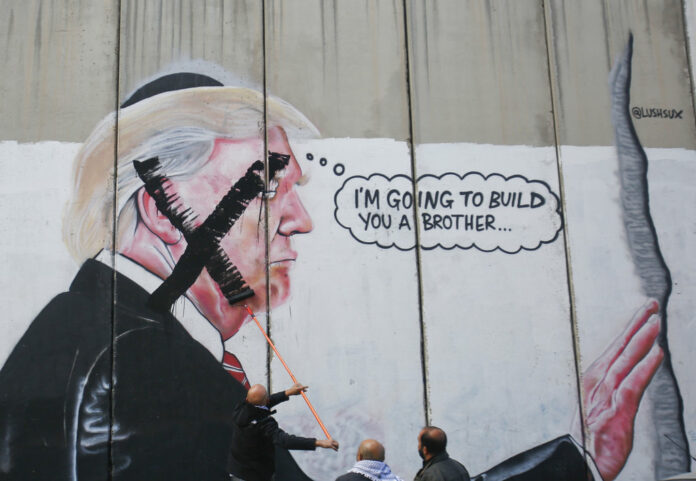
A Palestinian paints over a mural of the U.S. President Donald Trump during a protest in Bethlehem, West Bank on Thursday. Photo: Nasser Shiyoukhi / Associated Press

JERUSALEM — Palestinians shuttered schools and shops and called for protests in West Bank towns on Thursday, while the leader of the Hamas militant group called for a new armed uprising, in widespread show of anger over President Donald Trump’s move to recognize Jerusalem as Israel’s capital.

Trump’s dramatic break on Wednesday with decades of U.S. policy on Jerusalem counters long-standing international assurances to the Palestinians that the fate of the city will be determined in negotiations. The Palestinians seek Israeli-annexed east Jerusalem, captured by Israel in 1967, as a future capital.

There have been no signs of serious violence so far. But Friday, the Muslim holy day, could provide an important test when Palestinians gather for weekly mass prayers.

In the Gaza Strip, Hamas’ leader Ismail Haniyeh called on Palestinians to launch a new intifada, or uprising, against Israel on Friday.

“The American decision is an aggression on our people and a war on our sanctuaries,” Haniyeh said in a speech, urging supporters “to be ready for any orders.”

“We want the uprising to last and continue to let Trump and the occupation regret this decision,” he said.

Hamas, a group that seeks Israel’s destruction, killed hundreds of Israelis in suicide bombings and other attacks in the early 2000s. But the group’s capabilities are more limited now. Gaza, Hamas’ stronghold, is closed by an Israeli blockade, while in the West Bank, many of its members have been arrested. Nonetheless, it possesses a large arsenal of rockets capable of striking much of Israel.

Spontaneous protests sparked in Gaza overnight, with angry youths burning tires, American and Israeli flags and Trump posters.

The Israeli military said it would deploy several battalions to the West Bank ahead of Friday, while other troops have been put on alert to address “possible developments.”

The conflicting claims to Jerusalem, and especially its Old City, where sensitive Jewish, Muslim and Christian holy sites are located, lie at the core of the Israeli-Palestinian conflict. While Trump’s decision had no impact on the city’s daily life, it carried deep symbolic meaning, and was seen as siding with Israel and an attempt to impose a solution on the Palestinians.

Israel, which claims all of Jerusalem as its undivided capital, has welcomed Trump’s decision. Prime Minister Benjamin Netanyahu said Trump “bound himself forever” to the history of Jerusalem with the move and claimed other states are considering following suit.

“We are already in contact with other states that will make a similar recognition,” he said at the Foreign Ministry on Thursday.

Anger at the U.S. has rippled across the Arab world.

Saudi Arabia’s royal court, led by King Salman and his powerful son, condemned the Trump administration’s decision in a rare public rebuke by the U.S. ally. The regional powerhouse, which could help the White House push through a Middle East settlement, said Thursday the kingdom had already warned against this step and “continues to express its deep regret at the U.S. administration’s decision,” describing it “unjustified and irresponsible.”

Trump’s move puts the Sunni nation in a bind. The kingdom, particularly its powerful crown prince, Mohammad Bin Salman, enjoys close relations with Trump and his son-in-law Jared Kushner, who leads Trump’s efforts to restart Mideast peace talks.

U.S. Embassies across much of the Middle East and parts of Africa warned American citizens of possible protests following Trump’s move.

Palestinian President Mahmoud Abbas has suggested that with Trump’s move, the United States disqualified itself as mediator between Israelis and Palestinians, a role it has played exclusively in more than two decades of stop-and-go negotiations aimed at setting up a Palestinian state alongside Israel.

The talks, stalled in recent years, have failed to bring the Palestinians closer to the state the seek in the West Bank, Gaza Strip and east Jerusalem, lands Israel captured in the 1967 Mideast war. In parallel, Israel has steadily expanded Jewish settlements on war-won lands, even as it said it wants to negotiate a deal.

Trump’s claim Wednesday that he still wants to pursue what he has called the “ultimate” Mideast deal was met by mounting skepticism.

“With its decision, the U.S. has isolated itself and Israel, and has pushed the area into a dangerous situation and stopped the peace process,” said Nabil Abu Rdeneh, a senior Abbas aid. “Without a doubt, this decision will not help at all in solving the problems in the area, but rather strengthen the extremists.”

Abbas has not said what steps he would take, if any. Later Thursday, he was to meet with his closest Arab ally, Jordan’s King Abdullah II, to coordinate positions.

Jordan plays a central role in the mounting controversy and, alongside other U.S. allies in the region, has slammed Trump’s decision on Jerusalem.

The king is seen as one of Washington’s most dependable partners in the battle against Islamic extremism in the region.

At the same time, the legitimacy of his Hashemite dynasty is closely linked to its special role in Jerusalem, as religious guardian of a key Muslim shrine in east Jerusalem. Jordan, which has a large population with Palestinian roots, cannot afford to be seen as soft on Muslim claims to the holy city.

The consultations between the monarch and Abbas will kick off a series of meetings in the Arab and Muslim world on how to respond to Trump.

The Arab League, a group representing most states in the Middle East and North Africa, will meet Saturday. Next week, Turkey will host a gathering of the Organization of Islamic Cooperation, which has 57 Arab and Muslim member states.

The region has been bracing for fallout from Trump’s seismic policy shift.

Turkish President Recep Tayyip Erdogan on Thursday accused Trump of throwing the Mideast into a “ring of fire” and said his motives were difficult to fathom. “It’s not possible to understand what you are trying to get out of it, Erdogan said, referring to Trump in a speech to a group of workers at Ankara’s airport.

“Political leaders exist not to stir things up, but to make peace,” Erdogan said. “If Trump says ‘I am strong therefore I am right,’ he is mistaken.”

Defying worldwide warnings, Trump insisted Wednesday that it was time for a new approach, starting with what he said was his decision merely based on reality to recognize Jerusalem as the seat of Israel’s government. He also said the U.S. would move its embassy from Tel Aviv to Jerusalem, though he set no timetable.

“We cannot solve our problems by making the same failed assumptions and repeating the same failed strategies of the past,” Trump said, brushing aside the appeals for caution from around the world.

Story: Karin Laub, Ilan Ben Zion
Advertisement

Ring in the Holidays With 60-Story Ratchaprasong Light Show

BANGKOK — Ring in the new year with a 60-story light show in the shopaholic heart of Bangkok.

Starting Wednesday, a 3D-mapping installation will be projected several times nightly onto the Magnolias Ratchadamri Boulevard building in the Chit Lom area. For maximum seasonal cheer, view it from the holiday display outside CentralWorld at Ratchaprasong intersection.

The “Beautiful Bangkok” installation will premiere at 7:45pm. From Dec. 14 to Dec. 31, it will show at 7pm, 7:15pm, 7:30pm, 7:45pm and 8pm every night. On New Year’s Eve, there will be an extra show at 11:55pm for countdowners to have a dazzling start to 2018.

Projection mapping involves video projected onto 3D objects such as buildings. The mapping for this project is developed by Hungarian group Limelight, who produced the light show at this year’s iMapp Festival in Bucharest.

The Beautiful Bangkok project is backed by Magnolia Quality Development Corp., the Ratchaprasong Square Trade Association and the Tourism Authority of Thailand.

Advertisement

Woman Blames Bad Click For 150,000B Bangkok Hotel Bill. Then Her Story Got Weirder.

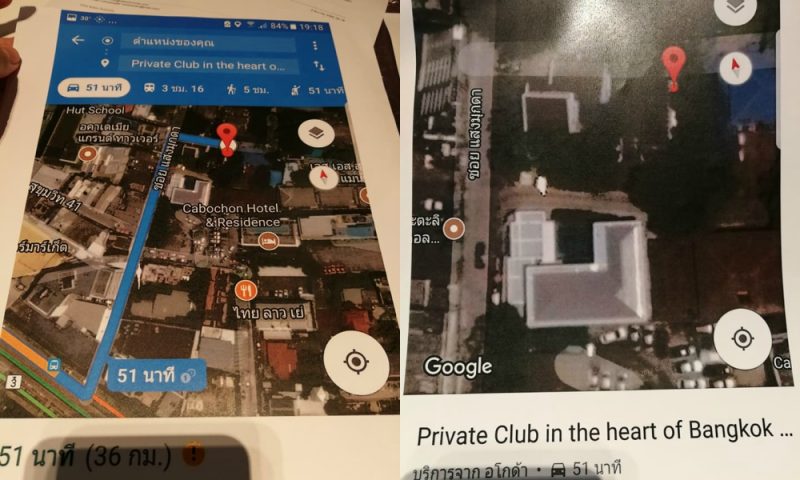
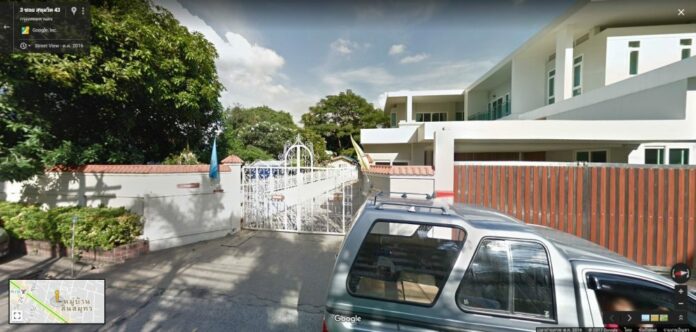
The location of what was supposed to be ‘Private Club in the Heart of Bangkok’ as listed on Agoda Homes. Image: Google

BANGKOK — A woman says an accidental swipe on her smartphone cost her 150,000 baht when she inadvertently booked a residence that turned out not to exist.

Sulawan Luckchonlatee on Thursday filed a criminal complaint against online booking agency Agoda after she was billed 150,000 baht and was unable to cancel the booking or contact the place – because she could not find it.

Min Buri cop Lt. Col. Noppakun Pratumpetch said Thursday afternoon that Sulawan filed a charge of fraud against the online booking giant. He said police are investigating and will summon a representative of the company to acknowledge the charge.

An Agoda representative said the company has no plan to make a statement or answer questions about the matter.

Sulawan’s allegations came to public attention Tuesday through Queen of Spades, a popular clearinghouse for social issues. The story has spawned many headlines in Thai about Sulawan’s “ghost hotel,” drawing attention nationwide.

In an interview Thursday afternoon, Sulawan said she started using Agoda’s smartphone app in August. As a regular Agoda member with a registered credit card, she said accidentally pressing the “book and pay” button instead of the “back” button caused her to immediately be charged 144,393.99 baht for a three-night stay at “Private Club in the Heart of Bangkok,” a four-bedroom apartment located in Soi Sukhumvit 43.

The app did not ask for any confirmation, she said, of the booking from Nov. 21 to Nov. 24.

Sulawan said her bank agreed to freeze her card for 180 days, but apparently would not reverse the charge because she’s still on the hook for paying the mystery hotel, the whereabouts of which remain unknown.

According to Sulawan, she will file a complaint at the Consumer Protection Board on Friday.

“Agoda should physically go to the location of the hotels they deal with,” Sulawan said.

It may not be that simple though. An entry for the property can still be found in the database of Agoda Homes, which is the booking giant’s Airbnb-like service that allows any private party to list their property. It could not be booked on Thursday.

Agoda is based in Thailand but owned by a subsidiary of US-based Priceline.

Saying she immediately sought to get her money back, Sulawan tried to call a contact listed on the booking but it was a number in the United States which the operator referred back to Thailand’s Agoda office. When she called Agoda, she said staff told her the company has a no refund policy once bookings are made.

So Sulawan said she tramped into the soi to find the hotel, using GPS to find the location shown on the booking page. There she found a privately owned home.

There was a hotel around the corner that shared similarities with the “private club” listing, but Sulawan said staff there denied receiving her booking.

AGODA HED e1512644381417
Private Club in the heart of Bangkok is seen on Agoda Homes
AGODA
Private Club in the heart of Bangkok is seen on Agoda Homes


Advertisement

Provincial Airport Closed as Southern Flood Toll Rises

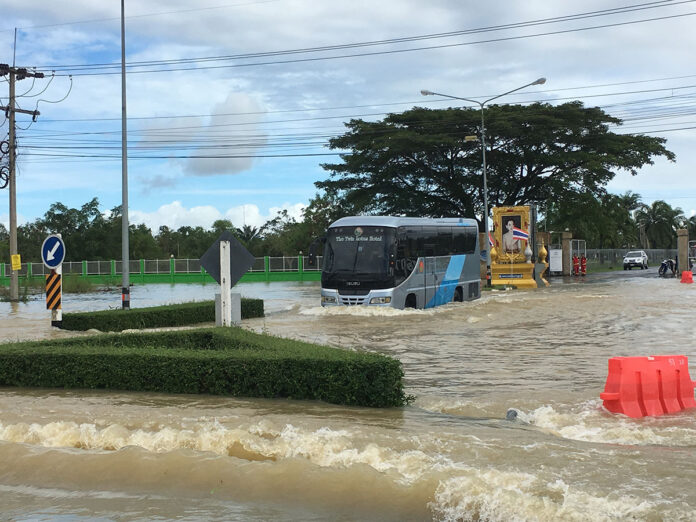
A tour bus attempts to drive Thursday through the flooded entrance of Nakhon Si Thammarat Airport.

NAKHON SI THAMMARAT — A southern provincial airport remained closed a second day Thursday as two more bodies were recovered from deadly floodwaters, bringing the death toll from the regional flooding crisis to eight.

The severe flooding that has persisted for the past month in the region caused the Nakhon Si Thammarat Airport to be closed Wednesday, a day after a bus flipped 60 kilometers to the north, killing two women who were sisters.

“We will close on Thursday, extending the closure for another day because we will need to check the weather, water levels and electrical systems,” Darun Saengchai, airport director, said today.

Those planning to fly into the airport should check with their airlines for flight changes. Darun says the airport plans to reopen Friday unless weather conditions take a turn for the worse.

Read: Unchecked Development, Poor Planning Set Stage for Flood Crisis

On Tuesday night, floodwaters swept away a bus shuttling 50 people along the Surat Thani-Nakhon Si Thammarat Road in tambon Thung Sai. The bodies of Jan Kamkeaw, 68, and Manee Kamkeaw, 63, were found the next morning, 300 meters from the accident.

It took hours for rescue workers to retrieve the Kamkaew women’s bodies since water levels continued to run high.

The transport bus was on the way to the Tha Sala district for a funeral when it was pushed onto its side by a flash flood. The rest of the passengers were safe.

The southern flooding, a nearly annual occurrence, claimed the life of a nurse driving at night in Trang on Friday and five others in seaside areas of Songkhla province on Monday, bringing the number of fatalities to eight.

Local city planners, flood relief officers and environmentalists attribute the severity and persistence of the flooding to poor infrastructure, urban sprawl and wetlands destruction.

Footage of the flooding Tuesday night in Nakhon Si Thammarat.

บน5
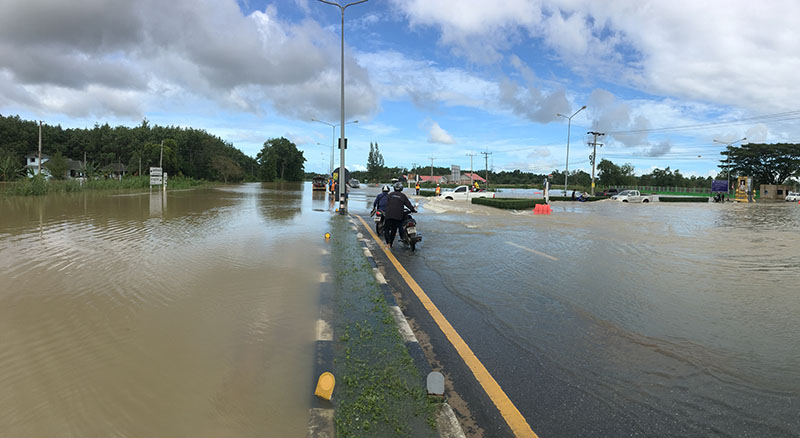
Motorists at the entrance to Nakhon Si Thammarat Airport on Thursday.
เอา2
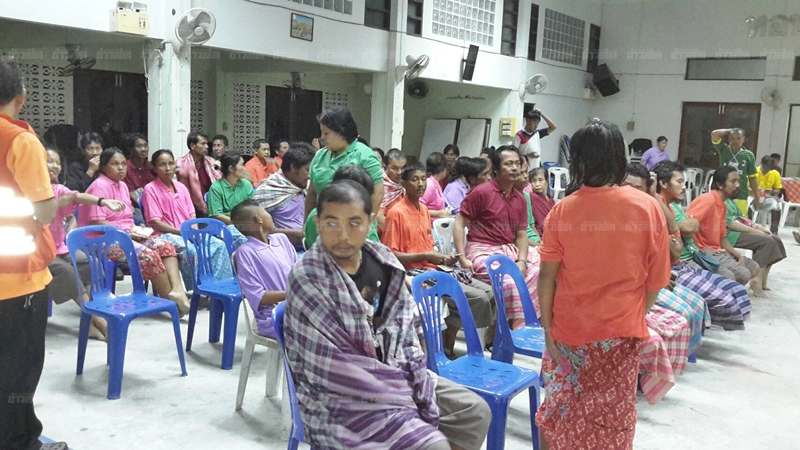
Survivors of a fatal bus accident at a shelter Wednesday morning in Nakhon Si Thammarat.

Related stories:

Southern Flooding Claims First Victim (Video)

Unchecked Development, Poor Planning Set Stage for Flood Crisis

Advertisement

New Traffic Tickets More Convenient – But Can’t Be Ignored

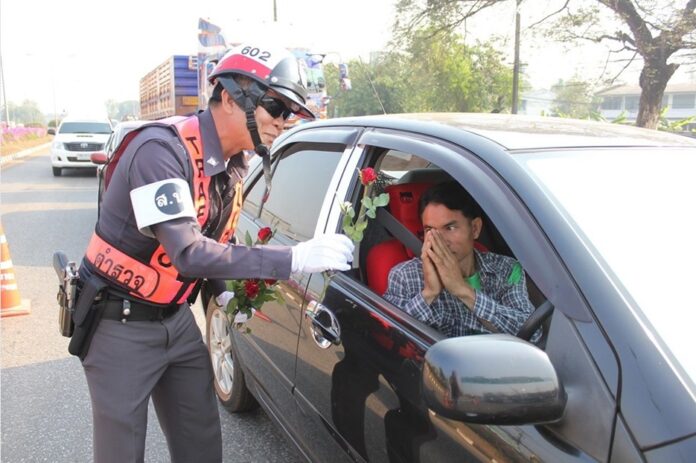
A cop hands out roses instead of tickets to traffic violators on Valentine's Day 2016 in Sakon Nakhon province.

BANGKOK — A new type of traffic ticket, which includes a barcode and English translation, will come into universal use early next year, police said Thursday.

In addition to impeding corruption, the new tickets allow traffic violators to pay fines at an ATM and are translated into English for the ever increasing number of foreign motorists in Thailand, said Jirapat Phumjit, deputy commander of Bangkok metro police. They also cannot be simply ignored as the old tickets often were.

“There are still some left in the circulation,” Maj. Gen. Jirapat said in an interview. “They can still be used, but they will run out soon, because the new forms will replace them … I think they will be all gone within the next two months.”

Jirapat also said the new tickets are already being used by traffic police nationwide.

Motorists previously caught breaking traffic laws were handed written tickets and had their driver’s licenses confiscated. Violators had to travel to the police station in order to pay any fines and retrieve their licenses. Or they could elect not to, and just drive without their licenses.

In March, after police pointed out only 11 percent or about 75,000 of 680,000 parking tickets were paid in a six-month period, junta leader Prayuth Chan-ocha tried to rein in the scourge of unpaid tickets by using his absolute power to deny them renewed licenses.

People who don’t respond to police reminders to pay the fines within two weeks after they are sent out are also liable for prosecution in court, according to the order.

Traveling to the police station is no longer necessary under the new system, Jirapat said. Motorists can simply pay their fines via any Krungthai Bank ATM or Counter Service at many supermarkets and convenience stores. Police stations will mail the confiscated driver’s licenses to violators once the fines are paid, he said.

Apart from convenience, the new tickets are also bilingual.

“We are now more inter,” Jirapat said, laughing. “Many foreigners drive these days. Many come from our neighboring countries via the land borders, so we have English translation.”

Related stories:

No More Police ‘Extortion’ Checkpoints, New Chief Vows

2 Cops Accused of Embezzling Traffic Fines

Advertisement

Court Delays Decision on ‘Elephant Duel’ Charges

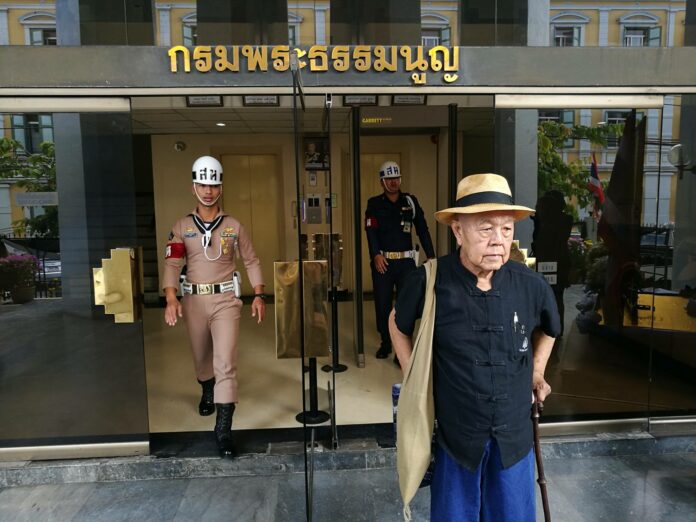
Sulak Sivaraksa, accused of lese majeste over comments about a 16th century elephant battle, meets Oct. 9 with military prosecutors.

BANGKOK — A military court on Thursday delayed a decision on whether to prosecute a prominent historian and social critic who suggested that a famed duel on elephant-back won by a Thai king against a Burmese prince 500 years ago may not actually have happened.

The 84-year-old Sulak Sivaraksa was charged by police last October under the country’s draconian lese majeste law that protects the monarchy from libel and defamation.

The military court on Thursday agreed with Sulak’s request to hear views from experts and historians and set a new hearing for Jan. 17.

Read: Court Delays Decision on ‘Elephant Duel’ Charges

Sulak told reporters outside the court that “to live in this country you must have a sense of humor because my case is nonsensical.” He said it would be impossible for Thais to learn history if commenting on King Naraesuan, who led the famous 1593 battle that is celebrated as a national holiday, is considered illegal.

The case stems from remarks Sulak made in 2014 when he urged a university seminar to think critically about Thai history.

Thailand’s lese majeste law is the harshest in the world, punishable by three to 15 years in prison. The law, in writing, only protects the king, queen, and heir apparent, and doesn’t appear to mention dead monarchs, but in practice the rules are more widely interpreted.

The ruling military government has pursued over 250 lese majeste cases since it seized power in a 2014 coup, more than any previous governments in the past decade, according to Thai newspaper Prachatai. The law has been widely criticized including by rights groups and the U.N., which has called for it to be revoked.

“The junta’s abusive use of the lese majeste law has reached a new height of absurdity when a prominent scholar is charged with a criminal offense for questioning the occurrence of a 16th-century battle,” said Brad Adams, Asia director of Human Rights Watch. “Academic freedom and free speech in Thailand will suffer devastating blows if the trial against Sulak proceeds.”

Sulak is a well-known academic and proclaimed royalist but an outspoken critic of the lese majeste law. He has previously faced at least five lese majeste charges.

British writer and historian Chris Baker said there are at least 10 different accounts of the elephant battle told in Thai, Burmese and French.

“There is no definitive account. There are various different accounts and historians accept that perhaps we don’t actually know what happened,” Baker said. “There are just many different stories told about an event that seems to have been very exciting.”

Related stories:
112 Case Moves Forward Against Historian For Doubting 16th Century ‘Elephant Duel’
King’s Death Left ‘Hole in Heart’ of Loyalist Critic Sulak

Advertisement

Australian Parliament Allows Same-Sex Marriages

Same-sex marriage campaigners and volunteers cheer as they call on politicians to pass marriage equality legislation during rally outside Parliament House in Canberra, Australia, Thursday, Dec. 7, 2017. Gay marriage was endorsed by 62 percent of Australian voters who responded to a government-commissioned postal ballot by last month. Photo: Lukas Coch / AAP Image via AP

CANBERRA, Australia — The Australian Parliament voted on Thursday to allow same-sex marriage across the nation, following a bitter and divisive debate settled by the government polling voters in a much-criticized ballot survey that strongly endorsed change.

The public gallery of the House of Representatives erupted with applause when the bill passed to change the definition of marriage from solely between a man and a woman to “a union of two people” excluding all others. The legislation passed with a majority that wasn’t challenged, although five lawmakers registered their opposition to the bill.

The Senate passed the same legislation last week 43 votes to 12. After royal assent and other formalities, the law will likely take effect in about a month, with the first weddings expected about a month later.

Amendments meant to safeguard freedoms of speech and religion for gay-marriage opponents were all rejected, though those issues may be considered later. The government has appointed a panel to examine how to safeguard religious freedoms once gay marriage is a reality in Australia.

Lawmakers advocating marriage equality had argued that the national postal survey in November mandated a change of the marriage definition alone, so changing the law should not be delayed by other considerations.

“It is now our job as members of Parliament to pass a fair bill that does not extend or create any new discriminations,” an emotional government lawmaker Warren Entsch, who helped draft the bill, told Parliament. “It is a strong bill that already strikes the right balance between equality and freedom of religion.”

“It’s an historic day for Australia today and I think the celebrations around the country when we finally … achieve marriage equality are going to be immense,” Janet Rice said before the vote. Rice is a minor Greens party senator who was only able to remain married to her transgender wife of 31 years, Penny, because Penny remained listed as male on her birth certificate.

Penny Wong, an opposition Labor Party senator who has two children with her lesbian partner, said: “I am feeling happy.”

Gay marriage was endorsed by 62 percent of Australian voters who responded to the government-commissioned postal ballot.

Most gay rights advocates believed the government should have allowed marriages years ago and saw various ideas for a public survey as a delaying tactic. The U.N. Human Rights Committee had called the ballot survey “an unnecessary and divisive public opinion poll.”

The current bill allows churches and religious organizations to boycott gay weddings without violating Australian anti-discrimination laws.

Existing civil celebrants can also refuse to officiate at gay weddings, but celebrants registered after gay marriage becomes law would not be exempt from the anti-discrimination laws.

One of the rejected amendments would have ensured Australians could speak freely about their traditional views of marriage without fear of legal action. It was proposed by Attorney-General George Brandis and supported by Prime Minister Malcolm Turnbull, both gay marriage supporters.

Former Prime Minister Tony Abbott, who was a high-profile advocate for traditional marriage, told Parliament that Turnbull and opposition leader Bill Shorten had failed to deliver detailed protections for freedoms of speech, conscience and religion in the bill.

“A promise was made by the leaders of this Parliament and the promise has not adequately been delivered on,” Abbott said.

Abbott pointed to an Australian teenager who lost her job for advocating against gay marriage on social media and an Australian Catholic bishop who was taken before a state anti-discrimination tribunal over a pamphlet he published extolling traditional marriage. The complaint against the bishop was dropped.

“The last thing we should want to do is to subject Australians to new forms of discrimination in place of old ones that are rightly gone,” he said.

Government lawmaker Trevor Evans ruled out an Australian equivalent of the U.S. Supreme Court case in which a baker who refused to provide a wedding cake for a gay couple argued he was exercising artistic freedom and was exempt from Colorado anti-discrimination laws.

“Let’s be honest here, for a case like that to arise in Australia, it would require a gay couple who care more about activism than about the success of their own wedding, to find a business operator who cares more about religious doctrine than the commercial success of their own small business, and for both of them to commit to having a fight,” Evans told Parliament.

“Typical Australians would genuinely question the bona fides of the players in a case like that and the slim prospects of that occurring doesn’t warrant the pages and pages of commentary and debate that have been dedicated to it,” he added.

Several gay marriage opponents in Turnbull’s conservative coalition have regarded marriage equality as inevitable and have welcomed an end to an issue that has long divided the government ranks.

Finance Minister Mathias Cormann, a same-sex marriage opponent who oversaw the postal ballot, said he felt “great satisfaction” that the issue was resolved.

“It was a polarizing issue on which good Australians had strongly and sincerely held views on both sides of the argument,” Cormann said.

“I and my colleagues on the coalition side always took the view that the best way to resolve a disagreement in the community like this is by giving the Australian people which we did, we kept faith with it, the Australian people embraced the process and the result was emphatic,” he said.

The result is a political win for Turnbull, who became prime minister after deposing Abbott in 2015 in an internal government leadership ballot.

Abbott was head-butted by a gay rights advocate during the postal survey campaign in September. Kevin Rudd, a center-left Labor Party prime minister whom Abbott defeated in elections in 2013, blamed the postal ballot for an assault on his godson Sean Foster, 19, as he campaigned for marriage equality a week earlier.

Veteran gay rights campaigner Rodney Croome said he expected the first same-sex weddings in Australia would not take place until February.

The law will likely take effect after a month. State laws then require couples to give 28 days’ notice of their intention to marry, Croome said.

Story: Rod McGuirk

Advertisement

Criticism of Prayuth Over Toon Bodyslam Draws Junta Wrath

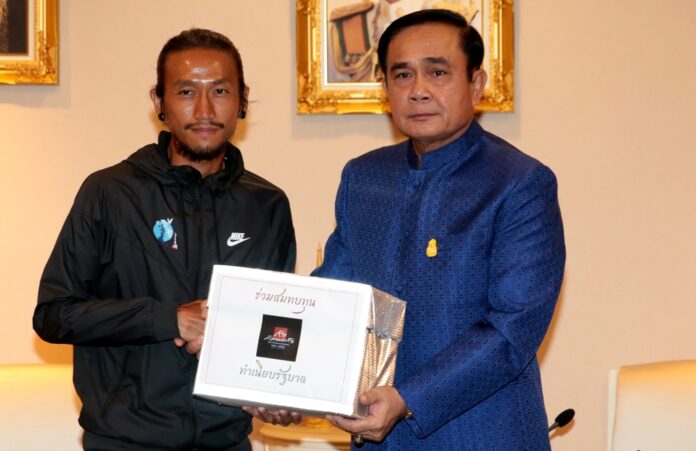
Toon Bodyslam meets junta chairman Prayuth Chan-ocha Monday at Government House in Bangkok

BANGKOK — A junta rep on Wednesday filed a criminal complaint against an opposition party spokeswoman for her scathing post about junta chairman Prayuth Chan-ocha.

The junta’s latest retaliation for online criticism was directed at Sunisa Lertphakwat for rhetorically questioning why Gen. Prayuth welcomed a rocker-turned-philanthropist with much fanfare Monday yet turned his back on environmental protesters arrested on the way to hand him a petition.

“Why did Gen. Prayuth refuse to receive a complaint petition from the locals personally?  Instead, he ended up putting them in jail and prosecute them?” Sunisa, a Pheu Thai Party spokeswoman, wrote Monday.

She added, “Is it because Gen. Prayuth saw the southern locals as less human than Toon, who’s a famous singer?”

For the post, Col. Burin Thongprapai, who represents the junta in legal cases, filed a complaint with the police cybercrime unit Wednesday, according to a source in the junta who requested not to be identified. Burin reportedly asked the police to prosecute Sunisa for violating the Computer Crime Act and sedition.

Technology Crime Suppression Division commander Worawat Watnakornbancha declined to comment.

“This is confidential information,” Col. Worawat said. “I cannot say anything.”

Junta spokesman Piyapong Klinpan said Thursday he had not heard about Burin’s complaint because he was attending a religious ceremony outside Bangkok yesterday.

Sunisa said police had not contacted her as of Thursday afternoon, and she only heard about the charge through media reports. She added that she’s sent a lawyer to the cybercrime unit to find out more information. 

Since coming to power in the 2014 coup, the junta has banned any form of public dissent and routinely silenced its critics – even in the virtual realm – drawing condemnation from domestic and international rights watchdogs.

The junta’s popularity appears to be sinking, and a number of missteps have provoked public consternation. In recent months, politicians and online personalities who have spoken out against the regime have been slapped with cybercrime and sedition laws. The latter offense carries a maximum penalty of seven years in prison. Those charged include a Khaosod English staff writer.

On Saturday, soldiers detained a popular Facebooker known for his fiery commentary on social issues after he mentioned the junta’s popularity was tanking. He was later released without charge.

Advertisement

Bitcoin’s Going Nucking Futs, Here’s How to Buy From Thailand

Three months ago today, bitcoin traded at a lofty 140,000 baht (USD$4,000). One month ago, it reached 200,000 baht (USD$6,000). In the past two weeks, it soared first to 290,000 baht ($9,000) before climbing to where it is today at over 460,000 baht ($14,000). Bitcoin’s value has increased by 70 percent since one month ago today.

At risk of understatement: Bitcoin fever is running wild. The cryptocurrency is on a rampage largely due to how many new people are getting on board. On Nov. 27, Bloomberg reported that in just a handful of days more than 300,000 new users had joined Coinbase, one of the largest of the many trading platforms out there.

So how to jump on board? Setting aside analyses of the underpinning technology or the social and economic impacts of crypto, when something is on this kind of run we all want to know where and how to invest. Bubble or not, let’s dive in.

For those whose finances are linked to Thailand, here’s what’s needed to make millions, or lose them, or make and then lose them (all outcomes being possible and not the responsibility of this writer or news agency).

To get started, you’re going to need a bitcoin wallet. There are two choices you have here: a free software wallet or a hardware wallet, which is more secure but ranges anywhere from 3,000 baht to north of 15,000 baht. These can be easily found on sites like Lazada.

Read: Bitcoin Ups and Downs Don’t Deter Digital Miners in Thailand

Software wallets are free but less secure. A common analogy that comes up is thinking of a hardware wallet like a bank for keeping large sums, and a software wallet like your actual wallet, where you keep cash at the ready. You can create one first, or just use the one that comes with the trading exchange you choose in the next step.

Your new sexy bitcoin wallet is going to need an address, which is basically like your account number. It tells you where bitcoins are going to be sent. Each wallet has some different setup involved we’ll gloss over here, but once you choose the one right for you, you can dive into setting it up however is needed.

Once you have that figured out, it’s time to get online with a bitcoin exchange to start buying or selling from your shiny new wallet.

So, where do you go to start your own Winklevoss bros bitcoin empire? Excellent question. I conducted a completely unscientific survey consisting of a handful of friends who dabble in cryptocurrency in Thailand to get their take on where to dabble.

Two sites came up repeatedly: Coins.co.th and Bx.in.th. Like Coinbase or other international platforms, they both offer a software wallet for your use. But if you want to jump into the deep end and start pumping large sums of money into bitcoin, I recommend getting a hardware wallet to keep your coins safe.

Both services allow you to top up cash in an account with cash at locations like 7-Eleven or via bank transfer and start trading or selling coins with others in the market.

Both also allow the user to cash out their account to various Thai banks, thus actually allowing you to bring those mad profits back from virtual bits into cash reality.

That’s the real important part here: Convert your crypto currency into cold hard cash at will.

For people with bank accounts abroad, it’s a simple matter of finding one operating in your country to sign up with you can use to buy and sell, usually by linking it to your bank account, PayPal, debit, credit card or other online wallet. These can include fees ranging from 1 percent to 3 percent – or more. There are a ton of apps and sites just a Google search away.

Read the account rules, as some disallow users from certain nations or are region-locked themselves.

For example, Americans can open free accounts on Coinbase, the popular San Francisco-based broker, but it balks when it sees your location is Thailand. One could simply VPN into the states, but they’d also need an accomplice there with a phone number for the OTPs (and this likely violates their terms of service).

Once you’re set up, buying and selling bitcoin pretty much works the same everywhere.

When you want to buy, you put in an order for the current rate and how much you want to spend. The platform then facilitates that sale by finding someone looking to sell some of their bitcoin. The platform takes a percentage (0.25 percent to 0.5 percent) for making the connection and the bitcoin is transferred between wallets. Selling basically puts you on the opposite side of the equation, you place an order for coin you have available for sale or at a certain rate, and the exchange matches you with a buyer and takes its cut.

Bitcoin is big, it’s getting bigger and there is money to be made (and lost). But before you dive in, make sure to understand what you are getting into, research the platforms and of course take the right steps to secure your investment.

Related stories:

Bitcoin Ups and Downs Don’t Deter Digital Miners in Thailand
Bangkok Computer Expo Swept Up by Digital Gold Rush
Where Blockchain Breaks Free, Thailand’s PromptPay Shackles
With Money in Reach and Eyes on Fintech, Thai Startups Turn Corner at Techsauce Summit

Advertisement

Gay Marriage Advocates Celebrate Ahead of Australian Vote

Two men watch a parade from a window as members of the gay community and their supporters celebrate the result of a postal survey calling for gay marriage right in Sydney, Australia, Wednesday, Nov. 15, 2017. Australians supported gay marriage in a postal survey that ensures Parliament will consider legalizing same-sex weddings this year. Photo: Rick Rycroft / Associated Press

CANBERRA, Australia — Gay rights advocates celebrated outside Australia’s Parliament House on Thursday in anticipation of same-sex marriage being legalized within hours.

Scores of men and women joined in singing ahead of what was scheduled to be Parliament’s final sitting day of the year.

“It’s an historic day for Australia today and I think the celebrations around the country when we finally … achieve marriage equality are going to be immense,” Janet Rice said. Rice is a minor Greens party senator who was only able to remain married to her transgender wife of 31 years, Penny, because Penny remained listed as male on her birth certificate.

Penny Wong, an opposition Labor Party senator who has two children with her lesbian partner, said: “I am feeling happy.”

The House of Representatives is widely expected to vote to at allow same-sex marriage across the nation.

The Senate passed the same legislation last week 43 votes to 12.

The only potential obstacle to the law passing on Thursday would be if marriage equality opponents managed to amend the legislation. The amended legislation would then have to go back to the Senate for ratification.

Gay rights advocates applauded from the public gallery on Thursday as amendment after amendment was voted down.

Government Leader in the House Christopher Pyne apologized to gay marriage supporters in the public gallery who had traveled to Canberra that the issue was not resolved after four hours of debate.

The debate was temporarily adjourned, but Pyne assured the supporters: “We’ll have a vote on it this evening.”

Gay marriage was endorsed by 62 percent of Australian voters who responded to a government-commissioned postal ballot by last month.

Story: Rod McGuirk

Advertisement

Hot News

LATEST NEWS

Bangkok
broken clouds
29.4 ° C
32.2 °
29.4 °
74 %
5.4kmh
58 %
Fri
29 °
Sat
36 °
Sun
37 °
Mon
37 °
Tue
32 °