Pope Francis waves to journalists as he boards the plane for his six-day trip to Myanmar and Bangladesh, Sunday at Rome's Leonardo da Vinci international airport in Fiumicino. Photo: Gregorio Borgia / Associated Press
VATICAN CITY — Pope Francis’ aim in visiting Myanmar and Bangladesh is to encourage their tiny Catholic communities and bring a message of friendship and peace to some of Asia’s most peripheral and poor. The big question looming is whether he’ll utter the word “Rohingya” while he’s there.
The “will he or won’t he?” issue has dominated debate before Francis’ trip, which begins Monday when his Alitalia charter flight lands in Yangon and ends with a youth rally in Dhaka on Dec. 2.
In between, Francis will meet separately with Myanmar’s civilian leader, Aung San Suu Kyi, its powerful military chief and Buddhist monks. He’ll greet a delegation of Rohingya Muslims and meet with Bangladesh’s political and religious leadership in Dhaka. Masses for the Catholic faithful and meetings with the local church hierarchy round out the itinerary in each country.
Myanmar’s local Catholic Church has publicly urged Francis to avoid using the term, which is shunned by many locally because the ethnic group is not a recognized minority in the country. Rohingya in recent months have been subject to what the United Nations says is a campaign of “textbook ethnic cleansing” by the military in poverty-wracked Rakhine state.
Francis, though, has already prayed for “our Rohingya brothers and sisters,” and any decision to avoid the term could be viewed as a capitulation to Myanmar’s military and a stain on his legacy of standing up for the most oppressed and marginalized of society, no matter how impolitic.
“Being a religious leader – Catholic leader – means that he is well-regarded, but of course there is this worry if he says something, people might say, ‘OK, he just came to meddle,'” said Burmese analyst Khin Zaw Win, a former political prisoner. “So, I think a lot of diplomacy is needed, in addition to the public relations.”
The trip was planned before the latest spasm of violence erupted in August, when Rohingya militants attacked security positions in Rakhine. Myanmar security forces responded with a scorched-earth campaign that forced more than 620,000 Rohingya to flee to Bangladesh, where they are living in squalid refugee camps.
The signals from the Vatican going into the trip were mixed: The Vatican spokesman used the term “Rohingya” in a pre-trip briefing and said “It’s not a prohibited word” as far as the Vatican was concerned. But the Holy See’s top diplomat, Secretary of State Cardinal Pietro Parolin, avoided it in an interview with Vatican media on the eve of the trip.
The debate isn’t just semantic: Myanmar’s government and most of the Buddhist majority consider them Bengali migrants from Bangladesh living illegally in the country, though Rohingya have lived there for generations.
“It’s going to be a tricky situation (if he uses the word), I think because most of the people can’t accept it,” said farmer Win Myaing.
Seaman Kyaw Thu Maung said the issue is difficult because the term “Rohingya” carries so much political weight for all of Myanmar’s people.
“But my feeling is that if the pope is going to talk about the Rakhine issue, the people aren’t going to like the pope anymore,” he said.
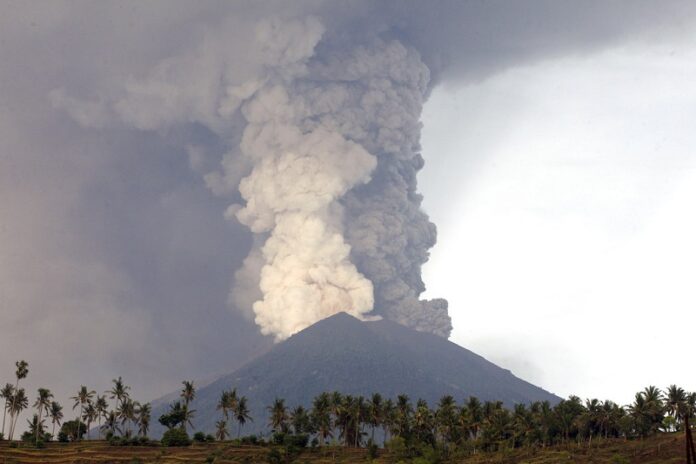
A view of the Mount Agung volcano erupting Monday in Karangasem, Bali, Indonesia. Photo: Firdia Lisnawati / Associated Press
KARANGASEM, Indonesia — Indonesian authorities raised the alert for a rumbling volcano on Bali to the highest level on Monday, stranding tens of thousands of travelers as ash clouds forced the closure of the tourist island’s international airport.
Mount Agung has been hurling clouds of white and dark gray ash about 3,000 meters (9,800 feet) into the atmosphere since the weekend. Video released by the national disaster agency showed a mudflow of volcanic debris and water known as a lahar moving down the volcano’s slopes.
Bali’s airport was closed early Monday after tests indicated ash had reached its airspace and authorities raised the volcano’s alert to the highest danger level.
Flight information boards showed rows of cancelations as tourists arrived at the busy airport expecting to catch flights home.
Airport spokesman Air Ahsanurrohim said 445 flights were canceled, stranding about 59,000 travelers. The closure is in effect until Tuesday morning though officials said the situation will be reviewed every six hours.
Bali is Indonesia’s top tourist destination, with its gentle Hindu culture, surf beaches and lush green interior attracting about 5 million visitors a year.
Geological agency head, Kasbani, who goes by one name, said the alert level was raised because the volcano has shifted from steam-based eruptions to magmatic eruptions. However he said he’s still not expecting a major eruption.
“We don’t expect a big eruption but we have to stay alert and anticipate,” he said on Indonesian TV.
The volcano’s last major eruption in 1963 killed about 1,100 people.
The exclusion zone around the crater was widened to 10 kilometers (6 miles). Previously it ranged between 6 and 7.5 kilometers.
Ash up to half a centimeter (less than half an inch) thick has settled on villages around the volcano and soldiers and police distributed masks on the weekend.
In Karangasem district that surrounds the volcano, tourists stopped to watch the towering plumes of ash as children made their made to school.
Indonesia sits on the “Pacific Ring of Fire” and has more than 120 active volcanoes.
Mount Agung’s alert status was raised to the highest level in September following a dramatic increase in tremors from the volcano, which doubled the exclusion zone around the crater and prompted more than 140,000 people to leave the area. The alert was lowered on Oct. 29 after a decrease in activity but about 25,000 people remained in evacuation centers.
From left, final five finalists Miss Colombia Laura Gonzalez, Miss Jamaica Davina Bennett, Miss Thailand Maria Poonlertlarp, Miss Venezuela Keysi Sayago and Miss South Africa Demi-Leigh Nel-Peters stand on stage at the Miss Universe pageant Sunday in Las Vegas. Photo: John Locher / Associated Press
LAS VEGAS — The woman representing South Africa has won has won the Miss Universe crown.
Demi-Leigh Nel-Peters, who recently earned a business management degree, was crowned Sunday during the event that took place at The AXIS theater at Planet Hollywood casino-resort on the Las Vegas Strip.
The runner-up was Miss Colombia Laura Gonzalez. The second runner-up was Miss Jamaica Davina Bennett.
Thailand’s Maria Poonlertlarp Ehren and Venezuela’s Keysi Sayago were the remaining two of the top five contestants.
Ninety-two women from around the world participated in the decades-old competition. This year’s edition had the most contestants ever.
The 22-year-old Nel-Peters has earned a yearlong salary, a luxury apartment in New York City for the duration of her reign and more prizes.
Last year, Iris Mittenaere from France was crowned when the pageant took place in the Philippines.
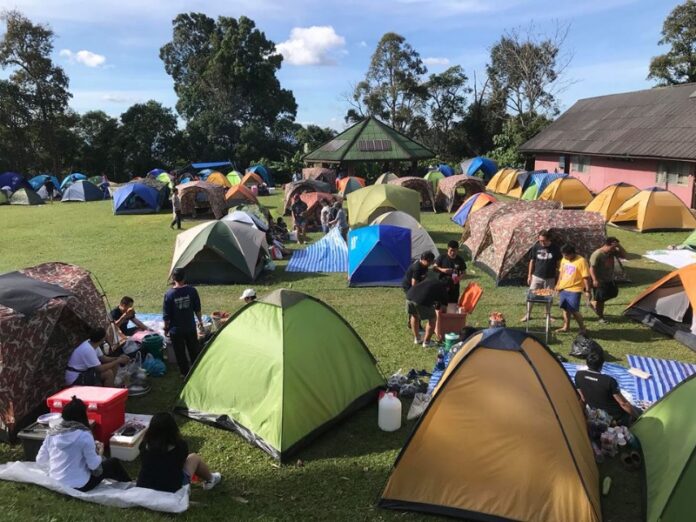
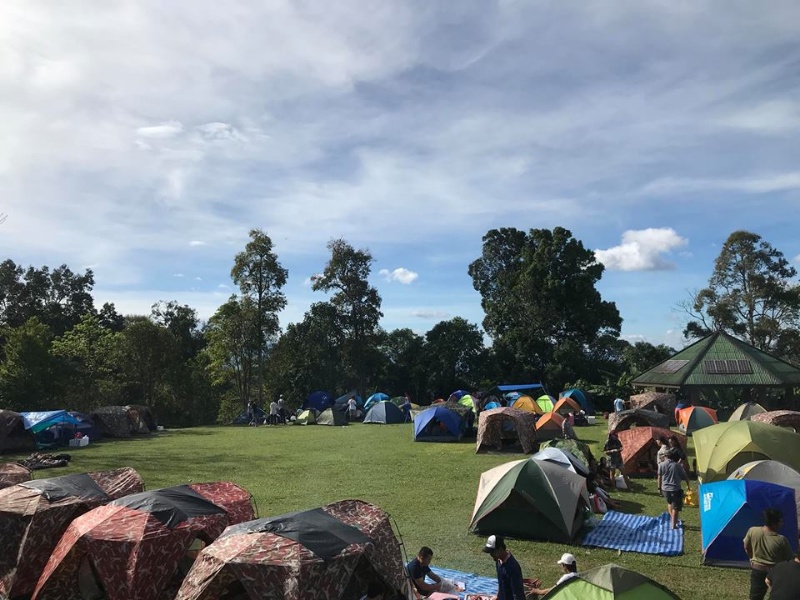
BANGKOK — The cooler has lead more people camping.
With the winter season and dry weather, more people have opted to go camping across different places in the country.
It is not just Khao Yai or the northern provinces such as Chiang Mai or Chiang Rai that are popular with campers. In Phetchaburi province, Khao Panern Thueng – part of Kaeng Krajan National Park – is also a popular spot for setting up tent and camping out.
Here are some photos of people enjoying the Thai winter.
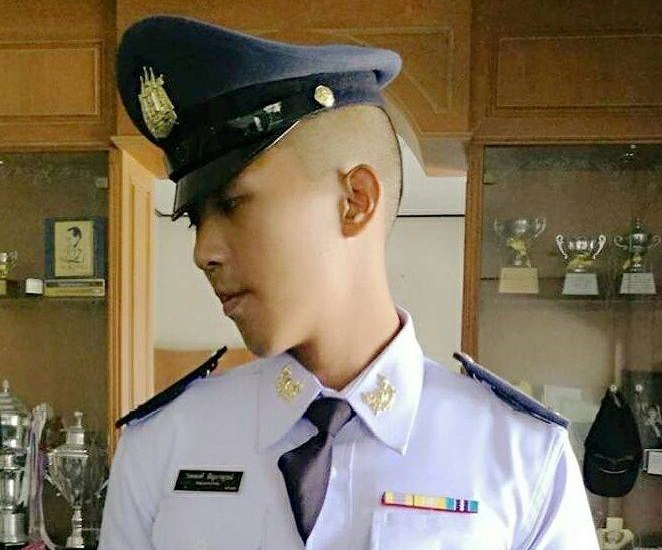
BANGKOK — The family of a dead military cadet demanded an explanation as to why forensic examination of organs returned by the army showed blood clots in his liver and spleen.
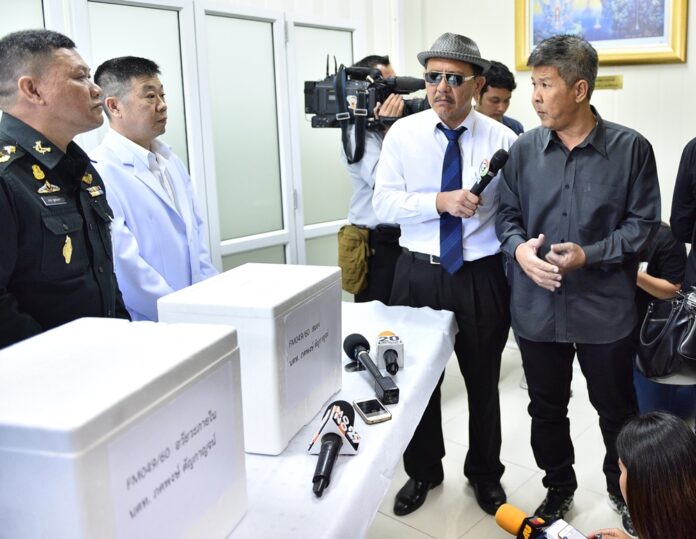
Supicha Tanyakan, elder sister of military cadet Pakapong Tanyakan, who was not given a full autopsy after his death last month – said they wanted an answer from authorities in response to the findings by Phramongkutklao Hospital. Supicha said there was no mention of the blood clots when military representatives returned Pakapong’s organs to them Thursday.
She said a doctor who conducted the independent examination told the family the clots could not have been caused by CPR in an attempt to revive Pakapong.
Pakapong was initially returned to the family with several vital organs missing, including his brain and heart. The family only made the discovery after growing suspicious. He also had internal bruising and at a broken rib.
The broken rib, Supicha added, also could not have been caused by CPR due to its location, the unnamed doctor told the family.
Supicha said the family only wants to know the truth and is not out to defame anyone or Armed Forces Academic Preparatory School, where Pakapong was a freshman. The family only learned about the missing organs after they became suspicious and decided not to cremate Pakapong’s body.
They sent his body for an independent autopsy where they discovered organs including the brain and heart were missing.
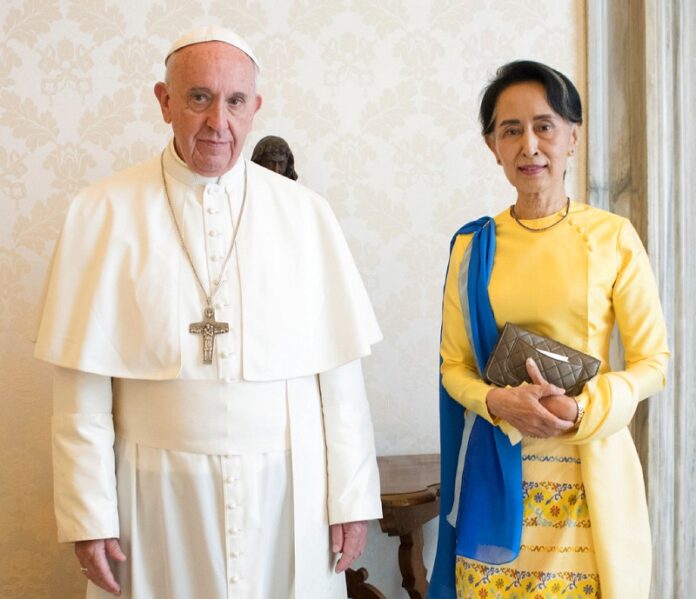
State Counsellor and Union Minister for Foreign Affairs of the Republic of the Union of Myanmar Aung San Suu Kyi, right, poses with Pope Francis on the occasion of their private audience in May at the Vatican on Noember 25, 2017. Photo: Associated Press
DHAKA, Bangladesh — Pope Francis on Monday begins a six-day trip to Myanmar and Bangladesh. While attention will focus on how Francis addresses the Rohingya Muslim crisis, the trip also holds huge significance for the tiny Catholic communities in each country.
Those Catholics face obstacles that include discrimination, an inability to land leadership roles and threats of violence. Many Christians hope the pope’s visit will highlight the plight of the poor and of minority religious groups, including their own.
Myanmar Catholics
There are 660,000 Catholics in Myanmar, just over 1 percent of the population of 53 million. In total, Christians make up just over 6 percent of the population. Catholicism was brought to the country more than 500 years ago, and for generations Catholics have played a vital role in developing far-flung rural areas that authorities have found hard to reach. But when the socialist government took power in 1965, most Catholic-based missionary schools, boarding houses and properties were seized by the military at gunpoint. Catholics were later able to slowly rebuild their missions.
Battling Discrimination
Myanmar Catholic leaders say that as members of one of the smallest religious groups in a country dominated by Buddhism, they face discrimination, even if it isn’t typically overt threats or torture.
“There are always challenges to stand up as Catholic and to have strong faith here,” said Rev. Mariano Soe Naing, a spokesman for Myanmar’s Bishops’ Conference.
Christianity is viewed by many as a colonial belief after the country was ruled by the British for a century until its independence in 1948. Likewise, the separation of church and state is considered a foreign imposition.
For the past 18 years, Myanmar has been listed by the U.S. as a “country of particular concern” under the International Religious Freedom Act for having engaged in, or tolerated, severe violations of religious freedom.
But unlike Rohingya Muslims, Christians haven’t faced widespread violence and persecution. Christian leaders say they’re afforded “peaceful coexistence” and an understanding the government won’t interfere.
Role in Myanmar
The Catholic Church runs about 300 boarding houses across Myanmar, hosting children from villages who can’t afford to go to school. It’s done without any significant support from the government in a country that remains among the poorest in the world.
But Catholics don’t play a broader leadership role in society.
“To be honest, if you are a Christian in this country, you will never get promoted,” Rev. Mariano said. “There are no Catholics in the government administration or in any significant leadership positions.”
Raising Awareness
The profile of Catholics was boosted when Archbishop Charles Maung Bo became Myanmar’s first Roman Catholic Cardinal in 2015. And they are getting another boost by having a pope visit the country for the first time. Catholic leaders hope the community will benefit in the long run.
“Because of the pope’s visit, Catholics will be more visible to many people and they will be aware of the existence of the Catholic community in Myanmar,” Mariano said.
Bangladesh Catholics
There are just 375,000 Catholics in Bangladesh, a tiny fraction of the population of 158 million. In total, Christians account for less than 1 percent of all people in the Muslim majority country. The Portuguese first brought Christianity during the 16th century and missionary efforts began in the early 1800s.
Backdrop of Violence
The pope’s visit takes place against a backdrop of religious tensions after radical Muslims attacked or threatened to attack Christian priests and their followers in Bangladesh. Last year before Christmas, many churches said they got phone calls or letters threatening dire consequences because of their attempts to spread Christianity.
A major attack in July 2016 on a restaurant in the diplomatic zone of the capital, Dhaka, left 20 people dead, including 17 foreigners. The Islamic State group claimed responsibility for that attack and several others, although the government claims the group doesn’t exist in Bangladesh. Authorities say the domestic group Jumatul Mujahedeen Bangladesh was behind the Dhaka attack.
The government launched a massive crackdown on suspected militants after the Dhaka attack. More than 60 people, including some suspected radical leaders, were killed in raids. Many others were arrested.
Catholics Excited
Francis will be the second pope, after Pope John Paul II, to visit Bangladesh since it gained independence from Pakistan following a war in 1971. The Vatican quickly acknowledged Bangladesh as an independent nation after the war, helping set the tone for cordial relations since.
Living in the Hatileite village north of Dhaka are some 1,500 Catholics. They are part of a tribal community in which many embraced the religion after the first tribesman converted in 1927. Villager Louis Suprobhat Jangcham, 50, said he’s enthusiastic about the visit.
“I attended a gathering when Pope John Paul came to Dhaka in 1986. It was very exciting,” he said. “The people from our village will attend this time too. This is a great moment for me.”
Message of Hope
Christian leaders in Bangladesh say they hope the pope’s visit will highlight a range of issues from religious solidarity to a warming planet.
Cardinal Patrick D’Rozario, the archbishop of Dhaka, said the visit will be an opportunity to emphasize the causes of the poor who need blessing and comfort.
“This visit is for spiritual causes, for highlighting peace and harmony. But the Holy Father will also touch upon other very important issues that concern Bangladesh,” he said. “The Rohingya crisis and climate change will come up prominently.”
The pope posted a video message ahead of his visit.
“We are living at a time when religious believers and people of goodwill are called to foster mutual understanding and respect,” the pope said. “And to support each other as members of our one human family.”
Pichet Tanyakan, father of the cadet, lashes out at an army rep Thursday at Phramongkutklao Hospital where he picked up his son’s missing organs.
BANGKOK — A leaked letter from a military cadet who died a questionable death indicates that the physical demands at the school made at least another student quit.
A letter which family members confirmed was written by Pakapong Tanyakan, 18, who officials maintain died of sudden heart failure, shows he wrote to offer moral support to a classmate who quit the Armed Forces Academic Preparatory School in Nakhon Nayok province.
The letter, which Pakapong’s family said was written two to three months before he passed away on Oct. 17, was returned to Pakapong’s mother, Sukanya Tanyakan, after the family was accused by some on social media of forcing a physically unfit son to enroll in the prestigious academy.
“Hello friend, my name is Maey, I’m the kid from Chonburi [province] and have dreamed since childhood of becoming a soldier. I’d do everything to become a soldier. I abandoned the fun of childhood in order to make my dream come true,” Pakapong wrote.
Pakapong told his classmate he tried and failed to enter the school twice before making it the third time. Pakapong added that he then really met the friend whom he was writing to because they passed one another while visiting the medical unit of the school for medical care.
“I am concerned about you. You are a fighter but your body is not well equipped. I understand and don’t blame you because each person’s physical [endurance] differs. When I met you I talked to you and you wanted to quit. I didn’t want you to quit and tried to change your mind but one thing I can’t do is to try and hold you against your parents’ wishes,” he wrote.
“In the end, you are a friend and I like your fighting spirit and hope your will become successful after your leave. You can apply some of the disciplines here out there. Be a good man and do not forget to debt of honors you owe to your father and mother,” he concluded.
After parents of Pakapong discovered that vital organs had been removed from their son’s body after it was returned to them, they demanded detailed answers as to what happened to the freshman cadet.
Pakapong had also written to another friend that he once passed out after enduring punishment but survived because his heart – which stopped – was resuscitated on time.
Incidentally on Friday, two senior officers at the school – Col. Chatchai Duangrat, commander of cadet regiment and Cmdr. Noppasith Pianchob, commander of the academy’s battalion – were transferred by Supreme Commander Gen. Thanchaiyan Srisuwan as pressure mounted on the military to provide an answer. No reason has been provided for the transfer order.
Pakapong’s parents are seeking an independent forensic examinations of key organs, returned to them on Thursday. Results are expected to come out in the next seven days.
As for the Pakapong’s family, his mother Sukanya and elder sister Supicha Tanyakan are currently hospitalized due to the stress and trauma caused by the death. The family said it learned from their son that he previously had to be hospitalized due to heavy corporal punishment.
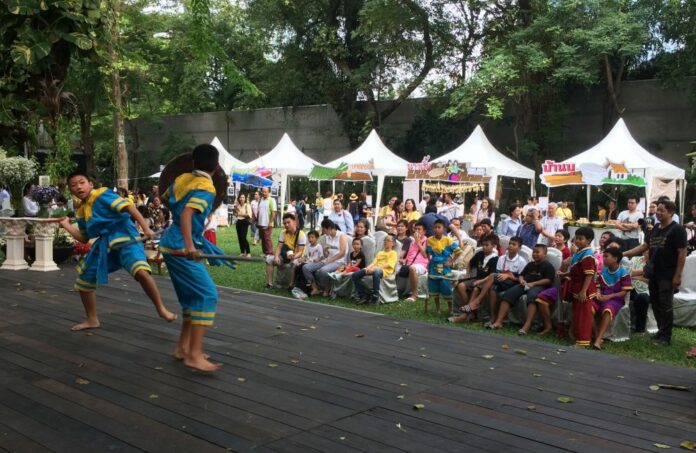
Children from Bann Bu community show off their baton fighting skill to onloonkers Nov. 18 at a fair promoting local tourism at Sukhothai Hotel in Bangkok.
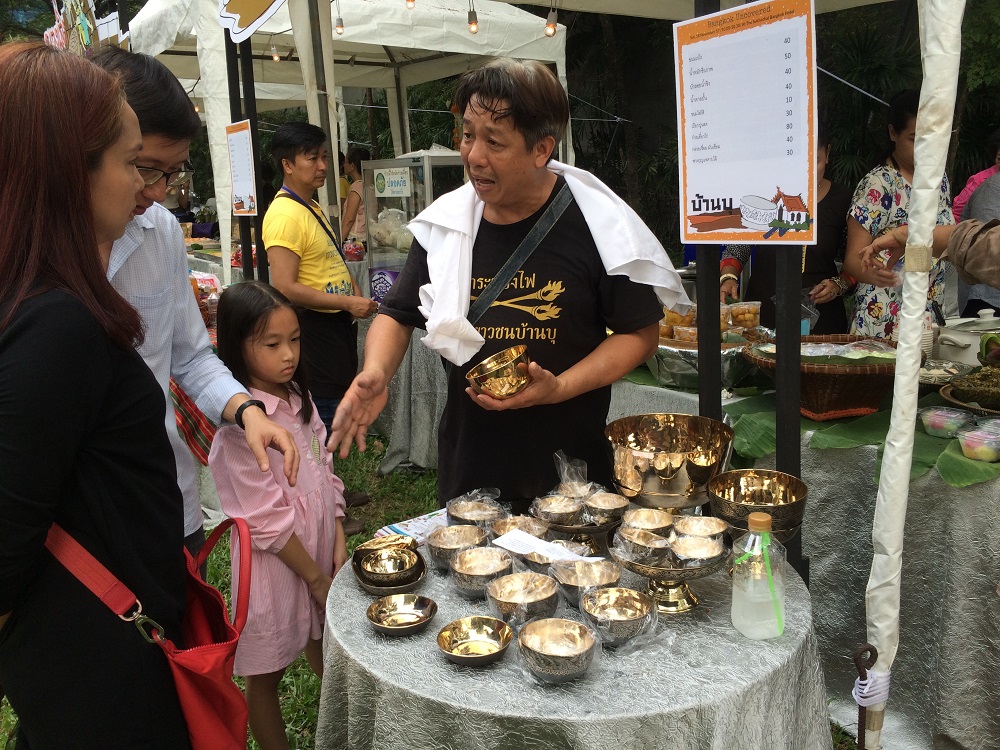
BANGKOK — It was as though six old neighborhoods around Bangkok were teleported to a hotel garden on a recent afternoon. At one corner, a man was hawking sets of glimmering bowls made from copper and bronze, a trade passed down in the Baan Bu community for centuries.
“There’s only one engraver left alive,” community leader Pichit Boonjin told a group of tourists. “No one else is taking up his job.”
“What happens when he dies?” a tourist asked.
“I don’t know! He’s leaving the craft to his son, but he’s not even a craftsman yet,” Pichit said.
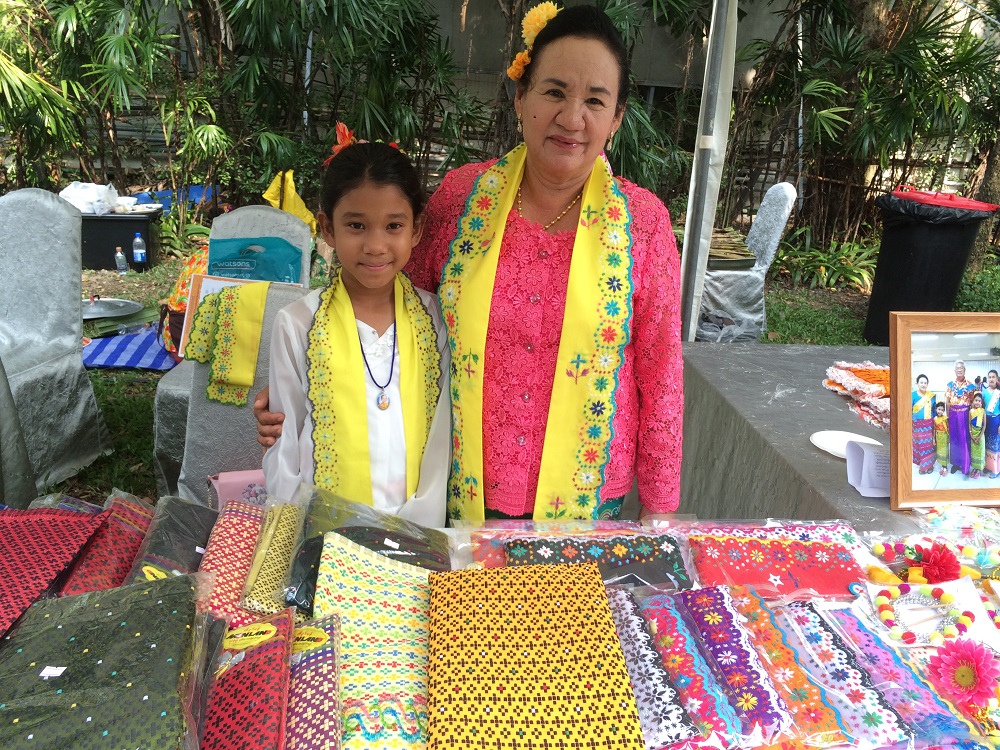
At another corner, Thais and foreigners line up to buy juice made from gac, a red colored fruit grown in the Koh Sarn Chao neighborhood. Not far off, descendants of ethnic Mon from the Bang Kadi community showed off handmade textiles to curious onlookers.
The marketing event was organized by a company that seeks to bring visitors to these old communities – some of which are even older than Bangkok itself. It’s part of a community-based tourism trend that’s fast replacing the old tradition of bus-hopping and snapping photos at familiar landmarks.
The six communities on display were Banglamphu, Hua Takhe, Baan Bu, Nang Loeng, Bang Kadi and Koh Sarn Chao. The company co-founder, Achiraya Thamparipattra, said she started the business after seeing old neighborhoods like Saphan Lek and Mahakan Fort torn down.
“I don’t want Bangkok to be without a soul,” Achiraya said.
The trend is fast catching up. There are now several companies offering tours to Bangkok’s traditional neighborhoods, like Hivesters and Local Alike.
Even Airbnb, a global accommodation service, launched what they called “Experiences” earlier this year, which allow tourists to join activities such as cooking classes and bicycle trips with locals.
Mon textile weaver Tawin Monda poses with her granddaughter Nov. 18 at a fair promoting local tourism at Sukhothai Hotel in Bangkok.
Tourism is expected to generate an income of 2.71 trillion baht by this year’s end. With 32.6 million foreign tourists visiting Thailand last year, there’s been an attempt to shift the focus from mass tourism to a more refined experience.
In fact, the agency in charge of promoting Thailand’s attractions, the Tourism Authority of Thailand, featured community-based tourism in its annual parade on Nov. 15.
“It’s something that has been gaining popularity for a while now,” bureau director Yuthasak Supasorn said. “It helps tourists stay longer and spend more … For example, tourists used to go to famous places like Pattaya and Phuket, and they just stayed on the beaches. But they could now experience the way of lives of local people.”
Fear of Vanishing
The event on Nov. 18, held by Hivesters took place at the garden of the Sukhotai Hotel, a luxury hotel in Bangkok’s financial district of Silom. The venue seemed paradoxical for a fair that wanted to recreate the down-to-earth atmosphere of these communities.
The fair drew a mixed crowd of Thais, hotel guests and expats. One vendor said she never imagined selling her food here in the enclave of Bangkok’s richest.
The mixture of luxury and the common is intentional. Each of the six communities is paired in a business partnership with high-end hotels in Bangkok, company head Achiraya said. For example, Koh Sarn Chao farmers sell soaps, candles and juice made from their local fruit to Sukhothai Hotel, while Nang Loeng vendors supply desserts to Sukosol Hotel.
“In this age, experience is a luxury,” said Achiraya, who holds a master’s degree in luxury branding from Paris. “Because you can’t find these things on Google.”
“We should preserve the charm of Bangkok,” Achiraya said. “We should regulate and preserve it, instead of wiping it all out. There should a be balance.”
Pichit Boonjin hawks locally made bowls to visitors Nov. 18 at a fair promoting local tourism at Sukhothai Hotel in Bangkok.
A French expat who gave her name as Alain said at the fair that she was interested in the program to tour old neighborhoods because of the recent trend of eviction and reorganization.
“Bangkok is now full of skyscrapers and where people used to live,” she said.
“I don’t understand BMA politics,” said her friend, Julie, referring to the Bangkok Metropolitan Administration. “It’s so sad to see them destroying the old buildings.”
Nang Loeng community leader Suwana Walploy-ngam said she knows the fate of her century-old market district is at the whim of the city government. She added she had a friend in Mahakan Fort area who was forced to relocate when city officials tore down housesthere in March.
“I am not afraid but I know it’s very hard to fight,” said Suwanna, who’s in her 50s. “We don’t get to participate whenever there are changes. We have no money and no power to negotiate. Information and news are also limited.”
Her community is clustered around the famous Nang Loeng Market. It boasts what’s widely described as the last theatre of Chatri traditional dance (“The dancer there started when she was 7. Now she’s over 70,” Suwanna said). It’s also home to many desserts and the now-ubiquitous deep fried bananas sold in paper packets.
“They care more about GDP than cultural values,” Suwana said of the city administration. “Hey don’t understand spiritual value, so it disappears with the old world. But we are still strong, generation after generation.”
Revival Tourism
Achiraya said the six communities showcased at the fair were selected because they met three criteria set by the company: they must have unique culture and craft; their community is at risk of disappearing; and they are willing to take visitors.
Hivesters developed tour itineraries and provided interpreters, but the guides and activities are all local. The company also works with Bangkok’s tourism bureau to promote the attractions.
“It’s a long-term, win-win business for both sides,” Achiraya said. “We don’t just go in there to paint some school building then leave.”
Some state agencies are also catching up with this new trend of community based tourism.
Wasana Kungsawat, a 55-year-old native of Hua Takhe neighborhood, said the lush canals there used to be full of boat trips carrying foreign tourists. She fondly remembers jumping naked into the canal when she was little and plucking lotus roots for her family to cook.
Tourism boom ended when Suvarnabhumi Airport was built nearby, changing the landscape.
But government agencies are now sponsoring local activities, Wasana said, including an event launched in September to promote tourism to Hua Takhe. An event showcasing graffitis in the community is also taking place on Saturday and Sunday.
Tamnu Alengkayan, 60, is a halal food vendor in a Muslim quarter of Banglamphu neighborhood, a melting pot of Buddhist temples, Sino-Thai shops, Muslim residents and backpackers party scene.
He said he wishes more tour companies, especially from Muslim nations like Malaysia and Indonesia, would visit Banglamphu so he can show them the multicultural aspect of Bangkok.
“We live peacefully together. People like to generalize that all Muslims are like in the Deep South,” Tamnu said with a laugh.
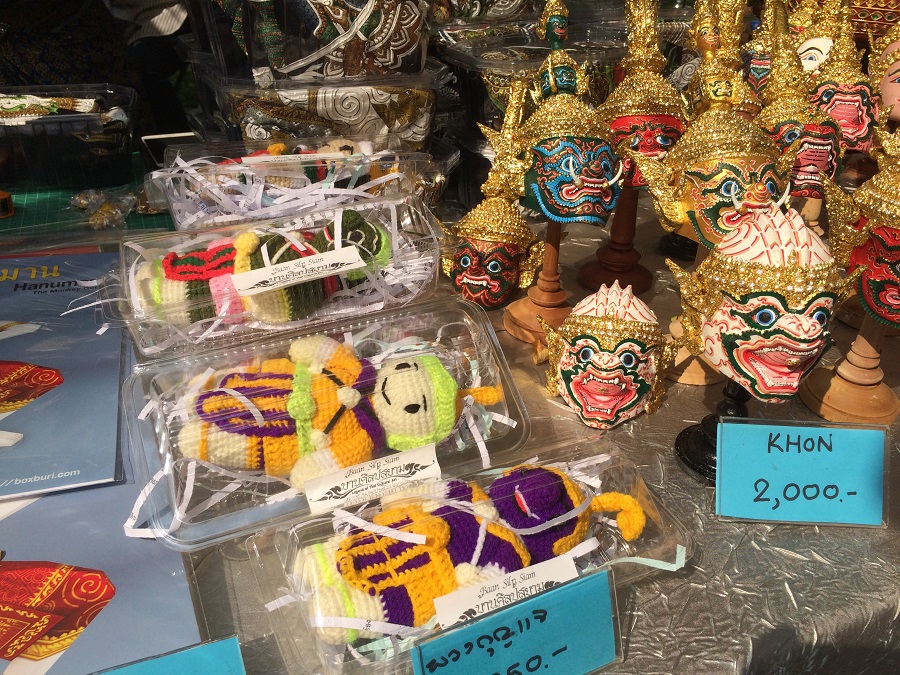
Souvenirs based on Khon tradtional masked dance are displayed on sale Nov. 18 at a fair promoting local tourism at Sukhothai Hotel in Bangkok.Soaps made from gac by Koh Sarn Chao community are displayed for sale Nov. 18 at a fair promoting local tourism at Sukhothai Hotel in Bangkok.
A woman personifying the Goddess of Liberty leads the people forward holding the revolutionary flag that became today's French flag in 'Liberty Leading the People.' Eugène Delacroix, 1830.
History speaks for itself, if one is open-minded enough to listen.
There’s a conventional path to indoctrinate a society with a new political ideology. Whether that ideology is fascism, communism or any other -ism. Democracy is no different. The path is through death and destruction.
Pick a democratic country out of a hat, trace its history and find wars and deaths, the destruction of old traditions and institutions. Then, eventually, the triumph of democracy.
In 1914, Germany stood a mighty empire ruled by an absolute monarch, then came World War I. Four years later, German absolutism was destroyed. But democracy did not yet triumph, instead fascism became en vogue. Again, Germany in 1941 stood a mighty nation, this time with a fascist leader in charge, then came World War II. Four years later, German fascism was destroyed. Democracy rose, at least in West Germany, but not from the free will of the German people at the time. It was imposed upon by the victorious allied powers.
At the start of World War II, Japan stood a mighty empire, with a fascist military regime in charge and a god-like emperor to rally around. Four years later, that was destroyed, and it was the Americans who authored a new democratic constitution, without needing the consent of the Japanese people at the time. But the victor does not need the consent of the defeated, it defeats the purpose of being victorious.
The two nations today are among the most prosperous democracies on earth. There are no more kaisers or fuhrers in Germany, and while the Japanese imperial family is revered, it doesn’t hold much power and prestige over the hearts and minds of the people as before.
England and France? Magna Carta. Glorious Revolution. Bastille stormed. Kings beheaded.
A cake-loving queen and a fascist parliamentarian. Centuries of ups and downs: Wars fought, destruction wrought and here they are today, champions of democracy. America overthrew the English king. Canada, Australia and New Zealand are byproducts of England’s democratic evolution. Across the world, tradition and institution were destroyed by colonial powers to start anew.
Along the way, the path to democracy is littered with tens, if not hundreds, of millions of lives. This is not to argue whether those wars were moral as we aim to understand historical evolution, not to justify it. As such, do not let facts offend personal feelings. History has proven that the conventional path for a new political system to triumph, democracy included, is for old institutions to be destroyed and old beliefs torn down.
Today, democracy stands a flawed political system vulnerable to abuse, manipulation and corruption. Still however, it is the best political system man has ever created, as it is the system most compatible with the ideals of human rights.
What then of Thailand? Never been colonized, therefore tradition and institution are very much unimpaired. There was a democratic revolution in 1932, with no death and minimal destruction, while traditions and institutions largely remained intact. Furthermore, through the past decades, traditions and institutions have been reinforced and strengthened.
As so happened in histories across the world, when absolutism is brought down, fascism and democracy squabble for supremacy, oftentimes this has also involved communism, and to a lesser extent, anarchism. If the past 85 years in Thailand have proven anything, it is that fascism has been slapping democracy around like a red-headed stepchild. Red-headed because democracy is a foreign concept, not a native one.
Today, Thailand stands a country ruled by a military junta. Look into history, and we see a long list of military strongmen in charge. Meanwhile, champions of democracy like Pridi Banomyong or Puay Ungpakorn are men who passed away in foreign countries, in exile. Men whose names are revered by some and vilified by others. Names little taught in schools and considered controversial in the official historical narrative.
Key to the success of the military is the narrative that it is the champion and defender of the monarchy, a Hindu-Buddhist Theravada tradition with power and prestige over the hearts and minds of the people. Unlike in other countries, there has been no destructive event in history to destroy this tradition and institution.
Does this mean we should pave a destructive path littered with death in order to bring down the old system and replace it with democracy? Of course not. But the danger of death and destruction comes when we have hardcore extremists on one side blindly yelling “democracy,” at their counterparts on the opposing side blindly yelling “Love, Love.”
If historical fact and present reality aren’t compatible with personal bias and tribal allegiance, then we need to put our emotions in check to instead embrace the truth.
The truth is Thailand is in a unique and complex situation. Neither old nor new systems can force each other out without death and destruction. Therefore, new ideals and old traditions must find a formula for compatibility in the interests of the nation’s future.
Key to this compatibility is for the military to take a step back and stay inside their barracks, unless called upon by a democratically elected government to defend not only the institution, but also democracy and the people.
Again, pick a democracy and we will see a destructive path in history. Pick Thailand, or any other country today, and let’s not allow death and destruction to pave the road to democracy. History exists so we can learn from it, not repeat the same mistakes over and over again.
The symposium held Saturday at Thammasat University.
BANGKOK — Domestic violence is complex and often hidden from society.
In a case heard Saturday at a symposium to mark the International Day for the Elimination of Violence Against Women, the victim eventually came out to talk about her case, but was unwilling to name names to hold the violator accountable.
At the symposium, entitled “Being Close is No License for Violence” and held in a small room at Thammasat University, speakers recounted their own bitter experiences. The talk was organized by Women Group of Thammasat University and other partners.
An Online Columnist Coming Out
Twenty-six-year-old Chotiros Naksut, or Lookkaew, was propelled to fame after she gave an interview to an online website revealing the details of violence against her made by her boyfriend of three years. The article which came out earlier this year was widely read and led to ample discussion about her case.
Her relationship, with an educated man who is a guest lecturer at various universities, ended in May after three years. She reckoned that violence against her – which included slapping, banging of her head against the floor and strangulation – occurred every three to four months.
In one incident, Chotiros said the violence started from a minor argument on the phone, the cause of which she couldn’t even recall. Chotiros vividly remembers being strangled by her then boyfriend, however. It became tighter and tighter, she said.
“I begged, telling him I couldn’t breathe anymore and he replied ‘that’s your problem’,” Chotiros said.
After a few such episodes, Chotiros thought her ex-boyfriend abused her for speaking too much, so she became less talkative. But it didn’t help.
“The lesson was that if I am close to him [physically] I will be on the receiving end,” said Chotiros, adding that there’s no profile as to what kind of man will be violent, be it in terms of education, class or look.
On another occasion, she was slapped in a public location and then banged against a door. A person nearby had to call the police but in the end police only took the two to a police station to cool off until they let them go.
“I asked the police to have it recorded,” she said.
Chotiros said in the end, and after three years, she decided to end the relationship and go public about the experience. She has continued to refuse naming her ex, however. Asked why, she shed tears at the symposium and said she still loved him.
“I don’t want him to get into trouble or be affected negatively… But there have been rumors [as to who he was]. I am still worried about him. I am still part of that culture of violence… It hasn’t reached the point where people are prosecuted,” she said.
‘Gays Deserve to Be Raped’
Muhammadmumin Muna is gay. He was raped by a man years ago when he was a student and realized it was hard to convince others he had been raped.
“Which man will rape you?” a friend told him. Others said he deserved it because gays are sexually insatiable.
“There’s a stereotype that gays must be sexually yearning,” said Muhammadmumin, who works for Amnesty International Thailand. “Violence occurs not only against women. It can happen to anyone.”
Observation from an Activist
Manee Khunpakdee, knowledge management manager at Social Equality Promotion Foundation, stressed that sexual violence often comes from people who have close relations. This, she added, could be family members, close friends, partners or spouses.
What’s more, there exists other forms of sexual violence that are often not regarded as violence in Thai society, Manee said. This includes the repeated use of violent words and barring one’s partner or spouse from seeing their child or children.
Police and the public also tend to play down any sexual violence when a married couple has problems, he said. Manee cited the Thai saying “tongue and teeth often clash” as an example of how sexual violence between couples is often discounted in the Thai context.
Manee added that there was still a long wayfor Thailand before it could realized a culture free of sexual violence.
In Thailand, even community of social and political activists are susceptible to sexual violence and harassment.