






























30.5 C
Bangkok
Sunday, June 28, 2026
Home Blog Page 2164

Voranai: Tears of the Junta

Voranai VanijakaIt’s been nearly a month since the royal funeral for King Rama IX. As the kingdom comes to terms with the great loss and pushes on into the future, an incident of note is worth discussing.

Many photos and VDO clips surrounding the funeral ceremony have been circulated and commented on. Of note is Prime Minister Gen. Prayuth Chan-ocha wiping tears from his eyes.

The social media reaction can be summed up as follows: He truly loves King Rama IX and keeps the peace in the streets. No matter the allegations of abuse, corruption, mismanagement or incompetence, in the eyes of many people, all is forgiven or at least excused, if not outright denied by turning a blind eye. This is because his tears are genuine and peace is desired. Hence, he’s deemed fit to be Thailand’s leader.

Emotion is a powerful thing, and surely the tears of the prime minister were as sincere as those of millions other Thais who also wept for the loss. As well, to say that he keeps peace in the streets is a statement of fact. Anyone who has ever lived through times of violence and civil strife should appreciate the benefits of having peace in the streets.

But at what price?

Here’s a quote attributed to one of America’s founding fathers, Benjamin Franklin:

“Those who would give up essential liberty, to purchase a little temporary safety, deserve neither liberty nor safety.”

There’s a debate as to what Franklin was actually referring to, as the context of today is vastly difference from 200 years ago. Nonetheless, in the context of a modern liberal democracy, people have interpreted the meaning to fight for personal freedom and liberty come what may, as opposed to sacrificing them in the interests of comfort and safety.

But Franklin was an American founding father, not a Thai one. The modern interpretation of the quote is in the spirit of Western liberal politics, which isn’t the same as that of a conservative, Southeast Asian, Hindu-Buddhist kingdom steeped in feudal traditions.

Through more than a decade of Thailand’s political strife, many observers have questioned how the affluent and educated urbanites could cast aside democracy and welcome dictatorship. The answer is a sarcastic quip drenched in generalities: You can take a Thai out of the kingdom, but you can’t take the kingdom out of a Thai.

Meaning, we are the sum of our past. The collective conscience of a nation, or a people, is molded by centuries of traditions still taught and celebrated today. One may have a Western education, be well versed in all things liberal and international, but still be Thai. As such, traditions dictate that at the heart of being Thai is communalism over individuality, conformity over independence and – more important than any principles – the institution of the monarchy.

In the West, democracy is in the social conscience. Liberals and conservatives may be at each other’s throats, but both believe in democracy. Even fascist political parties have to contest in democratic elections. Western democracy has been centuries in the making, struggling through wars and destruction to eventual triumph. And though today some may call it into question, democracy is still the shared value.

There are no founding fathers expounding democracy here in Thailand. But there is the concept of “father of the nation.” They are the kings of the Chakri Dynasty, from the first to the present. Furthermore, there have been no destructive wars to tear down old institutions to be replaced by new ones, as happened in Western nations and even Thailand’s neighbors.

Compared to the historical roller-coaster of Western history for the past couple of centuries, the fabric of our present-day kingdom has barely been touched and has hardly changed since its founding a little over 200 years ago.

But that doesn’t mean the Thai kingship and democratic ideals can’t be compatible.

As the nation comes to terms with the great loss and pushes on into the future, with an immediate one being the promised elections of November 2018, we must understand that traditions can’t simply be erased and replaced by democracy, nor expect traditions to bow down to new ideals.

The Thai monarchy and its place in society isn’t the same as with Western monarchies. For democracy to succeed in Thailand, it must come to terms with the power and prestige the monarchy holds. There must be a partnership between democratic and royal institutions.

This new partnership will see the military as not only defender of the monarchy, but also defender of democracy and the people. The latter being a role the military has not always fulfilled in the past.

Obviously, this is easier typed than done. Clearly, this will be a Thai-style democracy, not a Western one. But like the mantra for multinational companies “think global, act local,” the reality of traditions cannot be ignored.

In an alternate reality, the national leader who wept at the late king’s funeral would be a democratically elected one, not a junta leader. But alternate realities only exist in fantasy.


Advertisement

See 20 Years of Earth’s Seasons in 2.5 Minutes

CAPE CANAVERAL, Florida — NASA captured 20 years of changing seasons in a striking new global map of the home planet.

The data visualization, released this week, shows Earth’s fluctuations as seen from space.

The polar ice caps and snow cover are shown ebbing and flowing with the seasons. The varying ocean shades of blue, green, red and purple depict the abundance — or lack — of undersea life.

“It’s like watching the Earth breathe. It’s really remarkable,” said NASA oceanographer Jeremy Werdell, who took part in the project.

Two decades — from September 1997 to this past September — are crunched into 2 ½ minutes of viewing.

Werdell finds the imagery mesmerizing.

“It’s like all of my senses are being transported into space, and then you can compress time and rewind it, and just continually watch this kind of visualization,” he said Friday.

Werdell said the visualization shows spring coming earlier and autumn lasting longer in the Northern Hemisphere. Also noticeable to him is the Arctic ice caps receding over time — and, though less obvious, the Antarctic, too.

On the sea side, Werdell was struck by “this hugely productive bloom of biology” that exploded in the Pacific along the equator from 1997 to 1998 — when a water-warming El Nino merged into cooling La Nina. This algae bloom is evident by a line of bright green.

In considerably smaller Lake Erie, more and more contaminating algae blooms are apparent — appearing red and yellow.

All this data can provide resources for policymakers as well as commercial fishermen and many others, according to Werdell.

Programmer Alex Kekesi of NASA’s Goddard Space Flight Center in Maryland said it took three months to complete the visualization, using satellite imagery.

Just like our Earth, the visualization will continually change, officials said, as computer systems improve, new remote-sensing satellites are launched and more observations are made.

Story: Marcia Dunn

Advertisement

Cambodia Charges 2 Journalists with Espionage

Cambodian Prime Minister Hun Sen applauds June 28, 2017, during the 66th anniversary for his Cambodian People's Party in Phnom Penh. Photo: Heng Sinith / Associated Press

PHNOM PENH, Cambodia — Two Cambodian journalists who worked for U.S.-funded Radio Free Asia were charged with espionage on Saturday, the latest targets in an intensifying crackdown on perceived opponents of the country’s authoritarian prime minister.

The pair — Uon Chhin and Yeang Socheameta — were arrested Tuesday and are suspected of supplying information to a foreign state, a spokesman for the Phnom Penh Municipal Court, Ly Sophana, said.

The government of Prime Minister Hun Sen and its allies in the judiciary have been clamping down hard on critics in recent months, shutting down more than a dozen radio stations and dissolving the main opposition party this week.

In September, Radio Free Asia’s Phnom Penh bureau closed its office in the Southeast Asian nation after operating for 20 years, citing government intimidation of the media, which it said had reached an “unprecedented level.”

The same month, the independent English-language newspaper The Cambodia Daily was forced to shut down after being accused of not paying a huge tax bill — a charge it said was politically motivated.

The crackdown is seen as part of the Hun Sen government effort to neutralize political opponents ahead of elections next year.

Hun Sen has been in office since 1985 and has held a tight grip on power since ousting a co-prime minister in a bloody 1997 coup. Although Cambodia, ravaged by the murderous Khmer Rouge regime in the 1970s, is now nominally a democratic state, its institutions remain fragile and the rule of law weak.

Advertisement

Siam Square Animal Cafe ‘Kitties and Bears’ Shut Down

BANGKOK — A controversial animal cafe has been ordered shut by the authorities.

Kitties and Bears in Siam Square, where a former manager said more than a dozen animals died of neglect, will close on the order of Pathum Wan district officials. The animal cafe’s last day is Sunday.

District director Nawaporn Klinbuakaew said the cafe was operating illegally and in violation of numerous regulations. One of the main reasons, she said, is that it houses a large number of domestic and wild animals alongside food service. She said she found the smell unacceptable on each floor when she visited it.

Read: Owner of Cafe Where Animals Died Sorry For ‘Lapses’

The cafe did not have a valid permit in the first place, she added, saying the owner had misrepresented his plans to landowner Chulalongkorn University by saying he was opening a dessert cafe, not an animal cafe.

Kitties and Bears has 40 to 50 animals, wild and domesticate, including meerkats and raccoons.

The owner is Jonathan Tan, who in April was fined and jailed in Singapore for falsifying health records at a cat cafe where a number of cats died. His former employees said Tan did not provide proper care for the animals.

He moved to Bangkok and opened Kitties and Bears in July. Last month, a former manager went public with allegations that more than a dozen animals died of neglect, including dogs that died of parvovirus, a disease easily prevented by routine vaccination.

After an animal advocacy group led police to investigate, Tan told Khaosod English earlier this month he was sorry for what he described as “lapses” that resulted in animals dying.

Kitties and Bears has since taken to social media to discourage customers from believing what they’ve read. On Friday, it announced its closure.

“We have very sad news for you. In lieu of the internet scandal, we are being forced to close down the cafe,” was written today on its Facebook page. “We are sorry that it is very sudden, but we were not given much time by the authorities.”

The announcement also called for adoptees for the cafe’s dogs.

Additional reporting Todd Ruiz

Related stories:

Owner of Cafe Where Animals Died Sorry For ‘Lapses’

Advertisement

Luk Thung Singer ‘Lumyai’ Invades, Divides Laos

BANGKOK — Lumyai is back and this time her golden hot pants and crop top have caused an international furor.

Teen country singer Lumyai Hai Thongkam, whose sexually provocative dancing this year became an obsession of junta chief Prayuth Chan-ocha himself, has drawn fresh critiques, this time from Laotians for a video shot in their country.

Though her video “Plaa Kor Yai Viagra” (Snakehead Fish Viagra), was filmed back in May in Vang Vieng, Laos, it wasn’t until now that a debate erupted among Lao netizens about her costume and dance moves.

The video was posted Wednesday to a Lao-language community online, where it drew a slew of displeased comments, many of which said bikinis were inappropriate in Laos, a landlocked nation more socially conservative than Thailand.

In Thailand, where displays of female sexuality are encouraged yet shamed, a few joined in on the criticism.

“I heard that in Laos they’re criticizing this. Did you even study their culture before going to film this? You’re damaging their area’s reputation. Why didn’t you just film in Thailand?” YouTube user Rattcha Gio wrote.

Still, others saw no problem.

“It’s so hard to be born a Thai, people are always criticizing you for this and that. Have you actually ever been to Vang Vieng yourself? Farangs are in bikinis everywhere. Do you commentators wear traditional Thai costumes to the beach?” Pitch Kunlanonphisit wrote.

In the video, Lumyai sings and dances with country artist Charoenpan Phrakanyai before Vang Vieng’s mountain backdrop. Other Laos netizens said Lumyai was helping by promoting tourism in the small town located north of Vientiane.

Lumyai, whose real name Supansa Wetkama, first rose to fame in June when Gen. Prayuth Chan-ocha repeatedly criticized her her sexy dancing and attire, even dispatching police to her concerts to cover her up.

Since then, she’s released a music video featuring a Prayuth look-alike and her own brand of soap, which somehow also turned controversial.

Related stories:

Dirty-Dancing Country Singer Wants Soap Pirates to Come Clean

Prayuth-Alike Cameos in Teen Singer Lumyai’s New MV

Police Sent to Cover Up Teen Country Singer ‘Lumyai’

LumyaiGate: Teen’s Golden Hot Pants Overheat Culture Wars

Prayuth Criticizes Teen Singer’s Sexy Dancing, Blames Farangs

Advertisement

Former Malaysian PM: Current Government ‘Must Go’

Former Malaysian Prime Minister Mahathir Mohamad speaks at the ASEAN@50 in Retrospect, a regional Southeast Asia forum, Thursday in Bangkok, Thailand. Photo: Ted Anthony / Associated Press

BANGKOK — The man who led Malaysia through the final two decades of the 20th century and has waded back into its politics in recent months said Thursday the country’s current government is deeply problematic and “must go.”

“We are facing a lot of difficulties with a government that ignores the rule of law,” Mahathir Mohamad told an audience in Bangkok at a forum about Southeast Asia.

“These kinds of people must go,” he said of current Prime Minister Najib Razak’s government, which has held onto power through a huge corruption scandal.

Mahathir, now 92, was Malaysia’s prime minister from 1991 until 2003. Today, he has emerged as an unlikely rallying point for an opposition coalition stocked with people who once despised him. He has recently taken a strong stance against Najib’s government, saying his one-time protege is corrupt and has elbowed Malaysia backward instead of propelling it forward.

“I’m working with the very people who used to call me ‘dictator’ and other nasty things,” Mahathir said. He has insisted he does not want to become prime minister again and is said to be considering running for a parliamentary seat.

The opposition coalition tried to go after Najib over an international financial scandal that involved a state fund he created when he came to power in 2009. The so-called 1MDB fund is being investigated in the United States and several other countries. The U.S. Justice Department has said at least $4.5 billion is believed to have been misappropriated from the fund.

Najib has denied any wrongdoing. The coalition has targeted him in a number of ways, trying to engineer a no-confidence vote, asking for the intervention of the country’s king and trying to get police involved. Each effort fell short.

“Now we have to wait for elections,” Mahathir said. “We hope the elections will be fair and just, but we have worries about it.”

General elections in Malaysia must be held by August 2018.

In recent days, two Malaysian newspapers linked to the government have run stories about Mahathir’s granddaughter, Meera Alyana Mukhriz, and chronicled what they call her lavish lifestyle. The coverage is widely perceived as a shot at the former premier.

Asked about it, he seemed unfazed.

“You can publish the picture of my granddaughter on a yacht,” he said, then quipped, “It was a small yacht anyway.”

Mahathir was in Bangkok speaking at a forum called “ASEAN@50: In Retrospect,” which looked back on the past half century of the Southeast Asian economic and security alliance. The forum was sponsored by The Bangkok Post.

In remarks to the forum, Mahathir reflected on ASEAN’s history and its penchant for helping Southeast Asian nations develop economically but, more importantly, avoid conflict with each other. He attributed that ability to a diplomatic politesse rooted in the group’s leaders, who he said know how to deal with contentious issues without being too pointed.

“You couch your words in a way that doesn’t raise the hackles of another leader. You place constraints on yourself by being polite,” he said. “Developing an almost club-like atmosphere is very important.”

But he lamented the loss of a tradition  that longtime regional leaders really got to understand each other. Heads of state and government now pass across the stage so fast, he said, that it’s hard to build relationships as he did with fellow Southeast Asian leaders like Singapore’s Lee Kuan Yew and Indonesia’s Suharto.

“We knew each other very well. We were friends,” Mahathir said. “Now, every time you have a meeting of ASEAN, you see different faces. One term is not enough to develop good friendships.”

Story: Ted Anthony

Advertisement

German Court: Kuwait Airways Can Refuse Israeli Passengers

A Kuwait Airways plane in 2014 in Kuwait. Photo: Bill Wilt / Flickr

BERLIN — A German court ruled Thursday that Kuwait’s national airline didn’t have to transport an Israeli citizen because the carrier would face legal repercussions at home if it did.

The Frankfurt state court noted in its decision that Kuwait Airways is not allowed to have contracts with Israelis under Kuwaiti law because of the Middle Eastern country’s boycott of Israel.

The court said it didn’t evaluate whether “this law make sense,” but that the airline risked repercussions that were “not reasonable” for violating it, such as fines or prison time for employees.

An Israeli citizen, who was identified in court papers as Adar M., a student living in Germany, sued Kuwait Airways after it canceled his booking for a flight from Frankfurt to Bangkok that included a stop-over in Kuwait City.

The cancellation came a few days before M.’s scheduled departure in August 2016 when he revealed he had an Israeli passport. The airline offered to book him on a nonstop flight to Bangkok with another carrier.

The man refused the offer and filed the lawsuit, seeking compensation for alleged discrimination. He also insisted the airline should have to accept him as a passenger.

The court rejected his discrimination claim ruling that German law covers discrimination based on race, ethnicity or religion, but not nationality.

Germany’s Central Council of Jews condemned the ruling, calling it “unbearable that a foreign company operating based on deeply anti-Semitic national laws is allowed to be active in Germany.”

Frankfurt Mayor Uwe Becker expressed a similar view.

“An airline that practices discrimination and anti-Semitism by refusing to fly Israeli passengers should not be allowed to takeoff or land in Frankfurt,” Becker said.

Courts in the United States and Switzerland previously have ruled in favor of plaintiffs in comparable cases, the German news agency dpa reported.

A lawyer for the Israeli passenger called the verdict “deeply shocking.”

“This is an embarrassing ruling for democracy and for Germany,” lawyer Nathan Gelbart said. “It cannot be allowed to stand like this.”

Story: Kirsten Grieshaber

Advertisement

Dutch Man Arrested With Drugs Worth $3.5 Million in Germany

Drugs are on display Thursday during a news conference in Wuppertal, Germany. Photo: Claudia Otte / Associated Press

BERLIN — German police have arrested a Dutch man accused of running an international narcotics business from his apartment, after seizing drugs with an estimated street value of 3 million euros (USD $3.5 million).

News agency dpa reported that police and prosecutors in the western city of Wuppertal said Thursday they found 200 kilos (440 pounds) of drugs in the raid at the beginning of this week. Ecstasy, cannabis-laced chocolate, cocaine and amphetamines were all said to have been found.

Investigators say the 29-year-old sold drugs over the darknet, an area of the web accessible through special software, and dispatched them by mail. Packages went to Thailand, the U.S. and Australia among other destinations.

Police are still investigating where the source of the drugs and who else might have been involved.

In July, a Canadian man accused of masterminding the world’s leading darknet was found dead in a police cell in Bangkok.

Related stories:

AlphaBay ‘Darknet’ Suspect’s Flashy Cars Raised Eyebrows in Bangkok

Advertisement

Chicago DJ Chrissy to ‘Get a Room’ at Whiteline

mongkorn.bug .2017

With a career that spans more than a decade Chicago-based producer Chris Shively, or Chrissy, has earned a reputation for being one of electronic music’s most versatile producers.

Like many folks, Shively was inspired by the rave scene. In 2005 he started releasing Ragga Jungle tracks under his moniker Murderbot.

Over the years, Shively has dabbled in producing everything from juke to disco.

“I was into Rave and Jungle for pianos and dancehall bass lines once those were gone so was I,” Shively said in a podcast interview.

From his early jungle days, Shively ventured off into new territories. Releasing Juke tracks for labels such as Planet Mu and also producing house and disco as Chris E Pants.

“I try not to plan too far in advance – just make whatever I feel like making in the moment!” Shively said.

In 2014, Shively dropped both Murderbot and Chris E Pants to become Chrissy to focus on releasing music through his The Night Owl Diner label, which focuses on house and disco and is co-run by music and business partner Alex Burkat.

Eleven releases deep, the tracks have earned praise from industry bigwigs such as Jimpster and Honey Sound system. He has also started The Night Owl Diner’s sister label Cool Ranch.

Today, many folks stateside consider Chrissy to be a part of Chicago’s studded dance music alumni. Being that the city is the birthplace of house music, I asked Shively what he thought about the relationship between veterans and more recent artists such as himself.

“There is a lot of interaction between the different generations of house music DJs and producers in Chicago. I’ve been very lucky to get to know and have the support of some of the older generation, and kind of watch what they do and learn from it.”

I asked Chrissy what he’s planning on dropping during his set, who said his back catalogue will be a variety of different styles.

“I usually play a lot of different styles, centered on house music. We’ll see what happens!”

Next week Chrissy makes his Bangkok debut at “Get a Room,” an event series organized by DJ Jaydubb.

Get a Room will start at 10pm on Nov. 24 at Safe Room in Whiteline, located on Soi Silom 8. It is reachable by foot from BTS Chong Nonsi or by taxi from BTS Sala Daeng. Tickets are 300 baht and include a drink.

150908 chrissyhawley F 3
Photo: Courtesy
22854675 10213028788062125 1379215218 n
Image: Whiteline / Facebook

Advertisement

Police Raid Royal Pin Forgery Ring

Police raid a factory where counterfeit royal cremation pins were being mass produced Friday

BANGKOK — Police said they raided a factory Friday morning where counterfeit royal funeral badges were being mass-produced.

The raid followed Wednesday’s arrest of a shopkeeper who allegedly sold the pins in Bangkok’s Tha Prachan amulet district. She’s been charged with counterfeiting goods, though police have not ruled out a more serious charge of royal defamation, which carries a maximum penalty of 15 years in jail.

“We have to wait for result of the investigation first,” Maj. Nattapol Rattanamongkolsak from the Crime Suppression Division said.

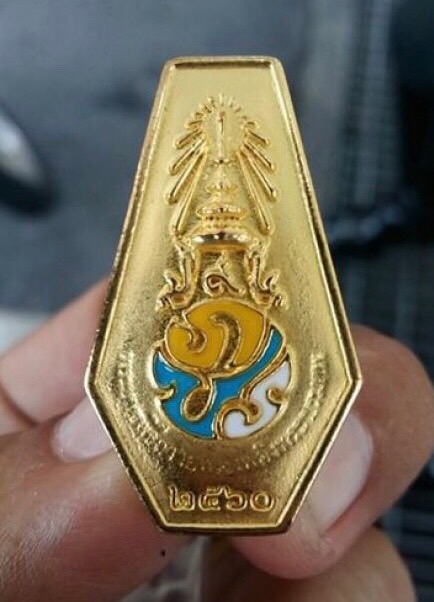
The pins, each about the size of a thumb, feature the royal insignia of late King Bhumibol and commemorate his Oct. 26 cremation ceremony. Police said they received complaints from the prime minister’s office that counterfeit badges were being sold, leading to the investigation.

Today’s raids at a building in Lat Phrao district. Police said they found full scale operation there: including scores of staff members and molds of the royal pins.

“The search is still ongoing,” Nattapol said. “There are so many pins. We haven’t finished counting yet.”

A man named Palangwat Thanakitchaisat was identified by police as the manager of the factory. He was being questioned this morning by police. Maj. Nattapol said he’s “definitely connected” to the shopkeeper arrested Wednesday.

The vendor, Tassanee Horcharankul, was denied bail and remains in police custody. She’s being taken to be arraigned today, Nattapol said. She has denied all allegations.

Any sign of disrespect toward the monarchy is harshly punished. Claiming false ties to the palace or forging palace-issued goods has led to serious charges in the past.

pin.molds
Molds of counterfeit royal cremation pins seized by police Friday
image1pin
A counterfeit royal funeral commemorative pin
Advertisement

Hot News

LATEST NEWS

Bangkok
overcast clouds
30.5 ° C
32.2 °
30.5 °
76 %
4.9kmh
100 %
Sat
30 °
Sun
35 °
Mon
35 °
Tue
33 °
Wed
32 °