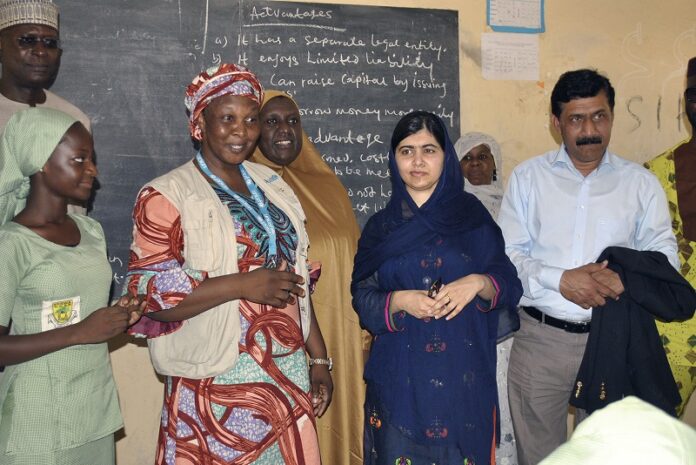
Pakistani activist Malala Yousafzai, centre right, stands Tuesday during a visit to a school in Maiduguri Nigeria. Photo: Jossy Ola / Associated Press
MAIDUGURI, Nigeria — Nobel Peace laureate Malala Yousafzai was greeted with cheers Tuesday by dozens of young women in northeastern Nigeria, where she spoke out for the many girls abducted under Boko Haram’s deadly insurgency.
The 20-year-old Pakistani activist told The Associated Press she was excited by the courage of the young women who are undaunted as they pursue an education amid one of the world’s worst humanitarian crises.
“This is part of my girl power trip, visiting many parts of the world,” said Yousafzai, who also met with the freed Chibok schoolgirls taken in a mass abduction by Boko Haram more than three years ago. “I am here now because of the Nigerian girls. Fighting for them and speaking up for them.”
Yousafzai visited internally displaced camps in and around the city of Maiduguri, where thousands have sheltered from Boko Haram’s violence. The extremist group continues to carry out deadly attacks there, often using young female suicide bombers.
“They have lived in the period of extremism,” Yousafzai said of the young women around her. Many have seen family members killed.
Yousafzai was 15 when she shot in the head by Taliban militants in 2012, targeted due to her advocacy for women’s education.
The Nobel winner said her Nigeria visit was significant because it was the partial fulfillment of what she advocated the last time she was there. In 2014, she pressed then-President Goodluck Jonathan to ensure the rescue of the more than 200 abducted Chibok schoolgirls.
On Monday, Yousafzai met with more than 100 who have since been rescued and now stay in the capital, Abuja, for what the government calls rehabilitation.
While she told the AP she shared their joy at being freed, she said she was not happy that the girls haven’t been allowed to reunite fully with their families.
She said she hopes they will “live with their family, live a normal life.”
Many others remain in Boko Haram captivity, “and the government must unite so that they should make sure that these girls are released,” Yousafzai said.
“Boko Haram themselves should learn that in Islam, such things are unacceptable,” she added. “This is against humanity, this is against Islam.”
Yousafzai also met Monday with acting President Yemi Osinbajo, speaking up for the more than 10 million children displaced by Boko Haram and pressing for the declaration of a state of emergency for education in Nigeria.
She also urged the international community to address the crisis in the country’s northeast.
Girls at the internally displaced camps said the Nobel winner’s story of courage gave them inspiration for a brighter future.
“Her story give us hope, that’s why we too want to go to school and become something in life,” said 15-year-old Fatima Ali. “We have to bear all pains like hunger to go to school. We barely eat once a day here. We have not eaten since morning because government people no longer bring us food for about two months now.”
Three million children in Nigeria’s northeast are in need of support to keep learning, according to the U.N. children’s agency. Nearly 1,400 schools have been destroyed during Boko Haram’s insurgency, which began in 2009, and more than 2,295 teachers have been killed, the agency says.
Ali said she was in school when Boko Haram attacked her town three years ago. “I want to become a soldier so that I could help my community to fight and kill Boko Haram, because they are not good people,” she said.
Another student, 15-year-old Fatima Grema, said she sees herself in Yousafzai.
“Boko Haram abducted me and wanted to marry me,” she said. After being taken from the town of Baga to a location near the Cameroon border, “I later managed to escape,” she said. “I was not in school until I came to the camp here.”
Grema said she now wants to become a teacher.
UNICEF’s country representative Mohamed Malick Fall said Yousafzai’s visit is a symbol of hope, and “we will do everything in our power to make sure all children can keep learning.”
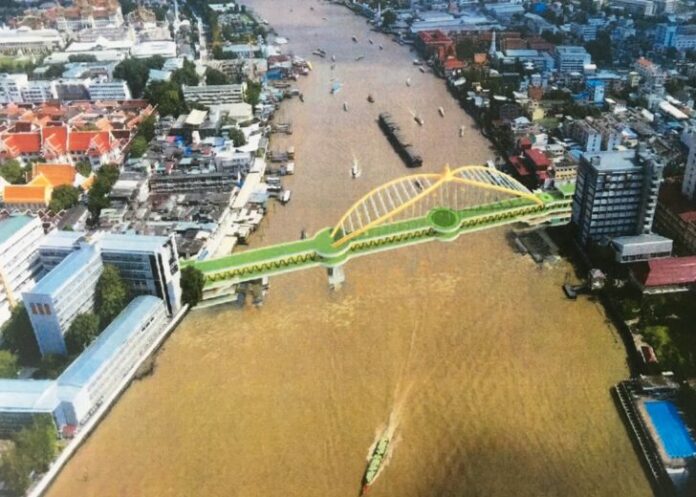
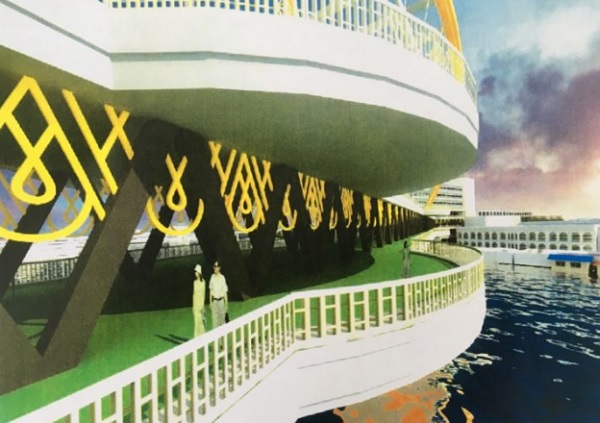
A rendering of the two-floor footbridge and bicycle lane spanning between Tha Prachan and Wang Lang piers revealed to the public on Friday. Image: Bangkok Metropolitan Administration
BANGKOK — City Hall on Tuesday dismissed concerns over the project to build a footbridge and bike lane across Chao Phraya river, after its latest design drew criticism throughout the weekend.
Criticized for its process, design, economic benefit and impact to the environment, Nat Sisukhonthana, director of the Department of Public Work, stepped out to defend that the plan to bridge Tha Prachan and Wang Lang piers had gone through a proper study.
Initiated in 2010, the project never made progress until City Hall revived it last year, spending 49 billion baht to hire consultants to conduct feasibility studies and design the bridge.
The contractor gave four designs before the final model was selected by participants in a December hearing.
In such design, the single-floor, cross-arched pedestrian bridge lacks piers and is about 10 to 15 meters wide.
The project was brought back into the spotlight after City Hall and its consultants held another hearing on Friday to present the revised design.
“People had suggested that it should have two floors,” said Nat’s No.2, Sorachai Tovanichkul on Monday. “So we asked the consultant, whose contract already ended in January, to arrange yet another hearing for the new design.”
The previous design of the walkway that was selected in a December public hearing has one floor and doesn’t need a bridge pier.
In the new blueprint, the nine-meter wide bridge also incorporates escalators and elevators to connect what are now two floors, and requires a concrete bridge pier to be driven into the river as a support for the structure.
The estimated construction cost is about 1.7 billion baht.
Sorachai said it had yet to be determined whether authorities would settle with the new model or use the December design. He could not say when this would be decided.
Bridging Rattanakosin Island to the Thonburi side, the project was overwhelmingly welcome by Thonburi residents, who said they had been waiting to be a part of the city’s development. As seen in a video from Matichon, attendees of the Friday hearing showed their support for the footbridge construction.
During the hearing, Itsaraphon Premkamol, representative of the Maritime and Business Association, raised concerns over having to build concrete pillars in that section of the river, alleging it could lead to accidents, Matichon reported.
Activist group “Friend of the River”, which has been campaigning aggressively against the Chao Phraya promenade project, questioned the footbridge initiative on its transparency and inclusiveness.
“There should be a study on the economic benefits that this bridge will create for the neighborhood,” the group wrote Saturday. “So the society can be assured that it’s worth spending 1.7 billion baht.”
A Landscape architect from the government’s Fine Arts Department said that judging from the design, the landmark could become another eyesore for Bangkok.
“It looks outdated. It neither represents anything about Bangkok nor creates a new identity for the city,” said Pornthum Thumwimol on Tuesday.
Saying he was not against the idea of building a bridge, Pornthum said the project should have studied the planned construction area before the design was drawn – especially given the sensitive characteristics held by this old part of the town.
He suggested City Hall should have arranged an open competition for the bridge design to make the process inclusive and consist of well-rounded inputs.
“We can’t freeze the city we are living in to be at one specific era forever,” he said. “ But if we design the new structure well, it can become a historical place in the future. It can be a representation of our time.”
A rendering of the two-floor footbridge and bicycle lane spanning between Tha Prachan and Wang Lang piers revealed to the public on Friday. Image: Matichon
Nat, the director from City Hall who oversees the project, responded to the criticism Tuesday saying the study already deliberated over the impact the walkway would have on the environment and the historical landscape.
As a safer and faster option to commute to the other side of the town, Nat said the bridge could help transfer patients to Siriraj Hospital quicker, as it’s right next to Wang Lang pier.
He added that the study also showed the return of economic benefits from the bridge – such as employment and tourist spending – would be worth the investment.
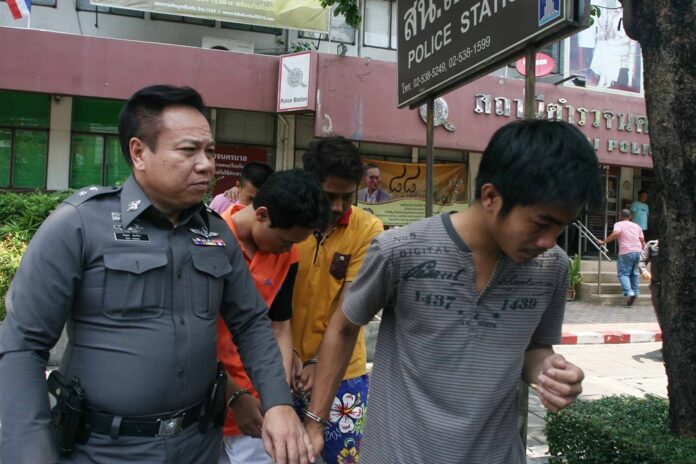
Police escort the men accused of killing Somkiat Srichan to court on May 3, 2016.
BANGKOK — The last Ananchai Chaiyadech saw of his neighbor, a disabled man named Somkiat Srichan, he was being cornered and repeatedly stabbed by three men wielding knives.
“He was looking at me,” Ananchai, a lawyer by trade, told a packed courtroom Tuesday. “I could see in his eyes that he was pleading to me. He wanted me to help. But I couldn’t intervene.”
Moments later Somkiat, who could not use his right leg, was slashed in the throat just as police officers arrived at the scene. He soon collapsed and died in the arms of his nephew.
The killing in the morning of May 1, 2016, shocked the nation after footage of the deadly assault made its way to social media. Online fury also broke out when it emerged that some of the suspects were sons of police officers. The three men and their alleged accomplices – altogether six men and one woman – are now standing trial in a Bangkok court.
Ananchai’s testimony to the court Tuesday marked the first day of the trial. Prosecutors are pursuing counts of murder, which carry the death penalty, but defense lawyers argue the killing was a result of a mutual fight turned violent, pointing to residual yaba found on Somkiat’s body.
The seven suspects are Arin Yodponganan, 21; Peerapol Yodponganan, 21; Monmanat Sangpho, 23; Akkaradet Thatsana, 24; Mek Polkraisorn, 20; Natnicha Ritlamlert, 20; and Jatuporn Chansopha, 19.
The incident took place in front of the bakery where Somkiat worked, in an alley off Soi Chokechai 4 in Ladphrao district. Ananchai, whose law office is located a stone’s throw away, was considered a key witness because he saw Somkiat’s last moments.
‘They Took Turns Hurting Him’
Speaking to judges, Ananchai said someone at his office told him Somkiat was being assaulted. He rushed outside at about 9am to see the disabled bakery worker being cornered by Peerapol, his brother Arin and Akkaradet in front of Pang Hom bakery shop.
Somkiat was feebly swinging a blade used for cutting bread to keep the three men at bay, while the three men switched two knives among each other and repeatedly charged at Somkiat to slash at him, the witness said.
“They were taking turns. They stabbed him and they taunted him. They were handing the knives to each other,” Ananchai said. “They took turns hurting him.”
Jatuporn and Mek were keeping their distance not far from the trio; Ananchai said they seemed poised to help the three if they faltered.
Footage of the incident shows Somkiat trying to hop away from his assailants with his one good leg.
Throughout the assault, Arin was picking up bricks and stones and throwing them at the victim, Ananchai said. He added that Arin’s girlfriend, Natnicha, was screaming obscenities and urging her friends to murder Somkiat.
“Get him. Get him and kill him,” the witness quoted Natnicha as saying.
Police officers soon arrived at the scene, but any relief Ananchai felt quickly turned to horror. Ananchai said the three men continued to assault Somkiat even as policemen shouted at them to stop.
He said one of them eventually dealt the fatal blow by slashing at Somkiat’s throat.
The assault only ended after a policeman decided to fire a shot in the air. Peerapol and Arin were allowed to go to hospital unaccompanied for the slight injuries they received, while the rest of the suspects were ordered to lie down on the ground and handcuffed.
While police were arresting the suspects, Ananchai said he walked to Somkiat, who was soaked in blood. He was on the ground, being cradled in the arms of his nephew, Matus Phonprasert, as he died.
“I need water. I can’t breathe,” Ananchai recounted Somkiat’s last words.
He was pronounced dead on arrival at the hospital.
Police Connection
The altercation reportedly first began when four of the defendants walked past Somkiat’s bakery shop and made a sneer about his bread, which led to a heated exchange of words.
Video footage of the incident showed Somkiat rushing into the shop and fetching a blade to scare off the assailants. Ananchai said the blade, 31-inch long, was usually used by Somkiat to cut bread.
Peerapol and Arin later arrived on motorcycles and brought knives with them, Ananchai told the court.
Somkiat’s death drew widespread attention not only because of the video footage that captured the moments of his killing, but also because police did not initially take action against the suspects.
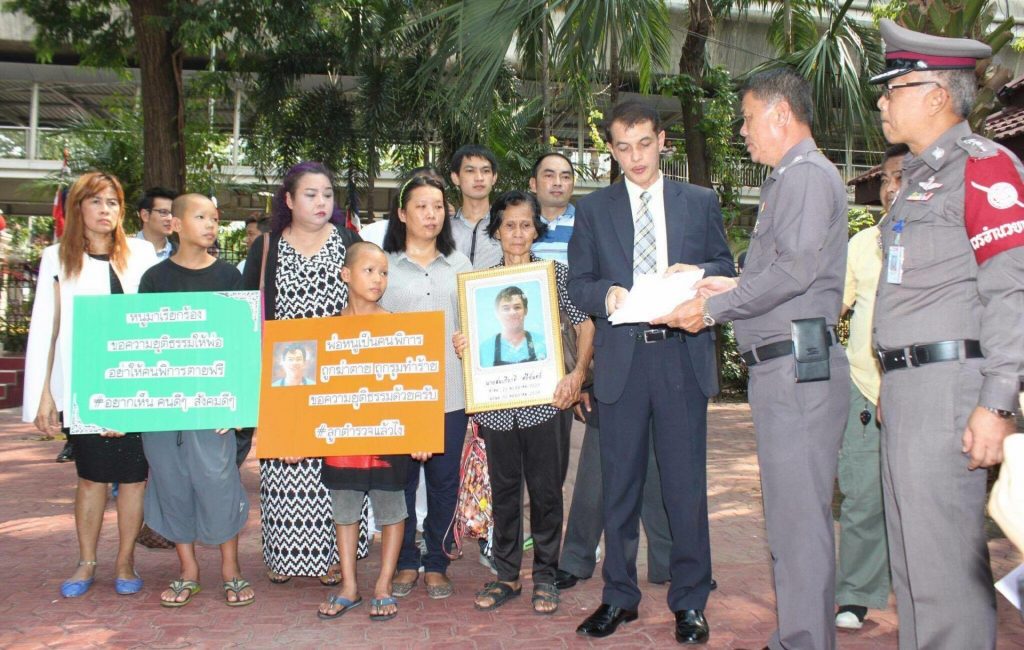
Family of Somkiat Srichan petition the police on May 16, 2016, to speed up the investigation.
It later emerged that Peerapol, Arin, Monmanat and Mek were sons of police officers – Mek’s father even worked at the police station that oversees the investigation – fueling allegations on social media that police were shielding the four suspects from the full force of the law.
Following online uproar, police charged all of the suspects with murder and other offenses related to the assault. Natnicha – who was not directly involved in the killing – was also charged with being accessory to murder.
Defense lawyer Kompet Chanpoon denied allegations that his clients were receiving any privilege from the police.
“Their fathers didn’t help at all,” Kompet said during a court recess. “If their fathers did, why would they be in jail for the whole year?”
Attack Not One-Sided?
Despite a packed courtroom – mostly with law students and interns observing the procedure – and the extensive coverage in weeks following the killing, only one reporter was present at today’s session. Family members of the accused also attended the trial.
Kompet did not dispute that his clients were involved in the killing, but he said the tragic events resulted from a fight between Somkiat and the young men.
The lawyer said his team would argue to the court that the defendants should be punished on a lesser charge of manslaughter. He said he hoped the seven suspects would be given a “three or four year” prison sentence instead of the death penalty.
During the witness cross examination, Kompet said he possessed video evidence that shows Somkiat riding a motorcycle toward the direction where the defendants had been hanging out earlier that morning. He suggested the two parties might have taunted each other prior to the altercation.
Kompet also pointed to an autopsy report that found traces of methamphetamine in Somkiat’s body.
“He was high on yaba,” the lawyer said.
The trial continues through July 26. The defendants are scheduled to take the stand on Friday.
In this photo posted on Facebook on Sunday, topless men lie side by side on a wet floor with their hands underneath each other’s trousers at an unspecified location. Photo: ANTI SOTUS / Facebook
BANGKOK — One of the annual controversies surrounding Thai university education is the initiation rites for freshmen students which often turn autocratic, abusive and even sadistic.
Chulalongkorn University student leader Netiwit Chotiphatphaisal is trying to turn his university into an example of good practice and the council he leads recently asked students heed six recommendations in a bid to eradicate the controversies of such practice.
The six recommendations are the respect for human rights without ethnic, gender, age or religious discrimination; the non-enforcement of initiation rites on students; the financial transparency in initiation-rite-related spending; the banning of harassment threats against freshmen; the maintenance of good hygiene and the openness of activities to outsiders.
On Friday, Netiwit – a sophomore at the faculty of political science faculty and the president of the university’s student council – took a reporter on a tour of the premises. Things seemed orderly and there were no visible sightings of the abuse so characteristic of the infamous rite known in Thai as Seniority, Order, Tradition, Unity and Spirit, or SOTUS.
Netiwit said the dark days are numbered, if not already behind. But as we were entering a large room housing 200 students undergoing rites, a female senior student in charge was seen carrying a transparent plastic bucket filled with straws and a leftover red-colored drink. This was a clear sign that communal drinking had been taking place and thus contrary to student council recommendations. Netiwit tried to downplay the matter, despite the recommendations clearly specifying that “for good hygiene, students should not engage in the communal consumption of food or drinks.”
Sarawit Pratchprueng, a sophomore who is among the seniors organizing the rite said no one is being explicitly coerced to participate in such initiation rite at the faculty any longer. Out of 282 freshmen at the faculty this academic year, he said only 231 willingly joined the program. He also pointed to the positive side of the SOTUS rite.
“Seniors and freshmen have the chance to get to know one another and build relationships. The connection will come handy in the future for works. If we use force like in SOTUS, it won’t be of benefit to the young,” explained Sarawit, adding that there’s no coercion involved whatsoever.
Asked if such connections bred nepotism and paternalism in the workplace wherein some large corporations favor people who graduated from the same university over others equally if not more qualified, Sarawit said that’s partly true.
“That’s partly right, there’s paternalism. But there are positive sides as well,” he said.
Phiotsinee Jeeraphum, a junior International Relations major at the same faculty – who was one of the main organizers of the initiation rite said that “there’re two sides to everything, good and bad,” adding that the rite ensures freshmen don’t feel isolated.
A student holds a bucket containing a red liquid Friday at Chulalongkorn University.
Flashback to the Recent Past
In some past cases, both in this and other universities, students who decide not to partake have been coerced to do so through back channels, and seniors have threatened to punish those who do not cajole others into joining.
Things used to be much rougher, at least at the university’s Faculty of Engineering, a former student who became an anti-junta activist insisted. Kittithat Sumalop, or Champ 1984, recalled how rites ceremonies at Chulalongkorn University were abusive back in 2000 when he was a freshman.
Kittithat, 34, said back then things were pretty coercive and abusive.
“This was brainwashing,” said Kittithat, adding that his seniors may have wanted him and fellow batch mates to love the seniors and the institution by instilling uncontested obedience. “It’s about being made to unquestioningly accept the power of seniors,” said Kittithat, adding that he sees a parallel with military dictatorship and what the junta demands from citizens at present.
Kittithat said he was made to run under the blazing sun and crawl on a concrete floor among other things before being forced to scream at pictures taken of him during the activities.
However, the end result was the total opposite to unison, as Kittithat said he emerged from the ordeal carrying “a seed of doubt” which eventually turned him from a conservative right-winger and a bookish and obedient child into a daring left-wing activist challenging the military regime 15 years later.
Nevertheless, the activist insisted that things had improved remarkably over the past decade and a half.
“Students nowadays increasingly dare to questions things,” said Kittithat, adding that issues such as compulsory student uniforms are also being questioned by students.
Coercion and Abuse Continue Elsewhere
On Sunday, local media reported an incident at Mahasarakham Rajabhat University in the northeastern region, where an initiation rite for incoming musicology students at the faculty of humanities allegedly involved the throwing feces at freshmen’s faces. Students involved in the organization of the event quickly denied the allegations, saying that shredded vegetables and pumpkin mixed with fermented fish paste had been used instead. The university administrator responded by launching an internal probe on Monday.
Moreover, Facebook page Anti-Sotus posted video footage Sunday which shows male engineering students at the university being forced to take turns to lick the nipples of fellow male students. Deputy Rector Pitawat Panthisri said on Monday that the university would probe both cases and have results within seven days.
The Facebook page also posted a photo which appears to show topless students lying side by side on a wet floor with their hands underneath each other’s trousers.
“Generating such idiocy. Will the university administrators not take any responsibilities? These seniors psychos are doing this in the name of the university and this is a disgrace to the Asean region,” wrote Hara Shintaro, a former lecturer of Malay language at Prince of Songkhla University in Pattani province, on his Facebook profile.
Once such practices are made public, universities can no longer defend them. It’s better to be proactive, said Prathai Piriyasuwang, associate professor of communication arts at Chiang Rai Rajabhat University. Prathai said his college would not tolerate any such cruel and abusive practice and that lecturers, himself included, were assigned to monitor the rite.
“I have to monitor how they are being initiated,” Prathai said, adding that anything that occurs unsupervised or after office hours would not be tolerated.
However, each new academic year has seen new cases of abuse. Piyarat Chonthep, co-founder of Anti-Sotus, which has more than 127,000 likes and focuses on such abuse said universities in the provinces tend to be more vulnerable to the conservative and autocratic ritual. What’s more, he said it’s a reflection of the larger society itself.
“Collegiate life is a reflection of the larger society. We are seeing increasingly militaristic initiation rites, top-down approaches and the use of connections to facilitates workplace recruitment.”
Piyarat – who traced the history of abusive and autocratic rites from Thai students who studied at universities abroad and returned to adopt them in Thailand – said things have improved considerably over the years and that younger generations have a more independent mind.
“Some have said no to such practices. I have hope for places like Chulalongkorn [university],” Piyarat said. “Upcountry, there may be less awareness about rights and students may be in situations where they feel compelled to subject themselves [to seniors].”
While the objective is to instill unity and spirit, the methods employed are often wrong because coercion doesn’t bring about unity, Piyarat said.
Even Piyarat and Netiwit, two of the main players in the debate over the appropriateness of initiation rites, think the practice will persists but hopefully without coercion and abuse.
“I don’t think it’s possible to do-away with it,” said Netiwit, who added that he is not against a human-rights-sensitive rite. “There are more positives than negatives. It helps students from the provinces [who come to study to Bangkok] to enjoy human contact. Initiation rites are not just about autocracy or a patronage system.”
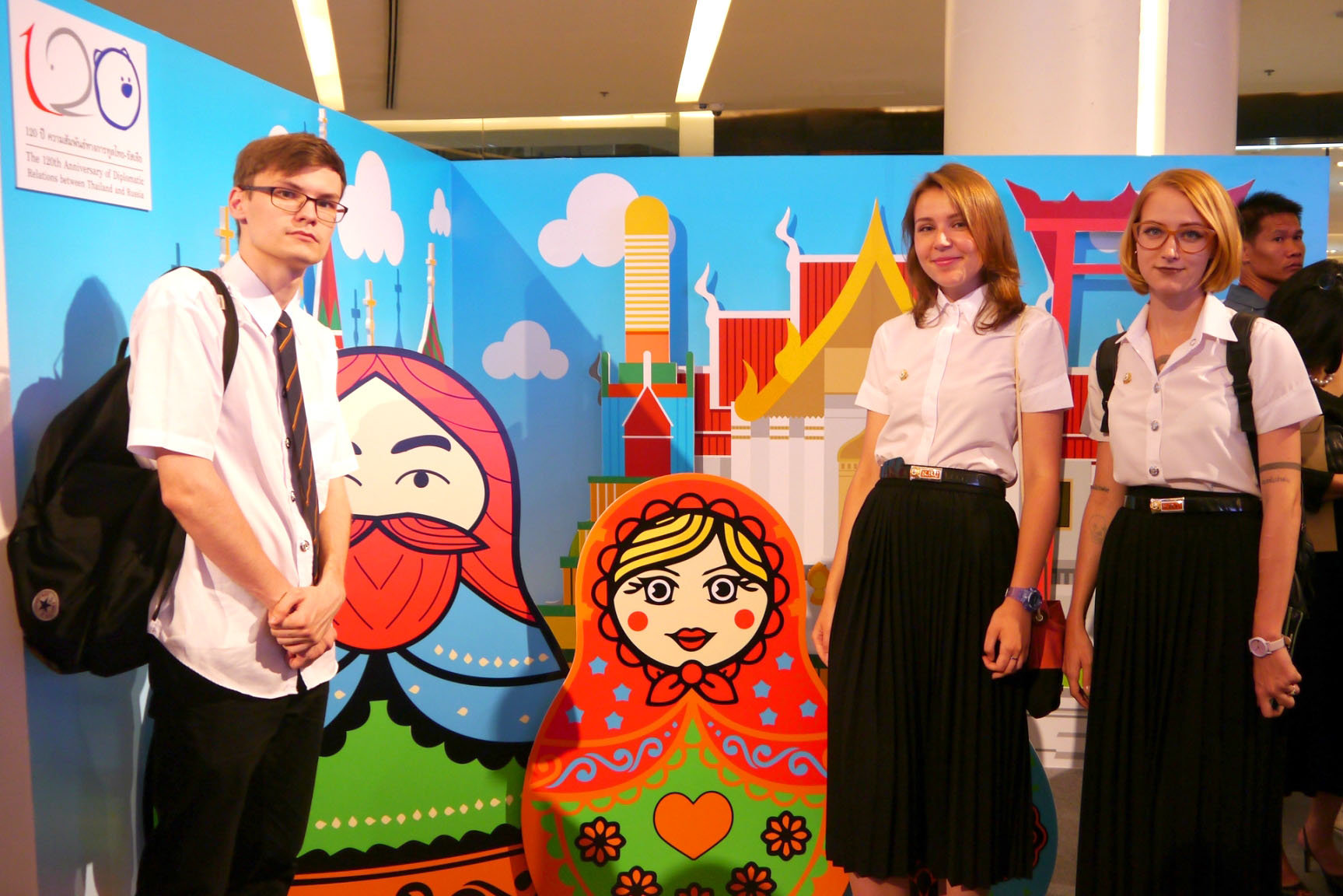
Russian students of Kasem Bundit University pictured Friday at the Russian Festival in Siam Paragon.
Top: Russian students of Kasem Bundit University pictured Friday at the Russian Festival in Siam Paragon.
BANGKOK — A Russian-themed festival in Siam Paragon that ran Friday through Sunday drew those who longed for a taste of the largest country in the world.
At the “Sharing Our Past, Forging Our Future” Russian festival held in Siam Paragon, mall-goers dropped by to see the fake snow and the polar bear mascot.
“I’m really happy that such events are organized in Thailand so we can share our cultural identity, ” Vladislav Tornikov, 19, a Russian student studying Thai at Kasem Bundit University, said at the Friday event.
Vladislav Tornikov, 19, a student studying Thai at Kasem Bundit University.
When asked what he would like Thais to know more about Russia, Tornikov mentioned his motherland’s history and culture.
“Russian culture is really interesting and fascinating. I would advise you to read novels by Russians, such as Dostoyevsky, Tolstoy or Chekhov,” Tornikov said.
The event was held to commemorate 120 years of Russo-Thai relations, and included dances by the Pattaya-based Katyusha Dance Academy as well as academic exhibitions from Thai universities with Russian programs.
Children on Friday pose with Mr. Russky Sri Ayudhya, the mascot for the event.Russian women sell matryoshkas and other souvenirs at the Embassy of Russia’s booth.The Katyusha Dance Academy’s dancers perform a Russian dance.Mr. Russky Sri Ayudhya, the Muay Thai-fighting polar bear, was inspired by Muay Thai champ Buakaw Banchamek’s win against Russian Artem Pashporin in 2015. His signature move? The “Fist of Friendship.”Attendees take selfies with Mr. Russky Sri Ayudhya.The festival on Saturday morning.
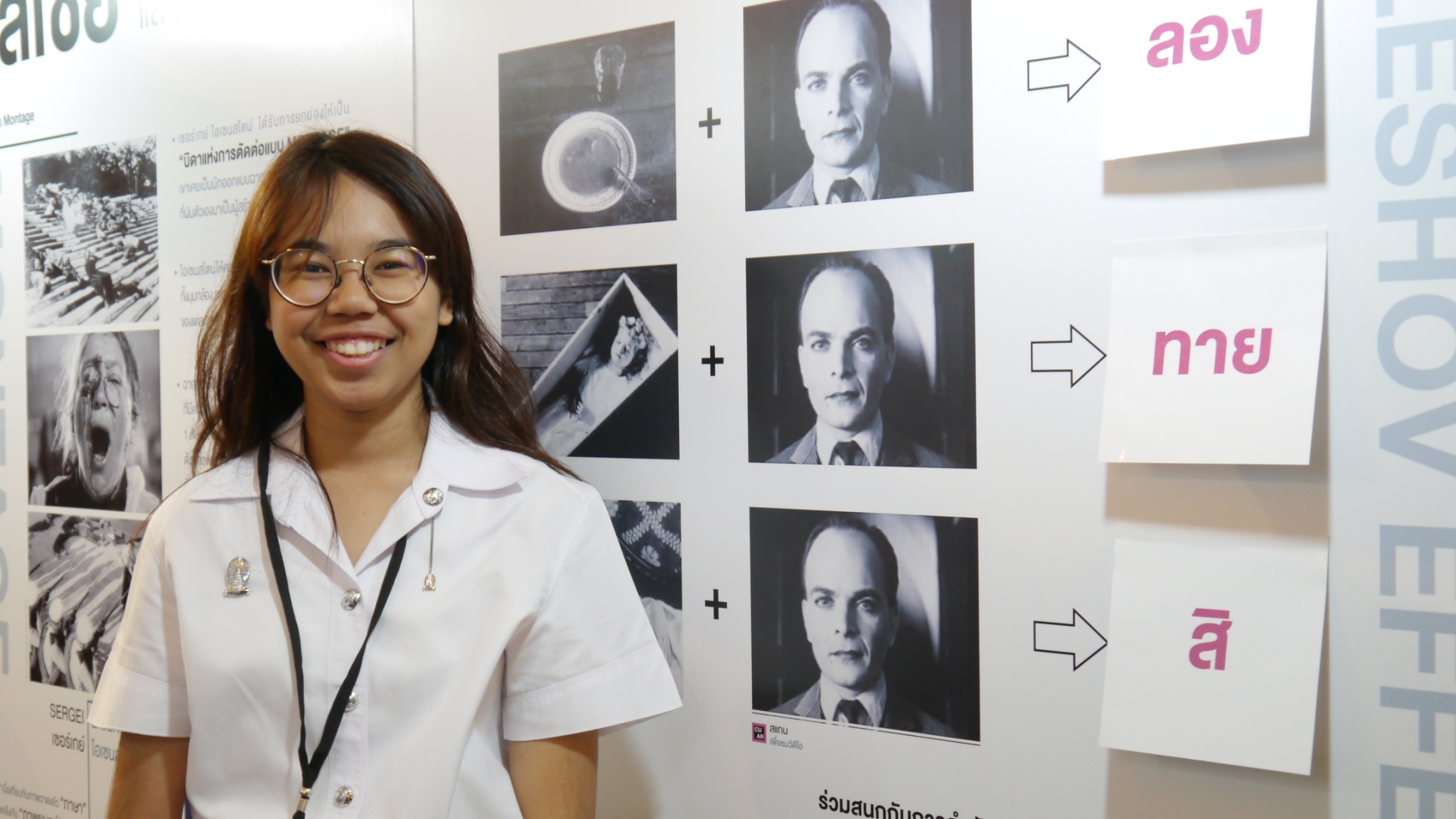
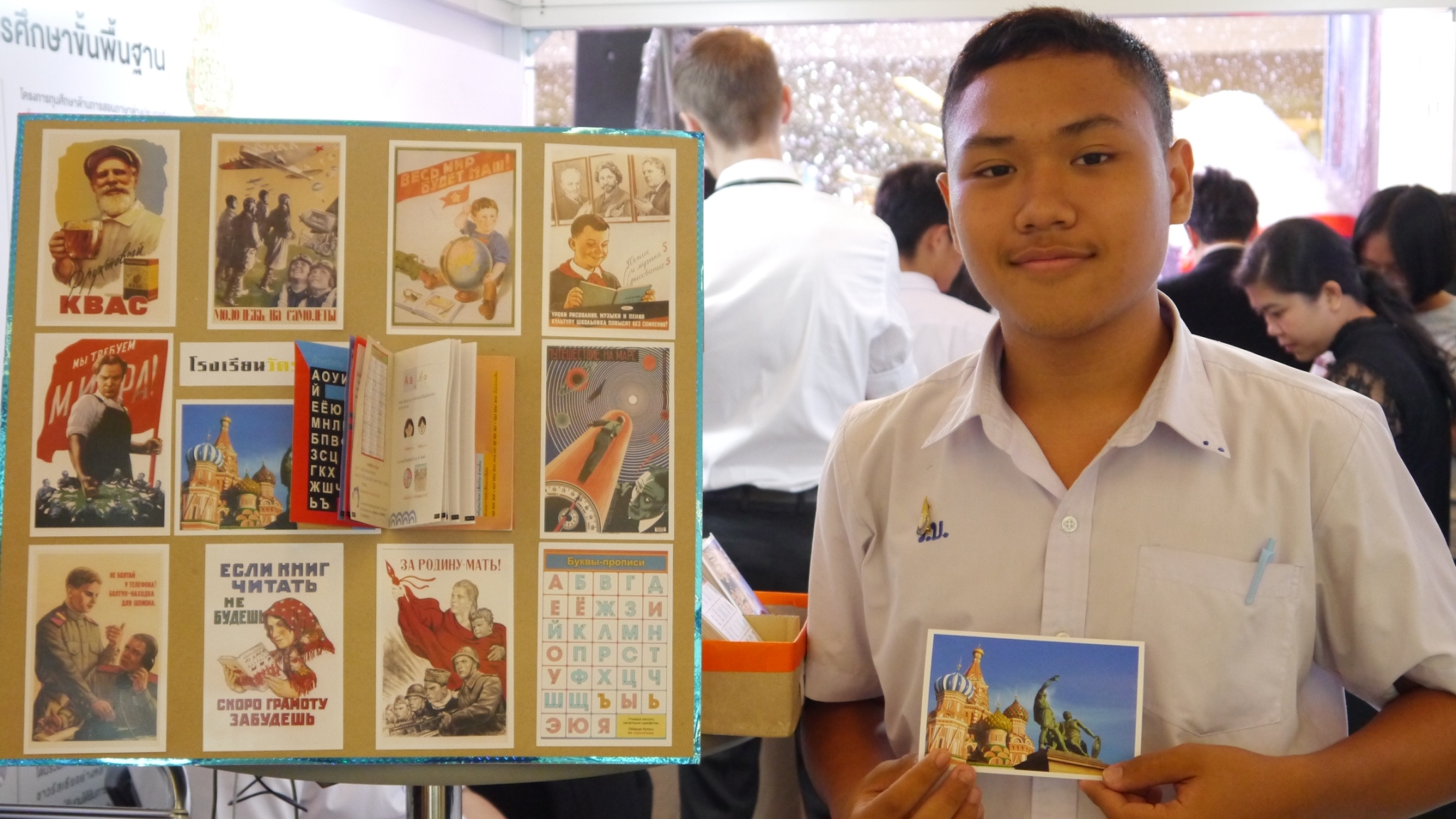
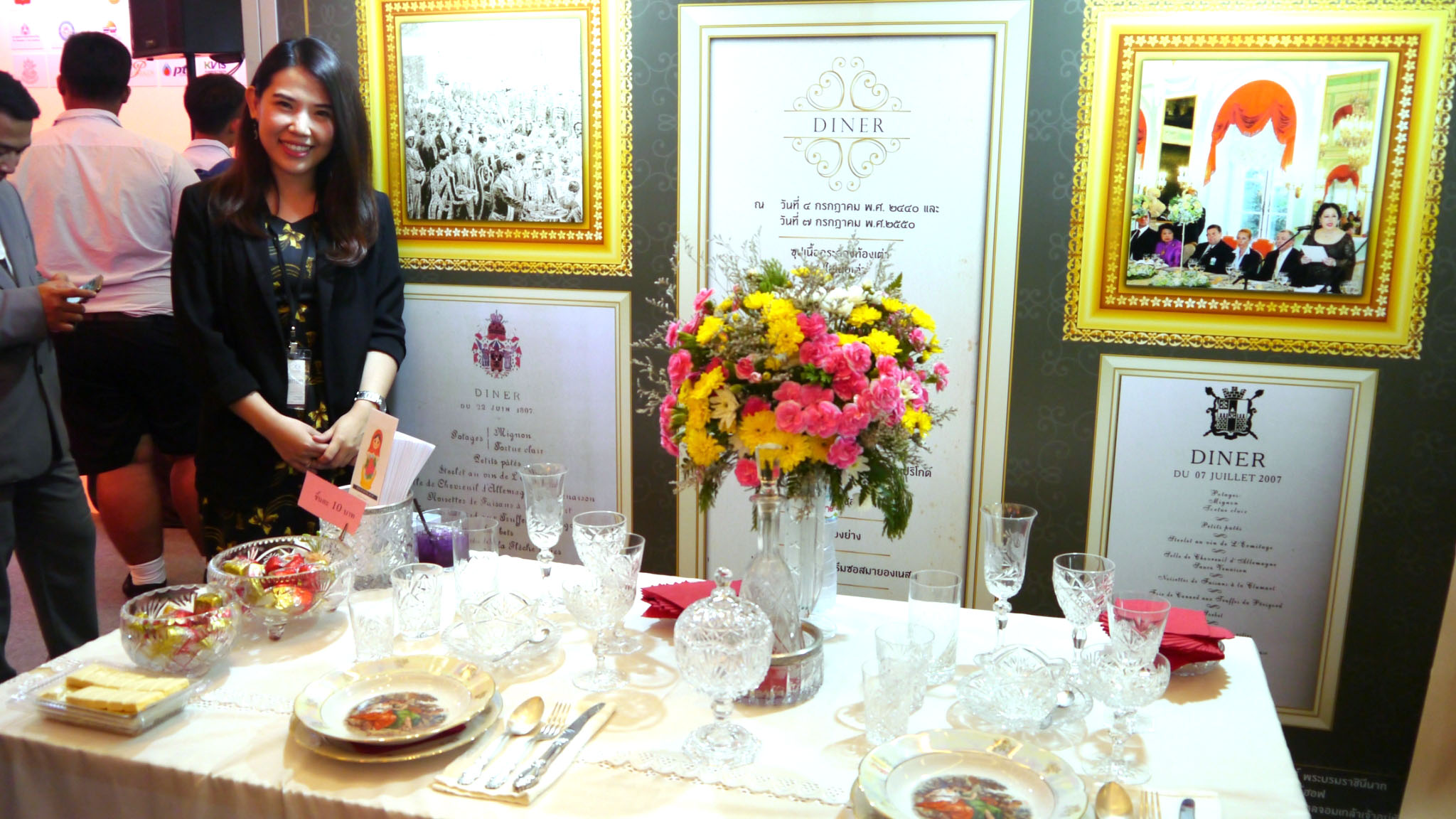
Students from the Russian Studies Program at Thammasat University dress up in Russian costumes and hand out Russian vinaigrette salad on Friday.Russian students studying at Kasem Bundit University pose in front of cardboard matryoshkas and temples Friday at Siam Paragon.At the Chulalongkorn University booth Friday, a student shows off an exhibition on Soviet director Lev Kuleshov’s Kuleshov Effect.A Chulalongkorn student demonstrates the booth’s interactive features, where an app pointed at the exhibition will show the Odessa steps scene from Sergei Eisenstein’s 1925 film, Battleship Potemkin.Pointing the interactive app at another section of the exhibition shows a 3D rendition of Eisenstein, as demonstrated by a student.A student poses next to Soviet and Russian postcards Saturday.A woman smiles next to the exhibition of the table setting modeled after the dinner Queen Sirikit had with Vladimir Putin on her state visit to Russia in July 2007.
There are no brothers in arms, no flashbacks to simpler times and pretty wives and girlfriends left behind, no old men in situation rooms pontificating about politics or helping with exposition. There’s no talk of Hitler, or Germans or battlefields or trauma or mothers. In fact, there’s hardly any talk at all, or, for that matter, even any characters in the traditional sense.
But don’t be mistaken: Christopher Nolan’s “Dunkirk” is a stone cold masterpiece.
It’s a stunningly immersive survival film told in 106 thrillingly realized minutes. Nolan puts the viewer right in the action whether it’s on the beach with 400,000 men queued up and waiting for a rescue that may never come, on the waters of the English Channel in the little civilian ship headed into hostile waters with only an aging man and two teenage boys aboard, or in the air above in the two lone Spitfires that are quickly running out of fuel.
I’ve never experienced anything quite like “Dunkirk’s” intoxicating immediacy. The screen and images envelope you with urgency, dread and moments of breathtaking beauty and grace as you wait with the soldiers, as the title card at the beginning says, for deliverance.
The story begins on the ground, with a young soldier, Tommy (newcomer Fionn Whitehead) wandering the deserted streets of Dunkirk looking for water and a place to relieve himself. Propaganda flyers float down to the ground reminding the soldiers of something they’re already well aware of — that they’re surrounded. “Surrender + Survive!” the flyers read as Hans Zimmer’s gently ominous score plays in the background telling us that while it may be calm for a moment, it is not safe. A deafening gunshot breaks the silence, and, fair warning, your racing heart will not stop for quite some time.
Nolan follows Tommy back to the beach where soldiers stand in long lines that stretch to the water, where no boats approach. His part is nearly silent, his motivations unknown. They are all haunted shells, stripped of meaningful weapons and a military purpose. He and the rest just know they need to get off the beach at any cost.
We accompany Tommy as he tries to achieve that objective which eludes him with almost comic frequency. He’s the unluckiest lucky fellow out there.
Occasionally we get the sobering perspective of the higher ups, compliments of the great Kenneth Branagh as Commander Bolton.
In the air there are the two Spitfire pilots, Farrier (played by Tom Hardy, whose face is once again largely obscured but who can act circles around many of his contemporaries even with just the use of his eyes and eyebrows) and Collins (Jack Lowden). They get to be the lofty, classical heroes of war films past as they shoot down the enemy. Hardly has a film ever made you feel as in the moment as this.
And on the sea, the three civilians, Mr. Dawson (Mark Rylance), Peter (Tom Glynn-Carney) and George (Barry Keoghan) who, like so many during the Dunkirk evacuation, took it upon themselves to captain their own small vessel and journey into war dressed in their seaside knits and armed only with lifejackets and blankets to help save their country’s stranded men. They’re the beating heart of film, especially when pitted against a shell shocked soldier (Cillian Murphy) who is determined to stop them from going back to Dunkirk.
These narratives intertwine and loop back and repeat from different vantage points with stunning effectiveness — never seeming redundant or dull. Nolan finds suspense at every angle, and ramps up the tension with the help of Zimmer’s ticking score. While, there might not be character arcs to speak of, the performances are first-rate nonetheless (even pop star Harry Styles, who might just have another viable career option).
Nolan continues to be unparalleled in Hollywood — working on a scope that few are able to. As many filmmakers experiment with the small screen, Nolan has only gone bigger and bolder with his commitment to film and IMAX. What a case “Dunkirk” is for the movie theater. Not only that, “Dunkirk” is far and away the best film of the year, and Nolan’s finest too.
See it big and then see it again.
“Dunkirk,” a Warner Bros. Pictures release, is rated PG-13 by the Motion Picture Association of America for “for intense war experience and some language.” Running time: 106 minutes. Four stars out of four.
Malaysian Airlines flight 9M-MRO Malaysia Airlines takes off in 2013 from Los Angeles International Airport. Photo: Paul Rowbotham / Wikimedia Commons
VIJFHUIZEN, Netherlands — The father of two siblings killed when Malaysia Airlines Flight 17 was shot down over Ukraine three years ago said Monday that relatives of the 298 people killed would not rest until those responsible face justice.
At an emotional ceremony marking three years since MH17 was shot down, Evert van Zijtveld said a group representing victims’ families “shall not give up and shall not be silenced until those who are responsible have been brought to justice.”
As Dutch King Willem-Alexander and Queen Maxima along with some 2,000 friends and relatives of victims gathered at a new memorial, Van Zijtveld said the loss of his 19-year-old daughter Frederique and 18-year-old son Robert-Jan “left a hole in our hearts.”
The commemoration came as international investigators continue their painstaking probe aimed at prosecuting those responsible for shooting down Flight 17 and killing all the passengers and crew.
The Boeing 777 was destroyed by a Buk missile on July 17, 2014, over conflict-torn eastern Ukraine. The international criminal probe has concluded that the missile was fired from rebel-controlled territory by a mobile launcher trucked in from Russia. Russia has denied any involvement, and denounced the conclusions as politically biased.
The U.S. has urged other countries to cooperate in the investigation.
U.S. State Department spokeswoman Heather Nauert said that Washington also welcomed a recent decision “to grant jurisdiction to the Dutch courts for the prosecution of those responsible for this tragedy.
“We have full confidence in the ability of the Dutch criminal justice system to conduct a prosecution that is comprehensive, objective and just,” she said.
Investigators last year said they had pinpointed 100 people they want to speak to who are believed to have been involved in transporting the Buk missile launcher or its use.
Nations involved in the probe have agreed to prosecute any suspects in the Netherlands, home to nearly 200 of the victims.
The European Union foreign affairs chief, Federica Mogherini, called for international cooperation in the hunt for the perpetrators.
“To ensure that those responsible for the downing of MH17 are held accountable and brought to justice, the criminal investigation needs the continuing support of the international community,” Mogherini said in a statement. “We expect all the States that are in a position to assist the investigation and prosecution of those responsible to do so, as demanded by United Nations Security Council Resolution 2166.”
After a ceremony at which relatives read out the names of victims, Willem-Alexander and Maxima, joined by 17 local children, each holding a single sunflower, were first to inspect the new monument.
The monument, a curved steel wall and an eye-shaped sculpture engraved with the victims’ names, stands in an amphitheater surrounded by 298 trees – still saplings – planted in the form of a commemorative ribbon. Each tree has a plaque bearing the name of a victim.
The monument is close to Amsterdam’s Schiphol Airport, from which MH17 departed on its way to Kuala Lumpur. In the silence preceding the commemoration planes could be seen and heard flying to and from the airport.
Last week, more than 90 family members attended a memorial in Malaysia for victims and a briefing on the ongoing probe. The flight was shot down while on its way from Amsterdam to Kuala Lumpur.
Transport Minister Liow Tiong Lai told reporters after the event, which was closed to the media, that the investigation was “very detailed and we are quite convinced that we will be able to find the culprits.”
In Ukraine, President Petro Poroshenko said his country is mourning the victims and said he believes the perpetrators of the attack will be brought to justice.
“We have faith in the objectivity and impartiality of the Dutch justice and that masterminds behind this crime will be inevitably brought to justice,” Poroshenko said in a Twitter post Monday.
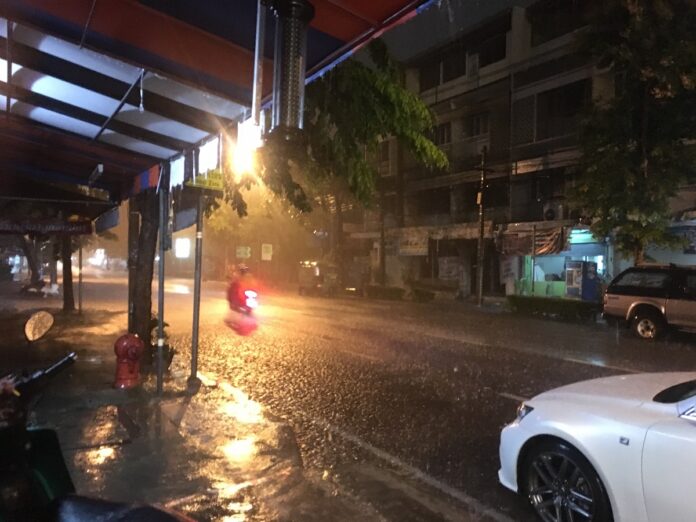
A flooded street Tuesday night in Yan Nawa district, Bangkok.
BANGKOK — The kingdom will see another full week of rains as showers range from Chiang Mai to Yala.
According to the Thai Meteorological Department, Bangkok will see a 70 percent chance of rain through Wednesday and a 60 percent chance through Sunday, while temperatures will range from 24C to 33C.
The north, Isaan, central, eastern and southern provinces will see a 70 to 80 percent chance of rain through Wednesday, with a slight decrease to 60 percent thereon. Residents should be wary of flash floods.
Heavier precipitation before Wednesday is due to tropical storm Talas moving into northern Thailand from Laos.
A rendering of the walking street City Hall plans to construct along both sides of Khlong Ong Ang where the historical Saphan Lek market used to be located. Image: City Hall
BANGKOK — Nearly two years after Saphan Lek market was dismantled, Khlong Ong Ang will get a new walking street along both of its sides, City Hall said Monday.
Unlike the maze of makeshift booths which sold cheap toys and electronic goods over the canal for more than 30 years, Bangkok Governor Aswin Kwanmuang said the new walking street – to be built alongside it – would remain clean and organized because it would be regulated by his office.
A rendering of the walking street City Hall plans to construct along both sides of Khlong Ong Ang where the historical Saphan Lek market used to be located. Image: City Hall
Aswin said authorities planned to seek for a contractor soon to lead the development of the 700-meter promenade along the canal to make it a new city attraction.
Hundred of Saphan Lek market stalls met the wrecking ball on Oct. 20, 2015 as part of the city’s campaign to reclaim public space.
City Hall promised after the 2015 demolition to turn the land into a public recreation space and to possibly run a public transportation system along the canal. Those promises were never fulfilled and the land is unused to this date.
Despite agreeing the labyrinth consisted of hundreds of hazardous and poorly-designed stalls, critics condemned the move as being devastating to Bangkok’s vibrant and historical neighborhood.
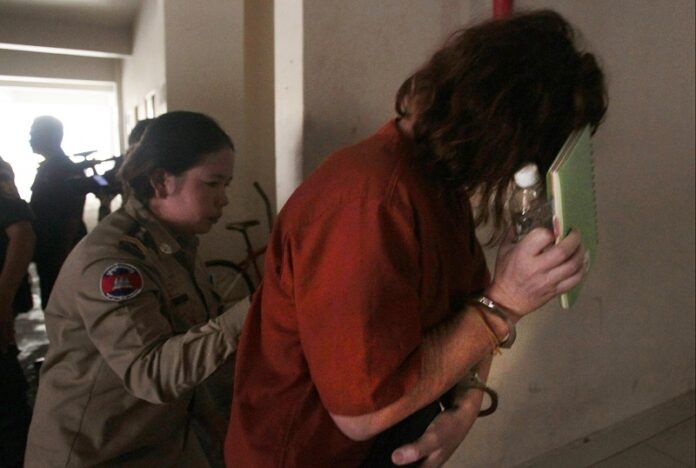
Tammy Davis-Charles, right, an Australian charged with providing commercial surrogacy services, hides her face as she enters the Phnom Penh Municipal Court in 2017 in Phnom Penh, Cambodia. Photo: Heng Sinith / Associated Press
PHNOM PENH — An Australian woman charged with providing commercial surrogacy services in Cambodia has told a court she has “lost everything” since her arrest eight months ago and is suffering from cancer.
Cambodia banned commercial surrogacy last year after becoming a popular destination for would-be parents seeking women to give birth to their children.
Tammy Davis-Charles pleaded innocent in a hearing Monday. The judge adjourned the case until Aug. 3.
Developing countries are popular for surrogacy because costs are much lower than in nations such as the United States and Australia, where surrogate services are about USD $150,000.
Davis-Charles says she launched her business in Cambodia only after consulting three local lawyers who assured her the clinic was legal.