30.5 C
Bangkok
Sunday, June 28, 2026
Home Blog Page 2458

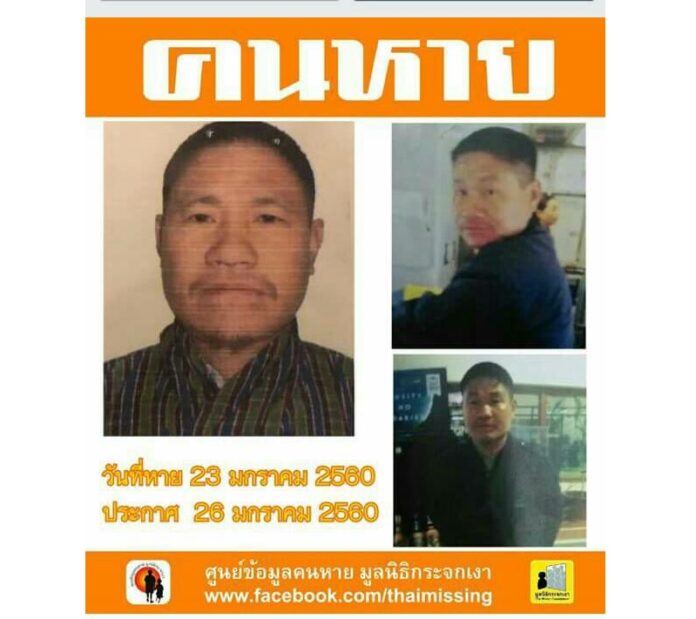
Search Continues in Strange Case of Bhutanese Teacher Missing 9 Days

Photo: The Mirror Foundation / Facebook

SAMUT PRAKAN — Nine days ago, a Bhutanese teacher walked out of his Bangkok hotel and just seemed to disappear.

Three days ago, police said a man resembling Harka Bahardu Sabba, 40, was seen 24 kilometers away in Samut Prakan province. He’s reportedly been seen by witnesses several times since then, but police still can’t be sure it’s him.

“The last time he was spotted, yesterday, was only confirmed by a witness without proof,” said Col Prasert Buakhao of Samrong Tai Police Station. “So we cannot confirm it was him.”

The Bhutanese teacher, who was visiting with a delegation of educators, disappeared early on the morning of Jan. 23 from the Sena Place Hotel in Soi Phahonyothin Soi 11 where they were staying.

Bhutan Ambassador Tshewang Chophel Dorji met with police Wednesday for an update on the case and to express his gratitude for the effort being made to find Sabba.

The ambassador said he was surprised that Sabba, who only speaks Bhutanese, would have traveled so far. He said the teacher has four children back home.

Sabba traveled to Thailand with 10 other teachers for an agricultural training course. Some of his group continued on to Chonburi province. A missing person notice has been sent to police and publicized on social media.

A motorcycle taxi driver, Aduldej Phetroj, 39, said he saw Sabba twice but didn’t know he was missing. The first time was on Soi Sukhumvit 107 on Thursday, then again on Friday. When he saw him on Friday, Sabba looked tired and had no shirt. The motosai taxi driver said he bought him a meal and gave him his shirt. Aduldej said the man could not communicate in Thai or English.

Samut Prakan’s police commander said he has ordered all stations in the province to look for the man.

Traffic police radio released a video in Bhutanese should someone find him. The voice in the video says, “Please go with this person, they will take you to the embassy to take you home.”

Those who have useful information are encouraged to call traffic police at 1808.

Advertisement

Refugees: A World Away From Loved Ones, Anxious and in Limbo

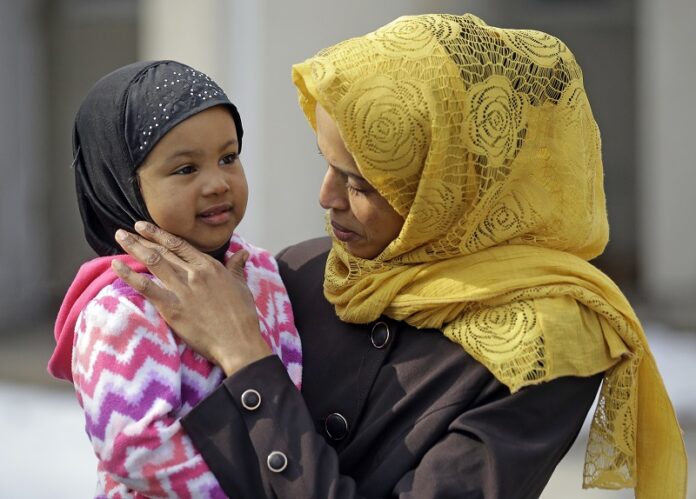
Somali refugee Nimo Hashi holds her daughter Taslim at their home Tuesday in Salt Lake City, Utah. Photo: Rick Bowmer / Associated Press

President Donald Trump’s executive order banning refugees from certain countries has brought stress, desperation, worry and confusion to a number of families in the United States and abroad.

Trump’s order temporarily halted the entire U.S. refugee program and banned all entries from seven Muslim-majority nations for 90 days. Many refugees in the U.S. had expected to reunite with relatives any day, but now their plans are on hold.

5-Year-Old Girl: Far From Mum and Dad

Nagi Algahaim, a U.S. citizen who runs a gas station in Detroit, said he’s effectively stuck in Malaysia with his wife, a native of Yemen. Their 5-year-old daughter is at home with relatives in Detroit but the mother can’t travel there.

Algahaim, 33, said he and Kokab Algazali, 28, have been in Malaysia since December, seeking immigration documents to qualify her for a green card in the United States.

Algahaim said Malaysia Airlines told them that while he can fly to the U.S., his wife cannot.

But he’s not leaving Kuala Lumpur without her.

“She’s been crying every day. It’s heartbreaking,” he said Tuesday.

Their daughter, who has health problems, hasn’t seen her mother since she was 8 months old.

“As an American, I’m disgusted,” Algahaim said. “I thought Trump was going to bring up America, not twist it around with fear and racism.”

Everything Was Set

Everything was set for the Syrian refugees to fly to the U.S.

A “processing error” that for months kept Baraa Haj Khalaf, her husband and baby daughter from joining her parents and two siblings in the U.S. had at last been taken care of. They were told to be at the Istanbul airport Monday for their flight to the U.S.  and a new life near Chicago.

So confident were they that they were on their way to America after fleeing Aleppo, Syria in 2013, Baraa and her husband sold or gave away practically all of their belongings.

In suburban Chicago, her 46-year-old father, Khaled Haj Khalaf, could hardly contain his excitement. “We were very happy,” he said through an interpreter Tuesday. “This is the land of freedom, the land of democracy.”

Even some Chicago mothers had volunteered to collect furniture, food, clothing and toys for the baby at their future apartment. Then came President Donald Trump’s executive order.

Now all the refugees’ plans and hopes are “in limbo,” said Melineh Kano, executive director of a group called RefugeeOne, which is providing support for the volunteers.

A Family Separated

Abdalla Munye and his wife resettled in Georgia weeks ago but their 20-year-old daughter wasn’t able to join them. Her flight was scheduled to arrive this week. Now her trip is on hold.

Munye said his family stayed in refugee camps after fleeing the violence of Somalia, and his wife, Habiba Mohamed, said she watched her 11-year-old daughter be raped and killed.

They are concerned about their older daughter, Batula, who remains in a refugee camp in Kenya.

“Now that we are here and we have left her behind, we are in a lot of distress and worry,” Munye, 44, said through a translator. “The only thing I can request from the American government is to help me be reunited with my daughter.”

The couple held out hope that first lady Melania Trump, herself an immigrant from Slovenia, might be able to persuade the president to reverse course.

“She’s a parent and she knows the love that a parent has for their child and I would like her to do her best to convince the president to change his mind,” Munye said.

A Daughter Who Has Never Met Her Father

Somali refugee Nimo Hashi bought couches and a new kitchen table for her Salt Lake City apartment in anticipation of reuniting Friday with her husband for the first time in nearly three years.

Hashi said she last saw him when she was two months pregnant with their daughter, Taslim. Her husband has never seen his daughter. After Trump’s order, it’s not clear when the father and daughter will meet.

The couple met in Ethiopia after both fled Somalia amid the civil war. Her refugee case had already been approved, so officials told her to go ahead to the U.S. where she could apply for her husband to join her.

“I was so happy and joyous but that dream is shattered,” Hashi said through a translator. “This is not right just singling out people from Muslim countries, being singled out based on religion.”

Stressed Out

Iraqi refugee Rana Elshekly expected to see her husband soon but his resettlement was put on hold. Now he is in limbo in Turkey.

“Every time we talk it sounds like we are arguing because we don’t know what to do,” Elshekly said through an interpreter. “He’s even trying to get me to come back to Turkey so we can at least all be together.”

Elshekly, 36, resettled in Albuquerque, New Mexico, in October with her two young boys, 9-year-old Dair and 3-year-old Laith.

Her husband, Hikmat Ahmed, 42, stayed behind after officials suggested that she and the children come alone to the United State to get out of the region faster.

When she thinks about returning to the war-torn region, she remembers her 20-year-old pregnant sister who was recently killed in a bombing at a market in Iraq.

“I start thinking of my boys, and I have to stay because of them,” she said.

No One Showed Up for Dinner

The Somali community in Providence, Rhode Island, prepared traditional home-cooked meals  including goat meat, vegetables and the crepe-like bread known as canjeero  and furnished an apartment for three brothers who were supposed to arrive Monday night. They never made it.

The eldest brother fled his war-torn homeland in the 1990s and had been waiting to be resettled since 2000, when he registered with the United Nations Refugee Agency, said Baha Sadr of refugee resettlement group Dorcas International Institute of Rhode Island.

“For the past 16 years, most of his life, he was just waiting to get approval,” Sadr said. “If anybody’s in waiting for 16 years, how much more extreme vetting can they get?”

From Afghanistan With Worries

Haidary Mohammad, 27, is celebrating little more than a week of being in the U.S., just barely settled into an apartment in Jacksonville, Florida, after years of working for the U.S. military as a translator in Afghanistan.

Haidary was able to move with his wife. But his father, mother and sisters and brothers remain in Afghanistan. He hopes they’ll be able to make it to the U.S. one day  like he did. But now there’s much to be uncertain about.

“I’ve been through a lot of firefights and ambushes and stuff like that in Afghanistan,” he said, adding he applied two years ago to be resettled as a refugee, fearing for his life from the Taliban.

“The Taliban look for the guys who work with Americans, and I was one of the guys,” he told The Associated Press. Now he doesn’t know what will happen with two friends who are helping U.S. forces and also want to come over.

“There’s two friends of mine still working in the north of Afghanistan with the Special Forces,” he said. “Their paperwork is nearly done, one already got his visa, and they’re still hoping to come.”


Advertisement

BBC Symphony to Orchestrate 2 Nights in March

BBC Symphony Orchestra in an image posted online Dec. 25, 2016. Photo: BBC Symphony Orchestra / Facebook

NAKHON PATHOM — From the Barbican Centre to metro Bangkok, the BBC Symphony Orchestra will bend their bows and trill their reeds in Thailand for the first time in March.

Considered one of the top orchestras in the world, the London-based orchestra will make a stop on its world tour for two engagements dedicated to the late king who was known as a musician and music lover.

The 87-year-old orchestra will serenade audiences for two nights with King Bhumibol’s Kinari Suite as an overture. The first night will followed by Gary Carpenter’s Dadaville, Britten’s Piano Concerto and Walton’s Symphony No.1. For the second night, audiences will hear Shostakovich’s Festive Overture, Mozart’s Piano Concerto No. 20 in D minor, Mendelssohn’s Calm Sea and Prosperous Voyage, as well as Elgar’s Enigma Variations.

Edward Gardner, chief conductor of Norway’s Bergen Philharmonic, will conduct, while internationally recognized pianist Benjamin Grosvenor will perform solo.

Tickets are 1,000 baht to 10,000 baht with seating available for guests with disabilities. Early bird discounts for students and group tickets are available until Feb. 14.

Both concerts begin at 7pm on March 28 and 29 at the Prince Mahidol Hall at Mahidol University in Salaya, about an hour’s drive from downtown Bangkok. It can be reached by taxi or shuttle bus from BTS Bang Wa exit Nos. 1 and 2.

Advertisement

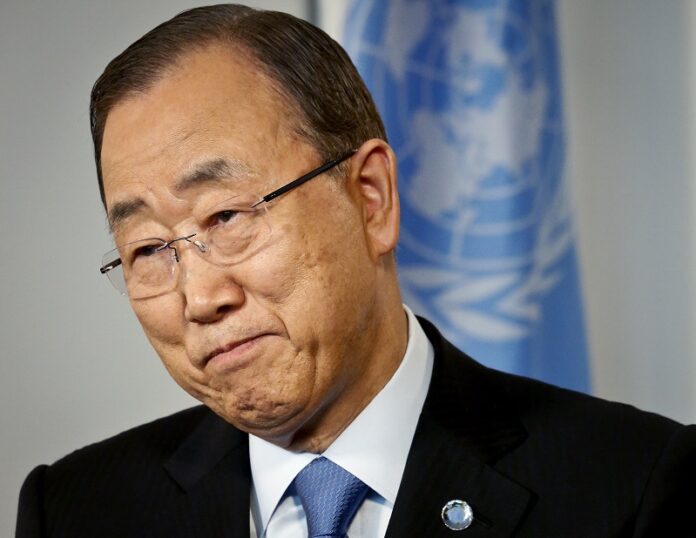
Ex-UN Chief Ban Ki-moon Won’t Run for S. Korea’s Presidency

United Nations Secretary-General Ban Ki-moon speaks on Sept. 9 during an interview at U.N. headquarters. Photo: Bebeto Matthews / Associated Press

SEOUL, South Korea — Former U.N. Secretary-General Ban Ki-moon said Wednesday that he won’t run for South Korea’s presidency, a surprise announcement that removes a key figure in the scramble to replace impeached President Park Geun-hye and further stirs the country’s already tumultuous politics.

The withdrawal of Ban, who had been considered the only major conservative contender, boosts liberal Moon Jae-in, who has enjoyed a comfortable lead in opinion surveys since Park was impeached in December.

Ban, during a hastily arranged news conference, said he had wanted to use his 10 years of experience as U.N. chief to resolve a national crisis and achieve unity. But he said his “pure patriotism” and pushes for a political reform were badly damaged by political slandering and by “various fake news” that targeted him.

He did not elaborate, but Ban has faced growing media questions about his political competence and about corruption allegations.

“I was also very disappointed by old-fashioned, narrow-minded egoistic attitudes by some politicians, and I came to a conclusion that it would be meaningless to work together with them,” he said.

Politics in South Korea have been upended by a massive scandal involving Park and her confidante, which prompted millions to take to the streets in protest. Park’s prime minister is currently the caretaker leader while Park is on a trial at the Constitutional Court, which is deliberating about whether to confirm Park’s impeachment or restore her to power.

If she is thrown out, presidential elections, originally set for December, would instead be held within two months of any ruling.

Ban, a former South Korean foreign minister, had initially generated sizable interest in his home country after leading the United Nations and was widely seen as testing the political waters before announcing his candidacy.

But his approval ratings have been falling in opinion surveys on who should succeed Park. A survey released this week showed Moon, who lost the 2012 election to Park, had a 32.8 percent approval rating while Ban ranked second with 13.1 percent.

In the weeks following his return to South Korea on Jan. 12, Ban repeatedly denied allegations raised in the media that he took bribes from a businessman at the center of a corruption scandal that led to the suicide of former South Korean President Roh Moo-hyun in 2009. Moon served as Roh’s presidential chief of staff.

Ban was also forced to defend himself over the criminal charges against two of his relatives, who have been indicted in the United States for plotting to bribe a Middle East official to influence the $800 million sale of a building complex in Vietnam. Ban has said he knew nothing about the alleged criminal activities of his relatives.

Story: Hyung-Jin Kim

Advertisement

African Leaders OK Strategy for Mass Withdrawal From ICC

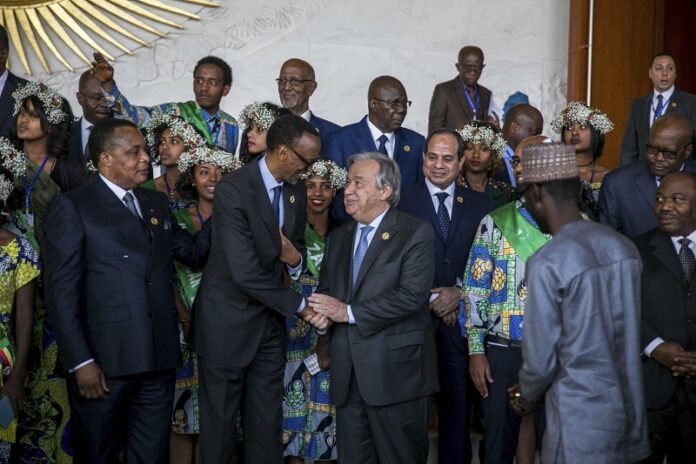
United Nations Secretary-General Antonio Guterres, centre right, shakes the hand of Rwandan President Paul Kagame on Monday during the 28th Ordinary Session of the Assembly of the African Union, in Addis Ababa, Ethiopia. Photo: Mulugeta Ayene / Associated Press

ADDIS ABABA, Ethiopia — African leaders on Tuesday adopted a strategy calling for a collective withdrawal from the International Criminal Court. The non-binding decision came behind closed doors near the end of an African Union summit.

It was the latest expression of impatience by African leaders with the court, which some say has focused too narrowly on Africa while pursuing cases of genocide, war crimes and crimes against humanity. Late last year, South Africa, Burundi and Gambia all announced plans to leave the court, leading to concerns that other states would follow.

Desire Assogbavi, head of Oxfam International’s liaison office to the AU, confirmed the adoption of the strategy. A source close to the continental body’s legal council also confirmed it, saying countries had been divided on whether to call for leaving the court individually or together.

The source said the majority of countries also wanted the meaning of immunity and impunity amended in the Rome Statute, the treaty that set up the court in 2002. The source spoke on condition of anonymity because he was not authorized to speak to the press.

Some African countries have been especially critical of the ICC for pursuing heads of state. Sudanese President Omar al-Bashir has been wanted by the court since 2009 for allegedly orchestrating atrocities in Darfur. The ICC also caused an uproar among some African nations by indicting Kenyan President Uhuru Kenyatta on charges of crimes against humanity for 2007 post-election violence in which more than 1,000 died. The case collapsed because of what the ICC prosecutor called lack of cooperation by Kenya’s government.

Elise Keppler with Human Rights Watch’s international justice program said the ICC withdrawal strategy has no timeline and “few concrete recommendations for action.” She pointed out that several African countries, including Nigeria, Senegal and Congo, have spoken up in support of the ICC in recent months.

A draft of the strategy, obtained by The Associated Press, recommends that African countries strengthen their own judicial mechanisms and expand the jurisdiction of the African Court of Justice and Human Rights “in order to reduce the deference to the ICC.”

Advertisement

NoGeo: TrueVisions to Drop 11 More Channels: NBTC

BANGKOK — Subscribers of the country’s largest cable provider will have even less to watch with news emerging it plans to drop nearly a dozen more major channels.

TrueVisions told telecom regulators that it will discontinue 11 pay-TV channels including Discovery, BBC Entertainment and National Geographic, a member of the National Broadcasting and Telecommunications Commission tweeted Tuesday night.

Read: TrueVisions Will Stop Showing HBO, Cinemax Channels in 6 Days

“I don’t want to tweet, summarizing the work today because we got an issue again,” tweeted Supinya on Tuesday night. “Following #truevisions canceled six channels (HBOs+Cinemax), today it canceled 11 more.”

Commissioner Supinya Klangnarong noted that this time TrueVisions claimed it had provided 30 days notice to its customers. Such notification is required under regulations, but the company did not provide it late last year when it dropped HBO’s channels.

She said the commission would discuss further details next week, including the provider’s plan to compensate customers and when the change would occur.

Calls to TrueVisions representatives went unanswered Wednesday morning.

Read: Go to Battle With Class-Action Lawsuit Startup ‘FongDi’

In late December, TrueVisions revealed it would stop airing six channels including HBO and Cinemax effective Jan. 1. Since then, customers have threatened a class-action lawsuit against the company, which is a wholly owned subsidiary of True Corp. and the Charoen Pokphand Group.

Supinya said the 11 channels to be dropped are: Discovery Science, BBC Entertainment, National Geographic, Cbeebies, Discovery Kids, M, Dmax, Eve, Block A, Fashion1 and MUTV.

But some TrueVisions customers wrote online to say some of those channels had already gone dark as they had been removed from their paid packages.

“EVE channel has been gone since the end of last year, hasn’t it? I remember I got a notification, then the channel disappeared. Shame, I was addicted to EVE,” @xianue tweeted.

Customers claimed TrueVisions notified them that the channels in question would no longer be included in the type of package they paid for but did not offer compensation.

“Most channels were canceled since Nov. 1,” @Ake_Chetsada tweeted. “But #truevision never did notify customers about its compensation plan.”
Peerapat Foithong, a lawyer with legal startup Fongdi, said Wednesday morning that about 100 dissatisfied TrueVisions customers had signed on for a possible class action against the company.

“Most channels were revealed to have been pulled since last year, some even in late 2015,” Peerapat said. “However, TrueVisions told us that they informed customers through on-screen messages.”
He said they had yet to decide whether to proceed with legal action.

“We have to investigate further to gather more evidence,” Peerapat said.

Related stories:

Go to Battle With Class-Action Lawsuit Startup ‘FongDi’

TrueVisions Will Stop Showing HBO, Cinemax Channels in 6 Days

Advertisement

Prayuth Upbeat on Peace Talks After Insurgent Leader’s Death

Hospital workers in Yala province rush Friday to assist Chak Kraithong, an undercover police officer, after he was struck by a roadside bomb on his way home from work - one of the near-daily attacks authorities attributed to the separatists.

BANGKOK — Junta chairman Prayuth Chan-ocha told reporters Tuesday he has seen progress in an ongoing peace dialogue with separatists in the Deep South following the death of their “spiritual leader” last month.

Hopes of closer negotiations between the Thai state and insurgents were raised after Sapaeng Basoe, who commanded the most well-armed group in the region, died last month at 81. However, it is still unclear who will replace him and how the movement will be steered.

“The dialogue is still taking place,” Gen. Prayuth said after a Cabinet meeting on Tuesday. “I have personally received positive information about it. There were more talks about setting up safety zones.”

Read: Death of Separatist Leader Prompts Hope, Fear For Peace Prospects

He said the effort would likely improve going forward.

“There should be progress because, in the past, they chose to talk about topics they couldn’t agree on,” Prayuth said. “The state maintains our position, and the other side only wants to focus on what it wants. Today we will choose what things we can do first. This is how we will solve the problem.”

The Saudi Arabia-educated Sapaeng was regarded as the spiritual leader of the National Revolutionary Front, or BRN, the most active among all militant groups currently seeking independence for the three Muslim-majority provinces in the southern border region.

The secretive group appeared to be reluctant to join the negotiation table under Sapaeng’s 13-year leadership. There were even reports of Sapaeng personally ordering his reps to walk out from some talks in protest to Thai authorities.

But experts say a BRN without Sapaeng will not necessarily mean a more gentle movement, as the group is divided into hawks and doves, and it is not clear who will assume power in Sapaeng’s absence. Those who share this view include Aksara Kerdpol, the general in charge of the Thai army’s negotiation team.

“They still have number two, three, four, and so on,” Gen. Aksara said. “We’re monitoring who will succeed him [Sapaeng]. We’re in touch with Malaysian authorities about the matter.”

Nevertheless, Aksara said the government will be committed to opening a dialogue with the insurgents no matter who replaces Sapaeng.

“It’s their business. No matter what they choose, it will not affect our talk,” the general said. “This is our policy. Our government’s policy.”

The secessionist conflict has claimed at least 6,800 lives since it first broke out in January 2004.

Col. Yutthanam Petchmuang, a spokesman for a regional counter-insurgency operation said he had no statistics about insurgent attacks since Sapaeng’s death, but he felt that the situation has improved somewhat.

Related stories:

Bangkok Bomb Plotters Linked to Southern Insurgency: Police

Prawit Wants to Build a Wall Along Border With Malaysia

Regime’s Southern Overtures Met With 19 Attacks, 3 Deaths

Advertisement

Slain Myanmar Lawyer’s Family Considers Him a Fallen Hero

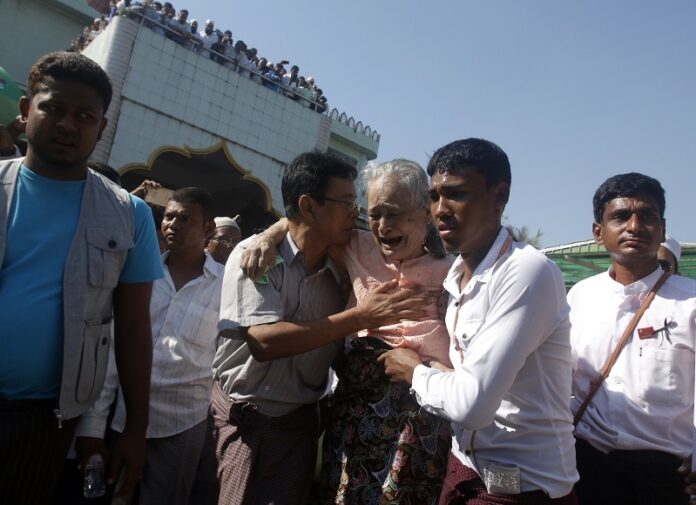
Tin Tin Aye, third from right, mother of Ko Ni who was assassinated by a gunman on Sunday, cries as she attend the funeral Monday at a cemetery in Yangon, Myanmar. Photo: Thein Zaw / Associated Press

YANGON — The family of an assassinated adviser to Myanmar’s government had worried about his activities and warned him to be careful, but he pursued his work for the sake of the country’s people, regardless of who they were or what religion they believed, his daughter said Tuesday.

Ko Ni, a prominent Muslim lawyer who advised Aung San Suu Kyi and her ruling National League for Democracy party, was shot in the head at close range as he was walking out of the Yangon airport Sunday.

His family feels no regret for his high-profile political work and considers him a fallen hero, his daughter, medical doctor Yin Nwe Khine, told The Associated Press in an exclusive interview. “We were always worried about him and the danger he might face because of politics,” she said.

“But he was always very enthusiastic about politics. He wanted to do good for the sake of the people,” she said in the family’s colonial-era apartment on a crowded downtown Yangon street. “He didn’t work for any particular people or religion.”

Ko Ni specialized in constitutional law, criticizing army interference in politics and advising Suu Kyi’s party how to try to get around statutes in the army-imposed constitution that gave the military undue power in the government democratically elected in 2015. He was also an advocate for the Muslim minority in the overwhelmingly Buddhist country, a position that earned him the enmity of ultra-nationalist Buddhist monks and their allies.

Suu Kyi as of Tuesday afternoon has not spoken publicly about the killing, and did not attend Ko Ni’s funeral on Monday, instead carrying out her duties in the capital Naypyitaw. Her silence has disturbed some of Ko Ni’s admirers.

“I didn’t notice if Daw Aung San Suu Kyi sent flowers for the funeral or not as it was a big crowd. But she never called or contacted us in person to give her condolences,” said Yin Nwe Khine, using an honorific for older women.

Pressed on how she felt about Suu Kyi’s silence, she responded: “My father is the biggest thing for me. I’ve lost that big thing, ‘my father’ and I don’t expect anything from anyone. The country and its people will judge what kind of loss my father’s death was for them.”

Underlining the potential for controversy, a ruling party official at the gate to the family’s apartment building told the largely Muslim crowd that journalists should not be allowed inside, sparking anger among the crowd who responded that the family had agreed to an interview.

Ko Ni is survived by his wife, three children and his elderly mother.

Police say the gunman also shot dead a taxi driver as he tried to flee Sunday. Officials described him as an ex-convict who had been imprisoned for illegally trading statues of Buddha. They have not publicly announced a motive for the killing, but a statement from President Htin Kyaw’s office said that according to an initial interrogation of the suspect, the shooting was intended “to threaten the country’s stability.”

There is much speculation that he was killed for standing up to the army, or for working on behalf of the Muslim community, but Yin Nwe Khine declined to take a position on the possible motive.

“It is too early to say if we are satisfied with the case or not, because it just happened a few days ago,” she said. “I think time and actions by the government will prove if they can reveal the truth or not.

“My father died, he was killed and he was a fallen hero. And for his death, he deserves at least the truth. We deserve to have this one thing, the truth.”

Story: Esther Htusan

Advertisement

Bangkok Man’s Poorly Devised Abduction Story Falls Apart

Srawut Pungprasop, shows police the ATM he claimed to be using when he was allegedly robbed Tuesday night in Bang Khen.

BANGKOK — A man reportedly confessed Tuesday to fabricating a story that he was abducted and robbed of 80,000 baht by men wearing police vests.

Srawut Pungprasop, 18, confessed to making up the story of being robbed in the early hours of the morning at an ATM in north Bangkok because he had gambled away money given to him by his sister to deposit for his school tuition.

Read: Police Dubious About Man’s ATM Abduction-by-Cop Story

“He made it all up. There was no sign of him on the 60 CCTVs around the market from 10pm to midnight,” said Capt. Anusorn Pratumtong of Khan Na Yao Police Station said Wednesday morning.

Srawut was charged with filing a false report Tuesday, a crime punishable by up to three years in jail and a fine of 6,000 baht. Col. Singh Singhdech said that Srawut would be convicted in court today.

Srawut originally told police that four men had abducted him in a van, beaten him and taken his money just as he was depositing it at a Kasikorn bank ATM located in the Bang Khen district’s Thanommit Market.

Police were immediately skeptical of his story as the ATM deposit machines do not take money after 10pm.

Khan Na Yao police pulled CCTV tapes from around the market and the bank branch located there, but found no footage of him or the car he claimed to have driven there. Police interrogated Srawut for five hours Tuesday until they said he confessed to inventing the story.

He said his sister, who works as a promotional model for race cars, had given him 80,000 baht for his school which he promptly gambled away.

Advertisement

Diplomats Defy White House Warning, Criticize Travel Ban

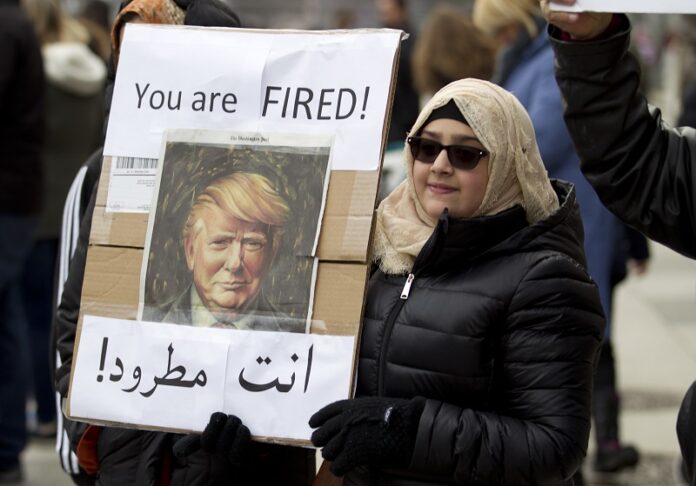
A woman carries a sign outside of the White House during a demonstration to denounce President Donald Trump's executive order that bars citizens of seven predominantly Muslim-majority countries from entering the United States on Sunday in Washington. Photo: Jose Luis Magana / Associated Press

WASHINGTON — Hundreds of American diplomats defied a White House warning on Tuesday, sending a memo to the State Department’s leadership that criticizes President Donald Trump’s temporary travel ban on citizens from seven Muslim-majority countries. It is believed to be one of the most popularly supported statements of dissent in the department’s history.

A State Department official said the cable was received just a day after White House spokesman Sean Spicer suggested those disagreeing with Trump’s new policy should resign. The official did not have an exact number of signatories, but said more than 800 indicated they would sign after drafts of the cable circulated over the weekend. The official wasn’t authorized to discuss the matter publicly and demanded anonymity.

The document argues that the executive order Trump signed last week runs counter to American values and will fuel anti-American sentiment around the world.

“A policy which closes our doors to over 200 million legitimate travelers in the hopes of preventing a small number of travelers who intend to harm Americans from using the visa system to enter the United States will not achieve its aim of making our country safer,” the diplomats wrote in the so-called “dissent cable.”

“This ban stands in opposition to the core American and constitutional values that we, as federal employees, took an oath to uphold,” a draft of the cable said. The final version wasn’t immediately available.

Dissent channel cables are a mechanism for U.S. diplomats to register disagreement internally about U.S. policies. It was established during the Vietnam War and was most recently used by diplomats to criticize the Obama administration’s approach to Syria. In that case, former Secretary of State John Kerry met with signers of the cable to discuss their concerns.

Trump’s secretary of state nominee Rex Tillerson is still awaiting Senate confirmation and it was unclear how we would respond to the memo.

In response to reports of the cable Monday, Spicer said of the diplomats: “They should either get with the program or they can go.”

He dismissed the criticism from what he called “career bureaucrats.” While he later said Trump appreciates the work of public servants, Spicer said they should respect the desires of the American people and the importance Trump places on protecting the country.

“If somebody has a problem with that agenda, that does call into question whether they should continue in that post or not,” Spicer said. “This is about the safety of America.”

Signers of dissent cables are supposed to be protected from retribution from superiors.

The department, along with other agencies entrusted with implementing Trump’s order, has been confused about the details, offering several contradictory instructions to embassies and consulates on how it plans to do so.

As word of the executive order began to circulate last week, diplomats at some embassies began to prioritize visa applications from citizens of countries they suspected might be affected, according to officials.

On Friday, before the order was signed, workers at one embassy dumped bins of hundreds of approved passports on the floor to pull those from the affected countries and affix visas in them, officials said. That effort stopped when the order was signed, they said.

Story: Matthew Lee

Advertisement

Hot News

LATEST NEWS

Bangkok
overcast clouds
30.5 ° C
32.2 °
30.5 °
76 %
4.9kmh
100 %
Sat
30 °
Sun
35 °
Mon
35 °
Tue
33 °
Wed
32 °