





























30.5 C
Bangkok
Wednesday, June 24, 2026
Home Blog Page 2503

At Least 26 Killed in Congo Protests, Rights Group Says

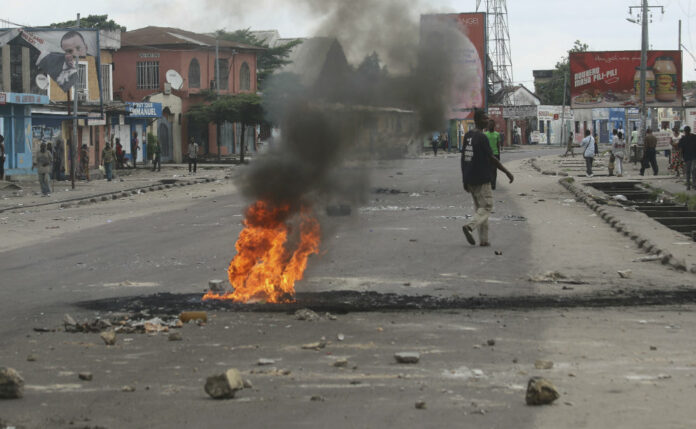
People walk near burning debris during protests in Kinshasa, Democratic Republic of Congo, Tuesday. Photo: John Bompengo / AP.

KINSHASA, Congo — Security forces in Congo have killed at least 26 demonstrators and arrested scores more amid protests against President Joseph Kabila’s hold on power, a rights group says.

Military and police forces were firing live bullets, raising fears that more people were killed in the first day after Kabila’s mandate expired, Human Rights Watch said. Its researcher Ida Sawyer said on Twitter late Tuesday that the killings took place in the capital, Kinshasa, the southern city of Lubumbashi and elsewhere. Residents told the group that Republican Guards were carrying out door-to-door searches and arresting youths.

Protesters burned the headquarters of the ruling party in Kinshasa.

Political talks between the ruling party and opposition, which stalled over the weekend, were expected to resume on Wednesday with mediators from the Catholic church.

Kabila, who took office in 2001 after his father’s assassination, is constitutionally barred from seeking another term, but a court has ruled that he can remain in power until new elections, which have been delayed indefinitely. They were meant to be in November, but the ruling party says it needs more time — until 2018, at least.

The leader of Congo’s largest opposition party, Etienne Tshisekedi, has urged peaceful resistance to what he called Kabila’s “coup d’etat.” In a statement posted on YouTube, he called the president’s actions “treason” and appealed to the Congolese people and the international community to no longer recognize Kabila’s authority.

The political impasse has fueled fears of widespread unrest in the vast Central African nation that has trillions of dollars’ worth of natural resources but remains one of the world’s poorest and most unstable countries.

The political negotiations that stalled over the weekend failed to reach an agreement on a date for new elections or the release of political prisoners. Both are key demands of the opposition parties, along with the dropping of criminal charges against opposition leader Moise Katumbi, who fled the country as authorities announced plans to try him. Katumbi’s supporters say the charges of hiring mercenaries are politically motivated, as he had been a leading presidential candidate.

Kabila’s government has tried to ease tensions by including some opposition figures. Shortly before Kabila’s mandate expired, the new opposition Prime Minister Sami Badibanga announced his new transition government.

Although a small part of the opposition, including Badibanga, took part in an earlier national dialogue mediated by the African Union, most of the opposition, including Tshisekedi, refused to take part and rejected an agreement signed in October.

People inside and outside Congo have feared a repeat of the dozens of deaths in September, when the opposition took to the streets after the electoral commission failed to schedule the presidential election.

In Kinshasa’s Matonge neighborhood on Tuesday, people played soccer in the street to block traffic as a form of protest amid the heavy police and military presence.

“Kabila has betrayed our country. He must leave,” said Jean-Marcel Tshikuku, a mechanic. “He announced a new government just at the end of his mandate. It’s an insult! We don’t want him anymore. We don’t want negotiations to resume. He must get out, that’s all.”

Story: Saleh Mwanamilongo. Carley Petesch and Krista Larson in Dakar, Senegal, contributed.

Advertisement

Thai Football Gets Cooler With New Look and Sound

BANGKOK — When Thai football wanted to update its image for the new year, it turned to an urban hipster with a rural heart to come up with something a little country, a little rock ‘n roll.

Days before being embroiled in some fiery hooligan drama, the Football Association of Thailand on Thursday dropped its new Thai League roadmap, a logo and new anthem composed by DJ Maft Sai, who’s credited with popularizing country music in the capital, and the guitarist from a rock band of legendary cool.

The association’s updated logo recalls an elephant, the national animal, and the letter T, presumably for Thailand. Designed by the same firm behind that of Chonburi F.C., it incorporates different colors to identify separate leagues.

The new anthem incorporates traditional Thai instrumentation with a modern rock sound. The musical fusion was made possible by Nattapon Siangsukon, who as DJ Maft Sai has toured the world with the Paradise Bangkok Molam International band; and Piyanart Jotikasthira, guitarist of beloved band Apartment Khunpa.

For 2017, 18 teams will compete in five leagues under the Thai League. Amateur teams can participate in the Thai Amateur Tournament which is considered the last tier.

Thai League new logos posted on Dec. 15. Photo: FA Thailand / Facebook.


Related stories:
Reward Offered For Hooligans Behind Thai Football Firestorm

Advertisement

Constitution Drafter Pushes for Executing Corrupt Politicians

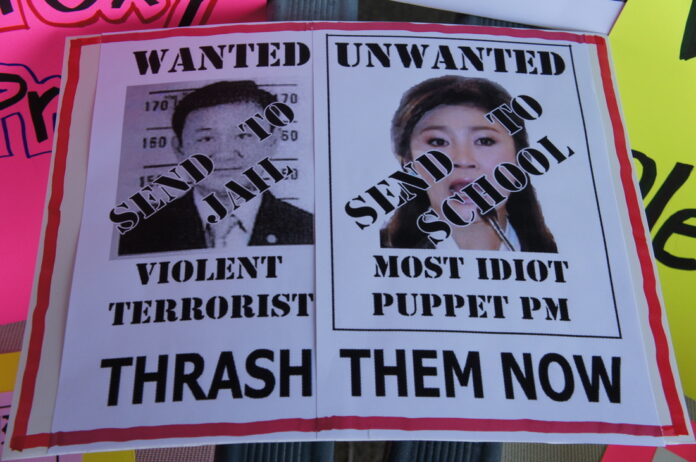
A sign calls for former PMs Thaksin Shinawatra, at left, and his sister Yingluck Shinawatra to be jailed for corruption at a protest in New York City in September 2012. Image: PAD New England

BANGKOK — One of the drafters of Thailand’s new constitution made the case Wednesday that it was written to support sentencing corrupt politicians to death.

When the new constitution is royally endorsed and its supporting laws can be written, a member of the Constitution Drafting Committee said they should include a maximum punishment of the death penalty for corrupt politicians, a provision a former politico describes as “barbaric.”

“It’s not too harsh of a law, especially when you compare it to the Criminal Code, which has already had the death penalty for over 60 years now,” Norachit Sinhaseni said. ”The death penalty is already in effect for civil servants who take bribes.”

Norachit, who served as spokesman to the committee of junta-appointed drafters, said Wednesday that codifying capital punishment for politicians who “buy and sell their positions” is an appropriate solution to the nation’s problem of endemic corruption.

Kraisak Choonhavan, a political commentator and former Democrat Party MP, expressed strong opposition to the idea.

“It’s a very barbaric law. Using state power to execute politicians won’t decrease corruption,” he said. “Does corruption seem like something you should be executed for?”

Kraisak said the use of capital punishment was already questionable in Thailand’s unreliable criminal justice system, a fact that wouldn’t change when it was applied to politicians.

“What if you execute the wrong person? I don’t trust the Thai justice system. For example, look at the case of the Burmese killers in Koh Tao. That’s already suspicious,” he said.

But Norachit said existing law supports extending the death penalty to politicians.

“If it applies to civil servants, then why can’t it be applied to politicians?” Norachit said. “Buying and selling positions at the ministerial level creates much more severe damage than low-level civil servants doing the same thing.”

He added that it would serve the public interest.

“Citizens are always hearing news about politicians buying and selling their positions. It’s become Thailand’s problem. This is the solution,” Norachit said.

But Kraisak questioned whether the rigged justice system, in which the wealthy and powerful are sometimes not held accountable, should be trusted with meting out the ultimate punishment.

“Those with power can slip out of important cases,” he said. “There will insufficient investigation when the alleged corrupt politician is powerful. This is already something that we can see happening.”

He also said it would put Thailand at odds with international norms.

“Nowhere in the world … do politicians face the death penalty. Many countries have repealed capital punishment, except dictatorships such as China and Vietnam,” Kraisak said. “As a country, we have to ask, how many do we kill per year?”

Norachit said people should not be alarmed, as the death penalty would not be sought in every case but left up to the court’s discretion.

Those not executed “will be stripped of their position for life and unable to run for office,” he said.

Advertisement

Gov’t Payment System Offline As Hacktivists Focus Online Assault

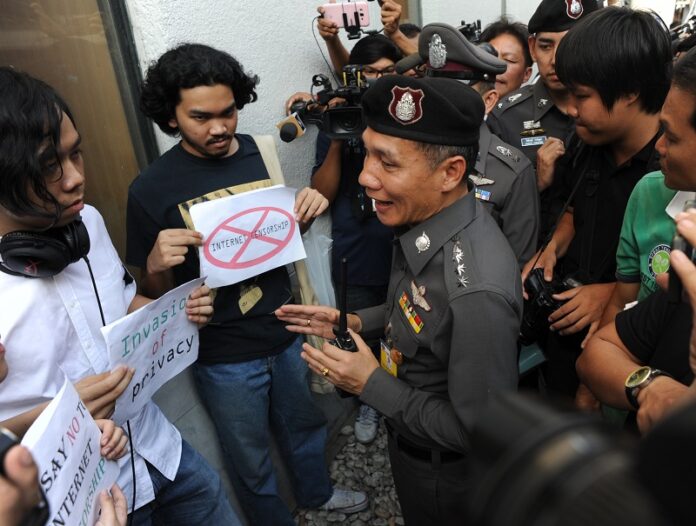
Police speak to activists protesting the new Computer Crime Act on Sunday at the Bangkok Art and Culture Centre.

BANGKOK — Online agitators escalated their attacks in protest of the new Computer Crime Act on Wednesday by targeting access to the military regime’s wallet.

The government’s payment and procurement system announced it had shut down its online system after it was listed as a target for hacktivists by the group coordinating a campaign of digital disobedience to the new cybercrime law which granted broader powers to authorities to intercept and censor content online.

In its announcement, the Comptroller General’s Department announced its network had failed as of Tuesday afternoon and its electronic system could no longer be accessed. Such systems are the platforms used for distributing funds nationwide and competitive bidding projects.

On the same day, hacktivist group Citizens Against Single Gateway announced attacks would intensify starting at 2pm on Wednesday. They made a single demand: Junta chief Prayuth Chan-ocha must use his absolute junta power under Article 44 to scrap the law, approved unanimously last week by his rubber-stamp legislature.

Asked why they were abandoning democratic methods to achieve their aims, the group replied that those methods weren’t respected in creating the law.

“It came illegally so it had to be gone by illegal way,” someone wrote in reply to an inquiry.

Read: Hackers Batter ThaiGov Online as Anger Over Cyberlaw Boils Over

Responding Tuesday, Prayuth said the attacks were illegal and dismissed those behind them as uninformed.

The law has also raised concern internationally. On Monday, the regional office of the U.N. High Commissioner on Human Rights issued a statement of concern, saying the amended Computer Crime Act posed a threat to online freedoms.

Foreign Ministry spokesman Sek Wannamethee dismissed those concerns, saying the new law was an improvement over the original, 2007 version and was intended to protect people from criminal cyber threats.

Since Monday, the Citizens Against Single Gateway group has brought down many key government sites including its central site and the Ministry of Digital Economy and Society. The Defense Ministry remained offline for a third day as of Wednesday afternoon.

The list of targets released Wednesday morning by the group included the central Government Procurement and Government Fiscal Management Information System and its regional systems.

“If any damage happens (from the attack), blame the decision of the government,” the group wrote Tuesday night on Facebook. “Don’t beg us. Beg Uncle Tu. Because we are just protecting the little online freedom that is left.”

Related stories:

Dismissive Prayuth Tells Hackers to Knock it Off

Computer Crime Act 2.0 Passes Unanimously

Single Gateway ‘Still Necessary,’ Deputy PM Prawit Says

‘Back Door’ in CCA Not Trojan Horse for Single Gateway, Drafters Say

New Cybercrime Regs Would Open Back Door to Censorship

Website Shutdowns Soar After King’s Death

Why Thailand Should Worry About an Improved(?) Computer Crime Act

Thailand’s Draconian Cyberlaws Tipping Toward Totalitarian

Computer Crime Act Has Issues, Google Tells Censorship Committee

Advertisement

Truck Pursued by Police Injures 18 in Ekkamai

BANGKOK — A police pursuit ended with 18 people injured in the capital’s Ekkamai area after the driver of a delivery truck plowed through a roadblock and damaged dozens of cars Wednesday afternoon.

Police opened fire on the truck driven by Ekkapoj Yodsiri, 27, who they managed to arrest and take to the Thonglor Police Station for questioning.

No one was seriously injured, but more than 30 vehicles were damaged in the incident, which took place in front of the Big C store near Soi Ekkamai 8. Police temporarily closed Soi Sukhumvit 63 to traffic.

Police had been chasing Ekkapoj from the Phaya Thai district. They found a gram of meth, or ya ice, in his possession and said he confessed to being high for three days.

Ekkapoj was charged with reckless driving and drug possession, according to Lt. Col. Wasu Chueput of Thonglor Police Station.

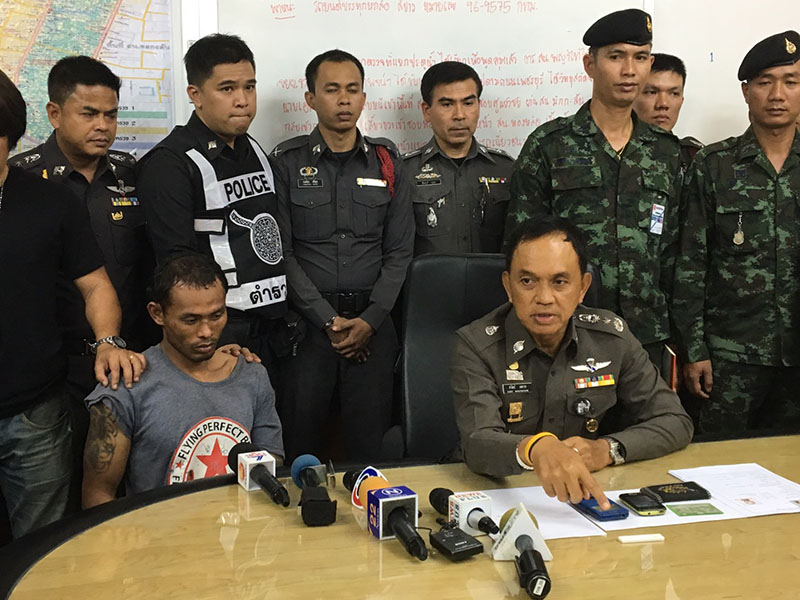
Bangkok police chief Sanit Mahathavorn, seated at right next to the unidentified suspect, speaks to reporters Wednesday afternoon in Bangkok.


Advertisement

Death Sentence, Then Freedom for Olympic Shooter’s Wife

Guards escort Nitiwadee “Nim” Pucharoenyos, in black, into prison Monday after she was found guilty of plotting the 2013 murder of her husband, Olympic shooter Jakkrit “Ex” Panichpatikum.

BANGKOK — The family of slain athlete Jakkrit “Ex” Panichpatikum asked the court Wednesday to reconsider its decision to free his wife after she was sentenced to die for plotting his murder three years ago.

While the lower court found Nitiwadee “Nim” Pucharoenyos guilty of hiring an assassin to gun down her husband in 2013, the court of appeals ruled Tuesday that she posed no flight risk, and allowed her to walk free on a 1 million baht bond while it considers her appeal.

Read: Death Sentence for Wife of Slain Olympic Shooter

In response, a lawyer representing Jakkrit’s family filed a formal protest, arguing that she should not be freed. Boonrueng Uthairat said he also went to the courthouse to see for himself the court order freeing Nitiwadee because he couldn’t believe it.

“I am really surprised,” attorney Boonrueng told reporters at Bangkok’s Min Buri Court. “Because in my 30-year working experience, I have never seen any case where the Court of First Instance sentenced someone to death and the Appeals Court granted them bail.”

The case would be one for the books, he added.

Nitiwadee, a 40-year-old physician, was found guilty and sentenced to die Monday along with the middleman she hired to arrange Jakkrit’s assassination in October 2013. After spending a night in jail, she was freed Tuesday night. She was spirited away in a Mercedes-Benz without talking to reporters.

Nitiwadee’s mother, who publicly confessed to arranging the killing to protect her daughter from Jakkrit’s abuse, was acquitted by the court due to insufficient evidence.

Jakkrit was a champion shooter who competed in four Olympic games between 1996 and 2012.

Advertisement

3 Suspected Militants Killed in Indonesia, Bombs Found

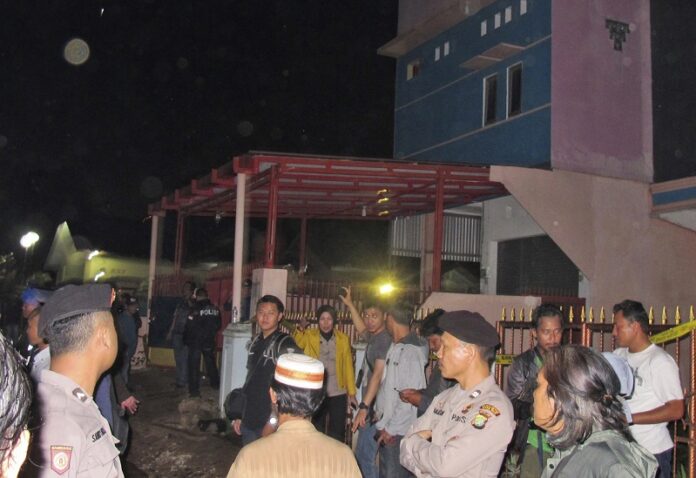
Officers stand guard around a house after it was raided by police Dec. 10 in Bekasi, West Java, Indonesia. Photo: Associated Press

JAKARTA — Indonesian police said they killed three suspected militants in a raid Wednesday on the outskirts of Jakarta and found several bombs which they are trying to defuse.

National Police spokesman Rikwanto told MetroTV that the residential neighborhood has been evacuated.

He said one person was arrested in the raid.

Police believe those involved in the plot are linked to several militants arrested Dec. 10 in another neighborhood on the outskirts of Jakarta who were planning a suicide bomb attack on a guard-changing ceremony at the presidential palace the next day.

Indonesia has carried out a sustained crackdown on Islamic militants since the 2002 Bali bombings that killed 202 people. But a new threat has emerged in the past several years from militants who have switched allegiance to the Islamic State group and from new recruits.

Advertisement

Nepalis Seeking Jobs Abroad Return Dead at Soaring Rates

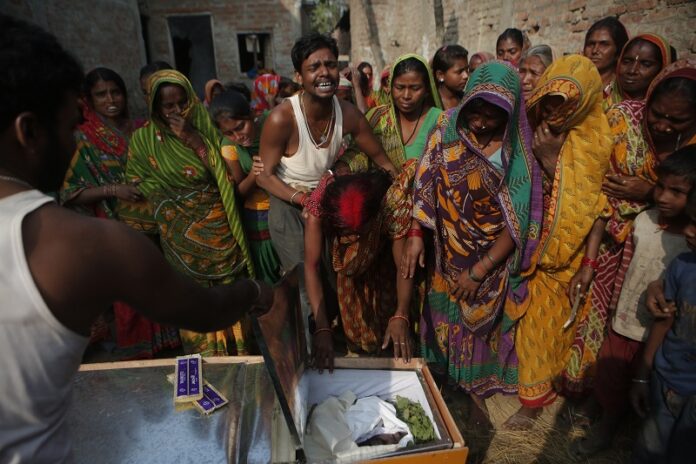
Saro Kumari Mandal, 26, cries in November as she leans on the coffin carrying her husband Balkisun Mandal Khatwe, 26, a migrant worker who died in his sleep in Qatar, at Belhi village, in Saptari district, Nepal. Photo: Niranjan Shrestha / Associated Press

KATHMANDU, Nepal — A tiny young woman crouches just outside the airport, crying softly into her thin shawl. It’s cold, but her sleeping toddler is warm in her arms.

Travelers swarm around: Himalayan trekkers load up expedition backpacks. A Chinese tour group boards a bus. A dozen flight attendants in crisp blue suits and heels click by.

Saro Kumari Mandal, 26, covers her head completely, a bundle of grief.

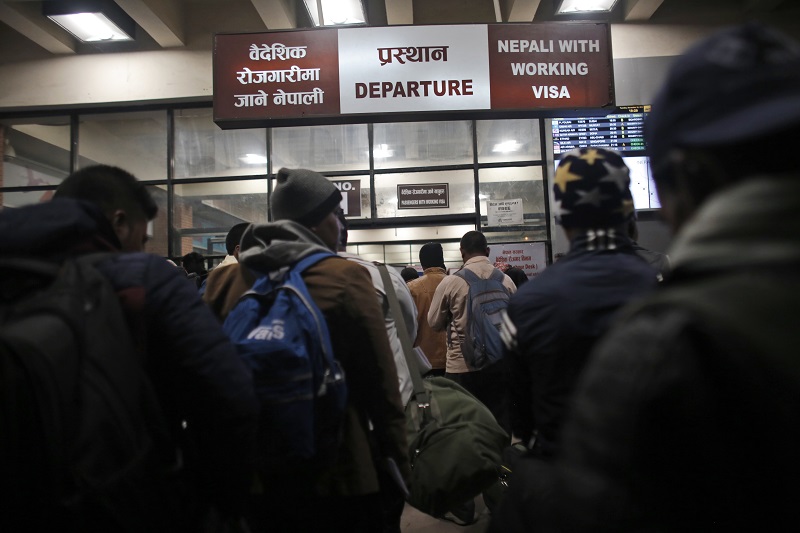
Hundreds of young Nepali men wave goodbyes. On this day 1,500 fly out of the Kathmandu airport for desperately needed jobs, mostly in Malaysia, Qatar or Saudi Arabia. But on this day, too, six come back in wooden caskets, rolled out of baggage claim on luggage carts.

Scrawled in black marker on one: “Human Remains, Balkisun Mandal Khatwe.” Saro’s husband.

The number of Nepali workers going abroad more than doubled after the country began promoting foreign labor in recent years: from about 220,000 in 2008 to about 500,000 in 2015. The number of deaths among those workers has risen much faster. One out of every 2,500 workers died in 2008; last year, one out of every 500 died, according to an Associated Press analysis of data released by Nepal’s Ministry of Labour and Employment.

In total, over 5,000 workers from this small country have died working abroad since 2008— more than the number of U.S. troops killed in the Iraq War.

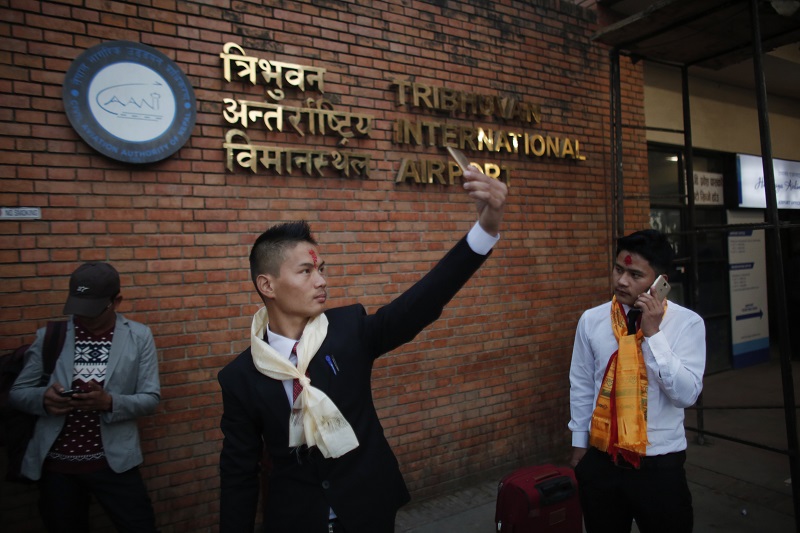
A Nepali Prem Bahadur Ale Magar, 23, takes a selfie in November while he waits for his flight to Malaysia, where he will work in a warehouse as a cleaner, at Tribhuwan International airport in Kathmandu, Nepal. Photo: Niranjan Shrestha / Associated Press

The causes are often listed as natural death, heart attack or cardiac arrest  the men go to bed after an exhausting day of work and never wake up. That’s what Saro was told happened to Balkisun.

Now medical researchers say these deaths fit a familiar pattern: Every decade or so, dozens, or even hundreds, of seemingly healthy migrant Asian workers start dying in their sleep. It happened in the U.S. in the late 1970s, in Singapore about a decade later and more recently in China. The suspected killer even has a name: Sudden Unexplained Nocturnal Death Syndrome.

Next year, an international consortium is launching to investigate. For today’s arrivals, they’re too late.

About 10 percent of Nepal’s 28 million residents work abroad. They send back more than USD $6 billion a year, 30 percent of the country’s revenues. Only Tajikistan and Kyrgyzstan are more dependent on foreign earnings.

“Nepalese workers are well known for their hard work, dedication and loyalty,” boasts the Nepalese Embassy website in Doha, Qatar, where a construction boom employs about 1.5 million migrants from many countries. The “comparatively cost effective” Nepali workers are experienced at “working in the extreme climatic conditions,” says the embassy.

Nepalis build highways, stadiums and houses in Gulf states and guard shopping malls, sew sweatshirts and assemble televisions in Malaysia. Anyone who has bought imported sportswear or electronics, or who plans to go to the 2022 World Cup in Qatar, may be using the products of their labor.

The migrants pay recruiters about USD $1,100 for the jobs. If they’re not tricked out of their earnings  and some are  they can send home about $300 a month.

Department of Foreign Employment spokeswoman Rama Bhattarai says some deaths are inevitable: “They die as foreign employees, they die here when a bus goes off a cliff.”

Balkisun’s body arrives on an 8 p.m. flight. He died in his sleep six weeks after he left Nepal, at 26, to help build highways as part of World Cup infrastructure improvements, said his Qatar-based Habtoor Leighton Group supervisor, Ganesh Khang Mandal.

At the airport, the casket slides easily into a custom-welded coffin rack on one of 10 trucks Nepal’s government provides to bring bodies back to villages.

Saro and 3-year-old son jolt around the backseat for a precarious, eight-hour journey home to Belhi village.

The family is marginalized in every way: Ethnically, they’re from the “untouchable” caste, and they speak Maithili, a language more common in India, a few miles south. They live eight to a room in a mud-and-stick home among sparse rice paddies. A shared cellphone is passed from house to house. Chronically hungry, they survive on less than USD $1 a day.

When the truck reaches Belhi, hundreds of women in traditional saris, men in work clothes and children pour into the narrow dirt street, tears streaming down their faces. Some stand on rooftops. Others crowd a balcony.

Mohammed Tohit, 28, watches from across the street. He is the envy and inspiration of his neighbors: Six years of sewing for Nike, Lacoste and Columbia Sportswear in Malaysia helped him buy a sturdy, cement two-bedroom house, a small farm, a cow, a goat and a television set. He’s leaving for Saudi Arabia in 10 days.

“I am scared, sure,” he said, “but I have no way to earn anything here.”

Nepali workers stand in queues at the departure gate for migrant workers in November at Tribhuwan International Airport in Kathmandu, Nepal. Photo: Niranjan Shrestha / Associated Press

What causes deaths like Balkisun’s? Medical journals associate Sudden Unexplained Nocturnal Death Syndrome with genetics, infection and nutritional deficiencies. In Nepal, authorities say it could be stress, a changed diet, even homesickness, brought on by physically demanding jobs in extremely hot climates.

Utah State University professor Ron Munger studied Thai migrant workers after hundreds died in their sleep in Singapore. He said the Nepali deaths “sound like exactly the same thing.”

While the causes of previous strings of deaths haven’t been pinpointed, fatalities dropped in each case when workplace safety, housing and diet improved.

Cardiac epidemiology researcher Nirmal Aryal at University of Otago in Wellington, New Zealand, recently published “A Call for Public Health Action” in the Asia-Pacific Journal of Public Health about the deaths. He’s organizing an international collaboration to investigate.

At Balkisun’s village, his wife falls screaming and crying onto the road and is carried inside. About 50 men carry his body to a river on a bamboo platform.

His young son is purified, dipped naked in the river. He’s wrapped in white cloth. And with his uncles’ hands guiding his own, he takes a bundle of burning twigs and lights his father’s funeral pyre.

Story: Martha Mendoza, additional reporting Binaj Gurubacharya, Niranjan Shrestha, Janak Raj Sapkota, Eileen Ng, Adam Schreck

Advertisement

29 Killed in Massive Fireworks Market Blast in Mexico (Video)

TULTEPEC, Mexico — A powerful chain-reaction explosion ripped through Mexico’s best-known fireworks market on the northern outskirts of the capital Tuesday, killing at least 29 people, injuring scores more and sending a huge plume of charcoal-gray smoke billowing into the sky.

The blast leveled the open-air San Pablito Market in Tultepec in the middle of the afternoon as it bustled with shoppers stocking up on fireworks to celebrate Christmas and New Year’s, reducing vendors’ stands to piles of rubble, ash, and charred metal. It was the third devastating explosion and fire to ravage the market since 2005.

Crescencia Francisco Garcia said she was in the middle of the grid of stalls along with a few hundred others when the thunderous explosions began. She froze, reflexively looked up at the sky and then took off running through the smoke once she realized everyone was doing so. As she ran she saw people with burns and cuts, and lots of blood.

“Everything was catching fire. Everything was exploding,” Francisco said. “The stones were flying, pieces of brick, everything was flying.”

In comments broadcast on local TV news, Mexico State Gov. Eruviel Avila reported Tuesday night that in addition to the 26 people who perished at the market, three more victims died after being taken to hospitals. State Health Secretary Cesar Nomar Gomez Monge said 72 people were being treated for injuries including severe burns, in some cases over 90 percent of their bodies. Those hospitalized included 10 children.

Authorities have not yet said what may have caused the explosion but announced that an investigation had been opened.

“We are going to identify who is responsible,” Avila said.

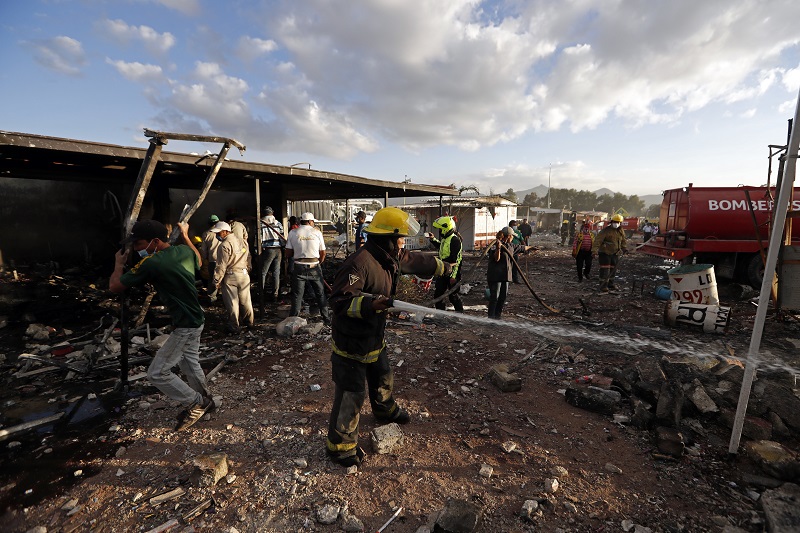
Sirens wailed and a heavy scent of gunpowder lingered in the air well after the explosion at the market, where most of the stalls were destroyed. The smoking, burned out shells of vehicles ringed the perimeter, and first responders and local residents wearing blue masks over their mouths combed through the ash and debris. Firefighters hosed down still-smoldering hotspots.

Tultepec Mayor Armando Portuguez Fuentes said the market was especially well stocked because demand for noisy firecrackers and rockets soars this time of year.

“We are obviously in the high season,” Portuguez said. “There was more product than usual because we are a few days away from Christmas, a few days away from New Year’s, and those are the days when the products made here are consumed the most.”

Firefighters and local residents work at the scorched ground of the open-air San Pablito fireworks market, Tuesday in Tultepec, outskirts of Mexico City, Mexico. Photo: Eduardo Verdugo / Associated Press

Cesar Ornelas of Atizapan de Zaragoza was only 10 minutes into shopping with his son and his father when he heard the first explosions. He tried to run, but something knocked him to the ground from behind. He tried several times to get up, unsuccessfully, and ultimately his 15-year-old son Francisco had to drag him out.

“We didn’t look back,” said Ornelas, who suffered light burns and a large bruise over his left kidney. His white tank top had a fist-size burn on the chest. “We heard how the explosion was kind of going off bit by bit.”

Nearly four hours later, he and Francisco limped gingerly out of the market area. Francisco said paramedics told him his leg was likely fractured by flying debris. Ornelas said his 67-year-old father, Ernesto, had run in a different direction and sought refuge in a nearby home. All the father’s clothing was burned, and his face and arm were bloodied. An ambulance had spirited him to a hospital, but Ornelas wasn’t sure where it was or how serious his injuries were.

“My condolences to the families of those who lost their lives in this accident and my wishes for a quick recovery for the injured,” President Enrique Pena Nieto said via Twitter.

A similar fire engulfed the San Pablito Market in 2005, touching off a chain of explosions that leveled hundreds of stalls just ahead of Mexico’s Independence Day. A year later a similar incident at the same market also destroyed hundreds of stands.

Portuguez, the Tultepec mayor, said the manufacture and sale of fireworks is a key part of the local economy. He added that it is regulated by law and under the “constant supervision” of the Defense Department, which oversees firearms and explosives.

“This is part of the activity of our town. It is what gives us identity,” Portuguez said. “We know it is high-risk, we regret this greatly, but unfortunately many people’s livelihoods depend on this activity.”

Story: Christopher Sherman, Peter Orsi

Advertisement

Suspect Arrested After Berlin Attack is Pakistani Asylum-Seeker

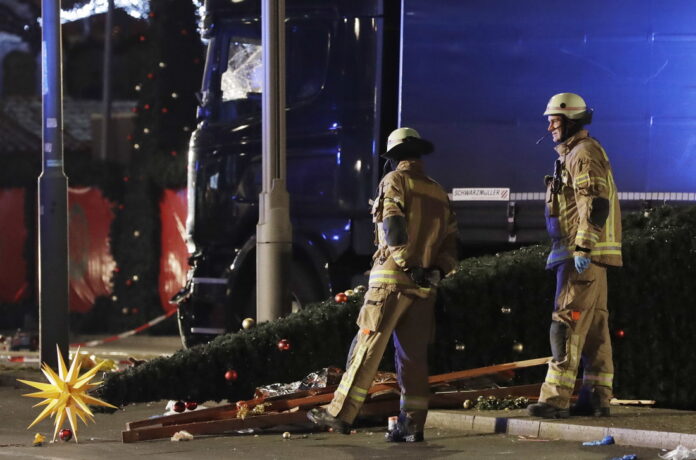
Firefighters look at a toppled Christmas tree after a truck ran into a crowded Christmas market and killed several people in Berlin, Germany, Monday, Dec. 19, 2016. Photo: Michael Sohn / Associated Press

BERLIN — Germany’s top security official says suspect arrested after attack “comes from Pakistan,” had applied for asylum.

This is a developing story and will be updated without notice.

Advertisement

Hot News

LATEST NEWS

Bangkok
overcast clouds
30.5 ° C
30.5 °
30.5 °
79 %
4.1kmh
100 %
Wed
31 °
Thu
36 °
Fri
38 °
Sat
37 °
Sun
36 °