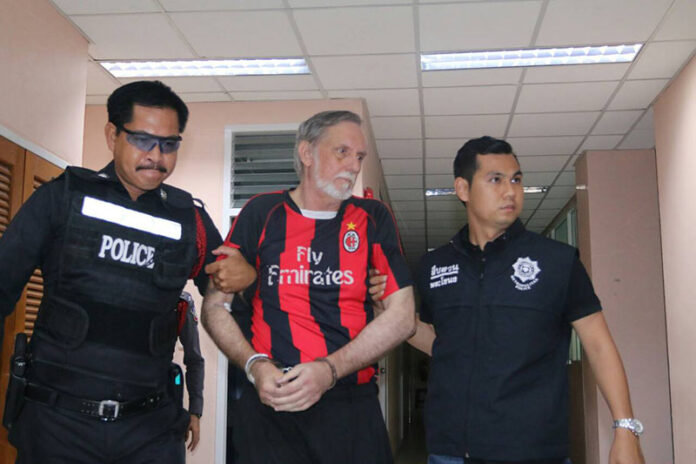
Herbert La Fon, 63 of the United States, is led from an interrogation session on Sept. 30 in Bangkok.
BANGKOK — An American man arrested recently and suspected of keeping a frozen body in a large freezer confessed to murder during questioning Friday, a source in the police station told Matichon.
Herbert LaFon and two other American men, Aaron Gabel and James Eger, were arrested Sept. 23 at a shophouse in Phra Khanong after police raided it on suspicion they were running a passport forgery operation there.
Reached to comment on the news, deputy metro police chief Suwat Jangyodsuk disputed the report, saying that La Fon had not confessed but provided “useful information in the case.”
During the raid, La Fon allegedly shot a police officer before being captured. The officer survived. In a search of the premises, officers discovered the frozen and dismembered remains of an older Western man they have still been unable to identify.
A former neighbor of La Fon’s told police he had seen the 63-year-old man remove the same freezer from his home in the Ekkamai area some months ago.
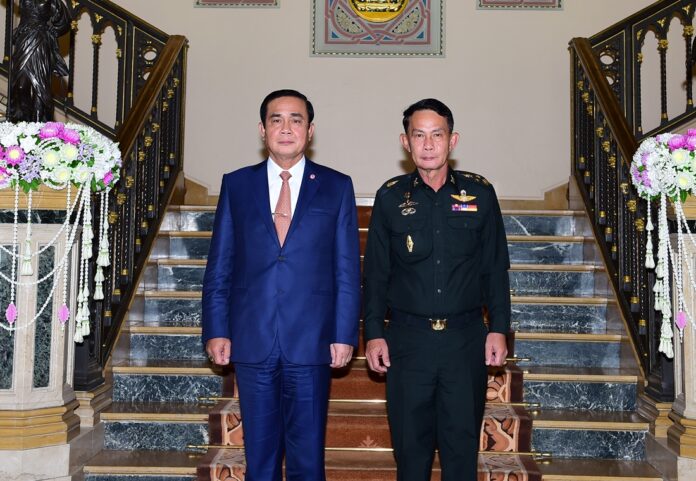
Prayuth Chan-ocha poses for photo with his brother Preecha Chan-ocha on Sept. 28, 2016, at Government House
BANGKOK — Military government leaders maintained Thursday there was nothing wrong with awarding contracts to the nephew of junta chairman Prayuth Chan-ocha in the face of mounting accusations of cronyism.
As more information emerged about how Contemporary Construction was awarded nearly 200 million baht in work since December 2014, the junta leader conceded it was somewhat “inappropriate” but also disparaged those calling for further transparency in the case.
“They can investigate whatever they want to investigate. They want to investigate his kitchen or his toilet, go ahead. ” Prayuth said of his brother Preecha Chan-ocha who led the army region where the work was awarded to his son.
However the junta chairman also challenged transparency activist Srisuwan Janya, who filed complaints with the national anti-corruption body last week over the company belonging to Pathompol Chan-ocha.
“And that man Srisuwan. What work does he do each day? He makes his complaints every day. Does he have a job?” Prayuth said, fuming. “Someday I will investigate him. What career do they have? Where do they get money from? … Are their jobs honest?”
Critics point to what they say are dodgy arrangements regarding Contemporary Construction. For one, it was founded in 2012 and, without any major projects to its name, went on to be awarded eight multi-million baht construction contracts by the army.
Then there’s an apparent conflict of interest. Company owner Pathompol is the son of junta member Preecha, who at the time, commanded the army region where the work was done. In the competitive bid that awarded Contemporary Construction the contracts, it only underbid its competitors by as little as 1,900 baht.
Finally it came to light Wednesday that the company’s offices are located on an army base, a clear use of a military facility for private business.
Since seizing power in 2014, the junta has presented itself as committed to cleansing the nation of its endemic culture of corruption.
Now its critics cry foul at what they see as another example of its blatant cronyism, while the military regime maintains there was no impropriety.
Gen. Prayuth said he’s put the matter behind him.
“[Preecha] apologized to me. He said he didn’t do anything wrong. It’s just some things he did were appropriate,” Prayuth said Thursday. “He admitted that point.”
Prayuth said he didn’t even know his nephew Pathompol had such a company.
“I didn’t know he had a company in all these years. He’s all grown up now. I haven’t met him in person for years now. I don’t see my family often because I have dedicated all my time to work,” the general said.
Deputy Prime Minister Wissanu Krea-ngam also said he found no irregularity in Contemporary Construction.
Since first reporting on Contemporary Construction on Sept. 19, investigative news site Isra News has published more details about the company, including the fact it received total payments amounting to 194.2 million baht from either the central army command or the Third Region Army for construction projects between December 2014 and April this year.
Throughout all those months, Pathompol’s father – Gen. Preecha – served as either deputy commander of the Royal Thai Army or chief of Third Region Army.
Preecha, who retired today as permanent secretary of the Defense Ministry, has also been the subject of a separate controversy involving his wife. Earlier this month he had to explain why she was afforded treatment reserved for members of the royal family.
Update: The event was postponed from Oct. 15 to Nov. 19
BANGKOK — His name was terror for Generation X, and his unchecked malevolence still holds its own four decades later.
Just in time for its namesake holiday, horror legend John Carpenter’s 1978 classic “Halloween” will get a mid-October rooftop screening in the Thonglor area.
More than another slasher flick, the film drives suspense through artful use of sound, camera and sparse dialogue to tell the well-known take of Michael Myers, a boy who escapes a mental hospital to chase people down and murder them.
“Halloween” also launched the career of Jamie Lee Curtis, earning her the title Hollywood’s first “scream queen.”
Tickets are available online for 300 baht and include a drink and popcorn. Snacks and drinks will be sold. The movie starts at 7pm on Nov. 19. The event is organized by the Bangkok Open Air Cinema Club.
The venue is atop The Hive Bangkok, a five-story coworking space made from converted shophouses on Soi Sukhumvit 49. Walk or get a motorbike from BTS Thong Lo exit No. 1 to get there.
‘Star Wars Episode IV: A New Hope’ screened in February. Photo: The Bangkok Open Air Cinema / Facebook
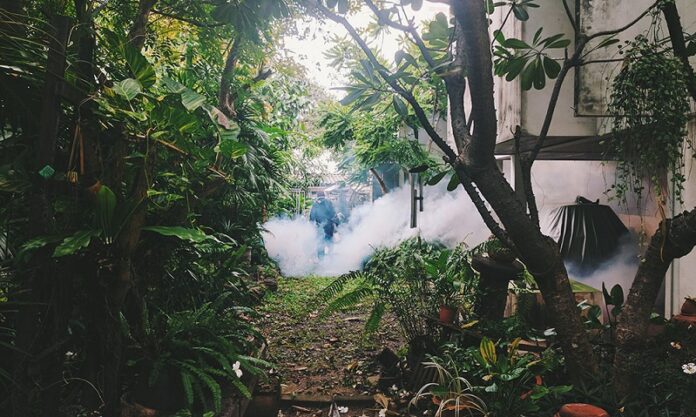
Workers fumigate a residence in Soi Ratchada 14 on Sept. 2. Photo: Pongvech Vechprasit
BANGKOK — At least two babies have been born with congenital defects linked to the Zika virus, health officials announced today.
Two babies were recently born with microcephaly, a condition of incomplete cranial development, which was confirmed to have been caused by their mothers’ becoming infected with the virus during pregnancy, according to Kiattikun Prasert Tongcharoen of the Health Ministry.
A third baby was born with a small head but tests whether it was due to Zika have been inconclusive. Officials are monitoring a fourth woman found to be infected and pregnant, saying her unborn child is at risk.
The United States issued a travel warning Friday which encouraged pregnant women not to travel to Thailand and 10 other ASEAN nations.
Earlier this month, a small outbreak of 22 cases in Bangkok’s Sathorn area were reported, including a pregnant woman.
The Ministry of Health recommends people get rid of standing water where mosquitoes breed and take measures to minimize exposure such as using insect repellent and covering up. As Zika has been proven sexually communicable, people are urged to use condoms during sex.
10-year-old Elison nurses his 2-month-old brother Jose Wesley, who was born with microcephaly, at their house Dec. 23 in Poco Fundo, Brazil. Photo: Felipe Dana / AP
Eighty percent of pregnant women will show no symptoms of the virus, it said.
The U.S. Centers for Disease Control and Prevention report that 11 ASEAN countries have cases of Zika, including Thailand. The disease has been in Thailand for years but few cases were reported.
During the past year it has spread rapidly through the world and raised alarm for the effect it can have on the health of unborn babies.
Kasikorn Bank promotes people to register for PromptPay on July 1.
Use an ATM or banking app and you’ve probably been nagged to register for a service called PromptPay. Maybe you’ve even gone ahead and done so without any idea what it is.
What is It?
In simple terms – and setting aside its criticisms – PromptPay lets people transfer money between bank accounts using only their phone number or national ID number. Reading off bank account numbers over the phone or typing them into a Line message will no longer be necessary to buy things online or pay back debts to friends.
At least that will be the case when it goes live Oct. 31, aka Halloween.
How Does it Work?
For example, let’s say you didn’t have cash for that surprise sushi lunch with friends. Someone spotted your share. If she registered with PromptPay, you could use the usual platforms – banking app, website or ATM – to enter her phone number and instantly send that 300 baht (or 30 baht or whatever).
And instead of being hit with 25 baht fees every time you transfer to someone who banks elsewhere, transactions under 5,000 baht will be free. Sending 5,000 baht to 30,000 baht will cost no more than 2 baht. From there it’s 5 baht for transactions up to 100,000 baht and 10 baht for greater amounts.
Are There Any Risks?
Behind it all is the central bank, or Bank of Thailand, and that’s what has critics saying with the convenience comes greater risk of government intrusion into your private finances – not to mention vulnerability, given the state’s track record with IT security. It certainly gives the taxman convenient access to your taxable transactions.
But that also means it can be used by government agencies to expedite their services.
PromptPay users won’t need to wait for checks to land in their mailboxes for tax refunds, pensions or other benefits. Link your national ID card to your bank account and get them deposited directly – and theoretically more quickly.
Grandma instantly gets her pension in one of the many slick marketing efforts promoting PromptPay.
How to Sign Up?
This is the easy part, as all financial institutions seem to be aggressively pressuring their customers to register. If somehow you have missed this, register for PromptPay in person at a bank branch office, via its smartphone app, web-based banking service or ATM.
Only one bank can be linked to your phone or ID number. But like registering, there is no charge to make changes or cancel the service.
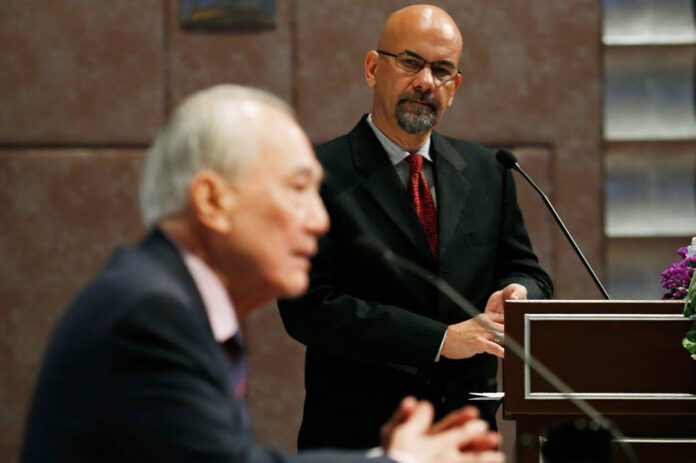
Nirmal Ghosh, as president of the Foreign Correspondents Club of Thailand, looks on during a keynote address by former Prime Minister Anand Panyarachun on March 23 at the InterContinental Bangkok. Photo: Nirmal Ghosh / Courtesy
BANGKOK — Thirteen years of reporting has led him throughout Thailand, from tsunami tragedy to political upheaval and beyond. But now Nirmal Ghosh, a doyen of the Foreign Correspondents’ Club of Thailand, is leaving the kingdom.
The Southeast Asia Bureau chief for The Straits Times of Singapore and two-time club president is heading west to Washington D.C. to lead the paper’s bureau there.
Recognizable for his clear-cut dome and Luciferian goatee, 56-year-old Ghosh reported from Manila and India prior to making his way to Thailand in 2003. During that time he’s fielded a preternatural calm to witness and report on two prime ministers named Shinawatra, one of the world’s deadliest natural disasters, cycles of street unrest and two coups.
Before he moves on, we posed a few questions for him to reflect upon.
Ed. Note: Responses lightly edited for publication.
Pravit Rojanaphruk: Tell us a bit about your time here and your most memorable experiences.
Nirmal Ghosh: As a journalist in Thailand, the most memorable experience was possibly the 2004 Asian Tsunami. One could not fail to be affected – shocked and deeply saddened really – at the scale of the death and devastation. Also memorable were the political dramas: The People’s Alliance for Democracy takeover of Suvarnabhumi Airport in 2008, the drama at the Asean Summit in Pattaya in 2009, and the violence in Bangkok in 2009 and 2010. The 2011 flood was extraordinary. Covering the Deep South, especially in 2004 and 2005 was also memorable.
Ghosh tours the Nam Theun 2 Dam in Laos in an undated photo. Photo: Nirmal Ghosh / Courtesy
But some of my most memorable experiences have not been work-related. They are sights and sounds at particular moments in time. Driving down next to the sea on the Hat-Yai-Pattani highway; the road to Tak Bai; the picturesque roads of the north and drinking fresh roasted coffee at Doi Inthanon; sitting on an empty beach one night at Khao Sam Roi Yot National Park; a wild elephant checking me out at close range at the Salakpra Wildlife Sanctuary.
PR:How has Thailand change over the years? Good and bad?
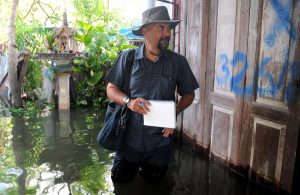
Ghosh in the field reporting on severe flooding in Thailand in 2011. Photo: Nirmal Ghosh / Courtesy
NG: The most obvious change is the way Thais have gone online and very actively embrace social media, which has led to a wide range of expression and opinion, including political. It is easy to see the negative aspects of this – fake news and propaganda, political partisanship, even hate – but there have been so many positive aspects as well. Issues surface, grab public attention and are debated. Social media was a key driver of the general public’s response during the 2011 flood disaster.
PR: Were you surprised by the 2014 coup? What is your view on the future of Thai politics?
NG: I was not surprised. Essentially, I was surprised by the 2006 coup, but in light of that coup and subsequent events, the 2014 coup was not surprising. The space for compromise was steadily getting narrower. When martial law was announced it seemed clearly to be stage one, so to speak. When Gen. Prayuth Chan-ocha summoned all the key players to the conference at the Royal Thai Army Club, it was obvious Thailand was within a hair’s breadth of a coup d’etat.
Thailand’s political future is, I believe, an old norm of politics and elections and probably weak civilian governments within red lines defined by the military.
PR: Some are worried about the future of foreign correspondents and the FCCT under the military regime. Do you share the sentiment?
Ghosh, a dedicated conservationist, at the Khao Sam Roi Yot National Park in Prachuap Khiri Khan province. Photo: Nirmal Ghosh / Courtesy
NG: I am not worried as such, but I am concerned. Antipathy toward foreign media, if it grows, only creates dissonance and clouds a country’s reputation for openness – and Thailand, at least until recently, had a reputation for relative openness. As for the FCCT, I trust the club is valued for what it is. It is the oldest and most attractive media club in mainland Southeast Asia, with a firm belief in a balanced approach to political issues despite an often fraught and combative environment. Former foreign minister Kasit Piromya once visited the FCCT and called it a “voice of conscience.” I thought that was well put.
PR: What about Thai journalists. How do they compare to foreign correspondents?
NG: It would be presumptuous of me to offer general comment on Thai colleagues!
PR: Any parting words for Thais, correspondents, politicians or the junta leader?
NG: For foreign correspondents, so many of whom I am lucky to have as friends, I will miss them and look forward to seeing their reporting on Thailand in the years ahead. It is not my place really, to offer any words to politicians or Prime Minister Prayuth Chan-ocha.
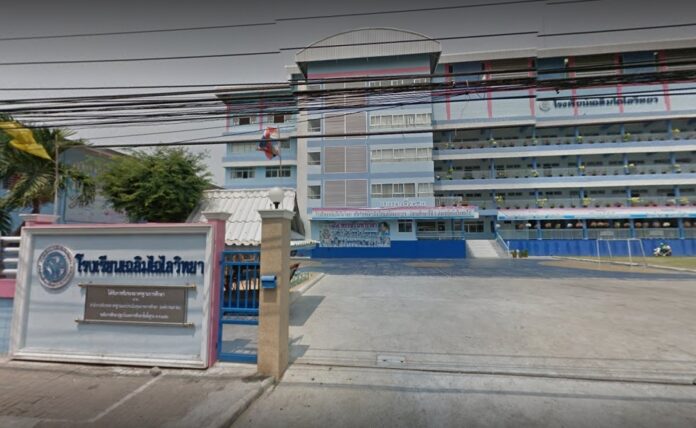
Chalermchailai Witthaya School in Samut Prakan province. Image: Google
SAMUT PRAKAN — A 14-year-old student told police Thursday he was handcuffed and kicked in the ribs by a teacher at his school in Samut Prakan province.
In the latest case of alleged classroom abuse, the boy’s family said a teacher at the Chalermchailai Witthaya School assaulted the student for damaging his classmates’ mobile phones, even though he had already financially compensated them.
“Next week we will summon both the teacher and the boy’s family for talks,” said Col. Preecha Iam-nui, Samut Prakan City police chief. “We have to talk to both sides to find out whether the incident really happened as claimed.”
Col. Preecha identified the teacher as Thaichaya Samuna, a physical education teacher at the school. Thaichaya was on leave and had not talked to police, Preecha added.
The boy’s grandmother, Wachareena Shinsri, came forward Thursday and told reporters at the police station that Thaichaya confronted the student in the classroom on Sept. 22 and berated him for throwing the mobiles of two fellow classmates out of the windows several days earlier.
The student, who was not named, admitted he had fought with two female students and had already paid 5,500 baht in damages to them, Wachareena said. But the teacher nonetheless punished the boy by putting him in handcuffs and then kicking him in the ribs several times, according to Wachareena.
Someone who answered the phone at Chalermchailai Witthaya School said the school’s director was not ready to comment on the matter.
No charge has been filed so far, Col. Preecha said.
The alleged incident comes on the heels of a string of classroom abuse reports. A teacher in Nakhon Ratchasima has been charged with physical assault after he threw a coffee mug that struck a schoolgirl in the face. Another teacher in Chonburi province is also under investigation for beating a student with a baton.
Philippine President Rodrigo Duterte gestures with a fist bump during his visit to the Philippine Army's Camp Mateo Capinpin at Tanay township in August in Manila, Philippines. Photo: Bullit Marquez / Associated Press
MANILA — Philippine President Rodrigo Duterte raised the rhetoric over his bloody anti-crime war to a new level Friday, comparing it to Hitler and the Holocaust and saying he would be “happy to slaughter” 3 million addicts.
Duterte issued his latest threat against drug dealers and users early Friday on returning to his home in southern Davao city after visiting Vietnam, where he discussed his anti-drug campaign with Vietnamese leaders and compared notes on battling the problem.
“Hitler massacred 3 million Jews … there’s 3 million drug addicts. There are. I’d be happy to slaughter them,” Duterte said, referring to a Philippine government estimate of the number of drug addicts in the country. Historians say that 6 million Jews were killed by the Nazis under Hitler before and during World War II.
Duterte has said that his public death threats against drug suspects are designed to scare them into stop selling illegal drugs and to discourage would-be users. Such scare tactics, he has said, are legal. But his remarks Friday took that crime-busting approach to a different level.
During the presidential election campaign earlier this year and during the three months he had held office, the tough-talking Duterte has threatened to drown drug suspects to fatten the fish in Manila Bay. He also threatened to execute drug traffickers by hanging — because he didn’t want to waste electricity on them — until their heads were severed from their bodies.
While Hitler victims were innocent people, Duterte said his targets are “all criminals” and that getting rid of them would “finish the (drug) problem of my country.”
PITTSBURGH, Pennsylvania — A Pittsburgh man has 30 days to figure out how to catch a noisy rooster or the city will penalize him.
The Pittsburgh Post-Gazette reports (http://bit.ly/2duCZRN ) the rooster’s piercing calls have plagued residents for years. Because it appears to live on Henry Gaston’s property, it has put him in violation of the city’s ban against roosters.
But Gaston told a judge Wednesday he’s tried to catch the animal and has failed. He says he called animal control and the zoo, but he still hasn’t come up with the rooster.
Assistant City Solicitor Adam Rosenthal says he would agree to give Gaston 30 days if he puts out food and tries to catch it with a net.
The judge says he’d like the rooster caught and transferred to a farm.
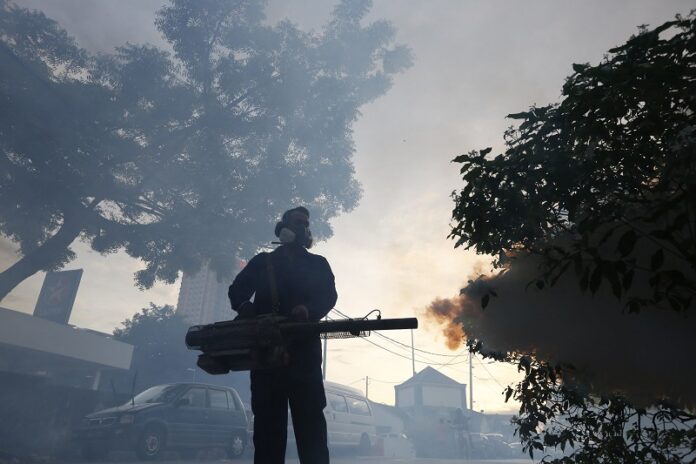
A worker from the Ministry of Health sprays mosquito insecticide fog on Sept. 14 in Kuala Lumpur, Malaysia, a day after two new Zika virus infection cases were detected in the country. Photo: Joshua Paul / Associated Press
NEW YORK — U.S. health officials are advising pregnant women to postpone travel to 11 countries in Southeast Asia because of Zika outbreaks in the region.
The advisory issued Thursday targets travel to Brunei, Cambodia, East Timor, Indonesia, Laos, Malaysia, the Maldives, Myanmar, the Philippines, Thailand and Vietnam.
The Centers for Disease Control and Prevention said Zika has been in some areas of Southeast Asia for years, and some residents may be immune. But a number of U.S. travelers have become infected there in the last year, so there is a danger to visitors.
Most infected people suffer a mild and temporary illness, at worst. But infection during pregnancy can causes severe brain-related birth defects. The virus is spread primarily by bites from infected mosquitoes.