































29.9 C
Bangkok
Saturday, June 27, 2026
Home Blog Page 2624

Wireless Earphones, Water Resistance and More Define New iPhone

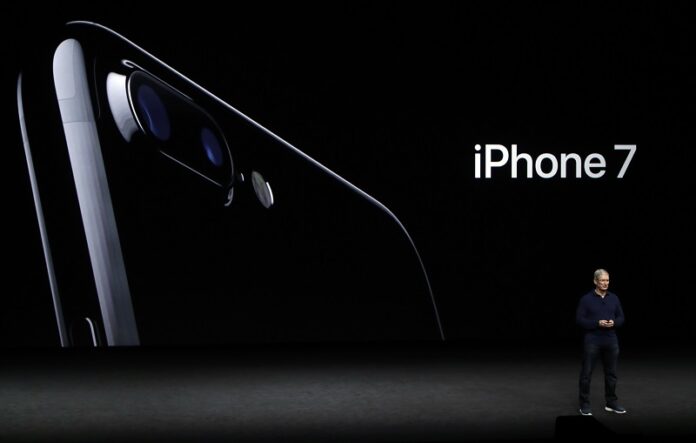
Apple CEO Tim Cook announces the new iPhone 7 on Wednesday during an event to announce new products in San Francisco, United States. Photo: Marcio Jose Sanchez / Associated Press

SAN FRANCISCO, United States — At Apple’s iPhone 7 unveiling in San Francisco on Wednesday, the tech powerhouse revealed a host of new and updated hardware and software, including a new type of headphone jack and souped-up camera. Here’s a rundown of the biggest announcements.

Apple Airpods

As expected, iPhone is removing the standard analog headphone jack and forcing headphones to use its “Lightning” connector, which plugs into the phone’s charging port. The iPhone 7 will come with an adapter so older earphones can still be used.

But Apple is pushing Apple AirPods, which CEO Tim Cook says are a “breakthrough design,” wireless headphones that sync across all Apple devices and respond to touch that can access Siri. The AirPods are shipping in late October and cost $160.

iPhone 7 and 7 Plus

Apple’s new iPhone is getting a faster processor, an updated home button and water and dust protection. Apple says theiPhone 7’s home button is now force sensitive. It will provide “haptic” feedback — that “pushing back” feeling — when you press it, but the button itself doesn’t move. It’s similar to what Apple has done with a trackpad in a slimmer MacBook model last year.

The iPhone 7 will have stereo speakers for the first time, with twice the volume of iPhone 6S speakers. The phone’s battery life is improved, too; Apple estimates that the new iPhones will have one or two hours of additional battery life over last year’s models.

Camera

Other camera improvements include a new flash with four LEDs rather than two for greater brightness. As with previous models, the flash will adjust its color to match ambient light. High-end photographers can get images in RAW format, which allows for more versatile editing, matching what many leading cameras now have.

Phil Schiller, Apple's senior vice president of worldwide marketing, talks about the features on the new iPhone 7 earphone options on Wednesday during an event to announce new products in San Francisco. Photo: Marcio Jose Sanchez / Associated Press
Phil Schiller, Apple’s senior vice president of worldwide marketing, talks about the features on the new iPhone 7 earphone options on Wednesday during an event to announce new products in San Francisco, United States. Photo: Marcio Jose Sanchez / Associated Press

The iPhone 7 Plus will have two lenses to boost the zoom capabilities of the camera. The camera can now zoom in twice as much without losing sharpness. Both cameras take 12 megapixel photos. The two lenses will also sense depth and allow users to blur backgrounds in images, mimicking an effect that typically requires changing the lens aperture in stand-alone cameras. That feature won’t be out until later this year.

Other smartphone makers such as LG and Motorola are also starting to offer models with dual lenses to improve picture quality. The difference is the wide angle on LG G5 has lower resolution with 8 megapixels.

Pricing and Storage

The iPhone 7 will start at $650, the same as the 6S it replaces. The larger Plus model is increasing to $770, instead of $750. They come in silver, gold, rose gold, black and the new jet-black finish. Storage has been doubled, so Apple joins rival phone makers in making the starter model 32 gigabytes, rather than 16 gigabytes before. Apple is doubling storage in higher-priced models, too — to 128 and 256 gigabytes.

The new phones will ship Sept. 16, with orders to start this Friday. Older iPhones will get price reductions, and last year’s models are also getting double the storage.

iOS 10

The latest software update, available on Tuesday, will add more intelligence to Apple services like Maps, Photos, the iPhonekeyboard and Siri, the voice-activated digital assistant. There’s a new Home app to control appliances. In a big change for Apple, the company is also opening Siri and its iMessage service to work with apps created by independent developers.

Apple is also allowing developers to build apps for iMessage, although the options so far appear to mostly involve sending payments or ordering food. It’s also adding bigger emoji and other visual effects for iMessage, including what it calls “Invisible Ink,” which blurs an image in a message until a recipient swipes a finger across the screen. Apple announced many of the features in June.

Apple Watch Series 2

Apple introduced a “swim-proof” watch, the Apple Watch Series 2. The new watch has built-in GPS, a brighter display and faster processor than the previous Apple Watch. There’s also new ceramic watch-face. The price starts at $370. The original model will get a faster processor price cut to $270, down from $300. The updates are coming Sept. 16.

Existing watches can get new operating software on Sept. 13. In addition, there’s a new Apple Watch Nike Plus, a Nike-branded Apple Watch in four colors that’s designed for runners. It is also priced at $369 and is available late October. The Nike version gets a special strap and custom watch faces, though the Nike app will be available for all Apple Watch models. Battery life, which has been a weak spot of the watch, was not mentioned.

Apple is phasing out smartwatch models made with 18-karat gold. The “Series 2” watches will use ceramic instead of gold for the luxury “Edition” version. The ceramic versions will start at $1,250, just a tad cheaper than the gold model, which started at $10,000.
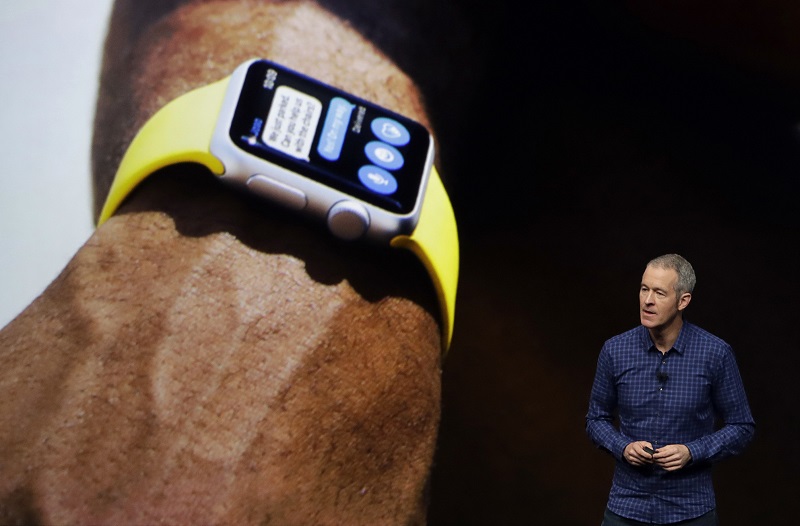
Jeff Williams, Apple's chief operating officer, speaks on Wednesday during an event to announce new products in San Francisco, United States. Photo: Marcio Jose Sanchez / Associated Press
Jeff Williams, Apple’s chief operating officer, speaks on Wednesday during an event to announce new products in San Francisco, United States. Photo: Marcio Jose Sanchez / Associated Press

Pokemon Go

A Pokemon Go app is coming to Apple Watch. The app lets you collect items from Pokestops, hatch eggs and alert you to nearby Pokemon (you still need your phone to catch actual Pokemon). It will be shipping before the end of the year.

New Mario Game

Nintendo debuted a new Super Mario game for iOS called Super Mario Run. It’s the first iOS game featuring Nintendo’s Mario characters. Nintendo has long resisted bringing Mario to mobile phones, relying on it instead to sell its hand-held DS gaming systems. The new game, which can be played one handed, will be released in time for the holidays. The game will have a fixed price which is being kept under wraps for now. The news sent Nintendo shares soaring on Wednesday.

Apple Bay

Apple Pay will come to Japan in October with a new wireless technology called Felica to be included in iPhones and Apple Watches there. Apple Pay will also come to New Zealand in October and Russia in the fall.

In the U.S. and elsewhere, mobile payments use a wireless technology called NFC. A transit feature in Apple Maps will also launch in Japan.

iWork in Real Time

Apple iWork suite of software, including word processing, processing, spreadsheet and presentation programs, will include real-time collaboration features for the first time. It’s something Google and Microsoft already offer in some form. Although Apple’s iWork package allows syncing through iCloud, it’s has been primarily for one person to work on documents at a time. The software is available for iPhones, iPads and Mac computers, with a web version for Windows users.


Advertisement

Latest Suspect in August Attacks Also Linked to Deep South Bombings

Investigators work at the scene of an explosion in the resort town of Hua Hin on Aug.12. Photo: Jerry Harmer / AP

PHETCHABURI — A man accused of being behind the recent deadly bombing of a Pattani railway and other attacks in the Deep South was named as the sixth suspect in last month’s spree of bombings in southern region.

A military court Thursday approved an arrest warrant for Seri Waemamu, 31 of Songkhla, who was identified as a third suspect in the explosions which struck the resort town Hua Hin on Mother’s Day.

Police said they found evidence linking Seri to a power bank bomb which caught fire but failed to explode at the Chat Chai Market several days later on Aug. 14. Police believe it was meant to be part of the coordinated attacks which killed four people in seven provinces on Aug. 11 and 12.

He is now charged with possessing explosives and attempted arson.

Seri was recently named by the authorities as being behind a bomb placed on the tracks in Pattani that killed a railway worker when it exploded Saturday evening.

He also had an outstanding warrant for a 2012 explosion in a Hat Yai hotel which killed five people. Another suspect named in the Hua Hin bombings, Ruslan Baima, was also implicated in that attack.

Photo of Seri Waemamu provided by police

A news agency reported Tuesday that a source inside the separatist group behind a bloody campaign for independence in the southernmost provinces took credit for the Mother’s Day attacks as well as the railway bomb and another attack which killed a father and his young daughter in front of Narathiwat school.

According to the report from BenarNews, the National Revolution Front, or BRN, said the escalation in violence was in response to Bangkok’s insincerity in peace talks.

Despite evidence consistently pointing blame at the insurgency movement, police investigators have declined to say there is a link, a position taken by the military government almost as soon as the attacks happened.

Police Gen. Srivara Ransibrahmanakul said today his team has yet to find anything linking the attacks to the BRN.

Just as the BRN has never taken credit for attacks in the past, Thai authorities regularly blame them on undefined people with bad intentions.

On Thursday, Srivara said he believed the bomb at the school Tuesday in Narathiwat’s Tak Bai district was committed by the “ill-intentioned people” and was not aimed to worsen the situation with the insurgency.

The warrant issued Thursday morning for Seri was the sixth granted in connection to the Mother’s Day attacks.

Only one suspect, Abdulkadir Saleah, has reportedly been detained on a military base in Pattani province. The rest remain at large.

Advertisement

Obama and Duterte Meet at Last in Laos

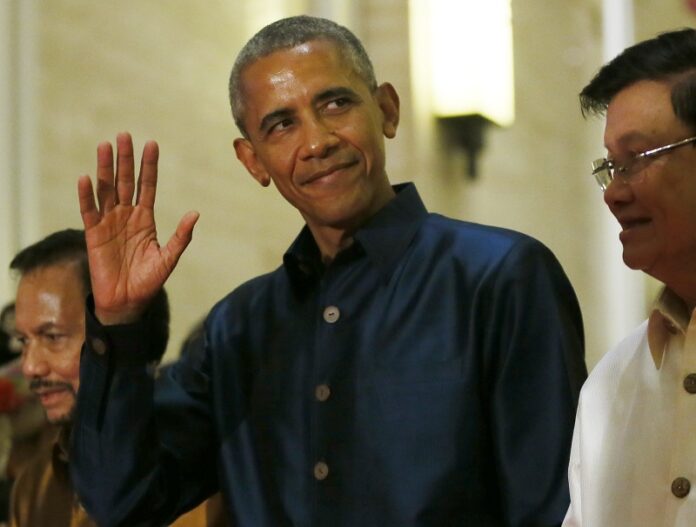
US President Barack Obama waves to the media on Wednesday as he arrives for the gala dinner of ASEAN leaders and its Dialogue Partners in Vientiane, Laos. Photo: Bullit Marquez / Associated Press

VIENTIANE — President Barack Obama and Philippine President Rodrigo Duterte met informally on Wednesday in a holding room before attending a gala dinner at a regional summit, Philippine officials said.

The brief meeting took a little sting out of the soured relations caused by Duterte’s intemperate language in referring to Obama earlier this week. That had caused Obama to cancel a formal meeting scheduled for Tuesday.

Philippine Foreign Secretary Perfecto Yasay told The Associated Press that the leaders had met.

“They met at the holding room and they were the last persons to leave the holding room. I can’t say how long they met. It all springs from the fact the relationship between the Philippines and the United States is firm, very strong. The basis for this relationship is historical and both leaders realize this. And I’m very happy that it happened.”

Obama and Duterte are in the Laotian capital along with other regional leaders for the summit. All of them made their way through the holding room before heading to the banquet hall.

According to a White House official who would not be named discussing the private meeting: Obama had a brief discussion with Duterte before the ASEAN Gala Dinner in the leaders’ holding space. The exchange consisted of pleasantries between the two.

On Monday, hours before arriving in Laos, Duterte told Philippine reporters he wouldn’t accept questions from Obama about extrajudicial killings that have occurred during his crackdown on suspected drug dealers and users. More than 2,000 people have been killed in the crackdown since he took office on June 30.

“I do not have any master except the Filipino people, nobody but nobody. You must be respectful. Do not just throw questions. Putang ina, I will swear at you in that forum,” Duterte said, using the Tagalog phrase for “son of a bitch.”

On Tuesday, Duterte expressed regret over the remarks, but the damage was done.

A Philippine Department of Foreign Affairs spokesman, Charles Joe, also said Obama and Duterte met in the holding room. He said it was a mutually agreed meeting, but that he had no details of what was discussed.

Obama and Duterte entered the dinner venue separately, and were seated far apart and did not interact with each other during the dinner that lasted an hour and 20 minutes.

Story: Jim Gomez

Advertisement

Residents Rescued From Collapsed Shophouses Near Prachaniwet Market

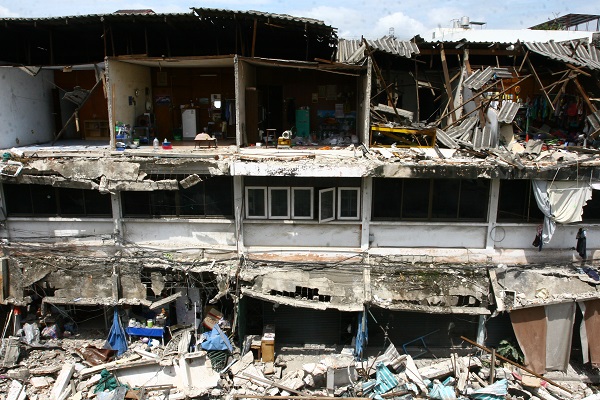
BANGKOK — Residents were briefly trapped inside a building in the Chatuchak district after 12 shophouses suddenly collapsed there Wednesday evening.

The outer wall of a row of shophouses near the Prachaniwet 1 Market came crashing down at about 6pm, trapping several people inside. No one was reported injured, but  at least seven cars and two motorbikes were damaged.

The incident caused a power outage in the area. Police said officers were eventually able to free the people stuck inside.

Pol. Col. Samard Promchat said the three-story, government-owned shophouses were built in 1982 and condemned two years ago due to flood damage from 2011. The residents were asked to move out several times, he said, but many refused to leave.

“They had a deep bond. They didn’t want to move out because they lived there for a long time,” the chief of Prachachuen police said.

Samard said police are investigating the cause of the collapse.

201609072009146-20150928153929

201609072034507-20150928153929

PCT_3491

IMG_7067


Advertisement

The Battle of the Burkini

Muslim women bathe last Friday in the Mediterranean sea in Tel Aviv, Israel. Photo: Ariel Schalit / Associated Press


LONDON, United Kingdom – There has been a lot of fuss lately about the handful of Muslim women who choose to bathe on French beaches wearing a special garment that covers the head (not the face), and much of the body. That garment – the so-called burkini – was invented in 2004 by an Australian-Lebanese woman named Aheda Zanetti, with the goal of enabling even the strictest Muslim women to swim or play sports in public. Little did Zanetti know that her creation would generate a national controversy.

The imbroglio started when mayors in several southern French seaside towns banned burkinis on their beaches. A grotesque photograph soon appeared in newspapers around the world of three armed French policemen forcing a woman to undress on a beach in Nice. Though the ban has now been invalidated by France’s highest court, it is still enforced in several seaside resorts.

And, indeed, the controversy is far from over. Former French President Nicolas Sarkozy, who is now running for a new term, recently called the burkini a “provocation,” while Lionnel Luca, the mayor of Villeneuve-Loubet, spoke of “rampant Islamization.” The equally outraged Prime Minister Manuel Valls has called bare breasts a symbol of French republican liberty. After all, he concluded, wasn’t Marianne, the female symbol of the French Republic, usually depicted with her breasts exposed?

There is little doubt that Sarkozy’s opposition to the burkini is entirely opportunistic. The controversy represents yet another opportunity to stoke prejudice against an unpopular minority, in the hope of siphoning votes from the far-right National Front’s Marine Le Pen in the 2017 election. But, in a tradition that spans centuries of European missionary zeal, his opportunism has been cloaked in moral terms: “We don’t imprison women behind fabric.”

Sarkozy would have us believe that the ban on burkinis is really meant to liberate Muslim women from primitive restrictions imposed by authoritarian Muslim men, just as British colonial rulers once liberated Indian Hindu widows from being burned alive to accompany their spouses in death. This reflects a broader tendency, which has been gaining traction since the end of the last century, to couch anti-Muslim rhetoric in the language of human rights, as though equal rights for women or gays were ancient Western customs that must be defended against alien religious bigotry.

In Valls’s version of history, public nudity is a cherished French tradition and a sign of freedom. To be fully French, it seems, women must, like Marianne, bare their breasts.

Yet, in the nineteenth century, when Marianne became a symbol of the French Republic, nudity was acceptable only in an idealized form, in paintings or sculptures of Greek deities and other mythical heroines. It was fine to gaze at the breasts of a painted nude Marianne or Venus; but for a real, living woman to expose even part of her ankle was considered highly improper.

Of course, nowadays, these attitudes are rare in the Western world. So even though Valls’s version of history is skewed, one might argue that European Muslims who insist that women of their faith should be covered up are out of step – especially given that women sometimes have little choice in the matter.

Indeed, in some immigrant areas, Muslim women feel obliged to cover their heads, lest Muslim men see them as prostitutes, who may be molested with impunity. But this is not always the case. Some Muslim women actually choose to wear a hijab and, in rare cases, a burkini.

The question is whether the state should be determining what citizens should or should not wear. The French republican answer is that people may wear whatever they like in private, but must conform to secular rules in public.

In recent years, however, those rules have been applied more strictly to Muslims than to members of any other faith. I have not heard of policemen forcing orthodox Jewish women to bare their heads by ripping off their wigs.

Well, some might argue, orthodox Jews are not responsible for massacres in the name of their religion. And that is true. But the assumption that women in burkinis are all potential terrorists is farfetched. A woman lying on a beach in a body-covering swimsuit is probably the least likely person to start shooting or bombing.

As for the argument that Muslim women need the state to free them from Muslim men who force them to wrap their heads in scarves or cover up their bodies, the question is whether this is worth depriving other women of their choice to appear in public in these ways.

I am inclined to doubt that it is. The best way to help women escape from domestic authoritarianism is to encourage them to lead public lives as well, in schools, in offices, and on beaches. It is better for a woman to be educated in a headscarf than not to be educated at all.

For certain public functions, it is perfectly legitimate to ask people to show their faces. Some jobs come with certain dress codes. Private companies can insist on their own rules; there is no need for national legislation. The excessive imposition of conformity by the state can actually have the opposite effect than what is intended. Forcing people to adhere to a common identity fosters a rebellious insistence on difference.

It is no good telling people named Fatima or Mohammed that they are French and must adhere to the norms laid down by Sarkozy or Valls, if they are not treated as equals by people called Nicolas or Marianne. Wearing a headscarf, beard, or bodysuit can be a harmless way for humiliated people to defend their pride. Take away that pride, and defensiveness can swiftly become less harmless.

Ian Buruma is Professor of Democracy, Human Rights, and Journalism at Bard College, and the author of Year Zero: A History of 1945.

Copyright: Project Syndicate, 2016.
www.project-syndicate.org

Advertisement

Prison Refutes Rumor Yellowshirt Founder Sondhi Died

Sondhi Limthongkul consoles one of his co-defendants Tuesday as they were taken to prison to begin serving 20-year jail terms for fraud.

BANGKOK — Former media tycoon and political activist Sondhi Limthongkul is alive and serving his 20-year jail for fraud conviction, despite online rumors suggesting otherwise, director of the Klong Prem Central Prison said today.

He was responding to a rumor circulated on social media Wednesday morning that Sondhi, who’s credited with helping topple two governments and surviving attempted assassination, died of stroke in prison Tuesday night, hours after losing his final appeal of a conviction for fraud amounting to more than a billion baht.

Yellowshirt Leader Sondhi Jailed 20 Years for Fraud

“I confirm that Mr. Sondhi is in normal condition. He is not suffering from any illness, as circulated in the online communities,” prison director Thawatchai Chaiywat told reporters.

Thawatchai said Sondhi did show some signs of stress but could sleep and eat normally.

The claim, shared by many Redshirts, said Sondhi had a stroke and was sent to prison hospital, where he later died.

According to Thawatchai, the former firebrand Yellowshirt activist even wrote him a letter expressing concern about the rumor, because many of his relatives mentioned it to him during today’s visiting hours.

“Mr. Sondhi wrote in his letter that he’s not sick. Everything is fine,” Thawatchai said.

On Tuesday the Supreme Court upheld a lower court’s 2012 conviction of Sondhi and three other executives of Manager Media Group for forging a company report to guarantee a 1.02 billion baht loan from Krung Thai Bank in 1997. Sondhi was immediately returned to prison to serve out a 20 year sentence, without it being suspended as is sometimes the case for well-connected or wealthy defendants.

It was a dramatic downfall for one of the most prominent activists in Thailand’s recent history.

In 2005 Sondhi founded the royalist Yellowshirt movement and campaigned for the overthrow of then-Prime Minister Thaksin Shinawatra, whom he accused of corruption, nepotism and disloyalty to the monarchy. The military staged a coup against Thaksin a year later, amidst the escalating street protests at the time.

Again in 2008, Sondhi and his resurrected Yellowshirt campaign successfully brought about the end of a pro-Thaksin government following months of protests, in which his supporters occupied government buildings and airports in Bangkok.

Sondhi receded from public view after a group of gunmen attempted to assassinate him in April 2009. His attackers were never caught.

Related stories:

Anti-Graft Crusader and Yellowshirt Founder Convicted of Fraud

Advertisement

From Iranian Scares to French Love, ‘Little Big’ Brings Indie Films to Bangkok

Under The Shadow. Photo: Vertical Entertainment / Courtesy

BANGKOK — A fearsome Djinn terrorizes a family in Iran’s first psychological horror film, an American drama details a woman’s transition to man, and a poignant Japanese drama about imperfect lives are among films ready to make audiences cry next week.

After a decade hiatus, a project begun 17 years to bring independent films to Bangkok is back with a roster of four acclaimed features.

Discontinued in 2006 because independent films had more venues to screen, the Little Big Films Project returns next week to tug at the heart strings.

Premiering earlier this year at Sundance, “Under the Shadow” is a 2016 Iranian horror film portraying the terrors a mother and her daughter have to cope with in revolution-torn Tehran in the 80s, as they are haunted by Djinn, the evil Middle-Eastern spirit.

“About Ray” follows Elle Fanning’s Ray who seeks to transition fully to male as her family struggles to accept Ray’s new identity. Also stars Naomi Watts and Susan Sarandon.

In period film “From The Land of the Moon,” Gabrielle (Marion Cotillard), a woman who settled for a marriage of convenience, is recovering from illness when she falls in love with a veteran recently returned from Southeast Asia. The 2016 French film competed for the Palme d’Or at Cannes.

“After the Storm” revolves around an award-winning author turned private detective who is trying to turn around his life as a deadbeat dad while trying to reconnect with his ex-wife. The 2016 film written and directed Hirokazu Koreeda competed at Cannes.

Koreeda will be in Bangkok to launch the project and will hold a cinematography workshop at 10am on Sept. 7 at House Rama RCA.

“After the Storm” shows Sept. 15, “About Ray” on Sept. 29, “Under The Shadow” on Oct. 13 and “From The Land of the Moon” on Oct. 27. The films will show at House Rama RCA, Lido, Paragon Cineplex, CentralWorld’s SFW Cinema and Esplanade Ratchada.

Advertisement

US Woman Falls Off Cliff Escaping Alleged Attacker in Krabi

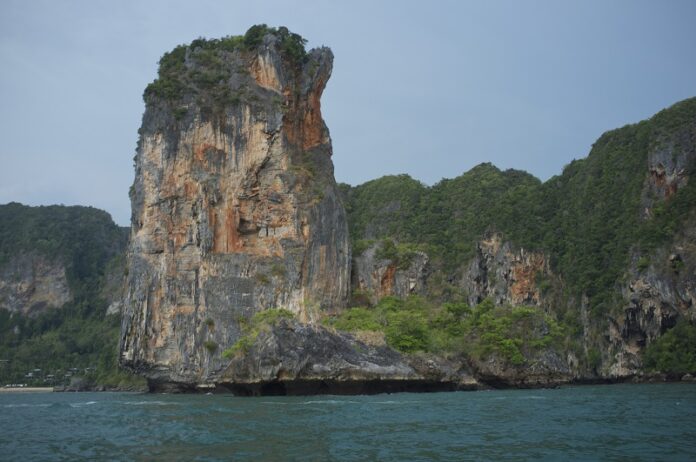
Limestone cliffs of Krabi Bay in 2014. Photo: Aleksandr Zykov / Flickr

BANGKOK — An American tourist was recovering Wednesday in a hospital in Thailand after breaking her spine while tumbling down a cliff trying to escape from a man who allegedly was molesting her.

The 23-year-old woman was attacked last Thursday in the southern seaside province of Krabi, a popular tourist destination, police said.

The woman, whom The Associated Press is not naming to protect her privacy, told police that a man who offered to help guide her back to her hotel at night took her down a remote path and tried to remove her clothes. She said she fought back, biting his ear before running away, only to plunge down a 45-meter (150-foot) cliff.

The woman was found by rescuers the next morning and is now recovering after surgery.

According to Krabi Tourist Police Inspector Attapong Sanjaiwut, the alleged attacker said that the account of sexual assault was a misunderstanding, and that he stayed by the woman’s side part of the night and called rescuers in the morning.

Police have detained the alleged attacker, who faces 5 to 20 years in prison if convicted of causing serious injury and obscene behavior toward another person. Attapong said police sent an initial report Wednesday to prosecutors, who are waiting to take testimony from the victim before she leaves Thailand. He suggested the woman might be able to leave for the United States in about 10 days.

Thailand welcomed almost 30 million foreign visitors last year, and tourism is one of the country’s important revenue earners.

Advertisement

BRN Says It Was Behind Mother’s Day Bombings: Report

Police on Sep. 7, 2016, inspect wreckage of a motorcycle bomb that exploded in front of Ban Ta Ba School in Pattani province, killing two people.

BANGKOK — A secretive separatist group in the southern border region has taken responsibility for last month’s bombing attacks in the south of Thailand, according to a news agency.

In an unprecedented move, an unnamed commander in the National Revolution Front, or BRN, told BenarNews it was behind not only Tuesday’s bomb attack at a school in Pattani province, but the spree of bomb and arson attacks in seven provinces that killed four people during the Mother’s Day holiday in August.

“We claim that the attack in Tak Bai district was the act of our operation, as well as the train bombing and those attacks in the seven upper southern provinces too,” the commander was quoted in the report.

In an emailed message, the managing editor of BenarNews confirmed the story’s details.

“I can confirm that we spoke to sources within the BRN,” Kate Beddal wrote. “… Not able to give more details to protect our journalists.”

BenarNews is a nonprofit news site funded by the U.S. government.

Four people were killed in the series of explosions and firebombs that struck seven provinces on Aug. 11-12, which marked the National Mother’s Day. No one had claimed responsibility for the attacks so far, but police say evidence increasingly point to separatist movement in the border provinces of Pattani, Yala and Narathiwat.

That separatist movement has historically not claimed responsibility for the frequent attacks it is suspected of carrying out. While the suspected militants in the past mostly targeted Thai security forces, civilians and other “soft targets” have come under frequent attack in recent weeks.

A weaponized motorcycle exploded in front of Ta Ba School in Pattani on Tuesday morning, when parents were dropping their kids off to the school. The blast killed Mayeng Wobah and his 4-year-old daughter, Mitra Wobah, and injured at least 10 others.

The BRN commander told BenarNews the group was targeting a group of police officers standing guard near the school and did not intend to kill civilians.

Authorities and experts have long described the BRN as the most well-armed and active among a network of shadowy militant cells operating in the three southern border provinces. The militants are aiming to secede the Muslim-majority region and revive the independent state of Patani.

At least 6,200 people have died since the separatist violence broke out in January 2004, mostly civilians.

Correction: An earlier version of this story mistakenly described BenarNews as a state news organization. It is in fact funded by the U.S. Broadcasting Board of Governors, according to its website.

Related stories:

BRN Implicated in ‘Unprecedented’ Ambulance Car Bomb

Separatists ‘Crossed Rubicon’ With Attacks, May Escalate: Expert

Military Holds First Suspect Arrested For August Attacks

Advertisement

Can Apple Make Listening Easy Without Headphone Jack?

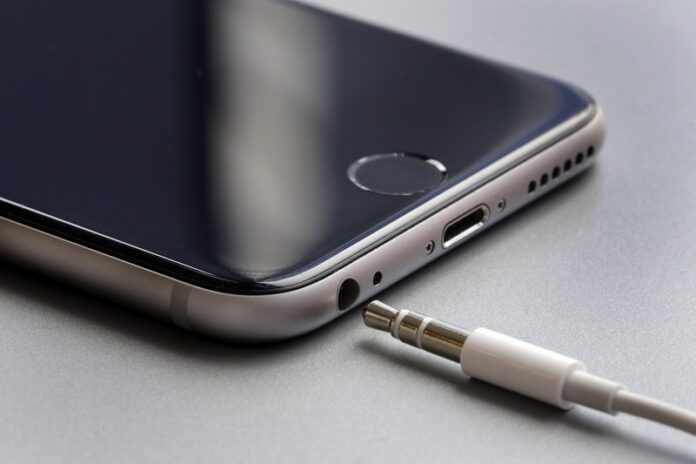
An earphone jack and charging port on an Apple iPhone 6 on Sept. 2 in New York. Apple is getting ready to unveil new iPhones on Sept. 7. Photo: Richard Drew / Associated Press

SAN FRANCISCO — When Apple shows off its latest iPhone on Wednesday, it will answer a question it hasn’t had to address in years: “What’s it putting in the box?” (Besides the iPhone itself, that is.)

The iPhone has traditionally shipped with a pair of Apple’s iconic earbuds, made famous in early advertising for the iPod music player. But tech analysts and industry bloggers, citing leaks from Apple’s Asian suppliers, say it looks like the tech giant has decided to do away with the analog headphone jack in the next iPhone.

That means the earbuds themselves are in for a revamp, one that could hint at Apple’s plans for expanded use of wireless technology.

IPHONE 7: INCREMENTAL CHANGES

The headphone jack is drawing attention partly because there might not be many other major changes in this year’s iPhone. The new models — the iPhone 7 and 7 Plus, if Apple sticks to its usual convention — are expected to offer faster processors, more memory and improved cameras.

But despite a recent dip in iPhone sales, most Apple watchers expect the company to save its next big overhaul for 2017, the 10th anniversary of the first iPhone’s release.

Though it might not seem dramatic, eliminating the 3.5 millimeter analog jack would be controversial. On the plus side, it could let Apple make the iPhone slightly thinner and possibly waterproof; it might also free up space for other components.

But it also means future iPhone buyers will need new headsets that use a digital connection. That could just mean changing the headset cord so that it plugs into the same port that recharges the device. Or it could herald an Apple commitment to wireless earbuds that connect to the phone via a technology such as Bluetooth. Apple already sells wireless headsets from Beats Electronics, which it acquired two years ago for $3 billion.

While Apple hasn’t commented, reports of the change have sparked an outcry from those who believe the old analog jacks worked perfectly well. Tech blogger Nilay Patel of The Verge blasted the move as “user-hostile and stupid.”

WHY HEADPHONES MATTER

For many people, listening to music and watching video — not to mention making the occasional phone call — constitutes one of the main uses for a smartphone. “People enjoy listening to music on their smartphones today as much as they listen to music at home,” said Brian Blau, a tech analyst at Gartner.

Today’s wireless Bluetooth headsets, however, can be clunky to set up and sometimes randomly drop their phone connections. And no headphone jack means that existing headsets won’t work with the new iPhones without an adapter. It’s also not clear how you’d plug in your headset if you’re already charging the phone.

Finally, Apple uses a proprietary design for its charging port, known as “Lightning.” So new headphones that plug into that port won’t be compatible with devices made by Apple’s competitors.

OLD TECH ON APPLE’S HIT LIST

Apple has a history of preemptively doing away with older technologies, often prompting lamentations from users — at least until they got used to it. Co-founder Steve Jobs famously decided the first iMacs didn’t need a floppy disk drive in 1998, years before Windows PCs followed suit. Later, he made waves by selling MacBooks without a CD drive or even a traditional hard drive, which have also disappeared from competing laptops.

More recently, Apple made millions of old power cords incompatible by replacing the 30-pin charging port on older iPhones and iPads with the much smaller Lightning port in 2012.

Apple, however, isn’t the first company to do away with the headphone jack. Already this year, Lenovo’s Motorola division and Chinese smartphone maker LeEco have released phones without analog audio jacks, relying instead on cords that plug into a new digital port known as USB-C — which, of course, is different from Apple’s Lightning port. Some argue that digital connections provide higher quality sound.

“The market is changing,” said Jim Thiede, head of global product marketing at Motorola, who expects to see a number of manufacturers producing “USB-C headphones, earbuds and what have you” over the next three to six months.

OUR WIRELESS FUTURE

Some believe Apple’s real goal is to move people away from cords and plugs altogether.

“They don’t like the mess,” said Jan Dawson, a tech analyst with Jackdaw Research. “Anybody who’s carried a set of earbuds in their pocket have had them get tangled up. And they get in the way when you’re exercising.”

Apple has already cut the number of ports on its latest MacBooks, encouraging owners to use wireless features like Apple’s AirDrop and AirPlay for sharing files or streaming music and video, he noted.

Widespread adoption of wireless headsets might also encourage people to try streaming music using the Apple Watch, said Carolina Milanesi, a mobile tech analyst at the research firm Creative Strategies. That would be a first step toward getting them interested in future smartwatch apps and services, she suggested.

“It might be good if you had a Bluetooth headset that connects to your phone and your watch at the same time,” she said. “What we see today is not necessarily the ultimate goal that Apple has for its devices.”

Despite criticism of Bluetooth’s audio fidelity, Milanesi said more expensive models offer better quality.

Apple could distribute the new iPhones with a “good enough” Bluetooth headset included, she added, while selling more expensive headsets separately. Dawson suggested Apple may provide earbuds with a Lightning plug, and possibly an adapter for older headsets.

Most iPhone owners will get used to the new technology, Milanesi predicted. Still, she cautioned, “people don’t like change.”

Advertisement

Hot News

LATEST NEWS

Bangkok
overcast clouds
29.9 ° C
31.1 °
28.8 °
90 %
2.8kmh
97 %
Sat
37 °
Sun
36 °
Mon
36 °
Tue
33 °
Wed
34 °