32.8 C
Bangkok
Saturday, June 27, 2026
Home Blog Page 2627

Parallel But Ever Apart, Worlds Clash Through Body Movement

Ladda Kongdach performs in “Parallel [between the lines].” Photo: Yeongu Kim / Courtesy

BANGKOK — A performing artist portrays the essence of a parallel universe through body movement and expression in a work launching Friday.

“Parallel [between the lines]” is a solo movement created and performed by Ladda Kongdach, who said she’s been interested in parallel worlds since childhood and often wondered what would happen if another version of herself chose a path other than the one she has taken.

“When I was a kid, I believed I had a twin, but that thought faded as I grew up and reality dawned on me,” Ladda said. “Still, I feel related to the parallel universe theory, as we might have a twin somewhere in the universe. We often have to choose different paths which turn our lives around. So, I want to express the possibilities of the decision through my performance.”

The 45-minute show consists of simple body movements and expressions, along with a human-sized puppet whose mask is molded from Ladda’s face. The 33-year-old artist creates a sense of parallels in the clash between body and mind, puppet and puppeteer and the divergent paths of unrequited lovers.

Ladda said she is inspired by her life experiences. With seven years experience in theatre, Ladda started directing her own three years ago to explore the use of puppets and body language in expressing a meaningful insight.

The performance was part of “Dancing in the Lake,” which premiered last month in Seoul.

“Although the work is personal, the feelings presented are mutual. The audience doesn’t have to know my story, but through movement, with no use of words, people can sense happiness or sadness and what I’m trying to convey,” said Ladda.

Tickets are 400 baht and can be reserved via the Facebook event page or by phone at 081-929 4246 and 083-123-6331.
Performances of “Parallel” start at 8pm running Friday through to Sept. 20, (except Wednesday and Thursday) at Crescent Moon Space in the Pridi Banomyong Institute. The venue is a 10-minute walk from BTS Thong Lo’s exit. No. 3.

Advertisement

Kindergartener Among Two Killed by Deep South Motorcycle Bomb

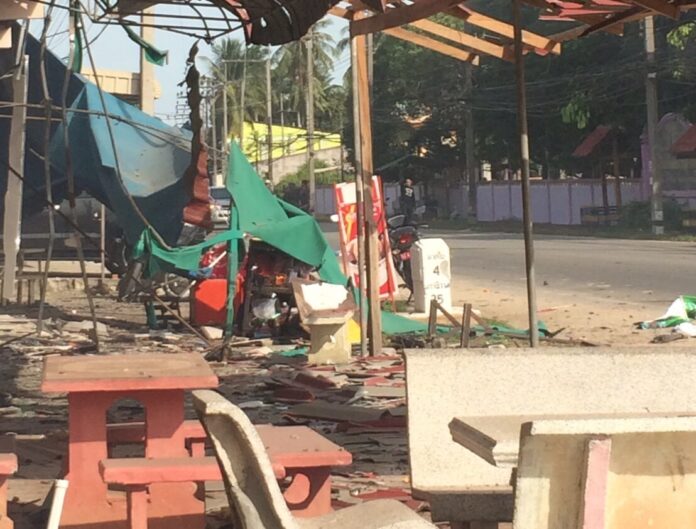
The aftermath of a bombing attack near a school in Narathiwat’s Tak Bai district this morning which killed two people including a young schoolgirl.

NARATHIWAT — A weaponized motorcycle exploded in front of a school in Narathiwat’s Tak Bai district this morning, killing two people including a 4-year-old schoolgirl, police said.

The bombing appeared to mark a recent trend in separatist violence of more indiscriminate targeting of civilians, coming just two weeks after an ambulance was used in the fatal car bombing of a hotel in Pattani province.

BRN Implicated in ‘Unprecedented’ Ambulance Car Bomb

A police report released to the media said the motorcycle was parked close to where a group of police officers was standing guard in front of Ban Taba School.

The report said a man and his daughter, a 4-year-old kindergartener enrolled at the school, were killed in the attack. Eight people were also injured.

Spokesman Pramote Prom-in of the Internal Security Operation Command condemned the bomb attack as an inhumane act that disregarded civilians, even young children.

“I’d like to ask [everyone] to help monitor and condemn the behavior of the perpetrators as much as possible,” Col. Pramote said.

Sunai Phasuk of Human Rights Watch also described the bombing as a “war crime” in a tweet.

More than 6,500 people, many of whom were civilians, have died in the southern border region since secessionist violence broke out there in 2004, according to Deep South Watch.

On Aug. 23 suspected insurgents converted a stolen ambulance into a car bomb and left it to explode in front of a Pattani hotel, killing two people.

A bomb also struck a passenger train in Pattani province on Saturday, killing a railway employee and disrupting southbound trains for hours.

Related stories:

Insurgents Steal School’s Milk Delivery Truck, Convert Into Car Bomb

Advertisement

Perp Pressers to Continue Despite Prayuth’s Concern for Human Rights

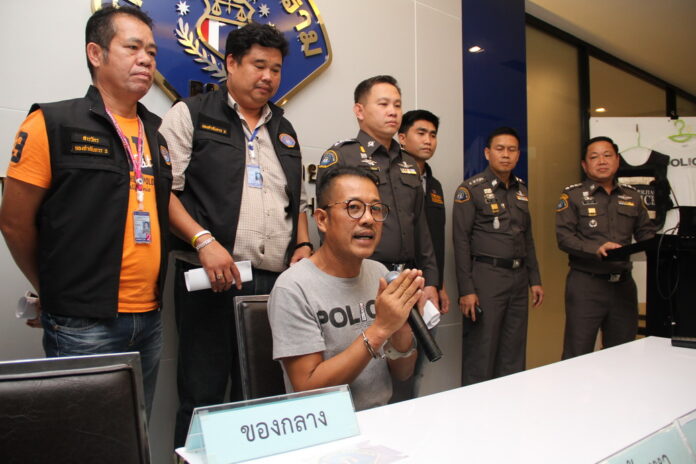
A typical setting of police news conferences, a man accused of rape on Friday was presented to reporters at Bangkok's Crime Suppression Division and told to apologize for his alleged crime.

BANGKOK — For a while it seemed like a tradition in the symbiotic relationship between police and media would be brought to an end.

But two days after junta chairman Prayuth Chan-ocha sent a letter to the Ministry of Justice telling police to consider ending the commonplace practice of parading suspects in front of reporters out of concern for human rights, police Monday said the show will go on – with some modifications.

“The prime minister did not outright forbid us. He ordered us to reconsider it on a case-by-case basis,” police spokesman Piyapan Pingmuang said by telephone. “We already have our own orders as well. There are already regulations and rules, but they were not strictly enforced in the past.”

Police spokesman Piyapan said the order will be respected, and crime conferences will only include suspects who consent to participate. No more minors will appear, he said.

Police defend the practice as something that gives suspects the right to ask for clemency, and to show society how criminals operate. Rights activists say it violates suspects’ due process, amounts to a public conviction before they can face trial and encourages bad policing.

In the letter sent late last month by the Prime Minister’s Office and made public Saturday, Prayuth instructed police to consider staging crime news conferences without the suspects being present. According to the letter, the instruction followed a recent briefing by the Ministry of Justice on the human rights violated by such practices.

For Their Own Good?

Like “crime reenactments,” crime news conferences are a ritual synonymous with police work and crime news.

At the events which are repeated daily nationwide, suspects are typically seated in police station meeting rooms behind a table littered with evidence implicating them in their alleged crimes. Police recite to reporters what the suspects are accused of, and at times the latter speak to the press directly.

They’re popular with both the officers who are eager to be featured in the media, and provide ample, if redundant, images for publication.

Sometimes they end in disarray, such as this time last year when a victim sucker-punched her alleged attacker in what became a viral video clip.

National Human Rights Commissioner Angkhana Neelaphaijit said such routines violate suspects’ rights because they lead the public to judge them as guilty before their case even reaches the court.

Her agency has received several complaints about the matter and has urged police to end the tradition many times, but authorities have so far ignored her pleas, Angkhana said.

Speaking by telephone Monday, Ankhana said that all too often “the police claim that suspects have already confessed.”

“But a number of suspects, well, probably a large number of suspects, were forced to confess under interrogation,” she said. “What’s important is that we must adhere to the principle of innocent until proven guilty.”

Spokesman Piyapan and other top police officials defended the practice.

“Sometimes, the suspects want to speak at news conferences because they have the chance to repent from their actions. They can use it as a cause to ask for a reduction of their punishment in the court” Maj. Gen. Piyapan said. “Sometimes, they also want to apologize to the victims for their crimes.”

Bangkok police commander Sanit Mahatavorn went further by saying that suspect news conferences help society understand how criminals work, so that they can protect themselves and more victims can file charges.

“When suspects commit crimes like snatching purses, robbery, fraud and scam, we have to present them for the people to see that these individuals have committed wrongdoing many times,” Lt. Gen. Sanit said. “People who were victims of those crimes can file criminal complaints to prosecute them.”

He said the police will only conduct them if the suspects provide consent and the police believe it will be of public benefit.

Piyapan also suggested that it was for the benefit of the press corps.

“Sometimes, it is the media who prefer it that way,” Piyapan said. “At those pressers, reporters can take photos and talk directly with the suspects.”


Unenforced Rules

As Piyapan said, there are internal police regulations concerning suspect pressers. But they are almost always ignored.

A 2005 order issued by the Royal Thai Police bans bringing suspects to news conferences unless there is a “benefit for the public,” in which case they must seek approval from their commanders first. Underage suspects cannot be presented under any circumstances, the order said.

The same order also bans bringing reporters along for arrests and other law enforcement operations – another common practice.

Another order issued in 2007 added a clause which banned allowing the media to photograph or interview suspects in police custody, unless it “benefits the case” or the suspects agree to it.

Piyapan admitted that police have not always followed those rules, but that they will be more strict from now on, after Prayuth urged them to be more mindful.

“In some cases, such as that of minors, we won’t take them to news conferences. These are practical changes,” the spokesman said. “I think it’s a good thing for our country that the nation’s leader expressed his concern about human rights in such a way.”

Advertisement

Obama Cancels Meeting with New Philippine President Duterte

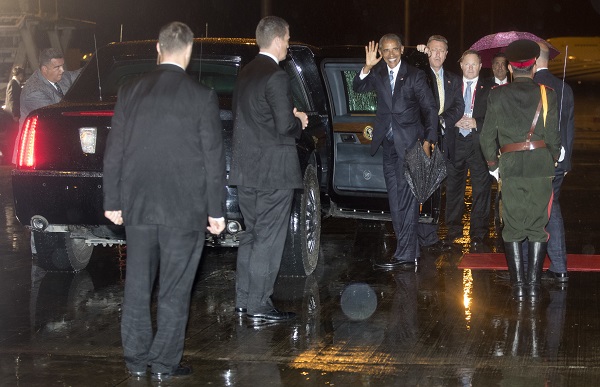
U.S. President Barack Obama waves before getting into his motorcade vehicle as he arrives on Air Force One to Wattay International Airport on Monday in Vientiane, Laos. Photo: Carolyn Kaster / Associated Press

VIENTIANE, Laos — President Barack Obama called off a planned meeting Tuesday with new Philippine President Rodrigo Duterte, seeking distance from a U.S. ally’s leader during a diplomatic tour that’s put Obama in close quarters with a cast of contentious world figures.

It’s unusual for one president to tell another what to say or not say, and much rarer to call the other a “son of a bitch.” Duterte managed to do both just before flying to Laos for a regional summit, warning Obama not to challenge him over extrajudicial killings in the Philippines.

“Clearly, he’s a colorful guy,” Obama said. “What I’ve instructed my team to do is talk to their Philippine counterparts to find out is this in fact a time where we can have some constructive, productive conversations.”

Early Tuesday, National Security Council spokesman Ned Price said the meeting with Duterte was off.

Duterte has been under intense global scrutiny over the more than 2,000 suspected drug dealers and users killed since he took office. Obama had said he planned to raise the issue in his first meeting with Duterte, but the Philippine leader insisted he was only listening to his own country’s people.

“You must be respectful,” Duterte said of Obama. “Do not just throw questions.” Using the Tagalog phrase for “son of a bitch,” he said, “Putang ina I will swear at you in that forum.” He made the comment in a televised news conference in southern Davao City.

Eager to show he wouldn’t yield, Obama said he would “undoubtedly” still bring up human rights and due process concerns “if and when” the two do meet.

The bizarre rift with the leader of a U.S. treaty ally was the most glaring example of how Obama has frequently found himself bound to foreign countries and leaders whose ties to the U.S. are critical even if their values sharply diverge.

In Hangzhou this week, Obama’s first stop in Asia, he heaped praise on Chinese President Xi Jinping for hosting the Group of 20 economic summit in his country, an authoritarian state long accused of human rights violations. His next stop was another one-party communist country with a dismal rights record: Laos, where mysterious disappearances have fueled concerns about a government crackdown.

And sitting down with Turkish President Recep Tayyip Erdogan, Obama made no mention in public of the roughly 35,000 people Erdogan’s government detained following the summer’s failed coup in Turkey. Instead, he worked to reassure the NATO ally the U.S. would help bring to justice whoever was responsible for plotting the coup.

Obama also spent about 90 minutes Monday with Russian President Vladimir Putin, another leader whose fate seems intertwined with Obama’s in all the wrong ways. On opposing sides of many global issues, the U.S. and Russia are nonetheless trying to broker a deal to address the Syrian civil war and perhaps even partner militarily there.

“President Putin’s less colorful,” Obama said, comparing him with Duterte. “But typically the tone of our meetings is candid, blunt, businesslike.”

Managing Duterte has become a worsening headache for Obama since the Filipino took office on June 30, pledging his foreign policy wouldn’t be constricted by reliance on the U.S. Washington has tried largely to look the other way as Duterte has pursued closer relations with China, a marked shift for the Philippines considering recent tensions over Beijing’s aspirations in the South China Sea.

A public break from the Philippines would put Obama in a tough position, given the Southeast Asian nation’s status as a longtime U.S. ally. The Obama administration has sought to compartmentalize by arguing that military and other cooperation won’t be jeopardized even if it detests the current Philippine leader’s tone.

Last month, Duterte said he didn’t mind Secretary of State John Kerry but “had a feud with his gay ambassador — son of a bitch, I’m annoyed with that guy.” He applied the same moniker to an Australian missionary who was gang-raped and killed, and even to Pope Francis, even though the Philippines is a heavily Catholic nation. He later apologized.

With a reputation as a tough-on-crime former mayor, Duterte has alarmed human rights groups with his deadly campaign against drugs, which Duterte has described as a harsh war. He has said the battle doesn’t amount to genocide but has vowed to go to jail if needed to defend police and military members carrying out his orders.

Story: Josh Lederman and Kathleen Hennessey

Advertisement

Duterte Warns ‘Son of a Bitch’ Obama Not to Question Killings in Philippines

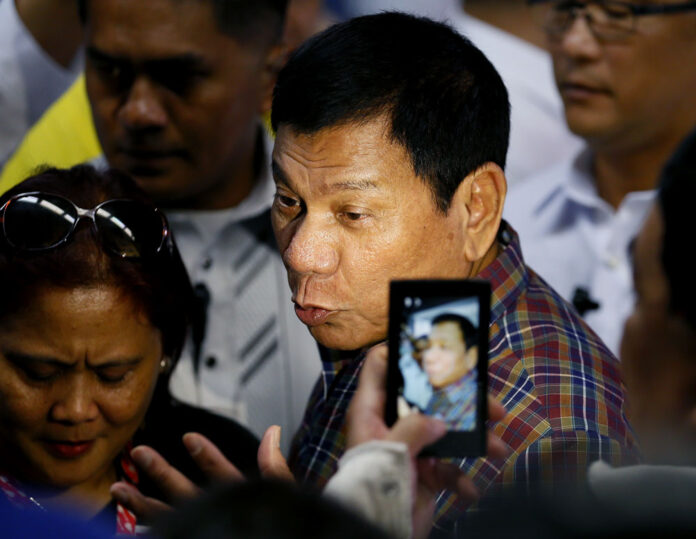
Philippine President Rodrigo Duterte talks to the media after welcoming Overseas Filipino Workers who were repatriated back to the country on Wednesday at the Ninoy Aquino International Airport. Photo: Bullit Marquez / Associated Press

MANILA — Philippine President Rodrigo Duterte warned President Barack Obama on Monday not to question him about extrajudicial killings, or “son of a bitch I will swear at you” when they meet in Laos during a regional summit.

Duterte said before flying to Laos that he is a leader of a sovereign country and is answerable only to the Filipino people. He was answering a reporter’s question about how he intends to explain the extrajudicial killings to Obama. More than 2,000 suspected drug pushers and users have been killed since Duterte launched a war on drugs after taking office on June 30.

In his typical foul-mouthed style, Duterte responded: “I am a president of a sovereign state and we have long ceased to be a colony. I do not have any master except the Filipino people, nobody but nobody. You must be respectful. Do not just throw questions. Putang ina I will swear at you in that forum,” he said, using the Tagalog phrase for son of a bitch.

Duterte has earlier cursed the pope and U.N. Secretary-General Ban Ki-moon.

It isn’t clear whether Obama planned to raise the issue of extrajudicial killings with Duterte during a scheduled meeting on the sidelines of the summit of the Association of Southeast Asian Nations.

Asked at a news conference in Hangzhou, China, whether he still intends to meet with Duterte and raise the issue of extrajudicial killings, Obama said he had instructed his aides to assess whether it is still possible for the two leaders to have a constructive meeting in Laos.

“I always want to make sure that if I’m having a meeting that it’s actually productive, and that we’re getting something done,” Obama said.

“We recognize the significant burden that the drug trade plays not just in the Philippines but around the world, and fighting narco-trafficking is tough. But we will always assert the need to have due process and to engage in that fight against drugs in a way that’s consistent with basic international norms. And so, undoubtedly, if and when we have a meeting this is something that is going to be brought up,” said Obama, who has been attending a meeting of the Group of 20 nations.

“Who is he to confront me?” Duterte said in his remarks, adding that the Philippines had not received an apology from the United States for misdeeds committed during its colonization of the Philippines.

He pointed to the killing of Muslim Moros more than a century ago during a U.S. pacification campaign in the southern Philippines, blaming the wounds of the past as “the reason why (the south) continues to boil” with separatist insurgencies.

Last week, Duterte said he was ready to defend his bloody crackdown on illegal drugs, which has sparked concern from the U.S. and other countries.

Duterte said he would demand that Obama allow him to first explain the context of his crackdown before engaging the U.S. president in a discussion of the deaths.

Story: Teresa Cerojano

Advertisement

In Blunt Terms, Govt Reminds Public Weed Still Not Legal

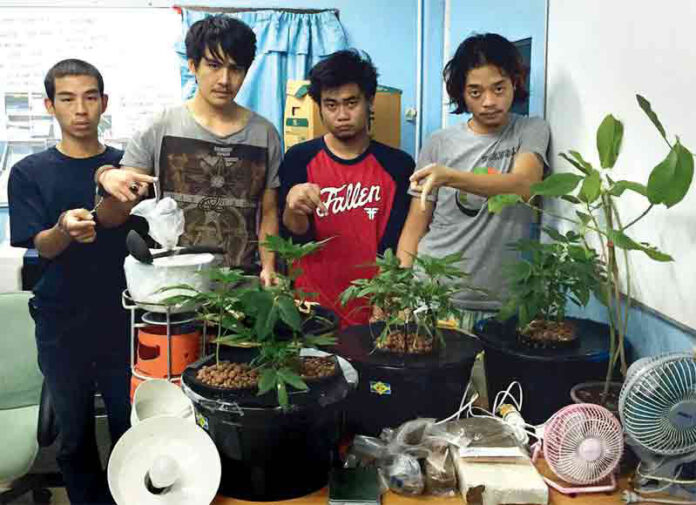
Ahead of their time? Singer Baramee Chamnankit, aka Earth AF9, was arrested Aug. 27 along with three friends for growing marijuana inside his condominium.

BANGKOK — The military government is urging the public to think again before buying full-spectrum grow lights and reflective mylar to wallpaper their homes with.

While recent news reports might create the impression Thailand was already going up in a purple haze of permissive drug legalization, Deputy Prime Minister Wissanu Krea-ngam soberly reminded the public Monday that no action has been taken yet.

Read: Regime Moves to Ease Drug Laws Starting With Meth, Marijuana

The response came after media reports came out Friday that the government had already acted to take marijuana off the list of Category 5 narcotics months ago in April at the request of the Food and Drug Administration.

Wissanu said the interim cabinet has yet to issue any resolution on the proposal to remove marijuana from the list of banned substances, and the idea is still being studied.

Adding further buzzkill to the 420-minded, he said there’s no time frame for implementation, despite Justice Minister Gen. Paiboon Khumchaya’s assertion the changes would likely roll out by year’s end.

But it’s not just a pipe dream. The plan promoted by Paiboon would declassify marijuana as a Category 5 narcotic, which would loosen restrictions on licensed cultivation and use for medical purposes and research.

How far the authorities are willing to go in regulating approved uses remains to be seen.

Somyot Kittimankhong, a government physician and author of “Marijuana is a Medicine that Cures Cancer,” said weed poses a Catch-22 for the authorities.

“They want to show research to support amending the law, but then no one can conduct research here because it’s illegal,” said Somyot, a longtime advocate for marijuana decriminalization. “I think we have to amend the law first because its medical benefits are already assured by a lot of research overseas.”

While curing cancer is probably a stretch, organizations such as the U.S. Food and Drug Administration, National Cancer Institute and American Cancer Society have found marijuana is helpful in treating symptoms associated with cancer. Varying degrees of legalization – from medical to recreational – have come to a growing number of U.S. states.

Somyot wants to see Thailand go even further to normalize medical marijuana.

“We should cut it from the drug list and create the new category for medical herbs,” he said.

Advertisement

South China Sea: ASEAN Summit Taboo

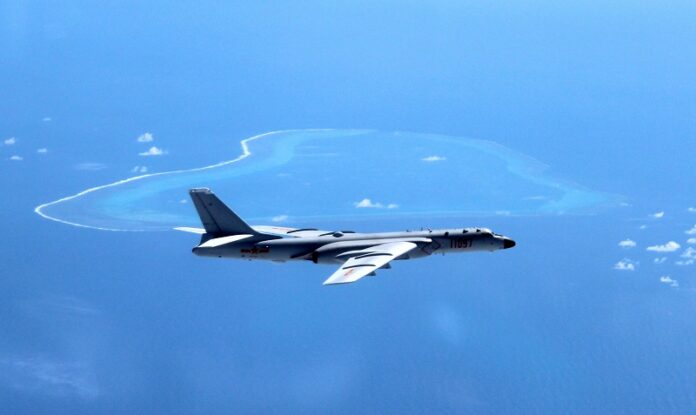
A Chinese H-6K bomber patrols the islands and reefs in the South China Sea. China is pitted against smaller neighbors in multiple disputes over islands, coral reefs and lagoons in waters crucial for global commerce. Photo: Liu Rui / Xinhua via the Associated Press

VIENTIANE — Southeast Asian leaders are likely to avoid any official mention at a summit this week of an arbitration ruling that shot down China’s expansive territorial claims in the South China Sea, according to a draft of their final declaration, in a victory for Beijing’s diplomatic clout.

But the draft also expresses strongly stated concern about Beijing’s construction of man-made islands in the South China Sea, which Southeast Asian countries fear could destabilize the region.

The draft, obtained Monday by The Associated Press, is being fine-tuned by officials for the leaders to approve ahead of the summit of the Association of Southeast Asian Nations that begins Tuesday in the Laotian capital. The final version is to be released Thursday, but most major points including those concerning the South China Sea are expected to remain largely unchanged.

Officials say Philippine President Rodrigo Duterte also plans to ask China’s premier at a meeting between ASEAN and other regional leaders whether China is trying to develop another disputed reef, Scarborough Shoal, off his country’s northwestern coast.

Duterte said last week that the Philippine coast guard has sighted Chinese barges at Scarborough, which he said could presage the transformation of the Chinese-held reef into another man-made island. One of the Chinese vessels had what appeared to be a crane, according to a Philippine official who did not want to be identified because he was not authorized to discuss classified intelligence.

The Philippine government asked China’s ambassador in Manila about the sighting of the Chinese barges, but the envoy denied any island building was under way, the official said.

China sparked widespread alarm when it converted seven reefs in the Spratly Islands into islands that the United States says could be transformed into military bases to reinforce Beijing’s territorial claims and intimidate rival claimant countries.

“We remain seriously concerned over recent and ongoing developments and took note of the concerns expressed by some leaders on the land reclamations and escalation of activities in the area,” the draft of the ASEAN leaders’ statement says. The reclamation and other acts “have eroded trust and confidence, increased tensions and may undermine peace, security and stability in the region.”

Duterte has taken a more conciliatory stance than his predecessor toward China. But a confirmation of Chinese reclamation activities at Scarborough Shoal, a rich fishing ground where Filipino fishermen have been forced away by Beijing’s coast guard, could impede relations.

U.S. officials have also expressed deep concern over the possibility of China developing Scarborough into an island or starting to erect concrete structures there, which could reinforce Beijing’s control over a swathe of the South China Sea.

Aside from China and the Philippines, Vietnam, Taiwan, Brunei and Malaysia have been contesting all or parts of the strategic waterway, an important route for commerce and oil that fuel Asia’s economies.

After China seized Scarborough following a tense 2012 maritime standoff, the Philippines took its territorial dispute with China to international arbitration, a move that was condemned by Beijing, which prefers one-on-one negotiations to prevent the United States and its allies from meddling.

In a landmark ruling in July, the arbitration tribunal invalidated China’s expansive claims, including in areas where Beijing built its islands, and admonished China for blocking Filipino fishermen at Scarborough, where it said both Chinese and Filipinos could fish.

China condemned the ruling as a sham and moved to prevent it from being recognized in ASEAN communiques, something that its close ally, Cambodia, has backed in meetings of the 10-nation bloc, which operates by consensus.

Story: Jim Gomez

Advertisement

Justice Minister Slams Doctor For Saying DSI Officers Murdered Suspect

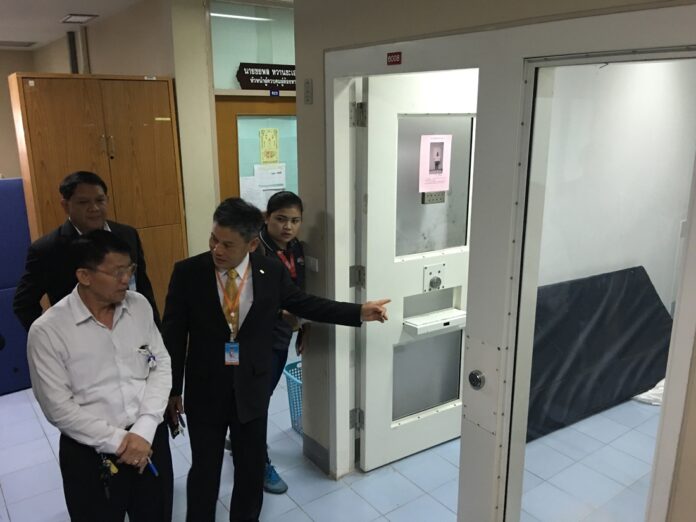
Officials lead media on a tour of the detention room at DSI headquarters where the agency claimed Thawatchai Anukul hanged himself the day earlier.

BANGKOK — The head of the Justice Ministry said Sunday that a hospital director discredited law enforcement by blaming investigators for the death of a suspect in custody last week.

Gen. Paiboon Kumchaya said it’s too early to speculate how former land official Thawatchai Anukul died in his cell at the Department of Special Investigation on early Tuesday morning despite a doctor’s insinuation the agency was involved.

Hospital Contradicts DSI ‘Suicide’ Explanation For Suspect’s Death in Custody

“How could you write something like this? By writing it, you damaged the relevant agencies, because the investigation is not concluded,” Gen. Paiboon said. “Maybe it’s true as you wrote, because no one knows for sure, but you can’t speak out about it at this time, because if the investigation is concluded, and it turns out you’re wrong, other agencies are already damaged.”

That message was aimed at Rienthong Nanna, the director of the hospital whose staff were among the first responders. Rienthong wrote Saturday that he believed some officers at the department conspired to have Thawatchai murdered.

“It was likely a case of murder in which officers within the Department of Special Investigation knew about and cooperated with the assassins, without any acknowledgement or involvement from directors of the Department of Special Investigation,” Rienthong of Mongkutwattana Hospital wrote on his Facebook.

Rienthong’s comments came after the department’s previous explanations – suicide and then botched CPR – were refuted by medical experts.

Paiboon told reporters Sunday that Rienthong prematurely went public with his opinion.

He continued, “I am not criticizing his expression of opinion. I am criticizing an expression of opinion that damages other agencies.”

The ministry was not considering any legal action against Rienthong, Paiboon added.

Thawatchai was arrested and detained at the DSI on allegation that he forged hundreds of illegal land deeds in Phang Nga, Surat Thani and Phuket provinces to wealthy business operators under his watch as a land official. The deeds were worth billions of baht, police said.

The DSI announced Wednesday that Thawatchai hanged himself in the cell the day earlier by tieing his socks to a door hinge. When preliminary autopsy result said the 66-year-old suspect actually died of injuries in his liver, the department blamed it on improper CPR procedure.

The latter explanation was later dismissed as impossible by Rienthong, the Mongkutwattana Hospital director.

Thawatchai’s death raised speculation on social media that he may have been silenced before his case went to court, possibly with help from some insiders. The DSI said it has set up a panel to find out whether any of its officials were involved in the incident.

Police spokesman Krisana Pattanacharoen said Sunday that extensive lab results from forensic examiners would determine Thawatchai’s cause of death within 30 days.

Advertisement

Military Holds First Suspect Arrested For August Attacks

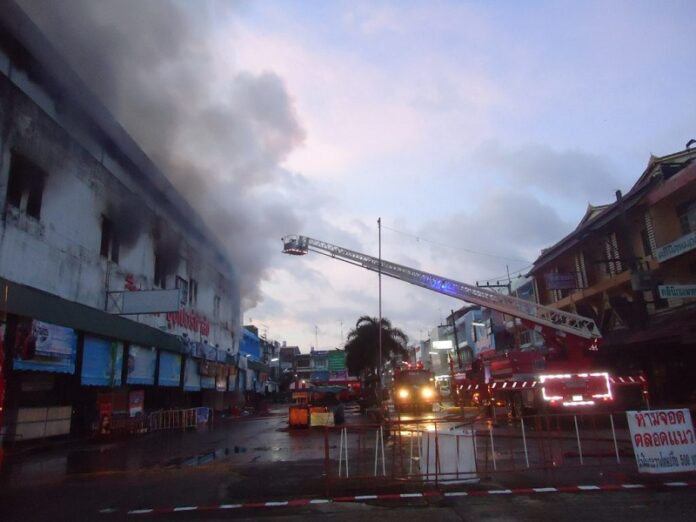
An arson fire burns at the Lee Mart Super Wholesale on Aug. 12 in Trang province. No one was hurt but it caused damage estimated at over 100 million baht. Photo: Matichon

PATTANI — One of five suspects sought in connection with last month’s attacks was reportedly being held Monday by the military in the Deep South.

Pattani resident Abdulkadir Saleah (transcribed from Thai) was arrested Saturday for allegedly firebombing the Lee Mart Super Wholesale Building in Trang province on Aug. 12.

He was taken to the Ingkhayuttha Borihan military base in Pattani province, said provincial police commander Daoloi Muandet. Under a special order issued by junta chairman Prayuth Chan-ocha, the military can detain suspects in national security cases up to seven days for interrogation before handing them over to police.

A warrant for the 33-year-old suspect’s arrest was issued Friday on arson and explosives-related charges.

No one was injured when fire struck the three-story wholesale outlet at about 3am on Aug. 12. The damage was estimated to be more than a 100 million baht. It was one in a spree of bomb and arson attacks across the southern region which killed four people.

Assistant national police chief Lt. Gen. Suchart Theerasawat told INN another suspect was taken into custody along with Abdulkadir.

Five arrest warrants have been issued for suspects, who are all believed active in the southern insurgency.

Abdulkadir is the only one known to have been arrested so far.

Advertisement

Spotlight on Laos Ahead of Key ASEAN Summit

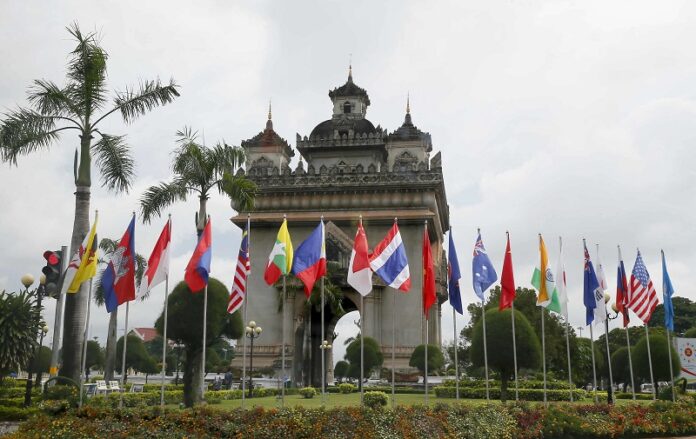
Flags of the 10-member ASEAN (Association of Southeast Asian Nations) and its dialogue partners are placed around the Patuxay Monument in downtown Vientiane, Laos on Monday. Photo: Bullit Marquez / Associated Press

VIENTIANE — The light was fading over Vientiane on a cool December evening when a Jeep was stopped at a traffic light. CCTV video later showed the occupant of the car being pulled out and taken away in a pickup truck, never to be seen again.

The disappearance of Sombath Somphone nearly four years ago is a reminder of the dismal human rights record of the authoritarian government of Laos, which prepares to host President Barack Obama and Asian leaders at a regional summit starting Tuesday.

The government says it is investigating but has provided no leads into Sombath’s whereabouts, and no arrests have been made, leading critics of Laos’ communist government to believe that his disappearance was state-orchestrated.

“It’s a test case for Obama. If he mentions it publicly it would make it much more difficult for Laos to sweep it under the carpet. The fact that the most powerful man on the planet cares about Sombath will count for something,” said Phil Robertson, the deputy Asia director of Human Rights Watch.

The three-day summit of the Association of Southeast Asian Nations is a rare opportunity to put the spotlight on the landlocked nation of Laos, which usually stays under the radar. Along with Brunei, it is the most under reported and under-scrutinized country in the 10-nation ASEAN.

Unlike fellow communist country Vietnam, the country of 6.2 million people is no economic beehive of activity. Nor does it have a democracy icon like Aung San Suu Kyi in Myanmar. Tourism, which has made Thailand a household name around the world, remains nascent; and it is not a U.S. ally like the Philippines, Singapore or Malaysia. Nor is it the world’s biggest Muslim nation by population like Indonesia to give it prominence.

Little wonder then that what goes on in Laos, largely stays in Laos.

But by virtue of taking on the rotating chairmanship of ASEAN this year, it has suddenly sprung into limelight. It’s the first time a U.S. president will visit Laos.

Sombath’s disappearance on Dec. 15, 2012, was captured on a traffic CCTV video, in which he is seen stopped at a police outpost and asked to step out of his Jeep, according to Amnesty International. Within a few minutes a man on a motorcycle arrives, drives away Sombath’s vehicle and a pickup truck takes Sombath away with armed people riding a motorcycle leading the way. The passenger on the motorcycle fires a gunshot in the air, said Amnesty.

“More than three years have passed since Sombath Somphone was last seen. We have no alternative but to conclude that the authorities are either directly responsible for his disappearance, or have failed miserably to take all necessary measures to get to the bottom of what happened,” said Rafendi Djamin, Amnesty International’s director for South East Asia and the Pacific.

Sombath’s wife, Shui Meng Ng, was driving her car ahead of Sombath. She thought she had lost him in the traffic and didn’t see the drama happening behind her.

“I am sorry to say I have no new information to share, except that the Lao Government has continued to stonewall any queries to his whereabouts. The government continues to maintain that ‘the state is not involved and the police are still investigating,'” said Ng, a Singaporean and a former U.N. official.

If Sombath was taken away by the government he was an unlikely target. The U.S.-educated activist mostly worked in rural development, showing farmers how to use more creative ways to raise fish and make handicrafts. But he was also vocal about land deals that had left thousands of villagers homeless without compensation, sparking rare political protests. And he had international connections.

Sombath is not the only one to be a possible victim of a government crackdown.

In 2015, an ethnic Lao who is a Polish citizen disappeared while visiting Laos, according to his Polish wife, allegedly for posting critical comments on Facebook. He was subsequently charged in court and sentenced to prison for 4 years and 9 months.

In March this year, three young Lao migrant workers who returned to Laos to renew their passports vanished, and reappeared on state TV in prison uniform to “confess” to using the internet to “defame the government.” They have not been charged and their parents have not been allowed to visit them. Another dissident, Ka Yang, who had fled to Thailand was deported to Laos in 2011 and was imprisoned.

Most Laotians are unaware of such events because of the government’s watertight control over the media, the security forces and the judiciary. Those who know are too fearful to talk about it.

“Laos has now become one of the most rights-repressing countries in ASEAN: leaders in the region and from around the world must stop looking the other way, and demand Vientiane end its asphyxiation of independent civil society,” said Walden Bello, a former member of the Philippines Congress and vice chair of ASEAN Parliamentarians for Human Rights.

Most of Laos’ top leaders are from the first generation of revolutionary fighters, and even those who have retired retain influence over the Communist Party and the government. But the leadership is passing on to a younger generation slowly, as seen in the party congress held this year.

While the top two posts – party secretary and president – are held by an old guard, former Gen. Bounhyang Vorachit, the cabinet has many young ministers, including Prime Minister Thongloune Sisoulith, the second-highest ranking person in the Politburo.

There is hope that this transition will lead to change in Laos. Thongloune has acknowledged corruption in the government and has taken action to halt timber and illegal wildlife trade. Still, many problems remain, such as environmental degradation, forced evictions and illegal land concessions.

Also, Laos wants to improve its economy and the life of its people by attracting more foreign investments, especially from its ASEAN neighbors. It also wants to forge closer ties to the U.S. as a counterbalance to China, which has a massive economic influence here.

“I believe that the ASEAN Summit provides some opportunities for world leaders like President Obama … to engage the Lao,” said Ng. “Such dialogue … may not lead to any immediate change but they can at least remind the Lao that improving its human rights record and relaxing control on civil society will in fact lead to real dividends for improved economic and social development in the long run.”

Story: Vijay Joshi

Advertisement

Hot News

LATEST NEWS

Bangkok
overcast clouds
32.8 ° C
36.6 °
32.7 °
68 %
3.3kmh
100 %
Sat
37 °
Sun
36 °
Mon
35 °
Tue
34 °
Wed
33 °