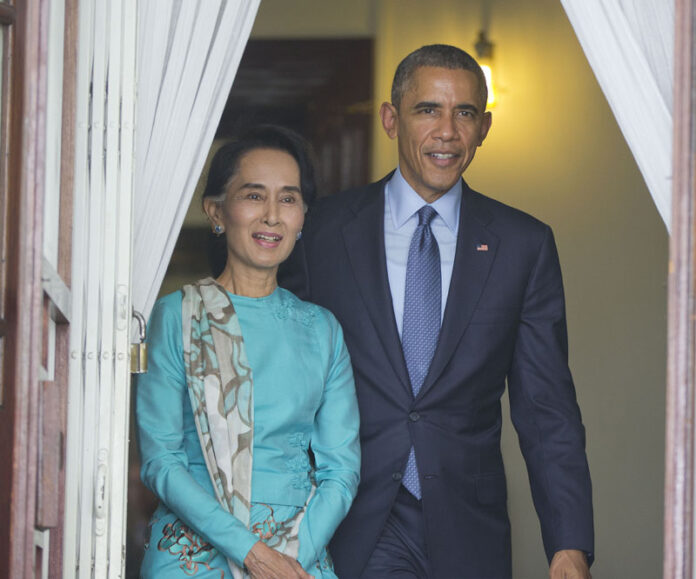
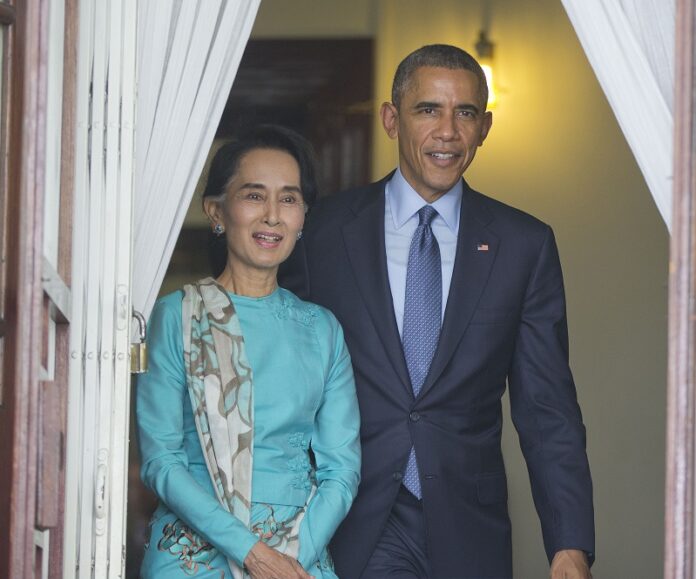
US President Barack Obama, walks with Myanmar's Aung San Suu Kyi at her home before the start of a joint news conference on Nov. 14, 2014, in Yangon. Photo: Pablo Martinez Monsivais / Associated Press
WASHINGTON — President Barack Obama said Wednesday the U.S. is lifting economic sanctions and restoring trade benefits to former pariah state Myanmar as he met with Aung San Suu Kyi, a former political prisoner who is now the nation’s de facto leader.
Obama hailed a “remarkable” transformation in the country also known as Burma, which spent five decades under oppressive military rule. Suu Kyi’s party swept historic elections last November, and the visit by the 71-year-old Nobel Peace Prize laureate, deeply respected in Washington, is a crowning occasion in the Obama administration’s support forMyanmar’s shift to democracy, which the administration views as a major foreign policy achievement.
The U.S. has eased broad economic sanctions since political reforms began five years ago and Obama has visited the country twice. But the U.S. has retained more targeted restrictions on military-owned companies and officials and associates of the former ruling junta. U.S. companies and banks have remained leery of involvement in one of Asia’s last untapped markets.
“The United States is now prepared to lift sanctions that we have imposed on Burma for quite some time,” Obama said as he sat alongside Suu Kyi in the Oval Office. He said it was “the right thing to do” to ensure Myanmar benefits from its transition. Asked by a reporter when sanctions would be lifted, Obama said “soon.”
Suu Kyi concurred it was time to remove all the sanctions that had hurt the economy. She urged Americans to come to the country and “to make profits.”
Congressional aides said that Suu Kyi requested the removal of the national emergency with respect to Myanmar — the executive order authorizing sanctions that has been renewed annually by U.S. presidents for two decades.
The Treasury Department said that Obama’s decision will be legally effective when he issues a new executive order to terminate the emergency. A U.S. official said that 111 Myanmar individuals and companies will be dropped from a Treasury blacklist and restrictions will be lifted on new investment with military and on the imports of rubies and jade. But penalties intended to block the drug trade and to bar military trade with North Korea would still apply, as would a visa ban barring some former and current members of the military from traveling to the U.S.
The official and aides spoke on condition of anonymity as they were not authorized to discuss the matter publicly.
The U.S. Chamber of Commerce hailed the announcement as “historic.” But human rights groups say there are powerful reasons for retaining sanctions. Military abuses continue in ethnic minority regions. Rohingya Muslims remain displaced by sectarian violence and denied citizenship. The military and its associates still have huge stakes in the economy.
“Obama and Suu Kyi just took important tools out of their collective tool kit for dealing with the Burmese military, and threw them into the garbage,” said John Sifton, deputy Washington director for Human Rights Watch.
Transparency watchdog Global Witness says Myanmar’s jade industry, based in a northern region plagued by civil conflict, is dominated by a military elite, U.S.-sanctioned drug lords and crony companies. It estimates the industry is worth nearly half of the nation’s economic output.
Suu Kyi addressed problems in western Rakhine state, where more than 100,000 Rohingyas remain stuck in camps, separated from Buddhists who are the majority in Myanmar. She said everyone entitled to citizenship in Myanmar should get it.
“We are sincere in trying to bring together the different communities,” Suu Kyi said.
The White House also notified Congress on Wednesday it would be reinstating in November trade benefits to Myanmarbecause of its progress on workers’ rights. The benefits were suspended in 1989, a year after the bloody crackdown on democracy protesters by the military.
Suu Kyi last visited Washington in 2012 when she was still opposition leader. On that occasion, she was presented with the Congressional Gold Medal, the legislature’s highest civilian honor, which she had been awarded in 2008 while under house arrest.
Now she is de facto leader of the country with the title of state counsellor although a junta-era constitution still enshrines the military’s role in politics and bars her from the presidency.
White House spokesman Josh Earnest pushed back on the notion the U.S. was undercutting its leverage over Myanmar on human rights and constitutional reforms by lifting sanctions. He said greater U.S. engagement would promote its ability to promote change.
Naruedee Jodsanthia, 17, seen before and after she suffered nerve damage caused by a teacher at her school. Original images: Zaii Naruedee / Facebook
KORAT — “I will get my smile back one day,” Naruedee Chotsanthia, a 17-year-old student in Korat, wrote recently in her Facebook bio.
The Matthayom 5 student used to smile. Now, because of damage to her facial nerves that left her face half-paralyzed, she can only manage a grimace. Her left eye cannot fully close, and the left side of her mouth doesn’t move with the right.
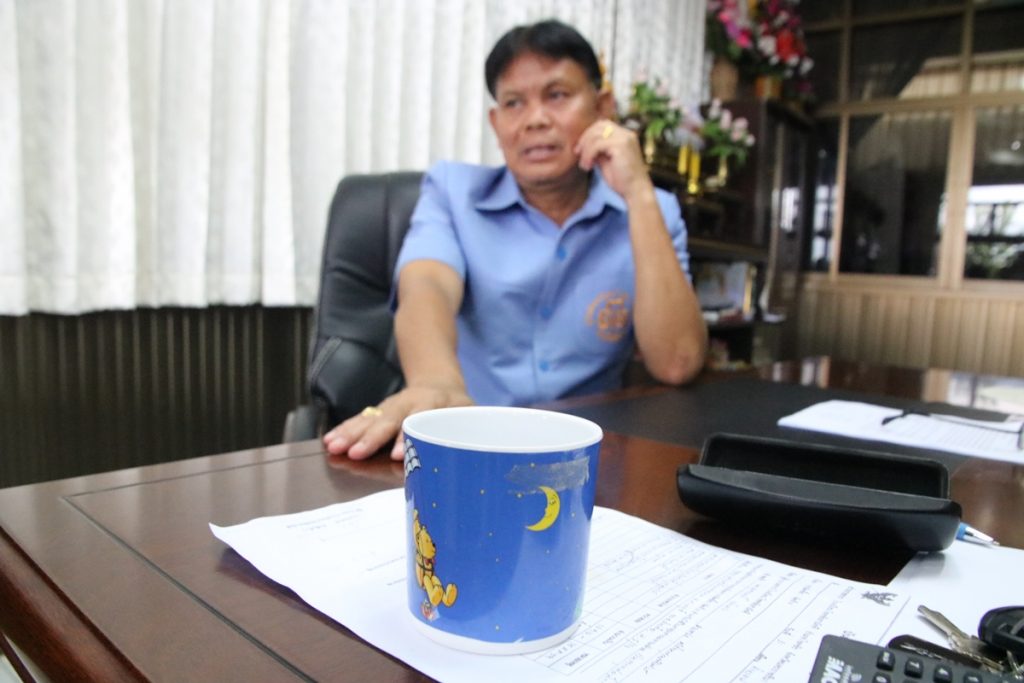
Naruedee’s disfigurement happened the moment a coffee mug thrown by her PE teacher struck her in the head at Chokechaisamakkhee School last month.
“Doctors told us that if she had arrived there a bit later, it would have been permanent,” Naruedee’s aunt, Matchima Supaeng, said Wednesday. “But doctors said it’s still a severe injury. It was rather grave. It’s been a month now, but she hasn’t gotten better.”
The latest example of casual brutality in Thailand’s schools wouldn’t have come to light had the family, which is asking for compensation, not gone public with what happened.
The school has demurred, offering to pay a small portion of her expensive medical bills, saying the teacher didn’t intend for the mug to hit her.
That teacher, 58-year-old Paithoon Klaengkrathok, is now under investigation for the Aug. 8 assault by the local education board.
“I have instructed them to report the conclusion of the investigation within seven days,” said Chookiat Wisetsena, director of District 31 Matthayom Suksa Office in Nakhon Ratchasima province.
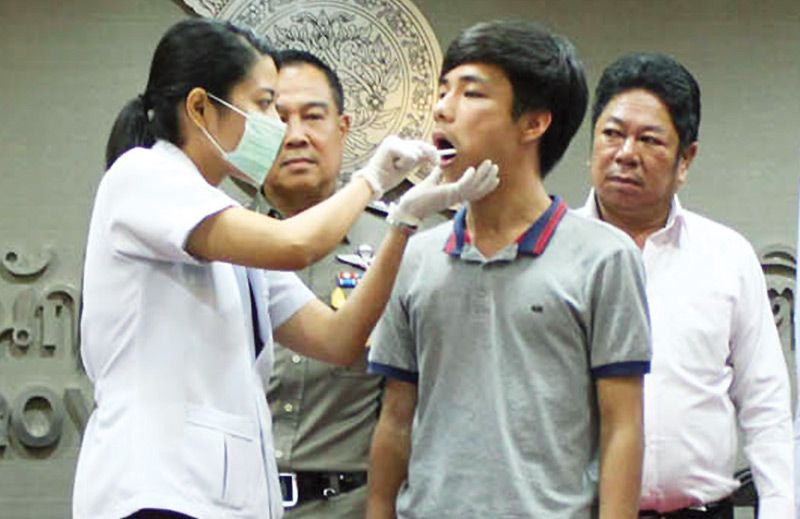
The school said Paithoon threw the mug because he was irritated by their loud behavior. Naruedee said the cup hit her face, after which she couldn’t move the left side of her visage. Doctors determined that a pair of nerves were damaged, she said.
Naruedee posted the story about her injury on social media earlier this week, drawing widespread attention. Her aunt said Naruedee waited a month because she thought the school would pay for her medical expenses and she didn’t want to cause a stir. She changed her mind when the school balked at paying.
School administration on Tuesday shows reporters the coffee mug thrown by Paithoon Klaengkrathok.
“Doctors said they needed to operate on her. They estimate it will be at least 300,000 baht. So we demanded money from the school,” Matichima said.
The school, she said, pleaded a lack of resources and offered to pay 80,000 baht.
She said her family and the state-owned school are negotiating. Naruedee has also filed a charge of assault against Paithoon.
In an interview with reporters Tuesday, school director Nipon Pakdeekaew said Paithoon merely wanted to discipline his students, who were getting rowdy in lines outside the teacher’s office, and he didn’t mean to score a direct hit with his coffee mug.
“After the incident, the PE teacher admitted that it was his fault, but he didn’t intend to hit the student,” Nipon said.
Paithoon has been suspended from teaching duties until investigation is concluded, Samak added.
Naruedee tries to go to school as often as she can, juggling her time between hospital and the police station, according to her aunt Matchima. She has exams next week.
“I’m worried for her,” Matchima said.
Physical and violent punishment in the name of discipline are commonplace in public schools and considered acceptable by many segments of society. In February, a Bangkok school teacher was disciplined for slapping schoolgirls, while a teacher in Mae Hong Son reportedly sawed off a 4-year-old boy’s ear in 2014.
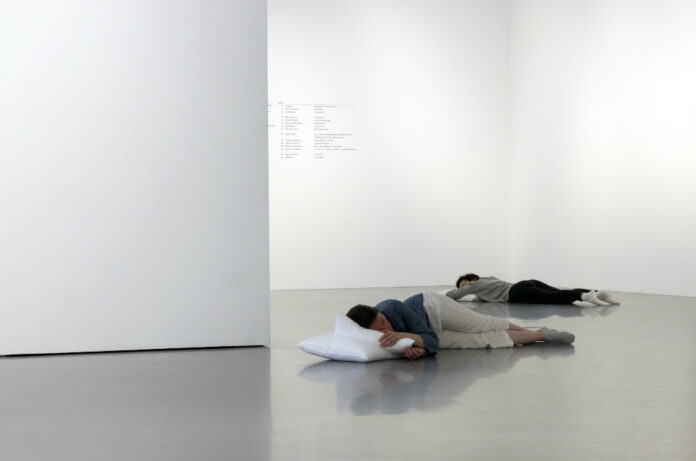
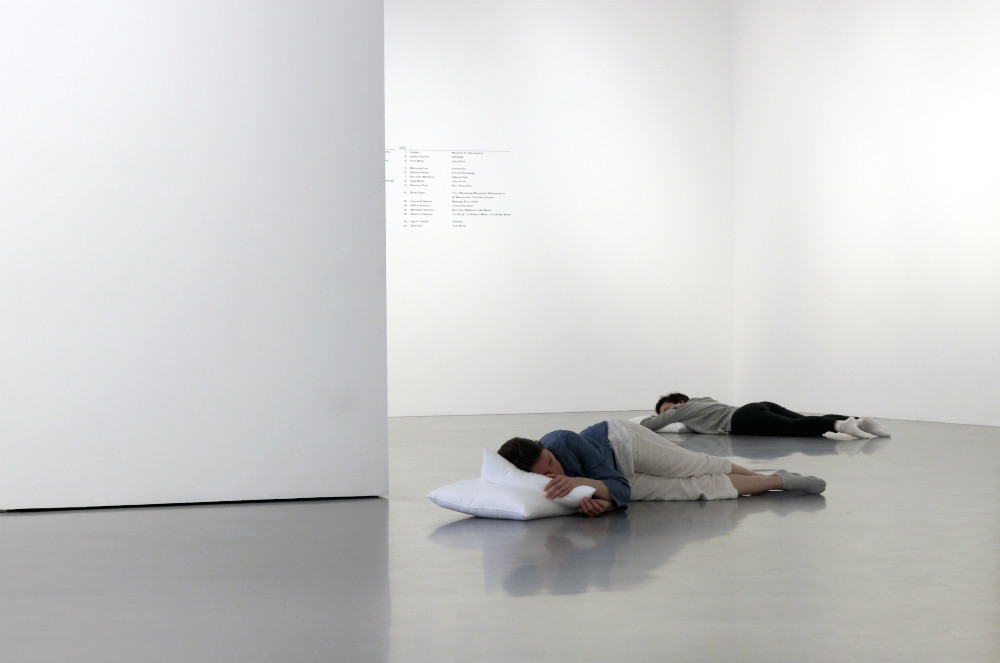
‘Sleep’ performance at Nahmad Project art space in London. Photo: Maria Katsika / Courtesy.
BANGKOK — Walking through the Bangkok Art and Cultural Centre this Friday, don’t be shocked to see people sleeping there – and don’t be shy to join them.
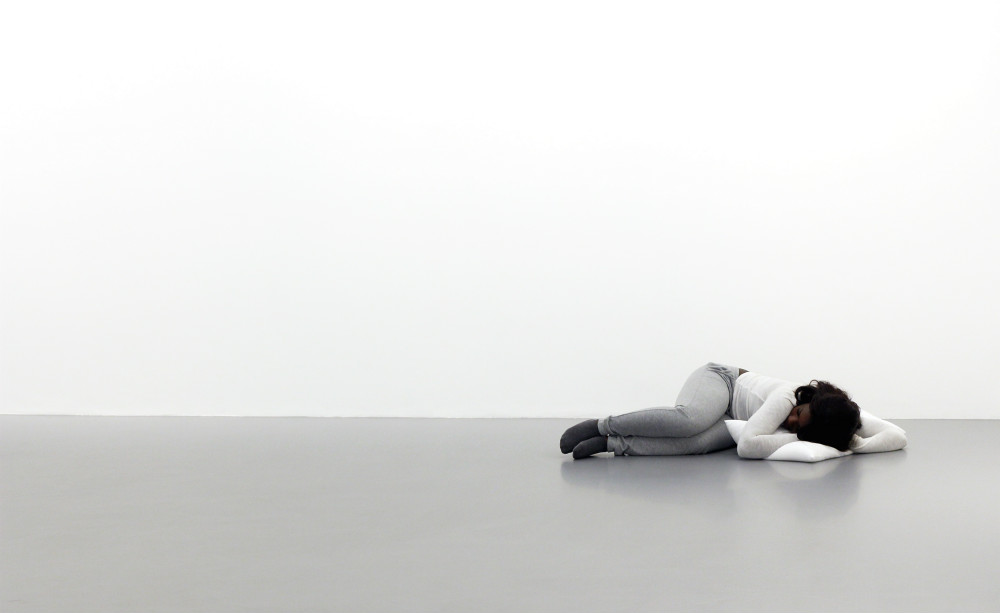
What may look like victims of some future economic collapse are actually participating in making a high-concept statement on our changing urban life rhythms.
“Conceptually this performance is a comment on the phenomenon of napping in public spaces in big cities,” London-based artist Anna Fafaliou said by email.
She said it’s commentary on changing lifestyles, especially in big capitals where people sleep less to work more, and the increase in public napping on the train or in the coffee shop as their bodies tell them “get some rest now.”
To explore what happens to the body and how people’s energy could be shared during sleep, the artist came up with the art project “Sleep.” Since launching earlier this year in London, the exhibition has a snooze-date in Bangkok on Friday.
Fafaliou, who’s doing a residency at HOF Art Bangkok this month, plans to take the show on the road elsewhere to observe different responses from different cultures.
She will nap solo, while the audience can participate by having their own nap time, or just observe the choreography of sleep from the sidelines.
“I’m part of the performance, so I can’t really stare or observe the audience. But I’m lying on the floor with them, and their energy in this shared moment of tranquility is really incredible. You can feel the tension, the hesitation and the complete looseness. It’s been a great experience so far,” Fafaliou wrote.
Beginning her art career in 2015, Fafaliou has produced 11 performances and installation pieces that deal with human existence and behavior in relation to environment, with consumerism and capitalism as the central focus.
Feel free to join the performance from 12pm to 6pm on Sept. 16, at the L floor next to the library at Bangkok Art and Cultural Centre which can be reached via skywalk of BTS National Stadium Station.
Pillows will be provided.
1 of 4
‘Sleep’ performance at Nahmad Project art space in London. Photo: Maria Katsika / Courtesy.
‘Sleep’ performance at Nahmad Project art space in London. Photo: Maria Katsika / Courtesy.
‘Sleep’ performance at Nahmad Project art space in London. Photo: Benedict Johnson / Courtesy.
‘Sleep’ performance at Nahmad Project art space in London. Photo: Maria Katsika / Courtesy.
A delicious mooncake photographed in 2015. It may be less delicious now. Phtoo: Tseen Khoo / Flickr
BEIJING — Four employees at Chinese internet giant Alibaba have lost their jobs after being accused of reprogramming an internal system to steal more than 100 boxes of mooncakes, a traditional delicacy shared during this week’s Mid-Autumn Festival.
State media reported Wednesday that Alibaba had offered a discount to employees for buying the circular treats, given during the festival that begins Thursday.
They said the fired employees exploited loopholes in the software to obtain more than the allotted amount and pilfered a total of 124 boxes of cakes.
An Alibaba statement said the firings were “unfortunate, but we wish them a better future.” The employees were not identified.
Alibaba is the world’s largest e-commerce platform. Its initial public offering in 2014 was the largest in the New York Stock Exchange’s history.
U.S. President Barack Obama, right, walks out with Myanmar's Aung San Suu Kyi at her home before the start of their joint news conference in 2016 in Yangon, Myanmar. Photo: Pablo Martinez Monsivais / Associated Press
WASHINGTON — Aung San Suu Kyi’s latest visit to Washington signals her transformation from long-imprisoned heroine of Myanmar’s democracy struggle to a national leader focused on economic growth.
President Barack Obama will meet with Suu Kyi at the White House on Wednesday to discuss rolling back more of the sanctions that were applied when the nation was under military rule. Suu Kyi will also be courting the American business community at a dinner where tables go for as much as $25,000.
Suu Kyi’s party swept historic elections last November, and the visit by the 71-year old Nobel peace laureate, deeply respected in Washington, is a crowning occasion in the administration’s support for Myanmar’s shift from pariah state to democracy, which it views as a major foreign policy achievement.
The U.S. has eased economic sanctions on the country also known as Burma since political reforms began five years ago but it still restricts dealings with military-owned companies and dozens of officials and associates of the former ruling junta. U.S. companies and banks remain leery of involvement in one of Asia’s last untapped markets.
Human rights groups, however, say there are powerful reasons for retaining sanctions. Military abuses continue in ethnic minority regions. Rohingya Muslims remain displaced by sectarian violence and denied citizenship.
Deputy National Security Adviser Ben Rhodes said the U.S. wants to balance concerns about the “outsized” role of the military in politics and the economy without impeding growth and offering a “democratic dividend” for an impoverished population.
“We hear frequently that the ongoing sanctions regime serves as a chill on investment from the United States and in some cases from other international firms, and so we want to make sure that our sanctions are not preventing the type of economic development and investment that we believe can improve the livelihoods of the people of Burma,” Rhodes said Tuesday, adding that the administration’s decisions would be guided by consultation with Suu Kyi and her government.
Suu Kyi, who will also be meeting with lawmakers, Vice President Joe Biden and Secretary of State John Kerry, last visited Washington in 2012 when she was still opposition leader. On that occasion, she was presented with the Congressional Gold Medal, the legislature’s highest civilian honor, which she had been awarded in 2008 while under house arrest.
Now she meets Obama as the de facto leader of the country with the title of state counsellor although a junta-era constitution still enshrines the military’s role in politics and bars her from the presidency. When Obama last visited Myanmarin November 2014, he voiced support for constitutional reform.
Suu Kyi’s stance on sanctions is unclear. When she met Kerry in Myanmar in May, Suu Kyi said that the U.S. was keeping sanctions not to hurt but to “help us,” and that if the country was on the right path, sanctions should be lifted “in good time.”
Her government is believed to support extension of U.S. duty-free benefits to help spur still meager trade with the U.S. Two-way goods trade with Myanmar totaled just $227 million in 2015, and U.S. companies account for less than 1 percent of total foreign investment.
Suu Kyi will speak on her government’s priorities at a dinner Thursday organized by U.S. Chamber of Commerce and the U.S.-ASEAN Business Council – a group that supports American business ties with Southeast Asia. The council offered companies the chance to book a table for eight and a seat at an off-the-record round-table with Suu Kyi for $25,000.
That event perhaps typifies the widening gulf between Suu Kyi and rights activists who championed her cause when she was under house arrest.
“With the democracy icon having won a popular mandate to govern and often taking the sole lead in shaping the civilian government’s policies, a number of civil society leaders feel excluded, ironically as the country moves toward greater democracy,” the Center for Strategic and International Studies think tank said in a report this week.
Rights activists are speaking out in support of keeping sanctions. Global Witness said Tuesday that U.S. industry lobbying to roll back sanctions before critical reforms have kicked in risks undoing the country’s fragile progress to democracy. Last year, the transparency watchdog reported that Myanmar’s jade industry is worth nearly half of the nation’s economic output and remains firmly in the grip of military elite, U.S.-sanctioned drug lords and crony companies.
U.S. sanctions currently bar the import of jade and gemstones from Myanmar.
Suu Kyi enjoys deep respect among U.S. lawmakers who were instrumental in the imposition of sanctions in the first place and they will likely follow her lead on whether they should be lifted. Lawmakers engaged on Myanmar policy are deeply suspicious about opening up engagement between the U.S. and Myanmar militaries.
“I certainly believe it would be premature to get rid of all the sanctions at this point,” said Democratic Rep. Joe Crowley of New York, a prominent voice on the issue in Congress. “I have very strong reservations about military-to-military cooperation.”
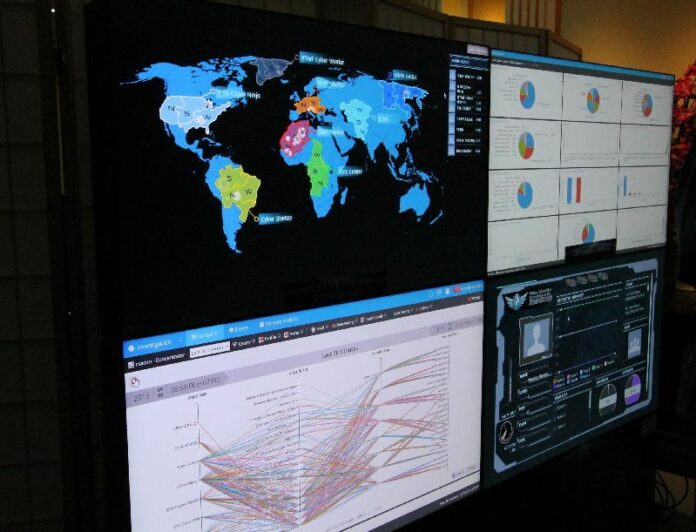
A display panel at the Royal Thai Army's cyber unit taken Sept. 9, 2015. Photo: WeLoveRTA.org
Amendments to the criminal code removing judicial oversight of wiretapping combined with new laws on cybercrime, cyber security and even the digital economy all suggest the Good People running the country can no longer distinguish between internal security and external threats.
These laws, as written, may well criminalize satire such as internet memes and have other far-ranging repercussions for free speech and privacy. Proponents argue these new powers would only be used against enemies of the state and are necessary given how much of our lives are now online. Many others shudder at the thought, as the line between the state and those running it increasingly blur.
A government overhaul of the criminal code would allow police to intercept phone calls and computer communication without a court order. The interim cabinet secretly approved these amendments on Aug. 9, according to the Thai Netizen Network.
The reason, ostensibly, is that with more and more of society’s business conducted online, the old framework of communication intercepts led by the Ministry of Justice’s Department of Special Investigations, or DSI, is no longer workable. Computer crime is no longer novel or special. DSI investigators have their hands full – the logic goes – and police are powerless when it comes to intercepting digital communications and gathering evidence.
Because the courts take time to approve these intercept warrants, digital data must be gathered quickly before it is deleted; therefore, the new law eliminates judicial oversight, leaving us with a police force that can intercept our communications at the discretion of its officers – all in the name of efficient justice.
This is the alarming state of things as laid out by Thai Netizen Network’s Arthit Suriyawongkul on the sidelines of a Sept. 8 NBTC public forum oddly described as “stealing money via the mobile.”
Wrong Solutions to the Right Problems?
The forum itself was largely a non-event. It stemmed from a high-profile case last month in which someone lost his life savings of 1 million baht after a cyber-criminal used a bogus ID to get a replacement of the victim’s SIM card issued, which he then used to reset his e-banking passwords and clean out his account.
Thailand has suddenly discovered that phishing happens and real money is lost. Welcome, however belatedly, to the 21st century. In the end, Kasikorn bank refunded the million baht and TrueMove gave the victim a free iPhone 6+ with a year’s free service thrown in.
NBTC commissioner Prawit Leesathornwongsa cynically suggested KBank and True quickly settled the case because the government could not afford bad publicity while rolling out PromptPay, its new national e-payment system. But the PromptPay omnishambles is a story for another time.
It was on the sidelines of the NBTC event that Arthit, a champion for online rights, shared his concerns about the government’s new cyber security laws.
Topping his anxieties is the current revision of the Computer Crime Act, namely its revised Section 16. It would criminalize mere possession of images that are defamatory without even dissemination or, as the law likes to phrase it, “entering into a computer system.”
Section 16. Any person who imports into a publicly accessible computer system of computer data including images of other persons whether or not the images have been created doctored, amended or adapted by electronics means or whatsoever means and by doing so is likely to impair the reputation of such other person or to expose such other person to hatred or contempt shall be subject to imprisonment not exceeding three years and a fine not exceeding 200,000 baht or both.
Section 16/2. Any person who is aware that electronic data in one’s possession is the data ordered for seizure and destruction as to section 16/1, the person is obliged to destroy such data. Any violation shall result in the person having to serve half of the penalty as provided for by the law in Section 16.
Source: Unofficial translation of draft amendment
Yes, when this law is promulgated, merely possessing an image that is defamatory could land you in jail for 18 months.
Arthit said he had asked the MICT subcommittee about this and the reply was chilling: If you do not have any bad intentions, that’s fine. You will have your day in court and you will be cleared.
Since when did Thailand adopt the guilty-until-proven-innocent school of jurisprudence?
Being overseas or even being a foreigner overseas does not help either, as the new 17(2) says computer “misuse” crimes are an extraditable offense. One can imagine many a foreign judge laughing when the extradition requests start flying.
Worse still, the National Legislative Assembly is trying to extend Section 16(2) to cover Section 14. Section 16 is for images, while 14 applies to any information deemed untrue or defamatory. The punishment is incarceration for up to five years.
“So if I grab your phone and write 1+1=3 on it, you can be charged under the new, extended [Computer Crime Act] Section 16(2) if it goes through, couldn’t you?” I asked Arthit.
He laughed and called me silly. Then he paused to consider what he’d just said about presumption of guilt.
Officer SpyWare
The other issue is the ongoing secret amendment of the criminal code to allow police to order so-called lawful intercepts without court oversight.
Arthit said that the cabinet approved the new criminal code on Aug. 9, but that it was kept out of any public documents and did not appear in the official cabinet meeting reports.
“How can we even talk about or oppose a law when it’s kept secret?” he asked.
Arthit explained that the current DSI act requiring a judge’s approval strikes the right balance between investigatory needs and a reasonable desire that other methods have been exhausted first. None of this, he alleges, is present in the new criminal code for police interception.
Arthit said that in light of cybercrime developments, he’s not entirely opposed to expanding police powers, “but there needs to be checks and balances.”
He shared his fear that internal cyber security is increasingly being mixed up with external cyber defense. Granted, in a connected world the lines are blurring. But the lines must remain for good reason.
Bill Adama
As Commander William Adama said in the cult sci-fi series Battlestar Galactica:
“There’s a reason you separate military and the police. One fights the enemies of the state, the other serves and protects the people. When the military becomes both, then the enemies of the state tend to become the people.”
The Good People running the country seem to be conflating national security and internal security with these legal amendments, perhaps without malice. Maybe that’s just how they were brought up.
Applying a totalitarian military mindset to internal security may indeed be efficient, but is it the path Thailand truly aspires to take? Are we really so happy with the absence of conflict that we are willing to turn a blind eye while the seeds of guilty-until-proven-innocent totalitarianism take root? Sadly it seems we are.
A memorial for David Miller, 24, and Hannah Witheridge, 23, as seen on Koh Tao on Sept.18, 2014.
BANGKOK — One night, two years ago tomorrow, Zaw Lin and his friend Wai Phyo were playing guitar and drinking beer on a beach. Today they are locked up in Thailand’s most notorious prison for a crime they say they didn’t commit.
“I miss home. Too much. Sometimes I [go] crazy,” Zaw Lin, 22, said Monday during visiting hours at Bang Kwang Central Prison on Monday. “If I killed anyone, I stay here. Why am I here? I think about that all the time.”
Two years ago, Woraphan Toovichien said, his family was respected and well-liked on Koh Tao, but that changed after many on social media accused his relatives of being responsible for killing two British backpackers on the island and covering up the murders.
“People already judged my family as guilty. My family has suffered so much … my family is in ruins,” said Woraphan, 51, who works as a local administrator on the small, comma-shaped island about 80 kilometers off the coast of Chumphon province.
It’s been two years since David Miller and Hannah Witheridge were found dead on a beach on Koh Tao in the early morning of Sept. 15, 2014. But both sides tangled in the murders that became an international sensation said they still felt injustice; one from a deeply flawed legal system, and the other from internet witch-hunting and uncritical reporting.
On Christmas Eve 2015, Zaw Lin and Wai Phyo were convicted of killing the two Britons. They were also found guilty of raping Witheridge before she died. For their crimes, the two Burmese men were sentenced to death. They’re now held on death row at Bang Kwang Central Prison, aka the Bangkok Hilton, awaiting appeal proceedings.
Inside the Tiger
Drive toward Bang Kwang Prison from the north and the first thing to see are paint-peeled guard turrets jutting over walls topped with electrified barbed wire. Most of the prisoners here are condemned to life behind bars or death for serious offenses like premeditated murder, armed robbery and kidnapping.
Citing security concerns, the prison only allows inmate visits from close relatives and those with the same surnames. Friends are turned away. Reporters have to get permission directly from the warden to interview Zaw Lin and Wai Phyo.
Wai Phyo, at left, and Zaw Lin are paraded in front of the media on Oct. 3, 2014, shortly after their arrest on Koh Tao.
“Oh, the two Burmese scapegoats?” one of the prison guards said upon reading the visitation document.
Several more forms and stamps later, I’m led through the last of three large metal gates that separate Bang Kwang Prison from the outside world.
Speaking from behind bars and glass panels through an intercom, Zaw Lin conversed cheerfully in passable English punctuated with frequent laughter. Wai Phyo was more quiet. He’s not confident enough with his English and mostly lets his friend speak on his behalf.
During the course of a 45-minute jailhouse interview, they recounted that night two years ago, discussed life behind bars, and insisted they will not seek a royal pardon as that would mean pleading guilty to something they did not do.
Of the crime, Zaw Lin offered the same version of events presented at their trial last year.
They didn’t know anything about the murders. They had finished working at the AC bar and were playing guitar on the beach. They drank some beer. They walked home at 2am.
He said he knew about the murders on the next day when he returned to work. Fifteen days later, Zaw Lin said, police arrived at the worker housing, took him and Wai Phyo to a safehouse, and beat them until they “confessed” to killing Miller and Witheridge.
Hannah Witheridge, at left, and David Miller, second from right, pose for a photo posted to facebook just hours before their murders on Sept. 15, 2014. Photo: Facebook
“They slap me many times. Me and him, in different rooms,” Zaw Lin said, gesturing to Wai Phyo seated next to him. “They also put a bag on me. Plastic bag. I couldn’t breathe. They kick me.”
The court also ruled there was sufficient evidence that Zaw Lin and Wai Phyo raped Witheridge before killing her and Miller on that night, including security footage, DNA traces and a phone of Miller’s found in Wai Phyo’s possession.
Lawyers representing the two defendants argued the evidence was circumstantial, and that police forensic testing procedures were unreliable and poorly documented. Wai Phyo also said, through Zaw Lin, that he picked up the phone on the way back home that night without knowing it belonged to Miller.
“I am angry – at police,” Zaw Lin said.
He said he felt that police targeted him because he and Wai Phyo were Burmese workers. Civil rights activists have long accused members of Thai law enforcement of exploiting and mistreating migrant workers from poorer neighboring countries such as Myanmar and Cambodia, who have little protection under the law.
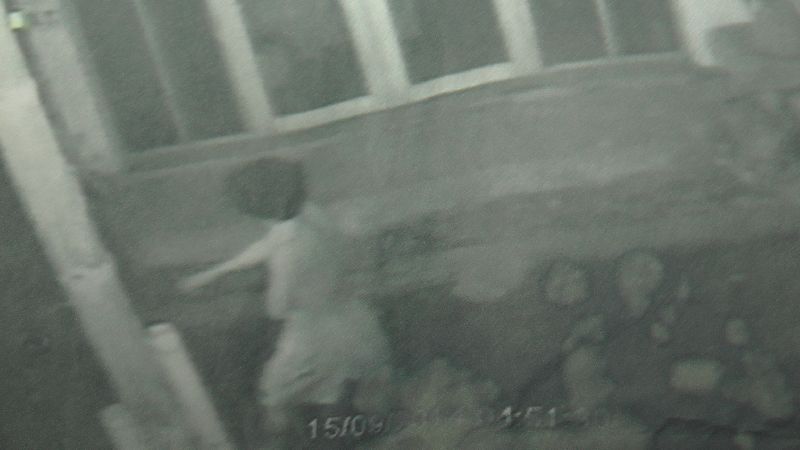
Police say this security camera image shows Wai Phyo walking away from the beach after David Miller and Hannah Witheridge were murdered there Sept. 15, 2014.
Attorneys for Zaw Lin and Wai Phyo, who work pro bono, have already filed an appeal, but no court date has been set yet. Zaw Lin said he was recently told by his lawyers that the trial may convene in 2017.
Tainted by Suspicion
In the aftermath of the Sept. 15, 2014, murders, the Toovichien family quickly became prime suspects – not of the police, but of amateur keyboard sleuths.
There were grounds for suspicion: Witheridge and Miller were last seen at AC Bar, which was owned by Montriwat Toovichien, a brother of village chief Woraphan. A Scotsman who worked as a busker on the island also posted on social media that he was threatened by Montriwat into fleeing Koh Tao.
Led by Facebook group CSI LA, online attention soon turned to Woraphan’s son: Warot, aka Nom Sod, a student at Bangkok University. The page accused Warot, then 22, of murdering the two Britons before fleeing to Bangkok, leaving his family in charge of the cover-up.
Woraphan said the allegations were baseless. DNA tests later established that Warot didn’t kill the two victims, and CCTV footage indicated he was in Bangkok at the time of the killings, but that didn’t stop people from labeling his son a murderer to this day, Woraphan said.
“How many people believed it, and how many people bothered to correct the news and defend him?” Woraphan said. “He was just living his life. Then some people accused him of trumped up charges. This is not how things should be. Imagine if you have a son, you will understand my pain.”
A forensic police officer tests Warot Toovichien for DNA on Oct. 30, 2014, while his father Woraphan Toovichien, at right, looks on at Royal Thai Police headquarters in Bangkok.
Woraphan took particular offense at media agencies who took up claims on social media and reported them as facts. “How many months did the media bombardment that my son was a murderer go on? And how many of those media outlets apologized? None at all, except the newspaper that I sued,” he said.
In August 2015 Khaosod settled with the Toovichiens and published an apology for a Sept. 24, 2014, headline identifying Warot as the “son of Koh Tao mafia” who “killed [two] farangs.”
Both Khaosod and Khaosod English are part of the Matichon Group.
“I think it should be a moral lesson that every media agency should exercise judgement, they should be more professional than this. Don’t just sell news. Have some ethics. Present facts,” Woraphan said.
Woraphan said he and his son try to live as normally as they can, but their lives are still tainted by the suspicion.
Death Row Optimism
Zaw Lin and Wai Phyo are now held in two separate cells on Bang Kwang’s death row. They say they are treated well and their cells are larger than at the Koh Samui jailhouse. Prison guards let them read books in their free time, Zaw Lin said.
“I no have beating. Nobody makes problem,” Zaw Lin said. “I meditate. I read books. I am now learning English, because my English is bad.” Because they didn’t speak Thai, Zaw Lin said he and Wai Phyo communicate with prison guards mostly in hand gestures.
According to Zaw Lin, even people in prison believe he and Wai Phyo are innocent. “They know I don’t killing. So they make no problem,” he said.
“I want to say ‘thank you very much’ for supporting me. They write letters every week. Some people send money to help me. I am happy,” Zaw Lin said.
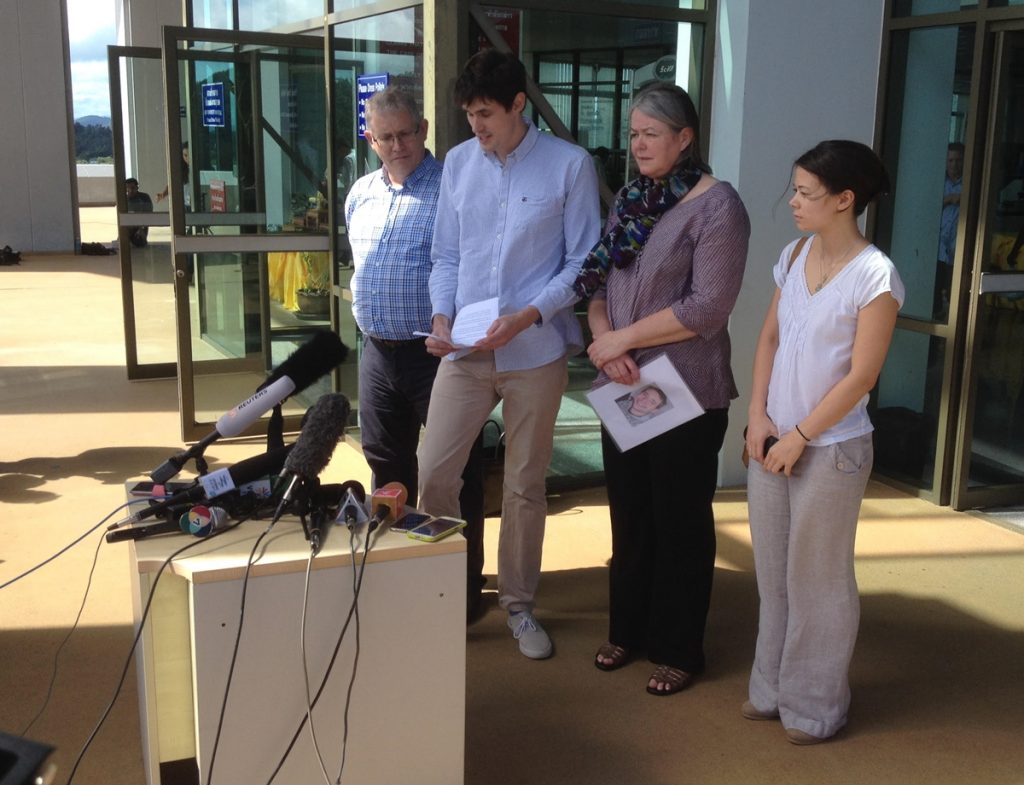
David Miller’s relatives tell reporters they accept the court’s verdict on Dec. 24, 2015, at Samui Provincial Court on Koh Samui.
Zaw Lin added that he still hopes to get out of prison one day and return to Myanmar (“I not come back to Thailand again!” he said with a laugh), but only if the court exonerates him. That’s why they won’t apply for a pardon.
“I need justice. I need truth. I will get out, with justice only,” Zaw Lin said. “I want people to know I no killing. I have the truth. I want justice.”
The court and prosecutors are still deliberating on the 200-page appeal files, so no trial date has been set yet, said Andy Hall, a migrant workers rights activist and member of the defense team.
New evidence and witnesses cannot be introduced in appeals; the proceedings will rest on re-interpretation of previous evidence. Hall said the defense team hopes to convince the new judges that police DNA testing procedures were flawed.
Update Oct. 18: The rest of the series has been canceled due to the national period of mourning for HM the Late King.
BANGKOK — Get in the mood for the season of scare with some cinematic chills by slating your bloodlust with a roster of creepy, mostly European horror films.
This week through Halloween, seven spooky films will show every Thursday at free screenings on the second floor of an art space-gallery-shophouse on Charoen Krung Road.
The mini-frightfest begins Thursday inside a British horror-film-within-a-horror film in “Berberian Sound Studio,” then survive past the end of the world in “Le Temps Du Loup” (Time of the Wolf) – it’s a ghastly place.
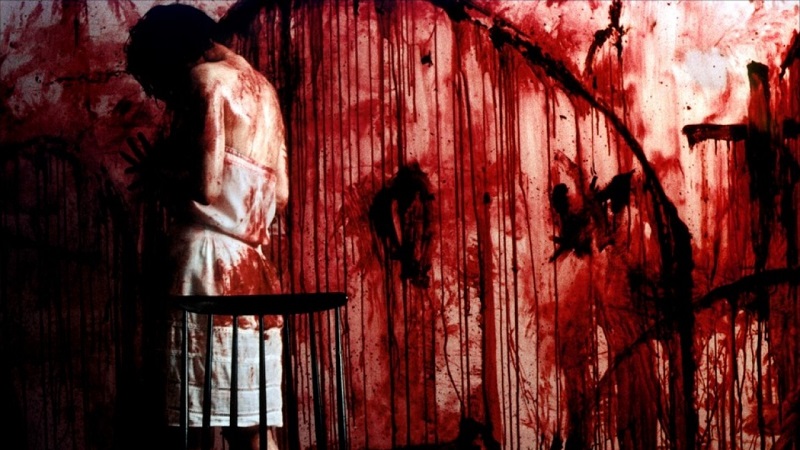
Does going on a late-September honeymoon in Paris sound good? Well you’ll regret it in “Trouble Every Day” which chronicles an increasingly creepy and blood-splattered American couple. Bonus(?): A lot of sex and biting.
Taking point in October, an ex soldier-turned-hitman (with a disturbing past!) in “Kill List.” A college student accepts a job as babysitter only to find out there is no baby in “The House of the Devil.” Before he made movies about giant robots, Mexico’s Guillermo del Toro made atmospheric creepy movies such as “The Devil’s Backbone,” which teamed him with legendary Spanish director Pedro Almodovar.
Scare Season ends Oct. 27 in the United States, home of blockbuster splatter, for “Drag Me to Hell.” After achieving Spider Man fame, director Sam Raimi returned to his “Evil Dead” horror roots in 2009 with a gonzo bloody tale of a loan officer who falls victim to a gypsy’s dark curse.
Admission is free. All shows start at 8:30pm and will show with English subtitles.
Bridge Art Space is located on Charoen Krung Soi 51. To reach the shophouse-gallery, head to BTS Saphan Taksin and walk from exit No. 4.
Toby Jones in ‘Berberian Sound Studio’ (2012)“Trouble Every Day” (2001)“The Devil’s Backbone” (2001)
Israel's President Shimon Peres speaks during an interview with The Associated Press in 2014 at his residence in Jerusalem. Photo: Dan Balilty / Associated Press
JERUSALEM — Former Israeli President Shimon Peres suffered a “major stroke” on Tuesday and experienced heavy bleeding in the brain, hospital officials said, as doctors raced to stabilize the 93-year-old Nobel laureate.
Dr. Itzik Kreiss, director of the Sheba Medical Center, told reporters outside the hospital near Tel Aviv that Peres experienced “lots of bleeding” as a result of the stroke. He said he had undergone a battery of tests, and that doctors planned to hold another assessment in a few hours.
Standing alongside Kreiss, Peres’ son Chemi said the situation was “not simple,” but that the family was trying to stay positive.
“My father is very special. I am keeping optimistic. Hoping for the best. But these hours are not easy,” he said.
He thanked the Israeli public for offering its support and prayers.
Peres’ office issued a statement early Wednesday describing his condition as “serious but stable.” It said he remained hospitalized in the intensive care unit.
Earlier, Israeli media reported the bleeding had stopped. Dr. Shlomi Matezsky, one of the doctors treating Peres, told Channel 2 TV that Peres had regained consciousness and was on a respirator.
“He is on a respirator and lightly sedated but is conducting actions, what is called in medical terms ‘simple actions’ and is not currently unconscious,” he said.
He said doctors were meeting to decide how to proceed. “The way things seem now, we don’t think surgery in the next few hours would benefit Mr. Peres’ condition,” he said.
Peres is the elder statesman of Israeli politics and the last surviving link to the country’s founding fathers.
Over a seven-decade career, he held virtually every senior political office in Israel, including three terms as prime minister and stints as foreign and finance minister. He won the 1994 Nobel Peace Prize for his work in reaching an interim peace agreement with the Palestinians.
He had remained active since completing his seven-year term as president in 2014, and even uploaded a video to his Facebook account earlier in the day.
In the video , in which Peres encourages the public to buy locally made products, he appears weary but is otherwise alert and coherent. Channel 10 TV said Peres had also delivered an hour-long lecture earlier in the day.
Earlier this year, Peres was twice hospitalized for heart problems but quickly released. His office said Peres received a pacemaker last week.
As president, a largely ceremonial office, he cultivated an image as the country’s elder statesman and became one of its most popular public figures.
He also became a fixture at international conferences like the World Economic Forum in Davos. Earlier this month, he participated in the Ambrosetti Forum in Cernobbio, Italy.
Since leaving the presidency, Peres frequently hosted public events at his peace center, bringing together Arabs and Jews in efforts to promote coexistence.
In a message posted on Facebook, Prime Minister Benjamin Netanyahu wished Peres a speedy recovery. “Shimon, we love you and the entire nation wishes you get well,” he said.
The cover to Norway's largest circulation newspaper, Aftenposten, displayed on Friday in Oslo, Norway. Photo: Cornelius Poppe / Associated Press
HELSINKI, Finland — Facebook’s chief operating officer has apologized to Norwegian Prime Minister Erna Solberg for deleting a photograph from its pages and conceded that “we don’t always get it right.”
Sheryl Sandberg said in a letter to Solberg that she’d raised important issues about Facebook’s decision to remove postings of an iconic 1972 image of a naked, screaming girl running from a napalm attack in Vietnam. On Friday, following protests in Norway the tech giant reversed its decision and allowed the photo “Terror of War” to be seen on its pages.
In a letter dated Oct. 10, Sandberg conceded that historical importance “sometimes … outweighs the importance of keeping nudity off Facebook,” after Solberg had reposted the 1972 image and other iconic photos with black boxes covering parts of the images.