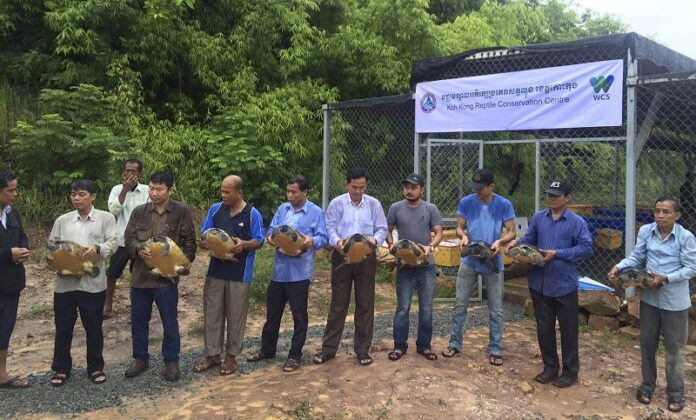
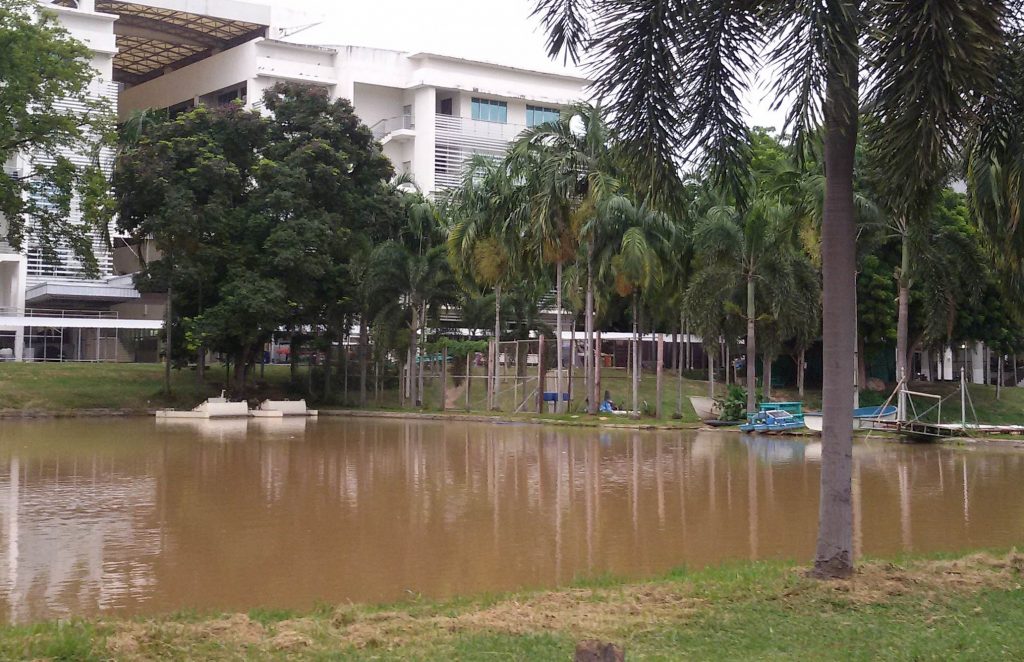
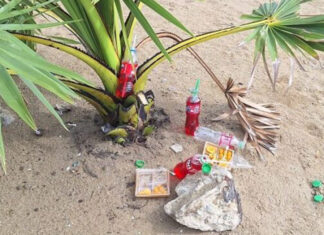
Conservationists prepare to release Royal Turtles on Tuesday at a conservation center in Mondul Seima, Koh Kong province, Cambodia. Photo: Mengey Eng / Associated Press
PHNOM PENH — Conservationists say they have transferred more than 200 of the nearly extinct Royal Turtles to a new purpose-built breeding and conservation center, easing fears the rare species will disappear in Cambodia.
“Cambodia’s national reptile is facing a high risk of extinction.”
In a statement Tuesday, the New York-based Wildlife Conservation Society said 206 Royal Turtles have been released into the facility, the Koh Kong Reptile Conservation Center, in western Cambodia.
The center is a joint effort between the government’s fisheries department and the society.
“We hope in time to have other species like Siamese crocodiles at the center, and may even develop it into a site for ecotourism to generate revenue to be used for conserving the turtles in the center,” Ross Sinclair, the society’s country director for Cambodia, said in the statement.
The Royal Turtle is one of the world’s 25 most endangered tortoises and freshwater turtles. Also known as the Southern River Terrapin, the Royal Turtle is so named because in historical times only the royal family could consume its eggs.
The species was designated as Cambodia’s national reptile in 2005.
It was believed extinct in Cambodia until 2000 when a small population was rediscovered. Since 2001, a joint project between the government and conservation society has saved 39 nests with a total of 564 eggs that resulted in 382 hatchlings. The hatchlings are raised in captivity and later released into the wild.
Eng Mengey, a society spokesman, said by telephone from Koh Kong province where the center is located that it consists of five big ponds with grass and sand banks for the resettled turtles to nest.
“With very few Royal Turtles left in the wild and many threats to their survival, Cambodia’s national reptile is facing a high risk of extinction,” said Ouk Vibol, director of Fisheries Conservation Department.
“By protecting nests and head starting the hatchlings, we are increasing the chances of survival for this important species for Cambodia,” he said.
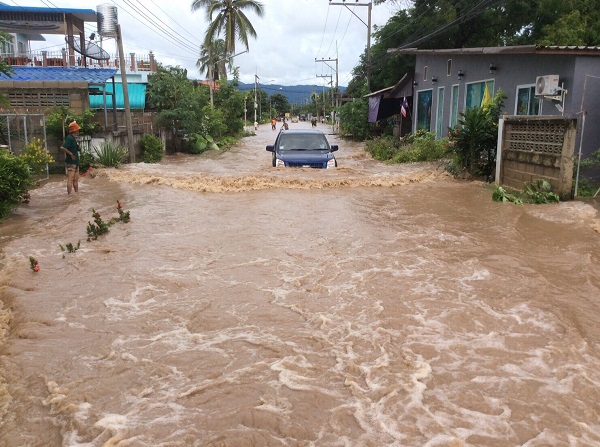
Roads flood due to the rain Tuesday in the northern province of Phayao.
BANGKOK — The daily downpour will get heavier still in Bangkok and most provinces despite the downgrade of tropical storm Rai.
Strong wind conditions and rough waters prevail in the Andaman Sea and upper Gulf of Thailand, although the Meteorological Department on Tuesday afternoon reclassified tropical storm Rai to a tropical depression, inbound from southern Laos and expected to arrive tonight.
Meteorologists expect it to weaken further as it passes over Isaan.
Bangkok was forecast to experience 80 percent rainfall Tuesday evening.
Small craft advisories are in effect on both coasts.
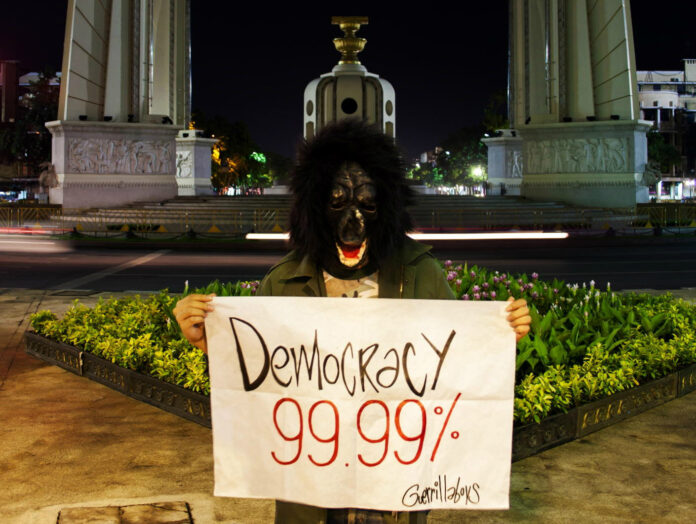
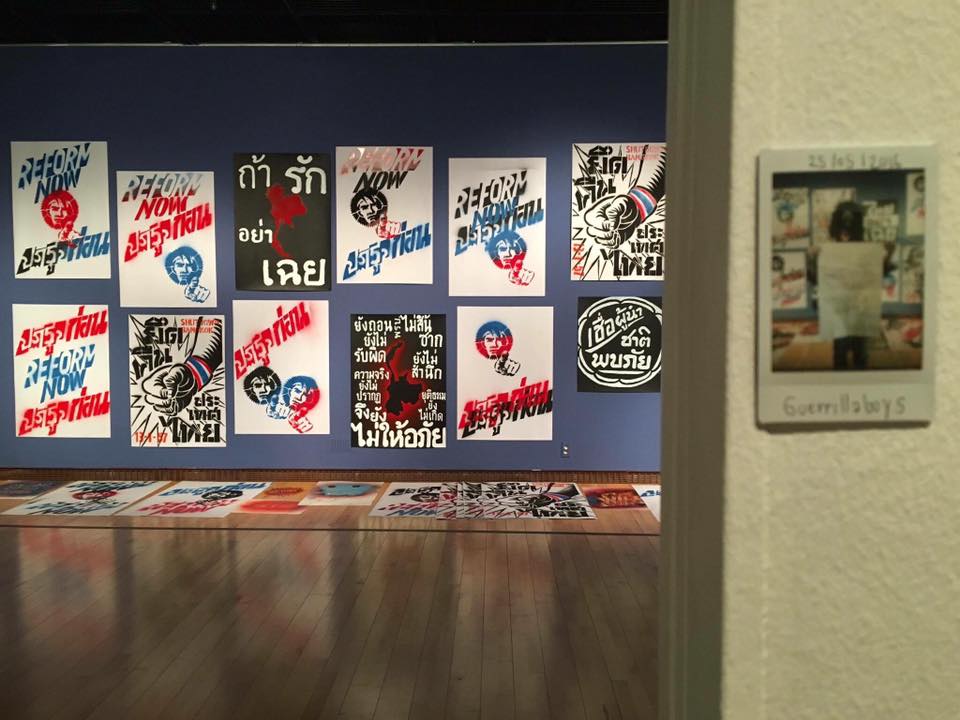
One of the Guerrilla Boys in a photo from Aug. 6 at the Democracy Monument mocking Prime Minister Prayuth Chan-ocha for saying earlier this year ‘We’re 99.99 percent democratic.’ Photo: Guerrilla Boys / Courtesy
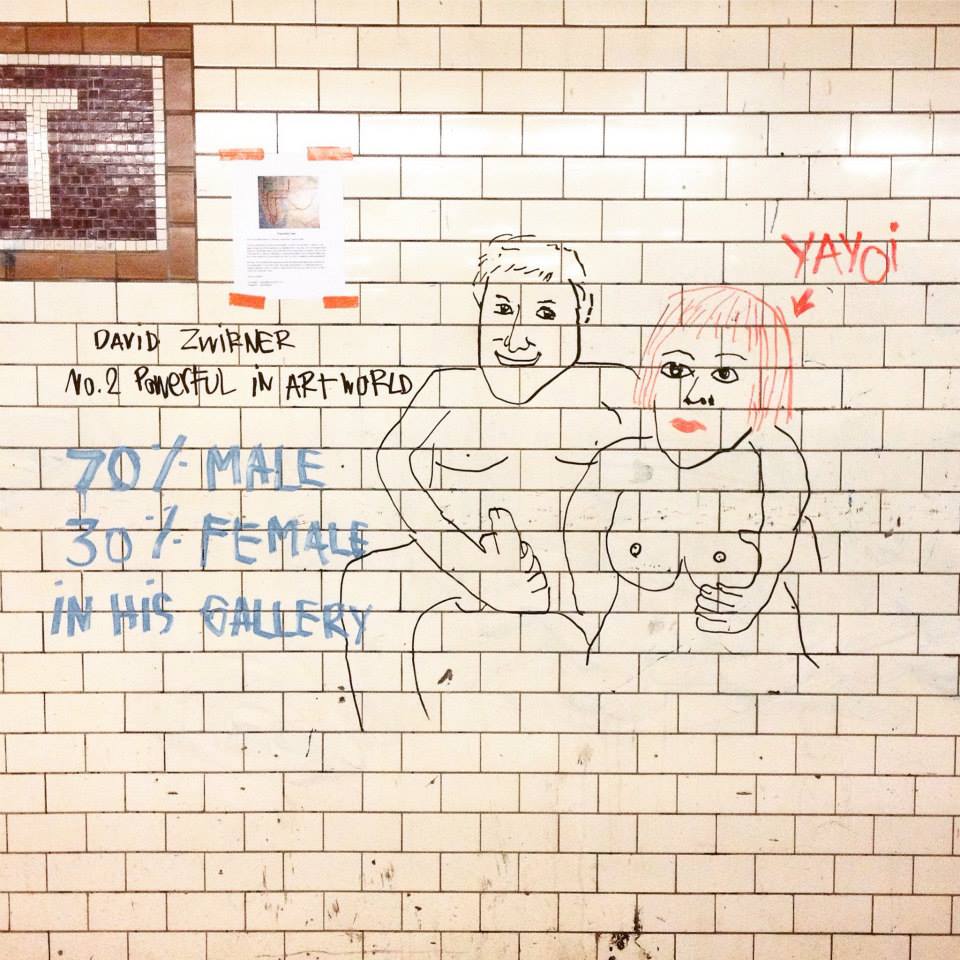
BANGKOK — In New York, they drew lipstick penises in subway stations to protest the art world’s gender imbalance. In South Korea, they struck at its democratic principles. In Bangkok, they marched on the Democracy Monument a day before the charter referendum.
They are the Guerrilla Boys. Drawing inspiration from Guerrilla Girls – an anonymous American feminist group formed in 1985 New York City – the three artists say they share a similar purpose: fighting sexism in institutional art through provocative acts.
Comprised of one Thai and two farangs, they are indeed boys. Boys who adopt the same collectivist, transgressive chic of provocateurs such as Pussy Riot – but without the vaginas. For that, they’ve also been criticized for appropriating the tools and symbols used in feminist agitprop.
One of the three is an artist in Thailand. He said they started the group about two years ago after seeing Guerrilla Girls fought in vain three decades ago without success.
Contacted over Facebook, where the group publicizes its work, the Thai member agreed to be identified as GB1. He said they can’t reveal their identities or exact locations for fear of getting into trouble or interference with their projects.
They were wandering the Museum of Modern Art in New York, GB1 said, where they noticed much fewer works by female artists than men. Doing some research on the matter, they found only 10 percent of the work in most galleries were by female artists.
Most of their work finds their audiences online through social media.
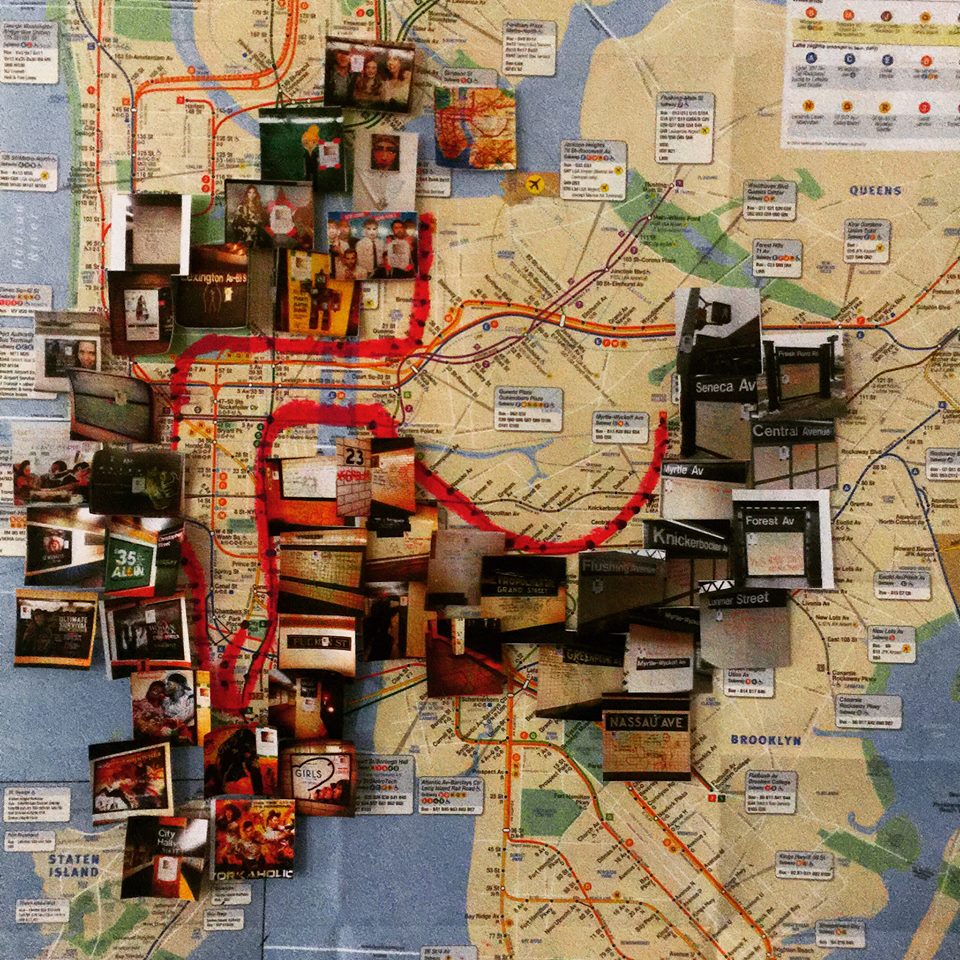
Frustrated by the imbalance in the art world, the three vandalized subway station signs, walls and ads using colored lipstick for their first project in April 2015, “F(eminist) Train.”
One month later they made headlines in South Korea where they protested an exhibition at the Gwangju Museum of Art for including a Thai artist’s work in support of the movement which helped pave the way for the 2014 coup.
Much of the Thai art establishment was outraged when the museum included “Thai Uprising” by Sutee Kunavichayanont, created to support the Bangkok movement against the democratically elected government. Many complained it was a poor choice for an exhibition commemorating South Korea’s uprising against dictatorship.
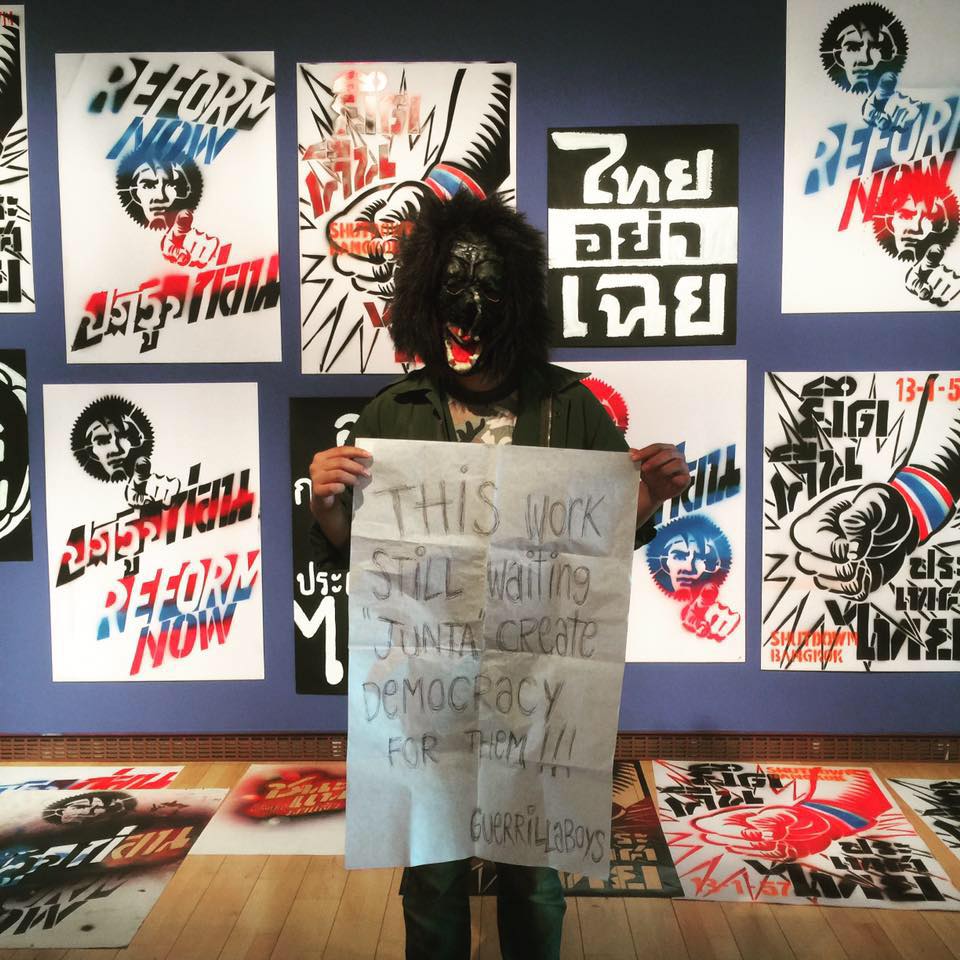
GB1 took action by showing up at the museum and taking photos in a gorilla mask holding an A3-size paper reading: “This work still waiting ‘junta’ create democracy for them!!!”
The demonstration was captured in Polaroids stuck to walls throughout the museum by chewing gum.
“We wanted to send a direct message to the museum’s curator,” the anonymous activist said. “It’s not a small issue that the curator can just let go.”
One of the Guerrilla Boys poses in front of Sutee Kunavichayanont’s ‘Thai Uprising’ on May 25 at the Gwangju Museum of Art. Photo: Guerrilla Boys / Instagram
Divided Response
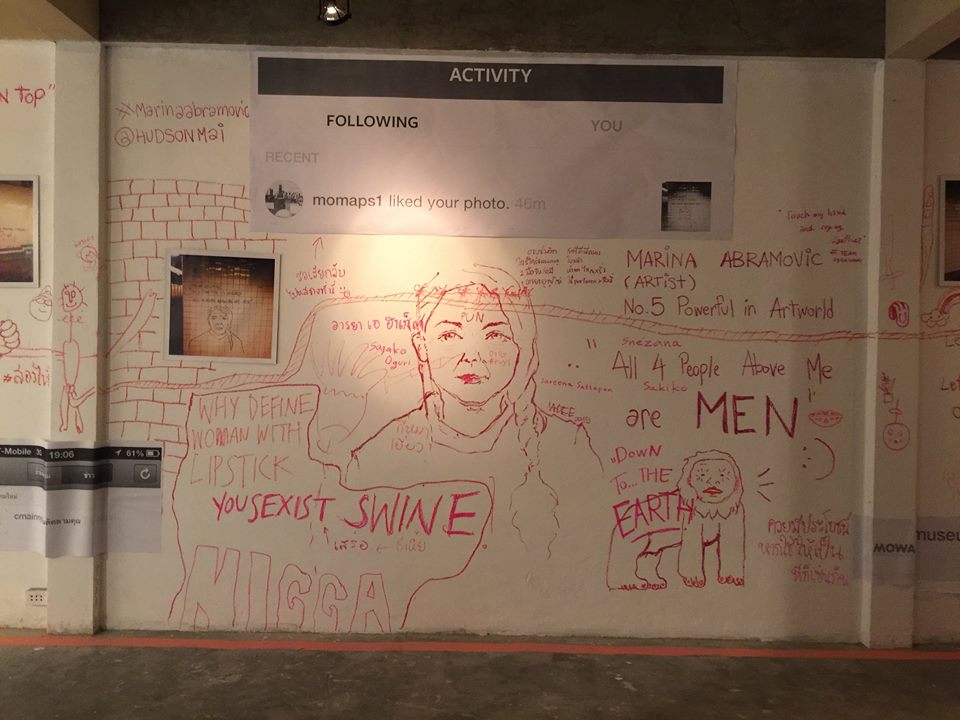
It was in Bangkok late last year that Guerrilla Boys met a strong reaction. Their first activity in Thailand was an installation called How Many Female Artists Do You Know? at gallery-bar Speedy Grandma just off Charoen Krung Road.
That day at Speedy, dozens of attendees wore simian heads and scribbled messages on the gallery’s walls in red lipstick, but the monkey business got intense when some present openly challenged them.
“Why define women with lipstick,” read one message on the wall. “You sexist swine.”
Some present strongly disagreed with their purpose and bona fides, according to gallery co-founder Unchalee “Lee” Anantawat.
“Since they focus on a controversial issue, they have to be prepared for the questions raised as well,” Lee said. “In terms of their success, I think it only has impact on a specific group of people – not people in general.”
A Guerrilla Boys-made Polaroid at the Gwangju Museum of Art. Photo: Guerrilla Boys / Facebook
Lee expressed her own uncertainty over the group’s authenticity, adding that, for her, it would take time to prove.
GB1 said some negative reactions were expected. He blamed that on the state of feminism in Thailand.
“[Other countries] have Free the Nipple campaign, but we don’t. We’re still stuck,” he said in reference to a Western campaign to normalize the sight of breasts. “[So] our strategy is to provoke women to do something. We’ve talked about this that if we put this kind of work in Thailand, some people would be panicked,” he said.
But artist Grisana “Chris” Eimeamkamol was at the event and said he appreciated their use of masks to bring a message into focus without distracting the audience with their identities.
“It’s public art raising questions without the essence of the author,” Chris said, noting the unexpectedly high turnout for the event. “With LGBT and feminism the hot topics now, I think it’s good to have someone provoking and getting people to exchange opinions.”
Boys Will Be Boys
The counterculture mystique of the whole “guerilla operative” thing certainly seems part of the appeal.
“I’m a risky person. It’s exciting,” GB1 said. “Once I sneakily placed works by Thai artists onto a restroom wall at a museum in England.”
Believing that just leaving petroleum-based graffiti won’t draw the limelight, the boys post their work online and tag the galleries and individuals involved, from New York’s Museum of Modern Art and its director Glenn D. Lowry to London’s Tate Modern gallery.
“Museum of Modern Art tapped a heart at one of our Instagram photos,” GB wrote. “New York Times did it as well while many other museums subscribed us.”
This recognition fills them with pride. At Speedy Grandma, they hung banners showing likes of their Instagram photos by Big Media and Big Art. One seemed intended just to show they were followed online by The Guardian’s photo team.
They definitely appear to relish the attention of the same institutions they raise their middle fingers at.
“Right now I still doubt whether they really are interested in feminism or only want to spark a trend,” said Lee of Speedy Grandma. “I’m really interested in what they will do next.”
In response, GB1 said it’s more complicated than that.
“We define ourselves as f(ak)eminists. If we identify ourselves as feminists, there would be only feminists who come to see our work,” he said. “So we redefine ourselves and just do it. Let the audience be the judge.”
Top: One of the Guerrilla Boys in a photo from Aug. 6 at the Democracy Monument mocking Prime Minister Prayuth Chan-ocha for saying earlier this year ‘We’re 99.99 percent democratic.’ Photo: Guerrilla Boys / Courtesy
Photo: Guerrilla Boys / InstagramPhoto: Guerrilla Boys / InstagramA Speedy Grandma wall during Guerrilla Boys’ How Many Female Artists Do You Know? exhibition. Photo: Guerrilla Boys / Facebook
At top, a rendering of the proposed Viman Phra In (Paradise of Indra) as presented by the Chao Phraya boardwalk design team. At bottom, a rendered image of Crystal Island as designed by British architect Norman Foster.
BANGKOK — Flames erupted over the Chao Phraya River again when one of the nation’s top architects pointed out that recently unveiled plans for a structure anchoring a controversial river redevelopment project were identical to that of a famous British architect.
In fact, architect Duangrit Bunnag said the design for the signature landmark Viman Phra In (Paradise of Indra), a monumental structure which will house a museum, came from a 3D model of architect Norman Foster’s work available for free download online.
On Tuesday, he asked the international architecture community to bring the story to Foster’s attention and offered his help to bring legal action against the university-hired boardwalk design team.
“The use of a model open for the public to download for free is common, but as a small part not the main design,” said the prominent architect, who has been a vocal opponent of the junta-driven project to develop concrete walkways along the river. “The 120 million baht design cost of this project was paid using our taxes.”
The issue was first brought to public attention Sunday by activist group Friends of the River, which has organized against a project they say was poorly conceived, destructive to riverside communities – and just ugly.
The junta has said it wants to build a monumental tourist attraction that will be an object of pride for the nation.
Members of ‘Friends’ said the design by the firm contracted by King Mongkut’s Institute of Technology Ladkrabang and Khon Kaen University, looked like Foster’s design for the Crystal Island, a Moscow project described as the world’s largest structure.
Design team A-Seven denied plagiarizing Foster; in fact, a representative insisted they have never even seen his work. They said the design was inspired only by a Thai-style chedi.
Design team head Watchara Chongsuwat went one further in a Matichon interview, asking why people didn’t consider Foster the copycat as chedis are – in his words – Thai architecture.
Artists’ rendering of the spire. The design team said it was inspired by Thai-style chedis.
Initiated by the junta, the project began as concrete walkwaysfor seven kilometers along both sides of the river. Contractors subsequently added more structures, such as the sprawling Viman Phra In, as well as redevelopment plans for the surrounding land.
Opponents slammed the design team’s work and said the seven months allowed by the junta was not enough time for the feasibility study and that public hearings were far from inclusive.
“They can download the model and adjust it in the program, adding more detail. But that doesn’t prove they designed it,” Duangrit said. “For the most simplest point, their design still looks just like Norman Foster’s building.”
A screengrab from a design program provided by design team A-Seven. Image: A-Seven / Matichon
Crystal Island by Foster and Partners was first proposed in 2007 but was put on hold after the 2008 financial crisis.
The architect, who has campaigned against the river project since it was announced last year, said plagiarism violates the Thai Architect Council’s regulations. He said the council has the responsibility to investigate. Should they be found guilty, it can revoke their license.
“My worry is that this is a project from the government, and if their license is revoked, the contract will be scrapped.”
The design team announced Monday that it will present its plans to City Hall on Sept. 26. Construction is expected to begin in early 2017 and completed mid-2018.
Gau Li Ping, in orange and red, is escorted to Phyathai Sriracha Hospital on Tuesday in Chonburi province.
CHONBURI — A Chinese woman who reportedly vanished at a tiger zoo in Chonburi province was found Tuesday hiding in a farmer’s hut in a nearby rice field, police said.
Gau Li Ping (transcribed from Thai) separated herself from a tour group Sunday at the Si Racha Tiger Zoo and hid in the hut because she feared for her life if she returned to China, a local police chief said.
“She didn’t get lost. She had the intention of fleeing [and staying] in Thailand,” Col. Chanapat Nawaluk of Nong Khaem police said. “She told an interpreter she didn’t want to go back to her country.”
The rice field’s owner saw the woman Tuesday morning and called police after learning that she fit the description of the missing Chinese tourist, Chanapat said.
“She told the interpreter that she cannot go back to China because she’s afraid that she will die,” Chanapat said, adding that she did not explain the cause of her fear.
Gau refused to come to the police station for questioning so she was sent to a hospital. She was later placed in the custody of Pattaya’s Tourist Police, the colonel said, adding that the Chinese Embassy has been notified.
Gau entered the country legally, according to Chanapat.
BANGKOK — Living in a dying Russian city where everyone gets married by 25 and retires to watch soap operas at home, a nurse turned photographer decided to travel the world in a quest for beauty.
Carrying her inseparable buddy, a Fuji camera, Vika Sukhova allowed her soul to wander the towns and countries capturing fleeting moments of humanity. That’s now led her to Bangkok for the first time where she will show 29 images mostly shot in black and white this week at WTF Gallery.
Visiting much of Western and Eastern Europe, Sukhova calls herself a world citizen and prefers not to identify with any one culture or country.
“It doesn’t mean I’m a conventional traveler,” Sukhova said. “It rather means I don’t belong to any particular place, especially in my hometown or my home country.”
Photo: Vika Sukhova / Facebook
“A Fleeting Home” goes on display at 7pm on Thursday and runs through Sunday.
Admission is free. WTF can be reached by foot from BTS Thong Lo exit No.1. The three-story venue is open 4pm to 10pm, Tuesday to Sunday.
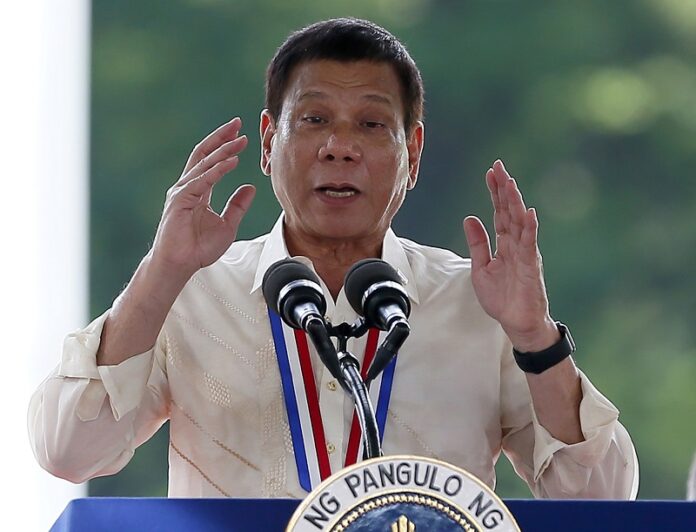
Philippine President Rodrigo Duterte gestures while addressing guests following a wreath-laying ceremony in observance of National Heroes Day Aug. 29 at the Heroes Cemetery in suburban Taguig city, east of Manila, Philippines. Photo: Bullit Marquez / Associated Press
MANILA — Philippine President Rodrigo Duterte said Monday he wants U.S. forces out of his country’s south and blamed America for inflaming Muslim insurgencies in the region, in his first public statement opposing the presence of American troops.
“For as long as we stay with America, we will never have peace in that land.”
Washington, however, said it had not received a formal request to remove U.S. military personnel. White House spokesman Josh Earnest said Duterte had a tendency to make “colorful comments” and drew a comparison with Republican presidential nominee Donald Trump.
Duterte has had an uneasy relationship with the U.S. since becoming president in June and has been openly critical of American security policies. As a candidate, he declared he would chart a foreign policy that would not depend on America, his country’s treaty ally.
In 2002, the U.S. military deployed troops to train, advise and provide intelligence and weapons to Filipino troops battling al-Qaida-linked Abu Sayyaf militants in the southern Philippines. When the American forces withdrew in February last year, U.S. officials said a smaller contingent of U.S. military advisers would stay. Details of the current U.S. military presence in the south were not immediately available.
Duterte did not mention any deadline or say how he intends to pursue his wishes.
State Department spokesman John Kirby said Monday that the U.S. was aware of Duterte’s comments, but is “not aware of any official communication by the Philippine government to that effect and to seek that result.” He said the U.S. remained committed to its long-standing alliance with the Philippines.
In opposing the U.S. military presence in the southern Mindanao region, Duterte cited the killing of Muslims during a U.S. pacification campaign in the early 1900s, which he said was at the root of the long restiveness of minority Muslims in the largely Catholic nation’s south.Before the alliance, the Philippines was a colony of the United States from 1898 to 1946, except for a period of Japanese occupation in World War II.
“For as long as we stay with America, we will never have peace in that land,” Duterte said in a speech to newly appointed government officials.
He showed photos of what he described as Muslim Filipinos, including children and women, who were slain by U.S. forces in the early 1900s and dumped in a pit in Bud Daho, a mountainous region in southern Sulu province. American soldiers stood around the mass grave.
“The special forces, they have to go. They have to go in Mindanao, there are many whites there, they have to go,” he said, adding that he was reorienting the country’s foreign policy. “I do not want a rift with America, but they have to go.”
By contrast, White House spokesman Earnest said, “Filipino people have enormous affection for the United States.” He said the U.S. military has been present in the Philippines for a number of years at the request of its leaders, and the U.S. provided humanitarian assistance when a cyclone struck and help for maritime security.
The special forces, they have to go. They have to go in Mindanao, there are many whites there, they have to go.
With the United States two months away from a presidential election that will pit President Barack Obama’s fellow Democrat Hillary Clinton against Trump, Earnest drew a comparison with the Philippines. He said that elections say a lot about what kind of person is “going to represent your country on the international stage.”
When asked if he were trying to draw a cautionary tale for the American people, Earnest said, “I guess some people could draw that analogy.”
Last week, Obama called off what would have been his first meeting with Duterte on the sidelines of an Asian summit in Laos after the Philippine president used the phrase “son of a bitch” in warning that he wouldn’t accept lectures from Obama on human rights.
Despite the remark, the two leaders later shook hands and had a brief chat in a holding room where Duterte reportedly said his words were not directed at Obama.
Duterte, however, has continued to press his criticism of the American president.
In another speech late Monday, Duterte said for the first time that he deliberately skipped a meeting between Southeast Asian leaders and Obama at the summit in Laos out of principle. His spokesman said at the time that Duterte did not attend the meeting because of a migraine.
American colonial forces killed many Muslims in the southern Philippines more than a century ago “because you were here as imperialists, you wanted to colonize my country and because you had a hard time pacifying the Moro people,” Duterte said in the speech.
While criticizing U.S. policies, Duterte has taken steps to repair relations with China, which were strained under his predecessor over territorial disputes in the South China Sea.
FILE -- In this Oct. 24, 2015 file photo, Israeli left wing activists hold signs during a peace rally Oct. 2015 in Tel Aviv, Israel. Photo: Sebastian Scheiner / Associated Press
LOS ANGELES — Stanley K. Sheinbaum, a former economics professor whose drive for Mideast peace had him mingling with presidents, royalty and movie stars, has died. He was 96.
Sheinbaum died of heart disease on Monday at his home in the Brentwood neighborhood of Los Angeles, said his assistant, Marti Maniates.
Sheinbaum gave up teaching to devote himself to what he called his quest to “create a little peace and justice in this unjust world.”
He raised funds to defend Daniel Ellsberg during the military analyst’s trial for releasing the Pentagon Papers, a secret study of the Vietnam War.
Never one to shrink from controversy, Sheinbaum met with late Palestinian President Yasser Arafat in an unofficial diplomatic mission to bring peace to the Middle East. The meeting propelled him into headlines and sparked protests from Israelis and the American Jewish community.
“For a while, I was the most hated Jew in America … by other Jews anyway,” he said in his 2011 autobiography. But he added, “I didn’t waste time agonizing.”
Still, he acknowledged, his mission for peace failed.
Sheinbaum “was a tireless advocate whose courageous stances breathed life into monumental change on both the local and global stages,” Mayor Eric Garcetti said in a statement.
“His work will forever inspire everyone who believes in bringing people together to transform our world for the better,” he said.
Sheinbaum’s causes ranged from reforming the LAPD to urging California universities to divest from their holdings in South Africa during apartheid.
“My failure is the greatest disappointment I have ever experienced… and I can only take solace from the knowledge that I really, really tried. I really did.”
In 1971, hearing that Ellsberg was to be prosecuted, Sheinbaum saw a cause that meshed with his anti-Vietnam War sentiments. He volunteered to organize Ellsberg’s legal team and raise money for his defense. He and his wife Betty moved to Los Angeles for the trial and never left. He recruited Hollywood celebrities to hold fundraisers and he signed up two of the most prominent civil liberties lawyers in the country, Leonard Boudin and Leonard Weinglass.His book, “Stanley K. Sheinbaum: A 20th Century Knight’s Quest for Peace, Civil Liberties and Economic Justice,” was written with a co-author when he was in his 90s. It contained book jacket testimonials from President Bill Clinton, Barbra Streisand, Jane Fonda and Norman Lear, who summed up his friend’s legacy by saying: “He’s addicted to fairness and justice.”
After many months of legal drama, the case was dismissed for governmental misconduct involving a break-in at Ellsberg’s psychiatrist’s office and the judge’s meetings with members of the Nixon administration.
In the 1980s, Sheinbaum became obsessed with the cause of peace in the Middle East. He managed to arrange a meeting with Palestinian Liberation Organization leader Yasser Arafat and the picture of him with his arm around Arafat that appeared on the front page of the Los Angeles Times set off a firestorm of protest within the Jewish community. He was booed when he spoke at synagogues. But he continued his mission, meeting with Arafat several more times and trying to negotiate peace with Israel.
When Arafat died, he said hope of a peace agreement died with him. His dream of peace had failed.
“My failure is the greatest disappointment I have ever experienced,” Sheinbaum said, “and I can only take solace from the knowledge that I really, really tried. I really did.”
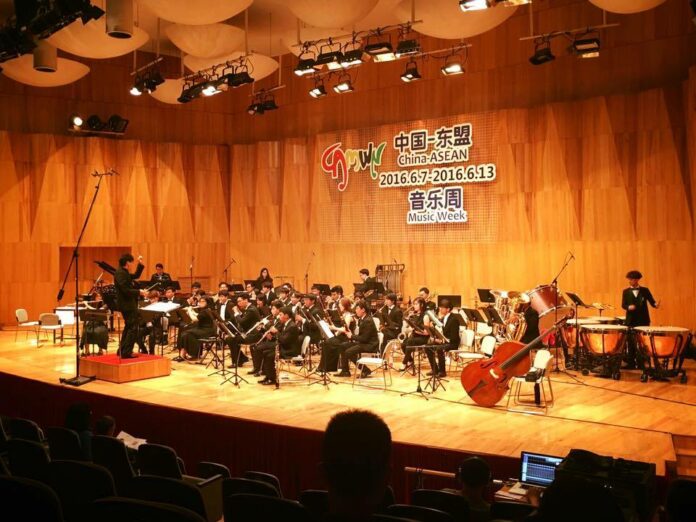
Mahidol Wind Orchestra performs in China-ASEAN Music Week. Photo: Mahidol Wind Orchestra / Facebook
BANGKOK — Four hundred years after Shakespeare shuffled off this mortal coil, his legacy endures not only in words but music. Several arrangements inspired by the famous poet will be performed Wednesday as part of “Shakespeare after 400.”
The Mahidol Wind Orchestra will perform arrangements by the Royal Shakespeare Company, followed by an original reinterpretation of folk song “Greensleeves” to portray the beautiful setting of the bard’s “Twelfth Night.” After that the orchestra will get down with some symphonic dances from “West Side Story,” which drew inspiration from “Romeo and Juliet.”
“As Shakespeare’s works are diverse, the performance combines various song and styles, be they classic or contemporary,” said conductor Thanapol Setabrahmana.
Learn more about Shakespeare and his work from the university’s Richard Anton Ralphs, who has directed several Shakespeare productions and will lead a discussion at 6:30pm before the concert starts.
The concert kicks off a series of events linking music to literature.
The Mahidol Wind Orchestra is comprised of undergraduate wind and percussion students of the university’s College of Music.
Tickets are 200 baht – 100 baht for students – and can be purchased at the box office.
The concert starts at 7pm on Wednesday at the Music Auditorium, College of Music, Mahidol University.
The best way to arrive is by taxi, from BTS Bang Wa exits No. 1 or 2.
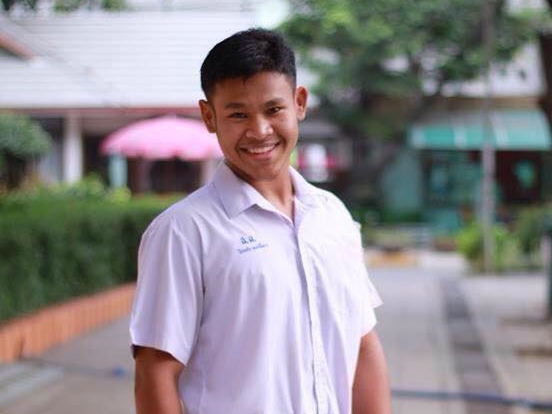
Chokechai Thongnuekhao in an undated photo. Photo: Pook Sukonta Berthebaud / Facebook
CHONBURI — The family of 19-year-old Chokechai Thongnuekhao was still waiting Monday to find out whether he would be back to his old self or suffer permanent brain damage after nearly dying in a hazing session he was forced to submit to at his university.
Witnesses said Chokechai was told Friday by senior students to swim across a large pond at the Chonburi campus of Kasetsart University as part of annual initiation rituals known as rub nong. Chokechai’s strength faltered before he could reach the other side, and he had to be rescued and taken to a hospital, where he remains on a ventilator.
“He’s out of critical condition. But we have to keep monitoring him. It’s a semi-critical condition,” Chutidej Tabongkarakha, director of Chonburi Hospital, said Monday afternoon.
Chokechai, an International Maritime Studies student, was the latest casualty in a tradition still common at Thai universities despite occasional fatalities and public controversy. No one has been charged for what happened to Chokechai.
According to Chutidej, the student showed recognition and blinked in response to hospital staff calling his name or giving him medicine. But he said it’s too early to tell whether his brain was damaged by oxygen deprivation, or whether he will be able to verbally communicate until he’s breathing on his own.
“Once we can remove the tube, we will reevaluate his brain,” Chutidej said.
Chokechai’s father, Amporn Thongnuekhao, told reporters Sunday after touring the site of the incident that he hoped Chokechai would recover and return to class soon.
Chokechai is a sports enthusiast who usually swims well, Amporn said.
Kasetsart University interim rector Chongrak Wachrinrat told reporters six or seven senior students were at the scene when the incident happened. According to Chongrak, the seniors “told” Chokechai to swim to them, and Chokechai appeared to have a cramp while swimming in the pond. The senior students immediately rescued Chokechai and brought him to hospital, the rector said.
Chokechai Thongnuekhao nearly drowned crossing a pond on the Chonburi campus of Kasetsart University, seen here on Sunday.
He said the university is investigating the matter.
Amporn said he has not filed any criminal charges against any of the senior students and won’t if Chokechai fully recovers. None of the students had yet to meet with him or apologize in person, he said.
Both Chongrak and Amporn also disputed a story on social media that the pond was polluted with chemical waste, though Chutidej of Chonburi Hospital said lab results for any chemical contamination in Chokechai’s body are not out yet.
News of Chokechai’s brush with death was met with a storm of fury online, where many comments expressed disbelief that risky rub nong, or hazing, is still tolerated at many universities. The ritual usually involves senior students forcing freshmen to perform grueling tasks to prove their worth.
“Let me tell you, it’s been more than 10 years since I left university, I have never found any use from my rub nong times, not a single thing,” Pook Sukonta Berthebaud wrote in a Facebook post that’s been shared more than 32,000 times. “Do you want a civilized rub nong? They organize themselves as social service volunteers. They don’t use their birth certificates or power to intimidate or force anyone to grovel to them.”
Rub nong occasionally leads to deaths, injury and sexual assault. In August 2014, a 16-year-old student died during hazing in Hua Hin.