29.4 C
Bangkok
Tuesday, June 23, 2026
Home Blog Page 2647

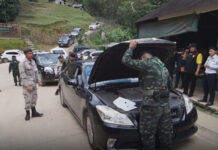
Car Bomb Attack at Yala Gas Station Averted

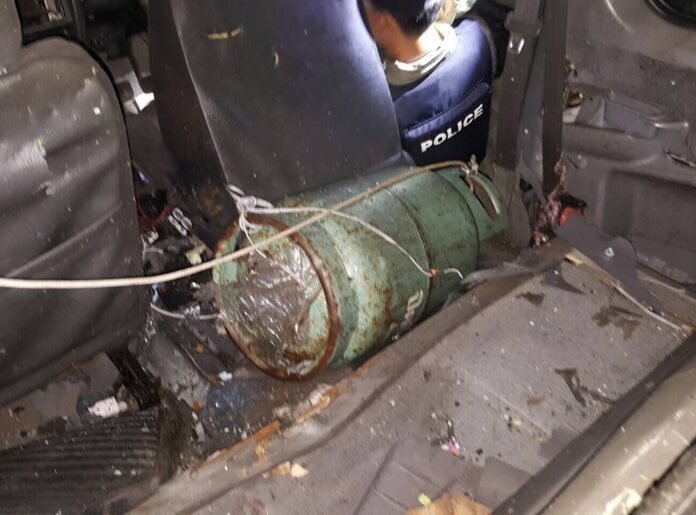
Police said explosives were packed inside this gas canister in a truck abandoned Wednesday night at a gas station in Yala province.

YALA — Police say they defused a large car bomb, preventing it from going off Wednesday night at a gas station in Yala province.

What could have been a large-scale attack in the region known for years of separatist violence was prevented after the station’s staff alerted police to a suspicious vehicle left at the station in Raman district, according to police.

Police said the staff saw two women wearing hijab leaving the car at the gas station shortly after stopping to fill their tank, so they phoned police to check the vehicle, leading to the discovery of a 90-kilogram bomb packed into a gas canister inside the pick-up truck.

Police reportedly spent two hours defusing the bomb.

According to police, the car was the same one used in a suspected separatist gun attack that killed a civilian there late last month.

Police said they are investigating the apparent car bomb.

Advertisement

German Crossword Art Vandal Says She Completed, Not Damaged Work

BERLIN — A lawyer for an elderly woman who filled in spaces on an art work depicting part of a crossword at a German museum says she contends that she was completing the piece, not damaging it.

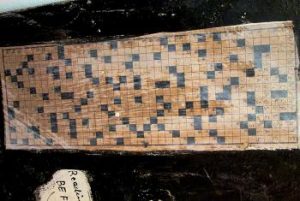
Arthur Koepcke’s 1965 'Reading-work-piece.'  Photo: @Austinkleon / Twitter
Arthur Koepcke’s 1965 ‘Reading-work-piece.’ Photo: @Austinkleon / Twitter

Officials at Nuremberg’s Neues Museum filed a criminal complaint after the 90-year-old, who hasn’t been identified, last month filled in blank spaces with a ballpoint pen on avant-garde artist Arthur Koepcke’s 1965 work, “Reading-work-piece.” She apparently took literally the phrase “Insert Words” at the edge of the picture.

Read: Avant-Garde Crossword Art Spells Trouble For Pen-Wielding German Woman, 91

Lawyer Heinz-Harro Salloch said Wednesday that the woman argued she hadn’t damaged the piece “but only completed it as the artist intended,” news agency DPA reported.

She told police that the picture even gained in value, he added.

The museum has since removed her additions.

Advertisement

1 Killed, 5 Hurt in London Knife Attack

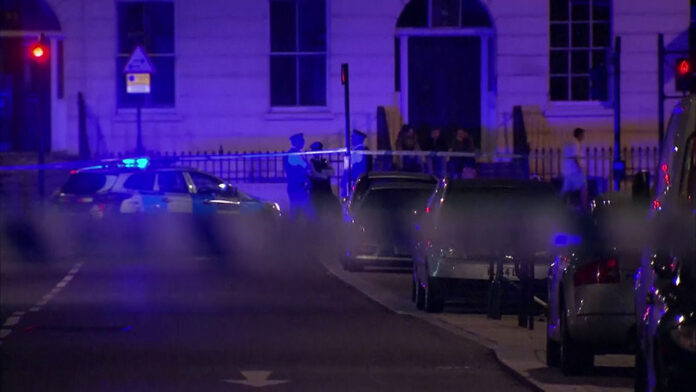
Police officers stand behind a cordon after a knife attack in London on Thursday.Photo: Sky News / Associated Press

LONDON — Police put more officers on London streets Thursday after a man stabbed a woman to death and injured five other people near the British Museum, just days after authorities had warned the public to be vigilant in light of attacks inspired by the Islamic State group in other parts of Europe.

Assistant Commissioner Mark Rowley, head of counterterrorism at the Metropolitan Police, said early indications suggested that mental health was a factor in the attack, which occurred at around 10:30 p.m. Wednesday in central London’s Russell Square. Police used a stun gun to subdue the 19-year-old suspect, who was arrested on suspicion of murder and is in custody at a London police station.

“We are keeping an open mind regarding the motive, and terrorism remains one line of inquiry being explored,” Rowley said.

Police said the victim who died was a woman in her 60s but gave no other details. Two victims remain in the hospital, while others have been discharged.

Helen Edwards, 33, who lives in the area, came out for a walk and found armed police near a subway station. In a city where memories of the July 7, 2005, attacks on public transport remain raw, she immediately suspected that an attack had occurred.

“There is always that thing in the back of your mind,” she said. “You live with that threat of terrorism or other crimes in the back of your mind. It wasn’t a huge shock I guess.”

London Mayor Sadiq Khan urged the public to keep calm and remain vigilant, urging people to be the first line of defense against any form of attack.

“We all have a vital role to play as eyes and ears for our police and security services and in helping to ensure London is protected,” he said.

The incident came within hours of an announcement by London police that they were putting more armed officers on the streets. The idea was to sustain public confidence following attacks by Islamic State-inspired groups in Europe.

The move was important because police in Britain do not carry guns for the most part — a principle that remains unchanged. Even with the additional armed officers, most of London’s 31,000 police officers will not be armed.

“In some of our big iconic locations, we’ve already got armed patrols — if you look at Parliament, Downing Street — so it’s not entirely new,” Metropolitan Police chief Bernard Hogan-Howe said Wednesday. “I think people understand that where you are going to have people as enemies who’ve got guns, we’ve got to have guns.”

The deployments underscore the challenge police face in responding to situations in which they may be outgunned — or face a pressing need to subdue a suspect. Hogan-Howe warned over the weekend that an attack in Britain was a case of “when, not if.”

Advertisement

Donation Drive Wins Freedom for Elderly Activist Jailed 9 Days

Election Commission staff demonstrate casting ballots for the August 2016 referendum at a school in Ubon Ratchathani province.

CHIANG MAI — After spending nine days in jail because he couldn’t afford the bond money, a 63-year-old man charged with violating the referendum law walked free last night, thanks to a crowdfunding effort to raise bail.

Samart Kwanchai was released from Chiang Mai Central Prison on Tuesday night, a human rights activist said. He’s still facing a trial for handing out leaflets urging people to reject the new constitution that will be put to vote on Sunday.

Elderly ‘Vote No’ Campaigner Jailed Because He Couldn’t Afford Bond

“The case is still in the investigation process. Police are still working on the case file,” said Noppon Archamas, a member of the Thai Lawyer for Human Rights, a group that assists legal cases that involve freedom of expression.

Noppon said the 100,000 baht bond money was collected in an online donation drive by the anti-junta group Resistant Citizen.

Samart was accused of placing Vote No flyers on vehicles in a Chiang Mai carpark on July 21.

“Down to Dictatorship! Long Live Democracy! Vote No on Aug. 7,” was written in the leaflets along with an image of the three-finger salute, an anti-junta gesture many activists adopted from the Hunger Games films.

Police later arrested him and charged him with violating the referendum law, which bans any attempt to “mislead” the public into voting in favor or against the constitution. Samart was jailed July 25 after telling the court that he couldn’t afford the 100,000 baht bond.

If found guilty, he faces up to 10 years in prison.

Advertisement

Tour Bangkok’s Fanciest MRT Station Later This Year

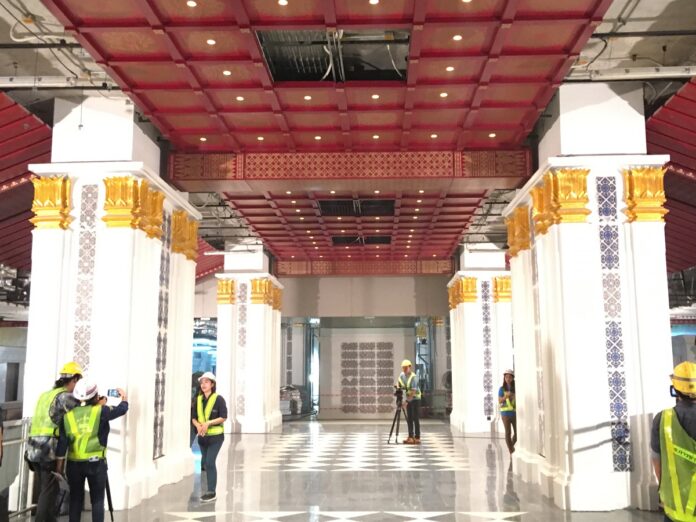
MRT Sanam Chai, located close to Bangkok’s Grand Palace, was opened to reporters Wednesday. It is expected to be completed by the end of 2016.

BANGKOK — Thailand’s most elaborate subway station will open for public tours later this year.

Built to resemble a Rattanakosin-style stateroom, MRT Sanam Chai is one of three stations to open in the old quarter, all artfully designed to reflect its diverse cultural roots.

Though the MRT Blue Line’s extension from Hua Lamphong east to Tha Phra won’t operate until 2019, MRT Sanam Chai, located near the Grand Palace, will be completed and opened for visitors, Gen. Yodyuth Boonyathikarn, chairman of the Mass Rapid Transit Authority, said Wednesday. No specific date was open.

The extension from Hua Lamphong to Tha Phra was said to cost 20 billion baht.

Sanamchai Station
MRT Sanamchai

The station was designed by National Artist Pinyo Suwankiri to fit in with the surrounding old town area and its signature fusion of Thai and neo-classicalist European architectural styles. Located beneath Sanam Chai Road, the station is close to some of Bangkok’s most important cultural landmarks such as Wat Pho, Museum Siam and the former Pak Khlong Talad flower market.

First is the station being built under Wat Mangkon (Dragon Temple) in Chinatown, which will mix Chinese and European designs with a dragon motif.

Wat Mangkorn1
Rendered image of MRT Wat Mangkon
Wat Mangkorn2
Rendered image of MRT Wat Mangkon

Next, find Sino-Portuguese colonial style at MRT Wang Burapha, located underneath the Sam Yod intersection on Charoen Krung Road between Mangkon and Sanam Chai stations.

Sam Yod1
Rendered image of MRT Wang Burapha
Sam Yod2
Rendered image of MRT Wang Burapha

After passing beneath the Chao Phraya River, commuters will hit the Thonburi side’s first station: MRT Itsaraphap. It will be decorated in the style of Thai swans, or hong, due to its location near Wat Hong Rattanaram Ratchaworawiharn (Jeweled Swan Temple).

Itsaraphap station
Rendered image of MRT Itsaraphap

Related stories:

With a Stroke of His Pen, Prayuth Solves MRT’s ‘Missing Link’ Problem

New MRT Purple Line Will Connect to Blue Line, But Not Anytime Soon

Frustrated Mess When Thousands Queue for Free Purple Line Tickets (Photos)

Sign Up to Test Ride New MRT Purple Line

Trade in Those MRT Cards or Lose the Money

Imagine Bangkok 2016: Better city, less life?

Look Inside Thailand’s First Underwater Tunnel (Photos)

Advertisement

Somchai Regrets Taunting Gravity With Ballot Box Bravado

BANGKOK — The public face of Sunday’s charter referendum said today that he regretted embarrassing himself before a national audience and launching a thousand internet memes by breaking what he claimed was an unbreakable ballot box.

A day after his demonstration to the press corps went awry, Election Commissioner Somchai Srisutthiyakorn acknowledged his pride was momentarily damaged like the plastic box which shattered when dropped, providing ready material for mockery by critics of the upcoming charter vote.

“When I tossed it into the air, and it broke apart, I felt so embarrassed,” Somchai said. “I knew that I would become big news.”

His demonstration intended to instill confidence in Sunday’s poll backfired, and thus, internet memes were born. Despite being the butt of many jokes, Somchai managed to put some positive spin on the outcome.

He said if it “made more people aware of the referendum and feel more eager to go out to vote, it was a good thing.” In fact, he said it might foretell “that many so people will come out to vote that the ballot boxes break apart!”

The commissioner said a technician explained the test went awry because he threw the box without its lid, and that a fully closed box wouldn’t suffer the same fate.

A photographer demonstrates the ballot box security strap he was able to rip off with his bare hands.

Update: At a Wednesday afternoon demonstration of the security of the boxes’ locks, a photographer was able to tear off the allegedly unbreakable seal. Somchai claimed it wasn’t properly attached before the demonstration.

Image: The Matter / Facebook
Image: PixelCrazy8bit / Facebook


Advertisement

Don’t Floss? Don’t Feel Bad. There’s No Proof it Helps.

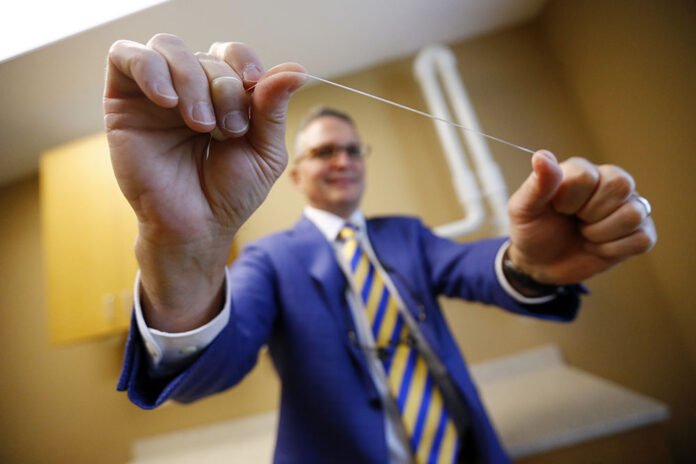
Dr. Wayne Aldredge, president of the American Academy of Periodontology, holds a piece of dental floss at his office in New Jersey. Aldredge acknowledges the weak scientific evidence and the brief duration of many studies on flossing, but says that the impact of floss might be clearer if researchers focused on patients at the highest risk of gum disease, such as diabetics and smokers. Photo: Julio Cortez / Associated Press

HOLMDEL, New Jersey — It’s one of the most universal recommendations in all of public health: Floss daily to prevent gum disease and cavities.

Except there’s little proof that flossing works.

Still, the federal government, dental organizations and manufacturers of floss have pushed the practice for decades. Dentists provide samples to their patients; the American Dental Association insists on its website that, “Flossing is an essential part of taking care of your teeth and gums.”

The federal government has recommended flossing since 1979, first in a surgeon general’s report and later in the Dietary Guidelines for Americans issued every five years. The guidelines must be based on scientific evidence, under the law.

Last year, the Associated Press asked the departments of Health and Human Services and Agriculture for their evidence, and followed up with written requests under the Freedom of Information Act.

When the federal government issued its latest dietary guidelines this year, the flossing recommendation had been removed, without notice. In a letter to the AP, the government acknowledged the effectiveness of flossing had never been researched, as required.

The AP looked at the most rigorous research conducted over the past decade, focusing on 25 studies that generally compared the use of a toothbrush with the combination of toothbrushes and floss. The findings? The evidence for flossing is “weak, very unreliable,” of “very low” quality, and carries “a moderate to large potential for bias.”

“The majority of available studies fail to demonstrate that flossing is generally effective in plaque removal,” said one review conducted last year. Another 2015 review cites “inconsistent/weak evidence” for flossing and a “lack of efficacy.”

One study review in 2011 did credit floss with a slight reduction in gum inflammation — which can sometimes develop over time into full-fledged gum disease. However, the reviewers ranked the evidence as “very unreliable.” A commentary in a dental magazine stated that any benefit would be so minute it might not be noticed by users.

The two leading professional groups — the American Dental Association and the American Academy of Periodontology, for specialists in gum disease and implants — cited other studies as proof of their claims that flossing prevents buildup of gunk known as plaque, early gum inflammation called gingivitis, and tooth decay. However, most of these studies used outdated methods or tested few people. Some lasted only two weeks, far too brief for a cavity or dental disease to develop. One tested 25 people after only a single use of floss. Such research, like the reviewed studies, focused on warning signs like bleeding and inflammation, barely dealing with gum disease or cavities.

Wayne Aldredge, president of the periodontists’ group, acknowledged the weak scientific evidence and the brief duration of many studies. In an interview at his private practice in New Jersey, he said that the impact of floss might be clearer if researchers focused on patients at the highest risk of gum disease, such as diabetics and smokers.

Still, he urges his patients to floss to help avoid gum disease. “It’s like building a house and not painting two sides of it,” he said. “Ultimately those two sides are going to rot away quicker.”

Aldredge also said many people use floss incorrectly, moving it in a sawing motion instead of up and down the sides of the teeth. Pressed about the origins of his organization’s endorsement of flossing, he said it may simply have “taken the ADA’s lead.”

When the ADA was asked for proof of its claim that flossing helps prevent early gum disease and cavities, the group cited the 2011 review and a 2008 two-week study that measured bacteria and did not even consider gum disease.

In a later statement to the AP, the ADA said flossing “removes plaque” and “is proven to help remove” debris from between teeth. A video on its website proclaims that flossing “helps prevent gum disease.” When pressed, Matthew J. Messina, a practicing dentist and spokesman for the dental association, acknowledged weak evidence, but he blamed research participants who didn’t floss correctly.

Even companies with a big market share of the flossing business — by next year, the global market is predicted to reach almost $2 billion, with half in the United States, according to publisher MarketSizeInfo.com — struggled to provide convincing evidence of their claims that floss reduces plaque or gingivitis. Yet the industry has paid for most studies and sometimes designed and conducted the research.

Procter & Gamble, which claims that its floss fights plaque and gingivitis, pointed to a two-week study, which was discounted as irrelevant in the 2011 research review.

Johnson & Johnson spokesman Marc Boston said floss helps remove plaque. When the AP sent him a list of contradicting studies, he declined comment.

The floss-making companies partner with the ADA through its Seal of Acceptance program. The ADA promotes the seal to companies as something that “directly affects the purchase decisions of consumers;” each manufacturer is charged $14,500 for the evaluation. If it approves the product, the ADA then charges an additional annual fee of $3,500.

The ADA says it rigorously evaluates products and makes no profit from the program. However, floss companies themselves are allowed to design the studies.

“The funding can come from companies — no problem at all,” said dentist Marcelo W.B. Araujo, vice president of the ADA’s Science Institute, who joined the organization after serving as an executive for Johnson & Johnson. “The design can start from the company.”

When flossing first gained acceptance, no proof was required of remedies. Dentist Levi Spear Parmly is credited with inventing floss in the early 19th century. By the time the first floss patent was issued, in 1874, the applicant noted that dentists were widely recommending its use.

The ADA has been promoting floss universally since 1908. “They just looked into what they did every day in their clinical practice and what they would recommend for patients,” said Araujo.

Count dentist Damien Walmsley, scientific adviser to the British Dental Association, among the skeptics. “It’s important to tell people to do the basics. Flossing is not part of the basics.”

Floss can occasionally cause harm. Careless flossing can damage gums, teeth and dental work. Though frequency is unclear, floss can dislodge bad bacteria that invade the bloodstream and cause dangerous infections, especially in people with weak immunity, according to the medical literature.

National Institutes of Health dentist Tim Iafolla acknowledged that if the highest standards of science were applied in keeping with the flossing reviews of the past decade, “then it would be appropriate to drop the floss guidelines.”

Regardless, he added, Americans should still floss.

“It’s low risk, low cost,” he said. “We know there’s a possibility that it works, so we feel comfortable telling people to go ahead and do it.”

Story: Jeff Donn

Advertisement

Boy Dies in Siberia Anthrax Outbreak Linked to Thawed Reindeer Corpse
Reindeer pull a sleigh in Russia in a 2011 photo. Photo: Elen Schurova / Wikimedia Commons

MOSCOW — An outbreak of anthrax in Siberia that has hit nomads, killing a young boy, was been traced to a long dead reindeer exposed by melting of permafrost, BBC reported Wednesday.

The death of a 12-year-old nomad was the first Anthrax fatality reported in Russia in 75 years, the regional governor’s office said Tuesday.

A 12-year-old nomad died of anthrax and 20 more people have been diagnosed with it following the outbreak in a remote area, according to the office of Yamalo-Nenets governor Dmitry Kobylkin. Hundreds of nomadic reindeer herders have been evacuated to the regional capital, Salekhard, for treatment, and 90 of them have been hospitalized.

More than 2,300 reindeer have died in the outbreak in the region 2,000 kilometers northeast of Moscow. Kobylkin said all reindeer in the area have now been vaccinated and the deaths have stopped.

He also sought to dispel fears that anthrax could spread to a wider area.

“There is no epidemic in Yamal,” Kobylkin said. “Only a small area was quarantined. The overwhelming majority of the nomads from the quarantined territory are healthy but Yamal doctors provide them with preventive treatment.”

A Nenet nomad child with reindeer in background. Photo: Oyvind Ravna / Wikimedia Commons

The government will earmark 90 million rubles (47 million baht) to help the nomads, who are indigenous to the remote region, build new homes in a new settlement. Yamal’s nomads live in temporary dwellings called chums that are typical for the nomadic people of Siberia as well as parts of Mongolia and China.

Advertisement

3 Volcanoes Erupt in Indonesia, Flights Disrupted

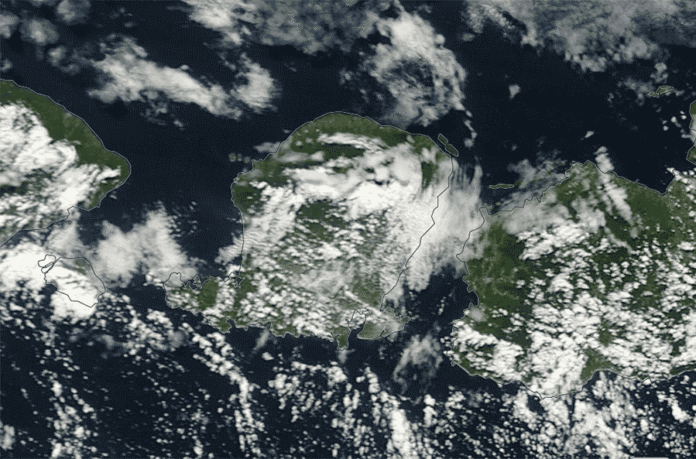
Clouds spread from eruption of Indonesia's Mt. Rinjani over past three days. Images: NASA

JAKARTA — Eruptions at three volcanoes in Indonesia have darkened skies in parts of the archipelago and disrupted some flights.

Mount Rinjani on Lombok Island near Bali, the Sinabung volcano on Sumatra Island and Mount Gamalama in the Moluccas chain of islands have all erupted in the past couple of days.

No one has been injured, but flights at two airports have been disrupted.

Sultan Babullah airport in Ternate, the capital of North Maluku province, was closed Wednesday and Lombok’s international airport was closed for several hours on Tuesday.

The three mountains are among about 130 active volcanoes in Indonesia. The archipelago of 250 million people is prone to earthquakes and volcanoes because it sits along the Pacific “Ring of Fire,” a string of faults that lines the Pacific Ocean.

Sutopo Purwo Nugroho, the spokesman for Indonesia’s Disaster Mitigation Agency, said that Gamalama and Sinabung erupted again late Tuesday, blasting debris high into the air. Hot ash tumbled down the Sinabung slopes as far as 2,000 meters (yards) southward into a river.

Nugroho said that farms and trees around the three volcanoes were covered in gray ash, but nearby towns and villages were not in danger.

More than 13,000 people have been evacuated due to volcanic eruptions since last year, mostly from around the slopes of Sinabung.

Advertisement

N. Korea Fires Missile Toward Waters Near Japan

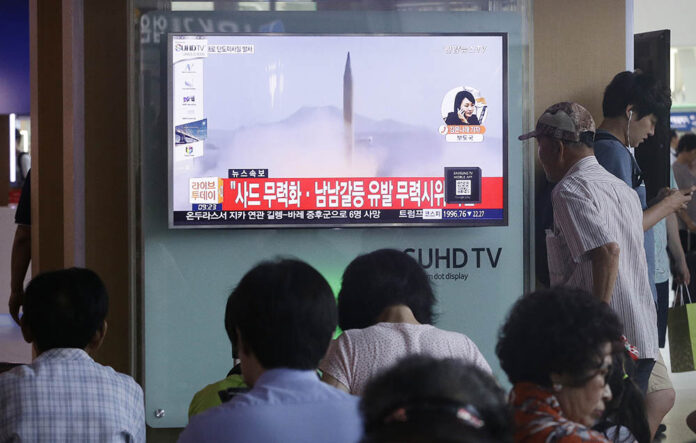
South Koreans on Wednesday watch a TV news program airing file footage of a North Korean rocket launch at the Seoul Railway Station in Seoul. Photo: Ahn Young-joon

SEOUL — A medium-range ballistic missile fired Wednesday by North Korea flew about 1,000 kilometers and landed near Japan’s territorial waters, Seoul and Tokyo officials said, one of the longest flights by a North Korean missile.

The U.S. Strategic Command, meanwhile, said North Korea fired two presumed Rodong missiles simultaneously on Wednesday, not just one. The command’s statement said initial indications reveal one of the missiles exploded immediately after launch, while the second was tracked over North Korea and into the Sea of Japan.

According to the South Korean and Japanese announcements, one suspected Rodong missile lifted off from the North’s western Hwanghae province and flew across the country before falling in waters between the Korean Peninsula and Japan.

Seoul’s Joint Chiefs of Staff said in a statement that it “strongly condemns” the missile launch because it explicitly shows the North’s intentions of being able to launch missile attacks on South Korea and neighboring countries.

Japan’s Defense Ministry said the missile landed inside Japan’s exclusive economic zone, the 200-nautical-mile offshore area where a nation has sovereign rights for exploring and exploiting resources. Japanese media reported it was the first North Korean missile that has splashed down in Japan’s EEZ.

“It imposes a serious threat to Japan’s security and it is unforgivable act of violence toward Japan’s security,” Prime Minister Shinzo Abe said.

North Korea previously fired Rodong and other missiles into the sea but South Korean analysts say Wednesday’s 1,000 kilometer flight was one of the longest for a North Korean test.

Several North Korean rockets have gone further and even over Japan. But Pyongyang called them satellite launches while Washington, Seoul and Tokyo said they were disguised tests of missile technology. After several failures, the North put its first satellite into space aboard a long-range rocket in December 2012 and conducted another successful satellite launch in February.

In June, North Korea, after a string of failures, sent another type of mid-range missile known as “Musudan” more than 1,400 kilometers high. Analysts say the high-altitude flight meant North Korea had made progress in its push to be able to strike U.S. forces throughout the region.

North Korea routinely conducts weapons tests, but the latest launch came after North Korea warned of unspecified “physical counter-actions” against a U.S. plan to deploy an advanced missile defense system in South Korea by the end of next year.

Seoul and Washington officials said they need the Terminal High-Altitude Area Defense, or THAAD, system to better cope with what they call North Korea’s increasing military threats. North Korea called the system a provocation that it says is only aimed at bolstering U.S. military hegemony in the region.

On July 19, North Korea fired three ballistic missiles into the sea, according to Seoul defense officials. The North’s state media later confirmed that it fired ballistic rockets carrying trigger devices for nuclear warheads as part of simulated pre-emptive atomic attacks on South Korea.

Analyst Kim Dong-yub at Seoul’s Institute for Far East Studies said the launch appeared to be aimed at showing an ability to attack U.S. military bases in Japan, a major source of reinforcements for U.S. troops should a war break out on the Korean Peninsula.

North Korea is expected to carry out more weapons launches in coming weeks to protest annual U.S.-South Korean military drills that begin later this month. North Korea describes the drills as an invasion rehearsal.

North Korea is pushing to manufacture a warhead small enough to be placed on a long-range missile that can reach the continental U.S., but South Korean defense officials say the North doesn’t yet have such a miniaturized warhead. Some civilian experts, however, believe the North has the technology to put warheads on shorter-range Rodong and Scud missiles that can strike South Korea and Japan.

North Korea is known to have an arsenal of estimated 300 Rodong missiles whose maximum range is 1,300 kilometers. The North has never flown its full range. A Rodong fired in March flew about 800 kilometers while two other Rodongs launched in 2014 flew about 650 kilometers.

The Korean Peninsula remains in a technical state of war because the 1950-53 Korean War ended with an armistice, not a peace treaty. About 28,500 U.S. troops are stationed in South Korea and tens of thousands of more in Japan.

Story: Hyung-Jin Kim

Advertisement

Hot News

LATEST NEWS

Bangkok
broken clouds
29.4 ° C
29.4 °
25.5 °
71 %
2.9kmh
60 %
Mon
29 °
Tue
38 °
Wed
37 °
Thu
36 °
Fri
37 °