



























30.5 C
Bangkok
Tuesday, June 23, 2026
Home Blog Page 2646

In Pressed Uniform, Prayuth Confirms He Will Indeed Vote ‘Yes’ For Charter

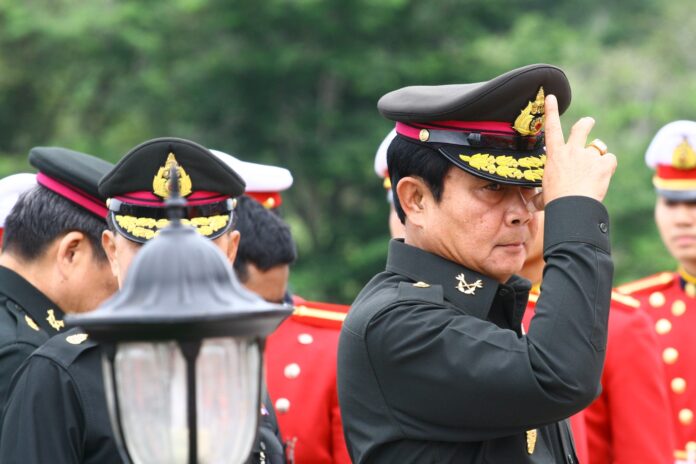
Junta chairman Gen. Prayuth Chan-ocha speaks Friday at the Chulachomklao Royal Military Academy north of the capital in Nakhon Nayok province.

BANGKOK — It came as little surprise Friday when junta chairman Prayuth Chan-ocha announced he will vote for the constitution drafted under his military regime when it’s put to vote Sunday.

But the sight of the former army chief in a crisp army uniform for first time since he retired from the military nearly two years ago did raise eyebrows, and one academic believes Prayuth was seeking to dispel any doubts the armed forces are still in charge.

Prayuth made his remarks at a ceremony marking the 129th anniversary of his alma mater, the Chulachomklao Royal Military Academy, Friday north of the capital in Nakhon Nayok province. He was flanked by ministers also wearing military uniforms.

“I will participate in the referendum as a citizen, and I will endorse the constitution draft, and the extra question,” Gen. Prayuth said, referring to the second ballot item which asks voters whether they will allow for five years the Senate, which will be mostly comprised of junta appointees, to select an unelected prime minister.

Prayuth, who heads the junta, aka the National Council for Peace and Order, cast Sunday’s vote as a choice between stability and uncertainty, and the best way to put Thailand on track to promised elections next year.

“I am not painting a scary picture, but I want to raise awareness of how we are going to live in the future,” Prayuth said. “What’s about to happen in the next two days will be the future of the country … I don’t want anyone to use the same problems to cause a new round of conflict, because today, everything’s better already.”

Who’s the Boss
Prayuth’s Vote Yes position is unlikely to surprise anyone. The charter’s drafters were handpicked by the NCPO, and the government pulled out all the stops in a PR drive touting the new draft constitution’s features.

Chulalongkorn University lecturer Pitch Pongsawat said the speech wasn’t the real message Prayuth was sending – but one of sartorial authority in his choice of clothes.

“I don’t care much about what he said. The point is, he wants to show that he’s still in charge of the NCPO, and the NCPO remains the political wing of the army,” said Pitch, a political scientist who’s written about coups and the military. “Today he not only revealed his stance but also stressed it beyond all clarity that the military is in charge of the country.”
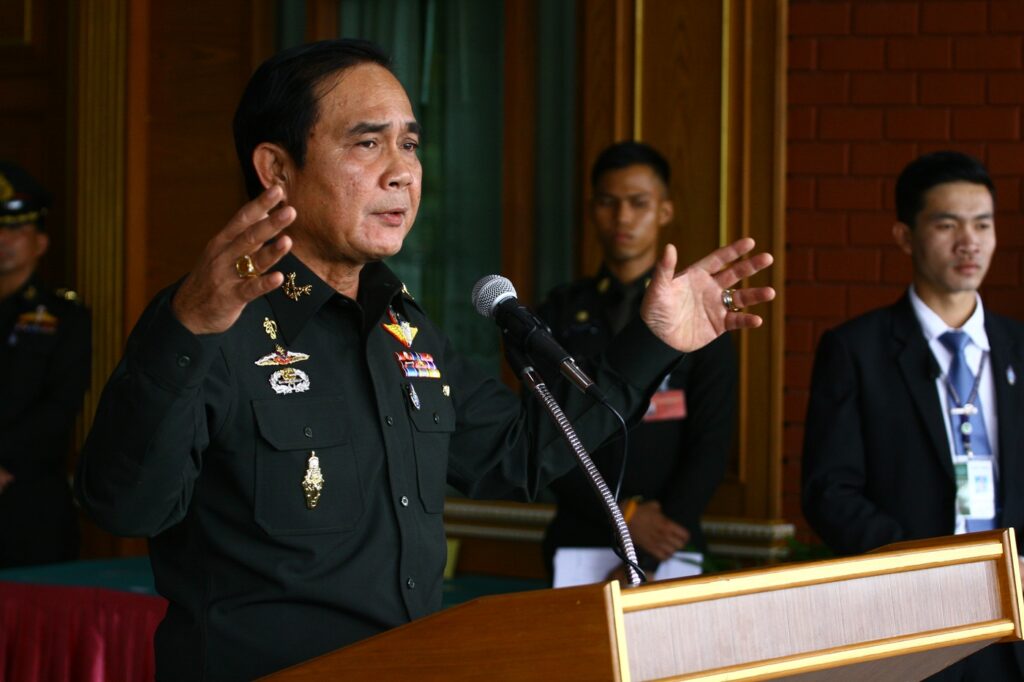
Junta chairman Gen. Prayuth Chan-ocha speaks Friday at the Chulachomklao Royal Military Academy north of the capital in Nakhon Nayok province.

There really was no more direct way to make the point, Pitch added.

“This is the clearest signal one can ever give before the referendum: That the army still has political power in this country,” he said.

The last time Prayuth donned his uniform in public was for the September 2014 military parade honoring his retirement from the army he led at the time. Since then, Prayuth has tried to strike an appearance of civilian authority, dressed in either in Western suits, traditional silk suits or civil servant khakis.

Nothing to See Here
However, a historian disagreed, saying that instead of strategy, Prayuth was simply expressing his natural bravado.

“There’s no signal. He’s a retired military officer, so he has the right to wear a uniform,” said Suthachai Yimprasert, who teaches political history at Chulalongkorn University. “He didn’t mean to imply anything. He went to an event, and he said whatever he felt like saying, as usual.”

Suthachai contrasted Prayuth with Prem Tinsulanonda, the former prime minister and retired military commander who abruptly donned an army uniform in the midst of the 2006 political crisis to tell army officers their loyalty lay with the monarchy and not the elected government. Some analysts said Prem’s speech helped pave the way for the royalist coup that ousted then-Prime Minister Thaksin Shinawatra two months later.

“It was totally a different context. Prem was a very quiet man. He thought a lot before saying anything, so he made a big surprise … but Prayuth talks every day,” Suthachai said.

The historian also believes Prayuth’s martial gesture today won’t have any impact on whether people vote yes or no.

“There won’t be any impact. Even for the army, there won’t be any impact,” Suthachai said. “That’s because the current army chief is more important than a former army chief.”

Pitch agreed it was unlikely to sway opinion.

“I think everyone’s already made up their mind, but they won’t say it in public,” Pitch said.
Advertisement

‘Yes’ Vote For New Charter Will Entrench Junta

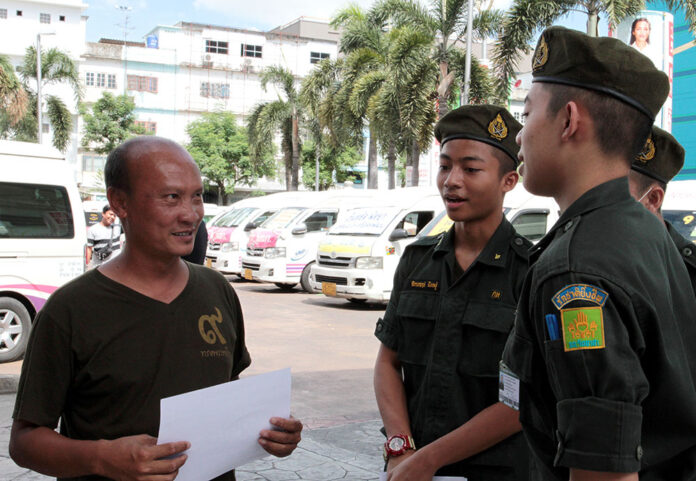
Trainee reservist officers from the Territorial Defense Command speak to a citizen June 14 in Bangkok about the importance of voting in Sunday's referendum. Photo: Vicky Ge Huang / Associated Press

BANGKOK — Sunday marks one of the most important votes in Thailand’s history, yet there have been no political rallies, no independent campaigns and virtually no debates. The junta made sure of that.

“Yes” votes on a new constitution and an accompanying measure would keep the military government in control for several years and enshrine a watered-down democracy that gives much power to appointed rather than elected officials. More than 100 people who tried to campaign against the referendum on social media have been thrown in jail, and open criticism has been made punishable by up to 10 years in prison.

“The lack of open campaigning is effectively a one-sided campaign. The intention is to have campaigns for the constitution, not against the constitution, because a lot of credibility is on the line for the junta,” said Thitinan Pongsudhirak, a political analyst at Bangkok’s Chulalongkorn University. “But it also means it has boomeranged because the other side now has gathered some steam, and now we are seeing more anti-charter movement rising.”

The junta, which came to power in a May 2014 coup, claims the new constitution will usher in a new era of clean politics and stable democracy in a country chronically short of both in recent years, sometimes sliding into violent internal political conflict.

Critics of the draft constitution have a long list of objections.

Chief among them: For at least a five-year “transition” period, the Senate will be a 250-member body whose members would be appointed by the junta, and include the commanders of the army and other security services. A deadlock in the 500-member elected Lower House could trigger a combined session of lower and upper chambers that could select a prime minister who is not an elected member of Parliament.

Also, emergency decrees enacted by the junta without any parliamentary consent remain valid as law. So-called independent bodies, stacked with conservative appointees, would hold “disproportionately broad and unchecked powers” that hang like a Damocles sword over elected politicians, said the international human rights consortium FIDH and the Union for Civil Liberty in Thailand.

“The draft charter creates undemocratic institutions, weakens the power of future elected governments, and is likely to fuel political instability,” they said in a report.

Even if Thais vote “no” Sunday, the military will remain in control for the foreseeable future. Junta leader Prime Minister Prayuth Chan-ocha has promised to hold elections next year, without elaborating on how that would happen if voters reject the draft constitution.

“I have no intention of holding on to power. I always said that we will have an election in 2017. … We want the country to move forward and figure out ways to have stability for at least five years,” Prayuth said Friday.

“If I was a real dictator, I would have not allowed the referendum or promised to hold elections.”

Thitinan said a “no” vote “would be a setback to the credibility of the junta, certainly, but it’s not going to see the back of them. They have insisted to remain in power. A “no” vote will mean we start over.”

Thailand has endured 13 successful military coups and 11 attempted takeovers since it replaced absolute monarchy with a constitutional monarchy in 1932.

Leaders of the latest coup say political conflict had made the country ungovernable and that military rule was necessary to bring stability. It set up hand-picked committees to craft a charter that would enshrine its declared goal of reforming politics by eliminating corruption.

Norachit Sinhaseni, a member of Constitution Drafting Commission, said Thai people “feel there is a lot corruption going on, money is being wasted and a lot of it is going into the pockets of politicians. So what they want and what we are trying to do is have a cleaner government, have better politicians who view the interests of the people at heart.”

Some other observers believe the draft constitution has a different aim: to weaken allies of former Prime Minister Thaksin Shinawatra, the central figure in a battle that has roiled Thai politics since 2006.

Thaksin’s political machine has easily won every national election since 2001, relying on the support of working-class and rural voters who benefited from the populist policies he implemented. Leading the other side is Thailand’s traditional ruling class, royalists unnerved by the political support Thaksin commands, especially as it contemplates its future. King Bhumibol Adulyadej, whose righteous rule has anchored the kingdom since 1946, is 88 and ailing.

The army ousted Thaksin in a 2006 coup, saying it needed to keep order after his so-called “yellow shirt” critics took to the streets, accusing him of abuse of power, corruption and disrespecting the king. He has lived abroad since 2008 to avoid prison for a corruption conviction that he says was politically motivated. The 2014 coup ousted his sister Yingluck Shinawatra, who was elected prime minister in 2011 but buffeted by protests sparked by legislation that would have pardoned Thaksin.

Thaksin, a telecoms billionaire, came to power by taking advantage of provisions in Thailand’s 1997 constitution, generally acknowledged as the most democratic in the country’s history. Crucially, that charter sought to stabilize the polity by curbing smaller parties that routinely sold their support to join ruling coalitions.

Those who brought Thaksin down now seek to weaken major political parties, which would ensure that real power stays in the hands of what is dubbed the permanent bureaucracy: the military, the courts and other unelected guardians of the conservative status quo.

Thitinan, the political scientist, said their premise is that elected politicians are the root of Thailand’s problems, so it is important to check their power.

The draft constitution would make it “very easy to disband parties, keep politicians in line, impeach politicians, and it will enforce a coalition government of weaker, smaller parties,” he said. “As a result, we will see power and authority shifted away from elected representatives to appointed agencies and individuals.”

Chaturon Chaisang, who served in the Cabinets of both Thaksin and Yingluck, told The Associated Press that his biggest objection is that “the draft charter will not allow Thai people to determine the future of this country.”

The referendum vote, he said, “will be meaningless, so the government after the election will not respond to the needs of the people and so there will be conflict in the future.”

Story: Grant Peck, Jerry Harmer


Advertisement

From Sauron to Shawshank, If Thailand Were a Story ….

We’ve heard from the officials, politicians and pundits.

With three days left before polls open, let’s consider the charter referendum’s significance in the greater national story.

For that narrative, we turned to several top artists, filmmakers and writers with one question: If the referendum were a story, which would it be?

Here’s what they said.


In Movies …

The Shawshank Redemption

Winyu “John” Wongsurawat is one-half of the immensely popular online satire show “Shallow News in Depth” or “Jor Khao Tuen.

For the film which best reflects today, John chose 1994’s “The Shawshank Redemption,” saying the public is the film’s Tim Robbins, a banker sentenced to life for murdering his wife and her lover despite professing his innocence.

Winyu ‘John’ Wongsurawat. Photo: @Johnwinyu / Twitter

“The main protagonist … represents the people who have done nothing wrong but are imprisoned by the authorities,” John said. “The tragic part is that the time lost during this period cannot be regained.  He’s among those who fall victims in society, but when the right time comes, he’ll stand up and liberate himself.”

He said the two can be linked by a “submission to injustice.”

“The referendum is just a fragment revealing how the authorities exercise their power,” John said. “Still, the movie’s main idea reflects people’s submission to injustice. Society is supposed to operate under the principle of rule of law, however, we’re ruled by laws under the current authoritarians, who make up new laws to serve their purposes.”

Like the film, he hopes the story ends with some measure of justice.

“I truly hope that one day we’ll be free from this vicious cycle, and that also the wrongdoers will be punished, which is a rare occurrence in Thailand,” said the the 30-year-old host.


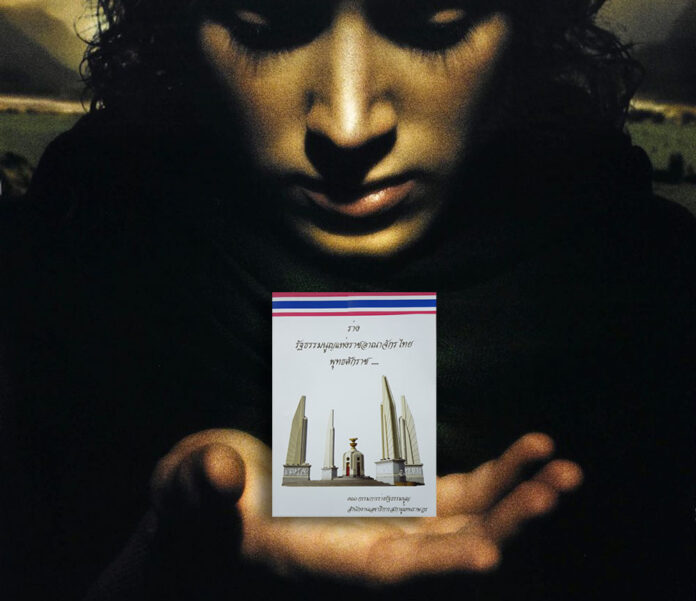
The Lord of the Rings

‘One Ring to rule them all.
One Ring to find them,
One Ring to bring them all and in the darkness bind them.’

J.R. R. Tolkien’s precious trilogy retold at the millennium’s turn by Peter Jackson, The Lord of the Rings, was chosen by prolific performance artist Teerawat “Ka-ge” Mulvilai.

The B-Floor Theater director known for politically provocative works said it makes sense, given the referendum’s contents and slow burn.

“Article 44 is like the Dark Lord Sauron controlling people with his ‘Evil Eye’ surveillance, which can spot any action against him,” Ka-ge said. “The ring is similar to the constitution or referendum, and conceals a dark power. Once you try it, you’ll be under its charm.”

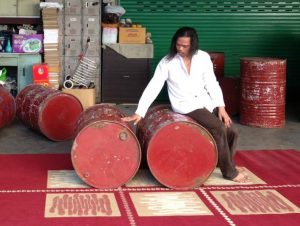
Teerawat “Ka-ge” Mulvilai Rehearsing 'Red Tanks' for the Ansan Street Arts Festival in a photo posted May 2. Photo: B-Floor Theatre / Facebook
Teerawat “Ka-ge” Mulvilai Rehearsing ‘Red Tanks’ for the Ansan Street Arts Festival in a photo posted May 2. Photo: B-Floor Theatre / Facebook

Running with it, Ka-ge went on to compare activists to hobbits and the military to the Ringwraiths held under the dark lord’s thrall. He’s obviously intimately familiar with Tolkien’s rich world.

“However, once people realize the ring’s evil, they try to destroy it like the Vote No allies such as [the New Democracy Movement] that try to warn people of its harm. However, every time they try to speak up, the Nazgul will try to shut them up.

“The superior and beautiful beings such as the elves are ignorant and try to be neutral, but some nonconformists see the effect of what’s happening in the world and decide to join forces with the Fellowship,” he said. “Or Arwen, who gives up her immortality to be with the love of her life. On the contrary, there’s someone who loves the ring dearly and can die for it, like Gollum.

“In creating such a powerful ring, are we giving extreme authority to someone? Isn’t this One Ring in fact made for just one person to wear, after all? The ring should be forged into 60 million pieces, so that everyone is given equal power and voice, not just letting someone hold the reins.”


The Purge: Election Year

The dystopian America of 2016’s “The Purge: Election Year” was the most obvious choice for documentary filmmaker Nontawat Numbenchapol. The movie franchise, now in its third bloody installment, is about an annual 12-hour period during which all crimes are legal.

“I’ve just watched the movie and found some similar logic structure in our current political situation,” Nontawat said. “I think the main challenge of democracy in Thailand is that we don’t respect international norms and instead strictly adhere to abstractions, such as virtue and morality.”

Director Nontawat Numbenchapol. Photo: Nontawat Numbenchapol / Courtesy

“After the introduction of democracy in 1932, situations similar to [the film] frequently occur: The exercise of power and violence, which leads to the killing of fellow citizens or other illegal acts in one day, which cannot be legally prosecuted,” said the 33-year-old director.

Or, even less metaphorically:

“The Ancien Regime tries to draft a law to make their people subservient and maintain their power,” he said. “Although it’s illegal in reality, they try to legalize it, which leads to repression and a class gap in society.”


In Books …

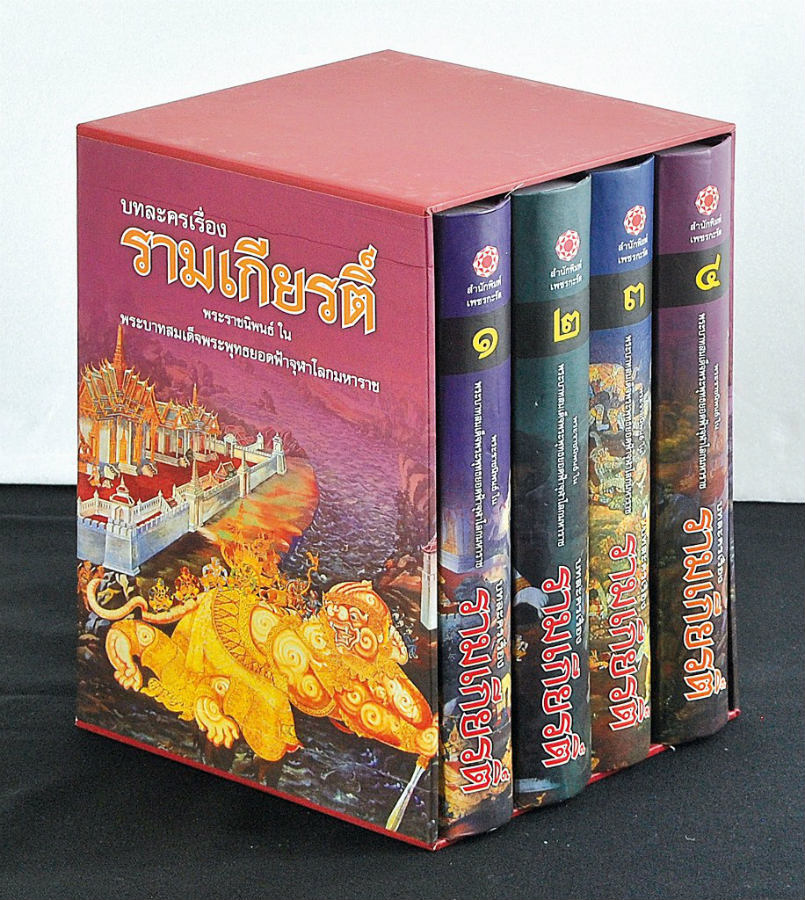
The Ramakien

A Ramakien boxset of a version originally issued by King Rama II. Photo: Rimkhobfabooks

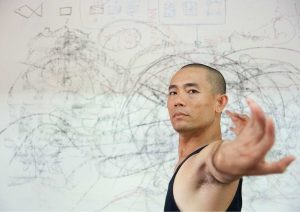
For a dance artist and choreographer who provokes the old guard with contemporary interpretations of traditional dance, Pichet Klunchun insists nothing less than the national epic of  Ramakien can explain the referendum.

Pichet Klunchun in a photo posted June 21, 2015. Photo: Pichet Klunchun Dance Company / Facebook

A localized retelling of the Hindu Ramayana, Ramakien focuses on Phra Ram (Rama), an incarnation of Vishnu, and his ultimate battle with evil in the form of Demon King Thotsakan, a story in the DNA of all Thai narrative (Spoiler alert: Good conquers evil).

“The Ramakien is similar to the upcoming referendum, as it cannot be criticized,” said Pichet, whose own works have taken divergent approaches in retelling the national fable. “The epic is written ideally and unrealistically, as all characters are divine. Those deities warred and raged in the past about things mundane people have nothing to do with, but still they are taken as pawns.”


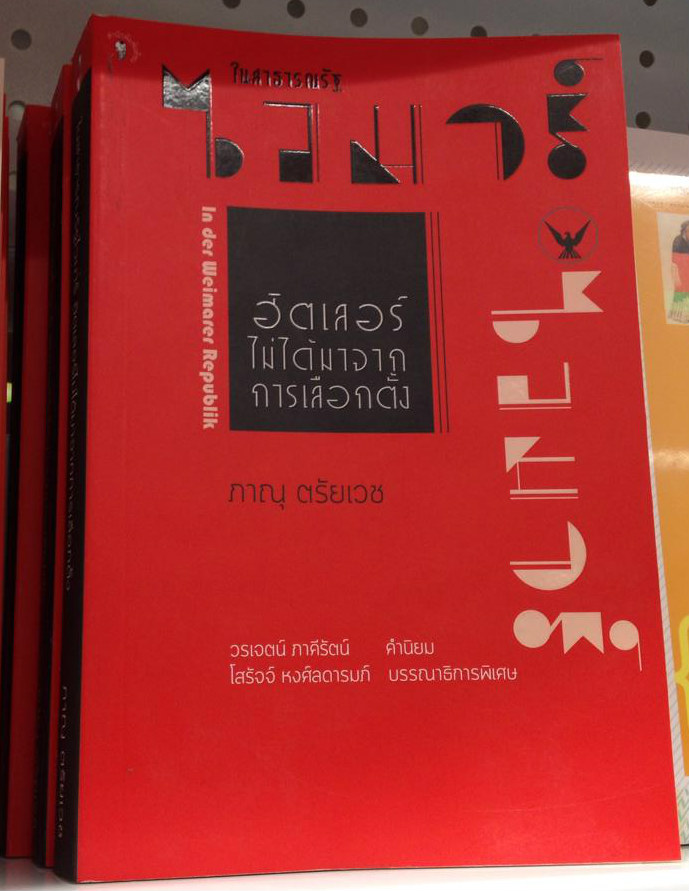
In the Weimar Republic

Panu Trivej’s ‘In the Weimar Republic.’ Photo: Matichon

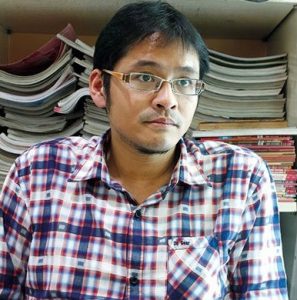
For his take, author Panu Trivej turns to his latest work of nonfiction, “In the Weimar Republic,” as an appropriate match.

“The atmosphere of Thai society now recalls, to me, Germany, 80 years ago,” Panu said, referring to the short-lived, democratic German state from 1919 to 1933.

Panu Trivej, author of ‘In the Weimar Republic.’ Photo: Matichon

“People in that period were introduced to the democratic spirit for the first time and realized that people could think differently and talk about it. And the best system for people to raise their voice is democracy,” said the 35-year-old writer, who researched the topic five years. “Similarly, many Thais weren’t familiar with democracy before and have to encounter it for the first time.”

Panu closed with a plug for his book.

“You might understand the current Thai political situation better if you read the book,” he said.


In Music …

If You Tolerate This Your Children Will Be Next

‘If I can shoot rabbits / then I can shoot fascists’

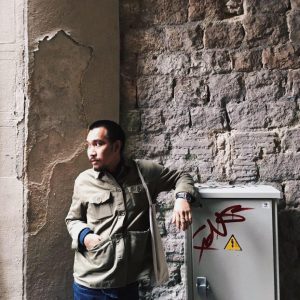
Pondering the referendum, Chiang Mai writer Jirat Prasertsup, a 2015 SEA Write Award shortlister, finds a perfect match in the Manic Street Preachers’ 1998 challenge to the status quo, “If You Tolerate This Your Children Will Be Next.”

Jirat Prasertsup in a photo posted March 15, 2016. Photo: Jirat Prasertsup / Facebook

“I view the referendum as a tool to legitimize the junta’s rule,” Jirat said. “In the past months, if you’re not so ignorant, you must see many situations that reflect the current government’s attempt to coerce people’s opinion toward the referendum and how they handle those who disagree.”

Jirat, 31, was aware of the rock song’s historical origins.

“Actually, the band’s inspiration for the song comes from a slogan of a left-wing brigade fighting against [Francisco] Franco’s military rebels during the Spanish Civil War. But when putting the song into the Thai context, I think the song works very well.”


Advertisement

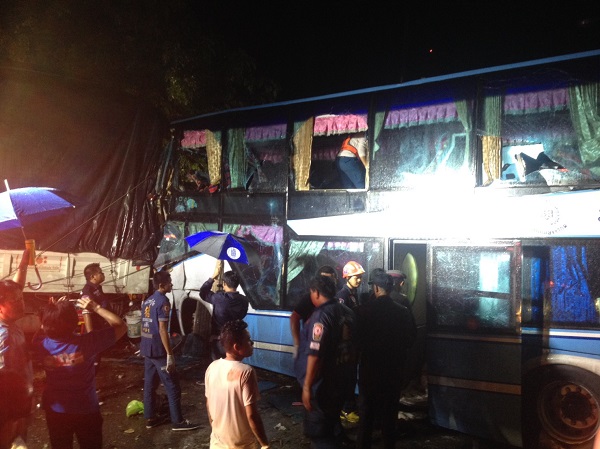
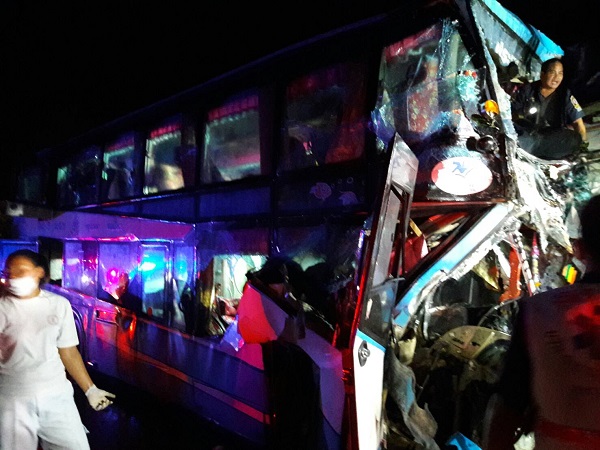
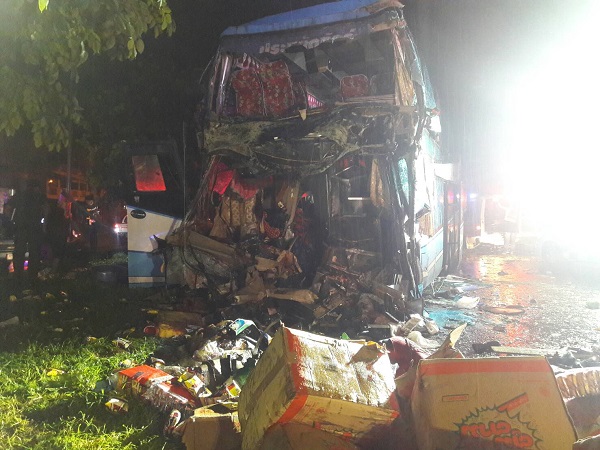
Six Killed When Bus Slides Into Path of Truck

Emergency workers search the wreckage of a bus and 10-wheeler which collided on Mittraphap Road in northeastern Thailand early Friday morning.

NAKHON RATCHASIMA — Six people died after a bus collided with a long-haul truck transporting snacks on a highway in the northeast of Thailand early Friday morning.

Police believe heavy rain made it difficult for bus driver Pichet Kinklang to control the vehicle when it slid into the opposite lane and crashed into a truck on Mittraphap Road at about 1am on Friday. Both drivers and four passengers died instantly, and 40 others were injured.

“About 10 people are still in critical condition,” said police Maj. Wirat Tassaniyom of Nakhon Ratchasima’s Sikhio Police Station.

The bus departed from the Phanom Phrai district of Roi Et province and was on its way to Bangkok when collided with the truck loaded with packaged snacks heading in the opposite direction.

10

11

1 2 4

Advertisement

Gang Rape Leaves Student Dead, 4 Men Arrested

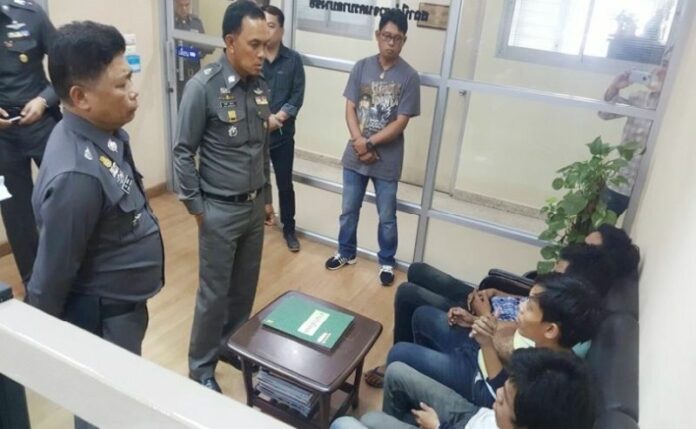
Bangkok police chief Sanit Mahatavorn on Thursday talks to four men accused of fatally raping a 19-year-old college student in Bangkok. Photo supplied by police investigators.

BANGKOK — Four men were arrested on Thursday and charged with sexually assaulting and killing a 19-year-old student at a hotel in Phayathai district.

Police said the four suspects have confessed to sexually assaulting the victim Wednesday night while she was unconscious. She died of heart failure during the assault, according to police.

The four were named as Thawatchai Bupphamatanang, 28; Khettawan Wiwattananont, 21; Kongkrapan Sankhameenoi, 21; and Khanakorn Thong-em, 19.

Witnesses said the victim appeared intoxicated when she was brought to the hotel by four men, according to the police report.

The suspects are charged with aggravated sexual assault resulting in death, the maximum penalty for which is death.

Police identified the victim as a 19-year-old student enrolled at a college in Bangkok, and one police officer said the victim’s family had requested privacy.

“Relatives of the victim do not want to give details to the media,” said Maj. Gen. Charoen Srisasalak, a division commander in the Bangkok police force.

Charoen said the four suspects were sent to court for a custody hearing on Thursday where they were denied bail.

Related stories:

Rape-Murder of Teacher Sparks Public Fury, Again

Justice Ministry Rules Out Death Penalty For Rapists

Murder and Rape Reignites Death Penalty Campaign

Pro-Execution Group Defies Ban On Public Protests

Advertisement

Authorities Anxious About Muslim Critique of Constitution Draft

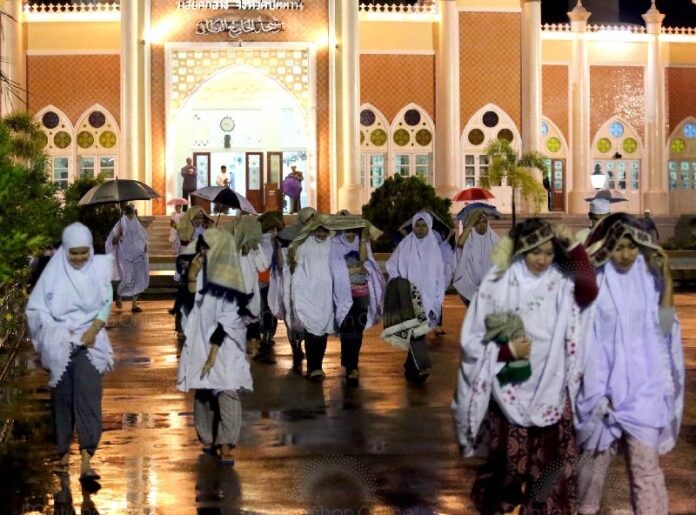
Muslims walk under the rain as they leave a mosque on July 11, 2013, in Pattani province. (Photo: Matichon)

BANGKOK — Governors in every province were asked Thursday to counter rumors circulating among some Muslims that their faith will not be respected in the proposed constitution being put to referendum on Sunday.

In an urgent order issued and made public Thursday, the Interior Affairs Ministry said an audio clip is spreading “distorted” facts about the new charter, though a longtime Muslim politician said officials were overreacting.

Buddhist Scholar Warns Against Establishing National Religion

“Each province must inform its provincial Election Commission and Islamic Central Committee to jointly discuss the issue, arrange a solution and create understanding with the public for them to know the correct facts,” the order said.

It went on to suggest officials ask Muslim clerics to spread the “correct understanding” about the charter’s clause addressing freedom of religion, which gives Buddhism special status but falls short of establishing it as state religion.

The order left unsaid the specific accusations being spread online, other than saying the clip alleged the junta-backed constitution violates the principles of Islam.

Areepan Uttarasin, a former MP who represented his home province of Narathiwat back in the 1980s, said he’s heard the audio clip after someone forwarded it to him over the Line chat application.

According to Areepan the unidentified speaker said the new constitution would only protect Buddhism as a national religion and disenfranchise other minority religions. The clip was shorter than two minutes, the politician said.

“He didn’t exactly distort the constitution. He was merely putting his feelings into his speech. It’s like he was giving his own interpretation of the constitution,” said Areepan, who belonged to a Pan-Islam political bloc called the Wadah. “This constitution uses this kind of language, so people of other religions are upset. And Muslims feel like they aren’t accepted.”

Although the new charter draft, like its predecessors, guarantees freedom of religion, it confers privileged status to Buddhism.

While the previous 2007 constitution broadly instructed the state to “support and protect all religions,” the proposed one specifically calls for the state to spread the teachings of Buddhism. And not just Buddhism in general, but the pro-state Theravada sect only.

The state is further required to defend the sect from any “threats.”

Meanwhile freedom of religion now has a condition: A religion must not “pose a danger to the security of the state.”

Areepen said the state should not overreact to the clip because it’s the interpretation of just one person.

“The state is treating this as a big issue,” Areepen said. “I don’t want them to pay too much attention to this. This kind of issue, it happens. Each person interprets it their own way.”

Related stories:

Thai Army Mistook Islam Summer Courses for Terrorist Meeting

Muslims Slam Allegations of Plot to Destroy Buddhism

BKK Airport Apologizes for Searching Muslim Cleric’s Headwear

Advertisement

Referendum: 95% Cap on Early Voting Returns Raises Alarm

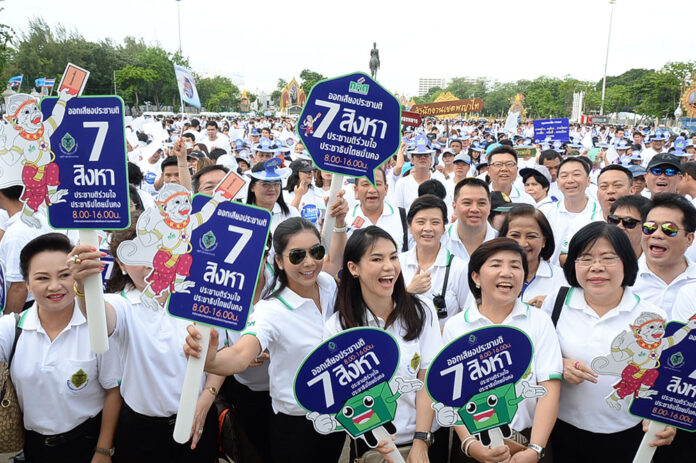
Government employees rally for the charter referendum to be held in three days on Thursday outside the Royal Plaza in Bangkok.

BANGKOK — Some critics remain skeptical of why the Election Commission will stop publicizing electronic returns Sunday evening after 95 percent of the votes have come in.

Concerned the military regime will follow its suppression of debate over the charter with outright manipulation of the polls, critics say the decision to withhold immediate release of 5 percent of the vote, creates, at a minimum, a bad appearance.

Read: How Referendum Sunday is Supposed to Go Down, Step-by-Step

“I am worried,” said Rangsiman Rome, a student leader of the New Democracy Movement. “If the results are unclear it could raise tensions in Thai society. If the Election Commission is slow, people will become tense and fear that rigging may have taken place.”

As some foreign rights groups are dismissing the referendum as hopelessly flawed, even neutral parties such as regional election monitor Pongsak Chanon said it makes no sense to place a cap on the results.

Pongsak, of the Asian Network for Free Elections, stressed that it sows doubts about whether the results will be manipulated.

“Why don’t they just release the count up to 100 percent, or as much as possible? The least we want to see is a full [unofficial] reporting so there won’t be any confusion,” Pongsak said.

Pongsak, whose group ANFREL will dispatch fewer than 10 observers Sunday, said he still doesn’t understand the necessity, even after listening to the rationale.

Days before the vote, Election Commissioner Somchai Srisuthiyakorn revealed that 5 percent of the vote would go unreported Sunday night, an unprecedented mechanism he explained as sparing the possibility of any significant discrepancies between the early electronic returns and the official results to be released by the commission up to three days later.

But given that the margin of victory or defeat may come down to a few percentage points, such discrepancies could prove critical.

For that reason, Somchai warned that the public must wait if the returns prove too close to call.

“If the result is a victory of not more than a million votes, then we’ll have to wait for official results. If it’s more than that, then there’s no need to wait,” Somchai said.

There are about 50.5 million eligible voters.

In reality, he said, he will be surprised to see more than 80 percent of the vote come in through the app, due to technical problems and his belief that about 5 percent of the 95,000 voting stations may lack phone signals.

Somchai has stressed election officials are above the fray and will not permit any regime interference.

The commission has been accused of taking sides before, most notably the last time it was tasked with staging a vote: the 2014 general election disrupted by anti-government protesters and later annulled.

Yingcheep Atchanont of the Internet Law Reform Dialogue, or iLaw, was more circumspect. He said it’s still better to have some rough idea of the outcome Sunday than nothing.

Read: We Took Top Concerns About Sunday’s Referendum to Elections Officials

“But if the official results turn out the opposite of the unofficial count, then they must be able to explain why,” Yingcheep said.

Rangsiman, the student pro-democracy activist, said measures should be taken to ensure that the unofficial votes filed from polling stations through the Rapid Report application are done transparently and in a way that can be independently verified.

Pongsak, the regional poll observer, also wondered the results keyed in through the app could be verifiably matched with the manually counted numbers.

However, a former election commissioner, Gothom Arya, was more sympathetic to the commission’s system. He said those worried something may go wrong should go out and monitor their neighborhood voting stations and take pictures of the posted results for possible random check at a later time.

He doesn’t believe there will be foul play through the app or the unofficial results to come out Sunday.

Somchai said cross-referencing polling station tallies with the Rapid Report results would be impossible, as the app does not publicly report things at the precinct level, only provincial.


‘Vote at the Barrel of a Gun ‘

With the referendum on the junta-backed charter draft three days away, two foreign groups since Wednesday have dismissed the whole process as undemocratic and not genuine.

Charles Santiago, chairman of rights group ASEAN Parliamentarians for Human Rights, issued a strongly worded statement Thursday morning.

“This is not a referendum in any genuine sense of the word. This is not a democratic process. It’s a forced vote at the barrel of a gun following a campaign in which the authorities have sought to actively thwart informed debate,” said Santiago, a Malaysian MP.

His peer from the Philippines, former congressman Walden Bello, also weighed in.

“The junta has failed to heed any requests for a fair and open debate and stubbornly ignored basic international standards for conducting this kind of referendum,” Bello wrote. “It seems that the Thai people are damned if they do and damned if they don’t approve this constitution. Gen.  Prayuth [Chan-ocha] and his council of elders clearly have no intention of willingly ceding their grip on power, and so they have provided the Thai people not with a clear choice, but a dangerous Catch-22.”

Meanwhile, the Paris-based International Federation for Human Rights and its Thai partner, the Union for Civil Liberty, issued a statement Wednesday saying there would be “zero credibility” to the results.

“The NCPO’s manipulation of the constitution drafting process is reflected in a document that legitimizes the influence of the military and unelected elites over Thailand’s political system,” wrote  federation President Karim Lahidji, referring to the junta known formally as the National Council for Peace and Order. “The NCPO’s heavy-handed actions in silencing criticism of the draft charter will result in the vote having zero credibility if the draft is approved.”


Related stories:
Somchai Regrets Taunting Gravity With Ballot Box Bravado
How Referendum Sunday is Supposed to Go Down, Step-by-Step
We Took Top Concerns About Sunday’s Referendum to Elections Officials

Advertisement

Chinese Tourists Rescued from Sinking Boat off Koh Lanta Noi

A family of Chinese tourists landed safely ashore on Wednesday following a rescue effort near Koh Lanta Noi in Krabi province.

KRABI — Navy personnel rescued four Chinese tourists from rough seas after their boat foundered in harsh weather Wednesday afternoon, an officer said.

The boat captain had ignored a rough seas warning to take the four on a tour of islands off the coast of Krabi province prior to the accident, according to Chief Petty Officer Weerayuth Praidam, the officer in charge of the rescue effort.

“There’s already a warning for small vessels not to leave the shore, but the captain probably thought it was okay because at first the sky was clear,” Weerayuth said Thursday. “But when the boat was headed back to shore, the weather took a turn for the worse.”

The boat reportedly hit a particularly rough wave that splintered a wooden deck plank, prompting water to rush in. The captain phoned for help and a navy personnel were dispatched from a garrison on nearby Koh Lanta Noi.

The four tourists suffered slight bruises but were otherwise in good condition, Weerayuth said. He added that the boat operator will not be charged for ignoring the weather warning.

“The tourists weren’t upset. They understood it was an accident, so they didn’t file any complaint to police,” Weerayuh said.

Related stories:

5 Chinese Tourists Injured in Speedboat Collision

28 Injured in Koh Samet Speedboat Crash

2 Tourists Killed in Phi Phi Speedboat Collision

British, German, Chinese Women Die in Yet Another Speedboat Tragedy

Advertisement

Two-Week Reprieve for 4 Busy Street Markets

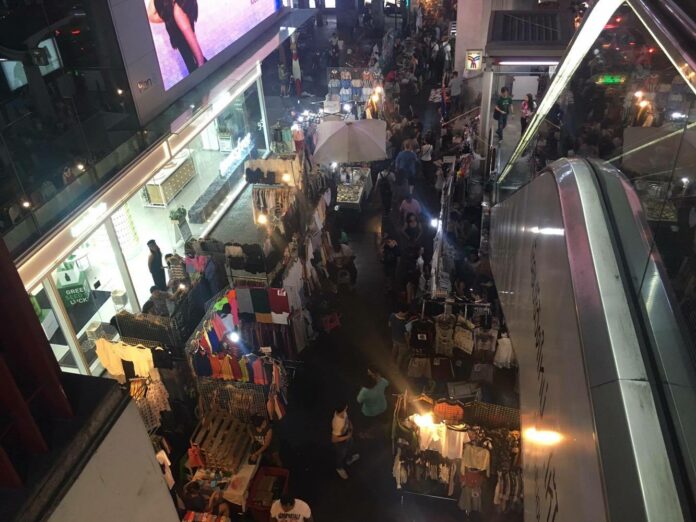
Street stalls selling fashion apparel at the end of the escalator leading up to BTS Siam.

BANGKOK — The bark of City Hall’s ultimatums have proven worse than their bite, with downtown street vendors in four locations granted extensions.

Despite insisting for months it would not reconsider its deadlines, the city’s Vallop Suwandee announced Tuesday that City Hall would extend its Monday demand for street vendors to leave four major areas – Pratunam, Ratchadamri Road, Siam and Silom Night Market – to Aug. 15.

Tuesday’s announcement was made a day after the Aug. 1 deadline came and went with no apparent effect. The four areas currently accommodate more than 2,500 vendors altogether, who are continuing to sell normally.

The Bangkok Metropolitan Administration says its campaign to remove street vendors from public sidewalks is aimed to improve traffic for both cars and pedestrians. Critics say it is trading away the capital’s charms for the sake of cleanliness and order.

A fifth location, the Saphan Phut Night Market, had previously been served a July 17 eviction notice, but Vallop said its 350 vendors will be allowed to set the shop under along the riverfront Saphan Phut Road between the Memorial and Phra Pok Klao bridges until Sept. 12.

Next up, Vallop also, are vendors along the length of Sukhumvit Road, from its start at Soi 1 all the way out to Bang Na. He said stall owners were told to move out by Sept. 5.

Related stories:

Sidewalk Showdown: City Won’t Budge on Ultimatum to Liberate Siam Footpaths

Say Goodbye to Night Market Vendors on Silom Road

Pratunam’s Flashy, Trashy Fashion to be Swept Away

Advertisement

Experimental Expression Asks What People Really Think About Design

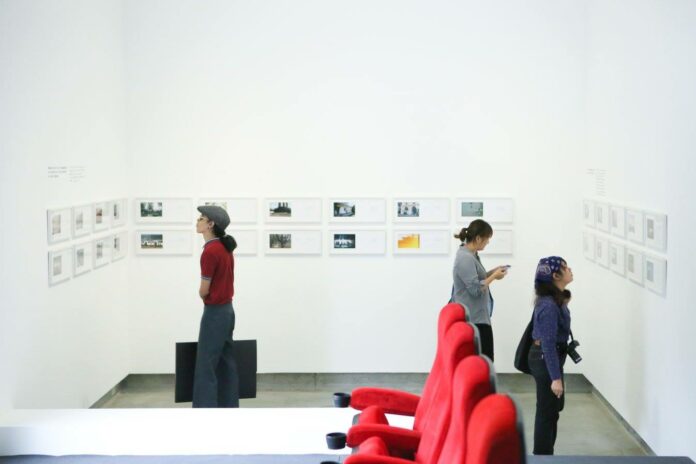
Photo: Bangkok CityCity Gallery / Facebook

BANGKOK — Individual voices about design scene in Thailand will be collected, printed onto posters, and hanged on a Bangkok gallery’s white walls for one month.

Frustrated by the design community he’s part of, ardent zinester and independent book publisher Grisana “Chris” Eimeamkamol is inviting his peers to have their candid opinions published for all to see on the walls of Bangkok CityCity Gallery.

All relevant thoughts submitted online will be printed by Chris into three copies. One for its creator, one to show at the gallery and a third for Chris’ archive. Got a provocative political message to share? Don’t expect it to be printed.

At Chat Room, the statements will be displayed in an open space on large-scale paper sheets. All statements will be published anonymously unless a name was submitted along with the text, Chris said.

Seeing inequality in who can express themselves when age, class and profession are accounted for, Chris said he wanted to create an open-ended platform where everyone can discuss a topic anonymously and ideas were evaluated for their merit alone.

Four years after returning to Thailand from Australia, Chris said he hasn’t seen much progress in the design community beyond a lot of good talk that doesn’t lead to action.

“There might not be a resolution to problems, but raising questions and arguments in public should at least be progress,” the 25-year-old graphic designer and founder of CEO Books said.

Chat Room will run Aug. 17 to Sept. 11 at Bangkok CityCity Gallery. Be there as the messages are printed and posted during a 24-hour live production from 2pm on Aug. 17 through 2pm on Aug. 18.

Chris will host weekly events to mark the monthlong exhibition. The details will be posted online by Bangkok CityCity Gallery.

The one-storey minimalist venue is located on Soi Sathorn 1 and can be reached by walking from MRT Lumphini’s exit No. 2.

Advertisement

Hot News

LATEST NEWS

Bangkok
overcast clouds
30.5 ° C
30.5 °
30.5 °
77 %
3.3kmh
100 %
Mon
30 °
Tue
36 °
Wed
38 °
Thu
36 °
Fri
36 °