The Election Commission on July 27 sent a school marching band through the streets of Roi Et province to publicize the Aug. 7 referendum.
CHIANG MAI — A 63-year-old man remained imprisoned Friday, four days after he was locked up for handing out leaflets that urged people to reject the pro-junta constitution in the Aug. 7 referendum.
In what has become a draconian, daily suppression of any dissent in the run-up to the vote to be held in nine days, comes the jailing of Samart Kwanchai, who will stand trial for violating the referendum law, which virtually outlaws any campaign for or against the draft charter.
A member of Thai Lawyers for Human Rights, an advocacy group that tracks civil rights cases under the military regime, said the court set a bond for Samart at 100,000 baht, which he could not pay.
“He has no money for the bail,” said one of its attorneys, Kumklao Songsomboon.
Samart, who’s said to have joined Redshirt protests in the past, was accused of placing Vote No flyers on vehicles in the carpark at Pantip Plaza Chiang Mai on July 21.
“Down to Dictatorship! Long Live Democracy! Vote No on Aug. 7,” was written in the leaflets along with an image of the three-finger salute, an anti-junta gesture many activists adopted from the Hunger Games films.
One of the leaflets distributed by Samart (Photo by Manager Online)
Police arrested Samart on July 23 at his home, where a 400 more flyers were found. He was charged with violating the Referendum Act, which bans any action that “uses rude language” or “misleads people” into voting for or against the charter. It carries a maximum penalty of 10 years in jail.
The military government has made the case that its charter, though unpopular, is necessary to safeguard Thailand from its endemic culture of corrupt politicians.
When police took him for a custody hearing on Monday, his bail was set at 100,000 baht, and Samart. Unable to pay it, he was sent to the Chiang Mai Central Prison to await trial.
Kumklao said the court is required by law to set a bond commensurate with the penalty prescribed by the alleged offense, which in Samart’s case led to the disproportionately high bail.
“Because the text of the [referendum] law has a punishment so disproportionate to the action that’s considered wrongdoing, it affected the bond hearing,” she said.
Samart is one of many people charged for voicing their opinion about the constitution the junta wants the public to accept.
Because of these arrests and the harsh law that governs the referendum campaign, many critics of the military regime say they will not regard the Aug. 7 vote as free or fair.
In this Monday, May 23, 2016 photo, Aedes aegypti mosquitos sit inside a glass tube at the Fiocruz institute where they have been screening for mosquitos naturally infected with the Zika virus in Rio de Janeiro, Brazil. Photo: Felipe Dana
GEORGE TOWN, Cayman Islands — The first wave of genetically modified mosquitoes were released Wednesday in the Cayman Islands as part of a new effort to control the insect that spreads Zika and other viruses, officials in the British Island territory said.
Genetically altered male mosquitoes, which don’t bite but are expected to mate with females to produce offspring that die before reaching adulthood, were released in the West Bay area of Grand Cayman Island, according to a joint statement from the Cayman Islands Mosquito Research and Control Unit and British biotech firm Oxitec.
The mosquitoes will be released over nine months in an area known to be a hot spot for the Aedes aegypti species, which are not native to the Cayman Islands and are the main vector for Zika as well as other viruses, including chikingunya and dengue.
The project had been scheduled in June but the release was postponed first by a delay in getting an occupancy permit for the lab in which mosquitoes are bred and then by a court challenge from opponents who argued that the government had not provided sufficient information about potential risks or adequately studied other alternatives. A judge ruled Tuesday that the effort could proceed.
Oxitec has deployed its mosquitoes to fight Zika in Brazil following initial trials there and previously conducted tests in the Cayman Islands and Panama. Oxitec and officials in the Florida Keys have proposed testing there as well and are awaiting U.S. regulatory approval.
‘I’ve been the one to party, until the end. Looking for the after party to begin I’m going down to … La La Land’ -Green Velvet
Bangkok is known for its vibrant nightlife, but these days it isn’t the 24-hour party city people think it is.
A closing time of 2am can be early for those who like it late, and in the electronic music scene, early closing times prevent DJs from fully working their magic and promoters from making money.
Today the forces of fun are in retreat from the onslaught of killjoys, and venues catering to those who like it late and later are vanishing. Apart from some cheesy dance clubs packed with old foreigners and the women who love them, there aren’t many places to get jiggy to an all-night techno or drum ‘n bass session.
That said, there are still some places for starry-eyed nighthawks to check out.
Here are a handful of late venues, but keep in mind that closing times can change in the blink of an eye and surprise visits from the boys in brown can happen when you least expect it.
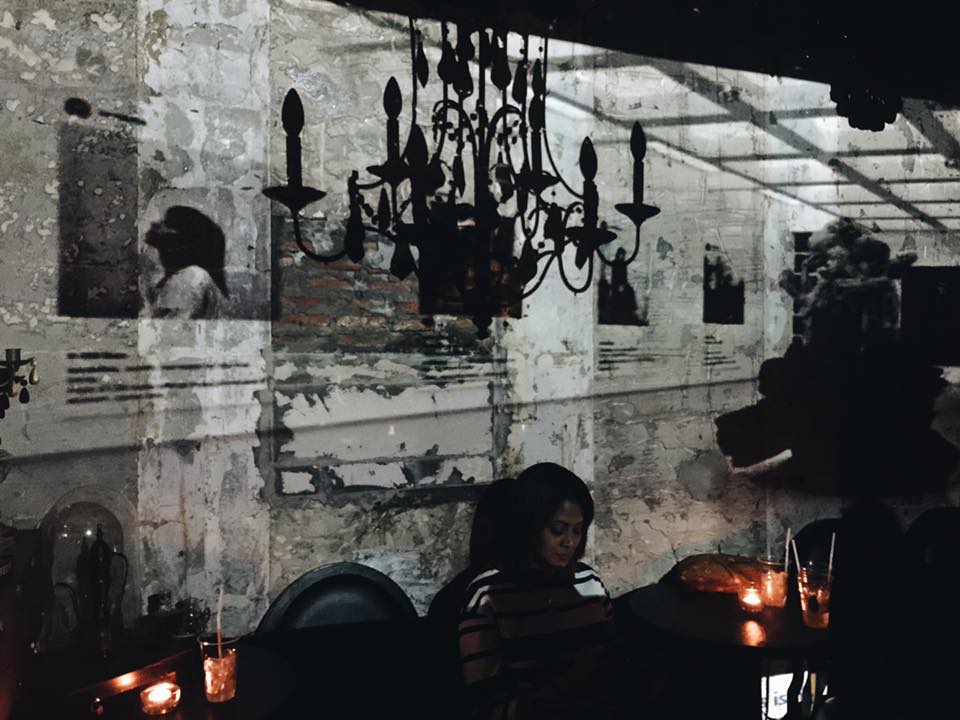
When it opened two years ago, Dark Bar rose to become considered by many the crown jewel of Bangkok’s underground club scene. Low key, tiny and tucked away from view behind a thick metal door on the second floor of Ekkamai’s Liberty Square is where you will find the venue. Inside the interior is raw concrete mixed with a splash of Victorianesque decor. A crystal chandelier hangs on the ceiling while the DJ controls the sounds behind a wooden booth. Once inside, find it’s only big enough to fit a handful of party-goers and on most nights more clubbers are found outside than inside, like bees swarming a hive.
Krit and his crew are known for taking audiences on late night tech house excursions. Chatting with him via Facebook, he told me his reason for giving standard closing times the middle finger.
“We think it’s good to show Thai people that this scene is part of our life and that it should be accepted, also most people arrive at 11pm or midnight; so two hours is not enough time to take the audience on a journey,” he said. “I think people who make the laws aren’t very open-minded. They don’t understand anything we do.”
Considering the work and risk they take, please show some love and pay the 200 baht door fee, even if you just lurk outside the Dark Bar.
2. Whiteline
Grooving upstairs at Whiteline. Photo: Arto
Across town from Ekkamai on Silom Road, near that most famous red light district Patpong, find Whiteline.
Whitelineis a pub, cafe and event space rolled into one. Open for about a year, it’s earned a reputation as a top-notch, late-night haunt thanks to events like the Bukruk festival after-party, which saw hundreds of party people pack the bottom and top floors of the venue. For late-night clubbing, skip the main area and head up to the second floor where all the sweaty dancefloor magic happens. Weekly events are organized by Sun Thappawut aka DJ Sun.
His shindig Back to Normal goes down tonight and features Boogie G (Studio Lam’s Nite Ride) and Maarten Goetheer (Beam regular) on the decks.
Sun told me he was inspired by a recent trip to Berlin to keep the dream alive.
“In Berlin, you can feel that the whole city is living for the scene. They really love and understand the music, while the law in Thailand is too unfair. As a promoter, it’s easy to lose money because of early closing times.”
Though it’s no longer guaranteed to go past 2am, we must include Glow in our journey. Opening in 2005, Glow Nightclub on Soi Sukhumvit 23 was for many years the go-to spot for proper underground music and late-night clubbing. Helping build its fame were the likes of the Phatfunk crew, that for six years has organized some of the best drum ‘n bass nights in Bangkok.
But in recent months Glow has dimmed or gone dark earlier than it used to, so it’s not guaranteed past 2am. Even Phatfunk head honcho DJ Azek said his crew has taken a break from organizing monthly events due to rough times brought by earlier closing times. All hope is not lost though as Phatfunk plans to bring back the vibes come Oct. 17, albeit at a different venue, with special guest Commix.
Tonight it’s the second installment of Inhale vs. Berlin Beats with DJs Sunju Hargun, Felix Moreno and Laurent Haze. Door is 300 baht, includes one drink.
4. Mustache Bar
Photo: Mustache Bar / Facebook
Rising above the sea of Ratchada massage parlors are the relatively new kids on the block at Mustache Bar.
Since February 2015, Mustache has made a name for itself with its techno-only music policy and what had until recently been a reliable destination for those wanting to groove till the wee hours of the morning.
For now the club has to deal with fluctuating closing times and unfortunately has to close much earlier than expected. Mustache promoter and Swedish DJ The Outsider remains positive.
“The scene in Bangkok is remarkably resilient and adaptive, we’ve learned to make the most of what’s on offer.”
On Aug. 28, The Outsider will host Purple Zone, an event focused on Deep Techno beats. Entry is free, so if you’ve blown all your cash buying your mates beer then head to Mustache if you want one last dance.
5. Mad Club
Photo: Mad Club / Facebook
Down the strip at Ratchada 14, find my final pick: Mad Club. With a music policy that leans more hip-hop, the recently opened club on Thursday will host a special guest – American booty-shaking bass pioneer DJ Tittsworth. Tickets are 300 baht at the door.
Have fun, be safe and don’t be mad if they’re closed now, them’s the breaks.
Until next time, Dub be good to you.
TOP: Kontraband at Dark Bar. Photo: Tetsuya Ishikawa
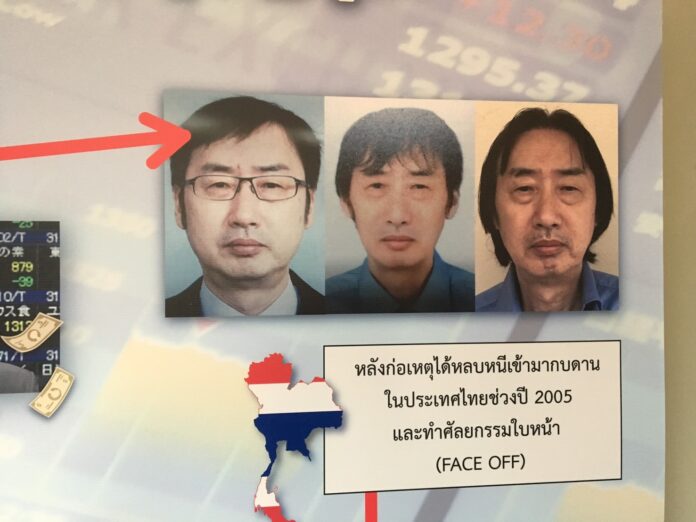
Changing face of Yasuo Tsubaki as shown on evidence board at Friday’s police news conference.
BANGKOK — A Japanese man who police say had his face reconstructed to evade capture for a decade was arrested Wednesday in Bangkok.
Yasuo Tsubaki, 62, wanted by Japanese authorities since 2007 for allegedly fleecing his company of 4 billion baht worth of securities fraud, was nabbed at the Immigration office on Wednesday evening when he tried to renew his visa, authorities said.
“All members in his gang were arrested except Mr. Yasuo, who fled to Thailand 10 years ago,” national police chief Chakthip Chaijinda announced Friday.
Chakthip described the lengths Tsubaki went to avoid arrest for a decade.
“He had a ‘Face/Off’ surgery, so that no one would recognize his face,” he said, referring to the 1997 action film helmed by John Woo.
Chakthip said from 2001 to 2005, Yasuo and his alleged accomplices handled stock speculation for their firm, during which time they embezzled 12 billion yen (roughly 4 billion baht).
A court in Japan’s Saitama prefecture in 2007 issued a warrant for Tsubaki’s arrest. Japanese police later alerted Thai police, Chakthip said, after determining he had gone into hiding in here.
Police said Tsubaki had been living on a retirement visa, which was to expire in September. The Immigration Bureau said he was arrested Wednesday when he went to renew it at the Chaeng Wattana Government Complex.
No details were given as to when he would be extradited to Japan.
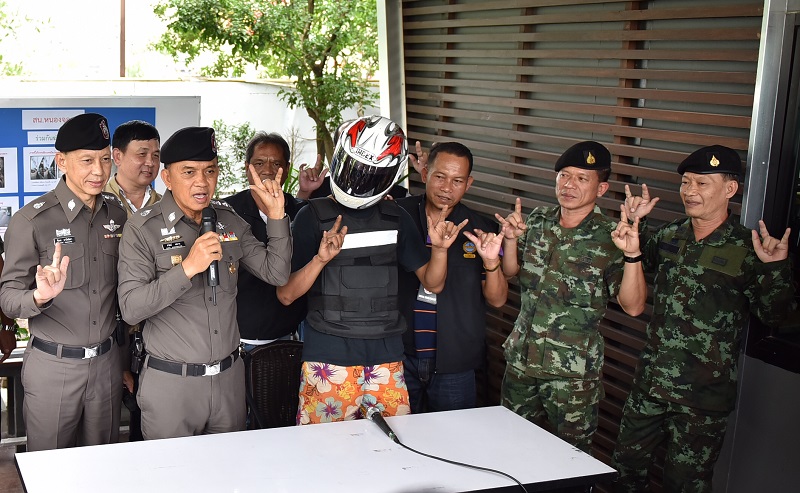
Police Lt. Gen. Sanit Mahathavorn demonstrates techniques for vocational students to make loving gestures when they run into one another instead of fighting in July
BANGKOK — If you see your enemy standing across the street, don’t raise your fist in anger. Instead, Bangkok’s police chief suggests, raise your arm in love.
That was his advice Sunday to vocational students in Bangkok when the chief launched a novel campaign to reduce student gang violence.
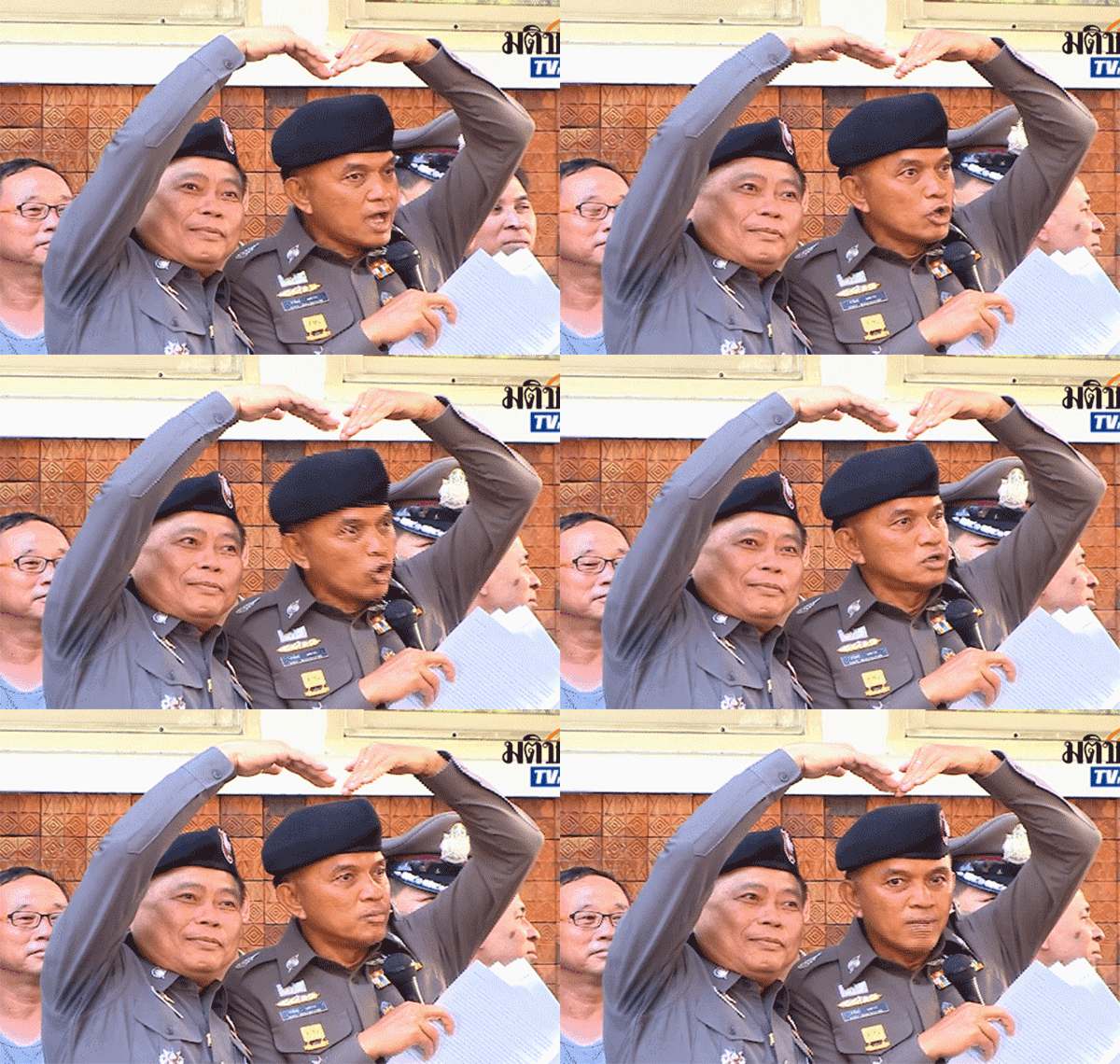
The goofy event, where police Lt. Gen. Sanit Mahatavorn himself demonstrated techniques for students to make loving gestures when they run into one another, from forming air hearts together to signing “I Love You,” drew considerable mirth. But that hasn’t stopped Sanit, who said it’s better to try something new than do nothing and watch children kill each other.
Why all the silly gestures? Sanit said youth need to stop making a very specific gesture that usually leads to brawls.
“You know what the middle finger means,” he said. “I suggest we change from showing ‘The Finger’ to ‘I Love You’ gesture.”
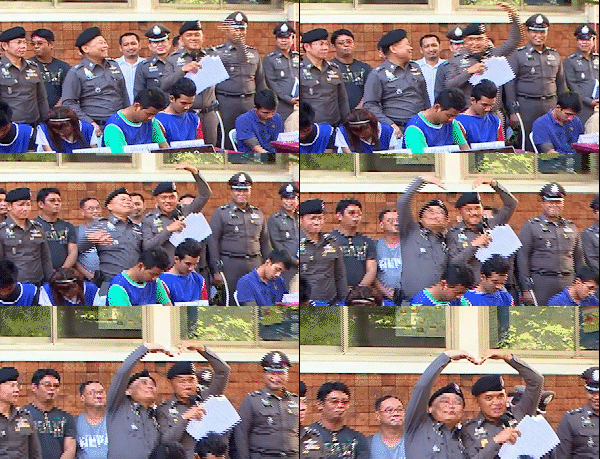
After first introducing the idea about a month ago, Sanit on Wednesday showed some techniques to an 18-year-old vocational student accused of stabbing a rival to death while the teen was performing a police “re-enactment” of his alleged crime. The unreal scene was made even more surreal by the motorcycle helmet worn by the 18-year-old suspect as Sanit introduced him to some loving gestures.
Here are some of the de-escalation techniques Sanit was seen promoting Wednesday and in recent days.
1. ‘ILY’
No, Sanit’s not encouraging teens to “throw the horns” like at a Metallica concert, this sign-language gesture for “ILY” or “I Love You” has gone mainstream.
How to do it: Upon seeing your enemy, follow your first instinct and make that fist. Now raise your index and pinky fingers and stick your thumb out. (Do this with your right hand, and your thumb will form the “L”).
2. Sarang Hae Yo
Most recognizable is the sarang hae yo, the K-Pop-inspired “make a heart with our arms” gesture.
How to do it: Raise your arm in a loving and not angry way before approaching your nemesis. Extending your hand up and forward, bend your wrist downward and then arc your elbow to form one half of a large heart. Try smiling as you wait for reciprocation.
3. The Mini-Heart
Perhaps most surprising was Sanit’s deft demonstration of the “mini-heart,” a gesture not well known outside of fans of Korean soap operas (Sanit said he’s not).
How to do it: Press your thumb into the crook of your index finger. Lower the tip of your index finger onto the side of your thumb, so it looks like they are hugging each other. If done correctly, it should look like a small heart.
“I learned it from reporters,” said Sanit, denying that he personally keeps up on the trends. “These kids are teens. If we teach them something old-fashioned, do you think they will listen? If we want to teach someone, we must adjust ourselves to them.”
Bangkok Police Chief Sanit Mahatavorn, third from left, shows an 18-year-old murder suspet, in helmet, how to make a ‘mini-heart’ with his hand Wednesday in Bangkok.
Along with the gestures, Sanit also introduced many solutions such as searching schools and patrolling potentially risky confrontation spots.
The Metropolitan Police Chief believes such gestures could get more play with the youth demographic rather than pushing them to do a more traditional wai.
And as far-fetched the idea that young toughs will cool their fists and instead make cute gestures at each other, Sanit hopes it could prevent escalation when confrontation occurs.
He knows people may scoff, but Sanit said it’s always better to try something new than to do nothing at all.
“If these gesture can stop five or 10 kids from fighting, wasn’t it worth doing?,” he asked. “If we do nothing, the result is zero.”
Bangkok Police Chief Sanit Mahatavorn, third from left, demonstrates the ‘ILY’ sign Wednesday in Bangkok along with police, military officers and an 18-year-old vocational student accused of murdering a rival, in helmet.
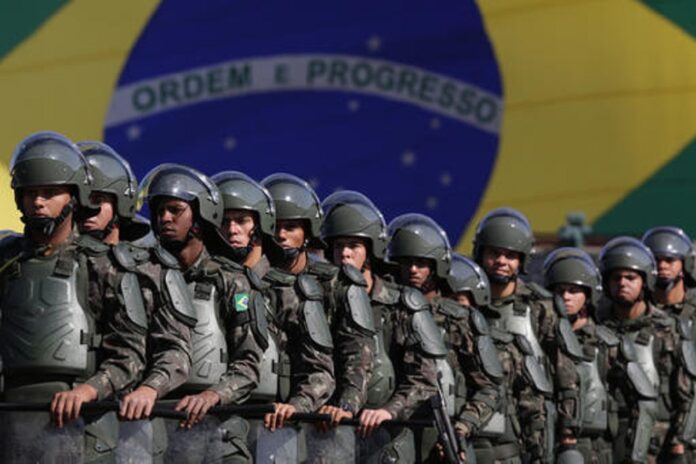
In this July 22, 2016 photo, Brazilian Army soldiers take part in military exercise during presentation of the security forces for the Rio 2016 Olympic Games, in front of the National Stadium, in Brasilia, Brazil. Photo: Eraldo Peres
RIO DE JANEIRO — A half-million foreign tourists, dozens of heads of state and the attention of the world’s media. If there were ever a headache for anti-terror forces, it’s the Olympics.
In the aftermath of deadly attacks by the Islamic State group in France and elsewhere, Brazil, which has almost no experience combatting terrorism, is beefing up security for the games that start in Rio de Janeiro on Aug. 5. Plans include doubling the number of security forces on the streets, erecting more checkpoints and working closer with foreign intelligence agencies than Brazilians did in the 2014 World Cup.
But will it be enough?
Richard Ford, a retired FBI anti-terror expert who lives in Brazil, said that while the government has a robust program to keep athletes and venues safe, he worries that authorities aren’t taking the threat of a lone-wolf or suicide attack seriously enough.
He cited comments by Justice Minister Alexandre de Moraes, who surprised many last week by saying the chances of a terror attack at the games were “next to zero” and that the bigger concern is street crime. Just a day later, the federal police overseen by Moraes arrested 10 Brazilians allegedly belonging to an amateur cell that had professed allegiance to ISIS over the internet.
“It’s very naive to think that the risks for terrorism are minimal,” said Ford, who has worked on security at several Olympic Games. “In the last year, the risk of a terrorist attack has gone up exponentially everywhere.”
Terror attacks have been rare, if horrifying at past Olympics. The most notorious was the 1972 massacre of 11 Israeli athletes and a police officer by a radical Palestinian group in Munich. A bomb planted by an anti-abortion protester killed one and injured 111 at the 1996 Games in Atlanta.
“But Brazil has a lot of problems that other countries don’t have,” Ford said. “It’s sort of a perfect storm for anyone wanting to carry out an attack.”
South America’s first-ever games have been plagued by a long list of problems, from the Zika epidemic and severe water pollution to slow ticket sales and questions about the readiness of infrastructure built for the games.
Compounding the security concerns is the deepest recession in decades, which has forced the cash-strapped Rio state government to slash spending and delay paychecks, and a distracting political crisis that led to the removal of President Dilma Rousseff while she faces an impeachment trial. To make up for the shortfall, the federal government has had to step in with almost $1 billion (around 34 billion baht) in emergency funding, much of which will be devoted to security. Extra police are also being deployed from other states.
Many of Brazil’s security holes are ancient and hard to resolve. Long, porous borders it shares with 10 countries are a major conduit for arms and drug smugglers. Obtaining an assault rifle, or explosives, is easy from the criminal gangs that dominate Rio’s hillside slums. Last year, thieves even managed to steal a truck carrying a ton of dynamite.
Harder to explain, though, is the late start on hiring security screeners. An investigation by The Wall Street Journal this month found that Brazil’s government waited until July 1 to award the contract to recruit and deploy thousands of security guards at Olympic venues, raising questions about whether screening procedures were rigorous for people who will be tasked with monitoring x-ray machines and performing pat-downs. The security contract for the 2010 Winter Olympics in Vancouver was awarded 10 months in advance.
To be sure, Brazil isn’t a newcomer to hosting mega-events. Every year it welcomes millions of foreign visitors during the weeklong Carnival celebration, and the 2014 World Cup went off with no major incidents.
But it has almost no experience fighting terrorism. The country has long prided itself on having an enemy-free foreign policy, one that rejects military intervention.
Not surprisingly, many Brazilians are on edge as the military buildup at airports and elsewhere become more evident. There have also been several bomb scares. The ritzy beach neighborhood of Leblon shut down streets for several hours last week after discovery of a suspicious bag that turned out to contain only clothes.
“I never felt like this about terrorism before. I only worried about street crime,” said Fernanda Rocha, a pharmacist in Rio. “I have no idea how to avoid terrorists if they come.”
Despite Brazilians’ easygoing attitude, better suited for a street party than an urban lockdown, Ford said there have been major improvements since the 2014 World Cup. Training exercises with U.S. and other foreign militaries to deal with chemical, biological and nuclear attacks have become more frequent. A joint-intelligence center has been created for the games, allowing intelligence services from around the world to share information and investigate threats as they emerge.
Precisely because of Rio’s reputation for criminality, elite police units are more battle-tested than their counterparts in major U.S. cities.
“They’re used to carrying bigger and stronger guns than we are,” said Bobby Chacon, a retired FBI agent who makes his home in Rio and spent a year running security at the 2004 Games in Athens.
There are expected to be 85,000 military personnel and police fanning out across the city, double the number on the streets in London in 2012. While most will be concentrated at sporting venues, tourist landmarks will also be heavily patrolled.
“They have the police in place and trained to stop a large-scale, coordinated attack,” Chacon said. “But there’s plenty of opportunities to cause harm, and they shouldn’t take anything for granted.”
Khaosod English has removed a July 28 article about an official’s objections to a story which appeared in European media about circumstances under which the Aug. 7 referendum might be canceled.
The story was ordered changed per instruction from Khaosod’s editorial management, who feared that content in the article might lead to legal action.
Rather than further censor the story, Khaosod English has opted to remove it in its entirety. We regret the necessity.
As a news agency based in Thailand, Khaosod English is obliged to comply with Thai law. However, we strive to serve the public interest by presenting objective, accurate news reports.
Former Prime Minister Abhisit Vejjajiva speaks Wednesday at Democrat Party headquarters in Bangkok. Photo: Matichon
BANGKOK — Opponents of the draft charter reacted harshly to Wednesday’s snubbing of the proposed constitution by none other than Democrat Party leader Abhisit Vejjajiva.
A day after Abhisit, a former prime minister, announced he would vote to reject the charter, critics faulted him as either an unabashed supporter of ongoing military rule, or worse, a shill trying to save face and prepare a “soft-landing” for the junta should a majority of the electorate agree with him.
“I believe the reason why he came out late is because he waited until he realized the wind was blowing in the direction of the Vote No camp,” said Rangsiman Rome, a student leader of the New Democracy Movement, which has campaigned against the charter draft.
Rangsiman said the move was simply opportunistic.
Abhisit said the proposed constitution would guarantee fewer rights and freedoms than previous charters and would not help to solve Thailand’s problems.
In his Wednesday announcement though Facebook Live, Abhisit walked a fine line, saying he was speaking as party leader but the announcement came not from a formal party resolution, as it is banned from meeting by the junta.
Abhisit also expressed concerns about the bigger role of the unelected senate laid out in the charter, saying it would lead the kingdom into political conflict with elected MPs. What’s more, Abhisit said, mechanisms to check and eradicate corruption have been weakened and contain loopholes.
Though Abhisit rejected the charter, he said the man who appointed its authors, Gen. Prayuth Chan-ocha, should stay on to oversee another drafting process if it goes down in defeat Aug. 7.
A member of the rival Redshirt movement and a former chairwoman of its umbrella group, the United Front for Democracy Against Dictatorship, described Abhisit’s announcement as a mixed bag.
“It’s good news in the short term but bad news in the long term,” said Thida Tavornsaet Tojirakarn, whose group opposes the charter draft.
Thida said Abhisit’s announcement is initially good news because it may encourage more people to vote against the charter draft, but is bad news in the long run because Abhisit gave carte blanche to the junta to restart the drafting process again for a third time.
“He still wants to see dictatorial power,” Thida said.
She said she believes he’s sided with the junta.
“He is not resisting the NCPO,” Thida said referring to the National Council for Peace and Order, the formal name of the military junta which staged the 2014 coup. “Whether the charter gets approved or not, the NCPO maintains the right to draft it anew. He’s not making himself an enemy of the NCPO. Actually he’s on the side of the NCPO and wants it to stay on longer.”
Another ranking member of Abhisit’s party said the lateness in timing was because the party’s wanted to avoid contributing to political conflict on the matter. Deputy party leader Nipit Intarasombat said Abhisit had been waiting for the junta to spell out what would happen if the draft goes down in defeat.
“Timing is important,” Nipit said. “It’s the party’s resolution. Well not formally the party’s resolution but before the leader made the announcement the party executives have substantially discussed the matter and the conclusion was that the party won’t accept the charter draft.”
Nipit said some party members would likely endorse the charter draft due to their support for the stance of the People’s Committee for Absolute Democracy with the King as Head of State, or PCAD, the group which led street protests against the former civilian government and is also known as the People’s Democratic Reform Committee.
There won’t be any campaigning by party members, Nipit said, insisting the party would not be fractured by Abhisit’s decision.
The most cynical reading of Abhisit’s announcement came from Chiang Mai-based political commentator Pipob Udomittipong, who asked whether 51-year-old Abhisit might be colluding with the NCPO to help it save face.
“It’s clearly a way of providing an exit for the NCPO chief. They can handle the outcome both ways,” he said, adding the junta opponents are dammed if the result ends in charter draft rejection as people like Abhisit is paving way for Prayuth to justify staying on and drafting another charter. “You are damned if you do. You are damned if you don’t.”
BANGKOK — Scrap metal, crates and other bits and pieces will come to life in a fantasy world featuring ball-shaped clockwork robot.
A century before BB-8 in a galaxy much, much closer, Tik-Tok took the stage for the first time in Los Angeles in service to the cruel king of a magical world.
Also written by L. Frank Baum, “The Tik-Tok Man of Oz” was a 1913 stage play in which Tik-Tok, believed to be modern literature’s first robot, learns the true meaning of love after he meets that female savior of Oz called Dorothy.
Fast forward to Bangkok today and find the production being staged at Thong Lor Art Space by director Surachai Petsangrot, who last year presented a shadow puppet adaptation of “Le Petit Prince.”
The story of the round copper-made man will be performed in English with surtitles inThai, English and Japanese. There are shows most evenings now through Aug. 12 at Thong Lor Art Space. Check the schedule and book tickets online.
Tickets are 450 baht (350 baht for students) and children under 120 centimeters are 300 baht.
Thong Lor Art Space is located on Soi Sukhumvit 55. The home of art and performances can be reached on foot from BTS Thong Lo’s exit No. 3.
In this May 10, 2016, photo, North Korea's leader Kim Jong Un watches a parade from a balcony at the Kim Il Sung Square in Pyongyang. Photo: Wong Maye-E
PYONGYANG, North Korea — North Korea’s top diplomat for U.S. affairs tells The Associated Press that Washington “crossed the red line” and effectively declared war by putting leader Kim Jong Un on its list of sanctioned individuals.
Han Song Ryol said in an interview Thursday that recent U.S. actions have put the situation on the Korean Peninsula on a war footing. He says a vicious showdown could erupt if the U.S. and South Korea hold annual war games as planned next month.
Han said North Korea believes the nature of the maneuvers has become openly aggressive because they reportedly now include training designed to prepare troops for the invasion of the North’s capital and “decapitation strikes” aimed at killing its top leadership.
Han says designating Kim himself for sanctions was the final straw.








































 A closing time of 2am can be early for those who like it late, and in the electronic music scene, early closing times prevent DJs from fully working their magic and promoters from making money.