27.7 C
Bangkok
Friday, June 26, 2026
Home Blog Page 2657

Politician Faces Week-Long Interrogation on Army Base Without Lawyer

Tassanee Buranupakorn is taken away on Wednesday on a military vehicle to an army base in Bangkok.

BANGKOK — A former Pheu Thai MP will be held up to seven days at an army base where soldiers will interrogate her without a lawyer present to determine whether she’s connected to undelivered letters in northern Thailand that urged people to reject the junta-backed constitution.

Tassanee Buranupakorn, 44, is suspected by the authorities of having a hand in the letters which, though amounting to private correspondence, could affect national security, a junta spokesman said. Tassanee served as a Chiang Mai MP before the military took power in May 2014.

“We won’t hold her more than the limit of seven days. It depends on the details that she gives us, what those details are, so we can expand the investigation,” spokesman Winthai Suvaree said Thursday. “Because this looks like a work of a group of people. Not only one or two. Their actions may affect peace and order.”

Officials Powerless to Halt Assaults on Referendum by Schoolboys, Monkeys, Coffee Brand

Under a special order issued by junta chairman Prayuth Chan-ocha, soldiers can search property without warrant and detain people without charge for up to seven days on army bases.

On Tuesday police named Tassanee as a suspect behind the discovery of sealed letters at a post office in Chiang Mai that “distorted” the draft constitution and urged people to vote against it in the Aug. 7 referendum. Her sister was also detained by the military.

Tassanee had gone to police headquarters in Bangkok on Wednesday where she hoped to insist on her innocence to commissioner Chakthip Chaijinda and ask that her sister be freed. Before she could, soldiers arrived and took her away. She’s now being held at the 11th Army Circle base.

Her lawyer, Chamnong Chaimongkol, told reporters Tassanee and her sister had nothing to do with the letters.

According to Winthai, Tassanee will not have any access to legal representation during her week-long interrogation, because she’s they don’t consider her to formally be in the legal system yet.

“When police press charges against her, she will enter the process,” Col. Winthai said. “Right now there’s no charges against her. She has to wait for the steps to be taken.”

Asked whether writing private letters urging recipients how to vote in the referendum was illegal, Winthai said it depends on the interpretation of the officers who intercept and read the mail.

“Sometimes, content can lead to different interpretations,” Winthai said. “Writers have one interpretation, but security officers may have a different one. They may interpret the content to be a potential risk to national security.”

Anyone accused of sedition in their lettered correspondence can always defend themselves in the court of law, the spokesman added.

Related stories:

Soldiers Arrest Activists For Handing Out Referendum Leaflets (Video)

Reporter Arrested While Reporting on Referendum in Ratchaburi

International Concerns Mount Over Referendum Restrictions, Arrests

Advertisement

No One Hurt in Fire at Major Cineplex Pinklao, Police Say

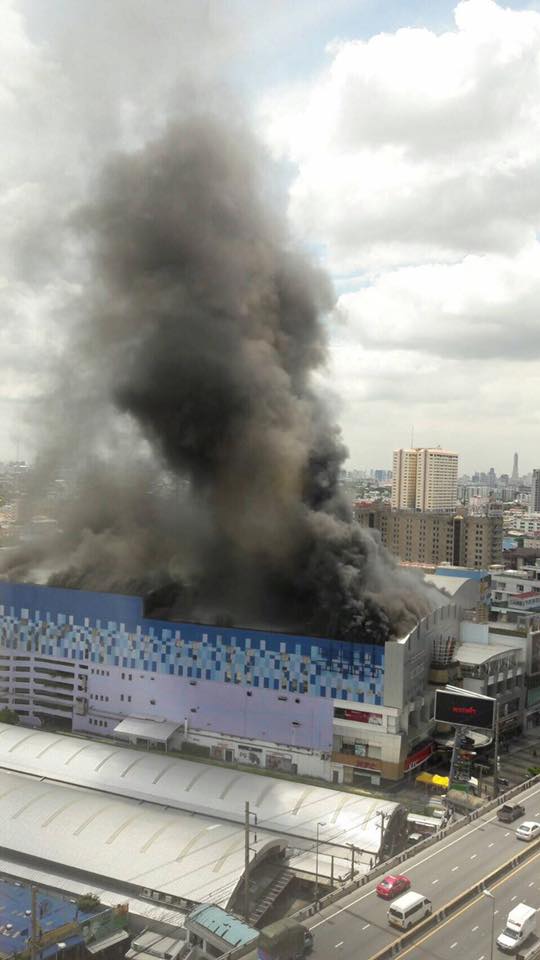
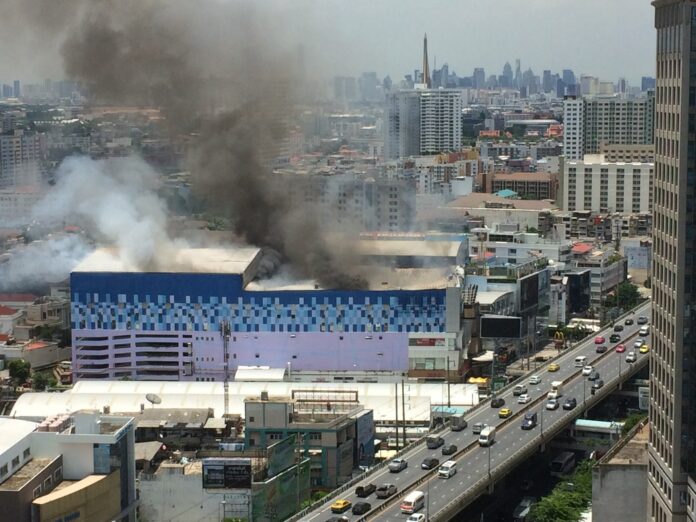
A fire burns at Major Cineplex Pinklao on Thursday morning. Photo: @Marian_plum

BANGKOK — A fire was burning at a large cinema complex on Bangkok’s Thonburi side this morning.

Police said no one was injured in the blaze at Major Cineplex Pinklao, as the cinemas were not yet opened when the fire started.

“The fire broke out on the third floor, in one of the 11 cinemas,” Lt. Gen. Sanit Mahatavorn, commander of Bangkok’s police force, said from the scene. “No one was in the cinema, because the place wasn’t open yet.”

Each branch of Major Cineplex houses cinemas, shopping mall and restaurants.

Sanit said the fire was now contained, and investigators would determine the cause of the blaze once the building was safe to enter.

According to images posted online, the fire at appeared to start around 11:30am. It sent a large plume of smoke that could be seen across much of Bangkok.

Just before 1pm, the roof of the cinema appeared to collapse.


A fire burns at Major Cineplex Pinklao on Thursday morning. Photo: Spring News / Facebook

Advertisement

Prachuap Police Vow Action After Moroccan and Italian Beaten and Robbed

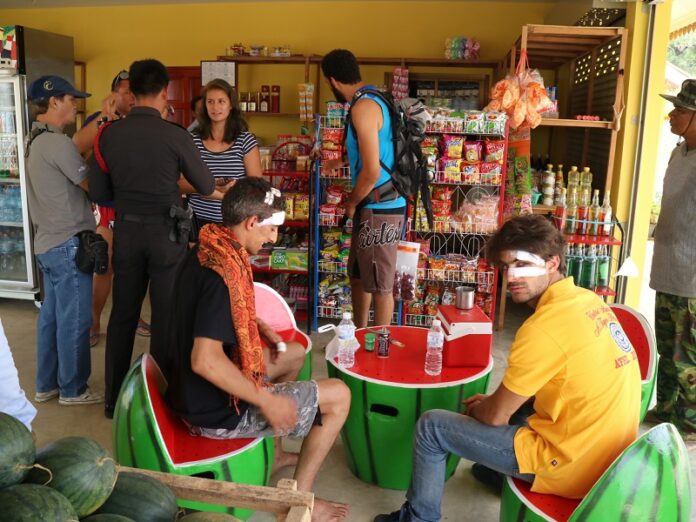
Two male victims sit in the shop they sought help from after they were robbed Tuesday night near Khao Sam Roi Yot National Park in Prachuap Khiri Khan province.

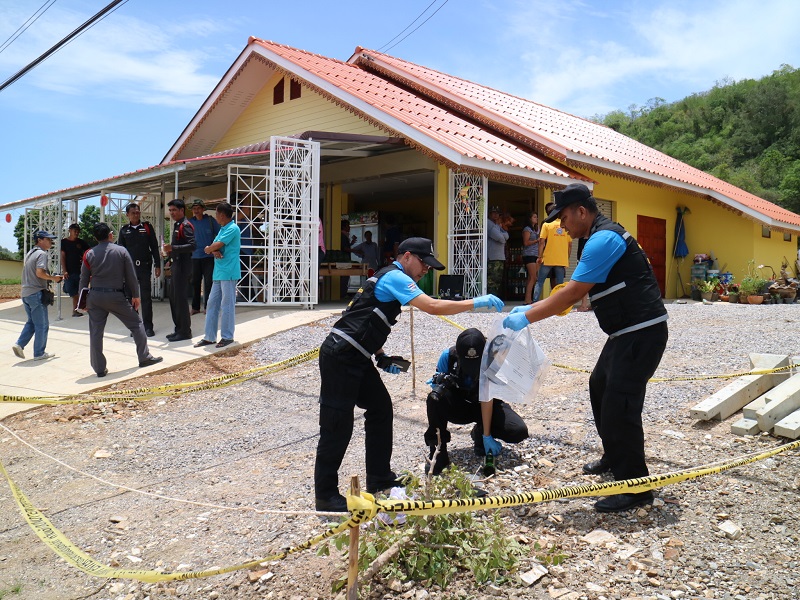
PRACHUAP KHIRI KHAN — Police said today they will soon make arrests of three suspects believed responsible for an attack on two foreign men whose motorbike had run out of fuel near a national park in Prachuap Khiri Khan province.

Moroccan model Youssef Ben Hayoun Sadafi was with his Italian friend Othmane Tigzirine were pushing their rented motorcycle along a road near the Khao Sam Roi Yot National Park when they were attacked late Tuesday night by three men.

The men assaulted the pair, leaving them with head injuries.

“We are sure we will be able to arrest the perpetrators soon,” police Maj. Gen. Krissana Jamsawang said Thursday. He declined to give further information about the purported three suspects.

The two foreigners had been training in Muay Thai at a local gym. They had been walking back to their accommodations when they said another motorcycle carrying three people rode up.

The pair said they thought the group was coming to their aid. In fact the three men allegedly assaulted them, stealing EUR200, credit cards and their passports. The victims then sought help from people living in the area.

Kritsana said he acknowledged the public was concerned about the attack’s damage the country reputation as one of the victims was of some celebrity. He said he urged all his officers to hunt down the guilty parties for prosecution.

201607261451016 20131003134427


Related stories:

Fourth Suspect Arrested for Assaulting British Family in Hua Hin

Scotsman Brutally Assaulted By Thais In Pattaya, Police Say

British Tourist Assaulted by 3 Thais in Pattaya

Netizens Jeer Bargirl in Songkran Sexual Assault Video

Advertisement

Ganesha Reconstructed in Ceramic Tributes From 17 Artists

‘Dreams Comfort Reality’ by Nino Sarabutra at Tribute exhibition. Photo: Sombatpermpoon Gallery / Courtesy

BANGKOK — Often worshipped as a grand master of the arts, Ganesha himself is the subject of a ceramic exhibition opening next week.

Seventeen artist from different backgrounds and stages of their careers joined hands in creating 20 ceramic artworks relating to the Hindu deity of the arts revered as an obstacle remover at the upcoming exhibition “Tribute.”

Although not every artist in the project is keen on the materials, they exchange different perspectives and personal experiences through their views of Ganesha and society.

“Dreams Comfort Reality” is the latest craft from Nino Sarabutra, a proficient porcelain artist, who created 100 illuminated origami-style porcelain elephants to reflect her curiosity on the devotees’ wishes to above beings.

“We only see the tribute when people pay homage to deity, but never do we know their wishes” said Nino on her work inspiration.

She researched people’s wishes and put each desire inside each of her work. The wish can only be seen when the elephant is illuminated. “If a prayer wishes for something and doesn’t do anything to achieve it, their wish is just a wishful thinking that never become true,” the artist said.

Apart from Nino’s works, various interpretations also presented at the exhibition from renowned artists such as Wasinburee Supanichvoraparch, Michael Shaowanasai and Pornpan Sudasna who will present her tribute saucer gilded with traditional lacquer.

The opening reception starts at 5pm on Aug. 3 and the exhibition runs through Oct. 2 on the second floor of Sombat Permpoon Gallery, Soi Sukhumvit 1. It’s a five-minute walk from BTS Phloen Chit.


Advertisement

Why Syria’s Al-Qaida May be Considering a Split

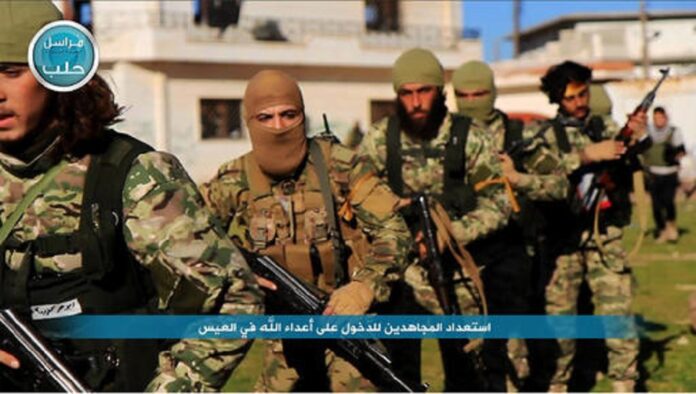
This file photo posted on the Twitter page of Syria's al-Qaida-linked Nusra Front on April 1, 2016, shows fighters from al-Qaida's branch in Syria, the Nusra Front, marching toward the northern village of al-Ais in Aleppo province, Syria. Photo: Associated Press

BEIRUT, Lebanon — Al-Qaida’s branch in Syria is considering splitting ties with the global terror group, members say.

A Nusra Front official told The Associated Press on Tuesday that the group’s leader plans to announce a disassociation with al-Qaida soon. Speaking via text message from northern Syria, the official, who spoke on condition of anonymity because he was not authorized to speak publicly about the issue, said Nusra will merge with other insurgent groups.

If it does, that could throw a wrench in talks between the U.S. and Russia on a military partnership in Syria, complicating efforts to separate the militant fighters from other moderate rebel factions.

Here’s a look at the Nusra Front and what the move would mean.

A Powerful Force

The Nusra Front, led by Syrian militant Abu Mohammed al-Golani, is al-Qaida’s affiliate in Syria and is the second strongest extremist group in the country after its rival, the Islamic State group. Its fighters have been among the strongest in battling the forces of Syrian President Bashar Assad and his allies like Lebanon’s Hezbollah guerrillas. Nusra is among rebels holding territory in northern, western and southern Syria.

While made up of Islamic extremists and some foreign jihadis, the Nusra Front has presented its priority as ousting Assad rather than immediately pressing al-Qaida’s global goals. That has enabled it to work alongside other Syrian factions, including moderate ones, to fight both the Syrian military and the Islamic State group. Those factions value its battlefield prowess: A Nusra-led coalition called the Army of Conquest has succeeded in rolling back Assad’s forces in northwest Idlib province.

But its closeness to other rebels has complicated efforts at a ceasefire. The last ceasefire brokered by the U.S. and Russia did not cover Nusra or IS, so Russian warplanes and Assad’s forces continued to battle them, often hitting moderate groups that were part of the truce, including ones backed by Washington and its Arab allies. That was one factor leading to the cease-fire’s collapse.

Why Split?

Those in Nusra who want to split hope that breaking with al-Qaida would remove the international stigma from their shoulders. The group could present itself as a local Syrian rebel group and allow it to work even closer with more opposition factions, perhaps giving it some protection from the international campaign against it.

There have been rumors in the past of a split, but it never happened. Last year, al-Golani repeated his allegiance to al-Qaida leader Ayman al-Zawahri. But talk has become louder again. This week, a senior Nusra fighter based in northern Syria told The Associated Press that many senior officials in the group support splitting. Militant websites and social media have been full of claims the move would come soon, with some supporters claiming it would change its name to the Front to Conquer the Levant.

Still, the move is not certain, given it also has downsides for Nusra.

Impact For The U.S.

A split would complicate things for Washington, which is likely Nusra’s intention.

The U.S. and Russia are trying to hammer out an agreement on a new military partnership in Syria. One leaked U.S. proposal would call for a sharing of intelligence and targeting for strikes against IS and Nusra on the condition Russia commits to convince its ally Assad to ground Syria’s bombers and start a political transition process.

But that would be more difficult if Nusra becomes even closer to other rebels. Washington and its allies have long pressed mainstream opposition groups to “de-couple” from front lines where Nusra is present, with little success.

“If Nusra Front was to sever its ties to al-Qaeda, opposition groups will in no way ever consider such de-coupling,” said Charles Lister, senior fellow at the Washington-based Middle East Institute. Consequently, any future intervention against Nusra will be perceived by opposition Syrians as a de facto move in support of the Assad regime, he said.

Downsides for Nusra

If it quits al-Qaida, the Nusra Front loses the brand name that drew many of its fighters to its ranks. That could drive away members.

Foreign fighters in particular could become disillusioned since many of them were drawn by the al-Qaida link and see their participation in the Syria war in more universal terms of global jihad rather than as simply a campaign to oust Assad, said Sam Heller, a Beirut-based analyst who writes about the Syria war.

A Syrian opposition figure said some hard-line Nusra leaders who oppose a move believe foreign fighters would switch over to other extremist factions like the Jund al-Aqsa militant group or the Turkistan Islamic Party. He spoke on condition of anonymity because he was not authorized to comment on the subject.

Once Al-Qaida, Always Al-Qaida?

Even if it breaks with the al-Qaida franchise, the group’s Islamic militant ideology is not likely to change. “Whatever it might then name itself, (it) will still be much the same organization,” said Lister.

And the U.S. is not going to start looking on it any more favorably.

Washington believes that Nusra’s “fundamental nature is that it’s al-Qaida in Syria,” said U.S. State Department spokeswoman Elizabeth Trudeau when asked Tuesday about talk of a possible split.

Story by: Bassem Mroue

Advertisement

Turkish Democracy’s Secret Weapon

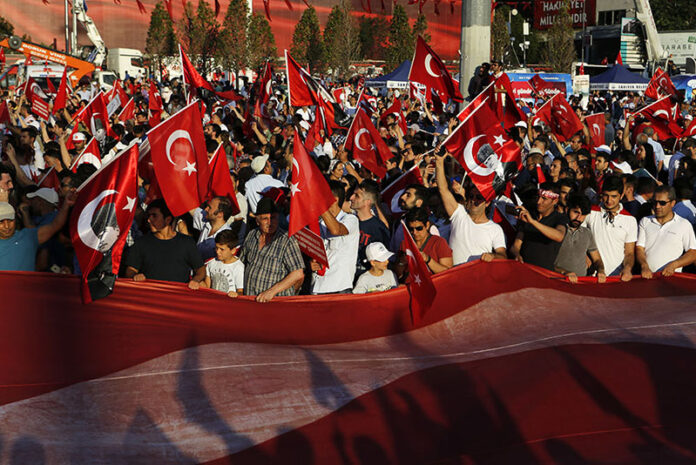
Supporters of the Republican People's Party, or CHP, wave Turkish flags during a "Republic and Democracy Rally" at Taksim Square in central Istanbul on July 24. Photo: Petros Karadjias / Associated Press

The recent failed coup attempt in Turkey highlights the country’s continuing vulnerability to military takeover. But it also reveals a newly developed – and highly potent – asset, one that Turkey’s neighbors should also seek to cultivate: a strong middle class willing and able to mobilize against extremist threats. The question for Turkey now is whether President Recep Tayyip Erdogan will cultivate this asset. For the wider Middle East, the issue is how to build a middle class that can safeguard stability.

When throngs of citizens took to the streets of Istanbul in the middle of the night, in an effort to push back the military coup makers, it was a powerful show of collective action – one that should interest any political leader, particularly those seeking to develop their countries. Analysis of the coup has tended to focus on the rivalries within the Turkish elite, and on Erdogan’s failings (which, to be sure, are plentiful). But little has been said about the structural shifts in Turkey’s political economy that have empowered the country’s middle classes, which form the electoral base of Erdogan’s Justice and Development Party, AKP.

Over the past two decades, Turkey has made remarkable economic strides, transforming itself from Europe’s sick man into one of its most vibrant economies and a new center of gravity for trade in the Middle East. Critical to this transformation have been infrastructure investment, support for medium-size firms, expansion of regional trade, and development of the tourism sector.

As a result of these efforts, Turkey’s per capita income has tripled in less than a decade, while its poverty rate has more than halved, according to World Bank estimates. This has underpinned tremendous economic mobility among Turkey’s rural labor force, small entrepreneurs, and lower-income workers, taking masses of people from the margins of society to the mainstream. Even foreign policy was, wherever possible, aligned with the economic interests of the rising middle class (though the Syrian intervention reflects a shift in foreign-policy priorities).

For Turkey’s new middle class, the survival of democracy could not be more important – and, as recent events have shown, they are willing to fight for it. Indeed, what has occurred in Turkey does not reflect only a power struggle between Erdogan and his challengers; it also highlights the determination of the middle class to ensure that Turkey does not revert to a political system that would damage its economic and political fortunes.

All of this suggests that, in responding to the coup attempt, Erdogan and his supporters must think beyond punishing the military faction that carried it out, though that is, of course, critical. They must also focus on strengthening the interests of the middle class that came to the government’s defense.

In this sense, the real challenge facing Turkey in the coming months and years will not be from the military or foreign conspirators. Succumbing to the temptation to consolidate power in the hands of the president, ostensibly to protect his government’s authority, could limit checks and balances and restrict space for political opposition, including within his own party. That would undermine the very system for which the middle class has been fighting.

Of course, Erdoğan does need to consolidate his political base, including by renewing ties with loyal supporters. And purging the military and civilian bureaucracy of possible coup supporters would undoubtedly please party loyalists. But he must also heal the political rift and forge a new consensus that supports economic prosperity.

Perhaps most important, the AKP needs to halt the dangerous unraveling of the Turkish model of regional economic integration, based on the policy of “zero problems with neighbors,” originally conceived by former Prime Minister Ahmed Davutoglu but rolled back in recent years. Turkey has severed ties with virtually all of its immediate Middle Eastern neighbors. The recent souring of diplomatic ties with Russia has further weakened Turkey’s position. In the process, Turkey’s status as a model Muslim democracy has gradually deteriorated and political polarization has deepened, amid growing threats to the country’s stability.

None of this is good for the economy on which Turkey’s middle class – and, in turn, the AKP’s electoral success – depends. That provides reason to hope that the failed coup, by highlighting the role of the middle class as a bulwark against military rebels, will spur Erdoğan’s government to resolve Turkey’s political impasse and ensure economic growth. Turkey’s middle class will not support a party that fails to advance its interests and deliver economic prosperity. But an AKP that returns to its foundational vision of enabling economic mobility – that is another story.

Importantly, as Erdogan seeks to concentrate more powers in the office of the President, he would do well to remind himself of the conditions that led to the Ottoman Empire’s emergence and its eventual collapse. Much like the AKP’s rise, the empire’s was based on the support of an emancipated citizenry in the rural countryside, particularly in the Anatolian heartland. But, upon consolidating their power in Constantinople, Ottoman rulers quickly moved toward establishing a Sultanic order that contradicted its progressive origins – and weakened it from within. With greater centralization of powers, Ottoman rulers became uncomfortably dependent on notables at home and imperial powers in Europe.

If Erdogan’s AKP hopes to avoid a similar fate, it must not continue its march toward a latter-day Sultanic order. A prosperous and inclusive democracy is the only way out for Turkey, and it would restore a model that the countries of the wider Middle East desperately need.

Adeel Malik is Globe Fellow in the Economies of Muslim Societies at the University of Oxford.

Copyright 2016 Project Syndicate

Advertisement

Obama Boosts Clinton: Carry Her Like You Carried Me

President Barack Obama arrives to speak during the third day of the Democratic National Convention in Philadelphia, Wednesday, July 27, 2016. Photo: Susan Walsh

PHILADELPHIA, Pennsylvania — His own legacy on the line, President Barack Obama implored Americans to elect Hillary Clinton to the White House, casting her as a candidate who believes in the optimism that powers the nation’s democracy and warning against the “deeply pessimistic vision” of Republican Donald Trump.

“America is already great. America is already strong,” he declared to cheering delegates Wednesday night at the Democratic convention. “And I promise you, our strength, our greatness, does not depend on Donald Trump.”

For Democrats, the night was steeped in symbolism, the passing of the baton from a barrier-breaking president to a candidate trying to make history herself. It culminated with Clinton making a surprise appearance on stage to greet Obama with a long embrace, an almost unimaginable image eight years ago when they battled for the Democratic nomination.

Obama urged Americans to summon the hopefulness of that White House campaign, before recession deepened and new terror threats shook voters’ sense of security. He robustly vouched for Clinton’s readiness to finish the job he started, saying “no matter how daunting the odds, no matter how much people try to knock her down, she never, ever quits.”

Earlier Wednesday, Clinton’s running mate, Virginia Sen. Tim Kaine, introduced himself to the nation as a formidable foil to Trump in his own right. With folksy charm, he ridiculed Trump’s list of promises and imitated one of the GOP candidate’s favorite phrases.

“Believe me!” he said mockingly, as the audience boomed back, “No!”

Obama’s vigorous support for Clinton is driven in part by deep concern that Republican Trump might win in November and unravel his two terms in office. He warned repeatedly Wednesday that the billionaire businessman is unprepared for the challenges that would await him in the Oval Office.

Republican presidential candidate Donald Trump speaks during a news conference at Trump National Doral, Wednesday, July 27, 2016, in Doral, Florida. Photo: Evan Vucci

Trump fueled more controversy Wednesday when he encouraged Russia to meddle in the presidential campaign. On the heels of reports that Russia may have hacked Democratic Party emails, Trump said, “Russia, if you’re listening,” it would be desirable to see Moscow find and publish the thousands of emails Clinton says she deleted during her years as secretary of state.

Wednesday night’s Democratic lineup was aimed at emphasizing Clinton’s own national security credentials. It was a significant shift in tone after two nights spent reintroducing Clinton to voters as a champion for children and families, and relishing in her historic nomination as the first woman to lead a major political party into the general election.

The convention’s third night was also a time for Democrats to celebrate Obama’s legacy. Vice President Joe Biden, who decided against running for president this year after the death of his son, called it a “bittersweet moment.”

A son of Scranton, Pennsylvania, Biden appealed directly to the working class white voters who have been drawn to Trump’s populism, warning them against falling for false promises and exploitation of Americans’ anxieties.

“This guy doesn’t have a clue about the middle class,” he declared.

Kaine also picked up the traditional attacking role of the presidential ticket’s No. 2. He tore into Trump, mocking his pledges to build a wall along the Mexican border, asking why he has not released his tax returns and slamming his business record, including the now-defunct Trump University.

“Folks, you cannot believe one word that comes out of Donald Trump’s mouth,” Kaine said. “Our nation is too great to put it in the hands of a slick-talking, empty-promising, self-promoting, one-man wrecking crew.”

Liberals, particularly those who supported Vermont Sen. Bernie Sanders, have grumbled about Kaine being on the ticket, particularly because of his support for “fast track” approval of the Trans-Pacific Partnership trade pact. Several delegates held up anti-TPP signs as he spoke.

In a move aimed at broadening Clinton’s appeal, New York City Mayor Michael Bloomberg — an independent who considered launching a third party bid for president — endorsed the Democratic nominee. A billionaire businessman himself, Bloomberg took aim at Trump’s bankruptcies, reliance on foreign factories and other economic experience: “The richest thing about Donald Trump is his hypocrisy.”

President Bill Clinton, filling the role of devoted political spouse, joined the crowd packed to the arena rafters in cheering the attacks on Trump.

The core of Clinton’s strategy is putting back together Obama’s winning White House coalition. In both his campaigns,Obama carried more than 90 percent of black voters, the overwhelming majority of Hispanics, and more than half of young people and women.

That coalition was vividly on display in the first two nights of the convention in Philadelphia. Women lawmakers were prominently featured, along with young activists, immigrants, and mothers whose black children were victims of gun violence or killed during encounters with law enforcement.

Gun violence continued as a theme Wednesday night as families of mass shooting victims took the stage. Delegates rose in an emotional standing ovation for the mother of one of the victims in last month’s Orlando nightclub shooting, who asked why “commonsense” gun policies weren’t in place when her son died.

“I never want you to ask that question about your child,” Christine Leinonen said.

Though Obama has six months left in office, his address Wednesday had the feeling of a political transition. He was emotional as he thanked Americans for sustaining him through difficult stretches.

“Tonight, I ask you to do for Hillary Clinton what you did for me,” he said. “I ask you to carry her the same way you carried me.”

Story by: Julie Pace, Catherine Lucey

Advertisement

For Would-be Reagan Assassin, Freedom Only Days Away

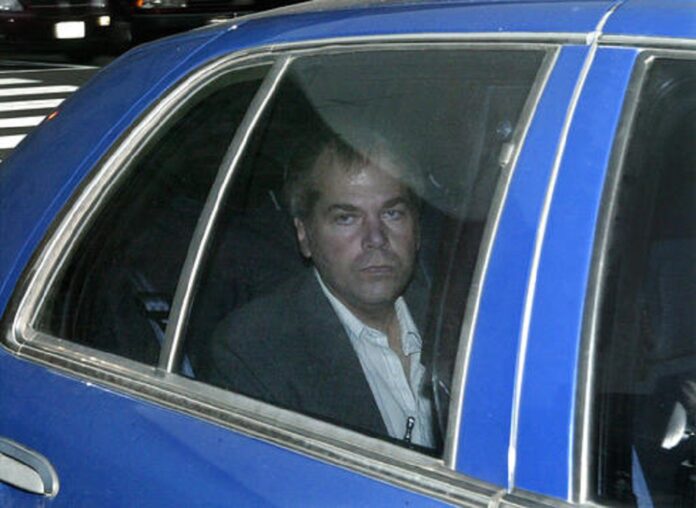
In this Nov. 18, 2003 file photo, John Hinckley Jr. arrives at U.S. District Court in Washington. Photo: Evan Vucci

WASHINGTON — For the past decade, the man who shot President Ronald Reagan has quietly spent a growing number of his days living with his 90-year-old mother in a gated community in Williamsburg, Virginia. On Wednesday, a judge finalized John Hinckley Jr.’s transition to freedom, ordering that Hinckley can permanently leave the psychiatric hospital where he was confined after the assassination attempt.

The order, which cannot be appealed, has been in the works for years, despite opposition by prosecutors, who sought numerous restrictions on Hinckley’s freedom, most of which were agreed to by Judge Paul Friedman. Hinckley could leave St. Elizabeths Hospital as early as Aug. 5.

Hinckley, now 61, was found not guilty by reason of insanity in the March 30, 1981, shooting fueled by his obsession with the movie “Taxi Driver” and its teenage star, Jodie Foster. He used a pawn-shop revolver to fire six shots at Reagan, the president’s aides and his protective detail outside a Washington hotel, wounding the president and three others.

Doctors have said for many years that Hinckley’s mental illness was in remission, and Friedman concurred in his ruling. Hinckley was a “profoundly troubled 25-year-old young man” when he shot Reagan, the judge wrote, but has not exhibited symptoms of major depression or a psychotic disorder for more than 27 years.

“Mr. Hinckley, by all accounts, has shown no signs of psychotic symptoms, delusional thinking, or any violent tendencies,” Friedman wrote. “The court finds that Mr. Hinckley has received the maximum benefits possible in the inpatient setting (and) that inpatient treatment is no longer clinically warranted or beneficial.”

Hinckley was first allowed to leave St. Elizabeths in 2003 to visit his parents in Washington, and he began staying with them at their Williamsburg home overlooking a golf course in 2006. For the past two-plus years, he has been allowed to spend 17 days a month with his mother.

Many of the restrictions attached to Hinckley’s temporary release will remain in place. He must attend individual and group therapy sessions and is barred from talking to the media. He can drive alone, but only within a 30-mile radius of Williamsburg, and the Secret Service will periodically follow him.

He also must return to Washington once a month so doctors can check on his mental state.

He will have to reside with his mother for a year. After that, he can live on his own, with roommates or in a group home in the Williamsburg area. If his mother is unable to monitor him in another setting, his brother or sister, both of whom live in the Dallas area, have agreed to stay with him until other arrangements are made. Hinckley’s father died in 2008.

The government could not persuade the judge to order Hinckley to wear an electronic ankle bracelet and install a tracking device on his car.

Hinckley’s longtime attorney, Barry Levine, said he and his client were gratified by the order, and that Hinckley has thrived under his new liberties.

“Mr. Hinckley recognizes that what he did was horrific. But it’s crucial to understand that what he did was not an act of evil,” Levine said in a statement. “It was an act caused by mental illness, an illness from which he no longer suffers.”

Reagan’s press secretary, James Brady, suffered debilitating injuries in the attack and died in 2014. Also wounded were police Officer Thomas Delahanty and Secret Service agent Timothy McCarthy.

Hinckley will be barred from trying to contact Foster, Delahanty, McCarthy or any of his victim’s families.

Reaction to his release was mixed.

The late president’s son, Michael Reagan, tweeted that others should forgive Hinckley the way his father did. But Reagan’sdaughter, Patti Davis, wrote on Facebook that “forgiving someone in your heart doesn’t (mean) that you let them loose in Virginia to pursue whatever dark agendas they may still hold dear.”

The foundation that honors Reagan’s legacy said Hinckley should remain in custody, noting his responsibility for Brady’s death, which was later ruled a homicide. Prosecutors declined to charge Hinckley with murder, in part because they would be barred from arguing he was sane at the time of the shootings.

“We believe John Hinckley is still a threat to others and we strongly oppose his release,” the Ronald Reagan Presidential Foundation and Institute said in a statement.

McCarthy, now the police chief of the Chicago suburb of Orland Park, says he is a bit perturbed he didn’t get a notification of the judge’s decision and hopes it’s the right one.

Dan Gross, president of the Brady Campaign to Prevent Gun Violence, declined to offer an opinion on Hinckley’s release but used the occasion to call for background checks for all gun sales, which Reagan supported. He noted in a statement that it would be “just as easy” for a would-be assassin to buy a gun today as it was for Hinckley.

Some of his mother’s neighbors in Williamsburg have long been wary of Hinckley.

Tom Campbell, who lives in the same gated community, has seen him strolling on a nearby walking trail.

“From a mental illness perspective, I just have some reluctance about having him roam free like this,” said Campbell, 77, a retired manager at NASA. “How can he be allowed to roam the streets as if nothing happened?”

His wife, Mary Margaret Campbell, added: “I don’t think a lot of these mental illness issues go away. One never knows what a mentally ill person will do.”

In an April 2015 story , The Associated Press delved into Hinckley’s attempts to integrate himself into the gated Kingsmill community and greater Williamsburg area. The story noted that he wore a visor or cap over his graying hair when he drove around the city in a Toyota Avalon, going to movies and eating at fast-food restaurants. It also found that he plays guitar, paints and cares for feral cats.

Hinckley, for his part, has been frustrated at times by people’s reaction to him. According to court records, many of his attempts to do volunteer work have been rebuffed, although he has volunteered at a church and a local mental hospital. He also has applied for jobs at Starbucks and Subway, without success, saying he was dismayed by having the Secret Service tail him as he sought employment.

“It made me feel awkward and uncomfortable,” he said.

But he said he also enjoyed meeting people outside St. Elizabeths, noting of his group therapy sessions: “It’s really refreshing to be in a group with people who aren’t completely out of their minds.”

Prosecutors cited what they called a history of deceptive behavior in arguing against more freedom for Hinckley. In July 2011, prosecutors said, Hinckley was supposed to go see a movie and instead went to a bookstore, where Secret Service agents saw him looking at shelves that contained books about Reagan and the assassination attempt, though he didn’t pick any of them up.

Some of the conditions of Hinckley’s leave could be eliminated or reduced within 12 to 18 months, but he still could be taken back to the hospital if he violates the remaining conditions.

Reagan died in 2004 at age 93.

Story by: Ben Nuckols

Advertisement

Trump Implores Russia to Hack, Leak Clinton’s Emails

Republican presidential candidate Donald Trump speaks during a news conference at Trump National Doral on Wednesday in Florida. Photo: Evan Vucci / Associated Press
MIAMI — Donald Trump has a message for Russia: find Hillary Clinton’s missing emails. But his running mate, Mike Pence, is sending mixed signals.

In a Miami press conference Wednesday, the Republican presidential nominee said that the 30,000 missing emails from Clinton’s private email server would reveal “some beauties” and made an extraordinary plea for a foreign power to locate them.

“Russia, if you’re listening, I hope you’re able to find the 30,000 emails that are missing,” Trump said. “I think you’ll be rewarded mightily by our press!”

Clinton’s campaign claims that Russia hacked computers belonging to the Democratic National Committee and released those emails on the eve of the party’s convention to benefit Trump’s candidacy. The emails, published by WikiLeaks last week, revealed that the DNC favored Clinton’s candidacy over rival Bernie Sanders, triggering a leadership shakeup within the DNC.

Trump dismissed the claims, saying it’s not clear who hacked those emails, but the incident is a sign that foreign countries no longer respect the U.S.

“If it’s any foreign country it shows how little respect they have for the United States,” said Trump, who added that he was “not an email person myself because I believe it can be hacked.”

Moments after he took the final question, Pence condemned the possible cyber-espionage, breaking from Trump for the first time since being selected as his vice president.

“If it is Russia and they are interfering in our elections, I can assure you both parties and the United States government will ensure there are serious consequences,” Pence said in a statement.

Trump, whom Democrats have accused of having cozy ties with Russian President Vladimir Putin, repeatedly declined to condemn the actions of Russia or any other foreign power of trying to intervene in the a U.S. election.

“No, it gives me no pause,” the celebrity businessman said. “If Russia or China or any of those country gets those emails, I’ve got to be honest with you, I’d love to see them.”

The Clinton campaign immediately denounced Trump’s call.

“This has to be the first time that a major presidential candidate has actively encouraged a foreign power to conduct espionage against his political opponent,” senior policy adviser Jake Sullivan said in a statement. “That’s not hyperbole, those are just the facts. This has gone from being a matter of curiosity, and a matter of politics, to being a national security issue.”

Trump also suggested that Clinton should not receive any security briefings due to the hack that would ensure “that word will get out.”

Trump has said that he has “zero investments” in Russia and insisted that his company had not received any significant investments from the country. He also has downplayed his affection for Putin and said he would treat the Russian leader “firmly,” though he said he wanted to improve relations with Russia. Some Democrats and security experts have said thatTrump’s proposal to set conditions on NATO allies could risk Russian expansion in Eastern Europe.

President Barack Obama, meanwhile, said “anything’s possible” when asked during an interview whether the Russians could be working to sway the election toward Trump.

“Donald Trump has repeatedly expressed admiration for Vladimir Putin,” Obama said during the sit-down with NBC News that aired Tuesday. “And I think that Trump’s gotten pretty favorable coverage back in Russia.”

JILL COLVIN, Associated Press
JONATHAN LEMIRE, Associated Press

Advertisement

Activists Welcome New Law’s Promise of Jobs for Beggars

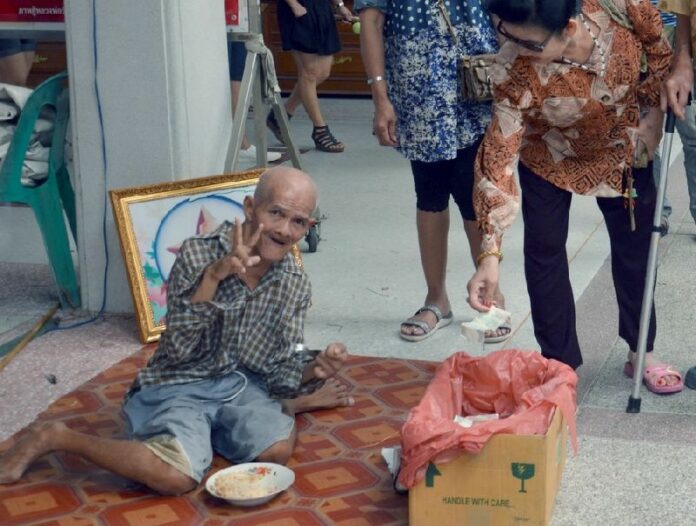
A beggar smiles outside Wat Rai Khing in Nakhon Pathom province in an undated photo. Photo: Matichon

BANGKOK — An overhaul of the country’s archaic law on panhandlers that goes into effect Thursday is being welcomed by lawmakers and activists for one or two reasons.

Instead of the flat criminalization of begging that has been the norm, the Beggar Control Act of 2016 verbs free shelter and job training will be provided to street beggars while those who force others, especially small children, into begging will be punished.

Thai Junta to Issue New Law Banning Begging

A crusader against child begging said he welcomed such punishment as it would help fight child trafficking.

“In the older law, it’s wrong, but there’s no real punishment,” said Witanapat Rutanavaleepong, who heads the Mirror Foundation’s campaign against child begging.

A significant number of Bangkok’s child beggars are children trafficked from other nations, sometimes sold by their parents to brokers and shipped off to Bangkok.

Witanapat also praised the law’s emphases on job training and rehabilitation rather than prosecuting people proven to be living in abject poverty. However, the social worker criticized some parts of the job program.

“They chose the professions for the beggars. They can only cut hair, cook and fix phones,” Witanapat said. “They don’t look at what the beggars really want.”

Puttipat Lertchaowasit, chief of the Ministry of Social Development and Human Security’s welfare department, said the details have yet to be hashed out until different ministries can meet Aug. 10 to discuss which agency will handle which roles in the new law.

“We will coordinate with the Ministry of Labor and other ministries,” said Puttipat, who’s in charge of the rehab effort. “For example, if they want to go into farming, the Ministry of Agriculture will have houses and plots of lands for them … If they want to work in factories, the Ministry of Commerce has a garbage recycling plant for them.”

Another prominent feature of the law is the separation of buskers from beggars. Under the new law, street performers must register with local authorities, and officials will come up with guidelines on the qualifications at the Aug. 10 meeting, according to Puttipat.

In the meantime, starting tomorrow, buskers will be granted a grace period, he said. Under current law, buskers make their living as the law is widely unenforced and left up to local police and officials who may or may not arrest them for begging.

So, what should people do when they see beggars Thursday onward?

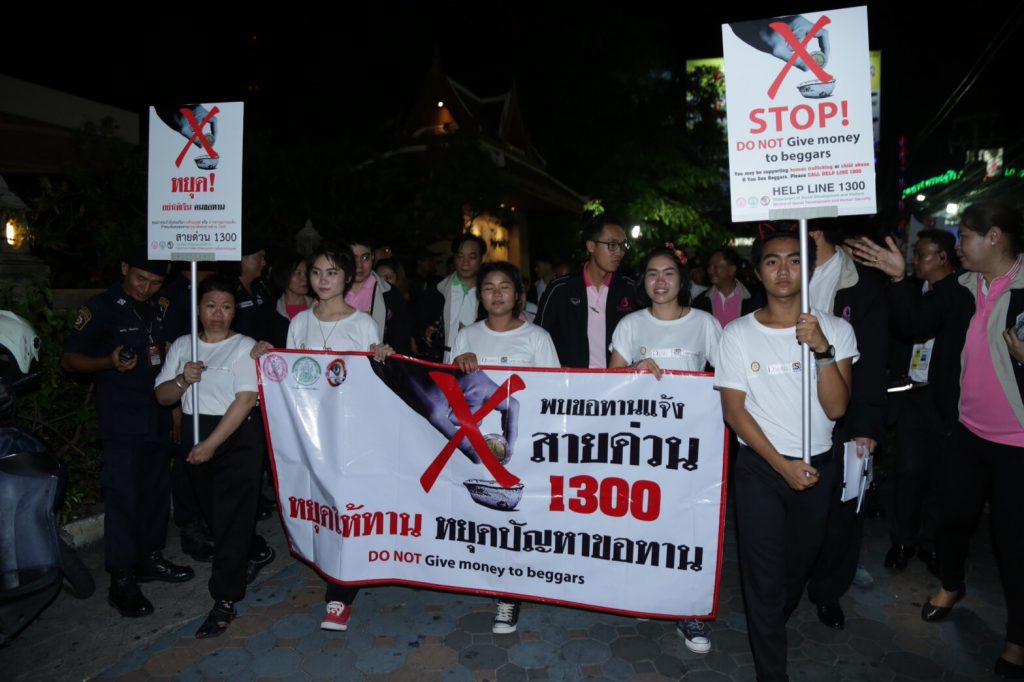
Dial the ministry’s hotline at 1300, Puttipat said.

Officials campaign about 1300 hotline on June 15 in Pattaya's Walking Street
Officials campaign about 1300 hotline on June 15 in Pattaya’s Walking Street

A team will be dispatched to take the beggars to a facility in Thonburi, where officials will assess whether they have any disease or disability, whether they are too old to work and whether they suffer any mental illness.

Those who fall into those categories will be sent to state hospitals, shelter homes for the elderly and mental institutions, respectively, Puttipat said, while those proven to be genuinely poor will qualify for the shelter facilities and job training programs.

Beggars who are not Thai citizens will be deported.

He said a part of the money for this program comes from public donations through a fund established by the Ministry of Social Development and Human Security.

“The important point that I’d like to tell the public is that they should know how to help beggars in a right way,” Puttipat said. “If they want to donate money to beggars, don’t give them coins. Give to the fund to rehabilitate them.”

Witanapat, the social worker with Mirror Foundation, said the program shouldn’t only allocate money for its job training but also for getting participants started afterward.

“They don’t have a marketing plan. Once their training is completed, where’s the fund for starting their business? They leave the shelter homes, but they don’t have any money, and not having money is the cause of begging in the first place” Witanapat said.

He suggested a microlending fund be established, as many of those in need lack access to traditional loans.

Puttipat, the head of the welfare department, said all these concerns will be addressed at upcoming meetings.

“You may ask why we haven’t set up these meetings yet. The reason is, the law will only come in force tomorrow. We couldn’t do it earlier,” he said.

Related stories:

Alleged Trafficker of Rose-Selling Children on Khaosan Road Arrested

Dramatic TV Ad ‘Supports Human Trafficking’

Advertisement

Hot News

LATEST NEWS

Bangkok
overcast clouds
27.7 ° C
27.7 °
27.7 °
80 %
2.4kmh
98 %
Thu
28 °
Fri
37 °
Sat
35 °
Sun
37 °
Mon
37 °