BANGKOK — Take a peep into others’ lives at a Friday performance inspired by our livestreaming surveillance society.
The second event by Speedy Grandma since she returned from four months in hibernation, Peep in Me features two artists whose live performances in front of CCTV cameras at several locations in Bangkok will be livestreamed into the newly revamped art space on Charoen Krung Road.
Artists Watcharapol Paksri and Rapat Bundawanich said exploring the culture of truth, fear, trust, and deception created through the medium of a surveillance society lies at the heart of the exhibition.
The duo will set up cameras next to government-operated security cameras to replicate what they see from the same angle, Watcharapol said.
“[We] want to talk about what people think it’s safe to talk about, but it’s actually not,” said Watcharapol, who’s studying film. “That’s why we chose CCTV cameras to be the main device here.”
Rapat said they want to use society’s own technology to document it.
“[We] try to use different gadgets to say what’s happening, whether it’s society or politics,” said Rapat, a photographer.
On Friday, Rapat will perform live and interact with people who pass within view of his lense at Pak Khlong Talad (Bangkok Flower Market), Chinatown and the King Rama V Monumentwhile Watcharapol live-types subtitles of what happens in English for audiences watching it from Speedy.
The experimental performance starts at 7pm on Friday, with the recorded videos to be on display through July 22. Speedy Grandma is a 15-minute walk or can be reached by motorbike from MRT Hua Lamphong’s exit No. 1.
In this Oct. 28, 2015 file photo, paramedics and doctors care for a baby girl after a boat with refugees and migrants sunk while was crossing the Aegean sea from Turkey to the Greek island of Lesbos. Photo: Associated Press
ATHENS, Greece — Authorities recovered the bodies of four people, including two children, and rescued six people after a boat carrying migrants overturned off the coast of the eastern Aegean island of Lesbos Wednesday.
The coast guard said the bodies of one girl, one boy, a man and a woman had been retrieved from the sea while six survivors had been rescued.
The first two people rescued had told authorities they had been in an inflatable dinghy with another nine people when the vessel capsized as it headed to the island from the nearby Turkish coast.
Vessels from the Greek coast guard and the European border agency Frontex were involved in the search and rescue operation, which was continuing.
Lesbos has been the main arrival point for hundreds of thousands of refugees and migrants heading to Europe. But numbers of new arrivals have fallen dramatically following a March deal between the European Union and Turkey to limit the refugee flow.
Many have died during the short but dangerous crossing, when their unseaworthy and overcrowded boats have capsized or sunk.
A traffic police officer in Bangkok's Yaowarat area in a 2011 photo. Photo: Mads Bodker
BANGKOK — When deputy inspector Chanchai Yensuk was told by a colleague that he could get him promoted to full inspector for 700,000 baht, Chanchai handed over the money.
But the man he paid it to, another deputy inspector named Chanintat Rattanachinotrai, apparently couldn’t work his magic, as Chanchai didn’t get the expected promotion in the latest shakeup.
Upset at the perceived betrayal, Chanchai then filed a bribery charge against Chanintat, only to learn he could also be considered guilty of the crime.
Both officers are now under criminal and administrative investigations.
The whole thing has proved another embarrassment for Thailand’s police force, an institution known for chronic corruption and nepotism. Even junta chairman Prayuth Chan-ocha vowed he would personally insure the matter was taken seriously.
“The Royal Thai Police must bring this person who offered the bribe [to justice]. If he’s really guilty, I won’t let him get away with it,” Gen. Prayuth said Tuesday.
According to the complaint filed by Cpt. Chanchai, he was approached by Cpt. Chanintat last month. Chanintant claimed to know puu yai (influential people) in the national police force that could make Chanchai a full inspector, in exchange for a gift of 700,000 baht.
Chanchai said he accepted the offer and arranged a meeting for June 8 at a gas station in Bangkok’s Bang Sue district where he had his wife pay the money. But when the latest police appointments were published, Chanchai wasn’t listed as an inspector, so he went to Bang Sue Police Station on July 5 to press charges.
But under the law, both parties in bribery, attempted or otherwise, are guilty of the crime, so police launched an investigation against both men.
The investigation is being handled by three police stations simultaneously: Nimitmai and Bang Rak stations where Chanchai and Chanintat are stationed, respectively, and Bang Sue station, which has jurisdiction over the gas station where the bribe was allegedly paid.
Although police commissioners pledged to take action, both Chanchai and Chanintat remain on active duty.
The police chiefs in charge of the investigation said although Chanchai and Chanintat have confessed to the bribery deal, they won’t outright condemn their actions. They said they want the probe to be concluded before making any judgement.
“Since details are still unclear, I still cannot say whether this is wrong or not,” Col. Thanachai Utsahakit, chief of Nimitmai Police Station, said.
Col. Nakhon Thongpanich, chief of Bang Rak Police Station, said, “We want the investigation committee to finish this matter first. I don’t want to comment on it yet.”
Nakhon said the inquiry is expected to wrap up before the month’s end. He said Chanintat lied about knowing well-connected people in the force.
“If it were true, he would have got the rank of inspector himself already, wouldn’t he?” Nakhon said. “Suppose he could really lobby for jobs, why is he still a deputy inspector? His claim of lobbying is just a scam.”
The Bang Sue chief could not be reached for comment.
Police spokesman Songpol Wattanachai said Chanchai and Chanintat would be expelled or suspended if found guilty.
Accusations of widespread bribery persist in plaguing the police force, where careers can be threatened by unpredictable waves of transfers and shakeups, and officers are known to often cajole and lobby for desired positions.
The body of Cambodian government critic Kem Ley is covered by the Cambodian National flags during a funeral ceremony, Wednesday, July 13, 2016, in Phnom Penh, Cambodia. Photo: Heng Sinith / Associated Press
PHNOM PENH, Cambodia — A former Cambodian soldier has been charged with murder in the killing of a prominent government critic, an attack that has raised accusations of a political conspiracy.
Oeut Ang faces up to life in prison if convicted of killing Kem Ley, who was shot dead on Sunday. He also was charged with possession of an illegal weapon when he appeared at the Phnom Penh Municipal Court on Wednesday.
During interrogation, Oeut Ang had told police that Kem Ley owed him USD$3,000 (105,000 baht), and that he shot the well-known political analyst and government critic because of the dispute.
He also identified himself by the nickname Chuob Samlab, which in Cambodian means “meet and kill.” Court officials said the nickname would be used in documents for now.
Oeut Ang was also charged with possession of an illegal weapon during his appearance at the Phnom Penh Municipal Court on Wednesday.
“After questioning, examining the documents and with the evidence present, the prosecutor of Phnom Penh Municipal Court has decided to charge the accused with premeditated murder and illegal possession of weapon,” said Ly Sophana, a court spokesman.
In an interview with The Associated Press on Tuesday, Oeut Ang’s wife said her husband was too poor to have loaned the victim USD$3,000. She also said he had never mentioned Kem Ley’s name before. She said her husband was a former Khmer Rouge soldier as well as an ex-government soldier.
Opposition parties and Global Witness, a British activist group whose work was occasionally the subject of Kem Ley’s radio commentaries, have suggested a political conspiracy behind the killing.
Kem Ley’s body is being kept at a Buddhist temple until his funeral on July 19 to allow his admirers and friends to pay their respects.
Prime Minister Hun Sen, often a target of Kem Ley’s criticism, has promised a thorough investigation into the killing, which came at a time of political tension that began last year with legal and other pressures by the government on the opposition Cambodia National Rescue Party.
Kem Ley was widely known because he was frequently heard on the popular Cambodian-language services of Radio Free Asia and Voice of America, U.S. government-funded services that are among the few independent news sources in Cambodia. He was also frequently quoted in the country’s handful of independent newspapers.
One of his most recent commentaries was about a report issued last week by Global Witness that alleged that Hun Sen and his family had enriched themselves and kept power through corruption.
Kem Ley is the most prominent Cambodian government critic to be killed since trade union leader Chea Vichea in 2004.
“This outrageous act of violence must be thoroughly, transparently and independently investigated,” Transparency International said in a statement Wednesday. It said it is also “concerned at increasing restrictions placed upon civil society organizations and harassment of activists in the country.”
The opposition CNRP also urged the government to appoint independent investigators to solve the killing. It noted that the police had still not found the masterminds behind the killing of Chea Vichea and an environmentalist, Chut Wuthy.
Instead, the police have arrested innocent people and coerced them to confess, the party said in a statement.
A sign posted outside a restroom July 12 at Radio Thailand’s offices in Bangkok. Photo: Twitter / @_Foremostt
BANGKOK — A sign at a women’s bathroom demanding it not be used by those born with another gender went viral and sparked debate online overnight.
Tweeted on Tuesday by a transgender intern at a public radio station, the photo purports to show a sign she recently discovered outside a restroom she had been using there.
“Third gender, don’t use the women’s room. Understand? We don’t welcome you. Thank you,” reads the sign she said was posted at Radio Thailand, a public radio station owned by the National Broadcasting Services.
The intern, who asked to be identified only as @Foremost for fear of repercussion, said by telephone that she was surprised and upset by the sign.
“I’ve been using this room for over a month and this morning I found the paper telling me to use men’s room,” she said.
Trans people, particularly women, have routinely used the restrooms of their preference, and the debate comes as Thailand’s LGBT community seeks more overt social acceptance rather than peripheral tolerance.
Foremost said she’s been an intern at Radio Thailand since the beginning of June and has always used the women’s bathroom. She asked the cleaning staff about the sign, and they told her they had no knowledge of it.
“I don’t like the part ‘not welcome.’ How were you raised to be this narrow-minded? Your parents don’t love you?” Foremost wrote in her tweet of the image.
Her message was retweeted more than 3,200 times and drew a stark divide in reactions.
“Bullshit. Using the toilet takes less than five minutes, not spending the night. This shouldn’t be an issue at all. The sign’s writer is so narrow-minded!” wrote Facebook user Warutthaya Korsrettharat on the page of LGBT-positive party organizer Trasher Bangkok.
Another female Twitter user wrote that she and her girlfriends would feel uncomfortable using a bathroom with transwomen who haven’t undergone sexual reassignment, framing it as a sanitary issue.
“We feel their fluids are still men’s,” @Annaleaz tweeted. “But I don’t think we have the right to ban transwomen.”
Someone suggested gender-neutral bathrooms be built.
“[If] women don’t want Khatoey in the lady’s room, they should build a transgender toilet for us so we can go there. I don’t wanna use the same room with you too, vaginas smell,” @Chocooliie tweeted.
Someone else said it made them feel insecure.
Twitter user @Satang27635986, wrote “… there might be someone pretending to be third-gender and sneaking in to do something bad, like peeping or taking pictures. [This sign might be] to protect against such situations.”
Foremost replied that while she understands such concerns, she could have been informed differently — telling her nicely face to face.
In this Sept. 15, 2010 file photo shows a general view of the city, in Muscat, Oman. A new report released Wednesday, July 13, 2016 by Human Rights Watch alleges that foreign maids working in Oman face abuse and conditions that near slavery. Photo: Associated Press
DUBAI, United Arab Emirates — A leading international rights group on Wednesday said that foreigners employed as maids in Oman can face physical and verbal abuse while working entrapped in conditions that near slavery.
Human Rights Watch, in a new report, blames in part Oman’s system of tying workers’ visas to their employers, as well as police failing to enforce laws and returning runaway maids to abusive homes. The report alleges Oman’s neighbor, the United Arab Emirates, acts as a gateway for maids to be trafficked into the sultanate, as Emirati employment agencies along the border put women on display “like window shopping.”
“Many find themselves trapped with abusive employers and forced to work in exploitative conditions, their plight hidden behind closed doors,” the HRW report said. “It is clear that abuses are widespread and that they are generally carried out with impunity.”
Oman’s government-sponsored Human Rights Commission and the Omani Embassy in Washington did not respond to requests for comment from The Associated Press.
Many from Asia and Africa come to Gulf Arab countries to work as maids, often as the sole provider for their families back home. While some find success, others can face abuse or find themselves working in conditions far different than those promised by recruiters, trapped without their passports.
Oman, a country of 4.4 million people on the eastern edge of the Arabian Peninsula, is home to nearly 2 million foreigners, according to the government’s National Center for Statistics and Information.
In the report, Human Rights Watch said its investigators interviewed 59 female migrant workers with some recounting being beaten, verbally abused, denied fair pay and working as much as 20-hour days. The report said employers routinely seized maids’ passports in violation of Omani laws and those that fled abusive situations often had police return them to their abusers under laws that consider the workers “absconders.”
“Situations like those described below are at the very least dangerously close to situations of slavery,” the report said.
The report called on Oman to overhaul its “kafala” employee sponsorship system. The system, versions of which are used throughout the oil-rich Gulf states, gives bosses considerable power over workers by effectively binding them to a given employer. It also urged Omani police not to return those who flee violence to abusive homes.
The New York-based group also implicated the UAE for allowing maids to sneak into Oman despite restrictions from some of their home countries and other visa restrictions. It described a series of employment offices in the Emirati border city of Al Ain serving as a point for Omanis to find domestic workers. Several of the women who spoke to Human Rights Watch described the situation as them being “bought” by Omanis.
Emirati officials did not respond to a request for comment from the AP.
Pattaya's Walking Street in a 2013 photo. Photo: Vishwanath Hawargi / Flickr
PATTAYA — A Cambodian teenager was arrested for allegedly pickpocketing foreign tourists in the resort town of Pattaya.
The 16-year-old suspect, now held in a children’s shelter home until her trial, was arrested Tuesday night and accused of entering Thailand on Thursday to go on a stealing spree with a number of accomplices police have been unable to identify.
“Based on her story under questioning; she works with her gang,” Col. Apichai Krobpetch, head of Pattaya City Police Station, said Wednesday. “But the CCTV only managed to capture [a clear] image of her. Footage of the other suspects was blurry, it’s not clear enough to see who they are, so we’re expanding the investigation.”
According to Apichai, the 16-year-old minor stole something from a Chinese tourist on Saturday, and police tracked her down after the victim filed a complaint.
He believes she and her suspected accomplices may be responsible for similar crimes during the past week.
Apichai said that the suspect was interrogated in the presence of social workers in accordance with the law on minor suspects and then sent to a state-run shelter home.
She has been charged with stealing at night, which carries a tougher penalty than daytime theft.
In this photo taken Thursday, June 16, 2016, a young gymnast trains at the Xuhui Sports School in Shanghai, China. Photo: Associated Press
SHANGHAI — In a room full of bright-colored cubes and giant mattresses, giggling children climb bars, try somersaults and walk gingerly on a low balance beam. Some stand on their hands, showing off their bellies under the guidance of four coaches.
It was pure fun for 8-year-old Lucy Huang, a chubby-cheeked, cheerful and talkative girl. Her parents have modest goals for her progress: they hope the lessons help her stay fit, improve her balance, and help brain development.
“I love it here because there’s lots of fun. I love doing flips forward and backward, and I like the rings,” she said in one breath while sitting on the balance beam, her legs dangling.
The scene in downtown Shanghai might be common in western countries but is a rare sight in China, where parents have eschewed gymnastics lessons for their children. The mere mention of gymnastics usually evokes stereotypical, decades-old images of little boys and girls tearfully practicing splits, living away from home under the watch of strict coaches, all for the chance at an Olympic gold.
This summer, Chinese athletes that primarily grew up in the decades-old state sports system are still expected to dazzle the world and scoop up dozens of medals when the Summer Games open in Rio de Janeiro.
But at home there are strong efforts to reform the state-led system, which is struggling to recruit the next generation of stars despite its glorious records of churning out hundreds of Olympic gold medalists and world champions.
“The current system is to rally national resources to train a few to win the Olympic golds and win honors for the country,” said Xiong Xiaozheng, a retired sports professor in Beijing. “But this strategy no longer works with today’s society, and is losing its advantages.”
Without change, China’s spot among the world’s elite in sports is in danger.
Established in the 1950s, China’s state-led sports training system was tasked with rallying national pride. The poor, communist country was in need of international accolades, and bringing potential stars into one place was a cost-efficient way to train athletes.
“When the country did not have the resources to popularize any sport, when families were still struggling to feed themselves, the only way to train top athletes was to pool all the resources the country had then,” said Ye Zhennan, who will travel to Rio as manager for China’s national gymnastics team.
For a long time, it worked. The system pushed China into top place in the gold medal hunt, peaking in the 2008 Beijing Olympics with 51 golds. Four years later, China grabbed 38 golds in London, trailing only behind the sports powerhouse United States.
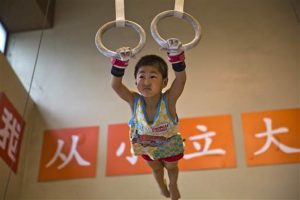
In this photo taken Thursday, June 16, 2016, a young child practices on still rings at the Xuhui Sports School near the slogans “Set ambitious goals from young” in Shanghai, China. Photo: Associated Press
In the system, local governments scout out potential talent at very young ages, often in pre-school. The children are separated from their families but corralled in state sports schools — overseen by sports authorities rather than education officials— to go through strict training programs for the sole purpose of winning world titles or Olympic golds.
The young athletes must go through rounds of elimination as they advance to the city team, the provincial team and eventually the national team. They must reach the top of the podium at the Olympics, or are considered failures.
“The path is extremely narrow,” recalled Cheng Liang, a former national all-around champion in artistic gymnastics. Because of injuries, he dropped out before the 1996 Atlanta Games.
Less than one percent of athletes reach the apex and are generously rewarded with fame and cash. They become household names, or even national heroes, with glowing reports published in state media. Those who fall off the path often find themselves tossed back into a bewildering society with inadequate academic preparations or social skills.
“Training is always the top priority, instead of school,” Cheng said.
Chinese families, especially poor rural households, were willing to send their children to the all-expenses-paid sports schools, and young athletes eliminated usually were able to find jobs in a state-planned economy.
But after decades of rapid growth, China has become the world’s second largest economy. Its people have much fatter wallets and far more life choices for themselves and their children. Sports schools, and their slim shot at success, are not as alluring. Add to that allegations that China has used underage gymnasts — they were ordered to return a bronze medal won in the Sydney Games — and parents decide to opt out.
“Parents these days want their children to enjoy a normal life,” Cheng said.
It is a far fetch to think Lucy, the giggly girl in the Shanghai gym, and her playmates may one day compete for China on a world stage. Yet the reason she can learn gymnastics at all is a reflection of changes that have made the sport recreation, instead of a career choice.
Criticism of the state system has grown louder in the past decade, as members of the Chinese public are increasingly rebelling against the notoriously ruthless, rigid training regimes, exploitation of young athletes, and proclivity for dishonest practices such as game rigging.
Taking cues from gymnastics powerhouses such as the United States and Japan, Chinese sports officials believe the answer lies with popularizing sports.
Already, Beijing has ordered the country’s football association to be divested from the government and has issued policies to promote the sport on school campuses. The country has commercialized football and basketball through leagues, with varying degrees of success. Road running and swimming are also beginning to take root among the public and are especially popular with members of China’s growing middle class.
Gymnastics is a bigger challenge. Chinese officials must popularize the sport after decades of keeping it from the public, reserved only for a chosen few.
“In the public eye, gymnastics is an elite sport. How can you popularize a sport that is widely considered to be extremely difficult, tiring and dangerous?” said Wang Tongjie, director of gymnastics at China’s General Administration of Sport.
There are only 7,000 registered Chinese gymnasts, Wang said. The United States — with a population only one-fourth of China’s — has nearly 150,000 competing gymnasts at all levels.
There is a huge gap in talent between China’s national team and the feeder teams at the provincial level, said Ye. The national team taps the country’s best to come up with 10 top gymnasts, a number small enough to achieve, for the Olympics, he said.
Team China is covered for now.
The future is not so certain.
“What we have is about to become broken, but the new system is yet to be established,” Ye said. He points to a former powerhouse that failed to qualify for Rio as a team this year as a tale of caution. “If we don’t change, we will be like Romania.”
His Olympic fortunes faded, and Cheng, the former national champion, moved to Alberta, Canada, in 1998 to work for a gym club. There, he was taken aback by what he saw: Kids of all sizes, some fat and slow, all learning skills. Gymnastics did not have to be an elite sport at all.
“I saw everybody doing gymnastics, and I realized this is a sport for everybody. It’s a fundamental sport,” Cheng said.
Sensing the changes in China, Cheng started to look for opportunities after the 2008 Beijing Olympics. By 2012, Cheng set up China’s first private gym club in the eastern city of Changzhou, catering to toddlers and children. He and his brother opened two more in Shanghai in late 2015 and signed up 300 members within six months. Annual membership costs more than $2,000 (around 70,000 baht), but local families with decent incomes see the membership as a good investment in their children.
“In our education system, sports are not very important, and there are few opportunities for kids to play, unless they opt for a training career,” said Yu Zhiqiang, a fund manager whose 9-year-old daughter Amanda is taking lessons with Cheng’s gym club.
“I would like to have her to have fun with gymnastics,” her father said. “If she’s truly talented and is willing (to take on a professional career), we will support her.”
Four years after Cheng’s gym opened, there are now 35 private gyms across China, and they have the support from the country’s sports administration, said Wang, from China’s General Administration of Sport. She is also pushing to introduce gymnastics to more kindergartens and grade schools across China.
Reforms at state sports schools are also under discussion. Wang said the plan is to gradually turn state sports schools over to education authorities, so the young athletes will no longer only focus on sports. They will instead become students that must meet the same expectations as their peers.
“We have to change the public opinion of the sport, and we’ve found it necessary to put the word ‘happy’ before gymnastics,” Wang said. “The word ‘happy’ may be superfluous in western countries to describe this sport, but if we don’t do so, the public won’t even give it a try but turn away at the mention of gymnastics.”
If the reforms are successful, the path toward Olympic gold will still be paved with sweat, rigor and sacrifice. But there will be a difference.
“By then, we will have athletes who really want to do it themselves and who can truly experience the joy of the sport, instead of those in the past who went into the field because the country asked them to do it,” Wang said.
Bangkok Screening Room founders, from left, Nicholas Hudson-Ellis, Sarinya Manamuti and Wongsarond Suthikulpanich. Photo: Bangkok Screening Room / Courtesy
BANGKOK — If it’s ghost movies, romantic comedies, or romantic ghost comedies, Bangkok’s corporate cinemas have got you covered.
But fans of art house flicks, indie documentaries, classics and alt cinema are mostly out of luck apart from some screenings at Apex’s Lido or House RCA.
Next month, that will change with the opening of the Bangkok Screening Room.
A yearlong project by a trio of cinephiles, “BKKSR” will be a place to see things like Apichatpong Weerasethakul’s “Uncle Boonmee Who Can Recall His Past Lives,” which despite winning the world’s highest film honor in 2010, only ran briefly on a few screens back home.
Or an improbable North Korean comedy such as “Comrade Kim Goes Flying,” which will have its Thai debut at the Silom-area theater when it opens in late August.
DIY Theater
Behind it are Sarinya Manamuti, Nicholas Hudson-Ellis and Wongsarond Suthikulpanich, three film buffs who wanted to create a permanent venue to screen classic, independent and documentary films with a cinema experience to rival mainstream theaters.
“We’re not competing with those big cinemas. Bangkok Screening Room provides more like a museum-style program which is carefully designed for audiences who wish to see alternative films that are rarely seen in normal cinemas, and they come with Thai and English subtitles,” Hudson-Ellis said.
Still, the theater will be tricked out with 50 seats, an ultra-high-def digital projector, professional surround sound and a small bar/restaurant.
Sarinya said they wanted to make a place to support both Bangkok filmmakers and fans.
“From our research over the past two years, Thai film students and independent filmmakers lack a space to present their work to the public,” said Sarinya, who previously worked at a Melbourne film and media museum. “Also, 30 years ago, there were films from Hong Kong, India and more variety at the cinema. But now, the Thai film industry is dictated by two cinema chains which screen the same old blockbuster films.”
With a shared passion and professional experience in visual arts and moving images, the three previously organized the “Open Reel Rooftop Festival” to screen international classics and films from emerging Thai directors in 2014, and also a pop-up cinema at last year’s Wonderfruit Festival.
They said those experiences inspired them to create a permanent venue.
In addition to “Uncle Boonmee” and “Comrade Kim,” BKKSR’s program kicks off with Japanese punk rock doc “Mad Tiger,” and “Hot Sugar’s Cold World,” a documentary about an American artist who creates music with everyday sounds.
They also plan a cinema classics season, affording audiences the chance to catch the original 1954 Japanese monster movie “Godzilla,” Marilyn Monroe’s 1953 comedy “How to Marry a Millionaire,” 1949 British thriller “The Third Man,” and Hitchcock’s 1958 mystery masterpiece “Vertigo,” rated by Sight and Sound magazine as the best film of all time in 2012.
Each film will show for at least one month with the possibility of extended runs if they prove popular enough.
Build It And They Will Come?
Complications in acquiring a cinema permit and delays in construction pushed back the intended launch date, but it should prove worth the wait. The revamped four-storey building was once Whitespace Gallery, located in the heart of the city near Lumphini Park.
The 300 baht ticket price seems steep compared to other cinemas, but the founding trio insist they will still struggle to turn a profit after dropping large sums of their own money supplemented by a far-short-of-target USD$3,628 (127,000 baht) crowdsourced via an Indiegogo campaign.
“The profit is small just to keep the cinema open and to curate good movies for audiences,” said Hudson-Ellis. “Also, we give more share of ticket revenues directly to filmmakers compared to chain cinemas to support the Thai filmmaker community,”
Instead of ads, BKKSR will show short films by students for free, enabling future filmmakers to get feedback on their technique. Space is also available for film and art talks or special events.
The founders aim to introduce support for the hearing impaired and wheelchair access.
Bangkok Screening Room will open in late August with two shows on weeknights and four on Saturdays and Sundays. Membership packages with extra tickets and other discounts are also planned for sale next month.
The cinema is located on Soi Saladaeng 1 and can be reached on foot from BTS Sala Daeng exit No. 4 or MRT Lumphini’s exit No. 2.
BANGKOK — BTS On Nut resumed service after it was briefly shut down by a raging fire Wednesday morning.
Flames broke out at 7:34am at a shop located in front of Soi Sukhumvit 81 and spread to the station’s elevator shaft. The BTS operator said the station was only shut down until 7:55am and has since resumed operation after the fire was brought under control and the smoke cleared.
The fire damaged part of the station’s elevator, said Arnat Apapirom of the Bangkok Mass Transit System Public Co. Ltd.
Passengers affected by the temporary closure can seek refunds, he said.
The cause of the fire was still being investigated.