





























30.5 C
Bangkok
Saturday, June 27, 2026
Home Blog Page 2791

Thanat Khoman, Former Foreign Minister, 101

In this Oct. 3, 1961, file photo, then-Thailand's Foreign Minister Thanat Khomanthen, left, talks with then-U.S. President John F. Kennedy at the White House in Washington. Photo: Bill Allen / Associated Press

BANGKOK — Thanat Khoman, who as Thailand's foreign minister helped cement his country's close relations with the United States during the Vietnam War, has died at age 101, his family announced. His death was attributed to natural causes.

U.S. diplomats who dealt with Thanat described him admiringly as shrewd and above all, dedicated to seeking advantage for his country. Shifting international politics saw Thanat move from being an advocate of close links to Washington to a promoter of regional balance by establishing relations with China, which had been a Cold War bogeyman.

"He defended Thailand's interests with grit and grace," U.S. Ambassador to Thailand Glyn Davies said in a statement after Thanat's death Thursday.

Thanat is credited with being a major force behind the 1967 founding of the Association of Southeast Asian Nations, a regional grouping which this year is seeking to evolve into a full-fledged ASEAN Economic Community.

After working in the Foreign Ministry under three military dictatorships, Thanat entered politics, serving as leader of the Democrat Party, the country's oldest, in 1979-82 and as a deputy prime minister in 1980-82 before withdrawing from public life.

Thai Foreign Minister Don Pramudwinai described Thanat on Friday as "visionary and … very determined to protect the interests of our country."

Born on May 9, 1914, Thanat studied law at the University of Paris before joining the Thai Foreign Ministry in 1940 and serving in his country's embassy in Japan, which after occupying Thailand in World War II became its nominal ally. Returning to Thailand before the war ended, he joined the anti-Japanese underground.

He resumed his diplomatic career with a posting in Washington in 1946-47, returning there as ambassador in 1957-58. He was named foreign minister in 1959, a job he held until 1971, when he was dismissed in a move thought to be linked to his advocacy of rapprochement with China.

Thanat's name is most closely associated with the Rusk-Thanat Communique of 1962 ― issued with then-U.S. Secretary of State Dean Rusk ― which pledged that the United States would come to Thailand's aid in case it faced aggression. Communist advances in neighboring Laos were the impetus for the agreement, whose importance for both countries grew as communist forces stepped up pressure in South Vietnam as well.

The agreement drew Thailand closely into the American orbit, indirectly leading to massive amounts of development aid and the stationing of tens of thousands of U.S. military personnel at air bases around the country used for missions against Vietnam.

But when Thanat realized by the end of the 1960s that Washington was unlikely to stick it out in Vietnam, he began urging a realignment of Thailand's foreign relations to win China's favor. Diplomatic relations were established with China in 1975, after Thailand's military rulers had been ousted and U.S.-backed governments in neighboring Indochina were defeated by communist forces. By 1976, the U.S. military was gone.

"Thanat Khoman was a convinced nationalist and worked well with the United States, as long as he felt the relationship was mutually beneficial," veteran U.S. diplomat John Gunther Dean recalled in a 2000 oral history interview for the State Department. "As time went on, Thanat's close relationship with the United States became progressively more strained and he became vocally critical of the U.S. on many subjects."

"Thanat favored Asians working together in their own national interest and not relying on one single foreign power for leadership," said Dean, the U.S. envoy to Thailand in 1981-85.

Thanat, whose survivors include daughter-in-law Sirilaksana Khoman, a leading anti-corruption activist, is to be cremated after traditional Buddhist funeral rites.
 

Story: Grant Peck / Associated Press

To reach us about this article or another matter, please contact us by e-mail at: [email protected].

Follow Khaosod English on Facebook and Twitter for news, politics and more from Thailand.

Follow @KhaosodEnglish

\

Advertisement

Bangkok Boat Blast Injures Over 60 Passengers (Video)

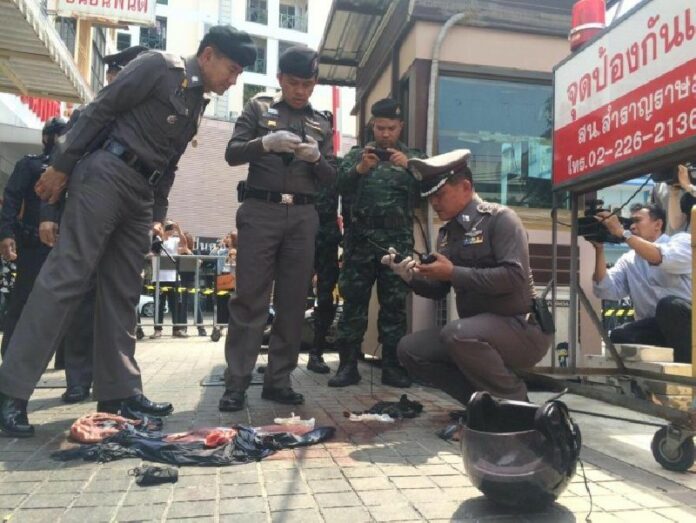
Officers investigating the damaged boat after its engine exploded Saturday morning at Wat Thep Leela pier


BANGKOK — At least 67 people were injured, two seriously, when a boat engine exploded on Khlong Saen Saep this morning.

The boat carrying around 80 passengers was approaching the dock at at Wat Thep Leela pier around 6:30am Saturday when the engine exploded, according to Chaowalit Methayaprapas, owner of Family Transport (Krob Krua Kon Song) company. The company operates the passenger boat service on Khlong Saen Saep in Bangkok.

A number of passengers fell into the water following the explosion. Police and rescue teams arrived at the scene to help them. Over 50 people injured from the blast were sent to hospitals.

Chawalit said the cause of the blast is still unclear. In order to protect against similar incidents in the future, his company’s 25 boats, which run on diesel and LNG like the boat which exploded, were ordered to use only diesel for now.  

The company also operates a further 45 boats which run only on diesel.

According to Chawalit, his company turned to liquefied natural gas, the use of which was approved after consultation with energy experts including those from PTT PLC.

Pairat Boondam, manager of Family Transport, told Khaosod English this afternoon that his company started to use boats that used natural gas around 7 or 8 years ago. Pairat said that today was the first time there has been explosion involving their boats.

Pairat said he is presently at a hospital visiting injured passengers.

Family Transport owner Chawalit said his company will compensate all passengers who were injured in the accident.

Pol.Col. Sarayuth Junnawat told Khaosod English by phone this afternoon that 67 people were injured, two of them seriously.

Officers have now called off the search for those who fell into the water. Nobody was found, according to Pol.Col. Sarayuth Junnawat of Hua Mak Police Station.

Other boats in the canal are still running as usual, Sarayuth said.

Chayanit Itthipongmaetee can be reached at [email protected] and @chayaniti92.

Follow Khaosod English on Facebook and Twitter for news, politics and more from Thailand. To reach Khaosod English about this article or another matter, please contact us by e-mail at [email protected].

 

Follow @KhaosodEnglish

\


Advertisement

Alleged Chinatown Gunshop Robbery Mastermind Arrested

Yang Zheng, at center, in custody Saturday at the Nakhon Sawan Train Station.

NAKHON SAWAN — The suspected leader of the gang which attempted to rob a gun store in Bangkok yesterday was discovered in Nakhon Sawan’s province Friday night riding an overnight train to the north.

Yang Zheng, 30, was on a train bound for Chiang Mai when he was apprehended by police. Police were tipped off by a witness who later told police that they had seen a man who they believed to be Zheng, buying a ticket to Chiang Mai from Hua Lamphong station.

Police believe Zheng was attempting  to flee to his home in China. He entered Thailand on Sunday with a tourist visa according to immigration records.

National police chief Gen. Chakthip Chaijinda is traveling to Nakhon Sawan to question the suspect.

According to Geng Ma, one of the suspects from Friday’s bungled robbery, the gang attempted to steal guns under orders from Zheng. Zheng  left Bangkok after the four would-be robbers under his command were arrested by police Friday morning.

Xingjun Wu, 39, one of the three suspects shot in a gun battle died at a hospital Friday afternoon.

Related stories

Gunshop Heist Suspect Dies, Footage Shows Motorbike Street Justice

Five Injured After Attempted Robbery at Chinatown Gun Shop


Advertisement

Architects Install Lounge at Hua Lamphong to Push Debate on Public Space (Video)

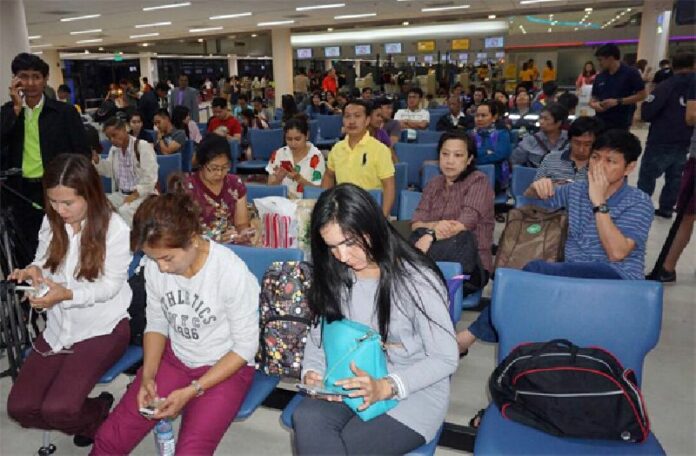
A passenger plays guitar while waiting for a delayed train Thursday at the Bangkok Railway Station.

BANGKOK — Though passengers and people pile up like luggage inside Bangkok’s Railway Station Hua Lamphong, a group of architects noticed its waiting hall was not designed for them.

So the group of professional and student architects, along with a few studying political science, moved in to occupy the capital city’s most iconic transit structure this past week to open a discussion on public space, which they believe should be usable by all.

They placed straw mats, beanbags and plants in the terminal’s main hall for their social experiment to see how they could change the space’s relationship and utility for those passing through.

Hua Lamphong, which celebrates its centennial this year, was the first target for their project called Ten for Ninety, a name which reflects the change they want to see in the percentage of people their profession serves.
 

On a given day, dozens of humans can be found sitting, squatting and lying on the terminal floor. Some are travelers with bags waiting for delayed trains. Some are homeless and shelter in the structure at night.

“As we started collecting information, we found that Hua Lamphong is not only a place for those waiting for the train,” said project advisor Supitcha Tovivich, a Silpakorn University instructor. “But also the janitors, homeless and those from the countryside who stay here while waiting for job opportunities in the city.”

While the railway station provides a number of chairs, the group thought their inflexible design made for poor social interaction and did not make efficient use of the space.

“The space between each row of chairs is very narrow, and people tend to sit on the outer chair first,” said Pat Likitswat, a recent architecture graduate. “So it is not comfortable for people who come later to walk past them to the inner chairs. The space then, in their eyes, is already full.”

The group blended different styles to furnish the area. They laid out traditional mats for country sensibilities and beanbags for the urban middle class.

Then they stepped back and watched to see if the layout made for a more flexible space for people to interact. It worked.

People took seats. They talked. Some played chess and card games, something normally difficult on the terminal’s fixed chairs.

“Gradually, it eliminates the former boundaries,” Supitcha said. “We saw a beanbag with foreigners sleeping on one side while the other side was shared by a homeless person.”

They weren’t trying to come up with an absolute decision. The most important thing about public space usually neglected in Thailand is that it should treat everyone equally.

Stop by and check it out; the experiment continues through Sunday.

The project Ten for Ninety was initiated by the committee of community architects under the Association of Siamese Architects under Royal Patronage. It aims to encourage architects to spend their spare time designing for the 90 percent of the population who either don’t have access to design, or who are not considered by it.

The group is considering whether to take the project to other spaces.


\


\


\


\


\


Advertisement

Gunshop Heist Suspect Dies, Footage Shows Motorbike Street Justice

Two men on motorbikes, and later a small dog, run down a robbery suspect Friday in Bangkok in a still image from security footage.

BANGKOK — One of three men shot trying to hold up a gun shop with BB guns and knives this morning near Chinatown died at a hospital Friday afternoon as footage emerged of the fourth suspect being captured.

Xingjun Wu, 39, was pronounced dead by police as another suspect, 34-year-old Geng Ma, told police via a translator his gang entered Thailand on Saturday on orders from their boss to steal guns. He said they hailed from Harbin, a city in China’s wintry, northernmost province of Heilongjiang and traveled from there to Bangkok.

Police say their boss is a man named Yang Zheng, who has now fled Bangkok.

Meanwhile CCTV footage captured the moment a pair of motorbike vigilantes intervened to prevent the escape of the man not shot in the bungled robbery.

In the video, the suspect runs through a narrow soi with a motorcycle taxi operator in close pursuit. The motosai knocks him down with two-wheel vehicle, at which point the man is almost bitten by a small black dog. He then continues to scamper away as another motorcyclist and the dog give pursuit.

He was later apprehended by police at Soi Sirichai 1 later in the morning, according to Lt. Col. Somkasem Jarak of the Samranrat police station.

The poorly thought-out heist was attempted at around 10am. Four Chinese-speaking men, including two others identified by passports as Junwei Sun and Kunpeng Li, went into Interarms Ltd. Partnership on Charoen Krung Road armed with BB guns and knives.

The owner and staff of the shop opened fire with real guns, but were stabbed in the resulting melee. They are being treated for their injuries.

Update: This story has been updated with names of all five suspects.


Related stories

Five Injured After Attempted Robbery at Chinatown Gun Shop


Advertisement

China's Military Spending Increase to be Smallest in 6 Years

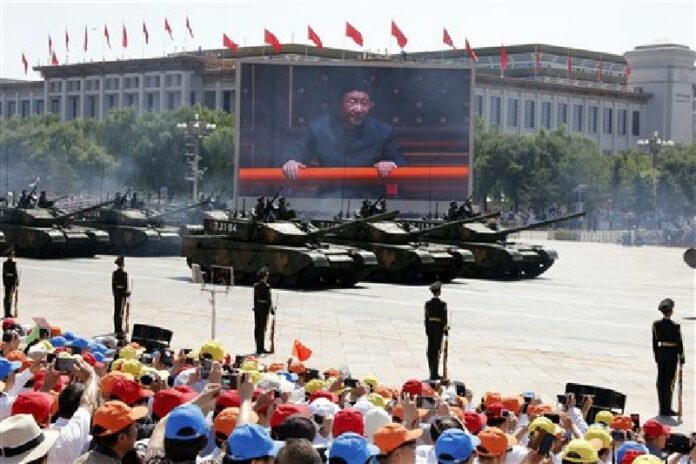
  In this Thursday, Sept. 3, 2015 file photo, Chinese President Xi Jinping is displayed on a big screen as Type 99A2 Chinese battle tanks roll across during a parade commemorating the 70th anniversary of Japan's surrender during World War II from Tiananmen Gate, in Beijing. Photo: Ng Han Guan / Associated Press

BEIJING — China said Friday it will boost defense spending by about 7 to 8 percent in 2016, the smallest increase in six years, reflecting slowing growth in the world's second-largest economy and a drawdown of 300,000 troops as Beijing seeks to build a more streamlined, modern military.

The People's Liberation Army, being trimmed to 2 million troops from 2.3 million, will still be the world's largest standing military. A robust armed forces remains a major priority for China's leaders who have pushed an increasingly aggressive campaign to assert territorial claims in the South China Sea and East China Sea, raising tensions with its neighbors.

Spending at all levels of China's government is being curbed because of a drop in the economic growth rate, which fell to a 25-year low of 7.3 percent in 2015 and is expected to decline further this year. For most years since 2000, China posted double-digit increases in military spending, and this will be only the third time in that period with a single-digit increase, including 2010's increase of 7.5 percent.

The lower increase is a reflection of the "new normal" of more moderate economic growth that President Xi Jinping has been touting for the past two years, said Alexander Neill, a senior fellow for Asia-Pacific security for the International Institute for Strategic Studies based in Singapore.

Still, such spending is "nothing to be sniffed at" in comparison with much smaller defense budgets in the developed economies, Neill said.

"It's reflective of China's determination to maintain a robust and modern fighting force," he said.

In announcing the approximate rate of increase, Fu Ying, the spokeswoman for the China's ceremonial legislature, National People's Congress, told reporters that China needs to consider its defense needs, economic development and the country's fiscal position in drafting the defense budget.

\

Chinese soldiers dressed as ushers march outside the Great Hall of the People in Beijing, Friday, March 4, 2016. Photo: Andy Wong / Associated Press

With last year's budget standing at USD$144 billion (5,103 billion baht), an increase of 7 to 8 percent would take defense spending for this year to between USD$154(5,458 billion baht) and USD$155 billion (5,593 billion baht)— still less than one-third of what the U.S. is proposing to spend this year. The exact figure will be revealed as part of the overall proposed national spending plan for 2016 to be presented at Saturday's opening of the NPC's annual two-week session.

The defense budget increased 10.1 percent last year, despite falling growth, raising concerns about whether such spending was sustainable.

China says its military is strictly for defensive purposes, but takes a broad view of what constitutes threats to its core interests — including protecting maritime territory that is in dispute with neighboring countries.

Its aggressive program of building islands on reefs and atolls in the South China Sea as part of its campaign to claim virtually the entire region has unnerved China's neighbors. Meanwhile, China continues a low-level campaign of confronting Japanese ships and aircraft near a set of contested East China Sea islands.

The modest size of the increase appeared to surprise many observers who had been expecting another double-digit increase in line with the military's higher profile

"I expected growth would be between 12 and 15 percent," said Ni Lexiong, a military expert at Shanghai's University of Political Science and Law, adding that any figure below 10 percent would likely "be not enough" to meet the PLA's modernization goals.

Ni said the lower figure was likely due to both China's current economic realities and a desire to be seen as working for peace and stability in its immediate environment, despite ongoing feuds with its Southeast Asian neighbors, the U.S. and Japan, with which it has sparred over an unoccupied island chain in the East China Sea that Japan controls but which Beijing claims.

The smaller increase comes as China is shifting more resources away from its massive land army and toward the navy and air force, along with cyber warfare and the missile corps.

Along with the structural changes it is undergoing, the PLA says pay raises are constantly needed to compete with the private sector to attract and retain educated personnel qualified to operate high-tech weaponry and computer systems.

\

In this Thursday, Sept. 3, 2015 file photo, Chinese soldiers take part in a parade commemorating the 70th anniversary of Japan's surrender during World War II in front of Tiananmen Gate in Beijing. Photo: Ng Han Guan / Associated Press

China provides no breakdown of its defense budget and Pentagon and global arms bodies estimate actual military spending may be anywhere from 40 to 50 percent more because the official budget doesn't include the costs of high-tech weapons imports, research and development, and other programs.

"The official numbers … on the Chinese defense budget are pure fiction. They are meant to give a false sense of certainty where there is none," said Ian Easton, research fellow at The Project 2049 Institute, an Arlington, Virginia-based Asian security think tank.

With inflation running at under 3 percent this year, the spending jump may actually be bigger in real terms than during the last decade when budget increases rose as high as 17.7 percent, but inflation also topped 8 percent at times.

The PLA's traditional mandate had been to guard China's borders and prepare for contingencies involving Taiwan, the self-governing island that Beijing has pledged to take control of, by force if necessary.

Newer missions, including U.N. peacekeeping operations, are now taking China's military much further afield, possibly even overseas on anti-terrorism missions as mandated by a new law.

Meanwhile, China's Asia-Pacific neighbors are responding with their own increased military spending.

Japan has already passed a record-high defense budget for 2016 of USD$41.4 billion (1,467 billion baht), the second annual increase following 11 years of declines prior to hawkish Prime Minister Shinzo Abe's rise to power in 2012. Planes and naval vessels to counter China's growing capabilities top the Japanese military's shopping list.

India is spending big. New Delhi has expressed concern not only about its disputed land border with China high in the Himalayas, but also about the Chinese navy's growing presence in the Indian Ocean.

Vietnam, which almost alone among the South China Sea disputants has confronted China openly, has roughly tripled its defense spending since 2009, adding advanced new equipment such as Kilo-class submarines from Russia.

At USD$598.5 billion (21,211 billion baht) last year, U.S. defense spending far outstrips all other nations, although it comes against a background of anticipated flat or falling defense budgets in coming years. The omnibus appropriations measure passed by Congress in December calls for USD$573 billion (20,307 billion baht) for defense operations in 2016 and another USD$163 billion (5,777 billion baht) for Veterans Affairs Department programs.

Regarding the U.S., China should be in excellent position to capitalize politically on the slower growth in defense spending, Neill said, especially when the U.S. raises its usual complaints about a lack of transparency in the Chinese system.

"China can come back and say, 'we've significantly cut spending," he said. "It's quite a shrewd move, really."

Story: Christopher Booden / Associated Press

Advertisement

Nok Air Dives Further With 61 Flights Abruptly Canceled

Passengers were stuck at Don Mueang Airport on Feb.14 after pilots of budget airline Nok Air went on strike.

BANGKOK — Despite assurances Nok Air’s downward course has been corrected from its CEO who recently unloaded millions of shares in the ailing airline, it sank further today with another 61 flights canceled.

The budget carrier issued letters of apology Friday signed by its CEO to passengers previously left stranded as another 61 flights were canceled, according to flight information from Don Mueang Airport.

Twenty-seven arrivals and 34 departure flights were canceled at the airport.

In his letter to affected passengers, CEO Patee Sarasin said the strike which disrupted the flights last month was an internal problem that came from the company’s effort to upgrade its standards to comply with European Aviation Safety Agency, or EASA. Patee said it would never happen again.

Further trying to tamp down speculation the airline is imploding, Patee also issued a news release Friday indicating the airline has recruited new pilots to address its critical shortage. He insisted all passengers will be compensated.

Nok launched with high expectations for investors in 2013 but its share prices soon fell off in value. They are currently trading down slightly at 6.95 baht.

On Jan. 21, Patee reportedly sold 6 million shares of NOK when it hit 7.62 baht. No word of any investigation into the transaction has been announced.

Patee’s handling of the crisis has been uneven. He was unavailable Feb. 14 when the original crisis left hundreds of passengers stranded, saying he’d been on a Valentine’s Day trip with his wife. He then said he would not answer questions for a number of days thereafter before blaming the airline’s poor performance on astrological misfortune.


Related stories:

17 Pilots Said to Quit Nok Air as More Flights Canceled

20 More Nok Air Flights to be Canceled

Nok Air Denies Flying Unqualified Trainee Pilots

Nok Air Punishes Employees After Strike Strands Hundreds

Nok Air to Compensate Passengers After Strike Leaves Hundreds Stranded

Thailand Sees Boom In Regional Air Travel

'Nok Air' Plane Finally Salvaged At Trang Airport


Advertisement

Driver Cowers, Passenger Films as Men Assault Taxi in Broad Daylight (Video)

A man attacks a taxi in still images from a video filmed Thursday afternoon in Bangkok. Images: Saeid Ghorbanipour

By Simon Duncan
Deputy Editor

BANGKOK — Two men riding a motorbike attacked a taxi with a passenger inside near the Queen Sirikit Center on Thursday afternoon in Bangkok.

Saeid Ghorbanipour, 45, an Iranian who runs a small trading company in Bangkok, told Khaosod English he was on his way home to see his wife and children at about 3:30pm on Rama III Road when two men approached the stopped car and attacked it with what appeared to be a a tire iron.

Ghorbanipour filmed the incident. In the video two men get off their motorbike and approach the taxi from the right side.They repeatedly strike the driver’s side window and also damage the wing mirror.

One of the two attackers wore a motorcycle taxi vest. Nobody was injured and Ghorbanipour said he did not know why it happened. The two attackers left the scene. Ghorbanipour said he convinced the scared driver to go to the Thonglor police station where they filed a report.

He said this afternoon police had no update to the case.


Related Stories:

Road-Raging Van Driver Accused of Attacking Reporter with Knife

Drunken Motorist Attempts to Run Over Loei Governor

Angered By Parking Fine, Motorist Attacks Krabi Cop 


Advertisement

Five Injured After Attempted Robbery at Chinatown Gun Shop

Police Lt. Gen. Sanit Mahatavorn investigating the scene where four men tried to rob a gun store. Photo: Matichon Online

BANGKOK — Five people were injured in a gun battle at a firearms shop near Chinatown on Friday morning.

Four Chinese-speaking men armed with BB guns and knives reportedly went inside gun store “Interarms Limited Partnership” on Charoen Krung Road at around 10am and attempted to rob the place. The owner and staff fought back by shooting at them, police said.

Five were injured: the store owner and a member of his staff were stabbed by the suspects, while three of the would-be robbers were shot, according to police reports. All of them were sent to hospitals in the area.

One of the suspects was not injured and fled from the scene but was later apprehended at Sirichai Soi 1.

Lt.Col. Somkasem Jarak of Samranrat police station said police have arrested all four suspects. The suspects used BB guns in their attempt to hold up the place, he said.

Somkasem also described the robbers as Chinese speakers, though their nationality has not been confirmed.

\

Photo from the crime scene by Matichon.

Advertisement

'Popcorn Gunman' Gets 37-Year Prison Sentence

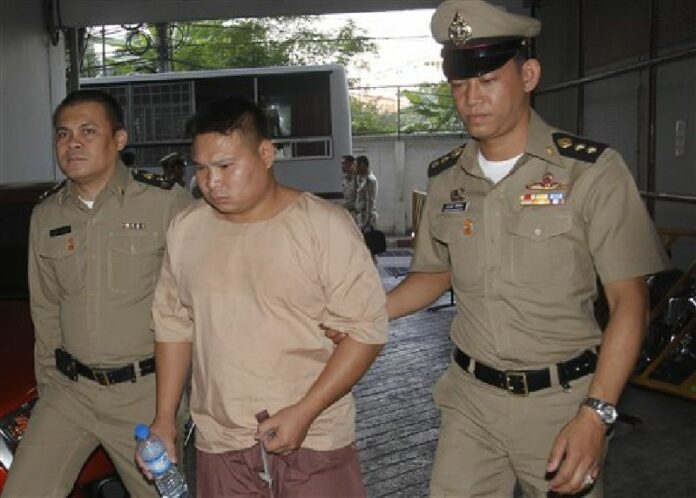
Thai correctional officers escort Vivat Yodprasit, the "Popcorn Gunman", center, as they arrive at Criminal court in Bangkok, Thailand, Thursday, Mar. 3, 2016. Photo: Sakchai Lalit / Associated Press

BANGKOK — A gunman who wounded four people, one fatally, when he opened fire in front of scores of witnesses during a political confrontation in 2014 was sentenced Thursday to 37 years in prison.

Vivat Yodprasit attained iconic status as the "Popcorn Gunman" because he concealed his assault rifle inside a large bag with the logo of a popcorn company as he fired. He became a folk hero for the side he was supporting — a mob that sought to block an election called by the government of then-Prime Minister Yingluck Shinawatra. T-shirts emblazoned with the popcorn logo became popular.

The Criminal Court found him guilty of murder, attempted murder and several weapons charges. The murder victim was a soft drink vendor who died seven months after being shot.

\

The "popcorn gunman" in Lak Si district on 1 Feb 2014.

Vivat wore a balaclava to hide his identity as he shot, but that same day was photographed without it on, allowing him to be identified and arrested a month afterward. He was part of a crowd that was demonstrating against Yingluck's supporters.

The confrontation was one of several bloody incidents in months of unrest stirred up by opponents of Yingluck's government, who called themselves PCAD (People's Committee for Absolute Democracy With the King As Head of State).

They succeeded in disrupting the election, and the confrontations they staged served as a reason for the army to take power in a coup d'etat that May. 

Story: Associated Press

Related Stories: 

Trial For 'Popcorn Gunman' Postponed

Yingluck Allies Blast Threat of Lawsuit Over 2014 Election

Advertisement

Hot News

LATEST NEWS

Bangkok
overcast clouds
30.5 ° C
32.2 °
30.5 °
76 %
4.9kmh
100 %
Sat
30 °
Sun
35 °
Mon
35 °
Tue
33 °
Wed
32 °