29.9 C
Bangkok
Saturday, June 27, 2026
Home Blog Page 2801

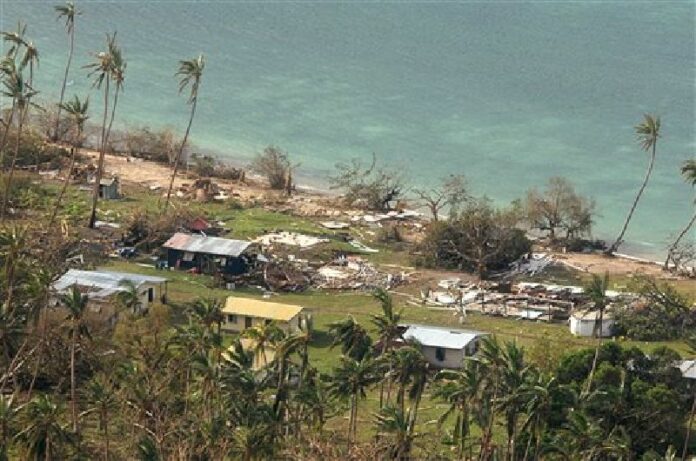
Fiji Cyclone Death Toll Reaches 29 After Island Leveled

In this Sunday, Feb. 21, 2016 aerial photo supplied by the New Zealand Defense Force, debris is scattered around damaged buildings at Susui village in Fiji, after Cyclone Winston tore through the island nation. Photo: New Zealand Defense Force / Associated Press

WELLINGTON, New Zealand — Ten people have died on a single small island in Fiji as the total death toll from a powerful cyclone climbed to 29, officials said Tuesday.

Government spokesman Ewan Perrin said the death toll on Koro Island had reached double figures and that most buildings there had been heavily damaged or flattened.

He said a relief vessel with about 30 people aboard had arrived at the island with medical supplies, food and water, and teams were helping build temporary shelters for the 4,500 residents.

"It's one of the worst hit," Perrin said.

He said officials also have fears about nearby Taveuni Island, home to about 12,000 people, because they've managed to have only limited contact with people there.

Winds from Cyclone Winston, which tore through the Pacific Island chain Saturday and early Sunday, reached 177 miles (285 kilometers) per hour, making it the strongest storm in Fiji's recorded history.

Getting emergency supplies to the group's far-flung islands and remote communities has been the Fiji government's top priority.

Alice Clements, a spokeswoman for UNICEF, said the aerial footage coming in showed a corridor of destruction over places like Koro Island.

"The imagery is heartbreaking," she said. "You're looking down and expecting to see a village and instead you're seeing a field of debris."

She said one priority is to ensure children get back to school because studies have shown it helps them recover faster emotionally.

United Nations Under-Secretary-General Stephen O'Brien said in a statement he was concerned by the devastating impact the cyclone was having on Fiji.

"Whole villages have been destroyed, homes and crops have been damaged, power lines have been cut and more than 8,100 people are currently sheltering in over 70 evacuation centers," O'Brien said.

O'Brien said Fiji was leading the response and had asked for international help. Australia has so far pledged 5 million Australian dollars (129 million baht) in aid and New Zealand has pledged 2 million New Zealand dollars (46 million baht).

Perrin said France, the U.S. and China have also provided or pledged support. He said relief agencies, including Oxfam and the Red Cross, have been helping with humanitarian efforts and that the Fijian government has set up a disaster relief fund.

Home to 900,000 people, Fiji has more than 100 inhabited islands, and authorities are having difficulty communicating with some of the more remote islands in the wake of the cyclone.

Phone communications have been rapidly restored in many areas but in other areas the damage was severe and would take longer to fix, Perrin said.

He said the electricity network across Fiji remained patchy, and in some cases power had been deliberately cut to prevent further damage. He said clean water was also a challenge, and people were being asked to boil their water, treat it with chemicals or drink bottled water.

Story: Nick Perry / Associated Press

Advertisement

Ministry Denies Targeting Foreign Media With New Rules

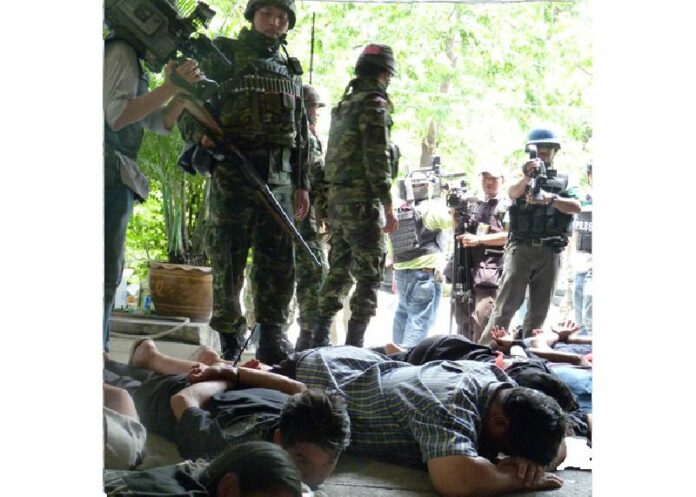
Foreign media film Thai soldiers take civilians into custody May 19, 2010, during a military crackdown on Redshirt demonstrations at Sarasin intersection near Lumpini Park in Bangkok.

By Pravit Rojanaphruk
Senior Staff Writer

BANGKOK — The Foreign Correspondents’ Club of Thailand will take up with the Foreign Ministry ambiguous new guidelines it has issued for approving media visas deemed as a possible means of keeping out critical reporters.

The club’s leadership said Saturday it would raise the matter in response to inquiries made by anxious foreign correspondents, particularly freelancers, since the revised rules came out Thursday with a vaguely worded cause for denying media visas to applicants.

“The latitude the Royal Thai government has in deciding what constitute grounds for rejecting the visa is a matter of concern,” FCCT President Nirmal Ghosh told Khaosod English by phone today. Ghosh said ministry spokesman Sek Wannamethee has assured him there is no attempt to restrict the media.

“We hope and trust he means what he said. However, we are watching it closely. Other organizations are watching it closely too,” he said.

At the heart of the matter is the first sentence regulation No. 4 which states that visas will be issued only if the applicant “has no work or behavior which indicates possible harm to the public or constituting any disruption to the public order or to the security of the Kingdom.”

Those concerned include commentators such as veteran German writer Nick Nostitz, who’s spent 23 years in Thailand and says such vague language can be readily abused to shut out critical voices.

“I have concerns about points 4 and 5, which mentions undefined and intimidating terms of ‘harm to the public,’ ‘disruption to the public order’ and ‘intentional distortion of information.’ These terms have been abused many times in the past by political factions during hate campaigns, and I in particular have been accused, wrongly, of such on numerous occasions,” said Nostitz, who wants the FCCT to do more. “What ensures us that these terms will not be abused to quell critical reporting?”

Rule No. 5 disqualifies applicants who have intentionally distorted information in previous media visa applications.

Nostitz also said he was concerned that, as a freelancer not employed by any news agency, he would qualify for a media visa under the new rules.

Former FCCT President Jonathan Head, who now leads its professional committee, said today he will seek a third meeting with Sek to question and seek assurances about how qualifications are being interpreted.

Head, a veteran BBC correspondent in Southeast Asia who lives in Bangkok, warned the regulations could cost Thailand its status as the regional hub for foreign journalists.

“The way the guidelines have been written have alarmed a number of journalists who believe they’ll be used to withdraw accreditations from critical journalists. We’re pleased that [the Ministry] has said it has no such intention.”

A Foreign Ministry statement on Saturday stated that in January, there were more than 500 foreign journalists who applied for media visas.

“Approximately not more than 5 percent of total journalists would eventually be ineligible to apply for a media visa following the revised guidelines,” it read.

Head said he’s still clueless as to why the Foreign Ministry would want to shed 5 percent of correspondents in Thailand beyond those who are not bona fide journalists.

“There are many foreign journalists who made their lives here and who have had M Visas for years,” he said. “They are now anxious whether they will get an M visa or any kind of visa in the future.”

Head cited an example of a European news photographer, whose name he withheld, who has lived in Thailand for more than 20 years and now teaches journalism with some photography work on the side. Last month the man lost his accreditation.

“This is a valuable member of the international media community,” Head stressed, adding that Thailand “should take pride” in being the hub of foreign correspondents despite the current political difficulties under the military regime.

“I genuinely believe this is an attempt to reduce the number of journalists and not to censor them… [but] we don’t really understand why… Why cause the enormous uproar? It’s a great shame,” he said.

It’s no secret that the military government has been unhappy with coverage by foreign media, particularly of junta leader Gen. Prayuth Chan-ocha, who led the coup in May 2014.

Head declined to say whether he thinks that has anything to do with the revised guidelines.

Related stories:

Foreign Affairs Says Cartoonist ‘Stephff’ Failed to Follow Regs

Longtime Political Cartoonist ‘Stephff’ Loses Work Permit & Visa

.


Pravit Rojanaphruk can be reached at [email protected] and @PravitR.

Follow Khaosod English on Facebook and Twitter for news, politics and more from Thailand. To reach Khaosod English about this article or another matter, please contact us by e-mail at [email protected].


Follow @KhaosodEnglish

\

Advertisement

Italian Man Shoots Ex-Wife and Himself

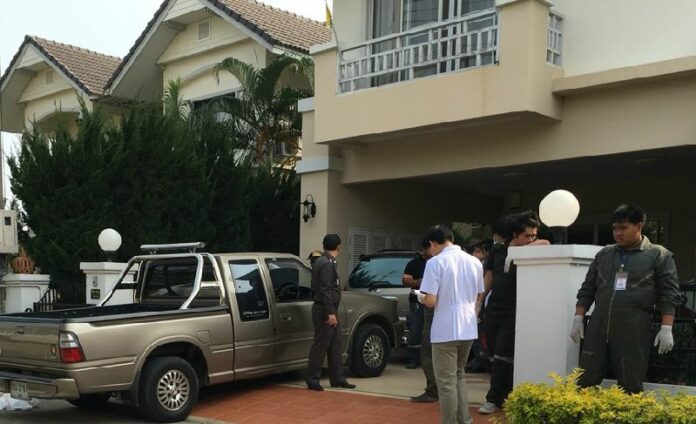
CHIANG MAI — An Italian man killed his ex-wife before turning the gun on himself yesterday in Chiang Mai’s Hang Dong district.

Gianluca Maynardi, 49, reportedly was quarreling with his former wife, Somjit Phanphon, over their 8-year-old son when he shot her to death and then committed suicide.

According to police Lt. Col. Wichien Chaichompoo, Maynardi and Somjit had a son together. After the couple divorced last year, they agreed to take turns caring for the boy, Wichien said. Somjit had left the man because she said he was abusive, the officer said.


\
Photo: Chiang Mai Citylife

On Sunday afternoon, Somsri came to the Maynardi’s house to pick up the boy, Wichien said, but the Italian man said he took the boy to a friend’s house, which led to Somjit becoming agitated and eventually an argument erupted. It turned physical, and according to an unidentified witness, Maynardi kicked Somjit several times.

At that point the woman pulled out a .380 pistol to defend herself, according to the witness, before she fled by running outside of the house. The Italian man chased after her, snatched the pistol from her hand and shot his ex-wife three times, Wichien said.

Then he shot himself.

Maynardi was a retired Muay Thai coach who had lived in Thailand on-and-off for many years, according to a report in Chiang Mai Citylife.


Advertisement

New Zealand Marks 5 Years After Quake

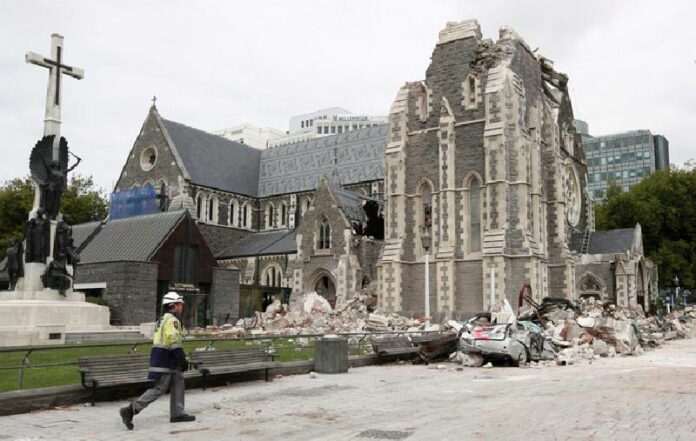
A relief worker walks past the earthquake-damaged ChristChurch Cathedral on Feb. 26, 2011, in Christchurch, New Zealand. Photo: Mark Baker / Associated Press

WELLINGTON, New Zealand — A service to commemorate the fifth anniversary of a deadly earthquake in the New Zealand city of Christchurch turned ugly Monday when someone threw goop over the government minister responsible for quake recovery efforts.

Hundreds of people attended the botanical gardens service in New Zealand's second-largest city to memorialize the magnitude-6.1 quake that killed 185 people on Feb 22, 2011.

As people chatted after the service ended, somebody tossed the unidentified goop from a plastic ice cream container over Earthquake Recovery Minister Gerry Brownlee, his spokesman confirmed.

Police said they arrested a 41-year-old man in connection with the incident and charged him with assault. Police said the man had left the service but was found a short time later.

\
Someone tipped ice cream onto Earthquake Recovery Minister Gerry Brownloee. Source: News Hub

Brownlee has proved a polarizing figure in the rebuilding of Christchurch. Many people frustrated at delays in collecting insurance or at the slow pace of the downtown reconstruction have blamed him.

Earlier in the day, Brownlee was heckled by a man during an outdoor radio interview: "You've done a bad job. A bad, bad job," the man yelled after first shouting an insult. On air, Brownlee laughed off the incident.

Brownlee's spokesman, Nick Bryant, said the lawmaker didn't wish to comment on the incident at the service because it had become a legal matter.

It's the second time this month that somebody has thrown something at a New Zealand lawmaker. On Feb. 6, a woman threw a pink toy penis at Economic Development Minister Steven Joyce to protest an international free trade deal.

Earlier during Monday's memorial service, speakers made the point that while there had been big progress since the quake, there was much left to be done.

"There is still some way to go until Christchurch is truly reborn," said Governor-General Jerry Mateparae.

\
A plaque commemorates those killed in a mall during the 2011 earthquake in Christchurch, New Zealand. Photo: Nick Perry / Associated Press


Speakers also mentioned the disquiet they felt when the region was rattled again last week by an earthquake, one of the strongest since 2011. Last week's quake knocked items from shelves and triggered rock falls, but didn't cause major damage.

Emergency responders and officials representing more than a dozen foreign nations were among those who read out the names of each of the victims who died in the quake.

Mateparae said it changed the region forever.

"We recall the ordered streets and gracious buildings of a city renowned for its style and substance," he said. "We recall how, in an instant, that physical landscape was shattered. We recall how dust and the sound of sirens filled the air."

He said many people have faced exhaustion, stress, frustration and financial hardship in the years since, but that he hopes the end of that period is fast approaching and people can look at their city with renewed optimism and energy.

Christchurch Mayor Lianne Dalziel said there was an incredible opportunity to reimagine and reinvent the city.

"But we must acknowledge there are still many people who have unanswered questions," she said. "People with unresolved insurance claims, people who are still living in the houses that were damaged five years ago. None of them with any certainty of when they will find closure."

Story: Nick Perry / Associated Press

Advertisement

Mystery Money Rains Down Over Siam Square

20 baht banknotes rain down Sunday evening from the Siam Square One shopping mall in Bangkok. Photo : @padpaddpaddy / Twitter

BANGKOK — Mystery money poured down on passers-by at Siam Square last night, with someone soon after taking credit online for the ethically challenging bounty.

Dozens of 20 baht banknotes appeared to be thrown from an upper floor of the Siam Square One shopping mall Sunday evening, according to the Twitter user @padpaddpaddy. Enclosed with the note was a small piece of paper with a “schwa” alien logo and name of a Facebook page called “Risk Invisible Hands.”

“This is money gotten back from a tricky person. If you take it, you must be sure that you are honest,” read the small piece of paper. “If you are not qualified but you take it, you will lose your honor. You have the right to choose whether to take it or not to take it.”

The admin of the page claimed responsibility, saying it was the money he unexpectedly got back from a scammer with the help of social media. It didn’t go provide further detail.

The admin then claimed to use it to inspire honesty in other people.

“I hope what I did will remind all of you when the chance to deceive or to lie to others comes,” it wrote. “The message you read today will remind you how have you answered yourself back then!”

The page turned popular overnight with almost 6,000 likes. Whether they hate or admire it, its followers remain unsure of its real purpose.

“You spent 20 baht per person to campaign for honesty,” wrote Facebook user Patiphan Jongrak in Thai. “You are doing good and don’t reveal yourself; so cool.”

Others were more skeptical about the motive behind the stunt.

“Will you start selling cream when your page is famous?” wrote Facebook user IMay Matchantika.

One user saw an efficient investment in social media.

“Not so much money spent, but you get to promote your page and get featured in media,” wrote Facebook user Kittisak Kidha. “I gotta say this is the best marketing.”

 
\

20 baht banknotes rain down Sunday evening from the Siam Square One shopping mall in Bangkok. Photo : @padpaddpaddy / Twitter


Advertisement

Smartphones Add VR, Better Cameras to Save Sales

Photo: Nan Palmero

BARCELONA, Spain — To revive interest in smartphones, Samsung and LG are improving their cameras and embracing the nascent world of virtual reality.

Facebook's Mark Zuckerberg joined Samsung at the Mobile World Congress show in Barcelona, Spain, to announce that their companies are teaming up to push VR in mobile phones and social networking.

Virtual reality "is now mainly used for gaming, but that is quickly changing," Zuckerberg said. "That is why Facebook is investing so much in VR, so we can deliver these social experiences."

Samsung's new Galaxy S7 and S7 Edge promise better photos under low-light conditions, in part with sensors that capture more light. Both will work with the USD$100 Gear VR headset that Samsung released last fall. And Samsung will now make a 360-degree camera for everyday folks to capture and share VR images.

VR is still in its early days, with much of the interest coming from hard-core gamers and tech pioneers. Samsung wants to make it easier for everyday people to create VR videos — so that friends will buy VR headsets to view them.

LG will also have its own VR headset and 360-degree camera, while the main camera on its upcoming G5 smartphone will have two lenses — one for standard shots, and another with a wider angle to capture more of what's in front of you.

Sunday's announcements at the Barcelona show come as worldwide smartphone growth has slowed, particularly for high-end devices such as Samsung's S and LG's G series. Many consumers have turned to lower-cost Android devices that sport features considered top of the line just a few years ago.

Phone makers used to guarantee upgrades by making phones bigger and bigger — but phones can't get much bigger for one-handed use. In fact, the new LG phone is shrinking to 5.3 inches, from 5.5 inches last year. Samsung's Edge is getting bigger, at 5.5 inches, but because the sides curve like a waterfall, the phone won't be much wider. The main S7 model is staying constant at 5.1 inches.

With size out of the equation, phone makers have to innovate elsewhere.

"Their problem is that phones from two to three years ago are still in use," said Ian Fogg, head of mobile analysis at IHS Technology. "VR is essential. It is a smartphone-industry initiative to drive consumers to upgrade."

That's been particularly important for Samsung, as its chief rival, Apple, largely matched Samsung on size, while boosting the iPhone camera's resolution to 12 megapixels from 8. The iPhone has also gotten better at low-light shots, even surpassing some stand-alone, point-and-shoot cameras in performance.

"Having seen everything the smartphone can deliver, at Samsung we have other ideas," said D.J. Koh, the head of Samsung's mobile business.

In a few months, Samsung will start selling its Gear 360 camera, a device with front and back lenses to stitch together 360-degree videos for VR devices and apps. Samsung phones will come with apps for viewing those videos on the Gear VR and sharing them with friends.

Samsung's phones will see improvements, too, particularly in the camera.

Realizing that the megapixel count alone doesn't necessarily translate to quality images, Samsung is reducing resolution in the new phones to 12 megapixels from 18. That allows individual pixels on the sensors to be larger, thus capturing more light. The new cameras also allow the camera's aperture to open wider, letting in more light. Together, the shutter needs to stay open for a shorter time, reducing the blurring that sometimes mars indoor and night shots.

Samsung also says its new phones will have a faster focus, which it says will improve performance at low light.

And for the selfie camera, Samsung is turning the screen into a flash, similar to what Apple introduced last fall.

Samsung is restoring the ability to add storage, but the battery won't be replaceable by users, something Samsung had allowed before last year. Instead, Samsung is increasing the battery capacity in both models, though the Edge's larger screen and other new features in both models, including an always-on mode, will sip away power.

The new phones will start shipping March 11, with advance orders to begin this week. In some markets, including the U.S., Samsung is including a Gear VR headset for free to those who order ahead of time. Prices will vary by carrier and region. In the U.S., AT&T, Sprint and T-Mobile are offering the regular version for USD$650 to USD$695 (23,000 baht – 24,800 baht) and the Edge version for about USD$100 more. Verizon hasn't announced prices yet.

LG, meanwhile, designed the LG 360 VR headset to work with an LG smartphone that's attached by a cable. With Samsung's VR device, the smartphone is inserted at eye level and becomes the headset's display, increasing the weight on the head. LG's version has built-in, lighter displays in the headset's eyepieces.

For the G5 phone, an optional attachment will function as a camera grip with physical buttons to take shots and control video recording. It's part of LG's new modular approach to design; you'll be able to pop out the phone's bottom and swap in new hardware features.

Prices and release dates for the LG phone and accessories from both companies have yet to be announced, though the LG phone is expected in the U.S. in April.

Neither VR system will be as powerful as full-fledged VR devices coming this year. HTC said Sunday that a consumer version of the Vive will start selling in early April for USD$799 (28,500 baht), with ordering to begin Feb. 29. A personal computer is required and sold separately.

VR isn't limited to high-end devices: On Saturday, Alcatel announced a mid-range Idol 4S — with packaging that can be folded into VR headset.

Story: Anick Jesdanun, Joseph Wilson / Associated Press

Advertisement

Australia Warns of Terror Attacks in Kuala Lumpur

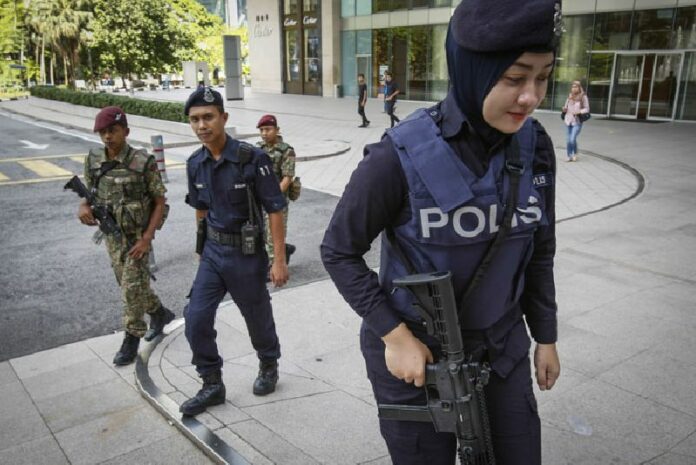
Malaysian military and police personnel patrol Jan. 25 outside a shopping mall in Kuala Lumpur, Malaysia. Photo: Joshua Paul / Associated Press

KUALA LUMPUR — Australia warned Sunday that terrorists may be plotting attacks in and around Kuala Lumpur, Malaysia's largest city.

The Australian High Commission in Malaysia said in a travel advisory that there was an ongoing terrorism threat in Malaysia, noting that authorities there have arrested a number of people allegedly involved in planning attacks, including against entertainment venues in Kuala Lumpur.

"Terrorists may be planning attacks in and around Kuala Lumpur. Attacks could be indiscriminate and may target Western interests or locations frequented by Westerners," the commission said in the advisory, which was posted on its website.

Malaysia has raised its security alert level following the Jan. 14 attacks in Jakarta that left eight people dead.

In response to Australia's warning, Kuala Lumpur police chief Tajuddin Mohamad Isa told the English-language newspaper The Star that security has been stepped up in the past few months and that there was no indication of an attack.

Since 2013, Malaysia has arrested more than 150 people with suspected links to the Islamic State group. Last month, a 28-year-old Malaysian man was detained just hours before he planned to blow himself up at an entertainment outlet in Kuala Lumpur.

The travel advisory also urged Australians to avoid travelling to Malaysia's eastern Sabah state on Borneo island, famed for its dive sites, due to a high threat of kidnappings by Philippine rebels.

It said Australians should exercise "normal safety precautions" when in Malaysia overall.

A Malaysian Foreign Ministry official said Sunday that foreign missions are at liberty to provide their own assessment of the security situation in the country.

The official, who declined to be named due to the sensitivity of the issue, said "it is nothing to be alarmed of," noting that the terror warning also acknowledged Malaysia's efforts in strengthening its security presence in high-risk areas.

Story: Eileen Ng / Associated Press

Related stories:

ISIS Claims Jakarta Attack Which Kills 7


Advertisement

Two Girls Thrown from Carnival Ride, Seriously Injured

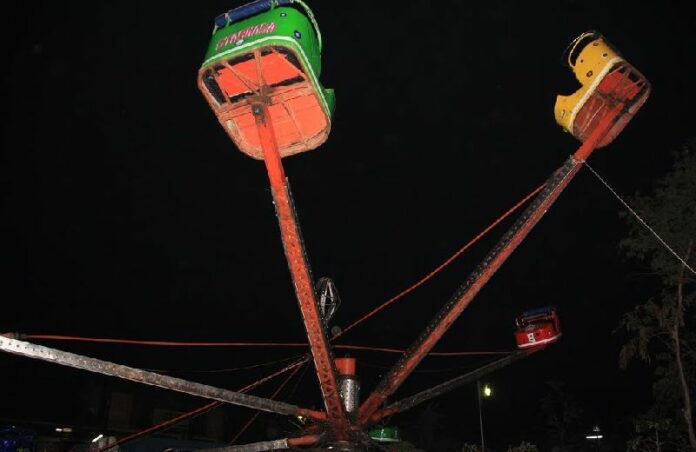
The Hurricane ride Sunday night at a fair at Wat Phra That Phanom.

NAKHON PHANOM — A carnival ride collapsed into its base and injured several riders at a temple fair on Sunday night.

Police and a rescue team arrived at Wat Phra That Phanom to find one arm of the Hurricane-style ride on the ground with two girls unconscious on the ground. Other passengers were stuck up in the air in other cars before emergency personnel climbed up to rescue them.

Siriwan Ladbasri, 14, received a broken arm and serious head injury while her 19-year old cousin, Penpicha Ladbasri, suffered a skull fracture.

The two are undergoing treatment at a hospital, Pichitchai said.

The 40-year-old father of Siriwan, Mongkol Ladbasri said that their family traveled together from Na Kae district. While others were visiting the temple fair, he bought his daughter and niece a ride ticket for 40 baht per each.

He was filming them enjoying the ride until the accident occurred.

“I was recording a video for a couple of minutes before the spinning ride fell to the ground. I ran to see my daughter and niece immediately,” Mongkol said, insisting someone must be held responsible for the incident.
 

The eight-armed ride was is owned by the Star Naza Co.

The staff member operating the ride Suwit Seripong, 59, told police the accident was likely caused by a broken lock nut. He told police that he was trying to stop the ride when he noticed the malfunction but failed to control it, according to police Lt. Pichitchai Roobkom.

Initially, Suwit was charged for recklessness resulting in injury by using the sub-standard carnival ride, Pichitchai said.

According to Pichitchai, the owner of Star Naza company said that his firm had a contract with an insurance firm which will compensate the family immediately.

Advertisement

Blatter Era Ends as Scandal-Hit FIFA Set to Elect New Leader

A carnival float depicting suspended FIFA president Sepp Blatter receiving money while he stands in a goal in front of a camera during the traditional carnival parade in Cologne, western Germany, Monday, Feb. 8, 2016. Photo: Martin Meissner/ Associated Press.

GENEVA ― The Sepp Blatter era at FIFA is set to finally end Friday when soccer's scandal-scarred world body picks a new president after nine months of crisis.

An election meeting designed to give FIFA a fresh start with a new leader could yet be overshadowed by its criminally corrupt past.

Voters return to Zurich this week unsure who is the next target of federal law enforcement agencies in the United States and Switzerland, who have sent FIFA into meltdown with waves of arrests, extraditions and guilty pleas.

Swiss prosecutors could decide this week is best to meet key witnesses in their widening case. Many soccer officials are making possibly their last working trip to Switzerland until May 2019, when the next scheduled FIFA election should be held in Zurich.

At the last election in May, Blatter won a fifth presidential term two days after FIFA's favored five-star hotel in Zurich and its own headquarters were raided. The pressure of criminal investigations soon forced Blatter from his beloved FIFA in his 41st year on the payroll.

Now, leaders of FIFA's 209 member federations visit the tiny Swiss city again to elect a successor for the now-banned 79-year-old who has been president since 1998. The winner will be just the fourth elected FIFA chief in more than 50 years.

Two front-runners have emerged in a five-candidate contest: Asia's soccer leader, Sheikh Salman of Bahrain, and Gianni Infantino, the Swiss general secretary of European governing body UEFA.

The other candidates are: Former FIFA vice president Prince Ali of Jordan, who lost to Blatter in May; former FIFA official Jerome Champagne of France; and South African businessman Tokyo Sexwale, once an inmate of Robben Island prison with Nelson Mandela.

Infantino acknowledged that police could hit FIFA for the fourth time in nine months.

"They know what is best for their work to be done in the most efficient way," Infantino told The Associated Press in a recent interview. "If I'm elected president of FIFA, what they can count on (is) not 100 but 200 percent with me to clean and to put anyone in jail who has done anything bad for football."

The three previous strikes ― arresting seven men, including two FIFA vice presidents, on May 27; interrogating Blatter and former protege Michel Platini on Sept. 25; arresting two more FIFA vice presidents on Dec. 3 ― were on days that FIFA's discredited executive committee met. It meets again Wednesday.

Sheikh Salman suggests government agencies have tried to influence FIFA politics. That view is shared by Blatter and Russian President Vladimir Putin, who claimed the U.S. wants the 2018 World Cup taken from his country.

"Choosing the time and place during an election or an (executive committee) meeting," Sheikh Salman told the AP this month of previous police raids, "I think this raises a lot of doubts on why, and leave people a bit suspicious on the intentions."

The Bahraini royal was "absolutely" sure FIFA did enough since May to deserve being left in peace this week.

FIFA also hopes so, and aims to persuade the U.S. Department of Justice that it is a victim of systemic corruption and should not be indicted.
 

The Vote

So, on Friday, the 209 members can also vote through wide-ranging reforms to restructure FIFA. These would dilute the president's authority, empower FIFA's staff and increase oversight by independent experts.

If FIFA was indicted, it would join 41 soccer and marketing officials, plus marketing agencies, who have been charged or pleaded guilty so far in the sprawling U.S. case. Blatter, who cannot be extradited from Switzerland, is a confirmed target.

American investigators have focused on bribery in North and South America valued at USD$200 million for awarding commercial rights for continental competitions. They also alleged cash-for-votes paid through a FIFA account linked to 2010 World Cup host South Africa.

Swiss prosecutors began by searching for money laundering in the 2018-2022 World Cup bid contests won by Russia and Qatar. Liaising with American counterparts, they went far beyond that brief to target all FIFA business.

Last September, a Swiss criminal case was opened against Blatter for mismanagement of FIFA money. It led FIFA's ethics committee to ban both Blatter and Platini for eight years. Verdicts in their appeals are expected Monday.

Even if barred from the election hall, Blatter has been an election factor taking calls from voters seeking advice, he told a French radio station this week.

"Vote with your conscience. Vote for who you find good," said Blatter, who has criticized Infantino in interviews. They were born in neighboring villages in the Valais region.

Infantino's campaign has tempted voters with more: Expanding the World Cup from 32 to 40 teams to increase FIFA's USD$5 billion tournament income; bigger annual grants to national and continental bodies; new money for small regional groups.

Salman's manifesto is closer to Blatter's thinking though he promises a hands-off leadership style.

Still, there is genuine warmth between the favorites.

"I get along very well with him," Sheikh Salman said of Infantino. "He's a great guy."

Infantino has not directly criticized the sheikh, who led Bahrain's soccer federation during Arab Spring protests in 2011.

Prince Ali did attack, saying Sheikh Salman cannot gain respect because he failed to protect Bahrain national team players who were detained for attending pro-democracy events. They later alleged torture by security forces.

In a potentially tight race, one theory has Prince Ali's voters holding the balance of power.

A plausible scenario sees Sheikh Salman and Infantino with significant support in the first-round ballot, yet short of up to 140 votes needed for outright victory, and maybe fewer than the 105-plus tally which could persuade rivals to concede ahead of a second vote.

A late campaigning opportunity was in Manhattan on Sunday, at the draw for Copa America Centenario. That 16-nation tournament is central to bribery allegations in the DoJ indictment.

By Wednesday, the election show is in downtown Zurich where FIFA will also open its USD$200 million museum this week.

Perhaps police and Blatter will join them.

Story: Graham Dunbar / Associated Press

Related Stories:

Ex-Top Cop Appoints Top Cop to Run Premier League

 To reach us about this article or another matter, please contact us by e-mail at: [email protected].

Follow Khaosod English on Facebook and Twitter for news, politics and more from Thailand.

Follow @KhaosodEnglish

\

Advertisement

Buddhist Scholar Warns Against Establishing National Religion

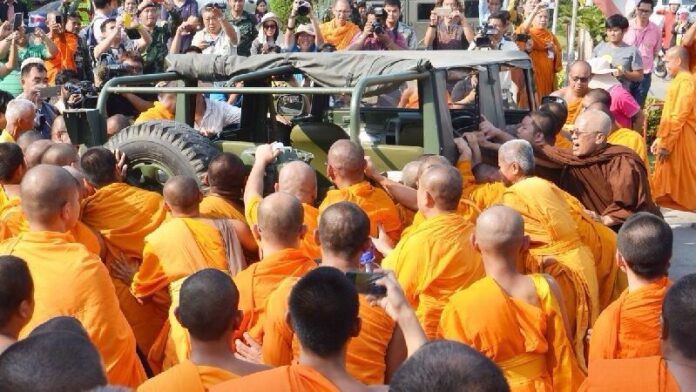
Hundreds of monks scuffle with soldiers and try to forcibly remove vehicles blocking their way Feb.15 at a Buddhism park west of Bangkok.

By Pravit Rojanaphruk

Senior Staff Writer

BANGKOK — A prominent Buddhist scholar warns that making Buddhism the national religion will do more harm than good and cause religious conflict in Thailand, where many profess other faiths including Islam and Christianity.

At at a time when loud calls are coming from some quarters for Buddhism to be legally enshrined as the official religion of the land, Sulak Sivaraksa predicts any serious consideration to the demand could cause religious turmoil like that experienced in countries such as Sri Lanka and Myanmar.

“Those who think like this are extremely nationalistic,” Sulak said.

His reaction came as some monks and Buddhist laymen are calling for a national religion to be written into the next constitution, most visibly on Feb. 15, when hundreds of monks clashed with soldiers west of Bangkok.

A spokesman for the junta-appointed drafters tasked with writing the next constitution, Amorn Wanichwiwatana, was noncommittal to the idea.

Sulak urged Thai Buddhists to think about fellow Thais of other faiths.

“It’s most inappropriate and will do more harm than good. Don’t we recognize the value of Muslims?” asked Sulak, adding, “A [Thai] female Christian told me being a woman is disadvantageous enough.”

Sulak attributes such yearning to a narrow understanding of Buddhism and ultra-nationalistic ethos.

“It’s because this country has taught people to be nationalistic, so they think we must have a national religion too,” he said, adding that the fact remains that Thailand has always been ethnically and religiously diverse. “Buddhism is also a religion which teaches people to reduce one’s ego and to nurture loving kindness. The Buddha taught people to love all mankind.”

Angkhana Neelapaijit, a national human rights commissioner who is Muslim, said for the sake of equality and respect for those professing other faiths and peaceful coexistence, no religion should be made national religion.

The subcommittee Angkhana chairs actually submitted a proposal to the Constitution Drafting Committee urging them to state in the draft constitution that while Thailand is a unitary state, it is also culturally a pluralistic society with diversity in religious belief.

Angkhana attributes the recurring attempt to make Buddhism a national religion to the controversial behavior of some well-known monks, and the belief that making it the national religion would strengthen Buddhism.

“Perhaps we should teach people about the essence of religion,” Angkhana said.


‘It Won’t End Nicely’

Former editor of a progressive journal Pacarayasara Magazine, Pipob Udomittipong, who himself is Buddhist, said Buddhism is being politicized by such demands.

“Making Buddhism the national religion will tie religion to the state and politicize it,” he said, adding that ordinary Buddhists in Chiang Mai province where he lives do not seem to care about the matter which is making headlines in Bangkok.

Pipob warned that if such a scheme were ever to succeed, it would have grave repercussions for Thailand. “The conflicts in the three [predominantly Malay Muslim] southern provinces will acutely exacerbate. [Separatists] will be able to recruit more people, and the issue would lead to more violence. The ending won’t be nice.”

Charter drafter spokesman Amorn meanwhile was circumspect about the proposal. He told Khaosod English that all faiths are already protected in the current draft charter, and he believes the current status quo is better than the proposal.

Asked if the charter drafters will ever give serious thought to the proposal, Amorn said people should wait to see the final draft, which is due by the end of March.

“You will know when the time comes,” he said.

Related stories:

Hundreds of Monks Clash with Military West of Bangkok (Video)

Pravit Rojanaphruk can be reached at [email protected] and @PravitR.


\

Advertisement

Hot News

LATEST NEWS

Bangkok
overcast clouds
29.9 ° C
31.1 °
28.8 °
90 %
2.8kmh
97 %
Sat
37 °
Sun
36 °
Mon
36 °
Tue
33 °
Wed
34 °