30 C
Bangkok
Monday, July 27, 2026
Home Blog Page 2919

Ex Con Busted for Alleged 'Sex for Meth' Enterprise

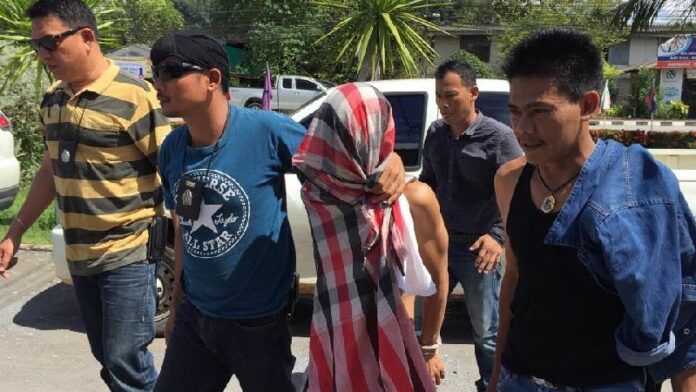
Undercover officers escort Tawee Boonthong away from the palm field yesterday in Nakhon Si Thammarat province where they sent a woman to test their suspicion he was trading drugs for sex.

NAKHON SI THAMMARAT — Two months out of prison, Tawee Boonthong was arrested again after reportedly caught offering to trade yaba for sex yesterday in Nakhon Si Thammarat.

Police Lt. Tawatchai Yangyuen said Tawee was arrested on Thursday after officers organized a sting in which they recruited a woman and sent her to the suspected dealer to buy some methamphetamines. The two met in a palm field in the Thung Yai district of Nakhon Si Thammarat, where police swept in to arrest the man.

A later search of Tawee’s home found a bag of 120 doses of speed hidden in the trash, police said. Tawee reportedly told them he could not find a job after being released from jail, so he returned to dealing drugs again. He said that he bought the drugs for 150 baht per hit from another dealer and was reselling it for 200 baht.

As for female clients who could not afford the drugs, Tawee said he was willing to make a deal under which they paid him with sex instead of cash, reportedly at a rate of one sexual encounter per hit. Tawee claimed his business was growing fast and well, police said.

Advertisement

Reserve Act Opens 12 Million to Summary Military Conscription

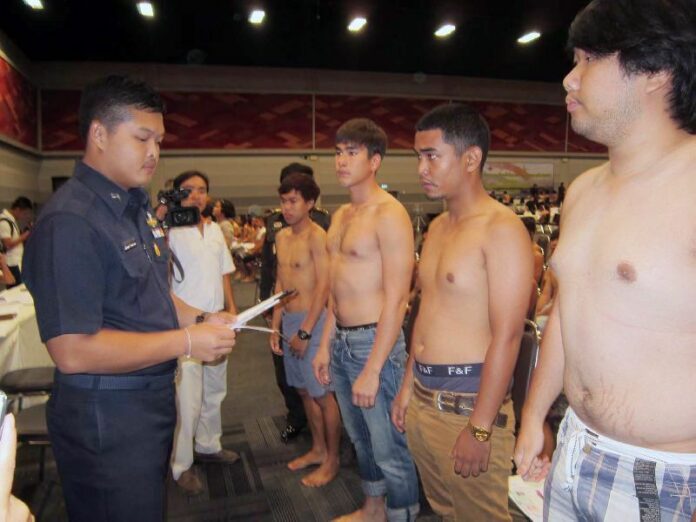
Men line up at a Khon Kaen conscription center on April 7, 2014.

BANGKOK — A law granting the military authority to order 300,000 men into service annually was recently passed by the junta-appointed legislature with little public debate and no opposition beyond an emerging online campaign against it.

An online petition launched Tuesday against the Armed Forces Reserve Act, passed recently by the military-stacked interim legislature, said that exposing 12 million men to summary conscription would lead to social and economic instability.

“If the draft comes into effect, it will bring a lot more economical and social problems,” read the petition. “The 12 million men who can be summoned already have their own professions which are part of developing the country too in some way.”

The new law empowers the Defense Ministry to call up to 2.5 percent of the 12 million reserve forces for service, and refusing to serve would be punishable by four years in jail. In Thailand, all men eligible to serve are considered in reserve once they register at 18 until they age out at 30. Reserves include those who were students in the territorial defense program, a usual mechanism for avoiding conscription.

The law was passed without opposition by 192 members of the NLA, with four members abstaining. It would allow the conscripts to be summoned for a variety of purposes such as helping with disaster relief, enforcing martial law, responding to emergency situations and preparing for war.

When he briefed the interim parliament on the plan in July, former army chief Udomdet Sitabutr said the impact would be negligible, as people would only need to serve for two months.

"There shouldn't be any problem, because mobilizing the reserve force won’t take much time,” he said. “We will only summon 2.5 percent of the entire reserve force to place in military units, and they will train for only two months."

The bill’s chief drafter, Gen. Singsuk Singprai described several scenarios to iLaw under which men may be called to serve. He said they could be summoned for a one-day “readiness inspection;” added to the force for two weeks of “mobilization training;” or called in for ongoing emergency or martial law situations.

The law requires employers to pay minimum wage while their employees are away for military training or face a 20,000 baht fine. Those who did not work for a company, such as freelance workers, would receive no compensation.

The law will come into effect once it is signed by the king and published in the Royal Gazette.

Gen. Singsuk said the law would give the nation, for the first time in six decades, clear regulations governing its reserves.

On the internet, one of the few forums of dissent, the Change.org petition launched Tuesday has garnered more than 8,000 signatures and comments critical of the militarization of society.

“It is wrong to force everyone to be a soldier,” it stressed.

In an article published Tuesday, democracy activist Pakawadee Weerapaspong questioned the bill’s necessity at a time when Thailand is not confronted with enemies or war, but how to compete economically with its neighbors under the ASEAN Economic Community.

“Considering all factors , the Armed Forces Reserve Act is likely to have more disadvantages than the advantages,” she wrote. “And it might eventually lead Thailand to be a failed state.”

Opinions opposing and supporting the bill were found on the kingdom’s biggest webboard, Pantip. Though some questioned the transparency of how the 300,000 would be selected, others deemed it a duty of Thai men to serve their country.

“I am willing to be called up for training,” wrote Pantip user Purisak. “Why are you trying to escape the duty of Thai citizens?”

Advertisement

Madaew and Friends to Throw Beauty ‘In Your Face’ at Alliance Francaise

Madaew, a 15-year-old fashion artist from Khon Kaen will perform at 'In Your Face' Nov. 27 in Bangkok as part of Galleries Night.

BANGKOK — A schoolboy fashionista from Khon Kaen, retired man etched with wrinkles and a sex worker with disproportionate breasts. Yes, it will be a big night at Alliance Francaise Bangkok later this month.

First up is the schoolboy, the weird and 15 and wonderful Madaew, who will travel from Khon Kaen with some friends to put on a fashion show at “In Your Face.”

Part of Galleries Night, the Nov. 27 installation features 400 projected portraits by 20 French and Thai artists.

Curator Myrtille Tibayrenc said that while portraiture has been around for centuries, they capture something completely different today than those of the 16th century, as portraits reflect the social ideals, economics and aesthetics of human society.

She contrasts the work of Kathmandu Photo Gallery’s Manit Sriwanichpoom with those of French artist Cyril Caine, who photographs patients of reconstructive facial surgery.

“[Manit] shot photos of Hi-So women in parties, very luxurious, wearing expensive clothes, drinking champagne,” Tibayrenc said. “Contrasted to French artist Cyril Caine’s [subjects’] complete loss of faith from accidents and disasters – getting plastic surgery to become human again.”

\Courtesy image, copyright Benjamin Mengelle

\Courtesy image, Cyril Caine

Portraits from both artists will be among those projected at “In Your Face.”

Myrtille said the medium of projection is one way to question the aesthetics of human beauty. All of the portraits will be projected onto a gigantic screen to literally get in your face.

The event is part of Galleries Night, a two-night event unfolding along downtown transportation corridors featuring special events at various arts and culture venues.

In Your Face” is supported by the French Embassy and will run from 8pm to midnight on Nov. 27 at Alliance Francaise. Madaew performs from 10 to 10:30pm. There will be booze pouring and music flowing from Toot Yung resident DJ Marine.  Entry is free.

Advertisement

Junta Seeks Blanket Amnesty for ‘Honest Use of Force’

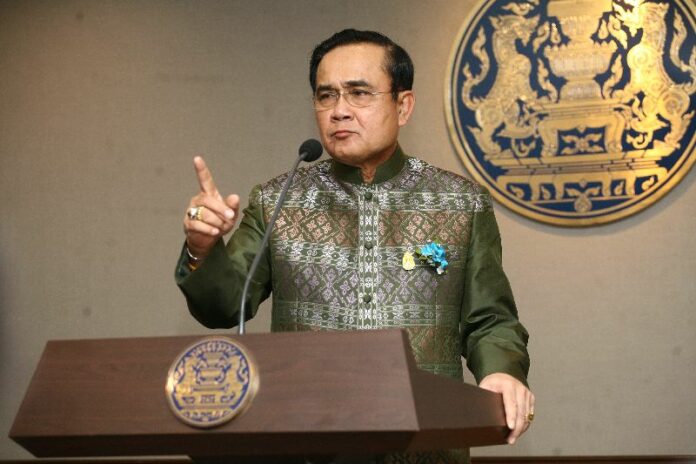
Junta chairman Prayuth Chan-ocha speaks to reporters Nov. 10 at Government House in Bangkok.

By Teeranai Charuvastra
Staff Reporter

BANGKOK — The junta has asked drafters of the new constitution to include a blanket amnesty for any use of force deemed to protect state security.

The request is among 10 suggestions made public Wednesday to the Constitutional Drafting Committee as part of its process for writing a new charter, after the previous was dissolved when the regime seized power in May 2014. 

While most of the items seem innocuous calls for democratic considerations such as more public participation and prime minister term limits, the seventh point urges drafters to insert a clause exempting the military from any civil, criminal or administrative punishment in the event that they use force in defense of national security. 

“The state security policy must enshrine the duty of the state to preserve the monarchy and the independence, sovereignty and integrity of state power. Any honest use of force to preserve the security of the state from both domestic and external threats must be exempted from civil, criminal and administrative punishments,” the text reads.

The eighth point also vaguely urges the new constitution guarantee the “political rights” and “freedom of political expression” for military personnel, while the sixth point calls for a special measure to solve unspecified political “dead ends” and “vacuums,” reminiscent of the controversial “chaos clause” of the previous, failed draft document. 

Samart Kaewmeechai, a member of the party which headed the former, toppled government, said he’s alarmed by these suggestions put forth by the junta, as it could be seen as coercing the new constitution’s authors.

He specifically raised his concern for the amnesty request.

“There’s no need to write that into the constitution, because if they really perform their duties honestly, they are already protected by the law,” said Samart, who has been appointed by the Pheu Thai Party to monitor the charter drafting process. “So, writing this kind of thing may signal some kind of an agenda. Who will judge what is honest and what is dishonest?” 

But drafter-in-chief Meechai Ruchuphan told reporters yesterday the committee is not required to accept the junta’s proposals. 

“We have to listen everyone and then think. It doesn’t mean we will only listen to the NCPO,” Meechai said, referring to the junta’s formal name, the National Council for Peace and Order. “I can assure you that the drafting of this constitution is not being done to satisfy those in power. I can guarantee you that a 100 percent. If there’s mistake, it will be only because of our foolishness.”

The junta has not publicly commented on the letter. 

The following is the full text of the junta’s proposals to the drafting committee:

1. Definitions of important issues must be complete, clear and easily understood. They cannot be vague words that may risk inaccurate interpretation.  

2. The constitution must not be too long. They should only cover important and necessary principles of state administration. A constitution that has too many details will only add complication to interpretation. The legislative branch should be tasked with a duty to issue laws to cover smaller details. However, the constitution should not be so short that it lacks important elements.
 
3. There should be methods to amend the constitution legally, so that the charter is flexible and ever appropriate to changing times. It will prevent any forceful or violent amendments of the constitution, especially coups d’etat.

4. The constitution should cover important principles of governance and politics, with processes to scrutinize political office holders’ performance of duty in a strict manner. There must not be distortion of correct principles to solving political crisis by extrajudicial means. 

5. Citizens must truly be empowered. The people must matter beyond the periods immediately before and after elections.

6. Political problems, crises and conflicts can arise at any time. The constitution may fall into a dead-end situation. Therefore drafting the constitution should prescribe a way to cut through those dead ends in order to prepare for such situations, especially the problem of legislative, administrative and judicial vacuums, and enable the continuity of the national administration.

7. The state security policy must enshrine the duty of the state to preserve the monarchy and independence, sovereignty and integrity of state power. Any honest use of force to preserve the security of the state from both domestic and external threats must be exempted from civil, criminal and administrative punishments.

8. Civil servants and state officials, especially military personnel, must enjoy the same rights and freedom in every aspect as the civilians. They should not be stripped of their rights and freedoms, including the rights and freedom to political expression, because of their military professions. 

9. The Prime Minister should be limited to serving only two terms of four years each in order to prevent any political monopoly or dictatorship. This will comply with term limits of prime ministers in democracies in civilized countries. 

10. The problem of corruption must be opposed and eradicated from the country. Wrongdoers must be punished harshly. This value must be prescribed in the constitution in order to raise the conscience for the nation among the people and civil servants. 


To reach us about this article or another matter, please contact us by e-mail at: [email protected].

Follow Khaosod English on and Twitter for news, politics and more from Thailand.

\


Advertisement

Myanmar Voters Dismiss Buddhist Nationalism

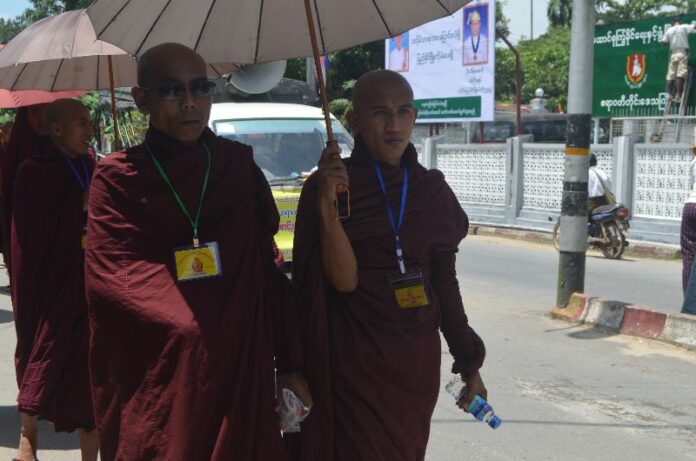
Buddhist monks walk past the office of the Union Solidarity and Development Party in the town of Pathein in the Ayeyarwady Delta this past September to join a rally held to celebrate the success of ‘race and religion’ laws. Photo: Swe Win / Myanmar Now

YANGON — In both Myanmar and abroad, the National League for Democracy’s landslide election win is seen as a victory of the people over the military and its ruling political elite.

It’s a price the army had to pay after subjecting the population to decades of repression. The public’s message was a clear call for democratic change, a mandate for which was given first and foremost to NLD leader Aung San Suu Kyi.

Yet, the crushing defeat of the military-backed governing Union Solidarity and Development Party, or USDP, also signals another message; it was an outright dismissal of the extremist nationalist “Buddhist” movement called Ma Ba Tha.

It had been whipping up nationalism and anti-Muslim sentiment. In the run-up to the elections the group – which enjoyed the support of President Thein Sein’s government – launched relentless campaigns against the NLD and Suu Kyi, while endorsing the USDP.  

Authorities looked the other way as the monks concocted a toxic mix of religion and politics, acts that directly violate the constitution.

The monks pointed out that Suu Kyi had a foreign spouse and that her NLD party objected to Ma Ba Tha’s four ‘race and religion’ laws. They spread fear among the public, saying that the Buddhist majority nation of Myanmar was under threat of Islamists. 

What Myanmar needed, they lectured the people, is a second-term Thein Sein government that would protect the country’s race and religion. “One good turn deserves another is one of the Buddhist principles,” wrote Tilokabivamsa, a monk who is Ma Ba Tha’s supreme leader, in a commentary in September. 

In tandem with the monks, some USDP candidates also claimed during the election campaign that they would promote Buddhism if they were elected. In an apparent attempt to capture nationalist voters reluctant to support USDP, Nay Zin Latt, a former political advisor of Thein Sein, established the purely nationalist National Development Party just a few months before the elections. 

The Ma Ba Tha was highly visible through organising dozens of rallies and sermons, and the public treated them with the respect traditionally granted to clergymen.

Given these developments, some assumed the NLD might struggle to win a majority great enough to form a government. However, the public’s deep-seated hatred of the military establishment is far stronger than any latent anti-Muslim sentiment. 

The USDP won just a very small percentage of legislative seats in the elections while the NDP got zero, as did other political parties with nationalist agendas such as the National Democratic Force, Myanmar Farmers Development Party and Peace and Diversity Party. 

Even in Ayeyarwady Delta, where the nationalist monks seemed to enjoy the strongest public and government support, the NLD walked away with almost all legislative seats. 

Does this result disprove the numerous reports over heightened Buddhist nationalism in the country that have appeared since the 2012 Rakhine State crisis and the 2013 communal riots that marred central Myanmar?

To a large extent, yes. 

Many ordinary people in Myanmar had begun to suspect in recent years that sectarian violence and the rising tide of Buddhist nationalism had all to do with politics. They found that anti-Muslim sentiment became almost synonymous with being anti-NLD or anti-Suu Kyi, and that authorities failed to take actions against individuals spreading such messages. 

Ma Ba Tha and their extreme positions were also increasingly being viewed as incompatible with fundamental teachings of Buddhism. Their image further declined when the public witnessed them campaign for former generals who have committed human rights violations 

Due to the strong traditional veneration of monks, very few dared to stand up against Ma Ba Tha out of fear that they will be portrayed as being pro-Muslim. There was also the risk that those who did could be jailed, like the former NLD official Htin Lin Oo, who is serving a two-year jail sentence for criticising the movement.

When given a chance to express their vote through a ballot, however, people voted en masse for an NLD-led change and against nationalist Buddhism. 

Whether the Rohingya should be recognised as citizens or not will remain a highly contentious issue; the group remains widely disliked and viewed as illegal immigrants from Bangladesh. The NLD has also shown its not-so-principled stand by bowing to Ma Ba Tha pressure and refraining from fielding any Muslim candidate. The new parliament will have not a single Muslim representative. 

Asked if he was surprised by the USDP loss, Thurein Soe, a leading Mabatha official in Yangon responded to me that, “It’s difficult to save someone who is on the verge of death.” 

For now, the Mabatha monks have publicly welcomed the NLD victory but warned that they would not remain silent if Suu Kyi’s new government tries to repeal the race and religion laws, or amend the controversial 1982 Citizenship Law, which stripped Rohingya from their citizenship rights.

Story: Swe Win

Advertisement

No Corruption in Rajabhakti Park, Army Rules

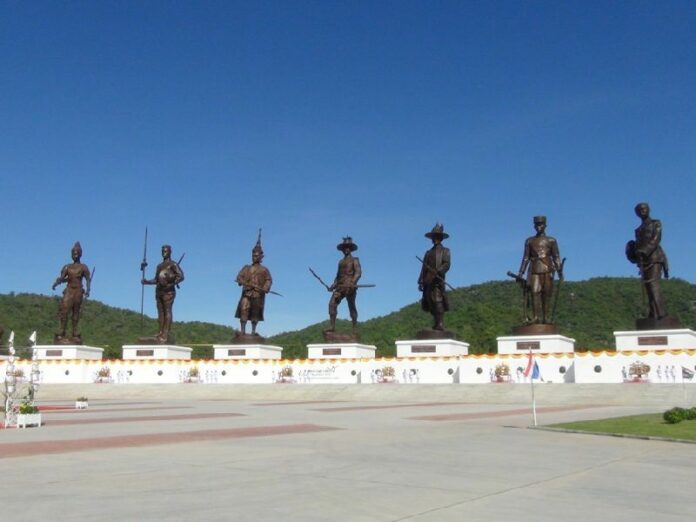
Rajabhakti Park in Prachuap Khiri Khan province.

BANGKOK — An internal review into the billion-baht Rajabhakti Park found no evidence of corruption, army chief Teerachai Nakwanich announced today.

Following media reports and statements from the former army chief confirming financial irregularities involving overpayments and dodgy commissions paid to middlemen, Gen. Teerachai said inspection of budget and accounts of the project found no such irregularities in the project.

“There is no corruption. Every procedure is transparent,” Teerachai said.

Therefore there is no need to ask the National Anti-Corruption Commission to investigate the project, he told reporters at a news conference just before noon today at the Royal Thai Army headquarters.


Former Army Chief Explains Royal Park Project Graft


As for the issue of a middleman taking 10 percent cuts of various expenses, including the statues said to cost about 40 million baht each, Teerachai said the media should directly ask former army chief Udomdet Sitabutr, who oversaw the project built to honor the monarchy by erecting large statues of significant historical kings.

He also said no military personnel are accused of corruption in the park project in the first place, despite an arrest warrant for Col. Kachachat Boondee, who is accused of soliciting donations and embezzling funds for the park project by falsely claiming ties to the monarchy.

“He’s wanted for a different matter,” Gen. Teerachai said without further explanation.

Teerachai said the army stood ready to act if new information came to light.

“Based on our inspection, we have not yet found any military officer involved in corruption. However if any additional inquiry finds there was corruption, we will investigate it further,” he said.

Army officials also did not allow media present to broadcast the news conference live, without stating a reason.

Asked if the army would open the books to for the public to see how money was spent, Teerachai said that would be dangerous.

"You want people to die for this? You want me to execute someone and their entire family for this? I mean, we have to look at their intention." 

He said the budget, estimated to be over 1 billion baht, would be kept confidential.

Advertisement

Prachachuen Shop Fire Kills Owner’s Daughter

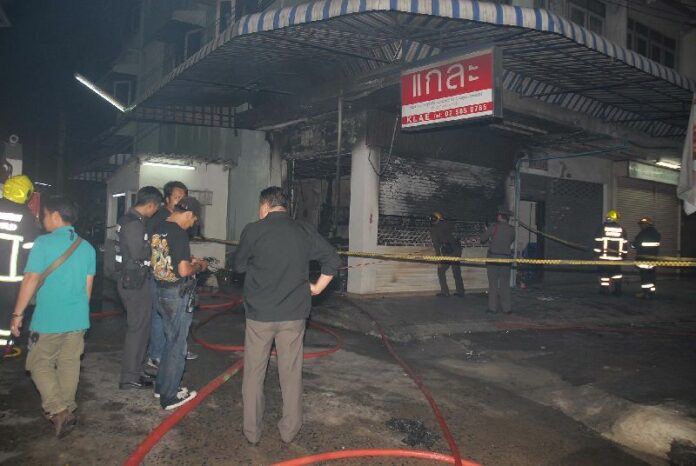
A woman died in a fire at the 'Klae' tailor shop early this morning in the Bang Sue district of Bangkok.

BANGKOK — A fire gutted a tailor’s shop on Soi Prachachuen 5 early this morning, killing one resident.

Police and firefighters responded to reports of a fire at a tailor’s shop called “Klae” just before 4am this morning in the capital’s Bang Sue district, police Maj. Gen. Charoen Srisassaluk said, and after putting out the blaze discovered the body of a 30-year-old woman.

She was identified as Poranee Summahawong, the daughter of the store’s owner. Her 35-year-old brother, Natthawat Summahawong, said five people lived in the shophouse. He and his girlfriend were sleeping on the fourth floor while his parents and the victim were on the third floor.

No one knew there was a fire, Natthawat said, until they heard sirens at 3:45am when the firefighters arrived and saw smoke from the first floor.

Everyone ran downstairs, he said, except his sister Poranee, who was ill.

Charoen said the origin of the fire had yet to be determined, but that the fire spread quickly due to the clothes in the store.


Advertisement

Ban Ta Klang Proud of its Elephant Pets

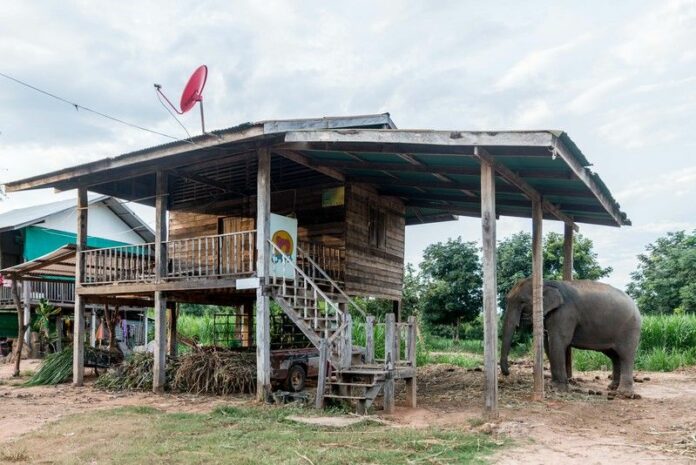
Elephants tied up to homes is a completely normal thing in the Ban Ta Klang, Surin Province, Thailand.

SURIN — Praethong, a 20-year-old elephant, would be an unusual house pet outside her hometown of Ban Ta Klang in north-eastern Thailand.

A small village that bills itself as having the world's largest number of domesticated elephants is determined to keep its traditions alive.

But in the small rural village in the rice-growing province of Surin, her 4 tons of bodyweight, inquisitive trunk and daily appetite for 400 kilograms of foliage are a common sight.

Praethong, meaning golden silk, was one of 269 elephants attending a feast Friday in the provincial capital, also called Surin. The event has previously set a record for the world's largest elephant buffet.

Back home she lives among the village's 200 elephants. She was born into a long line of elephants belonging to a family in the village, where around a third of households keep pet pachyderms.

Most villagers in Ban Ta Klang are of ethnic Kuy descent, whose ancestors were skilled at catching wild elephants and training them to fight or work.

The community is proud of its tradition of elephant husbandry. But they are not treated like normal, smaller, pets and critics have raised concerns about the animals' psychological and physical health.

\
A road sign displays an elephant warning on the side of the road leading to the village of Ban Ta Klang, Surin Province

\
A male elephant is standing in an agricultural land in Ban Ta Klang, Surin Province


"These elephants are chained up all day," says Tina Blessers, a Belgian zoo elephant veterinary nurse, who is staying at the village for a week. "It can make them depressed like that one," she says, pointing at one of the elephants nearby rocking back and forth rhythmically.

Wild elephants spend most of their day foraging and studies suggest that the lack of such opportunities can contribute to the meaningless repetitive movements among captive individuals.

"They should get to do things that are in their nature like roaming around freely," she says.

The village headman Pakit Pungpattana, who owns seven elephants, disagrees.

"This is natural for them because they are born in captivity and are used to being chained," he says, adding that the chains are usually long and allow elephants to move around.

"We tie them not to torture them but to prevent them from wandering off to other people's properties, eating their crops or hurting them," he says. "We live in a community so that is our responsibility."

The process of elephant training and the use of bullhooks – a stick with a sharp metal hook used to prod an elephant – also raise concerns.

"Training hooks and bullhooks can potentially injure elephants if used with force," says Worachot Buddee, who has worked with the community for four years on behalf of the Surin Project elephant welfare group to improve the living conditions of the animals. "Over the years I saw a few elephants with bruises from those hooks."

"We teach elephants tricks by using food, orders, gestures and repetition," says Chatree Salangam, the owner and mahout of Praethong, whom he raised since she was born. "Force is used only when necessary, not randomly."

"I used sharp hooks the first few months I trained her so that she would remember the tricks but not since, because she learned fast," he says, while signalling Praethong with his hand to raise his daughter up in the air with her trunk.

Praethong and most of the elephants in the village work at the village's elephant centre, performing tricks such as painting and throwing darts, and offering rides to local and foreign tourists.

Animal welfare advocates have criticized the use of elephants by Thailand's tourism industry, but headman Pakit denies the animals in the village suffer.

He set up the government-backed centre in 1995 to halt elephant street-begging. Until around 10 years ago, elephants were common roaming the streets at tourist spots, as their mahouts would sell visitors pieces of fruit to feed to the animals.

During late 1990s, Chatree and Praethong were begging in Chiang Mai for money to feed Chatree's family, including Praethong herself.

But when the centre was established they returned to the village, like many other mahouts and elephants.

"We are not like other elephant tourist camps, we do this because we love our elephants," Pakit says.

For each registered elephant, the mahouts get a monthly salary of 10,800 baht (USD$300) from authorities on top of the money made from tourists, he adds.

The elephant's main staple is bana grass, which is locally grown by some villagers and costs 2 baht per kilogram. Elephants eat around 10 per cent of their bodyweight daily, with adults weighing 2 to 5 tons.

"The centre supports the community – the mahouts and the elephants," Pakit says. "So we can continue raising elephants like we have been doing for centuries … it's part of who we are."

Chatree says he learned how to train and raise elephants from his parents and grandparents and he is teaching his 18-year-old daughter the techniques to prepare her for Praethong's calf due to arrive in less than two years.

"I love her," Chatree says, caressing Praethong with his hand while his daughter is on her back. "I don't think I can live without her."

Story: DPA / Siraphob Thanthong-Knight

Advertisement

Asia-Pacific Leaders Call For 'Urgent' Efforts to Fight Terrorism
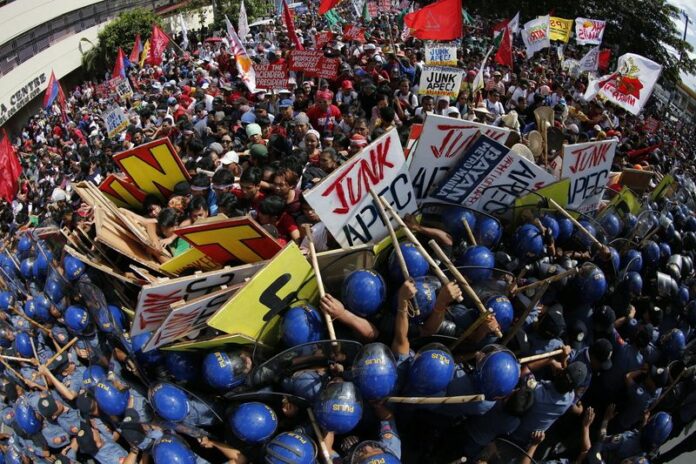
Filipino activists clash with riot police officers during a protest rally Thursday near the venue of the Asia-Pacific Economic Cooperation summit Photo: EPA / Francis R. Malasig

MANILA — Asia-Pacific leaders on Thursday stressed the "urgent need" for stepped-up efforts against terrorism, and vowed not to allow the violence to derail economic progress in the region.

At the end of a two-day annual summit of the Asia-Pacific Economic Cooperation, or APEC, forum in Manila, the leaders condemned recent attacks in Paris, Beirut and against a Russian aircraft, all claimed by the Islamic State group.

"We stress the urgent need for increased international cooperation and solidarity in the fight against terrorism," the leaders said in a joint statement.
The attacks in Paris, just days before the APEC meetings opened in Manila, prompted tightened security and overshadowed the discussions, which had been scheduled to focus on ensuring sustainable growth and reducing inequality.

The statement did not address territorial disputes between China and smaller nations in the region over the South China Sea, another issue that had clouded the APEC summit.

Some leaders, however, expressed concerns about freedom of navigation and security in the seas on the sidelines of the meeting.

US President Barack Obama implicitly raised the issue when he announced material aid for the Philippines navy and other South-East Asian allies when he arrived Tuesday.

Japanese Prime Minister Abe also stressed the need to respect the rule of law and refrain from force in resolving the disputes, his spokesman Yasuhisa Kawamura said Thursday.

As leaders gathered for their meeting Thursday, some 1,000 protesters carrying placards reading "Save the Planet. Junk APEC" and "Defend Sovereignty. Junk APEC" clashed with police, who used water cannons and batons to stop them from marching to the summit venue.

Demonstrators hit police officers with their placards and wooden sticks but failed to get through the security barricade about 1.2 kilometers from the convention centre venue.

Authorities earlier warned that anyone protesting without a permit would be arrested.

Story: DPA / Girlie Linao

Advertisement

Teachers Charged for Asking Junta to Respect Free Speech

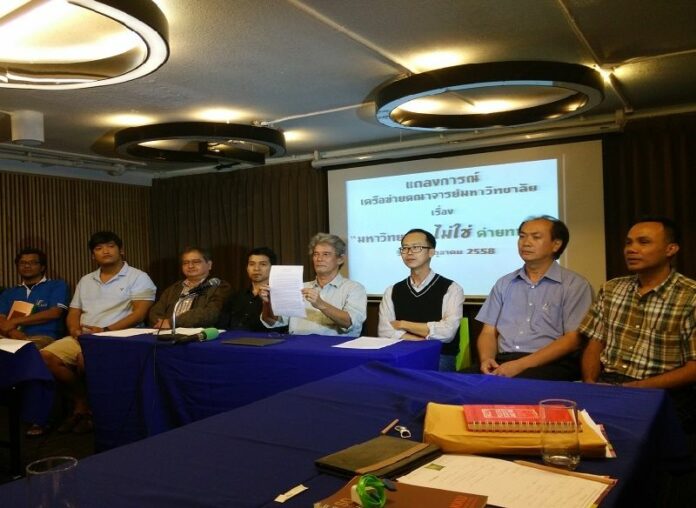
Eight academic hold a news conference urging the junta to respect free speech at universities in Chiang Mai province. Photo: Prachatham.com

BANGKOK — Police have charged eight academics with violating the junta’s ban on “inciting unrest” for a recent conference at which they told the regime to stop clamping down on free expression in universities.

The eight were summoned to report Tuesday to the Chang Puak Police Station in Chiang Mai to formally hear their charges, an officer at the station told Khaosod English. He said the charges stemmed from a news conference held by the academics in Chiang Mai last month.

“The suspects are all of the eight lecturers at the event,” Police Col. Prayoon Kardthip said by telephone. He added that the complaint was forwarded to the police by a military officer from the junta’s security wing.

At the Oct. 31 news conference in Chiang Mai province, the eight lecturers from seven universities issued a joint statement called “Universities Are Not Barracks,” in which they criticized junta chairman Prayuth Chan-ocha’s remark that he believed universities are being used to breed discontent against his regime.

The statement urged the junta to respect freedom of expression in universities and in larger society. 

“Forcing individuals to act in the same way by use of power – whether through gun barrels or unfair laws – will only bring a peace of forced silence for a short period of time,” it said. 

Since staging the coup d’etat against the elected government in May 2014, the ruling junta has imposed a ban on any form of protest, political activity and public criticism of its regime. Violators of the ban face trial by military tribunal and possible jail term if convicted.

Attachak Sattayanurak, the history lecturer at Chiang Mai University who organized the event, confirmed to Khaosod English that he had been summoned. 

Attachak said he plans to meet with police earlier than Tuesday because he has other appointments that day. He also expressed surprise that he now faces criminal proceedings for calling for free expression. 

“I’m surprised there’s still intimidation by legal means. I and other lecturers have talked to senior military officers many times already. We told them we have to do our duties as academics,” Attachak said. “We told them, just let these academics talk – no one listens to them anyway. Now that they forbid us from talking, more people will listen.” 

It appears police have yet to send summons to the seven other academics who attended the Oct. 31 news conference. Somchai Preechasilpakul, one of the group, said he hasn’t received anything.

“No one contacted me. No warrant was sent to me,” said Somchai, who also teaches at Chiang Mai University. 

Nevertheless, Somchai said he called a police officer in Chiang Mai after he heard about Attachak being summoned, and the officer he spoke with confirmed that he’s one of the suspects. 

Nearly 80 academic seminars have been blocked or censored by the ruling military junta since the 2014 coup, according to a report by the Thai Lawyers for Human Rights published in June. The junta, which is formally known as the National Council for Peace and Order, said such measures are necessary to avoid misunderstanding and maintain stability in the country. 

Word of the charges came the same day Gen. Prayuth, the junta chairman, reportedly assured U.S. President Barack Obama that reports about human rights abuses in Thailand were inaccurate and malicious. 

“I insisted to him that I’m already trying to take care of [human rights] issues,” Gen. Prayuth said. “But they were really [the result of] news presented by people with bad intentions. Sometimes, these reports were presented without any facts, so it led to misunderstanding.”


To reach us about this article or another matter, please contact us by e-mail at: [email protected].

Follow Khaosod English on and Twitter for news, politics and more from Thailand.

\

Advertisement

Hot News

LATEST NEWS

Bangkok
overcast clouds
30 ° C
30.5 °
30 °
69 %
3.6kmh
100 %
Mon
35 °
Tue
32 °
Wed
30 °
Thu
32 °
Fri
32 °