

































29.7 C
Bangkok
Monday, June 8, 2026
Home Blog Page 1548

Akira Back Restaurant and Bar entices gourmands with set dinner by guest chefs from Akira Back Singapore

Bangkok, Thailand, July 10, 2019 – Limited time only! Talented chefs from Akira Back Bangkok and Singapore team up for a special 5-course dinner made with prime ingredients and culinary expertise. Dinner by the guest chefs from Akira Back Singapore and Bangkok will be served from August 1 3, 2019 at Bangkok Marriott Marquis Queen’s Park only. 

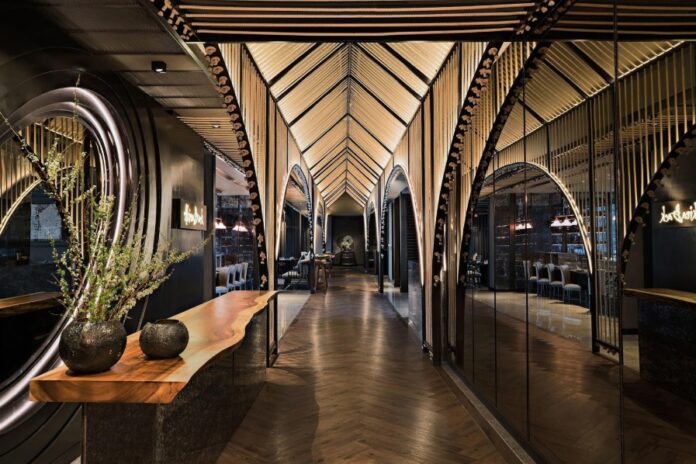
Located at Bangkok Marriott Marquis Queen’s Park, Bangkok’s largest luxury hotel, Akira Back Restaurant and Bar is propped on the 37th floor. Using only high-quality ingredients, the chefs create contemporary, innovative dishes. This time around, the restaurant is offering a new gastronomic marvel with 5-course set dinner that is a collaboration between chefs of Akira Back Bangkok, Chef William Rusli and Singapore, Chef Bobby Hyungmin Bae. Creative and talented chefs from two venues join hands to create delectable dishes with contemporary flair and exciting colors to please the patrons. 

The first dish by Chef Bobby, born in Seoul, South Korea and has been exposed to various styles of cooking from Korean, Chinese to Japan and Western. Now he is a chef at Akira Back Singapore. Chef Bobby’s first dish is the healthy Norwegian Salmon, where Norwegian salmon is smoked with applewood for unique taste, texture and aroma then served with apricot, Dijon mustard and Togarashi quinoa.

The second dish from Chef William, base background from French cuisine and worked at several top restaurant in Asia, and has accumulated experience at the Restaurant Joël Robuchon au Dôme 3 michelin star restaurant in Macao. He infuses Thai flair in Hokkaido Scallop where the succulent and sweet shellfish from Hokkaido is punctuated by an explosion of flavor of Thai green curry and citrusy notes of kizami yuzu, served with creamy coconut milk foam. 

Next up is a dish by Chef Bobby. His signature dish for the set is Sakana Chazuke, an Akira Back take on the Japanese classic rice with tea. Featuring sashimi with pickled plum paste and yukwa – a traditional Korean puffed rice childhood snack. 

For lamb lover, Chef William presents Lamb Loin. The lamb loin is charcoal-grilled South American style then served with smoked chipotle anticucho sauce. 

End the meal on a sweet note with The Glass, barley ice cream is missed with sweet winter melon vanilla foam and coconut praline cream the encased in a pulled sugar glass tower that caps off the meal with a bang. 

Chef Bobby-Hyungmin Bae from Akira Back Singapore together with Chef William Rusli will be cooking up the exclusive dinner at Akira Back Restaurant and Bar at Bangkok Marriott Marquis Queen’s Park between August 1 – 3, 2019 from 6:00 PM to 11:00 PM. The 5-course dinner set is served at THB 2,400++. For more information and reservation, please contact +66 (0) 2 059 5999, email [email protected] or visit www.bangkokmarriottmarquisqueenspark.com


Or connect with us via these channels:

Website:  www.bangkokmarriottmarquisqueenspark.com

Facebook:  www.facebook.com/akirabackbkk/

Instagram:  www.instagram.com/akirabackbkk/ 

Line official account:  @akirabackandabar

Advertisement

‘Boy Pablo’ to Soothe Broken Hearts in Bangkok This November

Photo: Boy Pablo / Facebook

BANGKOK — Norwegian YouTube phenomenon Boy Pablo is returning to Bangkok this November with its signature smooth, indie pop.

For its second gig in Bangkok, Boy Pablo is performing on November 22 at Voice Space on Vibhavadi Rangsit Road. Tickets are on sale now for 2,000 baht via Ticketmelon.

The Norwegian high school band shot to international attention after their homespun music video for “Everytime” went viral in 2017.

Known to indie listeners for combing breezy and balmy melodies with gloomy lyrics that address romantic anxiety, the band of five led by Nicolás Muñoz debuted their first single “Flowers” in 2016. The band won “Breakthrough of the Year” at the 2018 Norwegian answer to the Grammy Awards (Spellemannprisen).

Advertisement

Philippine Leader Signs Law Punishing Sexual Harassment

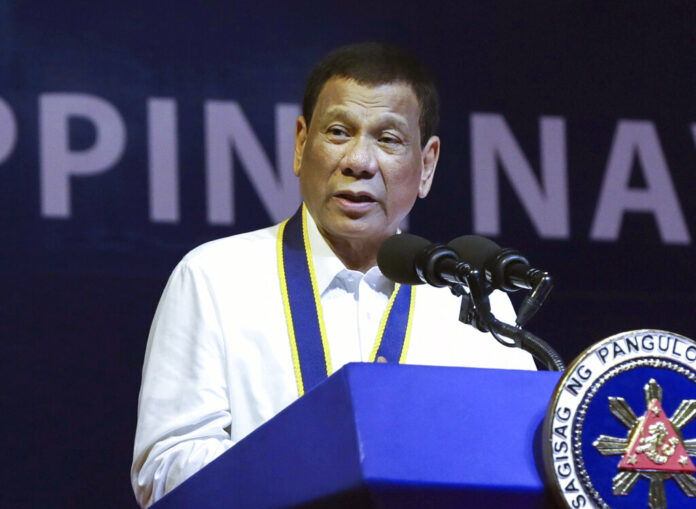
FILE - In this June 17, 2019, file photo made available by the Malacanang Presidential Photo, Philippine President Rodrigo Duterte delivers his speech during the 121st Philippine Navy Anniversary at Sangley point, Cavite province, Philippines. Duterte is
FILE - In this June 17, 2019, file photo made available by the Malacanang Presidential Photo, Philippine President Rodrigo Duterte delivers his speech during the 121st Philippine Navy Anniversary at Sangley point, Cavite province, Philippines. Duterte is "seriously considering" cutting diplomatic ties with Iceland, which spearheaded a resolution that asked the U.N.'s top human rights body to look into the thousands of deaths of suspects under his anti-drug crackdown. Photo: Robinson Ninal Jr./Malacanang Presidential Photo via AP File

MANILA — The Philippine president has signed a bill into law penalizing a range of acts of sexual harassment including catcalling, wolf-whistling and persistent telling of sexual jokes, which pro-women’s groups have accused him of committing.

Philippine officials released on Monday a copy of Republic Act 11313, known as the “Safe Spaces Act,” which Duterte signed in April. The reason for the delay in its public release was not immediately clear.

The bill’s main author, opposition Sen. Risa Hontiveros, has called the law a “massive victory” against a growing culture of rude sexist actions.

“This is a big victory and a major push back against the growing ‘rude culture’ in our streets and communities,” Hontiveros said. “With this law, we will reclaim our streets from sexual harassers and gender bigots and make public spaces safe for all.”

The law defines a range of offensive acts, including catcalling, wolf-whistling, intrusive gazing, cursing, misogynistic acts, sexist slurs and persistent telling of sexual jokes in public, including in streets, workplaces, vehicles, schools, recreational areas, bars or online.

Other offenses include stalking, exposing “private parts, groping or any advances, whether verbal or physical, that is unwanted and has threatened one’s sense of personal space and physical safety.”

Restaurants, bars, cinemas and other places of recreation are required to install clearly visible warning signs against would-be violators, including a hotline number to allow rapid reporting of offenses, and to designate an officer to receive complaints or apprehend perpetrators.

“It is the policy of the state to value the dignity of every human person and guarantee full respect for human rights,” the law says.

Punishments include fines and imprisonment depending on the gravity of the offense. Foreign violators would be deported after serving a jail term and paying fines.

Duterte, 74, a longtime mayor before winning the presidency in 2016, has been known for speeches laden with expletives and sexual jokes. Activists have repeatedly accused him of sexism and misogyny but supporters have defended him by saying he has introduced regulations to protect and uphold women’s rights.

Last year, Duterte publicly ordered troops to shoot female communist guerrillas in the vagina to render them “useless.” A left-wing human rights group, Karapatan, reacted by saying Duterte had distinguished himself “as a frothing-in-the-mouth fascist who incites the worst violations of international humanitarian law.”

Duterte was also criticized for kissing a married woman on the lips in front of a large Filipino audience in South Korea last year. When Duterte asked if she could explain to her husband that the action would be just a joke, she said yes, and the president leaned in and kissed her as the audience erupted in cheers.

“President Duterte acted like a feudal king who thinks that being the president is an entitlement to do anything that he pleases,” Hontiveros said then.

Story: Jim Gomez.

Advertisement

Von Der Leyen Confirmed as New European Commission President

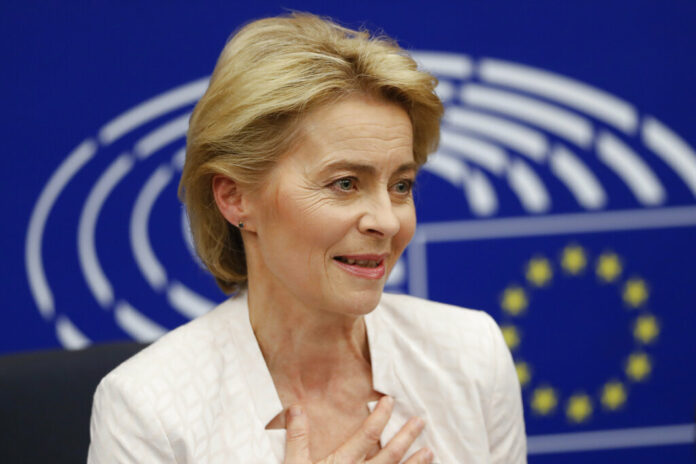
German Ursula von der Leyen talks to journalists during a news conference following her election as new European Commission President at the European Parliament in Strasbourg, eastern France, Tuesday, July 16, 2019. Photo: Jean-Francois Badias / AP

BRUSSELS — Ursula von der Leyen was confirmed as the European Commission president Tuesday, becoming the first woman to hold one of the most prestigious positions in the European Union and who will be one of the most prominent faces from the bloc on the world stage.

The European Parliament voted 383-327 with 22 abstentions to approve von der Leyen’s nomination. The confirmation required an absolute majority of 374 votes and the outgoing German defense minister scraped through with barely nine votes to spare in a cliffhanger vote.

“A majority is a majority in politics,” she said when questioned about her narrow escape.

Von der Leyen will replace Jean-Claude Juncker when his term expires at the end of October.

She was put forward as a last-minute candidate by EU leaders as part over an overall appointments package, sidestepping parliamentary wishes. Many legislators felt cold-shouldered and said they would oppose her out of principle, not over personal considerations.

“There was a great deal of resentment,” she said.

Von der Leyen insisted the challenges facing the EU, from climate to migration and internal division, were such that there was no time to look back.

“My message to all of you is: let us work together constructively,” she said.

Earlier in the day, Von der Leyen set out her political objectives on a greener, gender-equal Europe where the rule of law continues to hold sway.

Her approval was a key part in the package of top jobs that EU leaders agreed upon early this month. Under the deal, the free-market liberal Renew Europe group got Belgian Prime Minister Charles Michel as European Council president and the Socialists won the top parliament job. France’s Christine Lagarde was put forward as head of the European Central Bank.

Von der Leyen told lawmakers in Strasbourg that the gender element as embodied by herself and Lagarde will be an essential part of her job.

“I will ensure full gender equality” in her team of 28 commissioners. “I want to see as many men as women around the college table,” she said.

Pointing out that since its inception in 1958, less than 20% of commissioners had been women, she said: “We represent half of our population. We want our fair share.”

The gender breakthrough was welcome across much of the plenary.

“It is a great day for Europe to have a woman elected to lead the European Commission,” said Dacian Ciolos, leader of the liberal Renew Europe group.

The rest of the commission team, which prepares a wide range of legislation from climate change to farm subsidies and digital rules, will be proposed by the EU member states, which have the right to one each.

Von der Leyen insisted that, despite euroskeptic governments like Italy, Poland and Hungary, she would only work with pro-European politicians.

“I want a commission that is working to strengthen Europe to position Europe in this world in its appropriate role,” she said.

“None of us on its own will be as successful in tackling the problems as we are together — 28 member states,” she said.

Officials in the von der Leyen camp had long acknowledged that the vote would be a cliffhanger. She was set to get the majority of votes from her EPP Christian Democrats, the S&D socialists and the RE liberals. They were part of a grand coalition sharing out the top jobs.

Still, with dissent even within those groups, it long was too close to call.

During her address to the parliament, von der Leyen set out her political lines for the next few years and immediately addressed what she sees as the biggest challenge: climate change.

“I want Europe to become the first climate-neutral continent in the world by 2050,” she said, adding she would work out “a green deal for Europe in the first 100 days” of her office. It would include rules to improve on the current goal of reducing emissions by 40% by 2030.

“It will need investment on a major scale,” and funds would be available for nations, mainly in eastern Europe, still depending on polluting fossil fuels, she said.

She said that she would set up a climate division within the European Investment Bank to “unlock 1 trillion euros of investment over the next decade.”

Despite the need for votes to get the absolute majority, she did insist that her European Commission would continue to be at least as tough as now on countries like Poland and Hungary, which have been accused of disrespecting Western democratic values when it comes to the rule of law.

“There can be no compromise when it comes to respecting the rule of law. There never will be. I will ensure that we use our full and comprehensive toolbox at European level,” she said.

Story: Raf Casert.

Advertisement

CPF Philippines Carries on Medical and Dental Mission Into the Third Year

Engr. Eloy Castillo Eclar, Municipal Mayor of Gerona, the Philippines, presided over the opening ceremony of the Medical and Dental Mission for the third year.

The project was initiated by Charoen Pokphand Foods Corporation Philippines (CPF Philippines) in collaboration with local municipal of Gerona and concerned government agencies to provide health check and dental services to people in the community.

CPF Philippines supports medical supplies, medicines and medical services to those villagers living in the surrounding areas of its manufacturing plant.

The company also arranged luncheon for children and villagers of Barangay Sta. Lucia, Barangay New Salem, Barangay Tangcaran and Barangay Sembrano. Mr. Sompong Rojanaadisorn, Senior Vice President for agro-industrial business, CPF Philippines, led the company’s management and volunteers to jointly service people in Gerona.

1 7

02 1

04

05

06

08

Advertisement

Royal Defamation Case Against Pannika Moves Forward

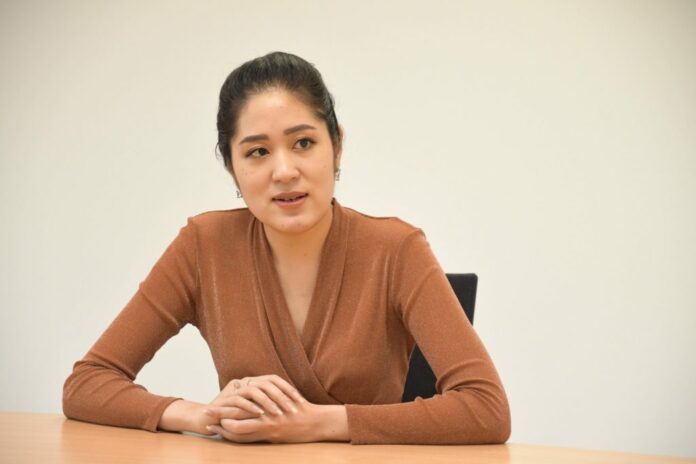
A file photo of Future Forward spokeswoman Pannika Wanich.

BANGKOK — A transparency activist said Tuesday he was summoned by the anti-graft agency to testify in an inquiry into allegations that the Future Forward spokeswoman disrespected the monarchy. 

Srisuwan Janya, who filed the royal defamation complaint against Future Forward Party’s Pannika Wanich in June, said he will meet the National Anti-Corruption Commission on Thursday to give testimony. Srisuwan wants Pannika removed from office, on allegations that Pannika mocked the late King Bhumibol in a 2010 graduation photo

Srisuwan said he filed the request for Pannika’s removal because a parliament regulation says MPs must uphold the monarchy and refrain from acts that bring “disgrace” to Parliament.

Srisuwan’s complaint came after the resurfacing in June of a photo showing Pannika and her friends in graduation gowns making faces at a portrait of King Bhumibol, drawing much condemnation from hardline supporters of the monarchy. The photo was first published by her classmates in a public Facebook post nine years ago.

Several other people have also filed criminal complaints against Pannika for the alleged insult, though police have yet to charge Pannika with any crime. Royal defamation is punishable by up to 15 years in jail under the lese majeste law.

Khaosod English has been instructed by Khaosod management not to reproduce the image for fear of legal consequences.

Pannika is currently on an overseas trip in Europe to meet foreign political leaders, her party said.

In a media interview in the wake of the controversy, Pannika apologized for any distress the photo might have caused. She said, at the time of the photo, she was trying to make a point about the monarchy being weaponized to hurt political opponents.

“It was easy to land anyone in jail just by pointing at them and saying that they weren’t loyal. This hate mongering led us youths to talk about it ironically, to reflect on the tragedy affecting Thai society,” she said.

The spokeswoman said neither she or her party had any intent to overthrow or insult the Royal Family, despite frequent allegations from junta supporters.

Advertisement

9 Years On, Crash Victims Say ‘Praewa’ Gave No Compensation

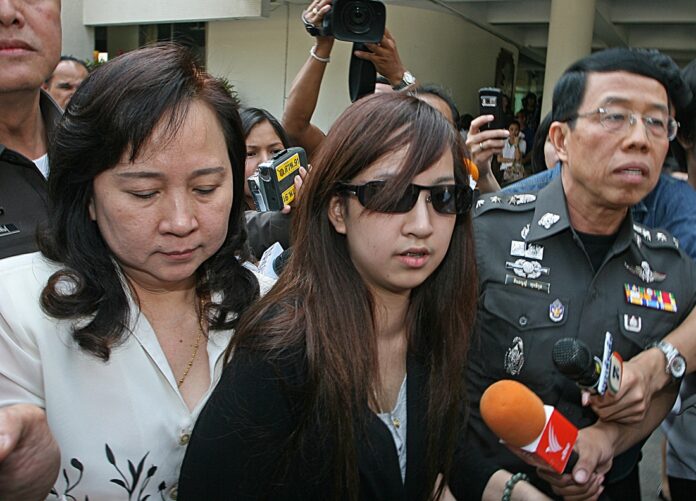
Orachorn ‘Praewa’ Thephasadin Na Ayudhya turns herself in at Metropolitan Police Bureau headquarters Jan. 5, 2011, in Bangkok.

BANGKOK — Nearly nine years after a wealthy teen killed nine people in a car crash, victims came forward Tuesday to say they have yet to receive an apology, much less compensation. 

Orachorn “Praewa” Thephasadin Na Ayudhya was 16 when she drove her car into a Thammasat University van on Dec. 27, 2010, killing nine people. Since then, she’s become a symbol of the wealthy and powerful avoiding jail after committing serious crimes. Instead of time in prison, she was ordered to serve 138 hours of community service, which was only completed in 2016.

Now victims are saying that they haven’t even been compensated for the death of their relatives and injuries, even though the civil case against Praewa finally ended on May 8. It also emerged that Praewa’s family identified themselves as “an esteemed family in society” in a court argument to prolong the compensation dispute. 

“I conceded to everything, did everything the court wanted. I was quiet for nine years, but I can’t take it anymore,” Warunyoo Ketchoo, a survivor of the crash, wrote on Twitter. “I know it was an accident, but it’s about what people have to do for each other after it occurred.” 

Compensation was supposed to be paid within 30 days, but none of the victims have received any more than two months after the resolution of the case. 

DSC 0930
Orachorn “Praewa” Thephasadin Na Ayudhya at the crash site in 2010.

In a series of tweets posted today, Warunyoo said that Praewa’s legal representatives kept slashing down the agreed-upon compensation after the crash, which left Warunyoo with multiple broken bones. He was confined to a hospital bed for two months. 

Warunyoo, who was 20 at the time of the accident, said the only time he ever spoke to Praewa was when she came to visit him in hospital.

“She came in a wheelchair and her mom did all the talking. Her mom told her to apologize, and she said ‘I’m sorry.’ Then she gave me some Baan Ayakan desserts and took a photo … the nurse told me that Praewa was walking but asked for a wheelchair at the ward,” he wrote. 

Warunyoo then suffered years of medical expenses and pain. Court proceedings dragged on in the Criminal Court, Court of Appeals, then the Civil Court, with Praewa’s lawyer pushing for lower and lower compensation. In April 2017, total restitution was cut down from 30 million baht to 19.8 million baht for the nine families.

“[The lawyer] bargained like he was buying vegetables and fish … He argued that she was from the Thephasadin Na Ayudhya family which has done good for the country – it really says that in the documents,” wrote Warunyoo, who posted an image of court files as proof. 

According to court documents, Praewa appears to have changed her name from Orachorn to Buabuchaa. She is 25 today. After her marriage in 2014 to former National Legislative Assembly member Sorawee Ratpitakteerada, she changed her name again to Rawinpirom Arunwong.

Image: @_Ritakwang_
Image: @_Ritakwang_

Even Praewa’s lawyer, Theerawut Arunwong, was absent at the last civil court hearing in May, according to Warunyoo. 

In an interview with Thairath TV, four parents of the victims who perished in the crash confirmed that they have received no monetary compensation.

“Since then we’ve received not a single word from her, not even a phone call,” said Saran Ningwan, the father of Sudawadee Ningwan who died in the crash. 

“Since December 27, 2010, we’ve received nothing, not even a friendly look or a smile from [Praewa] or any member of her family,” Chutima Ningwan, Sudawadee’s mother, added. 

Thawin Chaotiang, the adoptive mother of a doctor who died in the crash, echoed that the defendant’s legal representatives were less than cordial.

“They spoke to me to the tune of, ‘You want some cash? Then keep fighting.’”

An image of Praewa texting next to her crashed car has become a symbol of the Thai justice system’s leniency, which seems to be reserved only for the wealthy and powerful. 

Since the crash, Thailand’s seen several high-profile cases in which influential figures have managed to escape harsh punishment for alleged crimes.

An actress avoided jail time after crashing and killing a cop, businessman Jenphop Viraporn is out on bail for killing two students in a car crash, and a Red Bull heir skipped town after crashing into and killing a policeman in 2012.

A construction mogul is also out on bail after being sentenced to jail for bribery charges related to the killing of a black panther.

Related stories:

‘Praewa’ Ordered to Pay 30 Million Baht to Van Crash Victims

Supreme Court Rejects Appeal from Underage Motorist Who Killed 9

Update: The article has been updated with Praewa’s latest name and marital status.

Advertisement

Thai Parents Divided on Physically Punishing Children

A woman shows wounds on the body of her 7-year-old son allegedly inflicted "as a punishment" by his stepfather in Prachinburi province on March 21, 2018. Police later charged the stepfather with physical assaults. Image: Channel 3.

BANGKOK — Smacking a kid’s palm is the most popular form of corporal punishment for disciplining children, according to a survey of almost a thousand Thai parents.

In a survey of 999 Thai parents by YouGov, 29 percent of Thai parents used palm-smacking to discipline their children. Overall, some 80 percent of Thai parents use physical punishment.

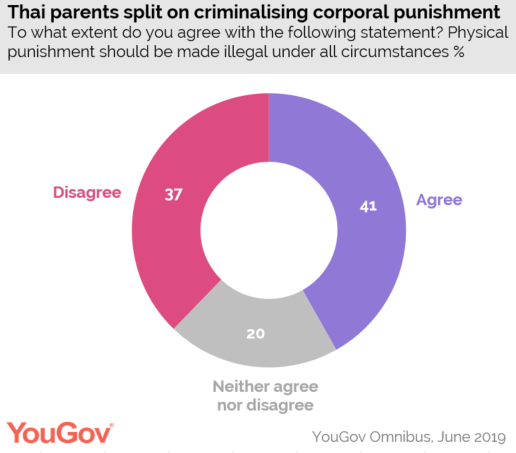
Two in five believe that physical punishment should be illegal, although about the same amount believe that physical punishment is normal. The remaining one in five are undecided.

“I just smack my children on the hand. There’s no need to use canes or tools to punish. They’re just children,” said Siriporn Suthiprapa, a 43-year-old secretary with a 14-year-old daughter and 11-year-old son. “If you make them bleed, that’s definitely wrong.”

The second most popular physical disciplinary method was caning (23 percent), then pinching (13 percent). Only 5 percent preferred slapping, while the least popular method was making the child eat unpleasant substances such as soap or chili (4 percent).

TH corporal punishment 1

In contrast to her acceptance of palm-smacking, Siriporn supports outlawing more violent methods such as caning.

“Some parents aren’t teaching with their heart, but just releasing their rage. They grab whatever they have on hand to hit the kid,” Siriporn said.

The most recent case of sensational domestic abuse to make headlines involved a 23-year-old Samut Prakan mother who, along with her new 26-year-old husband, hit her 5-year-old daughter to the point of hospitalization. Both were arrested and charged with domestic assault.

Mothers are slightly more likely than fathers to discipline their children using physical methods, the survey also found (82 percent vs. 76 percent).

The survey was conducted by UK-based market research company YouGov, which from June 26 to July 3 randomly selected parents from a pool of 165,000 Thais who signed up to participate in return for compensation. YouGov states the study has a margin of error of 3 percent.

TH corporal punishment 2

“While it appears most Thai parents are comfortable with physically disciplining their children at home, they are split over whether the law should come into play,” Jake Gammon from YouGov commented.

Seven out of ten (71 percent) of parents answered that physical punishment is “sometimes necessary.” The top three activities that surveyed parents viewed as warranting physical punishment were stealing, violence, and bullying.

The study found no correlating factors between support for physical discipline and socio-economic status. Nor was there a correlation between support for physical discipline and the age of parents.

The survey did not include questions on corporal punishment outside of the home, such as in schools. However, headlines regularly feature stories about teachers, often at public schools, hitting students. On July 5, a sixth-grade girl in Nakhon Nayok alleged that she had to get three stitches after her teacher hit her with a stick on the head for copying their friend’s homework.

According to a Time article in 2014 by psychologist Jared Pingleton, spanking can be an “appropriate form of child discipline,” but only for cases of “willful disobedience or defiance of authority—never for mere childish irresponsibility.” Parents with difficulty controlling their tempers should refrain from corporal punishment, Pingleton said, since “it should never be administered harshly, impulsively, or with the potential to cause physical harm.” Pingleton recommended stopping the practise of spanking by adolescence.

A more recent publication in November by the American Academy of Pediatrics, however, found that spanking may not decrease negative behaviors and might instead increase aggression. The study instead recommended non-physical disciplinary methods such as time-outs, ignoring bad behavior, and positive reinforcement.

Advertisement

Review: ‘Lion King’ Returns but It’s Harder to Feel the Love

This image released by Disney shows Nala, voiced by Beyoncé Knowles-Carter, left, and Simba, voiced by Donald Glover in a scene from
This image released by Disney shows Nala, voiced by Beyoncé Knowles-Carter, left, and Simba, voiced by Donald Glover in a scene from "The Lion King." Image: Disney via AP

Life moves in a circle, “The Lion King” tells us, and, increasingly, so does studio moviemaking.

Close on the heels of “live-action” remakes of “Aladdin” and “Dumbo” and on the precipice of a reborn “The Little Mermaid,” ”The Lion King” is back, too. Round and round we go. Cue Savannah sunrise. Cue “Naaaants ingonyama bagithi baba!”

The remakes have themselves been a mixed bag offering some combination of modern visual effects, fresh casting and narrative tweaks to catch up more dated material to the times. Don’t count on a new “Song of the South,” but much of the Disney library will soon have been outfitted with digital clothes for the Internet era.

It’s easy to greet these remakes both cynically and a little eagerly. In the case of “The Lion King,” the songs are still good, the Shakespearean story still solid. And, well, Beyonce’s in it.

And yet Jon Favreau’s “The Lion King,” so abundant with realistic simulations of the natural world, is curiously lifeless. The most significant overhaul to an otherwise slavishly similar retread is the digital animation rendering of everything, turning the film’s African grasslands and its animal inhabitants into a photo-realistic menagerie. The Disney worlds of cartoon and nature documentary have finally merged.

It’s an impressive leap in visual effects, which included Favreau, cinematographer Caleb Descehanel and VFX chief Rob Legato making use of virtual-reality environments. Some of the computer-generated makeovers are beautiful. Mufasa, the lion king voiced again by James Earl Jones, is wondrously regal, and his mane might be the most majestic blonde locks since Robert Redford. And the grass stalks of the pride lands shimmer in the African sunlight.

But it’s a hollow victory. By turning the elastic, dynamic hand-drawn creations of Roger Allers and Rob Minkoff’s 1994 original into realistic-looking animals, “The Lion King” has greatly narrowed its spectrum of available expressions. Largely lost are the kinds of characterization that can flow from voice actor to animation. (Think of how closely fused Tom Hanks is with Woody in the “Toy Story” movies.) Here, most of the starry voice actors (including Donald Glover as the grown-up lion prince Simba, Beyonce as the older lioness Nala and Chiwetel Ejiofor as the villainous Scar) feel remote from their characters. And, in many cases, so do we.

It’s worth asking: Just how real do we need our talking animals? Do we need the feathered majordomo Zazu (voiced by John Oliver) to look enough like a red-billed hornbill to win the approval of avid birders? “The Lion King” may well be a pivotal stepping stone toward CGI splendors to come, but for now, it feels like realism has been substituted for enchantment.

That doesn’t stop an army of top craft professionals and an enviable voice cast from doing their best to inject some vitality into “The Lion King.” The familiar songs by Elton John and Tim Rice are back, along with a new tune by Rice and Beyonce, though this time, the score by Hans Zimmer, with Lebo M., feels more airy and buoyant.

Yet the degree to which this “Lion King” mimics the first is disappointing. (Jeff Nathanson gets a solo writing credit but scene-to-scene the film hues extremely close to the original.) There’s a sound case to be made that the tale, which has been running on Broadway for more than 20 years, needs little revision.

But the few deviations taken by the filmmakers make you want more. The role of Nala has rightfully been elevated and toughened. The most rope for riffing has been extended to the new Timon and Pumba: Billy Eichner and Seth Rogen. Taking over for Nathan Lane’s meerkat and Ernie Sabella’s warthog, Eichner and Rogen make their own shtick together and they, more than anyone else, give “The Lion King” a breath of fresh air, even as they make plenty of fart jokes.

Yet that’s hardly enough to warrant a bland, unimaginative rehash like this, let alone merit Beyonce’s imperial presence. Instead, “The Lion King” is missing something. A purpose, maybe, and a heart. The life expectancy of Disney classics has begun to feel more like a hamster wheel than a circle of life, and it’s getting harder and harder to feel the love.

“The Lion King,” a Walt Disney Co. release, is rated PG by the Motion Picture Association of America for sequences of violence and peril, and some thematic elements. Running time: 118 minutes. Two stars out of four.

Story: Jake Coyle

Advertisement

Wissanu: Gov’t to Retain ‘Attitude Adjustment,’ But Won’t Detain People

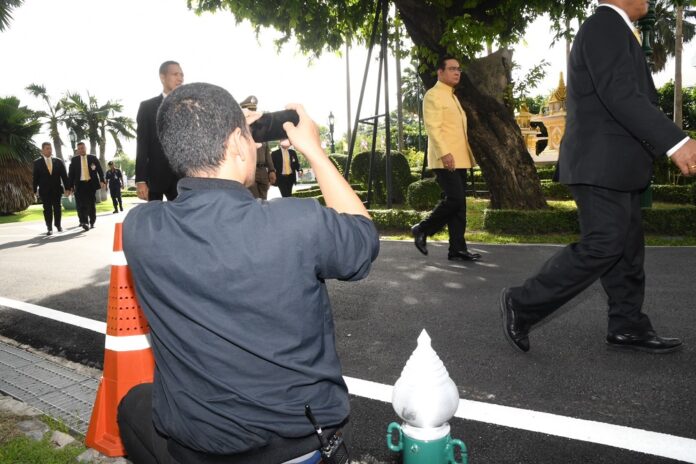
A reporter takes photos of junta chairman Prayuth Chan-ocha at Government House on July 15, 2019.

BANGKOK — The practice of “attitude adjustment” will continue even after the junta is formally dissolved tomorrow, deputy prime minister Wissanu Krea-ngam said Monday.

Wissanu told reporters the power to detain people without warrants will continue to rest with the counter-insurgency agency operating under the Prime Minister’s Office, but won’t be invoked. Instead, Wissanu said, those who pose threats to national security or the monarchy will merely be questioned and warned.

“No [detention]. No. We’ll continue to invite people to be have [their attitude] adjusted. Well, we’ll make requests and say please don’t [do such actions]. But we can’t detain them,” Wissanu said on Monday afternoon. “It’s okay to retain such power, however, because it’s to oversee peace and order.”

He also offered a silver lining, “It’s better than declaring martial law.”

Read: Some Junta Laws to Remain Effective Under New Cabinet

Wissanu’s remarks came after at least two political activists in Bangkok were visited and questioned by police on Monday, raising concerns among government critics that the authorities will continue to intimidate political opponents even after the regime ceases to formally exist tomorrow.

Although the junta will become defunct the moment the new cabinet takes its oath of office to His Majesty the King – scheduled to take place at 5pm on Tuesday – some of the regime’s controversial special orders will be retained under the succeeding government.

They include Orders 3/2014, 13/2015, and 5/2017 which allow designated military officers with rankings of no less than second lieutenant to detain people who are perceived as threats to national security, the monarchy, or who are “influential persons” without charge.

The forced detention, termed in junta euphemisms as “attitude adjustment,” can last as long as seven days in an undisclosed location with no visitation allowed. The measure has been routinely enforced since the 2014 coup to dissuade activists, politicians and even journalists from publicly challenging the junta’s rule.

Decisions to summon individuals for attitude adjustment after the junta is dissolved tomorrow will be made by the Internal Security Operations Command (ISOC), Wissanu said.

But adding to the confusion, a spokesman for ISOC insisted on Tuesday that the anti-insurgency agency has neither the authority nor mandate to summon people for attitude adjustment, because the junta never conferred such powers to the body.

“The NCPO has ceased to exist, but no powers were transferred to ISOC,” said Maj. Gen. Thanathip Sawangthep, using the NCPO’s acronym.

Thanathip added that Article 13/1 of the Security Act technically allows for provincial-level security committees under ISOC to invite people to provide information to security authorities. But calling such a measure “attitude adjustment” would be inaccurate, said Thanathip, since those invited would be neither interrogated nor detained.

“It’s the duty of the NCPO to clarify the whole thing,” Thanathip had said on Tuesday.

Yingcheep Atchanont, a coordinator at law reform advocacy group iLaw, said the authorities must clarify who will be responsible for authorizing attitude adjustment.

“Our preliminary demand is clarity,” said Yingcheep, who has organized a campaign to repeal the special laws enacted by the junta during its five years in power.

Despite support from opposition politicians for his campaign, Yingcheep has acknowledged that the repeals will be difficult to achieve because legislation of such scale would have to be approved by junta-appointed Senate.

According to iLaw’s database, at least 929 civilians have been summoned for attitude adjustment since the May 2014 coup, including those detained without charge for up to seven days.

In a farewell speech as the head of the soon-to-be-defunct junta, Gen. Prayuth Chan-ocha thanked the country for showing support to the regime over the past five years.

Gen. Prayuth also said in the televised speech that Thailand had moved toward a “fully democratic” transition under his watch. The broadcast made no mention of attitude adjustment and other special junta orders.

Additional reporting Teeranai Charuvastra

Update: This article has been updated with statements from the ISOC spokesman.

Related stories:

Man Complains of Election Fraud, Gets Attitude Adjustment

Yingluck’s Lawyer Summoned By Military For Attitude Adjustment

Advertisement

Hot News

LATEST NEWS

Bangkok
overcast clouds
29.7 ° C
31.6 °
28.8 °
81 %
3.7kmh
100 %
Mon
35 °
Tue
36 °
Wed
34 °
Thu
33 °
Fri
32 °