Myanmar's State Counsellor Aung San Suu Kyi delivers an opening speech during the Forum on Myanmar Democratic Transition in 2017 in Naypyitaw, Myanmar. Photo: Aung Shine Oo / Associated Press
YANGON — Myanmar’s ruling party led by Aung San Suu Kyi won just over half the seats in by-elections to fill 13 of the 1,171 seats in national, regional and state parliaments, according to complete preliminary results.
Suu Kyi’s National League for Democracy took seven of the 13 seats made vacant by death or resignation. Initial results for 12 races showed it had won six seats, and the delayed result for the 13th race, for a lower house constitutency in western Chin State, gave it its seventh victory.
The results for Saturday’s polls showed the NLD generally retaining support in the country’s heartland, but yielding seats to parties representing ethnic minorities in the areas where they live, mostly in border regions.
The NLD won a landslide victory in the 2015 general election, when there was wide-ranging popular support to end decades of military rule. But minority groups have been disappointed that the government of NLD leader Suu Kyi has failed to meet their demands for greater autonomy and a halt to aggressive army activities in their territories.
While the results of the small number of races have a negligible effect on the political balance of power, the contests were being watched for trends ahead of the next general election in 2020.
The return of voters to ethnic minority parties representing their interests had already been seen in another set of by-elections last year. What this year’s polls seemed to underline was the danger to the NLD of a weak voter turnout, which was probably behind the upset defeat of an NLD candidate for a Yangon regional parliament seat.
That contest was won by a representative of the Union Solidarity and Development Party, the country’s main political grouping after the NLD. The military-backed USDP won three seats in Saturday’s polls.
Suu Kyi’s appeal with the country’s Buddhist majority has not suffered much from a crisis involving 700,000 members of the Muslim Rohingya minority who fled a brutal army counterinsurgency campaign in the country’s west. However, economic development has been lagging and is a source of disappointment among her supporters.
BANGKOK — A deputy police commissioner said he’s ordered police to investigate whether anyone violated the law by handing out calendars bearing images of former prime ministers Thaksin and Yingluck Shinawatra.
Srivara Ransibrahmanakul told reporters the calendars had been distributed in Bangkok at Thammasat University, the Constitutional Court and the northeastern provinces of Udon Thani and Ubon Ratchathani. His comments came a day after soldiers visited the home of a woman who had distributed the calendars.
While Gen. Srivara said it appeared that no crime has taken place so far, police will continue to monitor the situation.
On Monday, soldiers paid a visit to the home of Wassana Kenhla and asked her to delete photos of the calendars from social media, an activist said. Media reports said she lives in Udon Thani.
“As far as I know, they did not take any legal action against her,” said Anon Chawalawan, a civil rights campaigner who has talked to Wassana. “They asked her to delete the photos, but she insisted she would not.”
“They came to visit me since morning. They asked me about the calendars, where I got them from and from who,” Wassana wrote. “So I asked them back, what’s wrong about it? They are for telling dates and months.”
Image: Wassana Kenhla / Facebook
Neither Wassana nor the junta’s spokesman could be reached for comment as of publication time.
Anon, who works for legal watchdog group iLaw, said Wassana told him she recently visited Bangkok and met a friend who showed her the calendars showing the Shinawatras, both fugitive former prime ministers and political nemeses of the military government.
Wassana told Anon she brought “20 to 30” of them home. She also handed out some to friends.
Wassana maintained she doesn’t show who made the calendars, Anon said in an interview.
The incident follows similar crackdowns on public displays of allegiance to the two former leaders, who remain immensely popular among the Redshirts. Late last month, police had to walk back a threat from Srivara to prosecute anyone who shared a rap video criticizing the military government.
The junta banned distribution of similar calendars back in 2016. Soldiers also seized traditional Thai New Year water bowls from Thaksin supporters in the same year because they were inscribed with New Year greetings signed by Thaksin.
The regime said at the time that the bowls “incited division” in the country.
Future Forward Party leader Thanathorn Juangroongruangkit greets employees in a gold shop Monday in Bangkok's Chinatown.
By Jintamas Saksornchai and Pravit Rojanaphruk
BANGKOK — The Future Forward Party hit the streets of Bangkok’s Chinatown on Monday to recruit new members among crowds mostly unaware of its existence.
Similar to last week’s march by Suthep Thaugsuban’s new party, an entourage of about 50 members and staff flanked founder Thanathorn Juangroongruangkit as they introduced themselves to shop owners and handed out leaflets with QR codes for online party registration.
Also like the Action Coalition for Thailand Party, Future Forward denied its effort violated a junta order banning political campaigning, saying it was not asking people to support its candidates at the ballot box.
“It’s indeed a political campaign, but not a campaign for votes in the election,” spokeswoman Pannika Wanich said. “It’s a campaign for recruiting new members, which is essential for us.”
This was reiterated by party leader Thanathorn, who voiced confidence the party will be able to gain enough traction despite the many political restrictions.
“We can’t say much. What we can do here is invite people to register with our party,” he said. “This is our first move in Bangkok. Our team will go around Bangkok after this to enlist members.”
“We’re very confident that we’ll become one of the big parties,” he said.
Future Forward Party spokeswoman Pannika Wanich, at center, with Thanathorn Juangroongruangkit, at right, Monday in Chinatown.
The ban on political campaigning remains in place despite the proposed date for elections being under four months away.
As they walked the street, staff wearing party T-shirts randomly chanted “Thanathorn, Future Forward!” and “Thanathorn, the new prime minister!” The party leader was most of the time surrounded by his own professionally outfitted production crew as he approached shop after shop.
The group did not appear to encounter the kind of hecklers faced by Suthep upon his return to the streets five years after leading anti-government rallies. It also saw less of the same warmth. Many people said they had not heard of either the party or Thanathorn before yesterday.
“I didn’t know about the party before but sort of know about Thanathorn,” said Apinya Chuenmeechon, 29, who help runs her family shop selling wholesale plasticware in the Sampeng market.
“Here, take a look at this. It’s Future Forward Party and Thanathorn,” a middle-aged woman who had just taken a pamphlet told a couple of young men sitting nearby. “Who’s Thanathorn?” one responded.
Others were reluctant to say if they would support the party.
“I’m still not sure if I’ll cheer for them. There are many things to be considered,” said the owner of one of the gold shops the group entered, who only gave her first name Nanthikan. “I like Khun [Pannika], but I don’t know much about Thanathorn.”
An employee in a dried goods shop said she wanted to see if the party can really deliver on its promises if elected.
“Their policies speak to me, probably because we’re from the same generation,” a 29-year-old identifying herself only as Nawaporn said. “But I don’t know if they’ll be able to do as they say. They all say nice things [to get people to vote]. I haven’t decided if I’ll support them.”
Promoting itself as the voice of the new generation, the party has mainly projected its ideology online since its March launch. It has been criticized for being out of touch with ordinary people and representing capitalism due to the status of its leader as the scion of a wealthy family and former top executive himself.
Thanathorn, who also once sat on the board of the publishing group which owns Khaosod English, insisted the party’s intent to represent the majority will be clear when its policies are revealed.
Thanathorn said after he concluded the march that people were more receptive to the party than had been expected. Acknowledging that many still don’t know who they are, he said he doesn’t see it as a problem.
“It’s alright under these many restrictions. What we have to do is to go out and make ourselves known to the people and build up our credibility,” he said. “That’s our challenge.”
He said the party has gained about 7,000 new members, who are required to pay 100-baht annual fees. He also said it had received about 25 million to 30 million baht in private donations in the past month. Pannika added that the party’s single largest donation was 5 million baht but declined to name the company, adding that it will be revealed in the party’s quarterly budget report in January.
Thanathorn said the party will release a full report of its donors next year for transparency and said it won’t be unduly influenced by big donors over individual members who give much less.
“When it comes to the elections of the party leaders, even if you donate 1 million or pay our 100-baht annual membership fee, you have one vote, equally,” he said.
He however did not say how exactly he will make sure major corporate donors won’t have more indirect influence on the party’s policy making process than ordinary members, who were promised to be Future Forward’s “true owners.”
The party said it will continue marching through Bangkok in the coming weeks with a walk through the Silom area slated for Friday.
CHIANG MAI — Police obtained a warrant Monday for the arrest of a university lecturer accused of taking upskirt videos of his students.
Jadet Techasai, a 30-year-old Thai-language professor at Chiang Mai University, was accused of using an iPad tablet to surreptitiously film videos after three unidentified students filed a complaint Friday at the Phu Ping Ratchaniwet Police Station.
The students told police Jadet pressed button to begin recording from the front camera of his iPad and then left it faceup on the floor near his desk as students approached to sign in for attendance.
Police said the students had suspected Jadet since August but only gathered evidence Thursday after snatching the tablet and handing it over to the university’s executive board. The board later gave the tablet with the footage to the police.
Jadet faces charges of obscenity involving a minor over 15. If found guilty, he faces up to 10 years in prison and a 20,000-baht fine.
Col. Teerapol Intaralip, deputy provincial police commander, said Jadet’s whereabouts are unknown. Authorities believe he fled to his hometown in Lampang province.
Correction: An earlier version of the article stated that Jadet faces charges of obscenity toward a minor under 15. In fact, he faces charges of obscenity toward a minor over 15.
A PLACE OF THEIR OWN
Between Poverty and Disability, Hard Lives Made Harder
For developmentally disabled youth in one of Bangkok’s poorest communities, poverty compounds neglect. One school offers a place for them and promotes care over shame.
For Girls, Sterilization Cast as Protection
Forced sterilization is embraced as an unfortunate necessity by doctors, parents and caregivers. But it singles out girls, and advocates say other options are ignored.
READ ARTICLE
By Asaree Thaitrakulpanich
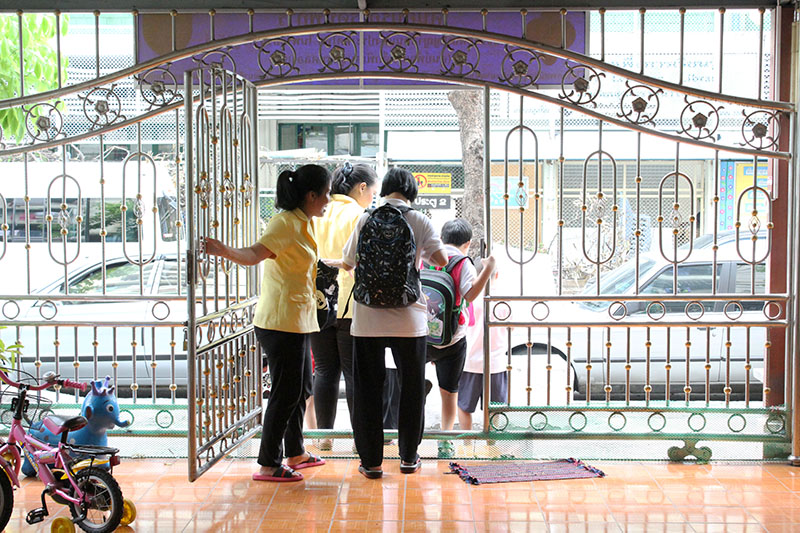
Of their 39 students, teachers worry the most about Tun.
The 6-year-old girl lives in a flat in Bangkok’s Khlong Toei tenements with her grandmother. Dad is out of the picture. Mom lives with her boyfriend.
Tun is quiet and autistic. Grandma rarely interacts with her except to shut her in a room to prevent her wandering. She also cuts her hair short in a haphazard bid to prevent sexual abuse, the teachers said.
Tun is one of 39 students at the Khlong Toei Community Center Pre-School for the Mentally Retarded, which is run by five teachers. The center is one of 10 branches of the Foundation for the Welfare of the Mentally Retarded of Thailand Under the Patronage of Her Majesty the Queen.
The school is one of few places providing services to youth with developmental disabilities; nine in 10 children with autism receive no treatment or accommodation, according to the Ministry of Health.
Photo: Taylor McAvoy
While the children have a refuge from the difficult conditions in the community, they risk being subjected to a controversial but widespread practice some advocates say unnecessarily deprives them of a fundamental human right.
Soon, if her guardian agrees, Tun will be sterilized.
Sterilization of children with developmental disabilities is a common policy endorsed by both doctors and state health officials. But those advocating for the rights of people with disabilities say it robs them of agency while other, more humane, options are ignored.
Nopphasorn Prasitphichid, the 59-year-old chairwoman of the center, says it is for their own good.
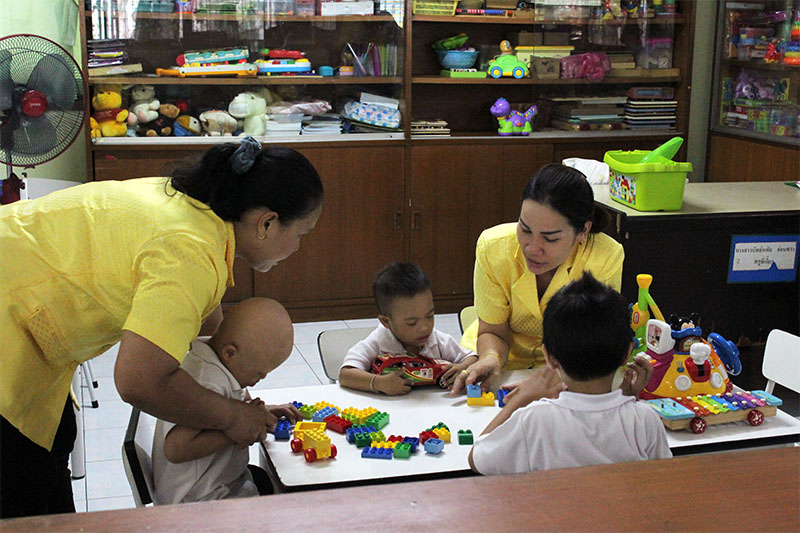
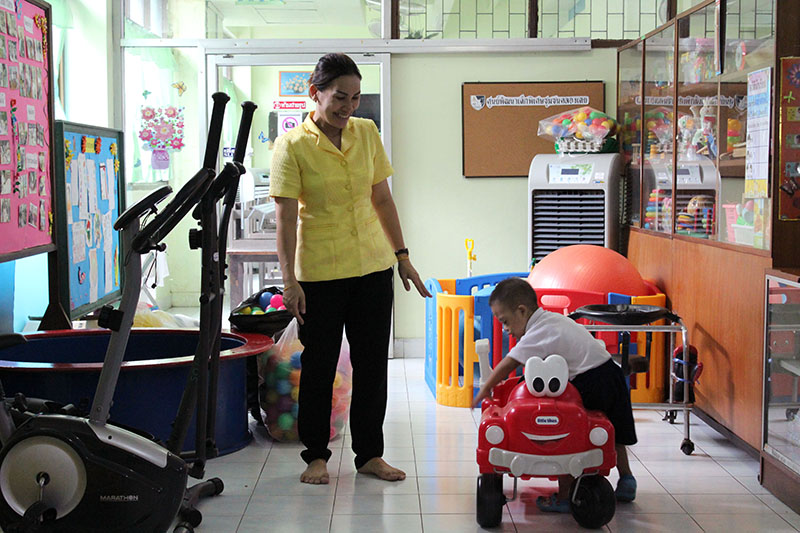
She calls herself “mom” to all the children, most of whom live with varying degrees of autism or Down syndrome. At the school, she and the other women take up a task few in society are willing to do: Educate special-needs children in one of capital’s most squalid communities.
The teachers say that while some parents are good-faith partners, others, such as Tun’s mother, do not completely take up the parental task of providing for a child with special needs.
“The mom, simply saying, is not cooperating with us. We took the children to make merit at the temple today,” Nopphasorn said, shaking her head with an audible ‘tsk.’ “The mother said she cannot bear the responsibility of the child, but neither can the grandmother.”
Sterilization as the ‘First Option’
Tun and her grandmother live in one of the flats in Khlong Toei, a community that sprang up around the port at its active peak many decades ago. Today it is shunned by many Thais as a place of abject poverty, low employment and high drug use.
Tun’s grandmother worries the young girl could become a victim of sexual violence. So she cuts her hair to make her look like a boy.
“Even with her hair cut like that, she’s still got a feminine nature,” the director said. “She looks older than she is, and she’s got a pretty face and good skin. This is most worrying.”
The school brings students who reach puberty, especially girls, to get sterilized, if their parents agree. Nopphasorn says sterilization is for their benefit.
“We’re so afraid she will get pregnant with someone who lives near her,” Nopphasorn said.
In Nopphasorn’s worldview, the community’s drug users are all potential predators, despite the fact most sexual violence occurs within the home.
“Drug-addicted people don’t care if the person they’re raping is mentally able or not. They’ll just do it,” she said.
But it’s unclear whether such a problem really exists.
Col. Sombat Kaenwijit said there are usually a couple cases reported each year, usually involving acquaintances or neighbors, with the chance of drug use being involved at “50-50.”
During his three-year assignment at the nearby Tha Rua Police Station, he’s never known of a person with a disability, mental or physical, being assaulted. Still, he said they may go unreported.
“Sometimes the families settles things themselves,” Sombat said.
Activist Nalutporn Krairiksh, who edits an online journal for and by Thais with disabilities, says the logic that sterilization will prevent sexual abuse doesn’t make a whit of sense.
“It doesn’t make sense to say it prevents rape. Now, they can be raped without any risk of pregnancy. This can cause more rapes, both from outside and within the family.”
The World Health Organization considers it a violation, issuing a joint statement with other agencies in 2014 saying that women with disabilities “are often treated as if they have no control, or should have no control, over their sexual and reproductive choices.”
“Obviously this is not a method to avoid or prevent abuse. Sterilization is a violation of the right of personal integrity,” María Soledad Cisternas Reyes, UN special envoy on disability and accessibility, said in an interview. “The Committee on the Rights of Persons with Disabilities in United Nations has been clear in relation to this matter.”
Forced sterilizations as policy were first practiced a century ago in the United States under the pseudoscience of eugenics. Those laws eventually fell out of favor, especially after Adolf Hitler cited them to create genetic courts for forced sterilization of nearly a half million people.
Though a number of nations still forcibly sterilize citizens with developmental disabilities, it is more common to place them on birth control medication or other reversible methods.
In Thailand, it remains the go-to method, despite being illegal except in cases involving children with disabilities whose guardians give consent. No one keeps statistics on how many are performed.
Nalutporn said it’s the “first option” encouraged by physicians and social services workers for dealing with pregnancy scares or menstrual hygiene, despite human rights infringements.
“Doctors often tell parents one-sided information about the benefits of sterilization. Sterilized girls won’t have periods that the parents have to clean up and no accompanying mood swings which are often violent in temperament,” Nalutporn said.
Nattavee Wattanasri, a lawyer who sits on the board of a Bangkok association for parents of autistic children, said that girls should be sterilized but not boys because, she believes, it prevents pregnancy in the former but increases the sex drives of the latter.
Photo: Taylor McAvoy
Although sterilizing girls does not prevent sexual abuse, preventing unwanted pregnancy is enough reason to do it, according to Nattavee.
“How much can you protect against sexual abuse of the disabled? It’s hard even for normal people,” she said. “If they’re raped, then they don’t need to get an abortion. But the prosecution of their attacker must happen.”
Chareeporn Yodfa, president of the Parents of Autistic Individuals Group in Phayao, said that although one-fourth of autistic people are female, they are disproportionately sterilized compared to boys.
“I don’t agree with sterilizing them, but I know parents do it out of care and worry,” said Chareeporn, who has a child with autism. “Autistic people can be easier to trick due to their innocence.”
Nalutporn said it can be a convenient cop out.
“It seems like the easiest way since it’s done once and taken care of forever, and expensive training doesn’t need to be used. But we have to see if the easiest option is the best one for the child,” disability activist Nalutporn said. “It’s like deciding for them what their future will be like, and they won’t have the right to choose later.”
Nalutporn said she worked with a family of three in Nakhon Pathom with a mentally disabled girl. State social security convinced the parents to bring her in to get sterilized, so she did.
“But four to five years later, she started to improve. Her mom said she regretted sterilizing her, because now they don’t know for sure what her future will be like,” Nalutporn said.
Sterilization where the disabled is uninformed of the entire nature of the operation usually happens in rural provinces, and are usually accompanied by other surgeries.
“For example, when delivering a raped baby from a mentally disabled woman, a physician would say, ‘Why don’t we include a sterilization too?’” Nalutporn said. “This kind of leading question from doctors is only asked to abled people if they’ve already had very many kids, or are elderly. Physicians should not have the ability to decide, but their duty is to give rounded information.”
Not all children must be sterilized if a qualified doctor recommends otherwise, said Nattavee of the parents’ network.
“Doctors know how much a mentally disabled child can develop and then they decide based on that. It’s not like everyone is forced to do it. I know one family that didn’t sterilize their disabled daughter, because she developed well. That way, they won’t have regrets.”
Nalutporn, the rights advocate, said she can understand how difficult situations can result in sterilization seeming like the best and only option.
“I really understand why they do it. There are real limitations, like money and environmental factors. Sometimes parents sterilize their children, even if they don’t want to, but because they have no other choice,” she said.
Working parents are often afraid their child will be assaulted and impregnated if left at home, or they don’t want to burden a caretaker with maintaining their personal hygiene.
Photo: Taylor McAvoy
“I never tell them it’s completely wrong if they decide to do this. It’s the surrounding factors that make them do it,” she said. “I understand why the school does it. There are problems, but no real mechanism to provide easier options than sterilization.”
Chareeporn said parents can be so lost at caring for a special-needs child they turn desperate, such as a mother who last year attempted suicide after killing her daughter because she couldn’t handle the burden.
“They feel like there’s no way out,” Chareeporn said.
That sentiment is understandable when the hardships keep piling up.
Tun’s grandmother, the one who wants her sterilized, recently stopped paying her bus fees – the school sponsors her tuition – of 1,400 baht a month ever since her mother came and took their money away.
The Khlong Toei Community Center Pre-School for the Mentally Retarded is willing and able to accept additional students from the Khlong Toei, Silom, Sathorn and Rama III areas. Contact them at Khlong Toei Flat 1 or at 02-2493168 if you know of a disabled child who is not receiving proper care, if you would like to donate to the school or sponsor a child.
A PLACE OF THEIR OWN
Between Poverty and Disability, Hard Lives Made Harder
For developmentally disabled youth in one of Bangkok’s poorest communities, poverty compounds neglect. One school offers a place for them and promotes care over shame.
For Girls, Sterilization Cast as Protection
Forced sterilization is embraced as an unfortunate necessity by doctors, parents and caregivers. But it singles out girls, and advocates say other options are ignored.
READ ARTICLE
By Asaree Thaitrakulpanich
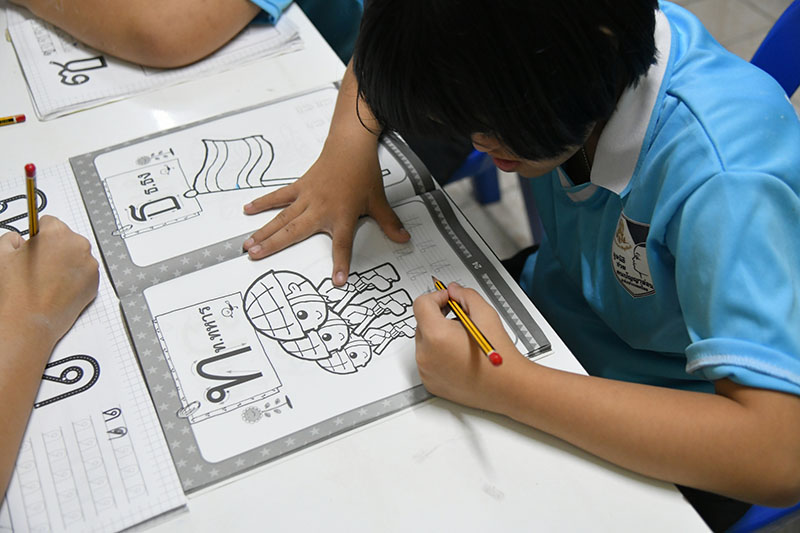
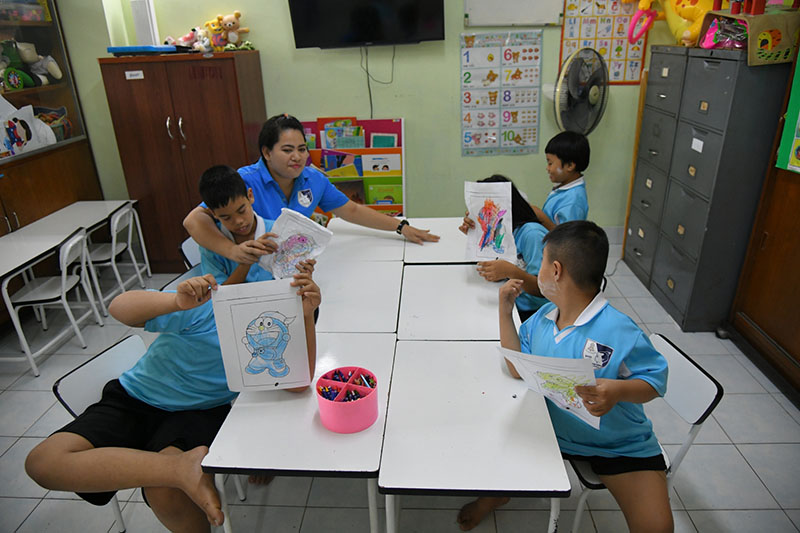
It’s 3pm and the older students in one classroom, those 12 to 22, are coloring and writing their names.
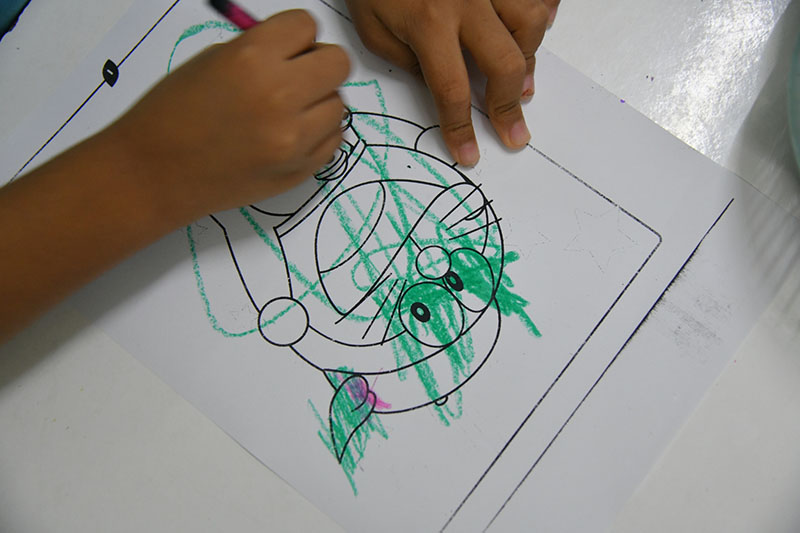
Babie, 14 with large brown eyes, is of mixed ethnicity and cannot speak. Boss, Fang, Most and 12-year-old Gunner grab crayons from a basket to color in alphabet workbooks. At another table, Mymint, Jane, and Bank require help holding their crayons and pencils.
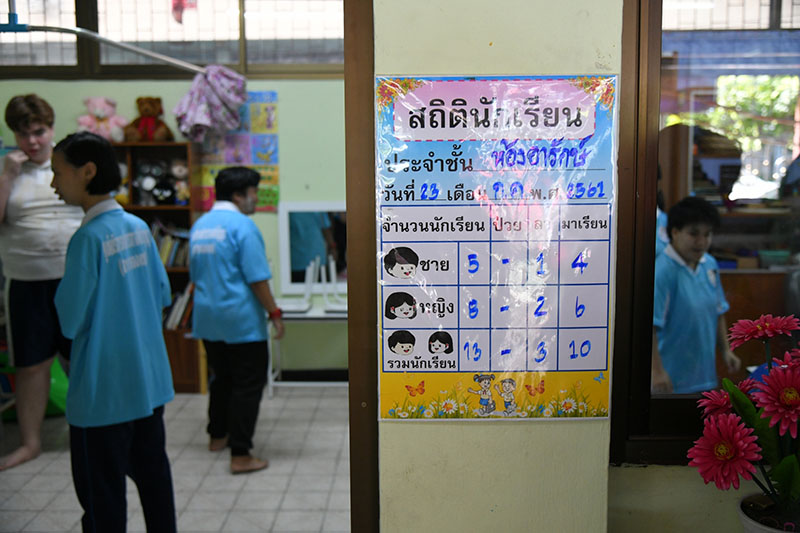
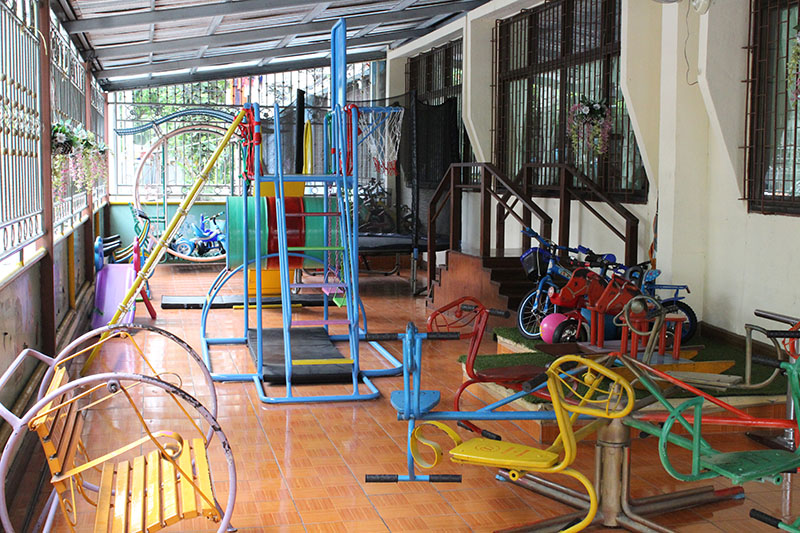
It’s a typical day at the Khlong Toei Community Center Pre-School for the Mentally Retarded, a place unaware its English name is behind the times. But that’s not a priority for the approximately 40 students with autism or Down syndrome able to leave behind difficult lives in one of the capital’s poorest communities to attend classes suited to their ability.
The school is one of the 10 branches of the Foundation for the Welfare of the Mentally Retarded of Thailand Under the Patronage of Her Majesty the Queen.
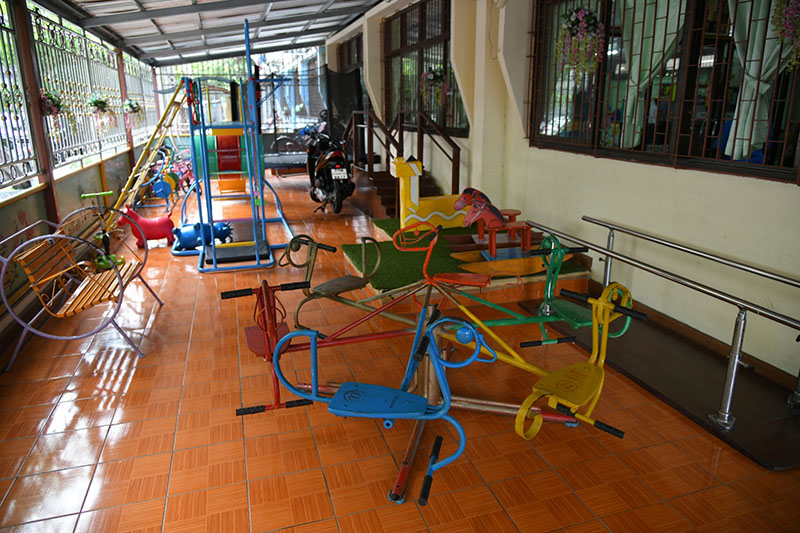
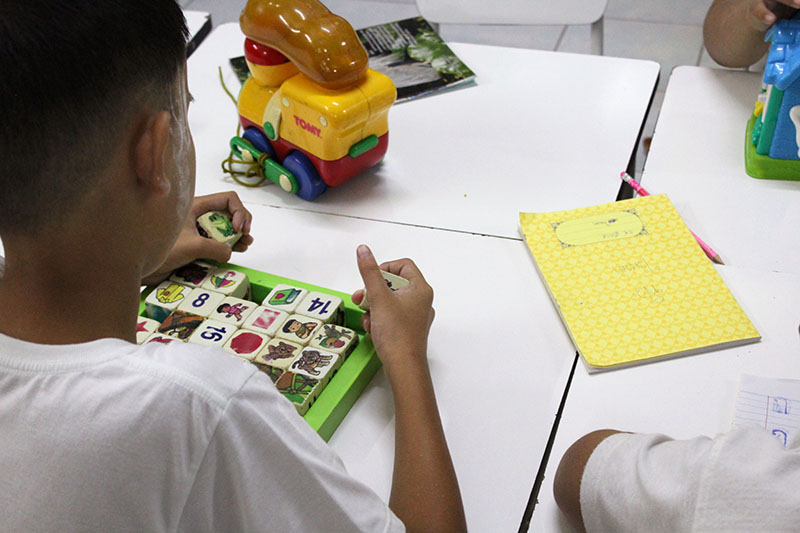
What appears rudimentary can help these students, who all live with varying degrees of disability, develop muscles and coordination with activities those in wheelchairs can join as well.
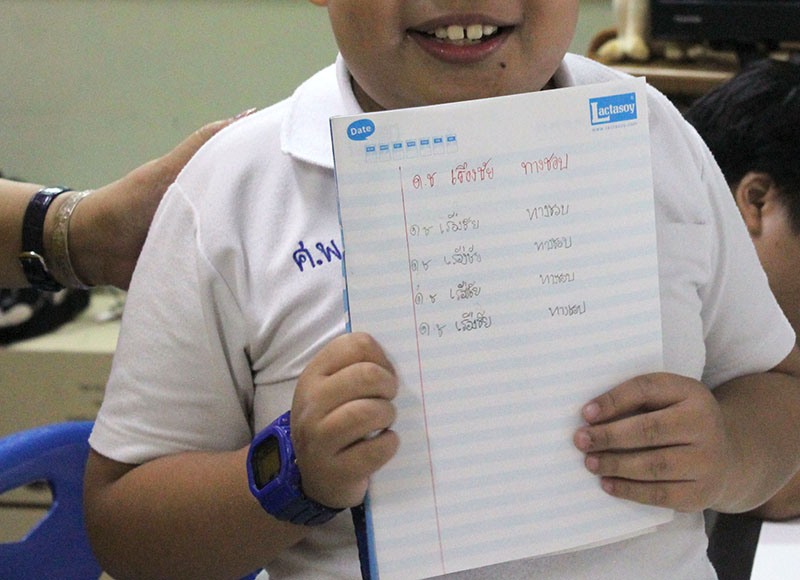
Most talkative is 10-year-old Bew, who on a recent visit was busy writing his name.
“My favorite subject is name writing,” he said, proudly holding up his notebook. “My name is Reungchai Thangchob krub!”
Occasionally, some children find the activity too demanding and cling to a teacher or each other, so Rojana “Kru Pae” Charoensukmongkul, 39 and one of the five running the school, maneuvers them out of the group to relax.
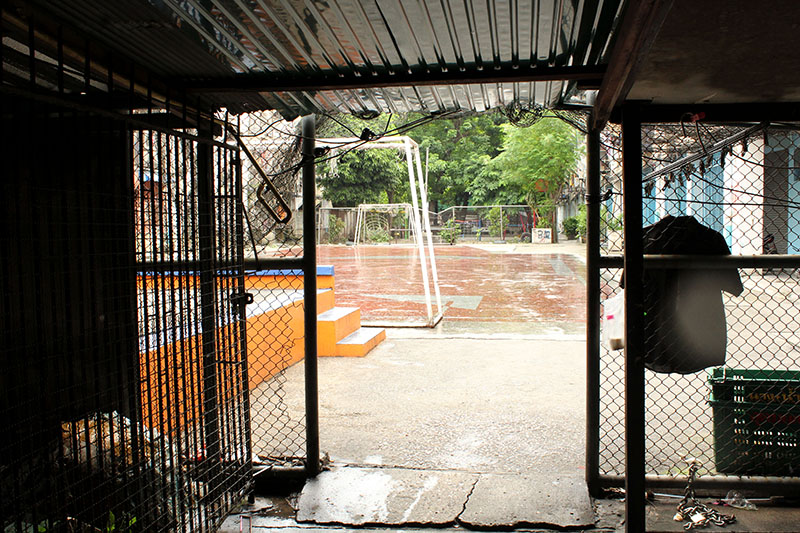
Though the students do not sleep there, it is for many the only place they have to go in the indigent warren of formal and informal housing.
Photo: Taylor McAvoy
“This is their second home, or for some, their only home, really. We have no days off,” Nopphasorn Prasitphichit, chairman of the school said.
The 39 students currently there range from 2 to 30. There’s a schedule of daily activities such as physical therapy for both fine and gross motor skills. The school helps everyone register for government disability cards, which entitle them to public transportation discounts and access to public healthcare. It’s also easier for cardholders to access public education for special needs people, including vocational training, and allows them to take out loans for tuitions.
On an average day, students arrive at 6:30am to practice meditation and hear lessons about loving the nation, religion and monarchy. Then there’s recess on the playground until flag time at 8am.
Photo: Taylor McAvoy
“They can sing some or not at all. We just want to turn on the song, so they can know that this is what our national anthem sounds like,” Nopphasorn said.
The children are then divided into age groups to work on their fine and gross motor skills, practicing control of their limbs and stretching. Teachers give special attention to two bedridden girls with HIV, helping them wiggle their hands.
Then there are activities designed to encourage expression and recognition of emotions, as many kids come in with uncontrollable tantrums. The older children, higher-functioning children help by feeding younger kids or teaching them to perform tasks like queue in a line.
“What we’re trying to do is bring the kids into the outside world so they are accepted, rather than being kept in a narrow world inside their house,” Nopphasorn said. “A lot of parents do not know what to do when the find out their child is autistic or has Down syndrome. Some parents won’t tell anyone about their child or their conditions, even refusing to accept it themselves.”
Though the children come from some of the lowest socio-economic rungs in society and the care basic, it is still a rare benefit.
About six in every 1,000 Thais have autism, making for estimated 300,000 children on the spectrum, according to a 2017 report from the Ministry of Health. Of those, the vast majority go untreated.
Only one in 10 receive any mental health care because their parents don’t realize anything is out of the ordinary, since symptoms develop only after a year or two. Parents only concerned with physical development often miss cues such as children who don’t make eye contact.
“Parents misunderstand that development will happen naturally eventually. They will assume a child with delayed speech is just a late talker, and don’t take them to the doctor or health officials,” Boonreung Trireungworawat, secretary of the Ministry of Health wrote in the report, adding that some parents turn to folk remedies. “Parents might try to ward it off by hitting their child’s mouth with a green frog, which has no good effect and bars the kids from getting help.”
Board member of the Parents of Autistic Individuals Group in Bangkok Nattavee Wattanasri, 53, herself has an autistic son, Pon, who is 17 but developmentally about 13.
“When Pon didn’t start talking, the doctor asked me, ‘Do you know what autism is?’” Nattavee said. “I argued with the doctor a lot. I thought he was just a slow talker. Then during the IQ test, I saw that my son wouldn’t respond when called, and I knew something was up.”
Photo: Taylor McAvoy
Chareeporn Yodfa, president head of the same group’s Phayao branch says it’s worse in the provinces than in Bangkok, as special help is harder to find.
“In outlying provinces it’s very hard to get help or special education. I live in Phayao and have to go to Chiang Mai for my autistic kid,” she said. “In Bangkok, at least there are more opportunities with vocational schools and those CSR programs.”
Although the teachers said most parents are attentive and attend to their children’s special needs, others are neglectful. That’s not to say that all guardians pay the same kind of attention.
“Some guardians will just raise up their child according to their means. If they work outside a lot, this could mean shutting them inside the house all day and not bringing them out into society,” Nattavee, board member of the parents’ network said.
The teachers swap memorable parent-teacher conflicts.
“Once, instead of dropping their child off here, a parent placed their deaf-mute autistic student on a motorcycle taxi,” Kru Pae said. “The kid couldn’t communicate, so the motorcycle went to the wrong school. We were lucky that the other school recognized our school’s uniform and sent’em here.”
Photo: Taylor McAvoy
Making Progress
Between 4pm and 5pm, most students leave the school to be picked up by parents or a school van.
The proudest moments for the teachers happen when one of two things happen: A student starts earning money and becomes at least partly self-sustaining, or they develop well enough to rejoin a regular school.
Activist Nalutporn Krairiksh, who runs an online journal advocating disability rights, says it’s possible for Thais with autism to live mostly regular lives with adequate special aid and developmental training. Still, she hasn’t heard of any Thais with Down syndrome living independently.
Noot, 30, looks all of 13. She’s been there the longest and is the oldest.
Diagnosed with autism, she earns 9,000 baht a month doing basic cleaning work in a program sponsored by Thai President Foods.
One student holds up toothpicks she decorated with beads.
“There’s a few autistic people living independently. They can learn very well but can’t adapt to social situations. For example, they might continue to greet their close friends with a formal sawasdee krub and wai, even after becoming close,” Nalutporn said.
Nopphasorn also created a foundation for students with strong motor skills to earn money by weaving necklaces. She’s decked out in earrings, rings and ropes of beaded necklaces made by Eve, one of the students.
“I love to accessorize and dress up. So I thought about what I would like the kids to do to earn some money,” she said, touching the pile of necklaces around her neck. “Nong Eve is particularly good at this; she can bead four-strand necklaces very precisely.”
Photo: Taylor McAvoy
Nopphasorn said she has asked the royal foundation for 100,000 baht to launch a project for the kids with the motor skills and coordination to make complicated, intricate jewelry to earn money.
The necklaces sell for a 1,000 baht and up at the school and government events such as the Red Cross Fair, as well as at the school. Nopphasorn boasts that some of the products have been presented to Princess Sirindhorn.
“It’s good, because through this they can add value to their life,” she said.
But for the younger students, being able to join a regular school through impressive development warms their guardians’ hearts.
Pon is currently in vocational school. His mom said he can’t speak very much, but writes, draws and does crafts well.
“Some kids really develop well enough to go to a regular school,” Kru Pae said. “If we can, we send them on their way.”
The Khlong Toei Community Center Pre-School for the Mentally Retarded is willing and able to accept additional students from the Khlong Toei, Silom, Sathorn and Rama III areas. Contact them at Khlong Toei Flat 1 or at 02-2493168 if you know of a disabled child who is not receiving proper care, if you would like to donate to the school or sponsor a child.
Philippines national football team's new head coach Sven-Goran Eriksson smiles Monday during a press conference in metropolitan Manila, Philippines. Photo: Aaron Favila / Associated Press
MANILA — Sven-Goran Eriksson is at the helm of another national team.
The 70-year-old Swede was introduced Monday as the coach of the Philippines after a famous stint with England more than a decade ago.
Eriksson has also coached Mexico and Ivory Coast, and numerous club teams including Roma, Lazio, Benfica and Manchester City.
Eriksson says “I suppose one of your questions will be why I am here? It’s not easy to answer that question.”
But Ericksson says he wants to “do something a little different.”
The Philippines has never reached the World Cup and lags far behind Japan and South Korea, the powers in the region.
A Lion Air Boeing 737 Max 8 lands in January in Papua province, Indonesia. Image: Raja Video Id / YouTube
Indonesian officials are providing the strongest hints yet that a faulty airspeed indicator played a role in the deadly crash of a Lion Air jet into the Java Sea.
Investigators said Monday that one of the so-called black boxes showed that the airspeed indicator on the Boeing jet malfunctioned on its last four flights, including the Oct. 29 crash that killed all 189 people on board.
Airspeed indicators have been around for decades to tell pilots how fast they are flying. They are paired with separate indicators measuring the degree to which the nose is pointed up, down or level.
Modern jetliners have redundant measurements to help pilots spot and disregard a single reading that looks unlikely and possibly erroneous.
Speed-measuring systems consist of tubes and sensors that measure air pressure generated by the plane’s movement and compare it with surrounding air pressure. They fail occasionally, especially in bad weather at high altitude, when the tubes located under the plane’s nose can become jammed with ice, preventing air from reaching the sensors. The Oct. 29 Lion Air flight took off in good weather.
Frozen pitot tubes were blamed for the 2009 crash of Air France Flight 447, which killed all 228 people on board. The year before, the U.S. Air Force said moisture in sensors caused the 2008 crash of a B-2 stealth bomber on Guam; both pilots ejected safely. In 2015, a wasp nest plugged the sensors on an Allegiant Air jet leaving St. Petersburg, Florida, forcing pilots to cut the flight short and land in Orlando.
Pilots train in simulators to learn how to notice potentially faulty readings and work around them. They learn the normal power settings and attitude, or nose-up and nose-down settings, for each of the various phases of a flight. A problem with the airspeed system should not result in a crash under most circumstances, according to safety experts.
“If you were driving down the interstate and the speedometer failed, would you expect to crash the car?” said John Cox, a former airline pilot and now a safety consultant. He said a faulty airspeed system might have contributed to the crash, but that based on what we know so far, it shouldn’t be considered the cause of the crash.
Safety experts said investigators will look at why Lion Air didn’t ground the plane if it experienced recurring problems with the sensors and subject it to more rigorous inspection and testing until the problem was fixed.
Alan Diehl, a pilot and safety consultant, said the report that the same problem happened four times and was never fixed suggests that the problem may have been intermittent, making it harder to pin down.
“Intermittent failures are very difficult for maintenance personnel to trouble-shoot because a lot of times they just say, ‘Cannot duplicate,’ and they write it up that way,” Diehl said.
The pilots’ actions will also be studied. Data transmitted from the plane and captured by flightradar24.com indicates that the plane continued flying at high speed away from the airport to which they intended to return, which Cox said seemed unusual.
The data transmissions – which will have to be confirmed through comparison with information from the plane’s black boxes – also show that a moderate reduction in altitude turned into a dramatic rate of descent, a loss of control.
Cox said that once investigators have all the data, they will work backward to determine if there was a problem with one of the plane’s systems or if pilot decisions put the plane in peril.
“We know that three other crews faced a similar challenge in this airplane and they landed successfully,” he said, referring to the findings of airspeed indicator malfunctions on four flights including the fatal one.
In a modern jet like the Boeing Max 8 that crashed, readings from airspeed sensors are processed by a computerized “flight management system” and sent to displays in the cockpit. They also have analog backup systems.
Despite all their training in flying without airspeed indicators, however, pilots can become unnerved when confronted by failure of a system that they count on. Some experts believe the hazard has increased with today’s highly automated cockpits.
In the Air France accident, all three primary and two backup airspeed-reading systems failed. “The crew got saturated trying to figure out why their computers weren’t working, and they quit flying the airplane,” said William Waldock, who teaches accident investigation at Embry-Riddle Aeronautical University.
Divers have recovered one of Lion Air Flight 610’s two black boxes, the flight data recorder. They have not yet found the other one, which captures conversations in the cockpit and ambient sounds such as a change in engine noise.
“They need to find that cockpit voice recorder,” Waldock said, “because that is going to tell us what the crew did in response to whatever situation they had.”
Myanmar opposition leader Aung San Suu Kyi speaks in 2015 during an election campaign rally of her National League for Democracy party for upcoming general election in Yangon, Myanmar. Photo: Khin Maung Win / Associated Press
YANGON — Myanmar’s ruling party led by Aung San Suu Kyi has won at least six seats in by-elections to fill 13 of the 1,171 seats in national, regional and state parliaments.
Preliminary results for Saturday’s polls, available Monday for all but one race, showed the National League for Democracy generally retaining support in the country’s heartland, but yielding seats to parties representing ethnic minorities in the areas where they live, mostly in border regions.
The NLD won a landslide victory in the 2015 general election, when there was wide-ranging popular support to end decades of military rule. But minority groups have been disappointed that the government of NLD leader Suu Kyi has failed to meet their demands for greater autonomy and a halt to aggressive army activities in their territories.
A Lion Air passenger jet takes off from Juanda International Airport in Surabaya, Indonesia, in a 2012 file photo. Photo: Trisnadi
JAKARTA — The “black box” data recorder from a crashed Lion Air jet shows its last four flights all had an airspeed indicator problem, investigators said Monday, after distraught relatives of victims confronted the airline’s co-founder at a meeting organized by officials.
National Transportation Safety Committee chairman Soerjanto Tjahjono said the problem was similar on each of the four flights, including the fatal flight on Oct. 29 in which the plane plunged into the Java Sea minutes after takeoff from Jakarta, killing all 189 people on board.
Problems with the plane’s previous flight, from Denpasar on Bali to Jakarta, were widely reported and “when we opened the black box, yes indeed the technical problem was the airspeed or the speed of the plane,” Tjahjono told a news conference.
“Data from the black box showed that two flights before Denpasar-Jakarta also experienced the same problem,” he said.
“Rumors circulating on social media are so great and here we want to clarify that in the black box there were four flights that experienced problems with the airspeed indicator.”
At the meeting with family members, Tjahjono had said that information downloaded from the jet’s flight data recorder was consistent with reports that the plane’s speed and altitude were erratic after takeoff on its final flight. Searchers are still trying to locate the cockpit voice recorder.
Lion has said a technical problem with the jet was fixed after problems with the Bali to Jakarta flight.
Rusdi Kirana, Lion Air’s co-founder, was not invited to speak by Transport Minister Budi Karya Sumadi, who moderated the meeting between relatives and the officials who are overseeing the search effort and accident investigation.
But he stood and bowed his head after angry and distraught family members demanded that Kirana, who with his brother Kusnan Kirana founded Lion Air in 1999, identify himself.
“Lion Air has failed,” said a man who identified himself as the father of passenger Shandy Johan Ramadhan, a prosecutor in a district on the island where the flight was headed.
“I want Mr. Rusdi Kirana and his team to pay attention,” he said. “Since the time of the crisis, I was never contacted by Lion Air. We lost our child, but there was no empathy that Lion Air showed to us.”
After the meeting, Kirana left in a hurry, avoiding questions from reporters.
Many families face an agonizing wait for missing relatives to be identified. Police medical experts have received nearly 140 body bags of human remains and have identified 14 victims.
Relatives questioned why the 2-month-old Boeing 737 MAX 8 plane had been cleared to fly after suffering problems on its Bali to Jakarta flight on Oct. 28 that included a rapid descent after takeoff that terrified passengers.
“Lion Air said the problem was fixed, is it true the problem was cleared?” asked Bambang Sukandar, whose son was on the flight. “If not, technicians in charge must be responsible,” he said. “The law is absolute, because they have stated that the plane was cleared to take off again. These bad technicians must be processed by law to prevent plane accidents from continuing in Indonesia.”
Tjahjono said the large amount of small debris and the relatively small area the debris was found in showed the plane hit the water at a very high speed.
“The plane was intact when it plunged to the sea, it did not explode in the air, and the aircraft engine was running when it touched the water at high RPM – it’s marked by the loss of all blades of the turbine,” he said.
The Lion Air crash is the worst airline disaster in Indonesia since 1997, when 234 people died on a Garuda flight near Medan. In December 2014, an AirAsia flight from Surabaya to Singapore plunged into the sea, killing all 162 on board.
Lion Air is one of Indonesia’s youngest airlines but has grown rapidly, flying to dozens of domestic and international destinations. It has been expanding aggressively in Southeast Asia, a fast-growing region of more than 600 million people.









































 Others were reluctant to say if they would support the party.